
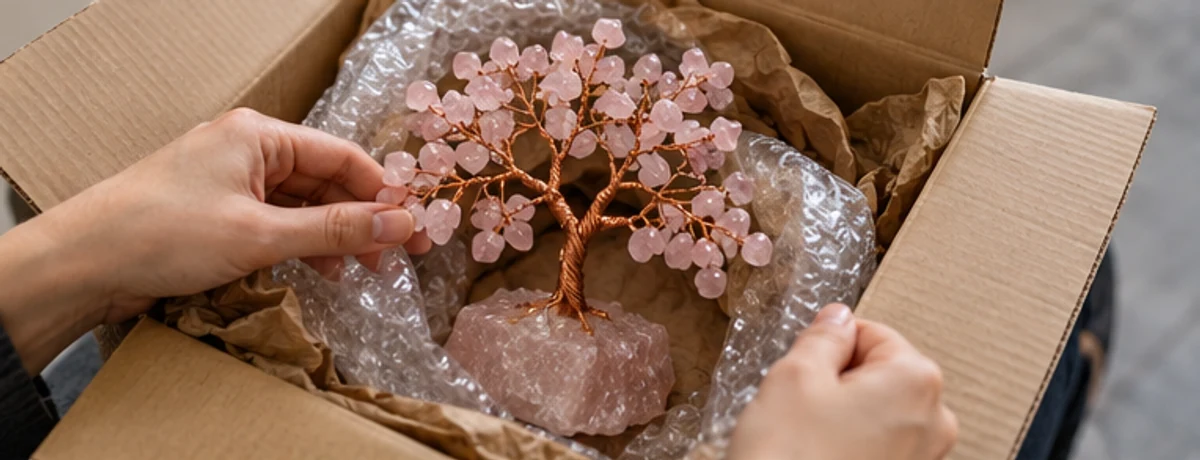
A gemstone tree often arrives with its canopy carefully compressed for transport. The first job is not to pull it into a perfect shape: it is to learn how this particular ornament was made. Small gemstone chips, hand-twisted branches, a central trunk, adhesive or mechanical fixings, and a weighted base form one assembled object. A little thoughtful handling can make the design look beautiful; forceful adjustment can loosen a chip, fracture a wire or destabilise the base. This guide takes you through unpacking, inspection, shaping only where permitted, Vastu display, cleaning and safe storage.
The correct method depends on the product. Some gemstone trees have genuinely adjustable wire branches; others are deliberately fixed, coated, wired so tightly that movement is not intended, or made with brittle decorative components. No claim that every gemstone tree can be reshaped should appear in a product description. Start with the seller's actual assembly instructions and treat the tree as a mixed-material ornament rather than as a plant that can be pruned and re-grown.
1. Understand the parts before touching the branches
A gemstone tree is frequently called a crystal tree, gemstone chip tree, bonsai gemstone tree, Vastu gemstone tree or crystal money tree. These retail names describe a construction style, not one universal geological material or ancient design. The stone chips might be quartz, amethyst, rose quartz, green aventurine, carnelian, tiger eye, obsidian, jasper, lapis lazuli or a mixed-colour assortment. They can be natural, treated, reconstructed or imitation materials. A customer should be told what is actually supplied.
The crown usually consists of small stones captured by individual wire tips or loops. Several tips are twisted into branchlets, branchlets into larger limbs, and the larger limbs into a trunk. The trunk may be mechanically fixed into the base, embedded into adhesive, joined to a concealed metal support or ornamented with an exterior wrapping. A resin or wood base can look like rock from above; a rock base may have a manufactured fixing. The attachment method matters more for safe adjustment than the decorative name of the stone.
| Part | What to inspect | Why it matters |
|---|---|---|
| Gemstone chips | Sharp edges, drilled holes, cracking, loose particles and any treatment disclosure | Chips may abrade or detach if pulled |
| Terminal wire loops | Whether each stone is securely held without a sharp free end | The loop is a fastening, not a lifting handle |
| Fine branches | Wire gauge, coating, pre-existing bends and visible stress | Repeated motion can weaken the same bend |
| Main trunk | Twists, soldered joints, glue, wrap and alignment | The trunk bears the crown; twisting it moves every joint |
| Base | Level underside, weight, felt pads, cracks and connection to trunk | Stability depends on the whole structure |
| Paint, plating or adhesive | Flaking, seepage, gaps or unusual stickiness | Finishes may be more fragile than the stone itself |
A natural chip can be irregular without being damaged. A purposefully asymmetrical canopy may be a design feature. At the same time, a new crack, protruding sharp wire, unstable foot or separated fitting deserves attention. Appearance must be judged against the actual product, not against a digitally symmetrical product photograph.
2. Prepare an unboxing area that protects the tree
Before opening the parcel, set aside a level table away from the edge. Lay down a clean, soft, low-lint surface such as a folded cotton cloth over a firm tabletop. Keep water glasses, incense ash, salt bowls, pets, small children and loose jewellery out of reach. Have a tray or small container ready for any removable pads, labels or packing fragments so tiny components do not disappear into the floor.
If the parcel came through courier delivery, photograph the unopened exterior if it is visibly damaged. Record the shipping label or order reference separately; you need not publish personal contact details. Then open the carton along its taped seams with scissors held away from the ornament. Do not push a blade into the centre of the package. Loose chips and fine branches can sit directly beneath a top flap, and a nicked wire coating may show corrosion later.
Remove the upper padding gradually and locate the base before lifting the item. If the tree is anchored in a moulded cradle, free the supports around that base first. When a foam sleeve is caught on branch tips, cut or open the sleeve away from the branches; do not yank the crown through the foam. Support the trunk only as a secondary stabiliser, and never lift the entire weight by a single wire branch.
A practical ten-step first-opening sequence
- Photograph the outside carton if anything looks crushed or damp.
- Open the outer box on a steady table; locate all packing layers.
- Identify the firm base and the position of the trunk.
- Separate padding around the base before removing padding around the canopy.
- Lift with the base fully supported from below, not by the stone chips.
- Place the tree on a flat protective surface and let the branches settle.
- Compare the whole outline with the product photographs without forcing symmetry.
- Inspect the underside, branch junctions and chip attachments for damage.
- Only if the design is explicitly adjustable, make the smallest supported changes.
- Choose a stable display place, photograph the final arrangement and retain suitable packaging.
The number of layers in the parcel does not indicate whether the tree is premium or genuine. Good packaging has a practical purpose: immobilising the heavy base, avoiding pressure against the canopy, and preventing chips from rubbing each other during vibration. A heavily taped crown is not an invitation to stretch it out quickly.
3. Inspect the tree before you attempt to arrange it
Make one slow circuit around the object at eye level. See whether branches lean because of the intended sculptural composition, because transport compressed them or because a joint has moved. Look at the base from the side; it should stand without rocking on a truly level table. If there is a protective foot or felt layer, check whether it is seated rather than trapped in shipping film.
Use a good indirect light and take photographs of the front, back and one close-up of the junction that concerns you. A crack may look different under sidelight; a rough, naturally irregular chip may not be cracked at all. If the item includes polished or coated stones, avoid scratch, acid, flame, hot-pin or immersion tests. Such tests can damage both the ornament and any treatment, and they are not appropriate as an unboxing routine.
| Observation | Likely interpretation | Appropriate first action |
|---|---|---|
| Crown slightly compressed but wire looks sound | Transport posture, potentially adjustable design | Check product instructions before a small adjustment |
| One branch designed to sweep sideways | Intentional asymmetry is possible | Compare with the listing; do not force it upright |
| Small crystal chip rotates within its loop | Fastening may be loose | Stop pulling that chip; take a close-up photograph |
| Wire shows a bright break or sharp free end | Physical damage or failed joint | Do not handle bare-handed at the break; contact seller |
| Trunk wobbles where it meets the base | Base-to-trunk connection may be failing | Keep upright and stationary; do not use the trunk as a lever |
| Powder, sticky deposit or flaking coating | Could be material, finish or storage change | Isolate gently and seek material-specific advice |
| Base tilts on an uneven desk | Display-surface problem, not necessarily tree defect | Test on a level stable surface before any adjustment |
The inspection is especially useful for future discussions with the shop. A clear original-condition photograph helps distinguish transit damage from later handling and lets a professional advise on a specific joint rather than guessing from a description such as 'it looks bent'.
4. Why wire can bend yet still break
Many gemstone trees use copper-coloured wire, plated copper wire, aluminium wire or mixed-metal supports. Colour alone cannot tell the metal composition. Metals can undergo plastic deformation when bent beyond their elastic range. After a wire has been shaped repeatedly at one spot, it may become less accommodating to further manipulation because of work hardening and accumulated mechanical damage. The result depends on alloy, gauge, temper, existing twists and how tightly the branch was wound.
A fine-looking branch is not automatically more flexible. A thin wire may be easy to bend once, yet its narrow junction can be the weakest part when a heavy gemstone chip swings on the end. A thick trunk may be structurally rigid even if its outer decorative wrap is soft. Some branches contain wire inside a coating or are glued in a fixed curve. Repeated back-and-forth bending, straightening every twist or rotating a whole cluster can concentrate strain where strands meet.
Conservation guidance for composite and metal objects emphasises careful support and avoidance of physical forces that cause distortion and breakage. This does not supply a universal safe bending angle or number of adjustments. The only safe rule for a buyer is to follow the actual manufacturer's guidance; where it is absent, regard the structure as decorative and leave it undisturbed unless the seller confirms adjustability.
| Construction observed | Adjustability | Safer response |
|---|---|---|
| Exposed single-wire tips, clearly designated adjustable | May permit small deliberate changes | Support close to bend; move once, a little |
| Several wires tightly twisted into a branchlet | Movement may strain shared junctions | Avoid untwisting; alter the outer silhouette by positioning the base |
| Painted, plated or lacquered branch | Coating can crack if flexed | Avoid reshaping unless the maker provides instructions |
| Soldered, welded or glued branch junction | Connection is not a hinge | Do not bend at the joint |
| Heavy stones on long branch tips | Increased leverage during movement | Support the terminal group and trunk simultaneously |
| Resin-set or fixed architectural frame | Usually intended to remain fixed | Treat as non-adjustable |
| Unknown construction | No reliable basis to assume safety | Photograph and ask the seller first |
5. How to arrange branches when adjustment is genuinely allowed
The best result is a balanced appearance with minimal manipulation, not the maximum possible spread. Set the tree where you can see its silhouette from the front and the side. Decide on the broad design—upright, spreading, windswept or compact—before moving anything. Identify a few small groups that genuinely overlap or obscure attractive chips, and leave well-positioned branches alone.
With one hand, steady the nearby supporting branch rather than only holding the base far away. With the other hand, guide the intended section through a small, smooth movement. Avoid bending at the point where a chip hole, loop, solder bead, adhesive join or existing sharp kink is located. If you feel resistance, hear a crackle, see coating whitening, or notice a wire beginning to separate, stop immediately. Never test the branch by bending it backwards and forwards to see how strong it is.
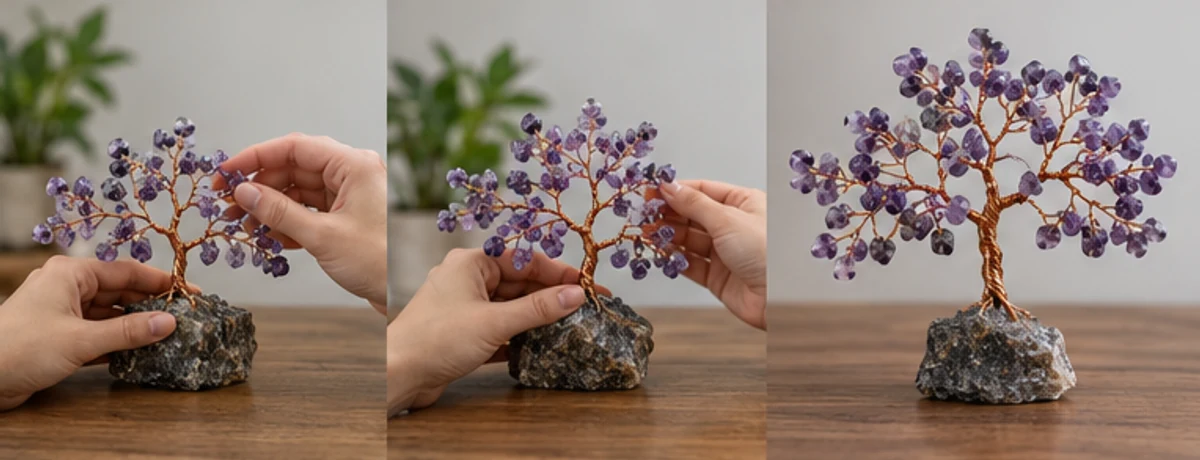
After each small change, release the branch gently and step back. Branches viewed from directly above may look dense while the same tree looks airy at seated eye level. You can change the look dramatically by rotating the entire base a quarter-turn without touching any wire. Consider the actual sightline of a guest, a person sitting for meditation or a customer passing a display shelf.
Example: A rose quartz tree arrives with three branchlets overlapping near the front. Rather than fan every wire outward, a buyer may, if the maker permits, separate just those branchlets a little while supporting the adjacent junction. Then the tree is rotated on its base to present the best side. The operation might take only moments, but the important achievement is avoiding unnecessary strain throughout the remaining canopy.
6. Shape the crown without confusing asymmetry with a defect
Gemstone chip trees often imitate the uneven branching patterns of living trees. A mature banyan, peepal or flowering tree does not have gemstones spaced at machine-perfect intervals. That natural imagery is part of the design appeal. A slightly open side allows light to pass through the stones and reveals the twisted-wire craftsmanship. If every branch points outward like an identical spoke, the result may lose the depth and interest that made the ornament attractive.
Consider three visual questions: Is the base visibly steady? Does the crown seem to belong to the trunk? Are the colours and chips visible from the main viewing direction? These are more helpful than counting whether the left and right branches match. Large colour clusters can be distributed so they do not all crowd the front. But changing every branch merely to rearrange colours is a poor trade-off when the material or wiring is delicate.
| Desired look | First low-risk choice | Avoid |
|---|---|---|
| Fuller crown | Rotate base; adjust viewpoint and nearby lighting | Pulling all outer branches sharply outward |
| More visible stone colours | Change background or viewing angle | Twisting each chip at its fastening |
| Balanced silhouette | Choose the better display side | Forcing a windswept design into symmetry |
| Compact desk shape | Choose a smaller tree or safer location | Compressing wires repeatedly for convenience |
| Open branch spacing | Only adjust approved flexible groups | Untwisting the main trunk or a fixed joint |
| Better stability | Place base centrally on a level shelf | Bending trunk to compensate for a rocking base |
7. How gemstone type changes the handling risk
Gemstone chips differ enormously in hardness, cleavage, toughness, surface treatment and response to light or moisture. A quartz chip can resist scratching better than a piece of fluorite, but hardness does not guarantee that a drilled hole or irregularly shaped edge cannot break. A dyed stone may have a coating or colour treatment at the hole. A rough metal loop can scratch a softer chip even during apparently gentle rearrangement.
In a mixed chakra tree, the label may refer to seven colours rather than to verified seven separate mineral species. Because mixed assemblies can contain fragile stones, adhesives, paint and coated wire simultaneously, gentle dry handling is generally the conservative starting point until the construction is known. An immersion method appropriate for one loose gemstone may be unsuitable for the entire tree.
| Stone or trade group | What may be visible | Specific handling consideration |
|---|---|---|
| Clear quartz, amethyst or rose quartz | Translucent or cloudy quartz chips | Chips can fracture at drilled or tightly wired points; some colours are light-sensitive |
| Green aventurine | Green, sometimes mildly sparkling quartz-rich chips | Check for dyes or rough holes; do not stress attachment loops |
| Red jasper and agate | Opaque or banded silica-rich pieces | Coloured batches may be treated; avoid abrasive contact between chips |
| Fluorite | Purple, green or mixed translucent chips | Relatively soft, with pronounced cleavage; do not force against wire |
| Lapis lazuli or sodalite | Blue chips with white or gold-coloured features | Surface finish and treatment may be sensitive; avoid aggressive cleaners |
| Obsidian | Glossy black or patterned volcanic glass | Can develop sharp chips at fractured edges |
| Hematite | Metallic grey, heavy-looking chips | Confirm material rather than assuming every metallic bead is natural hematite |
| Pyrite-bearing pieces | Brassy metallic texture | Keep dry and check condition; avoid wet ritual cleaning |
| Mixed 'seven chakra' colours | Several stone types or colour-matched substitutes | Care follows the most vulnerable component, not the set's marketing label |
The names above are examples, not an assertion that any particular OmmRudraksha tree contains them. The product's actual materials, origin, treatment and testing status should be checked individually. A jewellery laboratory report, when provided, must refer to the relevant specimen or sampled material; it should not be assumed to certify every chip of a multi-stone decoration.
8. Know when not to bend or attempt home repair
Stop adjusting if a chip is loose, the canopy appears detached from the trunk, the base feels unstable, the wire coating cracks, or the ornament does not match the construction described by the seller. Keep any detached chip in a labelled small pouch; avoid loose contact with other stones that may scratch it. Photograph the affected area and the overall object before doing anything else.
A general-purpose adhesive may yellow, stain porous stone, obscure a treatment, form a brittle joint or make professional repair more difficult. Epoxy, cyanoacrylate, hot glue and soldering have very different compatibility and safety requirements; none should be recommended automatically for an unidentified tree. Likewise, pliers can flatten soft wire or chip a stone if their jaws slip. Do not strip coating or polish an unknown joint merely to make it appear tidy.
| Problem | Immediate response | What to ask the seller or restorer |
|---|---|---|
| One chip loose | Stop manipulating the branch; preserve the chip | Can the original fastening be repaired without damage? |
| Exposed sharp wire | Avoid contact; keep out of reach | Is wire replacement appropriate for this construction? |
| Whole trunk leaning | Stabilise the base; do not lever the trunk | Is it transport damage, intended geometry or a failed base joint? |
| Decorative colour coming off | Suspend cleaning and handling | Was the surface plated, coated, painted or dyed? |
| White, green or powdery deposit | Keep dry and separate from nearby articles | Is the change from mineral, metal, adhesive or surface finish? |
| Broken stone chip | Save fragments safely; do not test by scratching | Is repair feasible, or should the chip be replaced? |
| Missing base pad | Check the packing and photograph underside | What original pad or mounting is specified? |
Small parts should be kept away from children and pets. A wire tip or fractured glass-like chip can be sharp even when the rest of the ornament appears harmless. For customer service, record the order number and photographs, but follow actual published return and warranty terms; avoid promising that all damage is eligible for a replacement.
9. Decide on the display position before further reshaping
A good display position reduces the need for constant touching. Use a shelf or table with a stable level surface, adequate room around the crown and no recurring contact from curtains, cabinet doors, fan vibration, cleaning cloths or charging cables. Avoid placing a heavy base on a narrow ledge simply to achieve a visually dramatic angle. Where children or visitors can brush past the ornament, a deeper shelf is preferable to a more exposed spot.
Indirect daylight can reveal the translucence of quartz and the banding of agate. Excessive direct sunlight, however, may fade certain coloured stones or affect coatings and adhesives over time. Bathrooms, damp planter trays, sinks and monsoon-exposed windowsills are poor default choices for a mixed-material tree. Dust is better managed through sensible placement and light cleaning than through repeated whole-object immersion.
| Location | Useful quality | Main risk to manage |
|---|---|---|
| Puja alcove | Calm background, meaningful ceremonial context | Water, oil, incense ash, candle heat or flower moisture |
| Home entrance console | Visible welcome or housewarming display | Crowding, bags, children brushing against branches |
| Study or work desk | Personal focus and a clear viewing angle | Spilled drinks, moving cables, frequent rearrangement |
| Living-room shelf | Colour and form visible to family and guests | High edges, drafts, cleaning collisions |
| Jewellery showroom | Close-range inspection of actual craftsmanship | Many hands touching, bright spotlights and busy counters |
| Professional Vastu kit | Demonstration of material, shape and directions | Repeated transport, mixed stones in one compartment |
10. Gemstone trees in Vastu, Kalpavriksha symbolism and Sankalpa
The image of a flourishing tree has deep significance in Indian cultural imagination. Kalpavriksha, the wish-fulfilling tree, is associated with abundance, blessings and the fulfilment of aspirations. Real sacred trees such as the peepal and banyan have distinct religious and regional associations. A modern hand-wired gemstone tree is not identical to a sacred living tree or a prescribed classical architectural element, but its roots, trunk, branches and coloured stones can be an evocative symbol of development, family continuity and prosperity.
Within contemporary Vastu practice, some householders associate a green gemstone tree with growth and harmonious relationships; a citrine or pyrite-themed design with abundance; a clear quartz or amethyst tree with a reflective puja or meditation setting; and a rose quartz tree with affection and family harmony. Those associations can be interpreted through Sankalpa, the conscious intention with which someone arranges a space, rather than as a fixed mechanical guarantee. Personal custom, the overall room, family practice and actual object matter.
Pancha Mahabhuta—Prithvi (earth), Ap or Jala (water), Agni (fire), Vayu (air) and Akasha (space)—offers a traditional interpretive framework. Stone contributes a material connection with Prithvi, branching form evokes growth and Vayu, warm colours may suggest Agni, and open spacing under the crown can be read as a reminder of Akasha. These are interpretive correspondences, not a geological classification of every gemstone and not a rule that every branch must face a particular compass bearing.
Ashta Dik identifies eight directions in traditional space symbolism. Ishanya, the northeast, is often associated with spiritual or devotional use; the north is associated in popular Vastu practice with Kubera and prosperity; eastern light may be associated with Surya and fresh beginnings. Vastu traditions and practitioner lineages differ, so location should be chosen with the room's function and the family's customary interpretation in mind. Do not distort the wire crown to make it point at a compass direction: orient or relocate the entire stable tree instead.
A simple traditional first-placement practice
After inspecting and gently cleaning the dry ornament, choose a suitable shelf, make room for a safe base, and place it with an intention relevant to the space. Some families offer a silent prayer or brief Sankalpa for auspicious beginnings, learning, gratitude or family harmony. A dry flower or a note kept beside rather than tied to the fragile branches can express this meaning. If lighting a diya or incense, keep sufficient separation so heat, ash and oils do not reach the canopy. Do not pour milk, water, kumkum solution, turmeric paste or fragrant oil over an assembled gemstone tree without confirming every material and finish.
11. Choosing the tree's visible side in a Vastu arrangement
Orientation is not only a compass decision. First determine which side offers the clearest silhouette from the doorway or seated viewing point. Confirm that the crown does not project into a busy path. Then consider whether the chosen spot expresses the intended purpose: a family may prefer a softer pink tree in a shared living area, a green design near a study or a mixed-stone tree on a Vastu demonstration shelf. If a direction has special importance in the family's practice, choose a safe position there without sacrificing stability.
| Intention or context | Contemporary symbolic association | Practical positioning question |
|---|---|---|
| Housewarming and auspicious beginnings | Tree form as rooted growth and abundance | Is the entry console deep and stable enough? |
| Learning and focused study | Sphatik, blue or amethyst tree as personal reminder | Will it stay clear of lamps, cables and notebooks? |
| Relationships and family harmony | Rose quartz or mixed gentle-colour design | Can it be enjoyed without repeated handling? |
| Business aspirations | Citrine, green aventurine or pyrite-themed design | Is it protected from cash-counter crowding and spills? |
| Devotional or meditation setting | Clear quartz or amethyst associations | Is it away from diya heat and wet ritual offerings? |
| Vastu education | Multi-stone reference tree | Are its materials correctly labelled and easy to demonstrate? |
Symbolic gemstone colour is not the same as a Jyotish prescription based on an individual's horoscope. For birth-chart-based planetary gemstone recommendations, the actual Graha, Rashi, Lagna, Nakshatra, Dasha and individual practice may be relevant. A decorative chip tree should not be represented as equivalent to a specifically selected and verified astrological gemstone simply because the colours resemble Navagraha stones.
12. Three worked examples: home, shop and professional kit
Example A — Bengaluru apartment. A family receives a medium rose quartz gemstone tree as a housewarming gift. They first lift it by its substantial base, inspect the wires and notice that a few front branches overlap. The seller's instructions confirm limited flexibility, so one branchlet is moved a little while its near junction is supported. The family places the tree well back from the living-room shelf edge, away from the flower vase. They associate the tree with growth and harmony, but no one needs to repeatedly reshape it as part of that meaning.
Example B — Jewellery showroom. A showroom wants to display a green aventurine tree near its consultation counter. The owner resists the temptation to fan it out to the maximum width, because customers are likely to brush past the outer tips. Instead, the tree is placed within a low, stable showcase area; a small nearby card explains the stone name, whether it is treated, the handmade wire construction and care. Staff lift the base rather than the crown. Questions about the meaning of the tree are addressed separately from claims about the identity of the individual stones.
Example C — Professional Vastu reference kit. A consultant brings several gemstone trees and samples to workshops. The goal is to demonstrate differences between natural stone chips, treated material, wire finishes and symbolic arrangements. Each tree travels with its base immobilised and the canopy protected by a removable cover that does not pull on the branches. At the venue, the consultant rotates the bases to show the silhouettes, rather than bending them for every attendee. A labelled specimen card supports accurate explanation of Pancha Mahabhuta and directional traditions without suggesting that all stones have the same physical properties.
13. Cleaning an assembled tree without harming the wiring
A gemstone chip might tolerate a certain cleaning procedure in isolation; its assembled tree may not. Adhesives, wire plating, base paint, stone treatments and porous components can respond differently to water, detergent, oils, solvents and heat. For an unidentified construction, begin with light dry dusting using a soft clean brush. Move from the trunk outward with the brush lightly supported, so fibres do not hook terminal loops. Never hold the crown upside down and shake it vigorously to dislodge dust.
If sticky residue or tarnish is present, resist all-purpose metal polish, acids, salt rubbing, ultrasonic baths and steam cleaning. A cleaner intended for solid quartz may damage fluorite, lapis lazuli, pyrite, dyed chips or copper-alloy parts. GIA's gemstone-care guidance specifically warns that treatments, heat and ultrasonic vibration can harm certain materials. The Canadian Conservation Institute highlights how humidity, deposits and physical force influence metal objects and their composite attachments.
| Cleaning task | Lower-risk approach | Avoid without confirmed material compatibility |
|---|---|---|
| Light dust | Soft dry brush around supported chip groups | Pulling cloth through twists or using high-force air |
| Fingerprints on base | Soft dry cloth matched to base finish | Abrasive polish on paint or plated surface |
| Dust between chips | Small soft brush and a controlled working surface | Soaking whole tree or ultrasonic cleaning |
| Sticky deposit | Identify source; ask for finish-specific advice | Solvent, alcohol, acetone or adhesive remover by default |
| Metal tarnish | Accept normal patina or consult seller | Aggressive copper/brass polishing of unknown plating |
| Mineral powder or moisture damage | Set aside dry and investigate | Washing, sealing over damage or brushing powder into joints |
A soft brush is useful because it reaches between chips without the leverage of a thick wet cloth. Even so, its bristles should not snag. Routine care is often less about an elaborate cleaning ritual and more about locating the tree where it stays clean with little intervention.
14. Packing the tree again for storage, moving or returns
Keep the original packaging where practical, especially the base supports and protective separation around the canopy. For a move, take one or more photographs before packing, remove detachable ornaments only if the manufacturer's instructions allow it, and secure the base so it cannot swing inside the box. Avoid compressing the canopy into a smaller shape just because the box is narrow. Loose stones should not rattle against the ends of adjacent wires.
Use a clean rigid carton with enough space for a protective collar around the branches. Soft wrapping should protect rather than hook or tug. A second outer carton may protect the first from courier handling. Keep each tree separate from heavy crystal pyramids, metal bells, rough stones and hard jewellery tools. Where humidity is an issue, store in a dry indoor location rather than near monsoon-exposed walls or in a damp basement. Do not seal an already wet object inside plastic.
Quick packing checklist
- Photograph the full tree and base before packing.
- Check that all chips and wire tips are secure.
- Immobilise the base from below with fitted padding.
- Protect the canopy from lateral force without squeezing it flat.
- Separate the tree from loose, heavy or abrasive objects.
- Use a rigid box and clear handling orientation where helpful.
- Retain the seller's material details and order reference with the packaging.
When shipping a damaged tree, ask the seller how it should be prepared rather than assuming the original compact crown is safe to recreate. A branch that is already cracked can break further under the same movement that was harmless when new.
15. A buyer's checklist before placing an order
Clear product information saves both the purchaser and the retailer time. Ask for the main stone names, treatment disclosure where known, wire and base construction, overall dimensions and whether the branches are adjustable. Photos should show the entire crown, trunk connection and underside, not only a close-up of a colourful chip. A one-line description such as '100% natural energy tree' does not answer how it is built or whether all stones have been verified.
| Seller information | Specific question to ask | Why it is useful |
|---|---|---|
| Materials | Which actual stones are in the tree; are any dyed or manufactured? | Accurate identity, care and value |
| Construction | Are the wires copper, plated, aluminium or another material? | Bending limits and finish maintenance |
| Adjustability | Is branch shaping permitted, and where? | Reduces avoidable breakage |
| Base | What is it made of and how is the trunk fixed? | Stability and storage planning |
| Size | What are height, crown width and base dimensions? | Fit on shelf, desk or puja niche |
| Weight | What is approximate total weight, not merely chip weight? | Safe handling and shipment |
| Images | Do photos show the actual stock or representative design? | Expectations for handmade variation |
| Inspection | What should customers report on arrival? | Clear first-opening procedure |
| Return/support | Which published policy applies to transit damage? | Practical help without unsupported promises |
On a handmade tree, small differences in chip arrangement, branch spacing and natural inclusions can be expected. That does not excuse undisclosed breakage, misleading mineral names, hazardous sharp ends or a base that cannot stand as sold. Good descriptions distinguish handmade variation from damage.
16. The differences between unboxing a tree and arranging a living tree
It is tempting to compare a gemstone tree with bonsai because both have a trunk and crown. But bonsai branches continue to grow and can be trained over time; the stones and metal wires in a gemstone tree do not regenerate. When a branch is moved, it remains a mechanical deformation rather than a horticultural response. A decorative 'bonsai' label therefore should not be used to imply routine pruning, winding or frequent training as a care instruction.
A completed gemstone tree is closer to a piece of mixed-media sculpture. Its value lies partly in the crafted relationship between materials, shape and light. This perspective helps a customer appreciate a handmade canopy without demanding laboratory-perfect symmetry. The tree can be meaningful in Vastu practice while still being handled with the same care given to delicate jewellery or a small sculpture.
17. Frequently asked questions about gemstone tree branches
1. Should I open all the branches immediately after delivery?
No. Inspect the tree first, check the actual product instructions and allow the crown to be viewed from several sides. Only a confirmed adjustable design should be gently arranged; some arrive ready to display.
2. Can every gemstone tree branch be bent?
No. Construction varies. Plated, glued, heavily twisted, soldered or rigid branches may not be intended for reshaping even when they look like flexible wires.
3. Which part should I hold when lifting it?
Support the firm base from beneath, using the trunk lightly only to prevent wobble. Do not carry the total weight by a branch, stone or decorative wire tip.
4. How wide should I spread the crown?
There is no universal measurement. Keep within the maker's guidance and the safe clearance of the display surface. Rotate the base before bending more than necessary.
5. What if I hear a crack while adjusting?
Stop at once. Inspect the joint without further pressure, photograph the area and seek seller guidance. Repeated test bending can worsen a hidden fracture.
6. Is an uneven crown a manufacturing defect?
Not necessarily. Handcrafted trees can be intentionally asymmetrical or windswept. Compare the actual listing and examine whether the base, trunk and joints are sound.
7. Why did a stone chip detach during unboxing?
Possible causes include shipping force, an existing weak attachment or handling strain. Photographs and the actual wire configuration are needed before drawing conclusions; do not immediately blame any one cause.
8. Can I glue a loose chip myself?
Not automatically. Adhesives differ in compatibility with stones, coatings and metal. Contact the maker or an appropriate restorer before applying a permanent material.
9. Can I wash the entire tree under tap water?
Avoid doing so unless all stones, wires, adhesives and base materials are known to be compatible. Dry dusting is a conservative initial care approach for mixed assemblies.
10. Can I cleanse it using salt water or milk for puja?
A traditional intention can be expressed without immersing the assembled tree. Salt, water, milk and paste may damage pyrite, metals, dyes, coatings, adhesives or porous stones.
11. Does a gemstone tree have to face north or northeast?
No single orientation suits every family or tradition. North and Ishanya are meaningful in some Vastu interpretations, but the stable display location and room function should also guide placement.
12. Can I keep a gemstone tree beside a diya or incense?
Keep enough distance to prevent heat, smoke, ash, wax or oil from contacting the ornament. A neighbouring ceremonial placement is safer than tying offerings or burning materials to the branches.
13. Why do some crystal chips look cloudy or irregular?
Natural inclusions, texture and cutting can affect clarity. However, cloudiness alone neither proves genuine material nor identifies a treatment; inspect the product specification.
14. Is a seven chakra tree made of seven natural gemstones?
Not necessarily. Some are marketed by colour arrangement, and the constituent chips may differ. Ask for the individual material names, treatments and whether they were actually verified.
15. Does copper-coloured wire mean solid copper?
No. It could be plated or coated metal. Material composition cannot be established reliably from colour alone; use the seller's specification.
16. Will reshaping branches improve the tree's Vastu effect?
Traditional placement and Sankalpa are about meaning and spatial practice. There is no standard mechanical rule that greater branch spread delivers greater spiritual benefit. Avoid damaging the object to pursue an arbitrary shape.
17. How do I clean dust from dense wire clusters?
Use a small soft dry brush with gentle strokes while supporting the nearby structure. Do not snag the loops with a towel or force a thick cloth through the crown.
18. Can it be kept in a bathroom or beside plants?
These are not ideal default positions because moisture and handling can affect metal, adhesive, sensitive minerals and some bases. Choose a drier, secure display area unless the construction is specifically suitable.
19. How should a shop display gemstone trees safely?
Use a stable shelf back from customer traffic, label the actual materials and treatment information, and ask staff to demonstrate by rotating the base rather than repeatedly bending branches.
20. What should I keep for a damage or warranty enquiry?
Keep the order reference, packaging photographs, a full-object photo and close-ups of the affected connection. Follow the actual store's published support and return procedures.
Research and practical reference notes
The handling guidance draws on the Canadian Conservation Institute's preventive conservation recommendations for metal and composite objects and the Government of Ontario's museum-object handling notes, including the need to support small delicate items. GIA's jewellery and gemstone care guidance informs the discussion of sensitive stones and treatments. These sources support the material-care guidance; the Kalpavriksha, Vastu direction, Pancha Mahabhuta and Sankalpa sections describe Indian traditional and contemporary interpretive contexts. No research institution's care advice is presented as proof of a spiritual outcome.
Final checklist before displaying your gemstone tree
Inspect before adjusting; support the base; preserve the original shape whenever possible; make small changes only on confirmed flexible wires; place the tree away from falls, damp and heat; treat its stones and coatings as a mixed-material assembly; keep photos and packaging for aftercare. A thoughtful arrangement values both the handmade workmanship and the traditional meaning of a flourishing tree without sacrificing the object's stability.
