
Gemstone tree construction determines whether a decorative crystal tree looks balanced, displays securely and survives ordinary handling. The chips may attract the eye, but the more important engineering is often hidden: how every chip meets a wire, how small branch bundles join the trunk, how the trunk is anchored and whether the base safely supports the crown. A well-made tree combines recognisable gemstone material, considered workmanship, a stable footprint and meaningful Indian tree symbolism. This guide explains how to inspect those details without assuming that every copper-coloured wire is copper, every stone-looking base is natural stone or every branch can be bent repeatedly.
1. Anatomy of a gemstone tree: what holds it together?
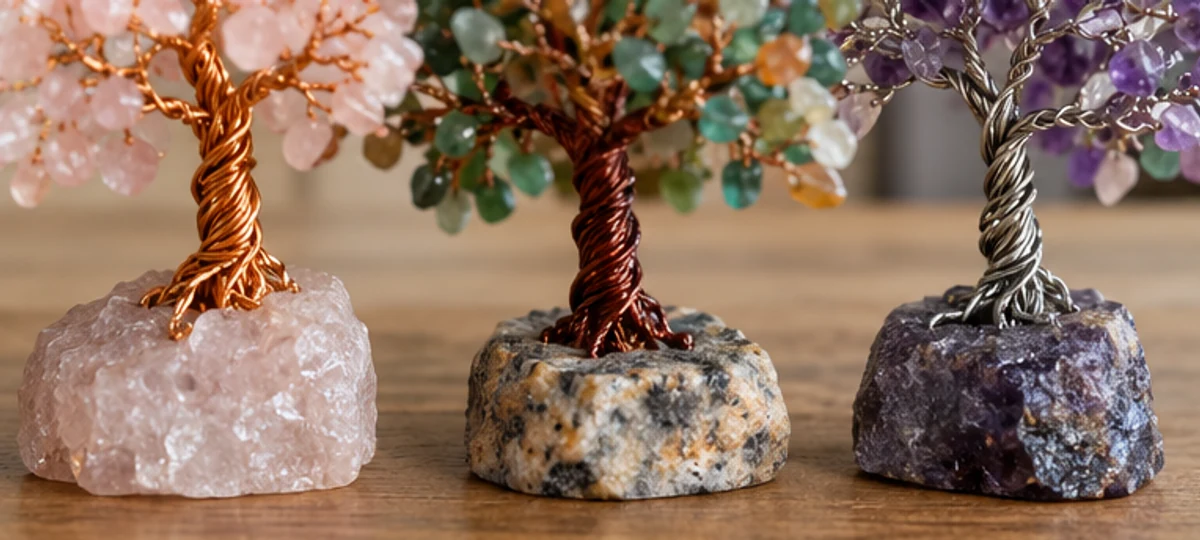
A typical handcrafted gemstone tree is a mixed-material assembly. Its crown carries chips, drilled fragments or small beads. Thin wires make the twig-like terminations; several twigs form branches; branches converge into a larger trunk; the trunk reaches a mount or base. Some makers add adhesive, filler, lacquer, plaster, putty, a metal insert or an additional decorative mineral layer. Other trees use a single larger stone plate as their base. The name of the gemstone in the crown does not establish what the other components contain.
Consider two trees with equal numbers of rose quartz chips. One may use short, firmly twisted branches and a wide stone base, while the other carries a tall canopy on thin wire anchored in an unusually narrow pedestal. They are not equally suitable for a busy reception counter. The first purchasing question is therefore not simply “which stone?” but “how has this object been assembled and where will it stand?”
| Component | Construction purpose | What to check | Common weakness |
|---|---|---|---|
| Gemstone chips | Colour, texture and leaf-like form | Identity, finish, drilled holes and secure attachment | Chip breaks or a loop slides free |
| Twig wires | Carry one or more chips | Loop closure, wire ends, smooth bends | Sharp tails and repeated-bend fatigue |
| Branch bundles | Distribute chip weight | Even twists, no excessive kinks | One branch sags under extra weight |
| Trunk | Collect the branches and provide height | Compact, stable twist and proper joining | Loose strands, wobble and unravelling |
| Anchor or fixing | Join trunk to foundation | No movement, cracking or exposed glue | Separation from the base |
| Base | Support the tree and protect shelf | Flat contact, size, weight and intact edges | Tipping, rocking or unstable adhesive |
| Coating/finish | Appearance and corrosion protection | Actual material disclosure and intact surface | Flaking, tarnish or staining |
A photograph should show the entire tree, not only a colourful patch of chips. Ask for a straight-on view, a side view, the underside of the base and at least one close photograph of chip loops and branch junctions. These views reveal different aspects of workmanship. A beautiful front image cannot by itself demonstrate that the tree stands without support.
2. Gemstone chips: real stone, shape, drilling and disclosure
Gemstone chips are usually intentionally irregular. They may be transparent, translucent or opaque; smooth, angular or rounded; drilled or held in a small cage of wire. Slight differences in tone and size are normal in many natural materials. However, visible variation does not prove natural origin, just as uniformly coloured chips do not automatically prove an imitation. Actual identification may require closer examination, documentation or testing.
Chip treatments matter because a decorative tree can include dyed chalcedony, heated quartz, synthetic materials, resin-coated fragments or mixed stones. “Natural gemstone tree” should not silently imply that every chip is untreated. A seller should describe the stone family, known treatments, mixed-material construction and the scope of any test report. A certificate for one sample cannot automatically authenticate every chip in an assembled crown.
Look closely at the drilled openings. A narrow hole through a thin or fissured chip can be a break point. The wire should pass without forcing the hole, with enough space to avoid wedging against a sharp edge. Chips need not all be identical, but chipped edges that may fall off, sharp fractured pieces or visible crack propagation deserve clarification before purchase. This is particularly relevant to softer or cleavable materials such as fluorite and calcite.
| Chip or bead form | Appearance | Useful question | Handling consideration |
|---|---|---|---|
| Irregular drilled chips | Organic leaf-like variation | Is every chip drilled and looped, or are some glued? | Rough edges can snag cloth |
| Tumbled mini-chips | Smoother, rounded look | Are holes clean and edges intact? | Inspect thin areas around holes |
| Faceted beads | Repeating sparkle | Are beads real stone, glass or crystal? | Check wire stops and end loops |
| Wire-caged fragments | Stone held without drilling | Is the cage securely closed? | Stone may slip if the cage loosens |
| Mixed-gemstone crown | Many colours and textures | Are individual varieties correctly named? | Care follows the most vulnerable material |
| Coated/dyed chips | Bright consistent effect | Which treatments or coatings are disclosed? | Solvents, sunlight and abrasion may matter |
In a professional showroom, separate three questions: what mineral is present, how the chip was processed, and how it was attached. A mineral report may answer the first question, a supplier disclosure may help with the second, and physical inspection is required for the third. One label or certificate rarely answers all three.
3. Wire materials and colour finishes: copper, brass, aluminium and coated wire
A wire-tree trunk might appear gold, copper, silver or antique bronze. These colours are finish descriptions, not proof of the underlying metal. Genuine copper wire, brass wire, aluminium craft wire, coated iron or steel, and plated or lacquered wire may all be used in different price ranges. Copper is workable and develops surface oxidation; brass is a copper–zinc alloy; aluminium is light; steel-based wire may be relatively springy and can corrode if coatings fail. The suitability depends on wire diameter, temper, twists, coating and actual load, not the metal name alone.
Gold-coloured wire is not necessarily gold-plated, and “silver tree” does not mean sterling silver. If a material is important to a buyer—for example, because of an intentional copper-based Vastu arrangement—ask for the actual component composition. Avoid quietly replacing “copper-coloured” with “pure copper” in a product listing. Conversely, an accurately described coated craft wire can still be a perfectly suitable component for a decorative tree.
Repeated manual bending can create work hardening and fatigue in many metals. A wire that initially moves smoothly may become less forgiving after repeated repositioning, especially near a tight twist or sharp bend. A snapped branch cannot always be repaired invisibly. A purpose-built adjustable design may tolerate some gentle shaping, but a tightly bound fixed design should be considered fixed unless the maker says otherwise.
| Wire type or finish | Typical characteristic | Ask the seller | Care or failure risk |
|---|---|---|---|
| Bare copper | Warm reddish appearance, workable | Is it actually copper or only copper-coloured? | Patina, tarnish and repeated bending |
| Brass | Yellow-gold alloy colour | Is the wire solid brass or plated? | Tarnish, surface wear and sharp ends |
| Aluminium craft wire | Lightweight and readily shaped | What diameter and temper are used? | Soft wire may deform under heavy crown |
| Coated base-metal wire | Wide range of bright finishes | What is the core and coating? | Flaking and exposure of the core |
| Steel-based wire | Can be springy or rigid | Is there a protective surface finish? | Corrosion if coating is damaged |
| Plated/lacquered wire | Decorative protective surface | What is the plating or lacquer? | Abrasives and chemicals damage finish |
Conservators note that metal deterioration is promoted by water, humid air and contaminants. A mixed gemstone tree may also contain adhesives, porous base stone and decorative pigments. Therefore aggressive polishing, lemon juice, vinegar, salt water and metal-cleaning solutions are poor default choices for an assembled tree, even when someone successfully uses a particular polish on a separate copper utensil.
4. Wire diameter, number of strands and mechanical support
Tree makers choose wire dimensions based on how many strands must be twisted, how long branches extend and how much chip mass those branches carry. There is no universal “best gauge” for every gemstone tree. A small tabletop tree with fine chips and a short open canopy needs different support from a tall tree with many heavy stones. Gauge systems also differ by convention, so a listing should ideally use millimetres for wire diameter when that dimension is advertised.
A single slender wire may adequately carry a small chip but may not carry a whole long branch without drooping. Makers often join multiple wires into a bundle, twisting them together to distribute weight and create the appearance of wood. Twists should be consistent enough to hold branches but not so violent that the wire becomes kinked or damaged. Loose unsupported tails should be tucked in or finished safely, particularly near areas that customers will touch.
Chip count cannot substitute for mechanical inspection. A tree with 300 tiny chips and a stout trunk may be more stable than a tree with 100 large, heavy chips supported by long thin branches. Check the relationship between chip mass, branch reach, trunk thickness and base footprint rather than assuming a more expensive or more densely filled crown is stronger.
| Observation | Usually reassuring | Needs closer inspection |
|---|---|---|
| Twig tip | Closed loop with no sharp tail | Open hook, exposed point or loose bead |
| Branch junction | Tidy, well-supported twist | Untwisting, slipping or abrupt thin spot |
| Crown load | Branches maintain intended position | Several branches droop or cross under load |
| Trunk | Firm central bundle, no wobble | Loose strands or movement where it enters base |
| Canopy symmetry | Shape suits intentional design | Unexpected lean placing centre of mass outside base |
| Repeated shaping | Maker identifies adjustable areas | Customer urged to bend everything freely |
A gentle visual check is usually better than forcefully tugging branches in a shop. Ask the maker to demonstrate a permitted adjustment rather than testing strength by pulling chips. If a tree already has movement where the trunk joins the base, that is a defect to resolve before sale or delivery, not an invitation to tighten the joint by twisting the entire crown.
5. Branch grouping, canopy shape and design balance
Branches may rise upright, spread sideways, form a rounded crown or follow an offset windswept shape. A graceful silhouette depends on more than symmetry. The maker may use open spaces intentionally so individual chips catch light. An elaborate full crown offers stronger colour but may also hide construction and be more difficult to dust. Neither sparse nor dense branches automatically indicate higher quality.
Look at the tree from eye level and from above. A very broad canopy on a tall narrow trunk can shift the apparent centre of gravity. If the base is light or the tree leans dramatically, slight contact on a busy desk may cause tipping. More branches are not always better. Good workmanship lets the visual style coexist with stable load distribution and usable access around the object.
When a tree is intended to be displayed beside books, laptops or puja objects, measure its maximum spread rather than only height. The widest chip-to-chip distance matters for safe shelf placement. A narrow tree can fit a side table but still need clearance for people to pass. A broader, lower tree may be better suited to a dedicated altar shelf, reception console or sturdy centre table.
6. Trunk architecture: twist, join, root spread and anchor
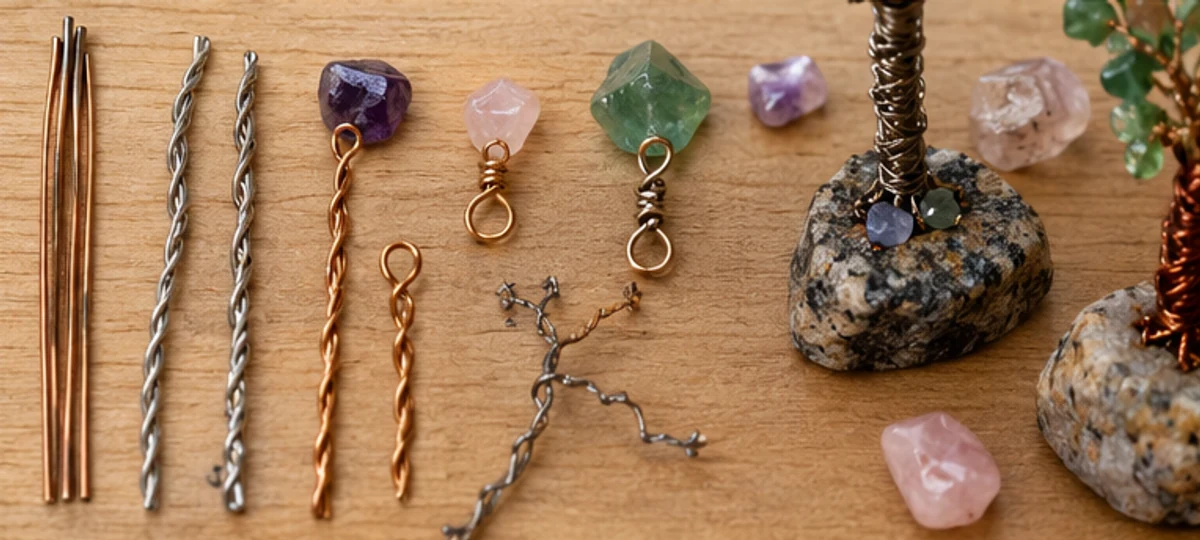
The visible trunk can be straight, braided, twisted, bent or divided into multiple stems. Twist direction is mostly an aesthetic construction detail: the buyer should care more about secure joining and stability than an arbitrary number of turns. The branches should gather progressively into a load-bearing central core, without a sharp change in thickness that produces a fragile waist.
Some trees extend wire roots across the base and fasten them mechanically. Others insert the trunk into a drilled opening and secure it with adhesive or filler. A third style may conceal the anchor beneath glued chips or ornamental stones. All three approaches can produce a sound decorative object when done well; no one should describe hidden fixing as “carved from one piece” unless that is actually true.
Inspect where the trunk enters the base. A visible adhesive collar may be acceptable if neatly finished and accurately described. A cracked base around the anchor, wet-looking uncured material, a loose upright insert or a trunk that rocks independently of the base needs action before shipment. The fact that the tree stands for a photograph is not sufficient proof that its joint will survive transport.
| Anchor method | What it may look like | What to verify | Care consideration |
|---|---|---|---|
| Drilled stone base | Trunk enters a hole in natural stone | Joint fit, stone cracks, adhesive disclosure | Avoid leverage on hole edge |
| Bonded pedestal | Wire fixed by adhesive/filler | Cure, wobble, visible excess | Solvents and soaking can weaken bonds |
| Spread wire roots | Individual wires lie on or through base | Closed secure attachment and flat contact | Do not use roots as carrying handles |
| Decorative chip cover | Small stones conceal joining area | Hidden core is stable, no loose decorations | Dust gently around clustered fixings |
| Metal socket or insert | Stem fixed inside a fitting | Fastener and finish integrity | Check corrosion at dissimilar materials |
7. The base: real stone, geode, wood, resin and composite options
A base is a functional foundation as well as a design feature. Makers use natural stone slices, polished quartz, rough mineral clusters, agate slices, geodes, stone-look resin, plaster or cement composites, wood and metal stands. A rough amethyst cluster may be visually appealing, but uneven projections can create an unstable footprint. A resin base may be strong and decorative without being a natural gemstone. The listing needs to identify the component truthfully.
Weight alone does not reveal the base material. Large resin bases can be weighted internally, while naturally porous stones may be lighter than expected. Similarly, a sparkling geode-like cavity can be natural, treated or assembled. Ask for the underside, its contact points, actual measurements and whether the trunk is inserted, glued or wrapped around the foundation.
Where a tree will be placed near lamps, incense, direct sunlight or windows, consider the vulnerabilities of every component. Adhesives and coatings can respond to heat; some gems fade in strong light; porous materials can stain; certain minerals are not suitable for wet cleaning. Choose an even shelf away from repeated drips and vibration, not only a visually attractive direction.
| Base material | Appearance and appeal | Information to request | Practical risk |
|---|---|---|---|
| Agate slice | Banded flat mineral slab | Natural/dyed, flatness and edge quality | Tipping if slice is narrow or mounted vertically |
| Quartz cluster | Sparkling irregular mineral points | Authenticity and join stability | Sharp points, rough dust traps |
| Carved stone | Polished, weighty profile | Mineral identity, repairs, holes | Chip/crack around drilling |
| Wood | Warm look and broad footprint | Sealing, finish, moisture exposure | Warping, adhesive separation |
| Resin composite | Flexible shape and colouring | Clearly disclosed composition | Heat, scratches or ageing of coatings |
| Metal/plated stand | Clean engineered appearance | Base weight, edge safety, corrosion | Sharp edges or scratched plating |
8. Geometry and balance: how to evaluate a tree before buying
A tree that looks stable in a styled photograph may still be easy to topple when touched. Compare overall height, canopy diameter, base width/depth and total weight as separate specifications. For an irregular stone base, the effective supporting footprint is the area actually touching the shelf, not the outermost decorative edge. A tall or offset canopy usually needs a correspondingly secure supporting base.
The centre of mass is not always at the centre of a visible base. Heavy chips concentrated on one side can pull the balance outward. Test the finished tree on a flat shelf with ordinary gentle movement, without subjecting it to tipping or force. Check whether it rocks. A felt pad can protect furniture, but adding thick padding under only one side may make the object less stable.
A supplier should record measurements for the actual model or batch, not copy dimensions from unrelated items. Stating a “300-chip tree” with no dimensions can be misleading: the count does not tell a buyer whether it fits a temple shelf or a desktop. A clear specification picture with a scale reference and base measurement is valuable for both online buying and after-sales support.
| Specification | How to record it | Why it matters |
|---|---|---|
| Overall height | From base bottom to highest chip | Shelf clearance |
| Maximum canopy width | Leftmost to rightmost chip | Side clearance and collision risk |
| Maximum canopy depth | Frontmost to rearmost chip | Distance from shelf edge |
| Base footprint | Actual flat contact dimensions | Tipping resistance |
| Total assembled weight | Whole tree, not loose stone weight | Handling and shipping |
| Chip count | Defined method and approximate if needed | Density expectation, not authenticity |
| Chip sizes | Typical range for real batch | Appearance and construction load |
| Wire/base description | Actual materials and finish | Care and purchasing transparency |
9. Kalpavriksha: interpreting the tree form in Indian traditions
The form of a flourishing tree is meaningful in Indian culture. Kalpavriksha or Kalpataru, the wish-fulfilling tree, is a symbol of abundance and fulfilment. The Indian Museum, Kolkata preserves a historic Besnagar representation depicting a tree with auspicious objects. That establishes the depth of tree symbolism in Indian art and practice. A present-day twisted-wire gemstone tree is a contemporary decorative interpretation of such ideas, not the same historical object.
The structure itself provides a natural symbolic vocabulary. The roots and base suggest steadiness and foundation; the trunk suggests continuity and personal discipline; the branches suggest opportunity, connection and expansion; and the stones or leaves suggest the fruits of sustained effort. An individual may place a tree near a puja shelf and make a Sankalpa, or choose the object as an auspicious gift for a new home or business.
Lakshmi and Kubera symbolism is often invoked when people select prosperity-themed gemstone trees. Such associations may inform the selection of a citrine-coloured crown, pyrite tree or auspicious gift, but do not change the physical requirements for secure construction. A loose branch cannot be judged durable by a spiritual label, and a mixed-stone design does not become a formally prescribed Navagraha remedy simply because it contains nine colours.
In Vastu discussions, a stable display, uncluttered surroundings and respectful placement are as relevant as stone colour. Some contemporary practitioners prefer particular directions for specific intentions, but there is no universal rule that every commercial wire gemstone tree must be placed in the same corner. The user’s space, family practice, material safety and actual intention should guide the choice.
10. Vastu Purusha Mandala, Pancha Mahabhuta and direction-conscious display
In traditional Vastu thought, orientation, functional use of space and the Pancha Mahabhuta—Prithvi (earth), Jala (water), Agni (fire), Vayu (air) and Akasha (space)—provide a framework for reflecting on environments. Contemporary gemstone-tree arrangements may use colour and material to represent these elements. Such decorative mappings vary by practitioner and should not be confused with an architectural survey of a building or an individualized Jyotish prescription.
The Ashta Dik, or eight principal and intermediate directions, are frequently used in Indian spatial and ritual symbolism. Ishanya (northeast) is often valued in devotional settings; other directions carry their own associations, such as Agneya (southeast) and Nairritya (southwest). Choose a physically safe shelf first and then consider traditional preference. Do not put an unstable tree on a ledge, high shelf or cooking surface to satisfy a direction chart.
| Placement context | Traditional intention or association | Construction priority | Practical selection |
|---|---|---|---|
| Puja shelf or meditation corner | Sankalpa, reflection, auspiciousness | Stable anchor; away from flame and water offerings | Compact crown, protected base |
| North or northeast home shelf | Auspicious orderly environment in some Vastu practices | Clearance and dust access | Sphatik or mixed-stone tree if preferred |
| Office or reception | Growth, continuity, productive effort | Weighted base and low snag risk | Medium crown with firm branches |
| Housewarming gift | Kalpavriksha and goodwill | Durable packing and easy placement | Clear material/size label |
| Child-accessible table | Meaningful decoration | No small loose chips or sharp wires | Protected or higher display |
| Retail showroom | Attractive stock presentation | Security and handling limits | Dedicated stand and display card |
For example, a Bengaluru apartment may have a narrow northeast shelf directly above a daily incense holder. Rather than forcing a large wide-spread gemstone tree into the spot, choose a smaller stable design, move the incense, or select another appropriate shelf. Practical fire safety and thoughtful traditional placement can work together without treating a direction as a substitute for structural care.
11. Choosing chips and construction for a particular intention
Traditional and contemporary selections often associate rose quartz with affection and harmony, amethyst with calm reflection, green aventurine with growth and opportunity, Sphatik with clarity and worship, and citrine-coloured pieces with prosperity. These are cultural and spiritual interpretations, not assays of material origin. A clear quartz tree made from accurately named, securely mounted chips is preferable to a poorly described tree marketed with an elaborate planetary label.
For a more personal Jyotish recommendation, a practitioner may examine the birth chart, Graha, Rashi, Nakshatra, Dasha and the wearer’s purpose. A decorative tree should not automatically be substituted for prescribed Ratna worn on the body. Some clients may still enjoy a tree as a visual support for prayer, Sankalpa, mantra or devotional routine. The construction and care principles stay the same whatever spiritual interpretation is chosen.
A seven-colour chakra tree often uses chips of several mineral types. Its rainbow appearance does not necessarily establish that it contains seven distinct untreated gemstones. Likewise, a nine-stone Navagraha-themed design may be symbolic rather than a certified Navaratna set. A good product description names the actual stones, clearly identifies substitutions and states whether colours were enhanced.
12. Worked example: a Bengaluru family apartment
Imagine a family selecting a rose quartz and amethyst combination tree for a shared living-room shelf. The apartment has two children, afternoon sunlight and a narrow display ledge. A broad 28-centimetre canopy may collide with curtains, regardless of whether its symbolism is attractive. The family should first measure ledge depth and clearance, then choose a lower crown with a wide, level base and an anchor that does not wobble.
A close photograph reveals the chips are drilled and looped, not merely glued to wire ends. The gold-coloured wires are correctly described as plated craft wire rather than gold. The base is identified as a resin-and-stone composite. None of these facts diminishes the tree’s meaning, but they clarify expectations, safe cleaning and purchase value.
In a devotional setting, the family may offer flowers nearby and make a short Sankalpa for harmony. The tree should remain clear of oil lamps, incense embers, splashed ritual water and areas where it could be knocked over. A removable tray may help protect the furniture; the tree itself should not be submerged or repeatedly rearranged. Such choices honour both meaning and workmanship.
13. Worked example: jewellery showroom and office reception
A Bengaluru jewellery showroom wants a larger gemstone tree near a customer consultation desk. The attractive option has heavy chips and long drooping branches, while a second tree uses fewer chips but a more compact trunk and wide base. In a high-traffic environment, the second may be the better long-term display, even if its chip count is lower. Customers may brush the crown accidentally while examining products.
The manager should examine the underside and anchor, record actual dimensions, keep the display away from a counter edge, and train staff to move the item by its foundation. In a shop, a clear material label—such as “green aventurine gemstone chips, coated wire and stone base”—is more informative than a generic “100% energy tree” label. Where treatment information is unknown, the shop should seek clarification rather than guessing.
If a larger tree is intended to symbolize Lakshmi-Kubera prosperity, its symbolic context can be explained in a neat information card while an adjacent physical-care label covers dusting and handling. These are complementary messages: one explains traditional significance, the other maintains trust in the actual product.
14. Worked example: a professional Vastu consultant’s reference kit
A professional who demonstrates gemstone trees during a Vastu consultation may carry several small examples rather than one heavy full-size tree. A kit could contain Sphatik, amethyst, rose quartz, green aventurine and a multicolour comparison, each with a consistent base and a label showing material, known treatment, chip construction and actual dimensions. A small chip sample card can help explain the difference between natural-looking inclusions and dyed materials.
Packing the trees for repeated visits calls for special discipline. Each crown needs an independent cavity or lightweight support so that branches do not rub together. The base, not the chip canopy, bears the weight of the object in its box. Avoid using string tied across delicate branches as the main restraint. After each trip, inspect loops, trunk junctions and anchor movement before demonstrating the kit again.
The consultant can use these objects to explain Kalpavriksha symbolism, the five elements and directional choices, while making clear which associations are general examples and which recommendations depend on an actual site assessment or a client’s birth chart. The objects remain teaching aids as well as devotional or decorative pieces, not substitutes for a complete Vastu assessment.
15. Buying checklist: twelve checks before confirming an order
- 1. Chip identity: ask for each gemstone name, including the composition of mixed-stone trees.
- 2. Treatments: ask whether chips are dyed, heat-treated, coated, stabilised or assembled.
- 3. Real photographs: request full front, side, detail and base images of the actual design or batch.
- 4. Chip fixing: inspect drilled openings, loops, sharp edges and any loose fragments.
- 5. Wire description: distinguish copper-coloured or gold-coloured coating from actual copper, brass or precious metal.
- 6. Trunk condition: look for loose strands, excessive kinks, cracking and instability.
- 7. Base identity: identify natural stone, resin, wood, metal or composites as supplied.
- 8. Base anchoring: confirm how the trunk is fixed and that the completed tree does not wobble.
- 9. Measurements: obtain total height, maximum canopy spread and actual base footprint.
- 10. Chip-count definition: learn whether advertised count excludes base decorations or non-gem accessories.
- 11. Care and packing: request specific handling and cleaning guidance for the whole assembly.
- 12. Returns and documentation: confirm what condition or authenticity claims are covered by any seller report and after-sales policy.
A brief seller response with precise facts is more valuable than a lengthy list of vague benefits. For instance, “approximately 200 mixed quartz chips, coated copper-colour wire, 16 cm tall, 13 cm spread, resin stone-look base” gives a buyer information to evaluate. If metal composition or mineral treatment has not been verified, the listing can state that rather than implying certainty.
16. Quality defects, repair and safe branch adjustment
During inspection, distinguish harmless handmade variation from defects. Unequal chip size, natural mineral patterns, slight asymmetry or small differences in wire spacing can be attractive. Exposed sharp tails, loose anchor joints, continuously shedding chips, extensive cracked base material or branches that will not support their intended mass are different: they affect practical use and should be addressed.
Never fix a loose gemstone by adding random household glue in a visible loop without considering compatibility. Some adhesives fog or stain stones, remain brittle or soften with moisture or heat. If a branch snaps, the correct repair may require replacement of a wire segment rather than joining two broken ends directly. For an expensive or sentimental piece, consult the maker or a suitably experienced repairer. Document the original condition before any work.
| Observed issue | Likely interpretation | Suggested response |
|---|---|---|
| Slightly irregular chip shapes | Normal handmade/natural variation | Accept if identity and finish match description |
| One branch sits lower | May be intentional or overloaded | Ask maker whether adjustment is permitted |
| Wire loop is visibly open | Possible chip-loss risk | Request secure rework |
| Trunk rocks in base | Anchor may have failed | Do not display until fixed |
| Base has a hairline crack | Could be material feature or stress | Inspect near drilled anchor, seek disclosure |
| Coating flakes onto shelf | Finish deterioration | Avoid abrasion; request repair or return |
| Chip drops off during handling | Attachment defect | Stop use and document for seller |
| Greenish metal residue appears | Possible copper-alloy corrosion | Keep dry; assess finish and storage |
If the maker confirms that a branch is adjustable, support it near the point where it joins a thicker group and use a small, deliberate movement. Do not yank on a gemstone chip. Avoid multiple back-and-forth movements in one location, especially if the wire has been painted or plated. Where the original object is rigid or the wire feels resistant, leave the shape as supplied.
17. Cleaning the entire assembly: stone, wire, adhesive and base
A gemstone tree is not a loose gemstone. Some single stones may tolerate water and mild soap, but the whole tree can contain metal finishes, glue and mineral types with very different responses. The safest default is a clean, soft, dry brush and gentle dusting while supporting the base. Do not carry it by a branch bundle, pull cloth through the crown or put the whole assembly into ultrasonic or steam-cleaning equipment.
Avoid salt-water immersions, vinegar, lemon juice, perfume, household metal polish, bleach and harsh solvents. Such products can affect dyed stones, finishes, adhesives and mineral surfaces. If incense ash or puja residue gathers near the base, remove it dry before it accumulates. Keep oil lamps at a safe distance; heat and soot are not needed to maintain the tree’s devotional meaning.
Store or display in a reasonably stable, low-dust environment. Sudden humidity changes can promote metal corrosion and affect wood or adhesive components. Avoid prolonged damp exposure, direct bathroom steam and wet planters. Place the object away from repeated knocks. For valuable mixed-material pieces, preservation guidance favours stable conditions and careful handling over attempts to make every component shine.
| Component | Routine approach | Avoid |
|---|---|---|
| Hard quartz chips | Gentle dry brushing of tree | Assuming whole assembly can be immersed |
| Soft/cleavable mineral chips | Minimal contact, inspect fractures | Hard knocks and aggressive rubbing |
| Dyed or coated chips | Dry dust, confirm treatment first | Solvents and strong prolonged light |
| Copper/brass/coated wire | Keep dry; remove loose dust | Abrasive polish and acid cleaners |
| Adhesive joints | Inspect for movement | Soaking, steam and heat |
| Natural stone base | Soft dry brush; protect edges | Impact, untested acids |
| Wood/composite base | Dry method tailored to actual finish | Standing moisture and hot surfaces |
18. Packing, shipping and seasonal humidity
Transport risk is often a construction risk. The chip crown can become a lever against a trunk joint if the base moves independently inside a carton. Secure the base in a fitted protective cradle or cavity, then give the crown enough clearance that it cannot strike the box walls. Avoid filling gaps with loose paper that presses directly on slender branches. The package should prevent shifting without squeezing the crown.
For multiple trees, use separate compartments. Wrap fragile base edges individually, keep chip tips away from each other and do not pack heavy bases above wire crowns. Provide a visible “lift from base” instruction and a modest unpacking diagram where the customer may need to uncover the branches carefully. For humid-season Bengaluru deliveries, keep packaging clean and dry; do not leave finished items in wet cardboard or near water-damaged storage areas.
Before dispatch, photograph the finished tree from the front, side, underside and branch detail. Record weight, dimension, wire finish and the actual base type. After delivery, the buyer can compare the received item with this record. These simple practices reduce avoidable disputes about variation, bent branches and missing chips while providing an evidence trail for the maker.
19. Product listing language: precise claims customers can trust
A useful online description distinguishes gemstone material, construction method, finish, physical specification and traditional interpretation. For example: “Amethyst chip tree with twisted gold-colour craft wire and polished stone base; suitable for a dry, stable shelf. Amethyst is traditionally chosen by many customers for a calm devotional setting.” This is more informative than claiming that the wire is gold, the base is a certified crystal or the object has a guaranteed effect without evidence.
Do not attach a specific gemstone laboratory certificate to a whole tree unless the report genuinely covers the submitted item and stated scope. A report on one selected chip or sample can be described as a sample test; it is not automatically a certification of all chips, metal, coatings and adhesives. Likewise, the presence of copper-coloured wire should not be marketed as a classical copper remedy unless its material is actually confirmed.
For SEO and usability, the page title should tell readers exactly what the article answers: chips, wires, trunk and bases. Product pages should then link to the guide where it helps explain workmanship and care. Since OmmRudraksha already provides a site-wide disclaimer, the editorial text can concentrate on traditional symbolism and factual construction details without a repetitive legal paragraph in every section.
20. Frequently asked questions
Are gemstone trees made entirely of natural gemstone?
Usually not. Even a crown made from genuine gemstone chips normally uses metal wire and an additional base. Some trees also have coatings, glue, filler or stabilisers. Ask what each component is made from.
Does gold-coloured wire mean the tree contains gold?
No. Gold-coloured is a description of appearance. The wire may be brass, anodised aluminium or a coated base metal. Actual precious-metal content requires specific disclosure and evidence.
Is copper wire always better than aluminium?
Not automatically. Copper and aluminium have different working properties, but durability depends on diameter, temper, construction, finish, loads and anchor. Compare the completed tree, not a metal name alone.
Can I adjust every branch after delivery?
No. Some designs are intended for gentle adjustment and others are fixed. Ask the maker, support an adjustable branch near its junction and avoid repeated back-and-forth bending.
Why do some gemstone trees lose chips?
A drilled chip can fracture, a loop may be open, a wire may break or a glued attachment may fail. Examine the actual attachment and request correction rather than pulling other branches to test them.
Do natural chips need to be exactly the same size?
No. Irregularity can be a normal characteristic of chip trees. What matters is correct identification, secure attachment and a crown that looks and behaves as described.
Does a larger chip count mean better quality?
No. Chip count does not measure the size of individual pieces, their identity, wire strength, trunk support or base stability. Inspect the completed construction and dimensions.
How do I know if the base is natural stone?
Request an accurate material statement and underside photographs. Appearance or weight alone cannot verify mineral identity; some bases are resin, composite or treated material.
Can a tree with an agate base be dyed?
Yes. Agate and chalcedony may be dyed, including decorative slabs and chips. If a supplier markets untreated natural colour, ask for supporting identification and treatment information.
Which base shape is more stable?
A broad level contact footprint generally provides better stability than a narrow rocking contact, though total mass, crown height and weight distribution also matter. Inspect the finished object on a level surface.
What is the significance of the twisted trunk?
Mechanically it gathers the branch wires. Symbolically, some people interpret a strong trunk as continuity and growth. The decorative twisting technique is not itself proof of a classical Vastu prescription.
What does Kalpavriksha mean for a gemstone tree?
Kalpavriksha is the wish-fulfilling tree of Indian tradition, associated with abundance and auspiciousness. Modern gemstone-chip trees draw on this wider tree symbolism but are different objects from historical sacred-tree representations.
Where should a gemstone tree be placed in Vastu?
Choose a clean, stable and safe location first, then consider your family’s devotional practice and the intended symbolism. Directional preferences vary by practitioner and need not override physical safety.
Can I use a gemstone tree during Sankalpa or puja?
Yes, if it fits your practice. Keep oil lamps, dripping water and hot incense away from delicate wires, stones and adhesives; the intention does not require damaging the object.
Is a multicolour chakra tree a prescribed Navagraha remedy?
Not necessarily. A seven-colour chakra arrangement and a nine-planet Jyotish scheme are different systems. Actual chip identities and any personalised recommendations should be stated separately.
Can I wash the entire tree in water?
Generally avoid immersion unless the maker has verified all stones, wire finishes, adhesives and the base as compatible with that process. A clean soft dry brush is a safer default.
How do I clean between closely packed chips?
Work gently with a small clean dry brush, supporting the base. Do not force a cloth through narrow loops; it can snag wire ends or pull chips free.
How should it be packed for transport?
Support and restrain the base, keep branches away from carton walls, separate trees from one another and avoid compression on the canopy. Include unpacking instructions.
Does a laboratory report certify the whole tree?
Only if its explicitly stated scope covers the complete item or relevant components. A report on a sampled chip cannot be represented as testing every stone, wire, fixing and base.
What should I ask before buying a tree online?
Ask for the gemstone and treatment details, chip attachment photographs, wire and base composition, actual height and spread, weight, anchor condition, packing method and return terms.
21. A final construction-first selection framework
The best gemstone tree is the one whose actual materials, workmanship and purpose fit its intended setting. First decide whether the tree is for a quiet puja shelf, a gift, a desk or a professional display. Then verify the mineral and treatment descriptions, the wire and anchor method, canopy and base dimensions, and the maintenance requirements. Only after those essentials should you rank decorative colour, chip count and optional traditional associations.
A carefully made tree with modest chip count, accurate material disclosure and a stable base may offer better long-term value than a crowded model supported by weak wire. Kalpavriksha symbolism, Vastu placement and Sankalpa can enrich the object’s presence without replacing the need for safe construction. The branches express growth; sound connections make the design usable in an actual home.
Research and editorial notes: The Indian Museum, Kolkata records the Besnagar Kalpavriksha sculpture and its auspicious symbolism. GIA material on gem treatments and gemstone care informs treatment disclosure and cleaning cautions. The Canadian Conservation Institute informs advice on handling mixed-material objects, metals, humidity and packaging. Wire-tree making references inform descriptions of branch bundles and gemstone attachments. Material, dimensions and treatment details for any specific OmmRudraksha item must come from its actual inventory record, photographs and supplier information.
