
A gemstone tree stays attractive longest when cleaning is gentle, predictable and appropriate for the entire construction. The polished chips may be quartz, feldspar, pyrite, fluorite or other materials, but the finished piece also contains wire branches, a central trunk, fasteners, adhesive, paint, a mineral or manufactured base, and sometimes protective coatings. This is why washing an individual gemstone and caring for a completed gemstone tree are different tasks. Start with dry dusting; use moisture only where the actual materials and manufacturer’s finish permit it.
For daily home display, a clean soft brush, a steady base and a sensible location usually accomplish more than elaborate cleaning products. Care also supports the traditional purpose of a Kalpavriksha or Kalpataru display: a tidy, respectfully maintained space for Sankalpa (intention), family puja, prosperity symbolism or Vastu decor. This guide covers practical cleaning, gemstone-by-gemstone differences, wire and base maintenance, festival preparation, packing, storage and common problems without confusing symbolic cleansing with physical restoration.
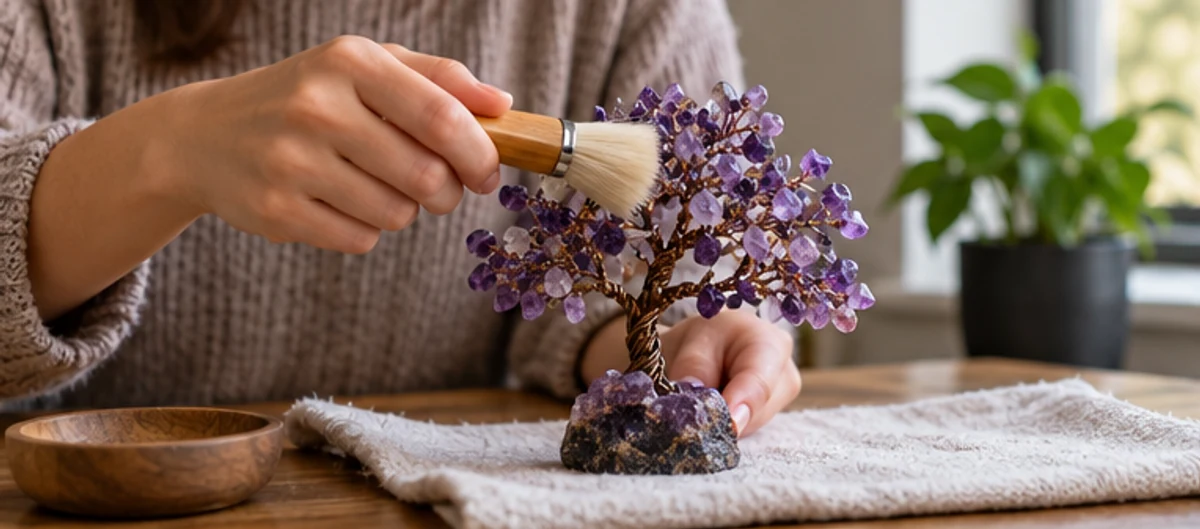
Quick answer: the safest routine for most gemstone trees
- Inspect the tree in good light before touching it. Identify loose chips, exposed wire ends, cracked stones, flaking finishes and unstable base joints.
- Place the base on a clean, padded, level table. Keep one hand near or underneath the base; never suspend the tree by its crown or trunk.
- Use a clean, very soft, dry artist’s brush to move dust gently away from accessible chip clusters, wire junctions and the upper surface of the base.
- Rotate the base, not the branches, to reach another side. Do not thread a cloth between thin wires, force branches apart or use compressed air at close range.
- If visible grease or marks remain, stop and identify the materials before trying a locally dampened cloth on a compatible, inconspicuous part. Do not immerse the tree.
- Return the piece to a stable, shaded, dry position away from water spray, intense sunlight, cooking fumes and frequently handled shelf edges.
| Situation | First choice | What not to do | Why it matters |
|---|---|---|---|
| Ordinary loose dust | Soft, clean, dry brush | Wet the entire crown | Dust rarely needs liquid; joints and coatings may not tolerate moisture |
| Dust inside dense branches | Light strokes from more than one direction | Pull a cloth through wire loops | Threads can catch and move branches or loosen chips |
| Fingerprints on a smooth, stable base | Dry microfiber on accessible base only | Rub a painted or friable finish hard | Bases can include surface treatments unrelated to the gemstone chips |
| Loose chip or exposed twist | Stop handling and photograph | Retwist blindly or add household glue | The branch design and fixing method must be understood first |
| Suspected pyrite corrosion | Isolate from dampness and inspect | Rinse, scrub, oil or seal wet material | Some pyrite deteriorates when moisture and oxygen interact |
| Festival display preparation | Dust and inspect in advance | Use incense smoke as a cleaning agent | Smoke deposits residue; flame and heat add avoidable hazards |
Core rule: A gemological cleaning recommendation describes a particular gem material. It is not automatic approval to apply that method to a finished wire-and-base object. The Gemological Institute of America (GIA) discusses warm soapy water for several individual jewellery gems, but a tree may have an unknown adhesive, paint or mixed set of stones. The whole construction sets the safe limit.
First identify what the tree is made of
A seller may list the crown as “amethyst,” “rose quartz,” “seven chakra,” “pyrite” or “mixed stones.” That product name seldom describes every component. Examine the chips and the architecture separately. A gemstone chip can be drilled and wire-strung, glued to a stem, held by a loop or secured by a combined method. The main trunk might be copper-coloured metal rather than solid copper. The base may be quartz, agate, wood, resin, cement, stone composite or another material. A gold-looking metallic finish might be electroplated, painted or lacquered.
You do not need laboratory instruments to make a sensible household care plan. Record what you can actually observe and what the supplier confirms. If treatment, material or coating is unknown, choose the least intrusive method. A seller's declaration that the chips are natural does not reveal whether the whole tree can be safely washed, whether a chip was dyed or whether the base joint is waterproof.
| Component | What to check | Common risk | Conservative response |
|---|---|---|---|
| Gemstone chips | Material, fractures, polish, dye, fragility | Scratches, surface damage, fading, chips loosening | Brush lightly without pulling individual chips |
| Looped branch wire | Exposed ends, kinks, corrosion, surface colour | Snagging, bending fatigue, damaged coating | Do not tug or repeatedly straighten |
| Twisted trunk | Stability, exposed metal, visible joins | Loosened wraps, tarnish, snapped wire | Support from the base; avoid abrasive metal polish |
| Stone or geode base | Loose crystals, pores, sharp edges | Scratches, retained dust, crumbling | Dry brush; avoid heavy rubbing of rough surfaces |
| Painted, resin or wooden base | Softened paint, cracking, swelling | Loss of finish, moisture damage | Keep dry unless maker's care advice says otherwise |
| Adhesive and attachments | White residue, gaps, loose stems | Separation under heat, water or vibration | Avoid immersion, steam and mechanical cleaners |
| Decorative charms or labels | Surface finish, textile ties, printed paper | Discolouration, snagging, glue failure | Clean separately only when removable and safe |
A proper dry-cleaning method, step by step
Prepare a safe work surface
Move the tree only when there is room to lift it safely. Clear a table; place a clean soft towel or non-slip pad underneath; and keep children, pets and dangling jewellery away from the branches while working. Good indirect light helps reveal dust without exposing colour-sensitive stones to harsh sun. A shallow tray can catch a fallen chip, but never use its edge as a handle. Take a photograph before cleaning, particularly when the branch silhouette is elaborate or the piece has already been arranged after unboxing.
Keep cleaning supplies simple: a small soft natural-hair or fine synthetic brush that sheds no bristles, a separate clean cloth for compatible smooth bases and a small storage pouch for anything that has become detached. A strong brush used for furniture, a wire brush, a toothbrush with firm bristles, an abrasive kitchen sponge and sticky lint roller all introduce unnecessary mechanical force. A large feather duster may displace the entire canopy. Conservation housekeeping guidance favours controlled soft brushing for fragile details.
Remove dust without disturbing the chip attachments
Begin at the highest easy-to-reach outer clusters and move towards lower accessible branches. Hold the brush near the ferrule so strokes stay controlled. Let the bristles glide over the surface with almost no pressure. Where chips are packed tightly, brush along the visible opening rather than pushing through it. If the brush catches, lift it away instead of pulling. Rotate the base a little and repeat; the goal is to remove loose dust, not to reach every concealed space at any cost.
The first few cleanings are useful inspections. A chip that swings unexpectedly, a wire that flexes at a sharp kink or a faint crack in the finish is a reason to pause. Do not repeatedly bend the wire to test whether it will last. In a large tree with hundreds of chips, cleaning smaller zones works better than attempting the whole crown in one motion. If someone else is helping, assign one person to stabilize the base and one to work with the brush rather than both touching the branches.
Clean the base only as its material allows
For a polished, stable base, a clean dry microfiber cloth can remove fingerprints without interacting with thin branch wires. Apply it to the exposed base surface, not across chip clusters. For rough rock or geode bases, gentle brushing is usually preferable because cloth fibres can catch on crystal points. Porous rock, painted finishes, paper labels and unknown resin adhesives call for dry cleaning first. If a known durable surface really needs a lightly damp cloth, test an unobtrusive spot, use minimal moisture and dry it promptly; never let liquid run toward the trunk attachment or underside.
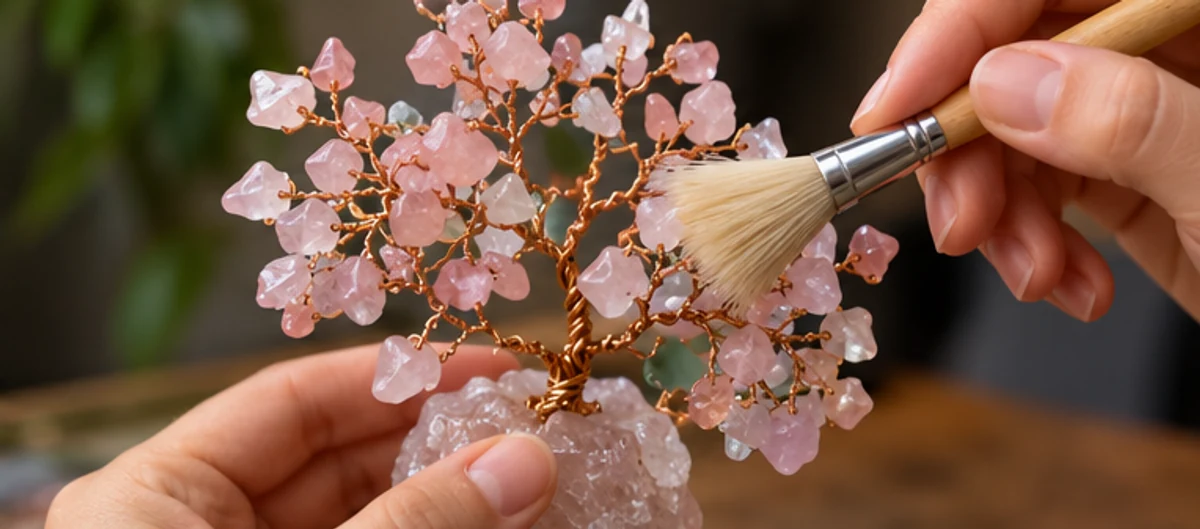
Gemstone-specific care: why different trees need different precautions
Mohs hardness measures resistance to scratching, not overall toughness, cleavage, colour stability or chemical resistance. For example, a quartz chip may be fairly scratch-resistant but still be held by an easily bent wire. Fluorite is softer and has pronounced cleavage, making it vulnerable to hard blows. Pyrite is a sulphide mineral whose moisture behaviour differs from quartz. The table below provides additional cautions, not a licence to rinse any completed gemstone tree.
| Gemstone tree | Material and important property | Practical care priority |
|---|---|---|
| Clear quartz or Sphatik | Quartz, Mohs 7; chips can still have inclusions and fractures | Avoid knocks, abrasive dust rubbing and immersion of the assembly |
| Rose quartz | Quartz, Mohs 7; often translucent with internal textures | Usually light-stable; GIA advises against steam and ultrasonic cleaning of the gem |
| Amethyst | Purple quartz, Mohs 7; some material is light sensitive | Avoid prolonged intense sunlight and sudden temperature changes |
| Citrine or heat-treated amethyst | Quartz; treatments may influence disclosure and appearance | Keep away from heat and prolonged intense light; protect the construction |
| Smoky quartz | Quartz; brown colour may be natural or enhanced | Keep out of intense heat and protect chip edges and wire joints |
| Green aventurine | Quartz-rich material with inclusions; sometimes confused with other green stones | Brush gently; identify any dyed or coated material before using liquid |
| Lapis lazuli | Multi-mineral rock, roughly Mohs 5–6; dye, wax or oil possible | Avoid solvents, vigorous rubbing, ultrasonic and steam processes |
| Moonstone or labradorite | Feldspar family; cleavage and poor-to-variable toughness | Protect from impacts, rapid heat changes and cleaning machines |
| Sunstone | Feldspar; cleavage may matter even with a good polish | Avoid impacts, heat, steam and ultrasonics |
| Fluorite | Calcium fluoride, Mohs 4; easily scratched and cleavable | Avoid soaking, impacts, hard brushes and strong light exposure where colour is sensitive |
| Blue apatite | Apatite group, about Mohs 5; more fragile than quartz | Light dusting; protect against pressure from harder neighbouring chips |
| Peridot | Gem olivine, Mohs 6.5–7; sensitive to rapid uneven heating | Avoid thermal shock, steam and ultrasonic cleaning |
| Howlite | Relatively soft, porous calcium borosilicate; frequently dyed | Avoid solvents and moisture on unknown dye or sealant; keep dry |
| Tiger eye | Quartz-based material showing chatoyancy | Preserve polished surfaces and branch attachments; avoid unnecessary chemicals |
| Black obsidian | Natural volcanic glass with conchoidal fracture | Avoid knocks and sharp exposed fragments; support small chips carefully |
| Black tourmaline or schorl | Tourmaline-group mineral; rough crystals can be fragile at points | Use very soft brush around edges and friable areas; keep base stable |
| Pyrite | Iron sulphide, FeS₂; humidity can promote alteration in susceptible specimens | Favour dry, ventilated storage; inspect unusual powdering or discoloration |
| Garnet or red jasper | Garnet is a mineral group; jasper is silica-rich material | Material-dependent caution; check for treatments and weak attachments |
Amethyst versus rose quartz: GIA notes that some amethyst colour can fade with prolonged intense light, whereas rose quartz is generally stable in light and heat. That does not make either finished tree suitable for direct sun on a hot windowsill. The wiring, adhesive, base and any dyed chips must be considered. Similarly, lapis lazuli jewellery may tolerate carefully selected water-based cleaning, but a lapis tree with numerous treated chips is best treated as an assembled decorative object.
Quartz versus feldspar: Clear quartz and rose quartz have different structural characteristics from moonstone and sunstone. Feldspar cleavage means a sharp knock can break a chip despite a polished surface. Do not use harder chips to scrape or separate a tangled feldspar branch. On mixed-colour trees, the more vulnerable material determines the safest routine.
Can you wash a gemstone tree with water?
Do not wash, rinse or soak a complete gemstone tree as a default cleaning method. Many online demonstrations show loose quartz pebbles being rinsed, but a dense chip tree has cavities, wire wraps, adhesive junctions and an often-undocumented base. Water may remain trapped under a metal finish or inside a porous socket long after the visible crown looks dry. Unknown dyes can migrate; moisture can swell wood, soften some adhesives or contribute to corrosion. A soaked tree may initially look clean and fail later at a weak joint.
A limited damp wipe may be reasonable on an explicitly identified, stable, water-tolerant separate surface if the maker permits it, but it is not the same as placing the entire piece under running water. If a tree has been accidentally splashed, do not shake the crown or use a hairdryer. Move it to a dry, ventilated position, gently blot accessible compatible surfaces and inspect the attachment areas. Consult the supplier if moisture entered the base, a coating became tacky or any metal started to change colour.
| Cleaning method | Whole assembled tree? | Reason or exception |
|---|---|---|
| Dry soft-brush dusting | Usually the preferred choice | Low moisture and mechanical stress when performed gently |
| Dry cloth on an accessible base | Often possible if finish is sound | Keep cloth away from fine wires, rough crystals and loose chips |
| Slightly damp cloth on a tested compatible area | Conditional, local use only | Never allow runoff into trunk, wires or adhesive |
| Rinse under a tap or immerse in a bowl | Not recommended by default | Liquid reaches hidden joints and mixed materials |
| Warm soapy water | Appropriate for some loose gems, not automatically a tree | Stone-specific cleaning standards do not validate the full assembly |
| Ultrasonic cleaner | Avoid | Vibration, fluid and heat can harm gems and attachments |
| Steam cleaner or hot-water spray | Avoid | Heat shock and adhesive or finish damage are possible |
| Vinegar, lemon, bleach, acid or ammonia | Avoid | Chemical attack, colour change and corrosion risks |
| Alcohol, acetone or nail-polish remover | Avoid unless professionally specified | Solvents can remove dye, wax, plastic or protective finishes |
| Oils, furniture polish or wax sprays | Avoid indiscriminate application | Can trap dirt, discolour surfaces and complicate future repairs |
| Compressed air or high-power vacuum | Avoid close-range force | Chips, fine wires and loose fragments may be displaced |
Why ultrasonic and steam cleaning are poor choices
Ultrasonic equipment can be useful in professional jewellery contexts for some suitable gemstones and mounts, but it transmits vibration through liquid. GIA specifically lists sensitive materials including feldspars, fluorite and lapis lazuli among those requiring caution; it also warns about filled or coated stones and vulnerable mountings. A wire tree can have dozens or hundreds of attachment points, none of which was designed or certified as a jewellery setting for mechanical cleaning. Even a quartz-only crown may contain a paint finish or glue that responds poorly to warm liquid and vibration.
Steam adds heat and moisture to a complex assembly. Heat shock can break peridot or moonstone; hot vapour can reach inaccessible joins. The fact that an individual hard gemstone survives a machine once does not prove that repeated cleaning will be safe. A soft brush is a practical alternative that does not make the object carry an unnecessary experiment.
Protect wire branches, trunks and surface finishes
Wire contributes both the silhouette and stability of a gemstone tree. Depending on manufacture, it may be copper, brass, iron alloy, aluminium or another metal with a lacquer, plating or coloured coating. Wire can gradually work-harden after repeated bending; a sharp twist that looks decorative can also become a stress point. A small amount of surface tarnish may be cosmetic, whereas powdery corrosion, a split joint or a loose trunk may need closer attention.
The Canadian Conservation Institute notes that dust and fingerprint deposits can bring abrasive particles, salts and moisture onto metals. This supports a light-touch policy: keep hands clean, avoid unnecessary touching of polished metal and never rub a coated trunk with abrasive metal cleaner merely to restore shine. Traditional copper-cleaning recipes involving lemon, salt or paste are not suitable general advice for a decorated multi-material tree. They can attack surface finishes and leave residues near the stones and base.
If a branch was intentionally designed to be adjustable, move it in small increments at its supported wire portion, not by tugging the attached gemstones. Adjust rarely. If resistance increases, a twist opens or the outer coating cracks, stop. Do not braid additional wire into an original structure without checking balance: added material can place unexpected stress on the trunk and base joint.
| Wire symptom | Possible explanation | Safe next action |
|---|---|---|
| Darker copper-toned areas | Normal tarnish or coating wear | Photograph and ask about finish before polishing |
| Green, white or orange deposits | Possible corrosion products, contamination or paint residue | Keep dry; identify material rather than scrubbing |
| Flaking gold or silver finish | Surface coating deterioration | Stop abrasive rubbing and prevent further handling |
| Branch repeatedly droops | Weight distribution, loose twist or fatigue | Support the branch and seek repair guidance |
| Sharp exposed wire tip | Broken or unfinished attachment | Keep away from fingers, fabric and children; arrange repair |
| Base rotates while trunk moves | Compromised trunk-to-base fixing | Stop repositioning until inspected |
| One chip spins freely | Loose loop, drill-hole wear or missing fastening | Isolate area, photograph and check original construction |
Care for natural bases, resin bases and geodes
The base determines where the weight rests and may be the most vulnerable part during moving. A carved stone or polished agate base is not necessarily fragile in the same way as a painted resin pedestal, but its underside can scratch furniture and its mounting hole may be bonded. A natural quartz-cluster base may have many tiny crystal points that catch cloth and shed loose dust. Wooden bases react to moisture, while some resin and composite finishes can soften or cloud from unsuitable solvents.
Use the manufacturer's description and a close visual inspection. Place a smooth, clean protective mat beneath the base if there is any risk to a glass, polished wooden or stone shelf. Avoid covering the underside permanently with an unknown adhesive pad: the new adhesive can age, leave residue or shift the display's balance. On geodes or rough clusters, never scrub into cavities to make them look uniformly bright; retained natural texture does not mean poor housekeeping.
Keep an eye on the base-to-trunk junction. If there is a visible gap, an unstable wobble, cracked resin or detachment, remove the tree from crowded displays. Household superglue can create a brittle repair, whitening residue and alignment problems, especially near porous stone or a painted finish. A controlled workshop repair often gives a better outcome and should be requested before a valuable or sentimental piece is altered.
Light, heat and placement: prevent damage before cleaning
Preventive care is the easiest way to reduce cleaning frequency. Choose a shelf or stable surface beyond direct midday sunlight and away from the kitchen stove, a bathroom splash zone, humidifier, open window that collects rain, or an air-conditioner outlet with condensation. Do not place the crown where curtains brush across it or where a door regularly clips the outer branches. Keep it away from candles and oil lamps even if the display is part of a puja area.
Light considerations differ across materials. Amethyst can fade after long exposure to intense light; peridot is relatively light-stable but vulnerable to uneven heating; some fluorite colours are sensitive to prolonged light; moonstone is generally light-stable but responds poorly to heat shock. A mixed seven-chakra tree should be placed according to its most sensitive actual component, not according to a single generic statement that “all crystals love sunlight.”
| Display location | Common issue | Better arrangement |
|---|---|---|
| Sunny Bengaluru apartment windowsill | Intense light, hot glass, changing temperature | Shift to an interior shelf with soft indirect light |
| Near kitchen chimney or stove | Grease, heat and airborne deposits | Keep in a clean area away from cooking |
| Open balcony or wet entrance | Rain splash, high humidity, dust and wind | Place indoors on a stable, sheltered ledge |
| Puja shelf with diya or incense | Heat, soot and accidental contact | Maintain distance from flame and falling ash |
| Busy showroom counter edge | Repeated handling, snagging, vibration | Use a stable rear position or covered display |
| Bathroom or near humidifier | Moisture and condensation | Choose a dry room, particularly for pyrite |
| Under a strong adjustable spotlight | Local heat and light concentration | Prefer cool, diffuse display lighting |
Special attention: pyrite gemstone trees and humidity
Pyrite trees are attractive for their metallic gold colour and their contemporary association with prosperity displays. However, pyrite is FeS₂, not brass or gold. Conservation research distinguishes stable examples from susceptible pyrite and marcasite specimens. In the latter, moisture and oxygen can cause deterioration commonly described as pyrite decay. The Canadian Conservation Institute notes heightened risk for susceptible specimens at relative humidity above about 50%; low-humidity storage is therefore important for vulnerable collections.
This does not mean every pyrite-chip tree will deteriorate or that a particular retail tree has an active problem. It means water-washing is not an appropriate universal care recommendation and visibly changing material deserves attention. Look for unexpected powdering, cracking, crystalline deposits, progressive dulling or an unusual change near an affected chip. Do not taste or touch residues unnecessarily, apply oils indiscriminately or scrape them through the rest of the display. Keep the suspect piece away from other valuable objects and seek specialist or supplier advice. Controlling ambient moisture and inspecting periodically is more useful than trying to make the pyrite shine with harsh chemical polishing.
How to clean a mixed seven-chakra gemstone tree
A Sapta Chakra or seven-chakra tree may combine amethyst, lapis or sodalite, blue apatite, green aventurine, rose quartz, citrine, carnelian, red jasper, fluorite or other stones, depending on the maker. There is no universal material recipe for this retail design. Ask for the actual list rather than assuming each colour represents a specific mineral. Dyed howlite and coloured glass can sometimes be sold under similar colour descriptions. Even when every chip is a natural stone, the colour treatment may differ.
For such a tree, identify the most vulnerable materials and choose a cleaning method suitable for all of them and the structure. Dry soft brushing is generally the lowest-risk routine. Protect fluorite and apatite from hard contact, avoid strong light on colour-sensitive chips, keep water away from the wiring and ensure the base is secure. If a dusted seven-chakra tree still looks dull, the cause could be room grease, deposits, a coating or natural variations in the stone; it is not a reason to escalate immediately to vinegar, polish or ultrasonic cleaning.
Traditional cleansing, puja and Kalpavriksha respect
Gemstone trees are used as contemporary decorative forms inspired by the wish-fulfilling Kalpavriksha or Kalpataru image. They may be kept in a place connected with Lakshmi, Kubera, Shri, household prosperity, devotion, concentration or a consciously chosen Sankalpa. A Vastu consultant may recommend a location using the room plan, Dik (direction), Pancha Mahabhuta symbolism, Ishanya or the Vastu Purusha Mandala. Personal practice varies across households and lineages; a mass-produced wire gemstone tree is a modern object, and not every current colour-to-direction claim is a rule from a classical Vastu text.
Spiritual cleansing and physical cleaning are different activities. One is a meaningful ritual expression; the other removes dirt while protecting materials. A simple intention, quiet recitation, Namaskara, meditation, prayer or other family custom can be performed without immersing chips in milk, Ganga water or saltwater. If flowers, kumkum, sandal paste, incense or lamp offerings are part of the space, arrange them so residues and heat do not touch a vulnerable gemstone tree. A soft cloth placed beneath nearby offerings can help keep the surrounding shelf tidy, but should not be wrapped tightly through the crown.
“Moonlight charging,” “sunlight charging,” salt cleansing, smoke cleansing and running-water cleansing are popular modern crystal practices, not universal gemstone-care rules. Extended sun exposure can fade some amethyst; salt and water can compromise metal finishes; smoke deposits fine particles; and oils or coloured powders may stain porous or treated chips. Respecting tradition does not require risking the object. A properly maintained puja or Vastu display can preserve its intention without material damage.
Care schedule for a home, showroom or consultation kit
Frequency should depend on exposure and the tree's actual condition, rather than a rigid ritual requirement. A tree in a closed glass cabinet may need infrequent dusting. A tree near an open Bengaluru window facing road dust or at the front of a shop may need more frequent inspections. Repeated heavy rubbing is not a substitute for better placement or a protective display. Set the schedule by observable dust, not by applying water every Friday or any other fixed day.
| When | Home display | Retail showroom | Professional Vastu kit |
|---|---|---|---|
| Before initial display | Check base, chips and branches; photograph | Inspect packaging and price-label placement | Record material and assembly condition |
| Every few days or as needed | Visual dust and stability check | Check public-access edges and obvious dust | Confirm no pressure damage after transport |
| Periodic maintenance | Gentle dry brush only when dusty | Clean outer accessible areas before opening if required | Light dusting after each session if appropriate |
| Before Diwali or festival arrangement | Inspect, dust, reposition away from flame | Check lighting and display stability | Check safe demonstration setup and storage bags |
| Before packing or gifting | Photograph, support base and crown | Confirm loose parts and care card | Record branch layout and pack individually |
| After relocation | Inspect wire, base and loose chips | Check counter stability and light exposure | Confirm all chips remained attached |
Bengaluru apartment example
Imagine a rose quartz tree on a living-room console near a west-facing window. In late afternoon, sunlight crosses the pink chips; a fan carries roadside dust across the open crown. The solution is not a monthly soaking ritual. Move the display slightly inward, keep the base on a stable protective surface and use a dry soft brush when dust becomes visible. If the cabinet is cleaned with household sprays, remove or protect the tree first so mist does not reach its wires. Place it back only once the surrounding surface is dry.
Jewellery and Vastu showroom example
A showroom display might have pyrite, amethyst, lapis and fluorite trees next to each other. Customers naturally reach for glittering chips, so staff should demonstrate lifting by the base, not the trunk. Store a designated soft brush for gentle cleaning and keep the counter free of adhesive labels that could touch chip surfaces. Position pyrite away from humid air and avoid halogen display heat over amethyst. An acrylic cover or glass cabinet can reduce dust and handling without making the tree inaccessible for sales demonstrations.
Professional consultation or demonstration kit
A consultant transporting gemstone trees for Vastu sessions should photograph each open crown before packing, label boxes by stone and base, and allocate padded compartments. Demonstrate the symbolic placement while keeping the specimen steady on a table. Do not pass a heavy or sharp-edged tree from hand to hand by the trunk. If the practitioner uses direction charts, leave space so compass, papers and bottles of water do not accidentally strike the branch ends. After the session, inspect joins and pack each tree separately.
Transport, storage and unboxing after cleaning
Clean only enough to remove loose dust before packing; do not begin untested wet-cleaning immediately before travel. Use a box with a solid bottom, a protected zone for the base and enough empty space around the crown so it does not bear stacking weight. Soft, clean packing materials can cushion the box and securely protect the base, but stuffing fabric through densely wired branches can deform their silhouette. Do not use loose foam pieces that catch on chipped or rough surfaces. Avoid direct contact between stones of different hardness during transport.
Store in a stable, dry, moderate-temperature environment away from fumes, direct sunlight and dramatic humidity changes. Keep separate trees from rubbing together. If there are labelled accessories or fallen pieces, place them in a clean sealed small bag with the tree’s record, not loose inside the crown. On unboxing, support the base, check against an earlier photograph and adjust only branches explicitly intended to be adjustable. Do not assume a bent wire should be straightened all at once.
Troubleshooting: dust, discolouration, loose stones and repairs
Some changes are ordinary, some may indicate a problem, and others need professional assessment. Dust on an uneven chip can look like fading. Natural quartz may show cloudiness or inclusions that were present before purchase. Copper-toned surfaces can darken over time, while coatings may peel. Pyrite's unusual powdering is a different concern from a uniform aged metallic appearance. Look at the pattern of change, not only the overall impression that the tree looks duller.
| What you notice | First check | Safe response | What to avoid |
|---|---|---|---|
| Light grey film on many chips | Room dust, kitchen aerosol or cleaner overspray | Gentle dry dusting, then improve location | Random chemical cleaners |
| Dull amethyst exposed to strong sun | Old photo, light and heat history | Move away from intense light; document appearance | Heating or dyeing to restore colour |
| A blue chip leaves colour on fabric | Possible dye or surface coating | Stop wet cleaning; ask seller about treatment | Solvents, scrubbing or colour tests on all chips |
| White crystalline or powdery deposit on pyrite | Moisture history, stone stability | Isolate in a dry setting and seek evaluation | Wash, scrape or oil the deposit |
| Loose single chip | Attachment and wire loop | Photograph, retain detached part, request repair | Blind twisting or gluing |
| Hairline fracture in stone | Knock, pre-existing fissure, stress | Avoid handling affected area; document | Pressing or flexing for a closer look |
| Wobbly base | Trunk-to-base joint | Remove from display until stabilized | Testing strength by rocking the crown |
| Sticky or cloudy resin base | Heat, solvent contact or coating aging | Stop applying products; seek maker guidance | Acetone or abrasive polishing |
| Scratch on wooden furniture | Base underside and loose mineral grains | Add suitable removable protector after inspection | Dragging the heavy tree across the surface |
If a chip falls out, avoid improvised magnetic attachment, hot glue or a forceful wire repair on a sentimental display. Keep the chip and take a clear photograph of the exact branch. The maker can determine whether a loop, drill hole, adhesive or fastener needs restoring. For a costly piece, trained repair preserves both appearance and balance. If a sharp wire is exposed, remove the tree from customer or children's reach until it is addressed.
Purchase and after-sales questions that make future care easier
A good gemstone-tree listing should support care decisions before the first dusting. Request a complete stone list for mixed trees, a statement about dyes or other enhancements where known, a clear base material, information on wire finish and whether branches are designed for repeated adjustment. Ask whether any water-based cleaning is permitted for the finished assembly. A certificate for a sampled gemstone chip cannot by itself answer those construction questions.
| Ask the seller | Why the answer matters | Useful evidence |
|---|---|---|
| Which stones are used in the crown? | Identifies the most delicate chips | Material list and close-up photographs |
| Are any stones dyed, coated or impregnated? | Guides solvent and rubbing precautions | Clear treatment disclosure |
| What are the trunk and branch wires made from? | Helps identify tarnish and finish risks | Wire and finish specification |
| Is the base natural rock, resin or another composite? | Determines moisture and abrasion risk | Base photograph and material statement |
| Can the branches be adjusted more than once? | Prevents fatigue-related breakage | Manufacturer handling guidance |
| How are chips fixed? | Helps evaluate loose-chip repair | Description of drilled loops or secure attachment |
| How should the finished tree be cleaned? | Avoids applying loose-gem methods to an assembly | Care card or written instructions |
| Is a repair or replacement chip available? | Supports long-term maintenance | After-sales contact and repair policy |
Twenty frequently asked questions
1. How do I clean a gemstone tree without damaging it?
Start with a clean, very soft, dry brush. Stabilize the base, work around accessible clusters and rotate the whole base to reach different angles. Do not pull on wired branches or use a wet towel through the crown. Inspect loose chips before and after each cleaning.
2. Can I wash a crystal gemstone tree under running water?
Not as an ordinary method. Even if its chips are quartz, the completed assembly can include painted wire, an unidentified adhesive and a porous or finished base. Running water can enter concealed joints; choose dry dusting until the maker confirms the complete tree's tolerance.
3. Is a microfiber cloth better than a soft brush?
A smooth microfiber cloth is useful on an accessible, sound base, but its fibres can snag delicate wire loops and rough crystals. A small soft brush offers better control around chip clusters. Use separate tools for the base and crown when appropriate.
4. Can an amethyst gemstone tree be left in sunlight?
Brief incidental light is not the same as continual intense direct sun. GIA notes some amethyst can fade after prolonged intense light exposure. Position the tree where soft indirect light shows its purple colour without long periods of heating near glass.
5. Does rose quartz need a different cleaning routine from amethyst?
For the completed trees, the first step is the same: careful dry dusting. Rose quartz is generally more light-stable, while amethyst may fade in intense light. Both constructions can still include delicate wire, coatings and adhesive, so their loose-gem cleaning recommendations should not be applied blindly.
6. Can I soak a gemstone tree in salt water for cleansing?
Avoid salt-water soaking. Salts and moisture can affect wire and finishes, while unknown dyes, glues and bases complicate the outcome. If salt has symbolic meaning in your practice, keep it in a separate vessel rather than resting the gemstone tree in it.
7. Is moonlight safe for a gemstone tree?
A brief indirect moonlit display is generally less intense than strong daytime sun, but outdoor exposure introduces dew, humidity, wind, dust and accidental falls. Prefer a protected indoor location and perform a personal prayer or Sankalpa without leaving an elaborate wire object outside overnight.
8. How should I care for a pyrite money tree?
Keep it in a relatively dry environment, avoid soaking and inspect any unexpected powdery changes. Some pyrite specimens can undergo humidity-related alteration, although not all do. Gentle dusting and suitable placement protect both pyrite chips and the metal or adhesive parts.
9. Can I use an ultrasonic jewellery cleaner for gemstone trees?
No as a household default. Ultrasound uses liquid and vibration, and the assembly may contain many delicate attachments. Some gemstones also respond badly to heat, stress or treatment-related instability. A soft brush is a less intrusive choice.
10. What about steam cleaning or a hairdryer?
Avoid steam and direct hot air. Heat or rapid temperature changes can damage certain stones, adhesives or coatings. A high-powered hairdryer can also move branches or blow a loose chip away. Use room-temperature ventilation if accidental moisture is present.
11. Why does a gemstone tree still look cloudy after dusting?
Cloudiness can be a natural internal characteristic, surface coating, trapped grease or fine dust in inaccessible places. Compare with the original product photo and identify the stone before using cleaning chemicals. Do not assume every cloudy chip is dirty or damaged.
12. Should I polish the copper-coloured trunk?
Do not apply generic copper polish without confirming its actual metal and finish. Copper-coloured branches may be plated, painted or lacquered. Abrasives and polishes can remove decorative layers and leave residue around chip attachments. Use conservative dry cleaning first.
13. What should I do if a gemstone chip becomes loose?
Stop bending the affected branch, photograph the attachment and retain any detached chip. Contact the seller or a suitable repair professional with the images. Avoid untested glue or extra wire because these can change the shape and strength of the assembly.
14. How often should a gemstone tree be cleaned?
There is no universally correct weekly or monthly interval. Inspect periodically and remove loose dust when it is noticeable. A protected cabinet accumulates less dust than a roadside-facing showroom counter. Reducing exposure is preferable to frequent rough handling.
15. Can I clean a seven-chakra tree with one gemstone cleaner?
Do not assume one liquid suits every colour or material. Seven-chakra trees vary by manufacturer and may mix quartz, feldspar, apatite, fluorite and treated chips. Use a conservative whole-tree method and identify the actual gemstone list before anything more intrusive.
16. Is incense smoke a safe physical cleaning method?
Smoke may be part of a household prayer ritual, but it deposits particles rather than removing dust. Keep incense and diyas at a suitable distance so ash, heat and soot do not contact the crown. Physical cleaning should still be a gentle maintenance activity.
17. Can I use essential oils or perfume to refresh the tree?
Do not apply oils, sprays or perfume directly to gemstone chips, metal finishes or the base. Fragrance chemicals may stain porous materials or damage some coatings. Keep any scented item separate from the display and avoid direct aerosol spray.
18. Why are some gemstone chips scratched while others look fine?
Chip materials have different hardness and toughness. Fluorite and apatite can be scratched or chipped more readily than quartz; handling and contact between neighbouring stones also matter. Avoid stacking trees together or forcing dense branches apart during dusting.
19. How do I pack a gemstone tree when shifting house?
Photograph its arranged shape, protect the base securely and prevent external pressure on the crown. Pack each tree separately in a sturdy box with suitable padding, keeping fibre material out of fragile wire loops. Inspect the trunk and attachments carefully after unpacking.
20. Does cleaning improve the tree's Vastu or spiritual significance?
A clean, respectfully arranged display can support a family's devotional intention and a well-kept Vastu environment. But physical dust removal is not a measurable guarantee of prosperity or other outcomes. Preserve the Kalpavriksha symbolism through careful placement, Sankalpa and maintenance without subjecting the object to harmful treatments.
Final maintenance checklist
Before leaving the tree on display, confirm that the base is level and steady, all visible chip attachments are intact, no exposed wire can catch a hand or fabric, and no new moisture or residue has entered its construction. Check that the location avoids strong heat, prolonged harsh light, dripping water and frequent accidental contact. Keep the gemstone/material description and care instructions with your purchase record; they are especially useful when replacing a missing chip or obtaining a repair years later.
The simplest reliable approach is consistent: inspect, stabilize, gently dry-dust, protect, and repair when necessary. That method respects the physical diversity of gemstone trees and leaves space for the household's devotional use without compromising the appearance of a cherished Kalpavriksha display.
Research basis: GIA’s gemstone-specific care and cleaning guidance for amethyst, rose quartz, peridot, lapis lazuli, moonstone and sunstone; GIA’s discussion of ultrasonic-cleaning limitations; the Canadian Conservation Institute’s preventive-conservation guidance for metals and natural-history specimens; and material information from Mindat and the International Gem Society. These references inform physical conservation decisions. Traditional Kalpavriksha, Lakshmi–Kubera, Sankalpa and Vastu descriptions are presented in their devotional and decorative context rather than as laboratory cleaning procedures.
