Colour and character
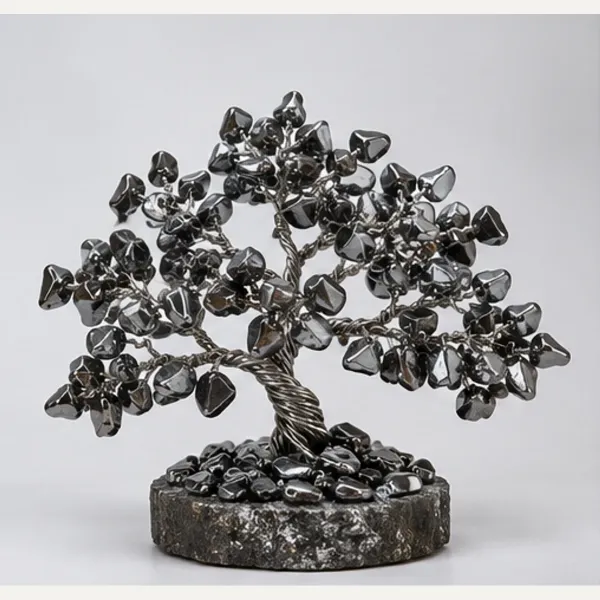
A hematite tree makes an impression through compact form and small reflections. The dark chips gather into a low canopy, while fine wire branches keep individual clusters visible. A stable-looking base and a modest trunk give the design a grounded outline without requiring a dense wall of colour. On a simple light surface, the contrast between bright highlights and quieter grey areas can be particularly appealing. It is a decorative choice for someone drawn to metallic textures and a restrained, small-scale silhouette.
Enjoying the gemstone palette
The label hematite should be kept separate from assumptions about magnetism, coatings or the weight of a finished object. A metallic-looking surface is a visual feature, not proof of a particular composition. Enjoy the complete palette and shape while using the actual item details for any material-specific statement. Pyrite offers a warmer brassy comparison, while black tourmaline creates a different dark-chip character.
An easy place to display
Try pale wood, cream or a medium neutral background that gives the compact crown definition. A low tree can be hidden behind taller ornaments, so keep the immediate arrangement open. On a desk, place the base beyond the movement of hands, cables and drink containers. There is no need to put it against equipment for a claimed magnetic or protective effect; its sculptural appearance is sufficient.
Personal meaning
A compact dark tree can represent steadiness or patient attention as a personal symbol. Contemporary crystal language sometimes connects hematite with grounding, but a decorative object does not need a promise about energy or protection to carry meaning. It might mark a particular workspace, a new routine or simply an appreciation of a cool metallic palette.
Care for the whole tree
Support the base securely when moving the tree and dust with a soft dry brush. Avoid immersion, household sprays and polishing chemicals until the actual chips and finish are understood. Do not test the object by dropping it, scratching it or repeatedly applying magnets. If the crown can be arranged, use small supported movements rather than twisting the trunk.
Questions about this design
Is every hematite-labelled tree magnetic?
No magnetic property is assumed here. The actual composition and any treatment or manufactured component need to be described accurately rather than inferred from a metallic look.
Can I judge its weight from the picture?
A close-up cannot establish net weight. The base, wire and chips all contribute to the finished object; use a measured value only when one is supplied for the item.
Which metallic tree offers a warmer colour?
Pyrite is chosen for a brassy palette, while the hematite direction here is darker and cooler. Compare their full silhouettes and textures rather than treating them as matching finishes.Explore this tree in more detail