
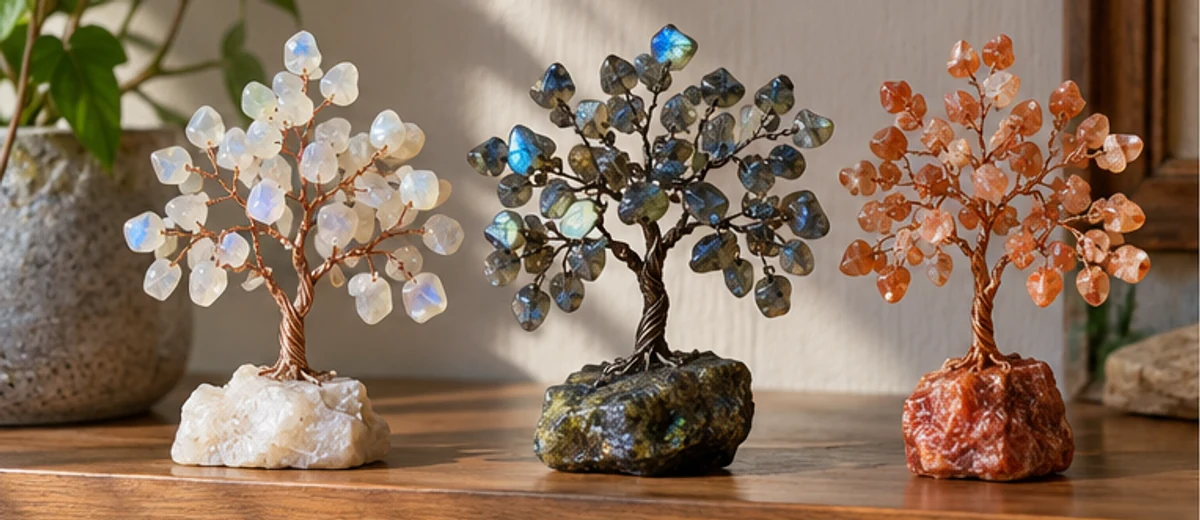
Moonstone, labradorite and sunstone gemstone trees are three distinct ways to enjoy the feldspar family. A moonstone branch can have a quiet, billowing sheen; a labradorite chip may turn suddenly blue or green; and a sunstone chip can show small coppery or golden points of reflected light. All three are valued in contemporary gemstone-tree arrangements, yet their names, mineral structures, optical phenomena, buying risks and handling needs are not interchangeable. This guide begins with the stone itself, then considers craftsmanship, Kalpavriksha symbolism, Vastu placement, puja use, professional evaluation and sensible care.
A tree is not one large cabochon. Its dozens of chips sit at different angles, often on twisted or wrapped wire. Consequently, a photograph that captures one spectacular blue flash cannot promise that every branch will look equally bright after delivery. A realistic purchasing decision combines the complete silhouette with close-up component photographs and accurate material disclosure.
1. What connects these three gemstone trees? The feldspar family
Feldspar is an extensive mineral group found in many rocks, not a single gemstone species. Traditional moonstone is commonly associated with orthoclase and albite feldspar intergrowths; labradorite belongs to the plagioclase range; and sunstone can occur in more than one feldspar composition, including orthoclase and plagioclase varieties. This mineral-family connection explains why all three may show interesting light behaviour without making every pale or glowing feldspar a moonstone.
For a gemstone tree, the mineral name should describe the actual chips offered. The tree may also contain copper-coloured wire, an artificial trunk, adhesive and a stone or resin base. Calling the entire craft object a “natural gemstone tree” should not conceal any plated, dyed, reconstructed or manufactured components. A correct material description makes the traditional symbolism more meaningful because the buyer knows what has actually been selected.
Feldspar gems commonly have significant cleavage, meaning there are directions in their internal structure along which a hard impact can cause splitting or chipping. A loose chip protected in a pouch behaves differently from one attached to an exposed wire branch. Even though the tree is usually displayed rather than worn, its vulnerable tips and thin stones deserve gentle handling.
| Tree material | Typical body appearance | Key optical phenomenon | What to expect in small chips |
|---|---|---|---|
| Moonstone | Cream, white, peach, grey or translucent | Adularescence: a soft moving sheen | Only selected chips may show a visible billow of light |
| Labradorite | Grey-green, charcoal or pale translucent | Labradorescence: directional colour flashes | Blue or green flashes appear only at some angles |
| Sunstone | Peach, orange, golden, brown or sometimes other colours | Aventurescence: tiny reflective flashes in phenomenal material | Some pieces sparkle; others show body colour with little visible glitter |
| Rainbow moonstone | Often pale, sometimes with rainbow sheen | Trade name for a labradorite feldspar | Check actual species and confirm trade terminology |
| Goldstone | Usually reddish-brown glass with dense sparkle | Man-made glass containing reflective particles | Decorative imitation, not natural sunstone |
2. Three light effects: adularescence, labradorescence and aventurescence
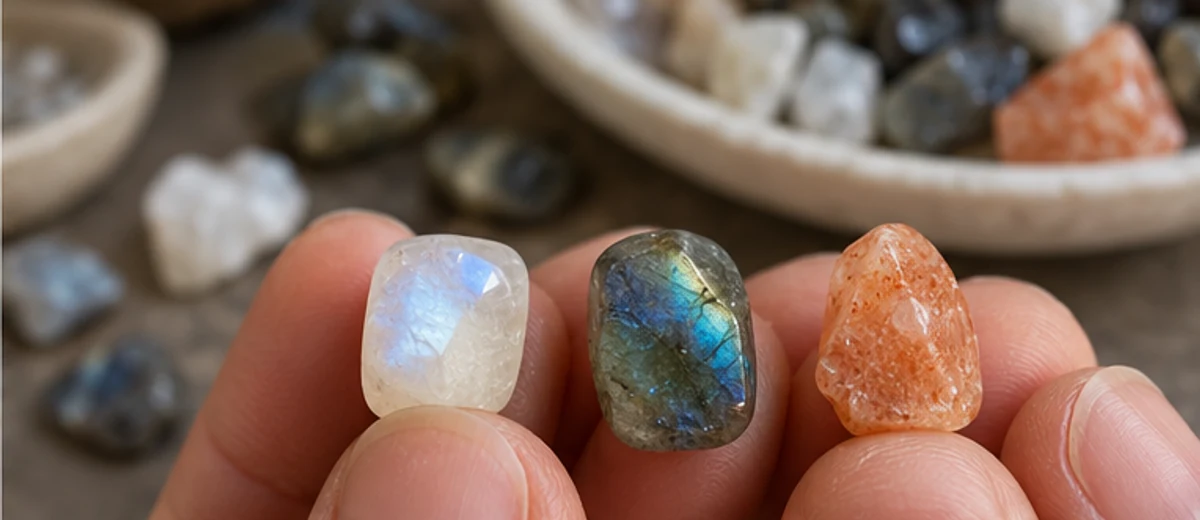
Adularescence is a soft, luminous sheet of light that appears to float or move within a moonstone when the object or the viewer changes angle. In many moonstones, thin feldspar layers scatter light to produce this appearance. It is not fluorescence, self-illumination or a permanent glowing coating. Pale chips against an equally pale wall may show little contrast, even when the mineral is genuine.
Labradorescence produces comparatively broad, angular flashes of blue, green and sometimes gold or other colours. It arises from the interaction of light with very fine internal layers in labradorite. Many pieces look subdued until rotated into favourable viewing geometry. Some attractive labradorite chips will show almost no flash from a particular fixed viewpoint. Their brown-grey body colour is therefore part of the aesthetic, not necessarily evidence of low quality.
Aventurescence is a different spectacle: small reflective platelets inside some sunstone produce a concentrated metallic-looking glitter. Depending on the sunstone variety, inclusions may involve copper or iron-bearing minerals such as hematite or goethite. Not every natural sunstone must show strong glitter; material name, body colour and specific optical effect should be described separately. Glittering goldstone glass may look bright, but it remains a manufactured substitute.
An accurate photo set should include natural indirect daylight, moderate indoor side lighting, and a short rotation if available. Excessive saturation, a point-source spotlight or editing can turn a selective optical effect into an unrealistic expectation. Use normal viewing distance to judge the complete crown, then inspect two or three representative chips closely.
| Optical cue | Moonstone | Labradorite | Sunstone |
|---|---|---|---|
| Movement | Soft cloudlike glow moving under the surface | Bold patch or band shifts on rotation | Separate specks or reflective plates brighten and dim |
| Best viewing habit | Slowly tilt toward indirect side light | Rotate tree base gently; observe from several angles | Move under even light and examine discrete flashes |
| Misleading photograph | One unusually brilliant blue chip | Only the brightest face in studio lighting | Extreme close-up under a harsh spotlight |
| Buying question | Does the actual crown show adularescence? | Which faces visibly flash, and how often? | Is the sparkle natural feldspar or glass? |
3. Moonstone trees: soft white, peach and blue sheen
A moonstone tree may feel visually quiet compared with a multicoloured crystal tree. White, cream and peach body colours work with a modest puja corner, a reading desk or a simple shelf. A loose, open crown often suits moonstone because individual pieces receive gentle side light. A pale wall, however, may hide a pale stone: a darker wooden or neutral textile background can help the edges of the chips remain visible without using intense illumination.
In the gemstone trade, the finest moonstone is often judged by attractive, mobile sheen and pleasing body colour, but a craft tree is a different type of object. Small irregular chips were not all cut as individual cabochons to maximize adularescence. Some may be milky, some nearly colourless, and some more translucent. Consistency should be assessed at the advertised grade and price, not against photographs of high-end polished single stones.
Do not confuse ordinary milky quartz, white glass or dyed chips with moonstone on the basis of a photograph. A visible sheen is useful evidence, but mineral identification can require refractive-index or other gemmological work. The seller should identify whether the material is conventional moonstone or rainbow moonstone, and should disclose any known treatment or substitution. When the precise component species has not been laboratory established, it is better to state what is known than invent certainty.
Moonstone is commonly given a gentle Chandra-related meaning in contemporary Indian gemstone practice: reflection, coolness, emotional balance, and a settled atmosphere. That association can inform a decorative choice without making a small wire tree the same thing as a prescribed Jyotish moonstone ring. Traditional Chandra gemstone recommendations are personal and require different criteria from choosing a pleasant shelf ornament.
4. Labradorite trees: why the flash is never uniform
Labradorite trees reward movement and observation. A chip with dark grey or greenish body colour can suddenly reveal a blue or green field, whereas neighbouring chips may remain quiet. This optical selectivity makes a layered, asymmetric tree particularly attractive: the crown has depth even when no flash is visible. On a desk, the effect often changes through the day as windows and lamps create different angles between light, stone and observer.
When buying a labradorite tree, first decide whether the general grey-green palette suits the room. Then ask for a full-tree video that rotates the base, not a video of a detached premium stone. Request an ordinary daylight image and a close-up of representative chips. The fact that the material is labradorite does not guarantee a certain number of blue-flashing pieces or an electric-blue flash on every side. Claims such as “all chips glow continuously” are not realistic descriptions of labradorescence.
Some labradorite is sold under names such as spectrolite, and pale labradorite may be sold as rainbow moonstone. These can be legitimate trade descriptions when their meaning and origin are clear, but neither is an automatic indication of higher value. An especially vivid colour in a photo does not demonstrate a particular geographic origin, and a dark tree should not be represented as Finnish spectrolite without supporting evidence.
For a meditation space, labradorite is often used in contemporary crystal practices as a symbol of inward attention, clarity and transition. Those are meaningful modern associations, not proof that historic Vastu manuals listed labradorite-chip trees as required directional rectifiers. A professional should keep the classical layout assessment distinct from an optional decorative gemstone choice.
5. Sunstone trees: warm feldspar sparkle rather than manufactured glitter
Sunstone can offer warm peach, apricot, orange, brown or copper-toned accents. Some pieces have discrete glittering platelets; others present attractive warm colour without obvious sparkles. The best composition need not be intensely orange. A restrained warm crown can sit well near natural wood, handmade ceramics and earthy interiors. Against an already busy golden wall, a lighter backdrop may show the chips more clearly.
Sunstone is a feldspar name associated with more than one mineral composition. Oregon sunstone is a noteworthy natural feldspar material that may contain copper platelets, but an ordinary sunstone-chip tree should not be labelled “Oregon copper sunstone” solely because a supplier uses attractive marketing photographs. Origin, copper inclusions, treatment and the lot being sold need evidence appropriate to those claims. Ordinary chips do not inherit the provenance or price of a fine faceted specimen.
Goldstone, by contrast, is deliberately manufactured glass with shimmering inclusions. It can be an appealing craft material if described as goldstone; it should not be billed as a natural sunstone gemstone tree. Similar caution applies to copper-flaked resin, metallized beads or orange glass. A convincing material specification is more useful than an exaggerated promise that every reflective fleck proves a rare mineral.
In contemporary spiritual vocabulary, warm sunstone colours are sometimes linked with Surya, Tejas, vitality and purposeful effort. These associations may help choose a gift or desk ornament. They are not an automatic substitute for the classical solar gemstone Manikya (ruby), and they do not establish any physical or astrological effect merely from a colour match.
6. Rainbow moonstone, spectrolite and other trade names
Trade names matter because “moonstone” is sometimes used broadly for a desirable appearance, not for a single feldspar species. Rainbow moonstone is widely accepted in the market, but it is generally transparent to translucent labradorite with multicoloured sheen rather than classic orthoclase moonstone. A seller who lists “moonstone and rainbow moonstone” as two tree options should explain that distinction clearly.
Spectrolite is associated particularly with exceptionally colourful Finnish labradorite, and its name should not be stretched into a generic label for every dark stone with a blue patch. Likewise, “sunstone” does not guarantee copper inclusions, and “moonstone” does not guarantee brilliant blue light. The description should identify mineral, trade name, available origin data, known treatment and actual optical performance as separate characteristics.
| Label on a seller page | What it usually indicates | What still needs checking |
|---|---|---|
| Moonstone | A feldspar showing adularescence; often orthoclase-related | Actual species, treatment, chip grade and representative sheen |
| Rainbow moonstone | Often pale labradorite with multicoloured sheen | Trade disclosure; not automatically orthoclase |
| Labradorite | Plagioclase feldspar; possible labradorescence | Whether the offered chips visibly flash in ordinary light |
| Spectrolite | A name strongly associated with Finnish labradorite | Origin evidence and true material description |
| Sunstone | Feldspar, sometimes showing aventurescence | Inclusions, geographical origin and any enhancements |
| Oregon sunstone | An origin-specific product claim | Traceable source and actual sample rather than stock images |
| Goldstone | Manufactured sparkling glass | Must not be represented as natural sunstone |
7. How to examine a gemstone chip without harming it
Begin with direct observation rather than scratching, burning, immersing, or using acid on the tree. Ask for sharp photographs of the actual lot at normal and close distances. Look at each chip from more than one angle to see whether a perceived glow moves, whether a flash is local and directional, or whether glass-like bubbles and uniform glitter suggest another material. A 10× loupe can reveal cracks, small coatings, adhesive residue and rough drill-hole edges, but it cannot by itself certify every feldspar species.
The feldspar family has overlapping appearances, and mineral species may require refractometer readings, microscopy or laboratory methods. A hardness scratch is particularly unwise on a finished ornamental tree: it can scar polish, dislodge chips or damage surface treatment. Reports should identify the submitted sample and testing scope. A certificate for one chip never certifies the full assembled tree or the origin of the wire and base.
Examine the stringing or wrapping holes where chips touch wire. A bright flash cannot compensate for sharp metal ends, unstable glue, a loose base or cracked stones. Ask whether the branches are intentionally adjustable. Some crafts use soft copper-coloured wire; others have rigid or lacquered forms. Neither should be bent repeatedly to chase a better optical angle.
| Observation | Reasonable inference | What it cannot prove |
|---|---|---|
| Mobile cloudy light | May be adularescence | Species, natural origin, or complete-tree authenticity |
| Blue-green patch that appears on rotation | May be labradorescence | Every chip will perform identically |
| Separate coppery sparkles | May be sunstone aventurescence | Oregon origin or natural untreated status |
| Fixed glitter in an extremely uniform matrix | May indicate goldstone or another craft material | Exact composition without closer inspection |
| Pale chips without obvious sheen | Could still belong to a feldspar lot | That all chips are fake or genuine |
| Retail certificate for one selected gem | Information about the tested sample | Authentication of every component of the tree |
8. How many chips, which branch style and which base?
A gemstone tree is a manufactured object. Its quality includes more than the gemstone label: chip count, size distribution, wire gauge, branch connection, canopy symmetry, base strength, adhesive quality and finishing matter. A high-chip-count advertisement can conceal tiny pieces that barely show an optical effect. Conversely, fewer generously spaced chips may offer more visible movement and easier dusting. Ask for total width and height in centimetres and the approximate weight of the entire finished tree.
Check the exposed branch ends. A cut metal tip should be tucked safely away from hands and fabrics, while the trunk should not wobble or rotate unexpectedly. Glue should remain discreet, with no visible pooled residue or loose grains near the base. A broad foot and central trunk offer stability on a busy retail counter. If the base is stone, resin, cement or wood, the material should be identified separately from the gemstone chips.
A mixed feldspar tree can also be appealing, but its listing should say “moonstone, labradorite and sunstone mix” only if all three chip groups can be supported by the actual item. A generic label such as “nine-planet crystal tree” is not evidence that the stated material corresponds to an accepted Navaratna selection. Accurate component naming is the best starting point for any deeper spiritual interpretation.
| Construction check | Useful seller detail | Red flag |
|---|---|---|
| Chip count and size | Approximate number and close-up of actual lot | Only an exaggerated stock photo |
| Branch layout | Whole-tree front and side views | Tangled wire or lopsided unsupported branches |
| Material label | Feldspar type plus any trade designation | All glowing chips called natural moonstone |
| Base | Dimensions, composition and stable footing | Loose glued trunk or a hidden weight imbalance |
| Metalwork | Wire colour, coating and whether adjustment is allowed | Exposed sharp ends or repeated cracking |
| Price | What is included, shipment protection, return conditions | Unverified rare-origin or laboratory claims |
9. Kalpavriksha and the meaning of a modern gemstone tree
The tree form carries a rich cultural meaning independently of mineral identification. The Kalpavriksha or wish-fulfilling tree appears in Indian traditions as a symbol of abundance, blessings, shelter and the fulfilment of worthy aspirations. A historical sandstone representation from Besnagar, held by the Indian Museum in Kolkata, shows auspicious objects such as a coin purse, conch, lotus and vessel of coins in a tree motif. That historical image demonstrates the old symbolic importance of the tree, not a claim that contemporary wire-and-chip gemstone trees are the same ritual object.
A modern gemstone tree brings this broader symbolism into domestic and commercial interiors. Roots suggest steadiness, the trunk continuity, branches expansion and gemstone leaves growth. In a gift, the choice may express a wish that knowledge, relationships, prosperity or purposeful work should flourish. Moonstone can emphasize a gentle, reflective intention; labradorite an inward, attentive mood; and sunstone a warmer sense of optimism or enterprise.
The traditional terms should be used carefully and richly: Sankalpa is a deliberate intention; puja is an act of worship or offering; Lakshmi and Kubera represent distinctive streams of auspiciousness and prosperity in devotional traditions; and Pancha Mahabhuta offers a language for thinking about earth, water, fire, air and space. None of those ideas requires declaring an unrelated commercial gemstone-tree configuration mandatory or universally prescribed.
10. Vastu placement: start with the room rather than a blanket direction
Begin by considering the use of the room, clean available surfaces, movement around furniture, the direction of light and the home’s existing puja practice. In Indian Vastu discourse, Ishanya (northeast) often carries associations of purity, devotion and spiritual attention; the east may be understood through sunrise and Surya; and the north is commonly associated with Kubera in popular placement guidance. These ideas can provide a traditional vocabulary for placement, but they are not interchangeable with a measured Vastu assessment of a specific building.
A moonstone tree near a quiet puja shelf may suit a calm visual arrangement, but do not put fragile chips where water from offerings, oil, kumkum or incense ash will strike them. A labradorite tree works well where one can enjoy changing light without handling the wire repeatedly. A sunstone tree may be chosen for a work desk or shop reception based on colour symbolism and appearance, provided it is not placed on a window ledge where heat and accidental knocks are likely.
For professional Vastu work, record the actual entrance, zones, usage, built features and occupants’ priorities before selecting ornaments. A gemstone tree is better presented as a meaningful optional part of the setting than as a universal rectifier for structural concerns. Do not use a small decorative object to excuse leaks, cluttered circulation, ventilation problems or unsafe electrical layouts.
| Location or purpose | Traditional context to discuss | Practical choice |
|---|---|---|
| Home puja corner | Ishanya, Sankalpa, devotional calm | Moonstone or a pale mixed tree on a dry protected shelf |
| Study or meditation desk | Attention, introspection, Saraswati association | Moonstone or labradorite with restrained lighting |
| Reception or business desk | Lakshmi, Kubera, orderly welcome | Sunstone or a mixed tree with a stable base |
| North or east-facing room | Kubera / Surya vocabulary in popular Vastu | Choose by actual light and safe clearance, not compass alone |
| Bright window ledge | Not essential to traditional placement | Avoid overheating, falls and strongly focused sunlight |
| Professional study kit | Ashta Dik, Pancha Mahabhuta comparisons | Labeled samples plus photographs and material records |
11. Chandra, Surya and Navagraha: symbolism is not chart prescription
Moonstone is often discussed in connection with Chandra, the Moon, and qualities such as coolness, tenderness and reflection. Sunstone is often linked in contemporary crystal traditions with Surya, radiance, confidence and active endeavour. Labradorite is more commonly encountered in modern contemplative practices than in the traditional canonical list of Navagraha precious gemstones. These associations can be meaningful when explained as traditions or contemporary interpretations rather than forced into a universal substitution chart.
In Jyotish, planetary gemstone advice ordinarily considers the birth chart, lagna, graha dignity, house rulership, dasha and individual context. A wire-and-chip tree is not automatically equivalent to a chosen wearable Ratna. For example, the classical solar gem Manikya (ruby) and traditional lunar gem Mukta (pearl) have their own symbolic and astrological histories. Calling sunstone “the Surya stone” or moonstone “the only Chandra gemstone” would oversimplify those traditions.
The Navagraha names—Surya, Chandra, Mangala, Budha, Brihaspati, Shukra, Shani, Rahu and Ketu—belong to a wider intellectual and devotional system. An article can explain them clearly without pretending that three feldspar trees span the full system. When a customer wants a personal chart-based recommendation rather than a decorative spiritual object, that is a separate consultation.
12. Worked example: a Bengaluru apartment puja and reading shelf
Consider a compact two-bedroom apartment in Bengaluru with a living-room niche used for evening prayers and reading. The shelf has limited depth and receives a little indirect light from a side window. A very large gemstone tree would crowd the prayer objects and may strike the shelf door. A small moonstone tree with a stable base may fit comfortably behind the daily-used items, with enough clearance to avoid cleaning spills and incense residues.
The owner may choose the tree because its pale appearance supports a peaceful atmosphere and reflects Chandra-related associations. They might prefer a simple Sankalpa during personal prayer rather than treating the item as a mechanical device. Its practical care remains straightforward: hold the base, dry-dust gently, do not pour water over the branches, and keep a safe gap from a diya flame. If the actual chip lot has only subtle sheen, that is noted before purchase rather than treated as a defect discovered later.
Another household may prefer labradorite simply because the occasional blue flash adds visual interest. The correct choice is not decided solely by the room’s direction. The household’s daily routine, display safety, devotional practices, actual light and preference should all be considered.
13. Worked example: a jewellery showroom and consultation counter
A gemstone shop can display a sunstone tree beside a neutral identification board, but the sample should not be introduced as rare Oregon material without supporting documents. A small sign can say “Feldspar with warm colour; selected chips may show reflective inclusions,” and a nearby comparison may show a manufactured goldstone bead. This is more educational—and more persuasive—than a banner claiming every glittering chip has extraordinary origin or guaranteed benefits.
A second display could place labradorite under broad, soft side lighting and show a short video of the actual offered tree turning through several angles. Some buyers will choose it for blue flashes; others will reject it because they prefer constant colour. Both reactions are valid. Staff should never tilt a delicate tree by its branches to force an effect during a demonstration. Hold and rotate the base instead.
For gifting, offer the buyer a concise card about Kalpavriksha and the chosen symbolism, while listing actual materials, size, branch adjustability, and sensible cleaning. The professional presentation separates spiritual tradition, decorative appeal and verifiable merchandise information instead of making all three sound like the same claim.
14. Worked example: a professional Vastu reference kit
A professional kit should make comparison reproducible. Include individually labeled samples or sturdy trees for moonstone, labradorite and sunstone, a manufactured goldstone comparison, a neutral grey background card, a small light source, and a record sheet that notes lighting direction and any known identification or treatment information. A foldable board marked north, east and other directions can support teaching Ashta Dik without implying that every gemstone sample must occupy a fixed directional square.
The practitioner may demonstrate that the same labradorite chip changes radically with angle while the gemstone remains unchanged. This makes an excellent example of why appearance cannot be judged from one image. Moonstone demonstrates a more diffused sheen; sunstone may show discrete glitter. The exercise also prepares the consultant to explain trade terms and prevent a client from confusing rainbow moonstone, labradorite and goldstone.
Separate the educational comparison from any specific recommendation. Record which attributes are objectively observed, which names are supplier-reported, and which meanings belong to tradition or contemporary crystal culture. A good professional kit is a teaching aid, not a substitute for gemmological identification or building-level Vastu assessment.
| Sample / tool | Purpose | Label information to retain |
|---|---|---|
| Moonstone sample/tree | Observe moving soft sheen | Source, trade term, chip grade and observed adularescence |
| Labradorite sample/tree | Observe broad directional flash | Viewing angle, body colour and flash distribution |
| Sunstone sample/tree | Observe warm body colour and reflective points | Any inclusion, treatment and origin claims |
| Goldstone bead | Show manufactured glitter imitation | Clearly marked as man-made glass |
| Neutral background and lamp | Compare under consistent conditions | Lighting type, distance and date |
| Inventory sheet | Prevent unsupported origin/certificate statements | Lot number, actual dimensions and supporting documents |
15. Choosing a tree: a step-by-step buyer checklist
Start with the purpose. Is the tree for a puja shelf, a housewarming gift, a meditation desk, a business reception or a professional demonstration? Select the approximate physical size and colour palette before paying extra for a named optical effect. Then ask for front, side and base photographs of the actual piece, with at least one image taken under ordinary diffused room light.
Next, compare mineral naming and origin claims. Is “rainbow moonstone” disclosed as labradorite? Is “sunstone” differentiated from glittering goldstone glass? Does a certificate refer to this actual lot, a separate representative sample or an unrelated premium specimen? Ask whether chips are dyed, coated, backed, impregnated or assembled if that information matters to the price and care plan.
Finally, confirm build quality and delivery conditions. Check height, width, base footprint, total weight, approximate chip size, stable wire ends, whether branches are adjustable, return conditions, and protection against movement during transit. A fine gemstone cannot compensate for a collapsing tree. The best purchase is a transparent combination of attractive material, workmanship and a realistic display expectation.
| Buying stage | Ask or inspect | Why it matters |
|---|---|---|
| Purpose | Home, puja, gift, shop or professional set? | Sets appropriate scale and symbolism |
| Real materials | Feldspar type and trade names disclosed? | Prevents moonstone / labradorite / sunstone confusion |
| Optics | Actual-tree photo or rotation under normal light? | Reduces unrealistic flash expectations |
| Treatments | Known dye, coating, filling or substitute? | Supports care and price decisions |
| Physical quality | Base stability, secure chips and smooth wire ends? | Prevents breakage and injury |
| Reports | What exact sample was tested? | Stops one report being used for an entire tree |
| Delivery | Dimensions, protection, returns and damage policy? | Helps manage transport risk |
16. What photographs and videos should a responsible seller provide?
Photographs should tell the truth about a complex object. Provide a front view of the entire tree, a side view of its canopy, a clear base image, two or three close-ups of actual chips and an ordinary room-light image. A brief rotation video is especially useful for moonstone and labradorite. If a bright spotlight image is included, label its lighting conditions rather than presenting it as the only appearance.
Include a ruler or dimension graphic, but do not obscure the mineral surface with overlaid words. A white balance that turns grey labradorite electric blue or peach sunstone bright orange undermines accurate choice. Inform the buyer when an image is representative rather than an image of their exact piece. Stock or illustrative photographs are useful for education, but should not be used as proof of a particular item’s optical effect.
A tree photo against a neutral lived-in Indian home shelf can be more helpful than an unrealistically immaculate fantasy altar. It lets the customer visualize actual scale, wire shadows and daylight variation. Where customer photographs are used, permission and privacy should be respected.
17. Pricing, quality grades and authenticity reports
Finished-tree price depends on the chip quality and quantity, actual mineral identity, branch craftsmanship, base, size, labour, packaging and the reliability of the seller. These factors do not rise together automatically. A tree with a vivid few labradorite chips might be more interesting than a larger tree whose stones have almost no flash; a cleanly assembled moonstone tree may be a better gift than one with a badly finished trunk and more expensive chip claims.
Avoid ranking prices by general gemological value alone. A clear blue-sheen moonstone cabochon is not the same merchandise category as a tree made from small chips. Likewise, fine faceted Oregon sunstone prices do not establish the value of an ordinary decorative sunstone tree. Do not assume a high price proves natural origin, and do not assume a lower price proves glass.
Laboratory documentation is useful when its scope is clear. A report might identify a submitted loose sample, but the final tree contains many chips, often from different batches, plus wires and adhesive. An invoice should name the materials actually used. If the supplier cannot verify a claimed origin or laboratory grade, the description should avoid presenting it as verified fact.
18. Safe cleaning, storage and handling of a mixed-material tree
Feldspar pieces can scratch or chip, especially along cleavage directions. Hold the base while moving the tree, keep branches clear of adjacent objects, and do not use an ultrasonic cleaner or steam jet on the assembled craft. Although some individual feldspar gemstones can be cleaned with warm soapy water, a completed gemstone tree is a different mixed-material object: its wire coatings, adhesive and base may not tolerate soaking. Gentle dry dusting with a soft brush is a sensible default unless the maker has supplied more specific instructions.
Keep the tree away from direct heat, strong cleaning sprays, acidic products, saltwater, repeated wet offerings and the immediate flame of a diya. Wipe dust from the base separately with the appropriate dry or slightly damp material if the maker permits it, keeping moisture away from joins. If an individual stone becomes loose, stop moving the branches and ask for repair rather than forcing it back with household solvent or hot glue.
For storage, wrap the crown loosely with soft inert padding without squeezing the tips; stabilize the base separately in a well-fitting box. Avoid packing different trees tightly together so their chips cannot knock or abrade one another. Protect metal parts from persistently damp conditions, and inspect periodically for corrosion, adhesive failure or movement in the trunk.
| Issue | Recommended approach | Avoid |
|---|---|---|
| Routine dust | Soft dry brush, support the base | Holding a branch and shaking the crown |
| Fingerprints | Light dry microfiber contact on accessible stable surfaces | Aggressive rubbing at sharp chip tips |
| Puja ash and oil | Place tree beyond direct offerings and flame | Oil baths, incense contact or repeated water pouring |
| Moisture | Store dry; inspect wire coating and joins | Soaking mixed materials or salty rinse |
| Loose chip | Isolate object for proper repair | Bending branch or hiding crack with fresh glue |
| Storage | Padded box with supported base and air space | Compressed canopy or uncontrolled humidity |
19. Packing and shipping without crushing the gemstone crown
Trees are structurally awkward to ship because the base may be heavy while branches are light and flexible. The packaging should immobilize the base, keep the crown away from box walls and stop stones from striking hard objects. Fit soft, non-abrasive sleeves around vulnerable branches only where they will not tug chips free. Use a rigid outer box with space for impact-absorbing material and clear handling guidance.
Before sealing, photograph the item, measure the packed dimensions, record the lot or order number and check that no branch is under tension. After transport, advise the recipient to lift by the base, remove protection gradually and inspect for loose chips or sharp wire ends. Do not instruct everyone to spread the branches aggressively on arrival: some products are fixed, while others permit minor adjustments within the wire’s safe bend range.
For a gift or professional reference kit, include a compact card explaining the three optical effects and the difference between a naturally occurring gemstone and a manufactured lookalike. Clear, grounded information strengthens trust and reduces avoidable post-delivery disputes.
20. Common buying mistakes—and a practical final recommendation
The most common mistake is purchasing the photograph instead of the object. A spectacular isolated moonstone chip, a labradorite face lit at the perfect angle and a sparkling sunstone under a spotlight are all attractive—but none describes how an entire tree will appear from the sofa, the puja seat or the counter. A second error is treating a supplier’s trade name as a full mineral identification. A third is confusing spiritual symbolism with a guaranteed commercial result.
For a small quiet room, choose moonstone if its understated palette and Chandra-associated meaning suit the space. Choose labradorite when you enjoy occasional blue-green flashes and a darker, changing appearance. Choose sunstone when warm tones, a Surya-associated intention and possible discrete glitter are more attractive. In every case, first confirm that the actual tree is stable, appropriately sized and honestly described.
A mixed feldspar tree may be a good option for someone who likes all three aesthetics, provided the different components are actually present and named correctly. Neither uniform colour nor dramatic sparkle alone is a reliable authenticity test. A modest, well-built tree with accurate materials, good photographs and sensible care instructions can be more satisfying than an expensive unverified “rare crystal” claim.
21. Frequently asked questions
Are moonstone, labradorite and sunstone all feldspar?
Yes, they belong to the broader feldspar family, but they are not a single mineral variety. Moonstone is commonly linked to orthoclase-type feldspar; labradorite is a plagioclase; and sunstone may occur in more than one feldspar composition.
Is rainbow moonstone a kind of labradorite?
In common gem trade usage, rainbow moonstone is typically a pale labradorite that displays multicoloured sheen. The name is accepted commercially, but the distinction should be disclosed where mineral species matters.
What is the difference between adularescence and labradorescence?
Adularescence is a generally softer, moving internal sheen classically seen in moonstone. Labradorescence is a more prominent directional colour flash associated with labradorite. Both depend on internal feldspar structure and viewing geometry.
What makes sunstone sparkle?
In phenomenal sunstone, flat reflective inclusions—sometimes copper or iron-bearing minerals—create aventurescence. The material can be natural sunstone even if some chips have little visible sparkle.
Is goldstone the same as sunstone?
No. Goldstone is a manufactured glass with reflective inclusions, while genuine sunstone is feldspar. Goldstone may be attractive as a decorative craft material when clearly named.
Will every moonstone chip show blue sheen?
No. Small rough chips vary in structure, orientation and polish. Even authentic stones can show weak or uneven sheen, especially under unfavourable light.
Will every labradorite chip flash continuously?
No. Labradorite flashes appear under suitable light and viewing angles. Most trees contain quieter chips, and the whole canopy should be assessed at ordinary viewing distance.
Does brighter sparkle prove Oregon sunstone?
No. Origin requires traceability or suitable evidence. The intensity of sparkle alone cannot establish Oregon provenance, copper content or the absence of treatment.
Can I test the chips by scratching them?
Do not scratch a finished tree. Hardness tests can permanently mar the material and damage wire attachments. Ask for accurate disclosure or professional identification if needed.
Is a moonstone tree the same as wearing a Chandra gemstone?
No. A decorative tree may carry Chandra symbolism, but personal Jyotish gemstone selection is a different practice based on chart interpretation, gemstone criteria and the intended form of use.
Can sunstone replace ruby for Surya?
Do not assume that. Sunstone may have contemporary solar symbolism, while the traditional Jyotish association of Manikya (ruby) is a separate subject requiring individual consideration.
Which tree is most suitable for the northeast?
A calm, appropriately sized tree may fit a devotional northeast shelf, but there is no universal classical requirement that one of these three feldspar types must occupy that direction. Consider the actual room and family practice.
Can a gemstone tree be kept in an office?
Yes, as a decorative and symbolic item if it has stable footing and does not obstruct work. For a customer-facing counter, actual dimensions and a secure base matter more than dramatic chip counts.
How do I clean the tree after puja?
Gently remove dry dust with a soft brush and keep oil, water, incense ash and cleaning sprays away from the chips and wire joins. A completed tree should not be soaked without maker-specific guidance.
Can I bend the branches for stronger flashes?
Only if the manufacturer identifies the design as adjustable and gives safe limits. Rotating the whole base is safer than repeatedly bending wire, which can loosen chips and fatigue the metal.
How should a tree be packed for gifting?
Support the heavy base independently, cushion the crown without compressing it, and prevent branches from contacting the outer box. Include unboxing and care instructions.
What does Kalpavriksha mean for a gemstone tree?
It invokes the longstanding Indian wish-fulfilling tree motif of growth and auspiciousness. A modern gemstone-chip tree takes inspiration from that symbolism but is not the same as a classical temple representation.
Can one laboratory certificate authenticate the entire tree?
No. A certificate applies to the sample and tests stated on it. Many separate chips, wire, adhesive and the base require their own accurate description.
Do pale or cloudy chips mean the tree is fake?
Not necessarily. Feldspar naturally varies in transparency, colour, optical performance and inclusions. Similar appearances can also occur in glass, so exact identification should not be based on cloudiness alone.
What should I ask before ordering online?
Request the actual-tree photographs, a short rotation if optical effects are claimed, gemstone and treatment descriptions, base and wire details, dimensions, secure packaging and damage/return terms.
22. Research and editorial reference notes
The gemstone and optical distinctions in this article were checked against the Gemological Institute of America’s moonstone description and buyer guidance, its sunstone description and care guidance, and gemmological material on labradorescence. The International Gem Society provides additional labradorite and feldspar context. The Indian Museum, Kolkata preserves a historical Kalpavriksha sculpture that supports discussion of the tree motif; its documentation is not used as evidence that modern chip trees have an ancient prescribed mineral layout. The Canadian Conservation Institute provides the underlying preventive-care principles for wire and mixed-material storage. Institutional names are retained as textual references, without adding promotional outbound hyperlinks.
Mineral identity, treatment, source location, test results, number of chips, wire metal and the base composition should be stated only to the extent verified for the actual item. Traditional uses—including Kalpavriksha, Lakshmi, Kubera, Sankalpa, Chandra, Surya, Ashta Dik, Ishanya, Pancha Mahabhuta and Jyotish—are explained in their appropriate contexts.
