
A pale aquamarine tree, a striking teal apatite tree and a soft blue-green amazonite tree may look similar in an online photograph, yet their stones belong to three different mineral families. That difference matters for identification, cost, chip strength, cleaning and long-term display. A well-chosen blue gemstone tree should be attractive in its intended space, accurately described and properly constructed—not selected from colour alone. This guide compares the three blue palettes, explains their place in modern Vastu and devotional settings, and shows how to evaluate the entire handmade object before buying.
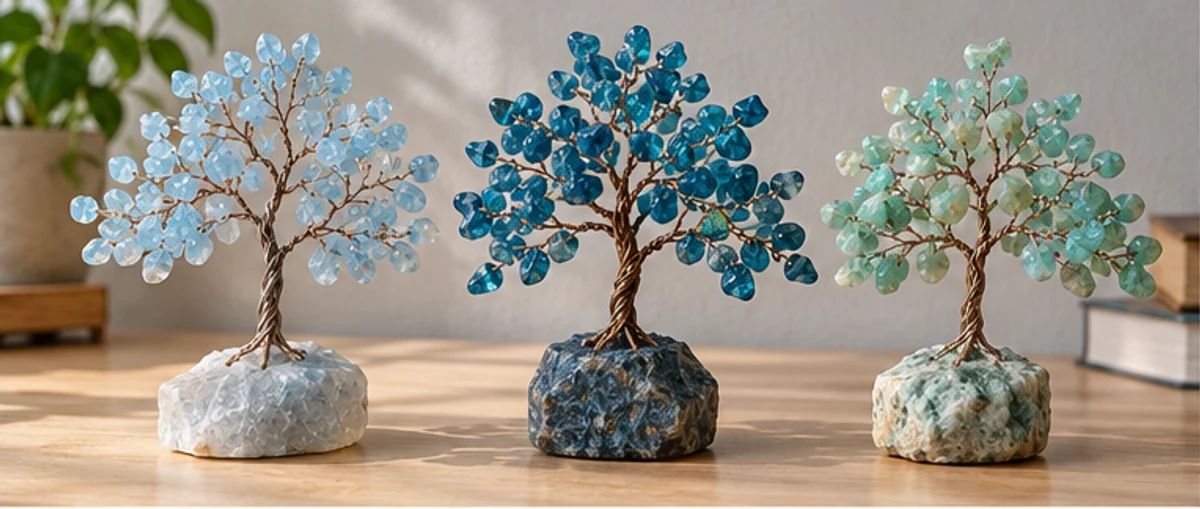
Quick comparison: three blue materials, three different gemstone families
The term blue gemstone tree describes a decorative style rather than a mineral species. An aquamarine chip may be lightly translucent; apatite can have a lively teal-blue tone; amazonite often shows an opaque blue-green surface crossed by paler areas. The effect of the full crown depends on light, chip size and branch density. A maker could also use dyed howlite, glass or another blue stone; an appealing colour does not identify its source.
Hardness refers to resistance to scratching, not to how much bending, shock or pressure a glued chip can tolerate. Actual trees combine gemstone pieces with wire, adhesives and bases.
| Feature | Aquamarine | Blue apatite | Amazonite |
|---|---|---|---|
| Mineral family | Beryl; blue-to-greenish-blue variety | Apatite mineral group; gem pieces commonly fluorapatite | Microcline potassium feldspar, commonly sold as amazonite |
| Typical appearance | Pale sky blue to greenish blue; translucent chips possible | Blue, blue-green or teal; often saturated and included | Turquoise-like blue-green, often cloudy or streaked |
| Mohs hardness | About 7.5–8 | About 5 | About 6–6.5 |
| Important vulnerability | Fractures and impact; wire attachment points | Brittle, relatively scratchable; heat/acid sensitivity | Distinct cleavage; edge chipping; fillers or coatings |
| Common colour questions | Heat treatment, dye or aquamarine-style imitations | Heat treatment; other bright-blue lookalikes | Dye, impregnation, coating or misleading “jade” names |
| Tree impression | Airy, cool, light-catching | Bold, energetic, oceanic blue | Soft, earthy, blue-green pattern |
Aquamarine gemstone trees: genuine beryl, pale-blue colour and translucence
Aquamarine is the blue to greenish-blue gem variety of the mineral beryl. Its pale seawater colour can look delicate on a branch even when the mineral itself is comparatively hard. Beryl has the chemical formula Be₃Al₂Si₆O₁₈. A good aquamarine tree should disclose the material actually used in its chips rather than relying on the words “aquamarine blue” as a gemstone identification. A pale blue glass tree and a genuine beryl tree can be styled similarly but should never be priced or described as though they are the same object.
Fine faceted aquamarines may have high clarity and strong colour, but tiny decorative chips are a different retail format. They can be irregular, cloudy or included, with edges that look pale when the light passes through them. A product photograph should show both a close-up of the chips and a normal viewing-distance picture of the assembled tree. There is little value in paying a premium for a dramatically saturated edited image if the delivered canopy appears almost colourless indoors.
Heat treatment can make some aquamarine appear bluer by reducing a greenish component. Treatment disclosure is therefore a genuine buying question, not proof that every aquamarine is suspect. For a tree made of many low-weight chips, a laboratory report for every chip is usually impractical. The seller can still give an accurate component description, supplier basis and any known treatment information, and avoid claiming that the whole assembly is certified unless it truly was examined as an assembled item.
A branch with aquamarine chips can be designed as an open crown so that the lighter stones remain visible against a calm background. White painted walls may wash out the colour in a photograph; a wooden shelf or pale grey backdrop often makes it easier to inspect the chips. Keep the crown away from high-traffic shelf edges because hard gemstone chips can still crack at weak cuts or adhesive joints if the tree falls.
Blue apatite gemstone trees: intense teal colour, brittleness and careful handling
Apatite is not a type of beryl, sapphire or turquoise. Apatite names a group of calcium-phosphate minerals; most gem apatite is described within the fluorapatite family. Its name is associated with the historical confusion of minerals that resemble one another. Blue and teal apatite can be visually arresting, especially where dozens of chips form a compact canopy. The same vibrant colour is often why a buyer needs to examine the material statement carefully.
Gem apatite has Mohs hardness around 5 and is relatively brittle. The tree is normally kept still, unlike a frequently worn ring, but the chips remain vulnerable when branches are twisted or compressed. Rough wire loops, metal burrs and an overcrowded canopy can chip a soft edge during handling. Instead of demanding a perfectly regular design, look for gentle and secure chip attachment, comfortable spacing and a stable trunk that does not require constant rebending.
Heat treatment is documented for some blue-green apatite; strong colour does not automatically indicate treatment, nor does pale colour establish that a chip is untreated. Colour may also appear different under warm indoor lights and cooler daylight. Ask for close-up photographs in neutral illumination, the supplier’s material description and a straightforward statement of any known enhancement. Do not try household acid, heat or scratch experiments to identify a finished tree. Those tests can damage the mineral or the adhesive holding it.
Blue apatite is best displayed where it will not be knocked, handled by small children or placed beside objects that repeatedly hit the crown. If dust settles, use a very soft dry brush or clean air from a hand blower at low pressure, supporting the trunk with the other hand. For any stubborn stain, consult the seller rather than soaking or scrubbing the whole tree: the stone, plated wire, glue and base may all respond differently to moisture.
Amazonite gemstone trees: real feldspar and blue-green pattern
Amazonite is a green-to-blue-green variety of microcline, a potassium feldspar with the formula KAlSi₃O₈. It is neither aquamarine nor jade. The blue-green body colour is often accompanied by white streaks or patches, which can be attractive across a tree canopy. Some pieces are more opaque and some more translucent, but a completely even turquoise colour should prompt closer examination of the actual material and any treatments.
Amazonite commonly has hardness around Mohs 6–6.5, but microcline has important cleavage directions. A piece can resist a light surface scratch better than apatite and still chip along an internal plane after a sharp knock. This is particularly relevant to thin pointed chips, drilled fragments and heavy crowns supported by a narrow trunk. Check whether the chips have obvious loose tips and whether the seller’s tree design protects the branches during shipping.
Natural amazonite, treated amazonite and imitation materials must be described separately. Gemmological references record dyeing, coatings and impregnation, and some uncommon colour treatments of feldspar. The trade term “Amazon jade” can be misleading because amazonite and jadeite/nephrite are different materials. A seller should not suggest that amazonite is a variety of jade merely to attach a more prestigious name. The buyer should examine the labelled specimen and its treatment disclosure, not use a green shade alone as the test.
A rounded, spreading amazonite crown can suit wooden office furniture or an entry shelf because its mixed blue-green pattern has visual texture. In a professional display, contrast the pale bands with a neutral background, then photograph the entire tree at a realistic scale. The expected look is generally softer and less transparent than a tree described as aquamarine; these are design differences, not a universal ranking of spiritual strength.
How blue chips can be mistaken for one another
Light, camera exposure and promotional editing change perceived hue. A broad “blue crystal” listing can even mix multiple minerals without identifying them. In finished gemstone trees the problem is magnified: chips are small, edges are irregular, wire may reflect blue light and dark glue can make translucent materials appear deeper. The appropriate first question is what the stones are, followed by how that description was established and whether any treatments or substitutions were used.
These are visual prompts for an informed discussion, not identification tests. Confirming a mineral can require professional gemmological examination.
| Offered appearance or name | What it may actually be | Useful buying question |
|---|---|---|
| Pale sky-blue chips | Aquamarine, blue quartz, glass or other pale materials | Are all chips named as aquamarine/beryl and what evidence supports that? |
| Neon teal chips | Apatite, dyed stone, glass or another blue-green gem | Is the mineral apatite; are treatments known? |
| Blue-green with white streaks | Amazonite, feldspar varieties or dyed substitutes | Is this microcline amazonite and is it coated or impregnated? |
| Very bright solid blue | Dyed howlite, sodalite, blue quartz or glass | Is the colour natural, treated or manufactured? |
| Royal blue with pale/metallic specks | Sodalite, lapis lazuli or mixtures | Does the product list the actual rock/mineral and possible treatments? |
| Blue flash that changes with angle | Labradorite or another feldspar optical effect | Does the blue depend on orientation rather than body colour? |
Natural, enhanced, assembled and imitation: what the description should say
“Natural gemstone” generally addresses origin of the mineral, whereas “untreated” addresses whether it has been enhanced. A genuinely mined stone can be heated, dyed, coated or filled. A manufactured glass chip is not a natural aquamarine chip, even if the shade is nearly identical. A tree made from both mined and man-made materials can be a legitimate decorative article, provided the materials are clearly described. The wording should tell readers what they are buying rather than relying on vague phrases such as “original energy stone”.
A laboratory report, where present, may identify a tested sample and disclose detectable treatment. It does not normally prove that every chip on an assembled tree has the same composition; check the report’s specimen number, whether the item was submitted loose or mounted, the testing scope and the exact conclusion. Supplier photographs, transparent treatment information and a clear return policy are useful even without a certificate. For mixed stones, a list mapping the colours to mineral names is more informative than a generic “premium crystal tree” label.
Ask for specific statements, not just a certificate photograph or a marketing grade.
| Claim on a listing | What it establishes | What it does not establish |
|---|---|---|
| “Natural aquamarine” | A material-origin claim that ought to be supportable | That it is untreated, flawless or a particular mine origin |
| “Heat-treated aquamarine” | A natural material may have had colour adjusted by heat | That the mineral is glass or otherwise counterfeit |
| “Apatite blue” | Possibly a colour description, unless component identity is specified | That the chip is mineral apatite |
| “Amazon jade” | A trade name sometimes used for amazonite | That amazonite is nephrite or jadeite |
| “AA/AAA quality” | A seller-defined sorting label in many markets | A universal, independent grading scale across chips and trees |
| “Lab-certified tree” | A claim requiring a report clearly covering the named object | That every stone, wire, adhesive and base was tested |
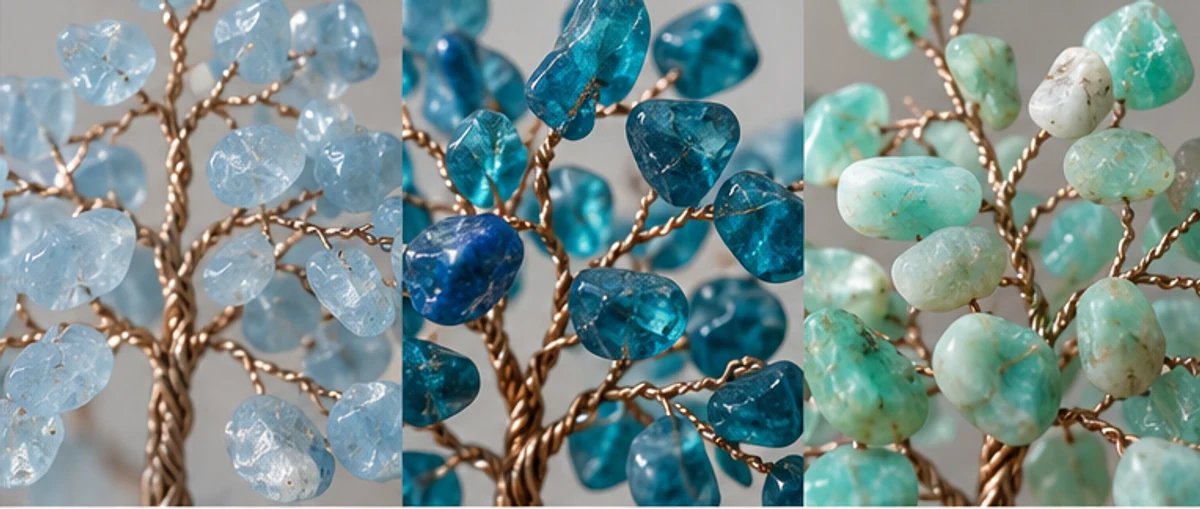
Tree construction: examine the complete handmade object, not only its gemstones
A gemstone tree is an assembly. The mineral chips are attached to fine metal wires, often twisted into branch clusters, then combined into a trunk and anchored in a base. Failure can occur at a wire bend, a weak adhesive point, a chip hole or a loose base even when the gemstones themselves are excellent. Because aquamarine, apatite and amazonite differ in toughness and cleavage, an identical branch-twisting technique does not suit every design.
Check if the wire ends are tucked away and whether the gemstone chips turn freely or hang loosely enough to slide off. Examine the trunk-to-base joint and ask whether the base is stone, resin, wood or another material. A stone base may look substantial yet have a smooth underside that slides on a polished shelf. A felt pad or non-marking stable footing may be needed for a delicate surface. A tree should stand level without being propped against a wall.
Natural irregularity should not be confused with poor construction. Slightly varied chip sizes and a handmade crown can be attractive; sharp wire ends, hidden glue blobs, unstable fastening and cracked chips are avoidable defects. A larger advertised chip count does not necessarily mean more value if the canopy is overcrowded, unsafe to move or assembled with unidentified materials.
| Inspection area | Good sign | Question or warning |
|---|---|---|
| Gemstone chip | Named material, finish consistent with nature of stone | Chipped tips, unexplained dye, mismatched description |
| Branch fastening | No slipping chip; end loops secure and tucked | Exposed wire end or repeated rework of thin wire |
| Trunk | Balanced crown with no sudden loose twist | Branch bundle wobbles under gentle movement |
| Base | Broad and stable enough for weight and height | Tiny footprint; slides on smooth shelf |
| Finish | No sticky residue or flaking paint | Obvious adhesive runs, peeling plating |
| Packing | Chip clusters separated and cushioned | Heavy base able to strike delicate branches |
| Photographs | Whole tree, crown close-up, base and scale view | Only a heavily saturated close-up |
Measurements, chip count, price and value: a buyer’s checklist
Before comparing prices, compare specifications. Two blue gemstone trees can have the same height but different crown widths, base materials and actual gemstone quantities. One may use many small chips, another fewer large ones. Seller photos can be taken from different angles to make a small canopy seem full. Record the height including the base, maximum width, base diameter, approximate net weight and whether the stated chip count is approximate or counted.
More intense aquamarine colour and higher clarity can be important to a loose-gem buyer, but fine-jewellery valuation cannot be transferred automatically to mixed decorative chips. Blue apatite may look vivid while requiring more careful handling. Amazonite may appeal through pattern rather than transparency. A sensible price assessment considers the exact stones, known treatments, quantity, craftsmanship, stability, packing, seller support and whether an authenticity claim is verifiable.
| Question before ordering | Why it matters |
|---|---|
| What are the exact stone names? | Separates beryl, apatite, feldspar and imitations |
| Are all chips the same stone? | Avoids paying single-mineral prices for mixed contents |
| What treatments are known? | Makes colour and care descriptions more accurate |
| What are height, width and base size? | Determines whether the object fits the shelf safely |
| How many chips and what approximate total stone mass? | Allows sensible like-for-like comparison |
| What are the trunk, wire and base materials? | Affects strength, corrosion and maintenance |
| Can I see ordinary-light photos of the actual item? | Reduces colour-expectation problems |
| What do the report or certificate details cover? | Avoids overreading the scope of one tested sample |
| How are branches protected in transit? | Especially important for brittle apatite |
| Who resolves damaged or mislabelled items? | Gives practical after-sale recourse |
Kalpavriksha and the symbolism of gemstone trees in Indian tradition
The decorated tree form has an Indian symbolic background that is deeper than a contemporary crystal colour chart. Kalpavriksha, the wish-fulfilling tree, appears in religious and artistic traditions as an image of abundance, generosity and the fulfilment of auspicious aspirations. The Indian Museum, Kolkata, catalogues an ancient Besnagar stone representation of a Kalpavriksha with prosperous objects among its branches. A modern wire-and-chip tree is not that historical sculpture or a living sacred tree, but it can evoke the recognisable themes of growth, rootedness and blessing.
A family may place a blue gemstone tree on a clean shelf as part of a Sankalpa, a consciously stated intention for clarity, study or harmonious conversation. The trunk and branches provide an everyday visual reminder of cultivation and continuity; the blue colour adds contemporary associations with openness, sky or water. These meanings become more personal when linked to the household’s actual devotional practice or shared intention rather than assigned as automatic powers of a gemstone chip.
Blue is not an instruction to ignore other auspicious elements. In a puja setting, respect the placement of deities, a diya, sacred texts and daily offerings. Do not put a fragile gemstone tree where oil lamps, incense ash, water vessels or regularly washed surfaces create a risk to wire and stone. Ritual respect and careful material handling are compatible: a clean dry display or a spoken mantra may suit the owner better than soaking the assembled object in a substance intended for an entirely different ritual item.
Vastu placement: directions, Pancha Mahabhuta and room purpose
Vastu Shastra approaches space through orientation, function, openings, circulation and the wider arrangement of a building. The Ashta Dik names the eight directions; Ishanya denotes the north-east, Uttara the north, Purva the east and the other directions have their own traditional contexts. Pancha Mahabhuta refers to the five elements—Prithvi, Jala, Agni, Vayu and Akasha. Contemporary crystal-tree guidance sometimes connects blue with Jala or Akasha, but that colour mapping is not a universal classical rule for aquamarine, apatite and amazonite.
For a small blue tree, first choose a location that is clean, dry, stable, visible and consistent with the room’s purpose. A study shelf in the east or north-east may suit a household’s contemplative routine, but a cramped or wet corner is not improved merely because the compass reads “correctly”. An office desk requires cable and elbow clearance. An entrance display should not obstruct movement or sit where a door can strike it. The right decision combines personal tradition, actual spatial conditions and responsible care.
Specific remedies and Jyotish prescriptions depend on the relevant tradition and individual assessment; these examples are not universal placement mandates.
| Setting | Traditional or personal interpretation | Practical placement |
|---|---|---|
| North-east/Ishanya puja shelf | Quiet reflection, prayer, study; household tradition may favour it | Keep separate from diya flame, wet offerings and regular cleaning |
| North/Uttara desk area | An intention around attentive work or opportunity | Stable low shelf away from monitors and cables |
| East/Purva study corner | Learning, morning routine and beginning a task | Indirect daylight; no precarious window ledge |
| Living-room display | Kalpavriksha imagery of growth and family harmony | Balanced height, non-slip base, child-safe reach |
| Shop or showroom | A welcoming visual reference for materials and craft | Avoid point-of-sale bump zones and frequent handling |
| Professional Vastu kit | Illustration of differing gemstone choices, not a diagnosis | Label each actual mineral and pack chips separately |
Chakra symbolism, Saraswati, Vishuddha and Navagraha: important distinctions
Contemporary chakra-colour presentations often associate blue with Vishuddha Chakra, linked with expression and communication. The Sanskrit name and the yogic-Tantric context deserve accurate treatment. The common assignment of a particular modern gemstone—say blue apatite or aquamarine—to that chakra is a later interpretive practice, not a universal prescription found in every Sanskrit source. A blue tree may be used as a devotional or reflective symbol without pretending that one mineral uniquely represents all accounts of Vishuddha.
Saraswati is revered in Hindu traditions in connection with learning, speech, music and knowledge. A student might choose a pale-blue tree near a reading area as a personal symbol of attentive study, perhaps alongside existing Saraswati devotion. That does not make an aquamarine tree the prescribed replacement for an image of Saraswati or for established forms of worship. It is useful to say which meaning comes from a traditional deity association, which is the broader Kalpavriksha image and which is a contemporary colour-based interpretation.
Navagraha and Jyotish gemstone selection form another, separate discussion. Blue colour alone does not establish a gemstone as a Neelam (blue sapphire) substitute for Shani; aquamarine is beryl, not corundum. Panna (emerald) relates to Budha in many contemporary Jyotish practices, but amazonite is feldspar, not emerald. Some crystal traditions give blue apatite a general communication association, yet that is not equivalent to a chart-based Graha prescription. When a customer seeks a personal remedy, consider the actual Janma Kundali and relevant tradition rather than substituting an attractive decorative tree for a prescribed Ratna.
| Term or association | Appropriate context | Avoid confusing it with |
|---|---|---|
| Kalpavriksha | Indian sacred tree imagery: growth, auspicious abundance | A fixed gemstone-chip formula for a manufactured tree |
| Sankalpa | Deliberate intention expressed in devotional practice | A promise that colour produces a guaranteed outcome |
| Pancha Mahabhuta | Five-element vocabulary within Indian philosophical traditions | A single standardized colour chart for all blue minerals |
| Vishuddha | Chakra name within yogic and Tantric systems | Universal ancient recommendation of apatite or aquamarine |
| Saraswati | Deity of learning, speech and arts in Hindu worship | An identification of a blue crystal as a required puja object |
| Neelam / Shani | A Jyotish gemstone association involving blue sapphire | Any blue tree or blue beryl chip |
| Panna / Budha | Emerald association in many Jyotish traditions | Amazonite or another green-blue feldspar |
Three realistic uses: Bengaluru apartment, showroom and practitioner kit
1. A Bengaluru apartment with a compact study-and-puja corner
A family wants a blue gemstone tree on a shared bookshelf near study materials and a small devotional shelf. The aquamarine palette looks gentle but pale against white walls, so a medium wood backing makes the chips easier to see. A broad amazonite crown may suit the available shelf better if the room needs colour at ordinary viewing distance. If the family chooses apatite for its teal tone, the tree is placed on a deeper, more stable shelf where the delicate branches will not be brushed when books are moved. The household can express a Sankalpa before beginning studies without claiming the object itself grants examination results.
2. A jewellery showroom comparing actual material identity
A Bengaluru retailer displays three labelled blue trees side by side. The label names “aquamarine—beryl”, “blue apatite—apatite group” and “amazonite—microcline feldspar”; photographs show both the whole item and a detail. The retailer also notes treatments where known, confirms whether the chips are uniform or mixed, and explains the base and wire materials. Customers can see that brightness does not decide authenticity. The store keeps delicate apatite away from places where visitors repeatedly pick up the display, and uses a simple price specification sheet rather than an unsupported “AAA” claim.
3. A professional Vastu consultation and educational reference kit
A practitioner carries small, separately labelled examples of all three minerals along with photographs of assembled trees. In a consultation, the practitioner can explain Kalpavriksha symbolism, directional vocabulary, Jala and Akasha associations, and how families use a tree as a personal reminder. The mineral samples help distinguish how aquamarine, apatite and amazonite actually look; the practitioner does not diagnose chart doshas from blue colour. Apatite is carried in a padded compartment, amazonite is protected from edge knocks, and the sample set remains separate from the heavier base of a display tree.
Care and cleaning: the gemstone is only one part of the tree
A single loose aquamarine can generally tolerate more routine cleaning than a delicate blue apatite chip, but a finished tree contains wires, glue, plating and a base. Therefore, the safest routine for the assembled object is to support the trunk and gently remove loose dust with a soft, dry brush. Keep the tree away from standing water, bathroom humidity, harsh chemical cleaners, steam and prolonged handling. Do not soak a tree because a guide says the gemstone alone may be cleaned with mild soapy water.
Avoid strong acids and hot water on apatite; do not use ultrasonic devices or steam on the assembly. Amazonite may contain cleavage planes or coatings that make aggressive cleaning especially unwise. Aquamarine has relatively good scratch resistance but its attachment wire can fail and chipped edges can still be sharp. If a chip comes loose, isolate it and ask the seller for repair guidance rather than adding random household adhesive where it may stain a porous base or obscure the mineral.
| Material or component | Recommended care | Avoid |
|---|---|---|
| Aquamarine chips | Soft dusting; stable low-traffic display | Impact on thin chips, aggressive handling, unverified soaking of whole tree |
| Blue apatite chips | Very gentle dry brushing; careful packing | Acids, heat, abrasion, shock, mechanical cleaning |
| Amazonite chips | Support branches; gentle cleaning, prevent edge knocks | Steam, ultrasonic treatment, scraping suspected coatings |
| Wire and plating | Dry brush or soft cloth with minimal movement | Repeated bending, corrosive liquids, harsh polishing |
| Adhesive joins | Inspect before carrying; keep dry | Immersion, heat, solvent cleaners |
| Stone, wood or resin base | Follow the actual base material’s cleaning method | Assuming the base and chips tolerate identical products |
| Storage | Cushion crown and base separately; use dry box | Heavy object pressing directly into gemstone branches |
Unboxing, branch shaping and moving a blue gemstone tree
Before opening the parcel, photograph its outside if there is visible crushing or water exposure. Set a clean towel on a stable table and remove the heavier base first only if the package was designed for that sequence; otherwise follow the seller’s instructions. Do not pull the tree out by its crown or shake packing material loose. Support the trunk close to the base, inspect branch joins, then free each chip cluster individually from the packing. Retain the internal packaging until the whole tree has been checked.
Some makers intend branches to be gently spread once after delivery; others secure them in fixed shapes. Ask which type you are receiving. If adjustable, move only a little at a time, never by dragging a gemstone chip across another chip. Metal wire can fatigue from repeated bending, and brittle apatite can chip under pressure even when the wire survives. Arrange branches to open the crown without creating an unstable overhang. Place the finished tree back down and check whether its base still rests flat.
For transport, secure the trunk and base against separate impacts. A soft divider between crowns prevents aquamarine from abrading weaker apatite chips in a mixed tree. Use a rigid box with enough clearance for the tallest branches, then label the stone and image records so a professional kit remains organised. Avoid tight compression solely to reduce parcel size; a damaged gemstone tree is rarely improved by packing it like an ordinary solid ornament.
Frequently asked questions about blue gemstone trees
Are aquamarine, apatite and amazonite the same blue gemstone?
No. Aquamarine is a beryl variety, apatite belongs to a phosphate mineral group, and amazonite is a microcline feldspar variety. Their shades may overlap in photographs, but their hardness, structure, market names and handling requirements differ.
Which blue tree is most durable for a busy desk?
Consider the construction and placement first. Aquamarine is harder than the other two minerals, but even it can be damaged by a fall, and a narrow base or loose wire attachment can fail regardless of the chips used. Avoid placing any tree where it will be repeatedly touched.
Is blue apatite a variety of aquamarine?
No. Blue apatite and aquamarine are different minerals. A listing that calls blue apatite “aquamarine” because both are watery blue should be corrected unless the actual chips are beryl.
Is amazonite really jade?
No. Amazonite is feldspar, while jadeite and nephrite belong to different mineral groups. “Amazon jade” is a potentially confusing trade expression; the mineral description should say amazonite or microcline.
Can an aquamarine tree have naturally cloudy chips?
Yes. Decorative chips may contain internal features and irregular edges even though high-grade faceted aquamarine is often transparent. Cloudiness by itself is not proof of imitation or a particular treatment.
Is brighter teal apatite always higher quality?
Not necessarily. Colour is one consideration, but visible fractures, correct identification, treatments, chip condition, craft and accurate representation matter. Bright photographs alone do not establish value.
How do I know whether the blue colour has been treated?
Ask the seller for the material identification, known enhancements and supplier information. Some treatments require professional testing to determine; phone photographs, scratch attempts or a home torch cannot give a reliable answer and may damage the tree.
Are blue crystal trees prescribed in classical Vastu Shastra?
The general tree and abundance symbolism has traditional roots, but a fixed prescription for an aquamarine, apatite or amazonite wire tree in each compass direction is a contemporary interpretation rather than a universal classical rule.
Can I place a blue tree in the north-east corner?
A household may choose a clean north-east study or puja shelf in line with its tradition. What matters in practice is stability, access and avoiding water, heat, crowding and obstacles. Direction alone does not override those concerns.
Does aquamarine correspond to Shani because it is blue?
Colour alone is insufficient. Jyotish gemstone choices involve specific Ratna traditions and birth-chart considerations. Aquamarine is not blue sapphire/Neelam and should not be sold as an automatic equivalent.
Is a blue gemstone tree suitable for Saraswati puja?
Some households may use a small tree as an additional respectful decoration near a study or prayer area. Established Saraswati worship practices are distinct, and the tree should not obstruct or endanger the puja arrangement.
Is the blue colour linked with Vishuddha Chakra?
Modern chakra-colour systems commonly use blue for Vishuddha, associated with communication and expression. However, assigning one specific gemstone to Vishuddha is not a universal ancient requirement.
What does a Kalpavriksha-shaped blue tree symbolize?
The tree form can evoke rooted growth, an auspicious beginning, sharing and fulfilment of worthy intentions. The blue stones contribute a contemporary aesthetic or personal interpretation; the manufactured object is not the same as a traditional living or sculpted sacred tree.
Should I put my gemstone tree in sunlight?
Use gentle indirect light for display and photographs. Strong direct sun can heat the assembly, stress some adhesives and alter the look of certain components. A window edge may also be physically unsafe.
Can I wash a blue gemstone tree under running water?
Do not assume so. Even where a loose aquamarine can be washed, the entire assembly contains adhesive, metal, base material and possibly more fragile gemstones. Routine gentle dry dusting is the safer default.
Can I bend the branches until the crown is perfectly symmetrical?
Only if the maker confirms they were designed to be adjusted, and then sparingly. Repeated wire bending causes fatigue; forcing chip clusters together can fracture or scratch them. A little irregularity is normal for a handmade tree.
Can a laboratory report prove every chip is genuine?
It depends on the specimens submitted and the exact report wording. A report for one loose chip does not automatically establish the identity or treatment of all chips and components in the finished tree.
What is a sensible size for a small Bengaluru apartment?
Start with actual shelf depth, height clearance, movement around the shelf and base footprint. A compact tree with a secure base often works better than a tall, unstable crown, irrespective of advertised chip count.
Can I combine aquamarine, apatite and amazonite in one tree?
Yes, if the finished tree is accurately described as mixed minerals and built with suitable care for the most fragile chips. Avoid presenting the mixed tree as pure aquamarine; arrange packing and dusting around the apatite component.
What should I do if the parcel arrives with a broken chip?
Photograph the packing, the damaged area and the complete item before further adjustments. Keep loose fragments out of children’s reach and contact the seller about return or repair; do not rush to glue the chip back in a way that obscures the material or creates a sharp edge.
Final selection: choose truthful materials, sound construction and a meaningful place
If you want a pale, light-catching crown, consider aquamarine while checking that the label truly refers to beryl. If you prefer lively teal, blue apatite may fit the design but needs more careful handling. If you value a calm blue-green pattern, amazonite offers a feldspar character distinctly different from both. None is automatically the “best” tree for every home, and none should be chosen solely from a saturated photograph or a promise attached to the colour blue.
A thoughtful choice brings together the named mineral, treatment disclosures, the overall canopy, wirework, base stability, dimensions, price, safe delivery and the owner’s actual tradition. Kalpavriksha symbolism, Sankalpa, a Saraswati-related study intention or a personal Vishuddha colour association can provide meaningful context when identified accurately. The strongest product description respects both that cultural depth and the observable object the customer will receive.
Research and terminology: Mineral identity, aquamarine treatment and care were checked against GIA references; apatite identity and brittleness against gemmological guidance from the International Gem Society; amazonite/microcline and treatment distinctions against Mindat, CIBJO and the International Gem Society. Kalpavriksha historical imagery was checked against the Indian Museum, Kolkata, and the IGNCA. Names are acknowledged for editorial transparency without adding external commercial links to the article.
