
How can you tell whether a gemstone tree is genuinely made with the stones named in its listing? Begin with the complete object, not its colour or the word “certified.” A gemstone tree is an assembly of mineral chips, twisted or wound metal wire, a trunk, attachment points and a display base. The chips can be natural, treated, laboratory-grown, dyed, reconstructed or imitated; the other parts may use separate materials and finishes. A beautiful crown is compatible with honest disclosure, but a single attractive photograph cannot answer all these questions.
Use this practical buying guide to compare natural stones and treatments, inspect workmanship, understand the limitations of gemstone testing reports, judge a fair listing, and select a tree for a home, office, puja shelf or professional Vastu reference kit. We also explain Kalpavriksha symbolism, the Pancha Mahabhuta, directions, Sankalpa and the traditional meanings associated with different colours and stones. The purpose is to choose an object whose documented materials, craftsmanship and significance match your needs—not to turn decorative features into unverifiable proof.
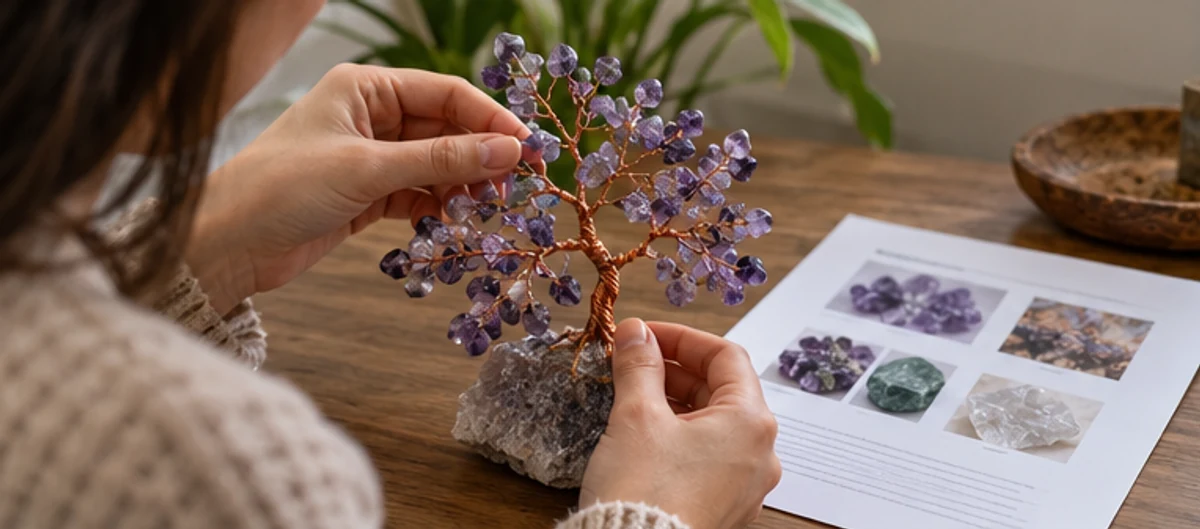
1. First identify the four different parts of a gemstone tree
A typical tree is described by its most noticeable element—perhaps “amethyst gemstone tree” or “citrine money tree.” That is shorthand for the crown or chip material, not a declaration that the entire object is amethyst or citrine. The tree may contain small drilled or undrilled stone chips, copper-coloured wire, a coated metal trunk, a wood or resin base, plus adhesive beneath the visible attachments. A “natural gemstone tree” should state what is natural and whether the other components have special coatings. The base may be real stone, but the chip variety and the base mineral need not be the same.
Inspect each part independently. Look for consistent chip attachment, wire ends that do not protrude, a firm trunk-base join and a stable footprint. The crown should not sway so far that the base tips during ordinary display. A decorative stone-name label should not silently extend to unseen fillings, adhesives, metallic paint or synthetic branches. This distinction matters especially when one component is supported by a laboratory report but the seller uses the report to market the entire assembly.
| Component | What the seller should describe | Physical checks |
|---|---|---|
| Gemstone chips | Named material, approximate size, treatments and whether natural or manufactured | Check colour range, chips, attachment and material consistency |
| Wire branches | Copper, brass, coated alloy or other material where known | Inspect sharp ends, plating, kinks and corrosion |
| Trunk and fixing | Twisted wire or fitted trunk; glue, putty or other fixing where relevant | Look for excessive wobble, gaps and hidden repairs |
| Base | Stone, wood, resin, cement, acrylic or mixed construction | Inspect underside, flatness, weight and surface protection |
| Surface finish | Polish, paint, plating, coating, wax or colour enhancement | Assess rubbing points and care requirements |
| Packaging | Individual support for crown and base | Check whether wires and chips can strike each other in transit |
2. Natural, untreated, treated, synthetic and imitation are not synonyms
Natural describes an origin in nature; untreated adds a separate claim about subsequent processes. A natural agate chip that has been dyed remains natural agate, but its colour is treated. A heat-treated amethyst converted to yellow quartz can be correctly identified as citrine if the treatment is disclosed. A quartz chip grown in a laboratory may be chemically quartz without being naturally formed. Coloured glass or plastic may resemble a gemstone but should not be sold as natural quartz. The terms answer different questions, so “genuine” needs to be accompanied by a material description.
Some tree crowns combine several gemstone varieties. In a seven-colour chakra tree, the red chips may have a different material history from the blue or green ones. The fact that one material has been identified does not settle all the others. Ask whether the contents are consistent across the batch or vary by piece, whether each colour is mapped to a gemstone species, and whether the description applies to the actual shipped item. Jewellery-industry terminology guidance treats disclosure of relevant enhancements as a commercial information requirement; the useful principle applies equally to decorative gemstone-chip products.
| Listing phrase | Potential meaning | What remains to verify |
|---|---|---|
| Natural gemstone | Material originated in nature | Could still be dyed, heated, filled or stabilized |
| Untreated | No disclosed enhancement | What evidence and which chips does the claim cover? |
| Dyed agate | Natural chalcedony with added colour | Dye stability and care; accurate variety name |
| Heat-treated citrine | Quartz colour altered by heating | Material identity and truthful treatment disclosure |
| Laboratory-grown quartz | Quartz crystallized through a manufacturing process | Do not present as earth-mined natural crystal |
| Imitation stone | Appearance copied by another material | Disclose glass, resin, ceramic or plastic |
| Composite or reconstructed | Fragments or powder assembled with a binder | Binder, proportions, coating and durability |
| Mixed gemstone tree | More than one stone variety in the crown | Which variety corresponds to each colour? |
3. Why colour, shine, cold touch and weight cannot prove authenticity
A vivid blue chip can be lapis lazuli, sodalite, dyed howlite, coloured glass or another material. A pink chip could be rose quartz, dyed chalcedony, pink calcite or glass. A dark metallic bead may be hematite, magnetite, a ferrite-based manufactured product or a coated imitation. Light and photography make the overlaps harder: saturation, white balance and a glossy image filter can make a variable natural crown seem uniformly coloured. Natural-looking imperfections are not proof either; manufactured goods may reproduce irregular texture.
Touch tests and improvised experiments are particularly unreliable on a finished tree. Coolness depends on thermal conductivity and room temperature; felt weight includes the base and wire; scratching may damage a genuine stone; acids, solvents and flame can harm coatings and glue. Do not pour water or perfume on the crown or attempt to burn a chip to see whether it is plastic. Read the seller’s material disclosure first, compare clear photographs of the actual tree, and seek qualified gemmological assessment when an expensive material claim merits independent checking.
4. Inspect the chips as a collection, not just as a single close-up
Chip trees are assembled from numerous small irregular pieces, commonly with rough, tumbled or polished surfaces. Their chips can have natural fractures, inclusions and uneven translucence without being defective. What matters is consistency with the stated variety and whether the chips are securely attached. Check the crown from front, back and both sides. If one part contains many broken tips or differs dramatically in colour from the product photograph, ask whether the image represented the batch or the exact object. Do not infer a chip count from a photograph where branches overlap.
A chip that looks clear in isolation may look cloudy in a dense crown. A pale mineral base can reflect light up through translucent stones; dyed stones may show highly concentrated pigment at edges or drill holes, but that observation alone is not a diagnostic laboratory result. Compare chips under neutral diffused light, with one detail photograph for texture and one whole-tree photograph for scale. Repeated machine-perfect bead shapes may indicate beads rather than irregular chips, which is a design difference rather than automatic evidence of a false mineral.
5. Common gemstone-tree materials: what to ask before buying
Material-specific descriptions prevent “gemstone” from becoming a single vague claim. Quartz varieties such as amethyst and rose quartz are generally more scratch-resistant than calcite or fluorite, but adhesives and the other assembly parts remain vulnerable. Citrine might be natural-colour quartz or heat-treated amethyst. Pyrite needs sensible dry storage and is not identified by gold colour alone. Lapis lazuli is a mineral-rich rock, while sodalite is a mineral; jade can mean nephrite or jadeite but is also misused as a marketing name for unrelated green rocks. A precise listing distinguishes colour symbolism from physical identity.
| Named chip material | Identification or treatment question | Care consideration |
|---|---|---|
| Amethyst | Is the purple quartz natural or laboratory-grown? Any colour treatment? | Protect dyes and adhesives; avoid prolonged strong sunlight |
| Rose quartz | Natural massive rose quartz or pink-dyed alternative? | Use gentle dry cleaning for the full wire assembly |
| Citrine | Natural-colour or heated quartz? Is the chip actually citrine? | Avoid prolonged heat and careless wet cleaning |
| Green aventurine | Quartz/quartzite with characteristic inclusions, or dyed substitute? | Check colour and actual mineral trade name |
| Tiger eye | Genuine chatoyant quartz or fibre-optic glass? | Scratches and abrupt impact can damage chips |
| Lapis lazuli | Natural lapis rock; any dye, wax or other finish? | Sensitive constituents and treatments favour gentle dry care |
| Sodalite | Correct mineral identity; not dyed howlite or lapis by assumption? | Do not rely on solvent or scratch home tests |
| Jade | Verified nephrite or jadeite, versus serpentine or trade-name “jade”? | Ask for exact variety and treatment details |
| Black tourmaline | Schorl mineral chips, mixed black rock or coated alternative? | Protect brittle edges and branch attachments |
| Pyrite | Genuine pyrite-bearing mineral and stable chips? | Keep dry; avoid damp storage and immersion |
| Hematite | Natural hematite or manufactured magnetic hematine? | Avoid crude magnet tests on the assembled object |
| Moonstone | Feldspar variety and optical effect, not only a white colour? | Protect from knocks and thermal shock |
| Aquamarine | Genuine beryl chips or pale-blue imitation? | Require stronger evidence for exceptional price or purity claims |
| Blue apatite | Apatite rather than dyed glass or another blue mineral? | Soft/brittle relative to quartz; handle gently |
| Garnet | Which garnet species or mixture is represented? | Colour alone does not identify a garnet species |
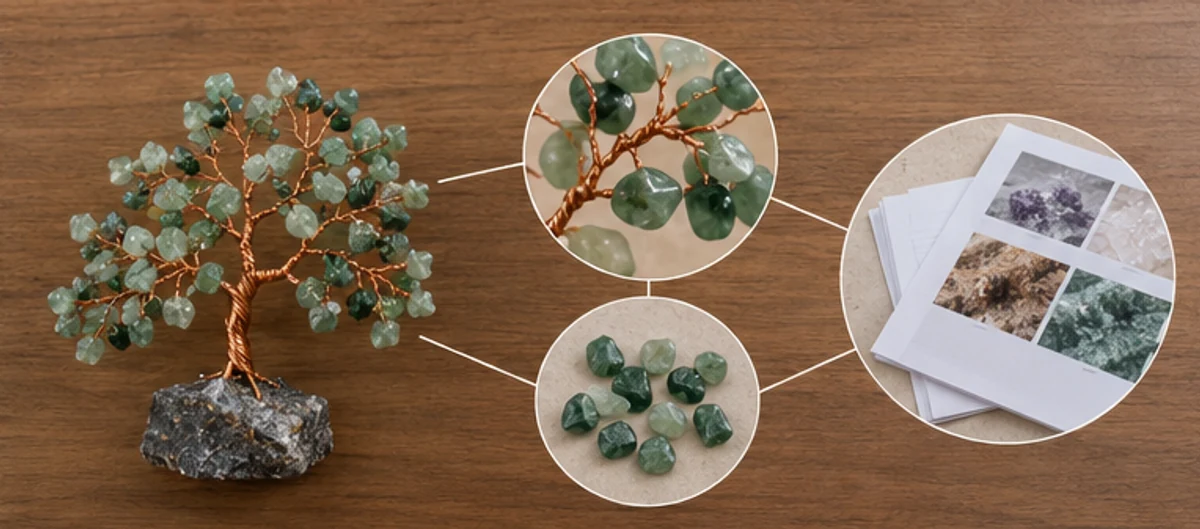
6. The wire and branch design affect safety and value
Some trees use copper or brass wire, while others use coated iron, mixed alloys or electroplated metal. Photographs showing a gold-coloured trunk do not identify the metal. Ask whether the wire is coated, whether the coating can wear at bends and whether visible end-caps or decorative beads are included. Loose wires can snag fabric, scratch furniture or pull away from adhesive; the branches are functional elements holding the chips, not merely ornament. A tree may be attractive yet fragile if its branches are too heavily loaded relative to the trunk.
A good inspection checks how chips are fastened—threaded through wire loops, clamped, glued or set in another manner. Look for tight, unbroken loops and a stable crown. Some wire trees are intentionally adjustable once during setup; others are fixed arrangements. Repeated bending hardens and fatigues metal, especially at the same joint. A listing should state whether gentle shaping is permitted. The buyer should never assume that because wire is visible every branch can be twisted repeatedly without weakening the attachments.
7. Bases, glues, repairs and mixed-material descriptions
The base is sometimes more responsible for stability than the entire gemstone crown. A heavy mineral-looking base may be stone, resin with filler, plaster, cement or a composite. The photograph of its polished upper surface cannot conclusively establish the interior material. Ask for an underside image and actual dimensions; look for protective feet, chipped corners, uneven surfaces and any concealed repair. The trunk should meet the base firmly without an exposed clump of loose adhesive.
A seller can accurately describe a mixed-material tree—for example “natural amethyst chips on copper-coloured coated wire with resin base”—without diminishing its visual or spiritual appeal. Conversely, saying “100% natural amethyst tree” could mislead if it is understood to describe wires, resin, dyes and every component. If the base is another gemstone such as agate, that should be named separately. A repaired component is not automatically unusable, but the location and condition of the repair should be disclosed rather than hidden by photographs.
| Area | Positive sign | Ask about or reject |
|---|---|---|
| Chip attachment | Secure loops; no loose pieces on gentle static inspection | Exposed sharp wires; loose chips |
| Branch spacing | Balanced silhouette appropriate to design | Crowded mass hiding broken joints |
| Trunk | No wobble at ordinary display | Visible opening at glue joint |
| Base contact | Flat stable support; no abrasive underside | Rocking, cracking or exposed sharp edge |
| Material labels | Each material and coating named where known | Everything described as one expensive gemstone |
| Repair / filler | Repairs disclosed with clear condition description | Concealed broken tip or unstable adhesive |
| Packaging | Crown and base separately supported | Loose shipping where branches strike each other |
| Finish | Even enough for intended handmade style | Peeling paint, corrosion or sticky coating |
8. What a gemmological certificate or laboratory report actually means
A real report has an issuing laboratory, date, report number, item description and stated findings. Depending on the service, it may identify a gem species or variety, state natural versus laboratory-grown origin, record detectable treatments, or provide measurements. Some reports can address geographic origin for particular gemstones; others cannot. GIA’s descriptions of its identification-report service illustrate why the examined item and test scope must be read, rather than assuming every official-looking paper says “authentic everything.” No single laboratory offers every possible service for every assembled chip tree.
For a finished tree, a lab may examine only a selected sample chip, a loose stone supplied separately, or a portion accessible in a mounted object. Results about one rose quartz chip do not automatically determine the identity or treatment of the other dozens of chips, the wire alloy or the base. If the report describes a loose sample rather than the pictured tree, ask how that sample was selected and whether it can be reliably connected to this exact piece or batch. A genuine report attached to an unrelated product is not suitable evidence for this purchase.
Reports should not be treated as spiritual certificates. Mineralogical testing can identify physical composition and sometimes treatment, but it does not test Sankalpa, auspiciousness, Lakshmi or Kubera associations, or the outcome of Vastu placement. Those belong to the traditional or personal-practice discussion. Keeping the two types of information distinct makes the seller’s documentation more useful rather than less respectful of belief.
| Report field | Why it matters | Buyer action |
|---|---|---|
| Issuer | Determines who actually examined the item | Verify issuer name and authenticity through its own channel |
| Report ID and date | Helps match and verify a specific document | Compare reference number and issue date |
| Item description | Specifies loose chip, mounted stone or complete object | Do not extrapolate from a sample to a whole tree |
| Species and variety | Identifies examined mineral material | Compare report wording to listing’s gemstone name |
| Treatments | Describes reported detectable enhancements | Do not interpret “none mentioned” as universal proof |
| Weight and measurements | May apply only to the tested sample | Do not confuse carat weight of chip with tree weight |
| Origin opinion | May be available for some gem materials only | Reject unsupported mine-country assumptions |
| Limitations / comments | May qualify scope or testing conditions | Read qualifications before accepting promotional claims |
9. How to verify a report without damaging the tree
Ask for a clear photograph or digital copy of the complete report, not a cropped certificate emblem. Check that the issuing body exists, that its verification service recognizes the report number if one is available, and that its description matches the material in question. When a report is for one sample, require the seller to disclose the sampling basis. A QR code may merely lead to a seller’s own page; it is not independently persuasive until the destination and issuer are confirmed. Avoid posting private purchase details publicly to verify a document.
If a seller says every chip is individually certified, ask for the number of pieces examined and the testing protocol. Such a claim deserves evidence proportionate to its cost. For a low-priced decorative tree it may be more sensible to choose transparent material labeling, photographs and a fair return procedure than to pay a large certificate premium. For a rare or unusually costly stone variety, an independent gemmologist can help determine whether sample testing or specific laboratory services are appropriate.
10. Read treatment disclosures as part of quality, not as a reason to reject every treated stone
Treatment is not automatically bad. Heat-treated citrine, dyed chalcedony or stabilized components may be beautiful and suitable for decorative use when accurately described. The relevant questions are what was changed, whether the result is stable in ordinary display, whether the material should be kept away from particular cleaning agents, and whether the asking price reflects the treatment. Some dyes may fade with intense light; fillers and coatings can react to solvents, heat or repeated rubbing. An unspecified treatment is not evidence of no treatment.
When a retailer cannot substantiate “untreated,” appropriate wording is “treatment status not confirmed” rather than suggesting a laboratory result that does not exist. This is especially important for mixed-colour gemstone trees, where one chip type may be heated, another dyed and a third untreated. A lot or supplier statement should be described accurately as such; it is not equivalent to an independent laboratory determination of each finished tree.
| Situation | Useful disclosure | Do not infer |
|---|---|---|
| Uniform very bright blue crown | Actual mineral, possible dye, light stability | Every bright-blue chip is lapis lazuli |
| Strong yellow quartz crown | Citrine identity and heat-treatment information | Yellow colour proves natural untampered colour |
| Very dark green chips | Nephrite/jadeite vs serpentine/other stones | Green colour proves jade |
| Metallic black chips | Hematite vs manufactured hematine | Magnet attraction is universal proof |
| Very clear quartz chips | Natural versus laboratory-grown identification | Few inclusions prove natural origin |
| Coated wire and base | Metal alloy or plating, resin or stone base | Golden appearance proves solid brass |
| Mixed chakra colours | Stone name for every individual colour group | All seven are one gemstone species |
| “Lab-tested tree” advertisement | What specimen, which tests and when | All chips, coatings and spiritual properties tested |
11. Choosing by price: material, size, workmanship and supporting service
Gemstone trees are not priced fairly by a simple equation of “more chips means better tree.” Value reflects the named stone and its supply, chip size and condition, assembly quality, wire and base, real measurements, careful packing, seller service and any credible testing. A small tree with well-attached attractive natural chips may be better for a narrow shelf than a larger crown with weak joins. Conversely a premium price should bring specific reasons—material disclosure, workmanship, actual photos, measurements or applicable provenance—not only claims of “positive energy” or “extra powerful” colouring.
Ask for height including the base, approximate maximum width, measured weight of the complete object and whether product photographs are stock or of the exact item. A large close-up can make an 8-centimetre tree appear like a 25-centimetre display. If the specification says 300 chips, ask whether that count is exact or approximate; hand-assembled work varies. The maker’s skill is part of the product’s worth, but it should not be converted into an invented laboratory or cosmic grade.
| Specification | Minimum useful information | Common listing problem |
|---|---|---|
| Overall height | Measurement from base underside to crown tip | Height shown without base or in scaled photo only |
| Crown span | Maximum width of branches in supplied shape | Close-up gives no room-fit information |
| Base footprint | Length and width of the contact area | Heavy-looking base is actually unstable |
| Overall weight | Grams of complete object | Weight of shipping parcel mistaken for item weight |
| Chip type | Stone varieties and treatments where known | Generic “7 chakra genuine crystals” with no breakdown |
| Wire / coating | Material as known, finish and adjustment guidance | Colour presented as pure copper or brass without evidence |
| Report | Issuer, item scope and verification details | Certificate shown only as unreadable icon |
| Returns | Condition and time window stated by seller | No clarity on damage during transit |
| Photographs | Front, back, crown detail, base and real scale | Only a heavily edited hero image |
12. Traditional meaning: Kalpavriksha, abundance and the handmade tree form
The symbolic attraction of a gemstone tree begins with the image of a flourishing tree. In Indian cultural and devotional traditions, the Kalpavriksha represents a wish-fulfilling tree and abundance; trees more broadly signify growth, roots, shelter and continuity. A modern wire-and-gemstone tabletop tree is not identical to an ancient sacred tree, yet it meaningfully draws upon that imagery. The roots or base suggest stability, the trunk sustained effort, the branches opportunities and the stones leaves or fruits of intention. Such symbolism can make a tree suitable for a new home, a shop opening, a study space or a family gift.
Lakshmi is associated with auspicious prosperity and good fortune, while Kubera has associations with treasures and wealth. These are meaningful frames for a prosperity-themed tree when a household uses the object as a reminder of gratitude, responsible effort and Sankalpa. A yellow, green or gold-toned crown is sometimes chosen to reflect that intention. Different modern schools of crystal practice vary, and stone-to-deity mappings should not be presented as uniform prescriptions from a single ancient Vastu text. Authentic traditional vocabulary enriches the explanation when applied with that distinction.
13. Vastu directions, the five elements and gemstone-tree choices
Vastu Purusha Mandala and the Ashta Dik (eight directions) provide a traditional architectural and symbolic vocabulary. The Pancha Mahabhuta—Prithvi (earth), Jala (water), Agni (fire), Vayu (air) and Akasha (space)—likewise informs contemporary colour-and-material readings. A gemstone tree is a decorative, symbolic addition to a space; compass orientation is only one factor alongside actual doorway traffic, stable furniture, daylight and household practices. A direction that is revered in one tradition should not be used to justify placing a fragile tree where it could fall, become damp or block a passage.
The Ishanya (northeast) is commonly associated with prayer and a quiet, clean setting, while north is linked in popular Vastu practice with Kubera, and east with the rising Sun. Depending on the custom, a clear quartz or amethyst tree may suit a meditation corner, green aventurine a work table, and a citrine-coloured crown a shop counter. These are interpretive choices, not material tests or universal guarantees of outcomes. For a professional consultation, use the actual plan and the client’s practice rather than recommending the same stone to every room.
| Space or direction | Common symbolic emphasis | Practical selection note |
|---|---|---|
| Northeast / Ishanya | Prayer, clarity, contemplative attention | Choose stable small tree away from ritual water and flame |
| North | Kubera and prosperity themes in popular Vastu | Consider green/citrine display, avoid blocking work |
| East | Morning light, beginnings and Surya associations | Protect colour-sensitive chips from harsh direct sunlight |
| Southeast / Agneya | Agni and active household functions | Keep wire/glue away from cooking heat and flame |
| Southwest | Stability and household continuity | Choose secure heavy base if display is appropriate |
| Home entrance | Welcome and growth symbolism | Place beyond traffic and door swing |
| Office desk | Sankalpa, attention and professional aspiration | Small footprint, no loose wire tips or clutter |
| Puja shelf | Devotion, Lakshmi symbolism or personal Sankalpa | Dry, stable placement away from lamps and liquids |
14. Navagraha, chakra colours and differences between spiritual systems
Gemstone trees are sometimes marketed as “Navagraha,” “Navaratna” or “seven chakra” designs. These labels describe different frameworks. Navagraha refers to the nine planetary principles in Jyotish; Navaratna is the traditional nine-gem concept with particular gem correspondences; a modern seven chakra tree often arranges seven colours for symbolic association with energy centres. The same seven-colour tree should not be represented as a complete Navaratna composition unless its stones and rationale actually match that system. Similarly, seven shades of glass do not become verified Navaratna gemstones merely because they follow a rainbow sequence.
In traditional Jyotish, recommending a planetary gemstone for an individual is not the same as choosing an attractive decorative tree. A kundali-based recommendation can consider Lagna, Graha placement, Dasha, dignity, afflictions and the person’s intended practice. A purple amethyst tree used for meditation is not automatically interchangeable with a prescribed Shani gemstone, nor is yellow quartz identical to a yellow sapphire in the Navaratna framework. A multi-stone tree can be meaningful as a symbolic display without claiming to replace a personalized recommendation.
15. Bengaluru home example: a thoughtful housewarming tree
A family in Bengaluru chooses between a rose quartz tree and a mixed-colour tree for a new apartment. The living room has a narrow shelf near a balcony window and a prayer corner where incense and lamps are used. Their first question should be about the physical fit: the overall height including the base, whether the wires protrude, whether the object can stand without leaning, and whether bright sunlight reaches the shelf for several hours. The pink palette may reflect affection, family harmony and a welcoming start, while the mixed-colour design may represent varied aspirations across the household.
The family asks for clear photos of the exact crown, stone-name disclosure and a view of the underside. They choose a spot sheltered from strong direct light and the heat of lamps. On a puja day, they honour the tree through a verbal Sankalpa rather than soaking mixed stones and wire in water. The meaningful purchase is the one that suits their family’s preference, physical space and devotional style, not the one with the loudest claim about invisible power.
16. Jewellery showroom example: customer confidence without exaggerated claims
A jewellery showroom wants a gemstone tree on a display counter, where visitors may ask if its chips are genuine and whether a certificate is provided. The merchant prepares an accurate card listing the crown stones, their treatment status when known, the approximate tree dimensions and the wire/base description. If a laboratory report concerns a selected chip, the card states that exact scope. A small sign can refer to Lakshmi and Kubera symbolism for business auspiciousness while leaving material authenticity to the documented evidence. This approach lets traditional meaning and product transparency reinforce each other.
The showroom also plans for handling: customers should not pull branches or bend them for a photograph. A stable base and a position beyond crowded payment equipment reduce accidental damage. If the retailer offers different grades, they explain the differences in chip quality and workmanship instead of assuming a higher price proves higher spiritual benefit. Staff can answer the same questions consistently without making promises about income, planetary remedy or laboratory results beyond the evidence in hand.
17. Professional Vastu consultant example: building a usable reference kit
A professional Vastu consultant may carry several mini trees to illustrate differences among citrine, amethyst, green aventurine, tiger eye, lapis and other materials. These objects should be labelled as reference specimens rather than automatically described as exact substitutes for a client’s eventual purchase. The consultant can document each specimen’s supplier, material claim, suspected or confirmed treatments, approximate measurements and care requirements. Compact, separately padded containers protect wires and chips during travel between sites.
When meeting a client, the consultant can explain Prithvi, Agni, Sankalpa, direction symbolism and the client’s own preferences while remaining clear about what the sample physically is. A colour-coded chakra selection can be a teaching tool; a Navagraha recommendation involves a different tradition and sometimes personal chart interpretation. The kit therefore becomes more valuable when its labels and material descriptions are precise, not when its cards repeat the same generic promise for every tree.
18. Packing, delivery inspection and aftercare
A well-made tree can arrive damaged if the base shifts against its crown. Choose a seller who immobilizes the heavy base, cushions the wire branches and avoids loose stones or accessories rattling inside the same compartment. Keep the unboxing video or photos until the item has been checked if the delivery policy requests evidence. Unpack on a clear dry surface, lift from the supported base rather than the branches, and inspect for loose chips, detached wire or new cracks before attempting adjustment.
For ongoing care, treat the object as a mixed-material assembly. Dry soft-brush dusting and a clean, soft, lint-free cloth are usually safer starting points than immersion, ultrasonic cleaning, acids or polishing powders. Do not apply water, milk, salt solutions, oils, perfume or cleaning sprays simply because a traditional ritual is being performed. Mineral-specific sensitivities matter: pyrite can suffer in damp conditions; gypsum and rock salt are water-sensitive; coatings, dyed chips, base adhesives and metal finishes may also react. If chips appear loose, stop handling and ask for the maker’s method rather than improvising with a strong glue on an unknown surface.
| Exposure or handling | Potential issue | Practical response |
|---|---|---|
| Strong midday sun | Some dyed or light-sensitive varieties may fade | Use indirect or moderate light; check supplier guidance |
| Puja water, milk or salt | Corrosion, soluble minerals, adhesive damage | Use dry symbolic cleansing when appropriate |
| Humidity in closed storage | Metal tarnish; vulnerable pyrite or coatings | Dry, ventilated display; monitor condition |
| Household cleaners and solvents | Dye and finish instability | Avoid direct application to mixed assemblies |
| Repeated branch bending | Metal fatigue and detached chips | Adjust only if seller confirms design permits it |
| Incense, diya or candle nearby | Heat, soot, accidental contact | Keep safe distance from flame and heat |
| Packing for delivery | Base and crown strike each other | Support components individually |
| Loose or cracked chip | Sharp edge, further loss, inaccurate listing | Photograph, isolate and seek appropriate repair |
19. A precise question list to send the seller
Before ordering, request a short written response that can be saved with the invoice: “Please confirm the gemstone varieties used in the chips, any known colour or stabilization treatments, the composition of the wire and base as far as known, overall measurements and weight, and whether the photographs show my exact tree or a representative batch. If a certificate is included, which exact part was tested and can I verify the report ID? Please also confirm whether the branches are adjustable, how the item is packed and the procedure if chips arrive loose.” This is more useful than demanding a generic “100% original” declaration.
A satisfactory response may acknowledge genuine uncertainty about a low-cost component rather than claim impossible certainty. “Chips supplied as natural green aventurine; independent laboratory testing not performed on every chip” is more informative than an unqualified full-product certification claim. The buyer can then judge whether the level of evidence matches the price and intended use. When material identity is central to a high-value purchase, request stronger verification before paying a premium.
20. Buyer decision checklist: compare three trees without losing sight of the whole
Imagine three options: a low-cost mixed-colour tree with undisclosed chip species, a mid-range accurately labelled amethyst-and-wire design, and an expensive tree advertised with a premium certificate that tests only one sample. The lowest price might suit someone seeking simple décor; the mid-range listing may provide the clearest material confidence; the expensive option earns its premium only if workmanship, actual stones and evidence support it. A thoughtful decision compares transparency, intended symbolism, physical quality and seller assistance—not merely colour saturation or certificate graphics.
For a home purchase, prioritize fit, safe placement and the stone association that resonates with the family. For gifting, prioritize sturdy packing, a clear material description and a personal note. For a professional set, prioritize reproducible labels and replaceable reference pieces. In every case, do not substitute one attractive photo, one magnet test or one generic laboratory document for inspecting the whole tree.
| Check | Confirm before purchase |
|---|---|
| 1. Actual object | Exact piece or representative batch identified |
| 2. Crown material | Correct names for the chip varieties |
| 3. Treatment | Known heat, dye, coating, filler or stabilization disclosed |
| 4. Mixed materials | Wire alloy/finish and base described where known |
| 5. Photos | Whole tree, reverse, chip detail and underside |
| 6. Size | Full height, crown span and base footprint measured |
| 7. Weight | Item weight rather than shipping package weight |
| 8. Workmanship | Stable trunk, secure chips and no exposed sharp wires |
| 9. Report | Issuer, report ID and exact tested specimen clear |
| 10. Meaning | Traditional symbolism differentiated from mineral identity |
| 11. Care | Material-specific cleaning and branch-adjustment instructions |
| 12. Delivery | Protective packing, condition documentation and return procedure |
Frequently asked questions about genuine gemstone trees
How do I know if a gemstone tree is real?
Read the declared chip minerals and treatments, inspect actual-item photographs, check workmanship and seek appropriate gemmological evidence for high-value claims. There is no single reliable home test for all gemstone trees.
Does “natural” mean every chip is untreated?
No. Natural material can be heated, dyed, filled or otherwise treated. Ask separately whether the claimed natural origin and the treatment status are known.
Can a real gemstone tree contain a resin base?
Yes. Many authentic mineral-chip trees are mixed-material assemblies with resin, cement, wood or stone bases. The base simply needs accurate description.
Can one certificate prove all 100 or 300 chips are genuine?
Not unless the document and documented sampling or test procedure actually cover that claim. A report on one selected chip is evidence about that examined specimen.
Can I verify a certificate from a QR code?
Check that the code resolves to the actual issuing laboratory, then compare the report number, date and item description. A seller webpage alone is not independent verification.
Is dyed agate fake?
Dyed natural chalcedony remains natural chalcedony with a colour treatment. It should be described and priced with that treatment disclosed.
Does bright green colour prove nephrite or jadeite?
No. Green aventurine, serpentine, dyed stones and glass can overlap in appearance. The precise mineral variety matters.
Does a heavier tree always contain more gemstone?
No. A large stone or resin-filled base and wire can account for much of the mass. Check the chip description and total dimensions separately.
What is the difference between a quartz tree and a Sphatik tree?
Sphatik or Sphatika is a customary term for clear rock crystal quartz. A quartz tree can include many colours and forms; confirm that the chips described as Sphatik are actually clear quartz.
Is an amethyst tree suitable for meditation?
Amethyst is often selected in contemporary spiritual practice for calm, reflection and a peaceful setting. Choose stable placement and protect the complete assembly from harsh conditions.
Is a citrine gemstone tree necessarily a prosperity remedy?
Citrine-coloured trees are popular symbols of aspiration, Lakshmi-related abundance and positive intention. That symbolism is distinct from a personally determined Jyotish remedy or guaranteed financial outcome.
Should a gemstone tree face north or northeast?
North and northeast have traditional associations in several Vastu approaches, but practical safe placement and the household’s own practice matter. No direction overrides risk of falling or heat damage.
Is a seven-chakra tree the same as Navaratna?
No. Seven-colour chakra symbolism and nine-gem Navaratna traditions are different systems; their materials and intended uses should be labelled separately.
Can I bend the branches after delivery?
Only if the maker confirms that the specific design is adjustable. Repeated bending can fatigue wire and loosen chip attachments.
Is a gold-coloured trunk necessarily copper or brass?
No. Painted or plated alloys can share the appearance. Ask for the wire material and coating description where known.
Can I wash or soak a gemstone tree for cleansing?
Generally avoid immersing a mixed chip, wire, adhesive and base assembly. Choose an appropriate dry practice that respects both the material and the devotional purpose.
Are natural flaws a sign of poor quality?
Natural inclusions, irregular chips and colour variation are not automatically defects. Loose chips, sharp wire ends, unstable repairs and dangerous cracking are workmanship concerns.
Why are laboratory reports more difficult for a whole gemstone tree?
A finished tree contains many small chips and different materials, making complete examination more complex and costly than analysis of a single loose gem. Read the exact report scope.
Should I choose the most expensive gemstone tree as a gift?
No. Recipient taste, dimensions, construction, transparent material descriptions and safe delivery often matter more than the highest advertised price.
What should I do if the delivered tree differs from the photograph?
Compare actual dimensions, stone and treatment descriptions and the listing’s sample-photo statement. Record discrepancies promptly and follow the seller’s published resolution process.
Conclusion: genuine materials, clear disclosure and meaningful symbolism belong together
A good gemstone tree should offer three things at once: a beautiful and stable handmade object, an accurate description of its components, and a symbolic meaning that suits the buyer’s tradition or intention. The most useful evidence identifies the actual chips, states treatments honestly, explains the limits of any report, and documents how the wire and base are made. Kalpavriksha, Lakshmi, Kubera, Sankalpa and Vastu terminology enrich the reason a family or professional may choose a tree; they do not replace the material facts the customer needs. Compare the object, ask specific questions, then enjoy the form and significance with confidence.
