
Hematite gemstone trees bring a distinctive steel-grey, mirror-dark appearance to a shelf, work desk or Vastu display. The real buying question, however, is not simply whether the chips shine. Are they natural hematite, a manufactured magnetic substitute, another dark mineral, or a coated material? How firmly are the chips attached, what contributes to the finished weight, and which place keeps the wire branches safe? This guide answers those questions while explaining the tree motif, contemporary Vastu associations and straightforward care.
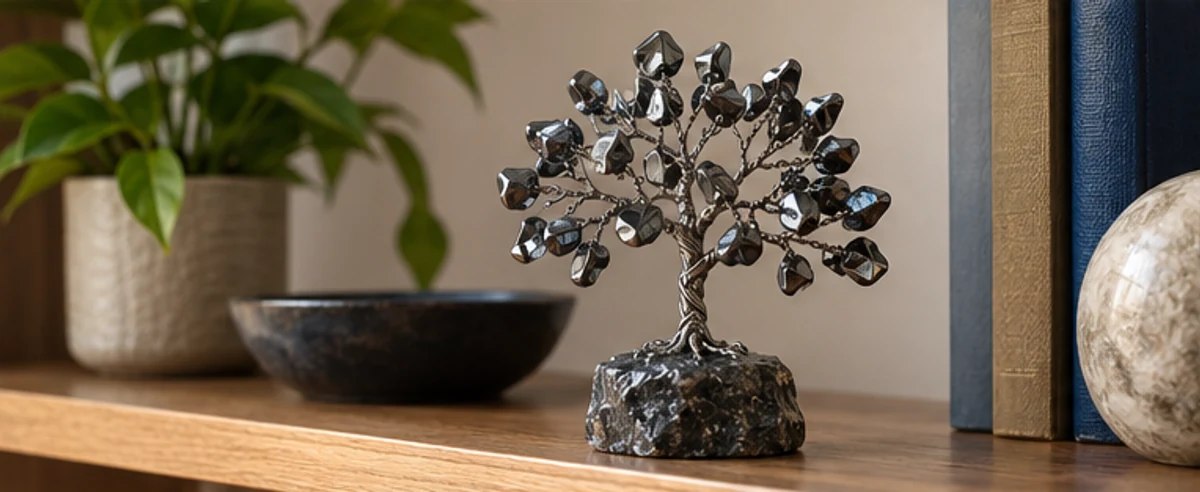
1. First understand the object: a gemstone tree is an assembly
A gemstone tree is normally made from small chips or shaped beads fastened to branching wire, which joins a trunk and some kind of base. It is not a single geological specimen. A retailer may show hematite-labelled chips on copper-coloured wire, dark coated branches, a mineral base or a cast base. The result combines multiple materials with different wear characteristics. Each component matters when identifying, pricing, storing and cleaning the piece.
The branched form carries a familiar symbolic vocabulary: roots for steadiness, a trunk for continuity, branches for development and leaves or chips for the fruits of effort. In a puja setting, the owner may connect it with the Kalpavriksha motif and a personal Sankalpa; in an office it may simply represent the patient growth of a business. The metallic-grey colour gives the idea a restrained, contemporary appearance without replacing the underlying tree symbolism.
Before choosing, ask for a full-front photograph, side and rear views, a close-up of two or three chips, the base underside and actual overall dimensions. A spectacular close-up of one polished chip cannot tell you whether the tree stands level, how broad the canopy is or whether the wire ends are neatly secured.
| Component | What to examine | Why it matters |
|---|---|---|
| Gemstone chips | Colour, surface, shape, uniformity and treatment statement | A reflective grey appearance alone cannot identify natural hematite. |
| Branch wires | Wire gauge, exposed ends, twists, bends and coatings | Repeated bending can fatigue metal and release a chip. |
| Trunk connection | How branches gather and attach to the centre | A secure trunk resists wobble when moved by its base. |
| Base | Material, underside, flat contact area, attachment method | A heavy-looking base need not be dense or stable. |
| Finishing materials | Adhesive, coating, filler and protective pads | Different materials may react differently to water, heat and cleaners. |
| Seller description | Net dimensions, weight, chips, base, care and report scope | Specific component facts are more valuable than a decorative label. |
2. What is real hematite? Mineral identity and metallic colour
Hematite is an iron-oxide mineral with the composition Fe₂O₃. Well-crystallized and compact material may look steel grey to nearly black with a metallic or submetallic lustre; earthy forms can be reddish or brown. Its name is historically linked with its red powdered appearance. For compact mineral specimens, a reddish-brown streak is an important diagnostic characteristic, but a finished gemstone tree is not an appropriate object to scratch merely to demonstrate it. A streak test can damage polished chips, nearby wires or the base.
Common mineral-property references give massive hematite a hardness of roughly 5.5–6.5 on the Mohs scale and a relatively high specific gravity of about 5.0–5.3. These are mineral reference values, not specifications for the finished tree. Tiny chips may have pores, coatings or mixed minerals, and total tree weight includes wire, glue and base. An earthy or platy sample can behave differently from a compact polished chip.
Some hematite beads are cut and polished to an almost mirror-like finish. Others show a muted gunmetal lustre or irregular edges. Neither gloss level is automatic proof of superior quality. Ask whether the advertised mineral was actually identified and whether surface finishes or replacement materials are disclosed. Natural origin, visual finish and quality of assembly are separate questions.
| Property | Hematite reference | Do not infer from a tree photograph |
|---|---|---|
| Composition | Iron oxide, Fe₂O₃ | A metallic colour does not prove the mineral formula. |
| Colour | Dark grey, black or reddish-brown forms | Uniform dark chips can also be manufactured or coated. |
| Streak | Typically red to reddish brown | Do not abrade a finished tree to obtain a streak. |
| Hardness | Often around Mohs 5.5–6.5 for compact material | Hardness does not protect twisted wires or glued joints. |
| Relative density | Dense mineral, near 5.0–5.3 specific gravity | The complete assembly can be light or heavy depending on its base. |
| Magnetism | Usually not strongly attracted like magnetite | A powerful magnetic response requires identifying the actual material. |
3. Natural hematite versus magnetic hematine and lookalikes
One of the largest sources of confusion is the phrase “magnetic hematite.” Natural hematite is generally not strongly magnetic in the way magnetite is. Strongly magnetic jewellery components sold under this phrase are frequently manufactured hematine or related magnetic ceramic/ferrite materials. Their exact compositions vary, so a seller should describe the actual component rather than treating the word hematite as proof that it is natural mineral.
A magnet is useful as a reason to ask questions, not as a final identification method. Metallic fittings, hidden steel, magnetite inclusions or components in the base can also attract a magnet. A finished tree is especially unsuitable for enthusiastic magnet testing: loose chips may move, a strong magnet can pull at wires, and the result may say more about one component than the whole object. If origin matters, request a supplier material declaration or appropriate independent identification of representative chips.
Hematite should also be distinguished from magnetite, which is a different iron oxide, Fe₃O₄, and typically much more magnetic. Black onyx, obsidian, shungite and black tourmaline are entirely different categories of dark material, each with its own texture and properties. Pyrite is an iron sulphide with warmer brassy highlights, not a dark iron-oxide equivalent. Buyers comparing several dark trees should ask about material first and aesthetic finish second.
| Name on listing | Material or visual character | Useful buyer question |
|---|---|---|
| Natural hematite | Dense iron-oxide mineral, commonly dark metallic-grey | Were the actual chips identified as hematite? |
| Magnetic hematine | Often manufactured magnetic jewellery material | Is it explicitly labelled as manufactured? What is its composition? |
| Magnetite | Natural iron oxide with pronounced magnetic response | Is the seller distinguishing magnetite from hematite? |
| Black tourmaline | Dark tourmaline, often with angular or striated chips | What is the specific mineral and surface finish? |
| Obsidian | Natural volcanic glass, glassy black appearance | Are the chips glassy with potentially sharp fractures? |
| Black onyx | Typically commercially used for dark chalcedony; may be treated | Was the black colour produced or enhanced by treatment? |
| Shungite | Carbon-rich rock sold in varying grades and finishes | What source material and form is actually supplied? |
| Pyrite | Iron sulphide with gold-brass metallic lustre | Is the appearance naturally pyritic or coated? |
4. A chip can be genuine while the tree description is incomplete
A claim such as “100% hematite tree” is ambiguous when the base, wire, adhesive and surface finish are not hematite. It may reasonably describe the chips, but the listing should say so. The same problem arises with “natural,” “untreated,” “handmade” and “certified.” These are distinct descriptions. A handmade assembly can contain manufactured components; natural chips can be polished or treated; a report for one sample cannot automatically cover every chip in a multi-chip tree.
Reports are useful when their scope is clear: the identifying laboratory or professional, specimen or sampled lot, date, tests, limitations and relationship to the actual purchased product. A generic printed card saying “original stone” without an identifiable test does not substitute for material disclosure. Equally, lack of a laboratory report need not disqualify an inexpensive decorative tree if the seller gives an accurate, modest description.
Avoid destructive customer tests. A scratch on porcelain, an acid drop or heavy polishing may permanently alter a chip and still fail to identify the entire assembly. Examine magnified photographs, compare the seller’s description across the product title and specification table, and request clarification when a highly magnetic chip is described as untreated natural hematite.
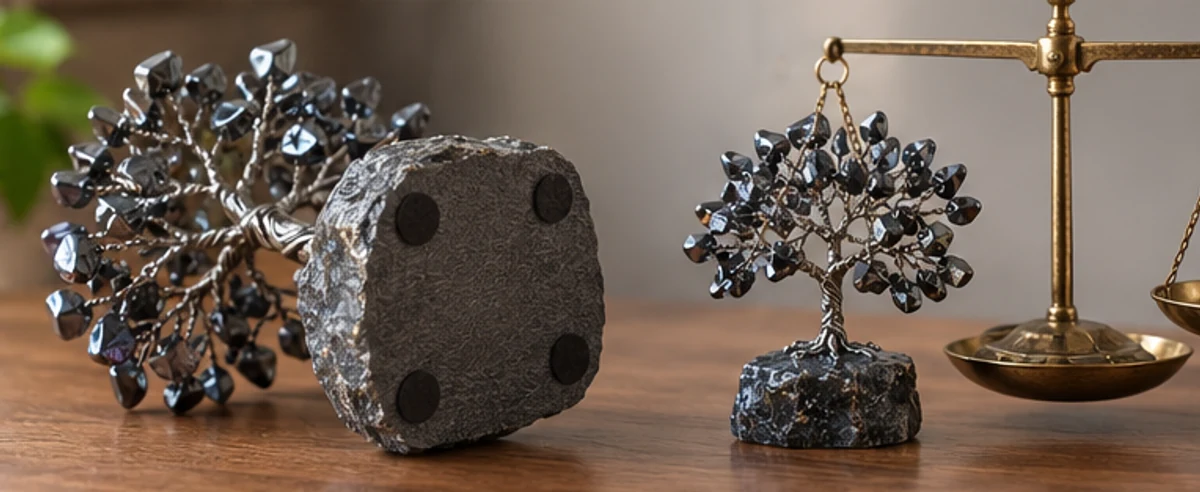
5. Weight: why a dense mineral does not tell you the tree’s weight
Dense hematite chips can add mass, but the balance is not as simple as “heavy means genuine.” A gemstone tree includes a canopy, wire, trunk, glue, protective coatings and base. A stone or filled base may dominate the total mass; a hollow or light base can make a larger-looking tree unexpectedly light. The appropriate product metric is a measured finished net weight, accompanied by clear overall dimensions and a description of what the value includes.
If the seller supplies weight only for a bag of chips, that is not the net weight of the displayed tree. If packaging weight is included, it should be labelled shipping or gross weight. If no verified measurement is available, the seller should not derive a number from a photograph, a competitor catalogue or the theoretical density of pure hematite. The shape, contact area and centre of mass are more important to a stable shelf display than an impressive number alone.
| Measurement | What it describes | How it affects placement |
|---|---|---|
| Overall height | Base bottom to highest natural branch tip | Needs clearance under shelves and cabinets. |
| Canopy width | Maximum spread of outer branch ends | Needs room away from books, curtains and busy passages. |
| Base footprint | Actual contact width and depth | Determines support on a small or narrow shelf. |
| Net assembled weight | Tree as sold, without box or shipping fillers | Helps with shelf load and portability. |
| Base material | Natural stone, manufactured material, wood or other | Changes care, weight distribution and resistance to moisture. |
| Wire adjustment | Fixed, lightly adjustable or fully shaped before shipping | Guides safe unboxing and future branch movement. |
| Loose accessories | Included beads, tray, stand or decorative props | Avoids mistaken assumptions from lifestyle images. |
6. Workmanship: inspect chips, branch ends, trunk and base
Good workmanship is easier to judge from several ordinary photographs than from a single high-contrast product hero. A dense, dark canopy can conceal crossed wires, exposed sharp ends or a weak junction. Inspect at eye level and from the underside. The tree should stand without visible rocking, and its branch tips should not snag fabric during normal placement. Chips should sit securely and the attachment should not visibly shed powder, flakes or residues.
Wire quality matters because every branch has been twisted, bent and sometimes retwisted. Copper-coloured wire may be genuine copper, coated wire or another metal alloy. A metallic-looking trunk should not be labelled pure copper unless the seller knows that fact. Repeatedly opening and closing the canopy after delivery can introduce fatigue, particularly where wires are already tightly twisted. If the product is supplied pre-shaped, leave it that way unless the instructions identify an adjustable design.
The base should be inspected from below for a stable contact surface, padding, unfinished edges, adhesive overflow and any marks that could scratch polished furniture. A dark tree can look attractive on pale stone or wood, but an unstable one can fall and injure a person or chip a surface. Avoid placing it at the outer edge of a shelf, behind a frequently opened door or where a child can reach exposed wires.
| Area | Good sign | Question or fault to examine |
|---|---|---|
| Chip finish | Consistent disclosed appearance under normal light | Coating flakes, deep cracks or sharp edges. |
| Chip fastening | Attachments remain secure under ordinary handling | Loose pieces, visible glue failure or protruding wire. |
| Trunk | Branches gather neatly without severe kinks | Splaying, thin weak junction or sharp twists. |
| Wire finish | Clear material/coating statement | Unspecified plated wire advertised as solid copper. |
| Base underside | Level, supported, clean contact area | Wobble, sharp corners or unsupported point load. |
| Assembly flexibility | Adjustability stated in instructions | Buyer is told to bend rigid branches repeatedly. |
| Packaging | Base restrained; canopy protected from pressure | Branches crushed by a tight lid or loose objects. |
7. Hematite trees in Vastu: meaning and direction without rigid formulas
The tree form is strongly resonant with Indian ideas of growth, blessings and continuity. Kalpavriksha is the wish-fulfilling tree of myth and religious art; a modern wire-and-chip ornament can draw on that image without becoming identical to a classical sacred tree. The owner may set a Sankalpa for steadiness in work, disciplined decisions, respectful relationships or patient progress, and keep the object as a visible reminder of that intention.
In contemporary crystal and Vastu practice, dark or metallic-grey stones are often associated with grounding and steadiness. That symbolic vocabulary is sometimes related to Prithvi Tattva, the earth element. The actual Pancha Mahabhuta framework also includes Jala, Agni, Vayu and Akasha. A steel-grey hematite-coloured tree is an aesthetic and spiritual selection within present-day practice; there is no universal rule that every classical Vastu text prescribes this exact modern object for a fixed compass sector.
A buyer may choose a north-oriented office shelf as a personal symbol of ordered financial effort, associate the northeast or Ishanya area with calm reflection, or simply choose a visible, clean place where the tree does not impede ordinary movement. Traditional directional ideas should be interpreted with the actual room, use, light, ventilation and personal practice in mind. Symbolic placement does not override safe, stable furniture or clear circulation.
| Place | Possible intention | Practical selection |
|---|---|---|
| Puja shelf or prayer corner | Sankalpa, continuity and gratitude | Choose a stable dry surface away from lamps and liquids. |
| Home work desk | Focus, discipline and finishing tasks | Keep a compact tree behind writing and cable movement. |
| Business reception | Steadiness and courteous growth | Use a secure base beyond visitor reach or bag contact. |
| North-oriented display | Personal association with professional or financial goals | Check that direction does not compromise accessibility. |
| Ishanya/northeast reflection space | Quiet contemplation and clarity | Prefer uncluttered display with sufficient branch clearance. |
| Professional Vastu reference kit | Material-comparison teaching | Identify chips, wire and base; label samples carefully. |
8. Navagraha and devotional connections: distinguish symbol from prescription
Some sellers associate dark stones with Shani (Saturn), stability or discipline; others connect iron-coloured materials with Mangala (Mars), effort or practical strength. These associations are not a universally agreed gemstone prescription. Classical Jyotish selection depends on the individual chart and on the specific planetary gemstone being discussed. A hematite-labelled decorative tree should not be presented as a direct substitute for a chart-selected Navaratna gemstone or a Rudraksha recommendation.
A devotee who wishes to keep the tree near a photograph of Lakshmi or Kubera may use it as an auspicious reminder of right livelihood, generosity and care with resources. That is a meaningful personal practice, but it is separate from claims that the object necessarily produces wealth. Where mantra, puja or fasting practices are important, explain the traditional practice itself rather than assigning a new ritual status to a mass-produced accessory.
For a consultation, first understand whether the customer wants a decorative gift, a Vastu display, a meditation accessory, a mineral reference or an individualized astrological recommendation. The answer changes the appropriate level of explanation. It also prevents a generic dark tree from being promoted as one-size-fits-all Graha Shanti.
9. An honest comparison with pyrite, black tourmaline and other dark trees
Hematite is chosen principally for a cool steel-grey look and dense, polished mineral character. Pyrite gives a brass-gold contrast often linked in modern prosperity symbolism with commercial ambition. Black tourmaline offers a more mineral-granular, matte or crystalline appearance, while black onyx often creates a smoother, jewellery-like black canopy. Obsidian has a glassy character and can be more vulnerable to sharp chips. These are visual and material differences first; spiritual associations should be described in their own tradition and context.
A buyer should not compare two trees solely by chip count. One larger, neat canopy may be better suited to a compact home than a crowded crown with hundreds of small chips. Similarly, the same material mounted on warm copper-coloured wire will look different from a silver-coloured trunk. Request neutral-light photographs and actual dimensions.
| Tree type | Typical visual impression | Questions that matter |
|---|---|---|
| Hematite | Cool gunmetal or reflective steel-grey | Natural mineral or manufactured magnetic hematine? |
| Pyrite | Warm brassy highlights and angular sparkle | Any crumbly areas; how is dryness maintained? |
| Black tourmaline | Dark crystalline/striated texture | Are chips stable and edges comfortably finished? |
| Black onyx | Smooth deep-black appearance | Any colour treatment; what is the actual chalcedony? |
| Obsidian | Glossy volcanic-glass appearance | Are sharp fracture edges and chips protected? |
| Shungite | Deep black matte-to-satin carbonaceous appearance | What material grade and coating are disclosed? |
| Tiger eye | Brown-gold directional silky band | Are chatoyant chips visible at normal viewing angles? |
10. Three worked situations in Bengaluru
A compact apartment and a family puja corner
A Bengaluru couple has a small shared puja shelf with framed deities, incense and an oil lamp. They prefer a compact tree because a broad crown would interfere with cleaning. A hematite-coloured tree can serve as an ornamental reminder of steadiness and gratitude, but the base belongs on a dry, level side shelf with clearance from flame, incense ash and spilled water. If the owner observes ritual sprinkling, the ornament need not be submerged; the worship practice can be performed without wetting the wired assembly. Measure the shelf and inspect the base underside before purchasing.
A jewellery showroom and customer conversation
A jewellery showroom wants a small tree next to the reception counter. Customers often ask whether the dark chips are magnetic, natural and certified. The best display has a modest card distinguishing natural hematite from manufactured magnetic substitutes and describes the wire and base separately. Keep the tree outside areas where bangles, bags, point-of-sale cables or cleaning cloths sweep across the counter. The tree works as a conversation piece even without claims about electronic shielding or guaranteed sales.
A professional Vastu consultant building a reference set
A consultant carries several gemstone trees to illustrate how shape, colour and material interact with the owner’s intention. A hematite specimen is labelled with its supplier claim, actual verified chip material if known, wire type, base type and net weight. A separate sample of magnetic hematine is clearly identified as manufactured rather than presented as the same substance. Photographs of both under diffuse light show the difference between visual resemblance and verified identification. A low box with canopy supports prevents travel damage.
11. Buying checklist: the questions that resolve most uncertainty
Ask what the word hematite applies to: the entire tree, the chips, or only the visual finish. Then ask what else the assembly contains. A good listing answers these questions without demanding that the buyer decipher a long marketing paragraph. If the colour is attractive but the supplier has not independently checked the mineral, transparent wording such as “hematite-coloured gemstone tree” is preferable to an unqualified authenticity guarantee.
| Question | What a useful seller answer includes |
|---|---|
| 1. What are the chips? | Named stone or manufactured material, with uncertainty acknowledged. |
| 2. Are they strongly magnetic? | Clear description of any magnetic or manufactured parts. |
| 3. Are they dyed or coated? | Known treatments and the limitations of the information supplied. |
| 4. What is the wire? | Actual metal or coating, not guessed from copper colour. |
| 5. What is the base? | Stone, composite, wood or other; underside photographs. |
| 6. How tall and broad? | Measured overall height, spread and base footprint. |
| 7. What is the finished weight? | Net weight of the actual assembled tree, not packaging. |
| 8. Can branches be adjusted? | Instructions for fixed or modestly adjustable wires. |
| 9. How securely are chips held? | Close-up of branch attachments, repair/return procedure. |
| 10. Does a report apply? | Named sample, laboratory, test scope and limitations. |
| 11. What will be shipped? | Exact tree, pictured accessories, packing method and protection. |
| 12. How should it be cared for? | Dry dusting, storage guidance and special limits of its components. |
12. Dry care: protecting chips, wire and finish together
For a multi-material tree, the safest starting routine is to support the base with one hand and use a very soft, clean, dry brush to lift dust from the chips and branch junctions. Do not pull a cloth forcefully through the crown: it may catch a wire end or detach a chip. Avoid abrasive pads, acidic cleaners, metal polishes, salt water, ultrasonic baths and improvised chemical brightening. Even if a particular mineral could tolerate some method, the adhesive or coating may not.
Humidity deserves attention because the assembly contains metallic branches and possibly ferric, copper or steel elements. The Canadian Conservation Institute explains that moisture and contaminants accelerate corrosion, and that mixed-material objects require care suited to every component. In a typical home, keep the tree away from bathrooms, open balconies, damp planters, kitchen steam and direct contact with wet stone surfaces. A closed storage box should be clean and dry before packing, with no damp cloth trapped against metal.
Check a displayed tree periodically for dust, wobble, loose chips, altered colour, white or greenish corrosion deposits on wires, or exposed sharp attachments. If damage appears, stop manipulating the branch and document the condition before repair. A conservator or appropriate craft professional can advise on significant or valuable pieces. For ordinary products, contact the seller for component-specific instructions and return terms.
| Risk | Better practice | Avoid |
|---|---|---|
| Dust on chips | Gentle dry brush while supporting the base | Rubbing hard with a snagging towel. |
| Moisture and humidity | Dry shelf with air circulation | Bathroom steam, wet stones and soaking. |
| Fingerprints on metallic finish | Handle mainly by stable base | Repeatedly touching polished surfaces. |
| Wire fatigue | Arrange only as the maker permits | Repeated bending and tight twisting. |
| Loose chip | Photograph, isolate and request guidance | Uncontrolled superglue or hard pulling. |
| Packing | Separate padded support for base and crown | Compressing canopy under heavy objects. |
| Ritual use | Keep surrounding puja area clean and dry | Putting the whole object in salt water or oil. |
| Children or pets | Stable high shelf without reachable wires | Unattended floor-level display. |
13. A thoughtful puja or Sankalpa practice that respects the object
In a household that uses symbolic objects during prayer, the act of placement may begin with cleaning the shelf, choosing a suitable location, and forming an intention: steadiness in daily work, fair dealing in business, or kindness in family life. One can remember Lakshmi as the principle of auspicious prosperity or Kubera as a traditional figure of wealth guardianship while respecting the actual devotional lineage of the household. The gemstone tree remains a contemporary display object within that practice.
Some owners like to keep a flower or lamp nearby. Maintain safe separation from flame, ash, incense smoke and water bowls, and avoid putting offerings directly onto chips or wire. If the tree is being given to another person, ask whether they welcome devotional language rather than assuming everyone wants a ritual. A simple, respectful note about growth and continuity is also meaningful.
14. Packaging, shipment and the first five minutes after delivery
The canopy is vulnerable even when the chips are durable. It should be protected from lateral impacts, and the base should be restrained so it cannot swing into the branches. Ask whether packing uses clean tissue, appropriate cushioning and a separate shield around protruding branch tips. A heavier base inside a loose carton can damage every part of the tree during a short trip.
On delivery, inspect the carton before discarding it. Open on a clean table, lift the tree by the base, remove each packing layer slowly, and note whether any chips have fallen into the box. Check the trunk and base for wobble and compare the included items with the seller’s specification. Photograph damage before trying to bend or reattach pieces. If the tree is adjustable, follow the maker’s guidance rather than attempting large branch movements in one step.
15. Frequently asked questions
Is every metallic-grey gemstone tree made from natural hematite?
No. Metallic-grey appearance also occurs in manufactured magnetic hematine, coated components and other minerals. Ask what the chips actually contain and whether the seller has evidence for that material statement.
What is the difference between hematite and magnetic hematine?
Hematite is a naturally occurring iron-oxide mineral. Magnetic hematine is generally a manufactured jewellery material sold as a substitute. The word magnetic should prompt an exact material question, not a promise that natural hematite always has that response.
Are natural hematite chips attracted to magnets?
Natural hematite is generally not strongly magnetic like magnetite. Some specimens or assemblies can show a response owing to other magnetic phases or hardware. A magnet test on the finished tree cannot identify each component reliably.
Is hematite the same as magnetite?
No. Hematite is Fe₂O₃; magnetite is Fe₃O₄. They can share dark colour but differ in magnetism and mineral properties. Accurate product names should not conflate them.
Does the red streak test prove a tree is genuine?
A reddish streak is an important clue for a mineral specimen, but rubbing a polished chip against rough ceramic can scratch it and damage the attachment. Prefer documentation or professional identification.
Does a heavy tree prove natural hematite?
No. The base, trunk, adhesive and any fillers all contribute to finished weight. Ask for a measured net weight and separately identify the chip material.
What is the Mohs hardness of hematite?
Compact hematite is commonly listed at approximately 5.5 to 6.5, while earthy forms may be softer. This figure is not a guarantee that a wire-and-chip arrangement resists breakage.
Can hematite trees have copper-coloured branches?
Yes. A decorative tree may use copper, a copper alloy, plated wire or coloured coating. Copper colour alone does not establish the metal composition; request a clear wire description.
Is a hematite gemstone tree a traditional classical Vastu remedy?
A wire-and-chip gemstone tree is a contemporary decorative and symbolic object. Owners may use it within Vastu-informed spaces and Sankalpa practice, but it should not be described as a universally mandated classical architectural remedy.
Which direction is suitable for a hematite tree?
Choose a safe, clean, visible place that suits the household or office. Contemporary users sometimes connect darker stones with grounding or north-facing professional spaces, but directional interpretations vary by tradition and room.
Is it associated with Shani or Mars?
Some contemporary crystal interpretations connect dark iron-coloured materials with Shani, Mangala or discipline. They do not replace an individualized Jyotish assessment or a specified Navaratna gemstone.
Will a hematite tree protect electronic devices from EMF?
The appearance or iron content of a small decorative tree does not establish effective electromagnetic shielding. Keep it as a display object rather than placing it against devices for an unverified protective purpose.
Can I wash a hematite tree under running water?
Do not assume the complete assembly can be washed. Even if an individual chip tolerates brief moisture, wires, coatings, adhesive and base may not. Gentle dry dusting is the safer first approach.
Can I cleanse the tree with salt water during puja?
Do not immerse the assembly in salt water: salts can encourage corrosion and adhesives or coatings may be affected. Maintain devotional practice without wetting the object itself.
Can I place it near a diya or incense burner?
Keep sufficient clearance from flame, heat, soot, falling ash and accidental liquid splashes. A separate stable shelf is often preferable to crowded placement beside ritual equipment.
Can I bend branches to make the crown wider?
Only if the specific product is made for gentle adjustment. Repeated bending can fatigue metal and loosen chips. Follow the seller’s instructions, particularly around the trunk and tightly twisted tips.
What does a certificate for a gemstone tree cover?
Only what the actual report says it covers. An analysis of one chip or sample lot does not by itself certify every chip, wire, adhesive and base in the finished item.
Is hematite better than black tourmaline or pyrite for Vastu?
They differ in colour, chemistry, surface texture, durability and symbolic associations. Choose based on the intended tradition, actual material disclosure, space and quality rather than a universal ranking.
How should a showroom label a hematite-named tree?
Identify the chips accurately, state any manufactured magnetic material, describe branch wire and base separately, give measured dimensions and weight, and clarify what reports or photographs cover.
What if a chip arrives loose or the base wobbles?
Keep the packing, photograph the condition and contact the seller before making repairs. Do not force the branch or apply unidentified glue or polish to a dark coated surface.
16. Final buying and placement decision
A well-chosen hematite gemstone tree combines the appearance you actually want with the material identity you have been told, careful assembly and an appropriate place. The cool metallic canopy can represent steadiness and purposeful progress; the tree form can recall Kalpavriksha and a personal Sankalpa. Neither symbolism nor gloss eliminates the need to identify manufactured magnetic substitutes, inspect wire ends, measure the finished object and keep the assembly clean and dry. A clear product specification and a thoughtful display are more valuable than an exaggerated claim.
Material and care references: Ohio Department of Natural Resources, Hematite; Missouri Department of Natural Resources, Iron; University of Minnesota, Hematite; GIA, Gems & Gemology study of hematite pigments; International Gem Society, Hematite Jewelry and Gemstone Information; Canadian Conservation Institute, Caring for Metal Objects and Storage of Metals. These sources inform identification and practical care; the article discusses Vastu and devotional associations separately.
