
A gemstone tree's chip count is useful only when read alongside the dimensions, chip size, branch construction, base and actual mineral identity. A 500-chip tree may look smaller than a 300-chip design; a 1,000-chip canopy may be wonderfully full yet unsuitable for a narrow shelf. This practical guide explains what numbers such as 100, 300, 500 and 1,000 can—and cannot—tell you before choosing a decorative Kalpavriksha-style gemstone tree for a home, showroom, office or Vastu setting.
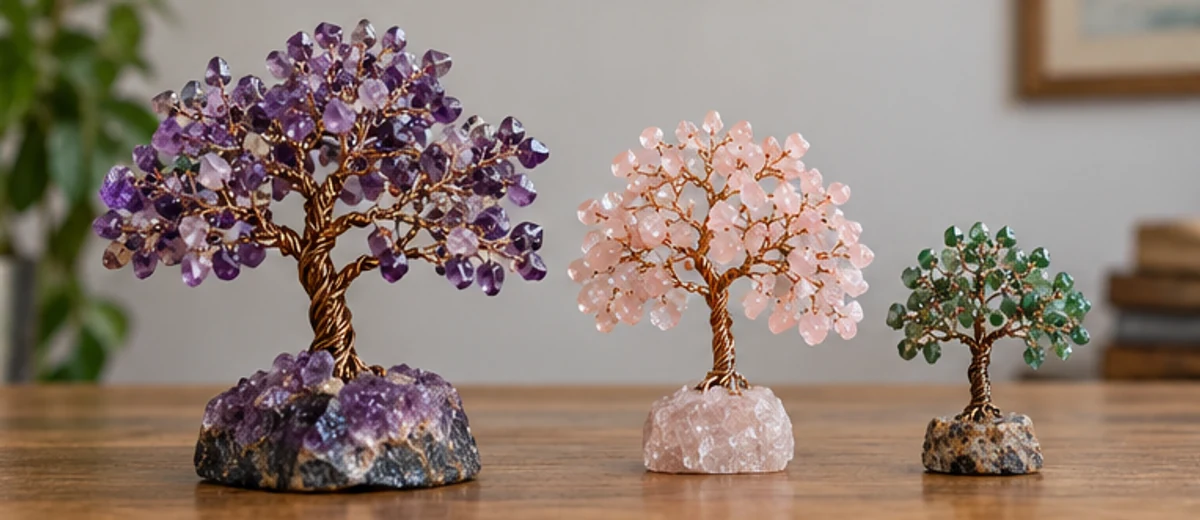
1. What does the chip count of a gemstone tree mean?
The simplest definition is the number of individual gemstone chips attached to the ornamental tree. In practice, a sales description is meaningful only when the seller makes that counting method clear. Some designs contain chips threaded onto wire loops; others use individual stones tied at their drilled holes; still others combine a branch canopy with chips glued or scattered onto the base. Counting those arrangements as though every tree followed a single factory specification creates confusion.
A chip is normally an irregular, small tumbled or shaped piece of gem material. It is not necessarily a bead, polished sphere, faceted gem, crystal point or equal-sized unit. Two chips cut from the same rough stone may differ substantially in volume. One may be thin and broad; another may be short and chunky. Consequently, a total of 300 tells you nothing reliable about the aggregate gemstone weight without additional information.
In a clear listing, a manufacturer may describe an approximate count, a nominal design size, or the actual inspected count. Those are not interchangeable claims. Handmade products can show normal variation, while a defined counted batch should correspond to a documented method. Ask whether the displayed count refers only to gemstone chips tied to the canopy, also includes decoration around the trunk, or counts multiple pieces mounted as a single cluster. Never assume that the photographs reveal every chip: the rear branches, overlapping layers and base decoration may be hidden.
The count is therefore a component specification, not a grade of authenticity, a spiritual-power measure or a substitute for physical dimensions. It becomes useful when combined with a scale reference, whole-tree photograph, chip close-up and accurate description of the supplied object.
2. Understanding 100, 300, 500 and 1,000-chip labels
Retailers commonly organise gemstone trees around memorable numbers. Such groupings help a buyer browse, but there is no single international chip-count sizing system that fixes the height, crown width, material weight or branch length of every 100-, 300-, 500- or 1,000-chip tree. Even two items from one workshop can vary because chips and branches are individually assembled.
| Advertised design | What the count could indicate | What must still be checked | Often suitable when |
|---|---|---|---|
| Around 100 chips | A relatively simple or open canopy in that maker's range | Height, stone size, wire strength, actual branch spread | A small shelf or symbolic gift is the priority |
| Around 300 chips | More attachment points and possible fuller arrangement | Whether chips are small or large; width of crown | You want a medium-looking tree with visible branches |
| Around 500 chips | Potential for multiple dense branch groups | Overall mass, footprint and time needed to dust | A prominent console or organised display is available |
| Around 1,000 chips | Many individual pieces, if the counting scope is consistent | Total weight, stand stability, anchoring and shipping protection | A substantial display is desired and dimensions fit |
These are illustrative shopping categories, not standardised measurements. They do not prescribe how many chips a tree must have for prosperity, health, education or a given Vastu direction. A sparse 1,000-chip design using extremely tiny fragments can remain smaller in apparent volume than a lower-count tree with broad stone chips and a spreading canopy.
Treat enticing numbers as a prompt for the next question: What exactly is being counted, and how large is the finished piece? The answer matters more than whether the catalogue places that tree in a higher numbered tier.
3. Chip count versus height, width, depth and footprint
The principal measurements answer different questions. Overall height runs from the bottom of the base to the highest point of the arranged branches. Canopy width is the widest lateral span of the branch clusters as supplied or displayed. Depth is the front-to-back extension; unlike a flat photograph, a tree occupies three-dimensional space. Base footprint is the area that actually rests on the table or shelf, not the outline of the canopy above it.
A branch may be repositionable within the maker's intended tolerance, so the crown's final width can change. Measurements should specify whether the tree was photographed with the branches closed for transport or opened for display. The canopy must be supported without making its fine wires into load-bearing handles. If an item's height is described as approximate, compare it with a ruler or a familiar object rather than using the number of chips to estimate its silhouette.
| Measurement | How a seller should describe it | Why it matters | Frequent mistake |
|---|---|---|---|
| Total height | Base bottom to tallest chip, with branch arrangement stated | Shelf clearance; visual proportion | Assuming 500 chips means 50 cm |
| Maximum width | Widest leaf-to-leaf span | Avoiding adjacent frames or furniture | Measuring only the trunk |
| Maximum depth | Frontmost to rearmost chip | Safe display on narrow furniture | Relying on a front-only image |
| Base diameter or length × width | Surface contact dimensions | Preventing overhang and instability | Measuring crown width as base size |
| Base thickness and weight | Actual dimensions and approximate mass | Balance and safe handling | Assuming all stone bases are heavy |
| Overall weight | Finished piece including wire, stones, resin, base and fittings | Shelf load, shipping and portability | Mistaking gross weight for gem weight |
For example, a shelf 22 cm deep may not safely display a tree whose canopy extends 30 cm front to back even if its base fits. Likewise, a wide crown on a tiny pedestal can be visually impressive but may be easier to tip. Measure the available clearance at the height where the branches will be, not merely the tabletop below.
A listing that gives both dimensions and chip count is immediately more practical than a listing that boasts only of the number. When the shape is asymmetrical, check the widest side and allow a little open space around it for routine dusting and safe removal.
4. Why 300 larger chips can appear fuller than 500 small chips
Chip number is an integer; visual fullness is an interaction among volume, surface area, opacity, branch direction, colour contrast and viewing angle. Imagine two handmade trees. One has 300 relatively broad red jasper chips, mounted on branches that spread into a shallow hemisphere. The other has 500 tiny chips clustered tightly around an upright trunk. From across the room, the first may cast a larger decorative outline despite having fewer individual pieces.
Chip size matters. A 10 mm piece and a 5 mm piece do not contain simply twice as much material when their forms are otherwise comparable. If the shapes were scaled in every direction, volume would scale roughly with the cube of the linear dimension. Real irregular chips are not neat geometric solids, so this is a conceptual illustration, not a method for estimating gem weight from a photograph. It shows why counting individual stones without considering their size is inadequate.
Chip shape matters. Flat pieces present broad coloured faces when turned toward the viewer, while rod-like or thin chips can disappear edge-on. Colour and transparency matter. Small transparent chips spaced against a pale wall may look airy; opaque green, red or dark-blue chips against a contrasting backdrop may create a stronger visual mass. Light matters. A window behind the piece can reveal gaps and translucent edges; diffuse side lighting often shows branch detail more clearly.
Branch spacing matters. A highly layered crown can show many chips from one angle yet conceal them from another. A tree meant to resemble a delicate bonsai need not have a uniformly spherical crown. Open spaces, visible wirework and intentional asymmetry can be marks of a carefully composed design, not missing chips.
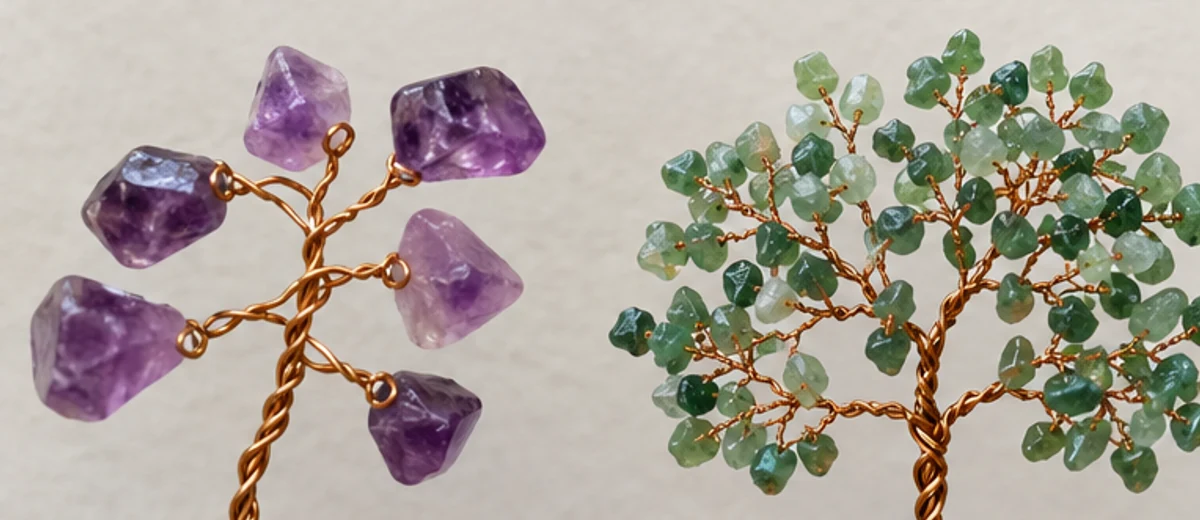
5. Canopy density: how to compare an airy tree with a dense tree
Canopy density is a visual characteristic, not a universally measured score. It asks how much of the visible crown area is occupied by stone pieces and how much remains open. A densely packed tree can create a saturated field of colour, while an airy design reveals individual chip shapes and wire branches. Neither is automatically superior.
| Canopy style | Visual character | Practical advantage | Potential limitation |
|---|---|---|---|
| Open, airy | Distinct branches and deliberate negative space | Easy to appreciate individual chip patterns | Can look sparse in a large room |
| Rounded and balanced | Broad, recognisable tree silhouette | Versatile on a mantel, desk or console | Requires enough surrounding clearance |
| Dense dome | Continuous colour with overlapping branches | Strong focal point at a distance | More careful dusting around hidden junctions |
| Tall, narrow | Upright composition with smaller lateral reach | Useful in some vertical niches | May need a stable base relative to height |
| Windswept or asymmetric | Sculptural movement and a directional crown | Attractive as an artistic object | Footprint and balance need particular review |
A buyer comparing photographs should inspect a straight-on front view, an angled view and an image of the complete base. Ask to see a detail of the attachment near the trunk and of the stone pieces themselves. Without these views, it is difficult to tell whether a broad crown is made from numerous little chips, a few prominent clusters, or packaging that has temporarily pushed the branches outward.
A dense tree may involve more joins, folds and overlapping wires, which can require patience during cleaning. A widely spaced crown can be easier to inspect but exposes the quality of wirework more clearly. Value depends on how convincingly the finished piece uses its materials, not merely how much of the background it hides.
6. What should be counted: chips, beads, clusters or branches?
A transparent specification begins with terminology. A drilled stone chip may be attached to a single loop, but a loop can hold more than one piece. A decorative cluster may contain several chips even though it is connected at one wire point. Similarly, some trees include crystal chips set into a bed of glue at the base. Those pieces contribute to the ornament but are not necessarily part of the canopy chip count.
Three different counts may therefore exist: the number of chips, the number of stone-bearing wire tips, and the number of branch groups. None is wrong when accurately labelled, but interchanging them makes comparisons misleading. “300 leaves” is particularly ambiguous if “leaf” denotes a wire tip rather than a separate mineral piece.
| Claimed term | Sensible interpretation | Clarification to request |
|---|---|---|
| Gemstone chips | Individual fragments of gem material | Does this exclude stones fixed on the base? |
| Wire tips or twigs | Ends of wire branches | Can one tip carry several chips? |
| Branches | Stems extending from a trunk or larger bundle | Are smaller twigs counted separately? |
| Gemstone beads | Normally drilled, more uniformly shaped pieces | Are they beads rather than natural-looking chips? |
| Crystal pieces | Very broad description | Which mineral, natural or manufactured? |
| Decorative stones on base | Chips or pieces added near the trunk | Included in the advertised count or listed separately? |
If the count is an estimate, the listing can say “approximately 300 gemstone chips” and specify tolerance or handmade variation where relevant. If a precise number is presented, there should be a defensible counting method. A buyer should not be told an exact count has been verified when nobody has checked the supplied specimen.
The most important question for a premium custom order is not “Which count looks auspicious?” but “What is the specification that the workshop will actually produce and inspect?” A simple written answer prevents many misunderstandings.
7. A fair way to compare two gemstone-tree listings
A practical comparison takes two minutes when information is available. First, hold the materials constant where possible: compare red jasper against red jasper, or accept that peridot and fluorite may have different wholesale costs, authenticity questions and breakage behaviour. Second, compare dimensions and base stability. Third, inspect chip size and workmanship. Only then use the reported count as one more descriptive attribute.
Consider a purely hypothetical example. Tree A contains 320 average-size chips, spans 24 cm, stands 28 cm high and has a stable 12 cm base. Tree B claims 520 small chips, spans 18 cm, stands 22 cm high and has an 8 cm base. The higher-count Tree B need not be the better choice for an entrance console, a bookshelf or a recipient seeking a prominent focal point. The lower-count design may occupy more visual space and may be easier to position; the higher-count design may appeal to someone who likes densely grouped tiny stones.
| Comparison factor | Question to ask | Why it may outweigh count |
|---|---|---|
| Exact gemstone | What mineral or recognised gem material is this? | Different materials carry different costs and care needs |
| Treatment | Dyed, coated, heated, stabilised or untreated? | Appearance and maintenance may depend on treatment |
| Chip dimensions | Typical range or close-up beside scale? | Affects visible leaf size and texture |
| Finished dimensions | Height, width, depth, base footprint? | Determines actual fit in the room |
| Construction | Are chips drilled, looped or glued? | Influences attachment security and repairs |
| Base and balance | What material and how securely attached? | Determines tip resistance and handling |
| Product photographs | Actual piece or representative sample? | Handmade trees may differ from a styled image |
| Packaging | Are branches protected and base immobilised? | Breakage risk affects delivered value |
When prices differ, a simple price-per-chip division is rarely a fair value indicator. A small dyed chip, a carefully selected gemstone fragment, a complex branch assembly and a shaped natural-stone base are different inputs. Price also reflects labour, finishing, storage, warranty, seller service and material verification. A $ or ₹ figure divided by count hides every one of these variables.
8. Gemstone identity matters more than a large chip number
A count of 1,000 pieces tells you nothing about whether those pieces are correctly named. A strand of blue glass could contain exactly the advertised number of pieces and still not be blue apatite. A tree made with dyed stone can look beautiful, but it should be described accurately. For a meaningful product listing, the seller should state the primary material, known treatments and whether any mixed or substitute materials are used.
Four materials commonly encountered in gemstone-tree collections illustrate the difference. Red jasper is a silica-rich rock variety associated with opaque red colour; polish and iron-related pigmentation influence appearance. Blue apatite is a phosphate mineral, generally around Mohs hardness 5. Fluorite is calcium fluoride, Mohs hardness 4, with perfect cleavage and greater susceptibility to rough handling. Peridot is gem-quality olivine, commonly Mohs hardness 6.5–7. An attractive collection can include all four, but they should not be given identical treatment claims or cleaning instructions merely because they are mounted on similar wire branches.
| Tree material | Distinguishing identity | Durability consideration | Useful buying question |
|---|---|---|---|
| Red jasper | Opaque silica-rich material, commonly reddish | Usually robust compared with softer chips, but edges can fracture | Is the colour natural or altered? |
| Blue apatite | Apatite-group phosphate mineral | Mohs about 5; relatively vulnerable to knocks | Are chips natural apatite and how are they secured? |
| Fluorite | Calcium fluoride, often transparent or banded | Mohs 4 and perfect cleavage; protect from impact | Are delicate fragments safely mounted and packed? |
| Peridot | Gem variety of olivine, typically yellowish green | Mohs 6.5–7; avoid sudden heat and rough cleaning | Is the mineral really peridot, not green glass or quartz? |
Mohs hardness measures relative scratch resistance, not wire attachment strength, adhesive quality or whether the complete tree will survive a fall. A tree with many hard chips can still fail where a thin branch meets the trunk. Likewise, softer fluorite may be excellent for careful stationary display even though it demands gentler treatment.
Consumer-facing gem terminology should make treatments clear. CIBJO's coloured gemstone guidance places strong emphasis on communicating treatments and special care. For a multi-chip tree, an assertion such as “certified genuine” should be scrutinised: Does the document cover a sample, the predominant material, or every stone in the specific item? An isolated certificate for one loose chip cannot automatically demonstrate the identity and treatment of an entire canopy.
9. Do 108 or other sacred numbers determine gemstone-tree quality?
Indian spiritual traditions use significant numbers in many settings. 108 is widely familiar in japa-mala practice, while 9 recalls the Navagraha and 27 the traditional nakshatra division. These associations can be meaningful to someone choosing a symbolic object. They do not, however, establish a universal rule that a wire gemstone tree must contain 108, 216, 300, 500 or 1,008 chips to be effective, suitable for a direction or acceptable as a gift.
A gemstone tree is a contemporary decorative expression of broader tree symbolism; its individual chip numbers are usually modern product specifications. A seller may offer an intentionally counted custom design for a customer's sankalpa, which is a personal devotional choice. That should be described as a chosen convention, not a classical Vastu Shastra requirement applying to every household. Similarly, a nine-colour canopy is not automatically equivalent to a ritually selected set of nine Navagraha gemstones, and counting chips does not substitute for chart-specific Jyotish assessment.
| Number encountered | Recognisable traditional context | What it does not establish |
|---|---|---|
| 9 | Navagraha symbolism in Hindu and Jyotish settings | A certified nine-planet remedy from any nine-chip tree |
| 27 | Nakshatra framework in traditional astronomy and astrology | Mandatory 27-chip canopy construction |
| 54 or 108 | Familiar counting divisions in mantra-japa practice | A required gem-tree chip total for every puja room |
| 300, 500 or 1,000 | Often straightforward product-tier or decorative counts | A classical Vastu efficacy rating or fixed dimensions |
| 1,008 | A number appearing in various religious enumerations | Assurance that each named chip is authentic or untouched |
The better approach is to identify the purpose first: visual decoration, a meaningful housewarming gift, a personal devotional reminder or a carefully specified Vastu consultation object. Then select the material, proportions, workmanship and count that actually suit that purpose. Respect traditional language while keeping product measurements transparent.
10. Kalpavriksha, Sankalpa and the symbolism of the branching tree
Kalpavriksha, also called Kalpataru, is the wish-fulfilling tree of Indian religious and artistic imagination. Its symbolism has a long history: an early sculptural depiction from Besnagar in the Indian Museum, Kolkata, shows a tree bearing abundance-related objects. The wider iconography expresses aspiration, generosity, fruitfulness and the idea that a tree gives shelter and sustenance. That historical imagery is valuable context for today's gemstone-chip trees, though it does not prescribe their modern wire shape or number of mineral chips.
A homeowner may place a gemstone tree where its branching form reminds them of a heartfelt sankalpa—a chosen resolve in worship or personal practice. A business owner may prefer a tree at a reception or display counter in connection with Lakshmi–Kubera symbolism, hospitality and prosperity. A student may choose a colour or stone conventionally associated in contemporary practice with attention or clarity. The significance lies in the devotional and decorative intention, not in making an arithmetic promise about the tally of stone fragments.
When invoking Pancha Mahabhuta—Prithvi, Jala, Agni, Vayu and Akasha—describe the principles as a traditional way of understanding space and qualities. When discussing Ashta Dik, name the directional framework accurately rather than turning every colour into a compulsory direction. A physical location should still satisfy ventilation, clearance, surface stability and the practical needs of the room.
The phrase “Vastu gemstone tree” is a modern commercial and devotional category. It can be used meaningfully in a home, but should not be confused with a universally attested chapter of classical architecture texts that specifies exactly 500 chips for wealth or 300 chips for harmony. Such specificity requires credible textual support and should not be improvised from sales copy.
11. Choosing a gemstone tree for a Bengaluru home or apartment
Apartment layouts vary: a narrow entrance console may be ideal for a compact, broad-base tree, while a large sideboard can hold a taller canopy with generous surrounding space. Start by measuring the actual shelf depth and free height above the base. A wall-mounted rack with limited depth is often a poor choice for a wide, heavily branched tree, regardless of its chip count. For an open living-room table, a stable base and a visually balanced crown may matter more than an especially high number.
For someone choosing a Kalpavriksha-style decorative tree for an altar or meditation corner, the position should respect the sacred setting: keep it clear of flame, incense ash, oily residue and splash-prone water vessels. If the household follows a preferred Ishanya (north-east) placement, integrate that custom with the actual architecture rather than placing the object on an unstable ledge. Do not let a directional preference override basic safety and ease of cleaning.
In a compact home office, a tree need not dominate the work surface. Consider sightlines to a monitor, access to cables, sunlight exposure and the possibility of the trunk catching on sleeves. A smaller count may be perfectly adequate if the design is well made and the chosen mineral is accurately identified. In a family living area with children or pets, a higher shelf or enclosed display may be more appropriate than a low open table with delicate wire and small detachable chips.
Illustrative planning: A 20 cm-deep shelf and a claimed 35 cm-wide crown are a mismatch even if the product is called “small 100 chips”. Conversely, a 15 cm-tall 300-chip tree may fit nicely on a bookcase if the actual width and base are within the available clearance. Use documented dimensions, not assumptions based on catalogue tiers.
12. Jewellery showroom, vastu professional and gifting examples
A jewellery showroom can use gemstone trees as decorative conversation pieces and educational samples. For example, placing red jasper, blue apatite, fluorite and peridot trees in different cases illustrates why similar-looking chip constructions do not imply similar material costs or handling limits. Accurate signs describing stone identity, possible treatments, height, width and count scope help customers appreciate value without overstated claims.
A professional Vastu consultation kit benefits from consistency. Rather than buying the highest count available, select specimens that can travel safely, have stable bases, and show clearly differentiated materials. A modest labelled sample of each stone may be more instructive than a single enormous multi-colour tree. When the consultant recommends an object for a room, record the available surface, preferred tradition and orientation, sunlight, household activity and maintenance limitations. The selected count then follows the physical specification.
For gifts, ask about the recipient's space and tastes. A delicate fluorite tree might delight a mineral enthusiast who maintains a protected shelf; a more robust jasper design may better suit a busy desk. Wedding and griha-pravesha gifts can emphasise Kalpavriksha, Lakshmi and abundance symbolism without claiming a particular numerical tally guarantees fortune. The gift note can mention stone type, simple care and the personal wish behind the gesture.
| Setting | First priority | Common pitfall | Suitable comparison method |
|---|---|---|---|
| Small Bengaluru apartment | Fit, stable base, limited depth | Selecting from chip count alone | Measure width, depth and clearance |
| Home puja or meditation corner | Appropriate placement and easy care | Putting branches beside flame or water | Review physical conditions, then tradition |
| Jewellery showroom | Appearance plus verifiable descriptions | Using “genuine” for mixed or dyed chips without clarity | Record stones, treatments and maker's count scope |
| Professional Vastu kit | Portability and clear teaching samples | Huge canopy with fragile wire | Compare labelled material samples and transport cases |
| Housewarming or festive gift | Recipient's style and available space | Assuming the biggest number makes the best gift | Use dimensions, stone choice and presentation |
13. What a high chip count means for craftsmanship and pricing
A large number of chips can imply more time spent attaching stones, folding wire and arranging branch groups, but it does not guarantee superior craftsmanship. Laborious work can be untidy; a sparse canopy can be exceptionally well proportioned. Inspect how the branches transition into the trunk, whether protruding ends are finished, and whether a chip can rotate or slip out of its attachment with light handling. The maker's stated method should match the physical object.
Look at the branch junctions. Neatly consolidated wires can produce a strong and visually coherent trunk. Exposed sharp wire ends, weak adhesive blobs, unstable glue joints and branches that barely reach their support are warning signs. A legitimate handmade piece can have slightly uneven spacing—that is often part of its charm—but assembly variation should not conceal poor anchoring or material misdescription.
Pricing may incorporate gemstone selection, chip size, assembly time, metal or plated wire, base material, packaging, transportation, retail support and post-sale service. A 300-chip tree using carefully selected natural pieces and a sturdy carved base may reasonably cost more than a 700-chip design using inexpensive dyed material. Conversely, an impressive count does not justify a premium if the workmanship and origin claims cannot be supported.
When comparing offers, separate value of stone material, value of fabrication and value of finished design. Ask for accurate dimensions, clear images and material disclosures before debating whether one unit contains a few dozen more chips. If an estimate is acceptable for a handmade ornament, make sure that approximation is stated instead of presenting a precise but unverified count.
14. How to inspect a count claim without damaging the tree
It is rarely practical to count every chip on a finished densely layered tree by hand. Attempting to pull branches apart can weaken loops or bend metal repeatedly. A non-destructive check should start with the supplier's specification and photos showing different angles. For an expensive bespoke tree, the maker might count chip packets before assembly and maintain a small work record for the item, or provide a labelled count range for the design.
If you do inspect visually, work on a broad flat table with a soft surface under the base. Photograph front, back and sides without lifting the tree by the crown. You can count visible branch groups and estimate whether the declared count is plausible, but that estimate is not a verified exact count. Do not claim exact conformance merely because a photograph appears dense.
For a bespoke order, a simple written specification can include: “Approximately 500 natural red jasper chips, excluding base decoration; finished height approximately X cm; width approximately Y cm after ordinary branch arrangement; base material Z; actual photography of final piece supplied before shipment.” Values X, Y and Z should be completed from real product measurements, not invented by the listing. This makes the agreement meaningful without turning handmade work into a misleading promise of industrial uniformity.
Where a count cannot be confirmed, be candid. “Maker's nominal 500-chip design” is more precise than “exactly 500 certified gemstones” if no individual count was carried out. Honest terminology strengthens customer confidence and supports better product data for online catalogues.
15. Unboxing, branch adjustment, cleaning and long-term care
Packaging can compress a tree's crown. After delivery, set the base on a padded stable surface before opening any protective wrap. Remove padding slowly, following the wire sections rather than pulling on stone chips. Compare the received tree with the seller's unboxed product views; a temporarily narrow crown may reflect transit positioning rather than a missing component. If there are broken joints, loose stones or bent load-bearing connections, photograph the condition and contact the seller before attempting a repair.
Where adjustment is expressly intended, bend only the indicated wire sections, support them near the junction and avoid repeatedly twisting the same point. A large-count tree may have more closely packed branches; opening every branch aggressively to increase apparent width can weaken attachment points. The objective is a naturally balanced form, not a mathematically dense sphere.
Routine dust removal is usually safest with a soft dry brush. Hold the base, and avoid dragging textile fibres through the canopy. Do not immerse the complete assembly in water: the base may contain adhesive, plating or porous material even when the chips are moisture-tolerant. Do not use steam or ultrasonic jewellery cleaners on a wire tree; those procedures are not suitable default methods for a mixed-material ornament. Keep fragile fluorite away from impact, be cautious with apatite's softer surface, and protect peridot from abrupt temperature changes. Consult the seller about any treated or coated chips before using liquid cleaners.
| Issue | Appropriate first response | Avoid |
|---|---|---|
| Dust among dense chips | Gentle dry brush while supporting base | Forcing a cloth through wire loops |
| Crown compressed after transit | Check instructions; adjust intended branches gradually | Pulling individual chips outward |
| One loose chip | Photograph and ask about compatible repair | Strong glue applied indiscriminately |
| Unstable base | Stop displaying; inspect attachment and contact seller | Propping a tall tree on a risky edge |
| Fluorite chips | Gentle stationary display; protect from impacts | Dropping or sharply bending branches |
| Dyed or coated stones | Follow stated treatment-specific cleaning limits | Solvent tests or soaking |
| Strong window exposure | Check stone and finish sensitivity | Assuming all stones and adhesives tolerate full sun |
16. A 12-point buying checklist for chip-count gemstone trees
Before ordering, confirm the precise gemstone name; known dyeing, coating or other treatment; whether the count is nominal, approximate or individually verified; exactly which pieces are counted; typical chip size; overall height; maximum crown width; front-to-back depth; base footprint and composition; the branch attachment method; whether the photographs show the actual specimen; and how the crown will be protected during shipping. Those twelve checks cover far more of the delivered value than a large number printed in the listing title.
If you are comparing multiple options, prepare a short grid with the same fields for each. An unanswered field is not automatically proof of low quality, but it is a reason to request clarification. The seller may be able to supply a simple ruler photograph or extra angle instead of an expensive new certificate. For stone identity or treatment questions, a trustworthy gemmological report must identify its specific tested sample and scope.
For OmmRudraksha product pages, a clear presentation can show an overall image with dimensions, one close-up of the chips and attachments, a straightforward count description and the exact stone name. Linking the product to its care article and related gemstone-tree comparisons helps a reader decide without distorting the product's meaning. If stock is handmade, note that photographs may be representative and that measured sizes or chip arrangement may vary within a disclosed tolerance.
A good gemstone tree should feel proportionate to the room, stable on its base, thoughtfully assembled and honestly described. The chip count is worth keeping—just keep it in its proper place among those more useful facts.
17. Frequently asked questions
1. Is a 500-chip gemstone tree always better than a 300-chip tree?
No. The 300-chip design may contain larger gemstone pieces, a wider crown, a more stable base or more detailed workmanship. Compare the actual gemstone, dimensions, overall proportions and attachment quality before treating count as a ranking.
2. Does a higher chip count always mean a larger tree?
No. A maker can attach many tiny chips to short branches, creating a compact canopy. Another tree with fewer large chips on longer branches can stand taller or spread much wider. Physical dimensions are the reliable comparison.
3. What exactly counts as one gemstone chip?
Usually one distinct fragment of stone attached to the design. However, manufacturers may use different conventions for base decoration, clusters and wire tips. The listing should identify whether the number is a canopy-chip count or something broader.
4. Are 100, 300, 500 and 1,000 standard gemstone-tree sizes?
They are familiar catalogue or design labels, not universally defined physical sizes. Different makers use different chips, wirework and bases. Do not infer height, gemstone weight or crown diameter from those numbers alone.
5. Does 108 chips have a special significance?
The number 108 is traditionally significant in mantra and japa contexts. A 108-chip decorative tree may carry personal symbolism, but that association is not a universal classical instruction for every gemstone-tree purchase or Vastu placement.
6. Can I estimate the number of chips from a photograph?
Only approximately, and sometimes not even reliably. Overlapping branches and the unseen back of the crown conceal pieces. Request a clear counting convention or maker's count information instead of presenting a visual guess as an exact total.
7. Are chips the same as gemstone beads?
Not necessarily. Chips are usually irregular fragments, while beads are commonly more uniform or intentionally shaped and drilled. Both can be genuine stone, but a bead-tree listing should not automatically be compared with an irregular-chip tree solely by quantity.
8. Does a dense canopy prove the chips are genuine gemstones?
No. Natural minerals, dyed stones, glass and manufactured pieces can all create a dense canopy. Authenticity concerns the identity of the material, not the number of visible pieces. Request accurate names and treatment information.
9. Why can two 500-chip trees look completely different?
Chip size, orientation, transparency, wire length, layering, branch design, base height and photographic angle all change appearance. A count describes the number of pieces, not the final composition.
10. Is a gemstone tree's weight equal to its gemstone weight?
No. The finished weight includes wires, adhesive, trunk material, base and any ornamentation. Unless gemstone weight is explicitly measured separately, it should not be inferred from the gross product weight.
11. How do I compare value between two sellers?
Use the same stone identity, treatments, actual dimensions, chip size, workmanship, base, photography and shipping support. Price divided by chip count ignores these differences and can reward an inferior object with more tiny pieces.
12. Which count is appropriate for a small apartment?
There is no magic number. Measure available depth, width and vertical clearance; choose a stable design that will not be knocked by daily movement. A well-proportioned lower-count tree may fit better than a compressed higher-count one.
13. Is a thousand-chip tree appropriate for a puja room?
It can be, if the room offers adequate stable space away from heat, lamps, incense ash and water splashes. Its suitability depends on the object and the devotional setting, not an automatically superior spiritual status assigned to its count.
14. Can I open the branches to make a tree look fuller?
Only if the maker designed it for adjustment. Support the wire near its intended bending point and move it gently. Pulling individual gemstone chips or repeatedly twisting fine junctions can loosen the construction.
15. How should I clean a very dense gemstone-tree canopy?
Begin with a soft dry brush while supporting the base. Avoid pulling cloth through wire loops, and do not immerse the assembly. Stone treatments, adhesives, plating and fragile crystals may each impose additional limits.
16. Are fluorite and peridot trees equally durable?
No. Fluorite is Mohs 4 with perfect cleavage, while peridot is Mohs 6.5–7; their resistance to surface damage and handling differs. The strength of the wire and base also matters, and neither should be subjected to careless impacts.
17. Do dyed chips count as real gemstones?
The answer depends on what material has been dyed and how it is described. Dyed natural stone remains stone, but the treatment should be disclosed. Coloured glass or plastic should not be represented as a natural gemstone merely because the chip total is correct.
18. Can a laboratory certificate prove all 500 chips are genuine?
Only if its stated testing scope genuinely supports that conclusion. Many reports identify a sampled piece or a limited selection; those results should not be exaggerated into complete stone-by-stone verification of an entire finished tree.
19. Is a chip count related to a person's horoscope or Navagraha remedies?
A modern decorative chip total is not a substitute for individual Jyotish assessment. Traditional planetary-gem prescriptions involve specific stones and contexts; a many-chip Vastu tree should not automatically be described as an equivalent remedy.
20. What are the most important questions before ordering?
Ask what stone is used, whether it is treated, precisely what the count includes, the finished height and spread, the base size, whether branches are adjustable, and whether the photographs show the actual supplied tree. Those answers make a purchase much clearer.
Sources and further study
Mineral identity and durability were cross-checked against the Gemological Institute of America (GIA), the United States Geological Survey (USGS) and established mineralogical references. Treatment-disclosure terminology was compared with CIBJO guidance. The historical image of Kalpavriksha was considered with reference to the Indian Museum, Kolkata, which documents an early Besnagar representation. These references are acknowledged by name rather than introducing unnecessary commercial outbound links. Seller-specific chip counts, dimensions and stock availability must still be confirmed against the actual product.
