
A gemstone tree can be a housewarming present, a new-office token, a wedding keepsake or a thoughtful gift for someone beginning a new chapter. The appeal is unusually flexible: its tiny stone leaves can represent growth, the wire branches suggest possibilities, and the tree itself works as a decorative object. A good gemstone-tree gift, however, is selected for a particular person. Start with the recipient’s tastes and available space, then consider the significance they attach to Vastu, gemstones, colour or devotional customs. Size, stability and the actual material description matter just as much as the message on the card.
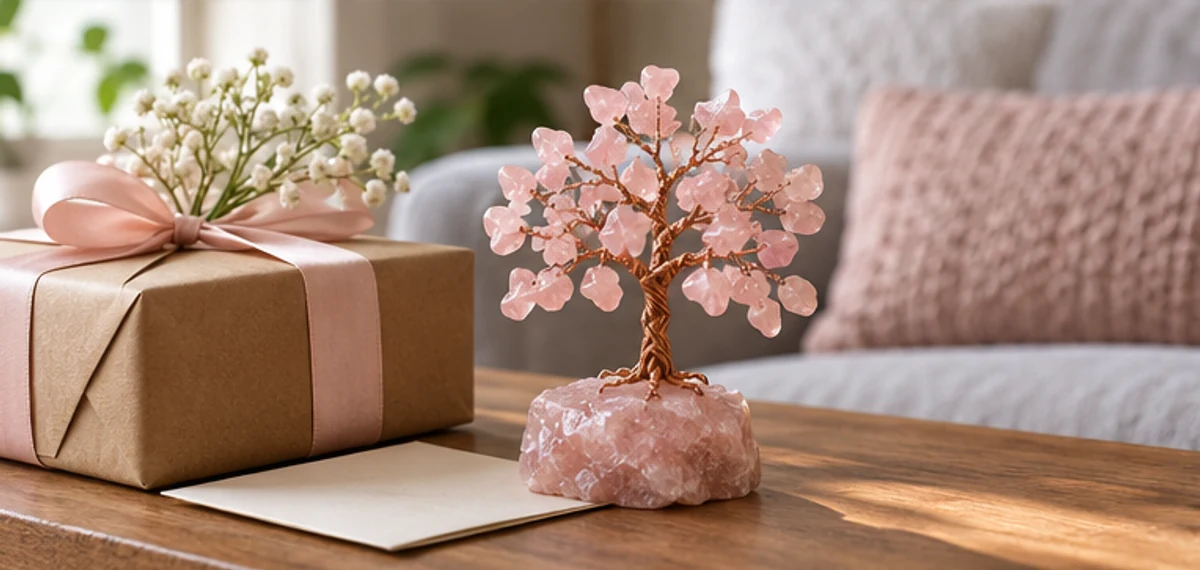
This guide explains how to select a tree for different occasions; what Kalpavriksha, Lakshmi, Kubera and Sankalpa add to its symbolism; how to choose a stone without assigning an unsuitable planetary prescription; how to inspect handmade construction; and how to pack, hand over and care for a finished tree. It also includes real-life gifting scenarios and ready-to-adapt messages. A polished photograph helps with style, but not with dimensions, inclusions, attachments or what the parcel contains.
What makes a gemstone tree a meaningful gift?
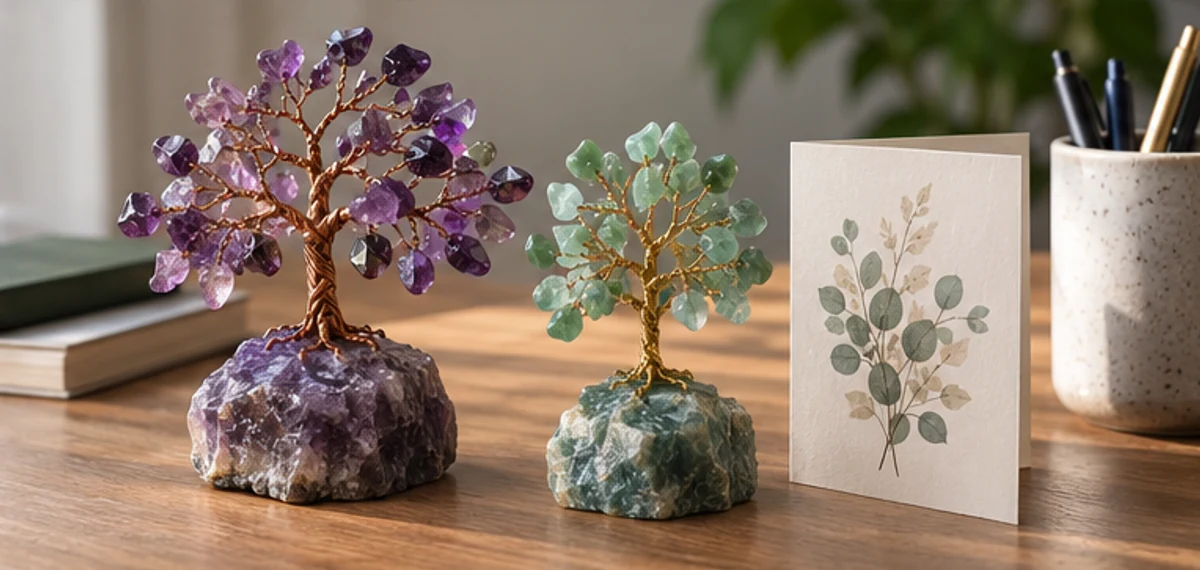
A gemstone tree normally consists of mineral chips or polished beads secured to bendable branches, a shaped wire trunk and a base made from stone, resin, wood or another material. The result resembles a flourishing tree without being a living plant. Its symbolism comes from the tree form, the individual stone or colour, the occasion and the recipient’s own interpretation. A purple amethyst design can mark reflection or learning; a green aventurine tree can complement a new-workspace intention; a rose quartz tree may express affection. These are contemporary associations, not proof that a gemstone forces a particular event.
The strongest gifts connect an understandable message to something about the recipient: a new apartment with pale interiors, a shop opening that deserves an unobtrusive counter display, or a colleague who loves deep blue. Unlike a generic gift basket, a small tree can remain on a shelf for years if it is easy to clean and its branches do not obstruct everyday work. Unlike a living sapling, it does not need sunlight or watering, but it still needs stable placement and protection from knocks. The absence of watering is an advantage for frequent travellers, not permission to ignore dust and fragile connections.
A gift succeeds in three independent ways. Presentation: attractive proportion, coherent colour, a base that stands securely. Meaning: a message suited to the occasion, with any Vastu or spiritual interpretation expressed naturally. Accuracy: honest disclosure of stone names, treatments, dimensions, package contents and care. If any one is missing, even a large and expensive tree can disappoint.
| Decision layer | Ask before choosing | Why it matters |
|---|---|---|
| Recipient | Do they enjoy colour, spiritual objects or understated décor? | Prevents a symbolic gift from feeling imposed |
| Occasion | Is this a housewarming, opening, retirement or personal milestone? | Shapes the message and ideal scale |
| Location | Is there a sheltered shelf, table or office niche? | Determines base footprint and branch spread |
| Stone and colour | Are the chip identity and any treatments stated clearly? | Helps with appearance, trust and maintenance |
| Assembly | Are the branches secure and the base flat? | Reduces the risk of breakage during gifting |
| Delivery | Is it hand-carried, couriered or checked into luggage? | Determines packing and gift-box expectations |
Kalpavriksha, auspicious trees and Indian gift symbolism
Indian traditions give extraordinary significance to trees. The Kalpavriksha or wish-fulfilling tree appears in mythological and artistic settings associated with abundance and the fulfilment of wishes. A historic Besnagar Kalpavriksha sculpture in the Indian Museum, Kolkata, depicts symbols such as a coin purse, lotus, conch and an overflowing vessel among the branches. The symbolic object is older than any contemporary wire-and-chip gemstone tree, and the two should not be presented as the same traditional artefact. The modern gift borrows the richer language of flourishing, shelter, continuity and an auspicious beginning.
When a family enters a new home, a tree-shaped object can suggest stable roots and a growing household. In a business setting it can communicate patient growth, ethical prosperity and the wish that worthwhile effort should bear fruit. These meanings sit comfortably alongside traditional blessings invoking Sri Lakshmi for auspicious prosperity and Kubera in connection with wealth and stewardship. The giver may include those names in a note when appropriate to the recipient’s faith and preferences. For a secular recipient, the same object can simply stand for growth, creativity or friendship.
Sankalpa, a consciously expressed intention, offers a useful way to personalize the gift. A brief thought such as “May this home be filled with mutual care” or “May your new work grow through wise decisions” is more personal than an absolute promise of wealth or protection. During a customary house-entry or puja occasion, some families may prefer to place the gift after the ceremony or in a clean, suitable area. Ask the hosts what they prefer; do not assume a decorative gemstone tree belongs directly on the deity altar or takes the place of prescribed ritual objects.
The Pancha Mahabhuta (Prithvi, Ap, Agni, Vayu and Akasha) and the Ashta Dik (eight directions) are meaningful Vastu concepts. The tree’s base, branches and coloured stones may inspire contemporary element interpretations, but there is no single universal classical rule assigning every wire gemstone tree to a compulsory compass point. A family following a specific Vastu consultation may have a chosen placement; otherwise, selecting a clean, stable, well-lit shelf and respecting household preferences is a good beginning.
| Symbol or tradition | A suitable gifting interpretation | Avoid assuming |
|---|---|---|
| Kalpavriksha | Growth, auspicious wishes and continuity | A modern chip tree is an ancient ritual replacement |
| Lakshmi | A blessing for harmony and prosperity | A purchase guarantees financial gain |
| Kubera | Responsible prosperity and thriving enterprise | One fixed gemstone cures every money concern |
| Sankalpa | The giver’s sincere intention | A formula is compulsory for accepting a gift |
| Prithvi | Stability and a settled home | Every earthy colour has one canonical direction |
| Ashta Dik | Attention to the character of a space | All eight directions demand an identical stone |
Match the gift to the occasion, not just the gemstone label
The most useful way to compare gifts is to ask what the recipient is doing next. A young family moving into a modest apartment has a different practical need from a shopkeeper opening a large showroom, and a teacher retiring from service may appreciate a quietly personal message more than a flashy display. The table below gives starting points rather than rigid spiritual assignments.
| Occasion | Thoughtful visual choice | Placement and size check | Message direction |
|---|---|---|---|
| Griha Pravesh / housewarming | Rose quartz, amethyst or harmonious mixed colours | Stable base on a shelf away from regular traffic | New beginnings, shared happiness |
| Business opening | Citrine or green-toned design if the person likes it | Counter space, signage visibility, customer reach | Sustainable growth, good decisions |
| New job or promotion | Compact green aventurine, tiger eye or chosen favourite | Desk footprint and monitor/cable clearance | Confidence, curiosity, steady progress |
| Wedding or anniversary | Rose quartz, pale quartz or a coordinated mixed tree | The couple’s interior style and personal customs | Affection, patience, companionship |
| Study or graduation | Amethyst, sodalite or a simple multicolour design | Bookshelf rather than crowded writing surface | Learning, insight and resilience |
| Retirement | A favourite colour or restrained natural-palette tree | Low-maintenance space with good access | Time, fulfillment and new pursuits |
| Festival gift | A locally meaningful palette and modest size | Respect the host’s puja and household conventions | Festive goodwill and blessings |
| Thank-you / appreciation | A small durable design selected for the recipient | Easy to transport and display | Gratitude for a specific contribution |
Housewarming and Griha Pravesh: the home comes first
A tree is a pleasant housewarming gift precisely because it does not prescribe how the hosts must furnish their rooms. If the household uses pale furniture and natural wood, choose a gentle pink, green or cream palette rather than a metallic crown that may dominate the setting. For a family with young children or active pets, avoid an unstable tall display; a compact base and protected upper shelf are more sensible. Ask about the home’s style if the relationship allows it. A family who already has a detailed Vastu layout may have a designated area in mind.
A housewarming invitation may mention a puja, a lunch or a short visit. Delivery should be timed for when the hosts can receive an object safely, not during the most crowded portion of a ceremony. The giver can hand over the tree with a simple note that acknowledges the family’s move. A bright photograph on the shopping page should not be treated as proof that the tree will fit the entrance niche; dimensions of the actual item should guide the purchase.
Business openings and professional milestones
For a boutique, consulting office or jewellery showroom, proportion matters more than the number of chips. A wide crown on a checkout counter can obstruct a payment terminal, visitor sightline or product photography. Choose a shape that can sit to the side, where it can be enjoyed without distracting from daily work. A business owner who enjoys prosperity symbolism may welcome a green aventurine, citrine-toned or pyrite-associated design, but these are contemporary choice traditions, not substitutes for a sound business plan.
A gift card can emphasize integrity and patient progress: “For a new beginning built on care, skill and loyal customers.” When choosing for a professional acquaintance, avoid language that assumes their religious affiliation. A neutral description such as “a tree-shaped keepsake for your new office” can be fully appropriate, and the recipient may add their own associations.
Wedding, anniversary and relationship gifts
For a couple, an object shared by both should ideally fit a palette they enjoy together. Rose quartz is often linked in modern crystal traditions to affection, and a mixed tree can stand for two people growing in different ways. Neither choice should be portrayed as a relationship remedy. If the couple has a minimal home or limited shelf space, a compact, symmetrical tree with a stable base is safer than an elaborate, delicate arrangement. Include a message about companionship rather than promising a specific outcome.
Graduation, new studies and a changing career
A study desk benefits from space for books, light and a laptop. A small sodalite- or amethyst-toned tree may suit someone who enjoys thoughtful colour associations, but it should not block their lamp or work area. Choose one with a short trunk and restrained canopy. An academic gift note can honour perseverance and learning; it need not claim enhanced memory or guaranteed examination results.
Choosing gemstone colours: useful associations and actual material questions
The colour of the chips creates the first visual impression. The named mineral determines the next set of questions. Trade labels are not equivalent to laboratory proof of identity. GIA documents that many gem materials—including chalcedony and howlite—can be dyed, and treatments may influence both appearance and care. The right question is not whether a treated gemstone is automatically unacceptable, but whether the seller identifies it accurately and explains what is included in the finished tree.
| Stone or display name | Common gifting association | Check before purchasing | Style note |
|---|---|---|---|
| Rose quartz | Warmth, affection, shared home | Natural stone versus glass; chip colour and fixings | Soft pink looks calm against wood |
| Amethyst | Reflection, learning, tranquil spaces | Stone identity, colour, branch spread, light exposure | Purple creates a clear accent |
| Citrine | Abundance, optimism, a new venture | Natural or heat-treated quartz where claimed; actual yellow tone | Warm against cream and walnut |
| Green aventurine | New opportunities and steady progress | Quartzite identity, sparkle, possible dye | Works with plants and pale interiors |
| Tiger eye | Determination and work milestones | Directional chatoyancy, dye/heat treatment | Golden brown pairs with desks |
| Sodalite | Thoughtful communication and study | Sodalite versus dyed lookalikes; white veining | Deep blue with light backgrounds |
| Labradorite | Change, exploration, an artistic eye | Directional flash, chips and edge durability | Angle-dependent colour can be striking |
| Moss agate | Nature, rootedness, gardening interests | Natural pattern; mineral and treatment description | Botanical appearance without a plant |
| Howlite | Quiet, pale minimalist styling | White natural material versus dyed variants | Understated with light wood |
| Mixed-stone tree | Many interests or a colourful celebration | Whether every named chip is actually present | Versatile if colours remain harmonious |
A label like “seven chakra tree” or “Navagraha tree” calls for more detail. Are seven different materials identified? Are the chips arranged intentionally? Is the description using a modern decorative colour sequence or claiming a classical planetary prescription? The nine grahas of Jyotish, traditionally associated with different gems and remedies, are not interchangeable with any random nine-colour display. A gift may celebrate Navagraha symbolism without becoming an individualized birth-chart recommendation. For a recipient seeking personal gemstone suitability, consultation should consider their actual preferences and the Jyotish system they follow rather than treating a gift tree as an automatic prescription.
If stone details are uncertain, lead with colour and physical form rather than inventing an identification. A well-identified, dyed green chalcedony may be preferable to an undocumented object marketed as rare untouched emerald. For gift-giving, the quality of the entire assembly and the honesty of the listing are essential.
Size, base, branches and how the tree will be displayed
Gemstone trees vary widely in silhouette. Two models with the same nominal height can occupy different shelf widths. A broad, umbrella-shaped canopy needs more clearance than a narrow upright tree; a low, wide base may be preferable on a reception table, while a narrow base that looks elegant in a studio photograph may need a protected shelf at home. Check both the base footprint and the outer width of the crown. Ask whether the advertised dimensions describe the tree as shipped or after branches are manually arranged.
| Feature | Practical inspection | Gift-related concern |
|---|---|---|
| Height | Measure base bottom to highest branch | Is the shelf tall enough? |
| Canopy width | Measure widest part after intended arrangement | Will branches touch nearby objects? |
| Base footprint | Measure length and width of the actual bottom | Can the entire base sit supported? |
| Net weight | Confirm whether tree and base are included | Shipping and stability planning |
| Wire and branch joins | Check for looseness, cracked coating and exposed sharp tips | Safety during unpacking |
| Chip attachments | Look for loose beads, uneven loops or unsecured ends | Loss or damage in transit |
| Surface finish | Inspect chips and base in normal lighting | Accurate gift appearance |
| Box contents | List stand, bag, card and accessories separately | Avoids false expectations |
Treat a gemstone tree as a mixed-material object: stones, wire, coatings, adhesives and base can react differently to handling and moisture. A chip may be relatively durable while the glue or thin wire beside it is not. Some branches are adjustable once; others are fixed or designed only for minimal repositioning. Unless the maker confirms the design, do not pull branches straight or repeatedly twist them. For a person receiving the item as a surprise, put an instruction in the gift box: move it by the base, arrange only where the construction allows, and do not force the branches.
If a tree is gifted to a school, workplace or shared home, consider whether it will be accessed by children. Small detached chips are a choking concern, while a pointed wire can scratch. Keep the finished piece out of reach where necessary; avoid presenting it as a toy. In a public-facing business, place it away from customer handling and food-service surfaces.
Placement: Vastu directions, common sense and the recipient’s choice
The best location joins symbolism to function. Contemporary Vastu advice often refers to Ishanya (north-east) for meditation and spiritual activity, Uttara (north) for Kubera-associated prosperity symbolism, and Purva (east) for new beginnings and Surya-related associations. These are contextual traditions, not a fixed map commanding that a particular coloured chip tree must always face one direction. The nature of the room, the host’s customs and any formal Vastu assessment should guide more precise choices.
A gifting instruction can therefore be simple: “Place the tree on a clean, stable shelf where you enjoy seeing it. If you follow a particular Vastu placement tradition, use the location that suits your home.” That respects both the recipient and the object. An entrance shelf near a frequently opened door may be auspicious to one family but physically risky for a wide-branch tree. A well-chosen interior shelf can be better than an exposed entrance table.
| Location | What works | What to avoid | Optional traditional interpretation |
|---|---|---|---|
| Living-room shelf | Flat support, visible crown, easy dusting | Door swings and crowded ledges | Family growth and welcome |
| Puja-room side shelf | Dry, clean, respectful distance from flame | Direct oil splashes, incense ash and heat | Sankalpa and auspicious intention |
| Home-office desk | Rear corner beyond keyboard and cables | Cups, routine hand movement, wobbly risers | Steady effort and work intentions |
| Shop counter | Side display outside payment and customer reach | Merchandise handling and sunlight through glass | Prosperity and hospitality |
| Bookshelf | Low or compact crown with clear headroom | Pressing branches between hard bookends | Learning and reflection |
| Reception area | Stable base and unobstructed sight lines | Narrow walkways and easily pulled wires | Welcome and opportunity |
Griha Pravesh and devotional etiquette
Some families offer or display decorative gifts after prayers, while others prefer to keep the central altar reserved for particular murtis, lamps and offerings. Ask the family about the preferred sequence. A decorative stone tree is not an automatic substitute for a Kalasha, traditional plant, Yantra or other ritual item. A short blessing delivered respectfully is often more welcome than detailed unsolicited instructions.
Office and commercial etiquette
When giving a tree to a colleague, teacher or customer, the accompanying message should not pressure them to follow a religious practice. Avoid instructions such as “you must place it in the northeast to prevent loss.” For a practitioner who specifically requested Vastu guidance, the gift can include a note that its final location may be considered alongside the room plan, entry, activities and intended use.
A practical budget and quality comparison
A thoughtful gift does not need a large chip count or elaborate packaging. Quality is better evaluated through a combination of identifiable materials, clean construction, stable base, actual measurements and truthful purchase details. Two similarly sized trees can use different types of wire, attachments and bases. Compare the product descriptions rather than assuming one is more valuable because its photograph uses stronger studio lighting.
| Choice category | Appropriate use | Value to compare | Common mistake |
|---|---|---|---|
| Small compact tree | Desk, graduation, thank-you | Stability, footprint, tidy crown | Paying only for decorative chip count |
| Medium balanced tree | Housewarming or anniversary | Colour coherence, durable support | Ignoring canopy spread |
| Larger statement tree | Opening ceremony or roomy reception | Actual weight, base size, shipping support | Assuming display props are included |
| Single-stone tree | Recipient has a favourite stone/colour | Accurate species and treatment disclosure | Assuming colour proves identity |
| Mixed-stone tree | Festive gift or varied décor | Clear chip list and harmonious composition | Equating every mix with Navagraha |
| Handmade bespoke style | Personalised milestone | Actual maker’s dimensions and permitted branch shaping | Assuming every photo can be recreated identically |
For price comparisons, verify the actual listing’s selling price, delivery charges, packaging terms, local availability and return conditions. A promotional lifestyle photograph may show a notebook, pot, cloth runner or gift box that is not supplied. If size and weight are not listed, request the actual measurements; do not infer them from a person’s hand in a picture. A courier booking may need the packed weight, not only the tree’s weight.
Three worked gifting examples in Bengaluru
Example 1: A family moves into a smaller apartment
A couple has moved into a Bengaluru apartment with a narrow entrance console, an active toddler and a pale-wood living room. Their friend initially considers a tall multi-stone tree but discovers the crown would extend beyond the console. They choose a shorter rose-quartz-toned tree with a stable base and enough space for the leaves, and the hosts put it on a higher interior shelf. The card says, “May this new home hold warmth, laughter and many happy beginnings.” The decision respects the household and avoids imposing a strict directional prescription.
Example 2: A jeweller opens a showroom
A jewellery showroom owner likes warm gold and green but wants the payment area to remain clear. A colleague compares a citrine-toned tree and a compact green aventurine tree, asks for close-up photographs of the chip attachments and the underside of the base, and checks the shipped dimensions. The chosen piece goes to a side display away from customer handling. Its meaning can be linked to Lakshmi and the spirit of good enterprise without claiming that placing it at a counter generates revenue.
Example 3: A professional starts a home consulting practice
A Vastu consultant is setting up a quiet video-consultation workspace. A friend considers a seven-colour chakra tree but learns that it will be visible against a visually busy bookcase. A modest sodalite-toned tree with a narrower crown would be more legible on camera and less likely to obscure documents. The accompanying note mentions clarity of thought, attentive listening and success earned through service. If the recipient uses the piece as a professional demonstration, they can explain that its decorative symbolism differs from prescribed chart-based or site-specific recommendations.
Packaging, courier delivery and the moment of unboxing
Gemstone trees need support at the base and restraint around the canopy during transport. The aim is to prevent the assembly from shifting, not to compress every branch into an artificially tight shape. First check whether the seller ships the tree assembled, partly folded or with a removable base. These conditions change how the recipient should unpack it. Never promise that a tree arrives in a premium gift box, with a certificate or greeting card unless those items are actually included for that purchase.
| Handover stage | Good practice | Why it matters |
|---|---|---|
| Before ordering | Confirm dimensions, exact contents and the recipient’s delivery window | Avoids wrong size and missed receipt |
| Before packing | Photograph full view, base, chip details and any loose parts | Creates a reliable dispatch record |
| Inner protection | Support base and separate branches from the box wall | Reduces bending and rubbing |
| Outer box | Use firm cushioning and enough clearance | Protects against impacts |
| Gift presentation | Put note and care card where they can be found without pulling branches | Makes opening easier |
| On receipt | Lift the base first and inspect the canopy without forcing wires | Prevents avoidable damage |
| If damaged | Keep packaging and take photographs before repair | Helps the seller assess the issue |
A simple unboxing card can read: “Open from the top. Lift the tree by the base. Remove cushioning gently. Do not pull individual gemstone chips. Shape branches only if the product instructions permit.” For a courier-delivered surprise, warn the recipient not to discard the protective material too quickly; small loose parts, if supplied, may be packed separately. For hand delivery, carry the tree inside its supporting box rather than gripping the canopy through decorative tissue.
If the tree will travel in luggage, vibration and pressure must be considered. A flat base can be damaged if the whole object rests on fragile branches, while loose chips may scratch adjacent materials. A strong internal support and an outer carton are more important than adding decorative wrapping alone.
A care note the recipient can actually use
A thoughtful gift includes proportionate aftercare. For most intact wire-and-chip trees, begin with a soft, dry brush and a sheltered display. Move the object by its base, keeping the canopy free of repeated knocks. Avoid soaking, salt-water immersion, harsh cleaners, acidic solutions, perfume, alcohol sprays, steam and ultrasonic equipment unless a qualified professional confirms that every component can tolerate a particular method. A gemstone cleaning method suitable for a loose quartz pebble may be unsuitable for a glued and wired decorative assembly.
GIA guidance on treated gems notes that some dyes can fade with prolonged sunlight or react to solvents. The Canadian Conservation Institute documents that humidity and airborne contaminants can accelerate corrosion in metals. Those properties matter because wirework and gemstone chips have different vulnerabilities. Keep the gift away from damp bathrooms, kitchen steam, open flames and very sunny windows when the materials and treatments are unknown. If a branch loosens, do not twist it tighter without first checking how the wire is fixed.
Traditional Shuddhi and devotional care can be expressed through keeping the place clean, offering a prayer or setting an intention without immersing the entire object in liquids. Households may have their own customs, and a decorative tree should be treated according to its actual materials. If it is near a diya or incense, leave sufficient distance for heat, soot and accidental movement. If a stone is a mineral that requires specialist care, that stone’s requirements govern the entire gift.
| Component | Sensible first care step | Avoid until verified |
|---|---|---|
| Quartz, agate or jasper chips | Gentle dry dusting | Solvents or abrasive scrubbing at joins |
| Dyed or coated chips | Keep away from strong light and solvents | Alcohol sprays and repeated wet wiping |
| Wire branches | Dry brush and inspect bends | Repeated twists, pulling and polishing agents |
| Adhesive joins | Keep dry and stable | Heat, soaking and improvised glue repairs |
| Unknown stone base | Wipe only with a suitably dry soft cloth | Acid, salt solution and immersion |
| Display shelf | Clean and dry before replacing the tree | Unstable edges and damp windowsills |
Personalise the card without prescribing a result
A memorable card is short, sincere and matched to the relationship. Avoid language that may embarrass the recipient or treat the tree as a guaranteed financial, medical or relationship remedy. If you know that they welcome Sanskrit or devotional words, include them naturally; otherwise, a thoughtful general message is enough.
| For whom? | Suggested card message |
|---|---|
| New homeowners | “May your new home grow into a place of warmth, laughter and belonging.” |
| New business owner | “For a venture built with care, good judgment and lasting relationships.” |
| Newlyweds | “May you keep finding new ways to grow together.” |
| Graduate | “May curiosity and perseverance accompany your next chapter.” |
| Colleague promoted | “With appreciation for your work and wishes for all that comes next.” |
| Teacher or mentor | “Thank you for helping so many new ideas take root.” |
| Festival host | “With blessings for a bright and harmonious season.” |
| Friend in a new city | “A small reminder that roots and friendships can grow wherever you go.” |
For a traditional Sankalpa-oriented note, consider: “With prayers for shanti, sadbhava and auspicious beginnings in your new home.” That is a blessing, not a binding ritual direction. Avoid printing a recipient’s birth details or private consultation information on the card. A personalized message need not include sensitive personal data to feel meaningful.
The 15-point gemstone-tree gift checklist
Before making a final selection, walk through the details in order rather than jumping from a photograph to checkout:
- Identify the occasion and choose the intended message.
- Think about the recipient’s spiritual preferences and décor style.
- Ask for the actual tree’s full front and side photographs.
- Check complete height, crown width and base footprint.
- Ask whether the branches arrive opened, folded or fixed.
- Confirm the listed gemstones, treatments and any mixed chips.
- Inspect the base, wire joins, exposed ends and attachments.
- Check whether the piece stands securely on a level surface.
- Confirm the supplied box, card, stand and other accessories.
- Avoid inferring size, weight or certification from a lifestyle photo.
- Choose a display location away from routine knocks and heat.
- Ensure the recipient can handle and clean the object safely.
- Confirm price, delivery timing and damaged-item procedure.
- Include a practical unboxing and dry-care note.
- Write one sincere sentence that belongs to the person.
When these points are satisfied, there is no need to make a routine decorative purchase complicated. A stable, clearly described, attractive gemstone tree with a meaningful note can be a very good gift whether it is chosen for Kalpavriksha symbolism, a modern crystal association or simply the pleasure of its colours.
Frequently asked questions about gifting gemstone trees
Is a gemstone tree a suitable Griha Pravesh gift?
Yes, when the hosts appreciate decorative or symbolic objects. Choose a safe size, verify the base and consider their household customs. A tree can represent growth and good wishes without replacing customary Griha Pravesh ritual articles.
Which gemstone tree is best for a new home?
There is no universal best material. Rose quartz, amethyst, green aventurine and mixed colours are popular visual directions, but interior style, size, treatment information and the recipient’s preferences are better selection criteria than a compulsory gemstone rule.
What does gifting a gemstone tree symbolize?
The tree form commonly represents rootedness, continuity, possibilities and flourishing. In an Indian cultural setting it can echo Kalpavriksha imagery; the message may be devotional or simply personal depending on the giver and receiver.
Is a gemstone tree the same as the Kalpavriksha of classical Indian tradition?
No. Kalpavriksha is a mythological and artistic wish-fulfilling tree with a long history. A wire-and-gemstone decorative tree is a modern object that can draw inspiration from its symbolism.
May I gift a gemstone tree to someone who does not practise Vastu?
Certainly. Focus on aesthetics, colour, craftsmanship and the occasion. Avoid attaching rules or rituals the recipient did not request.
Which colour is good for a new office?
A green, gold, purple or blue accent may suit different offices. Compare against the furniture and intended position. The best choice is one the recipient can display without interfering with daily work.
Is a citrine tree compulsory for business prosperity?
No. Citrine-coloured pieces are often associated with abundance in contemporary crystal practice, but no single gemstone tree is required for all businesses. Accurate material identification and a suitable display matter more.
Can I gift a gemstone tree for a wedding?
Yes. A restrained rose quartz or harmonious mixed-colour tree can make an attractive keepsake if the couple enjoys the style. Use a message about companionship rather than claiming the object guarantees harmony.
Should I choose a seven-chakra or Navagraha tree?
Only when its colours, components and symbolism suit the recipient. The modern seven-colour chakra sequence and the classical nine-graha system are distinct traditions; verify what the product actually contains.
Is north or north-east placement mandatory?
No universal placement applies to every modern gemstone tree. A recipient following a particular Vastu method can use their chosen approach; otherwise a stable, clean shelf is the practical priority.
Can the tree be kept in a puja room?
It can be placed respectfully on a suitable side shelf when that fits the household’s practice. Keep it away from flame, ash, oil, water offerings and fragile altar objects.
How large should a gemstone tree gift be?
Choose by available space, not by imagined prestige. Check full height, crown width and base footprint, and leave clearance for cleaning and movement. A compact tree is often better for a crowded desk.
Will the branches look exactly like the website photograph?
Not always. Handmade branch angles and natural chip distribution can differ, especially when the design allows gentle shaping. Confirm the photographed item and how it is shipped.
Do natural gemstone chips always have uniform colour?
No. Natural stones may vary in shade, translucence, pattern and inclusions. Uniform colour by itself does not prove or disprove authenticity; treatments and mixed lots should be described honestly.
Does a gemstone-tree certificate cover every component?
Not automatically. A report may test a particular sample or gemstone, not the complete set of chips, wires, base and adhesive. Read its exact scope and match it to the item offered.
Is gift wrapping always included?
No. The actual product and checkout details determine whether a gift box, card, bag or special wrapping is included. Photographed props are illustrative unless specified.
How should the recipient unpack the tree?
Open the protective box, lift by the base, remove packing slowly and check for loose chips or bent wires. Rearrange branches only when the design instructions explicitly permit it.
Can the whole tree be washed in water or salt water?
Do not assume so. Chips, wires, coatings, glue and base can respond differently to water or salts. Begin with gentle dry dusting and follow material-specific guidance.
Is a gemstone tree a suitable gift for an office colleague?
Yes, provided it is modest, appropriately sized and not accompanied by unsolicited spiritual instructions. A simple message about appreciation or new beginnings works well.
What if a tree arrives with a loose chip or unstable base?
Photograph the condition, retain the packaging and contact the seller before trying to bend, glue or polish it yourself. The correct remedy depends on the actual construction and delivery terms.
Final thought: meaning follows attention to the recipient
The most memorable gemstone-tree gift is not necessarily the largest or most elaborately named. It is one that suits the person, respects their tradition, fits their space and arrives intact with a meaningful note. The Kalpavriksha motif offers a beautiful vocabulary of rootedness and abundance; modern gemstone colours add another layer of expression. Good craftsmanship, accurate information and considerate presentation turn that symbolism into a lasting, useful gift.
Material and cultural references: Indian Museum, Kolkata, Kalpavriksha, the Wish-Fulfilling Tree; Indira Gandhi National Centre for the Arts (Kalpavriksha/tree-worship studies); Gemological Institute of America, gem-treatment and jewellery-care guidance; Canadian Conservation Institute, storage and care of metal-containing objects. Reference names are provided for further reading without adding external commercial links.
