
Choosing the right gemstone tree starts with three separate decisions: where the finished object will stand, which actual materials you want to own, and what meaning or visual character you want it to carry. A beautiful photograph and an impressive chip count are not enough. The safest purchase combines a measured height and canopy spread, a stable base, well-finished wirework, an understandable gemstone description, and a placement you can maintain comfortably. This guide brings together practical buying criteria, traditional Indian Kalpavriksha and Vastu associations, stone identification, workmanship, room-by-room examples, care, gifting and a final inspection checklist.
1. Start with your space, not the product photograph
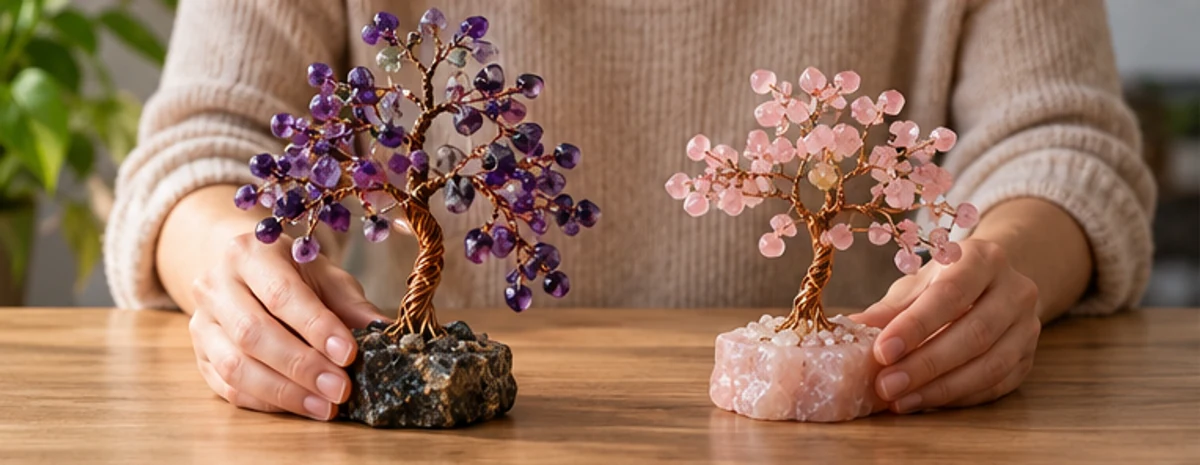
Imagine the tree already standing in its intended spot. Is it a living-room console visible from across the room, a narrow bookshelf beside a window, a dedicated puja platform, a reception desk or a shop display counter? The answer determines the workable dimensions, viewing distance, allowable branch spread and level of daily handling. A tree that looks charming on a large showroom table may be awkward on a small desk occupied by a monitor, charging cable and notebook. Conversely, an intricate miniature tree can disappear visually on a broad furniture surface even when its stone chips are attractive in close-up photographs.
Measure the usable surface, not the full piece of furniture. A side table might measure 45 centimetres across, but a lamp, tray and other objects may leave only 20 centimetres available. Consider the space around the tree as well. Long branches may extend farther than the base; moving curtains, sliding windows, cupboard doors or hands reaching for a frequently used object can catch the wire canopy. A display needs breathing room. The basic arrangement should remain attractive even when no one has spent several minutes styling the branches for a photograph.
Consider the normal line of sight. The tree should be visible from the places people actually sit or pass, rather than hidden behind a computer or close to a dark wall where dark chips blend into the background. On a low console, a broad crown may be welcome. On a high shelf, a taller but narrower silhouette may be clearer. For a gift, estimate how easily the recipient can find a stable location without rearranging a room. The room and its daily use are more decisive than an unverified promise attached to a gemstone name.
A quick room survey before shopping
Walk through the intended location at the time the room is normally in use. Look for direct afternoon sunlight, water splashes from a sink or plant, air-conditioner condensate, humid windows, incense smoke, a ceiling fan's airflow over lightweight displays, and busy paths where the tree may be brushed. These are not abstract concerns: direct sun can affect the colours of certain gems, moisture can matter to pyrite and metal fittings, and repeated contact can loosen small wire-wrapped chips. A clean, stable, dry position usually improves both longevity and appearance.
| Intended location | What to measure | Common overlooked problem | Better selection criterion |
|---|---|---|---|
| Small work desk | Free depth and base footprint | Branches catching sleeves, cables or documents | Compact spread, secure trunk, unobtrusive height |
| Living-room console | Visual width and height from sofa | Tree too small for the furniture or hidden by other objects | Balanced silhouette and colour contrast |
| Puja or meditation shelf | Usable height below any upper shelf | Nearness to flame, oil, water or incense residue | Easily moved, clearances around ritual items |
| Reception counter | Reach zone, sightline and traffic | Customers touching a fragile crown | Stable base, resilient chips, protected position |
| Retail showcase | Lighting, reflections, cleaning access | Overly saturated colours, poor product identification | Neutral-light close-ups, labelled materials |
| Bookshelf | Vertical and lateral clearance | Branch tips touching book spines or doors | Narrow crown with manageable wirework |
| Housewarming gift | Likely recipient's usable space | Too large, difficult to dust, fragile in transit | Moderate size, protective packaging and clear care note |
2. Understand the three measurements that make a tree fit
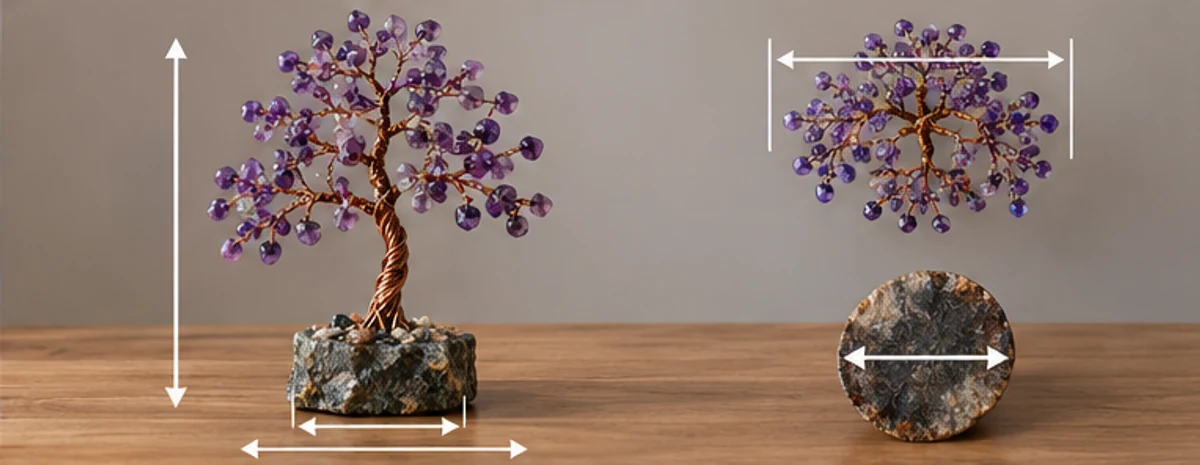
Overall height is usually taken from the underside of the base to the highest branch tip. Canopy spread is the maximum width of the leaves or wire branches after arranging them. Base footprint is the dimension of the part that actually touches the furniture. These are three different measurements. A product listing that provides only a height is incomplete for tight spaces; a listing that provides only a chip count tells you even less about the actual silhouette.
A tree 20 cm tall can have a spread of 12 cm or 30 cm depending on branch length and arrangement. A small base may carry a broad crown, creating an unstable object if the weight is unevenly distributed. Many handmade branches can be adjusted gently, so the exact width may change in use; the seller should distinguish an approximate fully displayed spread from an unalterable dimension. For a wide crown, ask whether the base remains stable when the branches are opened to the photographed shape, not merely when the tree is tightly packed for shipping.
Leave a little clearance beyond the advertised spread. Treat 5 cm around the canopy as an illustrative planning margin, not a product standard; use more where hands frequently move or where curtains and doors operate. Put a paper cut-out approximately the size of the base on the intended surface, and imagine a second larger outline around it for the widest branches. This low-effort test can prevent purchasing a beautiful tree that occupies the space needed for work or puja.
| Measurement | How to interpret it | Why it matters | What to ask the seller |
|---|---|---|---|
| Overall height | Base bottom to tallest branch tip | Shelf clearance and visibility | Is the listed height measured with branches arranged? |
| Canopy width | Widest spread of the branch tips | Compatibility with neighbouring objects | Is it approximate or an adjustable range? |
| Base width and depth | Area that rests on furniture | Stability and surface planning | What is the true footprint, including irregular edges? |
| Gross weight | Tree, base, wire and chips together | Shipping and top-heavy behaviour | Is weight of the complete item or only the stones? |
| Number of chips | Quantity of attached stone pieces | Visual density, not physical size by itself | Exact, approximate or counted by cluster? |
| Typical chip size | Length of individual pieces or a range | Texture, openness and weight | Are they small chips, larger nuggets or uniform beads? |
| Packed dimensions | Protected carton measurements | Transit and gifting | Are branches shipped compressed, and how should they be opened? |
3. Size and chip count: why the highest number is not necessarily the best
Gemstone trees may be advertised as 100-chip, 300-chip, 500-chip, 1,000-chip or other counts. These numbers are useful only when the maker explains the counting method. One item may count every tiny polished fragment; another may group two chips in one wire loop; another may use larger chips that make the crown look fuller with fewer pieces. A 300-chip tree with relatively large, well-spaced leaves may occupy more space than a 500-chip tree using tiny fragments on short branches. Neither is categorically superior.
View the crown from front, side and above when possible. Look for a balanced distribution rather than bare wire on one side and a heavy cluster on the other. Decide whether you prefer a dense, rounded crown, a branching bonsai silhouette, or a delicate spreading form with visible negative space. Some trees are intentionally asymmetrical, and that can look natural. Symmetry should not be mistaken for craftsmanship; controlled spacing, clean attachments and a stable centre of gravity matter more.
If the price changes substantially with chip count, compare the identity of the chips, their approximate size, the finish of the wire, and the support of the base. More wire and more low-cost dyed chips do not make an item equal in material value to a smaller tree made with the clearly identified stones you want. Equally, a premium stone name cannot compensate for exposed sharp wire ends or a loose trunk. Judge the complete object, not one line of specifications.
| Advertised feature | What it can tell you | What it cannot prove |
|---|---|---|
| 100-chip / 300-chip / 500-chip / 1,000-chip | Approximate design density if counting is consistent | Quality, dimensions, authenticity or guaranteed outcome |
| Larger chip size | Coarser texture and often more visible individual colours | Higher mineral quality without identification |
| Very dense crown | Rich, full visual surface | Strong wire attachments or natural colour |
| Tall trunk | More vertical presence | Sufficient base stability |
| Heavy base | Possible added stability | Appropriate weight distribution or natural-stone composition |
| Bright uniform colour | Intentional decorative palette | Untreated, naturally coloured gemstone |
| “Handmade” | Human assembly or shaping is involved | Consistent craftsmanship without close-up inspection |
4. Choose the silhouette and visual language you will enjoy
Look at the outline before choosing between purple, green, yellow or multicoloured chips. A wide low tree can feel generous on a console but may overwhelm a narrow shelf. An upright tree can work beside books or on a reception ledge, provided it is not top-heavy. A bonsai-inspired design uses visibly shaped branches and irregular spaces; it rewards close inspection. A rounded canopy gives an immediately recognisable ornamental-tree shape and can display many colours together. A seven-colour grouped tree presents a symbolic sequence, while a mixed tree disperses its colours more freely.
The trunk and wire finish are part of the look. Copper-toned wire can read as warm against cream or wooden interiors; silver-toned or dark wire may suit modern furniture. Ask what the wire actually is: copper, brass, aluminium, plated alloy or another construction material. A colour description is not an alloy specification. The branch tips and attachment loops should look deliberate, without conspicuous tangles or unfinished twists. A natural-looking design can still be structurally tidy.
Colour contrast matters more than perfect colour matching. Pale clear-quartz or rose-quartz chips may become visually faint against a white wall; dark sodalite or obsidian may disappear against dark cabinetry. A contrasting tray, plain background or repositioning within the room can make a modest tree easier to appreciate. Avoid selecting from a strongly filtered photograph alone. Request a full item view in ordinary light, ideally alongside a measuring scale rather than a potentially misleading decorative prop.
5. Match the gemstone material to your purpose and preference
There is no universal rule that every room requires a particular gemstone tree. A person may select a tree for its colour, cultural association, mineral interest, workmanship, family tradition or as a thoughtful gift. The actual gemstone name should remain an independent part of that decision. Several blue-looking chips can belong to entirely different materials; a yellow crown may contain citrine, yellow jasper or dyed agate; clear-looking chips may be quartz or glass. Stone identity matters to material value, expected durability and appropriate care.
A clear quartz or Sphatik tree offers a bright, neutral aesthetic and is often associated with purity and clarity in contemporary devotional use. In a room with many warm colours, it can sit quietly rather than becoming a focal point. A sodalite tree usually supplies deep blue colour, useful when the room needs one strong contrast. A moss agate tree has branching or moss-like mineral inclusions, useful for a natural, earthy visual; those inclusions are not living moss. A mixed gemstone tree can provide a more colourful focal point. These examples describe both appearance and real material distinctions rather than asserting that a particular stone automatically changes household fortunes.
For violet tones, amethyst is a variety of quartz and generally a sensible decorative chip material, but prolonged intense light can affect colour in some specimens. Green aventurine is a quartz-rich material with reflective mineral inclusions and differs from jade. Citrine is quartz in yellow to orange tones; much commercial citrine is heat-treated amethyst or smoky quartz, so treatment disclosure matters. Pyrite is an iron sulphide with a metallic finish, materially very different from warm yellow quartz, and needs more care around persistent dampness. Fluorite can be colourful yet relatively vulnerable to impact and rough branch adjustment owing to its cleavage. The best selection depends partly on whether the tree will be left undisturbed or handled often.
| Desired appearance | Possible natural material | Important identification or care point | Suitable design context |
|---|---|---|---|
| Clear, pale and versatile | Quartz / Sphatik | Distinguish natural quartz from glass or synthetic quartz | Light wood, puja shelf, simple desk |
| Deep blue focal point | Sodalite | Blue colour and white veins are not a complete authentication test | Neutral living-room console |
| Earthy, botanical pattern | Moss agate | Dendritic/moss-like inclusions are minerals, not plants | Bookshelf, nature-inspired decor |
| Soft pink | Rose quartz | Natural pink quartz differs from dyed imitations | Bedroom dresser, housewarming gift |
| Purple | Amethyst | Protect from prolonged intense sun | Meditation shelf, study nook |
| Yellow-orange | Citrine / yellow quartz | Commercial heating and other treatments should be disclosed | Warm interior accents |
| Glossy metallic gold | Pyrite | Iron sulphide; moisture conditions matter | Protected reception display |
| Bright green | Green aventurine | A quartz-rich material, not automatically jade | Work desk or family room |
| Many vivid colours | Identified mixed gemstones | Request the component list and colour-treatment notes | Family gifting, seven-colour design |
Material, colour and tradition are separate questions
It helps to ask three questions in order: Do I like the look? What is the material? What does it mean to me? A buyer can appreciate a dark blue tree for its visual calm, identify the stone as sodalite, and use the object as a reminder of thoughtful communication. Those three statements do not require claiming that sodalite is the only valid material for every communication-related practice. Likewise, if a household follows a particular puja or Jyotish tradition, that tradition should guide the spiritual meaning independently of the retail item's colour.
6. Genuine gemstone chips, colour enhancement and lab reports
“Natural gemstone tree” can describe several different situations. The chip material may be naturally formed mineral, while the chips have been cut, polished, drilled or tumbled before attachment. Their colour may also have been modified by heat, dye, irradiation, coating or impregnation, depending on the species. A natural mineral with treated colour is not the same claim as a naturally coloured, untreated gemstone; nor is either the same as manufactured glass. These distinctions affect what the customer receives and how it should be cared for.
Gemmological practice treats identity, natural or laboratory-grown origin, and detectable treatment as separate report questions. The CIBJO Gemstone Book provides a terminology framework, while GIA guidance emphasises meaningful treatment disclosure. For a decorative tree, however, an invoice or generic certificate may refer only to one sample chip or one material type. It may not establish the identity of every chip, the source of every colour, or the composition of the wire and base. Ask what was actually tested, by whom, when, with what report number, and whether the testing applies to the complete assembled product or a representative sample.
Potentially misleading descriptions include “certified energy stone,” “100% original all gemstones” without a material list, or “untreated” when no supplier has checked treatment history. A product can be a perfectly enjoyable decorative piece without an expensive gemmological report, but it should still be accurately described. A sensible seller can state when a stone name is based on supplier disclosure or visual sorting, and can avoid pretending that a document for one chip authenticates a 500-chip assortment.
| Listing wording | What to clarify | Useful proof or disclosure |
|---|---|---|
| “Natural gemstone” | Is each chip natural mineral, and is any colour treated? | Species or material list and treatment statement |
| “Original crystal” | Does this mean quartz, another mineral, or generic crystal decor? | Precise mineral species and clear close-up |
| “Seven chakra stones” | Which stones are used in each colour section? | Seven-group material list, not colours alone |
| “Certified gemstone tree” | What exact sample and attribute were tested? | Issuing laboratory, sample coverage, report details |
| “Pure copper wire” | Copper throughout or copper-coloured plating? | Construction and plating specification |
| “Natural stone base” | What stone, and is adhesive or resin part of the mount? | Base description, side and underside photo |
| “Handcrafted in India” | Which parts are handmade or assembled locally? | Honest workmanship and sourcing description |
| “No colour treatment” | Is that verified or an assumption? | Supplier declaration with material-specific basis |
7. Inspect the construction before the gemstone names impress you
Gemstone trees are composite craft objects: stone leaves, loops of wire, branch groups, trunk, adhesive or fixing points, and a base. A close-up should reveal secure wrapping around the chips, branches that can support their own leaves, a trunk that does not swivel loosely, and a base that stays steady when the crown is arranged. The surface facing the customer should have no sharp cut ends protruding at hand level. Especially in a workplace or a home with children, a securely finished structure matters more than a dramatic photograph.
Look for evenly supported branch clusters, not necessarily uniform ones. One cluster may have more pieces because the design is intentionally irregular; the question is whether it hangs naturally and remains attached. A bright plating finish may hide the underlying metal; if some wire has already discoloured in product photos, ask whether this is an intended antique finish or possible surface wear. The trunk can be a single wound bundle or a collection of twisted wire segments, but it should have a mechanically secure transition into the base.
The base deserves special attention. A stone slab can be heavy and beautiful, but may have uneven contact points. A resin base can be convenient and consistent but should not be advertised as solid natural stone. Some trees use a geode slice or mineral cluster, and the attachment may involve adhesive. Ask for the underside view and ensure the tree will not wobble on a smooth tabletop. A non-scratch protective pad can be useful, provided it is appropriate for the surface and does not make the tree less stable.
Gentle adjustment is different from repeated bending
Handmade wire crowns are often shipped in a more compact form to reduce damage. Branches may be intended for one cautious arrangement after opening. Hold the trunk near the branch being moved, support the chip-bearing section, and make small adjustments instead of repeatedly folding the same wire back and forth. Repeated bending can weaken metal at a tight twist. Chips of fluorite, some feldspars or fracture-prone stone can be damaged by twisting pressure even when the wire itself survives. If the listing claims fully adjustable branches, request explicit handling instructions rather than assuming unlimited flexibility.
| Part of the tree | What good workmanship looks like | Warning sign | Buying action |
|---|---|---|---|
| Stone chips | Defined material and neat edges | Many loose or visibly fractured pieces | Request close-ups of actual product |
| Chip loops | Secure attachment without sharp projections | Chips slipping from open loops | Ask for assembly detail and return terms |
| Outer branches | Intentional spacing, appropriate support | Sagging or severely tangled wires | Compare normal display photographs |
| Trunk | Firm twist and coherent shape | Loose swivel above base | Request short handling demonstration if costly |
| Wire finish | Consistent with advertised metal or plating | Unexplained flaking, rough ends | Clarify alloy, plating and finish |
| Base | Flat enough and suitably weighted | Wobble or obvious adhesive failure | Ask for underside/side photographs |
| Overall balance | Stable when arranged as shown | Top-heavy lean, tipping from minor contact | Check assembled height, spread and weight |
| Packaging | Protects both chips and branch outline | Crushed crown or rattling loose stones | Clarify replacement policy and shipping method |
8. Traditional meaning: Kalpavriksha, Sankalpa and auspicious trees
The tree form carries a rich meaning in Indian cultural and spiritual life. Kalpavriksha or Kalpataru evokes the auspicious wish-fulfilling tree, associated in narratives and artistic representations with abundance, shelter and fulfilment. An archaeological representation of Kalpavriksha from Besnagar, described by the Indian Museum, Kolkata, shows symbolic objects associated with prosperity on its branches. Modern wire-and-gemstone trees borrow the broader tree as a symbol; they are not identical to the ancient sculpture or a classical ritual object specified in one universal text.
A family's Sankalpa—a considered intention or resolve—can lend a chosen tree personal significance. It may remind household members to cultivate patience, study, careful speech, generosity or responsible stewardship of resources. Some place a green tree near a work area as a symbol of steady growth; others prefer clear quartz at a puja shelf, or a mixed-colour tree in a shared living room. These are meaningful choices when honestly described as traditional inspiration and contemporary devotional or decorative practice, not a claim that the particular chip arrangement is a mandatory Vedic prescription.
In modern Vastu practice, decorative gemstone trees are often associated with auspiciousness, harmony, prosperity, learning or professional progress. Individual sellers may recommend specific colour combinations for north, east or northeast. These associations are not universal rules independently specified for each gemstone tree in all classical Vastu texts. They should be read alongside the larger setting: Vastu Purusha Mandala, Ashta Dik (the eight directions), and Pancha Mahabhuta (the five great elements) are broader cultural and architectural frameworks. They are not the same as a retail colour chart.
Lakshmi, Kubera and the difference between symbolism and guaranteed results
Lakshmi is linked with prosperity and auspiciousness; Kubera with wealth and guardianship of riches in Hindu traditions. A household may choose a decorative tree as a respectful visual reminder of abundance and gratitude, particularly near a tidy entry console or business display. The spiritual association can be honoured without asserting that a specific specimen, chip count or direction will guarantee sales or income. A jewellery shop might use a gemstone tree both as attractive decor and as an example of the minerals it sells—two practical functions that sit comfortably alongside the owner's personal devotion.
Jyotish gemstone remedies are a different decision
Traditional Jyotish gemstone recommendations usually involve a particular person's chart, grahas, strengths, periods and the interpretive practice of the astrologer. Gemstones frequently connected with planetary discussions include Manikya for Surya, Mukta for Chandra, Moonga for Mangala, Panna for Budha, Pukhraj for Guru, Heera for Shukra, Neelam for Shani, Gomed for Rahu and Lahsuniya for Ketu. Those names refer to specific stones or traditions, not an instruction to substitute any similarly coloured chip in a decorative tree. A yellow-looking jasper tree is not automatically the same as a Pukhraj remedy; a blue sodalite tree is not Neelam. Keep decorative choice and personalised Jyotish guidance distinct.
9. A practical Vastu placement framework for homes and offices
In common Vastu discussions, Ishanya denotes the northeast, often associated with clarity, worship and water; north is frequently considered in relation to Kubera and commercial activity; east is commonly connected with Surya and beginnings. Yet homes have different layouts, actual daylight, furniture circulation and household practices. A decorative tree should fit safely within the room instead of causing unnecessary disruption to a functional plan. It need not occupy the exact geometric corner if that spot is a wet sink area, a direct sun exposure point or a crowded walkway.
For a puja area, keep sufficient distance from flame, hot lamps, oils and incense ash. A simple lower-stress position near, not immediately beside, ritual implements often gives better access for cleaning. On an office desk, avoid leaning branches into keyboards, moving chairs or cables. In a shop, a reception ledge may be more suitable than an unprotected edge. In a bedroom, aesthetics and easy maintenance may matter more than creating a dramatic display. When an experienced Vastu practitioner advises a specific configuration, confirm the practical details of the actual room and object before moving it.
| Vastu-related intention | Traditional or modern association | Practical placement thought | Important limit |
|---|---|---|---|
| Study, reflection or quiet puja | Ishanya / northeast associations | Clear, dry shelf with respectful space | Do not place chips beside exposed flame or water |
| Career or business focus | North / Kubera associations | Stable office display or protected counter | The object is not a substitute for business planning |
| Fresh beginnings and learning | East / sunrise associations | Bright but indirect-light position | Prolonged direct sunlight can affect some gems |
| Family harmony | Shared living space and Sankalpa | Visible, uncluttered central console | Shared meaning matters more than a rigid chip formula |
| Financial gratitude | Lakshmi–Kubera imagery | Clean entry or reception arrangement | Do not promise a measurable income result |
| Personal meditation | Chakra and contemplation symbolism | Eye-level shelf not blocking practice | Chakra-to-stone mappings vary by modern school |
| Gifting for a new home | Kalpavriksha auspicious-tree symbolism | Moderate-scale tree with care instructions | Give recipient choice of where to display it |
10. Match the tree to each real-world use case
A compact Bengaluru apartment
Suppose the intended position is a 25 cm clear section of an open bookshelf, with a sliding balcony door nearby. The first requirement is a narrow crown that cannot catch the door or moving curtains. A small rose quartz, clear quartz or mixed-colour tree may work visually, but decide by measured spread and base stability. Keep it away from intense afternoon sunlight, particularly if amethyst chips are involved. A compact tree with larger visible chips may be preferable to a dense crown containing hundreds of tiny chips that is hard to dust in a tight position.
A family puja area
A household may appreciate a clear quartz, amethyst or seven-colour design for its contemplative significance. Here the decisive points include distance from lamps, camphor, oil and water vessels, ease of lifting the object for cleaning, and a place where chips do not drop into offerings. If the family observes a particular sampradaya, continue its inherited ritual practice; do not replace its symbols with a shop-generated chakra diagram. A small tree can carry a sincere Sankalpa without occupying the central space reserved for the deity or puja objects.
A jewellery showroom or boutique
A showroom wants the product to look attractive and to be honestly labelled. A pyrite tree might create a metallic display feature; sodalite offers saturated blue; moss agate provides a botanical texture. Merchandise displays benefit from a neutral-light photo and a materials card, not only artistic spotlights. A well-positioned tree behind the counter can discourage casual handling while preserving a full view. Train staff to explain the actual species, common treatments, approximate dimensions and whether the display item is the exact piece offered for sale.
A shared office reception and meeting room
Reception desks are used continuously, so loose wires and very broad crowns create avoidable inconveniences. Choose a sturdy base and chip attachment, place the tree behind a safe reach line, and avoid a position where papers or customer bags brush the canopy. For a meeting room, a medium tree on a cabinet may be more appropriate than a miniature hidden behind an audiovisual screen. The tree can symbolise hospitality or growth; it should not obstruct sightlines, equipment vents or emergency access.
A professional Vastu consultant's sample kit
The consultant's goal is often explanation rather than permanent display. A compact set could include a clear-quartz example, a dark-blue sodalite or lapis example, a warm-toned stone, and a mixed seven-colour tree. Carry accurate identification cards and a simple diagram distinguishing height, canopy spread and base footprint. Use specimens robust enough for careful demonstrations. Fragile fluorite, polished pyrite prone to damp storage, and fragile adhesives require more protective transport. Most importantly, explain which associations are classical frameworks and which are contemporary gemstone-tree conventions.
Gifts: housewarming, wedding, graduation and new business
A gift works best when the recipient has room for it and appreciates the chosen style. For housewarming, a moderate size and neutral colour may be easiest to place. For a graduation, a small study-shelf tree with a personal note about focused learning can feel appropriate. For a new business, a Kalpavriksha-inspired piece may signal good wishes, but the note should express the giver's hope rather than claim guaranteed prosperity. Confirm the packaging is strong, whether a display tray is included, and how the recipient can adjust the branches safely after delivery.
| Recipient or setting | Prioritise | Ask before ordering | Avoid |
|---|---|---|---|
| Student or compact desk | Small stable base, clear sightline | Dimensions, chip durability | Spreading branches beside a keyboard |
| Family home | Balanced shape, easy cleaning | Actual finished-item photos | Excessively delicate crown in a busy area |
| Puja room | Respectful scale and safe distance | Stone care near heat, ash and oils | Placement immediately beside lamps |
| Shop opening | Professional appearance and disclosure | Material list, stable base, return conditions | Unsupported “guaranteed success” claims |
| Colleague or teacher gift | Neutral palette, protective pack | Recipient's desk or shelf space | Assumed personal planetary prescription |
| Consultant demonstration | Identified samples, transport protection | Component verification and aftercare | Unlabelled dyed chips sold as rare minerals |
11. How much should a gemstone tree cost?
A fair price is not determined by a single chip-count number or by a claim that the tree is auspicious. The meaningful cost drivers include the identified mineral or minerals, chip size and quality, labour spent wrapping and arranging branches, wire composition and finish, nature and stability of the base, workmanship, packaging, the ability to select the actual piece, and the seller's returns and support. A 300-chip piece with accurately named material, secure loops and thoughtful packaging can be a better choice than a nominal 800-chip tree with ambiguous composition and poor stability.
Comparing prices across sellers requires a common description. Ask for exact or approximate height, spread, base dimensions, the material list and any known treatment disclosures. A photograph should show the complete piece, not only a close-up of bright chips. Distinguish a generic product photo from a photo of the item that will actually be shipped. A premium price based on “certificate included” needs clarification about who issued the certificate and what it proves. Large gemstones and high-value chips justify closer scrutiny; an inexpensive decorative item may be purchased mainly for its style, provided its description is accurate.
A simple value comparison
Compare two trees by writing down their measurements, stone identity and visible craftsmanship side by side. If Tree A is taller but has a narrow canopy and light base, while Tree B is shorter with a broad crown and secure mineral slab, the right selection may depend entirely on the display location. If one description says natural amethyst and another says unspecified purple crystal, you do not yet have two equivalent products to compare. The next step is to obtain the missing identification, not to assume the higher price reveals which item is genuine.
12. Avoid common buying mistakes
Mistake 1: choosing by colour alone. Similar colours may belong to entirely different minerals, dyed materials or glass. Verify the description, particularly for bright blue, green and yellow chips.
Mistake 2: confusing Mohs hardness with overall toughness. Mohs describes resistance to scratching, not the ability to survive impact or branch pressure. A fluorite chip is less resistant to scratching than quartz and has pronounced cleavage, while a harder material can still fracture. The assembled tree's wire and mounting are additional weak points.
Mistake 3: equating large chip counts with spiritual or physical quality. Count says little about material identification, tree dimensions, stability and workmanship. Choose the full design.
Mistake 4: assuming every “chakra” or “Vastu” association is an unchanging Sanskrit textual rule. Contemporary colour-stone charts often vary. Treat them as modern interpretive design choices alongside the traditional frameworks of Sankalpa, Kalpavriksha, Jyotish and Vastu.
Mistake 5: putting the tree wherever a diagram indicates without checking the room. A nominal northeast corner next to a wet sink, direct sun, moving door or flame is not sensible for a mixed-material decorative object. Choose a safer nearby position or consult someone familiar with the actual premises.
Mistake 6: treating the tree like a loose tumble stone during cleaning. The chips, wire, adhesive, base and finish may require different methods. Never assume immersion, ultrasonic cleaning, abrasive polishing or salt water is safe for the complete assembly.
Mistake 7: overlooking the box and delivery process. A beautiful tree can arrive with bent wires or detached chips. Confirm branch-packing method, fragile-item protection, damage reporting procedure and whether the final piece is exchangeable.
13. Cleaning, daylight, humidity and storage after buying
For regular cleaning, begin with a soft dry brush or a clean lint-free cloth, supporting the trunk and smaller branches so they do not flex under pressure. Dust can collect between closely spaced chips; a gentle approach repeated occasionally is better than harsh scrubbing after dirt builds up. If a chip has fallen off, set it aside and contact the seller for the appropriate repair rather than using an unknown solvent or glue. Repeated twisting and unfolding of wire can weaken the structure, even when the individual stones remain intact.
Do not put an assembled gemstone tree in salt water or under running water merely because loose quartz is sometimes washed. Metal finishes, adhesives, dyed chips and porous stones may react differently. Keep the tree away from repeated splashes, wet plant saucers and unventilated damp cupboards. Some pyrite is vulnerable to oxidation in humid conditions. Amethyst and some other coloured stones can fade under prolonged intense light, and fluorite chips need protection from impact. A mixed tree should be cared for according to its most vulnerable component, not its hardest chip.
If the tree will be stored for a festival rotation or during travel, protect the base separately, support the crown with clean soft packing, and avoid pressing heavily against chip loops. If shipping requires compact branches, ask the maker for re-opening instructions. A transparent display box may help in dusty settings, but it should not trap moisture. In retail display, periodic inspections can catch loosening base joints or bending stress before they become visible failures.
| Material or construction | Main concern | Sensible routine | Avoid |
|---|---|---|---|
| Clear quartz, rose quartz, amethyst | Dust; amethyst can be light-sensitive | Gentle dry dusting, indirect display | Harsh impact and prolonged intense light |
| Sodalite, lapis lazuli | Treatment and surface differences | Soft dry cleaning for assembled trees | Solvents or abrasive polishing |
| Pyrite | Persistent dampness and possible oxidation | Dry location, periodic inspection | Wet shelves and soaking |
| Fluorite | Mohs 4 hardness, perfect cleavage | Minimal branch manipulation | Twisting or pressure at chip edges |
| Feldspar / moonstone | Impact and cleavage-related damage | Supported handling | Sudden force or thermal shocks |
| Dyed agate or quartz | Possible dye sensitivity | Follow supplier's care advice | Alcohol or strong chemical cleaners |
| Metal wire and plating | Tarnish, coating wear, metal fatigue | Light dusting, gentle one-time adjustment | Repeated sharp bending, corrosive agents |
| Resin, wood or stone base | Adhesive bond, surface compatibility | Stable, clean and dry support | Immersion or scraping beneath the tree |
14. A 12-point buying checklist you can actually use
Before checkout, use the following checklist. You do not need a professional gemmology course, but you do need a product description that can be checked against the photographs. For an expensive or unusual tree, request additional close-ups and written clarification rather than relying on an attractive generic title.
| Check | Buyer question | Evidence to request |
|---|---|---|
| 1. Intended location | Where will the complete tree stand? | Usable space and clearance measurements |
| 2. Height | How tall is the finished, displayed object? | Height from base bottom to highest branch |
| 3. Spread | How far do branches extend? | Approximate arranged canopy width |
| 4. Base | What is the footprint and composition? | Side and underside photograph |
| 5. Chip identity | What actual stones are present? | Written mineral or material list |
| 6. Treatments | Are colour enhancement or coatings known? | Specific supplier treatment disclosure |
| 7. Chip count | Is the count exact or approximate? | Counting method, if relevant to price |
| 8. Wire | What is the wire composition and finish? | Material and plating description |
| 9. Workmanship | Are chips, loops and trunk secure? | Macro photos of attachments and base |
| 10. Item photograph | Is this the actual unit or a sample? | Full front/side views in normal light |
| 11. Shipping | How are branches and base protected? | Packing approach and damage process |
| 12. Aftercare | How should the finished assembly be cleaned? | Stone-specific handling and repair guidance |
15. A decision path for choosing one tree from several
Begin with a simple filter: exclude any tree that does not fit the usable surface or that cannot be placed safely. Next, separate the visual candidates by silhouette—upright, broad, grouped-colour or informal bonsai-like. Then compare material identity and treatment statements. Only after this shortlist should you compare chip counts and price. Finally, ask whether the tree carries an association you or the recipient genuinely value. This order works because a spiritually meaningful object still needs to be physically usable and accurately described.
If two candidates remain close, ask to see them beside a neutral measuring scale. One may have smoother branch lines; the other may contain the specific material you wanted. If durability is critical, prioritise strong attachments and easy dusting over fragile, intricate shapes. If the tree is primarily for puja symbolism, prefer a size and colour that feel appropriate to the household's existing practice. For a professional gift, subdued styling and clear aftercare may be preferable to a dramatic but delicate piece. There is no requirement to select the most expensive or highest-count tree.
16. Questions to ask the seller before payment
A useful seller conversation is concrete: “Please confirm finished height, maximum spread, base dimensions, actual chip materials, known colour treatments, wire composition and packed branch arrangement. Is the photo of this exact piece or a representative design? If a chip comes loose in transit, what should I do?” These questions are more effective than asking whether the tree is “powerful” or “best for wealth,” terms that do not specify the object you will receive.
If the seller provides a certificate, read the name of the issuing laboratory, sample description, number and scope. A document describing one loose amethyst does not identify a crown of mixed amethyst, fluorite, dyed agate and glass. If material authenticity is a significant part of the price, a qualified independent gemmologist is the appropriate person to consult. For ordinary decorative selections, accurate written disclosure, detailed photographs and a sound return policy often provide the practical information the buyer needs.
Frequently asked questions about choosing gemstone trees
1. Which gemstone tree is best for a small room?
A compact tree with a narrow adjustable crown and stable base is often easiest to display. Measure the clear shelf area and nearby movement before choosing the chip material. There is no single gemstone that must be used in every small room.
2. Is a 1,000-chip tree always better than a 300-chip tree?
No. Counts may refer to different chip sizes and assembly methods. Compare actual dimensions, mineral identity, wire finish, spacing and base stability. A carefully constructed 300-chip piece can suit your space better than a dense 1,000-chip display.
3. How do I select a gemstone tree for my office desk?
Prefer a compact base, branches that do not overhang the keyboard or documents, and easy-to-clean materials. Avoid blocking screens, vents, drawers or frequently used cables. A tree should fit the workspace rather than displace essential equipment.
4. Which direction should I place a gemstone tree according to Vastu?
Modern Vastu recommendations often discuss north, east and northeast, but the appropriate position depends on room function and the family's practice. Choose a stable, dry, accessible place first, and consider personal Vastu guidance in that real context.
5. Is a gemstone tree suitable for a puja room?
Yes, it can serve as an optional decorative or contemplative object where it accords with household practice. Keep it away from exposed flame, lamp heat, oils, incense ash and spills. It is not a replacement for the household's principal puja objects.
6. Does Kalpavriksha mean every gemstone tree is an ancient ritual device?
No. Kalpavriksha is an important auspicious-tree symbol in Indian art and tradition. Modern wire-and-mineral decorative trees draw on that broader symbolism but should not be presented as identical to every classical representation or prescribed ritual item.
7. What is the difference between a seven chakra tree and a Navagraha remedy?
A seven chakra tree normally expresses a contemporary coloured-stone design referring to seven subtle-body centres. Jyotish Navagraha gemstone remedies are different, personalised practices involving nine grahas and particular gem names. The two should not be conflated.
8. Can I trust an online photograph to show the exact chip colour?
Not always. Lighting, saturation, background and screen settings affect appearance. Request full photographs in ordinary lighting and confirm whether the item pictured is the exact tree supplied or a representative example.
9. How do I know whether gemstone chips are natural?
Ask for exact material identification and relevant treatment disclosures. Colour and price alone do not prove identity. A gemmological report helps only to the extent that it genuinely covers the materials or samples represented.
10. Is a certificate for one chip enough for the whole tree?
No. A report about one chip supports conclusions about that tested specimen, not automatically every stone, metal fitting and base in an assembled product. Check laboratory, report number, sampling and stated scope.
11. Are dyed gemstone chips acceptable?
They can be perfectly valid for decorative use if accurately identified and priced. The important point is that dyed stone is not represented as naturally coloured untreated material. Follow treatment-specific handling advice.
12. What if I cannot tell quartz from glass by looking?
Avoid scratching, heating or otherwise damaging the tree in a home test. Ask the seller for material documentation or consult a qualified gemmologist when identity meaningfully affects the price.
13. Are copper-coloured branches necessarily pure copper?
No. They might be copper, brass, aluminium, plated alloy or another metal with a copper-toned surface. Ask for wire composition separately from its appearance.
14. Is a natural stone base better than a resin base?
Not automatically. Natural stone may provide weight and texture, while resin can offer a consistent shape. Stability, attachment quality, correct description and protection of your furniture matter more than one label.
15. Can I reshape the branches after delivery?
Only as permitted by the maker. Many branches allow gentle initial arrangement, but repeated bending fatigues wire and can strain fragile chips. Support each branch near the bend and avoid sharp repeated twisting.
16. Will strong sunlight improve or damage the tree?
Prolonged intense light can fade certain gemstone colours, including some amethyst, and excessive heat can affect finishes or adhesives. Indirect light generally offers a better long-term display choice for mixed-material trees.
17. Can I wash a gemstone tree with water or salt water?
Do not assume that is safe. The object contains more than stones: wire, adhesive, base finishes and possibly dyed or moisture-sensitive materials. Begin with gentle dry dusting and follow material-specific guidance.
18. Which tree is appropriate for a housewarming gift?
Choose a moderate size, a palette the recipient might like, a secure base and protective packaging. A Kalpavriksha-inspired wish for a flourishing home can accompany the gift without assigning an unsolicited planetary prescription.
19. How should a jewellery showroom display gemstone trees?
Use a stable position with ordinary-light visibility, a clear material description and room to inspect the silhouette. Avoid locations where visitors frequently brush the branches. Staff should know which claims concern stone identity and which are traditional associations.
20. What should I do if two trees have the same price?
Compare actual dimensions, stone disclosure, wire craftsmanship, base stability, photos of the unit supplied, packaging and aftercare. Choose the piece you can place safely and enjoy over time rather than selecting solely by the largest chip count.
Final recommendation: let purpose, proportion and truthfulness agree
The right gemstone tree is the one that looks appropriate in its real setting, uses materials you understand, and fits your household's personal or devotional intention. Measure height, canopy spread and base footprint; examine chip identity and treatment information; check wire loops, trunk and stability; and make sure the finished object can be cared for without difficulty. Kalpavriksha and Sankalpa symbolism can add meaningful depth, while traditional Vastu and Jyotish distinctions should remain clear. A considered choice gives you a beautiful, understandable object rather than merely an attractive image or an unexplained promise.
Research and terminology basis
Material descriptions and disclosure concepts are informed by the Gemological Institute of America (GIA), the World Jewellery Confederation (CIBJO) Gemstone Book, United States Geological Survey mineral descriptions, and preventive-care guidance from the Canadian Conservation Institute. Traditional Kalpavriksha iconography is documented by the Indian Museum, Kolkata. These bodies are named for context; a source discussing a loose gemstone or ancient motif does not certify a particular assembled gemstone tree or establish a universal placement rule.
