
Amethyst vs rose quartz gemstone trees is a comparison of two genuine quartz varieties presented in the same decorative tree form. An amethyst tree combines purple-to-violet chips with an impression of contemplation, devotion and a defined visual accent. A rose quartz tree combines pale-to-medium pink chips with a gentler appearance often chosen for affection, family harmony and gifting. Both can be meaningful in a Vastu-inspired interior, but neither colour by itself proves authenticity, a planetary connection or the quality of the finished tree. The right decision considers the stone, assembly, size, intended location and the person's Sankalpa (purpose).
The tree form matters as much as the stone. Each item is an assembly: many drilled or glued chips, shaped wires, a twisted trunk, a fixing point and a base. The following guide compares the stones' mineral properties, traditional Indian associations, chakra symbolism, material disclosure, practical placement, quality and maintenance. It includes separate recommendations for a Bengaluru family home, a business showroom, a meditation space and a professional Vastu reference set.
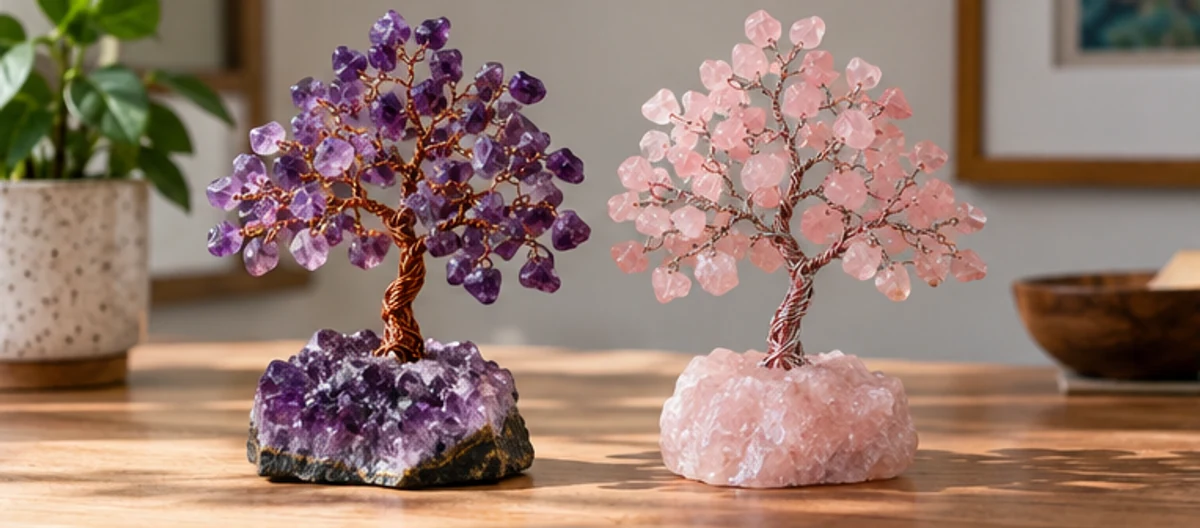
1. A quick comparison: purple amethyst and pink rose quartz
Amethyst and rose quartz belong to the same quartz mineral family, with the formula SiO₂ and a Mohs hardness of approximately 7. They are not the same variety: amethyst's purple coloration is linked to iron-related colour centres in quartz, while the pink appearance of common massive rose quartz is associated with microscopic inclusions and other mineralogical colour mechanisms. Natural variations in shade, translucency and internal features are expected. Similar hardness does not make their colour stability and finished-tree care identical.
| Question | Amethyst gemstone tree | Rose quartz gemstone tree |
|---|---|---|
| Main visual character | Violet, lavender, lilac to deeper purple | Pale blush, soft pink to stronger pink |
| Mineral identity | Purple variety of quartz | Pink variety of quartz, usually massive |
| Mohs hardness of the stone | About 7 | About 7 |
| Typical small-chip appearance | Transparent to translucent, with uneven purple zones | Translucent to cloudy, sometimes almost milky |
| Common contemporary symbolism | Shanti, contemplation, prayer, reflection | Prema, affection, friendship, household harmony |
| Common contemporary chakra association | Ajna and sometimes Sahasrara | Anahata |
| Light consideration | Some stones fade under prolonged strong light | Usually reasonably stable in ordinary indoor light |
| Best styling use | Defined colour accent near books, puja or reflection space | Gentle colour accent for bedroom shelf, shared room or gift |
These are useful selection cues, not fixed prescriptions for every home. A beautiful tree may have both stones, and a carefully made smaller tree may suit a room better than a large, loosely wired specimen. Compare actual photographed pieces rather than relying only on catalogue colour names.
2. Amethyst: how genuine purple quartz looks in a tree
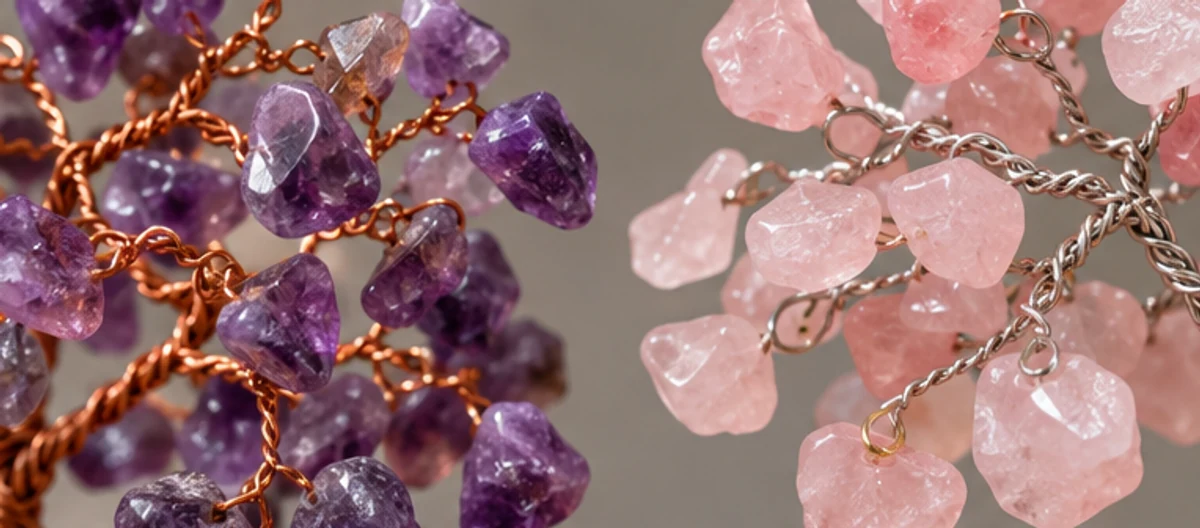
Amethyst is quartz coloured purple by specific trace-element and crystal-defect processes. It ranges from greyish lavender and pale lilac to strong violet. Individual chips may show alternating transparent and coloured areas, or several tones within one piece. Colour zoning is particularly useful when assessing a natural-looking lot, although zoning alone cannot conclusively prove natural origin. A set of chips may be pale because it was made from small offcuts; a deeper colour is not automatically a better tree if the wire or base is weak.
The chips in most gemstone trees are polished, drilled or irregular pieces, not faceted jewellery gems. Their surfaces can show small abrasion marks at drill holes. Natural fractures and inclusions can be visible with a loupe, but a very cracked chip may break at the hole when a branch is adjusted. Check the actual attachment, not merely the colour of the best chip in the listing. Uniform purple plastic or dyed glass may look attractive in a photograph and still be a different material from the promised amethyst.
GIA notes that amethyst is generally durable but can lose some colour after prolonged exposure to intense light; abrupt temperature changes may cause damage. A tree on a bright west-facing window ledge in Bengaluru is therefore a different care problem from the same tree on an interior shelf. Choose a position with daylight for viewing but without repeated strong sunlight, especially if colour preservation matters.
Treatment and naming questions for amethyst
Some amethyst in the gem trade is heat-treated to produce other quartz colours such as yellow-orange citrine. Treated, synthetic and imitation products must be named accurately when they are sold as a specific natural gemstone. A spectacularly purple chip is not necessarily artificial, and a pale chip is not necessarily more authentic. For a premium tree, request a representative close-up, construction details, accurate material description and, if justified by the price, qualified independent identification. A grading word such as “AAA” is not a universal certification standard for amethyst.
3. Rose quartz: cloudiness is not automatically a defect
Rose quartz is also quartz, but is more commonly encountered in massive material. Its colour spans almost-white pink to stronger pink. Many small rose-quartz chips look cloudy or softly translucent. GIA explains that microscopic mineral inclusions and tiny internal fractures may contribute to this familiar appearance. A rose quartz tree need not have glass-clear chips: a softly cloudy crown may be quite natural and visually pleasing, especially when the pieces have consistent polish and are securely attached.
Strong pink in a very small piece is less common than pale pink, although particular lots and treatments vary. A seller should not call colourless transparent chips rose quartz merely because the image has a pink background. Nor should a very even pink dye or plastic-like appearance be taken as proof of authenticity. Examine individual chip surfaces in neutral light, check whether colour seems concentrated in fissures, and ask what material is represented. These checks help frame questions but do not replace gemmological testing.
Rose quartz can occasionally receive irradiation treatment to enhance colour, and a finished tree may contain natural chips alongside plated wire, adhesive, painted bases or other manufactured components. The word “natural” should apply to the correct component, not automatically to the whole object. Care guidance for a polished rose quartz gem does not justify immersing a wired and glued tree in water: metal, coatings and fixing materials may react differently.
Rose quartz and crystalline pink quartz are not interchangeable terms
Ordinary rose quartz is generally a massive variety. Rare transparent pink quartz crystals may have different causes of colour and different light stability. Do not transfer a specific claim about rare pink quartz crystals to every common rose quartz tree. For shop copy, “rose quartz gemstone chips” is generally more precise than a dramatic assertion about rare pink crystal formations, unless the physical material has been independently identified.
4. Traditional tree symbolism: Kalpavriksha, auspicious growth and Sankalpa
The symbolism of a flourishing tree is deeply rooted in Indian cultural history. Kalpavriksha or Kalpataru, the wish-fulfilling tree, appears in traditional art as an emblem of abundance and auspicious attainment. The Indian Museum, Kolkata, preserves an early Besnagar sandstone representation with prosperity-related objects in its branches. That history explains why the tree form feels meaningful beyond contemporary gemstone merchandising. It does not mean a modern twisted-wire chip tree is itself an ancient prescribed Vastu yantra.
In a home, a gemstone tree may express a household intention: stability in a new dwelling, harmonious conversation, steady study, gratitude for a family milestone or respect for a puja space. A short Sankalpa—an intentional dedication made with clarity—is more meaningful than treating a purchase as a substitute for effort and conduct. An amethyst tree may be chosen as a symbol of quiet reflection; a rose quartz tree may be chosen to honour affection or reconciliation. Both can be dedicated respectfully without insisting that one colour has a mandatory spiritual power over every family.
Lakshmi and Kubera are sometimes mentioned in modern abundance-related gemstone-tree descriptions because of the overall tree symbol. Their devotional significance is not reduced to a purple-versus-pink formula. Lakshmi is associated with auspiciousness and prosperity, Kubera with wealth and custodianship, while Kalpavriksha represents abundance in its own narrative context. These associations can be explained separately so the reader understands the tradition rather than seeing every stone marketed with the same deity label.
5. Vastu placement: direction, room purpose and actual surroundings
Traditional Vastu considers the organization of space, directional qualities, movement, openings, room function and environmental context. Contemporary decorative gemstone-tree placement adds a personal symbolic layer. There is no single classical rule requiring every amethyst tree in the north-east or every rose quartz tree in the south-west. The direction of a shelf should be evaluated alongside its safety, cleanliness, light, humidity, worship use and the living arrangements of the family.
| Room or area | Amethyst tree: practical and symbolic use | Rose quartz tree: practical and symbolic use | Placement check |
|---|---|---|---|
| Puja room or devotional shelf | Calm purple accent for prayer and reflection | Soft pink accent for family gratitude and devotion | Avoid lamp flame, oil splashes and falling flower water |
| Meditation or study corner | Useful visual reminder of attention or quiet time | Gentle, reassuring appearance for reflective sitting | Keep beyond elbows, wires and book stacks |
| Shared living room | Stronger contrast on neutral shelves | Warmer accent for shared family space | Choose stable base, out of children's reach |
| Bedroom | For someone who enjoys purple or quiet reading | Often chosen for affection and gentle decor | Do not place over the sleeping area or on a narrow ledge |
| Office reception | Defined accent near an information counter | Welcoming colour in a visitor area | Keep away from spills, cleaning sprays and traffic |
| Gift display | Attractive where saturated colour suits branding | Pleasant with softer packaging palettes | Photograph real items under consistent lighting |
Ishanya (north-east), associated in many Vastu interpretations with prayer and spiritual activity, may be a suitable setting when the physical room permits. Other directions can also work depending on the purpose and layout. Prithvi, Jala, Agni, Vayu and Akasha—the Pancha Mahabhuta—provide a framework for discussing groundedness, fluidity, transformation, movement and openness. Do not force a rigid one-stone-per-element chart onto every Vastu tradition; modern colour correspondences are often interpretive systems.
Direction is not more important than safety
A heavy tree perched on a narrow north-east shelf above a lamp is not a good placement merely because a printed guide recommends that direction. A securely placed tree in a clean, accessible position elsewhere may be the more appropriate option. Avoid unstable furniture, open windows with repeated gusts, damp planters, direct heat from a diya and locations where children or pets might pull the wire crown. Preserve the household's practical comfort and the respectful character of the setting.
6. Chakra, meditation and Jyotish: related but different systems
In contemporary chakra-colour systems, purple amethyst is frequently connected to Ajna (the brow centre) and sometimes Sahasrara (the crown), while pink rose quartz is associated with Anahata (the heart centre). These are widely used modern correspondences layered onto older Sanskrit concepts; they are not proof that a specific amethyst or rose quartz tree is prescribed in every traditional scripture. The distinction matters for credible spiritual writing: explain the underlying term, then describe the present-day application.
A teacher or practitioner may keep amethyst near a meditation seat as a visible reminder of inward attention. Rose quartz may be a symbol of maitri—friendliness or benevolence—in a conversation or counselling setting. Such visual cues can support a chosen personal practice without being presented as measurements of an invisible energy field. If a customer has a family-specific mantra, deity or devotional tradition, that preference should lead the arrangement rather than a generic colour chart.
Jyotish is another separate discipline. Planetary gemstone advice is often determined by a Kundali, Lagna, Graha placement, Dasha and the individual's astrological approach. Amethyst is described in some modern markets as a substitute linked with Shani, while rose quartz is sometimes given Shukra-related symbolism; neither statement makes them automatically equivalent to classical Neelam (blue sapphire) or Heera (diamond) prescriptions. A decorative tree should not be advertised as a chart-specific remedy solely from its purple or pink colour.
| Concept | Amethyst tree | Rose quartz tree | Important distinction |
|---|---|---|---|
| Decorative colour meaning | Quiet reflection, depth and restraint | Tenderness, appreciation and gentle warmth | Personal preference varies |
| Kalpavriksha association | Growth and meaningful aspirations | Growth and harmonious relationships | Association comes from the tree form |
| Modern chakra mapping | Ajna / sometimes Sahasrara | Anahata | Interpretive association, not a mandatory rule |
| Pancha Mahabhuta language | Can be discussed through setting and intention | Can be discussed through setting and intention | No universal one-stone/one-element mapping |
| Jyotish conversation | Sometimes discussed with Shani alternatives | Sometimes discussed with Shukra symbolism | Requires chart-based context; not a substitute for classical ratna selection |
| Puja and Sankalpa | May accompany personal devotional practice | May accompany family or relational intention | Practices should follow household tradition |
7. Decide by the recipient's intention, not only a headline “benefit”
Before choosing, ask: who will see the tree daily, what mood or meaning do they wish to express, where will it stand, and how much care can they give it? A study desk often benefits from a small, well-balanced object; a large broad-crowned tree can crowd notebooks. A family area may suit a softer silhouette and understated colour; another family may love amethyst's strong purple. These are choices about significance and usability, not rankings of spiritual effectiveness.
For someone beginning a meditation habit, a modest amethyst tree may serve as a daily reminder to sit. For a wedding anniversary or a gift thanking a family member, a rose quartz tree may convey affection without a lengthy claim. For a housewarming, either can represent Kalpavriksha and growth, accompanied by a message adapted to the household. Avoid assuming that every recipient follows the same chakra or astrological interpretations.
| Occasion | Amethyst: when it may fit | Rose quartz: when it may fit | Better final question |
|---|---|---|---|
| Griha Pravesh / housewarming | Recipient enjoys purple and reflective decor | Recipient prefers warm pink or shared-room decor | What room and shelf are available? |
| Wedding anniversary | Personal purple preference or meaningful memory | Affection, partnership and appreciation | What colours does the couple already display? |
| Graduation | Focused study or contemplation symbolism | Encouragement and care from family | Is the recipient's desk space limited? |
| New office | Contrasting reception ornament | Welcoming, softer desk accessory | Can staff clean and handle it safely? |
| Parent or elder | Familiar devotional significance if welcomed | Gentle family appreciation | Is it easy to reach without stretching? |
| Meditation group | Visual cue for contemplation | Symbol of goodwill and community | Does the group already use specific traditions? |
| Professional Vastu practitioner | Example of purple quartz and product construction | Example of pink quartz and material comparison | Are chips properly identified and labelled? |
8. Construction quality: the tree is only as good as its weakest joint
An attractive gemstone tree is an engineered assembly as well as a spiritual object. The most common quality problems are loose chips, sharp wire ends, uneven branches, a poorly fixed trunk and a base that rocks. None of these issues can be judged by gemstone name alone. Inspect a full front view, side view, underside and one close-up of the branch-to-chip attachment before buying. Ask the seller to state whether branches are adjustable, fixed or partly flexible.
Copper-coloured wire may be copper, plated wire or colour-coated base metal. A gold-coloured finish is not evidence of solid gold, and a silver-coloured finish is not evidence of sterling silver. The tree may use adhesive hidden near the trunk or base; that is not inherently wrong when disclosed and done well. Trouble begins when glued chips detach easily, corrosion appears under coating, or a wire is repeatedly bent beyond its intended working range.
| Component | What to inspect | Why it matters | Ask the seller |
|---|---|---|---|
| Gemstone chips | Variety, drill holes, polish, unusual colour concentration | Material disclosure and breakage risk | Are all chips one named stone or a mix? |
| Thin branch wires | Finish, burrs, repeated bend points | Sharp ends and metal fatigue | Can branches be adjusted once, or not at all? |
| Twisted trunk | Uniform attachment, no exposed sharp ends | Stability and long-term handling | Is the trunk glued or mechanically fixed? |
| Base | Footprint, weight, flat underside, surface scratches | Toppling and furniture damage | What is the actual base material? |
| Crown shape | Open/closed spread and balanced distribution | Room fit and visual quality | What is the width after normal arrangement? |
| Adhesives or fillers | Loose residue, exposed blobs and odour | Appearance and cleaning compatibility | Are stones or trunk attachments bonded? |
| Packing | Individual crown padding and base separation | Prevents wire bending in transit | How will it be secured for shipping? |
Adjustable branches are not indefinitely flexible
A few light adjustments after unpacking may be possible on some designs. Support a branch at the base, work gradually and stop if resistance rises. Never twist the same wire back and forth repeatedly to achieve a perfectly symmetrical crown. A gemstone chip near a drilled hole can crack if used as a handle. Finished trees are not children's toys; a detached chip or small wire may present a choking or injury risk.
9. Natural stone, treated stone and imitation: compare claims accurately
A piece sold as amethyst should be quartz of the stated purple variety; one sold as rose quartz should be quartz of the stated pink variety. Natural versus laboratory-grown concerns origin. Treatment concerns modifications such as irradiation or colour enhancement. Imitation concerns another material, such as glass or resin, presented as if it were the named stone. Reconstructed assemblies and multi-material pieces need component-specific descriptions. These are separate questions and should not be collapsed into a single label such as “original.”
Photographs cannot determine every aspect. Dye concentrated near fractures may be a concern, and identical-looking plastic beads may suggest imitation, but neither visual clue is definitive. Natural quartz can be exceptionally clean; laboratory-grown quartz can contain inclusions. A laboratory report should identify what was examined, and a report on a single chip does not authenticate every gemstone chip, wire and base in a finished tree.
| Seller description | What it should mean | What it does not prove |
|---|---|---|
| Natural amethyst chips | Mined purple quartz chips | Every chip is untreated or all have same origin |
| Natural rose quartz chips | Mined pink quartz chips | Every metal/adhesive component is natural |
| Genuine quartz | Material belongs to quartz family | That colour, origin and treatment are known |
| Lab-grown quartz | Quartz produced by a controlled growth process | That it is a mined natural crystal |
| Dyed stone | Colour has been applied to a stone substrate | That the underlying stone is the advertised variety |
| Glass / acrylic imitation | Decorative man-made non-quartz material | That it is genuine amethyst or rose quartz |
| AAA grade | Seller-defined quality term in many listings | An internationally standardized amethyst grade |
| Certificate supplied | A document exists for a specific examination | That the entire multi-component tree was tested |
For OmmRudraksha product listings, disclose the actual chip stone, whether treatments are known, the total approximate height and crown spread, the base and wire materials, and whether the photograph shows the exact item or a representative design. If the origin of individual chips is unverified, do not invent a mine, country or certification. The aim is a clear, trustworthy choice and a product description that remains accurate when the customer receives the parcel.
10. How many chips, what size and which base?
A dense crown may have more chips, but chip count alone says little about workmanship, especially if the chips are very small. Compare overall height, maximum crown width, base depth, total weight and chip size together. If no exact stone count is confirmed, describe the tree's appearance without guessing the count. A narrow trunk supporting a heavy crown may tilt when the wire is expanded; a weighted base or a wider footprint often matters more than a particular numerological count.
Small desktops benefit from a compact base and modest crown. A console or reception shelf can hold a broader tree when it is well away from the edge. Large ceremonial or showroom pieces should be evaluated for stability, shipping damage and whether they obstruct sightlines. A “100-chip” or “300-chip” marketing name does not override actual dimensions or component quality.
| Intended spot | Useful size priority | Sensible choice | Watch for |
|---|---|---|---|
| Narrow study desk | Shallow, stable footprint | Compact amethyst or rose quartz | Keyboard and notebook interference |
| Puja shelf | Height clearance and firm base | Small or medium tree away from lamps | Oil, incense ash, garlands, water |
| Bedroom dresser | Modest crown spread | Soft rose quartz or preferred amethyst | Perfume sprays and accidental bumps |
| Living-room console | Visible but controlled scale | Broad balanced crown if secure | Children, pets, open window wind |
| Jewellery showroom | Finish and labelling clarity | Well-photographed real specimens | Frequent handling and cleaning liquids |
| Training/reference kit | Distinct, labelled stone samples | Compact matched comparison pair | Mixed or misidentified chips |
11. Practical example: Bengaluru home with a small puja-and-study area
Consider a two-bedroom Bengaluru apartment with a puja niche adjoining a bookshelf. The family wants a gemstone tree for their housewarming, but the available shelf is narrow and receives afternoon sun through a nearby window. Instead of asking which stone is strongest, measure the depth and height clearance first. An amethyst tree could suit the household's prayer-and-reading intention if placed away from direct prolonged sun. A rose quartz tree may fit the family room better if they prefer a pale colour that does not dominate the shelf.
Keep either tree clear of a diya flame and from water poured during puja. If flowers are offered nearby, use a separate plate so damp petals do not touch the wire or base. A small, stable base with tidy branch ends will be easier to maintain than a tall tree extending over books. The family may choose one tree and give the space meaning through a short Sankalpa of gratitude for the new home; placing both is not required.
12. Practical example: jewellery showroom and gift consultation
A Bengaluru jewellery showroom displays a purple amethyst tree beside a pink rose quartz tree for customers considering gifts. The most useful sales approach is not to make exaggerated claims. Put clear labels beside each: gemstone name, visual style, approximate dimensions, base type, care note and whether the image corresponds to the actual item. Show the recipient a complete front photograph plus a chip close-up. If a customer asks about Vastu, explain the decorative tree's Kalpavriksha symbolism and the general placement considerations; do not treat it as a substitute for a complete property assessment.
For an anniversary gift, the seller may recommend rose quartz for its contemporary association with affection, or amethyst when purple is the recipient's favourite colour. For a buyer interested in authentic mineral identification, explain that both are quartz but have different appearances, light-care concerns and possible treatment histories. If the tree is going to a humid coastal address, emphasize dry packing and moisture protection for the metal assembly more than the colour chosen.
13. Practical example: a professional Vastu reference kit
A professional Vastu consultant may carry one properly labelled amethyst tree and one rose quartz tree as a teaching comparison. Each label should separate four fields: mineral identity, observed colour and construction, contemporary traditional associations, and practical conditions of use. The consultant can show how a rounded pink crown or an open purple crown changes the feeling of a room while explaining that this is an aesthetic and symbolic decision, not a laboratory measurement of auspiciousness.
The reference kit should include dimensions, photographs, a simple care card, the exact component materials if known and a note of any unresolved origin questions. For mobile consultations, pack each tree separately so wire crowns cannot snag. Avoid using a gemstone tree as an instrument for precise measurement of a room's orientation; use an appropriate compass or site-plan method for the directional work, and then consider the tree as an optional interior object.
14. Cleaning, sunlight, humidity and the assembly's limits
Amethyst and rose quartz have similar scratch resistance as quartz, but both can chip at thin edges. More importantly, the entire tree includes components that may be less durable than the stone. GIA allows warm soapy water for individual amethyst or rose quartz gems in suitable circumstances. That instruction does not mean a wire tree with hidden adhesives, metal plating and a painted base should be soaked, ultrasonically cleaned or steam-cleaned. For an assembled tree, begin with gentle dry dusting using a soft brush while supporting the base.
Amethyst deserves extra attention to prolonged strong light; rose quartz is generally more stable in ordinary indoor light. Keep both away from sudden temperature changes, kitchen heat, harsh chemicals, bleach, acid cleaners and spray polish. Do not place either tree where repeated high humidity can affect wires or adhesives. If an old tree has corrosion, crumbling filler, a cracked base or loose chips, stop rearranging it until the cause is assessed.
| Care situation | Amethyst tree | Rose quartz tree | Best practice for both assemblies |
|---|---|---|---|
| Everyday dust | Stone is relatively hard | Stone is relatively hard | Soft dry brush, hold trunk or base gently |
| Bright direct sun | Some purple colour may fade over time | Usually stable, but avoid unnecessary heat | Interior shelf with comfortable indirect light |
| Sudden heat or cold | Thermal shock may damage quartz | Avoid abrupt temperature stress | Keep away from hot lamps and window heat |
| Water immersion | May harm glue, wire or base | May harm glue, wire or base | Do not soak complete tree |
| Steam or ultrasonic cleaning | Not suitable for full assembly | Not suitable for full assembly | Avoid on both, regardless of gem cleaning advice |
| Oil, salt or ritual liquids | May stain or corrode assembly | May stain or corrode assembly | Keep liquids in separate puja vessels |
| Branch reshaping | Risk of wire fatigue/chip cracking | Same risk | Make only gentle, necessary adjustments |
| Storage and travel | Protect tips and crown | Protect tips and crown | Wrap crown, immobilize base, keep dry |
Ritual shuddhi without damaging a finished tree
In some households, Shuddhi includes water, incense, flowers or mantra. Respect the family practice while protecting material components. A verbal Sankalpa, a clean display, a separate offering vessel or a brief prayer can be used without wetting delicate wirework. Do not apply saltwater, milk, oils or cleaning chemicals directly to a complete gemstone tree unless the manufacturer specifically confirms compatibility with every component. A practical distinction between ritual intention and material cleaning preserves both devotional respect and the object itself.
15. Packing, receiving and moving the tree
Ask that the crown and base be protected as separate pressure points. The heavy base should not be free to move and crush the branches; the crown should not be forced into a narrow carton. Loose chips must be contained so they do not scratch polished bases or other items. For deliveries during monsoon weather, protect the package from water entry and check for moisture after arrival. Do not leave a packed tree in a hot parked vehicle for extended periods.
After delivery, unpack on a clean table. Hold the base, lift the protective material gently and check the branch tips for damage. Photograph any transit defect before reshaping or throwing away the packing. Arrange the crown only if the construction is intended to be adjustable. Check the bottom for exposed fixing pins or rough edges that could scratch furniture, and use a stable tray or suitable protective pad where needed.
16. Pricing, seller questions and the final decision
Price can be affected by chip quality, number of attachments, total size, labour, wire finish, base stability, packaging and genuine stone disclosure. A tree with pale amethyst chips may be a good purchase if well made and honestly described. A rose quartz tree with richer pink colour may command attention, but a higher price needs actual quality evidence rather than an unverified spiritual promise. Ask what the price includes, whether photographs are of the exact tree, and how transit damage is handled.
| Buyer question | Why ask it? | What a useful answer includes |
|---|---|---|
| Are the chips natural amethyst or rose quartz? | Confirms material being sold | Stone identity and known uncertainties |
| Is any colour treatment known? | Distinguishes natural colour and enhancement | Specific treatment disclosure or honest unknown |
| Are photos of my exact tree? | Prevents a mismatch in crown/colour | Actual item or clearly labelled representative image |
| What are height, width, base size and weight? | Determines safe placement | Measurements taken from available item |
| Which parts are metal, painted or glued? | Guides maintenance | Accurate component and finish descriptions |
| Can I adjust the branches? | Prevents breakage | Clear fixed/adjustable instructions |
| What will arrive if a chip detaches? | Clarifies support and delivery | Damage policy and contact procedure |
| Does a lab report cover all chips? | Avoids overstated authentication | Exact sample tested and laboratory scope |
| How should I clean and place it? | Protects long-term appearance | Dry assembly care, light and humidity notes |
| What relevant Vastu meaning is intended? | Matches gift to tradition | Kalpavriksha/Sankalpa context without universal claims |
A good decision is the intersection of the recipient's preference, the real mineral description, the assembly's integrity and the available space. Amethyst is a reasonable choice where a purple contemplative accent is desired; rose quartz is a reasonable choice where warm pink and an affectionate gift message fit. Either can be meaningful when cared for, and neither must be bought solely because of a prescribed directional chart without understanding its context.
Frequently asked questions
1. Is amethyst or rose quartz better for Vastu?
Neither is universally better. The intended space, person's tradition, devotional practice, visual preference and the item's safety matter. Amethyst is often associated with reflection; rose quartz with affection. Use the Kalpavriksha form as a meaningful decorative choice rather than ranking one stone as universally effective.
2. Do they have the same mineral hardness?
Yes, both are varieties of quartz, usually rated about 7 on the Mohs scale. That describes scratch resistance, not how securely chips are attached or whether a finished tree can withstand repeated handling.
3. Why is my rose quartz tree cloudy?
Many genuine rose quartz chips are translucent or cloudy because of fine inclusions or internal features. Cloudiness alone is not a defect or proof of imitation. Examine polish, cracks near drill holes and the seller's material description.
4. Why are some amethyst chips pale and others deep purple?
Colour depth and zoning vary naturally and with chip size, lighting and material selection. A single photograph can exaggerate purple. Ask for views under neutral light if colour matching is important.
5. Can amethyst fade in a sunny window?
Some amethyst can lose colour after prolonged exposure to strong light. Choose indirect daylight and keep the tree away from repeated intense sun and excess heat.
6. Is rose quartz more suitable for a bedroom?
It is a common contemporary choice because soft pink suits many bedroom palettes and carries affection symbolism. Stable placement, unobstructed movement and personal preference matter more than a universal colour rule.
7. Which gemstone tree is associated with the heart chakra?
Rose quartz is frequently linked with Anahata in modern chakra-colour practice. This is a contemporary correspondence; households may use different symbolic systems.
8. Which one is connected to Ajna or the third eye?
Amethyst is commonly linked with Ajna, and sometimes Sahasrara, in contemporary crystal practice. The specific interpretation depends on the practitioner or tradition.
9. Can an amethyst tree replace Neelam in Jyotish?
Do not assume that. Some modern gemstone markets discuss amethyst in Shani-related contexts, but a chart-based classical gemstone selection depends on the relevant Jyotish approach and the person's horoscope.
10. Is rose quartz the same as diamond for Shukra?
No. Rose quartz is pink quartz, while diamond is a different mineral and a classical Ratna considered in some Shukra traditions. Decorative associations are not automatic substitutes for Kundali-based recommendations.
11. Do both have Kalpavriksha meaning?
Yes, the decorative tree form can evoke the auspicious symbolism of Kalpavriksha, growth and blessings regardless of which quartz chips are attached. A modern gemstone tree is not itself an ancient ritual object with a single compulsory method.
12. Can I keep both on the same shelf?
Yes, when there is enough stable space and the two crowns do not catch on one another. Choose a thoughtful arrangement that leaves room for ordinary cleaning and use of the shelf.
13. How can I tell if chips are glass or genuine quartz?
Some clues can be seen through close examination, but colour, clarity, bubbles or scratching at home are not dependable complete tests. Avoid destructive tests on a finished tree. For costly purchases, request appropriate professional identification.
14. Are all pink quartz chips naturally coloured?
Not necessarily. Natural origin and colour-treatment history are different questions. Rose quartz can sometimes be treated to strengthen colour; ask the seller to disclose known treatments.
15. Is a tree with more gemstone chips always better?
No. Secure attachments, stable base, appropriate width and accurate materials are more important than an advertised chip count. Small balanced trees can be preferable to sprawling poorly constructed ones.
16. Should I bend every branch immediately after unpacking?
Only if the manufacturer says the design is adjustable. Make small changes while supporting the wire near its attachment; repeated bending may fatigue wire or fracture chips.
17. May I wash the tree in salt water for purification?
Avoid immersing complete wired gemstone trees in water or salt solutions. Ritual practices can be performed with prayer, Sankalpa and separate offering vessels while protecting wires, coatings and adhesives.
18. Can I put the tree beside a diya or incense burner?
Keep a safe distance from flame, heat, falling ash, oil and smoke. A nearby devotional setting is possible, but decorative branches should not obstruct or touch a burning lamp.
19. Will a certificate prove that every chip is genuine?
Only if the certificate explicitly covers the complete tested set using an appropriate method. A report for one sample, a loose gemstone or the base does not automatically verify all chips and assembly components.
20. Which is a better housewarming gift?
Choose according to the recipient's colours, available shelf and preferred symbolism. Amethyst may express contemplation; rose quartz may express affection; both can represent good wishes for growth through the Kalpavriksha form. Include a short personal note and care instructions.
Explore OmmRudraksha gemstone trees and related guides
Discover the Gemstone Trees collection within Vastu, or compare the individual Amethyst Gemstone Tree and Rose Quartz Gemstone Tree designs. For material-safe maintenance, read Gemstone Tree Cleaning and Care; for occasion-based selection, see Gemstone Trees as Gifts: Housewarming, Desks and Preferences.
Editorial source context: GIA's amethyst and rose quartz descriptions and care guidance inform mineral facts and material handling; the Indian Museum, Kolkata's Besnagar Kalpavriksha sculpture informs the traditional tree discussion. The Vastu, chakra and Jyotish sections distinguish devotional and contemporary correspondences from actual physical identification. Product-specific dimensions and treatments must be verified for each item.
