
Lapis lazuli and sodalite gemstone trees are both blue ornamental arrangements, but they do not contain the same material. Lapis lazuli is a multi-mineral rock whose vivid blue commonly comes from lazurite; sodalite is a mineral in the feldspathoid group, often seen as blue stones with pale areas. Neither an intense photograph nor a scattering of white veins is enough to identify the chips. This guide compares their mineral properties, colour and quality, traditional Kalpavriksha and Vastu meanings, construction, reports, buying and long-term care so you can choose a tree for an actual home, office, puja room or thoughtful gift.
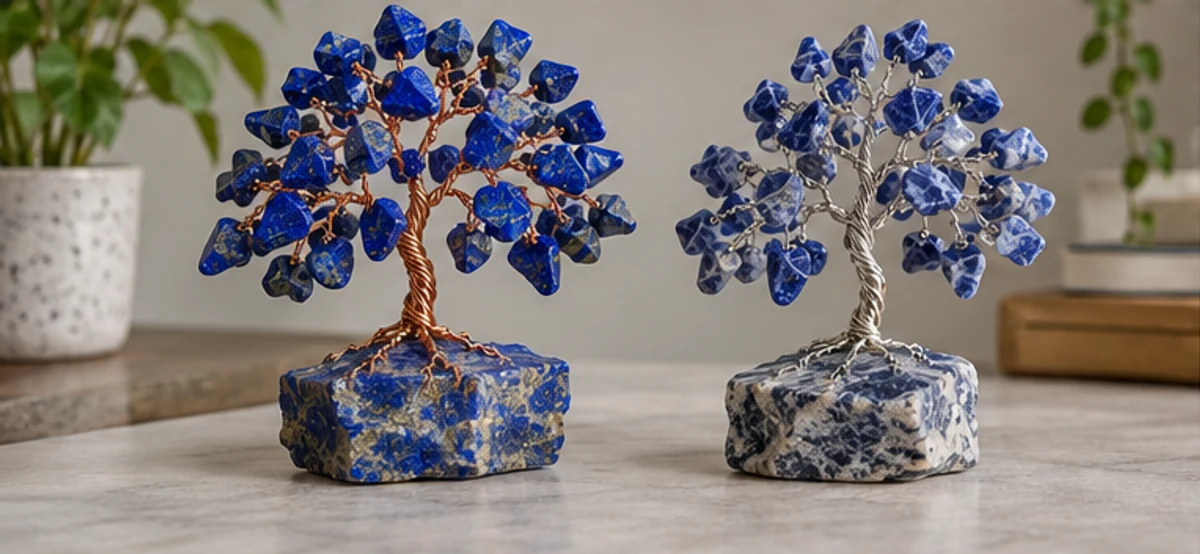
Lapis lazuli vs sodalite: what is the fundamental difference?
Begin with the material itself, not the decorative tree's advertised colour. Lapis lazuli is a rock made of several minerals. Its blue is principally associated with lazurite, while white calcite and golden-looking pyrite may also occur in varying amounts. Lapis may include other minerals, so two pieces from different deposits can look unlike one another. Sodalite is an individual mineral species, a sodium-aluminium silicate with chlorine; ornamental sodalite chips may come from rock that contains other minerals as well. Both have an established history as decorative or collectible material, but the label on a finished tree must accurately describe what its chips are.
A tree is not a faceted single gemstone. It is dozens or hundreds of small chips attached to wires and mounted on a base. Even if a seller correctly identifies a chip, that does not establish the provenance, treatments or uniform mineral identity of every stone in the canopy. A listing that reads simply “blue crystal tree” may refer to lapis, sodalite, dyed howlite, reconstructed stone, glass, or a deliberate mix. Ask the seller for a component declaration before deciding what is authentic.
| Question | Lapis lazuli | Sodalite |
|---|---|---|
| Material type | Multi-mineral rock, generally lazurite-rich | Mineral species, often in massive aggregates |
| Familiar colour | Saturated royal, indigo, violetish or greenish blue | Medium to dark blue, sometimes purplish or greyish |
| Pale areas | Calcite may appear as patches or veins | Pale calcite and other host-rock areas may occur |
| Metallic flecks | Pyrite may be visible, but is not required | Usually not a prominent feature; it is not impossible in associated rock |
| Approximate Mohs hardness | Often 5–6, variable with mineral mixture | About 5.5–6 for the mineral |
| Main buying concern | Treatment, actual rock composition, dye/wax, chip consistency | Misidentification, dyeing and blue-lookalike materials |
| Best question to ask | “Is this genuine lapis lazuli, and what treatments are disclosed?” | “Is this natural sodalite, and are chips dyed or mixed?” |
These ranges describe materials, not a laboratory result for a particular tree. A mass of lapis also behaves according to its weaker component or natural fractures; a small sodalite chip can crack despite a respectable Mohs value. Mohs hardness measures relative scratch resistance, not the strength of wirework or the resistance of a canopy to being dropped.
Understanding lapis lazuli: lazurite, calcite and pyrite
The most recognizable lapis is intensely blue, but its colour may range widely. Lazurite-bearing material contributes the characteristic rich blue; white calcite can interrupt it, and pyrite can create bright brassy reflections. These features are natural possibilities, not compulsory marks. A genuine lapis chip may lack visible gold flecks, and a stone with visible white patches is not necessarily sodalite. Likewise, a few shiny specks alone do not prove that a blue chip is lapis. Laboratory gemmology sometimes finds more mineral diversity than simple store descriptions suggest.
A popular buying misconception is that the largest number of pyrite flecks always means the best lapis. Some people like the starry appearance; others prefer deep, uninterrupted blue. The gem trade often values saturated colour and limited white calcite, but attractiveness in a miniature tree also depends on chip size, crown design and the way natural variation is arranged. A high-grade lapis cabochon and a decorative tree made with multiple chips are evaluated differently. A tree priced as premium material should have proportionately clearer disclosure, component quality and actual photographs.
Reports of “Afghan,” “Persian” or “Chilean” lapis may refer to trade appearance categories rather than verified mining origin. A country adjective on a product page is not a certificate of provenance. If verified geographic origin matters to you, request evidence specific to that supply. The same principle applies to any claim of a particular mineral percentage, antiquity or special mine: do not extrapolate it from a photo of blue chips.
Common lapis treatments and imitations
Lapis may be dyed to deepen colour or disguise pale zones. Wax or oil may be used to improve apparent lustre, and some pieces are stabilized or assembled. These practices are not all equivalent: a natural but treated rock remains natural in origin, while an imitation made of glass or resin is a different product altogether. Accurate disclosure helps customers select the material they actually want. Treatment may affect solvent, heat and moisture tolerance, especially in tiny chips around adhesive joints.
Look closely at drilled holes, chipped corners and fractures. Unnaturally concentrated colour in porous cracks, or colour transfer reported by a credible test, can motivate further inquiry; neither is a conclusive household identification procedure. Do not scratch a chip, soak it in chemicals, or wipe it with acetone to “prove” authenticity: these actions can damage coatings, dyes or adhesives. If the claim materially affects price, request a competent gemmological opinion or a report whose scope includes the submitted sample.
Understanding sodalite: natural blue and pale patterning
Sodalite is a feldspathoid mineral with a frequently vivid blue appearance. Massive ornamental pieces can include whitish, grey or otherwise contrasting regions from associated minerals. A sodalite tree may show a patchwork canopy rather than uniform royal blue. This is not necessarily poor quality. Some buyers specifically prefer irregular blue-and-white chips because they read clearly on a shelf and contrast with copper-coloured wires.
Sodalite's approximate Mohs hardness is 5.5–6, with relatively low toughness in thin and fractured chips. It can be dyed or otherwise enhanced in some cases. Darker blue does not automatically imply better sodalite: look at whether the seller identifies the actual material, documents treatments, and offers a consistent appearance across the finished tree. Naturally variable blue is compatible with a pleasing design; artificially uniform colour is neither proof of imitation nor proof of high grade.
Sodalite is part of a larger mineral family that includes lazurite, one of the blue components of lapis. This family connection can confuse product descriptions. “Lapis-like sodalite” describes a resemblance; it does not turn sodalite into lapis. Likewise, a tree marketed as “lapis sodalite” might be an unhelpful blended trade term rather than a precise identification. Request a label naming the components separately, especially for mixed trees.
Why a simple visual test is not enough
White veining is shared by both materials. Pyrite is common in many lapis rocks but is not mandatory, and published mineralogical work has reported pyrite associated with sodalite materials. Some lapis has little or no visible calcite; some sodalite can be more uniformly blue than store examples suggest. The colour on a phone screen changes with white balance and editing. Density, refractive index, streak and spectroscopy are useful professionally but are not reliable or appropriate as destructive DIY tests on a finished ornament.
| Popular claim | Better interpretation | What to do before buying |
|---|---|---|
| “Gold flecks always prove lapis” | Pyrite can support an identification but is not universally decisive | Ask for full material disclosure and, if warranted, testing |
| “No gold flecks means sodalite” | Some genuine lapis has no visible pyrite | Examine a representative group of chips and ask the seller |
| “White veins prove sodalite” | Calcite may occur in both material types | Do not rely on this feature alone |
| “Perfect royal blue means premium natural stone” | Treatment, lighting and imitations may influence colour | Request treatment and construction details |
| “A heavy tree must be lapis” | Weight includes wire, base and adhesives | Ask for chip identity separately from finished weight |
| “A scratch or acid test will settle it” | Destructive tests can spoil stones and assemblies | Avoid home chemical or scratch tests |
| “An authenticity card tests every bead” | The report may cover only a sample or supplier declaration | Read sample ID, testing method and exact scope |
The form of a gemstone tree matters as much as the chips
A gemstone tree normally combines mineral chips, wire branches, a central trunk, an adhesive or mechanically secured fixing and a base. Products differ widely in craftsmanship. A canopy can be open and naturalistic, densely rounded, layered or asymmetrical. The correct balance depends on where it will stand. A delicate tree with wide branches may be beautiful on a protected shelf but poorly suited to a narrow work desk beside equipment, files and cups.
Assess the structure from several angles. Viewed face-on, a crown may look full; from the side, the branches may cluster onto one half of the trunk. The trunk should not lean because the weighted crown overhangs the base. A base that rocks on flat glass or ceramic is a practical fault even when all chips are genuine. An item should be stable before it is used for rituals, displays or gifting.
| Component | What good workmanship looks like | Common concern |
|---|---|---|
| Gemstone chips | Smooth enough for handling, no loose grit or damaged drill holes | Breakage, sharp fragments, excessive filler |
| Wire branches | Secure wraps, no exposed sharp wire ends | Snags, fatigue after repeated bending |
| Central trunk | Firm, balanced transition to base | Loose anchoring or rotation |
| Base | Flat, protective underside, stable footprint | Tipping, scratches, unfinished cement |
| Adhesive/joint | Neat attachment with no visible separation | Brittle glue, discoloured residue |
| Surface finish | Consistent with materials and honest description | Unspecified lacquer, plating or paint |
| Packaging | Trunk immobilized without crushing canopy | Broken twigs, chipped stones, bent wire |
Ask whether the branches are intended to be reshaped. Many inexpensive trees use soft wire that is adjustable once or twice, but repeated dramatic bending causes fatigue and can loosen stone attachments. If a tree is sold as pre-arranged, treat its shape as the intended final sculpture. Never pull individual gemstone chips to “open” the crown; support the wire below the chip and move only within the manufacturer's recommended range.
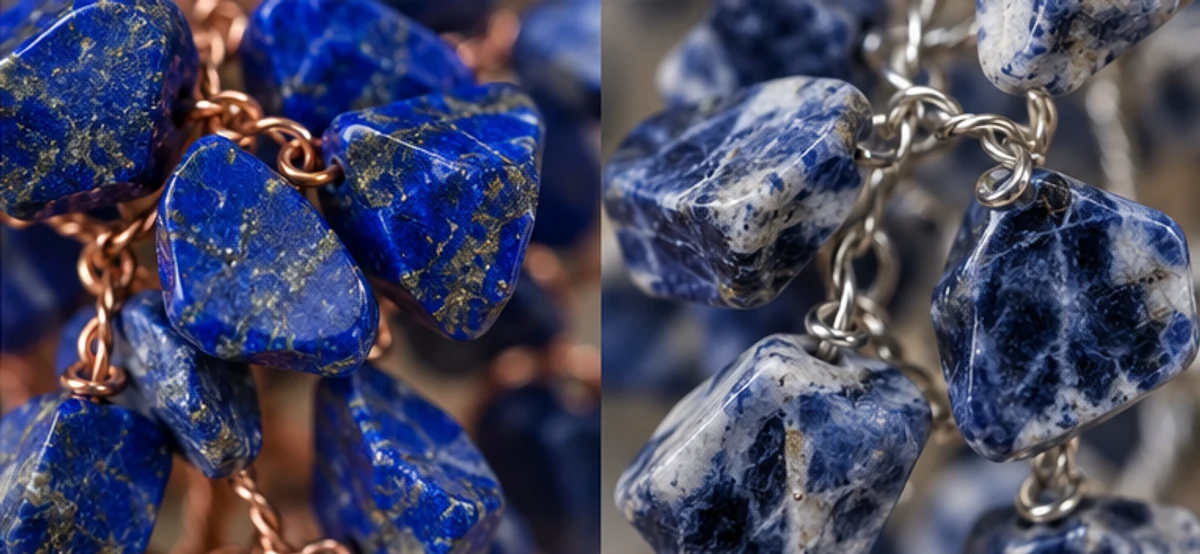
Which looks better: lapis blue or sodalite blue?
There is no single answer because room colour, viewing distance, lighting and personal preference have greater influence than a simple ranking of stones. Lapis can appear intensely saturated or speckled with metallic reflections; sodalite can show vivid blue interspersed with pale and grey areas. Each will look different under cool office LEDs, warm home lighting and filtered daylight. Ask for a photograph under neutral light and one showing the complete object against a plain background, not only a dramatically enlarged chip image.
| Display goal | Lapis lazuli tree | Sodalite tree | Practical note |
|---|---|---|---|
| Rich, concentrated blue accent | Often an attractive choice | Also possible in saturated blue pieces | Photograph actual canopy, not a sample |
| Visible blue-and-white pattern | Possible where calcite is present | Often a familiar aesthetic | White patterns do not certify the stone |
| Formal business shelf | Dark lapis can look striking | Sodalite offers softer variation | Prioritize stability and room fit |
| Reading or study corner | Blue can reinforce a quiet visual palette | Patterned blue can suit pale wood | Place away from books and drink spills |
| Mixed-tree arrangement | Lapis can be one distinct blue element | Sodalite provides contrast | Label the chips rather than blending names |
| Price-conscious gifting | Compare chip grade and final workmanship | Often worth comparing for appearance | No blanket rule for retail prices |
The wire finish also affects perception. Warm copper-toned branches can make navy chips appear richer; silver-toned wire can emphasize cool whites and blue. Neither wire colour proves that a precious metal is present. A product should say “copper-coloured wire” when the metal content is unknown, rather than “pure copper” or “silver” without evidence. Differences in the base—wood, stone, plaster or another support—also affect both appearance and cleaning.
Compare the complete tree, not a cropped chip image
A useful online product gallery shows the entire tree front and side, close-ups of representative blue chips, the tree against a scale reference, the underside of the base and any labels or certificates. The photographs should be of the actual item or clearly described as representative. If the seller uses a batch photo, ask how much canopy, colour and shape may vary in the delivered piece. Especially with mixed natural chips, two trees assembled from the same material can appear quite different.
Kalpavriksha symbolism and the spiritual meaning of gemstone trees
In Indian sacred and artistic traditions, Kalpavriksha or Kalpadruma is the wish-fulfilling tree associated with abundance and auspicious fulfilment. The Indian Museum, Kolkata, preserves a carved Kalpavriksha from Besnagar, dated approximately to the second century BCE, with symbols of wealth and plenty among its branches. That historic representation is not a modern wire-and-chip tree, yet it provides a meaningful cultural context for why a small branching ornament may be chosen for a gift, shrine shelf or business opening.
The tree's roots can signify steadiness, the trunk continuity, branches growth, and gem chips the fruits of effort or blessings. A person may associate a lapis tree with study, discernment and dignified expression, or select a sodalite tree as a reminder to communicate thoughtfully. Those associations are used in contemporary crystal practice; they should be explained as symbolic choices, not converted into claims that a specific blue mineral guarantees eloquence, a promotion or a change in another person's behaviour.
Lakshmi and Kubera associations sometimes appear when gemstone trees are sold as prosperity ornaments. It is more accurate to explain that the auspicious tree form and the chosen Sankalpa provide the symbolic framework. The specific mineral species alone does not establish a classical injunction. A family opening a new home might select an object to represent gratitude and continuity; a shop owner might use the tree as a visible reminder of disciplined work and generous dealings.
Vastu: directions, Pancha Mahabhuta and suitable placement
Vastu Shastra traditionally concerns the relationship of space, orientation, use and the environment. Contemporary decorative Vastu practices sometimes assign gemstone colours to directions or elements, but there is no single universally accepted classical rule specifying that one lapis tree must be kept in a particular compass corner and one sodalite tree in another. Consider the home's actual layout, cleanliness, movement and intended use together with traditional symbolism.
The Pancha Mahabhuta are Prithvi (earth), Jala (water), Agni (fire), Vayu (air) and Akasha (space). Blue may suggest Jala or Akasha in modern colour-based readings, but a blue mineral chip is a physical earth-derived material and need not be treated as a literal embodiment of only one element. An intention of calm learning, gracious conversation or reflection can be supported by a pleasant reading space and regular use of that space. Those practical activities matter more than the decorative object by itself.
The Ashta Dik directional framework includes Purva (east), Agneya (southeast), Dakshina (south), Nairritya (southwest), Paschima (west), Vayavya (northwest), Uttara (north) and Ishanya (northeast). Depending on the practitioner and purpose, a clean desk in the north or east, an undisturbed reading shelf or an orderly northeast puja space may be considered for a small tree. Do not crowd a sacred altar, obstruct doors or windows, or place fragile wire branches where children and pets can reach them easily.
| Location | Possible intention | Sensible placement practice |
|---|---|---|
| Study or reading corner | Vidya, attention and thoughtful communication | Shelf beside books; away from cups and direct impact |
| Puja or meditation area | Sankalpa, gratitude and quiet devotion | Stable dry support; keep away from lamps, incense ash and liquids |
| Office reception | Professional courtesy, harmony and welcome | Low-traffic shelf, visible but out of customer reach |
| Home living room | Shared aesthetic and continuity | Well-balanced position away from crowded surfaces |
| Business owner's desk | Focus on responsible decisions | Behind the working zone, not near electronics cables |
| Gift display | Auspicious Kalpavriksha symbolism | Include a clear material and care note |
A simple Sankalpa without complicated ritual claims
For a family that wishes to incorporate the tree into a devotional setting, clean the display shelf, choose an appropriate time according to family custom, and articulate a simple Sankalpa such as a commitment to clarity in speech, steady learning or harmony in the home. Place the tree securely and keep the area orderly. If a family tradition involves mantra, puja or offering, follow that tradition without pouring water, milk, scented oil or other liquids directly onto gemstone chips, glue or metallic wire. A symbolic offering can be made separately on a suitable tray.
For professional Jyotish guidance, do not treat an ornamental lapis or sodalite tree as an automatic substitute for a prescribed planetary gemstone. Classical Navaratna associations and chart-based Ratna recommendations involve named gem varieties, planetary conditions and individualized interpretation; a decorative tree's modern crystal symbolism is a different context.
Lapis, sodalite, Saraswati and Vishuddha: keep associations distinct
In modern chakra-oriented wellness and meditation practice, blue stones are frequently associated with Vishuddha (the throat centre) and communication. Some also connect blue imagery with learning and Saraswati, the deity associated with knowledge, music and the arts. These are meaningful devotional and contemporary symbolic associations when stated in context, but they are not mineral identification tests or universal scriptural prescriptions for two specific modern gemstone-tree products.
In Jyotish, Neelam generally refers to blue sapphire associated with Shani, not to lapis lazuli merely because both are blue. Similarly, natural lapis lazuli, sodalite and blue sapphire should not be advertised as interchangeable in value or astrological use. A customer's Rashi, Nakshatra, Lagna, Graha placements and Dasha are separate interpretive matters; choosing a study-room ornament does not require pretending it has the same role as a chart-selected gem worn on the body.
| Traditional context | Practical explanation for a blue tree |
|---|---|
| Kalpavriksha | Branching form evokes growth, blessing and abundance |
| Sankalpa | A personally articulated intention accompanied by action |
| Saraswati / Vidya | A study-oriented devotional or educational setting |
| Vishuddha | Modern chakra symbolism for expression and communication |
| Jala / Akasha colours | Contemporary use of blue as a symbolic design cue |
| Ishanya and other directions | Placement guided by actual space and family practice |
| Shani / Neelam | Distinct Jyotish gemstone prescription, not a blue-tree synonym |
| Navagraha / Navaratna | A separate system of planetary gemstone correspondences |
Worked example 1: a Bengaluru apartment reading shelf
Consider a compact two-bedroom apartment where a family wishes to place a decorative blue gemstone tree near a reading nook. The available shelf is 65 cm wide and 25 cm deep, already holds books and a small lamp, and receives bright afternoon light. The right first step is to measure the free footprint and make sure the canopy will not touch a book as it is removed. If a tree is 24 cm tall but only 10 cm wide at its base, it may still have branches spreading 20 cm across. Record both base and canopy dimensions.
If the family likes visual contrast against warm wood, a sodalite tree with blue-and-white chips may look especially attractive. A dark lapis tree might create a stronger single accent against a plain white wall. Neither is inherently “better for study.” The family can select by material disclosure, the actual photographs, stable workmanship and the atmosphere they want to create. The lamp should be moved far enough away that hot fittings do not heat a tree's adhesives or coatings. Dry dusting becomes part of weekly shelf care.
Worked example 2: a jewellery showroom reception
A jewellery showroom wants a tree on a reception counter. Customers routinely move card machines, bags, display trays and receipts across the surface. A delicate, widely spread tree placed next to the payment terminal may be hit repeatedly. A compact tree with a weighted, non-scratching base on a protected rear shelf is a more sensible option. Its gemstone colour may reinforce a tasteful retail display, but it must not interfere with product handling or queue movement.
The store could compare a richly coloured lapis tree and a more patterned sodalite tree under actual counter lighting. Staff should verify whether the wire is plated or merely copper-coloured, and whether the base is wood, stone or composite. The display card should name the principal gemstone chips and any known treatments. If the object is a shop decoration, don't casually imply that it represents the authenticity of other gemstones being sold in the same showroom.
Worked example 3: a professional Vastu consultation reference kit
A Vastu consultant may keep a labelled set of gemstones to explain how colour symbolism, mineral identity and construction affect decorative choices. Lapis and sodalite are useful teaching specimens precisely because both may look blue while having different compositions. A reference kit can include photographs of typical chipped, dyed, fractured or assembled stones alongside a safe material-identification checklist. The actual sample labels should distinguish confirmed identity from supplier declarations.
For a consultation, the professional can show how direction and purpose are considered without asserting a universal compulsory lapis or sodalite placement. If two tree samples are used, their weight, total height, base width, canopy width, wire and treatment information should be recorded separately. Once the demonstration is finished, return the samples to padded compartments rather than piling branches together.
How to select and buy an authentic tree online
Start with a statement of exactly what is being purchased: a finished decorative gemstone-chip tree with a given canopy size and specific type of chips. Seek photographs under ordinary light and a ruler or stated dimensions for scale. A single feature picture of a showpiece cannot establish the quality of the delivered item. Check the number or approximate abundance of chips if provided, but remember that chip count alone is not a measure of quality or monetary value. The smoothness of branches, stability of the trunk and appearance of the whole object matter.
Compare treatment and construction disclosures. The words “100% natural” and “untreated” are different statements. A tree can include natural lapis that has been waxed, or natural sodalite that has been dyed. A manufactured base or metallic wire does not make the genuine gemstone chips false; it simply means the whole object is assembled, as a gemstone tree generally is. Conversely, a seller should not label a glass-chip tree as natural lapis without disclosure.
| Buying checkpoint | What to request | Why it matters |
|---|---|---|
| Exact gemstone name | Lapis lazuli, sodalite, or clearly itemized mixed chips | Avoid ambiguous “blue healing crystal” labels |
| Treatment disclosure | Known dyes, waxes, oils, stabilization or coatings | Helps evaluate authenticity and care |
| Actual-item photos | Front, side, close-ups and underside | Reveals construction and pattern variation |
| Size details | Base, height, canopy width, approximate weight | Determines fit and stability |
| Wire construction | Metal or wire colour, adjustable or fixed | Sets realistic durability expectations |
| Chip quality | Sharp points, cracks, loose pieces, uniformity | Avoids handling and presentation problems |
| Base and adhesive | Material, flatness, finish and fixing type | Affects cleaning and long-term strength |
| Report scope | Whether a sample, chips or finished item was examined | Prevents overreading certificates |
| Packing method | Canopy cushioning and trunk immobilization | Reduces transit damage |
| Return process | Damage claims and photo evidence required | Supports practical resolution |
What can a laboratory report establish?
A qualified gemmological laboratory can identify material in a submitted stone or sample, and some treatment evidence, depending on the test and material. It does not automatically verify the identity of every separate chip in a commercial tree, nor the purity of the wire, strength of glue, place of manufacture or accuracy of all marketing claims. A supplier declaration may be useful but is not equivalent to independent laboratory analysis. If a seller provides a certificate, read the sample identifier, date, issuing laboratory, scope, detection limitations and whether its description matches the actual product.
For a high-priced tree, consider whether the premium is attributable to documented stone quality, workmanship, artisan time, dimensions or verified origin. Do not assume a certificate automatically makes a tree rare, ancient or more spiritually effective. If a price seems based only on a dramatic colour adjective, compare several actual constructions and request material evidence before paying.
Packing, receiving and arranging the blue gemstone tree
Choose packaging that immobilizes the base while supporting the crown without squeezing branches. Flexible tissue or cushioning should separate the canopy from hard surfaces; never wrap adhesive tape directly around chips or wires. When a parcel arrives, photograph the outer box before cutting it, open it over a clear table, and lift the object by its trunk and base—not by its canopy. Check for detached chips or fragments before placing it in a busy room.
Arrange branches only if the product is designed for it. Support a wire just below its tip and make minimal changes, avoiding repeated back-and-forth bends. If a chip has detached, avoid assuming that any household glue will be safe for the stone, finish and base. Request supplier guidance or a professional repair rather than burying the broken joint under visible adhesive. Save small detached components in a labelled container so the seller can identify the original assembly.
A gift should include a simple material card: “Lapis lazuli gemstone tree” or “Sodalite gemstone tree,” with approximate dimensions, care advice and any known treatment information. A heartfelt note about learning, thoughtful expression or a new beginning can carry the desired symbolism without exaggerated promises. If buying a multi-tree gift set, package each tree separately to prevent branch-to-branch abrasion.
Cleaning lapis and sodalite trees: the whole object governs care
Loose lapis jewellery and a finished gemstone tree are not cleaned identically. GIA describes gentle soapy water for suitable lapis jewellery, but a tree also has wires, adhesion, plating, base coatings and dozens of crevices. For a complete assembled tree of uncertain construction, begin with gentle dry dusting using a soft clean brush, supporting the base so the branches do not sway. Avoid immersion, steam cleaners, ultrasonic devices, bleach, acids and solvent-based cleaners. Do not soak the object for ritual Shuddhi or spray scented oil over the canopy.
Because some lapis is dyed or waxed, alcohol, acetone and heat may alter its finish. Blue colour can transfer from unstable treatments. Sodalite can also be treated and may have fragile thin corners. If the tree needs more than dry dusting, ask the supplier for a procedure compatible with the actual gemstone, wire, adhesive and base. A tiny water test on a discreet area is not risk-free for every assembly, especially around glued chips; do not recommend it universally.
| Risk | Lapis tree | Sodalite tree | Safer response |
|---|---|---|---|
| Abrasive rubbing | Can mark softer constituents and polish | Can scratch or loosen small chips | Soft brush; minimal pressure |
| Water immersion | Dye, wax and joints may be affected | Assembly and coatings may be affected | Keep complete tree dry unless maker approves |
| Solvents or alcohol | Treated lapis may lose colour/finish | Treatments and adhesives may react | Avoid household chemical tests |
| Direct strong heat | Surface treatments and glue at risk | Adhesive and coating at risk | Keep from lamps, heaters and hot windows |
| Repeated bending | Wire fatigue and chip loss | Wire fatigue and chip loss | Adjust only as designed |
| Crowded storage | Chips and branches may rub or snap | Same assembly risk | Individual padded boxes |
| Damp storage | Metal corrosion and adhesive weakness | Same mixed-material concern | Cool, dry, ventilated cupboard |
Ritual Shuddhi and the physical care of a finished tree
Some traditions include cleansing with water, incense, flowers, mantra or light. A method suitable for a stone, metal utensil or puja vessel should not automatically be applied to a mixed-material gemstone tree. You can clean the shelf, offer flowers nearby, recite a familiar prayer or express Sankalpa without wetting the ornament. If incense is used, keep ash and heat at a safe distance and avoid coating chips in smoke residue. Physical durability and ritual intention need not conflict.
Mistakes worth avoiding
Do not buy lapis merely because a picture shows metallic gold points, or sodalite merely because it shows pale veins. Do not use the terms “lapis,” “sodalite,” “blue sapphire” and “turquoise” as interchangeable words for the same blue object. Avoid relying on the exact centre of the canopy to judge the full tree. A tall ornament with a narrow base can be visually elegant but unstable. Do not try to fix a loose trunk by bending every branch inward to counterbalance it; address the base attachment instead.
Do not take a general gemstone hardness number as permission to rub branches together. Do not treat a generic authenticity card as proof of every component. Avoid assuming all natural lapis is untreated, or that a higher retail price always signals better material. Finally, do not let a rigid directional recommendation override an obviously unsuitable location next to a door, water source, heater or unstable shelf.
Frequently asked questions
1. Is lapis lazuli the same as sodalite?
No. Lapis lazuli is a rock made of several minerals, commonly lazurite, calcite and pyrite. Sodalite is a separate mineral species. Their similar blue appearance does not make them interchangeable.
2. Which gemstone tree is better for Vastu?
Either can be selected for contemporary Vastu-inspired display. Consider the purpose, family practice, physical location, authentic material and quality of the tree. There is no universal classical prescription making one always superior.
3. Does lapis lazuli always contain visible golden pyrite?
No. Genuine lapis may have obvious golden flecks, few flecks or none visible. Pyrite contributes one possible characteristic, not an obligatory mark on every chip.
4. Do white veins prove the tree is sodalite?
No. White calcite can occur within lapis and sodalite-bearing decorative rock. A photograph of pale streaks alone cannot confirm mineral identity.
5. Can sodalite contain pyrite?
Pyrite is not usually the dominant visible characteristic of commercial sodalite, but published gemmological work has reported it in some sodalite-associated materials. That is why a single-feature test is unsafe.
6. Can lapis lazuli be dyed?
Yes. Colour enhancement and wax or oil treatments are documented. Ask for clear treatment disclosure and avoid solvent tests that could damage a finished ornament.
7. Can sodalite be dyed?
Yes. Sodalite may be treated in the gem trade. Natural origin and absence of treatment are different claims, so check both when a seller advertises an untreated product.
8. Is royal-blue colour enough to identify genuine lapis?
No. Colour varies naturally and may be altered by treatment, photography or imitation materials. Mineral identification requires more than a colour adjective.
9. Is blue sapphire the same as lapis?
No. Blue sapphire is corundum; lapis lazuli is a rock. In Jyotish, Neelam refers to blue sapphire, not to any blue ornament sold under a similar description.
10. What does Kalpavriksha mean for a gemstone tree?
Kalpavriksha is the wish-fulfilling tree of Indian tradition. Modern gemstone trees can draw on its symbolism of growth and auspiciousness without being identical to ancient representations.
11. Which direction is suitable for a blue gemstone tree?
Place it where its purpose and actual room use make sense. Some contemporary practitioners favour a clean reading space, north/east work area or Ishanya shelf, but avoid treating any one compass position as compulsory.
12. Are blue gemstone trees associated with Vishuddha chakra?
Blue stones are commonly associated with Vishuddha in modern chakra practice. That association is symbolic; it does not by itself establish a classical gemstone prescription or scientific effect.
13. Can I keep a tree near a Saraswati image?
A family may choose a blue tree for a study or devotional setting associated with Vidya and Saraswati. Keep it stable and ensure it does not crowd lamps, offerings or sacred objects.
14. Does the material of the wire matter?
Yes. Wire composition and coating influence appearance, corrosion risk and flexibility. Do not infer that copper-coloured wire is pure copper or that silver-coloured wire contains silver.
15. How can I judge a tree from online photographs?
Request a complete front and side image, close-ups of representative chips, the base underside and a size reference. Ask whether photos show the actual delivered tree or a representative design.
16. Does a gemstone certificate authenticate the whole tree?
Not automatically. A report may cover only a submitted chip or stone sample. Check its item identification and testing scope before extending the statement to every chip and the entire assembly.
17. Can I wash a lapis or sodalite gemstone tree?
Avoid immersion unless the maker confirms that all components tolerate it. For a mixed-material tree, gentle dry dusting is the safer default because wires, glue, dyes and bases may react differently.
18. What if a small gemstone chip falls off?
Keep the chip in a labelled bag, photograph the affected branch and contact the seller for compatible repair advice. Avoid aggressive bending or applying random household adhesive.
19. Is a larger chip count always better?
No. Material identity, balanced crown design, neat fixing and a stable base are often more important than a large chip count. Compare proportion and craftsmanship.
20. What should I write on a blue gemstone tree gift card?
A simple note about knowledge, clear communication, steady growth or a new beginning suits the Kalpavriksha-inspired form. Include the correct stone name and care instructions rather than promising a guaranteed result.
Final selection checklist
A good purchase begins with accurate material naming and ends with a tree that fits its intended space. Decide whether you prefer lapis's often rich blue or sodalite's frequently patterned blue, then verify actual chip description, known treatments, photos, canopy dimensions, wire and base construction, packing and return terms. Keep the traditional meaning in context: Kalpavriksha, Vidya, Saraswati, Sankalpa, Vastu directions and contemporary chakra symbolism may enrich an object, but they do not replace workmanship, careful care or the practical life of the person receiving it.
Research notes: Mineral distinctions and lapis treatment information were checked against the Gemological Institute of America (GIA); sodalite properties against Mindat and the International Gem Society; the lapis-sodalite visual-test caveat against published Gems & Gemology research; Kalpavriksha history against the Indian Museum, Kolkata; and mixed-material preventive care against the Canadian Conservation Institute. These names are provided as sources without inserting new external commercial hyperlinks.
