
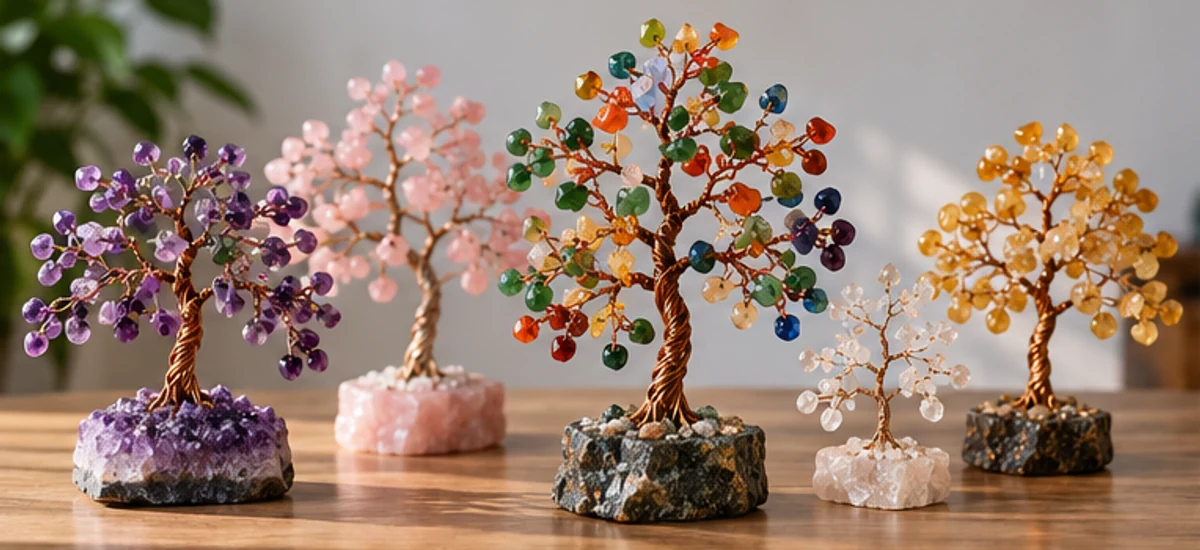
A gemstone tree is a hand-assembled decorative tree made from small mineral or gemstone chips attached to shaped metal-wire branches, gathered into a trunk and fixed into a supporting base. It is also called a crystal tree, gem tree, stone-chip tree, Vastu gemstone tree or, in some contemporary spiritual settings, a Kalpavriksha-inspired gemstone tree. These names overlap, but the materials and workmanship of individual trees can be very different. A good description identifies the actual chips, the wire, the base, the overall dimensions and any important treatments instead of relying on an attractive colour photograph.
The appeal is both visual and cultural. Branches suggest growth, continuity and interconnection; stones introduce texture and colour; the base gives an architectural object somewhere to stand. Indian households may connect a tree motif with Kalpavriksha or Kalpataru, make a Sankalpa about an intention, or select a piece for a Vastu-oriented shelf. Another buyer may simply want a crafted centrepiece. This guide explains both the tangible object and the traditional meanings clearly enough to make a confident choice.
1. What is inside a gemstone tree?
A finished tree is not a single crystal carved into a tree shape. In the familiar wire-and-chip design, many separate stones are combined into one sculptural assembly. Each chip is held, pierced, threaded or wrapped by a fine wire; several thin wires become a branch; branches are twisted or bound into a trunk. The trunk connects to a stable base, commonly stone, mineral aggregate, wood, resin or a composite. Makers sometimes use adhesive, sealant, plating or colouring on parts of the assembly. Even a tree advertised as an amethyst tree is therefore not made entirely of amethyst.
A close inspection can reveal where the work is strong or weak. The tips should not have exposed, sharp wire ends. Chips should not spin off after the lightest touch. The trunk should resist gentle wobble, the base should not rock on a level surface, and the canopy should be balanced enough to display without improvised support. A heavy-looking stone base is not automatically more stable than a well-designed smaller base; footprint, centre of gravity and attachment method all matter.
| Component | Typical construction | What to inspect | Why it matters |
|---|---|---|---|
| Leaf-like chips | Tumbled or irregular gemstone fragments | Material, size, sharp edges, holes, colour | Determines the visible stone character and much of the handling risk |
| Fine twigs | Thin copper-colour, brass-colour or coated metal wire | Smooth ends, secure wraps, coating damage | Holds individual chips and permits limited shaping |
| Larger branches | Several twigs bundled or twisted | Symmetry, fatigue points, exposed ends | Controls canopy spread and chip security |
| Trunk | Twisted wire bundle, sometimes wrapped or coated | Firmness, finish and attachment to base | Transfers canopy weight to the support |
| Base | Stone slab, geode-like base, wood, resin or composite | Level footprint, cracks, adhesive and finish | Prevents toppling and affects cleaning |
| Added finish | Plating, paint, varnish, glue or decorative filler | Visible repairs and stated materials | Influences durability, water tolerance and value |
A maker may intentionally leave the crown airy so light passes between the branches, or create a tightly packed crown where the gemstones dominate. Neither is intrinsically superior. Choose the proportions appropriate to the location rather than assuming that the densest tree must be the best or most spiritually meaningful.
2. The difference between gemstone, crystal and mineral terminology
In retail language, crystal tree is a broad category name. Scientifically, not every item sold as a crystal is one exposed, well-formed crystal. Amethyst and rose quartz are varieties of the mineral quartz, and small chips may not show crystal faces. Lapis lazuli is a rock made from several minerals, while obsidian is a natural volcanic glass rather than a crystalline mineral. Jade can refer to more than one mineral material. A mixed gemstone tree may contain all of these types of pieces in a single canopy.
That does not make the tree less attractive. It simply means that the correct description should be specific to the material supplied. A product using dyed stone chips should disclose dye; glass or resin decorations should be named accurately. The distinction between a naturally occurring material, a treated natural material, a laboratory-grown material and an imitation matters particularly when two otherwise similar-looking trees have very different prices.
| Label you may see | What it often refers to | Important question |
|---|---|---|
| Amethyst tree | Purple quartz chips | Are the chips genuine amethyst, coated or coloured substitutes? |
| Rose quartz tree | Pink quartz chips | Is the colour natural, uniform from enhancement, or not verified? |
| Citrine tree | Yellow-to-orange quartz chips | Has the supplier disclosed known heat treatment? |
| Green aventurine tree | Usually green quartz-rich material with inclusions | Is it genuinely aventurine rather than dyed quartzite or glass? |
| Seven chakra tree | Organised multi-colour gemstone or bead design | Which actual stones appear in each colour section? |
| Mixed gemstone tree | Several materials distributed through the branches | Is there an exact materials list for the offered piece? |
| Obsidian tree | Chips of volcanic glass | Is the material natural obsidian or manufactured glass? |
| Pyrite tree | Metallic iron-sulphide chips | How is moisture managed and how securely are chips attached? |
The Gemological Institute of America describes amethyst as quartz and notes that much citrine in the market is heat-treated amethyst. CIBJO's coloured-stone nomenclature guidance likewise emphasises accurate identification and disclosure of treatments. These observations do not require a seller to treat every enhancement as a defect; the important requirement is accurate, understandable naming.
3. How a gemstone tree is constructed, from chips to canopy
The craft usually begins with a decision about height, base size, approximate chip count and desired branching pattern. A maker selects a set of chips with compatible dimensions and drills or uses their existing holes. Wire is passed through a chip or wrapped around it, and the ends are twisted to create a small twig. Several twigs become a branch; branches converge into a trunk; the trunk is fixed onto or into the base. Makers then spread the branches, balance the crown, cover exposed joins if needed and check that the tree stands steadily.
This sequence is deceptively simple. If the wire is too thin or repeatedly bent at one point, it may fracture. If a drilled hole is close to the edge of a brittle chip, the stone may split during assembly or transit. If every branch points forward for the sake of a photograph, the real tree may look sparse from the side. The best workmanship anticipates how the piece will be viewed and handled after it leaves the maker's table.
- Select and sort chips: inspect colour, approximate size, drilling and obvious damage; do not rely solely on supplier labels.
- Prepare twigs: secure chips so no wire tip projects toward a hand or adjacent stone.
- Form branches: keep twists firm but avoid repeated bending at the same metal point.
- Build the trunk: distribute branches around the axis and plan the centre of gravity.
- Anchor the base: check the attachment, curing of any adhesive and resistance to wobble.
- Shape the canopy: create the intended spread without overstressing wires or loose stone holes.
- Inspect and pack: record dimensions, photograph the actual tree and protect the crown and base separately.
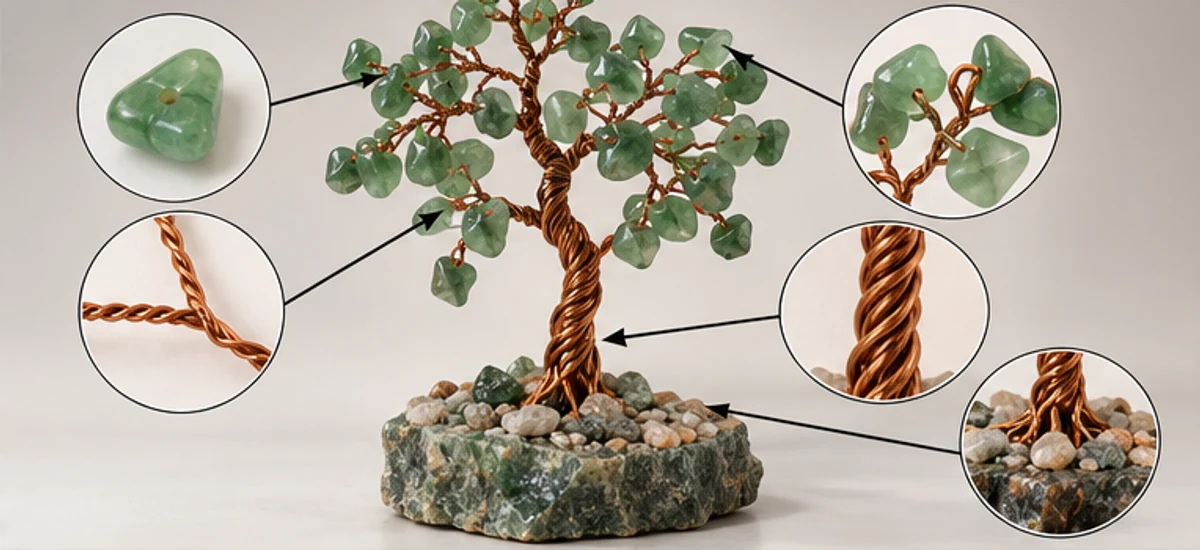
The visible branch structure is not merely a support system. It is also part of the design: the wire resembles small limbs, the gaps create light and shadow, and the different chip orientations make the tree look lively. More carefully finished branches may be worth paying for even when the gemstone chips themselves are inexpensive.
4. What does chip count actually tell you?
Gemstone trees are frequently offered with approximate counts such as 100, 300, 500 or 1,000 chips. These are useful inventory descriptors, not universal size categories or measures of spiritual power. Sellers may count one stone per twig, one bead per wire loop or every loose chip individually. A 300-chip tree built with larger chips and a broad trunk can occupy more space and weigh more than a 500-chip tree built from tiny pieces.
The number should therefore be read alongside actual height, maximum spread, base footprint, total weight, average chip size and construction photographs. It is wise to ask whether the figure is exact or approximate, particularly for complex crowns where a customer cannot realistically count every chip from a picture. No special efficacy or Vastu rule follows merely from a standard commercial chip-count label.
| Feature | Low-count airy design | High-count dense design | Better buying comparison |
|---|---|---|---|
| Canopy appearance | Individual branches visible | More stone colour fills the crown | Front and side photographs |
| Weight | Often lighter, but not guaranteed | Often heavier, depending on chip size | Actual weight and base footprint |
| Adjustment | Easier access to some twigs | More entanglement between branches | Maker's adjustment instructions |
| Dusting | Visible spaces are accessible | More small crevices trap dust | Soft brush access |
| Transport | Wide twigs may bend | Dense chips can collide | Protective packaging around crown |
| Pricing | Not necessarily inexpensive | Not necessarily premium | Stone identity, finishing and labour |
For a small work desk, a compact 100- or 300-chip tree may be more usable than a wide 1,000-chip design. For a dedicated reception shelf, the larger tree may provide the desired visual impact. Measure the actual space before deciding.
5. Common gemstones used in tree designs
The same tree construction can hold many different materials. Quartz varieties are common because they offer familiar colours and generally good resistance to everyday scratching; feldspars supply optical effects; agates and jaspers contribute patterns; fluorite and apatite offer striking but more delicate colours; pyrite and hematite produce darker, metallic-looking compositions. Every material has its own care requirements, and names should not be assigned only from a photograph.
| Stone or material | Recognisable appeal | Identity note | Practical display note |
|---|---|---|---|
| Clear quartz / Sphatik | Clear to milky chips | Quartz, silica | Usually durable chips; protect the wire and joins |
| Amethyst | Purple, lilac and zoned colour | Purple quartz | Avoid prolonged strong light that can fade some material |
| Rose quartz | Translucent pale-to-deep pink | Pink quartz | Judge real colour in ordinary light |
| Citrine | Yellow, honey and orange tones | Yellow-orange quartz, often heat treated | Ask for treatment information, not only a marketing name |
| Green aventurine | Soft to vivid green with potential sparkle | Quartz-rich material with reflective inclusions | Compare against dyed quartzite, glass and similar materials |
| Tiger eye | Golden-brown directional sheen | Quartz-based chatoyant material | Move the base gently to see the changing band |
| Lapis lazuli | Rich blue, often with lighter or metallic flecks | Rock containing multiple minerals | Avoid harsh solvents and indiscriminate soaking |
| Moonstone / labradorite | Soft glow or angle-dependent flashes | Feldspar-group materials | Protect from impact and hard branch adjustment |
| Fluorite | Purple, green, blue or banded chips | Calcium fluoride mineral | Relatively easy to scratch or chip |
| Pyrite | Gold-like metallic lustre | Iron disulphide | Dry display conditions and careful monitoring |
The best tree is not necessarily made of the most expensive named stone. A balanced, correctly labelled and securely assembled tree made with modest chips can outperform a poorly constructed tree with an extravagant gemstone claim. Similarly, a certificate for a single submitted chip does not prove the identity of every separate chip in a mixed tree.
6. Single-gemstone, mixed-gemstone and seven-chakra trees
A single-gemstone tree is designed primarily around one material, such as amethyst or rose quartz. Natural shade variation can remain visible within that single category. A mixed-gemstone tree combines different chips across the canopy, often without a strict colour sequence. A seven-chakra tree arranges colours or selected stones to correspond with a contemporary seven-centre presentation. These three formats are not interchangeable even though product listings sometimes call all of them "multi-crystal trees."
Modern seven-colour gemstone trees usually draw from red, orange, yellow, green, blue, indigo and violet presentations. Specific stone assignments vary: one maker may use red jasper, carnelian, citrine, aventurine, lapis lazuli, amethyst and clear quartz; another uses different minerals or dyes. The traditional Indian chakra concepts and their Sanskrit terminology have deeper textual histories, while the familiar rainbow mapping is a later synthesis in many modern retail presentations. Do not assume that a particular seven-colour crown reproduces a single ancient, prescribed gemstone list.
| Tree design | What defines it | Typical reason for choosing | Detail to verify |
|---|---|---|---|
| Single-stone | One named chip material predominates | Calm uniform palette or named material preference | Treatment and genuine chip identity |
| Two-tone | Two materials or colours arranged intentionally | Visual contrast, gifts, coordinated interiors | Whether colours are natural or enhanced |
| Mixed stone | Several materials distributed freely | Broad palette and variety | Complete material list, including substitutes |
| Seven chakra | Seven organised colour groups | Contemporary chakra-inspired visual symbolism | Actual stones used for all seven groups |
| Metallic/dark | Pyrite, hematite, black stones or combinations | Strong sculptural silhouette | Dry-care requirements and finish |
| Custom tree | Specified dimensions, palette or message | Memorial, event, consultation or interior design | Final sample, material availability and revisions |
A buyer interested in a particular mineral should choose based on actual material identity rather than the colour sequence alone. A buyer seeking a particular symbolic presentation may place greater weight on colour organisation, naming and accompanying information. Neither preference excuses unclear labels.
7. Kalpavriksha and Kalpataru: the traditional tree of abundance
Kalpavriksha (also written Kalpataru) is associated with the wish-fulfilling tree in Indian sacred and cultural traditions. It is an image of auspicious abundance, sustenance and fulfilment. Tree imagery appears across narrative, religious art and social memory, and its significance is older and wider than any specific modern gemstone-tree product. The Indian Museum in Kolkata documents a sandstone Kalpavriksha depiction from approximately the second century BCE, with branches bearing auspicious objects. This provides a historical anchor for the tree motif itself—not evidence that wire trees decorated with modern gem chips were made in that era.
The contemporary gemstone tree can be appreciated as a craft interpretation of a traditional tree symbol. In a puja or meditation setting, its branching form may recall growth, patience and the cultivation of a meaningful intention. Lakshmi and Kubera are often invoked in Indian abundance symbolism, while Sankalpa refers to a deliberate inner resolve. These traditional names should be discussed accurately rather than collapsed into a universal promise that any crystal object will produce wealth.
This distinction also helps customers from different households. Some families will connect the object with Lakshmi puja or a new business; others will use it simply as a welcome gift. A non-devotional office might choose the same design for its sculptural shape. Traditional symbolism is available without requiring every buyer to follow the same practice.
8. Vastu Shastra: directions and practical placement
Vastu Shastra considers spatial relationships, orientation, proportion and the organisation of a built setting. Ashta Dik refers to eight directions; Ishanya is northeast, Agneya southeast, Nairritya southwest and Vayavya northwest. Contemporary Vastu consultations sometimes recommend decorative trees as symbolic objects. However, one universal direction cannot be assigned to every gemstone tree without reference to the building, its use, the household's practice and the purpose of the object.
A small decorative tree for a puja shelf may be placed in a suitable clean and respectfully maintained location, while a showroom display may be positioned where customers can see both its canopy and base. Space for cleaning, safe distance from an open diya, and protection from hands reaching past the branches are not secondary concerns. A direction recommendation should never lead to a tree perched on an unstable ledge or blocking a passage.
| Direction / area | Traditional contextual term | Common planning consideration | Gemstone tree display question |
|---|---|---|---|
| North | Uttara, often discussed with Kubera in Vastu contexts | Work, movement and organised access | Is the shelf stable and accessible? |
| Northeast | Ishanya | Often associated with contemplative or puja uses | Is the space clean, uncluttered and free of heat? |
| East | Purva | Morning light and activity | Will direct sunlight affect sensitive chips? |
| Southeast | Agneya | Fire-related zone in many Vastu interpretations | Is the tree away from cooking heat, flame and sprays? |
| South | Dakshina | Actual room layout and circulation | Does the tree obstruct a walkway? |
| Southwest | Nairritya | Heavier furniture and fixed arrangements | Is the base proportionate to the shelf? |
| West | Paschima | Use of the room and evening light | Is lighting suitable for true colour display? |
| Northwest | Vayavya | Movement, visitors and changing use | Can passing people or bags snag the branches? |
A practitioner may additionally discuss Pancha Mahabhuta—Prithvi, Jala, Agni, Vayu and Akasha—as a traditional interpretive framework. The physical chips most directly evoke earth and minerals, the branching form may suggest growth and air, and the gaps in the crown bring space into the visual composition. These are symbolic associations, not laboratory measurements of the object's properties.
9. Jyotish, Navagraha and gemstone trees: what differs from a ring?
Vedic astrology, or Jyotish, uses a rich vocabulary of grahas and gemstones, including Surya, Chandra, Mangala, Budha, Brihaspati, Shukra, Shani, Rahu and Ketu. A gemstone selected to be worn for a specific astrological purpose is not the same thing as a decorative tree containing small chips. In traditional practice, wearing recommendations may depend on the birth chart, the gemstone's identity and quality, the metal, ritual conventions and individual interpretation. A mixed gemstone tree cannot automatically stand in for a personally prescribed ring or pendant.
Retail colour associations are often simplified. Yellow citrine should not silently be renamed Yellow Sapphire; green aventurine is not Emerald; a red jasper chip is not Ruby. Even when a decorative tree is marketed in connection with a graha, material naming must stay accurate. Gemstone trees can be chosen as symbolic reminders or home displays without being presented as substitutes for individual astrological recommendations.
| Traditional discussion | Gemstone tree context | What should remain separate |
|---|---|---|
| Surya and light | Warm-coloured or sunstone-themed display | Actual Ruby identity and wearing practice |
| Chandra and calm | Moonstone or pale quartz aesthetic | Natural Pearl or prescribed Chandra gem |
| Budha and green | Green aventurine or other green foliage-like chips | Emerald identification and chart-based selection |
| Brihaspati and yellow | Citrine-colour decorative tree | Yellow Sapphire is a distinct mineral, corundum |
| Shukra and beauty | Rose quartz and attractive floral palettes | Diamond and other personal wearing conventions |
| Shani and dark tones | Hematite, black tourmaline or darker designs | Blue Sapphire is not interchangeable with dark decorative chips |
| Rahu or Ketu | Contemporary thematic displays | Hessonite (Gomed) and Cat's Eye are specific gem materials |
10. Chakras, intention, meditation and contemporary crystal culture
The Sanskrit term chakra refers to a wheel or centre in different philosophical and yogic systems. Contemporary gemstone-tree designs commonly display seven colours to represent Muladhara, Svadhishthana, Manipura, Anahata, Vishuddha, Ajna and Sahasrara. The stone-to-colour mapping, however, is not universal across historical traditions. It is more helpful to explain how the particular tree is organised than to state that all historical sources demanded exactly the same commercial minerals.
An intention-based use can be straightforward: position the tree near a notebook, meditation cushion or quiet shelf, then let its branching form remind you of a Sankalpa. A professional Vastu practitioner may use trees as visual aids when teaching directions or symbolism. Someone setting up a study table may value an uncluttered display more than a complicated ritual. The significance comes from the chosen practice and context, not from chip count alone.
Do not confuse symbolism with gemstone identity or with a specific health treatment. A tree can be part of a meaningful devotional or reflective routine while product claims still identify what can actually be seen, measured and supplied.
11. Gemstone tree uses in Indian homes
In a Bengaluru apartment, a compact tree may fit on a console table, a living-room display shelf, a study nook or a dedicated puja space. The most helpful approach is to start with the exact available surface. Measure the tree's full canopy width, not only its base. Allow space between delicate branches and frequently handled keys, chargers, books or window cords. Children and pets may be attracted to shiny chips, so a high and stable shelf is often safer than a low side table.
If a family is observing a festival or a griha pravesha, a small tree can form part of an auspicious decorative arrangement alongside flowers, lamps and other traditional objects. Maintain a safe gap from flame, oil, water, incense ash and cleaning spray. A wire-and-stone tree should not be washed as if it were a metal puja vessel. Choose a setting where the visual meaning can be appreciated without shortening the object's useful life.
A family with a strong personal Vastu practice can discuss placement in relation to its own puja, room functions and practitioner advice. Another family may be equally satisfied with an attractive neutral display. Both uses fit the broad design category of a gemstone tree.
12. Gemstone trees in offices, showrooms and professional sets
Workplaces benefit from visual objects that do not interfere with circulation. On a reception counter, choose a stable base and a crown that does not hang over the customer side. In a meeting room, avoid a high dense tree that obstructs views or creates a fragile obstacle when people move laptops. A desk tree can be placed away from power cables and keyboard movement, and the cleaning staff should know to lift it by the base rather than its wire crown.
A jewellery showroom has additional responsibility to make the item understandable. Place an actual-specimen label beside the tree stating the chip material, dimensions, approximate count, wire finish, base material and any disclosed treatment. Show the base as well as the most flattering side of the crown. A mirror or side photograph helps customers judge the depth of the tree, not merely its front silhouette.
For professional Vastu consultation sets, consider choosing varied but clearly labelled examples: a quartz tree, a dark metallic-looking tree, a mixed gemstone design and a seven-colour example. Include a direction board and material-identification notes. The objects can support an educational discussion about Ashta Dik, Kalpavriksha and different materials without replacing an actual floor plan or a household's specific requirements.
| Setting | Useful tree style | Preferred position | Avoid |
|---|---|---|---|
| Small apartment shelf | Compact airy single-stone design | Stable surface with clearance | Edge of a frequently opened window |
| Home puja room | Manageable symbolic tree | Respectful clean shelf | Diya flame, oil spills and sprinkling water |
| Office work desk | Small stable-base design | Clear corner away from cables | Constant hand contact and movement |
| Retail reception | Medium broad but secure canopy | Visible counter zone away from customer reach | Overhanging branches and unstable displays |
| Jewellery showroom | Identified sample with product label | Well-lit shelf with front and side view | Exaggerated lighting or unsupported gem origin claims |
| Vastu teaching set | Several labelled material samples | Padded portable tray and direction board | Fragile pieces crowded in transit |
| Housewarming gift | Balanced colours and good packaging | Included size and care information | Unsupported promises and unlabelled substitutes |
13. Choosing a size and proportion for the actual space
Tree size should be chosen in three dimensions: height, width and depth. A narrow base may still support a large spread of wire branches. A short tree may occupy considerable visual space because its canopy is wide. Ask for actual measurements with branches in their normal display position, because flexible crowns can be shaped differently in photographs and after unpacking. The seller should state whether branches are designed for gentle repositioning or meant to remain fixed.
Look at the tree from the side, above and at shelf height. Is the trunk straight enough to support the composition? Does the base extend sufficiently under the centre of gravity? Are branches concentrated at one side? An intentionally asymmetric tree can be beautiful, but it should not be accidentally unbalanced. A product photograph of a tree on an empty studio backdrop cannot show whether it will overwhelm a small prayer shelf or fit beneath a cabinet.
| Space to measure | Measurement needed | Reason |
|---|---|---|
| Shelf or table | Usable flat width and depth | Prevents the base crossing an edge |
| Vertical clearance | Available height including overhead doors | Avoids branches snagging shelves |
| Canopy | Maximum branch-to-branch width | Allows a realistic fit, not just base fit |
| Nearby objects | Gap to books, candles, cords or doors | Limits accidental impacts |
| Base | Footprint and centre of mass | Helps judge stability |
| Access | Reach for cleaning and lifting | Prevents gripping by the trunk or chips |
| Background | Lighting and wall colour | Reveals natural chip colour accurately |
When buying online, request a photograph with a scale marker or ruler, as well as stated dimensions. Do not use a hand in a marketing photo as the sole size reference; perspective can be misleading. For a customized large tree, confirm shipping dimensions and whether the branches arrive folded for transit.
14. How to evaluate workmanship rather than only gemstone colour
A visually impressive canopy can conceal poor construction. Inspect a close-up of the chip attachment points. Where a chip is drilled, there should be sufficient material around the hole. Where a wire is wrapped, it should be finished neatly enough not to scratch nearby pieces. The twisting should look intentional rather than like a series of loose knots. The trunk and base connection should tolerate careful relocation without shifting.
Look for signs of early damage: a visibly detached chip, exposed sharp end, chipped base, heavy glue drip, buckled plating, frayed-looking wire, or an uneven bottom that rocks when set down. These defects matter more than small natural differences in chip colour. Natural chips can vary pleasantly in size and transparency; a broken fastening is a workmanship issue, not a desirable natural variation.
A good seller should explain if the branches are adjustable. Fine wire can be reshaped once or a few times, but repeated bending concentrates stress and may cause failure. The phrase "bendable tree" should not be interpreted as permission to repeatedly twist the same wire junction. Some premium designs are intentionally fixed and should not be re-posed after purchase.
15. Natural, treated, dyed and imitation chips: a practical buying guide
Gemstone trees are usually made from many small pieces rather than a few high-value faceted gems. That changes the practical inspection problem: it is rarely possible to authenticate every chip by sight, especially when the stones are tiny or the tree contains several materials. When a supplier advertises a specific premium material, ask about the origin of the batch, any known enhancement and what a report actually tested. A report on one chip should be described as a report on one chip, not automatically as a certificate for the entire finished tree.
Treatments are not all the same. Heating may change the hue of quartz; dyes can add colour to porous or light-coloured stones; coatings can change surface appearance; impregnation may influence surface response to solvents. Natural material with disclosed treatment is different from manufactured glass sold as the mineral. Correct naming allows a buyer to decide based on budget and aesthetic preferences without confusion.
| Description | What it means | Sensible purchase question |
|---|---|---|
| Natural, untreated material | Naturally occurring with no declared enhancement | What evidence supports the assertion? |
| Natural, heat treated | Natural stone whose appearance has been changed by heating | Is treatment disclosed and does it affect care? |
| Dyed stone | Natural material with added colour | Is colour stable during dusting and normal light exposure? |
| Coated or impregnated | Surface or pores altered with additional material | Which solvents, water or heat should be avoided? |
| Laboratory-grown | Material grown using an artificial process | Is it named distinctly from mined material? |
| Imitation | Different material mimicking the expected appearance | Is the actual glass, resin or other composition stated? |
| Mixed lot | Several chip batches combined | Are the major components accurately listed? |
Visual warning signs deserve questions, not instant verdicts. Identical neon colour on every chip, dye concentrated in cracks, unusually consistent transparent chips, or an implausibly low price for a rare claimed gemstone may justify closer inspection. Conversely, natural materials can sometimes be uniform, and variations do not themselves prove authenticity. Professional analysis is needed for definitive identification where material identity materially affects price.
16. Pricing: what determines the value of a gemstone tree?
The final price reflects several inputs: actual material and chip quality, quantity, drilling or pre-processing, wire type and finish, design complexity, labour, base material, strength of assembly, packaging and the seller's service. The market value of a large faceted gemstone should not be projected directly onto small irregular chips of the same broad mineral family. A tree with expensive-sounding stones may be poorly finished, while a modest quartz tree may be beautifully constructed and better suited to the buyer's home.
A useful comparison holds the physical scale roughly constant. Compare two trees of similar height and spread, then inspect chip size, finish, stability, material labels, included care instructions and product-specific photographs. Avoid ranking by chip count alone or by a claim that a tree will deliver a fixed amount of money, luck or success. The buyer is purchasing a tangible crafted article whose traditional symbolism may be meaningful, not a measurable outcome guarantee.
For stores, a transparent price card can show design type, actual materials, approximate chips, dimensions, base and included packaging. That is also helpful for repeat customers who want to order a matching piece later or compare a custom version.
17. What photographs should a responsible product listing show?
At minimum, a customer should see the whole tree from the front, a side angle, a base detail and several close-ups of actual chips and wire joins. Photographs under ordinary diffuse light are especially important for gemstones with strong flash, such as labradorite or tiger eye. A dramatic spotlight image can be useful as a demonstration of an optical effect, but it should not be the only representation of everyday colour.
For a handmade item, clarify whether photographs show the exact piece available or a representative design. Natural stone-chip variation means successive pieces may never look perfectly identical. This is not necessarily a defect, but it must be communicated when colour arrangement, orientation or canopy shape is important to the customer. A comparison image with a simple shelf or ruler helps explain actual scale more effectively than elaborate decorative backgrounds.
A short video may be useful for a complex tree, showing the base lifted securely and the canopy rotated without grabbing branches. Avoid effects or heavy colour filters that turn ordinary pale stones into highly saturated colours. Clear images build trust, especially where buyers cannot inspect the materials in person.
18. Cleaning and care: one object, several materials
Routine care begins with dry dusting. Support the base with one hand and use a soft, clean artist's brush or microfiber cloth, working gently among branches. Avoid pulling the canopy or rubbing two chips against each other. Even when an individual quartz stone might tolerate warm soapy water, the finished tree can include metal coatings, glues, resin or painted surfaces that do not. Do not immerse the whole assembly, use household descalers or blast the tree with ultrasonic or steam cleaning.
Material differences matter. Some amethyst can fade after prolonged strong light; softer fluorite is more prone to scratching and chipping; treated lapis may be vulnerable to cleaning chemicals; pyrite can deteriorate in persistently damp conditions. Metal wires can corrode when exposed to moisture and residues. The Canadian Conservation Institute's preventive-conservation guidance explains that humidity, dust, fingerprints and pollutants all influence metal deterioration, so a dry, stable display and clean handling are sensible defaults for a mixed-material object.
| Situation | Safer action | What to avoid |
|---|---|---|
| Dust on chips | Soft dry brush with base supported | Hard scrubbing and blowing chips against one another |
| Dust on wirework | Gentle brush and dry cloth where reachable | Wetting unknown coatings or joints |
| Amethyst near sunny window | Move to indirect light | Long exposure to intense sun |
| Pyrite or metal parts damp | Relocate to dry environment and assess | Regular spraying or prolonged humid storage |
| Loose stone or wire tip | Stop adjustment; ask maker for repair | Pulling hard or applying random solvent |
| Dirty painted or resin base | Follow finish-specific maker instructions | Abrasives, acids, solvent-based cleaners |
| Storage or shipping | Stabilize base; pad canopy loosely | Crushing branches under heavy packing |
For a religious setting, use symbolic practices that do not physically damage the object. If water, milk, oil or powders are part of a household's customary worship, keep the delicate wire-and-chip tree outside the wet application area. The object can participate in a devotional arrangement without being treated as washable stoneware.
19. Common defects and straightforward troubleshooting
A leaning trunk, a loose chip and a wobbling base are different problems. A gently adjustable branch that has shifted during shipping may simply need minimal reshaping following the maker's instructions. A trunk detaching from the base is more serious: do not continue displaying it on a high shelf where the crown can fall. A chip that slips out of a wire loop should be repaired carefully by a competent craftsperson rather than pushed back with force.
Green or brown residue on metal may reflect the finish, patina, corrosion or contact with adhesive; appearance alone cannot decide which. Do not polish the complete tree with a chemical metal polish, because residues may reach porous stones and glue. If several wires have cracked at one point, repeated bending is probably worsening fatigue. Stop handling and ask the seller about repairs or replacement parts.
| Symptom | Possible cause | First response |
|---|---|---|
| Tree rocks on table | Uneven base or surface | Test on a flat surface and contact seller |
| Canopy leans visibly | Uneven shaping, damage or poor anchoring | Inspect trunk and base before repositioning |
| One chip hangs loose | Weak loop or damaged drilled hole | Isolate the branch and seek repair |
| Wires feel brittle | Repeated bending or material fatigue | Stop reshaping; avoid loading the branch |
| Dull or faded chip colour | Lighting, contamination or actual fading | Compare normal-light photos; do not recolour at home |
| Metal shows residue | Dirt, coating wear or corrosion | Keep dry; seek finish-specific guidance |
| Base cracks in transit | Impact or poor padding | Photograph on arrival and report immediately |
20. Buying checklist: twelve questions to ask before ordering
The best online purchase begins with clear, verifiable product information. Ask these questions even when the tree is intended as an auspicious gift. A transparent seller should be able to answer most of them without extraordinary claims or expensive laboratory tests for every tiny chip.
- What specific gemstone or other material is used for each colour or chip group?
- Are any stones known to be dyed, heat-treated, coated, synthetic or imitation?
- Is the photographed tree the exact piece, or a representative handmade example?
- What are the actual height, width, depth and base footprint?
- How many chips are included, and is this count approximate?
- What size range do the individual chips usually fall into?
- What is the wire material or finish, and are branches intended to be adjustable?
- What holds the trunk to the base, and is the base natural stone, wood or resin?
- How stable is the tree on a level surface, and what is its approximate weight?
- Is a laboratory report for the exact product, for a representative sample, or unavailable?
- How will the crown and base be protected during delivery, and what happens if damage occurs?
- What cleaning instructions, exchange conditions and repair guidance come with the tree?
These questions can also become a shop inventory form. For a professional Vastu collection, consistent records make future comparisons and teaching easier, particularly if different trees were sourced from different craft batches.
21. Real-world examples: selecting a tree with a purpose
A Bengaluru family apartment. A household has a 28 cm wide living-room shelf with books and frequent movement nearby. Rather than buying a visually dramatic 1,000-chip tree, they choose a smaller, balanced quartz design with a measured spread and easy dusting access. They enjoy its Kalpavriksha association without crowding the shelf. The tree is placed away from the sunny window and away from a place where children reach for toys.
A new jewellery boutique. The owner wants a tree for the opening day, evoking Lakshmi and Kubera. The shop chooses an attractive, secure mixed-gemstone tree with a complete material list and a small printed card explaining the craft and its symbolism. The invoice records actual dimensions, chip count and any treatment disclosures. The tree is displayed outside the path where customers pass bags and shopping packages.
A professional Vastu demonstration. A consultant brings a compact green aventurine sample, a darker pyrite or black-stone sample, and a seven-colour design. The consultant discusses Ashta Dik and Sankalpa while explicitly identifying modern colour associations, then returns to the actual floor plan and needs of the client. The trees function as clear visual teaching aids and are carried in separated, padded compartments.
A housewarming gift. The giver prefers rose quartz because the family likes subtle pink rather than a bold metallic object. A gift card briefly explains the tree form as a symbol of growth and an auspicious new beginning, while the product label gives its actual materials and care instructions. This is more useful and respectful than making promises about specific future events.
22. A useful distinction: what a gemstone tree can and cannot tell you
A gemstone tree tells you something about human craftsmanship and material selection: its size, weight, palette, chip identity, apparent finishing and stability can all be inspected. It can represent a traditional sacred-tree theme or support a personal meditation or devotional routine. It may be a valued home object, a thoughtfully chosen gift or a professional display sample.
It does not, by its existence alone, verify that every chip is untreated, that every laboratory report applies to every stone, or that a colour corresponds to a specified classical gemstone recommendation. Similarly, the visual presence of a tree in a north or northeast corner is only one small part of any wider Vastu conversation. Keeping these distinctions clear lets buyers appreciate the full cultural and decorative meaning while judging the real product accurately.
23. Frequently asked questions about gemstone trees
1. What exactly is a gemstone tree?
A gemstone tree is a handmade decorative object consisting of mineral or gemstone chips attached to wires shaped as branches, joined into a trunk and secured to a base. It is not a living plant and does not need watering. Materials, size and build quality vary substantially among sellers.
2. Are gemstone trees made of natural stones?
Many use natural mineral or rock chips, but some contain dyed material, laboratory-grown stones, glass, resin or other decorations. The right description lists the actual components and disclosed treatments. Appearance alone cannot confirm every chip's identity.
3. Is a gemstone tree the same as a crystal tree?
In everyday retail language the terms commonly overlap. Mineralogically, not every chip in a "crystal tree" is necessarily a single crystal; some are rocks or natural glass. Product details matter more than the broad name.
4. What is the difference between a gemstone tree and a bonsai?
Bonsai is the horticultural practice of growing and shaping a living tree in a container. A gemstone tree is a stationary decorative craft made from stone chips, wire and a base. It needs careful dusting rather than plant care.
5. What is Kalpavriksha?
Kalpavriksha or Kalpataru is an auspicious wish-fulfilling tree motif in Indian tradition. Modern gemstone trees may draw visual or symbolic inspiration from this older sacred-tree image, but the wire-and-chip product is a contemporary craft form.
6. Can a gemstone tree be kept in a puja room?
Yes, if it suits the household's practice and there is a stable, clean location. Keep its wires, chips and adhesive away from open flames, oil and regular wet rituals. Use the maker's care instructions when cleaning.
7. Which gemstone tree is best for Vastu?
There is no single material that is automatically best for every household and room. Consider the purpose, size, available location, traditional associations and actual material identity. A practitioner may make a more specific recommendation after considering the space.
8. In which direction should I place a gemstone tree?
North, east and northeast are often discussed in contemporary placement guides, but the right position depends on the room, use and local Vastu interpretation. First ensure that the object can stand securely away from heat and damage. Do not force placement onto an unsafe ledge.
9. Does a gemstone tree represent Lakshmi and Kubera?
Some households associate the auspicious tree image with abundance traditions that include Lakshmi and Kubera. The association is symbolic and contextual, not a label that automatically applies identically to every product. A seller can explain the tradition and still give precise physical product information.
10. Is a seven-chakra tree different from a mixed-gemstone tree?
A seven-chakra tree intentionally organises seven colour groups; a mixed-gemstone tree may distribute several materials freely. Two trees with similar colours may use entirely different stone species. Ask for a list of actual chips in each group.
11. How many chips should a gemstone tree have?
Select according to dimensions, visual density and budget rather than a supposedly mandatory number. A 300-chip tree with larger stones can occupy more space than a 500-chip design with smaller chips. Counts are often approximate retail descriptions.
12. Are adjustable wire branches safe to bend?
Some branches permit occasional gentle shaping, but repeated bending at the same point can cause metal fatigue. Support the trunk and follow the maker's guidance. Do not force a chip that appears stuck or a branch whose wire is already cracked.
13. What is a good gemstone tree for an office desk?
Choose a compact tree with a low, stable base and enough space around the crown for daily work. Avoid a layout where cables, sleeves or bags can snag the branches. The material and colour can be selected according to taste or a symbolic theme.
14. Is more expensive always better?
No. Cost depends on stone identity, chip size, workmanship, trunk and base design, labour and packaging. A smaller well-made tree can be a better purchase than a larger unstable one. Ask what specific physical features account for the price.
15. Are citrine gemstone trees always untreated?
No. GIA notes that much commercial citrine originates from heat-treated amethyst. This remains quartz material but its colour history should be described accurately when known. A bright yellow-orange photograph is not proof of untreated natural citrine.
16. Can one certificate authenticate a whole tree?
A laboratory report identifies the sample or object actually examined. A mixed gemstone tree contains many individual chips, so a report on one stone does not automatically establish the identity of all others. Read the report's scope and connect it to the offered item.
17. Can I wash my gemstone tree with water?
Dry dusting is safer as a default because water can affect wire finishes, some gemstones, adhesives or painted bases. A cleaning method appropriate for one loose stone may not be appropriate for the assembled craft. Ask the maker before applying liquid.
18. Can sunlight damage the tree?
Prolonged intense sunlight can fade some gemstones, including certain amethysts, while heat can affect coatings and adhesives. Ordinary bright rooms are not automatically unsuitable; direct windowsill exposure deserves particular caution. Avoid placing the tree close to high heat.
19. What should I do if a chip comes loose?
Keep the detached chip and stop pulling on the damaged twig. Photograph the attachment and contact the seller or a craft repairer. Random household adhesive or forceful rewiring can damage adjacent materials and obscure the original construction.
20. Can a gemstone tree be given as a housewarming gift?
Yes. It can be a thoughtful symbol of growth, continuity and a new beginning. Choose a size and colour suited to the recipient's room, use protective packing and include actual material details and care guidance. Traditional meaning can be shared in a short gift note.
24. Further reading and material references
For deeper identification and treatment terminology, consult the Gemological Institute of America's gemstone encyclopaedia and CIBJO's coloured-stone nomenclature material. The Canadian Conservation Institute explains how humidity, fingerprints and pollutants affect metal surfaces; this is relevant because gemstone trees combine stone with delicate wire. The Indian Museum, Kolkata, records historical Kalpavriksha imagery that helps distinguish the ancient auspicious-tree tradition from modern decorative interpretations. These are educational references rather than claims that any institution has tested a particular commercial tree.
