
Pyrite and tiger eye gemstone trees share a warm golden palette, yet they differ in almost every practical respect: mineral identity, surface reflection, weight, possible treatments and the way a finished tree should be cared for. Pyrite is a metallic iron-sulphide mineral with a brassy appearance. Tiger eye is a quartz-based ornamental stone famous for shifting bands of light called chatoyancy. A pyrite tree can look like a canopy of small metallic leaves; a tiger eye tree shows striped brown, honey and golden chips that change as the viewing angle changes. Neither appearance alone establishes the quality of an assembled tree. This guide explains the physical distinctions, Kalpavriksha and Vastu symbolism, how to choose a genuine tree, which locations suit different arrangements, and how to keep the branches and stones in good condition.
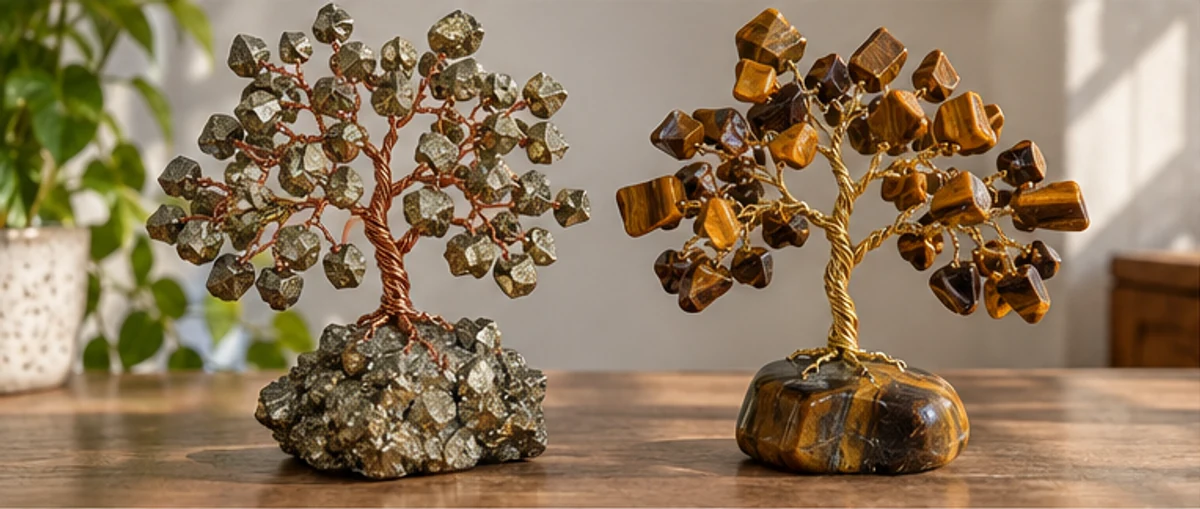
Pyrite vs tiger eye gemstone trees: the essential comparison
| Feature | Pyrite gemstone tree | Tiger eye gemstone tree |
|---|---|---|
| Main material | Pyrite, iron disulphide (FeS₂) | Quartz with aligned fibrous inclusions and iron-related colour |
| Recognisable effect | Opaque brassy-yellow metallic lustre | Silky moving golden band, or chatoyancy |
| Common colour range | Pale brass-yellow, with possible darker or tarnished areas | Honey, gold, caramel, brown and sometimes blue-grey varieties |
| Mohs hardness of principal mineral | About 6–6.5 | About 7 for quartz |
| Approximate specific gravity | About 4.8–5.0 | Often approximately 2.6–2.9, depending on material |
| Form in a small tree | Metallic chips, fragments, nuggets or polished pieces | Tumbled, polished or shaped striped stone chips |
| Viewing technique | Rotate to see metallic highlights and surface texture | Rotate under one lamp to follow movement of the eye-band |
| Common naming problem | Confused with gold, brass, chalcopyrite or coated pieces | Confused with goldstone glass, fibre-optic glass or dyed alternatives |
| Main care priority | Protect from humidity, water and signs of mineral deterioration | Protect polish and treatments; avoid rough impacts and cleaning chemicals |
| Symbolic emphasis | Prosperity, resources, enterprise and Lakshmi–Kubera intention | Courage, steadiness, focused effort and purposeful action |
This comparison is about actual mineral chips, not an assumption that every item sold under either name contains those stones throughout. Both designs include a wire canopy, a trunk, bindings or adhesive, and a base. Construction quality can matter more to daily use than a small difference in chip price.
What is a genuine pyrite gemstone tree?
Pyrite is an iron-sulphide mineral, formula FeS₂. It is commonly opaque, brassy yellow, relatively dense and strongly reflective on suitable faces. Its familiar nickname, fool's gold, refers to resemblance in colour—not to gold content. A polished or crystal-bearing chip can reflect sharply, while a fine-grained fragment may appear textured, uneven or darker. Natural pyrite occurs in different habits and associations; it is not always a perfect cube, and a decorative chip should not be expected to have a collector-grade crystal face.
A properly described pyrite tree should identify the material in its leaves or chips, the construction of the trunk and wire, and any coating, adhesive, stabilization or additional material. In a mixed-mineral rock, pyrite may occur alongside quartz or other minerals. A seller should not label an entire assemblage as pure pyrite merely because the most visible grains are metallic. Likewise, gold-coloured wire is not evidence of precious-metal wire; plated iron, copper-coloured alloy and decorative craft wire are separate components of the tree.
Pyrite's high density can make an otherwise small collection of chips surprisingly heavy. However, the finished tree's total weight includes stone, wire, resin, plaster, wood or rock base, so weighing the object cannot prove pyrite authenticity. For identification, compare the chips' surface, construction, stated material and, when necessary, testing by an appropriately equipped gemmological or mineralogical professional.
Pyrite colour, natural texture and possible deterioration
Metallic brightness can vary between chips without automatically indicating a defect. Small natural pits, grain boundaries and irregular crystal faces are possible. Loose powder, newly forming whitish or yellowish crusts, friable material, an acidic odour or progressive cracking deserve more attention. Some pyrite specimens are prone to oxidation in damp air; conservation guidance highlights the risk when relative humidity becomes elevated, particularly above about 50% for susceptible specimens. A tree intended for a humid windowsill, bathroom or kitchen needs a different risk assessment from one kept in a dry enclosed cabinet.
Do not test a finished tree by scratching, soaking, applying household acid or breaking off chips. Those acts can harm the mineral and its wire attachments. A close photograph of the actual canopy in neutral light, plus a written material description, is a better starting point for a retail purchase.
What is a genuine tiger eye gemstone tree?
Tiger eye, also written tiger's-eye, is a quartz-based ornamental material displaying chatoyancy, a silky band of reflected light caused by aligned fibrous structures. GIA describes tiger eye's optical effect in relation to quartz and iron-rich fibrous mineral history; advanced geological work has refined the exact formation mechanism. The practical buyer's point is simpler: a quality polished chip may show a bright band that appears to glide as the angle of illumination changes. The band is a physical optical effect, not glitter added to the surface.
Most familiar tiger eye is gold to brown, often with darker parallel stripes. A given chip may show several transitions, while another from the same batch may look nearly uniform until it is tilted. The original rough material, how a chip was cut, its polish and its orientation in the wire branch all affect the finished tree's appearance. Expect some variation across dozens of small chips. A highly edited photograph showing every chip with an identical glowing eye is less useful than an ordinary-light photograph and a short moving-angle view of the actual piece.
Hawk's eye generally refers to the blue-grey related material. Red tiger eye is sometimes heated or otherwise treated. Intensely coloured green or blue commercial products may be dyed. The seller should identify the treatment where known; the presence of a quartz base does not mean that a bright colour is untreated. A tiger eye tree is not the same mineral as sunstone, nor is a glittery glass imitation a natural tiger eye product.
Why does the band of light move?
Chatoyancy depends on ordered fibres and their orientation relative to the polished surface, the lamp and the observer. Hold an individual chip still and move the light, or hold the light still and turn the chip; the band may move, brighten or disappear. That is why one still photograph cannot show the optical performance of an entire canopy. Even natural, genuine stones may have a weak eye on one side of the tree and a stronger band on another. Request several views of the exact object when appearance matters.
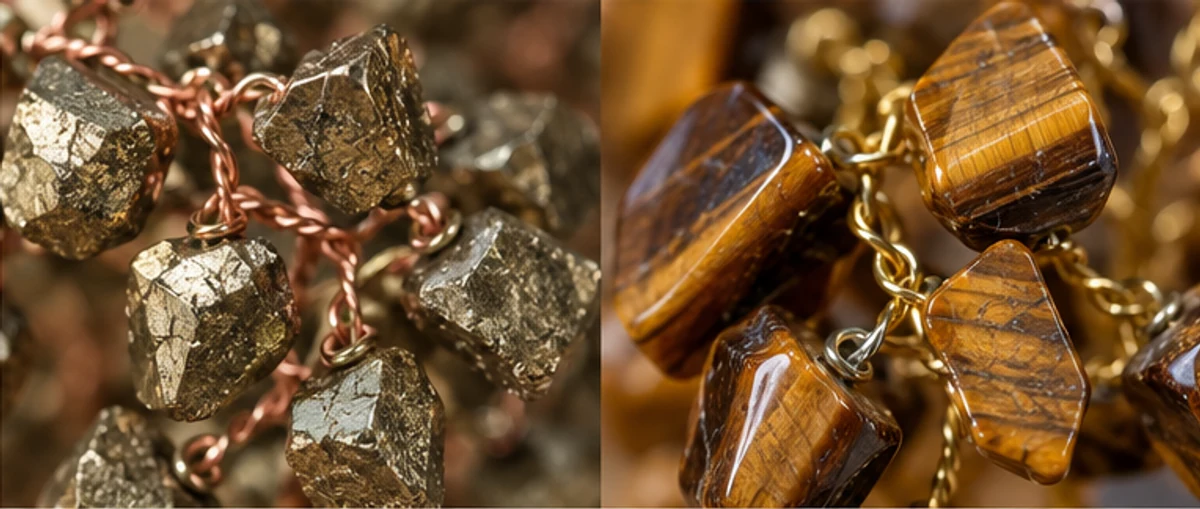
Real minerals, coatings and common lookalikes
| Offered name or lookalike | What it may actually be | Practical inspection question |
|---|---|---|
| Pyrite | Natural FeS₂, sometimes with associated minerals | Are the leaves true pyrite chips, and are any mixed or stabilized? |
| Gold-plated or brass-look chip | Metal-plated material, brass, resin or painted composite | Is the gold appearance from the chip itself or from a surface finish? |
| Chalcopyrite | A different copper–iron sulphide, sometimes iridescent | Is the mineral specifically verified as pyrite rather than another sulphide? |
| Marcasite | Same FeS₂ composition as pyrite but a different crystal structure | Is “marcasite” a mineral identification or only jewellery trade terminology? |
| Goldstone | Manufactured glass containing sparkly metallic inclusions | Is it sold honestly as glass, rather than natural tiger eye? |
| Fibre-optic glass | Manufactured glass with a moving optical streak | Does the seller disclose the manufactured nature? |
| Dyed tiger eye | Genuine quartz material with altered colour | Is the original material and dye treatment clearly stated? |
| Tiger iron | A different patterned rock containing iron-rich layers and tiger-eye-like material | Is the product a mixed rock rather than simple tiger eye? |
| Natural tiger eye | Quartz-based material showing directional silky reflection | Does the band move under neutral light when the material is turned? |
A gold appearance is not a reliable scratch test, magnet test or gold-content test. Magnetic behaviour can be affected by associated minerals and construction wire. Nor does the phrase “100% natural” clarify whether the whole item is one stone type, whether chips are colour-treated, or whether the finished canopy has synthetic bindings. Ask for a precise declaration of the decorative material and its treatment history, not a broad promise about colour.
How to inspect an actual gemstone tree before buying
A successful purchase begins with the finished object's design. Check the canopy from the front, both sides and above. Inspect whether branches are evenly distributed, whether the wire ends are tucked away, whether the trunk is straight, and whether the base sits flat without wobbling. Small trees are often displayed close to people, books or clothing, where an exposed sharp wire end matters more than it would in a high cabinet.
For pyrite, use side lighting to inspect metallic chips for visible crumble, loose powder, cracks or suspicious coatings. A regular variation in luster can be natural; progressive deterioration is a separate concern. For tiger eye, ask for an angled-light view, not a promise that each chip is equally bright. Look for parallel brown-gold patterning and a polished surface appropriate to the stated chip form. Uneven chip sizes may be a design choice, but numerous detached leaves or a bare branch should be disclosed.
| Component | Check before purchase | Why it matters |
|---|---|---|
| Mineral chips | Correct name, visible pattern, known treatment | Prevents material substitution and confusing trade labels |
| Wire branches | Secure loops, no dangerously exposed tips | Reduces snagging and loss of chips |
| Trunk | Tight twist or designed covering, no loose segments | Holds the canopy's shape |
| Attachments | Suitable binding, no visible leaking adhesive | Helps the assembly last |
| Base material | Stone, wood, resin, mineral or other material identified | Determines stability and care method |
| Base underside | Flat support and protective contact surface | Prevents wobble and scratched furniture |
| Crown width and height | Actual finished dimensions, not approximate advertising | Determines whether it fits the intended shelf |
| Photo evidence | Actual item front, side, underside and close-up | Shows proportion, damage and workmanship |
| Weight | Whole object weight and, if relevant, stone-chip weight | Avoids confusing a heavy base with heavy gemstone chips |
| Shipping protection | Branch support and a base that cannot move inside the box | Reduces bending and broken attachments |
Comparing the canopy under ordinary light
Look first from normal sitting or standing height. The same tree can appear fuller at eye level and sparse when seen from above. Pyrite's metallic highlights are often strongest against a matte cream, grey or dark green background; tiger eye's striped bands can complement timber, earthy ceramics and neutral walls. Avoid judging either tree under coloured shop spotlights alone. Ask the seller to use neutral daylight or a plain white lamp for an additional photograph.
Next, consider balance rather than abundance of chips. A dense pyrite canopy may create a concentrated metallic cluster. A tiger eye canopy with a little space between branches may allow the stripes to show individually. Neither approach is automatically superior. Decide whether the object will be seen from a sofa, a reception counter, a puja shelf or an office desk. If the display is against a wall, a fan-shaped crown can work; if it is in the middle of a table, a more balanced all-around form may look better.
Some product photos show a tree resting inside a water bowl or among wet plants. That setting is unsuitable as a default for a pyrite tree. For either tree, a cup, humidifier, open window or frequently cleaned surface can expose the metal fittings and base to unwanted moisture. Design the whole setting for the material, not only the photograph.
Kalpavriksha: why the tree form is auspicious
The Kalpavriksha (Kalpataru) is the wish-fulfilling tree of Indian mythic and devotional traditions. Its branches symbolize nourishment, gifts, prosperity and continuity. The Indian Museum, Kolkata preserves a historic Besnagar sculpture traditionally identified as Kalpavriksha, with objects of abundance including a purse, conch, lotus and overflowing vessel. A modern wire-and-gemstone tree is a contemporary decorative form, but its symbolism can draw meaningfully from this older visual language of growth and blessings.
At home, a gemstone tree may become a small reminder of Sankalpa, the deliberate intention accompanying worship, study, business or a new beginning. Its roots and base suggest steadiness, the trunk suggests perseverance, and the crown suggests expansion. This language can be used for a griha pravesh gift, a newly opened store, a study area or a family prayer shelf without claiming that one gemstone automatically substitutes for a ritual, an architectural Vastu correction or personal effort.
For a pyrite tree, its golden metallic look lends itself to prosperity-related imagery connected in popular devotional settings with Mahalakshmi, Kubera, resources and enterprise. Tiger eye's changing bands can offer a different personal reminder: maintain focus, act with courage and continue steady work. These specific gemstone–intention pairings are prominent in modern crystal and Vastu-oriented decorative practice; they should not be presented as quotations from an ancient text prescribing the exact commercial product.
Lakshmi, Kubera, Surya and the Navagraha distinction
Lakshmi is revered for Sri, auspiciousness and abundance. Kubera is associated with wealth and custodianship of treasures. Surya represents light, vitality and disciplined purpose in Jyotish and worship. When people place a warm-coloured tree in a business or study setting, such themes may form part of the family's chosen Sankalpa. The association should follow the intended practice, not an arbitrary rule that all golden objects are equivalent to a prescribed planetary gemstone.
The Navagraha / Navaratna system has its own traditional gem associations. In common Jyotish practice, ruby is associated with Surya, pearl with Chandra, red coral with Mangala, emerald with Budha, yellow sapphire with Guru/Brihaspati, diamond with Shukra, blue sapphire with Shani, Hessonite (Gomed) with Rahu and cat's eye with Ketu. Neither pyrite nor tiger eye should silently replace those stones in a formal Navaratna set. A person's Rashi, Lagna, graha strength, Dasha and individual chart matter when the request is for astrological selection rather than simple decorative Vastu placement.
| Spiritual context | Traditional idea | Meaningful use of a tree |
|---|---|---|
| Kalpavriksha | Growth, continuity, blessings and abundance | A visible symbol for a new home, project or family milestone |
| Mahalakshmi | Sri, auspiciousness, prosperity | A pyrite-coloured decorative tree in a clean, well-maintained place of intention |
| Kubera | Stewardship of resources and treasures | A reminder of responsible business and financial organization |
| Sankalpa | Deliberate, personally stated intention | Choosing a tree in relation to a goal and caring for the space around it |
| Surya | Light and disciplined action | A warm tiger eye palette near a workspace or study area |
| Navagraha | Individual planetary associations | Use verified chart-based guidance when selecting actual planetary gemstones |
| Puja and devotional care | Cleanliness, respect and orderly placement | Keep the tree dry, stable and clear of candle flames and spill-prone offerings |
Pancha Mahabhuta, directions and Vastu placement
Vastu Shastra discusses the organization of space using directional relationships and the Pancha Mahabhuta: Prithvi (earth), Jala (water), Agni (fire), Vayu (air) and Akasha (space). In an educational display, the stones, colours, shape and location can illustrate these themes. The exact placement also depends on the entrance, room function, the Vastu Purusha Mandala and the household's practice. A commercial gemstone tree is not a universal substitute for architectural assessment.
Ishanya is the north-east direction, associated with sacred study and puja in many Vastu traditions. North is often associated with Kubera, while east relates to Surya and morning light. South-east is linked with Agni and is not a preferred place for a moisture-sensitive tree beside a sink or stove merely because the colour looks fiery. The practical condition of the shelf and the tree's materials should be considered alongside symbolic direction.
| Direction or area | Traditional reference | Practical interpretation for gemstone trees |
|---|---|---|
| North (Uttara) | Kubera and resources | A stable, uncluttered office or shop shelf can support a prosperity-oriented Sankalpa |
| North-east (Ishanya) | Puja, contemplation and sacred orientation | A modest tree may accompany a prayer or reflection space if it does not crowd sacred items |
| East (Purva) | Surya, beginnings and purposeful work | Morning study or a writing desk may suit the warm tiger eye palette |
| South-east (Agneya) | Agni and activity | Avoid heat, flames, wet kitchens and excessive cleaning moisture |
| South-west (Nairritya) | Stability and grounding | Consider a sturdy cabinet only when it suits the room's actual usage and tradition |
| Centre (Brahmasthana) | Open, balanced central space | Do not obstruct circulation with decorative stands or boxes |
| Shop reception | Welcome and first impression | Place where the item is stable and does not block movement or payment activity |
| Puja shelf | Order, respect and Sankalpa | Keep clear of oil, water, incense ash and heated lamps |
A pyrite tree should not be placed in standing water, on top of a damp planter or where sprays routinely reach the chips. Tiger eye tolerates ordinary indoor settings better as a quartz-based material, but its dyes, wires, adhesives and base remain relevant. If the tree sits near a south-facing window, consider glare and heat exposure as well as the room's orientation. Let the purpose of the room and the chosen tradition guide placement together.
Which tree suits a home, shop, office or gifting occasion?
Bengaluru home example. A family wants a small decorative tree near a bookcase and puja corner. The shelf is away from a bathroom and has a dry, matte wooden surface. A low tiger eye design may suit their warm timber and offer a symbolic reminder of focused study; a pyrite tree could suit the same space if the area stays consistently dry. The family places it off to one side, leaving the puja lamp and water vessel unobstructed. Their decision comes from meaning, aesthetics and safe location together.
Jewellery showroom example. A store owner wants a small object for a reception shelf. A pyrite tree can provide an eye-catching brassy texture associated with commerce and Lakshmi–Kubera symbolism. Before ordering, the owner asks for close-ups of the actual chips, the base and the wire finish, plus humidity-care instructions. They do not label the tree “real gold” or leave it where customers might spray perfume or touch the exposed branches. If the showroom has high humidity, the owner instead chooses a tiger eye arrangement with manageable maintenance.
Professional Vastu consultation example. A consultant wants a representative comparison kit, not one decorative product presented as the answer to every property. The kit includes clearly labelled pyrite and tiger eye chip samples or small trees, written mineral distinctions, actual photos, treatment statements, suitable dry-care guidance and a direction reference sheet. A separate Navagraha set remains clearly identified as an astrological reference rather than being re-labelled with these decorative stones. The consultant uses the kit to explain materials and symbolism before discussing any individualized recommendation.
Housewarming or business-opening gift. Tiger eye offers brown and amber stripes and a relatively approachable care routine; pyrite may suit someone who enjoys bolder metallic visual texture and can provide a dry display place. A gift card can say, “May this new space support steady work, growth and auspicious beginnings.” Include the material name and a short care note. Choose the recipient's actual room and interests rather than treating every gold-coloured gift as identical.
A buyer's checklist before paying
| Check | What to request or confirm |
|---|---|
| 1. Product identity | “Pyrite chips” or “tiger eye chips,” not merely “gold crystal tree” |
| 2. Treatment statement | Dye, plating, sealing, stabilization or other treatment where known |
| 3. Whole-object photograph | Front, side, top and base of the actual item |
| 4. Mineral close-up | Pyrite texture or tiger eye chatoyant bands in normal light |
| 5. Size | Overall height, canopy width and base dimensions in centimetres |
| 6. Weight | Total packed or unpacked item weight, clearly distinguished |
| 7. Branch count | Meaningful description of structure, not only a decorative leaf count |
| 8. Chip fixing | Firm wire loops and secure endings |
| 9. Trunk | Tight construction and durable surface finish |
| 10. Base | Stable, correctly identified material, no wobble |
| 11. Damage check | No loose pyrite powder, cracked base or detached chips |
| 12. Light demonstration | Multiple viewing angles for tiger eye optical movement |
| 13. Packing | Individual protection for canopy and base, with no forced compression |
| 14. Care card | Clear instructions for mixed stone, wire, coating and base |
| 15. Returns | Confirm procedure for transit damage, incorrect material or missing pieces |
When comparing prices, avoid converting a description such as “large money tree” into a claim of precious-metal value. Evaluate the actual natural material, quality, number and size of chips, workmanship, base, packing and seller support. A smaller, neatly constructed tree with honestly named chips can be preferable to a large object with unclear parts.
What can a gemstone certificate prove?
A laboratory report can be valuable if it clearly states which specimen was tested, what methods were used and what conclusions are within scope. A single tiger eye chip identified as quartz does not automatically certify the other chips, the natural origin of each fibre pattern, every treatment or the tree's wire and base. Similarly, a laboratory-tested pyrite sample does not establish that every metallic chip in a different finished assembly is pure pyrite. For common decorative trees, a complete seller declaration with representative evidence may be more useful than a vaguely worded “certificate of authenticity.”
Ask whether any report covers the exact piece being sold, a loose sample from the same batch, a photograph, or only a supplier's generic inventory. A certificate number can be checked with the issuing laboratory where a genuine verification service exists. Even a correct identification does not promise a Vastu or financial outcome. The report answers mineral questions; traditional guidance answers an entirely different type of question.
Dry care for pyrite, tiger eye and assembled branches
A gemstone tree contains several materials with different vulnerabilities. Use a soft, dry brush to remove loose dust, supporting branches with the other hand rather than pulling them by the chips. Hold the base when moving the tree. Avoid soaking, detergent baths, acid cleaning, salt-water purification, aggressive polishing liquids, steam and ultrasonic machines as routine treatment for the assembled object. Those methods may weaken adhesive, change dyed surfaces, discolour wire or damage mineral chips.
For pyrite, keep the display dry and away from wet plants, condensation and repeated humidifier mist. If new powder, unusual crusts or surface breakdown appears, separate the tree from other mineral objects, photograph the change and consult a knowledgeable conservator or mineral specialist before cleaning. Do not brush potentially deteriorating material over books, textiles or other objects. A dry closed cabinet can help if its conditions are monitored; avoid assuming that any sealed box is automatically dry.
For tiger eye, a gentle dry cloth can maintain a polished appearance. Protect chips from repeated abrasion, sharp impact and excessive bending of attached wires. If the tree includes dyed chips, prolonged light or solvents can cause colour changes depending on the treatment. Neither tiger eye nor pyrite should be heated near a diya or held over incense smoke to “cleanse” it; keep devotional practices safe for the complete item.
| Situation | Pyrite tree | Tiger eye tree | Complete assembly |
|---|---|---|---|
| Regular dusting | Soft dry brush; inspect for powder | Soft dry cloth or brush | Support the branch and handle by base |
| Wet wiping | Avoid as a default | Avoid as a default for assembled tree | Glue, coating and base may react |
| Puja water, milk or salt | Keep away from direct contact | Do not immerse the tree | Set offerings in a separate vessel |
| Incense or diya | Keep clear of heat and smoke | Keep clear of heat and smoke | Wire coatings and glue may be heat-sensitive |
| Bright window | Watch for dampness and heat | Consider possible dye light sensitivity | Avoid toppling and thermal stress |
| Storage | Dry, separated and monitored | Padded and protected from abrasion | Prevent branch compression and wire snags |
| Transit | Individual support and dry packing | Individual support and soft wrapping | Immobilize heavy base independently |
| Loose chip | Preserve sample and photograph | Preserve sample and photograph | Ask seller for compatible repair procedure |
Unboxing, arranging and safe packing
Open a new tree on a clean cloth above a table, not over a hard tiled floor. Lift the base first, remove padding gradually and check the wiring for tension. Do not pull the crown out of the box by gripping a stone cluster. Some trees have adjustable branches and others have fixed or adhesive-bound designs: confirm the construction before reshaping anything. If adjustment is permitted, spread branches gradually near the supported trunk, working in small increments. Repeated twisting in the same place can cause wire fatigue and chip loss.
Before display, photograph the tree and note any chipped stone, exposed wire or unsecured base. Keep heavy pyrite pieces away from the edge of a narrow shelf. For storage, place thin soft wrap between the canopy and surrounding objects, support the trunk, and immobilize the heavier base separately. A dry, sturdy labelled carton is generally more useful than decorative but flexible gift packaging. Write the stone names and care requirements on a separate card so a recipient does not mistake pyrite for gold or tiger eye for coated glass.
Decision guide: which gemstone tree should you choose?
| Your preference or circumstance | More suitable starting point | Why |
|---|---|---|
| Distinctive metallic golden texture | Pyrite | Opaque brassy chips provide reflective metallic contrast |
| Moving brown-gold optical bands | Tiger eye | Natural chatoyancy makes viewing angle part of the display |
| Lakshmi–Kubera-inspired business-opening theme | Pyrite | Popular prosperity imagery pairs naturally with its appearance |
| Focus or purposeful-work gift | Tiger eye | Warm striped palette and contemporary confidence symbolism |
| Dry, well-managed cabinet or shelf | Either | Choose by appearance and preferred traditional association |
| Damp or frequently washed placement | Neither in the wet zone | Move the object to a dry shelf before choosing |
| Visitor-handled reception counter | Sturdy low design of either type | Base support and tucked wire ends matter most |
| Professional reference material | Both, separately labelled | Shows the difference between metallic lustre and chatoyancy |
| Actual Navagraha recommendation | Use individualized Jyotish review | Do not substitute decorative stones for chart-based Ratna guidance |
For most buyers, the best choice is the tree whose material is correctly described, workmanship is reliable, setting is appropriate and meaning is personally relevant. The aim is not to find a single universally superior golden tree, but to choose an actual object that can be displayed, appreciated and cared for over time.
Frequently asked questions about pyrite and tiger eye gemstone trees
1. Are pyrite and tiger eye the same gemstone?
No. Pyrite is an iron disulphide mineral (FeS₂) known for an opaque metallic brassy appearance. Tiger eye is a quartz-based material with aligned fibrous structures that produce a changing silky band. Their composition, weight and care requirements differ, even when both look golden in a retail photograph.
2. Is a pyrite gemstone tree made of real gold?
A golden colour is not a declaration of precious gold. Actual pyrite is an iron sulphide. A complete tree may also contain metallic-looking decorative wire, plating, paint, wood or resin. Ask what its individual parts are made from; avoid descriptions such as “gold tree” that conceal the material identity.
3. What should a real tiger eye chip look like?
Many natural pieces have a brown-to-golden stripe pattern and a silky optical band that changes under moving light. The exact band strength differs with orientation and polish. Some genuine chips show only a modest flash, particularly if the wire fixes them at an angle less favourable to the observer.
4. Can pyrite lose its colour or crumble?
Some specimens can oxidize in unsuitable humid conditions and develop powdery or crusty deterioration. Ordinary differences in colour or natural pits do not prove that deterioration is active. Keep pyrite dry, inspect changes over time and seek specialist advice for new powder or progressive breakdown rather than scrubbing the surface.
5. Is tiger eye naturally magnetic?
Tiger eye is primarily a quartz-based material, so strong attraction to a magnet is not a general authenticity criterion. Attached steel wire or an iron-rich inclusion can also affect the observation. Do not rely on a magnet, especially when testing a complete assembled tree with a metal trunk.
6. How can I distinguish pyrite from brass or gold paint?
Look for a clear seller declaration and real close-ups of the chips. Natural pyrite can have an uneven metallic mineral surface, while coated resin or metal may have uniform paint over moulded shapes. Visual checks are preliminary: professional mineral identification is the appropriate route when a material claim is important or disputed.
7. Does more sparkle mean higher-quality tiger eye?
Not necessarily. Tiger eye is valued for directional chatoyancy rather than fine glitter scattered everywhere. A single chip may show a striking band, but workmanship, material identity, treatments and a secure branch assembly are also quality factors. Very uniform glitter may signal another product, such as goldstone glass.
8. What is the Vastu meaning of a pyrite tree?
In contemporary crystal and Vastu-oriented decoration, pyrite's golden appearance is commonly connected with prosperity, Lakshmi–Kubera intention and business growth. The tree shape adds Kalpavriksha symbolism—abundance, continuity and blessings. Its placement should fit the actual room, the household's Sankalpa and the care needs of pyrite.
9. What is the traditional meaning of a tiger eye tree?
A modern tiger eye tree is often chosen for courage, perseverance, attention and determined action. Its golden-brown colour also connects readily with warmth and Surya-related imagery in personal devotional interpretation. Its use as a decorative tree should be distinguished from a formal Jyotish prescription for a person's birth chart.
10. Which tree is better for a shop or business office?
A pyrite tree may suit a dry, stable shelf when the owner wants a metallic prosperity-oriented display. Tiger eye may suit a desk or consultation area where its warm stripes and focused-work symbolism appeal. Choose based on the actual interior, humidity, visitor access and workmanship—not a promise of a fixed commercial result.
11. Where should a pyrite tree be placed according to Vastu?
North is linked with Kubera in many Vastu traditions and may suit a prosperity-oriented Sankalpa. North-east is associated with worship and contemplation, while east is associated with Surya. For pyrite, the chosen location should also be dry, stable, away from water vessels and not exposed to repeated mist or damp cleaning.
12. Can a tiger eye tree be placed in a puja room?
It may be placed as an additional decorative or contemplative object when appropriate to the family's practice. Keep it away from hot diyas, ash, oils and spill-prone offerings. The separate vessels and altar arrangement should remain clear. Devotional respect and practical care can coexist without immersing the entire tree in water.
13. Are pyrite and tiger eye substitutes for Navaratna gemstones?
They should not automatically be presented that way. The Navaratna tradition involves particular gemstones associated with nine grahas; personal recommendations also consider relevant Jyotish factors such as Lagna, Dasha, Rashi and planetary placement. Decorative Vastu trees serve a different purpose and are not replacements for individualized astrological selection.
14. Can I display a pyrite tree and a tiger eye tree together?
Yes, when the shelf is stable and spacious and the two trees are clearly identified. A pair can provide an informative contrast between metallic lustre and chatoyancy, or express two related personal intentions. Allow air and space around the canopies and protect the pyrite from moisture. Avoid pressing their branches into each other.
15. Is tiger eye the same as goldstone, sunstone or tiger iron?
No. Goldstone is manufactured glittering glass; sunstone is a feldspar gemstone displaying its own optical phenomena; tiger iron is a different layered rock often containing iron-rich materials and tiger-eye-like bands. Similar gold and brown colours do not establish the same mineral name. Ask for accurate naming and treatment information.
16. Can I wash either gemstone tree with water or salt water?
Routine immersion is not advised for either complete tree. Pyrite is particularly vulnerable to moisture in susceptible specimens, while both trees can contain coated wire, glue, untreated wood, dyed chips or a composite base. For puja-related cleaning, use a safe separate symbolic practice and keep the assembly dry unless every component's care method is confirmed.
17. Why do some tiger eye chips show no moving golden band?
The chips may be oriented away from the lamp or observer, poorly polished, very small or naturally weak in chatoyancy. The absence of a strong band in one photograph is not automatically proof of an imitation. Request a short moving-angle view of several actual chips; if the seller describes a dramatic effect, their evidence should support it.
18. What if a chip falls off or a wire branch bends during shipping?
Photograph the tree, fallen chip, packaging and damaged attachment before attempting a repair. Keep the piece in a labelled envelope and contact the seller. Some designs permit careful reshaping, but repeated bending can weaken wire or adhesive. Avoid applying random household glue before discussing compatible repair and return arrangements.
19. Is a gemstone certificate necessary for every tree?
A laboratory report may help when a specific mineral claim is material to the purchase, but its scope must be explicit. A report on one sample is not a certificate for every chip and component in a different tree. Clear product naming, material and treatment disclosure, actual photographs, construction details and a reliable seller remain essential.
20. What should I write on a pyrite or tiger eye gift card?
For pyrite: “May this new beginning bring auspicious growth, wise stewardship and abundance.” For tiger eye: “Wishing you courage, clear focus and steady progress.” The card can mention Kalpavriksha or Sankalpa if meaningful to the recipient. Add a small care note explaining that the tree should be displayed on a stable, dry shelf.
Final selection summary
Choose a pyrite gemstone tree if you appreciate natural brassy metallic texture, a Lakshmi–Kubera-inspired prosperity theme and can maintain a genuinely dry display place. Choose a tiger eye gemstone tree if you prefer golden-brown stripes, moving light bands and a warm symbolic reminder of steadiness and focused effort. For both, insist on correct chip identification, disclosed treatments, a safe wire structure, accurate dimensions, a stable base and sensible packaging. The Kalpavriksha form is meaningful in its own right: it can express blessing, growing responsibility and continuity when matched with the recipient's chosen Sankalpa.
Research notes: The mineral composition, hardness and metallic properties of pyrite were checked against Mindat. Tiger eye formation, quartz identity and chatoyancy were checked against the Gemological Institute of America (GIA), with treatment distinctions from gemmological references. Pyrite's moisture-related deterioration risk was checked against the Canadian Conservation Institute. Historic Kalpavriksha imagery was cross-checked against the Indian Museum, Kolkata, and the Indira Gandhi National Centre for the Arts (IGNCA). These reference names are recorded without introducing new external commercial hyperlinks.
