
Howlite gemstone trees are usually chosen for their pale, ivory-white chips, fine grey veining and quiet contrast with a copper-coloured or silver-coloured wire crown. Yet the most important buying decision begins before selecting a Vastu direction or a decorative shelf: what exactly are those chips made of, and have they been dyed or assembled from a different mineral? Natural howlite is a real calcium borosilicate mineral, but the trade also contains dyed howlite, dyed magnesite, lookalike stone and mixed-chip trees. This guide explains the mineral, the Vastu symbolism people associate with a white gemstone tree, practical comparisons, the construction details worth checking and the care needed to protect the complete handmade object.
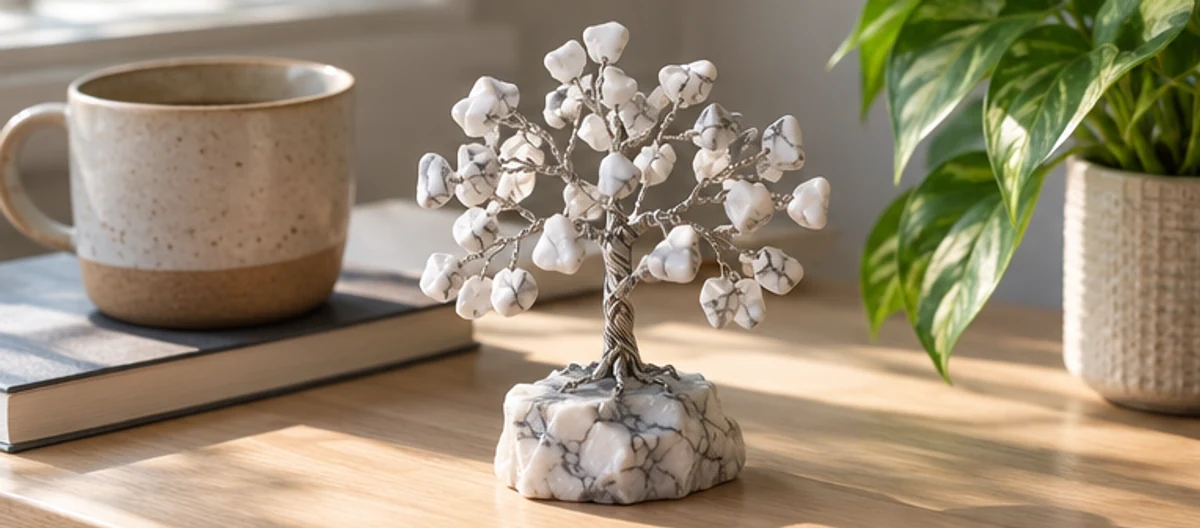
1. What is howlite and why does a gemstone tree look white and grey?
Howlite is a distinct mineral species named for Henry How, who described material from Nova Scotia in the nineteenth century. Its accepted chemical formula is commonly written Ca₂B₅SiO₉(OH)₅ (the same constituents may be ordered differently). Howlite typically occurs in compact nodules or masses; ornamental cutters turn suitable material into beads, cabochons and chips. A gemstone tree then arranges those chips as leaves on a hand-formed wire framework. The mineral is not itself a living tree, and the base, wires, adhesives and stone chips must be evaluated separately.
White or cream material with irregular grey, charcoal or brownish veins is the familiar appearance of ornamental howlite. Some chips are almost plain white and others show dramatic dark networks. A pale chip is not automatically untreated howlite, and a chip with grey veins is not automatically howlite at all. The pattern is a visual clue; responsible identification uses the material statement, supplier evidence and, when the value makes it worthwhile, gemmological testing. This difference matters especially for small mixed chips because the appearance of one photographed piece cannot establish the identity of every leaf on the tree.
A decorative tree made from small pieces has a different set of stresses from a solid carved sphere or pyramid. Drilled or wired chips can have fragile edges, the wire can loosen, a coating can change how a piece responds to cleaning, and the base may contain natural rock, resin or cement. A beautiful product therefore needs both a mineral description and a construction description. Buyers should expect a practical answer to each rather than a vague promise that the tree is simply “real crystal.”
| Property | What the reference means | Why it matters for a tree |
|---|---|---|
| Material identity | Calcium borosilicate: a mineral species, not turquoise | Use the actual howlite name if verified |
| Usual ornamental look | Opaque to mildly translucent pale material with dark veining | Compare multiple chips, not only one macro image |
| Massive-material hardness | About Mohs 3–3.5 for typical earthy ornamental material | Protect small chips from abrasion and knocks |
| Rare crystal hardness | Individual crystals are reported around Mohs 6.5 | Do not use the crystal number for a common chip assembly |
| Dye susceptibility | Howlite is often dyed, especially blue | Ask what has been applied to the material |
| Finished-tree structure | Stone chips plus wires, fixings and base | Stone properties alone do not describe whole-object durability |
2. Read veining, colour and polish without over-interpreting photographs
In a useful product photograph, the entire crown should be visible in ordinary light, followed by closer views of chips, branch joins and the base. Grey veins may run through a chip, cross an edge or disappear beneath a polished surface. Natural variation can make two stones look unlike one another, while a very uniform batch could reflect sorting, colouring or another material. None of these appearances alone constitutes a positive mineral test. Even highly convincing blue-and-black web patterns may be produced by dyeing a pale stone.
For a white howlite tree, photograph on a neutral background with at least one darker surface or book behind the crown. Against a pure-white background, the veins and chip boundaries may be lost. Strong studio enhancement can shift pale grey towards blue or beige; ask for a daylight photo without heavy colour filters. Also inspect the underside of the base and a side angle. A tall narrow crown may be attractive in a product hero image but unstable on a small desk if its centre of mass is not adequately supported.
Surface finish is not the same as authenticity. Small chips may be tumbled, irregular, faceted or lightly polished, and naturally uneven edges need not mean a poor product. However, sharp protrusions, chalky crumbling, flaking coatings, chips hanging from a single loose twist or visible adhesive blobs are practical defects worth disclosing. A seller should describe the item actually supplied; generic stock photographs cannot show a one-off handmade tree’s exact branch spacing, number of chips or colour balance.
3. Howlite versus magnesite, turquoise, calcite and artificial lookalikes
The name “white turquoise” is especially confusing. Turquoise is a different mineral; white howlite does not become turquoise because it shares a veined appearance. Dyed howlite is an accepted decorative material when labelled honestly as dyed howlite. Magnesite, a magnesium carbonate, is another pale, often veined material that may be dyed blue and marketed under misleading names. The two can resemble each other closely in small chips. A finished tree should not be tested with acids or scratched with a steel tool to settle the question: such home tests can permanently damage stones, dyes and metal wires.
Agate, chalcedony, calcite, marble, ceramic and glass appear in adjacent gift and decorative categories. Each has different physical properties and treatment possibilities. Visual comparison can narrow questions but rarely proves the source material when pieces are small, polished or coated. When accurate species identity matters for price or inventory, a qualified laboratory or gemmologist can assess an appropriate representative sample, while noting that a single chip report cannot automatically cover every chip in a mixed tree.
| Material | Appearance that can overlap | Question to ask before purchasing |
|---|---|---|
| Natural howlite | White to cream with grey or dark veins | Is the material actually identified as howlite? |
| Dyed howlite | Blue, green or other colours over veins | Is the colour treatment disclosed? |
| Magnesite | Pale porous stone or dyed blue, often with veins | Is this magnesium carbonate rather than howlite? |
| Turquoise | Blue to green ornamental mineral with variable matrix | Is turquoise identity documented, and is it stabilised? |
| Calcite or marble | Pale stone with bands, cloudy areas or veins | Is the listing using a generic white-stone label? |
| Glass, ceramic or resin | Uniform coloured chips or repeating patterns | What is the manufactured composition and finish? |
4. What dyeing changes, and why disclosure matters
Howlite’s pale appearance makes it useful for coloured decorative beads. Dyed blue, it can imitate the look of turquoise; darker blue and veining can also recall some lapis-lazuli designs, though the materials are entirely different. A dyed stone is still real howlite if the underlying mineral really is howlite. The critical distinction is between natural mineral identity, the applied colour treatment and any claim that the stone is turquoise or another mineral. Each question deserves a separate answer.
GIA’s educational guidance on gem treatments explains that dyes may enter porous or fractured materials and that their stability varies. Some colours can be vulnerable to prolonged sunlight or certain solvents. A seller should not describe every bright blue chip as naturally coloured, and a buyer should not automatically interpret every strongly coloured stone as deceptive: honestly labelled dyed howlite may be exactly what a customer wants for a particular design. The relevant information is whether the treatment is known, how it affects care and whether the order matches the description.
The label “stabilised” also needs explanation. It may refer to resins, waxes or other treatments used in different materials; it is not a mineral name or proof of a particular stone. If a tree is made with reconstructed pieces, resin-bound chips, surface coatings, dyed stones or a mixture of minerals, the listing should say so. Treatments should be described using a trustworthy supplier record, not a guess derived from an unusually saturated photograph. Claims such as “untreated” should be supported rather than used as a decorative marketing adjective.
| Less useful wording | Clearer wording | Why it matters |
|---|---|---|
| Turquoise crystal tree | Dyed howlite gemstone tree, if verified | Does not misname the mineral |
| Natural blue howlite | Blue-dyed howlite chips | Distinguishes natural origin from artificial colour |
| 100% pure gemstone tree | Howlite chips, metal wires and a separate base | Describes the mixed assembly truthfully |
| Certified authentic tree | Report for specified tested sample, if supplied | Defines the actual scope of testing |
| Untreated stone, no evidence | Treatment status not confirmed by supplier | Avoids assuming an unsupported fact |
| Selenite, jade or turquoise style | Howlite-look design; material verification needed | Keeps style labels separate from species |
5. Assess the gemstone chips, wires, trunk, joins and base
A handmade gemstone tree has four construction systems: chips that represent leaves, flexible wires that carry the chips, a central trunk that gathers the wires, and a base that supports the weight. All four must work together. Count chips only when the seller lists an actual verified number; photographs alone can conceal overlap and branching. Ask whether the crown can be adjusted or whether branches have already been fixed in place. Repeated bending hardens and fatigues many wires, especially at tight twists near chip holes, so the safest instruction may be simply to leave the arrangement as delivered.
Metal colour does not prove composition. Copper-coloured wire may be copper, plated metal or lacquered alloy; a silver tone may be steel or another finish. If the exact material matters for allergies, corrosion or long-term storage, request it in the product specification. Inspect for sharp cut ends hidden among the chips, tarnish around joins, incomplete insulation, unstable trunk anchoring and glue overflow. None of those can be judged from a single front-facing photograph.
The base deserves equal attention. A polished rock base may contain natural matrix and uneven underside contours; a resin base can have a different weight and impact response. Ask for base width, depth, underside image and total assembled weight. A heavy crown over a small base may wobble. Measure the available shelf before ordering and leave enough clearance so branches are not crushed against a wall or brushed by a person walking past.
| Component | Good inspection question | Potential problem |
|---|---|---|
| Howlite chips | Are edges intact and attachment holes stable? | Chipped tips or cracks near a wire |
| Individual branches | Are twists secure without sharp wire ends? | Loose leaves and exposed snags |
| Main trunk | Does it remain firm under a gentle stationary inspection? | Leaning trunk and movement at the join |
| Wire finish | What metal or plating is used? | Tarnish, coating flakes or corrosion |
| Base underside | Is it flat, stable and suitable for furniture? | Wobble and scratches on polished surfaces |
| Adhesive or filler | Are visible joins neat and explained? | Softening, discolouration or detached pieces |
| Packaging | Are crown and base independently supported? | Bent wires or crushed chips in transit |
6. The tree form, Kalpavriksha and white-colour symbolism
The deeper symbolism of the gemstone tree begins with the form of the tree itself. In Indian cultural and devotional imagination, the Kalpavriksha or wish-fulfilling tree represents auspicious abundance, continuity and the hope that good intentions bear fruit. The roots suggest grounding, the trunk suggests steadiness, and branches express growth and interconnected relationships. Modern gemstone trees borrow from this wider symbolic language; a twisted-wire ornament should not be confused with an actual sacred tree or a prescription found word-for-word in a classical architectural text.
White colours are commonly connected with cleanliness, clarity, tranquillity and simple devotional surroundings. A family might choose an ivory-grey tree for a prayer shelf because it does not compete with pictures, lamps and flowers. In contemporary crystal practice, howlite is also associated with patience, reflection and mental composure; these are modern symbolic associations rather than established clinical effects. These ideas can guide personal Sankalpa, or conscious intention, without pretending that a particular mineral guarantees a change in mood, relationships or material fortune.
Saraswati and Chandra are sometimes mentioned in discussions of white objects, learning, calmness and lunar aesthetics. That does not make howlite a universally prescribed Chandra Ratna or a substitute for traditional Jyotish gemstone selection. In classical planetary-gemstone traditions, specific stones are associated with grahas through distinct lineages and methods; a white howlite tree is a modern decorative and devotional choice, not automatically a Navagraha remedy. The distinction improves both ritual clarity and editorial accuracy.
| Idea | Meaning in this context | Responsible interpretation |
|---|---|---|
| Kalpavriksha | Tree shape as growth, blessings and abundance | A cultural analogy for the decorative tree |
| Sankalpa | A personally stated intention before display | No exact fixed ritual required for every owner |
| Sattva and a pale palette | Order, simplicity and quiet visual balance | An aesthetic and contemplative interpretation |
| Saraswati | Learning, music and study traditions | Optional devotional connection, not mineral certification |
| Chandra | Lunar symbolism and some white-colour associations | Not proof that howlite is a classical lunar gemstone |
| Prithvi Tattva | The stone and stable base as grounded material forms | A symbolic connection, not a physical energy measurement |
| Pancha Mahabhuta | Five-element framework used in many Vastu discussions | Consider whole room and functional conditions |
7. Vastu directions: choose a suitable place, not a universal formula
Vastu Shastra attends to the relationship among orientation, use of space, light, movement, built form and domestic activity. The symbolic position of a small ornament should not override the practical function of a room. A home or shop layout needs to be read as a whole, especially where entry doors, windows, toilets, kitchen fixtures and circulation differ from the idealised plan. The same howlite tree may be appropriate in several locations depending on the family’s purpose and the available safe surface.
For a quiet puja or reading area, an owner might prefer an uncluttered shelf in or near the Ishanya (north-east) side of a room when the actual layout allows it. On a study desk, it may sit beside a notebook without blocking task lighting. In a shop, place the display where it cannot fall into walkways or become a snagging hazard near a sales counter. A tree on a sunny western windowsill is not automatically better than a shaded stable shelf merely because someone has assigned a direction to its colour.
Ashta Dik, the eight-direction framework, can be used to document a consultation: note the existing use of each zone, its daylight and ventilation, the intended activity, and any safety concerns. If the user is following a particular sampradaya, household practice or adviser’s Vastu method, respect that context rather than treating a seller’s generic direction chart as universal. The tree is a small accessory, not a substitute for correcting moisture, poor lighting or unstable furniture.
| Space | Possible reason to choose it | Placement caution |
|---|---|---|
| Puja shelf | Quiet backdrop for personal Sankalpa | Keep clear of lamp flame, incense ash and water |
| Study or reading desk | Neutral colour alongside books | Leave writing and device ventilation space |
| Living-room shelf | Gentle visual contrast against dark wood | Avoid traffic and fragile glass edges |
| Office reception | Small welcoming display | Keep clear of client bags and payment devices |
| Jewellery showcase | Example of pale stone and wire craftsmanship | Label material and treatment correctly |
| Professional Vastu kit | Reference for the look of pale veined chips | Do not use one tree as a universal authenticity standard |
| Window ledge | Natural light for display photography | Protect dyed components from long direct sun |
8. Three worked selection examples: Bengaluru home, store and consultation
Example A: a Bengaluru apartment with a compact prayer shelf
A family has a narrow shelf near the living room rather than a large separate puja room. There are brass lamps, flowers and a framed deity image. A small white howlite tree could offer texture without introducing another bright colour. Before ordering, measure both overall width and height, and check that its branches do not approach the wick or an incense holder. A compact base on a dry side shelf is preferable to a crowded corner where oil, water or flower residue can reach the chips and wires. If the family favours Ishanya, it can consider that direction while preserving actual safe clearance.
The family should also ask whether the white chips are natural howlite or a “howlite-style” mixed assortment. A light appearance does not answer that question. If the tree is a gift for a housewarming, include straightforward care instructions and a modest Sankalpa message about wellbeing and harmony, instead of promising guaranteed outcomes. The value of the object is in its symbolism, suitability and workmanship.
Example B: a jewellery showroom displaying a blue and a white version
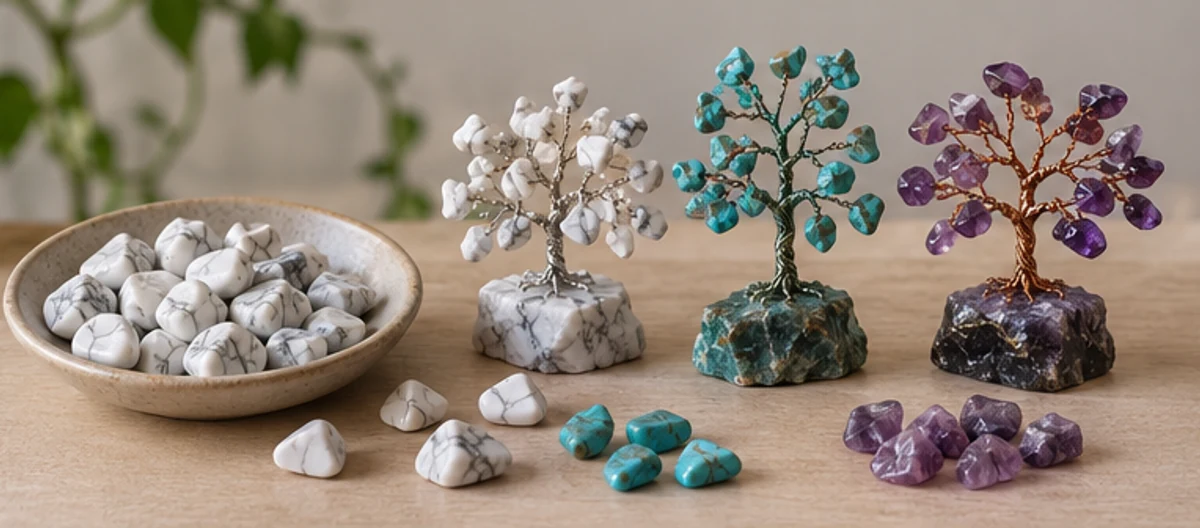
A showroom displays a white-grey tree beside a vividly blue-veined tree. Customers may assume the second is expensive turquoise because the web pattern looks similar. The label should instead say “blue-dyed howlite” or “dyed magnesite” if that is what supplier evidence confirms; if material identification remains uncertain, say that clearly and verify before selling it as a named gemstone. Make the product cards distinguish the chip material from the wire finish and rock base. Photograph a side angle, chip close-up, base underside and a ruler for dimensions.
Staff can explain that dyeing is a treatment, not automatically a defect, and that “natural howlite” could mean the mineral is natural while its colour has been changed. Display dyed pieces away from direct sun, avoid solvent-based cleaning sprays on the showcase, and instruct staff not to pinch the thin branches when rearranging the shelf. A correct label is more useful than a dramatic but unsubstantiated claim about turquoise, rare origin or planetary effects.
Example C: a professional Vastu and gemstone reference kit
A consultant keeps a howlite tree next to labelled sample trays for sodalite, clear quartz, magnesite and dyed decorative stones. The aim is to show the form and appearance of a tree rather than treating the decorative object as a mineral-testing instrument. Each label identifies the actual verified specimen, notes whether colour treatment is known and distinguishes the wood, metal and adhesive parts. Comparison photos of white and blue chips can help explain buying questions to clients, but laboratory reports should be attached only to the samples they actually cover.
For transport, the consultant supports the crown inside a fitted box, places a rigid divider beside the base, and avoids packing loose quartz points against softer howlite chips. At the client’s home, the conversation covers practical siting, available space, dust and incense exposure, not just a direction on a compass. These small procedural choices make the kit useful and reproducible across visits.
9. How to compare howlite with other gemstone-tree choices
A neutral gemstone tree may be chosen alongside clear quartz, rose quartz, amethyst or sodalite, but these are not interchangeable minerals. Quartz typically has much greater abrasion resistance than massive howlite; sodalite’s blue colour and white areas differ from dyed-blue howlite; magnesite can resemble howlite but is chemically distinct. Select the tree for the appearance, tradition, available space and durability actually relevant to the recipient, and ask for disclosure when the stone’s name changes the price.
Personal meaning is also allowed to differ. One owner may associate white howlite with patience and calmness, another with a clean minimalist desk, and another may use it in a puja setting as a reminder of a particular Sankalpa. Sellers should not force a single Graha assignment or identical Vastu placement onto every item. When recommending based on an individual Kundali, a properly qualified Jyotish interpretation is a separate service from buying a decorative white gemstone tree.
| Tree style | Distinctive visual effect | Different material or buying question |
|---|---|---|
| White howlite | Ivory chips with possible grey veins | Check mineral identity and dye disclosure |
| Dyed-blue howlite | Bright blue over a veined base | Never label as turquoise without identification |
| Clear quartz / Sphatik | Transparent to translucent sparkling chips | Verify quartz rather than glass or synthetic imitation |
| Rose quartz | Soft pink cloudy chips | Colour may be subtle; ask about actual material |
| Amethyst | Purple quartz chips | Consider light and colour variation |
| Sodalite | Deep blue with light veins or patches | Not automatically lapis or dyed howlite |
| Magnesite | White or coloured carbonate mineral | Ask if incorrectly sold as howlite |
| Mixed gemstone tree | Multi-colour decorative crown | Request a complete chip material list |
10. A buyer’s twelve-point inspection before ordering
The safest purchasing decision is built from information the seller can actually supply. A written product description should identify the chip material, any known treatment, the wire and trunk finish, the base, dimensions, total weight and whether the photographed item is the one being sold. If a certificate is mentioned, confirm what object or sample was tested and what the report states. An attractive close-up does not replace this information, especially for handmade items that vary from batch to batch.
| No. | Check | Useful evidence |
|---|---|---|
| 1 | Correct mineral name | Written howlite/magnesite/mixed-material statement |
| 2 | Dye or coating | Explicit treatment information or status unknown |
| 3 | Real item photographs | Front, side and natural-light detail images |
| 4 | Chip quality | No unexplained crumbling or obvious fractures at holes |
| 5 | Crown proportions | Full width and height shown with a scale |
| 6 | Wire composition | Material/finish disclosed when known |
| 7 | Sharp ends | Close-up of branch ends and twist quality |
| 8 | Trunk fixing | Side and underside view of base connection |
| 9 | Base dimensions | Contact footprint and furniture suitability |
| 10 | Finished weight | Actual item or batch measurement, not just stone density |
| 11 | Report scope | Specific tested sample and report limitations |
| 12 | Packing and returns | Protection against transit bends and breakage |
11. Reports, authenticity and the limits of a photograph
A genuine gemstone report is useful when its issuing body, sample and tests are identified. A lab may examine an individual loose specimen, but that does not automatically verify all twenty, fifty or hundred chips on a finished tree, nor its wire, adhesive or base. A seller should not attach a report from one batch to a different assembly without explaining that relationship. A “100% certified” phrase is not a substitute for a document that names the actual examined material.
When comparing samples, a gemmologist may use microscopy, refractive index or suitable spectroscopy, subject to the constraints of mounted materials. Some home tests commonly shared online—scratching chips, applying acid to distinguish a carbonate, dipping stones in acetone, using a hot needle or trying colour-fastness by abrasion—are unsuitable for a completed decorative tree. They can injure the user, spoil the finish or detach chips. If material verification matters, arrange a controlled assessment by a qualified person.
Ask also about supplier terms such as “semi-precious,” “natural crystal,” “turquoise howlite” and “energy stone.” Those are broad retail expressions, not independent proof of mineral species or treatment. The product card should use mineral names where known and clearly separate decorative symbolism from laboratory-identifiable physical characteristics.
12. Cleaning a mixed-material tree without damaging dyes or fittings
Start with the simplest maintenance: a gentle dry soft-bristle brush and a steady hand supporting the base. Brush loose dust outward from branches and away from the twists, without dragging a cloth through small wires. Avoid immersing the entire tree; water can reach adhesive, metal contacts and porous chips, and an unknown dye may react differently from natural pale stone. Do not place it in a dishwasher, ultrasonic cleaner, steam cleaner or saltwater bowl. None of these methods is required to enjoy its spiritual symbolism.
If the object sits near an active puja lamp, prevent oil droplets, turmeric paste, ash and incense residue from accumulating on the chips. Move the tree temporarily to a safe dry surface during cleaning or aarti rather than spraying it with fragrant cleaners. For a personal purification practice, a spoken mantra, mindful tidying or Sankalpa may be more compatible with fragile materials than physical washing. This is a practical care suggestion, not a claim that a particular ritual is universally mandatory.
Keep away from prolonged strong sun if the chips are dyed or treatment status is uncertain; many dyes can change in intense light. Avoid acids, alcohol, acetone, essential oils and abrasive polishing compounds. When a branch or chip loosens, save the fragment in a labelled pouch, photograph the join and ask the seller or an appropriate craftsperson to advise. Do not pull a strand tight or attempt a quick repair with an untested glue on a valuable or unusual assembly.
| Method or situation | Recommendation | Reason |
|---|---|---|
| Dry soft brush | Preferred first cleaning method | Gentle on chips, wires and joints |
| Soft dry microfiber | Use only on accessible broad base surfaces | Cloth may snag small branches |
| Running water or soaking | Avoid for whole assembled tree | Moisture and unknown dyes/glues/metal finishes |
| Alcohol, acetone or cleaners | Avoid unless component-specific expert guidance exists | May affect dye, coating and adhesives |
| Saltwater purification | Avoid physical immersion or salt contact | May stain or corrode assembly parts |
| Bright permanent window display | Use a shaded alternative when possible | Some dyed colour can fade |
| Incense and diya near branches | Maintain safe separation | Heat, smoke film, ash and fire risk |
| Travel or storage | Use separate cushioned crown and base supports | Prevents branch bending and abrasion |
13. Common buying and display problems, with practical fixes
The most common dissatisfaction is not always that the stone is wrong; often it is that the real product differs from the photograph. A buyer may expect a full rounded crown and receive a narrower tree, may not have enough shelf clearance, or may discover that the branches were fixed rather than adjustable. These are specification and communication problems. A seller can prevent many of them by publishing an accurate front and side view, measured dimensions, and a plain statement about natural variation and adjustability.
Other issues require material follow-up. A surprisingly bright blue tree should lead to a question about dye or the actual stone type, not an immediate accusation. White powder or chipping near drilled points needs examination of the affected pieces and construction. A wobbly base is a stability issue whether the gemstone is authentic or not. Never compensate for a leaning tree by crushing branches toward one side until it seems balanced; assess the footing and trunk fixing.
| Observed issue | Possible explanation | Safer next action |
|---|---|---|
| Bright blue chips described as turquoise | Dyed howlite, magnesite or another simulant | Request precise material and treatment information |
| Veins look different from photo | Natural variation or image colour processing | Ask for the exact item photo |
| One loose gemstone chip | Weak twist or movement in transit | Retain fragment and contact seller |
| Tree leans or wobbles | Unstable base or bent trunk | Inspect base, do not force wires |
| Visible greenish metal deposit | Potential metal corrosion or residue | Keep dry and seek component-specific advice |
| Dust trapped in narrow crown | Ordinary display accumulation | Use light dry brushing with support |
| Colour seems to fade | Light-sensitive treatment or photographic mismatch | Reduce intense light and compare records |
| Certificate looks unrelated | Report may cover another specimen or batch | Verify identifying details and scope |
14. Gift preparation, packing and long-term storage
For gifting, a howlite tree suits recipients who prefer pale neutral décor, a study shelf or a calm-looking work corner. It may be offered with a short message about steady growth, good beginnings or blessings, reflecting Kalpavriksha symbolism. For a recipient who prefers strong colour, a clearly labelled dyed-blue howlite version can be appropriate too. The gift should not be sold as a cure or as a universal planetary remedy; explain the intended meaning and material clearly.
Transport requires cushioning without squeezing the crown. Wrap the base securely, insert soft supports that hold the trunk steady, and protect loose branches from rubbing against each other or heavier objects. Use a box tall enough for the highest branch and fill the voids with clean non-shedding packing material rather than crushed paper pressed against gemstones. If shipped assembled, include an unpacking instruction that tells the customer to hold the base first and release restraints gradually.
For long-term storage, use a cool, dry, shaded shelf or box away from perfume, household sprays and reactive metals. Keep separate from harder loose stones such as quartz points that might scratch chips. Photograph the crown when packed so that a later change in shape is easier to notice. Do not seal a damp object immediately into plastic; allow the complete assembly to be dry before storage.
15. A concise decision framework for OmmRudraksha customers
Choose a white howlite gemstone tree when the pale, veined material is genuinely the appearance you want and the seller can identify the chips and disclose known treatments. Prefer stable workmanship, realistic dimensions, intact holes and a base that fits the actual room. If the product is described as turquoise, magnesite, quartz or an unspecified “white crystal,” ask for clarification before paying for one mineral while receiving another. Your decision should be grounded in the supplied item, not a generic photograph of a visually similar tree.
For traditional placement, begin with a suitable clean surface, available light and personal Sankalpa. Consider a puja area, reading desk, reception shelf or professional reference display according to actual function and household practice. Kalpavriksha, Saraswati or peaceful white-colour symbolism may enrich the choice, but a single fixed Vastu direction or automatic Chandra remedy should not be presented as an established rule for every howlite tree. If a chart-based personal selection is desired, that is a separate Jyotish consultation.
Frequently asked questions about howlite gemstone trees
Is howlite a real natural mineral?
Yes. Howlite is an accepted calcium borosilicate mineral species. A finished decorative tree can nevertheless contain dyed howlite, a lookalike mineral or manufactured components. Confirm the actual chip material instead of treating a retail category name as a complete identity statement.
Is a naturally white howlite tree always untreated?
No. A pale appearance does not prove the absence of surface treatment, coatings or replacement chips. If untreated status matters, request specific supplier information and do not infer it simply from colour.
Why does howlite have grey or black veins?
Common ornamental howlite can show contrasting vein-like markings and impurities. The visibility and distribution vary between pieces. Veining helps describe its appearance but does not alone confirm species.
Can dyed howlite be genuine howlite?
Yes. If the original mineral is howlite, dyeing changes its appearance but not the fact that the substrate is howlite. Label it as dyed howlite rather than “natural blue howlite” or turquoise.
Is blue howlite the same as turquoise?
No. Turquoise and howlite are distinct minerals. A blue dye can make howlite resemble turquoise, sometimes convincingly; a product sold as turquoise should be identified as turquoise and its treatments disclosed.
What is the difference between howlite and magnesite?
Howlite is a calcium borosilicate, while magnesite is magnesium carbonate. Both can be pale and veined and may be dyed. On a completed tree, avoid acid or scratch tests; ask a qualified gemmologist if identity is commercially important.
Why do some references report different howlite hardness values?
The earthy, compact material normally carved into ornamental chips is often rated around Mohs 3 to 3.5, while much harder individual crystals are reported. The crystal figure should not be applied to every commercial chip or used to justify rough cleaning.
Can I use howlite for a Vastu tree in my home?
Many people do in contemporary Vastu-inspired décor. Choose a clean stable shelf suited to the room and to the family’s practice. Material identity, physical safety and meaningful intention are more useful than a universal direction promise.
Which direction is best for a white howlite tree?
There is no single demonstrated placement rule for every modern handmade howlite tree. A quiet Ishanya-side reading or puja shelf may suit some households, while a stable shelf elsewhere may be more sensible in another layout.
Is howlite the main gemstone for Chandra in Jyotish?
Howlite is not generally the classical primary Chandra gemstone in common Navagraha gemstone lists. Lunar-colour symbolism and modern crystal associations should not be confused with an individual chart-based Ratna prescription.
Can a howlite tree be associated with Saraswati?
An owner may connect a white, quiet display near books or a learning space with Saraswati devotion. This is a personal or contemporary devotional association rather than evidence of an ancient fixed howlite-tree ritual.
Can the tree bring calmness or prosperity?
Howlite is popularly linked with patience and composure in contemporary crystal traditions, while the tree form can evoke Kalpavriksha and auspicious growth. Such symbolism may support reflection and Sankalpa; the ornament does not guarantee emotional, financial or medical results.
Should I immerse the tree in water to purify it?
For a mixed-material wire tree, avoid immersion, especially if dyes, coatings, adhesive or metal finishes are unknown. A dry brush, careful tidying and optional non-contact devotional practice are more compatible with the object.
How do I clean dust between the branches?
Support the base on a steady table and use a very soft dry brush in short gentle strokes. Avoid dragging cloth through loops and do not bend a chip merely to reach hidden dust.
Will coloured howlite fade in sunlight?
Some gemstone dyes can change with prolonged strong light. Without details of the particular dye, a shaded indoor shelf is the safer display choice for coloured pieces.
Can I straighten bent branches after delivery?
Only if the seller has confirmed that the design is adjustable and provides a method. Repeated bending near tight twists or chip holes can fatigue metal and loosen the assembly. Document transit damage before attempting a repair.
Does a gemstone certificate prove the whole tree is genuine?
Usually not. A report identifies the particular sample or object tested under the stated conditions. A report for one loose chip does not verify every chip, adhesive, branch or base of a complete tree.
How many gemstone chips should a tree have?
There is no universal fixed chip count. Ask for an actual count when offered, then judge spacing, balance and sturdiness. More chips do not automatically mean better quality, better Vastu placement or greater value.
Is a howlite tree suitable for a shop opening or housewarming?
Yes, it can be a thoughtful neutral-colour gift when its appearance suits the recipient. Include accurate material information and simple display and care guidance with any Kalpavriksha-inspired gift message.
What should I do if the item arrives damaged?
Photograph the packaging, base, crown and detached pieces before moving branches or applying adhesive. Keep the fragments and contact the seller using the agreed damage or return process. Avoid improvised solvent cleaning or strong repair adhesives.
Research and terminology notes: Mineral identity and the distinction between massive ornamental howlite and rare crystals were checked against Mindat and the International Gem Society. Dyeing and treatment care were checked against GIA educational guidance, while howlite, magnesite and turquoise lookalikes were compared with gemmological references. Soft-brush conservation practices were checked against Canadian Conservation Institute guidance. Traditional Kalpavriksha, Vastu, Sankalpa and Jyotish terminology is discussed as cultural and devotional context, separate from physical gem identification. These source names are editorial references, not outbound promotional links.
