
Green gemstone trees are not one mineral, one price category, or one traditional prescription. A soft green aventurine crown, translucent peridot chips, a jade-named design, moss agate patterns and pink-green unakite look different because their geological materials and the way they are assembled differ. They may also carry different contemporary symbolism. This guide helps you select a tree for home, office, gift or Vastu display by checking the actual stones, treatments, workmanship, room setting and care requirements rather than trusting a photograph or a green colour alone.
Indian tree symbolism adds a meaningful cultural layer. The Kalpavriksha is the auspicious wish-fulfilling tree associated with abundance, continuity and blessing. In contemporary Vastu and crystal practice, a gemstone tree can represent purposeful growth, harmony, prosperity or steady progress. The object remains a modern wire-and-stone ornament: its symbolic value is distinct from its verifiable mineral identity, and the right choice depends on the recipient, place and intention.
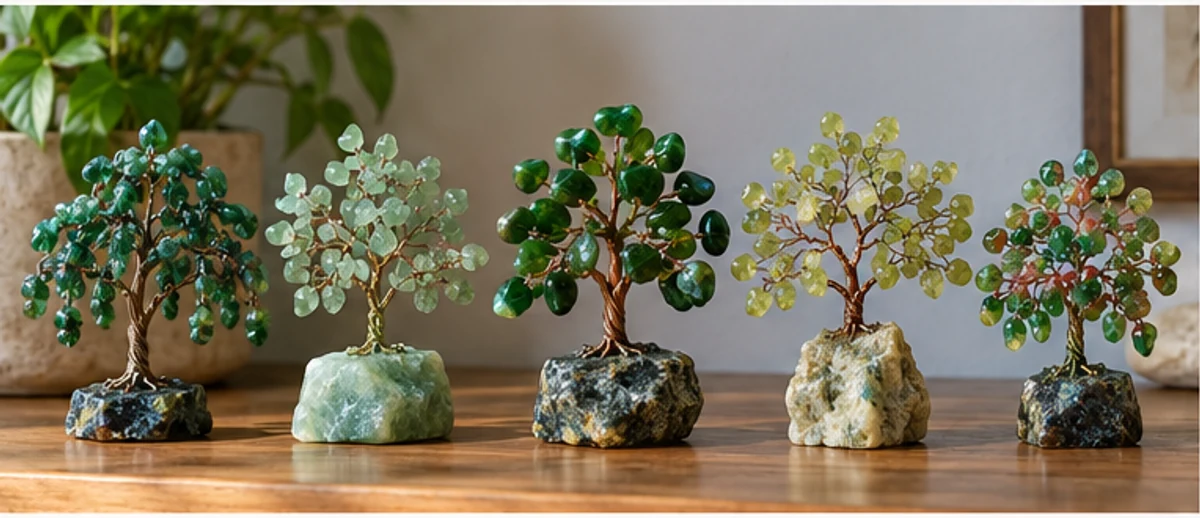
1. Five green gemstone tree families at a glance
Green is a shared appearance, not a scientific classification. Some chips show mica-like sparkle; others have a soft translucent body, a mossy internal pattern, or pink-and-green patches. A vendor should name the material used for the actual tree rather than describing every example as jade or as a uniformly graded green crystal.
| Tree material | What it is | What you see | Main buying question |
|---|---|---|---|
| Green aventurine | Quartz-rich material, often mica-bearing | Usually medium green with fine reflected shimmer | Is it natural aventurine, dyed quartzite or another green stone? |
| Jade (named) | Jadeite, nephrite or qualified green omphacite; trade use can be looser | Waxy to polished pale or rich green | Which jade material, and what treatments, are actually present? |
| Peridot | Green gem variety of olivine | Yellow-green, olive or grass-green, often translucent | Are the chips really peridot, or a cheaper green substitute? |
| Moss agate | Chalcedony with green mineral inclusions or dendritic patterns | Clear, milky or pale chalcedony with moss-like scenes | Are the visible patterns natural inclusions? |
| Unakite | Aggregate of green epidote, pink feldspar and quartz | Distinct mottled green-pink and pale areas | Is it an actual unakite rock assemblage, not a mixed-chip claim? |
The table compares material categories, not guaranteed quality rankings. Tree chips can be tiny and irregular; a specialist may need magnification or laboratory methods to establish identity. A small decorative item need not carry a high-value gemstone report, but its seller still needs an accurate and appropriately qualified component description.
2. Green aventurine: a leafy-looking quartz-rich tree
Green aventurine is familiar in the gemstone-tree market because its colour resembles fresh leaves and its chips often polish well. Mineralogically it is usually quartz-rich material containing reflective inclusions such as green chromium-bearing mica, often described as fuchsite. These platelets can cause a gentle sparkling effect called aventurescence; it is not identical to the sharp moving eye of tiger eye or the glitter of manufactured goldstone.
Not every chip shows an obvious sparkle. In a rough or tiny chip, scattered reflections may only appear when the light angle changes. A tree can be attractive even when some chips are opaque. Compare its colour in indirect daylight, near a neutral background and under the actual display lighting. Dramatic saturated retail photography can make a moderately green crown appear almost emerald coloured.
For an ordinary study desk or living room, aventurine is a versatile design choice: a broad crown gives a foliage-like look, while a narrow upright tree uses less surface area. Check whether wires are folded and fastened cleanly at each branch, whether the trunk is stable, and whether the base can support the spread of the crown. Do not use the natural-looking colour as a substitute for inspecting the assembly.
A seller should disclose if quartzite chips are dyed, coated or marketed under a broad trade name. Natural-origin stone can still have undergone treatment. By contrast, green glass or plastic is not a natural aventurine gemstone, regardless of its shade. A specialist can examine material details when a higher-value identity claim matters.
| Observation | Useful interpretation | Limit |
|---|---|---|
| Fine shimmering reflections | Can be consistent with mica-bearing aventurine | A photo cannot conclusively identify the mineral |
| Uneven green hue | Often compatible with natural material variation | Colour variability alone does not prove untreated origin |
| Green accumulating around fractures or holes | Reason to ask about colour enhancement | It is not a definitive dye test |
| Heavy, dense crown | Can produce attractive canopy volume | Check base stability and trunk attachment |
| Very uniform glossy chips | Can be visually appealing | Ask whether they are quartz, glass or coated composites |
3. Jade gemstone trees: jadeite, nephrite and trade names
The word jade deserves precise explanation. GIA describes jade as a term for jadeite, nephrite, and under particular conditions green omphacite. Jadeite is a pyroxene mineral, while nephrite is a tough amphibole aggregate. They have different compositions, texture and value considerations. Many inexpensive decorative items labeled “green jade” use other green stones, including serpentine or dyed quartzite; an attractive green appearance does not establish jade identity.
For a gemstone tree, the practical question is whether the actual chips are correctly described. Ask the seller: “Is this jadeite, nephrite, tested omphacite, serpentine, or another named material?” If the answer is simply “jade colour,” the product should be presented as a colour style rather than as confirmed jade. “New jade”, “Korean jade”, or similar trade names do not by themselves establish jadeite or nephrite identity.
Treatments also matter. In a widely used trade system for jadeite, Type A refers to untreated or traditionally wax-polished jadeite, Type B to bleached and polymer-impregnated jadeite, and Type C to dyed jadeite. Those terms are not a universal grading scale for mixed-chip trees and do not certify a whole assembled object. Any laboratory report must state the exact stone or sample tested and the conclusion actually made.
A customer may reasonably select a jade-style tree for its soft, rounded leaves and understated visual weight. A higher asking price justified by “natural untreated jadeite” requires stronger proof than a decorative tree priced for its pleasant colour and workmanship. A modestly priced green serpentine tree, accurately described, can be a perfectly suitable decorative choice without using an unsupported luxury name.
| Label on listing | What to establish | Practical buying advice |
|---|---|---|
| Natural jadeite | Specific identity, treatments and evidence | Ask for a report when the price or claim merits it |
| Nephrite jade | Amphibole jade versus jadeite | Compare texture, chip size and disclosure |
| Jade Type A/B/C | Specific treatment classification for jadeite | Do not transfer the classification automatically to all green chips |
| Green jade / new jade | May be a broad market name | Ask for the mineral name rather than assuming it is jade |
| Green serpentine | Distinct mineral group used ornamentally | Buy on accurate material and workmanship |
| Green glass or resin | Manufactured decorative material | Do not price or describe as natural jade |
4. Peridot: the vivid yellow-green olivine option
Peridot belongs to the olivine mineral group and is chemically distinct from quartz, jade, agate and unakite. Its familiar range includes yellow-green, olive green, brownish green and some strong grass-green colours. Good transparent gem peridot can be valuable; a small decorative tree with purported peridot chips should therefore be assessed with attention to component identity, chip size, translucence and price plausibility.
Peridot is approximately Mohs 6.5–7, but that hardness does not make a finished wire tree immune to damage. Its toughness and sensitivity to thermal shock make rough handling undesirable. According to GIA, light is generally stable for peridot, yet rapid temperature change can cause cracking and steam or ultrasonic cleaning is unsuitable for gem peridot. For a mixed assembly, a dry soft brush is the safer default because the wire and base may not tolerate water.
Some green glass, dyed chips, green quartz and other inexpensive substitutes can resemble small peridot pieces in photographs. A genuine peridot tree should not be confirmed from brightness, colour alone, a claimed country of origin or an “AAA” adjective. Ask for close-up photographs of several chips and any actual supporting material information available. Do not perform destructive tests on finished branches.
As a visual design, a light green peridot crown can look airy and luminous on a neutral shelf. It also suits a recipient who prefers yellow-green to the muted deep green of aventurine. Keep it away from unstable ledges and direct heat, and avoid spreading the branches so far that the base can tip.
| Check | Why it matters | Good response |
|---|---|---|
| True mineral name | Peridot is olivine, not quartz or jade | Identify material correctly in the listing |
| Chip clarity and colour | Tiny chips can vary in transparency | Show several actual close-ups |
| Wire attachment | Hard mineral chips can abrade loose wire connections | Check closed loops and covered ends |
| Rapid heat changes | Can damage peridot and adhesives | Keep away from intense heat sources |
| Steam / ultrasonic cleaning | Not suitable for peridot and assembled trees | Use gentle dry dusting instead |
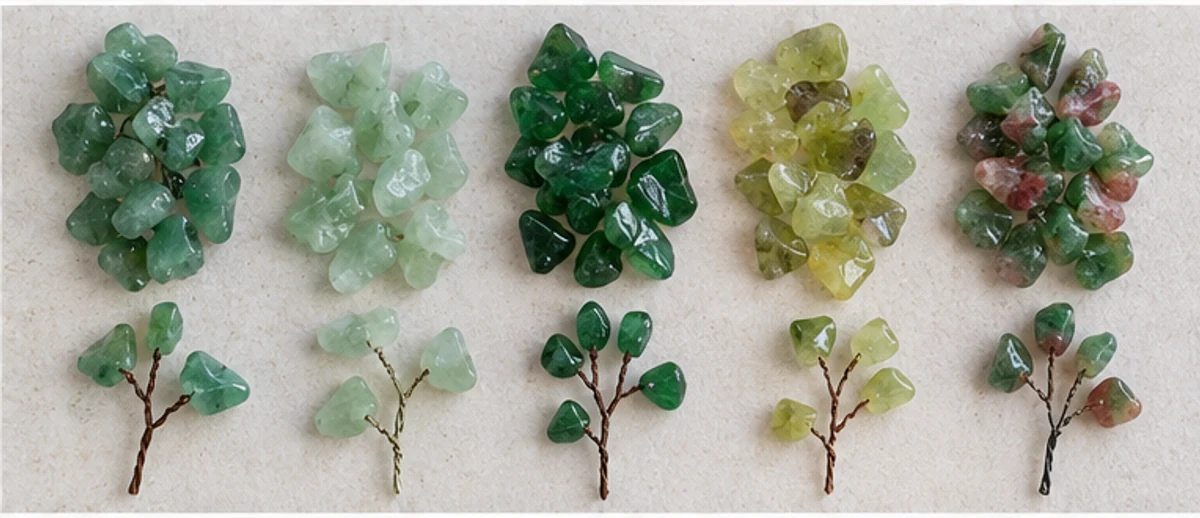
5. Moss agate: the natural landscape pattern
Moss agate is a chalcedony variety with green mineral inclusions that resemble moss, lichen or miniature branches. The patterns are geological, not botanical: there is no living moss inside the stone. Minerals such as chlorite or amphiboles may create green forms, and iron or manganese oxides can create dendritic brown or dark patterns. In ordinary commercial usage “moss agate” can describe material with little or no clear agate banding.
A moss agate tree often gains its character from the variation between chips: one may be translucent white with dark branching; another may carry cloudy green patches; a third may look almost clear. That variation is a useful aesthetic feature rather than an imperfection. If the seller represents identical dark-green dyed chips as natural moss agate, request additional inspection. Photographs must show the actual patterns rather than a single attractive representative bead.
Because moss agate typically has a quartz/chalcedony base, its mineral hardness is around 6.5–7. Still, an assembled ornament has metal, glue and a base, so soaking or scrubbing should not be standard care. Preserve the inclusions visually by keeping the tree out of dust-heavy locations and cleaning with a dry soft brush.
For Vastu-style decor, a moss agate tree can evoke natural growth, a garden or a forest landscape. It works in a quiet home office, near plants if the surface is dry, or as a gift with a note about patience and renewal. Avoid placing mineral trees where potting water or fertilizer spray can contact wire and stone.
6. Unakite: green epidote and pink feldspar in one rock
Unakite is a rock assemblage commonly made up of green epidote, pink potassium feldspar (often orthoclase) and quartz. Its salmon-pink and olive-green mosaic is not a sign of several deliberately mixed gemstone varieties, though some sellers may also combine chips from different rocks. A true unakite chip contains naturally associated minerals; one should not label a mixed rose-quartz-and-aventurine tree as unakite merely because it resembles the same colour palette.
The ratio of green and pink varies from chip to chip. Small, opaque pieces with mottling are normal, and polished surfaces can show mineral transitions. Examine magnified photographs for natural junctions rather than demanding perfectly even colour. The material is usually more earthy and patterned than glassy peridot and softer-looking than a strongly polished jadeite bead.
Unakite can suit households that prefer a warmer accent than an all-green tree. In a home with cream walls and wood furniture, its soft pink patches often feel approachable; on a brightly coloured shelf it may look busy. Choose the base and trunk proportions to suit the room. In a professional Vastu kit, label it as a mixed-mineral rock, not a single-molecule crystal.
Unakite, like other multi-mineral rocks, requires care based on the finished composition and vulnerable inclusions or fractures, not on the hardness of a single constituent alone. Use gentle dry cleaning and protect raised branches from snagging.
7. Choosing by colour, surface and tree silhouette
Customers often look first at the green hue, but the shape of the whole tree matters at least as much. Dense canopies can resemble a small indoor shrub; spare open canopies present each chip like a specimen display. A round crown may feel balanced on a sideboard, while a taller form can create a vertical accent in a niche. The appropriate design is the one that fits the place and is stable.
Compare each tree against its actual setting. Photograph the chosen spot from normal standing and seated positions; measure not just the pot or base but the maximum branch spread and vertical clearance. A design that looks elegant in a studio photograph may interfere with laptop screens, curtains, fan airflow or a frequently used drawer. The best Vastu display should be thoughtfully located without creating a daily obstacle.
| Desired appearance | Possible material direction | Where it works well |
|---|---|---|
| Soft, leafy uniform green | Green aventurine | Bookshelf, reception table, quiet desk |
| Muted carved-looking polished green | Accurately identified jade or jade-style material | Formal living room or gift display |
| Bright yellow-green sparkle or translucence | Verified peridot | Light-toned shelf away from heat |
| Moss and landscape details | Moss agate | Calm work corner or contemplative reading area |
| Warm green and pink mottling | Unakite | Housewarming display or earthy decor |
| Multiple hues and stones | Clearly labeled mixed-gemstone tree | Educational kit or colourful gift |
8. Kalpavriksha, Lakshmi, Kubera and traditional tree symbolism
In the Indian cultural imagination, trees signify shelter, fertility, continuity, generosity and the renewal of life. Kalpavriksha, the wish-fulfilling tree, is an important image of auspicious abundance. Historic Indian art includes sculptural representations of a wish-fulfilling tree, such as the Besnagar sandstone example catalogued by the Indian Museum, Kolkata. A modern gemstone tree draws inspiration from these traditions, although its wire-and-chip construction is not a claim that it is identical to a classical ritual object.
In contemporary Vastu shops, green trees are often selected as prosperity symbols or as reminders of growth. Lakshmi is associated with Shri, auspiciousness and abundance; Kubera is traditionally connected with treasure and wealth. A tree near an account desk may express a Sankalpa for honest business growth. These meanings do not make one particular mineral compulsory, and a customer should not interpret an attractive ornamental tree as a substitute for practical financial planning or suitable Vastu analysis.
The Pancha Mahabhuta framework—Prithvi (earth), Apas/Jala (water), Agni (fire), Vayu (air) and Akasha (space)—can guide a reflective arrangement. Stone itself has an obvious association with Prithvi, while plant-like green imagery suggests vitality and balance. Such colour-to-element assignments differ among lineages, region-specific practices and contemporary gemstone guides. We should describe the relevant tradition where known rather than stating that one universal Vastu text prescribes green aventurine for every household.
A simple Sankalpa can be personal: choosing to cultivate clarity, patience, generosity or disciplined work. The act of keeping a clean, stable and thoughtfully placed symbol may be meaningful without relying on a claim that the object automatically changes external circumstances.
9. Vastu directions: Ishanya, north, east and practical placement
Traditional directional discussions frequently highlight Ishanya (north-east) for prayer, calmness and spiritual orientation; the north is associated with Kubera; the east with sunlight and Surya. These are broad traditional associations, not a fixed rule that all green gemstone trees must occupy the north-east or north. A professional recommendation should consider the room plan, entrances, use of space, light, obstructions and any specific practice already followed in the home.
For a puja shelf, keep the tree off the direct flame path of a diya, incense ember or oil spill. Near the entrance, place it where bags, children or cleaning tools cannot strike the branches. At a business counter, a low tree can avoid obstructing customers or inventory. In bedrooms and shared living rooms, the safest surface is usually a stable shelf out of the reach of pets and young children.
A person using the Ashta Dik (eight-direction) framework should distinguish a symbolic display from a complete Vastu diagnosis. Stone choice cannot be inferred just from a compass reading. If a client follows Jyotish, the Navagraha associations of actual gems—such as Emerald/Panna for Budha and Hessonite/Gomed for Rahu—should not be casually reassigned to any green decorative stone. A green aventurine tree is not automatically a prescribed substitute for an emerald gemstone in astrology.
| Area or intention | Possible display | What to check |
|---|---|---|
| North-east prayer or study area | Small simple tree with restrained crown | Space for puja, dry surface, no flame contact |
| North-side business or accounts desk | Compact stable aventurine or jade-style tree | Clear sightlines and no obstruction |
| East-facing reading shelf | Light green moss agate or peridot arrangement | Avoid heat and sun-damaged adhesives |
| Family living room | Balanced medium canopy | No edge tipping, pets, children or cables |
| Professional consultation studio | Distinct labeled material examples | Accurate identification and easily separated specimens |
10. Chakra and Jyotish associations without confusing gem identity
Contemporary chakra displays commonly associate green with Anahata, the heart centre, and may pair it with compassion, harmony, openness and balance. The traditional Sanskrit chakra system has a long interpretive history; a particular commercial seven-colour gemstone chart is only one modern way to present that system. A green tree can be selected as an Anahata-themed decor object without asserting that ancient texts specify green aventurine chips on a copper-wire trunk.
Planetary gemstone traditions require even greater precision. Budha (Mercury) is traditionally associated with emerald (Panna), while specific classical and regional gem prescriptions depend on the individual Kundali, Lagna, Dasha and planetary assessment. An ordinary decorative green jade, peridot or moss agate tree should not be described as a Jyotish remedy merely because its colour is green. Where a customer asks for horoscope-based selection, distinguish that consultation from choosing a Vastu ornament for its symbolic meaning and practical appearance.
The same principle applies to Lakshmi, Kubera and Sankalpa symbolism: spiritual associations can be presented in meaningful traditional language while the actual product remains precisely identified. Keeping the two dimensions clear makes the article more useful for both practicing devotees and buyers who simply enjoy mineral-based home decor.
11. Natural, dyed, coated and composite components
A gemstone tree is an assembly, and its constituent chips may not share the same treatment history. It might contain genuine quartzite with dyed surfaces, natural peridot with minor inclusions, resin-impregnated jadeite, or dyed green glass pieces. “Natural” should refer to the mineral origin, whereas “untreated” is a separate statement about the absence of enhancement. Sellers should be specific and should not rely on broad words such as “original” or “AAA quality” without context.
The term genuine is meaningful only when coupled with the named material. A genuine piece of green serpentine remains genuine serpentine; it is not genuine jadeite. Likewise an assembled tree with natural chips and a man-made adhesive is still an assembled decorative item. Customers should expect the listing to describe the stone, wire, base, finish, treatment information, actual dimensions and photograph status.
| Claim | Helpful follow-up question | Why it matters |
|---|---|---|
| 100% real jade | Jadeite, nephrite or which verified mineral? | Prevents broad trade-name confusion |
| Premium AAA chips | What internal grading criteria are used? | No universal tree-chip AAA scale |
| Untreated gemstone | Which treatment evidence supports the statement? | Natural origin does not guarantee no treatment |
| Certified tree | Did the lab test one chip, a lot or the assembled object? | A report has a limited scope |
| No glass or dye | Can the seller disclose components and actual photographs? | Colour can be produced by multiple processes |
| Rare origin | Does any credible documentation establish origin? | Colour or shape cannot prove mine location |
For higher-priced claims, a reliable gemological laboratory may be appropriate. For small decorative trees, the most useful documentation may be truthful material naming, clear close-ups, treatment disclosure where known, and realistic specifications. Do not damage the tree with flame, acid, scratch or hot-needle tests.
12. Workmanship: chips, drill holes, wire, trunk and base
A tree is only as practical as its construction. Check each drilled chip for hairline cracks and excessive chipping; inspect the wire loop or twist around the stone; look for exposed sharp ends; examine the transition from branches into the trunk; and ensure that the base does not rock. A heavy crown attached to a narrow base is a common source of accidental tipping.
Tree shapes are often hand-adjusted. But **not every tree is designed for repeated branch bending**. If wire strands have been twisted sharply in manufacture, repeated shaping can produce metal fatigue. Ask whether the branches are adjustable, how far they can move, and whether the seller has photographed the actual shipped arrangement. Use two hands, one supporting the trunk or base, for any permitted minor adjustment.
Good images show at least four perspectives: front whole-tree, side profile, chip close-up and base/trunk fixing. Additional images of the actual stones help distinguish moss agate from uniformly dyed green chips and peridot from glass. When possible, compare the colour in ordinary daylight rather than relying entirely on a saturated catalogue image.
| No. | Inspect | Reason |
|---|---|---|
| 1 | Actual mineral name | Avoids generic “green stone” descriptions |
| 2 | Treatment information | Separates natural origin from enhancement |
| 3 | Chip size consistency | Supports a balanced visual canopy |
| 4 | Chip edge finish | Reduces snagging and loose fragments |
| 5 | Drill-hole quality | Can reveal cracking or weak attachments |
| 6 | Wire material and finish | Affects corrosion and appearance |
| 7 | Branch end closure | Avoids sharp projecting wire |
| 8 | Trunk twisting | Reveals weak mechanical joins |
| 9 | Base material and fixing | Supports stability |
| 10 | Total width and height | Checks space clearance |
| 11 | Actual item photographs | Helps compare retail and delivered object |
| 12 | Packing and return terms | Makes damage issues easier to resolve |
13. Choosing for a Bengaluru home, office and showroom
Example 1: a Bengaluru apartment. A household wants a small tree to mark a Griha Pravesh but has only a narrow cabinet near its puja shelf. Instead of choosing a wide-canopy jade-style tree on colour alone, it measures the available clearance, prefers a compact green aventurine tree on a stable base, and places it away from the diya. The accompanying gift note mentions Kalpavriksha and a Sankalpa for a harmonious new home. A separate decision can be made about directional placement after considering the actual floor plan.
Example 2: a jewellery showroom. A business chooses a green stone tree for a reception counter. Shiny glass may look brilliant in strong shop lighting, while genuine peridot may be more expensive and vulnerable to rough handling. The owner prefers a medium moss agate tree whose branching pattern is interesting at close range and whose component name can be clearly shown on a small label. It is kept below eye level so it does not block the assistant or customer.
Example 3: a professional Vastu consultation kit. A consultant maintains five labeled examples: aventurine quartzite, documented nephrite or jadeite, olivine/peridot, moss agate and unakite. The kit records physical appearance, trade names, care needs and the symbolic associations the consultant uses. The specimens are not presented as interchangeable just because they are all green. Photographs and material labels help a client understand the difference between a chosen decor object and a chart-based gemstone recommendation.
Example 4: gifting a colleague. The recipient enjoys plants but cannot maintain them in a busy office. A small unakite tree offers foliage-like green with pink variation, and a card conveys a wish for fresh projects and growth. The sender checks the packaging, returns and desk size rather than promising an outcome. The gift remains thoughtful even when its symbolism is personal rather than prescriptive.
14. Cleaning, dusting, humidity and long-term storage
The assembled tree should be cleaned more conservatively than an isolated loose gemstone. Even when quartz or jade might tolerate certain professional cleaning methods, the wire coating, adhesives, decorative base and multiple stone types may not. Start with a dry soft brush or clean microfiber cloth. Support the trunk while dusting; avoid tugging individual chips or twisting every branch.
Do not soak a completed tree, place it under running water, use saltwater or detergent baths, or expose it to abrasive cleaning. Strong fragrance oils, puja liquids, acid cleaners and humid bathroom shelves can damage wire finishes, adhesives or sensitive stones. If a dry cloth is insufficient, first establish the full material composition and follow the maker’s care instructions before trying any damp cleaning on a small area.
Peridot needs particular caution around rapid heat changes; treated jade and other resin-impregnated gems may be sensitive to solvents or heat; wire or plated-metal finish may corrode with moisture; moss agate can hide dust among chips. Keep the object out of the direct path of incense smoke, cooking grease and window rain. If stored, wrap the crown gently in soft, clean material and place it in a rigid box with cushioning around the base, without compressing branches.
| Material | Primary concern | Conservative approach |
|---|---|---|
| Green aventurine | Chip attachments and surface coatings | Dry dust, protect the wirework |
| Jadeite / nephrite | Unknown wax, resin or dye treatments | Avoid heat, solvents and abrasive methods |
| Peridot | Thermal shock and hard knocks | No steam or ultrasonic cleaning; stable temperatures |
| Moss agate | Fragile assembly even if quartz is durable | Dry brush between chips |
| Unakite | Several minerals and potential fractures | Gentle dusting, do not soak |
| Any green tree | Wire corrosion, glue, unstable base | Keep dry, avoid forceful branch adjustments |
15. Price, reports and product-description transparency
A price comparison should account for more than the word “green”. Consider chip mineral identity and weight, treatment disclosures, quantity and size of chips, workmanship, wire and base materials, finished dimensions, packaging quality and the scope of any certificate. A handmade tree with well-secured branches can be a better purchase than a larger tree with weak construction, even if the latter uses a more impressive gemstone name.
On OmmRudraksha product pages, the best description identifies what is known about the actual item and leaves unsupported attributes unclaimed. A product may say “green aventurine chip tree with brass-colour wire and stone base” if the materials are verified. If origin or treatment status has not been tested, do not convert that absence of testing into a definite purity or mine-origin assertion. For customer confidence, photographs should be realistic rather than unnaturally uniform and should match delivered stock where possible.
Professional reports are valuable when a price depends on a gemological property, but the existence of a report is not proof that the entire tree was tested. Review the report number, issuer, listed specimen, analysis type, limitations and date. A statement such as “tested green gemstone” is not an acceptable substitute for a specific mineral conclusion.
16. A 15-question buying checklist before ordering
• What is the actual mineral name for each green chip type?
• Is the tree single-material or deliberately mixed-material?
• Which treatments, dyes, waxes or polymer fillings are disclosed?
• Are the photographs of the actual stock or illustrative?
• Can I see chips in neutral daylight at close range?
• What are the full height, canopy width and base dimensions?
• Is branch shaping permitted, or are the branches fixed?
• Are wire ends closed and shielded from touch?
• Does the base sit steadily without rocking?
• What is the estimated total tree weight, including its base?
• Is the certificate for a chip, a sample lot or the whole object?
• Are the claimed gemstone type and quality consistent with the price?
• Is the tree intended for a puja shelf, desk, gift or professional kit?
• How will the branches be cushioned during transport?
• What are the documented damage and return procedures?
The questions work as a practical shopping sequence: begin with material identification, examine the complete construction, then match the object to the recipient and room. A seller who openly explains limitations and offers useful actual-item details often provides more value than one promising extraordinary results without describing the stones.
17. Frequently asked questions
Are all green gemstone trees made of jade?
No. Green aventurine, peridot, moss agate, unakite, serpentine and glass can look green. Identify the actual component material.
What is the most common natural green stone tree?
Green aventurine is a familiar commercial design, but what is commonly stocked varies by retailer and region.
Is green aventurine a type of jade?
No. Green aventurine is ordinarily quartz-rich, often mica-bearing; jade is a separate group of gem materials.
Do green aventurine chips have to sparkle?
Not every small chip shows strong aventurescence. Lighting, inclusions, polish and orientation affect reflections.
Is peridot a form of green quartz?
No. Peridot is the gem variety of olivine and differs in composition and physical properties.
Is peridot generally more expensive than green aventurine?
Fine verified peridot may command higher prices, but compare actual chip identity, size, quantity and complete assembly rather than relying on one trade name.
Does moss agate contain real moss?
No. Its moss-like patterns are mineral inclusions or dendrites within chalcedony.
What gives unakite its pink patches?
Pink potassium feldspar is usually responsible, alongside green epidote and quartz in the rock.
Is new jade the same as jadeite?
Not necessarily. New jade is an imprecise trade name sometimes used for other green stones; request mineral identification.
Can a gemstone tree be called untreated without laboratory evidence?
A seller should only make that claim when it is reliably supported. Natural gemstone origin and untreated status are different statements.
What does a Type A jade report mean?
In the jadeite trade, Type A generally denotes natural or traditionally wax-polished jadeite; it does not grade all the components of a tree.
Which green tree is suitable for a north-side office desk?
Select a stable size and material that suits the workspace. North has Kubera associations in some traditions, but no one green tree is a universal requirement.
Can I place a green tree in the north-east puja corner?
It may fit a traditional Ishanya-oriented devotional arrangement if the shelf is stable, dry and away from flames; consider the actual room and your practice.
Is a green tree linked to Anahata Chakra?
Contemporary chakra-colour schemes often associate green with Anahata; the specific gemstone-tree pairing is not a universal classical instruction.
Is green aventurine a substitute for Panna in Jyotish?
Do not assume so. Classical planetary gemstone choice is a separate chart-based matter and should not be inferred from an ornament’s colour.
Can I wash a completed tree in water?
Dry dusting is the safest default because wires, glue, coating and mixed materials may react differently to water.
Will direct sunlight harm every green gem tree?
Not in the same way. Avoid strong heat and consider possible fading, coatings and adhesives; peridot is light-stable but heat shock is a concern.
Can I bend branches to reshape the crown?
Only if the maker confirms adjustability. Repeated bending can fatigue wire and loosen chips.
Does a certificate for one chip cover the whole tree?
No. A report covers only the specific submitted sample and testing scope.
What should I check when a tree arrives?
Inspect packaging, base stability, wire ends, loose chips, cracks, actual size and correspondence with the order photographs before extensive handling.
18. Sources and editorial notes
Material identities and treatment distinctions were cross-checked with the Gemological Institute of America (jadeite/nephrite definitions, peridot chemistry and care, jade treatment categories), Mindat (moss agate, aventurine and unakite mineral descriptions), and the Indian Museum, Kolkata (the historic wish-fulfilling tree motif). Named authorities are provided as textual references rather than adding unnecessary external promotional links. Exact product specifications and any laboratory report must always refer to the individual item actually offered.
The traditional terms in this guide—Kalpavriksha, Sankalpa, Ishanya, Ashta Dik, Pancha Mahabhuta, Lakshmi, Kubera, Anahata, Budha and Panna—are used to explain the subject in its Indian religious, Vastu and Jyotish contexts. They should not be collapsed into an unsupported single mineral prescription. Where an individual seeks a personalized chart-based recommendation, that is a separate consultation from choosing a decorative tree.
