
Gemstone Tree Placement at Home and in the Office: Vastu Directions, Desk Layout and Display Care
A gemstone tree can be a striking expression of Kalpavriksha—the wish-fulfilling tree of Indian sacred imagination—and a thoughtful decorative feature in a modern home or workplace. Its exact position matters for several reasons at once: the meaning a family gives it, the visual balance of the room, the durability of the gemstones, and the safety of its wire branches and base. A beautiful tree on an unstable shelf or a crowded work desk is not well placed, however auspicious the compass label may sound.
For a useful decision, first identify the purpose of the tree, then choose an appropriate zone, and finally assess the actual surface, lighting, access and material. This guide explains where to keep a gemstone tree at home, where to place one on an office desk, what commonly used Vastu directions mean, how to manage small Bengaluru apartments and showrooms, and how to care for different gemstone species. It also explains why a gemstone tree is not the same object as a classical architectural Vastu remedy or a separately prescribed Jyotish ratna.
Start with the purpose, not the compass
What is the tree supposed to contribute to the space? Different aims lead to different layouts. A family may choose a green tree for a welcoming living room; a shop may use a citrine or pyrite tree near a display; a student may appreciate a blue or purple tree near a reading corner; a professional may use a small tree as a visual marker for focused work. In every case the physical location should suit the real activity.
Ask five questions before deciding on direction. Can the base sit entirely flat? Is the tree beyond the reach of an accidental arm sweep, pet or swinging bag? Will its gemstone chips be subjected to strong direct sun, moisture, cleaning sprays or appliance heat? Is there enough clearance around the canopy? Can it be dusted without lifting it by a branch? If any answer is unfavourable, select another spot within the preferred room or zone.
The tree's footprint is the area occupied by its base, while its canopy spread includes the widest outer branches. The canopy can be substantially wider than the base, especially on elaborate 500- or 1,000-chip examples. Count and height alone do not tell you whether the tree fits. Measure the widest point after gently shaping only those branches the maker says may be adjusted; repeated heavy twisting can fatigue fine wire or loosen the chip loops.
| Placement purpose | Useful room or setting | What to check before choosing the spot |
|---|---|---|
| Welcoming home decoration | Living-room sideboard or foyer console | Firm base, passage clearance and cohesive display |
| Daily Sankalpa or personal reflection | Reading shelf or dedicated quiet corner | Calm access, cleanliness and meaningful visibility |
| Study and learning | Study-room shelf beside, not beneath, work materials | Books and laptop remain usable; tree cannot fall into work area |
| Business reception | Reception counter or secure display niche | No interference with payments, queues or visitors' belongings |
| Office focus | Rear corner or side shelf near a desk | Keyboard, mouse, files and monitor are unobstructed |
| Devotional symbolism | Respectful shelf near a family worship area | Sufficient separation from flames, incense smoke and water |
| Gift or seasonal arrangement | Stable decorative console | Temperature, children, pets and holiday cleaning routines |
Kalpavriksha, Sankalpa and the meaning of display
Kalpavriksha or Kalpataru signifies the wish-fulfilling tree in Indian religious and cultural storytelling. It is linked in different traditions with abundance, aspiration, generosity and auspicious fulfilment. A contemporary gemstone-chip tree is inspired by that symbolism; it is not automatically identical to a ritual tree described in a Purana or to a prescribed Vastu construction. Treating the distinction carefully leaves the symbolism intact instead of assigning unsupported antiquity to every modern product design.
Placing a tree intentionally can accompany a Sankalpa, a considered resolution or devotional intention. Some households place one near their family deity, some alongside a Lakshmi–Kubera arrangement, and others in a study or office as an emblem of steady growth. These are context-dependent customary uses. A decor item does not replace puja, disciplined work, suitable architecture, or the individual considerations used in traditional Jyotish.
The idea of the Pancha Mahabhuta—Prithvi, Ap, Agni, Vayu and Akasha—can inform how people read a space. The stone and base suggest material solidity, reflective surfaces bring an interplay with light, and open space around the branches expresses an uncluttered setting. But assigning one entire gemstone tree to a single element, one direction, one chakra or one planet is a modern interpretative choice unless the teacher, lineage and purpose are specified. A family can honour the tradition without turning a colour chart into an inflexible law.
Vastu directions: a helpful framework for choosing a zone
Traditional Vastu Shastra approaches land, built form, entrance, orientation, the Vastu Purusha Mandala and the relationship among activities. It does not provide a single universal placement command for every commercially made gemstone tree. Popular directional suggestions are best understood as ways to position an ornament within a wider household practice. The key terms are Ishanya (northeast), Purva (east), Uttara (north), Agneya (southeast), Dakshina (south), Nairritya (southwest), Pashchima (west) and Vayavya (northwest).
Families often favour the northeast for a clean, light prayer or meditation corner, north when invoking Kubera or considering business prosperity, and east in relation to the rising sun, learning and fresh beginnings. These are familiar directional associations, not laboratory-derived properties of the mineral. More importantly, no such suggestion requires a glass shelf in the northeast, a sun-heated windowsill in the east or a hazardous spot at the edge of a staircase. Respectful, practical placement is the better interpretation.
| Vastu direction | Traditional directional association | Possible modern display approach | Practical qualification |
|---|---|---|---|
| Northeast — Ishanya | Isha, devotion, purity and contemplative use | One modest tree near a quiet shelf or puja corner | Avoid diya flames, wet vessels and crowded altar platforms |
| North — Uttara | Kubera, resources and stewardship | Visible but secure office or living-room side display | A cash desk must remain functional and uncluttered |
| East — Purva | Rising sun, orientation and beginnings | Study, morning reading area or sideboard | Strong east-facing sun can fade or heat sensitive material |
| Southeast — Agneya | Agni and fire-related activity | Select only if there is a genuinely safe display niche | Never keep delicate chips near stove, heater or hot lamps |
| South — Dakshina | Yama and southern sector in directional lore | An existing stable decorative shelf when otherwise appropriate | Do not invent an automatic stone remedy for this sector |
| Southwest — Nairritya | Weight, stability and a relatively grounded sector | Sturdy low console if the room suits the display | A lightweight tree is not a structural substitute for Vastu design |
| West — Pashchima | Varuna and the western sector | Sheltered wall shelf or reading-room display | Guard against hot afternoon sun and window condensation |
| Northwest — Vayavya | Vayu, movement and exchange | Reception or circulation-adjacent side surface | Keep clear of doors, fans, bags and active walkways |
North, northeast and east are starting points, not three compulsory positions for every gemstone tree. A home with a kitchen in the northeast or an office with a crowded northern doorway may have a better, safer shelf elsewhere. If a practitioner has assessed the actual building and made a specific recommendation, use that contextual advice rather than a generic internet direction chart.
How to locate a direction in a real apartment or office
First decide the reference point. Is the recommendation about the whole dwelling, an individual room or an office desk? These are not interchangeable. For a whole-home layout, establish the plan and the main orientation; use the centre of the usable floor plan for a broad eight-sector discussion. For a single room, identify its walls and corners on that room's own plan. A north-facing entrance does not mean that every wall or desk corner is north; the orientation of the door and the sector within the plan are separate concepts.
Use a reliable compass outside the immediate influence of iron cabinets, reinforced columns, large magnets, speakers and electrical equipment. Check readings from more than one point. Modern smartphones can give unstable headings near metal. For a multistorey Bengaluru flat, note whether the consulted system uses the individual unit's plan or the entire building footprint before treating its Vastu grid as authoritative. Record the assumed reference point and avoid pretending the map is more exact than the available measurements allow.
If your apartment's prayer shelf is on the east wall but is reached by walking west, avoid casual phrases such as 'facing east' without stating whether the person, the wall, or the idol is facing that way. A gemstone tree with a symmetrical crown does not normally have an inherent directional face. The base, room sector and viewing direction are different variables.
| Question | What the measurement describes | Common confusion | Better method |
|---|---|---|---|
| Is the main door north-facing? | Orientation of the entrance | Assuming the whole home is the north sector | Draw the full plan with cardinal directions |
| Is a tree in the northeast? | Its location within a defined floor plan | Calling any left-hand corner northeast | Mark the reference point and sectors |
| Does a person face east? | Direction of their gaze or body | Treating the tree as if it faces the same way | State whose orientation is being described |
| Is the desk at the north wall? | Desk position within a room | Assuming sitting at that desk means facing north | Check chair and monitor orientation separately |
| Does a phone show 35°? | A compass bearing relative to north | Forgetting local magnetic interference | Recheck away from steel and large electronics |
Placing a gemstone tree in a living room
The living room usually provides the best combination of visibility and low handling. A stable sideboard, internal display niche or broad, low shelf may suit a medium tree. Let its canopy form a recognisable outline; if a frame, vase or tall bookcase hides half the branches, move the surrounding objects before bending the tree. A background with moderate contrast helps reveal translucent chips and fine wire without a powerful spotlight.
For a single tree, give the object enough visual breathing room to read as a focal piece. If displaying several types—rose quartz, green aventurine and clear sphatik, for example—vary height carefully using stable risers rather than stacking loose books or pots. The most fragile tree should not be placed where another object's removal can snag it. A useful arrangement might include a low tray or museum-style nonslip support appropriate to the base; never glue collectible stone bases to furniture without considering possible surface damage and reversibility.
In a compact apartment, an empty wall shelf beside the television may look convenient but can accumulate cable dust, heat or vibration from nearby appliances. A low console away from the TV ventilation path is often more manageable. The top of a tall cabinet is rarely ideal: the tree is harder to clean, easier to pull down while reaching for other objects, and less visible to everyday visitors.
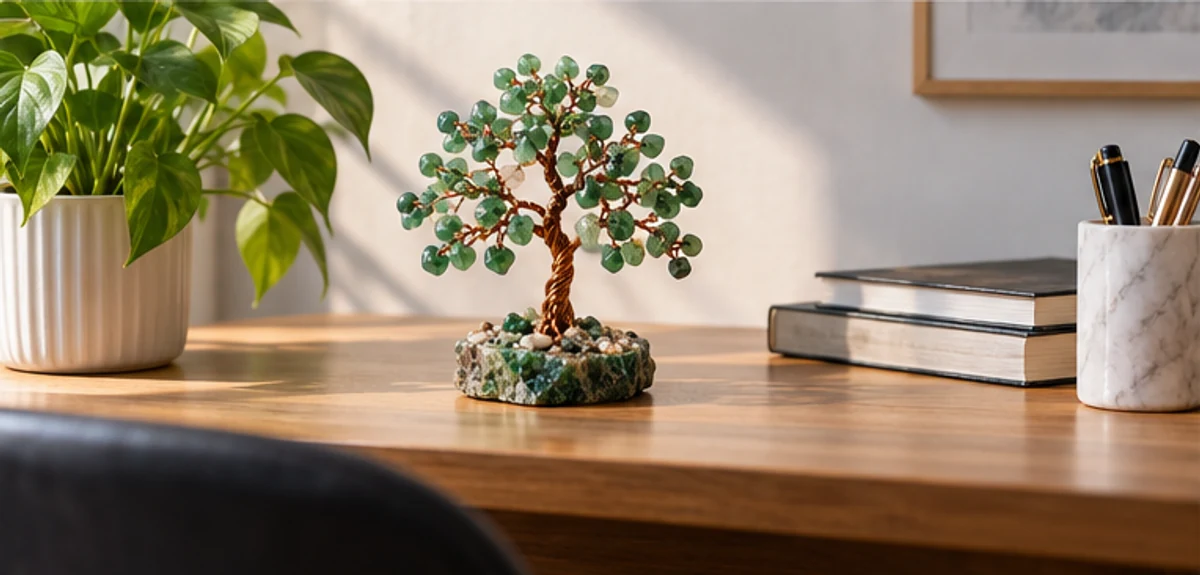
The photograph illustrates an ordinary work surface, but the same principle applies to a home: a clear, stable footprint is more important than placing the tree at the exact middle of a table. Check both the base and the outermost chip loops; a branch projecting over a furniture edge remains vulnerable even when the base is secure.
Foyer, entrance and reception positioning
A gemstone tree near a home entrance can be a pleasant welcome symbol, especially when it is integrated with a tidy console, small lamp or family photograph. Yet the busiest entrance locations are also the easiest places to damage delicate trees. Look at the path of the door swing, footwear storage, delivery parcels, backpacks and umbrellas. Avoid the narrow ledge directly beside a switch panel or a place where a visitor naturally sets keys or a heavy bag.
For a shop or commercial reception, place the tree where the attendant can see it and reach it for dusting, but where customers do not need to brush past it. If your shop sells gemstone trees, a sample near reception can introduce the category; keep the specimen fixed in an appropriate display base or behind a protective panel, not precariously on the edge of the transaction counter. The cashier still needs room for point-of-sale terminals, bills, packaging tape, cards and cash trays.
In wet weather, particularly during Bengaluru's monsoon, position the display away from the route taken by dripping umbrellas and raincoats. Water can damage some metal finishes, adhesives and mineral combinations even if a particular chip is relatively water-tolerant. Reception flooring and walkways should never be compromised to satisfy a decorative direction preference.
Office desk: where to keep a gemstone tree without sacrificing work space
The most suitable desktop position is usually a side or rear corner beyond the primary working area. Keep the monitor in a comfortable viewing position, keyboard and mouse within easy reach, and paper or drawing surfaces clear. A tree should not displace frequently used tools or create a reason to reach awkwardly across the desk. Workplace ergonomics guidance from OSHA distinguishes essential working zones from secondary accessories; a gemstone tree belongs among the secondary objects.
A typical 120–140 cm desk may accommodate a 12–20 cm tree on a rear side shelf, but actual suitability depends more on monitor arms, desk depth, cable runs and branch spread than on desk width alone. Leave space behind the screen for monitor movement, and do not block vents on a laptop, monitor, docking station or UPS. At a shared desk, inform other users before leaving a delicate ornament in the working space. At a standing desk, test stability at both sitting and standing height and while the desk moves; unsecured trees can tip as cables tighten or the table rises.
Select a place outside the swing of a chair arm or a person's elbow. The edge nearest the keyboard is especially risky. Avoid a cable draped through the branches; even a charging lead that feels light can pull a gemstone tree over when someone disconnects a device. Place water bottles, mugs and cleaning sprays on the opposite side. A small, stable shelf at or just beyond the rear corner may be better than the desktop itself.
| Work setting | Recommended practical location | Risk to avoid | Helpful size and display thought |
|---|---|---|---|
| Individual computer desk | Rear corner outside keyboard-and-mouse zone | Cable snags and arm movement | Small tree with compact canopy |
| Standing desk | Stable separate side shelf | Table movement and cable tension | Leave standing-height clearance |
| Shared workstation | Agreed secondary surface | Unaware colleagues shifting objects | Portable, well-balanced low tree |
| Manager's office | Sideboard beside seating, not at monitor | Blocking guest sightlines | Medium tree that complements furniture |
| Reception counter | Staff-controlled niche beyond visitor reach | Queue movement and payment clutter | Display-oriented, secure mounting |
| Conference room | Low side credenza | Presenter cables, papers and sightlines | One moderate tree, not a high centrepiece |
| Study desk | Rear corner or nearby bookcase | Books falling and accidental hits | Small tree chosen for easy cleaning |
Reading room, study and creative studio
A gemstone tree in a study may be associated with knowledge, Saraswati, Budha, concentration or Ajna and Vishuddha symbolism, depending on the family's practice. These associations should be named as traditional or contemporary interpretations rather than universal mineral facts. A blue amazonite or sodalite tree might suit a blue-themed reading corner; an amethyst or sphatik tree may suit a quieter palette. Choose the design that the student or professional finds agreeable, without making the object a substitute for light, ventilation, ergonomics, attention or study habits.
For schoolwork, a tree should not rest where notebooks, art supplies, rulers or reference books are pushed aside. In a drawing studio, keep it away from pigment powders, adhesives, solvents and cutting tools. In a music or recording room, protect it from vibration and constant cable movement. Where children are present, avoid fragile removable chips within easy reach and never use a tree as a play object.
A workroom can also use the tree as a gentle visual cue. For instance, someone may place one near a project journal to mark a long-term Sankalpa. The ritual or reflective role is personal; the measurable practical benefit of the chosen placement is that it does not interrupt work or put the object at risk.
Puja room, devotional shelf and home mandir
Some households display a gemstone tree near Lakshmi, Ganesha, Saraswati or a household deity as an auspicious expression of growth. A clean, respectfully maintained shelf near the worship arrangement can accommodate a modest tree when space allows. In a traditionally organised room, the northeast Ishanya sector may be preferred for puja; whether a supplementary gemstone tree should share that exact shelf depends on the existing worship practice and available space.
Keep the tree physically separate from diya flames, dhoop, incense embers, hot brass lamps, abhisheka water and oil. Wire coatings, adhesives, thin mineral chips and base finishes have different thermal and moisture tolerances. A tiny chip falling into the flame area can be a nuisance even if the mineral itself does not burn. Do not let a decorative tree block a deity, altar lamp, offering tray or space used for namaskar and cleaning.
One clear display beside the main puja arrangement often works better than adding multiple gemstone trees to an already crowded mandir. When ritual sprinkling or cleaning is part of the practice, move the object to a dry, safe surface beforehand. The purpose is to respect both the ritual and the materials of the crafted tree.
Sunlight, heat and artificial lighting: what the stones can tolerate
Gemstone trees are often photographed against dramatic window light, but the best photograph is not necessarily the best permanent display. Intense sun can heat the base and metal branches, degrade some adhesives or finishes, and change the colour of certain gemstones. GIA notes that some amethyst colour may fade after prolonged intense light exposure and that abrupt thermal changes can cause fractures. A sunny east window is particularly misleading when someone has heard that the east is auspicious; that directional preference does not make the materials immune to sunlight.
A bright, indirectly illuminated shelf generally offers a practical balance. Avoid powerful halogen lamps or enclosed display lighting that raises temperature. A low-heat LED display light may work well when fitted at a safe distance; do not assume the LED is completely harmless if its placement heats the object or exposes it to strong light continuously. For more delicate or valuable displays, limiting exposure when nobody is viewing the object is a basic preventive-conservation approach.
| Light and heat situation | Potential problem | Better arrangement |
|---|---|---|
| East-facing window with direct morning sun | Prolonged exposure, warming and possible colour change | Inner shelf receiving indirect daylight |
| West-facing glass with afternoon sun | Higher heating and strong light | Move deeper into room or use shading |
| Halogen or hot display lamp | Heated wire, resin, adhesive or chips | Cooler light source placed with sufficient distance |
| Dark enclosed cabinet | Little visibility and difficult dusting | Moderate filtered lighting when cabinet is in use |
| Air-conditioner vent | Constant airflow and dust deposition | Stable shelf away from direct blast |
| Near humidifier or sink | Moisture on metal, adhesives and some minerals | Dry location with ordinary room conditions |
| Near incense or oil lamp | Soot, smoke, heat and accidental contact | Separate devotional display surface |
Do not test a gemstone tree by leaving it in direct sunlight for a week. Such a trial can cause irreversible colour or assembly changes. Identify the chip materials first, then follow the most conservative requirement among the stones, wire, finish and base. In a mixed seven-chakra tree, one light-sensitive gemstone is enough to justify choosing gentler light for the whole object.
Material-specific placement: one rule does not fit every stone
A tree combines minerals, sometimes with very different hardness, cleavage, porosity, treatment history and light stability. Hardness is resistance to scratching, not a guarantee against breakage if the tree falls. The fastening loops, wire trunk and mounting adhesive are additional weak points. Placing a tree safely means attending to the most vulnerable component, not choosing a position solely from the mineral name or colour.
| Gemstone tree material | Distinctive placement consideration | Suggested display approach |
|---|---|---|
| Amethyst | Some colours can fade with prolonged strong light; abrupt heat changes matter | Away from directly sunlit window ledges |
| Rose quartz or clear sphatik | Quartz is reasonably hard, but individual chips and branches can still chip or break | Secure, medium-height shelf away from impacts |
| Green aventurine | Quartz-rich chips may have mica inclusions; attachment quality varies | Indirect light and enough canopy clearance |
| Fluorite | Lower hardness and pronounced cleavage increase impact vulnerability | Protected shelf beyond reach of books or elbows |
| Pyrite | Prolonged dampness is undesirable, especially for susceptible specimens | Dry, ventilated indoor niche; no wet cleaning |
| Moonstone and labradorite | Feldspar can fracture or chip, despite attractive flashes | Stable, shaded display with careful handling |
| Lapis lazuli | Some specimens are dyed, coated or impregnated; solvents can affect treatments | Dry dusting and separation from sprays |
| Black tourmaline | Striated crystals and attached chips can have fragile edges | Secure base; no repeated touching of stone tips |
| Mixed seven-chakra tree | Several mineral species and finishes with different care limits | Choose the mildest common environment |
For example, a pyrite gemstone tree may look attractive next to a flowing indoor fountain, but the damp setting is not a wise default. A fluorite tree on the front edge of a busy cashier desk is similarly vulnerable despite its colourful appearance. An amethyst tree on a strong-sun balcony will need much more caution than a small sphatik tree on an interior shelf, but neither should be placed where it might fall.
Shelves, bases and clearance: make the display mechanically safe
Before positioning the tree, inspect how the base meets the surface. Resin, natural stone, wooden and composite bases differ in weight and friction; a polished slab can slide on smooth glass even when the tree itself feels heavy. The centre of mass rises as the canopy becomes taller or spreads to one side. A small wobble at the base becomes a major problem when the branch tips are close to a wall, door or passing person.
For a wall-mounted shelf, check that the shelf and fixings are suitable for the object and everything else displayed there. A narrow floating shelf may be visually appealing but unsuitable for a wide branching crown. Place the entire base well inside the edge. Do not position the tree beneath heavy books or loose frames that could be knocked down during cleaning. For a glass cabinet, allow clearance from the glass doors before opening them, and inspect whether hinged panels swing into the branches.
Where an adhesive pad, museum putty or nonslip mat seems useful, confirm compatibility with the base finish and furniture. Some pads stain porous stone, lacquer or wood; others adhere too strongly to a delicate decorative base. Avoid irreversible gluing unless the maker recommends it. A loose twig or chip loop should be repaired according to the maker's method rather than repeatedly bent into place during every cleaning.
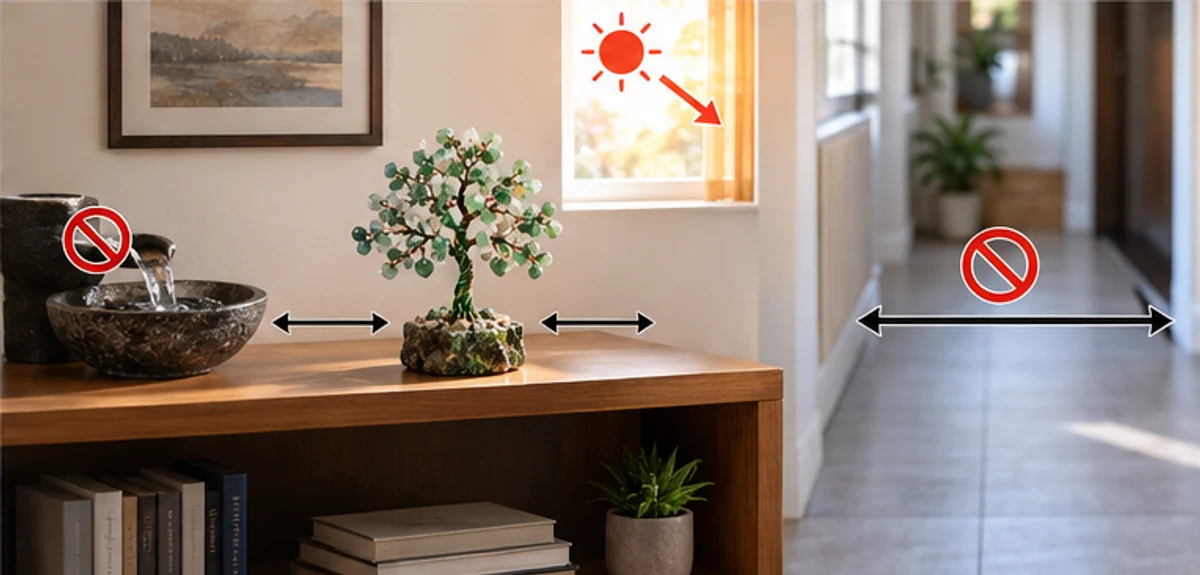
The example display keeps a deliberate distance from water and movement. The same assessment applies when the material is expensive or symbolically important: the fewer times it must be moved, rotated, dusted aggressively or reshaped, the longer the crafted structure is likely to remain presentable.
Balcony, kitchen, bathroom and outdoor placement
A gemstone tree is generally an indoor crafted object. Balcony placement exposes it to rain, airborne dust, pollution, temperature fluctuations, wind and direct UV. Even when an individual gemstone survives outdoor exposure, copper-coloured coating, steel wire, adhesive or base paint may not. In an open Bengaluru balcony, strong seasonal rain can reach a shelf that appears sheltered during the dry months. A glassed-in balcony may still overheat in direct sun.
The kitchen combines heat, steam, grease and frequent wiping. Keeping a decorative gemstone tree above a gas stove, near a chimney exhaust or beside a sink creates unnecessary cleaning and safety problems. A distant, dry dining-room sideboard is usually more suitable for a welcoming arrangement. The bathroom adds humidity, cleaning chemicals and slippery shelves, all poor default conditions for a mixed-material gemstone tree.
| Space | Is it a good default? | Main decision factor |
|---|---|---|
| Living-room console | Often yes | Stable base and room for the canopy |
| Study or work desk corner | Often yes, when compact | Clear working area and no cable tangles |
| Enclosed reception cabinet | Often yes | Secure presentation and controlled handling |
| Covered but open balcony | Usually no | Wind, rain, dust and strong sun |
| Kitchen shelf near cooking | Usually no | Steam, grease, heat and wiping chemicals |
| Bathroom or wash area | Usually no | Moisture, sprays and slippery surfaces |
| Home mandir side shelf | Often yes, with care | Distance from flame, water and incense |
| Stair landing or entrance passage | Usually no | Collisions and obstruction |
A tree kept on a protected windowside indoor shelf is not automatically an outdoor display. What matters is actual exposure. Similarly, a secure glass-fronted cabinet can be an excellent location when it avoids direct sun and internal heat buildup. Decide from conditions, not the name of the room alone.
How to place more than one tree without visual or Vastu confusion
Collectors and shops may display several designs together: clear sphatik, green aventurine, rose quartz, smoky quartz, black tourmaline, citrine, tiger eye, amethyst and a multicolour seven-chakra tree. Rather than assigning a rigid direction to every stone, first decide whether the collection is for retail display, a family devotional shelf or a practical reference library. A shop display benefits from readable labels and identifiable chip colours; a home usually benefits from a smaller, more curated selection.
Use different heights only when each support is stable. A broad tree should not obstruct the fragile crown of a smaller one. If the stones are marketed in relation to Navagraha, chakras or Vastu directions, indicate what each association means and the tradition that uses it. Navagraha gemstone correspondence in Jyotish is not the same thing as a wire-and-chip tree assigned to a compass point. The seven-chakra colour systems used for modern decorative trees likewise differ in historical development from classical Sanskrit descriptions of chakras.
A display with a clear centre often reads better than nine closely packed crowns. Leave enough access to dust the bases without reaching through other branches. Label trees in a retail environment so visitors can distinguish, for instance, natural smoky quartz from dyed stone, green aventurine from jade, and pyrite from gold-coloured glass. Material transparency strengthens the buyer's confidence more than a densely packed prosperity display.
Four realistic placement examples in Bengaluru
Example 1: A compact apartment with an east-facing window. The family wants an amethyst tree in its northeast reading corner. The northeast shelf receives harsh morning sunlight and sits beside the dining passage. A safer alternative is an internal shelf just outside the direct sunbeam, still within a calm area used for reading. They keep the base securely behind the shelf edge and let the natural purple colour be seen under indirect light. The choice respects their intended devotional association while protecting the stone and its assembly.
Example 2: A small business reception in a commercial building. The owner wishes to display a green aventurine or citrine gemstone tree in a north-side reception area associated with Kubera. Rather than placing it beside the POS terminal, invoices and visitor water bottles, they use a secure niche behind the reception counter. The tree remains visible, the transaction surface is usable and visitors cannot snag its branches with bags. Signage can describe the tree as a traditional symbolic decoration without making claims about guaranteed sales.
Example 3: A shared technology office. A developer keeps a small clear sphatik tree on a desk that has dual monitors, a docking station and charging cables. The northern edge of the desk is filled with equipment; the safer placement is on the separate side shelf. OSHA's workstation guidance prioritises clear access to keyboard, mouse and monitor, which resolves the practical conflict. The tree remains a pleasant personal object but does not reduce concentration by interrupting ordinary tasks.
Example 4: A professional Vastu consultation kit. A consultant carries samples of pyrite, black tourmaline, rose quartz and fluorite trees to demonstrate differences in stone, chip size, wire and base. The samples are kept in individual padded boxes during transport, then placed on a stable consultation table away from the client's tea and files. Each label distinguishes the traditional interpretation from mineral identity. This helps a customer choose size, colour, workmanship and intended placement before purchasing for the actual home.
A room-by-room placement audit
A systematic audit is more reliable than repeatedly moving the tree after hearing a different recommendation. Walk through the candidate room at the times it is normally used: morning sun, afternoon sun, work hours, family cleaning and evening worship. Observe whether people turn corners with bags, open cupboards, swing chairs or pass the intended shelf. Inspect the material, the base, the canopy and any surface coating. A tree that looks balanced in a staged photograph can be risky in a lived-in room.
| Audit point | What to inspect | Action if unsuitable |
|---|---|---|
| Base stability | Complete footprint supported; no rocking | Move to flat shelf or suitable support |
| Canopy clearance | No branches overhanging traffic or cupboard swing | Relocate; avoid forcing branches inward |
| Light exposure | Direct sun, hot lamps or persistent glare | Move to indirect light or adjust shading |
| Moisture and chemicals | Drinks, sinks, fountains, sprays or damp walls | Use a dry separate surface |
| Human movement | Sleeves, bags, cleaning tools, children, pets | Raise protection or choose less-travelled niche |
| Working function | Keyboard, mouse, invoices, books remain accessible | Use a secondary shelf or smaller tree |
| Vastu intention | Direction and room purpose clearly identified | State whether using home, room or desk reference |
| Cleaning access | Object can be reached by the base without snagging | Reduce clutter and improve shelf access |
| Material identity | Fragile or treated chips known | Apply the most conservative care rule |
After placement, take a photograph from ordinary eye level and another from the viewpoint of someone walking past. These can reveal an awkward branch overhang or blocked sightline more clearly than a close-up beauty photograph. If the tree needs to be moved regularly to make the space function, it is probably in the wrong place.
Common placement mistakes and sensible corrections
Traditional preferences and decorative styling are compatible when neither obscures the object's physical needs. Most problems come from using colour and compass advice without checking the surroundings: putting a tree on a narrow windowsill for an east-facing location, shifting a work desk accessory into the keyboard area for a north-sector recommendation, or crowding several trees onto a shrine beside flames and water.
| Mistake | Why it causes difficulty | Correction |
|---|---|---|
| Choosing direction before checking stability | The only available corner may be narrow or uneven | Select a safe surface within the broader preferred zone |
| Placing amethyst in intense sun | Colour can be affected over time | Prefer bright indirect light |
| Keeping pyrite near a fountain | Humidity can affect susceptible iron-sulphide specimens | Choose a dry interior display |
| Putting a broad tree at a desk edge | Sleeves and cables can catch chip loops | Move to rear corner or side shelf |
| Treating a gemstone chip count as a size | Canopy spread depends on design and chip dimensions | Measure the full spread and base before purchasing |
| Assuming every blue stone is a Jyotish gem | Sodalite, lapis and sapphire are distinct materials | Confirm mineral identity and intended traditional use |
| Burning incense immediately beside tree | Soot, heat and embers affect assembly | Use separate devotional surfaces |
| Frequently reshaping thin branches | Metal fatigue and loose chips can follow | Make limited adjustments only when approved by maker |
Selecting the right tree before you choose its position
Measure the depth of the shelf, not just its visible width. Compare that measurement with the base dimensions and actual canopy spread. Ask the seller for a photograph showing the entire object from the front and side, not merely a tightly cropped product image. If purchasing an elaborate large tree, ask whether branch positions are permanently fixed or intended for limited shaping after delivery. Clarify base material, weight, chip type, treatment disclosures and packaging. A little advance planning avoids using a precarious location merely because the bought tree is too wide.
For a small work desk, favour a compact tree that does not compete with monitor and paperwork. For a living-room focal point, a medium tree with clear branch spacing may be more effective than a very dense, oversize arrangement. For a jewellery showroom, select enough diversity to illustrate stone colours while keeping each item labelled and reachable. For a professional demonstration, use robust, transportable samples with proven attachments instead of tall, easily destabilised branches.
Check craftsmanship: whether all stone chips have secure loops, whether trunk twists are neat but not overworked, whether the crown sits above the base without extreme imbalance, and whether the base finish is uniform. Do not infer that more chips always means a better tree or greater ritual significance. Compare the entire product against the available display space.
Daily maintenance once the tree is in place
Use gentle, dry dusting as the default. A clean, soft brush can reach between chips without tugging loops. Support the object at its base if it must be moved. Do not grasp its highest branch as a handle. Avoid placing it on a wet cleaning cloth, washing the whole tree under a tap, steaming it, or using ultrasonic cleaners: even when a single gemstone can tolerate a cleaning method, the entire tree may not. Check the maker's instructions and the most sensitive gemstone present before attempting anything beyond simple dry cleaning.
During seasonal deep cleaning, move the tree to a padded, stable surface and keep screws, glass panels and cleaning liquids separate. If a stone falls off, retain the original chip and consult the seller or a repairer familiar with the tree's construction; ordinary household glue may discolour stone or finish. An inspection after transport, after any fall and periodically during normal use is more useful than constantly touching the branches.
When a placement is connected with Lakshmi puja, Kubera worship, a family Sankalpa or a Vastu consultation, the object can be handled respectfully without unnecessary water exposure. A carefully maintained decorative tree offers a more dignified setting than one left coated in dust or repeatedly struck by moving objects.
A practical decision sequence
Use this five-stage method: purpose → zone → surface → material → maintenance. First decide why you want the gemstone tree in the room. Second choose a broad suitable location, using household Vastu practice if applicable. Third inspect stability, reach and clearance in daily life. Fourth confirm how the actual mineral species, coating and base respond to light, water and heat. Fifth make sure ordinary dusting and future movement can be performed without strain or damage. This process can be repeated after changing the room layout or adding more display objects.
The method works for a quiet study shelf, a shop's reception counter, a home mandir and an office desk. It preserves the traditional richness of Kalpavriksha and Vastu while treating the gemstone tree as a real, crafted object with physical care requirements.
Frequently asked questions about gemstone tree placement
1. Which direction is best for a gemstone tree at home?
In many contemporary Vastu discussions, northeast (Ishanya), north (Uttara) and east (Purva) are popular choices for prayer, prosperity symbolism or study. There is no single compulsory direction for every material, room and household practice. Start by identifying whether your reference is the entire house or one room. Then look for a stable, dry shelf away from direct heat, strong sun and moving traffic. A suitable internal surface is usually more sensible than forcing the tree onto a risky windowsill solely to match a compass point.
2. Can a gemstone tree be kept in the northeast corner?
Yes, a gemstone tree may be displayed in a clean northeast corner when that sector fits the household's intended Vastu practice and has appropriate space. If the same corner contains a diya, water-filled puja vessels or a narrow crowded altar, keep the tree on a separate nearby shelf. Distinguish the broad northeast sector from an exact spot inside an altar; the tree need not interfere with worship. Preserve easy cleaning access and enough clearance for delicate branches.
3. Is north a good direction for a prosperity gemstone tree?
North is associated with Kubera in widely used Vastu directional symbolism, so some households and businesses prefer a north-sector display for a tree chosen to express abundance or stewardship. This is a traditional association rather than a guaranteed financial result. A reception niche or sideboard can be a sound placement if it is secure and visible. Avoid locating it in the path of a cash drawer, payment terminal, cabinet door or customers' bags.
4. Can I put a gemstone tree near the main entrance?
Yes, provided it does not obstruct entry, create a trip hazard or sit where keys, parcels and umbrellas will strike it. An entry console can offer an attractive welcome arrangement. Check the door swing, overhead cupboards and traffic at the busy times of day. In a shop, keep the tree behind or beside the reception area rather than on the exposed front edge of the customer counter. A tree is a decorative object and should not be used as a substitute for safe circulation.
5. Where should a gemstone tree sit on my office desk?
A rear or side corner outside the main work zone is a good starting point. Preserve comfortable monitor placement and easy access to the keyboard, mouse, notebook and frequently used files. Keep branches away from charging cables, office drawers, rolling chairs and water bottles. If the desk is crowded, a separate side shelf is preferable. For a height-adjustable desk, confirm that moving the tabletop does not tug wires or destabilise the display.
6. Is a gemstone tree suitable for a work-from-home desk?
A compact tree can suit a home workstation when the surface remains functional. Choose a model whose canopy does not block the screen or the natural movement of your hands. Look for indirect light, a broad stable base and a location away from coffee mugs and laptop vents. If children or pets enter the room, a protected shelf often works better than the desktop. The intended purpose can be personal focus, Sankalpa or simply visual pleasure.
7. Can an amethyst gemstone tree be kept in sunlight?
A little ambient daylight is not the same as prolonged direct sunlight. GIA cautions that some amethyst colour can fade after extended intense light exposure; heat and abrupt temperature changes also matter. For a permanent display, choose bright indirect light rather than a hot windowsill or balcony. Do not deliberately test colour stability through extended sun exposure. The wire finish, mounting adhesive and base deserve protection alongside the quartz chips.
8. May I keep a pyrite tree beside an indoor water fountain?
A dry position is generally better. Some pyrite-containing specimens can deteriorate under unsuitable humid conditions, and metal wires or base coatings may also be damaged by repeated splashing. A nearby fountain introduces moisture even when the main stone surface seems dry. Separate the tree from fountains, sinks, humidifiers and wash basins. If a particular maker has provided protective-care instructions, follow them, but do not assume all pyrite tree assemblies are water-resistant.
9. Can I keep a gemstone tree in a puja room or mandir?
Yes, some families display one in association with Kalpavriksha, Lakshmi, Kubera or a personal Sankalpa. Keep it respectfully arranged without hiding the deity or obstructing worship. Avoid placing fine metal branches next to diya flames, hot incense holders or abhisheka water. An adjacent dry shelf can be preferable to putting the tree directly on an already crowded altar. The exact arrangement depends on the family's practice and the size of its devotional space.
10. What gemstone tree is appropriate for a study room?
A study room can accommodate a compact sphatik, amethyst, blue-stone or other gemstone tree according to personal choice and household associations with Saraswati, Budha, knowledge or reflective attention. Material identity and placement quality matter more than a fashionable colour prescription. Leave the lamp, books and writing surface usable, and do not set the tree beneath a pile of frequently moved textbooks. If the room receives strong direct sunlight, check the gemstone's light stability first.
11. Can I display more than one gemstone tree together?
Yes. Grouping is often effective in a showroom or a large home display, provided crowns do not overlap or snag. Give each base secure support and make sure every tree can be removed for dusting without reaching through the others. In retail, use clear labels for gemstone species and treatments. In a devotional arrangement, consider whether a smaller, cleaner grouping better serves the intended focus than a crowded collection of every colour.
12. Does a seven-chakra gemstone tree need a special direction?
Multicolour gemstone trees are contemporary interpretations that combine stones and modern chakra-colour associations. They do not all have one universal classical compass prescription. For actual display, treat the most delicate chip and the overall assembly as the controlling care requirements. A safe, modestly lit sideboard, consultation table or quiet corner is more useful than forcing the tree into one direction regardless of heat, moisture or access. Traditional chakra study and decorative chakra merchandising should be distinguished clearly.
13. What if the recommended Vastu corner has no shelf?
Do not improvise an unstable ledge, stack of boxes or balancing point. Look for a nearby broad, stable surface within the room or an adjacent appropriate location. A securely fixed shelf may be an option if its load capacity, depth and furniture compatibility are checked. If a specific practitioner has advised that sector, discuss practical alternatives with them. The gemstone tree should not become an obstacle or injury risk just to satisfy a diagram.
14. Is a gemstone tree suitable for a bedroom?
It may be suitable as an ordinary decorative object when the room has a stable shelf and the tree does not interfere with sleep, movement or cleaning. A large tree on a narrow bedside table is easily knocked over while reaching for a phone or glass of water. Choose a position away from bed edges, busy cupboard doors and direct air-conditioner blasts. Households that follow particular Vastu rules for bedroom decor may take those customs into account without compromising practical safety.
15. Can I put a gemstone tree on the balcony?
An open balcony is usually not an ideal permanent location. Rain, direct sunlight, wind, heat, dust and sudden temperature changes can affect the stones, wire finishes and mounting adhesives. Even if the tree contains relatively durable quartz, its base and assembly may not be outdoor-rated. A protected interior shelf near a shaded window generally provides a better view with less exposure. Do not assume that a roofed balcony is dry during monsoon winds.
16. How far should the tree be from an incense burner or diya?
There is no universal safe distance because flame size, heat, airflow, branch spread and the materials differ. The key rule is to keep the tree well outside the zone of flame, radiant heat, soot and accidental spills. On a compact mandir shelf, use a separate stand or move the decorative tree to a nearby display surface during rituals. Never allow a branch, resin base, cord or display mat to overhang a burning lamp.
17. Should the tree face a particular direction?
A balanced gemstone-chip tree generally has no inherently prescribed facing side. Some handmade models have a front selected for aesthetics, particularly when the branches fan more attractively from one viewpoint. Place that side toward the viewers while separately recording the direction of the room or shelf if you follow Vastu. Do not confuse a person facing east during prayer with the tree itself being 'east-facing'; these describe different orientations.
18. Is a north-facing desk the same as a tree in the north sector?
No. 'North-facing desk' may describe which way the seated person looks. 'Tree in the north sector' describes the object's location relative to the selected floor plan. One does not automatically imply the other. Sketch the desk, room boundaries and cardinal directions before using either term in a Vastu recommendation. In everyday office planning, clear working space, comfortable monitor positioning and a secure base remain important whatever the directional terminology.
19. How often should I move or rearrange a gemstone tree?
Move it when a room is rearranged, the location proves unsafe or the tree requires careful cleaning—not merely because a different online chart appears. Repeatedly twisting thin wires can weaken loops, and lifting by the crown may detach chips. If relocation is necessary, support the base with both hands, protect the branches and place the tree on a padded surface while assessing its new site. Inspect the tree after transport or an accidental knock.
20. What is the simplest placement checklist before buying?
Measure the candidate surface and the tree's full canopy, identify the gemstone materials, check how much direct light and moisture the location receives, and watch how people move through the room. Confirm that the base is secure, branches clear nearby objects, and ordinary work or worship can continue without obstruction. Then incorporate the family's chosen Kalpavriksha, Lakshmi–Kubera, Sankalpa or Vastu meaning. This sequence produces a display that is both thoughtfully chosen and manageable to maintain.
Research basis and further reading
The material-care points in this guide draw on the Gemological Institute of America's amethyst care guidance and Gemstone Durability: Design to Display, the Canadian Conservation Institute's preventive-conservation recommendations, and mineral-conservation discussions of humidity and pyrite. Office-placement principles are informed by the US Occupational Safety and Health Administration's computer workstation guidance. Vastu directional vocabulary follows established Ashta Dik and Vastu Purusha Mandala discussions; for one institutional example, Indian Railways' Building Planning and Design – Vastu Shastra describes the northeast in relation to a puja room and the north in relation to storage. These sources are acknowledged here by name rather than adding unnecessary outbound links.
In summary: a gemstone tree may be placed in a living room, study, office or devotional area when its symbolism is meaningful and the actual site is stable, visible and suitable for the materials. Choose a broad Vastu zone with context, verify the surface and light, and protect the handcrafted canopy. A tree that can remain safely and beautifully in place is preferable to one forced into a difficult corner.
