
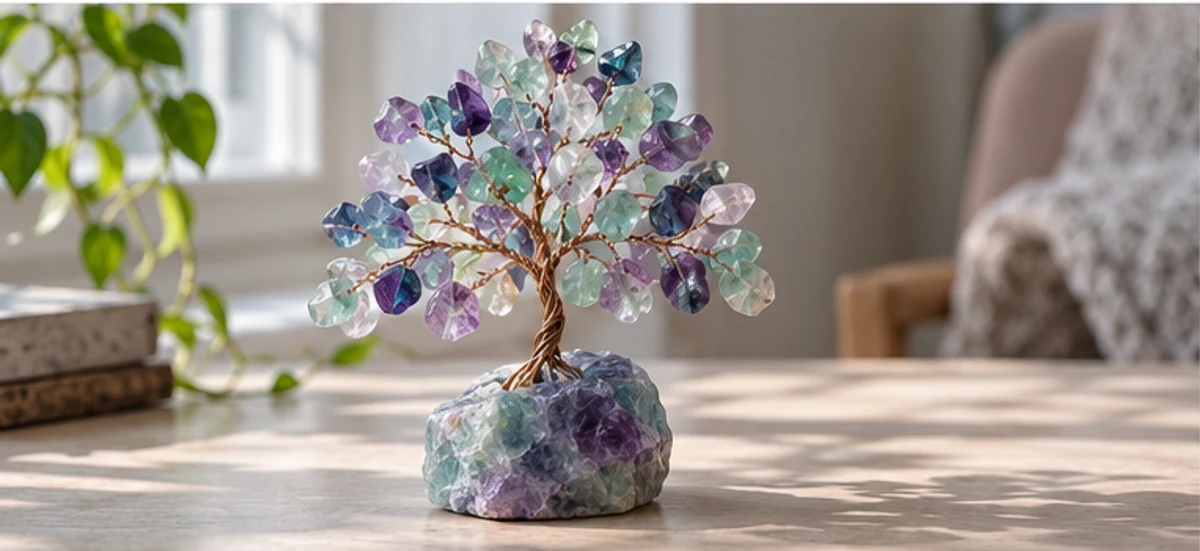
Fluorite gemstone trees combine a branching miniature-tree form with translucent green, violet, lilac, clear, blue or yellow mineral chips. Their soft colour transitions suit a puja shelf, study corner or welcoming office display; their construction, however, deserves closer attention than an ordinary decorative tree. Fluorite is calcium fluoride (CaF2), a mineral of Mohs hardness 4 with excellent colour variation but perfect cleavage that makes individual chips vulnerable to hard knocks. Choosing a good fluorite tree therefore means assessing the actual stones, their attachments, the wirework and the stability of the base—not simply admiring a brightly lit product photograph.
This detailed guide combines mineral identification, natural and treated colours, the meaning of the tree form, traditional Vastu and Sankalpa associations, practical directions and room placement, craftsmanship, an authenticity checklist, the differences from amethyst and mixed-stone trees, safe care, and practical questions for buyers. It also explains how to inspect a delivered tree without damaging it and what to ask a seller about its materials. The physical facts and the traditional symbolism answer different questions, and both are useful to a thoughtful buyer.
1. What exactly is a fluorite gemstone tree?
A gemstone tree is a crafted object. A typical example uses many small polished or tumbled chips threaded through wire loops; the loops combine into twigs and branches; the branches join at a trunk attached to a mineral, wood, metal or resin base. Some designs are deliberately flexible, while others have fixed, glued or soldered parts. The words fluorite gemstone tree ordinarily describe the chips, not the whole object. A tree advertised as “natural fluorite” should still identify whether its base is quartz, agate, resin, stone or another material and whether any coloured chips are treated or substituted.
Some designs contain uniformly green fluorite, others feature lilac and green together, and still others mix many colours into what traders call “rainbow fluorite.” The term is a commercial description of colour variety, not a separate mineral species or guarantee that each chip is naturally multicoloured. Light transmitted through thin chips can intensify colours; a thick chip on the same tree may look muted. This is why whole-object photographs in ordinary light matter more than a single close-up of the prettiest piece.
The tree's silhouette changes how those mineral qualities are perceived. A narrow, upright crown offers a gentle accent on a desk. A wider branch arrangement places more colour across a larger surface, often becoming the focal point of a shelf. A full crown can be attractive, but it also increases opportunities for contact with nearby objects. For a small apartment, a steady base and adequate clearance are usually more valuable than a very high chip count.
What a realistic product listing should tell you
| Listing detail | Why it matters | What to verify |
|---|---|---|
| Chip material | Fluorite is the central product identity | Natural fluorite, treatments, substitutions and whether mixed stones are used |
| Colour range | Sets expectations for the delivered crown | Actual photographs of green, lilac, clear or other zones, not one edited sample |
| Tree height and canopy width | Controls fit and clearance | Measurements in centimetres, with base included in overall height |
| Base dimensions and material | Determines balance and contact protection | Footprint, underside condition and how the trunk is fixed |
| Branch construction | Determines safe adjustment | Whether branches are meant to be repositioned, and any adjustment limits |
| Chip count | May explain overall fullness | Count method and whether approximate; not a substitute for workmanship |
| Photos and after-sales terms | Shows condition and how issues are resolved | Front, side, reverse, base and close-up views; delivery-damage process |
2. Fluorite mineral facts: hardness, cleavage and natural colours
Fluorite is a halide mineral with chemical formula CaF2. In crystalline specimens it belongs to the cubic, or isometric, crystal system; well-known natural crystals form cubes or, following cleavage, octahedral shapes. The mineral's glassy lustre, translucency and many colours make it suitable for decorative carving and collectors' specimens. It is also relatively soft compared with quartz. On the Mohs scale fluorite is 4, quartz 7 and calcite 3. Mohs values describe resistance to scratching, not toughness under impact or bending.
The more important vulnerability in a small tree is perfect octahedral cleavage—the tendency of fluorite to split along four crystallographic directions. A chipped face may develop if a piece strikes a hard surface, even when the stone looked polished and intact beforehand. A tiny drill hole, sharp wire loop or pressure from an adjacent chip can create a weak point. That risk calls for careful design, gentle handling and protection during shipping.
Fluorite occurs in colourless, green, violet, purple, blue, yellow and other colours. Some natural specimens show bands or zones because their chemistry and structural defects varied as the crystals developed. Trace constituents, radiation-related colour centres and geological history all contribute; it is inaccurate to attribute every shade to one single element. A multicoloured tree need not be assembled from multicoloured chips: a seller may group differently coloured natural pieces into one canopy. Such an arrangement can be beautiful and should be described exactly.
| Property | Fluorite | What it means for a tree |
|---|---|---|
| Chemistry | Calcium fluoride, CaF2 | Material is not quartz, calcite or glass |
| Mohs hardness | 4 | Prone to scratches from harder objects |
| Cleavage | Perfect in four directions | Careful chip handling and good protective packaging matter |
| Lustre | Usually vitreous | A polished chip can look glassy without being manufactured glass |
| Appearance | Transparent to translucent; colour varies | One tree can contain different tones and opacities |
| Fluorescence | Occurs in some material; variable | UV response is not a universal authenticity test |
| Typical identification | Mineralogical or gemmological tests | Seller's colour photographs cannot verify mineral identity alone |
Fluorite is historically associated with the study of fluorescence because some specimens glow under ultraviolet light. Not all fluorite fluoresces, and other minerals or manufactured materials may fluoresce as well. A purple glow, no glow, or a dramatic UV photograph is not enough to authenticate a tree. For a commercial display, avoid prolonged high-intensity UV exposure; normal room-light viewing is more useful and gentler on the entire assembled object.
3. How to recognise natural green, purple and rainbow fluorite chips
Start with the whole tree. Does it have a believable range of light and dark areas, small natural irregularities and chips of slightly different translucency? Is every piece an identical vivid hue, or is the colour distributed in a way that warrants asking about treatment? Neither uniformity nor variation proves authenticity. Natural pieces can be consistent if sorted, and sellers can also sort, dye or coat other materials to imitate an appealing pattern.
Under diffuse daylight, a green fluorite chip may appear sea-green, grass-green or pale mint. Violet chips can range from light lilac to deeper purple. A chip containing several zones can show sharp or diffuse transitions. A strongly backlit photograph may exaggerate internal transparency, while warm shop lighting can shift the perceived shade. Request a second image made without coloured filters, perhaps beside a neutral grey card or plain white background.
Chip shape is another clue about workmanship, not by itself about mineral origin. A chip may be tumbled smooth, minimally polished or irregularly shaped. Minute natural fissures and cleaved surfaces can occur; however, powdering, unstable fragments and sharp exposed fractures should be disclosed and examined. A crack close to a wire hole is more concerning than a harmless internal colour band because it may affect whether the chip remains attached.
Distinguishing useful observations from claims they cannot prove
| Observation | Reasonable interpretation | What it does not establish |
|---|---|---|
| Green and violet bands in a chip | Compatible with zoned fluorite | Authenticity or absence of treatments |
| Very clear small chips | Thin material can transmit light well | Natural origin or premium grade |
| Glassy surface | Fluorite often has vitreous lustre | That the object is glass—or definitely not glass |
| UV fluorescence | Some fluorite fluoresces | A pass/fail authenticity certificate |
| Visible internal fractures | Possible natural structure or damage | That the chip is stable without closer inspection |
| Perfect colour matching | Chips may have been sorted | That all chips are untreated |
| Seller's mineral report | May support the tested sample's identity | That every chip and the whole assembly were tested |
4. Fluorite vs amethyst, clear quartz, glass and mixed-stone trees
Similar-looking trees can carry different mineral identities, prices and handling requirements. Amethyst is purple quartz; clear quartz is often called Sphatik in Indian devotional trade. Both are substantially harder than fluorite and do not have its characteristic perfect cleavage. Manufactured purple or green glass can resemble polished mineral chips, while decorative composites can combine stone powder, resin and pigments. Colour alone is inadequate for a purchase decision.
A genuinely mixed gemstone tree is not an inferior fluorite tree; it is a different product concept. Some mixed trees intentionally place rose quartz, amethyst, citrine, aventurine or other stones into one crown to represent a broader spectrum. Such a tree should be sold as mixed gemstones, with its ingredients identified as specifically as possible. Conversely, a tree named for fluorite should not quietly include other chips without explanation.
| Tree type | Typical appearance | Useful distinction | Care implication |
|---|---|---|---|
| Fluorite | Soft green, purple, clear and varied zoning | CaF2; Mohs 4; perfect cleavage | Protect chips from impact and pressure |
| Amethyst | Purple to violet quartz | Mohs 7; often more consistently purple | Avoid prolonged intense sunlight and avoid stressing wire |
| Clear quartz / Sphatik | Colourless to cloudy transparent chips | SiO2; Mohs 7 | Still protect wire attachments, adhesives and base |
| Rose quartz | Pale pink, often cloudy | Quartz rather than calcium fluoride | Protect from hard impacts and strong light |
| Mixed gemstones | Deliberately multicoloured crown | Different minerals have different properties | Use the gentlest approach appropriate to the whole assembly |
| Dyed glass or composite | Potentially brilliant and uniform colour | Manufactured material must be identified honestly | Check coating, dye, adhesive and wire compatibility |
Do not scratch a finished tree with a key, knife or glass panel to prove that its chips are fluorite. Such tests can irreversibly mark genuine material or break fragile attachments. If identification affects a valuable purchase, request reliable supplier documentation and, where appropriate, testing by a qualified gemmologist. For a modest decorative tree, truthful material disclosure and clear photographs may be a more sensible purchasing threshold than elaborate claims about certification.
5. The Indian symbolism of gemstone trees: growth, Kalpavriksha and Sankalpa
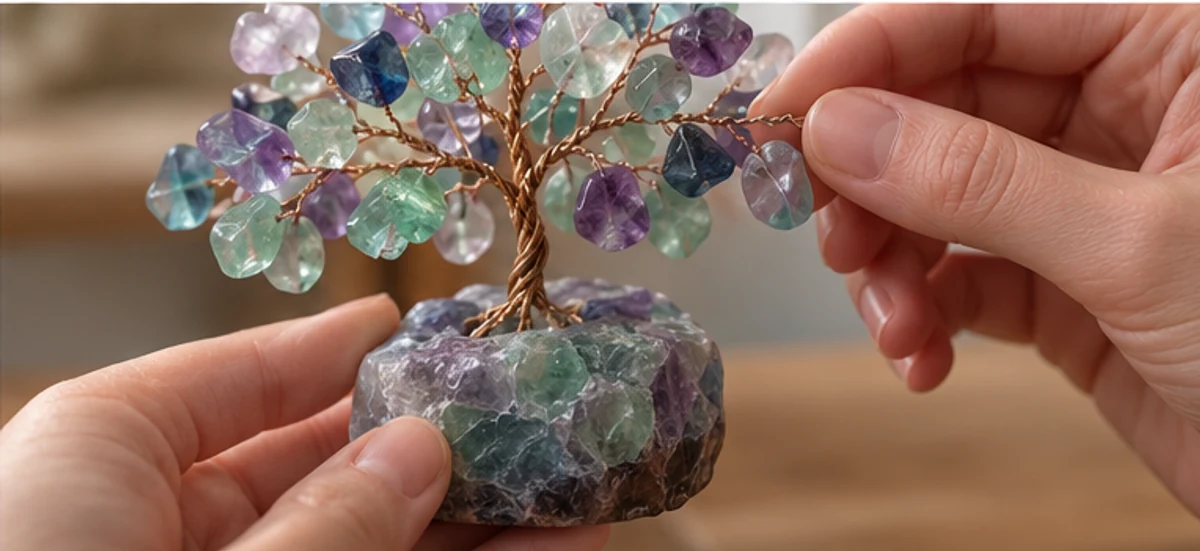
The tree form matters independently of mineral species. In Indian cultural traditions, flourishing trees evoke continuity, nourishment, shelter, fertility, family prosperity and the renewal of life. Kalpavriksha, the wish-fulfilling tree known in Indian mythology, is a rich symbolic reference for growth and abundance. Modern gemstone-wire trees draw on this broad auspicious imagery; they are decorative and devotional objects rather than exact equivalents of a living sacred tree or a classical architectural device.
A householder may place a small fluorite tree near a reading desk as a reminder of a Sankalpa—a consciously stated intention for disciplined study, clarity in communication, patient work or harmony in the home. The branching form invites a simple interpretation: the trunk symbolises stability, the branches a family's different responsibilities, and the mineral chips the diverse results of sustained effort. This is an interpretation of an object within personal practice, not a promise that a mineral will replace effort, planning or study.
Some contemporary crystal traditions associate green fluorite with harmony and renewal, purple fluorite with contemplation, and multicoloured fluorite with balancing different interests. These meanings may be useful when choosing a gift or personal devotional accessory. The symbolic vocabulary overlaps with popular chakra systems, but correspondence lists vary among teachers and are not a reliable substitute for a chart-specific Jyotish gemstone recommendation. A modern decorative fluorite tree is not by itself a classical Navaratna prescription.
In a puja area, such an object is best understood as a respectful accessory to the central worship arrangement. It may accompany a clean lamp stand, flowers or a framed image of a deity without being treated as the focus of ritual authority. Where a family follows a specific sampradaya or guru's instructions, their established practices take priority. For a non-ritual desk display, a quiet intention and good daily care are sufficient.
6. Vastu placement: directions, five elements and real rooms
Vastu Shastra considers orientation, usable space, light, circulation, proportion and the functional arrangement of a building. Contemporary Vastu gemstone practice often adds small objects according to colour, intention and the Pancha Mahabhuta (Prithvi, Ap/Jala, Agni, Vayu and Akasha). Fluorite-tree advice is therefore best given in the context of a particular room, rather than as an inflexible direction rule. No universal classical direction for a fluorite-wire tree should be inferred merely because a commercial listing labels it a “Vastu remedy.”
Ishanya (north-east) is traditionally linked with a contemplative and clean area in many Vastu discussions, so a small mineral tree on a stable, dry shelf near a meditation corner can be a sensible modern placement. A workspace's north or east side may also be selected when the aim is order, concentration and a non-obstructive display. For a shop, a tree belongs where it is visible but protected from customer handling, water, merchandise stacks and swinging door panels. Before choosing a direction, solve practical issues: is there enough clearance, will the base sit level, and will no one strike it while reaching for something else?
Colour-based symbolism is not identical to planetary gemstone therapy. Purple fluorite should not automatically be equated with amethyst for every Graha; green fluorite is not an exact replacement for emerald or Budha-related gemstones. Jyotish choices usually depend on the natal chart, Graha strength, Dasha and the consultation method used. A decorative tree can be selected independently for visual pleasure, a Sankalpa or a family tradition.
| Location | Potential purpose | Practical checks | Traditional framing |
|---|---|---|---|
| Puja or meditation shelf | Quiet visual accent near a seated practice | Keep clear of flames, incense ash and liquids | Sankalpa, orderly space, contemplative Ishanya where suitable |
| Home study desk | Personal marker for focused work | Place outside notebook, mouse, cable and bag movement | Knowledge, patient study, individual intention |
| Family living room | Welcoming display in a shared area | Choose stable surface away from children and pets | Harmony, renewal and the tree's growth symbolism |
| Reception or office | Subtle decorative focal point | Protect from frequent touching and cleaning spray | Purposeful work and orderly welcome |
| Jewellery showroom | Educational example of mineral variation | Use secure case, accurate labels and controlled handling | Respect for natural material and informed selection |
| Professional Vastu kit | Reference example of crystal-tree construction | Transport upright or immobilised; label material and damage risks | Illustrative tool, not a substitute for evaluating a building |
Consider Ashta Dik, the eight directions, as a planning vocabulary rather than eight places requiring eight separate trees. The direction names—Ishanya, Purva, Agneya, Dakshina, Nairritya, Paschima, Vayavya and Uttara—help locate the display in the user's actual floor plan. An experienced consultant can discuss whether a decorative piece contributes to a defined objective, or whether it merely adds clutter. The dominant aim should be an appropriate, calm and workable setting.
7. Can fluorite colours be linked with chakras, Navagraha or deities?
In contemporary crystal practice, green mineral tones are sometimes associated with Anahata (heart-centred symbolism), while violet colours are associated with Ajna or Sahasrara in popular chakra correspondences. These are interpretive colour associations; they are not mineralogical properties or universally accepted rules of traditional tantric practice. A two-colour fluorite tree may represent an intention to balance compassion with thoughtful decisions, but its physical value remains its natural material, graceful form and workmanship.
Deity-related interpretations differ with family tradition. Saraswati is closely linked with learning, arts and speech; Lakshmi with auspiciousness and prosperity; Ganesha with beginnings and obstacle-removal in devotional settings. A person may offer a Sankalpa before these deities while keeping the tree nearby, but the tree is not thereby transformed into a consecrated deity image or a prescribed replacement for mantra, puja or established worship. In a traditional household, maintain the customary separation between decorative items and objects requiring specific ritual treatment.
For Navagraha associations, avoid marketing the same fluorite tree as the definitive remedy for Budha, Shukra, Shani or Guru without describing the tradition and method used. Colour-only matching is a simplification. The same applies to claimed links with planetary health, wealth or examination outcomes. Present this as an optional devotional or Vastu accessory with the relevant cultural vocabulary, rather than making an absolute promise of a result.
| Symbol or tradition | Appropriate discussion | What not to assume |
|---|---|---|
| Kalpavriksha | Growth, abundance and continuity | Wire gemstone tree is an ancient prescribed Kalpavriksha icon |
| Sankalpa | Personal intention during study or worship | Object automatically achieves the intention |
| Anahata | Contemporary association with green colour | Unique, universal fluorite correspondence |
| Ajna / Sahasrara | Contemporary association with violet tones | Equivalent to every traditional chakra practice |
| Saraswati | Study, language and learning as devotional themes | Tree replaces puja or disciplined work |
| Navagraha | Respect individual Jyotish systems and chart context | Fluorite automatically equals emerald or another planetary gem |
8. Quality of the wirework, trunk, chip loops and base
A completed tree should be evaluated as an assembly with several failure points. The uppermost loops hold small chips; mid-branches merge multiple wires; the trunk bears their combined weight; the base keeps the object upright. Examine these points in photographs or under gentle handling. Even a tree containing genuine fluorite may be disappointing if its loops loosen, the trunk rotates or the base rocks on a table.
Look for chips that sit securely without being compressed against jagged wire ends. A chip drilled too close to its edge may crack under tension. An exposed cut end can scratch another chip or a person's hand. Branches should not droop under their own weight or require repeated reshaping to hold their form. The trunk's wrapping ought to be reasonably even and its joint with the base firm, though handmade variations need not be perfectly symmetrical.
The base should provide a broad enough footprint for the canopy. An agate or quartz-slice base can look attractive, but should not have an unstable rocking edge, exposed adhesive or a sharp underside against polished furniture. A resin or wood base may also be appropriate if labelled accurately and securely attached. A seller should provide measurements of both the canopy and the base, because “height 25 cm” alone tells little about whether a broad crown will fit a narrow shelf.
| Component | Good sign | Warning sign | Buyer action |
|---|---|---|---|
| Fluorite chips | Secure, reasonable finish, truthful variety description | Loose powder, sharp cracks, mismatched disclosed material | Request close-up and treatment statement |
| Chip holes and wire loops | Even seating, no sharp ends | Chipped rim, exposed wire tip | Inspect before reshaping |
| Fine branches | Supported and well joined | Wire fatigue or looseness | Adjust only if seller confirms safe method |
| Trunk | Firm centre connection | Rotation, unravelled coil, glue separation | Request reverse and base photographs |
| Base | Stable, protective underside | Rocking, cracks, sharp contact points | Check on a level surface |
| Overall canopy | Balanced mass and sufficient clearance | Top-heavy, pressing against nearby objects | Use measurements, not just close-up views |
9. Twelve-point buyer's checklist before ordering a fluorite tree
For a decorative gemstone tree, the most useful seller conversation is precise but short. Ask questions that establish the material and construction, then evaluate the photographs and return terms. Avoid treating a long list of spiritual keywords as evidence of mineral quality. A reliable description should stay consistent across the product title, photographs, invoice and any accompanying test report.
| Check | Question to ask | Why it is useful |
|---|---|---|
| 1. Material | Are the coloured chips fluorite throughout? | Clarifies product identity |
| 2. Mixed chips | Are any chips quartz, glass, resin or another stone? | Prevents ambiguity in a mixed-material design |
| 3. Treatment | Are any chips dyed, coated, stabilised or otherwise treated? | Helps with identification and care |
| 4. Actual item | Can I see the actual tree in neutral light? | Sets realistic colour expectations |
| 5. Dimensions | What are height, canopy width and base size? | Ensures a safe fit in the chosen place |
| 6. Chip count | Is the number exact or approximate? | Separates appearance from marketing counts |
| 7. Wiring | What wire is used, and is adjustment intended? | Guides handling and expected durability |
| 8. Base | What is it made from, and how is the trunk fixed? | Assesses stability and disclosure |
| 9. Condition | Are there chips, loose pieces or repairs? | Clarifies the actual condition |
| 10. Certificate | What exactly did any report test? | A sample report does not certify the whole tree |
| 11. Packing | How is the canopy immobilised in transit? | Protects cleavage-prone chips and wire |
| 12. Support | What is the arrival-damage and return procedure? | Defines the next step if a problem occurs |
If a report is offered, read its item description, sample count, test methods and limitations. A mineral identification report for an isolated chip may support the identity of that particular chip; it does not automatically identify every chip on the canopy or certify the base and wire. “Certified gemstone tree” needs an actual documented testing scope. Likewise, statements about a particular mine or country of origin require traceable evidence, not merely an appealing origin story.
10. Cleaning, light, moisture and ritual care: protect the whole assembly
The safest routine for a fluorite tree is light dry dusting with the base supported. Use a clean, very soft brush to loosen settled dust and an appropriate dry microfibre cloth only on stable broad areas. Avoid dragging a cloth across fine branches, where fibres can catch on wire loops. Do not shake the tree or lift it by a branch. Support the base and lower trunk whenever moving it.
A fluorite chip can scratch, cleave or chip if knocked. Soaking the entire object adds another category of problems: moisture can enter wire twists, affect metal finishes and weaken adhesives or the base. Household acids, descalers, bleach, abrasive powders, strong soaps and jewellery-cleaning solutions should not be applied without a component-specific assessment. Avoid steam cleaners, ultrasonic machines and sudden temperature changes. Fluorite itself is not a suitable object for aggressive home polishing.
Place the tree in moderate, indirect indoor light rather than intense sunlight on a hot windowsill. Some coloured fluorite may be light-sensitive, while adhesives, paints and some base materials can also age under heat and UV. If a bright lamp is used for photography or a shop window, minimize heat and long-term exposure. Do not leave a delicate tree directly below a dripping plant, beneath a household diffuser, beside a kitchen sink or close to a humid bathroom wall.
Traditional Shuddhi may refer to physical cleanliness, and in many households ritual purification may involve water, milk, oils, incense or flower offerings. For a delicate fluorite-wire assembly, choose a practice compatible with its material: a clean dry space, a respectful Sankalpa and separately placed offerings. Keep lamp flames, burning camphor, incense ash, liquids and salt from touching the chips, wire or base. A family may continue its chosen mantra or puja without soaking the object.
| Situation | Safer response | Avoid |
|---|---|---|
| Routine light dust | Support base; use soft dry brush | Hard rubbing and pulling branches |
| Sticky residue | Ask seller or a suitable conservator about all components | Unapproved solvents and hot water |
| Near a puja lamp | Maintain generous separation | Flame, hot wax, ash, camphor contact |
| Humid season | Choose dry shelf and allow air circulation | Wet planters, bathrooms and water sprays |
| Direct strong sunlight | Move to moderated indoor lighting | Hot windowsills and prolonged UV illumination |
| Loose chip or branch | Stop bending; photograph; seek seller's advice | Force-fitting or fast glue without knowing materials |
| Long-term storage | Immobilise canopy with clean padding and labelled box | Crushing with other ornaments |
11. Receiving, unboxing and branch arrangement without breakage
Open the parcel on a clean table with enough room for the packaging and the tree. Photograph the exterior if it shows damage before removing its contents. Locate the base first; do not pull upward on the visible branches. Remove padding in the order that releases pressure from the canopy, taking care not to snag a wire loop with scissors or tape. Retain the packing materials until you have inspected the object and are satisfied it is stable.
Set the tree on a level surface and check whether it rocks. Look for loose mineral fragments inside the packing, visibly broken chips, detached twigs, exposed sharp wire and separation at the trunk-base joint. Inspect both sides of the crown. A few naturally imperfect chip shapes can be acceptable, but fresh damage from transport should be identified and reported before branches are moved. Keep any detached piece in a labelled bag for the seller's assessment.
Some trees are designed for modest adjustment after delivery. If the product instructions expressly permit it, support a branch near the intended bend and move it only once or twice by a small amount. Avoid twisting at chip holes, sharply bending the same location back and forth, or forcing a perfectly symmetrical canopy. Metal fatigue develops with repeated flexing, and the fluorite at the tip may break even if the wire itself survives. If adjustment is not documented, use the original shape.
For professional transport between client sites, immobilise the base separately from the canopy so that the weight of the base cannot swing into the chips. A fitted box, removable cushioning around the crown and a clear orientation label are often more useful than simply adding more loose packing material. An inspection photograph and a brief inventory note help when preparing a demonstration kit for repeated journeys.
12. Three worked examples: family apartment, jewellery showroom and Vastu practice
Example A: a small Bengaluru apartment study and puja shelf
A family wants a gentle green-and-purple gemstone tree for a shared study area. They first measure the shelf, noting the reach of an opening cupboard and the location of a diya used during evening worship. A small, stable fluorite tree fits on the far side of the study shelf, away from the lamp, water container and books frequently pulled out. The family uses it as an image of steady learning and growth, with a brief Sankalpa before beginning study. The chosen position is determined by safe use and an orderly room first; a preferred direction is considered only after those needs are met.
Example B: a jewellery showroom display
A showroom owner wants to show customers the difference between purple amethyst, clear quartz and multicoloured fluorite trees. The owner labels the fluorite accurately as CaF2, notes its Mohs 4 hardness, identifies any treatments that are known, and keeps it behind a counter where customers can see the crown but cannot repeatedly bend it. A neutral-light photograph accompanies the display card. Staff demonstrate the different mineral colours using the whole object rather than scratching a chip to prove identity. At closing, the tree receives gentle dry dusting if needed, without shop-floor cleaning spray.
Example C: a professional Vastu consultation reference kit
A consultant carries small samples to discuss materials, colours and modern Vastu display choices. The fluorite tree is labelled with its mineral name, chip count as approximate if appropriate, construction notes and a reminder that its physical fragility differs from quartz. During a consultation, it illustrates how a compact decorative object can bring a selected colour into a space, while the actual Vastu assessment still concerns the floor plan, circulation, functions and the client's stated Sankalpa. The tree returns to a fitted case rather than remaining loose among heavier mineral pyramids.
13. Price, gift suitability and ongoing value
The price of a fluorite tree depends on its actual mineral material, colour sorting, translucency, chip quality, assembly labour, branch count, base quality, size, finishing and packaging. A larger crown may use more chips but can still be poorly assembled. A small tree with stable wirework and attractive balanced colour may be a better purchase than a taller item with a top-heavy base. Treat an unusually low price or an unusually high “rare” premium as a reason to ask for clearer details, not an automatic verdict.
For a housewarming or study-related gift, assess the recipient's taste before selecting a stone because colour and style are personal. A quiet fluorite canopy can suit a bookcase or work desk, while a brightly multicoloured version may suit a more expressive room. Provide a simple care card: carry by the base, use light dry dusting, avoid water and impacts, and keep away from heat. That card is often more useful than a set of exaggerated claims.
Within OmmRudraksha's broader Vastu and gemstone range, a fluorite tree can be compared with purple amethyst trees, transparent Sphatik trees and mixed gemstone trees. Choose according to material preference, traditional meaning, the available display space and your realistic budget. A visitor who requires a chart-specific gemstone recommendation should follow the separate Jyotish consultation process rather than selecting by colour alone.
14. Frequently asked questions about fluorite gemstone trees
What is a fluorite gemstone tree?
It is a crafted decorative tree with branches and small fluorite chips attached to wire. The base and wire may be made from other materials and should be described separately.
Is rainbow fluorite a different mineral?
No. Rainbow fluorite is a trade description for multicoloured fluorite, often green and violet. It is not a separate mineral species or a promise that each chip has several colours.
Is fluorite the same as amethyst?
No. Fluorite is calcium fluoride with Mohs hardness 4 and perfect cleavage. Amethyst is purple quartz with Mohs hardness 7. The colour may overlap, but the materials and durability differ.
Does every fluorite chip glow under ultraviolet light?
No. Fluorescence varies. Some fluorite fluoresces and some does not; other materials may also glow. UV reaction alone does not authenticate a tree.
Can a natural fluorite tree contain chips of different shades?
Yes. Fluorite occurs in several colours and can be sorted or mixed within a single crown. Ask whether the seller has used only fluorite or mixed other gemstone chips.
Can fluorite chips be dyed or coated?
Treatment is possible across the decorative stone trade. A particular tree should be assessed through supplier disclosure and appropriate testing rather than assuming every vivid chip is treated or untreated.
How hard is fluorite?
Fluorite is Mohs 4, softer than quartz. Its perfect cleavage also makes it vulnerable to breaking along crystallographic planes under sharp impact.
Is it safe to scratch-test the tree at home?
No. A scratch test may permanently damage the mineral or its attachment. Request clear identification information and seek professional testing if the decision warrants it.
Does a single certificate cover every chip?
Not necessarily. Check the report's sample count and tested item. A single-chip result does not automatically verify every stone, the wire, or the base.
Where should I place a fluorite tree according to Vastu?
A clean, stable, sheltered shelf is a practical starting point. Some contemporary Vastu approaches favour a study or north-east contemplative area; the room's actual layout and family tradition matter more than a generic universal direction.
Is green fluorite a replacement for emerald in Jyotish?
No. Fluorite and emerald are different minerals. A chart-specific gemstone selection involves the chosen Jyotish system and natal considerations, not simply matching the two stones by colour.
What does a purple fluorite tree symbolise?
In contemporary crystal symbolism, purple may suggest reflection or meditation. The tree form also evokes growth and Kalpavriksha imagery. Interpretations vary and are distinct from a classical planetary gemstone prescription.
Can I keep it beside a diya or incense?
Keep adequate distance. Flames, heat, oil, ash and liquids may harm fluorite chips, wire finishes or adhesives. Use a separate stable position.
Should I wash the tree with water or salt water?
Avoid soaking the complete tree or using salt solutions. The wire, base, adhesives and fragile fluorite chips may not tolerate those treatments. Prefer soft dry dusting.
Can sunlight fade fluorite?
Some fluorite colours can change with prolonged strong light; other parts of the assembly may also age in heat and UV. Moderate indirect indoor light is a sensible display choice.
May I rearrange the branches?
Only if the design is intended for adjustment, and then gently with support close to the bend. Repeated flexing can fatigue the wire or stress drilled chips.
How do I tell whether the tree is stable?
Check the base on a level surface, note whether the trunk rotates, and view the canopy from the front and side. The base should support the crown without rocking.
What should I do if a chip arrives detached?
Photograph the package and damaged area, preserve the chip, and contact the seller before bending, gluing or cleaning the affected branch.
Is a larger fluorite tree always better?
No. A larger tree needs more clearance and a stable base. Material accuracy, finish, branch strength and suitability for the intended surface are more important than height alone.
Can a fluorite tree be used in a professional Vastu kit?
Yes, as a labelled educational reference for mineral colours and tree construction. Pack it securely and do not treat it as a substitute for evaluating the building or the client's actual purpose.
15. Choosing the right tree: final practical assessment
Start with your actual purpose: a gentle multicolour display, a traditional symbol of growth, an educational mineral example or a carefully chosen gift. Verify the identity and treatment disclosures for the fluorite chips, and remember that the finished object also includes wire and base materials. Compare two or three real photographs in neutral light, confirm its dimensions, inspect the stability of the construction and understand the seller's procedure for transport damage. In a family home, place it where people will enjoy the appearance without repeatedly touching it. In a shop, label the material accurately. In a professional kit, protect the vulnerable chips during travel.
A well-chosen fluorite gemstone tree is worth appreciating for its delicate mineral palette and the skill of assembling many small elements into one balanced form. Its Kalpavriksha-inspired symbolism, Sankalpa and contemporary Vastu associations can enrich that experience without replacing careful mineral identification, an honest description or practical handling. The simplest successful choice is a tree whose appearance, material, construction and intended setting agree with one another.
Research and terminology notes: Fluorite chemistry, Mohs hardness, cleavage, colour variation and fluorescence have been cross-checked against Mindat, the University of Minnesota's Common Minerals reference, the Australian Museum and Ohio's Department of Natural Resources. Mixed-material preventive care and stable supports follow Canadian Conservation Institute principles. The discussion of Kalpavriksha, Sankalpa, Pancha Mahabhuta, Ashta Dik, contemporary chakra symbolism and Jyotish is traditional and cultural context; it is not an identification test for a mineral chip. Source names are included as editorial acknowledgments, without adding promotional external links.
