
Clear quartz and smoky quartz gemstone trees belong to the same mineral family, yet their colour, visual weight, treatment questions and traditional associations can make them very different choices for a home, workspace, puja area or gift. Clear quartz—often called Sphatik or Sphatika in Indian devotional contexts—ranges from almost water-clear to visibly included or cloudy. Smoky quartz ranges from light grey and tea-brown to deep brown or nearly black. Both are quartz (SiO2) with Mohs hardness about 7, but a quartz chip is only one part of a finished wire-and-stone tree.
A useful choice is not simply “white for peace” or “brown for grounding.” Check the actual mineral, whether colour treatments are known, the number and quality of chips, wire connections, branch spread, base stability, display location and care. Then consider the wider symbolism of Kalpavriksha, Sankalpa, Pancha Mahabhuta and contemporary crystal practice. This guide compares both materials carefully and gives examples for a Bengaluru apartment, jewellery showroom, professional Vastu reference collection and gifting.
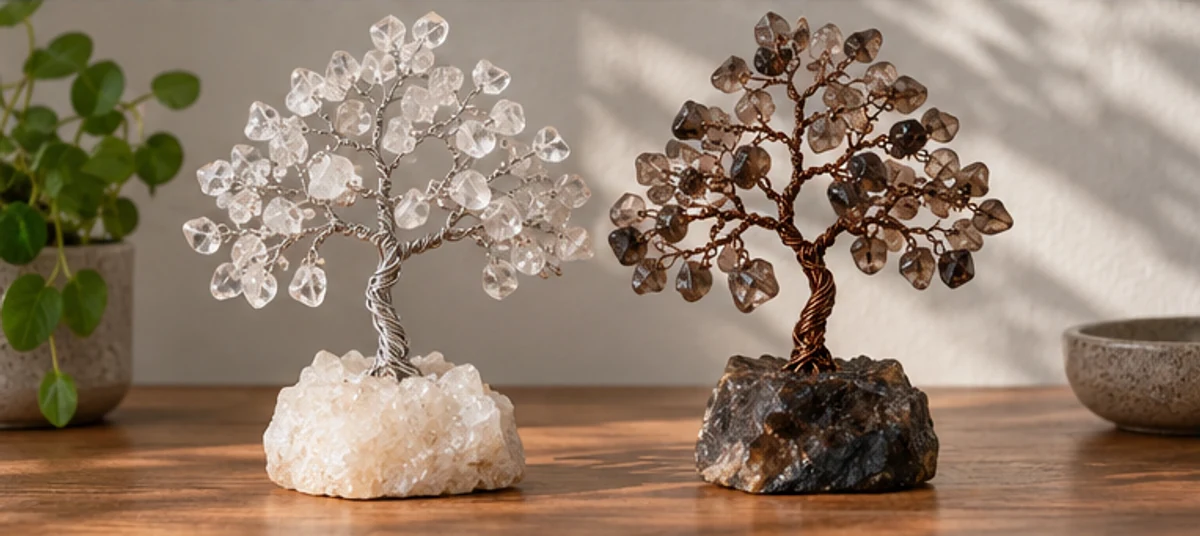
1. Clear quartz and smoky quartz: the essential comparison
Both gemstones are varieties of crystalline quartz rather than unrelated species. In colourless quartz, visible light usually passes through with little body colour, although natural fractures, liquid or mineral inclusions and surface polish can produce a cloudy or milky appearance. Smoky quartz has a grey-to-brown absorption caused by colour centres associated with trace aluminium and irradiation. In nature, radiation from the surrounding geological environment can create that colour over time; commercial treatment can create or deepen a similar appearance. The colour of a loose chip cannot by itself establish which process occurred.
| Buying question | Clear quartz / Sphatik | Smoky quartz |
|---|---|---|
| Mineral species | Quartz, SiO2 | Quartz, SiO2 |
| Normal appearance | Colourless, transparent to cloudy or included | Light grey, tea-brown, dark brown to nearly black |
| Mohs hardness | About 7; chips can still fracture or chip | About 7; dark colour does not make chips tougher |
| Material colour | May be naturally colourless; other materials can imitate it | Aluminium-related colour centres from natural or commercial irradiation |
| Common substitution | Glass, acrylic or other transparent stones | Brown glass, dyed or coated material, wrongly named dark stone |
| Traditional presentation | Sphatika, clarity, purity, puja and devotional symbolism | Earthy, steady and grounding symbolism in modern crystal practice |
| Best photo request | Same-light close-up, full crown and base, visible inclusions | Same-light photo showing true brown/grey range, edges and chip thickness |
| Complete-tree care | Dry dusting; protect wire, glue and base | Dry dusting; additionally avoid strong heat and long harsh light exposure |
The shared mineral species matters: claims that smoky quartz has a fundamentally different hardness, weight or crystallographic structure merely because it is darker are misleading. A darker tree can feel visually heavier, but the actual mass depends on chip size, number, base and wire construction. Ask for dimensions and weight rather than inferring them from the photograph.
2. Why Sphatik is important in Indian devotional traditions
Sphatik or Sphatika is a familiar Indian name for transparent quartz in puja objects, malas and some traditional representations of the Shiva Lingam. Sphatika is valued for its clarity and luminosity in devotional settings; the significance of an established Sphatika mala or Lingam should not be automatically transferred to every modern gemstone-tree decoration. The materials may be related, but the object, consecration, use and tradition differ.
A clear-quartz tree displayed near a reading desk or home prayer shelf may be selected as an emblem of mental clarity, simplicity, reflection or a fresh beginning. A family may connect the tree shape with the wish-fulfilling Kalpavriksha or Kalpadruma. The Indian Museum in Kolkata records an early stone Kalpavriksha representation from Besnagar, with symbols of abundance borne by its branches. The modern gemstone-chip tree is a contemporary ornamental interpretation of the broader auspicious tree motif, rather than that ancient sculpture reproduced in mineral wirework.
When a person uses the tree during a puja or Sankalpa—a consciously stated spiritual intention—its role should be meaningful and practical. It may sit beside, rather than replace, a deity image, lamp, flowers, water vessel or other established objects. Keep enough room for safe movement, light and cleaning. The clarity of quartz is a material property; the devotional meaning comes from the family’s practice and the context of the object.
3. How smoky quartz acquires its brown colour
Smoky quartz contains small amounts of aluminium-related defects within the quartz structure. Exposure to radiation produces electronic colour centres that absorb some visible wavelengths, creating smoky-grey, brown or darker tones. This is described in mineralogical and gemmological literature, including Mindat and GIA. Naturally occurring irradiation is a geological process; controlled commercial irradiation may produce similar colours in quartz. The final colour is not a visible stamp of origin.
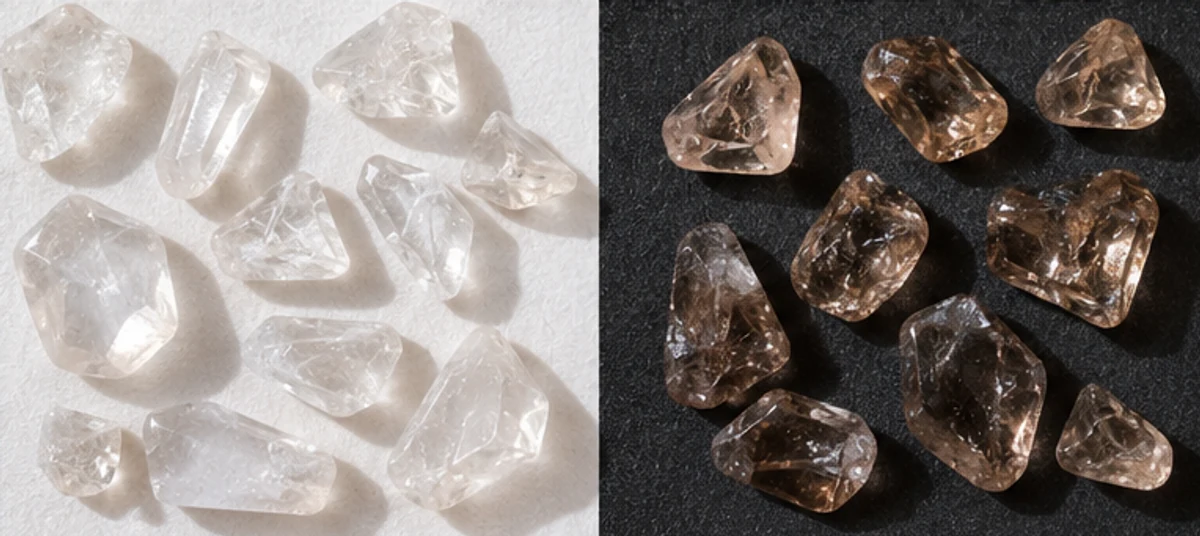
A chip may look dark because it is thicker, because several chips overlap, because it was photographed against a dark background, or because it really has stronger body colour. Ask for an individual chip held in ordinary diffuse light and a full-tree photograph under the same conditions as the clear tree. Deep black-brown material is sometimes described commercially as morion, but that name alone says nothing about whether the colour was induced commercially.
| Observation | What it can show | What it cannot prove |
|---|---|---|
| Transparent pale grey chip | Smoky appearance and some optical clarity | That colour was formed exclusively in nature |
| Very dark, nearly black chip | High apparent colour intensity | Better mineral quality, higher “energy” or geological origin |
| Patchy shade across a crown | Variation in individual chips and their overlap | Treatment history without further evidence |
| Few or no inclusions | A polished appearance that some buyers prefer | Natural origin rather than laboratory-grown quartz or glass |
| Colour fading under excessive heat | A vulnerability of certain colour centres | A safe home identification method—do not perform heating tests |
| Seller states “natural smoky quartz” | The seller’s representation | Independent confirmation of untreated colour unless appropriately supported |
Do not try to distinguish natural from treated colour by heating, scratching, soaking in chemicals or exposing a chip to strong radiation. Such experiments can damage an assembled tree and cannot substitute for reliable origin and treatment records. A seller should disclose known treatments accurately and should say when a statement is unknown rather than turning uncertainty into a claim of untreated origin.
4. Identifying genuine clear quartz in a finished tree
Natural colourless quartz is a crystalline mineral with vitreous lustre. Its chips may show irregular fracture surfaces, fine internal veils, liquid inclusions, zones of clarity and small variations from one chip to another. None of these features proves authenticity on its own. Glass can show bubbles and flow lines, but some glass lacks obvious bubbles; quartz can contain round-looking inclusions or surface pits that resemble them. Acrylic may be much lighter and easier to mark, yet damaging scratch or density tests should not be performed on a finished product.
A finished tree should be assessed at two levels. The first is the identity of the chips: quartz, glass, resin or a mixture. The second is the assembly: whether the wire is securely twisted, chips are firmly attached, the trunk is fixed, the base is balanced and any glue or coating is disclosed. Even authentic quartz chips can be incorporated into poorly made trees, and an attractive product photograph may hide the joint beneath the trunk.
- Request a close photograph showing several representative chips, including any cloudy or strongly transparent areas.
- Ask whether the stone is described as natural quartz, laboratory-grown quartz or a quartz-look imitation.
- Check whether all chips are one material or whether decorative filler pieces have been mixed in.
- Inspect the base, trunk and back of the crown in an ordinary-light photograph.
- Request the actual height, branch spread, base dimensions and delivered weight—not just chip count.
5. Identifying genuine smoky quartz in a finished tree
Smoky quartz is not identified by brown colour alone. Brown glass, tinted resin, coated stones and some unrelated dark minerals may resemble a smoky chip in a thumbnail image. Genuine quartz properties are best established by an appropriately qualified gemmological examination of a representative stone; a visual photograph is useful for judging colour and workmanship, not a full mineral test.
Look for a believable range of grey-brown to brown tone under normal light, consistent material descriptions, and close views of surfaces that are not hidden by the wire. A seller may offer naturally smoky quartz, quartz that has been commercially irradiated, or material of unverified colour history. These should not be merged under one “100% untreated” claim. Nor should the appearance of one loose stone be taken as proof about every chip on a large mixed tree.
| Seller description | Appropriate interpretation | Follow-up request |
|---|---|---|
| “Smoky quartz” | A quartz-variety identification claim | Ask for stone identity and treatment disclosure |
| “Natural smoky quartz” | Usually claims naturally formed mineral material | Clarify whether the smoky colour is stated to be natural or treatment-induced |
| “Untreated smoky quartz” | A stronger claim about treatment history | Request supporting documentation for that representation |
| “Black crystal tree” | A decorative colour label, not a mineral identity | Ask whether chips are smoky quartz, obsidian, onyx or glass |
| “Verified genuine gemstone tree” | Scope may refer to part of the assembly | Ask what was tested and whether a report identifies each sampled material |
| “Lab certified tree” | May describe a sample or an individual stone | Check lab name, report number, test method and exact objects covered |
6. Clear quartz, smoky quartz, glass and synthetic quartz
“Real quartz” and “naturally formed quartz” are not identical descriptions. Laboratory-grown quartz has quartz chemistry and a crystalline structure but is grown with human intervention. Glass is amorphous and differs from quartz structurally even when it looks transparent. Plastic or acrylic is another category again. A careful seller identifies the actual material instead of using the broad word crystal for all four.
A clean, colourless appearance is not enough to distinguish them. Nor is a smoky hue proof that a chip came from a natural mineral pocket. GIA research has noted the challenges of distinguishing natural from synthetic colourless quartz where obvious inclusions and growth features are absent. For high-value or heavily marketed claims, independent gemmological examination is more meaningful than a home scratch test.
| Material | Nature | Possible tree appearance | Buying question |
|---|---|---|---|
| Natural clear quartz | Naturally grown crystalline SiO2 | Colourless to cloudy transparent chips | How was mineral identity checked? |
| Natural smoky quartz | Naturally grown crystalline SiO2 with smoky colour | Grey, brown or nearly black chips | Is colour-treatment history known? |
| Commercially irradiated natural quartz | Natural mineral material with human-induced colour | May look essentially the same as natural smoky quartz | Was irradiation disclosed? |
| Laboratory-grown quartz | Man-made crystalline quartz | Clear or coloured, potentially visually convincing | Is laboratory origin clearly stated? |
| Manufactured glass | Amorphous silica-based material, not quartz crystal | Clear or brown; sometimes deliberately bubbled | Is it sold honestly as glass rather than gemstone? |
| Acrylic or resin | Polymeric manufactured material | Clear, tinted, lightweight or moulded | Does the material description identify the polymer? |
7. What clarity, cloudiness and inclusions mean
A clear quartz tree need not be made of flawless gems to be attractive or authentic. Natural quartz often contains features that scatter light: healed fractures, mineral specks, cloudy areas or internal growth patterns. The effect is different from a coating or a surface scratch. Some imperfections are part of the visual character, while edge chips, sharp protrusions and loose fragments are quality concerns.
Smoky quartz can also be clear enough to see through despite its body colour. Conversely, a nearly black chip may conceal inclusions. Judge the condition of finished chips using raking side light, then judge the crown in the ordinary room light where the piece will actually be displayed. Do not equate a heavily retouched, spotless image with a superior specimen.
For either tree, quality is not a one-number ranking. The top edge of a chip matters for safe handling; the wire loop must hold without excessive pressure; the branch should balance the base; and the overall silhouette should remain legible from a normal viewing distance. A family gifting a tree can reasonably prefer a modest, sturdy piece over a densely filled tree with fragile attachments.
8. Branch construction: what matters more than a chip count
Gemstone trees are assembled objects. Small chips may be pierced, wired, wrapped or affixed near branch tips. The branch wire may be copper-coloured, brass-toned, painted or plated; the apparent finish does not establish the metal composition. Bases may be stone, wood, resin, plaster or combinations. Ask for the actual materials of the complete item, not only the headline gemstone.
A high chip count can create a visually full crown, but counts are not directly comparable unless chip size and branch design are also similar. A large clear quartz tree with widely spaced branches may contain fewer stones than a compact smoky quartz tree with dense miniature chips. Both can be valid designs. The more revealing measurements are total height, maximum spread, base footprint, weight and stability on a flat shelf.
| Inspection point | What to look for | Why it matters |
|---|---|---|
| Chip attachment | Loops sit snugly without crushed or split edges | Reduces loose chips and sharp fragments |
| Branch wire | No obvious fatigue breaks, rough ends or flaking coating | Improves safe positioning and long-term appearance |
| Trunk connection | Firm twists or joint with no movement at the base | Avoids toppling and repeated adjustments |
| Base stability | Level underside and sufficient footprint for crown spread | Prevents falls in busy rooms or display counters |
| Photographic evidence | Front, side, back, base and scale reference | Reveals construction hidden by a studio hero shot |
| Description | Identifies stone, wire, base and any stabilising adhesive | Keeps mixed-material care realistic |
| Packaging | Branch protection, secure base and no pressure on chip tips | Reduces damage during delivery |
9. Kalpavriksha symbolism and the meaning of a gemstone tree
The tree shape carries a long-standing cultural association with rootedness, growth, shelter, continuity and abundance. The name Kalpavriksha evokes the wish-fulfilling tree in Indian sacred storytelling. Its meaning can be expressed through a modern crafted tree without claiming the contemporary object is an ancient Vastu implement. The roots and base may suggest steadiness; the trunk effort and discipline; branches development; and the many chips the fruits of work and care.
With clear quartz, buyers often focus on Sphatika, brightness, simplicity and a devotional or meditative atmosphere. With smoky quartz, some modern crystal practitioners emphasise steadiness, reflection and a grounded workspace. These associations are interpretive and vary by practitioner. They should be presented as meaning and usage traditions, not as proof that a quartz tree alone determines a person’s finances, health, relationships or horoscope.
A meaningful Sankalpa might be written as a brief personal intention for steady study, disciplined business practice, family harmony or thoughtful prayer. The tree then serves as a visible reminder in a space that is already used for those activities. This gives symbolic objects an intelligible role instead of asking them to substitute for ordinary action.
10. Vastu Purusha Mandala, directions and five-element interpretation
Classical Vastu concerns the relationship of site, structure, orientation, light, movement and occupied space. The Vastu Purusha Mandala and the Ashta Dik (eight directions) provide a conceptual background, although exact design prescriptions vary across texts and regional traditions. Contemporary practitioners sometimes extend directional and elemental symbolism to gemstones and ornamentation. A tree can be part of a considered arrangement; it should not be treated as a universal correction independent of floor plan and function.
In a puja or quiet-study context, the northeast (Ishanya) is often given special attention; some traditions connect the north with Kubera and the east with Surya and light. These are cultural associations, not a fixed guarantee that a clear or smoky quartz tree must always sit in one corner. The best position also needs a level shelf, safe traffic flow, clean surroundings, adequate light and protection from direct heat.
| Area / concept | Traditional association | A practical tree choice | Placement consideration |
|---|---|---|---|
| Ishanya / northeast | Often valued for worship, reflection and clarity | Small clear Sphatik tree as a restrained accent | Avoid blocking puja vessels, lamp use or walking access |
| North | Kubera and prosperity symbolism in many Vastu teachings | Clear or smoky tree for an office intention | Keep documents, devices and sight lines accessible |
| East | Surya, illumination and beginnings | Clear quartz where daylight reveals chip detail | Avoid prolonged harsh direct sunlight and hot window sills |
| Southwest / Nairritya | Stability and anchoring themes in some interpretations | Smoky tree for a subdued decorative palette | Do not replace structural/site analysis with a small object |
| Panchabhuta: Prithvi | Material steadiness and grounding symbolism | Smoky colours may resonate aesthetically | Use symbolism thoughtfully; it is not mineral physics |
| Panchabhuta: Akasha | Space, openness and contemplation | Clear quartz with an airy branch silhouette | Leave negative space around the crown |
| Work and study areas | Concentration, discipline and routine | Either, selected for visual calm | Avoid crowding, glare or toppling risks |
11. Chandra, Shani, Graha and gemstone correspondences
Some buyers ask whether clear quartz belongs to Chandra or whether smoky quartz belongs to Shani. Crystal-practice correspondences vary, and a transparent tree should not be silently equated with the classic Jyotish prescription of a pearl for Chandra. Likewise, smoky quartz should not be described as a universal replacement for Neelam (blue sapphire) in a Shani recommendation. The distinction between a decorative Vastu tree and a Ratna prescribed from a Kundali is important.
Traditional astrological selection may consider Graha position, Rashi, Lagna, Nakshatra, Dasha, house rulership and the circumstances of the individual. A tree selected for home decor is a different decision from wearing a planetary gemstone on the body. OmmRudraksha’s individual consultation process can therefore be relevant when a person seeks chart-specific guidance rather than simple decorative symbolism.
For a family with varied preferences, clear quartz may be an easy symbolic choice because of its neutral colour, while smoky quartz may suit someone who prefers subdued brown tones. Neither colour should be marketed as automatically overcoming a particular Dosha. Respect the established devotional and astrological language without forcing unsupported one-to-one equivalences.
12. Clear quartz tree for a puja room or meditation area
A clear quartz tree often suits a room with a calm visual palette. Its transparent or milky chips catch ambient light without introducing another strong colour. On a devotional shelf, a modest tree can sit to the side of the primary shrine, leaving space for daily puja and the safe operation of a diya or incense holder. Keep wire branches away from open flames, oil, water spillage and the daily reach of clothing or prayer materials.
In a meditation or reading area, select a branch spread that fits the shelf. A low, stable base is usually more valuable than a dramatically leaning canopy in a narrow location. If the shelf is white and the chips disappear visually, use a neutral wooden or stone-toned background; if the room is dim, move the tree into soft indirect light instead of placing it in a hot window.
13. Smoky quartz tree for a home office, desk or showroom
Smoky quartz provides grey-brown depth that can work with timber, warm neutral walls and traditional furniture. A short tree on an office shelf may serve as a personal reminder of careful decisions, steady work and financial discipline. These meanings fit modern “grounding” symbolism, but the tree’s practical function remains decorative and reflective. It should not obscure the monitor, keyboard, task light or documents.
In a jewellery showroom, position smoky quartz against a light background so its outline and the variation in chips are visible. Photograph clear and smoky specimens with the same exposure and scale. On a crowded glass counter, a dark tree may attract attention because of contrast rather than because it contains better stone. The price should reflect demonstrated materials, size, workmanship, supplier documentation and condition.
14. Practical example: a Bengaluru family apartment
Imagine a compact Bengaluru apartment with an east-facing living-room shelf and a small separate puja space. The family is choosing between a 15 cm clear quartz tree with an open crown and a 20 cm smoky quartz tree with long outward branches. The clear tree fits the narrower devotional shelf without interfering with the lamp; the smoky one looks better on the living-room sideboard. This is a more useful distinction than declaring either colour universally correct for east.
The household should measure the clear space behind and beside each tree, inspect base stability and consider dust, ceiling-fan air flow, children and pets. If a family member wishes to perform Sankalpa during housewarming or Griha Pravesh, that can be an occasion for intentional placement. The physical inspection and sensible position remain part of the decision.
15. Practical example: a jewellery showroom and retail display
Suppose a shop displays clear and smoky quartz trees beside gemstone bracelets. A fair comparison uses matching camera angle, similar light, accurate labels, and actual measurements. The clear tree should not be advertised as “flawless Sphatik” without evidence; the smoky tree should not be advertised as “unheated and unirradiated” merely because it came from a supplier describing it as natural stone.
The shop can provide a compact product card listing: actual stone name, known colour treatments, total height, maximum spread, base material, branch wire finish, approximate chip size, delivered weight and basic care. This answers customers’ questions and improves trust more directly than a large collection of interchangeable spiritual slogans.
16. Practical example: a professional Vastu reference kit
A professional Vastu consultant may keep one clear and one smoky quartz tree as visual examples of crystal varieties and material disclosure. A reference kit should label the stones accurately and show where each sample came from. It is useful to add a small loose clear quartz specimen, a labelled smoky quartz sample, and photographs of the whole trees, so clients can understand the difference between a mineral specimen and a decorative assembled object.
The consultant may discuss Prithvi, Akasha, Ishanya, Ashta Dik or Sankalpa where relevant to the client’s practice. They should also explain that crystal variety, treatment, room context and chart-specific Jyotish advice are distinct questions. A professional kit benefits from repeatable explanations and honest limits, not from assigning a different universal “remedy” to every colour shade.
17. Gifting: choose by recipient, intention and care burden
A clear quartz gemstone tree can be chosen for a student, new home, prayer area or minimalist interior. Smoky quartz may suit an office opening, a traditional wooden desk or a recipient who likes muted decor. If the recipient prefers brighter colours, another gemstone tree may be a better gift; do not use spiritual symbolism to override personal taste. Confirm space and care needs before selecting a tall or delicate tree.
For gifting, the package should protect the crown and trunk without crushing branch tips. Include a short material card, a note that wires should not be bent repeatedly, and any actual treatment disclosures. A message such as “May your new space grow in clarity, steadiness and happiness” can express Kalpavriksha meaning without promising a particular outcome.
18. Buying checklist: what to ask before ordering
| Question | Why ask it? | Acceptable evidence |
|---|---|---|
| Are chips clear quartz or smoky quartz? | Establish actual mineral variety | Accurate invoice/specification and representative close-up |
| Is natural origin claimed? | Separate natural mineral from synthetic quartz and imitation | Supplier statement or suitable independent testing |
| Is smoky colour treatment known? | Natural radiation and commercial irradiation can look alike | Clear seller disclosure; unknown should be recorded as unknown |
| Is the tree mixed stone? | Decorative chips can vary across the crown | Full material list for prominent components |
| What are height, spread and base size? | Different designs occupy different shelf space | Measurements of the actual item or verified design |
| What metal and finish are used? | Coatings and wire finishes affect care | Description of wire and trunk materials where known |
| Can branches be adjusted? | Repeated bends cause fatigue in some constructions | Maker guidance and close views of branch connections |
| What does a certificate cover? | Sample evidence may not cover every chip | Lab report scope, date, report number and sampled material |
| How is it packed and supported? | Prevents breakage during transport | Protective packing details and damage-resolution process |
| How should it be cleaned? | Stone hardness alone does not govern the entire object | Mixed-material dry-care instructions |
If two vendors quote different prices, compare like with like: total dimensions, actual chip size, density of the crown, quality of wirework, base material, supply chain and treatment information. An elaborate staged photograph may indicate good marketing rather than better mineral content. If no item-specific facts are available, choose a simpler listing that states what is known and what has not been verified.
19. Care: quartz chips and mixed-material construction
Quartz at Mohs 7 is comparatively scratch resistant, but it can chip under impact and can contain fractures. The assembled tree is more vulnerable than a loose quartz specimen because it includes thin wire, loops, coatings, adhesives and a base. Dry dusting with a soft clean brush is the safest default. Support the trunk and base while cleaning rather than holding the whole tree by its most delicate branch.
Avoid immersing the entire tree, ultrasonic cleaning, steam, detergents of unknown strength, acid cleaners, harsh abrasives and direct spraying. Those methods can weaken attachments, corrode wire, discolour coatings or damage the base even when quartz itself would tolerate brief contact with water. Strong heat is especially unwise for smoky quartz because its colour centre can change with heating. Keep both trees off hot windowsills and away from open flames.
| Situation | Recommended handling | Avoid |
|---|---|---|
| Ordinary dry dust | Soft dry brush, base held securely | Dragging cloth aggressively across branch tips |
| Fingerprints on accessible chips | Very gentle wipe of individual chip if attachment is sound | Soaking the full wire-and-stone tree |
| Loose stone or wire | Stop adjustment and ask maker for repair | Twisting repeatedly or applying household superglue indiscriminately |
| Smoky tree at sunny window | Move to indirect light and moderate temperature | Heating to “test” natural colour |
| Puja room with water and oil | Place aside from spills and wipe dry promptly | Regular washing, oiling, salt water or chemical sprays |
| Storage or shipping | Immobilise base, pad crown and protect chip points | Compressing branches beneath heavy goods |
| Long-term display | Recheck base and wire joints periodically | Assuming material hardness prevents structural damage |
20. Puja, traditional cleansing and practical material safety
Some traditions include sprinkling water, wiping a devotional object, offering flowers, reciting mantra or performing a simple purification before use. If a gemstone tree is part of that practice, the ritual can be performed without putting its entire construction into liquid. A spoken mantra, respectful placement, a clean surrounding area and a Sankalpa may be appropriate to the family’s custom. Keep any water offering in a separate vessel rather than soaking wirework.
Salt baths, intense heat, incense ash, lemon juice and prolonged direct sunlight should not be prescribed as universal cleaning methods for gemstone trees. Quartz chemistry does not justify exposing every glue, plated wire, lacquered base or dyed decorative element to those conditions. Traditional meaning and careful stewardship belong together.
21. Common mistakes when comparing clear and smoky trees
- Treating “natural quartz” as proof that a smoky colour was never commercially induced.
- Calling all transparent clear chips Sphatik without checking whether they are quartz, glass or acrylic.
- Claiming that a darker crown is heavier or more authentic without measurements.
- Using photographs with different lighting or camera exposure to compare gemstone quality.
- Equating a chip count with size, stability or workmanship.
- Assigning a fixed Vastu direction to every home regardless of layout and actual function.
- Describing smoky quartz as an automatic Shani gemstone prescription or a universal Graha Dosha correction.
- Using soap, salt or water to clean the entire tree because quartz alone is durable.
- Assuming one sample lab report authenticates every chip, base and wire.
- Bending finished branches repeatedly to match a styled photograph.
22. Frequently asked questions
Is smoky quartz a different mineral from clear quartz?
No. Both are crystalline quartz, SiO2. The smoky colour arises from colour centres related to trace aluminium and irradiation. The overall tree can nevertheless differ in chip size, arrangement and construction.
Does smoky quartz always contain natural colour?
Not necessarily. Smoky colour may form through natural geological irradiation, or it may be induced or intensified commercially. The visual appearance of a finished chip normally cannot establish the history on its own.
Does natural smoky quartz mean untreated smoky quartz?
No. “Natural” may describe the quartz mineral rather than the origin of its colour. Ask for a clear statement about known irradiation and other treatments, and do not infer untreated status from wording alone.
Is Sphatik the same as clear quartz?
Sphatik or Sphatika is a common Indian name used for clear rock crystal quartz, particularly in devotional objects. On a commercial listing the mineral identity should still be stated accurately, because transparent glass can also be marketed loosely as crystal.
Can a finished gemstone tree be made with laboratory-grown quartz?
Yes, technically. Laboratory-grown crystalline quartz is distinct from natural quartz and from glass. An accurately labelled product can be decorative, but its origin should not be described as naturally formed when it was grown in a laboratory.
Does a perfectly clear chip prove it is glass?
No. Natural quartz can be very clear and glass can be nearly inclusion-free. Visual clarity alone is insufficient to establish identity; reliable testing and provenance information are more useful.
Are cloudy clear quartz chips lower quality?
Cloudiness may be due to internal features and can be an attractive part of a decorative tree. Judge the actual condition, finish, visible damage, matching design and price. A tiny internal veil differs from a dangerously chipped edge.
Is very dark smoky quartz more powerful?
Darker material has greater apparent absorption or chip overlap; colour strength does not establish spiritual effectiveness. Select the appearance and symbolic context that suit the space, while checking identity and construction.
Can I place a clear quartz tree in the northeast?
A modest clear quartz tree may suit a quiet northeast puja or reflection area in many contemporary Vastu interpretations. The specific room layout, shrine use, cleanliness and stability matter more than repeating a universal placement formula.
Where can a smoky quartz tree be placed in an office?
Choose a level shelf or sideboard with enough clearance from screens, doors and daily movement. Some modern practitioners associate smoky quartz with steadiness; the exact direction should follow the room and the approach used in consultation.
Is smoky quartz linked to Shani?
Some modern crystal traditions make that association, but it should not be treated as interchangeable with a Jyotish gemstone prescription based on a Kundali. A chart-specific recommendation considers more than stone colour.
Can I use clear quartz in a Shiva puja area?
Sphatika has established devotional associations, and a small clear quartz tree may be a respectful decorative accent. It is not automatically equivalent to a Sphatika Lingam or a consecrated ritual object. Keep it away from flame, oils and spills.
Is a gemstone tree a classical Vastu remedy?
The ancient symbolism of auspicious trees is well established, while modern wire-and-chip gemstone trees are contemporary objects. Placement practices vary; treat an ornamental tree as one part of an intentional space, not a substitute for site or architectural analysis.
Which is better for a housewarming gift?
Clear quartz often suits minimal, bright decor and a clarity theme; smoky quartz suits subdued interiors and a steadiness theme. The recipient’s tastes, available shelf size and ability to maintain the tree should decide.
Does chip count decide the tree size?
No. Chip dimensions, branch length, spread, density and the base determine the size. Compare measured height, maximum width and footprint rather than relying on chip count or a close-cropped product photograph.
Can I reshape the wire branches after delivery?
Only if the maker identifies the branches as adjustable, and then only gently and sparingly. Repeated bending can weaken wire connections and cause chips to loosen. Support the trunk rather than tugging individual tips.
Can the whole gemstone tree be washed with water?
Routine soaking is not advised. Although quartz itself tolerates gentle water cleaning, adhesives, wire finishes and bases may not. Dry dusting is a safer default for the complete assembled piece.
Will direct sunlight damage smoky quartz?
Prolonged harsh exposure and especially high heat are best avoided. Smoky colour can be heat-sensitive, and the assembly has additional metal, coating and adhesive vulnerabilities. Use gentle indirect daylight for display.
What should a laboratory report say?
It should name the laboratory, dated sample or item, tested material and any detectable treatment conclusions. Read what was actually examined: one sample chip is not proof that the whole tree is composed exclusively of the same material.
How can a shop compare two trees fairly?
Show both in similar ordinary light and with a scale reference. Supply actual dimensions, chip and base details, known treatment disclosures and close photographs of construction. Let customers compare the complete objects, not only colour and glamour photography.
23. Summary: choose the right tree for the right reason
Choose clear quartz / Sphatik when you want a light, neutral palette, transparent or clouded crystal character, or an association with clarity and devotional simplicity. Choose smoky quartz when you prefer a grey-brown palette, stronger contrast and the contemporary symbolism of steadiness or grounding. Both are quartz, and their physical properties overlap; treatment history, chip quality and tree workmanship must be considered separately.
For either option, look for accurate material descriptions, an honest statement of what the seller knows about treatments, detailed dimensions, stable base construction, clear photographs and realistic care advice. Kalpavriksha, Sankalpa and Vastu provide meaningful cultural context, while safe handling and responsible product information make the tree suitable for everyday use.
Research note: Mineral identity and smoky colour mechanisms were checked against Mindat and published GIA gemmological research; treatment-disclosure terminology against CIBJO; devotional tree symbolism against the Indian Museum, Kolkata; and mixed-material handling against established gemmological and conservation guidance. Named institutions are given for educational provenance without adding unnecessary external shopping links.
