
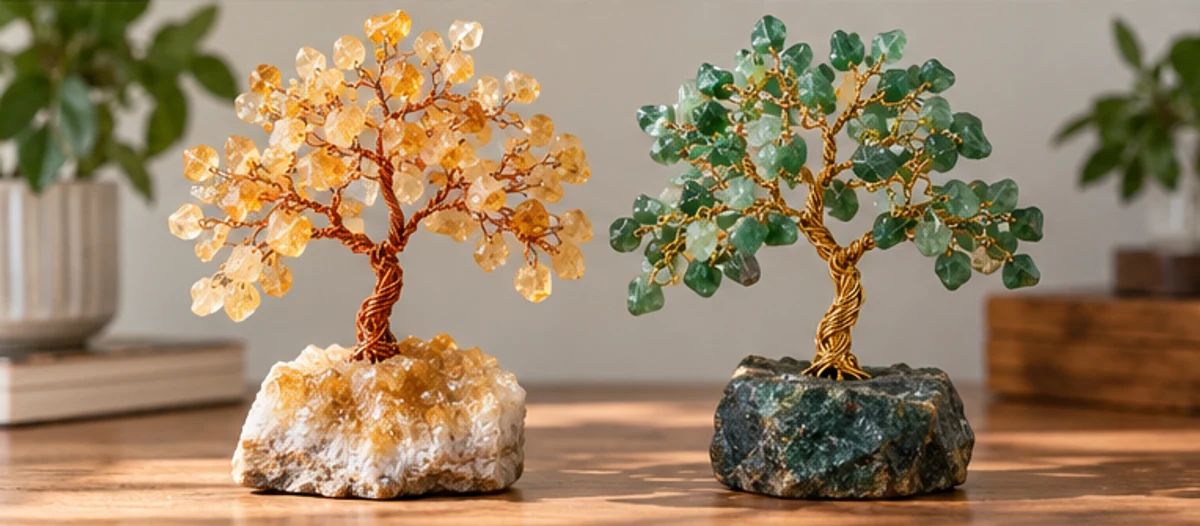
Citrine and green aventurine gemstone trees are often chosen for a similar intention—growth, prosperity and an auspicious atmosphere—yet they are not interchangeable minerals, colours or finished objects. Citrine is yellow-to-orange quartz; green aventurine is generally a quartz-rich or quartzite material containing minute inclusions, commonly green chromium-bearing mica, that can create a subtle sparkle. In a gemstone tree, those small pieces are fixed to wire branches above a base, and the physical workmanship matters just as much as the name of the stone.
The best comparison therefore asks four connected questions. What are the chips actually made of? What treatments have been disclosed? What does each colour and tree form mean in the family's Vastu or devotional setting? And will the complete wire-and-stone object fit its shelf, be safe to handle and remain attractive with sensible care? This guide answers each question, including how to photograph and inspect the actual item, how to avoid confusing traditional symbolism with Jyotish gemstone prescription, and how to choose for a Bengaluru home, a shop counter, a work desk or a thoughtful gift.
1. At a glance: citrine and green aventurine are different materials
Citrine refers to the yellow, golden or orange variety of crystalline quartz, with chemical composition SiO₂ and Mohs hardness about 7. A significant proportion of commercial citrine receives its colour when amethyst or related quartz is heated. A piece of heat-treated citrine is still quartz, and its treatment history is a disclosure issue rather than automatic evidence of imitation. Green aventurine usually refers to a translucent or opaque quartz-rich rock containing dispersed, reflective particles such as fuchsite mica; these inclusions help create the green colour and sometimes a sparkling optical effect called aventurescence. Both names can be misused for glass, dyed substitutes or poorly described chip mixtures.
| Question | Citrine gemstone tree | Green aventurine gemstone tree |
|---|---|---|
| Main material | Yellow-to-orange crystalline quartz | Green quartz-rich/quartzite material, often with fuchsite |
| Typical appearance | Clear to translucent yellow, gold, honey or orange chips | Light to deep leafy green, commonly cloudy or granular chips |
| Visual effect | Transmitted warm colour; sparkle from polished faces | Green body colour and sometimes mica-related aventurescence |
| Approximate Mohs hardness | 7 for quartz | Often approximately 6.5–7 for quartz-rich aventurine; the assembly varies |
| Treatment question | Natural colour, heated amethyst, synthetic quartz or imitation? | Natural colour, oiling, dyeing, composite or imitation? |
| Commonly chosen symbolism | Prosperity, warmth, enterprise, confidence and generosity | Growth, renewal, harmony, steady opportunity and nature |
| Common buying mistake | Assuming strong orange colour proves rare untreated citrine | Assuming every green chip is genuine untreated aventurine |
| Complete-tree care | Gentle dry dusting; avoid prolonged harsh light and heat | Gentle dry dusting; keep coatings, wires and adhesives dry |
Neither tree can be evaluated by colour alone. Chip composition, manufacturing method, branch flexibility, base stability and the intended place of display can all change which option is more appropriate. A warm yellow tree may look striking on pale wood but disappear against a bright yellow wall; a green tree may enliven a neutral reception area but compete with a busy foliage-pattern background. Ask to see the complete item at ordinary viewing distance, not only the most flattering close-up.
2. What qualifies as genuine citrine?
A mineralogical description of citrine begins with quartz rather than with a marketing word such as “money stone.” GIA describes citrine as transparent pale yellow to brownish-orange quartz and notes that naturally occurring yellow quartz is comparatively uncommon. Much commercially sold citrine is quartz whose colour was changed through heating of amethyst. This transformation does not make the mineral glass, plastic or a false stone; it does mean that claims such as “untreated natural citrine” deserve evidence rather than inference from a photograph.
In a chip tree, individual pieces may differ in hue, transparency, thickness and polish. One tip can look pale lemon and another honey-brown because of material variation or lighting. Very orange colour, particularly in a quartz cluster, often warrants a treatment question, but it is not an at-home proof of heating. Vendors may also use terms such as “citrine colour,” “golden quartz,” “yellow crystal” or “citrine-look.” Those terms are not all equally precise: ask which mineral is present and whether the colour is natural, induced or only a visual resemblance.
Inspect the sample under diffuse daylight without placing it in direct sun for long periods. Glass may imitate quartz and can sometimes show rounded bubbles, but the absence of visible bubbles does not prove quartz. Laboratory-grown quartz shares the species' chemistry and many physical properties; an ordinary photograph cannot establish geological origin. Similarly, a certificate for one loose sample may not establish the identity of every chip in a complete tree. A trustworthy seller states what was actually examined and what is known about the supplied piece.
| Seller statement | What it really tells you | Good follow-up |
|---|---|---|
| “Citrine tree” | A commercial material description | Are all crown chips quartz? Are any treated? |
| “Natural stone” | May refer to mined quartz despite colour treatment | Is the colour naturally occurring or heat-produced? |
| “Untreated natural citrine” | A stronger claim about origin and colour history | What testing or traceability supports this? |
| “Heat-treated citrine” | Quartz with commercially altered colour, disclosed | Does the description refer to every chip? |
| “AAA grade” | Usually a seller-specific term, not a universal tree standard | What visible quality and measurements does the grade mean? |
| “Certificate included” | A document exists | Who issued it, what was sampled, and which conclusion was reached? |
For a finished decorative tree, a full and accurate material statement is usually more useful than a grand grade. It should identify quartz chips, any known heat treatment, the wire material or finish, the base, overall dimensions and approximate actual weight. If those facts cannot be established, say so rather than replacing them with a laboratory-sounding assertion.
3. What qualifies as genuine green aventurine?
Green aventurine is often described simply as “green quartz.” That is a useful beginning but not the whole picture. Many specimens are made of quartz or quartzite with numerous microscopic inclusions; green fuchsite, a chromium-bearing mica, can impart a leafy or apple-green colour and flashes of reflected light. Mindat describes aventurine as a variety of quartzite and cautions that the trade term is applied broadly. The mineral assemblage and visibility of reflective flakes can vary across chips and between batches.
Aventurescence is not the same as the crisp moving chatoyant band of tiger eye. It resembles many tiny reflective points, visible when light meets included plates at certain angles. Some genuine green aventurine chips have only faint sparkle, particularly if they are small, matte or cut from material where the inclusions are not aligned strongly. A spectacularly glittering green surface might instead be glass, coated material or a photograph with hard directional lighting. Neither extreme establishes identity by itself.
Green aventurine may be oiled to deepen colour and some material is dyed. A chip's luminous or unusually uniform green should encourage a question about treatment rather than a conclusion. The phrase “Indian jade” has historically been used for aventurine, but aventurine is not automatically jadeite or nephrite. A seller describing a green tree as “jade and aventurine” should state whether both materials are present and how the components are distributed. Jade, serpentine, green glass, prasiolite, dyed quartzite and green aventurine should not be silently exchanged.
| Observation | Possible interpretation | What it does not prove |
|---|---|---|
| Fine scattered glitter under angled light | Reflective inclusions and possible aventurescence | That every chip is identical or untreated |
| Soft cloudy green | A natural quartz-rich texture may be present | That the item is definitely aventurine |
| Extremely vivid uniform green | Strong colour, lighting or a treatment possibility | That the stone is superior in grade |
| Different shades across branches | Mixed batches, natural variation or treatments | That the whole tree is a single mineral lot |
| “Indian jade” label | A loose historical or commercial name | Jadeite or nephrite identity |
| No obvious sparkle | Fine or poorly oriented inclusions | That genuine aventurine is impossible |
The practical approach is to ask for a sharp, colour-balanced close-up of several chips, a full-crown view and a material statement describing any known dyeing or oiling. Where authenticity materially affects a high-price transaction, seek a suitable independent identification rather than relying on scratch tests, chemical exposure or social-media tricks that could damage the object.
4. Why the two colours feel different in a room
Citrine supplies a warm visual palette: lemon yellow, golden honey and orange-brown can echo brass lamps, wood furniture, marigold flowers and warm walls. Green aventurine evokes foliage, new growth, fresh leaves and the steady rhythm of plants. These impressions matter in decor and in the cultural language people use when choosing a home or business gift. They are not measurements of power. The material, light and setting combine to create the effect.
Place the same tree against pale stone, deep wood and a patterned fabric, and its apparent brightness can change substantially. A yellow tree may stand out against a darker reception wall while a green tree blends comfortably with indoor plants. A green crown may appear fuller because many opaque chips create a continuous colour field; a more translucent citrine tree can seem lighter because light passes through gaps and thinner chips. Compare actual width and number of branch groups before interpreting one as physically larger.
Lighting also matters. Strong spotlights can make yellow chips look more intensely golden and can conceal minor colour zoning. Side light can exaggerate sparkle in aventurine. Ask for one photograph in ordinary room lighting and one close-up under diffuse illumination. If a seller provides different backgrounds for the two products, request a same-scale image before deciding. A photo of a brightly lit crown does not reveal whether the base rocks or whether the trunk is properly fixed.
For a workspace, consider what the tree will sit beside. A low, spreading crown may work well at the far end of a bookshelf but interfere with keyboard cables or invoice trays on a desk. A tall narrow tree may suit a niche but tip more easily if its base is small. The correct choice is the one that maintains safe clearance and looks composed, regardless of whether its chips are yellow or green.
5. Kalpavriksha: the older tree symbolism behind modern chip trees
The symbol of an auspicious or wish-fulfilling tree reaches far beyond modern gemstone merchandise. Kalpavriksha or Kalpataru is associated in Indian cultural and devotional contexts with abundance, generosity, continuity and fulfilment of worthy wishes. The Indian Museum in Kolkata catalogues an early sandstone Kalpavriksha representation from Besnagar, approximately the second century BCE, with branches bearing objects such as a coin purse, conch, lotus and a vase overflowing with coins. Its visual language links a flourishing tree with auspicious provision.
A modern gemstone-chip tree is not that ancient sculpture and should not be presented as an identical classical Vastu instrument. It is a contemporary decorative object that people interpret through a much older symbolic vocabulary. The trunk represents rooted stability; the spreading branches can suggest opportunity, relationships or continuity; many small stone chips can resemble leaves, fruit and the gradual results of care and effort. That meaning can be thoughtfully expressed without attributing a universal scripture-based formula to every coloured chip.
For an opening ceremony, a citrine tree may be selected to express brightness and enterprise; a green aventurine tree may express healthy growth, collaboration or renewal. In a home, a family might choose the tree that complements its puja shelf and reflects its own Sankalpa, a conscious intention stated during prayer or reflection. In gifting, the person receiving the object may simply appreciate a carefully made and attractive tree. Traditional meaning and aesthetic value can coexist without assuming that every buyer performs the same ritual.
6. Lakshmi, Kubera and prosperity symbolism
Both trees are commonly marketed as prosperity trees, but the associations are not exact equivalents. Warm yellow and golden shades are often connected in contemporary spiritual merchandise with abundance, generosity, light and auspiciousness. In many household devotional settings, Sri Lakshmi is honoured in relation to auspicious prosperity and wellbeing, while Kubera is associated with treasure and stewardship. A person may see a yellow citrine tree as a visual reminder to keep a workplace orderly, manage accounts consciously and express gratitude for livelihood.
Green has its own language of fertility, nourishment, continuity and the flourishing of work or relationships. A green aventurine tree can be offered as a wish for a new venture to grow steadily rather than merely for sudden financial gain. Calling either item a “money tree” is a familiar contemporary phrase; it does not identify an exclusive deity, an ancient mandatory stone prescription or an assured commercial outcome. The actual spiritual setting—deity image, lamp, clean surface, suitable timing and family tradition—provides context.
In a shop, the tree should not block the cash drawer, customer movement, QR payment placard, inspection light or safety equipment. A stable shelf away from traffic often serves better than placing a fragile wire object at the busiest point on the counter. In a home prayer space, keep it away from oil lamps, incense embers, water vessels and heavy flower arrangements that could catch the wires. Respectful placement is both a devotional and a practical consideration.
7. Vastu directions: how to choose without pretending one chart fits all
In traditional Vastu discussion, the directions—Ashta Dik—are considered alongside the use of the room, orientation of the building, central Brahmasthana, movement, light and Pancha Mahabhuta. The north and northeast are commonly discussed in relation to resources, clarity and spiritual activities; the east has associations with sunrise and activity. However, a specific modern citrine or aventurine chip-tree placement is usually a contemporary interpretive choice, not an invariant rule that overrides the architecture or family practice.
| Setting or direction | Possible traditional interpretation | More important practical check |
|---|---|---|
| North-facing business shelf | A setting some families relate to Kubera or opportunity | Does it interfere with counters, records or payments? |
| Northeast (Ishanya) puja area | Often associated with prayer and contemplative use | Is the shelf clean, secure and away from lamps and water? |
| East-facing reading space | A bright, active setting associated with morning light | Will long direct sunlight overheat or fade materials? |
| Living-room shelf | Harmony, welcome and a pleasant focal point | Is it secure from pets, children and accidental knocks? |
| Home office desk | Conscious intention for steady work and focus | Does the canopy obstruct work equipment? |
| Reception or showroom | Welcoming decoration and brand atmosphere | Is the displayed item clearly labelled and stable? |
| Professional Vastu kit | Illustration of materials and directional symbolism | Are stones, treatments and intended meanings labelled accurately? |
Use the table as a thoughtful starting point rather than as a compulsory placement prescription. A northeast shelf with a hot lamp directly beneath it may be worse for a delicate tree than a shaded, well-supported shelf elsewhere. If an astrologer or Vastu practitioner recommends a specific placement after assessing the actual premises, document that advice separately from a general product description.
8. Panchabhuta: yellow and green are not automatic elemental diagnoses
Pancha Mahabhuta refers to Prithvi (earth), Jala (water), Agni (fire), Vayu (air) and Akasha (space). In modern colour-based interpretations, citrine's yellow and gold may evoke the warmth of Agni and the brightness of sunlight; a green tree may evoke Prithvi, growth, vegetation and the continuity of life. These are symbolic associations, not literal mineralogical elemental identities. Both citrine and aventurine are silica-rich materials, and a tree assembly also contains wire and a base.
Some traditions and contemporary schools link green with the heart centre and yellow with a solar or navel-centred symbolism. Such associations depend on the system taught and should not be collapsed into universal classical Vastu requirements. A person studying both spiritual traditions and gem materials can keep two useful registers: the symbolic story that makes an object personally meaningful, and the physical description that explains what was supplied and how to care for it.
A professional display can explicitly label the interpretive framework: “contemporary crystal-tree symbolism,” “family devotional use,” “Vastu directional illustration,” or “material identification sample.” These labels are more educational than using one vague “energy” label for every stone. If the tree is used during a Sankalpa, it may accompany the intention as a focus or reminder without altering the physical identity of its components.
9. Distinguish tree symbolism from Jyotish gemstone prescriptions
It is tempting to connect a yellow tree directly with Guru or Brihaspati (Jupiter) and a green tree directly with Budha (Mercury). That can be a useful discussion of colour and planetary symbolism, but it requires precision. In widely followed Navagraha gemstone traditions, the principal Jupiter gem is yellow sapphire (Pukhraj) and the principal Mercury gem is emerald (Panna). Citrine is quartz, not yellow sapphire; green aventurine is not emerald. Substitute-stone practices exist in different schools, but an alternative is not automatically equivalent to the principal prescribed gem.
A personalised Jyotish recommendation may consider Lagna, Rashi, Nakshatra, planetary placements, dignity, lordships, Dasha and the person's actual objective. A ready-made ornamental tree, purchased for a reception shelf, is not the same thing as selecting and wearing a gemstone according to a birth chart. Nor is one fixed direction, mantra or metal prescription appropriate for everyone merely because the item is yellow or green.
| Term | Relevant distinction for these trees |
|---|---|
| Guru / Brihaspati | Planetary association with Jupiter; yellow sapphire is a principal classical gem in many systems |
| Budha | Planetary association with Mercury; emerald is a principal classical gem in many systems |
| Citrine | Yellow-to-orange quartz; not automatically Pukhraj |
| Green aventurine | Quartz-rich green decorative gem material; not automatically Panna |
| Navagraha set | Nine-planet symbolic or gem arrangement; requires component-specific identification |
| Sankalpa | Personal devotional intention; not a certificate of gemstone origin |
| Personalised recommendation | Considers individual chart and tradition, separate from general decoration |
This distinction strengthens the educational value of a product page. It preserves genuine Jyotish vocabulary while allowing a purchaser to enjoy a beautiful tree without inventing a chart-based prescription or confusing different mineral species.
10. How chip size and crown design change what you receive
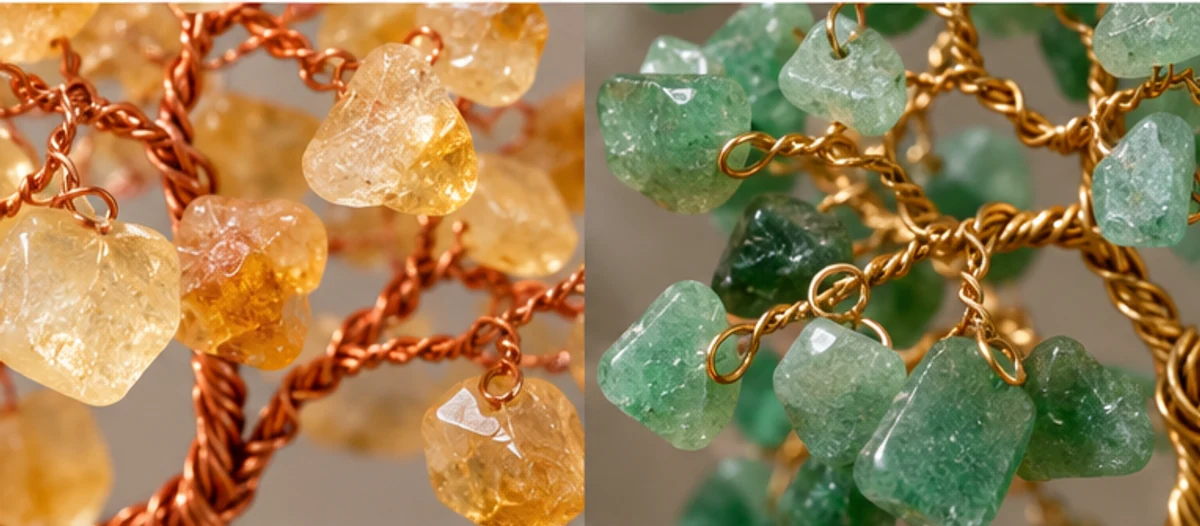
Two gemstone trees with the same approximate number of chips can differ greatly in value and appearance. One maker may use many small fragments on short branchlets to create a dense canopy; another may use fewer, larger polished pieces with long open branches. A labelled “300-chip tree” does not give height, stone mass, width, base dimensions, total weight or material quality. The counting scope may also be unclear if decorative chips occur around the base.
Citrine chips are often translucent, so thickness and overlap influence colour intensity. Small pale chips can look bright on a thin branch even when a larger chip looks deeper yellow. Green aventurine chips tend to read as a fuller, more continuous green mass, although their opacity varies. If a listing shows a tree's most attractive side, ask for front, side and underside views. An asymmetrical tree may be elegant when deliberately composed, but a leaning trunk with a narrow base is a stability concern.
| Component | What to inspect | Why it matters |
|---|---|---|
| Individual chips | Sharp edges, fractures, polish, colour and size variation | Durability, touch safety, visual consistency |
| Chip attachments | Wire loops, drilled holes, glue and loose ends | Prevents pieces from detaching during dusting |
| Small branches | Twisting, kinks, repeated bends and symmetry | Explains adjustability and fatigue risk |
| Main trunk | Binding, straightness, visible joints and corrosion | Supports overall structure |
| Base material | Stone, resin, wood or mixed assembly | Affects stability, cleaning and disclosure |
| Base underside | Footprint, felt pads, rough edges and wobble | Protects furniture and reduces tipping |
| Full dimensions | Height, widest canopy spread and base footprint | Determines fit in the intended place |
| Packaging | Protected canopy, separate cushion and clear orientation | Reduces transit damage |
Do not assume all wire branches are meant to be reshaped. Many handmade trees allow modest one-time adjustment, but repeated flexing of fine metal can work-harden and break the wire. Support the branch near the connection when making a permitted adjustment, rather than pulling the attached chip. A tightly twisted decorative trunk may be stiff while the outermost branches are fragile.
11. Material disclosures and common trade-name confusion
A tree listing might say “citrine,” “lemon quartz,” “yellow jade,” “yellow aventurine,” “green jade” or “Indian jade.” These are not interchangeable material identities. Lemon quartz may describe treated yellow quartz in certain markets, while “yellow jade” and “green jade” can be used broadly for materials outside jadeite/nephrite. Green aventurine and yellow aventurine also do not necessarily have identical inclusion chemistry merely because they share a trade-name family. A proper listing should identify the actual components rather than transfer a familiar price or ritual meaning from a different stone.
Watch for decorative photos that show a large crystal point, polished sphere or gemstone cluster rather than the exact wire tree offered for sale. The image may help illustrate colour but cannot establish tree height, chip count, wire finish or the nature of the base. A stated “natural product” should specify which parts are natural: gemstone chips, base stone, metal, pigments and adhesives may have different origins. If an item contains synthetic or reconstructed materials, it can still be sold as a decorative object when clearly described.
For higher-value purchases, an invoice or product specification can record the stone name, any known treatment, approximate size, base type and condition on dispatch. An identification report can be valuable when its scope and method match the question, but it does not replace inspecting the construction. A tree can contain genuine quartz and still have poorly fixed chips or an unstable base.
12. Which tree for a Bengaluru apartment?
Consider a hypothetical apartment with a small northeast prayer shelf, a bright west-facing study desk and a wooden cabinet in the living room. The family's first instinct may be to choose citrine for “prosperity” and aventurine for “growth.” Instead, begin with the surfaces. If the prayer shelf already carries a lamp, incense, deity images, bell and water vessel, neither tree should crowd that arrangement. A narrow tree on a separate, stable part of the cabinet may be more practical.
On the desk, direct afternoon sunlight and heat are relevant. Quartz has respectable scratch resistance, but GIA notes that some citrine colour may fade after prolonged intense light, and abrupt changes in temperature can harm the stone. A glass-front cabinet that traps solar heat is not a good place to assume the tree will remain unchanged. A green aventurine tree may be visually compatible with indoor plants, yet live-plant irrigation can wet the base, wire coating and glue. Keep ornamental stone trees away from damp soil and repeated water splashes.
If the home has young children or pets, choose an inaccessible position with a wide, non-slippery base. Tiny loose stones and protruding wire ends are unacceptable. When gifting to relatives, ask whether they have a suitable display surface rather than insisting on a particular direction irrespective of the layout. A well-positioned, clean, intact tree carries the auspicious visual meaning more gracefully than a precarious object balanced beside ritual flames.
13. Which tree for a showroom or office?
Imagine a small Bengaluru jewellery showroom with a consultation table, product displays and a reception counter. A citrine-colour tree may visually echo gold-toned jewellery; a green aventurine tree may offer a calmer colour contrast. Neither choice should obstruct the customer's view of actual jewellery or be presented as proof that gemstones on sale are certified. Place the tree where it is part of the atmosphere, with its own factual label if it is a retail item.
The showroom also creates practical risks: bright inspection lamps, cleaning sprays, moving trays, payment devices and daily dust. A narrow stable tree on a protected shelf is more durable than a delicate broad canopy at elbow height. If a display is sold to a customer, photograph the actual piece before packing so that material variation and branch shape are transparent. Avoid generic images that do not show the purchased assembly.
A professional Vastu consultant can keep one citrine and one green aventurine tree as demonstration samples and explain both the material identity and the modern symbolic conventions attached to them. Label whether the stone is known to be treated; do not turn a commercially heated quartz chip into an unsupported “untreated rare specimen” because the sample is used professionally. During a consultation, mark proposed placement on a room plan and explain that the physical arrangement must respect doors, utilities and the household's use of space.
14. Selecting a meaningful gift
Citrine trees can suit a new business, professional milestone or festival gift when the recipient appreciates warm colour, abundance symbolism or a gold-toned room. Green aventurine trees can be selected for a new home, retirement, study space, wellness room or garden-facing apartment when the recipient enjoys a natural green palette and a message of sustained growth. Those are gift ideas, not rules that exclude the other colour from any occasion.
A good gift should include the real product dimensions, a simple note about the chips and base, and basic care instructions. For example, a card might say, “May your new workspace grow with wisdom, good decisions and generous opportunities,” rather than making a commercial promise. For a housewarming, a recipient may connect the tree with Griha Pravesh, a new beginning and a Sankalpa for a harmonious home; it is courteous to ask about their own beliefs and available space.
Packaging is part of the gift's quality. Cushion the base so its weight cannot swing into the branches; protect the canopy without compressing its wire tips; remove loose paper shreds that can catch on loops. Include clear instructions to lift by the base and avoid tugging individual gemstone chips. A beautiful tree with a broken twig on arrival is a poor gift regardless of the alleged stone grade.
15. How to compare price fairly
A sensible comparison starts with the entire assembly. Count, chip quality, actual mineral disclosure, total dimensions, trunk workmanship, base type, packaging and seller responsibility all affect price. Quartz and quartzite are not usually priced like fine certified jewellery stones simply because a finished object is called a “prosperity tree.” A claim of “premium energy” is not a substitute for measurable differences in material and workmanship.
| Price factor | Fair comparison question |
|---|---|
| Gem material | Are citrine/aventurine chips genuinely and accurately identified? |
| Treatment | Are known heating, dyeing or oiling disclosed consistently? |
| Amount of stone | Does the seller describe chip size/quantity without implying unsupported grade? |
| Workmanship | Are loops, branches, trunk and base finished securely? |
| Dimensions | Are height, width and base footprint measured on the actual item? |
| Presentation | Do photographs show multiple true-to-life views? |
| Reports | Does any certificate identify the same material and scope? |
| Delivery | Is protective packing included and damage handling explained? |
| Aftercare | Can the owner safely clean and store the complete assembly? |
Buying locally can allow a person to inspect the piece under ordinary light, feel whether its base is stable and compare colours directly. For online buying, request an actual-piece video showing the complete tree slowly rotated, with a ruler near the base and a close-up of the chip attachments. Avoid assuming that a social-media sparkle filter, extremely vivid colour or dramatic prosperity claim increases intrinsic material value.
16. A twelve-point inspection checklist before ordering
- Confirm whether the chips are citrine quartz, green aventurine quartz/quartzite, or a mixed design.
- Ask about known heat treatment for citrine and known dyes or oils for green aventurine.
- Request photographs of the actual finished tree, not only a specimen or representative colour sample.
- Compare the whole crown from the front, side and rear rather than judging a single attractive branch.
- Ask how the chip count was obtained, if the count is part of the sales description.
- Confirm height, maximum spread and base footprint separately.
- Check the trunk material, colour finish and whether joints or glue are visible.
- Inspect how wires pass through or around the chips and whether sharp ends protrude.
- Make sure the base is stable and protects the surface beneath it.
- Check whether the branches are intended to be adjustable; never assume unrestricted bending.
- Review the packaging method, return terms and what happens if chips detach in transit.
- Read any laboratory report for its actual tested sample, result and limits.
This checklist applies whether the tree is kept for Vastu decoration, selected as a personal devotional reminder or purchased primarily as craftwork. Accurate information makes the traditional meaning more satisfying because the owner knows what the object really contains.
17. Care: one routine for an assembly, not just the loose gemstones
Quartz has Mohs hardness about 7, but that does not mean every part of a gemstone tree can survive vigorous cleaning. The chips may be attached by thin wire loops, adhesives or drilled holes. A trunk may have plating or lacquer, and a base may contain stone, wood or resin. The safest everyday routine for an unidentified or mixed assembly is gentle dry dusting with a clean soft brush while holding the base on a steady surface. Do not pull a cloth through the canopy where fibres can snag.
GIA notes that loose citrine can generally be cleaned with warm soapy water, but that advice does not imply that a complete wire tree should be immersed. Water can enter joints, undermine some adhesives and affect metal finishes; steam and prolonged intense heat are particularly unwise. For green aventurine, disclosed oiling or dyeing may also make careless chemical or wet cleaning inappropriate. Keep glass cleaners, aerosols, solvents, acidic puja liquids, salt-water baths and metal polish away from the entire assembled object unless its materials and finishes have been specifically evaluated.
During Shuddhi or devotional preparations, a family may wish to purify the surrounding space with prayer, mantra, incense or a Sankalpa. A ritual does not require soaking the gemstone tree in milk, salt water, oil or acidic substances. It may be enough to clean the shelf, arrange the devotional objects safely and keep the tree protected from an open flame or dripping liquid. This lets cultural practice remain meaningful while protecting the fragile assembly.
| Care concern | Citrine tree | Green aventurine tree |
|---|---|---|
| Ordinary dust | Soft dry brush, support the base | Soft dry brush, support the base |
| Long harsh sunlight | Some citrine colours may fade; avoid hot windows | Protect finishes and potential dyes; avoid hot windows |
| Water immersion | Not advised for assembled wire-and-base tree | Not advised for assembled wire-and-base tree |
| Salt or acid ritual bath | Avoid: wire, adhesive and base may be damaged | Avoid: treatments and assembly may be damaged |
| Steam/ultrasonic cleaning | Not suitable for complete tree | Not suitable for complete tree |
| Loose chips | Stop pulling and inspect connections | Stop pulling and inspect connections |
| Storage | Stable, dry, padded, away from pressure | Stable, dry, padded, away from pressure |
Store unused trees separately from heavy metal objects and large crystal pieces. A broad crown can be cushioned loosely without forcing branches inward. If a branch has fatigued or a chip has detached, document the damage and ask for a craft repair suitable to that construction. Do not glue every break with a random household chemical; some products cloud transparent stones or stain the base.
18. Common purchasing mistakes and how to avoid them
One mistake is confusing a symbolic label with a mineral identification: “wealth stone” does not say whether a yellow chip is quartz, calcite, glass or painted composite. Another is assuming that the brightest green must be the most natural aventurine; colour enhancement is possible and should be disclosed. A third is treating the chip count as the only measure of craftsmanship. A stable tree with well-attached chips, a thoughtful silhouette and clear materials may be better value than a larger but fragile design.
Buyers also sometimes ask whether one type will work “faster” for prosperity. The meaningful distinction is not speed: an object can be used as a personal reminder of effort, planning, gratitude and auspicious intention, but its colour does not guarantee a financial result. The practical success of a business depends on its customers, pricing, product quality and decisions. Respect for Lakshmi or Kubera traditions need not depend on a sales claim that cannot be established.
Finally, avoid taking a material-care trick from one stone and applying it to all others. A loose quartz crystal, a wire tree and a glued decorative base are different cleaning problems. And avoid converting contemporary colour-to-chakra associations into a claim that a specific product must be positioned at one exact compass point in every home. The actual premises, family practices and safe display requirements deserve attention.
19. Frequently asked questions
Is citrine the same mineral as green aventurine?
They are related through silica-rich mineralogy but are not identical commercial materials. Citrine is a yellow-to-orange variety of crystalline quartz. Green aventurine commonly consists of quartz or quartzite containing green reflective inclusions, frequently mica. Their texture, treatment questions and optical appearance can differ.
Does a bright orange citrine tree prove the chips are natural and untreated?
No. Much commercial citrine derives from heated amethyst, and colour alone cannot establish treatment history. Heating changes the quartz's colour, not its basic identity as quartz. Request an honest description of what is known about the supplied chips.
Does heating mean citrine is glass or artificial stone?
No. A heated natural amethyst remains quartz. A laboratory-grown quartz chip or a glass imitation is a different category. The label should distinguish natural mineral origin, possible treatments and manufactured imitations.
Can a green aventurine tree contain genuine mica sparkle?
Yes. Reflective inclusions, often fuchsite mica, can create an effect called aventurescence. A chip may show little visible sparkle depending on its texture, polish and lighting, so lack of dramatic glitter does not automatically establish a false material.
Is green aventurine a type of jade?
No, not in the strict mineralogical sense. Aventurine is quartz-rich or quartzite material; jade commonly refers to jadeite and nephrite, with some classification nuance for particular green omphacite. “Indian jade” can be a trade name, not proof of jade identity.
Can citrine replace Pukhraj for everyone?
Citrine is quartz and Pukhraj is yellow sapphire, a corundum gemstone. Some Jyotish traditions discuss substitutes, but recommendations differ and should not be assumed from the colour alone. A decorative tree is not automatically a chart-prescribed wearable gem.
Can green aventurine replace Panna for everyone?
Green aventurine is not emerald (Panna). In personalised Jyotish, planetary gem selection depends on the chart and the practitioner's tradition; a green ornamental tree cannot be represented as universally equivalent to an emerald prescription.
Which tree is traditionally connected with Lakshmi or Kubera?
Both may be used in contemporary prosperity-themed displays, with yellow frequently emphasising warm abundance and green emphasising growth. Neither is an exclusive mandatory historical gemstone tree for these deities. A family's puja practice and intended symbolism give the object context.
Is north or northeast compulsory for either tree?
Not as a universal rule for every modern chip tree. North and Ishanya are discussed in many Vastu interpretations, but the actual room use, family tradition, safety and a considered premises assessment matter. Avoid unsafe placement merely to match a generic diagram.
Are the tree colours linked to chakras?
Contemporary chakra-colour systems commonly link yellow with the navel or Manipura centre and green with Anahata. Such colour charts are not identical to all traditional Sanskrit presentations. The decorative chip tree remains a modern interpretation rather than a classical chakra instrument by definition.
Which tree is better for a small office desk?
Choose by canopy spread, base stability, surrounding equipment and the desired visual palette. A compact citrine tree can provide a warm accent; green aventurine can create a calming green field. Neither should block screens, cables, payment equipment or work surfaces.
Which is better for housewarming?
Either is appropriate when the recipient likes the colour and has a safe display spot. Citrine can convey warmth and prosperity; green aventurine can express renewal and steady growth. Include a useful care note and avoid assuming the recipient follows a particular ritual.
Do more chips make a tree stronger or more valuable?
Not necessarily. Chip count does not tell you chip size, stone identity, treatment, total weight, stability or wire quality. A dense crown can even impose more load on thin branches if construction is weak. Compare the finished assembly.
What photographs should I ask for before buying online?
Ask for the actual item in diffuse light: front, side, canopy close-up, trunk connection and base underside. Request a ruler for scale and an ordinary-light video if the appearance or cost warrants it. A stock or representative colour photograph is not sufficient for item-specific claims.
Does a certificate authenticate the complete gemstone tree?
Only if the report explicitly covers the relevant components and methods. Many reports examine one loose stone or limited sample; they do not automatically identify every chip, wire coating and base. Read the report's scope and findings.
Can I wash the tree with soap and running water?
Avoid immersing the complete assembly unless its actual construction has been assessed for wet cleaning. Advice for loose quartz chips does not automatically apply to wire, plated finishes, glue or a mixed base. Gentle dry dusting is the safer default.
Can I soak it in salt water for ritual purification?
Salt water can damage metal components, coatings and adhesives; it is not necessary for a respectful devotional use. Clean the display area and perform a suitable prayer or Sankalpa without soaking the wire tree.
Will direct sunlight damage the tree?
Long intense light and high heat are avoidable risks. GIA notes that some citrine colour can fade under prolonged intense light, and abrupt temperature changes can fracture quartz. Finishes, dyes and adhesives may also be vulnerable. Choose a shaded stable shelf.
What should I do if a chip comes loose?
Stop handling that branch by the chip, keep the detached piece safely, photograph the attachment and seek suitable repair or seller guidance. Do not keep bending a damaged branch or use indiscriminate adhesives near the mineral and finish.
Can I include both trees in one Vastu display?
Yes, if the space is stable, not crowded and the user understands their different materials and chosen meanings. A pair may symbolise warm initiative and steady growth. There is no need to claim that the two colours cancel one another or that a fixed combination is mandatory.
20. Final selection: choose the real object and the intended meaning
Choose citrine when you prefer a warm golden palette and the seller can accurately disclose what is known about the quartz chips and colour treatment. Choose green aventurine when a green, foliage-like crown and its quartz-rich, inclusion-bearing texture suit the room and the seller identifies the material and treatments clearly. In either case, prefer a stable base, neat attachments, proportional branches, sensible measurements and protection from careless handling.
A gemstone tree may express the auspicious idea of Kalpavriksha, a conscious Sankalpa or a wish for growth and prosperity. Its cultural meaning is strengthened—not diminished—when the description is precise about mineral identity, workmanship and care. An excellent tree is one that the owner understands, enjoys, places thoughtfully and can maintain over time.
