
Carnelian, red jasper and garnet gemstone trees share a warm red palette but not a common mineral identity. Orange-red carnelian typically catches light through translucent chalcedony; red jasper brings opaque earthy body colour; garnet chips may appear wine-red, brownish red or almost black until held against light. Choosing between them involves the actual stones, treatments, crown construction, Indian tree symbolism, Vastu placement, the recipient’s taste and reliable care instructions. This guide compares all three in detail and shows how to inspect an assembled gemstone tree rather than judging it by a single close-up photograph.
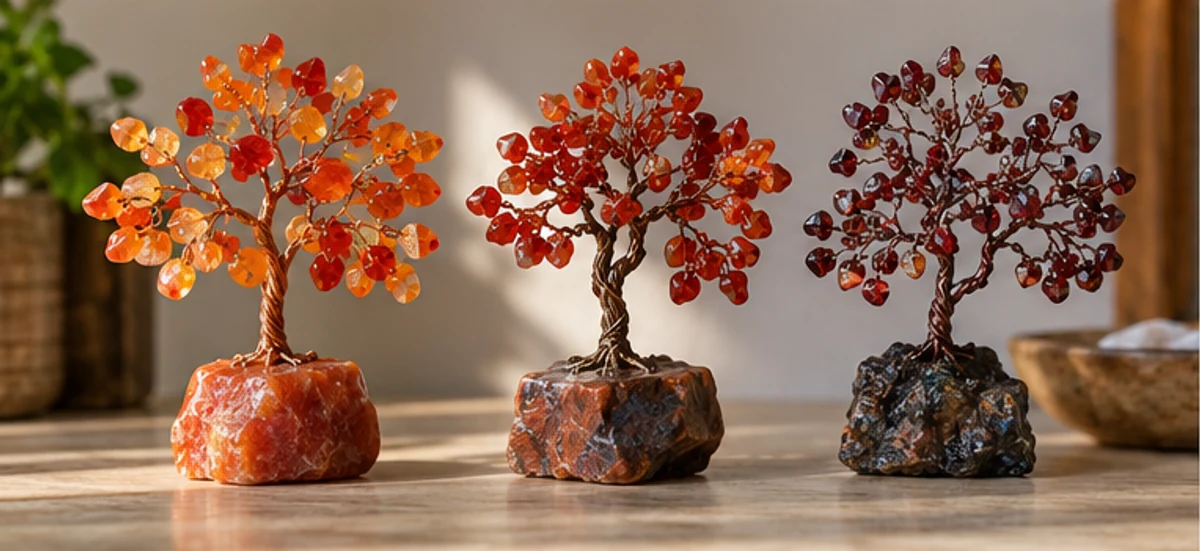
1. Three warm-coloured gemstone trees: the essential comparison
A gemstone tree is an assembled decorative object: mineral chips or polished beads are secured to wire branches and joined to a trunk and a base. The chip material affects colour and durability, while the wire, adhesive, base and canopy geometry affect the finished tree’s everyday usability. The same name may describe a compact, dense crown or a wide airy crown. A gemstone identity alone therefore cannot communicate every feature that matters to a buyer.
Warm colours have different uses in a lived-in Indian home. A carnelian tree can create an energetic orange accent near a workspace; red jasper can produce a quieter brick-red impression beside terracotta or natural wood; and a deep garnet arrangement can appear formal or contemplative near a bookcase. These are visual and symbolic choices, not interchangeable mineral materials. Begin with the finished tree’s proportion and actual component description, not claims that the deepest red must be the most valuable.
| Feature | Carnelian | Red jasper | Garnet |
|---|---|---|---|
| Material family | Chalcedony; fine-grained silica | Opaque silica-rich jasper/chert | Several related silicate mineral species |
| Usual warm palette | Orange to orange-red, brownish orange | Earthy red, brick red, rusty red | Wine red, purplish red, brownish red; other colours exist |
| Light transmission | Commonly translucent to semi-opaque | Predominantly opaque | Transparent to opaque depending on chip and species |
| Typical Mohs hardness | About 6.5–7 | Approximately 6.5–7 | About 6.5–7.5 across the group |
| Visual character | Warm glowing edges | Solid grounded colour | Dark, rich colour; often brighter at thin edges |
| Treatment question | Heat enhancement and dye disclosure | Dye, heat or surface treatment disclosure | Species identity, unusual treatment and possible filler |
| Tree-specific issue | Chip holes and consistent translucent edges | Heavy-looking opaque crown and base balance | Species and chip quality versus dark photography |
2. Carnelian: orange-red chalcedony and the role of iron
Carnelian is a variety of chalcedony, a fine-grained form of silica rather than a red garnet. Its classic colour runs from yellowish orange to red-orange and brownish red. Finely dispersed iron compounds are responsible for the warm appearance. Different chip thicknesses, polish quality and internal cloudy zones can make one carnelian tree show light and dark tones without the stones being defective. A thin chip held toward a diffuse light source often looks brighter than the same chip in a densely overlapping crown.
Heating of iron-bearing chalcedony can intensify orange and red tones, and dyed or otherwise enhanced material is also encountered in the market. A real chalcedony chip can still be treated. Therefore ask the seller about natural material identity and colour treatment as separate questions. A uniform highly saturated colour may warrant a closer look, but a photograph alone is not a treatment test; naturally coloured and treated pieces can overlap in appearance. Avoid destructive scratching, hot-needle experiments and household acid tests on a finished tree.
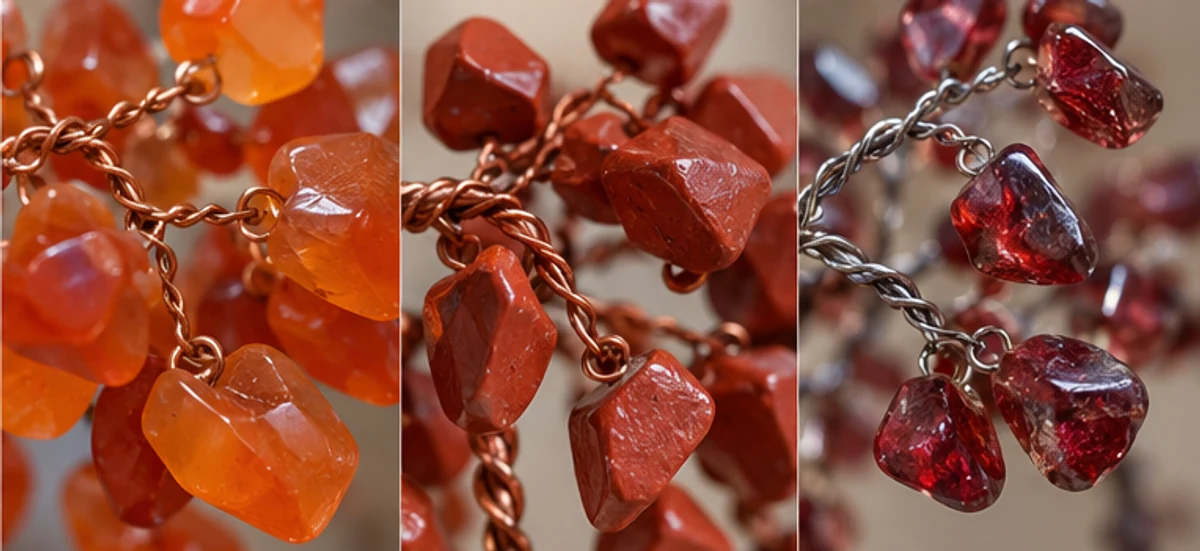
For a carnelian tree, the useful photo sequence includes an overall view, a chip detail in diffused daylight, a close-up of drilled holes or wire loops, the underside of the base and an image of the tree at true room scale. The hue should be evaluated across several chips rather than one perfect specimen. A natural material claim should be specific to the actual chip lot, not inferred from the orange-red product category or from a sample certificate belonging to a different item.
| Observation | Useful interpretation | What it cannot prove |
|---|---|---|
| Light passes through thin chip edges | Consistent with translucent chalcedony | Not a complete proof of carnelian identity |
| Orange, coral and brownish-red variation | Can be normal within one stone lot | Does not establish untreated origin |
| A very uniform cherry red | Reason to ask about dye or heat enhancement | Not itself evidence of a counterfeit |
| Dark spots near drilled holes | Inspect for dye accumulation and chip fractures | Not a conclusive home test |
| Smoothed, rounded chips | Less snagging than sharp fractured fragments | Does not prove durable wirework |
3. Red jasper: opaque, iron-rich earth tones
Red jasper is typically an opaque silica-rich ornamental material coloured by microscopic iron oxides and other impurities. The word “jasper” has a long commercial history and is not restricted to a single strictly defined mineral species: some marketed jaspers are impure chalcedony or chert, and some descriptive trade names cover other rocks. For the tree in front of you, “red jasper chips” is most meaningful when the seller can identify the actual material and disclose any colouring or reconstruction.
Unlike carnelian, red jasper generally does not offer pronounced light transmission through individual chips. It creates an earthy, weighty visual impression even when each chip is small. Naturally varied red and ochre markings are possible; a repeated pattern need not mean machine printing, and perfect uniformity is not required for genuine material. A few cream, brown or black markings can be mineral features rather than defects. The final aesthetic depends on how these shades are distributed throughout the canopy.
The density of an opaque crown can conceal thin or poorly secured branches. When examining a red jasper tree, gently inspect how branches are joined to the trunk without forcing them; check whether chip clusters twist freely and whether the base stays level. Even a chemically durable stone can crack if the wire loop is overtightened or the object falls from a shelf. A stable, compact crown may be a better purchase than a wide impressive crown on a poorly matched small base.
| Feature | Prefer | Ask more questions when |
|---|---|---|
| Material name | Red jasper with honest description of natural variation | Seller uses vague “red crystal” for every chip |
| Surface | Consistent polish, comfortable chip edges | Colour residue appears on packaging or cloth |
| Pattern | Natural variation, visible macro pictures | All product photographs conceal the chip details |
| Treatment | Clear disclosure of dye, resin or other enhancement | Product claims “untreated” without supporting basis |
| Assembly | Secured loops, covered wire ends, sturdy base | Loose chips, exposed sharp ends or rocking base |
4. Garnet: a mineral group, not merely a dark red trade name
Garnet is a group of related silicate minerals, not a synonym for every burgundy gemstone. Common red gem garnets include almandine, pyrope and intermediate compositions, while other garnets can be orange, green, yellow or even colour-changing. GIA lists Mohs hardness around 6.5–7.5 for the group, and the International Gem Society describes the variation among red garnet types. A seller who says “garnet chips” may not know the exact species; claiming a particular species, origin or grade should require evidence appropriate to that claim.
Small red garnet chips may become nearly opaque when several overlap in a tree crown. Under diffuse backlighting some edges can glow red or purplish red. This effect is affected by thickness, cut, polish and lighting; a dark indoor appearance does not mean that a chip is poor quality. Conversely, a bright clear-red chip should not automatically be advertised as top-grade almandine or pyrope. Ask for normal-room photographs alongside the bright close-up so the whole object is accurately represented.
Garnet is usually sold without routine colour enhancement, although exceptions and occasional fracture-related treatments exist. There is no universal “AAA garnet” grading system that independently certifies a gemstone tree. A report identifying one garnet sample does not certify the whole crown, and an appraisal for a single cut jewel cannot be transferred to mixed chips. For professional buying, identify what the report tests, the material sample size, whether the chips are one lot, and the limits of the stated result.
| Term | Meaning | Buyer caution |
|---|---|---|
| Garnet group | Related mineral species; not just one red stone | Do not infer a species from colour |
| Almandine | Often deep red to brownish-red iron-bearing garnet | Not every dark red chip is almandine |
| Pyrope | Magnesium-rich garnet, often red to purplish red | Some natural gems fall between species end-members |
| Rhodolite | Purple-red gem material commonly of almandine-pyrope composition | Trade variety label should match the tested material |
| Hessonite (Gomed) | Orange-brown grossular garnet used in Jyotish contexts | Not the same as a generic red-garnet decorative tree |
| AAA grade | Seller-defined commercial quality term | Not a standard proof of mineral identity or laboratory grading |
5. Carnelian vs jasper vs garnet: simple identification without damaging the tree
Appearance can suggest which material deserves closer testing, but colour is not a conclusive mineral test. Carnelian and red jasper overlap because both are fine-grained silica-rich materials; garnet belongs to a different mineral group. The diagnostic methods a gemmologist chooses depend on the form of the specimen and may include microscopy, refractive-index measurements on suitable polished material, spectroscopy or other non-destructive laboratory techniques. Such testing is not always possible on an assembled tree without removing a chip.
At home, begin with non-destructive observations: compare translucence in indirect light, look for surface coatings or unusually uniform dye at holes, and examine close-up images for cracks or adhesive. The goal is to identify what needs clarification, not to claim laboratory certainty. Be especially cautious of simple internet tests involving heat, solvents, household acid or scratching: these can damage finishes, adhesives, metal wire and genuinely valuable stones while providing unreliable conclusions.
| Question or observation | Why it helps | Limit |
|---|---|---|
| Can a thin carnelian edge transmit light? | Supports a chalcedony-style appearance | Some other minerals and glass also transmit light |
| Is red jasper uniformly opaque? | Common feature of typical red jasper | Some red silica materials overlap visually |
| Does a dark garnet chip redden against light? | Explains attractive dark-to-light appearance | Not a species identification test |
| Was the material heated or dyed? | Separates natural origin from treatment status | Requires reliable seller or testing evidence |
| Does the listing give actual chip and base details? | Verifies the complete product, not just a mineral name | Dimensions still require an actual-item check |
| Does the certificate describe the lot or one sample? | Clarifies the report’s scope | One sample cannot certify the entire assembled object |
6. Stone colours, traditional symbolism and Kalpavriksha
The image of a flourishing tree carries deep significance in India. Kalpavriksha, the wish-fulfilling tree, is associated with abundance, continuity and auspicious aspiration. The Indian Museum, Kolkata, preserves a sandstone Kalpavriksha relief from Besnagar in which its branches carry objects associated with prosperity. A modern wire-and-gemstone tree draws on a broad cultural symbol; it should not be described as the exact ancient artefact or as a mandatory component of every traditional household shrine.
When choosing a gift or personal display, colour provides a second symbolic layer. Orange-red carnelian can represent enthusiasm, initiative and warmth in contemporary crystal practice; red jasper can suggest stability, patience, the earth element and grounded effort; deep red garnet can signify commitment, strength and mature affection. These associations support a meaningful Sankalpa—a clearly stated intention—especially when linked to real action such as beginning a study routine, welcoming guests or tending a business responsibly.
A well-chosen gemstone tree need not imitate a classical temple object. It can be placed on a clean shelf, beside an account ledger, near books or in a reception area. A family may keep it as a symbol of progress; a shop owner may connect it with a sincere intention for honest commerce; a friend may give it to mark a new home. Those uses gain depth from the Kalpavriksha motif without requiring every stone choice to be presented as an ancient prescription.
| Gemstone tree | Common symbolic emphasis | Suitable personal Sankalpa |
|---|---|---|
| Carnelian | Vitality, initiative, warm welcome | “May I approach new work with attention and courage.” |
| Red jasper | Prithvi, steadiness, patience | “May this household grow with stability and care.” |
| Garnet | Commitment, endurance, depth of feeling | “May effort and relationships mature with integrity.” |
| Mixed red and orange tree | Different expressions of active and grounded energy | “May enthusiasm be supported by dependable action.” |
7. Vastu, the five elements and the eight directions
Vastu draws upon spatial order, orientation and the Pancha Mahabhuta: Prithvi (earth), Ap or Jala (water), Agni (fire), Vayu (air) and Akasha (space). Warm red and orange decorative stones are frequently associated in modern colour-based Vastu practice with Agni and, for more opaque earthy stones, Prithvi. These are useful interpretative associations, but different teachers and household traditions apply different schemes; a commercially marketed red gemstone tree is not an automatic corrective for a measured architectural Vastu defect.
Directions also require understanding of actual room use. The southeast (Agneya) is traditionally associated with Agni; the northeast (Ishanya) is often kept suitable for prayer and reflection; north and other orientations have their own inherited associations. A visually intense orange or burgundy tree may work best where it does not crowd a puja seat or interrupt daily activities. Do not reduce Vastu decisions to a simple rule that the same red stone must be installed in the same direction in every building.
In a one-bedroom Bengaluru apartment, a small carnelian tree on a stable study desk may communicate productive energy better than a large object crowding the kitchen counter. In a family living room, red jasper may suit a low wooden cabinet away from children’s play areas. In a jewellery showroom, a garnet tree can provide a rich colour accent near information on the material, provided it is secure and not in a location where hands or bags will brush the wire branches.
| Area or direction | Traditional association | Considerations for an actual tree |
|---|---|---|
| East (Purva) | Dawn, Surya, new beginnings | Keep morning-light exposure and easy cleaning in mind |
| Southeast (Agneya) | Agni and activities involving heat | Warm colour can be decorative; avoid heat, oil and moisture |
| South (Dakshina) | Different directional guardianship in Vastu texts | Choose stable furniture rather than a forced placement rule |
| Southwest (Nairritya) | Heaviness, stability in many Vastu systems | A small jasper tree may visually suit a quiet solid surface |
| North (Uttara) | Kubera in common directional traditions | A business owner may prefer an uncluttered accounting shelf |
| Northeast (Ishanya) | Prayer and contemplation | Use restraint with a large, strongly coloured crown |
| Other directions | Context depends on floor plan and use | Prioritize safety, access and coherent room arrangement |
8. Jyotish: Mangala, Surya, Rahu and the meaning of Gomed
A decorative red tree is not automatically a prescribed Jyotish Ratna. Planetary gemstone selection in traditional Jyotish may consider Lagna, Rashi, Nakshatra, Graha placement, Dasha–Antardasha, house lordship, aspects and the purpose of the consultation. A generic product’s colour does not supply these details. A red jasper or carnelian tree can be used for a personal Sankalpa even when no chart-based gemstone recommendation has been made.
Warm red colours are associated by some contemporary practitioners with Mangala (Mars) and orange-gold tones with Surya. Garnet requires special care in terminology because Gomed (Hessonite) is a particular orange-brown grossular garnet traditionally connected with Rahu in Navagraha gemstone systems. It is inaccurate to call any dark red garnet tree “Gomed” or to conclude that every garnet chip is a Rahu gemstone. Likewise, a red ornamental tree is not a substitute for the distinct material and setting prescribed in an individual Jyotish recommendation.
A respectful devotional presentation can mention the intended puja or Sankalpa without implying the object automatically changes a planetary condition. If a customer seeks a chart-specific gemstone, the appropriate process is an individual assessment and clear identification of the recommended material. For general home gifting, the tree’s cultural symbolism and the recipient’s preferences may be more relevant than any planetary label.
| Term | Context | Important distinction |
|---|---|---|
| Mangala | Mars; red and strength symbolism in many practices | No universal chart recommendation from a red object alone |
| Surya | Sun; activity and illumination symbolism | Carnelian colour alone does not prove a Surya remedy |
| Rahu / Gomed | Hessonite garnet in traditional Navagraha practice | Generic red garnet chips are not automatically Hessonite |
| Muladhara | Root chakra in modern stone-colour pairings | Colour-chakra maps vary across teachers and traditions |
| Svadhishthana | Sacral chakra often associated with orange in popular schemes | A contemporary association, not a test of mineral identity |
| Kalpavriksha | Auspicious tree motif in Indian cultural traditions | Modern gemstone trees are contemporary interpretations |
9. Chakra colour associations without confusing materials
Modern seven-chakra gemstone arrangements commonly associate red with Muladhara and orange with Svadhishthana. A red jasper tree may therefore be selected as a visual reminder of grounding, while carnelian is often chosen for an orange-colour meditation setting. Garnet’s deeper red can fit a more contemplative symbolic arrangement. These associations come from contemporary colour-based crystal practice interacting with older chakra vocabulary; individual traditions need not assign the same mineral to the same chakra.
For an altar or meditation corner, leave sufficient physical space around the object. A tree with a stable base can stand beside a lamp and book, but never near a naked flame, where wax or incense ash can reach the chips or metal. A few minutes of mindful placement, prayer or deliberate intention can be more meaningful than filling a small shelf with many similar objects whose materials and upkeep are not understood.
10. Construction matters: chips, wires, canopy and base
A gemstone tree is vulnerable at its connections. Examine the chip-to-wire loop: edges should not dig into a fragile stone or leave exposed needle-like wire ends. Branches should be shaped firmly but not overtightened. A trunk may be twisted from several wires; check that the twist ends cleanly at the base and does not cut into the decorative finish. Material names such as “copper-colour wire” and “gold-colour trunk” describe a surface appearance, not proof of copper or precious-metal content.
A large canopy can act as a lever on a small base. Height alone is an incomplete size measurement: ask for total width, greatest branch spread, base footprint and overall weight. Evaluate stability on a level surface and inspect photographs of the actual underside, glue joints and attachment holes. The assembled object may contain natural stones, plated wire, resin or adhesive and a mixed rock base; a claim that the “entire tree is 100% natural gemstone” is rarely a complete description of every component.
Carnelian chips are often translucent enough to reveal small holes; jasper fragments can have irregular dense shapes; garnet fragments may be thicker and darker. These differences influence how an attractive crown is distributed. A less crowded design can be more durable and show its stones more clearly than a very full canopy. Good workmanship does not mean artificially identical branches; it means clean joins, sensible balance and no obvious shipping damage.
| Part | What to inspect | Potential warning |
|---|---|---|
| Gemstone chips | Material consistency, rounded edges, cracks | Chips loose, chipped or disproportionately sharp |
| Wire loops | Firm attachments, no wire ends protruding | Exposed tips or twisted wires cutting into stones |
| Crown shape | Balanced spread and proportion | Weight concentrated on one side |
| Trunk | Secure joins and appropriate finish | Loose windings or flaking surface |
| Base | Level underside and good attachment | Rocking, fresh cracks or exposed adhesive |
| Weight and dimensions | Actual height, width, base footprint | “Large” used without measurements |
| Treatment documentation | Clear chip material and enhancements | Unsupported all-natural or certification claims |
11. Choosing the right tree for home, office, retail or gifting
A small urban apartment may favour a restrained carnelian or red jasper tree with a manageable base. For a work desk, aim for a shape that does not block a screen, notebook or electrical socket. In a consultation room, the tree can be a focal point that invites discussion of colour and materials; it should not distract from the advice given to a visitor. In a large foyer, a wider crown can work visually if it is kept away from door swings, children and heavy foot traffic.
For gifting, first understand the recipient rather than prescribing a stone by label. An artist may prefer carnelian’s lively translucent chips, a person who enjoys earthy crafts may prefer red jasper, and someone with a preference for darker jewel tones may choose garnet. A handwritten note explaining Kalpavriksha and the intention behind the gift is more personal than a generic promise. Include the actual stone description and simple care instructions with the package.
| Setting | Possible selection | Reason for the choice |
|---|---|---|
| Bengaluru study desk | Small carnelian tree | Warm orange focal point with a narrow footprint |
| Family living-room shelf | Compact red jasper tree | Earth-toned, opaque chips coordinate with wood or terracotta |
| Jewellery showroom display | Deep red garnet tree | Rich colours can complement material education |
| New office reception | Medium carnelian–jasper mix where accurately labelled | Balanced warm palette and practical size |
| Housewarming gift | Recipient-chosen red or orange tree | Personal preference and Kalpavriksha symbolism |
| Professional Vastu reference kit | Separate labelled samples or distinct trees | Preserves identification and comparison value |
12. A practical buyer checklist for gemstone-tree authenticity
Before ordering, request actual-product photographs and a component-specific description. A product can be beautifully handmade while still containing heated carnelian, a dyed chip lot or plated wire; good disclosure does not diminish the craftsmanship. The question is whether the buyer receives the material and construction described. A seller should distinguish laboratory conclusions, sourcing statements and visual impressions rather than mixing them into a single “certified original” slogan.
- Confirm whether the crown is carnelian, red jasper, garnet, a mixed-stone design or a colour-themed imitation.
- For carnelian, ask whether colour was heated or dyed, and whether all chips belong to the same specified batch.
- For red jasper, clarify opaque silica-rich material versus an unrelated “jasper” trade name.
- For garnet, ask whether a species is actually identified or whether “garnet group” is the reliable description.
- Check whether any laboratory report is for one stone, a sampled lot, or the finished object; do not transfer its scope.
- Request real measurements in centimetres and grams, including maximum crown width and the base footprint.
- Review front, side, underside and close-up photographs, preferably in normal room light.
- Inspect wire ends, chip loops, visible adhesive, base cracks and the overall balance of the crown.
- Ask which colours are due to coatings or plated wire rather than solid metal, and how to clean the finish.
- Check the return/damage procedure and whether the seller will supply the actual pictured style or a varied handmade equivalent.
- Confirm packaging keeps the canopy, base and neighbouring branches from striking one another.
- Choose the tree for real space, personal taste and intended symbolism rather than relying solely on a planetary claim.
13. Realistic quality grading and price comparisons
Two similar red trees can differ in cost for legitimate reasons: gemstone species, chip size and finish, labour for attaching hundreds of pieces, base size, packaging and seller service. A dense crown is not always the better product; many small chipped fragments may create high stated counts while a carefully balanced tree with fewer sound chips can display better. A very dark garnet tree cannot be valued from photographs as if all chips were individual jewellery-grade faceted garnets.
Treat words such as premium, AAA, 100% natural, vastu activated and certified as claims requiring appropriate specifics. An invoice should describe the actual goods, not a universal effect. Check whether the product is sold by overall height, number of chips, base dimensions, total weight or stone weight; these measurements are not interchangeable. Before comparing prices, ensure both products have similar size, materials, workmanship and after-sales conditions.
14. Safe cleaning: respect the whole mixed-material tree
A loose piece of chalcedony may tolerate cleaning methods that are unsuitable for a completed tree. The assembly can include metal wire, plated finish, adhesive, porous base material and fragile chip connections. For routine upkeep, choose gentle dry dusting with a clean soft brush or dry microfibre cloth while supporting the base. Remove lint gently; do not hold a thin branch as the handle. For a sticky patch, request a material-specific cleaning method rather than soaking the object.
GIA recommends warm soapy water for many loose garnets but advises against steam cleaning; that advice does not mean the entire assembled tree should be immersed or steamed. Avoid household acids, saltwater bowls, abrasive compounds, incense oil, perfume, strong solvents and ultrasonic cleaners on an unknown mixed-material construction. Salt and moisture can accelerate deterioration of certain metals, and water can weaken adhesives or leave residues on the base. If there is active corrosion or a loosened branch, isolate the tree and seek appropriate repair rather than repeated home cleaning.
| Component | Routine care | Avoid |
|---|---|---|
| Carnelian chips | Soft dry dusting; inspect for coatings or dye | Unnecessary abrasive polishing |
| Red jasper chips | Dry cloth and support of branch | Soaking assembled wire and base |
| Garnet chips | Dry clean in assembly; inspect cracks and loops | Steam or ultrasonic cleaning of the finished tree |
| Plated wire | Dry cloth, minimal handling | Saltwater, polish chemicals and rough scrubbing |
| Glue or resin joints | Keep dry and free of strain | Heat sources and solvent-based cleaners |
| Rock/mineral base | Stable dry shelf with padding | Repeated lifting by trunk or branches |
15. Display conditions in humid or busy Indian homes
The stones may be relatively robust, but the finished object is not immune to the room. In Bengaluru’s monsoon months, keep gemstone trees away from damp window ledges and areas where a wet cloth is frequently used. In a jewellery shop, position them away from cleaning spray, customer bags and frequently handled trays. A room that receives strong afternoon sun may alter the apparent colour of translucent chips and accelerate ageing of some adhesives or coatings, so a stable indoor location is generally more sensible than a hot windowsill.
Dust accumulates between overlapping chips, particularly in a dense crown. Schedule brief cleaning rather than allowing buildup followed by hard scrubbing. When moving the tree, hold its base with two hands and support the trunk if needed; never lift it by a branch. If children or pets are likely to pull loose chips, keep the tree out of reach. Small loose stone pieces and wire ends are more important safety considerations than the metaphysical meaning assigned to a particular colour.
16. Packing, transport and unboxing
Before shipping, each branch cluster should have room to resist impact without rubbing repeatedly against neighbouring chips. Use soft clean barrier material, brace the base independently and place the protected item within an adequately cushioned rigid box. Avoid tape directly on stones or painted wire. Large and fragile canopies may need a shaped inner insert to prevent the tree from tipping during transport. Even hard stones can chip or fracture at drilled holes when they strike one another.
When unboxing, locate the base first, remove packing gradually and avoid pulling the canopy free by its outer tips. Photograph any damage before adjusting loose branches. Only gently move branches if the maker confirms the wire is intended for adjustment, and stop at resistance rather than repeatedly twisting the same point. Read the care information before putting the tree in a puja room or near a source of moisture. Retain the protective box if the tree is to be moved between seasonal displays.
| Stage | Check | Reason |
|---|---|---|
| Before packing | Photograph full tree and underside | Provides a record of original arrangement |
| Chip protection | Separate delicate clusters with soft padding | Reduces stone-on-stone abrasion |
| Base restraint | Brace base without pulling branches | Prevents impacts at the trunk connection |
| Shipping carton | Use a rigid box with cushioning | Reduces movement during transport |
| First unboxing | Support base and peel back packing | Avoids bending outer branches |
| Inspection | Look for loose chips, cracks, wire ends | Allows timely return or repair requests |
17. Three worked examples: home, shop and consultation
Example 1: a newly furnished Bengaluru apartment
A couple with limited shelf space wants one warm-coloured tree for a housewarming. They compare a 15-cm carnelian piece with a 27-cm sprawling red jasper tree. The smaller tree is the practical choice because it leaves room for books and daily dusting. They select it for its orange hue and Kalpavriksha symbolism, request the actual base width and confirm whether the carnelian colour has been enhanced. The choice is based on the shelf and the people, not an unsupported “universal southeast remedy” label.
Example 2: an OmmRudraksha-style jewellery showroom
A shop comparing natural-stone gift lines wants clear material education. Three distinct trees are displayed with accurate cards: carnelian (chalcedony, warm translucent tones), red jasper (opaque silica-rich ornamental material) and garnet (mineral group, species not separately confirmed). Under ordinary shop lighting the garnet tree appears darker, so a controlled chip close-up is available alongside the complete-object photograph. A small card explains treatments and care, and the staff can describe the difference between a decorative red-garnet tree and Jyotish Gomed without conflating them.
Example 3: professional Vastu reference and customer advice
A consultant uses three labelled trees to demonstrate how colour, material, height and direction interact within a home layout. Instead of presenting red trees as interchangeable Graha cures, the consultant records the client’s concern, available space, lighting and preference, then explains the traditional Prithvi–Agni colour symbolism and the limits of a visual demonstration. For a client specifically seeking a Graha-linked Ratna recommendation, the consultation proceeds through the relevant birth-chart method separately from decorative-tree selection.
18. Mistakes to avoid and a concise decision method
- Do not identify every burgundy chip as garnet or every bright orange chip as natural carnelian.
- Do not assume a stone is untreated merely because it is geologically natural.
- Do not treat a generic red-garnet tree as a certified Hessonite (Gomed) Navagraha item.
- Do not compare handmade tree prices solely by “number of stones” without size and construction details.
- Do not place a wired, glued decorative tree in a bowl of saltwater for routine spiritual cleaning.
- Do not use Mohs hardness as a promise that drilled chips, wire and base cannot break.
- Do not force branches to match a catalogue photograph if the wire is not made to be reshaped.
- Do not crowd a puja shelf or desk purely to satisfy an oversimplified direction chart.
Final decision method: First select the intended placement and overall size. Next choose the colour character—orange translucent carnelian, earthy red jasper or deep-red garnet. Verify the actual stone description and disclosed treatments. Inspect chip attachments, wires and base. Choose a meaningful Kalpavriksha or Sankalpa context that suits the recipient. Finally confirm packing, care and seller support. This sequence produces a more satisfying and defensible choice than relying on colour, astrology slogans or gemstone names alone.
19. Frequently asked questions
Are carnelian and red jasper the same stone?
No. Both are silica-rich materials, but carnelian usually refers to orange-to-red translucent chalcedony, while red jasper is generally opaque and includes additional fine mineral impurities. Their typical visual character differs.
Is carnelian always naturally red?
No. Carnelian is natural silica material, but heat enhancement and colouring occur in trade. Ask the seller to disclose treatments and distinguish natural origin from untreated colour.
Can I identify carnelian by holding it up to sunlight?
Some carnelian chips transmit warm light at their thin edges, but several other materials do too. It is a useful observation, not a reliable stand-alone identity test.
Why does a red jasper gemstone tree look more opaque?
Red jasper generally contains fine-grained silica and colouring inclusions that produce an earthy opaque appearance. Garnet or carnelian can transmit more light depending on thickness and the actual specimen.
Is a dark garnet tree poor quality?
Not necessarily. Deep garnet chips can look very dark in indoor light. Judge the tree through real-room photos, accurate material information, a stable crown and appropriate workmanship.
Does garnet always mean Gomed?
No. Gomed refers to hessonite, a particular garnet variety in traditional Jyotish practice. Generic red garnet or almandine chips should not be labelled Gomed without material confirmation.
Are red gemstone trees associated with Mangala?
Some colour-based traditions associate red with Mangala, but choosing a planetary Ratna from a birth chart is a separate practice. A decorative tree does not independently establish a Graha recommendation.
Which of these trees is best for a study desk?
Choose the size and colour that suit the desk. Carnelian creates a lively warm accent; jasper a grounded red; garnet a darker jewel tone. Keep the tree stable and outside the active writing area.
Where should a red gemstone tree be placed according to Vastu?
Placement depends on the full room layout and intended use. Southeast/Agneya is associated with Agni in common Vastu schemes, but no single direction is mandatory for every red gemstone tree.
Can I keep a carnelian tree in a puja corner?
Yes, as a decorative or devotional object if it fits comfortably and safely. Keep it clear of open flames, oil, ash and any ritual water that could damage the assembled materials.
What is the link between gemstone trees and Kalpavriksha?
A modern gemstone tree uses the form of a flourishing tree to evoke growth and abundance. Kalpavriksha is a much older wish-fulfilling-tree motif in Indian traditions, not a label proving the mineral quality of a commercial product.
Can a certificate establish that every gemstone chip is genuine?
Only if the report actually covers those chips and defines its sampling and testing scope. A report on a single loose stone does not automatically certify an entire assembled tree.
How do I compare two trees listed as 300 chips?
Check chip size, species, treatments, overall crown spread, wire joints, base footprint and actual photographs. Equal stated counts do not guarantee equal workmanship or value.
Should a real garnet tree be heavier than a carnelian tree?
Individual garnet minerals can be denser than chalcedony, but a complete tree also contains varying amounts of stone, wire, adhesive and base. Whole-tree weight is not a reliable identification test.
Is it safe to wash a gemstone tree with water?
Routine dry dusting is safer for most finished trees because they contain wire, plated surfaces and adhesives. Cleaning advice for a loose gemstone does not automatically apply to its assembled decorative tree.
Can I purify a tree using saltwater or incense oil?
Avoid applying saltwater or oils directly to an unknown mixed-material tree. Those substances can damage wires, coatings, glue and bases. Devotional intention or prayer can be expressed without putting the object in liquid.
Can I bend the branches after delivery?
Only when the maker confirms the branches are designed for adjustment. Repeated bending at one point causes wire fatigue and can loosen drilled gemstone chips.
What if a chip falls from the tree?
Keep the loose piece away from children and pets, photograph the attachment point, and request the maker’s repair guidance. Avoid adding random adhesive that could permanently mark the stone.
Can I give a garnet tree as a housewarming present?
Yes, if the recipient appreciates its deeper red palette and you verify material, size and construction. A short note about Kalpavriksha and personal intention can make the gift more meaningful.
Which is best: carnelian, red jasper or garnet?
There is no universal winner. Carnelian favours translucent warmth, red jasper earthy opacity, and garnet rich depth. Choose by intended room, authentic material disclosure, stable craftsmanship and personal meaning.
20. Research and editorial terminology
Mineral identity and carnelian treatment descriptions were checked against the International Gem Society and geological reference material; jasper terminology against Mindat and the International Gem Society; garnet species, hardness and care against GIA and the Indian Bureau of Mines. The Kalpavriksha reference was checked against the Indian Museum, Kolkata. Mixed-material and metal-component care was informed by the Canadian Conservation Institute. These source names are given for editorial transparency without embedding external shop or competitor links. Individual gemstone trees should be described according to their actual materials, treatments, construction and photographs.
