
Black tourmaline and black obsidian gemstone trees can look similar from across a room, yet their materials, textures, durability and meanings differ. Black tourmaline usually refers to the iron-rich tourmaline mineral schorl, a crystalline borosilicate that may show prismatic, lengthwise-striated surfaces. Black obsidian is naturally formed volcanic glass, typically with an intensely glassy polish and the potential to form sharp curved fractures. A jewellery shop, a family puja room and a professional Vastu workspace may therefore choose different trees even when all three prefer an understated black accent.
A proper comparison begins with the material of the actual chips, not the colour name in a product listing. It continues with the construction of the tree: branch wire, chip attachment, trunk, adhesives and base. This guide also explains the sacred-tree symbolism of Kalpavriksha, contemporary protective associations of dark stones, Vastu directions, buying questions and gentle maintenance without reducing Indian traditional significance to generic interior styling.
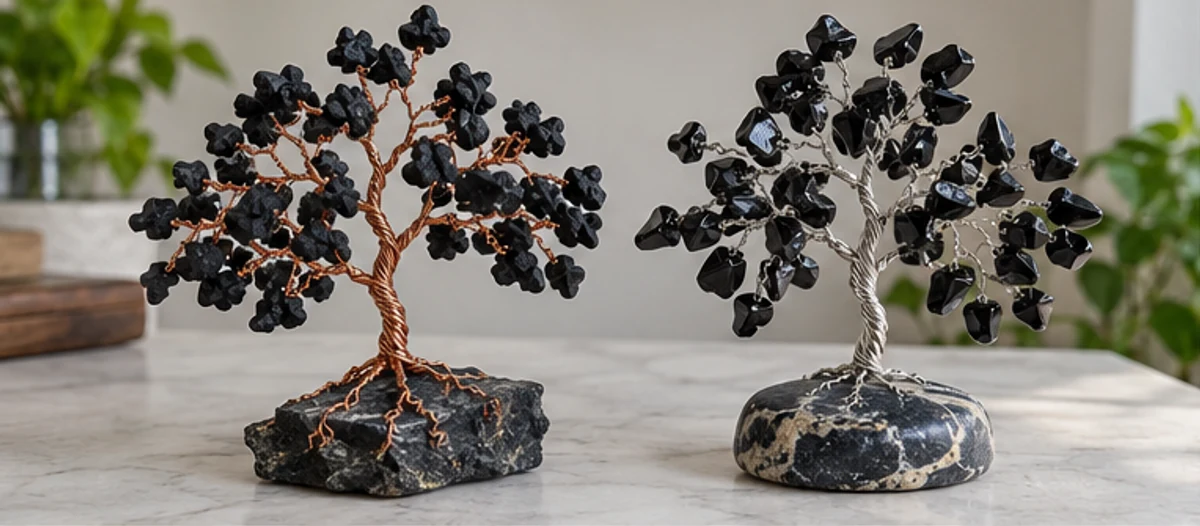
1. Black tourmaline versus black obsidian: an at-a-glance comparison
| Feature | Black tourmaline tree | Black obsidian tree |
|---|---|---|
| Principal material | Usually schorl, a tourmaline-group crystalline mineral | Obsidian, natural volcanic glass |
| Typical appearance | Black, often with uneven or longitudinally striated crystal-chip faces | Black and strongly glassy; some pieces show subtle flow or sheen |
| Mineral structure | Ordered crystal structure, trigonal | Amorphous glass; no regular crystal lattice |
| Approximate hardness | Schorl about 7; tourmaline generally 7–7.5 on Mohs scale | Commonly about 5–5.5 on Mohs scale |
| Fracture and handling | Brittle chips can fracture or split along irregular surfaces | Conchoidal fracture may create extremely sharp edges |
| Relative feel | A grainy, ribbed or vitreous surface is possible | A smoother polished-glass impression is common |
| Main assembly concern | Loose angular chips, exposed wires and crystal-end breakage | Edge chips, sharp fragments and glass-to-glass abrasion |
| Symbolic preference | Contemporary grounding, stability and boundaries | Contemporary reflection, clarity and protection symbolism |
| Safe default care | Gentle dry dusting of the complete assembled tree | Gentle dry dusting or careful soft wiping; avoid scrubbing glass |
| Identification limit | Black colour and striations are clues, not laboratory proof | Gloss and conchoidal appearance are clues, not proof of volcanic origin |
The chart compares commonly encountered materials, not every possible commercial product. A merchant might sell a dark mixed-material tree containing obsidian, onyx or reconstructed chips while using a broad “black crystal tree” name. Likewise, black tourmaline may be intergrown with quartz or host rock. A tree does not become more authentic because the photographs are dramatic or because the chips appear perfectly uniform. When material identity matters, ask about the actual stone constituents, treatments, supporting evidence and possible substitutions.
2. What is black tourmaline, and what does schorl mean?
Tourmaline is a family of closely related borosilicate minerals, rather than a single chemistry covering every coloured gem. In everyday gemstone-tree descriptions, black tourmaline typically means schorl, a sodium-iron-aluminium tourmaline. Schorl is characteristically bluish black, brownish black or deep black; its crystals often grow in elongated prisms with visible lengthwise striations. A small chipped tree component may display only part of that shape because it has been cut from a crystal, tumbled or polished.
Mindat describes schorl as a valid mineral species with a Mohs hardness around 7 and a specific gravity near 3.18–3.22. These are mineral reference values, not a promise that every stone chip in a finished tree has precisely the same density or appearance. Other tourmaline-group minerals can also look black, so the correct identification might require professional mineralogical assessment. Neither a visual photograph nor a home scratch test can reliably establish mineral species or treatment history across a whole assembled ornament.
Natural tourmaline often has growth lines, imperfect fracture faces and visible inclusions. A glossy finish does not rule out natural schorl, and a rough finish does not prove it. Examine several chips in neutral light. Their individual edges should be appropriately secured, with no visibly detached fragments and no unfinished wire tips projecting where the tree will be handled. Some tourmaline chips may include pale host material; that is not automatically a defect, but the merchant should describe a predominantly schorl tree accurately if composition is mixed.
Crystalline is a geological term here. It does not make schorl a replacement for other minerals used in traditional Indian Jyotish, nor does it turn the assembled gemstone tree into an ancient ritual instrument. The scientific identity of the chips and the spiritual interpretation of the ornament are related to different questions. Being precise about both gives a buyer a clearer choice.
3. What is black obsidian, and why is it called volcanic glass?
Obsidian forms when suitable silica-rich lava cools so rapidly that much of the material does not form ordinary mineral crystals. The resulting natural glass can be black, dark brown, grey or differently coloured according to chemistry and inclusions. Black obsidian is often highly reflective after polishing, but natural glass can also be dull or irregular where it has fractured. The USGS describes obsidian and other geological references describe obsidian's volcanic origin and characteristic curved or conchoidal fracture.
That conchoidal fracture is both a mineralogical clue and a practical handling issue. Obsidian was historically used for cutting tools because a fresh fracture can produce an extremely sharp edge. On a finished gemstone tree, a small broken chip can retain that edge. Buyers should not deliberately break or scratch any chip to “prove” authenticity. If a loose shard is visible, set the tree aside, protect hands from the damaged area and contact the seller about repair or replacement.
Natural obsidian is not the same as factory-made black glass. Both may be shiny and dark, and both can fracture sharply. Colour and gloss cannot prove that an ornament uses genuine volcanic glass. Natural obsidian sometimes contains bubbles, flow patterns, small mineral inclusions or optical sheen; manufactured glass can also contain bubbles and deliberate visual effects. Experienced gemmologists may assess refractive index, structure and other properties, while a customer should rely first on an accurate seller description and applicable evidence.
A single obsidian tree might contain plain black chips, sheen obsidian or a mix of darker and lighter varieties. The term black obsidian should not be stretched to include every black polished stone. Obsidian is a specific natural glass, while black onyx, black agate, hematite and tourmaline are different materials that can reasonably appear in separate tree designs.
4. What to look at on actual gemstone chips
A macro photograph is helpful for evaluating colour, finish and attachment, yet it is not a laboratory identification. Inspect multiple chips rather than making a decision from one impressive close-up. For dark materials, a neutral grey background and a diffuse source of light usually reveal more than a dramatic black backdrop.
| Observation | Tourmaline interpretation | Obsidian interpretation | What to do next |
|---|---|---|---|
| Fine parallel grooves | May be compatible with natural tourmaline crystal striations | Not a typical obsidian crystal habit | Ask for a magnified image of several chips |
| Bright mirror-like surface | Possible on polished tourmaline | Common on polished obsidian glass | Treat gloss as an appearance feature, not proof |
| Irregular matte surface | Possible rough crystal or a less-polished fragment | Possible weathered or fractured glass | Check actual mineral claim and finish |
| Smooth curved break | Some minerals can fracture in curved ways | Characteristic of conchoidal glass fracture | Do not create a test break; inspect for hazards |
| Very even black colour | Not inconsistent with natural schorl | Not inconsistent with natural obsidian | Ask whether chips were coated, dyed or substituted |
| Pale or grey inclusions | Could be host minerals or mixed material | Could be crystallites or other inclusions | Request honest description of mixed components |
| Identical mass-produced shapes | May be processed natural material | May be processed natural material or manufactured glass | Ask about cut, assembly and source of chips |
A crucial limitation: a tree often combines small stones with metal wire and glue, so hardness, refractive-index or specific-gravity tests on a finished tree can damage it or yield misleading results. Do not use acids, flame, scratching, breaking or magnets as improvised authentication methods. If a high-value claim depends on unambiguous mineral identification, request a report applicable to the exact material sampled and understand its scope.
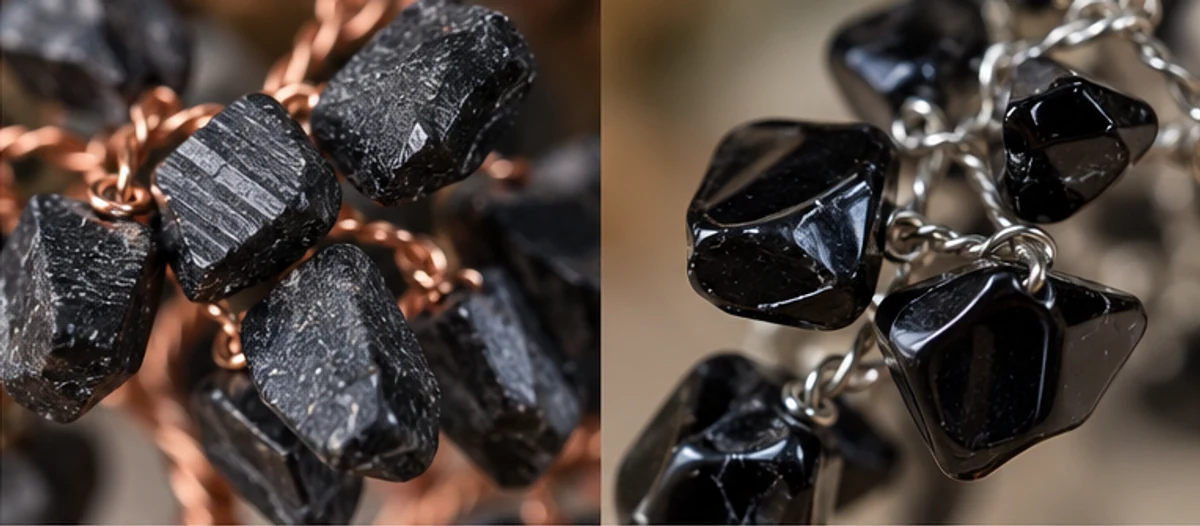
5. Surface texture, fracture and the appearance of the complete tree
Black tourmaline can give a finished crown a more rugged, mineral-textured character. Some chips carry ribbed crystal surfaces; others are smoothed by tumbling. That combination may work well beside warm wood, a light stone shelf or a muted wall. The crown's visual quality comes from how several branches overlap, not from every chip being an identical glossy nugget.
An obsidian tree often looks more glasslike, especially when the chips are rounded and polished. Under direct light, individual chips may reflect bright highlights; in indirect light, the same tree can appear almost uniformly dark. Strong spotlighting can show every wire loop and glue point, while diffuse lighting may better display the complete form. A customer should compare at least one whole-tree photograph under ordinary light and one close-up of the materials.
Do not confuse the visual appeal of a stone with its resilience. Obsidian's relatively lower hardness can allow abrasive rubbing by hard dust or adjacent minerals, and its brittle fracture means knocks deserve attention. Tourmaline is harder, but hard does not mean unbreakable: a slender crystal chip, poorly secured branch or exposed corner can still fail. In both cases the stability of the entire assembly may matter more than the mineral hardness of one chip.
The same tree can look different in three places
A tree on a dark television console may merge into the background. On a pale shelf it may create a crisp silhouette, while in a glazed display case reflections can exaggerate the glossy material. If the plan is for a meditation seat, choose a position that remains visually calm without requiring a large or elaborate tree. If it is for a shop, make sure the chosen surface does not obstruct staff movement or customer access to products. For a desk, prefer a broad, stable base and branch tips away from routine hand or cable movement.
6. Kalpavriksha: why a gemstone tree has meaning beyond its mineral
The broader Indian symbolism of the Kalpavriksha or wish-fulfilling tree provides a meaningful interpretive background for modern gemstone trees. The tree form evokes rootedness, growth, continued blessings and the fruits of worthy effort. The Indian Museum, Kolkata, records a historic Besnagar Kalpavriksha sculpture depicting a flourishing tree carrying signs of abundance, including coin purses and treasures. That heritage is richer than the simplistic claim that any particular black mineral automatically produces prosperity or protection.
The metaphor unfolds through the object. Roots and base suggest stability, the trunk strength and continuity, branches the extension of family or livelihood, and the gemstone leaves the aspirations entrusted to the space. A person choosing a black tourmaline tree for a demanding workspace may see it as a reminder of focus and boundaries. Someone choosing obsidian for a meditation corner may value its polished dark surface as a prompt for introspection. Both can fit the tree motif without pretending these modern assembled ornaments are identical to ancient sacred trees.
Lakshmi and Kubera are associated with auspiciousness, abundance and wealth in Indian religious and cultural contexts. A gemstone tree may be selected for a shop opening, Griha Pravesh or personal desk in that spirit. Those devotional associations are meaningful as cultural and spiritual practice; the stone name does not by itself establish a traditional command to place a black tourmaline tree in one exact corner or to perform a specified mantra with an obsidian tree.
A practical Sankalpa can be framed in the owner's customary language: to work diligently, maintain clarity in decisions, protect household harmony or keep business records responsibly. Where a family already performs puja, the tree can be one object in a familiar devotional setting. Keep it safely away from lamps, incense heat, spilled water and loose offerings because the tree contains wires, adhesives and fragile chips.
7. Vastu placement: Ashta Dik, Pancha Mahabhuta and actual rooms
Vastu Shastra concerns the organisation and character of a built space. Ashta Dik describes the eight directions, while Pancha Mahabhuta names the five elements—Prithvi (earth), Jala (water), Agni (fire), Vayu (air) and Akasha (space). The materials and black palette of a modern gemstone tree may be interpreted within contemporary Vastu advice, but a generic shop chart cannot replace assessment of the building's entry, layout, room use, ventilation, light and household traditions.
| Space or context | Suitable way to use a dark gemstone tree | Vastu or traditional consideration | Practical checkpoint |
|---|---|---|---|
| Family living room | Quiet shelf or display niche | Shared harmony and a deliberate Sankalpa | Stable base, away from children and traffic |
| Work desk | Modest tree behind or beside working area | Focus, boundaries and disciplined work | Avoid keyboards, cables, drink spills |
| Shop reception | Visible but unobtrusive counter display | Auspicious new venture and orderly reception | Keep payment and packing area clear |
| Puja room | Secondary ornament beside established devotional objects | Respect existing family puja practice | Keep distant from diya, incense and water |
| Meditation corner | Minimal dark accent rather than crowded altar | Reflection, steadiness and intention | No sharp exposed branches at sitting height |
| North or east oriented desk | Position relative to actual room and use | Some contemporary practices favour these directions | Do not obstruct light or circulation |
| Ishanya (north-east) area | Use only if suited to the household's arrangement | Traditionally significant devotional orientation | Avoid forcing a black object into an unsuitable puja shelf |
| Professional Vastu demonstration | Label and compare samples | Teach differences between stones and directional claims | Keep provenance and material notes beside the object |
The table is an interpretive selection framework, not a rigid command that black tourmaline must occupy one particular sector or black obsidian another. A home with a narrow puja shelf may be better served by a smaller, safer ornament than by a large tree positioned to satisfy a generic diagram. Where a family's Vastu advisor provides more specific direction-based recommendations, ask for the reasoning and the building context. The decorative tree should not force inconvenient alterations to a home or working area.
The five elements in the construction itself
Stone chips can evoke Prithvi through their mineral origin; their colour and sheen may inform the intended atmosphere. The branches contain metal wire, the base might use wood or stone, and the object occupies a spatial setting shaped by light and airflow. These are material and symbolic aspects of an assembled ornament, not an experimentally established element-balancing device. Their value in a traditional home often lies in making an intention visible and keeping a place of practice carefully arranged.
8. Protection, grounding and contemporary crystal traditions
Black tourmaline and black obsidian are often described in contemporary crystal practice as stones of grounding, boundaries and protection. Those associations help explain why customers select dark gemstone trees for entrances, desks or quiet corners. A tourmaline tree may represent personal steadiness during demanding work; an obsidian tree may stand for honest reflection and the willingness to face difficult decisions. These interpretations are part of present-day spiritual language and need not be erased from a Vastu article.
However, the meaning of protection must remain clear. A decorative tree has no established performance rating for electromagnetic shielding, radiation blocking, elimination of household hazards or security against real-world harm. The electrical properties that some tourmaline crystals can show under particular laboratory conditions are not proof that a wire tree protects computers, electrical wiring or people. Keep technical safety measures and spiritual symbolism in their proper domains.
A customer could reasonably choose a dark tree for a family entrance as a visual sign of welcome, intention and orderly transition into the home. The item should nevertheless sit on a stable, clean surface rather than blocking the doorway, and its fragile branches should be out of the path of bags and clothing. This preserves the intended atmosphere without inventing a technical function for the stone.
9. Muladhara, Shani, Rahu and Jyotish: related but distinct ideas
In contemporary chakra-colour teaching, dark or earth-toned materials are sometimes associated with Muladhara, the root chakra, and ideas of stability. Black tourmaline and obsidian may consequently appear in chakra sets, but no single gemstone-leaf tree should be presented as a universally prescribed classical chakra object. The chakra tradition has its own Sanskrit concepts, iconography, mantras and lineages; a modern mineral-colour association is a further interpretation.
Similarly, Shani and Rahu are important in Vedic astrology. Black or dark materials sometimes acquire associations with these Grahas in commercial spiritual writing. Such an association does not make every dark stone interchangeable with Neelam (blue sapphire), Gomed (hessonite) or other established Navagraha gemstones. Ratna selection in Jyotish, where practised, considers a person's chart, Graha strength, Dasha, Lagna, intended remedy and tradition of consultation. Choosing a desk ornament by its appearance is a different decision.
This is especially relevant to OmmRudraksha readers who may browse both gemstones and consultation services. Someone seeking a chart-based recommendation should not infer that buying an attractive black tree completes a personalized Graha Shanti practice. Conversely, a family may simply appreciate a tree as a traditional decorative symbol without seeking a natal-chart prescription. The article can honour both interests by naming the concepts correctly.
10. Construction: chip, wire, trunk and base quality
Even genuine mineral chips will not make a good tree if the assembly is unstable. The chip-to-wire attachment deserves particular attention because small black pieces can conceal unfinished holes, rough edges and loosely twisted ends. Inspect the quality of the wire loops, the number and distribution of branches, trunk fixing and weight distribution. A tree with a wide crown needs an appropriately weighted and level base.
| Component | What good workmanship looks like | Common problem | Buyer action |
|---|---|---|---|
| Gemstone chips | Named material with reasonable size consistency | Mislabelled, poorly drilled or loose chips | Request several close-up photographs |
| Chip holes | Secured and free from obvious stress cracks | Sharp hole edge, chipped corner | Ask for replacement before delivery |
| Branch wire | Even twists, enclosed ends, controlled tension | Exposed cut ends or weak bends | Check hand-contact areas |
| Main trunk | Firmly grouped, stable and upright | Loose strands, visible gaps or wobbling | View front, side and base photographs |
| Base | Flat, appropriate mass, clean finish | Tilted tree, cracked resin or loose fixing | Confirm actual base dimensions |
| Coating or polish | Correctly disclosed surface treatment | Flaking or tacky coating | Ask if product is coated or assembled |
| Overall canopy | Balanced silhouette with usable display clearance | Overcrowded branches hiding stones | Request a full-tree photo in neutral light |
| Packaging | Immobilised crown and protected base | Loose tree moving against box wall | Request separate cushioning for fragile parts |
Natural is not a synonym for untreated or single-piece. Natural tourmaline chips may be mounted on coated metal wire; a genuine obsidian tree can have resin adhesives or a cast base. These combinations are normal for decorative products when clearly described. Conversely, a product that uses black glass or resin chips should not be represented as a tree made from natural schorl or volcanic obsidian. The value of the finished tree depends on the honesty of its specification as well as the quality of its workmanship.
11. Comparing legitimate varieties and common substitutes
A tree marketed as “black crystal” could contain tourmaline, obsidian, onyx, agate, hematite or other dark materials. These are not interchangeable labels. Black onyx in jewellery retail frequently refers to dyed chalcedony or agate. Hematite is iron oxide, with a different metallic appearance and weight profile. Shungite is a carbon-bearing rock with variable composition. Black glass is a manufactured alternative unless the seller can establish a natural glass origin.
| Material | What it is | Visual clue often noticed | Main question |
|---|---|---|---|
| Black tourmaline / schorl | Crystalline borosilicate mineral | Ribbed or uneven black chip surfaces | Is it actually tourmaline, and are chips mixed? |
| Black obsidian | Natural volcanic glass | Glassy polish, sometimes curved fracture surfaces | Is the material natural obsidian rather than manufactured glass? |
| Black onyx / dyed agate | Chalcedony, frequently colour-treated in trade | Smooth consistent black polished chips | Is dye or treatment disclosed? |
| Hematite | Iron-oxide mineral | Steel-grey to black metallic lustre | Natural hematite or manufactured magnetic hematine? |
| Shungite | Carbon-bearing rock, variable mineral mix | Deep black, may be matte or polished | What precise rock is supplied, and is it coated? |
| Basalt | Fine-grained volcanic rock | Often dull black with fine texture | Is it sold as basalt, not as volcanic glass? |
| Manufactured black glass | Artificial glass | Uniform polish; may look like obsidian | Is the glass origin accurately named? |
| Resin composite | Manufactured or assembled material | Very uniform weight and glossy moulded shapes | What part is mineral and what part is binder? |
Photographs can narrow the questions but generally cannot prove these identities. Weight is likewise a poor standalone test for a tree because wires and bases contribute substantial mass. A steel-grey chip might be hematite while a glossy black chip might be obsidian, but an assessment must consider more than one clue. Ask for the actual material name and the maker's basis for that claim rather than relying on an attractive trade adjective.
12. Buying genuinely described black gemstone trees
Begin with intended use: a modest desk ornament, a Griha Pravesh gift, a showroom accent or a reference item for professional Vastu discussions. Then compare component identity, dimensions, price, construction and returns policy. For two nearly identical-looking trees, clearer component disclosure and better workmanship may provide more value than a vague promise of exceptional energy or “AAA” quality.
| Buying question | Why it matters | Acceptable response to look for |
|---|---|---|
| What are the exact stone chips? | Black colour covers many minerals and glass | Schorl, obsidian or accurately named mix |
| Are chips natural, treated or manufactured? | Price and description must match | Specific, qualified treatment disclosure |
| Is every chip the same material? | Mixed crowns are common | Honest percentage or material description when known |
| What are full height and canopy width? | Size photographs can mislead | Measurements in centimetres plus base size |
| What is the complete tree's weight? | Determines stability and packing | Actual item weight, not only stone weight |
| Are wire, glue and base materials disclosed? | Mixed materials affect maintenance | Clear assembly description |
| Are the branches adjustable? | Repeated bending risks fatigue | Maker's permitted adjustment instructions |
| Can I see a video or neutral-light photograph? | Shows gloss, shape and stability | Real-item views from multiple angles |
| Is there a report? What was sampled? | A single chip report is limited | Exact report scope and traceability |
| What happens if chips arrive detached? | Damage should have an agreed process | Clear packaging, return or repair policy |
Certificates need a precise scope. A laboratory document for one submitted fragment does not authenticate every stone in a tree, nor does it guarantee that later assembled trees contain the identical material. A seller claiming every chip is a premium grade should be able to explain how the claim was established. A decorative tree may be sold honestly without an expensive laboratory report when the material description and price are proportionate and qualified.
Avoid buying solely because a listing invokes a famous mine, an international laboratory or a country of origin. Genuine origin and quality statements should refer to the actual item. A “natural black tourmaline tree” should use appropriately identified natural tourmaline chips; a “natural obsidian tree” should use natural volcanic glass. Other design elements may be manufactured and should be listed without confusion.
13. Cleaning, humidity, sunlight and safe handling
For a finished wire tree, the safest general cleaning routine is light dry dusting, supporting the base with one hand and using a clean soft brush around the crown with the other. This is a precaution for the combined object: even when a loose tourmaline gem tolerates carefully applied soapy water under specialist guidance, its tree's metal wires, adhesives, paint, base and unsealed joints might not. Do not immerse the whole assembly in water or perform ritual washing with salt solution, milk, oil or cleaning chemicals.
GIA identifies tourmaline as relatively hard but only of fair toughness, with sudden temperature changes capable of damaging it. Obsidian is softer and can chip, scratch or fracture to sharp edges. In practical terms, neither tree belongs beside hot lamps, an open diya, strong heat sources or places where children may knock branches. Keep them out of damp bathrooms and plant-watering zones; the dry-shelf habit also protects wire finishes and adhesives.
| Care situation | Black tourmaline tree | Black obsidian tree | Shared assembly precaution |
|---|---|---|---|
| Routine dust | Very light soft brushing | Gentle soft brushing; avoid hard grit on polish | Hold base, never pull branches |
| Water and soap | Loose gem care differs from assembled-tree care | Loose glass care differs from assembled-tree care | Do not soak wire/glue/base assembly |
| Heat or flame | Thermal shock may damage crystals | Heat and impact may harm volcanic glass | Keep away from diya and direct heat |
| Sudden impact | Chips can break at flaws | Chips may make sharp shards | Isolate damaged piece and contact seller |
| Storage | Soft separation and stable base | Separate from harder or abrasive stones | Wrap crown carefully without wire pressure |
| Ritual use | Prefer intention/mantra without wet treatment | Prefer intention/mantra without wet treatment | Follow family practice while protecting materials |
| Transport | Cushion crown, secure bottom | Add protection against edge collisions | Avoid loose movement in a box |
If an obsidian chip has broken, do not sweep small fragments with bare hands; use ordinary safe broken-glass handling, keep the area clear, and avoid disturbing the damaged ornament. If a branch wire has snapped or a chip is loosening, resist improvised glue applications that may discolour stone and prevent proper repair. Record the problem with photographs and ask the maker or seller for guidance.
14. Examples: family home, Bengaluru showroom and professional Vastu kit
Example A: Bengaluru family apartment
A family wants a small black gemstone tree on a narrow shelf between the living room and a home-office alcove. The main decision is not “which material provides stronger protection”; it is whether the shelf can support a stable base without protruding branches. A modest tourmaline tree can offer a mineral-textured silhouette beside pale walls. A polished obsidian tree can create a glossy, reflective accent. If young children can reach the shelf, a simpler less fragile display may be preferable. The family may associate the chosen tree with Sankalpa for orderly work and household steadiness, while retaining its established puja practice separately.
Example B: Jewellery showroom counter
A Bengaluru jewellery showroom wants a symbolic tree near the reception desk. The manager prefers a calm design that does not compete with gemstone trays. A black tourmaline tree may read as rougher and more geological; an obsidian tree may reflect overhead lighting more strongly. Staff inspect the base, ensure there are no sharp obsidian chips, and place the tree away from packaging, cash drawers and customer reach. The display card names the actual material and avoids unsupported technical promises. Lakshmi-Kubera or Kalpavriksha language can express auspicious opening-day intention without misdescribing the stones.
Example C: Professional Vastu reference collection
A practitioner assembling a reference kit includes one accurately named schorl sample and one obsidian specimen, together with photographs or trees only when appropriate. Labels state crystalline tourmaline versus natural volcanic glass, common visual clues, handling concerns and the limits of identification from colour. The practitioner can explain Pancha Mahabhuta, Ashta Dik and contemporary symbolism while making clear which parts of the presentation are traditional cultural interpretations and which are mineral facts. This kind of carefully labelled kit is more useful than treating two black ornaments as technically identical.
Example D: New-home gift
A person considering an affordable housewarming gift chooses between a natural black tourmaline tree and an obsidian tree because the recipient favours dark, minimalist interiors. They first check the recipient's available shelf area, whether a pet can reach the display, and the planned packaging. A note might wish the household steady growth, clarity and harmony, drawing on the Kalpavriksha idea. No claim about a guaranteed business outcome is needed for the gift to carry a thoughtful traditional message.
15. A 15-point final selection checklist
- Confirm whether the listing says black tourmaline, schorl, black obsidian or a clearly named mixture.
- Verify the difference between a crystalline mineral and natural volcanic glass is explained correctly.
- Request neutral-light photographs of the complete crown, side profile and base.
- Examine several chips rather than relying on a single representative close-up.
- Ask about dye, coating, reconstructed material, artificial glass or glued chips.
- Check total height, canopy width, base dimensions and actual assembled weight.
- Inspect trunk attachment, wire twists and uncovered metal ends.
- Make sure the base sits flat and supports the crown's centre of gravity.
- Confirm whether branches may safely be adjusted after delivery.
- For obsidian, inspect especially for chipped or dangerously sharp edges.
- For tourmaline, inspect fragile prismatic ends and loose host-rock fragments.
- Understand exactly what a certificate or laboratory document tested.
- Choose the room and traditional intention before chasing a generic direction chart.
- Plan dry cleaning, safe storage and protective shipping or gift wrapping.
- Retain the item description, photographs and seller terms for future identification and care.
These checks protect both spiritual meaning and practical value. A straightforward, accurately described tree can be an excellent choice even if its chips are not expensive gem grade. Conversely, a premium-priced tree deserves adequate documentation and workmanship rather than a vague label or dramatic marketing claim.
16. Frequently asked questions
1. Are black tourmaline and black obsidian the same stone?
No. Black tourmaline normally refers to crystalline schorl, while obsidian is naturally formed volcanic glass. Their chemistry, structure and typical durability differ.
2. Which one is harder?
Schorl is about Mohs 7, while common obsidian is around 5–5.5. Hardness measures resistance to scratching, not whether a branch, adhesive or chip will survive impact.
3. Is every black tourmaline chip schorl?
Not necessarily. Schorl is the usual trade interpretation, but other dark tourmalines and mixed rocks exist. Ask the supplier to describe actual identified material.
4. Can black gloss prove that a chip is obsidian?
No. Manufactured glass, polished onyx and some other dark stones can look similarly glossy. Obsidian is a specific natural glass that may require trained identification.
5. Do lengthwise grooves prove schorl?
No. Longitudinal striations are characteristic clues on many tourmaline crystals, but small chips and imitation surfaces can be ambiguous. Several observations and appropriate evidence matter.
6. Is obsidian a true crystal?
In mineralogical terminology, obsidian is amorphous volcanic glass rather than a crystal with an ordered lattice. Retail stores sometimes use “crystal” broadly for decorative stone objects.
7. Is a black gemstone tree traditionally called Kalpavriksha?
A modern gemstone tree draws inspiration from the broader Kalpavriksha symbol of auspicious growth and abundance. The ancient sacred-tree motif does not establish every modern stone-and-wire design as a classical ritual prescription.
8. Is black tourmaline associated with Muladhara?
It is frequently linked with grounding and Muladhara in contemporary chakra-colour practice. The association is interpretive and should be distinguished from specific classical Sanskrit teachings.
9. Does black obsidian have Vastu meaning?
Many modern Vastu and crystal practitioners associate it with reflection, boundaries and protection. Selection should also consider the room, family practice, material quality and safe placement.
10. Must a black tree always be placed in the north-west?
No universal rule follows from its colour or mineral name alone. Direction-based decisions depend on the Vastu system, particular building and intended space; generic charts often disagree.
11. Does either tree replace Neelam or Gomed in Jyotish?
No automatic equivalence exists. Neelam and Gomed are specific traditional planetary gemstones; a decorative tree's black colour is not a horoscope-based substitution.
12. Will the tree shield my devices from EMF?
No verified shielding performance follows from the ornament or the mineral's natural electrical characteristics. Treat “protection” as a spiritual and personal association, not a substitute for engineering safety.
13. Can I wash the entire tree in water?
Dry cleaning is the better default for a complete assembled tree. Wire, coatings, adhesives and base components can react differently from a loose mineral specimen.
14. Can I use salt water or milk for purification?
Those liquids can damage mixed materials or leave residues. A person can follow the devotional intention through their customary prayer, mantra or Sankalpa without soaking the object.
15. Can I bend branches after unpacking?
Only if the maker confirms the branch design is adjustable. Repeated bending may weaken the wire or loosen chips, irrespective of gemstone identity.
16. What if an obsidian chip arrives broken?
Avoid touching the fresh fracture, isolate the tree safely and contact the seller. Natural volcanic glass can form very sharp broken edges.
17. Is more weight proof of natural tourmaline?
No. The weight of a finished tree includes the wire, trunk and base. Dimensions and component mix vary, so total mass cannot authenticate chips.
18. Does a laboratory certificate cover all chips?
Not unless its actual stated scope and sampling demonstrate that. A report for one sample usually describes only the item tested, not an entire assembled multi-chip ornament.
19. Which makes a better gift?
Choose the material and design that fit the recipient's taste, shelf space, handling requirements and intended symbolism. Accurate material labels and secure packaging are more helpful than competing energy claims.
20. How can a shop compare two trees fairly?
Use the same neutral lighting, show the actual item from several angles, disclose each material and treatment, compare construction and dimensions, and provide a practical care note.
17. Research references and editorial notes
The material distinctions were checked against Mindat's schorl and tourmaline descriptions, GIA's tourmaline-care guidance, United States Geological Survey information on obsidian, and gemmological references on natural volcanic glass. The Kalpavriksha discussion draws on the Indian Museum, Kolkata, and Indian cultural scholarship about tree symbolism. The original USGS hyperlink is retained above; other authorities are named as educational references without adding unnecessary external links.
Traditional terminology has been retained intentionally: Kalpavriksha, Lakshmi, Kubera, Sankalpa, Griha Pravesh, Ashta Dik, Ishanya, Pancha Mahabhuta, Prithvi, Muladhara, Shani, Rahu, Graha, Jyotish, Neelam and Gomed belong to different but relevant Indian religious, philosophical and astrological contexts. The article distinguishes those contextual meanings instead of making a universal gemstone-prescription claim. For a specific natal-chart decision, individual Jyotish consultation is separate from selecting a decorative gemstone tree.
