
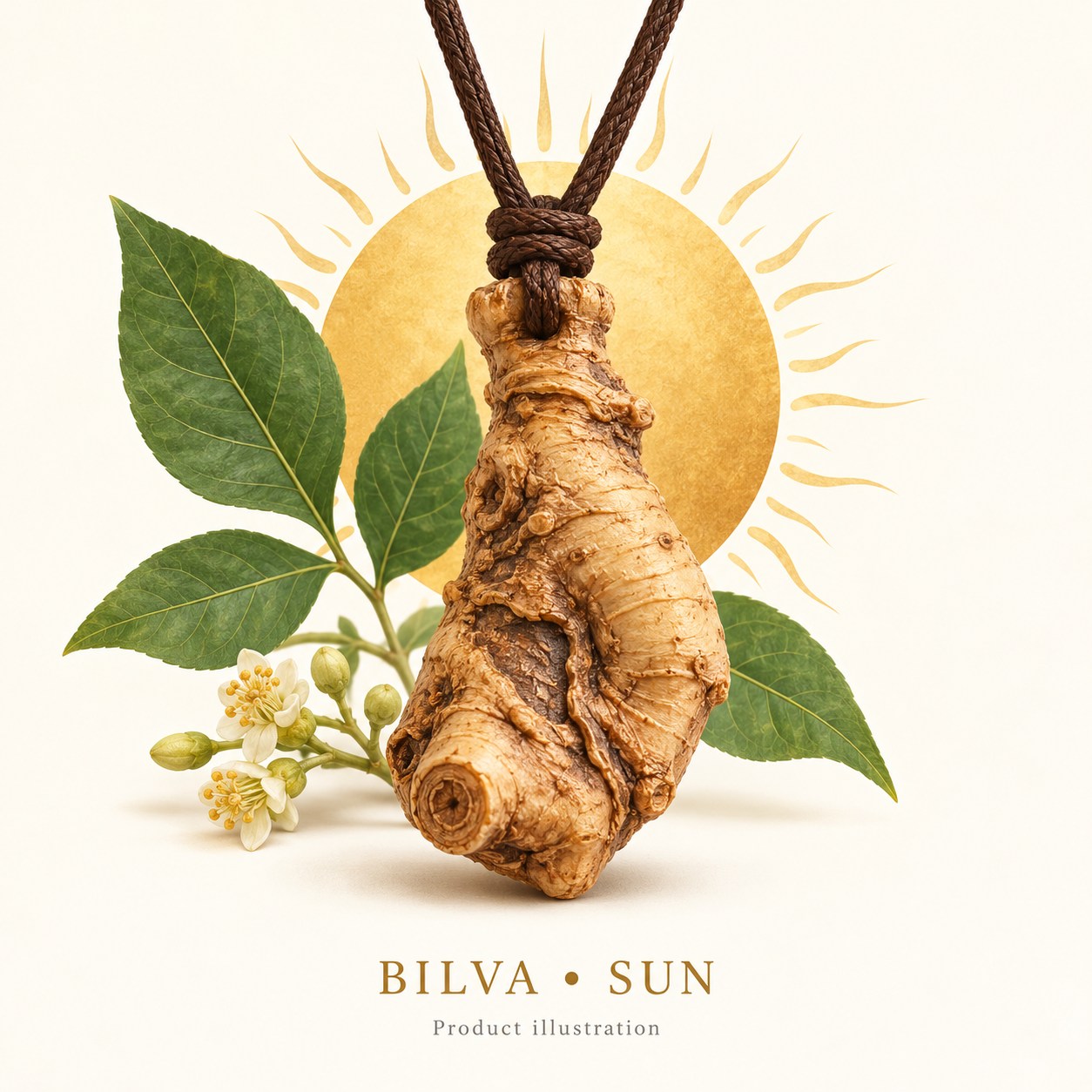
A Bilva root pendant, a ruby and a Rudraksha bead may all appear in a discussion about Surya (the Sun), yet they are three substantially different materials with different histories, identities, wearing forms and verification needs. A responsible comparison should not begin with the assumption that they are three prices for the same object or that the one most expensive will necessarily be the most suitable. It should begin with what the item actually is, which spiritual tradition is being followed and what the buyer will receive.
The central distinction: ruby (manikya) has a widely recognised place in traditional Jyotish gemstone correspondences for Surya; particular Rudraksha practices, notably the twelve-faced bead in several Shaiva interpretive traditions, can be linked with the twelve Adityas and solar symbolism; and Bilva is an especially revered plant in Shiva worship, although a Bilva-root pendant specifically prescribed for Surya is better described as a particular planetary-herbal-jewellery custom rather than a universal rule across classical Jyotish texts. These spiritual associations deserve to be explained accurately alongside botanical and gemological facts.
This guide compares plant identity, gem quality, bead morphology, authenticity documents, product measurements, worship and wearing customs, price considerations and ongoing care. It is designed for customers choosing among very different products, not for reducing personal Jyotish practice to a simplistic replacement chart. Readers interested in a particular tree or ceremony can explore Bilva (Bael) tree and Surya traditions; for the physical accessory, see how to wear and care for a Bilva root pendant.
1. The three materials at a glance
The names describe different categories. Bilva root is processed plant material, ruby is a crystalline mineral and Rudraksha is a hard botanical fruit stone or bead. Even the word natural means something different in their respective markets. A natural ruby can be heated; a real seed can be drilled and oiled; a botanical pendant can contain genuine wood-like plant material but lack convincing evidence identifying the species. A category name is not a material test, and a material test is not an astrological assessment.
| Decision factor | Bilva / Bael root pendant | Ruby / Manikya gemstone | Rudraksha bead |
|---|---|---|---|
| Basic material | Piece represented as root from Aegle marmelos | Red variety of corundum, aluminium oxide | Hard seed-like endocarp from a Rudraksha-producing Elaeocarpus tree |
| Principal identity question | Was this exact root correctly linked to an authenticated plant? | Is it ruby; natural or laboratory-grown; what treatments? | Is it a genuine bead; are its natural faces and physical condition accurately described? |
| Traditional context | Bilva worship, Shiva; some modern Surya-root lists | Established Surya gemstone correspondence in Jyotish practice | Shiva devotion, with some mukhi traditions connected with Adityas or Sun |
| Typical finished form | Small sealed or fitted fragment on thread or chain | Cut gemstone in ring or pendant setting | Single pierced bead, pendant or mala component |
| Documentation focus | Botanical provenance and product-batch traceability | Gemological report with treatment disclosures | Examination of actual bead and face structure, plus seller provenance |
| Common durability concern | Moisture, surface splitting, attachment security | Stone treatments and integrity of setting | Cracks, drilling, surface treatment, cord wear |
| Buying comparison | Size, botanical description, fitting, provenance | Colour, cut, clarity, carat, treatment, origin evidence | Mukhi, condition, shape, size, examination scope |
The table shows why a slogan such as “same benefit, lower price” leaves out the details customers most need. A gemstone laboratory report cannot identify Bilva roots. An invoice reading “twelve mukhi” is not, by itself, a bead authentication report. A tree photograph may verify that a seller photographed a Bilva tree, but it does not automatically connect that tree to the piece in a sealed pendant. The documentation should address the material actually being sold.
2. Surya in Hindu tradition and Jyotish
Surya is the visible Sun, a deity invoked in Vedic, Puranic and devotional settings, and a graha interpreted in Jyotish. Names such as Aditya, Savita, Bhaskara, Ravi, Arka, Divakara and Mitra occur across different literary and ritual contexts; their usage should not be flattened into an identical formula. The twelve Adityas belong to an important solar devotional vocabulary, while the seven horses or rays of Surya's chariot are familiar iconographic themes in many retellings. In daily worship, reverence may be expressed through offering water (arghya), recitation, meditation and the practice of Surya Namaskar; the precise method varies by school and household.
In Jyotish, Surya commonly represents atman, authority, vitality in a traditional symbolic sense, dignity, father or paternal themes, leadership, public recognition, responsibility and the capacity to act with clarity. It is associated with Simha (Leo) as its sign and with Krittika, Uttara Phalguni and Uttara Ashadha as the three nakshatras conventionally ruled by the Sun in the Vimshottari framework. In that widely used dasha sequence, Surya Mahadasha has a duration of six years. None of these correspondences proves that every person with an important Sun placement should buy the same accessory.
Chart analysis typically examines the Sun's sign and house, relevant aspects and conjunctions, the house it rules, its relationship to the lagna, and the period being considered. Traditional systems often describe Surya as exalted in Mesha (Aries) and debilitated in Tula (Libra). Those are interpretive placements, not an automatic prescription. An exalted Sun does not mean that a ruby will always be beneficial; a debilitated Sun does not mean a root pendant is mandatory. Specific advice in Jyotish properly depends on the complete chart and the chosen interpretive school.
| Surya term | Meaning within a traditional discussion | Useful buyer distinction |
|---|---|---|
| Surya / Ravi / Aditya | Solar deity and/or Sun graha | A sacred name does not authenticate material |
| Simha rashi | Sign ruled by the Sun | Sun-sign alone is insufficient for product advice |
| Krittika, Uttara Phalguni, Uttara Ashadha | Sun-ruled nakshatras in Vimshottari | A nakshatra is not a product quality grade |
| Surya Mahadasha | Six-year period in Vimshottari dasha | Period interpretation requires the wider chart |
| Arghya and Aditya Hridayam | Devotional practices and recitation traditions | They do not require one purchased object |
| Manikya | Traditional Sanskrit name associated with ruby | Material identity and treatment need separate verification |
| Dvadasha Aditya / twelve Adityas | Solar divinities and symbolism | Provides context for some twelve-mukhi traditions |
A customer may value an ornament as a sankalpa reminder: something that recalls a devotional intention each morning. That significance does not depend on promising a measurable change in professional rank, relationships or health. It does help to understand how the object relates to an existing ritual or personal preference.
3. Bilva: a sacred tree, not a generic unidentified root
Botanically, Bilva or Bael is ***Aegle marmelos* (L.) Corrêa, a tree in the family **Rutaceae. Kew's Plants of the World Online records this as an accepted species, with a native range centred on the Indian subcontinent. Regional names include Bilva, Bel, Bael, Vilvam, Koovalam, Maredu and other spellings. Names change with language, local trade and context; common naming alone does not confirm a cut or carved fragment. The family Rutaceae also includes citrus relatives, but Bilva is its own tree and should not be presented as an ordinary citrus-root substitute.
Leaves of the Bilva tree, often arranged in three leaflets, are especially important in Shiva worship. The threefold leaf receives several symbolic interpretations in different traditions, including references to Shiva's three eyes, three gunas or three functions. Such devotional symbolism explains why the tree is revered, why Bilvapatra is offered in worship and why households may plant or protect a Bael tree. It does not mean that every Bilva part has the same ritual status as the leaf. In particular, a root pendant worn for Surya should not be called a universally prescribed classical substitute for a ruby without specifying the text or lineage supporting that precise claim.
Bilva has also been described in the literature of medicinal plants and Ayurveda. The plant's fruit, leaf, bark and root have different traditional names or applications, and the familiar term Bilva does not erase those distinctions. A botanical article discussing traditional properties of roots is not automatically instructions to ingest root material from a jewellery item. The process used to cut, clean, seal or dye a pendant is different from preparing a plant material for another purpose.
A good supplier will identify the species and the plant part, explain whether the root is whole or cut, identify any coating or casing and state how the material was obtained. The provenance challenge is practical: once roots are dried, trimmed, drilled or placed inside an opaque cap, many field-identification features such as leaves, flowers, fruit and bark are absent. A root piece's colour or woody texture is not a decisive species marker.
Bilva botanical verification checklist
| Item to verify | What to ask | Why it matters |
|---|---|---|
| Scientific name | Is it Aegle marmelos, not just “Sun root”? | Connects the label to a taxon |
| Plant part | Root, branch, bark or mixed material? | Avoids misdescribing the object |
| Source | Farm-grown, pruned material or another lawful source? | Protects traceability and responsible harvesting |
| Batch continuity | Can the supplied piece be linked to the identified lot? | Prevents photo-to-product mismatch |
| Processing | Was it coated, lacquered, bonded, drilled or sealed? | Determines appearance and care |
| Condition | Any cracks, powdering, soft spots or rough edges? | Helps judge wearable durability |
| Fitting | Cord hole, metal cap, adhesive, bail, chain? | Identifies the weakest point in the accessory |
| Dimensions | Full length and width, not only root diameter | Helps assess actual wearing comfort |
The original article's botanical reference, Kew: Aegle marmelos, supports the accepted plant name and classification. It does not constitute a certificate for a particular finished pendant. For purchasing context, examine the current Bilva (Bael) Root Pendant for Sun listing and request specimen-specific details before ordering.
4. Ruby: why Manikya occupies a different place
Ruby is the red variety of the mineral corundum, with chemical composition Al₂O₃. Chromium is a principal cause of its red colour. In traditional Jyotish gemstone lists, Manikya is widely associated with Surya; hence ruby is the closest of the three materials to what a customer usually means by a formal “Surya gemstone” recommendation. The association is traditional and symbolic, while the identification of an offered specimen is a scientific gemological question. Both subjects deserve attention, but they answer different questions.
A ruby's price can be influenced by colour, transparency, cut, carat weight, visible inclusions, origin evidence and treatment. Fine ruby is neither guaranteed to be more red in every photograph nor guaranteed to be untreated because a seller writes “natural.” Many natural rubies are heat-treated, and some market material is fracture-filled with glass; a laboratory-created ruby has essentially ruby's mineral composition but a different origin. Glass-filled or composite stones may look appealing in photographs while demanding different care and carrying different pricing implications.
The words “real ruby,” “Burmese ruby,” “pigeon blood,” “untreated,” and “certified” should not be used interchangeably. A seller should disclose whether the stone is natural or synthetic, whether treatment is known or suspected, what report accompanies it and whether that report's measurements match the supplied item. A gem laboratory can identify the stone and detectable treatments. It does not certify a Surya outcome or a precise Jyotish suitability for an individual.
GIA describes ruby as corundum with Mohs hardness 9, but hardness is not immunity from all damage. A gemstone can chip at an exposed edge, a loose prong can permit loss, and glass-filled fractures can be vulnerable to chemicals. The cleaning method depends on treatment and setting. The trade commonly accepts disclosed heat treatment, while significant fracture filling changes both value and care expectations. Customers can compare available designs in the Ruby Gemstone collection; review the exact item's report rather than assuming every listing has identical properties.
| Ruby buying term | Practical explanation | Question to ask before paying |
|---|---|---|
| Natural | Formed geologically, not laboratory-grown | What independent identification supports this? |
| Laboratory-grown | Man-made corundum with ruby composition | Is laboratory origin disclosed prominently? |
| Heat-treated | Heating used to improve appearance | What treatment has been detected or disclosed? |
| Glass-filled | Surface-reaching fractures or cavities contain filler | Is filling extensive, and what care restrictions apply? |
| Carat | A unit of gemstone mass, not pendant size | What are measurements and actual weight? |
| Colour | Hue, tone and saturation influence appearance | Is a neutral-light video available? |
| Origin | Geographic locality when reasonably determined | Is an origin opinion documented, rather than merely advertised? |
| Report | Laboratory examination of a particular item | Do number and measurements match the stone offered? |
5. Rudraksha: bead morphology and solar associations
Rudraksha is a traditional Shaiva sacred bead made from the hard inner portion of a fruit of a Rudraksha tree. Many older commercial and botanical descriptions use Elaeocarpus ganitrus; Kew now treats that name as a synonym of the accepted Elaeocarpus sphaericus. This nomenclatural distinction matters for articles that claim botanical precision. A seller may continue using the familiar older name as a trade label while explaining the accepted name, but calling a different seed Rudraksha merely because its surface resembles a bead is not reliable identification.
Mukhi usually refers to naturally occurring longitudinal divisions or faces visible on a bead. Different mukhi counts have diverse associations in Shaiva practice, devotional texts and current retail traditions. In particular, some interpretations link twelve-mukhi Rudraksha with the twelve Adityas, making a solar association intelligible. That does not mean every twelve-mukhi bead comes with a uniform ritual requirement or that a verse regarding the Adityas functions as a laboratory authenticity document. Other mukhi associations may also be given by individual teachers or sellers; specify the tradition when offering a recommendation.
A genuine bead purchase should involve photographs of the actual bead from multiple angles, clear views of its natural face channels, hole and interior condition when relevant, measured size, stated surface treatment and an honest explanation of any examination. Imaging can sometimes add information about internal structures, but it cannot verify spiritual results. A scanned report should match the exact offered bead; the claim “laboratory certified” should state what the laboratory actually tested. The presence of natural irregularities is not a defect by itself, whereas filled, carved or artificially added grooves warrant transparent disclosure.
Rudraksha is often worn on a cotton or silk cord, chain or mala assembly. Bead movement, impact against hard metal and moisture exposure affect practical durability. As with a root pendant, fit and safe skin contact matter. Strong detergents, long soaking, aggressive oiling or unsupervised home drilling can damage some beads or assemblies. An occasional soft dry cleaning and inspection of threads and fittings is generally simpler than a complicated regime. Customers can explore the Rudraksha for Planets collection and evaluate the exact bead rather than a generic stock photograph.
6. How the three Surya associations differ
Some comparisons begin with the word “remedy” and then list three objects under it. That is too compressed. Ruby and Surya belong to a well-established Jyotish gem correspondence. Rudraksha and Surya may be discussed through face-specific Shaiva symbolism, especially a twelve-Aditya association. Bilva and Surya in the context of this jewellery collection reflects a specific root-pendant choice, while the more broadly recognised Bilva connection is with Shiva worship. These paths are not identical. A devotee can recognise all three without requiring one theory to replace the others.
If a practitioner recommends a ruby, the customer can ask whether the recommendation concerns the birth chart, a household custom, the aesthetic of a red gem, or an intended ritual. If a particular mukhi is recommended, ask which text or teaching underlies the association and whether bead authenticity is verified separately. If a Bilva root is suggested, ask whether it is an individual custom, a family practice, or a named herbal planetary list. A transparent answer makes the choice more meaningful even when the customer decides not to buy.
Surya mantras and observances are also not interchangeable with material purchases. Morning arghya offered respectfully, Surya Namaskar, recitation of the Aditya Hridayam in suitable settings, or remembrance of a chosen deity can be meaningful independently of a pendant. Some households associate Sunday (Ravivar) with Surya puja, red or saffron offerings, specific flowers or simple acts of charity. Customs differ; precise timings, mantras and eligibility should follow one's accepted tradition rather than a generic checkout instruction.
| Question about tradition | Bilva root | Ruby | Rudraksha |
|---|---|---|---|
| Most clearly established emphasis | Bilva tree and Bilvapatra in Shiva devotion | Manikya–Surya in Jyotish gem practice | Shiva devotion; some twelve-mukhi/Aditya links |
| Is the material itself the ritual? | No; pendant is one possible accessory | No; gemstone may be part of a personal practice | No; bead may support remembrance or japa |
| Is a chart assessment always required? | Not to appreciate the plant or ornament | Often requested for personalised Jyotish advice | Depends on the practitioner and mukhi practice |
| Does a larger item imply stronger blessing? | No such material-scale rule | Carat alone does not establish spiritual merit | Bead diameter alone does not establish merit |
| What should be independently verified? | Botanical source and genuine root | Species, origin type and gemstone treatment | Bead identity, face structure and condition |
| Does another category substitute automatically? | No | No | No |
7. Choosing between a root pendant, gemstone ring and bead
Begin with the reason for choosing an item. A person who appreciates Bilva as a sacred tree may prefer a simple root pendant as a reminder of that relationship. Another may be following a Jyotish consultation that discussed ruby specifically. Someone already observing a Shaiva practice may prefer a Rudraksha bead with documented mukhi characteristics. These are reasonable differences in spiritual and material preference; the safest buying decision is one where the product is described accurately and remains comfortable to wear.
Consider body placement. Rings are exposed to frequent knocks, detergent, water and friction. A pendant may avoid some knocks yet swing against clothing or fittings. A bead on a cord may move with activity or catch on jewellery. A root under a metal cap can hide the exact point where a crack or adhesive failure begins. The more complicated the assembly, the more important it is to inspect joints, bails, clasp security and likely skin contact. If skin sensitivity to a metal or coating is known, choose a compatible fitting instead of insisting on direct contact.
Discuss your budget in terms of the actual offer. Compare the final total including setting metal, chain or cord, tax, report and resizing or repair service. An inexpensive piece can still be poorly made; an expensive piece can still have a weak fitting or missing information. A symbolic association does not fix these defects. Request a clear front/back photograph with a ruler or measurements and ask whether the photograph is of the exact deliverable or merely a catalogue example.
The correct question is not “which one is strongest?” but “which material, tradition, documentary evidence and wearable design fit my intended practice?” Avoid products claiming that a gemstone or bead can replace clinical treatment, determine fate on its own, or guarantee leadership or financial gain. An honest seller can present traditional meanings fully while describing the actual object accurately.
8. Certification, testing and supplier evidence
The word certificate covers very different documents. A gemstone report may identify ruby, natural versus laboratory growth and detectable treatment. A botanical identification record could document the original tree or collected specimen but still leave a traceability gap between that specimen and a finished root pendant. A Rudraksha examination may document dimensions, count of observed channels and certain internal features. No single document proves botanical identity, gemstones, bead morphology and personal astrological suitability all at once.
For ruby, ask to see a report number, photographs or dimensions consistent with the stone, date and issuing laboratory; if an origin is claimed, check the report's actual wording. For a botanical pendant, ask for the accepted plant name, part used, sourcing region, processing disclosures and lot identification. For Rudraksha, ask whether the report examines the individual bead and what features were observed. If a seller offers only a sales invoice, treat it as proof of transaction, not scientific verification.
A photograph is also limited. A Bilva tree with distinctive leaves can help explain a species, but the photographed tree may not have supplied the pendant. A ruby glamour photograph may use backlighting that intensifies colour; it cannot settle treatment. A Rudraksha image may hide a groove, crack or altered edge. Request ordinary lighting, multiple angles and scale. Reliable documentation is valuable because it narrows uncertainty, not because it converts an accessory into a guaranteed remedy.
Verification document: what it can and cannot demonstrate
| Evidence | Helps establish | Does not alone establish |
|---|---|---|
| Botanical species record | Identification of a sampled plant | Identity of every pendant in an unrelated batch |
| Root-lot traceability | Link between sourced material and finished items | Astrological effectiveness |
| Gemological ruby report | Ruby identity and detectable treatments for examined stone | Personal chart suitability or guaranteed results |
| Gem origin opinion | Lab-supported geographic opinion when determinable | Value or authenticity of a different specimen |
| Rudraksha bead examination | Recorded visible/internal characteristics within its scope | Spiritual potency or bead identity without specimen match |
| Invoice and product label | Commercial terms and seller claims | Independent verification of scientific claims |
| Workshop photographs | Some stages of fitting and processing | Botanical authenticity without a traceable source |
9. The overlooked issue of plant-root sourcing
Bilva is a living tree with ecological and devotional value. Extracting roots from a mature tree may damage its health or stability; not every root accessory deserves to be called responsibly sourced merely because the species is sacred. Questions about orchard or cultivated sources, legally collected pruning by-products, and whether destructive uprooting occurred are practical. A supplier might use approved material already separated during land management; if so, basic lot records are still useful. Avoid encouraging customers to dig up temple trees or remove roots from communal land.
Traditional reverence for a tree and modern responsible sourcing can reinforce one another. A worshipper who values Bilva's living leaves and shade may be especially interested in preserving the source tree. An article about pendant products should not portray destructive collection as obligatory religious behaviour. If the supply chain cannot explain how the root was obtained, that uncertainty should remain visible rather than hidden behind auspicious vocabulary.
The same principle applies to Rudraksha material. Mature tree origin, collection methods, sorting and storage influence the quality of genuine beads. Seed-like material may acquire cracks during aggressive drying or preparation. A commercial certificate cannot substitute for careful examination of the delivered bead. Ruby has different sourcing issues involving extraction, cutting, treatment and supply-chain disclosures; do not apply a botanical collection question to a mined gemstone as if it were the same process.
10. Wearability: dimensions, metal, cord and assembly
The finished object's total size often tells more than an isolated material weight. A Bilva root pendant with an overlarge metal cap may feel bulky despite its light core. A ruby in a tall ring setting may catch on clothes. A Rudraksha bead with an off-centre drill hole may hang unevenly and put stress on the cord. Ask for front, back and side measurements and, when practical, a short video showing how the object hangs. The actual material should be visible when a customer is paying for a named root or bead.
Cord and chain selection also matter. Smooth, strong cord with suitable knots may suit a light botanical pendant; a metal chain may suit a ruby pendant with a properly made bail. A bead mala should have secure knots and appropriate spacing. Inspect exposed wire ends, sharp metal edges, insecure glue, loose jump rings and a clasp that is difficult to operate. Avoid wearing fragile botanical jewellery during sports, heavy labour, swimming or tasks that repeatedly soak the assembly.
If a person follows a tradition of touching the accessory to the skin, comfort remains an important practical check. Metal alloys, adhesives, dyes, oils and finishes may cause irritation in susceptible wearers. A clean cloth barrier or a different fitting may solve the problem, and removing an irritating item is better than treating discomfort as a required part of worship. A dangling necklace is not suitable around machinery, for young children, or in any situation where snagging is dangerous.
11. Material-by-material cleaning and storage
Bilva root: begin with a dry soft cloth or soft brush, minimal pressure and prompt removal of surface dust. Do not soak, steam, scrub with detergent, coat with unknown oils or expose a raw piece to repeated humidity cycles. An encased or lacquered root may have separate care instructions for the cap and coating; follow the maker's directions and inspect bonding. If the root becomes soft, mouldy, powdery or cracked, stop wearing it until examined.
Ruby: the stone itself is relatively hard, yet the treatment and setting control the safe cleaning method. GIA describes warm soapy water as suitable for many untreated and heated rubies, but glass-filled, cavity-filled or dyed material should be cleaned conservatively with a damp cloth. Do not assume that ultrasonic cleaning or steam is appropriate when the report and treatments are unknown. Protect high-set rings from impacts and have loose prongs checked by a jeweller.
Rudraksha: use a gentle dry cloth or a suitably soft brush for ordinary dust, inspect grooves without scraping aggressively and keep the bead away from household chemicals and prolonged water exposure. Oiling routines vary by local tradition and supplier; applying substances to every bead without knowing whether it has been dyed, sealed or repaired can change appearance or loosen a fitting. If the bead is split at the drilling hole, stop wearing it before it falls from the cord.
| Care condition | Bilva root pendant | Ruby jewellery | Rudraksha bead |
|---|---|---|---|
| Daily dust | Soft dry cloth or brush | Soft cloth; cleaning depends on treatment | Soft dry cloth or brush |
| Extended soaking | Avoid | Avoid unless care status and setting support it | Avoid |
| Ultrasonic / steam | Not suitable | Only where treatment and mount permit; ask jeweller | Not suitable |
| Direct sunlight and heat | Avoid long exposure, especially coated or glued pieces | Avoid sudden extreme thermal exposure and treatment risks | Avoid prolonged harsh exposure |
| Chemical cleaner | Avoid | Avoid on filled/dyed stones and uncertain assemblies | Avoid |
| Storage | Dry pouch, protect from compression | Separate padded compartment, protect setting | Soft pouch, avoid crushing |
| Repairs | Specialist fitting, avoid home drilling | Qualified jeweller, tell them about treatment | Assess drill hole, cracks, thread and knots |
12. Sunday worship and the difference between custom and necessity
Many worshippers honour Surya on Sunday (Ravivar). Depending on household practice, observances may include a morning bath, clean clothes, offering water to the rising Sun from an appropriate safe location, recitation of Surya Gayatri or other solar hymns, and conscious attention to one's duties. Aditya Hridayam is a well-known Sanskrit hymn associated with Surya devotion. The exact ritual procedure, Sanskrit pronunciation and role of an instructor depend on tradition; do not treat a seller's bundled card as the only accepted method.
Some people take a sankalpa before worship: a clear statement of intention, gratitude or discipline. A pendant, ring or Rudraksha bead may then act as a reminder. Others perform worship without wearing anything. Both can be part of a sincere religious life. It is also reasonable to ask a practitioner whether a specific material should be worn daily, kept on an altar, or reserved for particular observances. An answer grounded in a named tradition is more helpful than a generic instruction to wear all Sun-labelled products together.
Keep traditional meanings distinct. A three-leaf Bilvapatra offering to Shiva is not the same act as wearing a Bilva root in a metal cap. A Surya gemstone recommendation does not require replacing a long-standing Shaiva Rudraksha practice. A person may have a personal connection to the Sun through prayers, family worship or yoga without needing any object. This guide honours the traditions while helping the buyer understand the physical products.
13. How to assess an individual Jyotish recommendation
A personalised recommendation should explain why Surya is being considered. The question may concern the current dasha, the Sun's placement, a chosen devotional practice, or simply a gemstone preference. If the recommendation is astrological, relevant terms can include lagna, rashi, bhava, nakshatra, drishti, yogas, graha bala, dasha, antardasha and the house lordships as read in the practitioner's system. A product listing alone does not assess these factors. An apparently universal claim that “every Leo must wear ruby” is insufficiently specific.
For ruby, a practitioner may discuss gemstone size, metal, finger and timing according to a chosen method. The merchant must still supply a stone that matches its description. For Rudraksha, the conversation may concern mukhi selection and whether the bead is used for devotion or a more specific practice. For Bilva, clarify whether the recommendation comes from a named herbal planetary system or a personal custom. These answers should be recorded in ordinary language so the customer can make a considered decision.
Do not confuse classical Surya symbolism with diagnoses. Traditional texts may describe vitality, confidence and resolve as solar significations; they do not turn a pendant purchase into a treatment for weakness, stress or another medical condition. Likewise, a Jyotish discussion of leadership or authority is a symbolic reading, not a guarantee of promotion. The practical purchase decision remains about an accurately described, wearable object chosen voluntarily.
14. Price, total cost and value comparison
Root jewellery, ruby gemstones and unusual-mukhi Rudraksha can occupy very different price ranges, and those ranges change with the exact item. A root's cost may reflect sourcing and handcrafted fitting; a ruby's price can vary dramatically with quality, carat and treatment; a rare mukhi bead may command a premium for its appearance, source and documentation. No static comparison table can supply a truthful live selling price for every specimen. The reliable approach is to request current quotations with all inclusions stated.
Check what the customer actually receives. Does the Bilva product include a chain or only a cord? Is the ruby price for a loose stone or an assembled ring? Does the Rudraksha include the displayed bead or a category-stock substitute? Is documentation from an independent examiner included, extra or absent? What is the return policy for an item whose natural material varies? How are damaged shipping parts handled? Such questions can prevent surprise expenses more effectively than a slogan ranking materials from “least” to “most powerful.”
| Cost or service | Bilva root | Ruby | Rudraksha |
|---|---|---|---|
| Material price driver | Sourcing, processing and finish | Colour, size, cut, treatment, transparency | Mukhi count, condition, provenance and examination |
| Setting or cord | Cap, bail, thread, metal type | Ring/pendant metal and labour | Thread, spacer, cap or mala construction |
| Evidence cost | Botanical records and supply-chain documentation | Laboratory gem report | Individual bead examination and provenance |
| Potential maintenance | Replacing cord, cap or coating | Prong checks, resizing, treatment-aware care | Restringing, worn caps, bead condition |
| Variability | Shape, texture, grain | Inclusions, hue, natural features | Size, shape, grooves and surface |
| Comparability across types | Not directly equivalent | Not directly equivalent | Not directly equivalent |
15. Common selling statements: what they really tell you
“Natural” should identify a natural material and clarify processing. For ruby, it is crucial to distinguish natural origin from a claim of no treatment. For Rudraksha, “natural faces” should mean grooves were not carved or joined artificially. For Bilva, “natural root” should refer to an identified botanical part rather than a generic piece of wood. Ask for a precise description and a statement of what has not been independently established.
“Energised” or “prana-pratishtha” may describe a ritual the seller says was performed. This is a distinct statement from a gemology or botanical test. The provider can explain the puja tradition, who performed it, and whether any record exists; neither a video of worship nor a certificate of attendance establishes the species of a root or the treatment of a gemstone. A customer who values ritual provenance may ask about both the ceremony and the item's material evidence.
“Original” and “certified” should not conceal the source of certification. A laboratory's name, scope of test, specimen number and any limitations matter. “Guaranteed results” is not a meaningful quality measure for a root, stone or seed. “One size suits all” is also dubious in wearable jewellery because body dimensions, skin comfort, setting security and tradition differ. Detailed and modest product descriptions usually tell the customer much more.
16. Side-by-side buying scenarios
Scenario A: a buyer wants a simple symbol of the sacred Bilva tree. A modest root pendant with clear sourcing, safe edges and a sturdy cord may suit the purpose. The buyer should not pay a ruby-like premium based on unsupported equivalence. If the purpose is specifically Bilvapatra devotion, a plant-based ritual without root harvesting may be more consistent with their preferences.
Scenario B: a Jyotish consultation names Manikya. The person should clarify what type of ruby is recommended and then inspect actual gemstone options. A natural heat-treated ruby and a glass-filled composite material are not identical products. Setting height, metal sensitivity, budget and documentation may influence the final selection even when the ritual recommendation is unchanged.
Scenario C: a devotee wishes to explore twelve-mukhi Rudraksha. The relevant questions are whether the chosen school makes the solar connection, whether the particular bead's faces have been evaluated, and whether the purchase includes a durable arrangement. A photograph of an attractive bead is not the same thing as evidence about the specimen being sold.
Scenario D: a customer wants a gift. Spiritual preference and practical wearability are important. Ask what the recipient already wears, whether they are comfortable with a particular sacred symbol, and whether they prefer a ring, pendant or mala. A carefully chosen, accurately described item can make a more appropriate gift than a costly stone selected without understanding the recipient's practice.
Scenario E: a buyer wants all three together. Some people enjoy combining different sacred accessories, but there is no general requirement to wear every material associated with the Sun. Check cumulative weight, overlapping pendants, chain friction, and whether any practice discourages a particular combination. Material care can also conflict: do not wash a whole necklace containing root, gemstone and bead as though every component tolerates the same water exposure.
17. Product-page information OmmRudraksha should show
A useful product page should identify a specific product, not merely provide a decorative spiritual narrative. For Bilva: a clear description of plant identity, part, finish, dimensions, image of the actual style, fit and sourcing. For ruby: visible size, weight, gemstone status, treatment disclosure, setting details and report availability. For Rudraksha: mukhi, condition, measured size, any inspection claim and finished construction. Across all three: price, availability, what the package includes, sensible care notes and accessible customer support.
The user may arrive through different pages: a Jyotish guide, a product page or a category listing. The links should support that journey without forcing every article to recite the entire catalogue. This article links to the relevant ruby selection, the Bilva root pendant, the planet-associated Rudraksha category and the planetary herbal jewellery collection. Readers who need a more focused background can turn to the Bilva and Surya cultural guide or the Bilva wearing and care guide.
Article-level metadata should reflect what the page actually teaches: Bilva root vs ruby vs Rudraksha for Surya; Manikya; 12-mukhi Rudraksha; Bilva botanical identity; authentic buying; comparison; care. The text should avoid repeatedly promising a result or treating unlike products as substitutes. Clear headings, natural internal links, explanatory tables and FAQs answer search intent without needing dozens of external references.
18. A practical six-step decision process
- Name the purpose. Is it Bilva devotion, a Surya gemstone choice, a specific Rudraksha tradition, a gift or an attractive everyday accessory? Write the purpose before comparing prices.
- Ask which tradition is relevant. Separate a general product association from a personal Jyotish reading or family worship custom. When a practitioner is involved, ask for the rationale in understandable terms.
- Identify the actual material. For Bilva, confirm Aegle marmelos root provenance; for ruby, natural/laboratory status and treatments; for Rudraksha, bead identity and the claimed mukhi.
- Inspect the finished item. Ask for actual dimensions, photographs, fittings, metal type, surface condition and any signs of repair or colouring.
- Check the full offer. Compare the price including report, chain, setting and service. Read returns and care terms for natural variation and wear-related damage.
- Choose the maintenance you can sustain. A delicate botanical pendant, a high-set gemstone ring and a grooved bead have different cleaning needs. Choose a form that will remain practical in daily life.
The best choice is the one whose spiritual context you understand and whose actual object has been described and documented well. A customer does not need to accept claims of immediate effects to value Indian devotional symbolism or a beautiful natural material.
19. Frequently asked questions
1. Are Bilva root, ruby and Rudraksha the same Surya remedy?
No. They are respectively botanical root material, a corundum gemstone and a sacred bead. They appear in different strands of spiritual practice and have different verification and care requirements. A shared Sun label does not make them material or astrological equivalents.
2. Which of the three is traditionally most closely linked with Surya in Jyotish gemstone lists?
Ruby, traditionally called Manikya, is the prominent gemstone correspondence for the Sun in many Jyotish systems. That fact identifies a tradition, not an instruction for every person to wear ruby. Personal recommendations depend on the chart and practitioner.
3. Is Bilva primarily associated with Surya or Shiva?
The Bilva tree and especially Bilvapatra are extensively associated with Shiva worship. A Bilva-root pendant labelled for Surya can reflect a particular herbal-planetary product tradition. The two meanings should be stated separately rather than presented as the same universal scriptural rule.
4. What is the scientific name of Bilva?
The accepted name is Aegle marmelos (L.) Corrêa, in Rutaceae. Bael, Bel, Bilva, Vilvam and other regional words may refer to the same tree. Botanical confirmation of a finished root requires source traceability.
5. Do three Bilva leaflets prove the identity of a root pendant?
No. Trifoliate leaves are useful context when identifying a living tree, but a cut pendant root lacks that feature. A photograph of leaves also cannot prove which tree supplied a particular manufactured piece.
6. What is ruby made of?
Ruby is red corundum, aluminium oxide (Al₂O₃), commonly coloured by chromium. It has high hardness, but its durability also depends on cracks, treatment and setting. Mineral identity and astrological symbolism are different questions.
7. Is a heated ruby fake?
No. A natural ruby can undergo heat treatment and remain natural ruby. Treatment should be disclosed because it affects value and sometimes care. Laboratory-grown material and glass-filled material require their own clear descriptions.
8. Is a laboratory-grown ruby the same as glass imitation?
No. Laboratory-grown ruby is corundum produced through a controlled manufacturing process, while red glass is an imitation with a different material identity. Neither should be marketed as a naturally mined untreated ruby.
9. Does a GIA report certify Surya benefits?
No. A gemological report addresses characteristics such as identification and detectable treatment of the examined stone. It does not assess a person's horoscope or guarantee spiritual, career or health outcomes.
10. Which Rudraksha mukhi is linked with the Sun?
Twelve-mukhi Rudraksha is linked in some Shaiva and Aditya-oriented readings with the twelve Adityas, giving it a solar association. A specific teacher may use a different practice. Always distinguish that tradition from the physical inspection of a bead.
11. Is Elaeocarpus ganitrus an incorrect Rudraksha name?
It is a familiar historical or commercial botanical name, but Kew currently lists it as a synonym of accepted Elaeocarpus sphaericus. A precise article can mention both names and explain the relationship.
12. Can a bead's mukhi count be confirmed from a single product photo?
A single view can miss natural channels or altered areas. Ask for multiple views and an account of how the bead was examined. The examination should refer to the exact delivered bead, not a similar example.
13. Can I wear Bilva root with a ruby pendant?
Some people choose combined accessories, but there is no universal requirement. Confirm whether the combination fits your practice and ensure that fittings do not damage one another. Do not clean the combined piece with a method unsafe for its most delicate component.
14. Can I combine Rudraksha and ruby?
Customers may wear these materials together for personal or devotional reasons, subject to individual traditions and a comfortable fit. Keep jewellery secure, avoid abrasion and confirm gem treatment before cleaning. No automatic additional astrological effect is established by combining items.
15. Is Sunday the only day to begin wearing a Surya item?
Sunday, or Ravivar, is commonly important in Surya worship, but initiation customs vary. A particular practitioner may specify a ritual or timing; another devotee may prefer simple everyday remembrance. A universal compulsory rule should not be inferred from the product label alone.
16. Which mantras belong to Surya worship?
Forms such as Om Suryaya Namah occur in widespread devotional practice, while fuller hymns and mantras depend on the lineage. Correct pronunciation, intention and context matter. The purchase of Bilva, ruby or Rudraksha is not a prerequisite for sincere recitation.
17. Do I need a gemstone report for a Bilva root pendant?
A gemstone identification report is not an appropriate substitute for botanical identification. Request the scientific name, plant part, collection source and traceable material-batch information. A product label alone does not prove species.
18. What should a root-pendant certificate say?
Ideally it should identify the sampled plant and method of identification, the plant part, batch or lot, and the connection to the finished pieces. If it is only a seller declaration, it should be described as such. No document should claim more than it evaluated.
19. Does a larger ruby or root always have more spiritual value?
Size and gemstone carat are commercial and physical measurements. They can affect cost and comfort, but they do not independently establish spiritual merit or guaranteed outcomes. Traditional advice may include size conventions; those should be attributed to the specific practice.
20. Why can a ruby that looks similar cost much less?
Natural/laboratory origin, treatment, transparency, cutting, colour and documentation can all affect value. An extensively glass-filled specimen is not directly comparable to a fine untreated ruby. Ask for written treatment disclosure and the report for the exact stone.
21. How do I clean a Bilva root pendant?
Begin with a dry soft cloth and avoid immersion, strong chemicals and heat. Check whether the piece has a protective finish or glued metal fitting. A cracked, mouldy or powdering root should be examined before further wear.
22. How do I clean a ruby ring safely?
First find out the gemstone's treatment and inspect the setting. Many untreated or conventionally heated rubies tolerate gentle soapy cleaning, but glass-filled, cavity-filled and dyed material needs extra care and a damp-cloth approach. When uncertain, ask a qualified jeweller.
23. Can I soak Rudraksha for hours to cleanse it?
Routine prolonged soaking is unnecessary and may stress certain beads, coatings, cords or repairs. Gentle surface cleaning and prompt drying are safer general practices. Follow specimen-specific advice rather than an elaborate universal oiling or soaking instruction.
24. Is a ritual or puja certificate the same as a lab certificate?
No. Ritual documentation may record that a ceremony occurred; laboratory or botanical documentation concerns material evidence. Both may matter to a buyer, but one does not establish the other. Ask exactly what each document supports.
25. What should I ask before ordering online?
Request the exact item's dimensions, photographs, materials, process disclosures, certification scope, current total price, shipping and return conditions. For a root also ask botanical source; for ruby ask treatment; for Rudraksha ask actual bead and mukhi evidence. Compare answers before purchase.
26. Where can I read about Bilva before choosing a pendant?
See Bilva tree's sacred and solar-related interpretations and Bilva root wearing and care. To compare current categories, visit the ruby collection, Rudraksha for Planets and Planetary Herbal Jewellery. Verify individual product availability and specifications when browsing.
20. Conclusion: three meaningful traditions, three different buying tests
Bilva root, ruby and Rudraksha should be appreciated for what they actually are. Bilva connects buyers with the sacred Bael tree and specific herbal-jewellery customs; ruby is the traditional Manikya gemstone of Surya in widely used Jyotish correspondences; and Rudraksha is a Shaiva sacred bead with face-specific associations that can include the Adityas. None needs to be misidentified or described as scientifically equivalent to the other to be meaningful.
When you decide, examine the actual material, available documentation, preferred spiritual practice, comfortable fitting and maintenance. Ask for a full price and carefully read the specific listing. A transparent comparison empowers the buyer to choose a well-described object rather than relying on a generic promise. For the original Bilva item, explore the Bilva Root Pendant for Sun and related resources in Spiritual Jewellery.
