
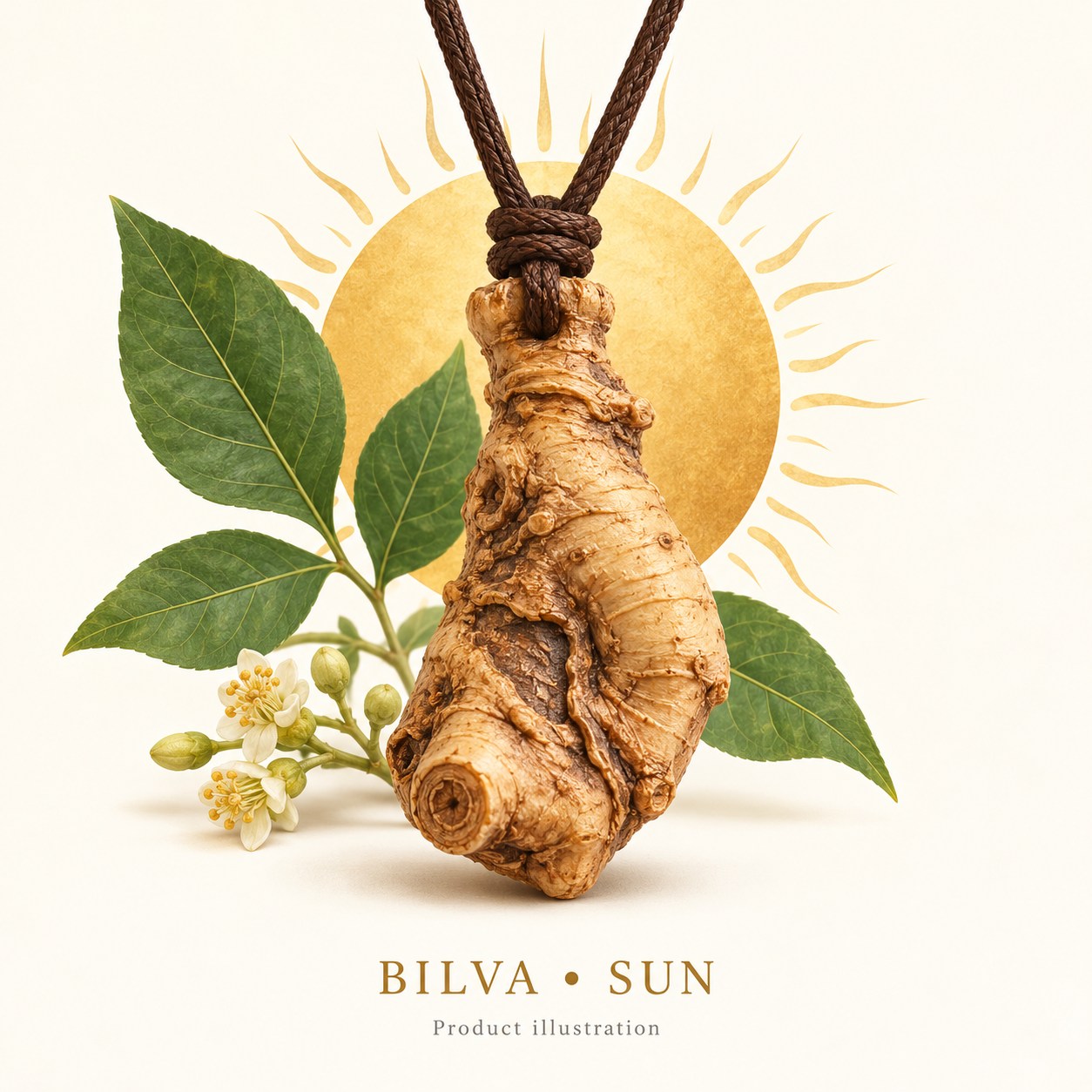
A Bilva root pendant is a small piece of botanical jewellery associated in some planetary herbal traditions with Surya (the Sun). Its meaning can be devotional, personal, or connected with a Jyotish consultation, but successful everyday use begins with something very practical: knowing what the pendant is made from, how the root is held, whether the cord fits, and which handling methods are suitable for the finished piece. The best wearing routine respects both its sacred context and its physical construction.
Bilva, also written Bel, Bael, Bilwa or Vilva, is the tree botanically known as Aegle marmelos (L.) Corrêa, of the Rutaceae family. The familiar Bilva leaves offered to Lord Shiva are part of a well-known Hindu devotional tradition. A Bilva root pendant offered for Surya is a different, more specific form of herbal jewellery: do not mistake the plant's well-established Shiva association for proof that every root ornament has an identical, universal scriptural wearing rule. A person may follow the Surya symbolism taught by a family, practitioner or seller while remaining careful about the origin and condition of the actual item.
This guide is for a finished necklace pendant, not for medicinal use of Bilva, planting a tree, or preparing ritual liquids. It explains the inspection to request before purchase, how to choose a comfortable cord, optional Ravivar (Sunday) observances, appropriate dry care, safe storage in Indian weather, and when to stop wearing a damaged ornament. If you are choosing among different types of Sun-related jewellery rather than learning fitting techniques, consult our Bilva root, ruby and Rudraksha comparison first.
Quick answer: the safest everyday routine
Start by checking the root surface, any existing drilled passage, the mounting, and the fastening. Choose a length that allows the pendant to sit comfortably without catching on your neckline. If you wish, begin wearing it after a short, dry personal prayer on a Sunday morning; this is a customary choice, not a universal condition of ownership. Remove the pendant before bathing, swimming, exercise that pulls on the cord, and activities involving perfume or cleaning liquids. Gently remove surface dust with a soft dry cloth or brush only if the vendor confirms the finish can tolerate it. Store the item completely dry in a separate protective pouch or compartment, inspect the cord routinely, and stop wearing it if the root cracks, sheds fragments or develops a suspicious surface growth.
There is no need to soak a delicate botanical pendant in milk, ghee, water, perfume, essential oils or temple liquids simply because these substances appear in other devotional procedures. The prayer and the cleaning are separate activities. You can perform the first respectfully without turning the second into an experiment on an unidentified root and coating.
| Step | What to do | What to avoid | Reason |
|---|---|---|---|
| Identify | Request the tree name, part used and supplier information | Judging authenticity by colour alone | A brown carving is not a botanical certificate |
| Inspect | Check root, hole, bail, cord and knot | Wearing a loose or splintered fitting | Weak attachments fail under daily movement |
| Size | Measure finished necklace length and pendant drop | Guessing from a cropped product photograph | Fit depends on both cord and pendant |
| Begin wearing | Follow a simple personal Sunday observance if desired | Treating immersion or a mantra as compulsory | Custom varies; moisture can damage plant material |
| Daily use | Protect from moisture, snagging and harsh contact | Wearing for showering or rough sport | Root and fastener have different vulnerabilities |
| Clean | Use approved gentle dry dusting | Soaking, steam, ultrasonic machines or chemical dips | Treatments may loosen coatings or adhesives |
| Store | Keep separate in a clean, dry, shaded place | Packing a damp piece in plastic | Trapped moisture encourages deterioration |
| Review | Inspect after a pull, fall or visible change | Hiding cracks with glue or oil | A damaged root or mount needs examination |
1. Know which part of the Bilva tree you are wearing
The living Bilva tree is typically identified by a combination of botanical features, including its trifoliate leaves and characteristic hard-shelled fruit. A root pendant no longer displays those field features. Once a small piece has been cut, dried, polished, coated or mounted, it may look similar to many other brown plant materials. A photograph of a carved pendant cannot establish that the specimen came from Aegle marmelos. An honest product description therefore separates botanical identification of the parent plant, provenance of the cut material, and description of the finished accessory.
The name Aegle marmelos is accepted in Kew's Plants of the World Online; its family is Rutaceae. Historic botanical synonyms or regional names can appear on older labels without changing what a supplier should document. Common names such as Bael, Bel, Bilva, Bilwa, Vilva and Maredu are helpful search terms, but common-name use differs by language and locality. For a purchased root pendant, the strongest practical question is not simply “does it look like Bilva?” It is “what chain of identification connects this finished piece to a known Bilva source?”
Distinguish root, bark, wood, fruit shell and a manufactured resin or composite. All may be brown. Grain, pores, polish and weight offer clues, but no single visual cue authenticates a botanical part after processing. If a pendant is described as “Bilva root” while the vendor supplies only a generic carved-wood image, ask for actual-product images and an explanation of the material. A supplier may be able to provide a harvest-lot label, workshop record or invoice linking the material to Aegle marmelos. If no such record exists, treat the identity claim as unverified rather than assuming the finished surface proves it.
A particularly important ethical question is how the botanical material was collected. Bilva is a culturally valued living tree. Removing major roots from a healthy standing tree can harm it, and taking material from a temple, protected site or another person's land may be inappropriate or unlawful. Prefer traceable, authorised sources that do not encourage injury to sacred trees. A genuine-looking item is not an excuse for destructive harvesting. The purchase can honour Bilva's place in tradition while asking for responsible collection and handling.
| Name or description | Meaning in this guide | What it does not prove |
|---|---|---|
| Aegle marmelos | Accepted scientific name of the Bael/Bilva tree | That a particular pendant comes from that tree |
| Rutaceae | Botanical family of Bilva | That the carved piece is root rather than wood |
| Bilva / Bilwa | Sanskrit-based traditional name in many settings | A single standard jewellery ritual across regions |
| Bel / Bael | Common marketplace and English transliteration | Botanical verification of an individual item |
| Vilva / Vilvam | Forms often encountered in southern Indian usage | A distinct species solely because the spelling differs |
| Bilva patra | Sacred leaves used in devotional offerings | That the same care rules apply to dried root jewellery |
| Root pendant | A piece sold as root in a jewellery mounting | Proof of the tree, age, source or treatment |
| Polished botanical pendant | A finished accessory with possible coating or adhesive | That bare-root care instructions are suitable |
2. Ask for a complete construction description
A root pendant is an assembly. The botanical body is only one part; the bail, eyelet, wire, adhesive, drilled channel, cord, beads, clasps and protective finish determine how it hangs and how it should be cleaned. A plain dried root threaded onto cotton behaves differently from a lacquered carving held inside a metal cap. A waxed cord behaves differently from silk, and a plated clasp requires different attention from an uncoated natural-fibre knot. The most useful care advice is therefore product-specific.
Ask whether the root is drilled straight through, tied with a loop, enclosed in a metal cap, or held by a glued fitting. Look at the point where repeated movement concentrates force. If the pendant is suspended from a small drilled hole, inspect the edge for radial cracks and worn grooves. If a wire wrapping is used, check that sharp wire ends do not contact skin or clothing. For a glued fitting, ask whether the adhesive is part of the original assembly and what exposure to water or heat the maker permits. Do not attempt a pull test so strong that it damages a sound accessory: ordinary visual inspection and gentle handling are preferable.
The product listing should distinguish the dimensions of the root alone from the finished pendant drop, and the total necklace length from the length of one side of a folded cord. It should state whether the pendant is adjustable and whether metal, dyed thread, resin or other skin-contact materials are present. If the seller describes the accessory as “all natural,” request the exact finish and fitting composition; a botanical core can still have a synthetic coating or metallic fastener.
If you already own the piece, document its starting condition. Take a clear photograph of the front, back, drilled hole and clasp, and retain the purchase information. That reference can later distinguish an existing inclusion or stain from new damage. The objective is not laboratory documentation of every tiny mark; it is a simple, reproducible basis for caring for the same pendant over time.
Read the description before treating the ornament
A label such as “waterproof,” “energised,” “temple blessed,” “handmade” or “original Bilva root” is not a substitute for cleaning instructions. Spiritual descriptions explain the intended use; they do not tell you whether an adhesive softens, a finish clouds, a cord shrinks, or a metal component causes a skin reaction. Ask the supplier for a care instruction applicable to that exact model. If the answer is unavailable, avoid immersion, alcohol, polish and abrasive cleaning.
| Component | Inspection questions | Typical vulnerability | Sensible action |
|---|---|---|---|
| Root body | Is the surface intact, dry and free from loose powder? | Cracking, splitting, surface wear | Keep out of repeated moisture and impacts |
| Drilled hole | Is there any crack running from the hole to an edge? | Stress concentration and breakage | Stop use if the edge begins to open |
| Bail / loop | Is it closed, smooth and securely attached? | Snagging or opening under load | Ask maker or jeweller to inspect if loose |
| Metal cap | Is it tight, without corrosion or sharp seams? | Cap separation; contact sensitivity | Identify the metal and finish before cleaning |
| Adhesive | Is the bonded section stable? | Softening or brittleness | Do not heat, soak or re-glue at random |
| Cotton / silk cord | Are strands sound and the knot secure? | Fraying, dirt, shrinking and moisture retention | Replace worn cord through suitable fitting |
| Coated / dyed cord | Does colour transfer onto cloth or skin? | Dye transfer or finish breakdown | Stop use and contact supplier if it bleeds |
| Clasp / adjuster | Can it fasten, release and move without jerking? | Fatigue, slipping or snagging | Repair before regular wear |
| Varnish / resin finish | Is the coating clear, stable and unpeeling? | Clouding, cracking or solvents damage | Follow confirmed finish-specific instructions |
3. Select the right length, position and wearing style
There is no single mandatory cord length for every wearer. The correct size depends on the pendant's drop, the shape of the collar, the wearer's comfort, the construction of the fitting and whether the necklace is worn over clothing or touches skin. A cord that feels comfortable while standing may become tight when sitting, bending or turning the head. A long cord may swing into work surfaces; a very short cord may place the pendant directly against the throat. Try the complete assembly, not just the string measured flat on a table.
To measure a necklace you already like, lay it straight without stretching it, measure the full wearable circumference, and note where the bottom of the pendant actually rests. For a new purchase, ask for the finished circumference and the drop from the cord to the lowest point of the root. If you wear kurtas, sarees, collared shirts or other layered clothing, think about whether the pendant must sit above the neckline, below it, or safely inside clothing without constant friction. A pendant worn against a button or zip can abrade a coating much faster than one hanging freely.
Try the necklace seated, then stand, bend slightly and turn the head slowly. Confirm that you can remove it easily. A child or anyone at risk of snagging should not be given a cord that could create a neck hazard. During active work, exercise, sleeping, machinery use or situations where it may be grabbed, remove the necklace rather than relying on a knot to release safely. Wearing customs do not override ordinary physical safety.
If the pendant seems too short or too long, change the cord only when the mounting permits it. Do not enlarge the hole through the botanical piece, hammer the fitting, heat the cap, insert a screw or attach an untested household adhesive. A suitable jeweller can often adjust an external cord, clasp or loop without disturbing the root. Keep the original cord if it has ritual or sentimental significance; photograph the assembly first and ask what can be replaced safely.
Over clothing or against skin?
Both styles are possible according to personal practice and the actual material. Wearing over clothing limits contact with sweat, cosmetics and skin oils, and may be the simpler default for a pendant with unknown coating or metal composition. Wearing against skin may be preferred by some families, but the supplier should identify every skin-contact surface first. If contact causes redness, itching, staining or discomfort, discontinue direct wear. Do not attempt to diagnose whether the cause is a “spiritual reaction”; identify the ordinary material or fitting issue.
A pendant should not be made to fit through force. Fit is successful when the root hangs securely without pressure, chafing or repeated tugging. The same observation applies whether a person wears it during a morning puja or on a normal workday.
| Wearing situation | Recommended approach | Why |
|---|---|---|
| Office / desk work | A secured length that does not strike the desk | Repeated impact can stress root and fitting |
| Traditional clothing | Check neckline and whether the cord rubs embroidery | Threads and rough decoration may snag |
| Layering with chains | Keep heavy metal pieces from pressing into the root | Root can be scratched or crushed |
| Outdoor commuting | Keep under suitable clothing when practical | Reduces catches, sweat and dust exposure |
| Temple visit | Wear or carry according to family practice; avoid liquid contact | Devotion does not require soaking the pendant |
| Bathing / swimming | Remove before entering water | Dampness may affect root, cord and adhesives |
| Sport / manual work | Remove and store safely | Pulls and impacts can damage the assembly |
| Sleep | Remove before sleeping | Neck cords can snag, twist or put pressure on fittings |
| Skin irritation | Stop contact and review exact materials | “Natural” does not guarantee comfort |
4. Surya, Ravivar and the meaning of beginning to wear
In Jyotish, Surya represents the Sun and is associated traditionally with vitality, authority, self-expression, fatherhood, clarity, honour, illumination and the principle of the Atman in many interpretive contexts. The Sun rules Simha (Leo) in the standard planetary-rulership scheme. Surya's nakshatras are commonly listed as Krittika, Uttara Phalguni and Uttara Ashadha. In a Vimshottari Dasha framework, Surya's Mahadasha spans six years. These terms belong to an interpretive astrological tradition; they do not make a single pendant equally appropriate for every chart.
Ravivar, Sunday, is the customary weekday of Surya worship. Someone who chooses a Bilva root pendant as a Surya-related devotional object may begin wearing it after a morning prayer, with clean clothing, quiet intention and respect for the family's sampradaya or local practice. Some worshippers offer water to the rising Sun in a suitable vessel as Surya arghya. If you follow that observance, perform it in its customary way and keep the jewellery itself away from spills. A pendant does not need to be immersed in the offering vessel.
Commonly used short invocations include “Om Suryaya Namah” and “Om Ghrini Suryaya Namah.” A longer Surya mantra, an Aditya Hridayam recitation, a family prayer or silent remembrance may also be relevant depending on instruction. There is no single compulsory count or universal procedure inherent in a root accessory. The value of a devotional observance is not measured by whether a delicate pendant has absorbed sandal paste, oil, milk or water.
Bilva itself has especially prominent significance in Shiva worship, including offerings of the trifoliate leaves in many regional customs. That cultural relationship is worth honouring without confusing materials. The tree's sacred leaves, a temple Bilva offering, a medicinal preparation made from another plant part, and a dried pendant sold for Surya are four distinct things. A person's traditional or astrological recommendation may relate them symbolically, but the physical care of the finished root pendant comes from its actual materials.
Is Sunday compulsory?
Not necessarily. If your family, teacher or a consulted astrologer has recommended an observance, use that context. A seller's broad claim that every Bilva root pendant must be worn at an exact hour, with a guaranteed effect, is too sweeping. The suitability of an astrological recommendation is normally discussed through the whole chart—planetary dignity, houses, dashas and the intended practice—rather than assumed from a product title. Someone who values the pendant as a sacred reminder can also wear it without inventing an elaborate ceremony.
If the pendant has been blessed
Some customers request puja, sankalpa or energisation before wearing. Record what the supplier actually performed, rather than treating vague terms as interchangeable. The practice may involve mantra, offering or a temple visit. That spiritual history does not alter the need for dry storage, appropriate fitting and repair of worn cords. If an existing blessing is personally important, a careful cord replacement can be discussed with the relevant religious adviser without sacrificing a damaged fitting to an unsafe rule.
| Tradition or term | General meaning | Relevance to a Bilva pendant | Practical limit |
|---|---|---|---|
| Surya | Solar graha in Jyotish | A symbolic planetary association in some herbal-jewellery systems | Does not authenticate plant material |
| Ravivar | Sunday | A common day for personal Surya prayer | Not a universal product warranty or deadline |
| Surya arghya | Offering of water to Surya | Can be part of a separate morning observance | Do not immerse the ornament |
| Sankalpa | A deliberate devotional intention | May accompany first wearing | It is not a coating or physical treatment |
| Surya mantra | Invocation such as Om Suryaya Namah | Optional remembrance during worship | No universal mandatory count for all owners |
| Bilva patra | Bilva leaves used in Shiva worship | Establishes a different prominent sacred context | Leaf-offering customs are not pendant-cleaning rules |
| Jyotish consultation | Chart-based astrological interpretation | May guide a person's chosen practice | General sales copy cannot substitute for individual analysis |
| Ruby / Manikya | Traditional Sun-associated gemstone | A different material and jewellery option | Ruby care and authenticity tests do not apply to roots |
| 12-Mukhi Rudraksha | Rudraksha type linked in some traditions with Surya | Another devotional option | A seed bead is not a Bilva root |
5. A simple first-wearing sequence without harming the pendant
A useful first-wearing routine can be meaningful without being complicated. First inspect the new pendant in daylight, confirm the fit and ensure that it is dry and intact. Second, decide what personal intention or prayer you wish to associate with it. Third, if you observe Ravivar, choose a calm Sunday morning according to your family practice. Fourth, perform your prayer separately from the jewellery: maintain any usual arghya, lamp or offering on an appropriate puja surface. Fifth, put on the pendant carefully using the clasp or cord and check that it sits comfortably. Sixth, retain its care card and store it in a safe place for later reference.
If you use a clean cloth on the puja table, you may rest the pendant on it while praying. A candle or diya should be kept sufficiently far away from the root, thread and coating; smoke, hot ash and open flames are hazards for botanical material. If sandal paste, kumkum or flowers are important in the ceremony, use a separate offering plate unless the maker specifically confirms that a particular dry contact is safe for the accessory. Dried flowers and coloured powders can leave residue, and oil-based preparations may stain or weaken a finish.
There is no need to photograph or publicly announce a personal sankalpa. For many devotees, the purpose is a respectful, private acknowledgement of Surya and of the plant's sacred associations. If you are following an astrologer's prescription, ask whether the recommendation concerns a root pendant, a gemstone, a Rudraksha bead, a mantra, charitable action or a different observance. These are not necessarily interchangeable merely because an online catalogue groups them under “for Sun.”
The pendant's proper condition should still decide whether it is worn. If a new item arrives broken, damp, strongly odorous, unstable or without the promised construction details, pause use and contact the seller. An auspicious calendar date is not a reason to wear a defective accessory.
6. Daily cleaning: gentle, dry and specific to the finish
For a botanical pendant, dry dusting is generally the most conservative starting point, provided the vendor confirms the surface can tolerate light contact. Wash your hands and make sure they are dry. Hold the item by a stable part without pulling the root away from its mount. Use a clean, soft, dry, lint-free cloth to remove loose surface dust with minimal pressure. A very soft brush may help around a stable carved edge or setting, but avoid brushing into a crack or under a lifting coating. Stop if fibres, pigment or root particles come away. The goal is to remove dust, not to make the surface glossy.
Do not assume water is necessary. Many household cleaning suggestions are aimed at solid metal, glass or selected gemstones, not plant fragments. Ultrasonic cleaners, steam, chemical dips, boiling water, bleach, vinegar, strong detergents and abrasive powders can damage unidentified finishes, adhesives and cords. Even a method gentle for the botanical body might corrode a metal cap or loosen a dyed thread. Never follow generic crystal “cleansing” advice without checking the item being treated.
If your pendant has a clear protective coating, ask whether it is resin, varnish, lacquer, wax or a different treatment, and request the maker's exact method. Dry cloth polishing that is suitable for one finish might create streaks or abrasion on another. If the cord alone becomes dirty, determine whether it can be detached and cleaned or replaced without wetting the root. Sometimes a new cord is a safer, simpler answer than attempting to launder an attached one.
Perfume, deodorant, lotion, hair spray, sunscreen and sweat may affect colour and fittings over time. Apply personal-care products first, let them dry, then put on the pendant. Remove jewellery before any activity involving cleaning chemicals. If liquid accidentally splashes it, blot surface moisture gently without rubbing, leave it in a clean ventilated shaded place, and ask the supplier about any finish-specific follow-up. Do not accelerate drying with a hair dryer, radiator, direct fire or strong sun.
What “energising” or “cleansing” means here
The words shuddhi, pavitrikaran, abhisheka, mantra-japa and energisation may appear in devotional instructions, but they are not all physical cleaning procedures. For a mounted root pendant, a short spoken mantra or placing it near a prayer space is materially different from bathing it in water, panchamrita, milk or oil. Distinguish the intended religious action from its possible physical contact with the object. Where a tradition includes liquid abhisheka, the ritual can be performed with an appropriate separate object or vessel rather than subjecting an unverified pendant to moisture.
7. Caring for the pendant during Indian summer, monsoon and travel
India's weather changes make storage more important than decorative packaging suggests. Heat, humidity, dust and abrupt transitions between outdoor air and air-conditioned interiors place different demands on a natural root, thread and mounting. The aim is a stable, reasonably dry environment, not extreme dehydration. Museum conservation guidance for botanical specimens explains that excessive dampness encourages mould and very dry, unstable conditions can also make plant material brittle. A small pendant is not a museum specimen, so numerical museum storage targets should not be presented as a guaranteed necklace specification; the principle of avoiding extremes is still relevant.
During the monsoon, do not leave the piece on a bathroom shelf, beside a window that receives rain, or in a bag containing wet clothing. Before closing it in a pouch, check that the root, clasp and cord are dry. In summer, avoid dashboards, parked cars in direct sun and windowsills where temperatures can rise sharply. If you travel between climates, let the item remain in a protective dry pouch when not being worn, and inspect it before use. If a package arrives with visible condensation, do not immediately seal it again in plastic.
A soft fabric pouch inside a rigid box can help prevent pressure from heavier jewellery. Keep the pendant apart from sharp metal chains, coins, keys, gemstones and rough beads. A very tight container may bend a protruding cap or trap a damp cord. A large loose container without padding may let the ornament strike the sides. If you are using a desiccant sachet, keep it separate from the jewellery and follow the supplier's packaging instructions rather than assuming aggressive drying is always beneficial.
During temple visits, pilgrimage and travel, plan for crowded spaces and changing clothes. Keep the necklace from snagging on bags, shawls and seat belts. A small protective travel box is useful when a situation calls for removing the pendant. Do not leave it where a child or pet can play with the cord or detach a small fragment.
| Environment or activity | Risk to consider | Practical prevention | If a problem appears |
|---|---|---|---|
| Monsoon humidity | Damp cord, mould-like spots, odour | Store only when dry in a shaded, ventilated place | Stop wearing; isolate and consult seller |
| Direct summer sun | Hot metal, finish change, uneven drying | Avoid dashboards and hot windowsills | Examine for cracks or lifting finish |
| Shower / swimming pool | Wet root, weakened glue, cord deterioration | Remove before entering water | Gently blot and obtain material-specific advice |
| Temple puja | Oil, kumkum, smoke, flame or liquid splash | Keep pendant on a dry cloth away from heat | Do not scrub residue into the root |
| Physical exercise | Snags, sweat and sudden pulls | Remove and store before activity | Check mount, knot and root-hole area |
| Suitcase / handbag | Crushing and scratching | Use individual soft pouch inside a firm case | Inspect edges before wearing |
| Long storage | Dust, pests, hidden humidity | Inspect periodically and keep record | Avoid using an item with unexplained damage |
| Child or animal access | Chewing, swallowing parts, cord hazard | Store securely out of reach | Treat a detached piece as a safety issue |
8. Inspect the cord, knot, bail and root at regular intervals
Preventive inspection is short and inexpensive. Before putting the pendant on, look for frayed thread, an opening ring, a slipping adjuster, a cracked drilled hole, new splinters and residue. A gentle observation under ordinary light is preferable to bending or tugging the root as a test. After a snag or fall, give the mounting a closer inspection even if the pendant still hangs normally. A failure often begins at the small area where the root and attachment meet.
For a regularly worn pendant, set a practical habit of looking at the mounting weekly, after any unusual force, and during occasional thorough storage checks. These are reasonable habits rather than a universal manufactured-service schedule. The frequency depends on how often the jewellery is worn, how the cord is constructed and what the maker recommends. If the thread is visibly fraying, replace it before it breaks. If a bail is bent or metal is corroding, ask a qualified jeweller whether repair can be made without damaging the botanical material.
A loose root may rattle inside a cap because a bond has failed. An opening crack beside a drilled hole can be structural even when the rest of the piece looks intact. Powdery debris may come from the root, finish, wood-boring organisms or friction, and should not be dismissed without inspection. Mould-like spotting, an unexplained musty odour or new softness after dampness is reason to stop wearing and isolate the item until the cause is assessed.
If the pendant breaks, gather the pieces without exposing others to splinters, keep them in a clean labelled container, and contact the seller or maker. Do not use quick-setting household adhesives on skin-contact surfaces or attempt to restore a weakened hole by drilling. Even where sentimental or ritual value makes an item worth retaining, a broken ornament does not need to remain around the neck. It can be stored respectfully while a safe repair or replacement decision is made.
| Visible issue | Possible concern | Immediate action | What not to do |
|---|---|---|---|
| Loose loop / bail | Pendant may detach | Stop wearing; arrange inspection | Tighten by crushing fragile root |
| Cord fraying | Sudden string failure | Replace suitable cord | Rely on a knot through weakened fibres |
| New crack near hole | Structural stress | Photograph, isolate and seek maker advice | Drill a larger hole |
| Powder or fragments | Abrasion, biological damage or coating loss | Set aside and identify source | Rub aggressively to remove it |
| Mould-like marks / odour | Moisture-related deterioration | Isolate in suitable dry storage and consult seller | Apply perfume or oil to mask it |
| Peeling finish | Coating instability | Suspend wear, identify finish | Polish, acetone-clean or re-varnish blindly |
| Redness after wear | Skin-contact problem | Remove and assess fitting materials | Continue wear expecting an auspicious effect |
| Clasp will not close | Mechanical failure | Repair/replace clasp | Force the clasp with pliers against the root |
| Water splash | Possible swelling, staining or joint failure | Blot gently, ventilate, inspect | Apply direct heat for rapid drying |
9. Purchase, authenticity and replacement questions
When choosing a Bilva root pendant, request a photograph of the actual finished piece where practical: front, back, side and attachment. An illustration helps communicate design but cannot substitute for images showing natural variation, size and condition. The listing should give actual measurements, cord length, mounting composition, finish, any special handling restrictions, and information about the claimed root source. If each pendant differs, the vendor should explain the range of variation and what customers may receive.
A useful seller can explain whether the botanical body is genuinely root, a root-like carving from another part of the plant, a composite, or a decorative imitation. They can describe their supplier's identification process and whether traceability documents are available. A retail description should not claim laboratory confirmation without a corresponding test or credible supplier record. The Kew link below confirms the scientific identity of the living Bilva tree; it does not certify an individual pendant. That distinction protects buyers and strengthens the credibility of herbal-jewellery collections.
Ask whether repairs and cord replacements are available, especially for pendants intended for daily wear. Know whether the maker can replace a clasp without handling the root and whether shipping conditions protect the item against crushing and moisture. Take note of the return or damage-on-arrival process. A credible business can also explain when damage is not repairable, rather than promising that any cracked root can be made safe again.
Within OmmRudraksha, the Bilva (Bael) Root Pendant for Sun product page should be the starting point for the individual item. For broader selection, explore Planetary Herbal Jewellery within Spiritual Jewellery. Those collections may have different roots, cords, sizes and traditional planetary descriptions; one product's care sheet should never automatically be copied onto all of them.
10. Compare root jewellery with Rudraksha and gemstone alternatives
People researching a Surya-associated pendant may also encounter Manikya (ruby) and 12-Mukhi Rudraksha, but a root, a gemstone and a seed bead are different forms of jewellery and have different identification standards. A ruby is a mineral gemstone; its origin, treatments, filling and mounting can be assessed by an appropriate gemological process. Rudraksha is a seed-derived bead for which the surface and internal structures, mukhi count, drilling and processing matter. A Bilva root accessory requires botanical provenance and inspection of a plant-derived, possibly coated body.
The traditional significance also differs. Ruby has a long-standing association with Surya in ratna-shastra and contemporary Jyotish practice; Rudraksha traditions include particular mukhi-related associations; Bilva has a widely recognised Shiva context, while its use as a Surya herbal pendant belongs to a more specific product and practice tradition. Do not assume that the three are automatically substitutable in a personalised chart recommendation, or that they should all be immersed, oiled, exposed to sun or polished alike.
For a fuller comparison of meaning, selection and authentication, read Bilva Root, Ruby and Rudraksha for Surya. The Rudraksha for Planets collection can help distinguish planetary bead traditions from herbal pendants. If the aim is daily comfort, choose first from the actual construction and fitting, then consider the customary significance important to you.
11. Care calendar: a workable routine for ordinary owners
An elaborate daily programme is not necessary. Before each wear, look at the cord and fastening and confirm the root has no new damage. After wearing, allow surface moisture from ordinary handling to dissipate in a suitable shaded place before storing it; do not pack it while damp. Periodically, inspect the attachment, wipe approved surfaces gently if dusty, and review any changes from your first photograph. After any fall, snag, wetting or unusual smell, suspend use until the issue is understood. These steps are enough to form a useful care habit without manufacturing complicated ritual requirements.
If you reserve the pendant for Sundays or puja occasions, you may wear it less frequently, but storage still deserves attention. A piece stored untouched for a long time can develop a weakened cord, a corroded clasp or unnoticed dampness. Check it before the next occasion. If it has sentimental or devotional importance, keep a purchase note documenting the claimed botanical origin, date received, construction and any prior repair.
Why the care guide matters to traditional practice
A sacred object need not be fragile because of its spiritual meaning; a small dry root pendant is fragile because of its material, finish and dimensions. Respect for the tradition includes sensible treatment of the object, avoidance of irresponsible harvesting, honesty about what is known of its origin, and attention to comfort during use. The traditional prayer belongs to the person; the material-care routine belongs to the accessory. Taken together, those two approaches allow devotional meaning without avoidable physical damage.
12. Frequently asked questions about Bilva root pendants
1. What is a Bilva root pendant?
A Bilva root pendant is a piece of botanical jewellery sold as containing a portion of root from the Bilva or Bael tree, Aegle marmelos. It may be suspended from a cotton cord, an adjustable thread, a metal loop or another mounting. In some planetary herbal-jewellery systems it is associated with Surya, while the Bilva tree itself is particularly prominent in Shiva traditions. A retail label identifies the claimed material; actual authentication depends on the supplier's sourcing and processing records. Its use as jewellery is separate from medicinal preparations of Bilva.
2. Which botanical species is called Bilva or Bael?
The accepted name used here is Aegle marmelos (L.) Corrêa of Rutaceae. Bilva, Bilwa, Bel, Bael and Vilva are among names encountered in Indian languages and product catalogues. Kew's taxonomic record concerns the living species, not an individual finished ornament. If your purchase is represented as a Bilva-root pendant, ask what document or workshop record connects the dried piece with an identified plant source. Colour, grain and smell alone may not be enough after processing.
3. Is Bilva root the same as Bilva patra?
No. Bilva patra refers to the leaves, especially the familiar three-leaflet form used in many Shiva offerings. A root pendant is a different plant part prepared as an accessory. The tree's devotional importance does not mean leaf-offering methods, water rituals, food preparations or plant identification methods transfer unchanged to the pendant. A care instruction written for fresh leaves is not a cleaning instruction for a dry, coated root with a cord and metal mount. Ask what is actually supplied.
4. Why is a Bilva root pendant associated with Surya?
Some planetary herbal traditions place particular plant roots under graha associations and offer a Bilva-root pendant in their Surya selection. Surya is the Sun in Jyotish and is traditionally connected with illumination, dignity, vitality and authority. The association should be identified as part of that specific customary framework, not represented as a universal botanical property. Bilva's strong association with Shiva is a distinct tradition. People seeking a prescribed remedy should discuss the intended practice in the context of their own Jyotish guidance.
5. What is the traditional day to begin wearing it?
People observing Surya worship often choose Ravivar (Sunday), especially a quiet morning, for prayer or first wearing. Others follow a family calendar, a teacher's guidance or a personal devotional intention. The finished pendant does not contain a universally mandated wearing day simply because it is sold for the Sun. More important than forcing a particular date is making sure the root, cord and mount are in sound condition. A damaged pendant should be repaired or replaced before wear, even if a chosen occasion is approaching.
6. Which Surya mantra may be said while wearing?
Om Suryaya Namah is a common short invocation. Another customary form is Om Ghrini Suryaya Namah. Families and lineages may use different mantras, longer recitations, prescribed counts or no vocal mantra at all. A personal sankalpa can accompany the prayer. These are devotional practices; reciting them does not require wetting or rubbing the pendant, heating it in sunlight or applying any substance. If a particular practitioner recommended a mantra, follow that instruction in its stated context rather than inventing a universal requirement.
7. Must I bathe the pendant in milk, water or panchamrita?
No universal requirement follows from the fact that the item is a Bilva root accessory. Bathing or abhisheka practices directed toward a deity or suitable ritual object are different from washing a mounted botanical pendant. Liquids can soak a cord, swell a plant part, leave residue, soften a glue or alter a coating. Unless the maker confirms a precise procedure is safe for the complete assembly, keep the object dry. You can place it on a clean cloth during prayer or perform offerings separately without damaging the jewellery.
8. Can I wear it all day?
It depends on comfort and construction. A stable pendant may be worn during ordinary, low-risk activities if the fit and materials are suitable. Remove it for bathing, swimming, strenuous sport, sleeping, machinery work or situations likely to snag the cord. Inspect the root-hole area and clasp routinely. A person who prefers to wear it only during prayer or selected occasions is also following a reasonable personal routine. No general rule that it must remain on the body continuously should override safe use.
9. Can I wear it against my skin?
Only after checking the actual skin-contact materials and personal comfort. A natural root may still be finished with lacquer, wax, resin, dye or adhesive, while the bail and clasp may contain metals that irritate some wearers. Wearing over clothing can reduce contact with sweat and cosmetics. If direct contact results in itching, redness, staining or discomfort, remove the necklace and identify the possible material cause. Do not continue contact simply because a seller describes the item as natural, sacred or energised.
10. What cord length is best for a Bilva pendant?
There is no single ideal measurement for everyone. Request the total wearable circumference and the complete pendant drop, then compare them with a necklace that already fits comfortably. Check how it sits while standing, sitting, turning your head and bending. Account for necklaces, collars, kurtas and other clothing that could rub or catch the piece. An adjustable cord can be useful if constructed securely, but do not enlarge the root's drilled hole to change length. Ask a qualified maker to adjust the external fitting when necessary.
11. Is a cotton cord better than a metal chain?
Neither material is universally better. Cotton, silk and other cords offer a particular look and may be used in devotional accessories, but they can fray, absorb moisture or retain dirt. Metal chains can be durable yet may add weight, cause abrasion at the bail or contain skin-sensitising alloys. The right choice depends on the root's mounting, the wearer and the maker's design. A fragile drilled root may need protection from a heavy chain. Always confirm material, weight, adjustability, clasp and replacement instructions.
12. Can the root be polished with oil or ghee?
Do not apply oil, ghee, mineral oil or polish without explicit instructions from the maker for that specific surface. A bare plant fragment, waxed carving and resin-coated pendant can respond differently. Added oil may attract dust, alter colour, seep under a fitting, stain clothing or mask an underlying problem. An item that has become dull is not necessarily spiritually weakened; first identify whether it has ordinary surface dust, coating wear or a structural issue. Approved gentle dry cleaning is a better initial approach.
13. How should I clean a dusty Bilva root pendant?
If the supplier approves, carefully remove loose dust using a clean soft dry cloth or very soft brush with minimal pressure. Hold a stable part of the assembly, not a weak attachment, and inspect around the drilled hole before working. Avoid water immersion, soap, steam, ultrasonic jewellery cleaners, chemical dips and abrasive powders unless the maker specifically approves the method for every component. If the surface sheds root particles or coating during light dusting, stop and obtain advice instead of increasing pressure.
14. What should I do if the pendant gets wet in the rain?
Remove it from further moisture, gently blot accessible surface water without rubbing and place it in a clean, shaded, well-ventilated location. Do not seal it while damp or accelerate drying with high heat or direct sun. Examine the cord, finish, mounting and root for change after it has returned to normal conditions. If the root is swollen, sticky, cracked, unusually soft or odorous, suspend wear and ask the seller how to proceed. There is no universal drying time because the assembly and finish vary.
15. How should the pendant be stored during the monsoon?
Make sure the pendant and its cord are dry, then keep it separately in a soft pouch or padded box protected from rain, wet clothing and bathroom humidity. Avoid both a damp sealed bag and exposure to intense direct heat. Check it periodically for changes in colour, odour, loose dust or attachment condition. Indian monsoon conditions differ by home and region; the essential principle is to avoid prolonged moisture and unstable storage. Do not treat a desiccant packet as a substitute for inspecting a damp ornament.
16. Can I wear the pendant while sleeping?
Removing it before sleep is the safer default. Neck cords, chains and dangling ornaments can twist, catch on bedding or place pressure on the root and bail. A protective pouch near your other valuables allows the item to be stored respectfully overnight. Some personal traditions differ about continuous wearing, but the construction of a small mounted root should be considered first. If a cord is already fraying or the drilled hole is cracked, do not sleep in it or wear it during the day until it is assessed.
17. What if the cord breaks?
Stop wearing the pendant and collect any fallen parts. Photograph the original threading, loop and knot if possible. Ask the maker or a suitable jeweller to supply a cord compatible with the mounting and the expected weight. Do not enlarge an existing hole, tie a tight knot across a crack or attach a heavy replacement chain by force. If the broken cord has special personal or ritual significance, you can retain it separately while replacing the mechanically unsafe component. Confirm the repaired fastening before use.
18. What if the root develops a crack or starts shedding dust?
Suspend wearing it. Record where the crack appears, especially whether it extends from a drilled hole, glue point or mounting. Fine decorative surface marks and structural breaks are not identical, but an opening crack or loose fragments require inspection. Do not use superglue, oil or polishing compound to conceal the problem. Retain the pieces in a labelled container and contact the supplier. A cracked pendant can remain meaningful to its owner without being safe to wear on a cord.
19. Can perfume, sunscreen or hair oil damage it?
They may affect a particular coating, adhesive, cord or metal fitting, and can leave residue on porous material. Apply personal-care products before putting on the necklace, let them dry and avoid spraying onto the root. If contact causes staining or softening, do not try to reverse it with another solvent. Record the change and ask about the specific finish. This advice is a precaution for an assembled botanical ornament; it does not imply that all Bilva root materials react in exactly the same way to every product.
20. Is the pendant safe for children?
A pendant with a neck cord, clasp, drilled root or detachable small components presents potential snagging or swallowing hazards. Keep it out of reach of infants and young children, and do not treat it as a teething object or edible herb. Children should not wear such jewellery without appropriate adult judgement about age, construction, supervision and the setting. A spiritual intention does not eliminate mechanical risks. Secure storage also prevents pets from chewing a cord or detaching a plant fragment.
21. Can I combine Bilva root with ruby or Rudraksha?
Combining jewellery is a matter of comfort, construction and any personal Jyotish guidance. Ruby (Manikya), 12-Mukhi Rudraksha and Bilva root are distinct materials with different traditional contexts and care needs. Heavy gemstone settings can strike a root pendant; neighbouring beads can rub against a coating. Avoid stacking them where they damage each other. For the traditional differences, consult the Surya comparison guide and the Rudraksha for Planets collection rather than assuming identical instructions for all three.
22. Does a root's colour prove that it is original Bilva?
No. Shade, grain, surface pores and texture depend on plant part, age, drying, carving, staining and protective finish, and may overlap with unrelated woods or root materials. A glossy brown appearance is not a botanical test. Ask for the accepted species name, claimed plant part, source details and available supplier records. Close-up product photographs help judge condition and construction but do not replace provenance. Kew's plant database provides reliable taxonomy for Aegle marmelos; it does not identify a particular retail pendant from a picture.
23. Does a Bilva root pendant need certification?
There is no single universally recognised retail certificate that independently proves every such root pendant's species, source and spiritual suitability. A credible vendor should explain what can actually be documented: supplier identity, harvest or purchase lot, processing records, material description and any specialist botanical assessment. Do not equate a shop-issued authenticity card with independent scientific testing unless its scope is clearly described. A certificate may still be useful for customer service and traceability, but it should not promise outcomes or claim tests that were not performed.
24. Can I make herbal tea or a home remedy from the pendant?
No. A finished ornament may have been drilled, glued, coated, dyed, polished or in contact with metals and packing materials. It is made and sold for wearing, not for ingestion or preparation of herbal remedies. Bilva's place in Ayurvedic and regional plant traditions concerns particular authenticated materials and preparations, not an accessory. Do not chew it, soak it into drinking water, burn it for inhalation or put detached fragments in food. If you are researching medicinal Bilva uses, consult an appropriate qualified source for that separate purpose.
25. What should I do if the pendant smells musty or shows spots?
Take it off and avoid skin contact while the cause is unknown. Dampness, contaminated packaging, a changing finish or biological growth may contribute to unusual odour or spotting. Isolate it from other jewellery in an appropriate dry location, photograph the affected areas and ask the supplier for examination or replacement guidance. Do not cover an odour with incense, perfume or oil; do not scrape away suspicious growth from a fragile root. Persistent damp-related deterioration may make the piece unsuitable for continued wear.
26. What is the best long-term care rule for a Bilva pendant?
Treat it as devotional jewellery made from a specific, potentially delicate botanical assembly. Verify the material and fitting as well as you can; choose a comfortable cord; follow personal Surya or Shiva observances without exposing the root to unsafe substances; remove it during wet or high-risk activities; store it clean, dry and protected; and inspect the mounting regularly. If the root or clasp becomes damaged, stop wearing it until professionally assessed. These habits protect the object without reducing its spiritual significance to a cleaning formula.
Closing guidance: wear with respect, maintain with care
A Bilva root pendant may serve as a personal reminder of Surya, a family practice, or the sacred significance of the Bael tree. Those reasons can be meaningful while the care instructions remain straightforward. The important distinctions are clear: the Bilva tree is botanically Aegle marmelos; a particular pendant still requires its own provenance; Surya-related root-jewellery traditions are distinct from Bilva-patra offerings to Shiva; and cleaning depends on the actual root, mounting and finish.
Before each wear, check that the fitting is sound. During prayer, keep the pendant away from flames and unapproved liquids. After use, store it separately and dry. If it breaks, changes unexpectedly or causes discomfort, stop wearing it and obtain appropriate advice. To view the relevant product, see the Bilva (Bael) Root Pendant for Sun; for its cultural background, read Bilva (Bael) Tree and Surya: Traditional Meaning and Sacred Significance.
Botanical reference
- Kew: Aegle marmelos — accepted name, taxonomic placement and geographic distribution. This reference confirms the plant species, not a particular product's identity.
For a wider overview of plant-based pendants, browse Planetary Herbal Jewellery under Spiritual Jewellery. The OmmRudraksha team can clarify the materials, fittings and care applicable to the actual item you receive.
