
Bilva (Bael) Tree and Surya: Traditional Meaning, Shiva Worship and Sacred Significance
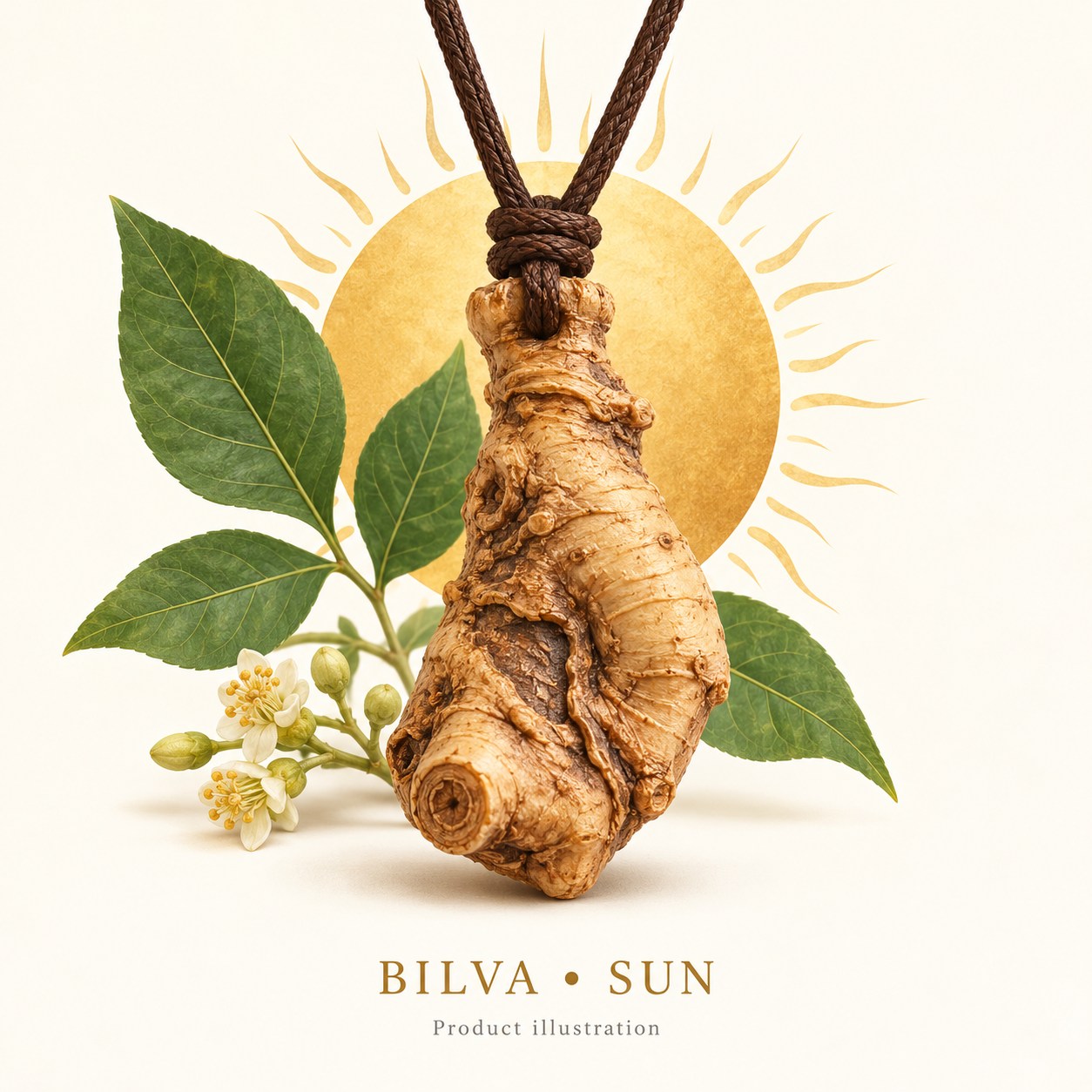
The Bilva tree, widely called Bel, Bael, Bilwa or Vilva, occupies a remarkable place in the religious, botanical and cultural life of India. Many devotees first meet the tree through bilva patra, the leaves offered to Lord Shiva. Others recognise the hard-shelled bael fruit, remember a tree growing beside a family temple, or encounter Bilva as the name of a medicinal plant in Ayurvedic texts. A more specific association appears in certain systems of planetary herbal jewellery, where a piece described as Bilva root is linked with Surya, the Sun in Jyotish.
These meanings complement one another, but they are not identical. The leaves presented in Shiva puja are not the same plant part as a root set in a pendant. The traditional dignity of a sacred tree does not by itself authenticate a particular manufactured accessory. And a botanical source can establish which plant bears the name Aegle marmelos without settling the spiritual significance assigned to it by a practitioner. Understanding these distinctions makes the story of Bilva richer, not weaker.
This guide brings together the living tree, Shiva worship, symbolic meanings of the three-part leaf, regional customs, Surya and Ravivar associations, classical Ayurvedic terminology, responsible collection, and practical questions for choosing an authentic botanical pendant. If your immediate need is the fitting or cleaning of a purchased root pendant, see the Bilva wearing and care guide. To compare Sun-related materials, see Bilva root, ruby and Rudraksha.
Quick reference: Bilva at a glance
| Topic | Essential information | Why it matters |
|---|---|---|
| Accepted botanical species | Aegle marmelos (L.) Corrêa | Confirms the living Bael tree being discussed |
| Family | Rutaceae | Places Bilva within the citrus family, although it is its own genus |
| Indian names | Bilva, Bilwa, Bel, Bael, Vilva and regional spellings | Name variants alone cannot authenticate a supplied root |
| Recognisable traits | Often trifoliate aromatic leaves, spiny branches, hard-shelled fruit | Features used in living-plant identification, not a carved pendant |
| Principal devotional association | Bilva patra offered in Shiva worship | A widely recognised and well-documented practice |
| Surya association | Used in some planetary root-jewellery systems | A distinct applied Jyotish association, not identical with Shiva puja |
| Traditional Ayurvedic context | Bilva occurs among the trees of Bṛhat Pañcamūla and Daśamūla | A materia-medica context, separate from the use of jewellery |
| Jewellery material | A declared piece of root or another clearly identified botanical part | Documentation must match what is physically sold |
| Conservation consideration | Root extraction can injure or kill a tree | Traceable and responsible collection is particularly important |
1. What does the word Bilva mean?
Bilva is a name deeply embedded in Sanskrit religious and Ayurvedic vocabulary. In contemporary English writing the same plant is often called bael or bel; regional forms include bilwa and vilvam. The names may appear on a puja shopping list, a horticultural nursery label, a classical plant glossary, or a handmade jewellery catalogue. Readers should therefore ask what kind of object the name refers to: a living tree, fresh leaves, fruit, dried root, bark or a finished ornament. A cultural name is not a specification of the harvested plant part.
Botanically, the familiar sacred bael tree is Aegle marmelos (L.) Corrêa, an accepted species in the family Rutaceae. Kew's Plants of the World Online lists its native range in the Indian subcontinent. The plant also grows and is cultivated in other parts of Asia. Its accepted scientific name is far more precise than a catalogue label that merely says “holy root” or “bel wood.” Names such as Crateva marmelos occur in historical botanical synonymy; older literature may use them without referring to an unrelated sacred plant.
There is a subtle complication: historical and medicinal-name databases record Bilva as a name used for different taxa in different sources. This does not make the classic bael identification uncertain. It means that a name by itself is insufficient when a supplier is being asked to identify a dried item. The species name, the plant part and a credible source record should be read together. The same discipline applies when translating an inherited local name into a modern e-commerce title.
Botanical name versus product name
A nursery may identify a healthy tree through its flowers, leaves, fruit and growth habit. A jeweller may receive only a piece of dry material already cut by another supplier. Those are very different evidentiary situations. The scientific name on a product listing is valuable only when it can be connected to the actual production batch. A photographed tree, a Sanskrit quotation or a generic root image cannot substitute for that connection. Good descriptions celebrate tradition and remain precise about what has been verified.
2. How to recognise a living Bael tree
In a garden or orchard, Bilva is generally a medium-sized tree, sometimes thorny, with compound leaves commonly made up of three leaflets. The leaves are often aromatic when handled. The fruit is rounded and enclosed in a hard shell; its contents and appearance change as the fruit matures. The flowers are typically pale, with details that require closer botanical observation. A combination of features is better than any one feature, especially when the tree has not yet fruited or when a regional species has a similar appearance.
The familiar three-leaflet arrangement deserves special attention because it links botanical form with religious interpretation. Some leaves may be imperfect, damaged or differently developed; the symbolic use of three leaflets should not be mistaken for a mathematical rule that every leaf on every specimen must be identical. Botanical identification also considers the arrangement of leaves on the stem, spines, buds, flowers and fruits. A single loose leaf offered in worship does not provide enough evidence for identification in every circumstance.
A professionally verified tree or herbarium record is a more dependable starting point than a social-media image. Photographs of the leaf front and back, the connection to the stem, bark, thorn placement, flowering structures and mature fruit can help a botanist assess an unfamiliar specimen. Because some field traits vary with growing conditions, avoid declaring a plant genuine from one photograph taken in poor light.
| Living plant feature | What to look for | Common source of confusion |
|---|---|---|
| Leaves | Frequently three leaflets, sometimes aromatic | Three leaflets occur in other plants as well |
| Branches | Spines may be present | Absence of visible spines in one cropped photo proves little |
| Fruit | Hard outer rind or shell, characteristic internal pulp | Several hard-shelled fruits share overlapping common names |
| Flowers | Pale floral parts on reproductive growth | Flower photographs are rarely supplied with a root pendant |
| Bark and habit | Tree form, branching pattern and bark characters | Weathering and tree age change bark appearance |
| Provenance | Nursery, orchard, collector or botanical record | A generic photograph cannot track a particular jewellery lot |
3. Bael fruit, wood apple and the problem of common names
One avoidable source of confusion concerns the English expression “wood apple.” It is used for more than one species. The sacred bael tree Aegle marmelos and Limonia acidissima, another Rutaceae tree, can both appear in material bearing this common name. Their fruits may both be hard-shelled, but they are not the same botanical species. Kew's medicinal plant name records and horticultural resources distinguish them. A supplier who writes only “wood apple root” leaves an important identification question unanswered.
In daily life, many people know Bilva from fruit drinks, seasonal produce markets or traditional household uses rather than from leaves in a shrine. That is a legitimate part of its cultural history; however, food uses of bael fruit are not evidence that an unidentified root ornament is edible or appropriate for making infusions. Fruit, leaf, stem bark, wood and root are separate materials with different chemistry, processing requirements and cultural applications.
For the OmmRudraksha catalogue, a simple practice prevents considerable confusion: state the accepted botanical name, the claimed material part and the form of the product. “Bilva (Aegle marmelos) root pendant” is a more useful specification than “Bael/wood apple energy charm.” If the supply chain cannot confirm the particular root, describe the uncertainty rather than relying on colourful mythology to fill a documentation gap.
4. Why is Bilva especially sacred to Lord Shiva?
The offering of bilva patra to Shiva is one of the best-known devotional uses of the tree. During an individual puja, family worship, temple ritual or Shravana observance, devotees may place fresh Bilva leaves near a Shiva linga, often with water and other customary offerings. The exact procedure depends on sampradaya, family instruction, regional practice and the temple's rules. Mahashivaratri is another prominent occasion when Bilva is especially visible in Shiva devotion.
For many worshippers, offering a simple leaf expresses bhakti rather than display. The gesture can carry the idea that something grown by nature, carefully chosen and offered with sincerity, has more significance than its material price. Another family may place emphasis on the prescribed order of mantra, water, flowers and leaves. These approaches should not be flattened into one compulsory ritual for everyone. When learning a practice, a local priest or trusted family tradition is a better guide to temple-specific observance than a universal online checklist.
The Shiva Purana discusses offerings of bilva leaves in the broader setting of Shiva worship. This source supports the importance of Bilva as a devotional leaf. It does not automatically establish a universal rule about wearing pieces of Bilva root around the neck for Surya. That additional connection belongs to its own interpretive setting. Separating the two allows readers to honour the inherited Shiva practice accurately while understanding the different intention of a Sun-associated pendant.
5. Three Bilva leaflets: Trinetra, Triguna and sacred symbolism
Devotional interpretation often sees the familiar three leaflets as reminders of Shiva's three eyes (Trinetra). Other explanations connect the tripartite form with Triguna—sattva, rajas and tamas—or the threefold dimensions of spiritual practice. In some households people connect the leaflets with past, present and future or with three sacred functions. These are symbolic readings in devotional culture, and more than one can coexist without a need to identify a single botanical “correct answer” for a religious symbol.
The widely circulated Bilvashtakam praises the act of offering a single Bilva leaf to Shiva. Worshippers may recognise the line beginning “Tridalam trigunakaram”, which brings together the three-leaflet form, attributes and the image of the three-eyed deity. An article can discuss the familiar chant's meaning without claiming that every modern version, translation or attribution has the same textual pedigree. Where a quotation is used in ritual instruction, spelling and recension should be checked against the version actually followed by the family or teacher.
The symbol is not a laboratory statement about a root's electromagnetic properties. It is a language of devotion, memory and embodied ritual: the form of a common leaf becomes a prompt for contemplation. The same family that treasures the sacred leaf may decide not to collect roots from its tree. That practical restraint, too, can reflect reverence for the living plant.
6. Bilva in temple life, household puja and regional practice
The tree's significance extends beyond a single festival. Some Shiva temples maintain Bilva trees in their gardens, and many household worship routines include obtaining clean Bilva leaves from a known plant. In northern India, a devotee may speak of belpatra, while in parts of southern India the words vilva or vilvam are familiar. In Odisha, Bengal and neighbouring regions, the tree and leaves also occur in local seasonal and goddess-oriented ceremonies. The details differ, so a blanket statement that every place uses an identical leaf count or rite would be misleading.
Seasonal practices matter in the handling of the leaves themselves. Freshly collected leaves are often valued in puja; methods of choosing intact leaflets, washing them, or offering them differ by household and temple. Some temples have specific instructions against plucking on certain days or from particular trees. Those rules should be learned locally, not inferred from a commercial jewellery page. A person visiting a temple should not remove leaves, branches or roots from the premises without permission.
Bilva also belongs to a larger Indian tradition of sacred trees and sthala-vriksha. The tree can mark the identity of a place, shade a shrine, link generations of worshippers and encourage care for the immediate environment. Its significance is therefore ecological and communal as well as personal. The presence of a sacred tree at a temple tells a story about custodianship; it does not authorise harvesting its roots for sale.
7. The meaning of Bilva in Sanskrit and Ayurvedic plant literature
Bilva appears in classical Ayurveda as a named plant material, with references to fruit and other plant parts depending on preparation. A particularly important context is Bṛhat Pañcamūla, the “five greater roots” grouping in the Daśamūla tradition. Names commonly listed alongside Bilva include Agnimantha, Shyonaka, Patala and Gambhari; taxonomic treatments of some of these other plants differ between sources and lineages. This is a history-of-texts and materia-medica fact, not a reason to treat an ornament as a pharmaceutical product.
The word mūla is useful here because it literally relates to root, but the classical preparation and a polished root pendant should not be confused. An Ayurvedic pharmacopoeial context may require authenticated ingredients, defined collection practices, plant-part selection and processing. A jeweller does not meet those requirements merely by assigning the name of the herb to a piece of root. Conversely, the fact that Bilva appears in an herbal text should not diminish its distinct sacred-tree role in puja.
Terms such as rasa, guna, virya, vipaka, dosha, dravya and kalpa belong to the conceptual vocabulary of Dravyaguna and Ayurvedic practice. When a blog explains them, it should identify the classical framework without treating a wearing accessory as if it delivers the effects attributed to a medicinal preparation. This distinction is particularly useful for customers who search both “Bilva root Ayurveda” and “Bilva root Sun pendant” and might otherwise assume they refer to the same use.
| Context | Plant part or object | Traditional purpose | Why it differs from a pendant |
|---|---|---|---|
| Shiva puja | Bilva leaves / bilva patra | Devotional offering | The offering is a leaf, not proof about a root ornament |
| Fruit and food culture | Bael fruit | Regional culinary and household traditions | Edibility of fruit does not apply to root jewellery |
| Ayurveda / Daśamūla | Specified authenticated botanical ingredients | Classical materia-medica tradition | Processing and use are different from an accessory |
| Sacred-tree heritage | Living tree | Temple and community identity | The tree must be protected, not harvested casually |
| Surya-themed herbal jewellery | Root identified as Bilva in a pendant | Planetary symbolism in a particular contemporary/traditional system | Requires plant-part identity, mounting information and source context |
8. Bilva and Surya: why does a Shiva-associated tree appear in Sun jewellery?
This is the central question for readers encountering a Bilva root pendant for Surya. In Jyotish, the Sun (Surya) is a graha associated with Atman, selfhood, authority, father, leadership, visibility, status, personal responsibility and the capacity to stand in one's role. Different texts and teachers organise these significations in somewhat different ways, but the broad Surya vocabulary is familiar across many astrological schools. A plant-jewellery tradition may select Bilva as a symbolic companion to such themes.
The Shiva–Bilva association is wide and prominent in devotional practice. Bilva root–Surya is a more particular association found in some lists of planetary herbs and pendants. It should be presented as an association used by that tradition, rather than as though every classical Jyotish source prescribes the same tree root for every Sun concern. A serious consultation also considers the individual janma kundali, the Sun's house placement, strength, dignity, aspects, conjunctions and the question being asked; a single item name cannot replace that process.
One person may choose the pendant after a practitioner has recommended a plant-based item. Another may appreciate its symbolism without accepting any prescriptive astrological application. Both customers benefit from a clear description of the object's material and the particular interpretation used by the seller. The article should never imply that simply owning a piece of Bilva is equivalent to worshipping Shiva or observing an entire Surya sadhana.
9. Surya in Jyotish: Simha, dignities, houses and nakshatras
A classical astrological account gives Surya more nuance than the popular phrase “Sun for confidence.” In standard Parashari Jyotish frameworks, Surya rules Simha (Leo), is conventionally exalted in Mesha (Aries) and debilitated in Tula (Libra). His own graha day is Ravivar (Sunday). He governs the nakshatras Krittika, Uttara Phalguni and Uttara Ashadha in the familiar Vimshottari-dasha lordship scheme. These correspondences describe an interpretive grammar of Jyotish; they do not independently prescribe a root pendant for a chart.
Surya may be read as a karaka for father and paternal figures, the public role, administrative responsibility, honour and the way a person carries obligations. The ninth, tenth or first house may matter depending on the actual question; no universal shortcut makes one placement good or bad in isolation. Surya Mahadasha and Antardasha are relevant only when calculated using the chosen dasha system, birth data and ayanamsha conventions. A generic website article should not tell every person born under a particular rashi that they need a Bilva pendant.
A thoughtful Sun-related article therefore explains the vocabulary and directs personal remedial selection toward an actual chart review. Questions such as “Is Surya my lagna lord?”, “Is the Sun functional benefic for this ascendant?”, “Is there an eclipse or combustion context involving other planets?” and “What is the purpose of the remedy?” cannot be answered from a product photograph. Even when a traditional remedy is meaningful, the material chosen should be discussed for its sourcing, wearability and suitability.
| Surya topic | Traditional association | Interpretation note |
|---|---|---|
| Graha | Surya / Ravi / Aditya / Bhaskara | Names point to overlapping but differently nuanced devotional contexts |
| Weekday | Ravivar (Sunday) | Common setting for solar observances |
| Rashi lordship | Simha (Leo) | Does not automatically mean every Leo-born person needs Sun jewellery |
| Exaltation | Mesha (Aries) | One dignity among several chart considerations |
| Debilitation | Tula (Libra) | Must be assessed with house, aspects, divisional context and other factors |
| Nakshatra lordship | Krittika, Uttara Phalguni, Uttara Ashadha | Part of a named Vimshottari dasha scheme |
| Related devotional forms | Surya arghya, Aditya Hridayam, Surya namaskara | Practices vary in religious and practical meaning |
| Bilva root | Specific planetary-herbal-jewellery pairing | Not identical to the well-established Shiva leaf offering |
10. Why Sunday (Ravivar) is discussed with Sun-related devotional objects
Sunday is associated with Surya in Indian weekday tradition. A person following Ravivar worship may rise early, bathe, offer a simple prayer, recite a familiar name of Surya, or perform arghya according to family custom. Other practices include recitation of Aditya Hridayam or particular Surya mantras taught by a practitioner. Different lineages have different requirements about timing, offerings, repetitions, fasting, orientation and eligibility, and these should not be homogenised into mandatory instructions for everyone.
For an optional devotional beginning with a Bilva pendant, the central principle can be straightforward: keep the accessory clean and dry, place it respectfully near the puja area if the materials permit, perform the customary prayer separately, and wear it when ready. The pendant need not be immersed in milk, ghee, temple water or other liquids simply because such substances appear in other ritual settings. Dried root, cord, metal, glue and finish may react differently to moisture. The physical care of an object and the spiritual meaning of a ritual are compatible when their purposes are kept clear.
A sankalpa is a statement of intention in worship. Its wording should reflect the devotee's actual practice rather than a marketing script asserting guaranteed outcomes. The mantras “Om Suryaya Namah” and “Om Ghrini Suryaya Namah” are frequently encountered in modern Sun devotion; local pronunciation and recitation instructions should follow the tradition being practised. A catalogue may explain the context without making the purchaser dependent on an elaborate ritual supplied by a seller.
11. Bilva, Shiva and Surya: complementary meanings rather than a contradiction
A single plant can participate in multiple cultural systems without those systems being collapsed into a single assertion. Bilva leaves in Shiva worship are part of a documented devotional history. Sun-root jewellery using Bilva belongs to a narrower list of planetary associations. Bael fruit in household food culture is another domain entirely. Bilva in Ayurvedic formula terminology is a fourth. Respect for the plant requires recognising which meaning is being invoked and which part of the tree is involved.
There is no need to describe a Bilva pendant as “more powerful than worship” or to suggest that a sacred leaf has become a scientific transmitter because it has a Sun association. Its spiritual relevance can come from the wearer’s sankalpa, family custom and the symbolic role of Surya. Devotional value and material accuracy are not opposites. A person can regard Bilva as holy while still asking whether the pendant contains documented root, whether the tree was harmed and whether the finished item is suitable for daily use.
The same precision protects long-term SEO value. A high-quality article answers the reader's question about Bilva and Surya, clearly explains the celebrated Shiva relationship, and links to fitting and comparison guides only where they help. It does not force every topic into one repeated set of planetary promises, because readers want to learn different things from each page.
12. Does the sacredness of the leaves extend automatically to the roots?
Devotional literature most often highlights the leaf offering. A root is another part of the same tree, but it is collected differently and carries a different ethical burden: extensive root removal can damage a living Bilva. A statement that Bilva is sacred therefore cannot by itself justify cutting roots from temple trees. If the root is used for a pendant, the description should specify whether it was obtained from legitimate cultivated stock, a naturally fallen or removed tree, an authorised agricultural source, or another traceable supply channel.
The phrase “sacred root” is a cultural or product designation. It does not demonstrate a fixed age, inherited lineage, species authentication or special efficacy. An honest item record may contain a vendor declaration, harvest-location information to an appropriate non-sensitive level, a batch number and images of the finished piece. These details are more useful than inventing a romantic origin story. If collection records do not exist, a seller can say that provenance is limited and improve the supply chain for future stock.
A family may also decide that the best way to honour Bilva is to grow a tree, support a temple garden or offer leaves in approved ways. Botanical jewellery is an optional expression of symbolism, not a prerequisite for devotion. In that sense, the ecological life of Bilva is part of its sacred significance rather than an unrelated afterthought.
13. What botanical authentication can and cannot establish
A living source plant can be identified by a trained botanist using diagnostic features, voucher specimens and accepted floras. An already polished root fragment may lack leaves, flowers and obvious internal characters. Colour, smell, grain, hardness and weight can be informative but are not uniquely identifying. Where the claim is commercially important, a supplier may need authenticated source records, appropriate microscopy, reference collections or specialist testing rather than relying on a photograph of the jewellery.
Ask for the accepted scientific name, the declared plant part, the place and method of acquisition, and the construction materials of the pendant. A product photograph should show the actual fitting and any surface treatment. A signed or dated supplier specification can be valuable, but it must not be misrepresented as a laboratory certificate. A gemological certificate designed for a ruby does not authenticate a botanical root. Conversely, a nursery identification sheet for a living tree does not necessarily trace every piece in a jewellery production lot.
The most helpful response to uncertainty is specificity. If a vendor knows the item is a brown botanical piece but not whether the material is root or stem, the product should not assert more than the evidence supports. OmmRudraksha's product copy can explain the traditional meaning of Bilva while keeping these material details separate and accessible to customers.
| Supplier evidence | What it can support | What it cannot guarantee |
|---|---|---|
| Accepted botanical name with source record | Identity of the collected plant if records are reliable | Identity of an unrelated finished batch |
| Nursery or orchard collection log | Provenance of a particular source plant | Absence of later substitution during processing |
| Batch invoice and workshop trail | Continuity through supply chain | Species correctness without original identification |
| Actual-item front/back photographs | Size, colour, finish and attachment | Plant species from appearance alone |
| Coating and cord specification | Maintenance and contact considerations | Botanical authenticity |
| Independent specialist authentication | Greater confidence in a stated determination | Spiritual efficacy or guaranteed results |
| Ritual or family tradition | Meaning of a practice for participants | Material identification of a purchased accessory |
14. Ethical sourcing and care for living Bilva trees
Because Bilva is sacred to many households and temples, provenance has a social meaning as well as a commercial one. Root harvesting is not comparable to collecting fallen leaves or ripe fruit. Digging into major structural roots can weaken a tree, create entry points for disease and disturb the soil that supports it. Purchasing decisions can influence whether suppliers value the long-term survival of the tree or simply the short-term sale of root fragments.
A responsible seller should ask whether a tree was already being removed with permission, whether material came from a managed nursery or permitted cultivation, and whether collection complied with local ownership and forest rules. A customer need not obtain confidential supplier details, but can reasonably ask for a straightforward source description. Avoid claims such as “taken secretly from a famous temple tree,” which would make the sourcing less reassuring, not more sacred.
Living Bilva trees also provide shade, seasonal fruit, habitat and cultural continuity. The sacred grove and sthala-vriksha traditions remind us that care for trees can be a sustained community practice. Planting an appropriate native tree where space, water and local ecological conditions allow may be a more meaningful expression of reverence than purchasing an item with no traceable harvesting history. The sacred status of Bilva is a reason to be more exacting about sourcing, not less.
15. How Bilva compares with ruby and Rudraksha in Surya traditions
Customers searching for a “Surya remedy” may encounter ruby (Manikya), twelve-mukhi Rudraksha, and Bilva root jewellery. These are materially unlike one another. Ruby is a variety of corundum with its own gemological standards and disclosure issues. Rudraksha is a bead from an Elaeocarpus fruit, and its mukhi arrangement is evaluated differently from a faceted gemstone. Bilva root is a botanical piece whose identity depends on plant provenance and part verification. They are not interchangeable simply because a shop places all three under “Sun.”
Traditionally, Manikya is a familiar Surya-associated ratna, while particular Rudraksha associations belong to their own strands of practice. Bilva root should be explained as a plant-based option within the system using that correspondence. A comparison should consider the person's tradition, practitioner guidance, budget, sensitivities, construction, daily activities and evidence available for the item. The most expensive object need not be the most meaningful, and a cheaper alternative should not be sold as automatically producing the same results.
| Material | Identity | Traditional context | Most important purchasing check |
|---|---|---|---|
| Bilva root pendant | Declared Aegle marmelos root in a mounting | Specific Surya-themed herbal jewellery tradition | Botanical provenance, plant part, responsible sourcing |
| Ruby / Manikya | Red corundum | Widely used Surya gemstone association in Jyotish | Natural vs synthetic status, treatment disclosure, credible report |
| 12-mukhi Rudraksha | Sacred seed bead with a stated mukhi count | Sun/Aditya associations in certain Rudraksha traditions | Genuine bead, natural mukhi structure, condition |
| Bilva patra | Leaves of the living Bilva tree | Widely established Shiva offering | Clean and respectfully obtained leaves per local custom |
For a dedicated buying comparison, read Bilva root, ruby and Rudraksha for Surya. It explains the materials rather than treating all of them as one product type.
16. Bilva root pendant: what should the product actually disclose?
A customer should be able to distinguish the cultural story, physical specification, care instruction and stock availability without reading between the lines. A good product page can state “Bilva (Bael) Root Pendant for Sun” and then list the declared material as Aegle marmelos root, if the supplier has authenticated that description. The dimensions should indicate whether they include the bail and cord. Any coating, resin seal, metal fitting, adhesive, plating or adjustable closure should be identified as accurately as possible.
A catalogue should also show close-up images of the actual product or a clearly labelled representative sample. One illustration of a root pendant may suit a blog header but cannot show every crack, mounting detail or variation of an individual batch. Botanical materials are not expected to have identical grains, tones or shapes. Variation is not itself a quality defect; the important distinctions are normal material variation versus damage, accurate species claim versus unverified label, and suitable finishing versus poor construction.
If the pendant is ready for sale, a customer should see the price, measurements, attachments, handling guidance and return-related facts under the normal product policies. The article can explain these principles without changing existing category or product settings. Readers who want the actual listing can visit the Bilva root pendant for Sun; those concerned about fit should proceed to the detailed wearing and care guide.
17. Respectful use: wearing a root and observing a puja are separate acts
A root pendant is designed to be worn or kept as a symbolic object; a leaf offering is part of a ritual. Wearing does not require imitating every practice used for offerings, such as washing a deity, bathing a Shiva linga or presenting ingredients at an altar. If a family wishes to include the new pendant in a Ravivar sankalpa, it can be kept dry on a clean cloth during prayer and worn afterwards. A person who prefers private contemplation can recognise the Bilva–Surya meaning without performing a public ritual.
Do not use essential oils, milk, perfume, saltwater, incense ash or chemical cleaners on an unidentified plant part. The same advice applies to a cord of uncertain dye stability, a plated bail or an attachment secured with adhesive. Root materials can crack or absorb moisture, and glued fittings may loosen. Keep the pendant away from rough sport, prolonged dampness, bathing and sleeping when snagging is possible. For actual cleaning and storage decisions, follow the specifications of the finished item rather than a generic rule for wood or stone.
If a pendant splits, shows loose fragments, develops a persistent unfamiliar odour, or causes irritation, remove it and inspect the materials. These are practical questions about the item and personal comfort. A devotional interpretation should not prevent someone from repairing a failed clasp or replacing a damaged cord. Worship and maintenance are different responsibilities.
18. Festivals and seasonal associations: Shivaratri, Shravana and Sunday
Mahashivaratri and the Shravana period are prominent in many forms of Shiva worship and are times when Bilva leaves may be especially sought. The local religious calendar, temple rules, and regional interpretation determine the actual dates and procedures. Sunday is a general Surya weekday association, while not every Shivaratri or Shravana activity is an instruction concerning the Sun or a root necklace.
For a family already devoted to Shiva, understanding Bilva's tree heritage can deepen the familiar act of offering leaves. For someone interested in the Sun through Jyotish, the Ravivar context may be useful. Neither practice needs to erase the other. The distinction is especially important in online descriptions because a headline combining “Bilva and Surya” might otherwise lead readers to assume that Belpatra is offered only to Surya or that the root pendant has the same scriptural status as the Shiva leaf offering.
A meaningful calendar note can say what a festival is associated with, what may be done locally and what is not prescribed universally. That is much more respectful than claiming every customer must purchase a new object before an auspicious date.
19. Bilva and the wider idea of sacred ecology
Indian sacred-plant traditions frequently link trees with particular deities, temples and local histories. Their importance lies not only in texts but also in the continued care of groves, temple gardens and neighbourhood trees. Bilva is an excellent example because its leaves can be offered, its fruit can be recognised in ordinary life, and the tree itself can become a marker of continuity for a community. In this setting, the practical care of living plants is part of the religious narrative.
An ethical approach begins by asking where the tree grows, who maintains it, whether the leaves may be collected, and whether harvesting practices allow it to survive. Sacredness does not grant open access to temple property or protected land. When selecting leaves for personal worship, follow local permissions and avoid unnecessary injury. When buying root products, seek material obtained without destroying a valued healthy tree.
The same outlook improves catalogue language. “Root sourced responsibly from an identified Aegle marmelos supply” would be a useful statement if supported by actual records. “Guaranteed one-hundred-year temple root” is not useful without evidence. Customers increasingly value clear provenance and respectful handling. These are durable features of quality, independent of any interpretation of planetary influence.
20. Five common misunderstandings about Bilva
- Bilva is only a Surya plant. No: its Shiva worship association is much more prominent and widely documented. The Surya root connection appears in particular planetary-herbal traditions.
- Every item called wood apple is Bilva. No: common names also refer to Limonia acidissima and may be applied inconsistently in trade.
- A triple leaflet proves a tree is Aegle marmelos. No: botanical identification requires a range of features, ideally with reliable provenance.
- Ancient use of Bilva root in Ayurveda authenticates a root pendant. No: a medicinal text identifies a plant material within its own context; a finished retail item still needs source documentation.
- A sacred plant is always safe to soak, burn, ingest or apply to skin. No: plant part, preparation and product materials matter. A jewellery item is not a food or medicinal preparation.
21. Questions to ask when choosing Bilva for worship or jewellery
Start with your purpose. Do you want to understand Shiva leaf offerings, plant a Bael tree, study Ayurveda, or buy a Surya-related pendant? Each purpose has different evidence and practical requirements. If you need leaves for a temple rite, the temple's instructions matter. If you want to plant a tree, site conditions and suitable nursery stock matter. If you are buying jewellery, provenance, dimensions, fastening and care matter.
Ask the vendor to name the plant, part used, source, treatment and finished form. Then ask for representative photographs that show the reverse and the point of attachment. Where a planetary recommendation is claimed, ask which tradition is being followed rather than accepting a universal promise. If a personalised Jyotish decision is wanted, the birth details and interpretive method belong in a consultation; the website article should provide background rather than pretend to know a visitor's chart.
A buyer can value sacred symbolism without abandoning ordinary purchasing standards. A carefully described accessory that is comfortable and responsibly sourced serves that purpose better than extravagant claims. The same approach protects trust in Bilva's actual spiritual heritage.
22. Read related OmmRudraksha material in the right order
The broader Spiritual Jewellery category introduces devotional and traditional jewellery, while Planetary Herbal Jewellery groups plant-based pendants by their stated graha associations. Readers interested in the actual product can view the Bilva (Bael) Root Pendant for Sun. For comfort, cord length and keeping botanical materials dry, read How to Wear and Care for a Bilva Root Pendant. If you are comparing material classes for Sun symbolism, use Bilva Root, Ruby and Rudraksha for Surya.
OmmRudraksha's established For Planets collection is another route for understanding bead choices, but a Rudraksha recommendation is not automatically a substitute for a plant-based tradition. These connected pages have distinct jobs: plant heritage here, wearable care in the pendant guide, and selection among materials in the comparison. That division helps customers make informed choices without reading repetitive content.
23. Final perspective: sacred meaning with clear botanical identity
Bilva deserves attention for more than a single accessory. It is the Bael tree of Indian botanical and household tradition, the source of bilva patra revered in Shiva worship, a recognised Ayurvedic materia medica name, and a living plant whose care connects worship with ecological responsibility. Within some systems of planetary herbal jewellery, Bilva root also carries a Surya symbolism. The latter can be explained respectfully without claiming that it supersedes the better-known devotional role of the leaves.
An excellent choice rests on understanding what is actually in front of you: the living tree, a fresh leaf offered in puja, a historically described herb, or a finished pendant. Identify the plant carefully, ask how the material was obtained, observe the family or temple custom that matters to you, and use the jewellery in a way that suits its real construction. In this balance, traditional meaning and practical accuracy strengthen one another.
Frequently asked questions about Bilva, Bael, Surya and Shiva worship
Is Bilva the same tree as Bael or Bel?
In common Indian botanical and devotional usage, yes: Bilva, Bel, Bael, Bilwa and Vilva commonly refer to Aegle marmelos. These spellings arise from language and transliteration. A finished object nevertheless needs more than a common name for verification. Ask whether the seller means the Aegle marmelos tree, which part was used and how the supplied material was traced to that species. Names can overlap across plants in historical drug-name records, so a scientific name with provenance is a better standard for commerce than a name alone.
What is the scientific name and family of the sacred Bilva tree?
The accepted scientific name is Aegle marmelos (L.) Corrêa, placed in the citrus family, Rutaceae. Kew's botanical record describes its range and accepted nomenclature. Some old texts use historical Latin synonyms, which may be valid references to an earlier naming convention rather than evidence of another product. A source document should still record the accepted name and the part of the plant. The family name explains botanical relationship; it is not an authentication test for a pendant.
Why are Bilva leaves offered to Lord Shiva?
Bilva patra has an established role in Shiva devotion, including temple and household pujas and especially observances during Shravana and Mahashivaratri. Worshippers may connect the leaf with Shiva's three eyes and the three gunas, or simply regard its offering as a familiar act of bhakti. Sources including the Shiva Purana discuss bilva offerings. The exact count, handling and mantras are determined by the temple or family tradition followed; a website should not replace local observance with an invented universal rule.
What do the three leaflets of Bilva symbolise?
The three leaflets are often interpreted as a reminder of Trinetra, Shiva's three eyes, and in some presentations as Triguna, the three qualities sattva, rajas and tamas. Other devotional explanations also occur. These interpretations give a physical leaf spiritual meaning, but they are not botanical diagnostic rules. Many species have compound leaves, and damage can alter the shape of any individual leaf. Use the symbol for prayer and several plant characters for species identification.
Does Bilvashtakam mention the three-part leaf?
A widely known line of Bilvashtakam begins “Tridalam trigunakaram,” linking the threefold leaf to devotional symbolism. Recitations and translations circulate in several forms. The presence of the leaf in a familiar chant makes sense in Shiva worship, but it should not be stretched into a claim that every variant of a modern root pendant has the same classical instruction. Use the text and pronunciation preferred in your actual lineage, and distinguish the poetic image from a product specification.
Is Bilva associated with Surya or only with Shiva?
Its association with Shiva through leaf offerings is especially prominent and well documented. Bilva root is also associated with the Sun in some lists of planetary herbs and spiritual jewellery. These are different practices. A user may value both but should not assume that the leaf offering itself is prescribed as a Sun remedy in all forms of Jyotish. When a seller presents Bilva for Surya, ask which tradition or recommendation is being followed, and confirm the physical item independently.
Is Bilva root the traditional gemstone for Sun?
No. Bilva root is a plant-based item, not a gemstone. Ruby, known as Manikya, is the more familiar ratna associated with Surya in Jyotish, while certain Rudraksha traditions discuss twelve-mukhi beads in relation to Aditya. A shop may offer a root pendant as another type of traditional item, but this does not make the materials identical. Compare botanical authenticity, gem treatment disclosure, bead structure, comfort and cultural preference rather than assuming that they perform the same function.
What are Surya’s main Jyotish associations?
In standard Parashari descriptions Surya rules Simha, is exalted in Mesha, and is debilitated in Tula. Ravivar is the Sun's weekday. Krittika, Uttara Phalguni and Uttara Ashadha are the three nakshatras assigned to Surya in the usual Vimshottari scheme. The Sun also signifies Atman, personal authority, father, status and responsibility in many readings. A recommendation based on an individual chart must consider the full kundali; neither a nakshatra name nor one rashi placement automatically creates a need for a purchase.
Must a Bilva root pendant be worn on Sunday?
Sunday is a familiar day for Surya observances, so some people choose Ravivar to begin wearing a Sun-themed item. It is not a universal botanical rule. If a family has a specific practice, follow that practice with appropriate care for the accessory. Starting on another day does not change the tree's botanical identity or the pendant's construction. Keep any prayer dry and separate from activities that would damage the root, coating, cord or metal fittings.
Which mantra can accompany a Surya-themed Bilva pendant?
Some devotional contexts use “Om Suryaya Namah” or “Om Ghrini Suryaya Namah,” while others include Aditya Hridayam or a family-specific practice. Mantra choice, pronunciation, counting and eligibility differ by lineage and teacher. There is no sound reason for a shop page to impose one lengthy formula on every purchaser. If a pendant is part of a personal Jyotish recommendation, request the recitation and sankalpa instructions from the practitioner who gave it.
Can Bilva leaves be used during Mahashivaratri and Shravana?
Yes, bilva leaves are especially familiar in many Shiva-oriented observances during Mahashivaratri and the Shravana season. Local rules can govern when and how leaves are obtained, whether they are washed, and the form of the offering. Respect the temple's instructions and avoid plucking from protected trees without permission. The importance of fresh leaves in a puja does not mean a root pendant should be dipped in water or anointed with every substance used in ritual bathing.
What is the difference between Bilva Patra and Bilva root?
Bilva patra refers to the leaves, commonly offered to Shiva. Bilva root refers to below-ground botanical tissue and appears in traditional materia-medica contexts and in some marketed plant-based jewellery. A dried pendant may be coated, pierced and mounted, giving it maintenance needs unlike those of a fresh leaf. A leaf is relatively renewable when collected properly; cutting large roots may injure the tree. Identify the plant part before relying on a cultural or care instruction.
Does a Bilva root pendant have to come from a temple tree?
No. A claim that the root came from a famous shrine is not necessary to explain its traditional symbolism, and it raises important permission and conservation questions. A responsibly sourced, accurately identified material from permitted cultivation is preferable to an undocumented object taken from a protected or sacred tree. Ask for the source and permission status rather than relying on a dramatic origin story. The spiritual meaning of Bilva need not depend on harvesting a temple tree.
Is Bilva part of Daśamūla in Ayurveda?
Bilva is commonly listed among the five larger-root trees of Bṛhat Pañcamūla within the classical Daśamūla grouping. Other named members include Agnimantha, Shyonaka, Patala and Gambhari. Classical names and modern botanical identifications can have taxonomic complexities, and the meaning of a formulation depends on its prescribed ingredients and preparation. An ornament made with a piece described as Bilva root is not the same as a medicinal Daśamūla preparation and should not be sold as though it were one.
Is Bael fruit the same as wood apple?
The common name “wood apple” is ambiguous: it is used for both Aegle marmelos and Limonia acidissima in some references. Those are distinct Rutaceae species. Market labels may also vary by language. If a vendor uses the phrase in an identification record, request the scientific name and ideally a photograph of diagnostic plant features or a verified source plant. For a root pendant, the risk of confusion is greater because the fruit and leaves used for easier identification are no longer attached.
Does an old Latin name mean the Bilva tree is a different species?
Not necessarily. Botanical names can change when taxonomists revise classification or accepted nomenclature. Kew includes historical synonyms for Aegle marmelos. A supplier can reference those for historical context while using the current accepted name in the product specification. The more important risk is a common name applied to an unrelated species, or a product supplied without continuity from the source tree. A Latin name written on packaging is not by itself a substitute for a traceable lot record.
Can a polished brown root be recognised as Bilva by sight?
Usually not reliably. Grinding, drying, carving, staining, oiling and coating can remove the living tree's diagnostic features. A piece of brown plant material may resemble root, stem wood or a manufactured composite. Photographs can reveal construction, visible damage and finish but may not establish species. Ask about identification before processing, workshop or batch records, and any specialist assessment available. Avoid damaging home scratch, burning or solvent tests: they can destroy a usable item while still failing to prove its origin.
What should be checked before buying a Bilva root pendant?
Confirm the claimed botanical name, the stated plant part, source documentation, actual dimensions, coating, cord and bail material, fitting condition, care guidance, price and applicable store policies. Request actual-product photographs where possible. Ask whether the supplied piece is natural root, another plant part or a composite, rather than assuming the photograph answers that question. For a purchase tied to astrology, clarify the recommendation separately. A good listing permits a customer to understand the item without accepting a sweeping claim about guaranteed planetary effects.
What is an ethical source for Bilva root?
The answer depends on local ownership and collection rules, but a useful source should be authorised and traceable. Material from permitted cultivation or an existing legitimate tree-removal process may be more defensible than roots cut from a healthy sacred or protected tree. Tree-root extraction can affect stability and survival. Suppliers should be able to explain their sourcing model at least in broad terms and retain records appropriate to their operation. Do not treat “sacred” as permission to remove material from temple property.
Can a Bilva pendant be immersed in milk or water during puja?
Not without material-specific approval. A finished pendant may combine porous botanical material, adhesives, threads, plating or surface coatings, each vulnerable to liquids in a different way. A prayer can be performed with the item on a clean dry cloth while the usual ritual is conducted separately. If an item has already become wet, dry it gently and inspect for changes; do not use direct heat. The religious intention of a ritual does not require making a delicate accessory difficult to maintain.
How should Bilva root jewellery be cleaned?
Use the item's specific care instruction. For many finished root pendants, gentle dry dusting with a soft clean cloth or brush is a prudent first approach, provided the coating and mounting are sound. Avoid soaking, chemical polishes, steam, ultrasonic cleaning, strong sunlight and abrasive scrubbing unless the manufacturer explicitly allows a method. Check the drilled opening and attachment for cracks. The care routine is about preserving a finished accessory, not imitating the preparation of medicinal Bilva.
Can a Bilva pendant be worn with Rudraksha?
Some people wear different devotional items together, while others follow a specific instruction from a guru, family or Jyotish adviser. Practical compatibility matters: hard metal or stone components can strike a delicate botanical pendant, cords can tangle, and heavier beads can pull on a small fitting. Check length, attachment strength, skin comfort and the actual meaning each item has in your practice. Wearing multiple objects does not automatically multiply a promised result.
Is Bilva worship only for people born under Simha rashi?
No. Shiva worship with Bilva leaves is not generally limited to people of one zodiac sign, and the sacred-tree tradition extends well beyond horoscope interpretation. In Jyotish, Simha is Surya's own sign, but birth rashi alone is not a full indication for a specific remedy. A personal recommendation uses the chart and the question being considered. People who simply appreciate Bilva's cultural significance can learn from or participate in relevant devotional customs irrespective of their rashi, subject to local practice.
Is the Bilva tree suitable for planting in a home or temple garden?
It may be suitable where climate, space, drainage and local horticultural advice support a healthy tree. Consider its eventual dimensions, any thorny growth, access for maintenance and the suitability of the site before planting. A local nursery or botanist can recommend appropriate stock and care. Do not plant close to infrastructure without understanding root development. Cultivating a living Bilva can be a meaningful long-term way to honour the plant rather than relying exclusively on purchased symbolic objects.
Can the fruit or leaf traditions be used as medical instructions for a root pendant?
No. Ayurveda and regional household practice discuss particular plant parts and preparations, with a context quite different from a polished piece of jewellery. The presence of Bilva in an herbal text does not establish the composition, dose or function of a pendant. This article explains terms such as Daśamūla and Bilva so readers can distinguish histories and practices. Decisions about ingesting or applying herbal preparations require information specific to those preparations, not a retail ornament description.
Where should I read next about the Bilva–Surya tradition?
For the living tree and its sacred significance, remain with this guide. To explore the particular wearable item, visit the Bilva root pendant product page. If your questions concern how it sits on the body, dry cleaning or storage, use the dedicated wearing and care guide. If you are comparing Bilva root against ruby or twelve-mukhi Rudraksha for Surya, read the separate material-comparison guide. The Planetary Herbal Jewellery and For Planets collections offer the broader context without confusing the categories.
Sources, identification notes and related reading
The following botanical records support the tree name and cultural background; they do not authenticate an individual retail pendant. These are the two original external destinations from this article, retained with nofollow attributes. No new outbound links are required for the rewrite.
- Kew Plants of the World Online: Aegle marmelos — accepted botanical name, family, synonymy and distribution.
- National Medicinal Plants Board: Bael — existing plant-reference destination from the source article; review current accessibility separately before a production link audit.
Other cultural and nomenclatural details were independently checked during editorial research against Kew's Medicinal Plant Names Services, botanical field references, sacred-plant conservation literature and accounts of Shiva worship. No additional external hyperlink has been added to the article. Isha Foundation: “Why is the Vilva Leaf Dear to Shiva?” is mentioned in the original as an unlinked reading reference and remains unlinked in accordance with the site's external-link policy.
For the associated product see the Bilva Root Pendant for Sun; for the practical care guide see How to Wear and Care for a Bilva Root Pendant; for material comparison see Bilva Root, Ruby and Rudraksha for Surya.
