
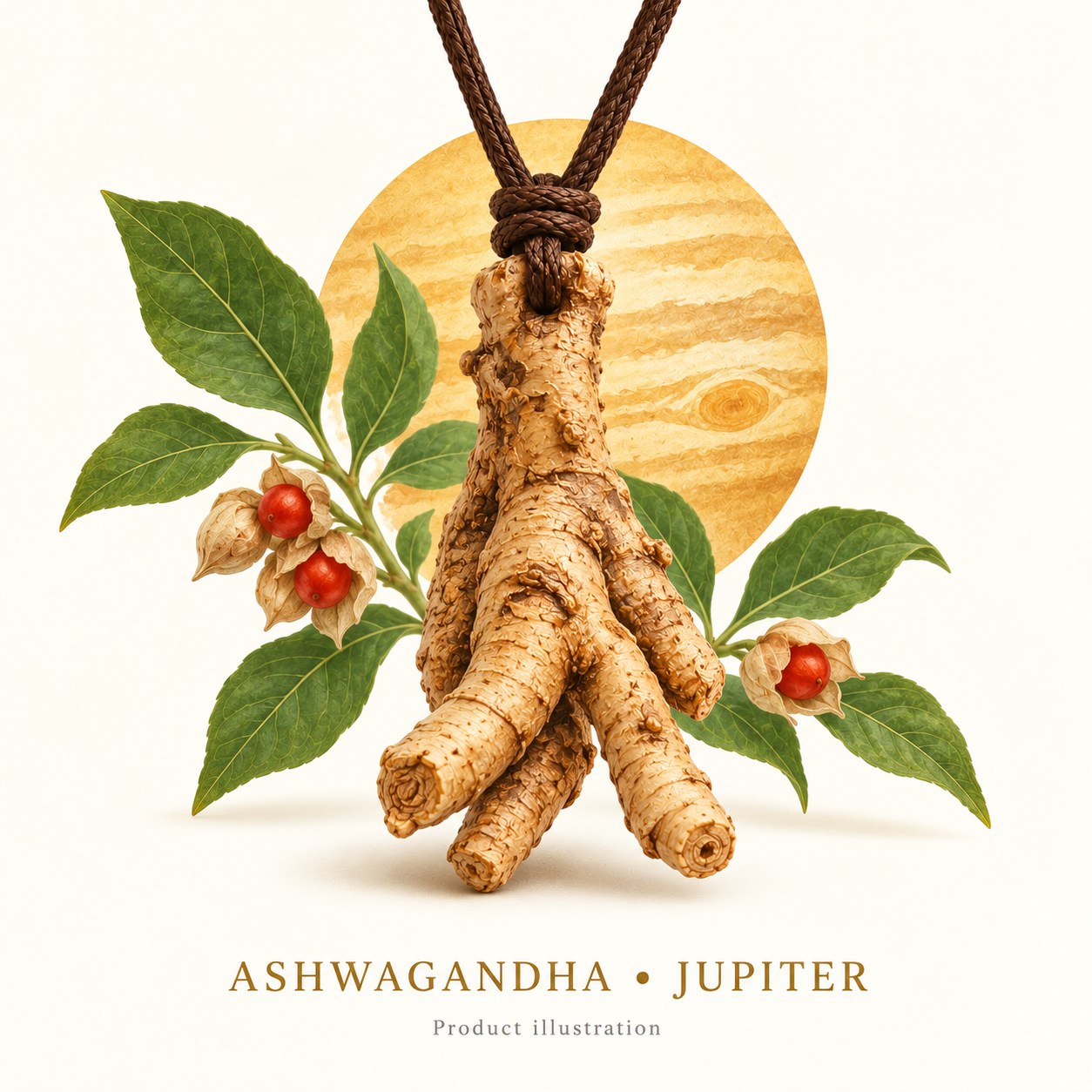
Should you choose an Ashwagandha root pendant, a yellow sapphire (Pukhraj) or Rudraksha for Guru (Jupiter)? The answer begins by recognising that these are three different forms of devotional or astrological jewellery, not interchangeable versions of a single remedy. Ashwagandha refers to a plant root accessory; Pukhraj is a corundum gemstone; Rudraksha is a sacred plant-derived bead associated especially with Shiva. The terms Guru and Brihaspati explain why these materials may share a traditional conversation, but they do not remove the need to verify each actual item.
Below you will find a detailed side-by-side guide to Jyotish and Navagraha associations, botanical and gemological identity, Rudraksha mukhi terminology, reports, mounting, care, customary Thursday practices, comparative value and questions to ask before purchasing. Traditional descriptions are presented as traditions; physical descriptions are presented as material facts requiring item-specific confirmation. This distinction helps preserve meaningful spiritual language while making the buying decision clearer. A buyer looking for Guru, Brihaspati or Jupiter materials may encounter three offers on the same screen: an Ashwagandha root pendant, a yellow sapphire ring and a Rudraksha bead. All can be discussed within Indian devotional or astrological practice, yet they are not three grades of the same material. One begins as a plant root, another is a cut mineral crystal, and the third is the hard inner structure associated with a tree fruit. Their preparation, identification and long-term maintenance differ so much that comparing only an alleged planetary effect misses the most useful purchasing information. This guide uses three separate lenses. The traditional lens explains why Guru and Thursday worship appear in the conversation. The material lens asks what the seller can actually identify and document. The practical lens asks whether a particular ring, bead or pendant fits comfortably, survives ordinary use and suits the buyer's budget. A statement that a product is linked with Guru belongs to the first lens; its exact species, corundum treatment or bead anatomy belongs to the second. They should not be confused. The right choice is not automatically the costliest item. Nor should a root be presented as a scientifically established replacement for Pukhraj, or a Rudraksha as a cheaper version of a sapphire. A person may favour one devotional tradition, own an heirloom bead, wear a gemstone because of a family custom, or prefer no ornament. The comparison is meant to clarify meaningful differences rather than prescribe one object for everyone. Ashwagandha appears in modern planetary herbal jewellery catalogues as a root sometimes linked with Guru or Jupiter. It should be described as a correspondence used in particular contemporary or regional practices, not as a universally agreed rule across every classical Jyotish lineage. Lists of roots, plants and graha associations vary between sources and communities. If a teacher or family practice has a specific list, ask which source is being followed and whether the root is a devotional symbol or a prescribed object within that practice. The word Ashwagandha has another, separate public life in Ayurvedic and medicinal-plant discussions. That does not make a pendant a measured dose of an herb, nor does a root worn externally work like a prepared extract or medicinal formulation. Here the relevant item is the physical root accessory: what plant it came from, what part of the plant it contains, how it is mounted, and whether its appearance and care instructions match the item actually supplied. Someone interested in the wider collection can begin with the Planetary Herbal Jewellery category and the Ashwagandha Root Pendant for Jupiter. Those pages provide a product context; this article concentrates on careful comparisons among three different wearable traditions. The accepted botanical name commonly associated with Ashwagandha is Withania somnifera (L.) Dunal, in the Solanaceae family. The plant is a shrub or subshrub whose leaves, flowers, fruits and underground parts have their own identifying features. A dried and cut root fragment in a small pendant may no longer show the leaf or flower characters that a botanist would use to recognise a growing plant. Colour and aroma alone are not dependable proof of species identity, especially once a piece is polished, lacquered or enclosed in a cap. A supplier who uses the scientific name should know whether it describes a documented source plant or is simply a conventional label printed for the category. Ideally, the underlying batch information records where the material was sourced, the part collected, processing steps and how the batch connects to the finished item. Not every small craft seller will have laboratory testing, but the absence of such a report should not be replaced by an invented certificate claim. Ask for a reasonable description of what is known and what remains unconfirmed. This distinction matters because root, rhizome, stem and dried herbal mixture are not interchangeable botanical terms. Ashwagandha jewellery promoted as a root pendant should, where properly documented, actually contain root material. Powder enclosed in a vial, a carved wooden piece and a dried stem are different products even if all appear brown. Their storage and stability may differ. An honest product page should state the physical form rather than rely on the name alone. The same plant name can appear on a devotional pendant and on a bottle containing powder, tablets or extracts. The products cannot be compared as if they had the same route of use. A root pendant is an external accessory; a medicinal formulation is prepared for a specified use with its own quality controls, dosage and professional considerations. A fragment worn on a thread is not an approved means of administering herbal ingredients, and it should never be chewed, boiled for a drink, crushed for consumption or offered to a child as food. The distinction becomes especially important when a product description reuses fashionable terms such as vitality, stamina, immunity or stress support. Such discussions may occur in Ayurveda or scientific research about preparations of Ashwagandha, but they do not establish benefits from a pendant worn outside the body. Even when an article discusses cultural beliefs about auspiciousness, it should not drift into claims about a pendant's treatment of disease or an individual's hormones. The category is devotional jewellery and its handling instructions should remain appropriate to that form. For the focused explanation see Ashwagandha Root Pendant vs Herbal Supplement. If anyone intends to consume Ashwagandha, the suitable source of guidance is a qualified healthcare professional and a properly labelled medicinal or supplement product, not the jewellery listing. Yellow sapphire, known in many Indian gemstone shops as Pukhraj or Pushyaraga in a broader Sanskrit naming tradition, is a yellow variety of corundum. Corundum is principally aluminium oxide (Al2O3) and registers 9 on the Mohs scale. That hardness helps it resist scratching in normal jewellery use, although it does not mean that a cut stone or its metal setting cannot be chipped, loosened or damaged by impact. Yellow sapphire ranges from pale straw tones to richer yellow and orangy-yellow appearances. The yellow colour is not a certificate by itself. Natural sapphire may have colour generated by trace elements and crystal-related processes; some stones are heated to change or improve colour, some have undergone diffusion treatment, and laboratory-grown corundum can have the same basic mineral chemistry as natural corundum. Glass, yellow topaz, citrine, synthetic materials and other coloured stones may also be marketed misleadingly under ambiguous trade names. A gemstone's identity requires more than a storefront photograph. Among traditional Jupiter gemstones, Pukhraj holds a particularly prominent place in many contemporary Jyotish practice descriptions. But its prominence does not settle whether a specific stone is natural, treated, suitable to the person or sensibly priced. Those are separate questions. A spiritually motivated purchase can still apply the same insistence on item-specific details as any other fine-jewellery purchase. The Yellow Sapphire collection should be used to compare the actual stones and settings currently offered. When considering a yellow sapphire, identify the particular stone: weight in carats, measurements, shape, colour description, transparency, inclusions, cut quality and any disclosed treatments. A reputable laboratory's identification report may address natural versus laboratory-grown origin and certain detectable treatments, with its conclusions and limitations stated on the document. Such a report is not an astrological endorsement and generally does not certify that a stone will produce a spiritual outcome. The report number, dimensions and picture or characteristics, if available, should match the item delivered. Heating can alter the appearance of sapphire and is widely encountered in the trade. Diffusion treatment is a different process: elements may be introduced into corundum under high-temperature conditions, affecting the resulting colour and market valuation. Some changes are difficult to recognise without specialist equipment. Conversely, an inexpensive-looking inclusion does not by itself prove that a sapphire is fake. Avoid home scratch tests, acid tests or attempts to heat a stone. These can cause damage without providing reliable identification. Natural colour, natural origin, no evidence of heating, untreated and certified are not interchangeable descriptions. Ask for the precise wording of any report. A seller might correctly describe a natural corundum sapphire that has been heat-treated; that is different from claiming a natural, untreated stone. The treatment statement and return policy are commercially meaningful whether the buyer wants the stone for Jyotish, beauty or a family tradition. In ordinary retail vocabulary, colour names sometimes blur mineral distinctions. A yellow quartz sold as citrine is not corundum; yellow topaz has a different mineral structure and cleavage; yellow glass, synthetic corundum and other simulants require separate descriptions. Each has its own optical appearance, price range and care needs. If a family adviser specifies Pukhraj, the buyer should ask whether the intended material is specifically natural yellow sapphire rather than a generic gold-coloured stone. Do not assume that a large clear yellow stone must be rare sapphire because it looks impressive in a photograph. Ask to examine it under neutral light, read the product's exact name and check independent documentation for material claims. Equally, a small sapphire can be genuine even if it is less vivid or has visible inclusions. The quality discussion combines colour, cutting, clarity, carat weight and treatment disclosure. Any claim about origin, such as Sri Lankan or another locality, is an additional claim that deserves its own evidence. In Jyotish discussions, the distinction between mukhya ratna (principal gemstone) and uparatna (secondary or substitute stone) may arise. Different teachers and textual traditions give different lists. These are classifications within astrological practice, not a mineralogical re-labelling of citrine as sapphire. A seller should use the correct mineral name first and discuss customary substitutions separately. Rudraksha refers to a sacred bead widely used in Shiva devotion, japa malas and personal worship. The bead is derived from a fruit of a tree in the genus Elaeocarpus. The names Elaeocarpus ganitrus and Elaeocarpus sphaericus appear in botanical and medicinal-source references; Kew's medicinal-plant naming service maps the former name to the accepted name Elaeocarpus sphaericus in the corresponding records. An authenticated living plant or reliably sourced fruit is one kind of evidence; evaluating a single processed bead is another. The hard structure has naturally formed longitudinal features. In trade these are counted as mukhi or faces. A bead may be used singly, as a bracelet, or strung into a mala with a particular count, knotting pattern and guru bead according to practice. Because beads differ naturally in size, shape and surface texture, buyers should inspect the actual piece rather than expecting every authentic bead to be geometrically uniform. A consistently symmetrical surface can look attractive without settling authenticity. Its spiritual context is not merely Jupiter. Rudraksha occupies a broader place in Shaiva practice and often appears in stories of Shiva, discipline, mantra and meditation. A person's reason for wearing Rudraksha may be devotion to Shiva rather than a specific planetary remediation. The Rudraksha collection and the For Planets collection should therefore be read as related but not identical shopping pathways. Some modern graha-to-Rudraksha correspondence charts associate five-mukhi Rudraksha with Guru, Jupiter or Brihaspati, while other sources emphasise its relationship with Kalagni Rudra or broader Shiva worship. Different lineages also present additional mappings or combinations. It is more faithful to traditional diversity to say that the association exists in some systems than to tell every customer that all Jupiter-related needs require one fixed bead type. Before using a planetary chart as shopping guidance, ask whether it comes from a named practitioner, a specific scripture, a regional devotional custom or a modern product list. The source matters. An individual's teacher may recommend a japa practice with a familiar five-mukhi mala without invoking any horoscope assessment at all. Conversely, an astrologer may discuss the functional role of Jupiter in the natal chart before recommending anything. The category page alone cannot arbitrate these differences. For physical authenticity, a correct mukhi description should follow the natural grooves of the bead and its actual condition. A seller's photograph should show all sides and the hole, not only the front. Deep cracks, glued reconstructions or heavily manipulated surfaces merit explanation. A high quoted price or a ritual certificate should not replace basic physical disclosure. Thursday is widely called Guruvar or Brihaspativar, connecting the weekday with the Guru/Brihaspati tradition. In many homes, people choose yellow flowers or garments, visit a temple, honour teachers, offer appropriate food or charity, or recite a mantra learned from their family. Exact observances vary. Some communities include turmeric, chana dal, banana or a lamp as part of a broader practice; it would be inaccurate to present one household's materials or timing as mandatory for every purchaser. A commonly encountered short invocation is Om Brim Brihaspataye Namah, although spellings, transliterations and mantra forms vary. Other practices use Guru's name, stotras, a teacher's instruction or Shiva mantras for Rudraksha. One should not assume that the same mantras are prescribed for a piece of sapphire, a sacred bead and a root fragment simply because all are offered in one category. For a sankalpa, the personal intention and chosen devotional context are more important to describe than a rigid retail script. Wearing a pendant while observing Thursday customs can be a meaningful reminder of study, gratitude and self-discipline. That remains a devotional choice. A seller can discuss familiar customs, but should not guarantee exam success, a marriage date, business growth or a specific change in planetary influence. The associated tradition is worth explaining in its own terms, without making the material sound like a calibrated instrument. The word genuine changes meaning with the object. For Ashwagandha, it may mean the stated botanical species and genuine root material in a correctly described accessory. For yellow sapphire, it means an accurate mineral identity, natural or laboratory-grown status, treatment disclosure and a stone that matches its report. For Rudraksha, it involves the naturally formed bead, honest mukhi identification, condition and any repair disclosure. No single certificate template suits all three. A supplier's own attestation is useful when it states the observed facts and source, but it is not automatically equivalent to independent testing. A generic certificate with the words "energised" or "authentic" does not tell the buyer whether a yellow stone is corundum, whether a root belongs to Withania, or whether a bead contains reconstructed parts. The best record is specific enough that the object in the packet can be matched to the record and the method of assessment is intelligible. For small-value accessories, formal laboratory testing of every item may be disproportionate. That is a commercial reality rather than permission to invent a result. Transparent statements such as "identified by supplier," "material name used in local trade," "no independent botanical analysis supplied" or "condition documented by close photographs" give buyers more useful information than an unsupported universal guarantee. A ring is more than a gem. Check the setting, metal, shank, size, prongs and the position of the stone relative to the finger. Some Jyotish wearers prefer an open-back setting or particular metal because of a customary rule, but jewellery safety still comes first: a poorly secured stone or abrasive edge is not improved by ritual language. If an heirloom ring is resized, ask whether the work can affect prongs or an existing treatment-sensitive stone. A root pendant may have an adhesive, resin casing, glue, metal cap or cord that contacts the skin more often than the root itself. Check for rough edges, peeling coatings, mould, unexplained odour and parts that may detach. The pendant's dimensions and overall weight should be stated, especially if the supplier photograph enlarges a tiny central fragment. Avoid wearing any piece that causes skin irritation. A buyer with a known metal sensitivity should ask specifically about the cap, chain and clasp rather than treating the botanical name as the entire ingredient list. A Rudraksha bead may be placed on cotton, silk, metal wire, elastic or a chain, and many malas use knots. Compare bead shape, bore and string tension. Direct contact with soaps, perfumes and perspiration can change a finished assembly; the failure point may be the knot or clasp rather than the bead. For children, loose beads and long cords introduce choking or entanglement risks, so devotional significance should not be used to dismiss ordinary product-safety decisions. The yellow sapphire ring suits someone who wants a conventional jewellery item and understands that it may require periodic inspection of the mount. A pendant may be preferable when finger sizing or hand-intensive work makes rings inconvenient, but the chain length, weight and exposed surfaces should still be checked. A root pendant is often lightweight and visually modest; its lightness is an advantage for some wearers, while its organic nature requires more careful storage and handling. A single Rudraksha may be carried as a pendant or worn in a bracelet. A mala can also function as a tool for japa rather than everyday fashion. If beads will be repeatedly moved through the fingers, threading and knotting quality become especially important. Choose the format that matches the actual practice rather than assuming every item should be worn continuously, during bathing or while sleeping. Long cords and protruding pendants may catch during physical work. When a seller promises that all three should be worn together, ask what concrete reason supports the combination. A personal consultation may use a specific tradition, but there is no general commercial need to purchase three separate objects to make one devotional intention valid. A person can select one, use an existing item or prioritise non-purchase forms of Guru worship such as learning, service and respectful conduct. Ritual practices may include prayer, incense, mantra, touching a clean cloth or placing an item near the home altar. These can be meaningful without exposing the object to substances that are unsuitable for its material. A root fragment may soften or lose integrity in water, milk, oil or humid storage. Metal caps can tarnish; adhesive may degrade. Some gemstones and settings are sensitive to temperature changes or to how they were treated. A multi-material mala brings its own thread and spacer components. When advice suggests immersing an entire pendant in a mixture, distinguish between the symbolic intention and the physical procedure. A prayer does not require a damaging immersion. If a family custom calls for a substance, the wearer can ask a trusted teacher whether a non-contact gesture is acceptable for the accessory. Do not boil, burn, chemically soak or scrape an object to demonstrate its spiritual authenticity. The same principle applies to "activation" claims. A customer may request a puja or personal mantra practice, but the product page should specify whether any actual service is included, who performs it, and what is delivered. It should not confuse an included service with botanical identification or a gem lab report. The old and new purposes are different: one is devotional, the other evidential. If your primary intention is Shaiva devotion or regular japa, Rudraksha may fit naturally with an existing mantra discipline and can be chosen primarily as a bead or mala. If you are following a gemstone-based Jyotish custom that specifies a particular Pukhraj, a clearly identified yellow sapphire and its report become central. If you follow a planetary-herbal practice involving Ashwagandha, sourcing the correct root material and preparing an appropriate lightweight pendant will be the practical priorities. None of these criteria requires claiming that one object reproduces another object's effect. Some people want an item solely as a reminder of a personal sankalpa, a gift from a parent, or a connection to a teacher. For them, appearance, provenance, comfort, workmanship and meaning may outweigh laboratory cost. Others are specifically paying for a natural, untreated gemstone, and disclosure of heat or diffusion treatment materially affects their purchasing decision. Both are legitimate use cases, but they are not the same transaction. Make the buying decision in two stages. First, identify the devotional practice and whether a particular material is needed within it. Second, assess the actual object as jewellery: correct identity, fit, workmanship, price, care and ability to return a misdescribed item. This two-stage approach helps avoid paying for a dramatic planetary promise when the delivered object itself has not been adequately described. Yellow sapphire pricing depends on the stone rather than just its yellow colour: identity, size, clarity, hue, cutting, treatment, documentation and origin claims can affect valuation. The metal and labour of the setting add a second layer. A quote for a loose 1-carat stone is not directly comparable to a complete ring, and a report fee or resizing charge may be additional. Current prices should be checked on the exact listing rather than repeated as permanent figures in evergreen editorial content. Root pendants are usually valued through raw-material sourcing, artisan preparation, protective treatment, fitting, packaging and the seller's service. They should not be described as scientifically equivalent to a gemstone merely because they cost less. Rudraksha prices vary by type, condition, size, provenance, workmanship and market supply. A commonplace bead and a rare claimed mukhi count invite different levels of verification; the latter should not be purchased on price or seller confidence alone. Some shops bundle mantra, energisation, certificates, a chain, shipping and gift packaging. Ask the seller to itemise what the price covers. Confirm whether the certificate comes from an independent organisation, from the vendor or from a ritual provider. A clear invoice and a written return policy often provide better practical protection than an ornate paper without a test method. Physically, it may be possible to wear a ring, pendant and bead together when each piece is comfortable and securely constructed. That does not mean the combination is required. Traditions vary on whether certain gemstones should be prescribed according to the birth chart, and some devotees wear Rudraksha without involving astrology at all. For an individual who follows a specific spiritual guide, the appropriate response is to ask that guide about the intended practice rather than assert a universal shopping rule. From a maintenance perspective, keep a hard sapphire from repeatedly striking softer or fragile accessories. A dangling root pendant can snag on Rudraksha strands; chains and cords can become tangled. If several items are worn near one another, test the arrangement during ordinary movement and inspect where hard components rub. Remove accessories before activities likely to pull, wet or crush them. If multiple accessories carry different religious or family meanings, the wearer can decide how to organise them without framing an accidental interaction as an omen. The seller's responsibilities remain ordinary ones: accurate material descriptions, clear recommendations about care and honest separation between a traditional custom and a verifiable physical claim. A gift intended to support a student's focus or a family member's spiritual routine can be affectionate without attaching an obligation to believe that a gemstone will guarantee examination success. For a child, avoid small detachable beads, loose strings and long cords because of swallowing or entanglement hazards. An adult should choose any wearable item with the recipient's consent and consider skin sensitivities, dexterity and comfort. A gemstone ring may be inconvenient for someone whose fingers change size; a secure pendant or a non-wearable keepsake may be more practical. For an elder who performs daily japa, a well-strung mala can have a familiar rhythm; bead size, weight and thread texture may matter more than decorative metal fittings. For a recipient who already wears a religious bead, an unexpected second item can conflict with personal preferences. Ask discreetly or give an exchange option. The spiritual value of a gift is not dependent on forcing it to be worn daily. A good gift label can say what the item is and what it is traditionally associated with. It need not make claims about curing anxiety, improving academic scores or influencing the recipient's life events. The choice and practice should remain with the person receiving it. For a root pendant, ask: What is the recorded botanical name? Is the material actually root? Is it one whole piece, powder, wood or a decorative reconstruction? What coating is present? Where do the chain and cap come from? Can it be kept dry, and what happens if it becomes damp? Is a batch photograph available? These questions are appropriate even if the item is inexpensive. For yellow sapphire, ask: Is the stone natural corundum or lab-grown? Has heat, diffusion, filling or another treatment been detected or disclosed? Is there an independent report with a matching number? What is the carat weight of the gem alone? Are the colour and origin claims supported? Can I inspect the stone in ordinary lighting? Are there chips at the girdle, loose prongs or mounting changes after the report? What does the return policy say if the stone is not as described? For Rudraksha, ask: What mukhi count is being offered? May I see every side of the actual bead? Is it dyed, repaired, drilled or filled? What is its diameter? Is it intended for a single pendant or mala? Who checked the bead's visible characteristics, and are the photographs of my exact piece? If a planetary mapping is stated, which tradition is being used? A knowledgeable retailer can answer material and policy questions without claiming mastery over every school of Jyotish. One mistake is comparing a generic root pendant's price directly with that of a natural, untreated gem, then calling the cheaper item "the same remedy." The second is treating a rich yellow colour as sufficient proof that a stone is Pukhraj. The third is assuming a high mukhi count from an attractive surface photograph or equating an expensive Rudraksha with automatic authenticity. Each mistake arises when a broad story replaces examination of the actual material. Another error is to use one universal cleaning ritual for three different materials. A root is vulnerable to dampness in a way that corundum is not; a sapphire's setting introduces complications absent from a bare bead; a mala's knots and cord need separate care. The correct cleaning plan follows the whole assembly and its weakest component. Ask for the maker's instructions rather than applying a procedure from an unrelated product. Finally, avoid purchasing solely because a seller says that Jupiter is weak or strong without showing what interpretive framework is used. Jyotish consultation, when requested, is a separate personal service; a general article can explain commonly used terms but does not analyse a personal kundali. It is reasonable to ask for the assumptions, the scope of advice and whether the recommendation requires buying anything. Imagine opening each product ten months after purchase. The root pendant should still be dry and intact, with its protective surface and loop secure. If it is damp, friable or discoloured in a way suggesting deterioration, continuing to wear it would be unwise until it is inspected. The sapphire ring should still have tight prongs, a comfortable shank and no new chips at exposed edges. The Rudraksha should have an intact bead and sufficiently strong cord or knots to withstand its intended handling. The purchasing documents should also remain intelligible: a root-source note that identifies the material, a gemstone report that matches the individual stone, or clear bead photographs and a receipt showing what was sold. A vague "energy guaranteed" certificate will do little to resolve a dispute about a stone treatment or damaged clasp. Condition photographs made when the parcel arrives can help document what the customer actually received. When an object is part of a personal practice, careful maintenance is compatible with respect. There is no contradiction between reverence for Guru, Shiva or family custom and checking a clasp, asking about a laboratory report or requesting accurate botanical nomenclature. Responsible stewardship of material objects supports the long-term usefulness of the tradition. Explore the Ashwagandha Root and Guru (Jupiter) traditional guide for a deeper look at the planetary-herbal correspondence and the root pendant versus herbal supplement discussion for the important distinction between an accessory and an ingestible preparation. The Yellow Sapphire collection and Rudraksha collection allow material-specific browsing. Return to Spiritual Jewellery or Planetary Herbal Jewellery when considering other root-based forms. These links point to complementary subjects rather than to a ranking of spiritual efficacy. For planetary Rudraksha shopping, see the Rudraksha for Planets collection and confirm the exact type and customary association on the current listing. No. They appear in overlapping traditions but have different substances, verification routes and devotional roles. A root accessory, a natural corundum gemstone and an Elaeocarpus bead should not be advertised as scientifically interchangeable. Specific Jyotish recommendations vary by practice and by person. Pukhraj generally refers to yellow sapphire in Indian gemstone trade. Yellow colour alone is insufficient to establish that identity. Ask for a clearly described sapphire and, where appropriate, an independent identification report; do not assume that citrine or yellow topaz is the same mineral. Guru represents Jupiter and is associated in many Jyotish interpretations with wisdom, learning, mentors, dharma, counsel and expansion. A traditional association does not prove that wearing an item creates a specified event. Chart-based recommendations depend on the framework used by a qualified practitioner. Ashwagandha is the common name of a plant, generally Withania somnifera, while a root pendant should contain a part of that plant identified as root. The label must not substitute for evidence about the particular piece. A powdered herb, stem and root section are distinct products. Yes. Kew lists Withania somnifera (L.) Dunal as an accepted name in Solanaceae. That botanical record validates the scientific name of the plant, not the identity of an untested individual pendant. Ask the supplier how the batch was obtained and labelled. No. A worn root or resin-mounted accessory is not prepared or labelled for ingestion. It may contain glue, coatings or metal components. Food, medicines and supplements follow different quality and use requirements. Consult an appropriate health professional for any intended ingestion. Claims studied or discussed for oral preparations cannot be transferred to a decorative root worn on the body. Its role here is a traditional or devotional accessory. The plant name alone provides no evidence of a pharmacological dose from external wear. No. Genuine sapphire occurs in different yellow tones and saturations. Hue and intensity affect market appearance and price, but genuineness concerns the mineral identity and disclosed natural or laboratory-grown status. Treatment and report information should be checked separately. No. A sapphire may be natural corundum and still have undergone heat or another treatment. Ask what the report says about detectable treatment and what the seller discloses. Words such as natural, unheated and untreated have different meanings. It is a high-temperature treatment that can alter corundum colour by introducing elements into the stone. The distinction can affect price and appropriate disclosure. Some treatments are difficult to recognise without expert testing, so do not use home tests as a substitute for reputable gemological assessment. These are different materials from sapphire. Trade mislabelling can occur, but a careful listing states the correct mineral or imitation identity. If the buyer specifically wants yellow sapphire, a seller should not silently substitute another yellow stone. It denotes a Rudraksha with five recognised natural longitudinal faces or grooves according to trade classification. Some modern correspondence systems connect five-mukhi with Guru; other traditions emphasise Shaiva meanings. Ask for complete photographs and the source of any claimed planetary mapping. No. Rudraksha is a plant-derived bead, not mineral corundum. Its natural formation and verification differ from those of gemstones. A gemology report for sapphire cannot be reused as a botanical certificate for Rudraksha. The name is widely encountered in Rudraksha literature. Kew medicinal-name records map Elaeocarpus ganitrus to the accepted name Elaeocarpus sphaericus for those records. Name usage changes across publications; ask how the specific source is being described instead of relying on a single unexamined label. No. No universal rule requires purchasing a root, sapphire and Rudraksha together. Some traditions discuss specific materials or practices; others favour mantra, study, service or devotion without jewellery. A decision should follow the person’s actual practice and budget. There is no scientifically established shared scale that ranks the planetary effectiveness of these three objects. A spiritual teacher may prefer one practice within a lineage, but physical authenticity and price do not establish an objective ranking of life outcomes. Thursday is associated with Guru in many observances, but actual wearing guidance varies by religious practice, lineage and household. A maker’s instructions about moisture, comfort and secure fittings still apply on any day. Confirm a specific ritual with the tradition you follow. Different practices may use Guru invocations, Shiva mantra or a teacher’s instruction. It is better to preserve the devotional context of each item than to issue a universal ritual command. A short Guru invocation is common, but transliteration and customary procedures differ. Do not assume so. Water or oil may damage root material, adhesives, threads or jewellery fittings; gemstone treatment and mounting affect cleaning choices. A non-contact devotional observance can often preserve the intention without putting the object at risk. A useful report identifies the stone, measurements, carat weight and disclosed conclusions concerning natural or laboratory-grown origin and detectable treatments. Always match the report to the actual gem. A laboratory identification does not establish whether the stone suits a birth chart. Only what its author actually assessed. A botanical source or batch declaration may help with plant identity; it is not equivalent to a gem report. An “energised” note documents a ritual claim, not scientific verification of species or spiritual results. Ask what surface is in contact with the skin: raw root, resin, cap, adhesive or chain. If any component irritates your skin, discontinue contact and consult a suitable professional as necessary. Check the actual fitting rather than relying on the botanical name. Thread and knots can wear with handling, moisture, friction and age. Loose knots and weakened cord threaten the assembly even when the beads themselves are intact. Inspect periodically and use a skilled person to restring a valued mala when needed. Choose according to the recipient’s practice, comfort and wishes. A Rudraksha bead may suit someone devoted to Shiva, while a gem or root pendant may relate to a personal custom. Ask about metal allergies, ring size, wearable safety and exchange rights before gifting. It can be chosen as a different kind of accessory if the buyer’s practice allows it, but it is not a mineral replacement or a proven equivalent of yellow sapphire. Be clear whether the choice reflects budget, devotion, style or a tradition-specific recommendation. First identify your purpose: Guru worship, Shiva japa, a specific horoscope-based gemstone recommendation or simple personal jewellery. Then verify the exact material, workmanship, price, report or supplier record, fitting and care. Browse the related guides and ask a specific question before ordering. The source file already included a botanical reference to Kew's plant record: Kew: Withania somnifera. That record concerns a scientific name and the plant's classification, not the individual root used in a pendant. For gemology, technical definitions of sapphire, corundum, treatment and laboratory reports were checked against Gemological Institute of America educational material, retained here as a named reference rather than adding repeated outbound shopping or authority links. Kew medicinal-name records also distinguish published Rudraksha botanical names. The specific seller should identify the actual item and disclose any relevant uncertainty. A Guru-related root pendant should be honestly described as a botanical accessory, a yellow sapphire should be sold under its correct gemological name with treatment information, and a Rudraksha should have a transparent bead and mukhi description. Each may hold a legitimate place within a person's devotion or customary interpretation, but none needs exaggerated comparisons to be meaningful. Begin with the intended practice, confirm the actual material, and choose a comfortable, well-described item you can care for over time.The first distinction: three different objects, one overlapping tradition
At a glance: Guru-associated root, gem and bead
Question Ashwagandha root pendant Yellow sapphire / Pukhraj Rudraksha bead Material family Plant tissue, commonly a dried root section Corundum gemstone; aluminium oxide Seed-derived hard endocarp / bead from an Elaeocarpus fruit Main identity question Is the plant really Withania somnifera and is the part a root? Is it natural sapphire, synthetic corundum or an imitation? Is it a natural Rudraksha bead and what is the verified mukhi count? Typical wearable form Sealed or mounted small piece on a cord/chain Ring or pendant with a stone setting Single bead, necklace or mala Evidence to request Supplier botanical and plant-part information Independent gem-identification report when appropriate Detailed bead photographs, type and condition disclosure Everyday care priority Protect from moisture and fragile fittings Protect setting; follow treatment-sensitive cleaning Check cracks, cord and prolonged soaking Spiritual context Some planetary-herbal practices associate the root with Guru Pukhraj is traditionally prominent in Jupiter gemstone discussion Rudraksha belongs to Shiva devotion; some systems also map bead types to grahas Is Ashwagandha actually an established Guru remedy?
Ashwagandha botanical identity: Withania somnifera, not a generic brown root
How to verify an Ashwagandha pendant before wearing it
Verification point Useful evidence Warning sign Practical follow-up Botanical identity Withania somnifera name tied to a source or batch Generic herb name presented as specimen proof Ask how species identity was established Plant part Root indicated in supplier or artisan description Root, bark and stem used interchangeably Request a close view of unmounted material Physical condition Dry intact piece; no visible active mould Persistent dampness, powder leakage, softening Avoid wearing; discuss a replacement Surface treatment Coating, resin or sealant clearly named "Raw" claim on a fully encased or dyed piece Ask about direct skin contact and ingredients Construction Photos of cap, loop, knot, clasp and size No picture of the back or attachment point Confirm whether chain and fitting are included Provenance claim Traceable supplier statement appropriate to item Unverifiable spiritual certificate with no subject Request written, item-specific information Ashwagandha jewellery is not Ashwagandha medicine or a supplement
Yellow sapphire or Pukhraj: what is the stone?
Why sapphire treatments and laboratory reports matter
Yellow sapphire report and selection checklist
Listing item What to check What it does not prove Name and identity Natural or lab-grown corundum; not merely a yellow stone That a photograph is a scientific identification Colour and cut Hue, transparency, windowing, symmetry, visible inclusions That deeper yellow automatically has stronger Guru meaning Weight Carat weight of gem, not whole ring weight Spiritual potency by weight alone Treatments Heat, diffusion, filling or other disclosures if relevant That "natural" necessarily means untreated Report Lab name, number, current item match, limits of testing Astrological suitability, future events or personal outcomes Mounting Metal, ring size, prong condition and underside access That a loose-stone report describes the final ring Total price Stone, setting, report, alterations, delivery, returns That price and ritual significance follow one universal scale Pukhraj is not the same as every yellow gemstone
Rudraksha: the sacred bead, its tree and Shiva tradition
Which mukhi Rudraksha is associated with Guru?
Rudraksha mukhi, evidence and traditional meaning
Aspect Questions worth asking Interpretation Botanical name What Elaeocarpus source is claimed and how was material obtained? Scientific naming and bead identification are separate steps Mukhi count Can all natural longitudinal lines be seen clearly? Count is a visible commercial feature, not proof of planetary outcome Five-mukhi association Which Jyotish or Shaiva tradition informs the Guru mapping? Not all traditions use one identical graha chart Condition Are there cracks, filling, glue, dyes or repairs? Disclose repairs even for devotional accessories Wearability Are hole, cord, knots and clasp sound? Construction can matter more than a decorative certificate Ritual use Is it for daily japa, a mala, or a single pendant? Intended practice affects appropriate configuration Guruvar worship and the meaning of Thursday
Three kinds of authenticity: plant, mineral and seed
What documentation actually answers
Document type Can reasonably establish Cannot establish by itself Root-supplier declaration Named source, part, batch and preparation Planetary effect or clinical benefit Botanical analysis Species identity within method and sample limits That every pendant in an unrelated batch is the same Independent gem report Stone identity, characteristics and detectable treatments Horoscope suitability or predicted results Bead inspection record Mukhi count, measurements, surface and condition The practitioner’s individual recommendation Jewellery invoice Purchased item, declared material, cost and policy Scientific genuineness unless supported separately Ritual or puja note What devotional action was performed by whom Gemological or botanical authentication Construction and skin contact: compare the whole finished ornament
Everyday wearing: ring, pendant, bead or mala
How to clean and store each material
Situation Ashwagandha root accessory Yellow sapphire jewellery Rudraksha bead or mala Regular dust Use a soft dry cloth or gentle soft brush Soft cloth; mild cleaning consistent with treatment and setting Gently brush dry grooves; inspect knots Water and soaking Avoid soaking plant fragment, glue or cap Usually durable, but cleaning depends on treatments and mount Avoid long soaking; drying of holes and thread can be slow Heat and sunlight Avoid strong heat and prolonged sun exposure Avoid thermal shock and high heat; check stone treatment Avoid high heat, harsh cleaners and prolonged wet storage Oils and perfume Avoid direct oils on porous or coated material Keep products off the setting; clean residue promptly Follow supplier-specific care; avoid heavy oil buildup Storage Dry breathable protected area, separate from moisture Padded section away from abrasive contact with other jewellery Dry, clean pouch; avoid crushing the bead and tangling cord Damage noticed Stop wearing if root crumbles, wets or leaks Have loose prongs or chipped stone checked professionally Check deep cracks and restring if thread has weakened Traditional cleansing versus physical cleaning
Choosing by intention without assuming three objects are equivalent
A decision matrix for common buyers
Buyer situation Reasonable first consideration Check before purchase Wants japa mala and Shiva devotion Rudraksha mala or bead appropriate to practice Bead authenticity, threading, comfortable count and fit Given an individual Pukhraj recommendation Specified natural yellow sapphire, if that is what was recommended Gem identity, treatment, weight, lab report and return conditions Follows a family planetary-root custom Ashwagandha root pendant if part of that custom Actual species/part description, dry construction and chain Needs lightweight everyday jewellery Small bead or a compact secured pendant Comfort, sweat exposure, fittings and snagging Wants long-term fine jewellery Yellow sapphire jewellery may be suitable Budget, setting maintenance and treatment-sensitive care Shopping on a limited budget Simple, accurately described object or no purchase Avoid claims that spending more guarantees a result Buying a gift for someone else Ask recipient’s actual practice and material preferences Allergies, size, authenticity policy and consent Price, value and what is included
Can Ashwagandha, Pukhraj and Rudraksha be worn together?
Buying for a child, elder, student or family member
Twenty practical questions to ask a seller
Common buying mistakes and how to avoid them
A useful comparison across a lifetime of ownership
Where to continue reading within OmmRudraksha
Frequently asked questions
Botanical and gemological source notes
Final perspective: respect the tradition and identify the object
