
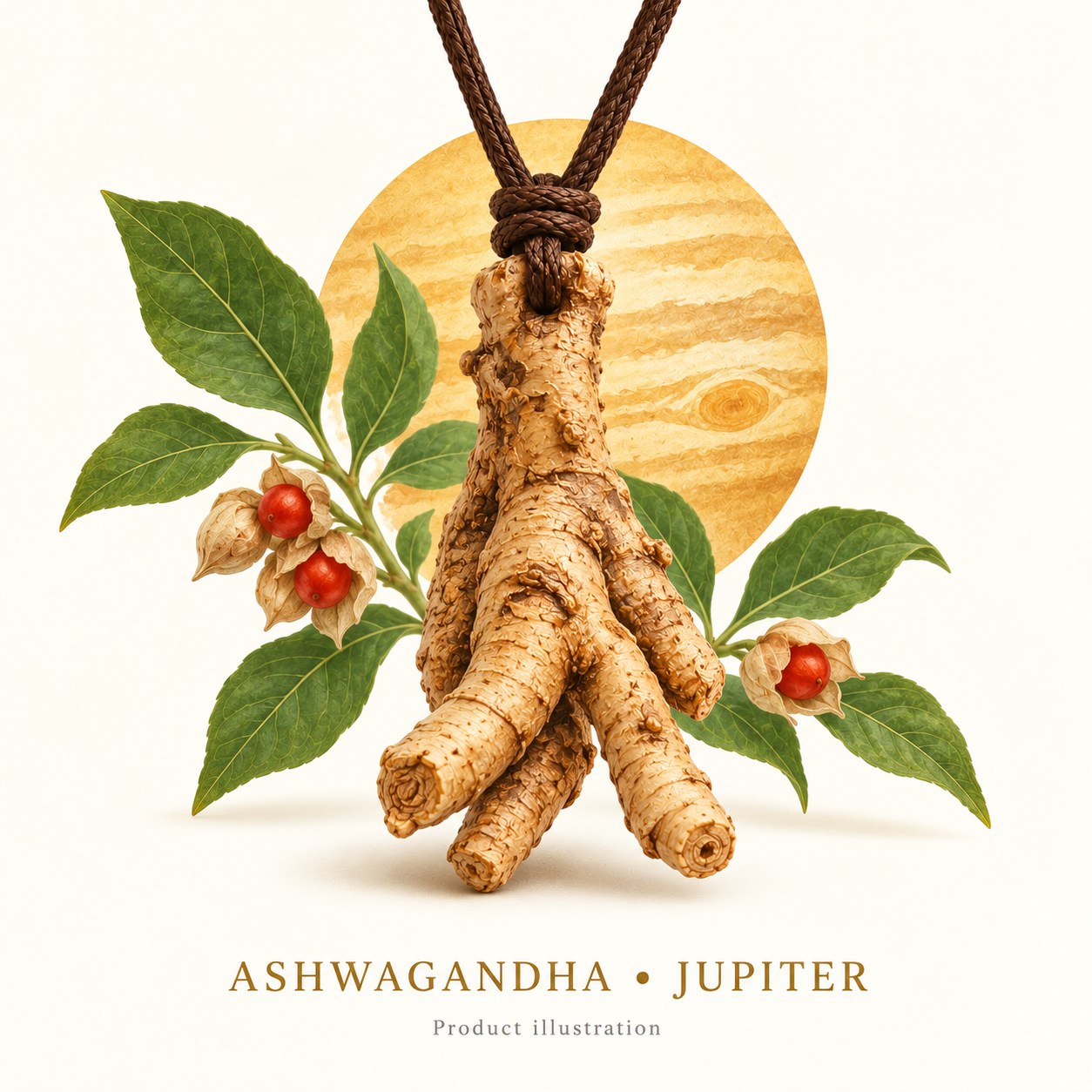
An Ashwagandha root pendant and an Ashwagandha supplement may carry the same plant name, but they are not the same product, do not have the same intended use, and should not be judged by the same claims. A pendant is a wearable botanical accessory. A supplement is a preparation designed for consumption, with its own ingredients, quality requirements, exposure pattern and safety questions. Even when both truly originate from Withania somnifera, the difference between a root fragment on a cord and a manufactured extract in a capsule remains fundamental.
This guide is written for readers who value Ashwagandha, Ashvagandha or Asgandh in traditional Indian knowledge and are also trying to shop responsibly. It explains plant identity, what the word root actually tells you, why a withanolide label on a supplement has no equivalent in jewellery, how Ashwagandha enters some Guru (Brihaspati/Jupiter) and Navagraha accessory traditions, and what to check before buying, handling or gifting a pendant. The purpose is not to strip away spiritual meaning; it is to place devotional, botanical, commercial and clinical language in their proper contexts.
At a glance: the forms are different
| Question | Ashwagandha root pendant | Ashwagandha supplement |
|---|---|---|
| Basic product | A dried botanical component mounted for wearing | A powder, extract, capsule, tablet, liquid or other ingestible formulation |
| Primary selection concern | Plant identity, genuine component, secure fitting, comfortable contact and care | Ingredient declaration, preparation, amount, manufacturer controls and suitability |
| Intended route | Worn externally as an ornament or traditional accessory | Taken according to the actual product's intended route and directions |
| Measured active ingredient | Generally not specified or validated for wearing | May state a root-powder amount or a standardised extract, depending on the label |
| What botanical name establishes | A claimed species that should be supported by traceable sourcing | A declared ingredient identity that must also match the actual preparation |
| Cultural context | Personal devotion, customary Guru/Jupiter symbolism or jewellery preference | Traditional Ayurvedic preparation or contemporary supplement use |
| Research interpretation | Clinical trials of swallowed preparations do not establish effects from wearing | Research must match preparation, dose, duration and population before it can be applied |
| Practical warning | Do not chew, brew, scrape into food or use the pendant as a source of medicine | Consider ingredient and safety information before consumption, especially with medicines or medical conditions |
1. The botanical name matters more than the product label
Ashwagandha is the widely used name of ***Withania somnifera* (L.) Dunal, a member of the **Solanaceae family. It is a shrub or subshrub rather than a gemstone or a Rudraksha-bearing tree. Traditional and commercial names include Ashvagandha, Asgandh, Indian winter cherry and Indian ginseng. Those names are useful when recognising an ingredient or an article, but they are not proof that the piece in a particular pendant is correctly identified.
Kew's Plants of the World Online lists Withania somnifera as an accepted botanical name. Its medicinal-plant naming records also associate the plant with historical root preparations. These are references for the identity of a species, not independent certificates for a specific piece of jewellery. If a supplier receives mixed plant material, a correctly spelled Latin name on the website cannot by itself resolve substitution, incorrect plant part, treatment or provenance.
The word root describes the source part claimed for the component. It does not tell the shopper whether the material is one unmodified segment, a dried and sealed slice, a pressed mixture, a resin-encased fragment or a visually similar decorative substitute. Nor does every brown fibrous object become authenticated merely because it resembles a photograph. A responsible retail description should distinguish what is directly observed from what is supported by supplier documentation.
An ordinary dried root may be light tan or brown, fibrous and irregular, but colour and texture alone are not decisive botanical tests. Cleaning, drying, cutting, lighting and finishing can change its appearance. For a commercially prepared pendant, identification is best supported through the source chain: supplier species declaration, plant part, preparation details, batch information where available, and honest photographs of the finished item.
2. Ashwagandha in Ayurvedic and cultural vocabulary
Ayurvedic literature discusses Ashwagandha within Rasayana, Balya, Vata and related traditional frameworks. The established herbal tradition gives the plant a prominent place in Indian intellectual and practical history. However, classical discussion of a herb as a prepared material for a specified practice is not identical to a modern claim about wearing a decorative object. The terminology can be respectfully explained without transferring all uses of the plant to a pendant.
Names carry meaning in themselves. Ashwagandha is commonly interpreted through Sanskrit elements connected with the smell or strength of a horse, and the plant also appears under regional names. Such linguistic and historical context enriches a jewellery article, but it should not be used as chemical authentication. A botanical description belongs with identification; a traditional interpretation belongs with history; and a claim about health outcomes requires a different kind of evidence.
Tradition also includes diversity. Practices differ between families, teachers, regional merchants and ritual settings. Some people buy a root accessory because they have received a personal recommendation, some because of family custom, and some simply because they appreciate its place among Navagraha-related natural materials. An explanation that identifies the custom and explains how people use the object is more useful than claiming there is only one compulsory ritual for every purchaser.
3. The Guru–Brihaspati–Jupiter connection
In Jyotish, Guru or Brihaspati is the graha associated in many traditions with teaching, guidance, wisdom, ethical judgment, dharma, learning, counsel and spiritual instruction. Thursday (Guruvar or Brihaspativar), yellow colours, certain donations and prayers to Guru are common cultural reference points. Ashwagandha root can appear within some contemporary planetary-herbal accessory lists associated with Guru. This does not mean all classical lineages prescribe an Ashwagandha pendant, or that the plant has a single universal graha designation across every tradition.
A Jyotish recommendation ordinarily starts with interpretation rather than an item label. Guru's placement, dignity, aspects, conjunctions, lordship, dasha or antardasha, personal intent and the practitioner's lineage may influence how an accessory is understood. No product listing can independently establish that a particular wearer needs a Guru-related object. The customer's horoscope, purpose and source of recommendation are separate from the commercial description of the pendant.
The object's traditional role can therefore be expressed accurately: it is a botanical accessory associated with Guru/Jupiter in certain planetary-herbal traditions. Someone may wear it as a reminder of study, humility, devotion or a chosen sankalpa. Whether the ritual is done on Thursday, whether a mantra is recited and whether the object is dedicated at home or at a temple are matters of personal practice rather than intrinsic properties of the root material.
For a fuller traditional discussion, read Ashwagandha Root and Guru (Jupiter) in Traditional Astrology. For the actual accessory, see the Ashwagandha Root Pendant for Jupiter listing. These pages answer different questions: one addresses association, and the other should answer what an individual customer is receiving.
4. What actually goes into an oral herbal preparation?
The term Ashwagandha supplement covers more than one product type. A label may describe dried whole-root powder, a root extract, a root-and-leaf extract or a formulation containing Ashwagandha with other substances. Manufacturing involves selection, cleaning, drying, processing and packaging; extracts add choices about extraction methods, plant-part ratios and concentration. Two similarly named capsules can differ materially in composition.
Withanolides are among the compound families discussed in Ashwagandha research. A supplement may declare a percentage or quantity associated with a particular standardisation method. That number does not establish that all preparations have identical effects, and it does not mean that a jewellery piece contains a clinically relevant or deliverable amount of any constituent. Concentration, identity and biological exposure are separate questions. A root fragment enclosed in a mount is not made into a supplement simply by attaching a milligram figure to its weight.
A customer should also understand the distinction between root weight, extract weight and a reported marker-compound concentration. These are not interchangeable units. The weight of a finished pendant may include metal, thread, resin and other materials. Even the dry weight of the botanical component is not the same as an amount intended for ingestion. Its shape and treatment are chosen for jewellery construction, not to provide a defined edible portion.
| Label or term | What it ordinarily means | What it does not prove about a pendant |
|---|---|---|
| Withania somnifera | Identified plant species | That a particular mounted fragment has been authenticated |
| Dried root | Plant part and broad preparation | Food-grade processing or an ingestible dose |
| Root powder | Ground botanical material for a formulated product | That scraping a pendant produces equivalent material |
| Extract | Material obtained through a defined extraction process | That an unextracted root ornament behaves like that extract |
| Standardised withanolides | A stated chemical marker specification for a preparation | A demonstrated effect from skin contact or wearing |
| Capsule or tablet weight | Weight of formulated product or ingredient | Weight or constituents of a jewellery component |
| Traditionally used | Description of historical or customary practice | Clinical proof for a different delivery method |
| Supplement clinical study | Research in a defined population using a specific preparation | Evidence that a plant accessory worn around the neck reproduces the result |
5. Why the research cannot be copied across product forms
The US National Center for Complementary and Integrative Health (NCCIH) summarises research on Ashwagandha preparations, including some studies relating to sleep and stress. The US National Institutes of Health Office of Dietary Supplements also describes research limitations, including variability in extracts, study populations and durations. Those discussions concern substances taken in the ways described by the studies. They are not investigations of a root segment worn on a necklace.
Four questions are necessary when interpreting any study. What was the precise plant material or extract? How much was taken and by what route? Who participated and for how long? What outcome was actually measured? Without answers, a study's headline cannot reliably become a product promise. A finding about a standardised oral extract does not transfer to raw root powder automatically, much less to an accessory from which no defined oral exposure is intended.
A blog should avoid phrases such as “the pendant gives all the benefits of Ashwagandha tablets,” “wearing boosts hormones,” or “the root absorbs into the body through the necklace.” The mechanisms and evidence needed for those claims have not been established by the cited supplement research. Conversely, stating that evidence for wearing is not established is not a judgment on the owner's faith or the object's cultural role. Spiritual appreciation and biological efficacy are different questions.
A practical analogy helps: the same plant species might be used as an ingredient, grown in a pot, displayed in a botanical collection or preserved as a keepsake. A result measured after consuming a formulated ingredient does not automatically apply to looking at the plant, holding it or placing a preserved piece on a shelf. Changing the form and route of use changes the question under investigation.
6. Supplement safety is a separate, specific topic
Because this article compares forms, it is helpful to keep the legitimate safety discussion attached to the supplement, not to suggest that every pendant wearer is experiencing oral exposure. NCCIH notes that Ashwagandha preparations can cause unwanted effects such as drowsiness and gastrointestinal symptoms and describes rare reports of liver injury associated with supplements. Research on longer-term use remains limited. It also identifies groups and medication interactions for which particular caution is warranted.
Pregnancy, breastfeeding, thyroid disorders, autoimmune conditions, planned surgery and certain medicines are examples discussed by NCCIH as reasons for avoidance or professional assessment in relation to taking Ashwagandha. Possible interactions include sedatives, thyroid hormone drugs, medications for blood pressure or diabetes, anticonvulsants and immunosuppressants. The scientific picture is nuanced and preparation-specific; a jewellery retailer should not try to resolve it by proposing an individual dose or advising a customer to stop a prescribed medicine.
These cautions are not claims that a securely mounted pendant delivers the same compounds into the body. They explain why the accessory must not be marketed as a replacement for an ingestible preparation, and why the plant component should never be repurposed into one. Keep the distinctions clear: clinical safety data address the exposure studied; jewellery care addresses material handling and physical contact.
7. Never treat a pendant component as a home ingredient
The root in a finished pendant may have been handled, dyed, glued, lacquered, stabilised or mounted with substances suitable for a decorative object but not for ingestion. It may have collected sweat, dust, polishing residues, perfumes or oils after sale. A cord, bead cap, sealant or adhesive may also have contacted the botanical material during assembly. None of these details is answered by the phrase “natural Ashwagandha root.”
Do not chew or suck the material. Do not break it apart to make tea, put shavings into milk, crush it into powder, boil it, place it in food, or offer it to someone as an Ayurvedic preparation. A fragment purchased as jewellery has not thereby been prepared, labelled or checked as a food or medicinal ingredient. A piece with a religious meaning deserves suitable handling, and this is one practical reason to keep it separate from kitchen and medicine-cabinet contents.
If a pendant is damaged, collect the pieces without grinding them. If the original assembly has an exposed edge, cracking surface or flaking coating, stop wearing it until the seller can advise whether the item can be safely repaired or must be replaced. A repair using an unknown household adhesive may create new contact or preservation issues. Avoid removing coatings or “purifying” the root with chemicals before wearing it.
8. How botanical identity should be verified for jewellery
A customer may not have access to a botanical laboratory, but can ask questions that improve confidence. The seller should distinguish what the item is called from how the seller knows what it is. The strongest information often begins upstream, before a fragment is polished or enclosed: an identified plant supplier, batch records, part-specific purchase data and any available documentation connected to the actual stock.
A photograph alone has limits. Dried roots from different plants may look similar; cut faces and fibrous surfaces can be distorted by finishing and photography. Printed tags, incense-style descriptions or a Latin name repeated from another listing do not by themselves prove that a specimen was identified by a botanist. When no independent confirmation is available, the description can say so without implying certification.
| Verification question | Useful seller answer | A warning sign |
|---|---|---|
| Which plant is claimed? | Withania somnifera stated clearly, including regional name used by supplier | Only “magic Guru root” with no plant name |
| Which part is used? | Root material, with details of slicing, drying or preservation | Vague “natural herb” with no part identified |
| How was identity checked? | Source declaration, traceability, specialist confirmation when available | “Looks identical online” offered as conclusive proof |
| What treatment was used? | Honest note about sealing, lacquer, resin, dye or adhesive | Denial that any finishing can exist despite a glossy coating |
| Is the image representative? | Real item images or a clear representative-image note | Stock image presented as proof of the exact piece |
| What touches the skin? | Cord, fitting, coating and metal materials described | No information about metal or adhesive |
| What happens if the root breaks? | Care and replacement process explained | Advice to consume or crush broken material |
| Is there an independent report? | Specific report and the part or batch it covers | “Certified” with no certifier or identifiable scope |
Kew's Withania somnifera botanical record is useful for understanding the plant name. It does not authenticate a specific pendant. A responsible shop should make that distinction easy to understand.
9. Root, leaf, extract and pressed material: different descriptions
The plant name is only the beginning. A root pendant should not be casually described as a leaf product or an herbal concentrate. Root indicates a plant organ. Leaf indicates another. Extract indicates a processed preparation from a designated source. Pressed botanical composite would describe a manufactured material in which the visual shape may not correspond to a single intact piece of root. These distinctions matter for pricing, care, description and customer expectations even when none of the products is intended for consumption.
A clear root accessory listing can state the intended botanical source, whether the visible piece is whole or sectioned, the dimensions of the botanical component separately from the overall necklace, and whether the piece is sealed. A transparent or resin-coated pendant should describe the encapsulation rather than claiming that the wearer directly touches raw root. There is no need to reject either construction; the buyer simply needs to know what is being purchased.
The chemical composition of an orally marketed root-and-leaf extract is also not a specification for a root pendant. When research discusses the amounts of particular compounds in extracts, that discussion should stay in an appropriate health-information section. It cannot serve as a retail guarantee of an accessory's spiritual effectiveness or its physiological effects.
10. How a root pendant is physically assembled
The simplest assembly is a prepared botanical segment attached to a cord by an appropriate mounting. Others may use a wire cage, a metal cap, a perforated housing, a protective transparent chamber, a pendant frame or a mixed-bead necklace. Construction is important because dried plant matter can be more sensitive to rough wear and moisture than a polished mineral gemstone.
Check whether the pendant relies on a hole drilled through the root, a band or wrap, a glued cap or a complete enclosure. A drilled soft or fibrous component can split around the hole. A poorly secured cap may release the root. A wire setting may snag clothing. A sealed chamber may protect the material from handling but should be inspected for trapped moisture or damage. None of those structural questions can be answered by a statement that the pendant is sacred.
For the cord or chain, confirm length, adjustability, clasp type and any metal that touches the skin. If children are present in the household, a small detachable botanical component and a long cord introduce ordinary choking or entanglement considerations; store the accessory out of reach when not worn. For adults, choose a length that does not catch in machinery, sports equipment or daily work. Everyday usability is part of respectful care.
11. Skin contact, coatings and sensitivity
An external accessory is not automatically suitable for every skin type. Irritation may arise from a metal fitting, dye, adhesive, cord fibre, perfume residue, rough edge or the wearer's individual sensitivity. Ask whether the root itself touches the skin or is isolated by a setting. If the manufacturer uses a coating, ask whether its composition and intended contact use are known. The plant's long history in Ayurveda does not serve as an allergy test for a modern decorative assembly.
If redness, itching or discomfort develops where an accessory contacts the body, remove the item and check its construction. Do not test the plant by tasting it or applying its powder to the skin. People with known sensitivities may prefer a longer cord or an enclosed setting that keeps the botanical component away from direct contact, but the fitting materials still matter.
A product should not claim “hypoallergenic” solely because its central element is a root. Metal purity, plating, clasp composition and the actual materials in contact with skin are separate issues. This level of detail helps customers choose with confidence without changing the spiritual meaning of their purchase.
12. Moisture, cleaning and daily care
The most useful general care principle for dried botanical jewellery is gentle, dry handling. Keep the accessory away from prolonged soaking, swimming, baths, detergent, perfume sprays, heavy perspiration and humid storage. Excess moisture can affect cords, adhesives, unfinished plant surfaces and protective coatings. The exact instructions depend on the construction: a fully encapsulated piece and an exposed root segment may not tolerate the same treatment.
Dust the outside with a clean, soft, dry cloth or appropriate soft brush, without scraping the botanical surface. If a metal or resin exterior needs cleaning, follow the seller's instructions for that material and avoid transferring liquid to exposed root. Do not scrub the piece with lemon juice, salt solutions, alcohol, essential oils or harsh cleaners. A method suitable for a metal chain is not necessarily suitable for a plant segment or glue line.
For storage, dry the outside after ordinary use and place the pendant in a clean separate pouch or box away from direct heat, prolonged sunlight and condensation. Avoid pressing it between harder gemstone pieces. Inspect the fastening periodically. If a component has become soft, smells abnormal, shows visible mould-like growth or has a failing seam, stop using it and consult the seller about replacement rather than trying a home chemical treatment.
| Situation | Practical action | What to avoid |
|---|---|---|
| Ordinary dust | Soft dry cloth or brush on suitable surfaces | Scraping or soaking the root |
| Rain or accidental splash | Blot exterior gently and allow appropriate drying | Heat gun, oven, direct flame or aggressive rubbing |
| Perfume or lotion | Apply to skin before wearing and let it dry | Spraying a botanical component directly |
| Loose metal cap | Set aside and request a qualified repair assessment | Adding unidentified household glue |
| Fraying cord | Replace with a compatible fitting if construction allows | Pulling hard on the botanical segment |
| Ritual handling | Use a clean dry space; follow material-specific care | Immersing unprotected root in liquid offerings |
| Travel or gifting | Separate protective pouch and care card | Packing against heavy stones or sharp items |
| Storage in a humid climate | Dry container, airflow and periodic inspection | Sealed damp packets or wet cotton |
13. Puja, Thursday observances and material-safe practice
A wearer who follows Guru-related customs may choose Thursday, a personal prayer, the name Brihaspati, a mantra received from a teacher, or a simple sankalpa expressing a commitment to study and right conduct. In some households, yellow flowers, yellow cloth, charity or respectful conduct are more important than elaborate treatment of the pendant itself. The accessory may be placed in a clean puja space before being worn if that accords with family practice.
Ritual custom does not require damaging a delicate botanical piece. If your household normally uses water, milk, ghee, sandal paste, incense ash or oils for another puja object, ask whether that procedure is suitable for this particular construction. A root segment, thread and adhesive are not equivalent to a stone murti or a metal yantra. A dry gesture of respect, a separate vessel for offerings or a cloth beneath the item may be preferable when the root must stay dry.
There is no need for a retailer to insist that every purchaser perform one fixed number of recitations, use one universal mantra or wear the pendant on a single non-negotiable date. Follow the guidance of a trusted practitioner when seeking an individualised Jyotish observance. A product page can describe commonly encountered practices while respecting regional diversity and the customer's own tradition.
14. Spiritual value does not depend on clinical equivalence
A devotional object can have value because of a person's intention, practice, family tradition and cultural association. That value does not need to be expressed as a measurable change in cortisol, hormones, sleep duration or a medical diagnosis. Claims drawn from clinical supplement research are a poor way to explain an accessory whose purpose is ritual, symbolic or aesthetic.
A customer might select the pendant as a visible reminder of Guru's qualities of knowledge and discrimination, or include it among other natural Navagraha-themed objects. A gift may mark the start of a course of study, a new phase of disciplined spiritual practice, or a family observance. Such intentions can be described openly as customary or personal without inventing medical outcomes. The result is more authentic spiritual writing, not less.
For broader background on related planetary materials, visit the Rudraksha for Planets section. Rudraksha has its own botanical origin, mukhi terminology, traditions and care requirements. Placing two objects in the same planetary conversation does not erase their different identities.
15. Comparing Ashwagandha pendants with Pukhraj and Rudraksha
Some buyers encounter Ashwagandha after searching for Guru remedies, yellow sapphire (Pukhraj), Pushyaraga or a Rudraksha associated with Jupiter. These are distinct items. Yellow sapphire is corundum, and gemological examination may consider identity and treatments. Rudraksha is a naturally patterned seed-related bead sold by mukhi count, condition and provenance. Ashwagandha root jewellery is plant-derived ornamentation whose identity is tied to its botanical source and the treatment of its component.
The choice is not simply a contest of price or asserted strength. It involves the spiritual framework the person follows, how the item is constructed, comfort, maintenance, budget and the quality of the seller's disclosures. If someone is acting on an individual chart recommendation, the exact object should be discussed with the practitioner; one product cannot automatically substitute for another merely because both appear in a Guru shopping category.
| Object | Physical identity | Typical verification focus | Wearing/care focus | Traditional context |
|---|---|---|---|---|
| Ashwagandha root pendant | Botanical component, intended as jewellery | Species/part declaration, authenticity, preparation and construction | Moisture, coatings, cord and fitting | Guru/Jupiter in some planetary-herbal accessory systems |
| Yellow sapphire / Pukhraj | Corundum gemstone | Gem identity, treatments, origin claims and report scope | Setting integrity, scratch and impact care | Widely discussed in Jyotish for Guru |
| Rudraksha bead | Botanical bead with natural mukhi lines | Mukhi count, bead condition, source and alterations | Bead integrity, thread, cleanliness and handling | Shiva-focused traditions and several planetary interpretive systems |
| Prepared Ashwagandha supplement | Ingestible botanical formulation | Declared plant part, amount, manufacturer and formulation | Storage and medical suitability, not jewellery wear | Ayurveda or modern supplement use, not itself an accessory |
Read the dedicated Ashwagandha Root, Yellow Sapphire and Rudraksha comparison for a fuller buying discussion. This article remains focused on the easily confused pendant-versus-supplement question.
16. What a genuine product listing should tell you
A good listing does not stop at “100% natural” or “effective for Jupiter.” It gives information a customer can actually use: a clear product name, species claim, plant part, approximate dimensions, whether the component is individually variable, fitting material, finishing process, available photographs, handling instructions and what the seller can verify. If the seller cannot provide a certificate, it is better to state the identification basis than to describe the piece as laboratory-certified without documentation.
When a pendant is sold with a metal cap, the listing should distinguish the metal composition from the root. A silver-coloured finish is not evidence of sterling silver. When a polished surface comes from protective lacquer or clear resin, the description should make that visible rather than using it as proof that the root is unusually pure. If the image is illustrative, the buyer should know that actual shape, fibres and colour can vary naturally.
A listing may also explain who should be contacted for an individual recommendation, how the item will be packed and what to do if it arrives damaged. These questions support meaningful purchasing decisions. They matter more than a large number of broad promises that cannot be verified from the finished item.
17. How to read a supplement label without confusing it with jewellery
A supplement label ordinarily communicates a serving size, ingredient list, amount per serving and manufacturer information. Some products also state extract ratios, root-versus-leaf composition or standardisation methods. A customer reading such information should not assume every number has the same meaning across products. For example, “500 mg root powder” and “500 mg concentrated extract” describe different preparations, and a named withanolide specification cannot be translated into how a pendant will behave.
The appropriate source for questions about taking a supplement is the actual label, reliable evidence about that preparation and qualified professional guidance where relevant. A jewellery page is the correct place to discuss shape, finish, wear, symbolism and care, not to advise on the consumption of powders or extracts. If a customer specifically wants a health-related product, it should not be quietly replaced by an accessory carrying the same plant name.
For research context, the existing NCCIH Ashwagandha information discusses the evidence and safety questions relating to actual preparations. It does not constitute clinical support for a wearable root pendant.
18. Seller checklist: questions worth asking before paying
The list below is designed for real conversations with a shop rather than an idealised laboratory procedure. Many small craft products are made in batches with natural variation. A seller should still be able to explain the product honestly, identify which details are documented and identify where information is unavailable. A buyer does not need an elaborate story; clear answers are enough.
| Ask the seller | Why the answer helps |
|---|---|
| “Is the botanical component specifically identified as Withania somnifera root?” | Separates the plant claim from a general Ashwagandha trade name |
| “Is it one real root segment, a composite or an encapsulated specimen?” | Clarifies what is physically being sold |
| “Do you use resin, wax, lacquer, glue, dye or a surface seal?” | Explains finish, skin contact and care restrictions |
| “What are the approximate botanical-part dimensions?” | Prevents a large frame from being mistaken for a large root specimen |
| “Which parts touch the skin?” | Identifies metal, coating and cord compatibility questions |
| “Can you show a photograph of the actual type supplied?” | Helps assess finish, natural variation and assembly |
| “What is your basis for the species identification?” | Distinguishes traceable sourcing from an unverified visual guess |
| “What should I do if the cap loosens or the root cracks?” | Tests whether practical after-sale care has been considered |
| “Is this sold exclusively as jewellery?” | Avoids confusion with edible or medicinal root material |
| “Do you provide a care card?” | Helps protect a potentially fragile natural component |
19. Price, authenticity and marketing language
A higher price does not prove botanical authenticity, spiritual suitability, unusually concentrated plant constituents or clinical effects. Price may reflect workmanship, design, metal components, sourcing, packaging or the seller's service. Those factors can be legitimate, but they should be described as such. Similarly, a low price is not conclusive evidence that a specimen is synthetic. Ask for material facts rather than treating cost as an authentication test.
Terms such as energised, blessed, siddh, abhimantrit or ritually prepared are sometimes used within devotional commerce. These are descriptions of an asserted practice, not chemical or botanical test results. If a ritual service is offered, ask who conducts it and what is included. Do not confuse the claim that an object was used in worship with a claim that its plant identity was independently confirmed or that wearing it has a proven medical effect.
A good catalogue can combine culturally meaningful information with exact retail specifications. It can say that a pendant is traditionally associated with Guru and that the item is made from a supplier-declared botanical root held in a particular setting. It need not claim that root jewellery and supplement trials are equivalent, nor promise a guaranteed outcome to justify the purchase.
20. Choosing an appropriate wearing arrangement
Consider the way the accessory will actually be worn. A light pendant may be comfortable on a soft cotton cord, but the cord can absorb water and require replacement. A chain may be longer lasting, though its metal composition matters for sensitive skin. An enclosed setting can reduce direct handling of the root. A highly ornate design may be more appropriate for occasional ritual use than continuous workday wear.
If you plan to wear the accessory under clothing, check whether its edges can catch fabric and whether heat or perspiration could affect the setting. If it will be used primarily for puja or kept in a personal collection, ease of display and safe storage may matter more than all-day comfort. A purchaser should not be told that longer wear automatically makes the object stronger; that is not a substitute for a clear statement of the practice being followed.
The accessory can be removed for bathing, strenuous activity or cleaning. This does not diminish respect for it. Careful handling is a sensible response to a physical object made from natural plant material, regardless of the spiritual meaning attributed to it.
21. Responsible gifting and family use
A pendant associated with Guru may be gifted to someone who values study, spiritual instruction or personal devotion. Include a note explaining what the object is, which traditional association you are referring to and how it should be cared for. Such a gift is more considerate than attaching promises about health improvements, fertility, hormonal changes, sleep or a fixed result in examinations or business.
Make sure the recipient is comfortable wearing botanical jewellery and understands any relevant materials in the setting. For a child, store small detachable elements and long cords safely rather than assuming that a religious object is exempt from common household hazards. For someone who prefers not to wear the item, keeping it in a clean display or puja area may better match their practice.
A recipient who takes an Ashwagandha supplement should not interpret the gift as an instruction to start, stop or change that supplement. The shared name is incidental to two different purposes. Clear communication protects the meaning of the gift and avoids an unnecessary medical misunderstanding.
22. Common wording: what to say and what to correct
| Unclear marketing statement | More accurate description |
|---|---|
| “This pendant is an Ashwagandha dose.” | “This is an Ashwagandha root accessory intended for wearing, not consumption.” |
| “Clinically proven pendant for stress.” | “Ashwagandha preparations have been studied for some outcomes; those studies do not establish effects from wearing jewellery.” |
| “All Ashwagandha roots are the same.” | “Species, part, source, processing and identity should be checked for the actual item.” |
| “Contains standardised withanolides, so it works through skin.” | “A supplement marker specification cannot establish a delivery route for a pendant.” |
| “Natural means safe for all wearers.” | “Review cord, fitting, coating and skin contact; discontinue wear if irritation occurs.” |
| “Certified because Kew lists the species.” | “Kew provides botanical taxonomy, not certification of this finished piece.” |
| “Guaranteed Guru results.” | “Traditionally associated with Guru in some herbal-jewellery practices; personal interpretation varies.” |
| “Use the root for tea after wearing.” | “Do not ingest any part of a jewellery component.” |
23. A practical buying sequence
Start by deciding which question you are trying to answer. If you are shopping for a botanical devotional ornament, focus on root identity, construction, available images, care and the spiritual custom relevant to you. If you are studying Ayurvedic history, look at primary traditional literature and credible botanical sources. If you are considering an oral supplement, assess the formulation and health guidance relevant to that product. There is no advantage in merging these three separate decisions.
Next, confirm the item against the supplier's claim. Ask the species, part, finish, mounting material, variation and return policy. Compare the seller's photographs with the stated construction. For a Guru-themed accessory, understand whether it is offered as a general devotional piece or as something requiring a personalised Jyotish consultation. Then select a comfortable design and follow care guidance appropriate to the actual materials.
Finally, retain the receipt, product description and any care note. If a future question arises about the root identity, coating or repair, the original item details will be more helpful than recollection of a broad promise. A good purchase is one whose cultural meaning, identity and practical requirements remain clear after it leaves the shop.
24. Frequently asked questions
1. Is an Ashwagandha root pendant the same as an Ashwagandha capsule?
No. The pendant is a physical accessory meant to be worn, while a capsule is an ingestible preparation with ingredients and an intended route of use. Even when the plant name is identical, formulation, handling, exposure and applicable evidence differ. It would be misleading to present the pendant as a substitute for a capsule, or to describe a capsule as an item whose usefulness comes merely from being held or worn.
2. Does wearing Ashwagandha reproduce the results seen in supplement studies?
Research cited for Ashwagandha generally concerns particular oral formulations or other defined uses; it does not establish the same results for a mounted root component worn against the body. A finding from a study cannot be moved to another product form without evidence relating to that product and route. The pendant can still be valued for its traditional or personal significance.
3. What is the correct botanical name for Ashwagandha?
The accepted scientific name is Withania somnifera (L.) Dunal, in the Solanaceae family. Kew provides a botanical reference under that name. A seller's declaration of the Latin name is useful, but it is not direct authentication of the exact piece in the setting. Ask how the actual botanical component was sourced and identified.
4. Are Ashvagandha, Asgandh and Indian ginseng different plants?
These are names commonly used for Ashwagandha, but trade names can be interpreted differently by suppliers. “Indian ginseng” is a common name and does not mean the plant is a species of Panax ginseng. For a purchase, the species and plant part are clearer than a common name alone, especially where the listing contains mixed terminology.
5. Is an Ashwagandha root pendant associated with Jupiter?
Some planetary-herbal jewellery traditions associate the root with Guru or Brihaspati (Jupiter). That is a customary astrological association, not an assertion that every Jyotish tradition makes the same recommendation. A personal recommendation may depend on the chart, practitioner's lineage and purpose. For background, see the linked Guru/Jupiter tradition article.
6. Is Thursday compulsory for wearing this pendant?
Thursday or Guruvar is commonly associated with Brihaspati worship, and some wearers prefer to begin an observance on that day. However, a shop should not present a single universal rule for all families and lineages. Follow the practice that is meaningful to you, and prioritise protecting the botanical component from unsuitable liquids or rough handling.
7. Can the root be placed in milk, water or ghee during puja?
A botanical jewellery assembly may include glue, coating, metal, cord or an exposed dried root that can be damaged by immersion. Check the seller's care instructions before any contact with liquids. Many people can honour an object with a clean dry placement, prayer or offerings kept in a separate vessel rather than soaking the accessory itself.
8. Can I scrape a little root from the pendant to make tea?
No. A decorative component should not be repurposed into a food or medicinal ingredient. Its identity, handling history, coatings and assembly materials may not have been evaluated for ingestion. If you are interested in Ashwagandha as a preparation rather than jewellery, the correct questions concern the actual regulated product and suitable professional guidance.
9. Is the entire pendant made of root?
Not necessarily. The visible botanical section may be surrounded by a metal cap, thread, wire, resin, glass-like chamber or other construction materials. Product dimensions and weight may refer to the entire accessory rather than the root. Ask the seller to identify the components and to explain whether the root is exposed or sealed.
10. Is raw Ashwagandha root always brown?
Dried root commonly appears in pale tan, beige or brown shades, but drying conditions, sectioning, finish and lighting affect colour. Appearance alone does not prove botanical identity or disprove treatment. A seller should avoid claiming that a particular colour is a reliable certificate of authenticity. The identification basis and actual material declaration are more useful.
11. Can Kew's botanical website certify my pendant?
No. Kew provides authoritative information on plant taxonomy, nomenclature and distribution. It does not certify the botanical identity of a specific retail item simply because a seller links to the page. A separate traceability or identification process would be needed for that claim, and its scope should be clear.
12. Does a withanolide percentage tell me how powerful a pendant is?
No. Withanolide specifications may appear on defined extracts and supplements, where they describe certain marker compounds measured by stated methods. An unprocessed or mounted root fragment is not a standardised dosage form. The percentage on an unrelated supplement cannot establish biological exposure or a traditional result from wearing jewellery.
13. Should I compare a pendant's weight in milligrams with a capsule label?
No. Total pendant weight may include the mount, chain and coatings, while even isolated root weight says nothing about an intended ingestible preparation. Capsule labels refer to particular formulations. Comparing those numbers as if they measure the same use can create a false equivalence and should not guide a devotional-jewellery purchase.
14. Is root-and-leaf extract identical to a root pendant?
No. Plant part, extraction and intended route all differ. A root-and-leaf extract is a processed ingredient that may include chemistry from more than one plant part. A pendant should be described by the actual botanical component and construction it contains. Neither a supplement's extract ratio nor its constituent specification validates a wearing claim.
15. Can I wear the accessory every day?
That depends on comfort, fastening security, skin compatibility and the particular construction. A protected item may suit regular wear, while an exposed dried root can need more delicate treatment. Remove it for swimming, bathing and vigorous activity if moisture or impact could damage it. An individual ritual practice may also call for occasional rather than continuous wear.
16. Will the pendant absorb water or sweat?
Exposed botanical material and cords may be affected by moisture, while sealed designs depend on the integrity of their enclosure. The degree of absorption cannot be determined from the plant name alone. Keep the accessory clean and dry as instructed, check its fittings, and avoid storing it damp. Ask for specific care if you live in a humid climate.
17. How should I clean an Ashwagandha root pendant?
Usually begin with gentle dry dusting of suitable exterior surfaces. Avoid soaking, scraping, acidic cleaners, perfume and forceful rubbing. Metal and resin parts may require their own cleaning method, which should not be applied indiscriminately to exposed root or adhesive. When in doubt, ask the seller for construction-specific guidance rather than trying a home remedy.
18. What if the root cracks or the cap becomes loose?
Stop wearing the accessory until the defect is assessed. Keep loose pieces out of reach of children and do not grind, consume or heat the material. Ask whether the original setting can be repaired with compatible materials or whether replacement is preferable. A neat replacement is often safer and more respectful than improvised glue or wire repairs.
19. Is a natural pendant automatically skin-safe?
No. A complete accessory includes cords, metal, coatings and other materials. Individual sensitivity, friction and contamination can matter even when the botanical component is genuine. If contact causes irritation, remove it and check the materials. A “natural” claim does not replace accurate disclosure of what touches the skin.
20. Should a child wear Ashwagandha root jewellery?
Consider the ordinary hazards of small detachable pieces and necklace cords. A root element or bead that breaks loose may create a choking risk, while a long cord can catch or entangle. For young children, display or safe storage is generally preferable to unsupervised wearing. A cultural or religious association does not change those physical considerations.
21. Can a pendant replace my prescribed medicine or a supplement?
No. A devotional accessory is not a prescribed treatment or a substitute for an oral formulation. If you are using a medicine, or considering a botanical supplement for a health goal, discuss that decision with an appropriate healthcare professional. This is a distinction about product purpose, not a judgment on the spiritual meaning of the jewellery.
22. Why do some shops sell root jewellery under Navagraha products?
Planetary-herbal collections group natural materials according to customary Jyotish associations. Buyers may find Ashwagandha alongside other roots, gemstone jewellery, Rudraksha and ritual items. These groupings help explain the intended traditional setting. They do not make all products chemically identical, interchangeable in a horoscope, or supported by one shared body of clinical research.
23. Can a yellow sapphire or Rudraksha be substituted for this pendant?
The three objects have different physical identities and traditional histories. Yellow sapphire is a gemstone, Rudraksha is a bead and Ashwagandha jewellery uses a botanical component. Any personal astrological substitution should be discussed within the chosen Jyotish framework; a retailer should not automatically present one as equivalent simply because it appears under Jupiter or Guru.
24. What documents should I request if the seller says the piece is certified?
Ask who issued the document, which specimen or batch it covers, which identification method was used, and whether it refers to the plant material or only another component such as metal. A photograph of a generic laboratory logo is not enough. Clear supplier declarations can be valuable even where an independent test is not available, provided the distinction is honestly stated.
25. What is an appropriate way to gift a Guru-associated Ashwagandha pendant?
Explain its traditional association and include a care note. A gift may symbolise learning, guidance, gratitude toward teachers or a personal sankalpa. Avoid attaching guarantees about health, examinations, marriage or financial outcomes. If the recipient prefers not to wear jewellery, the object may be kept respectfully in a clean personal or ritual space according to their tradition.
26. Where should I read more about the plant and the actual accessory?
Use a botanical reference for the species, an appropriate health-information source for supplement research, a tradition-focused article for Jyotish context and the actual product listing for price, construction and care. Our Ashwagandha Root Pendant for Jupiter, Guru tradition guide and root–sapphire–Rudraksha comparison serve those different shopping and educational needs.
25. Final checklist before you choose
An Ashwagandha root pendant is best evaluated as a traditional botanical accessory: verify the claimed species and plant part, ask about processing and fittings, confirm who or what the item touches, understand its Guru/Jupiter association in the context of your own practice, and follow gentle material-specific care. A supplement must instead be evaluated as an ingestible formulation with its own ingredient, exposure and safety information. The two may share an important plant name and a long cultural history without being the same kind of object.
The useful buying question is not whether the pendant contains “the power of a capsule,” but whether the actual item is accurately identified, honestly represented, comfortably assembled and suitable for the devotional or aesthetic purpose you have chosen. Explore Planetary Herbal Jewellery, view the Ashwagandha Root Pendant for Jupiter, or browse the broader Spiritual Jewellery collection for related designs and reading.
Further reading and source context
The following two pre-existing references remain for readers who want to verify the distinction between plant identity and the evidence relating to particular preparations. Neither external reference certifies an individual OmmRudraksha product.
- Kew Plants of the World Online — Withania somnifera: accepted botanical identity, family and nomenclature.
- US NCCIH — Ashwagandha: Usefulness and Safety: research scope and safety considerations for relevant preparations.
For related OmmRudraksha reading, see Ashwagandha Root and Guru in Traditional Astrology, the Ashwagandha Root, Yellow Sapphire and Rudraksha comparison, and Rudraksha for Planets. These resources are complements rather than proof of equivalence between a wearable root and a supplement.
