
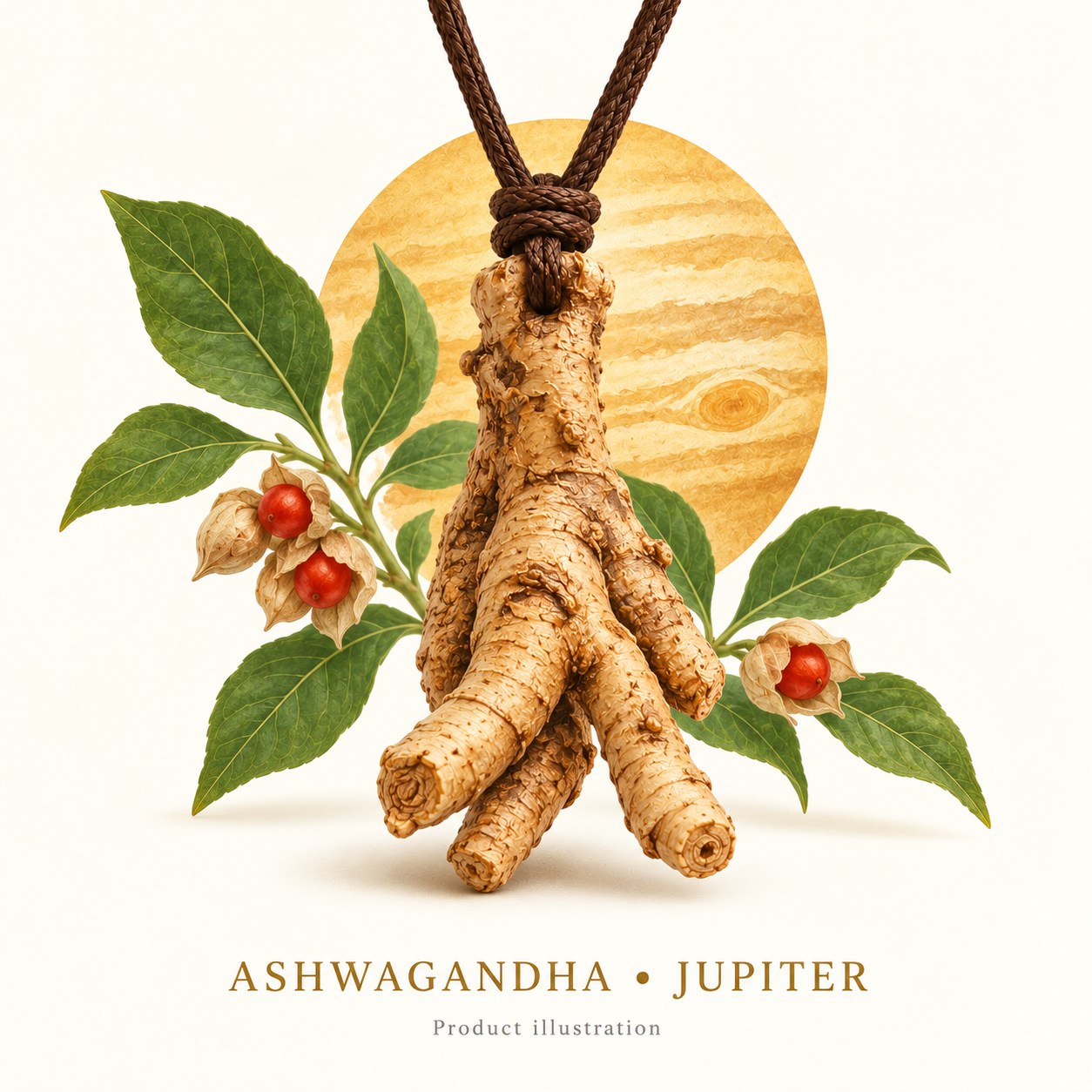
Ashwagandha root and Guru (Jupiter) belong to two connected but distinct areas of Indian tradition: the plant has a well-established botanical and Ayurvedic identity, while the graha Guru, also called Brihaspati, represents wisdom, learning, dharma, counsel and the guidance of teachers in Jyotish. Some contemporary Navagraha herbal jewellery collections present an Ashwagandha root pendant as a traditional Guru-associated accessory. Understanding that connection requires more than matching a plant name with a planet: it calls for an explanation of the graha, the family's or practitioner's wearing custom, the identity of the root and the construction of the finished item.
This guide focuses on the Jyotish and devotional context of Ashwagandha root rather than repeating medical information about ingestible Ashwagandha supplements or a detailed comparison of gemstones. It explains Guru's traditional significations, the relationship between Jupiter and Dhanu and Meena rashis, the Punarvasu, Vishakha and Purva Bhadrapada nakshatras, the significance of Guruvar (Thursday), mantra and sankalpa practices, botanical identification, and sensible ways to select, wear and care for a root pendant. Spiritual practice can be discussed richly on its own terms without confusing a devotional accessory with medicine or promising a specific result from wearing it.
1. At a glance: the Ashwagandha–Guru relationship
| Topic | Traditional or practical meaning | What to understand before choosing |
|---|---|---|
| Guru / Brihaspati | Jupiter graha; wisdom, teaching, dharma, counsel, generosity and discernment | Interpret within a whole horoscope and the practitioner's tradition, not from one isolated label |
| Weekday | Guruvar, Brihaspativar or Thursday | A customary day for remembrance and puja, not a physical property of a root |
| Traditional colours | Yellow and golden tones are commonly associated with Guru | Colour symbolism does not establish botanical authenticity |
| Associated rashis | Dhanu (Sagittarius) and Meena (Pisces) | Rashi ownership alone does not decide an individual's accessory |
| Nakshatra lordship | Punarvasu, Vishakha and Purva Bhadrapada in Vimshottari dasha | This is a dasha-lordship correspondence, not a universal rule about root wearing |
| Botanical material | Ashwagandha, Withania somnifera (L.) Dunal, Solanaceae | Confirm species, plant part and supplier traceability |
| Offered accessory | A dried root component secured in a pendant, sometimes with metal, cord or resin | Verify actual dimensions, materials, fit, finish and care |
| Nature of the association | Described in some planetary-herbal jewellery customs | Do not assume that every classical Jyotish text prescribes this exact root for Guru |
2. Who is Guru or Brihaspati in Indian tradition?
Brihaspati (Bṛhaspati) is remembered in Vedic and later Hindu traditions in connection with sacred speech, prayer, learning and the role of a spiritual or priestly guide. In the familiar Navagraha framework, Guru is the Sanskrit name for Jupiter, one of the nine grahas employed in the interpretation of a kundali. The deity's older literary contexts and the later systematic astrological use of Jupiter should not be collapsed into a single historical claim. Both inform the living tradition, but they are not identical genres of source.
In Jyotish, Guru is commonly called a natural benefic (shubha graha) and is associated with knowledge, judgment, teaching, tradition, spiritual instruction, generosity, the relationship with one's mentors and the capacity to understand a principle beyond immediate gain. The name Guru also means a teacher, which explains why the planet is frequently discussed in conversations about education, guidance and faith. Some astrologers include putra-karakatva, prosperity, dharma and family blessings among Jupiter's traditional significations. These are symbolic and interpretive categories within astrology; the precise reading depends on the chart.
The ideal of Guru is not simply to become more successful. A teacher asks for patience, integrity, discipline, careful speech and respect for knowledge. That makes a Guru-associated wearable item meaningful to people who wish to remember a personal vow to study, practise charity, honour their teachers or cultivate self-restraint. The intention (sankalpa) may matter more to its owner than an object's appearance. An article about Guru should therefore explain the cultural ideas that surround the accessory rather than reduce Brihaspati to a list of fashionable outcomes.
3. Why Jupiter is linked with learning, dharma and counsel
Jyotish often describes the grahas through karakatva: the topics and relationships they signify in interpretation. Guru is associated with the teacher, sacred study, wise advice, ethics, faith, the capacity to distinguish sound principles and, in various schools, auspicious growth. These meanings are interconnected. Learning without judgment becomes accumulation of information; generosity without discernment can lose direction; faith without humility can become stubbornness. The Guru symbolism points toward the balanced cultivation of these qualities.
For a student, the association may inspire a promise to attend lessons regularly or study with concentration. For someone facing a difficult decision, it may be a reminder to seek qualified counsel rather than act impulsively. In devotional life, it may accompany prayer, scriptural reading, service and gratitude to an actual teacher. A buyer may value such meanings whether or not they intend to undergo a personalised horoscope consultation. They are reasons for symbolic observance, not measurements of the planet's influence or laboratory properties of Ashwagandha wood.
The Sanskrit word dharma itself is richer than a one-word translation such as luck: it can refer to order, responsibilities, ethical conduct, religious obligations and a path of appropriate action, depending on the text and context. When describing Guru as a significator of dharma, explain the practical virtues rather than promising particular fortunes. If a practitioner recommends a Guru-related pendant during a period of study or spiritual discipline, the user can ask which interpretation and lineage informs that recommendation.
4. Guru in the birth chart: rashi, bhava and dignity
In commonly taught Parashari Jyotish, Jupiter owns Dhanu (Sagittarius) and Meena (Pisces). It is traditionally described as exalted in Karka (Cancer) and debilitated in Makara (Capricorn). These terms express a graha's conventional strength or ease of expression in a particular sign. They do not stand alone: the house occupied, the house ruled, conjunctions, aspects, planetary periods and other relevant chart conditions affect the reading.
A person with a Dhanu or Meena Moon sign does not automatically require an Ashwagandha pendant, and a person born under another sign is not automatically excluded. The same applies to an exalted or debilitated Guru. Such statements skip the main work of Jyotish, which is to examine relationships and timing across the complete chart. The role of lagna (ascendant) and functional benefic or malefic classifications may alter how a classical practitioner approaches a supposed strengthening practice. A seller's universal instruction should not overrule a considered personal recommendation.
A genuine consultation may ask about birth date, precise birth time and birthplace to construct the chart, then explain the basis of the advice. An accessory listing should serve a different purpose: describing an actual product accurately. Keep chart interpretation separate from item specification. When the two are brought together, let the counsellor explain the astrological reasoning and the seller explain the material, workmanship, care and availability. This division improves clarity rather than diminishing traditional practice.
5. Jupiter's nakshatras and the Vimshottari framework
Under the widely used Vimshottari dasha system, Jupiter is associated with the nakshatras Punarvasu, Vishakha and Purva Bhadrapada. Here the word lord refers to the planet assigned to those lunar mansions in a specific dasha sequence; it is not a statement that the plants worn by all people born under those stars must be the same. Guru's mahadasha traditionally lasts 16 years in the 120-year Vimshottari scheme, and its subdivisions are calculated according to the system's rules.
Nakshatra lordship must also be distinguished from a nakshatra's presiding deity, symbols, qualities or an individual's Moon and ascendant positions. Each classification answers a different interpretive question. A general educational page may mention all three Guru-linked nakshatras so readers recognise the terminology. It should not instruct every Punarvasu, Vishakha or Purva Bhadrapada native to wear an Ashwagandha root without any other context.
| Jyotish term | Usual Guru association | Practical reading note |
|---|---|---|
| Dhanu / Sagittarius | Jupiter's own rashi | One component of sign ownership and house lordship |
| Meena / Pisces | Jupiter's other own rashi | Interpret its house and placement in the actual lagna chart |
| Karka / Cancer | Jupiter's exaltation rashi | A dignity, not a standalone purchase instruction |
| Makara / Capricorn | Jupiter's debilitation rashi | Context and modifying factors matter |
| Punarvasu | Jupiter-ruled nakshatra in Vimshottari | Do not confuse dasha lordship with a mandatory plant |
| Vishakha | Jupiter-ruled nakshatra in Vimshottari | Individual birth details and chart framework matter |
| Purva Bhadrapada | Jupiter-ruled nakshatra in Vimshottari | Part of a dasha sequence, not a merchandise classification |
| Guru mahadasha | Traditionally 16 years | Timing interpretation belongs to a complete horoscope |
6. What is an Ashwagandha root pendant in planetary-herbal jewellery?
A root pendant is a wearable item that contains plant material, commonly a small dried root fragment held by a cap, enclosure, wrapping or other mounting. The accessory may include thread, chain, beads, metal hardware and a protective finish. In a collection of planetary herbal pendants, its presentation may link the botanical material to a graha and a customary devotional purpose. This is the context in which Ashwagandha may be marketed as a Guru-related root.
The planetary association and the physical identity are separate checks. A customer can recognise Ashwagandha as a culturally meaningful herb while also asking whether the actual pendant contains Withania somnifera root. The trade name does not establish the species, and a reference to Ayurveda does not identify an individual batch. Conversely, a botanical supplier's documentation does not establish that a particular ritual association is universal across classical lineages. A clear description explains both layers without using one as proof of the other.
The item's construction matters as much as its name. A pendant that is too heavy, has a sharp cap, an unreliable loop or an undisclosed coating may be inconvenient even if its root was correctly sourced. Compare the finished item's dimensions, total weight, metal material, fastening and wearing length. If the product listing uses an illustration, request photographs of the particular design or available stock. Find the current offering in the Ashwagandha Root Pendant for Jupiter product page, and use the wider Planetary Herbal Jewellery collection to understand the category.
7. What Ashwagandha actually is: botanical identity
The plant generally called Ashwagandha, Ashvagandha or Asgandh is ***Withania somnifera* (L.) Dunal, in the nightshade family **Solanaceae. Kew's Plants of the World Online accepts this name and describes a shrub or subshrub. Indian medicinal-plant references also describe its characteristic roots, leaves and flowering or fruiting structures. For a jewellery buyer, the key distinction is that a botanical name identifies a species; it does not certify a particular piece that has been cut, dried, sealed or set in a pendant.
Plants of this species can be described by their branching stems, simple leaves, greenish flowers and berry-bearing fruiting structures. These are useful when botanists identify a complete plant, but the same field characteristics are usually absent from a small pendant component. The dried root may be pale cream, tan or brownish and have fibrous, irregular surfaces. Processing, soil, maturity and finishing influence appearance; a colour test or smell alone cannot establish species identity. Ask the seller what identification or source information connects the individual piece to the stated plant.
In the Indian medicinal-plant trade, root is familiar as the named plant part, but leaf and seed also occur in broader botanical and agricultural discussions. These distinctions matter in product labelling. “Ashwagandha herbal jewellery” is broad; “Ashwagandha root pendant” makes a specific material claim; “Withania somnifera root, dried and mounted” is more precise still, if supported by the supply chain. Botanical records also help distinguish common and regional names from formal taxonomy. The existing Kew record for Withania somnifera is a useful identity reference, not an individual product certificate.
8. Ashwagandha in Ayurveda, and why the context matters
Ashwagandha occupies a prominent place in Ayurvedic vocabulary, including Rasayana and Balya traditions. Names such as Ashvagandha, Asgandh, Asgand Nagori and Indian winter cherry reflect different linguistic, regional and commercial settings. The history of the herb is valuable context for an article on botanical jewellery: a customer may approach it with family knowledge, familiarity with classical remedies, or interest in traditional Indian plants.
However, Ayurvedic use of a prepared ingredient and Jyotish use of a wearable root object are distinct practices. A powder, decoction, extract or compound formulation has a route of administration and preparation; a pendant is worn externally. Do not import dosage, withanolide percentages or clinical study outcomes into a jewellery listing. Equally, do not turn a page on Guru's devotional meaning into a narrow article about supplements. The two subjects deserve their own explanation because readers have different intentions when seeking them.
Those who want to understand the difference between the categories can read Ashwagandha Root Pendants and Herbal Supplements Are Not the Same. Its focus is product form and research interpretation. This article's focus is why a person might choose the root as a symbol of Guru, how that choice fits personal practice, and how to treat the finished accessory appropriately.
9. Is Ashwagandha universally assigned to Guru?
Plant-graha correspondences are found in several kinds of teaching and modern catalogue. A particular regional custom, family tradition, school of astrology or retailer's classification may link Ashwagandha root with Guru. The existence of such an association should be stated; it need not be presented as a command binding every practitioner. Different lists can connect a graha with different trees, leaves, roots, ritual materials or offerings according to the intended activity. A homa offering, a medicinal herb, a tree for ritual planting and a root worn in jewellery are not interchangeable categories.
The strongest way to describe this accessory is as Ashwagandha root used in certain Guru/Jupiter-associated planetary-herbal wearing traditions. If a more specific classical prescription is claimed, request the text, passage, lineage and context rather than accepting an unattributed quotation. Historical accuracy matters because the devotional practice itself has depth. It is reasonable to recognise a living custom without inventing a universal Vedic injunction for every shop product.
For a customer who already has a recommendation from an astrologer or family elder, the most useful questions are: Does the teacher mean the actual root of Withania somnifera? Should it be worn in a specific mounting or simply kept respectfully? Is it part of a Thursday observance or an ongoing devotional practice? The replies give more practical guidance than a blanket slogan. A person without such instruction can still appreciate the item for its traditional symbolism and workmanship.
10. Thursday — Guruvar and Brihaspativar
Thursday, called Guruvar or Brihaspativar in many Indian languages, is widely associated with Jupiter and Brihaspati. Some families observe this day through prayer, offerings, temple visits, recitation, study, charity, wearing yellow and gratitude to teachers. The precise practice differs by region and lineage. Devotees may worship Brihaspati specifically, or honour Vishnu, Dakshinamurti, Sai Baba, a family deity or their living guru in a local tradition. These are not all the same liturgy, but they can share the broader cultural association with Thursday.
A person may choose Thursday to begin wearing a Guru-associated pendant because the day provides a meaningful ritual anchor. It is not necessary to imply that a root chemically changes on that day, or that an ordinary customer must wait for a precise planetary hour to wear an ornamental item. If a priest or practitioner has recommended a particular muhurta, use that personal instruction. In other circumstances, a calm setting, simple prayer, clean clothing and clear intention can be entirely adequate as a devotional custom.
For everyday planning, define the purpose: study, seva (service), satsanga (good company or spiritual gathering), svadhyaya (self-study), or a promise to act more thoughtfully. An object worn in remembrance of Guru can prompt a practical weekly habit. Someone can pair the Thursday observance with visiting an elder, helping a student obtain books, sharing a meal or reviewing what they have learned. These are concrete expressions of Guru-related values, rather than retail promises about changing fate.
11. Yellow, flowers and other Guru-related ritual symbols
Yellow garments, yellow flowers, turmeric, gram or chana dal and certain yellow foods often appear in Brihaspati-related customs. Their significance is partly visual, partly devotional and partly community-specific. Yellow sapphire (Pukhraj) is a distinct gemstone conventionally associated with Guru in many Jyotish gemstone traditions. It is a gemstone, not the same item as a herbal root; different questions govern its authenticity, treatments and pricing. Neither yellow colour nor the presence of a yellow thread can by itself confirm that a dried botanical component is Ashwagandha.
A sensible devotional arrangement might place a clean flower near the puja space, recite a familiar prayer, remember one's teacher and set a simple sankalpa. If the pendant includes porous root, metal plating or adhesives, keep turmeric paste, perfume, oil, milk and water away from the mounted object unless the maker specifically permits those substances. A ritual can be performed beside the pendant instead of soaking it. This respects both the devotional intention and the material's practical limitations.
People also associate Guru with the northeast (Ishanya) in some Vastu and Jyotish descriptions. That association may be meaningful for the arrangement of an altar or study area, but it does not establish that the pendant must be stored on one particular shelf or that moving it changes a person's fortune. Keep the jewellery in a clean, dry and safe location when not worn. A devotional rule adopted by a family can be observed by choice without presenting it as a universal condition of purchase.
12. Mantra, stotra and recitation: choosing the right context
Mantra forms a central part of many Guru-related observances. A commonly heard Navagraha invocation is “Om Brim Brihaspataye Namah” (ॐ बृं बृहस्पतये नमः), with differences in pronunciation, transliteration and lineage. Some devotees recite a Guru or Brihaspati stotra, names of the deity or verses learned from a teacher. Rigvedic verses addressed to Brihaspati also exist, but Vedic recitation is a specialised oral tradition involving accents, meter and correct transmission; it should not be casually treated as identical to a modern short Navagraha formula.
A reader should distinguish general devotional remembrance, family recitation, and a specific remedial prescription. The first may involve simply remembering Brihaspati or expressing gratitude. The second follows what has been taught at home or by a community. The third may specify japa count, day, initiation or other details decided by a practitioner. A shopping page cannot responsibly assign the same complex ritual to everyone, nor does a customer need a lengthy ceremony merely to own a well-made botanical pendant.
If you already follow a recitation, continue in the form your teacher provided. If not, an ordinary prayer for wisdom, humility and clear judgment is a meaningful devotional choice. The pendant need not be immersed, heated, fumigated heavily or chemically treated to accompany that prayer. Avoid promising that a fixed number of recitations will guarantee an examination result, marriage, fertility or financial outcome; the spiritual character of the practice is better served by accurate, respectful wording.
12A. Guruvar observance: optional elements and practical meaning
A Thursday observance can be modest or formal. The following examples describe recognised kinds of devotional activity; they are not a package of compulsory steps. Families differ in their prayers, offerings and chosen deity, so an individual can adapt the practice to an established tradition. The practical column is particularly relevant when the observance includes a fragile root pendant.
| Observance | Traditional setting | Material-safe approach for a root pendant |
|---|---|---|
| Guru or Brihaspati remembrance | Navagraha worship, personal prayer or gratitude to a teacher | Place the pendant on a clean dry cloth or wear it after prayer |
| Yellow flowers or cloth | Familiar colour symbolism of Guruvar | Keep wet petals and dyes off the root, chain and glue |
| Mantra or stotra | Family recitation, japa or guidance from a teacher | Recite without needing to wash or heat the accessory |
| Charity or food sharing | Seva, generosity and a Thursday observance | Carry out the act independently of the object's physical treatment |
| Scriptural or academic study | Svadhyaya, disciplined learning and devotion | Use the item as a personal reminder to study consistently |
| Offering water, milk or turmeric | Ritual elements in some worship settings | Offer separately instead of soaking an unknown botanical finish |
13. Sankalpa: the intention behind a Guru-related accessory
A sankalpa is a consciously held intention or resolve, often expressed at the beginning of worship or personal practice. In a Guru context, a useful sankalpa can be specific and ethically grounded: to study with regularity, seek good counsel, practise truthful speech, respect a teacher, donate according to one's means or meet family responsibilities thoughtfully. The custom gives direction to the owner without making the object a substitute for effort.
A sankalpa need not imitate another person's ceremony. One may sit quietly before a regular morning prayer, hold the clean accessory briefly without handling it roughly, remember Brihaspati or the family guru and express the intention in a familiar language. A teacher may recommend a longer procedure. Someone who wears the pendant simply as jewellery may not perform any ritual at all. It is helpful to distinguish these use cases rather than imply one correct path.
The value of such an object may be remembered through behaviour. A student who wears it can use its presence as a prompt to begin a study session. A professional can use it as a reminder to listen before speaking. A devotee might connect it with weekly seva or scripture reading. These examples describe personal meaning and chosen habits, not independently established effects of root molecules, planetary rays or the mounting metal. They also give an article a genuine cultural centre beyond generic selling language.
14. What a personalised Guru recommendation may consider
Astrologers may discuss Jupiter's rashi, bhava, lordship, drishti (aspect), conjunctions, dignity, avastha, dasha, antardasha and relationship with other grahas. They may also consider whether a given practice suits a person's family custom or worship tradition. Some methods recommend mantras, charity, education-related service or observances before, or instead of, a wearable item. A rooted explanation is preferable to a simplistic rule that everyone with a difficult Guru placement must purchase a particular pendant.
| Question for a consultation | Why it matters | What a product description can confirm |
|---|---|---|
| Is the concern about Guru generally or a specific chart factor? | Jyotish meanings differ by placement and lordship | Only the accessory's declared traditional association |
| Is Guru operating in a dasha or antardasha? | Timing systems need birth-chart calculation | The article cannot calculate or replace an individual reading |
| Is this a personal lineage recommendation? | Plant assignments and observances can differ | The seller can identify how this collection describes the item |
| Is the advice for wearing, keeping or worship? | Different practices require different handling | Item shape, mount, cord, clasp and care possibilities |
| Is a weekday or mantra specified? | It may be part of a teacher's recommended observance | Whether the item is physically suitable for the proposed method |
| Are there sensitivities or jewellery preferences? | Comfort and contact with metals matter | Materials and finish must be disclosed |
| What outcome is being sought? | Helps distinguish symbolic practice from contractual promises | No commercial listing can promise a chart outcome |
An individual may find satisfaction in a complete explanation of why a practice was suggested. That explanation should be given separately from a claim of botanical authenticity. The astrologer or consultant interprets the traditional meaning, while the vendor documents the actual root and construction. Respect for both disciplines makes the customer's decision better informed.
15. Identifying genuine root before it enters jewellery
A botanical name on a product page is helpful, but the chain of identification is what makes it credible. Before the root is cut into small pieces or hidden under a cap, a supplier may have records of its collection or cultivation, identification, drying and batch. Such information can be stronger than an attractive close-up photograph of a finished pendant. Ask which plant part was purchased; a stem, resin block, compressed powder and whole dried root are different materials even when all are sold under the same familiar name.
Ashwagandha roots described in Indian medicinal-plant cultivation references may be fleshy when harvested, then dry to an irregular, fibrous and pale-to-brown appearance. Width, colour and texture vary. A shop does not need to invent a laboratory certificate to present a truthful product, but it should distinguish independently verified information from supplier declarations or visual inspection. A specialist may use macroscopic or microscopic characters to establish plant identity in formal contexts. A photograph of a tiny jewellery fragment generally cannot substitute for that process.
A serious buyer can ask for the declared species (Withania somnifera), source region or supplier where known, actual plant part, treatments or coatings, whether the supplied piece is individually photographed, and the nature of any certification claim. Reject statements such as “Kew certified this pendant” when the seller merely cites a public plant database. Kew provides taxonomic information about plants, not authentication for a particular necklace. These questions protect the integrity of a traditional product rather than opposing traditional belief.
16. Choosing between a loose root, capped pendant and enclosed pendant
Different constructions suit different uses. A loosely tied root may show more botanical surface, but the material can rub against clothing, absorb moisture and catch on threads. A metal-capped fragment offers a defined hanging point yet requires careful inspection of adhesive, crimp and edges. A fully enclosed or resin-protected piece can limit direct contact but makes it harder to examine the original root and may change the item's visual character. The best option depends on whether the buyer prioritises traditional appearance, durability or convenient daily wearing.
| Construction | Advantages | Questions and trade-offs |
|---|---|---|
| Exposed, cord-tied root | Visible plant material, simple appearance | Fraying, friction, breakage, sweat contact and limited durability |
| Metal-capped root | Defined bail or hanging point, familiar jewellery style | Metal composition, sharp edges, plating, glue and cap security |
| Wire-wrapped component | Flexible design and visual access to the material | Protruding ends, pressure points and loosening wires |
| Resin-encased or sealed root | Lower dust shedding and more protected surface | Coating identity, appearance, UV changes, authenticity visibility |
| Textile pouch or amulet holder | Less direct root contact, easy to remove for care | Size, closure security, washability of fabric and moisture retention |
| Beaded necklace with root element | Allows layered devotional styling | Total weight, cord strength, bead compatibility and possible tangling |
The piece's full weight includes cord, metal and any enclosure, not merely plant matter. Ask for clear dimensions in millimetres or centimetres, photographs of both sides and the closure, and whether the pendant is one actual root segment. If the item has skin-contact hardware, ask whether it contains nickel or other metals that can irritate sensitive skin. Natural origin is not a guarantee of comfort; physical design remains important.
17. Does wearing the root require direct skin contact?
Some family customs prefer a pendant to touch the body; others simply wear it over clothing or carry it as a devotional token. Direct skin contact is not established by botanical taxonomy, and it should not be advertised as necessary for a scientifically measurable transmission of Guru's qualities. If a practitioner gives a particular instruction, distinguish that ritual preference from the supplier's safe-use instructions. A root sealed behind a mount is still a traditional accessory even if it never touches the skin.
For daily comfort, assess the chain length, surface finish and any coatings. Sweat, perfume, skin creams and friction can affect both jewellery materials and fragile dried roots. People with sensitive skin may prefer a cloth layer, a hypoallergenic fitting verified by the seller or a form kept in a pouch rather than worn against the body. If redness or discomfort occurs, remove the item and inspect its finish. A religious item should not require persisting through irritation.
A pendant is also a potential snagging hazard during sports, sleep, heavy machinery work or childcare. Children should not be given small loose root segments or long cords that could pose choking or entanglement risks. Secure the accessory in a dry box when not in use. Such considerations are elementary jewellery care and do not need to be framed as opposition to ritual tradition.
18. Material-safe puja for a botanical pendant
A devotional item can be honoured without soaking the root. Many traditional pujas involve water, milk, turmeric, sandal paste, lamp flame, incense or flowers; different materials tolerate those substances differently. A dried root fragment, adhesive, plated metal, string and protective coating may all react to moisture, heat or oils. A root pendant should not automatically receive the same abhisheka or cleansing treatment used for a stone or metal idol.
If a family observance calls for water or flowers, arrange them in a small vessel beside the pendant. Offer prayer, light a lamp at a safe distance, and keep the object free from liquid residue. Avoid exposing a flammable botanical component or textile cord to open flame and hot incense ash. If a practitioner has prescribed a ritual involving the actual object, explain the item's construction to them and ask for a material-safe adaptation before proceeding.
A simple sequence is enough for many owners: clean the surrounding surface, place the pendant on a soft cloth, offer flowers or prayer separately, recite a familiar invocation or remember one's teacher, make a sankalpa, then put the item on using the clasp or cord. This is a practical example, not a claim that there is one mandatory ancient method. The respect lies in mindful handling and intention, not in subjecting an unknown finish to chemicals.
19. Daily wearing, cleaning and storage
Botanical jewellery benefits from gentle handling. Wipe accessible hard fittings with a clean, soft, dry cloth while avoiding heavy rubbing of the root. If the botanical segment is porous, avoid immersion, dish soap, vinegar, alcohol, bleach and ultrasonic cleaners. Even brief rinsing can encourage swelling, staining or loosening of an adhesive joint. A supplier familiar with the exact sealant and mount may give more specific instructions; follow those rather than borrowing a gemstone-cleaning method.
After wearing, allow any surface moisture on the cord to dissipate in normal indoor conditions, away from direct high heat. Store the item in a dry, padded pouch or divided jewellery box, ideally away from objects that might crush or scratch it. Check the loop, cap, cord knot and clasp occasionally. Stop wearing the piece if the root cracks, the metal edge lifts, a coating flakes or the suspension point becomes unreliable. Repair or replace it through a competent maker rather than forcing the fitting or using an unsuitable adhesive at home.
| Situation | Recommended handling | Avoid |
|---|---|---|
| Light surface dust | Soft dry cloth or very gentle brushing where accessible | Scraping or wet scrubbing the root |
| After perspiration | Remove, dry the cord and fitting with a clean cloth, then air in shade | Putting damp jewellery directly in a sealed box |
| During bathing | Take the pendant off | Showers, swimming pools and prolonged soaking |
| During puja | Keep offerings separate from the mounted root | Milk baths, oil coatings, flame or incense ash on the object |
| During storage | Dry, padded, separate compartment | Humid windowsills, heavy objects and excessive sunlight |
| Loose cap or cracked root | Stop wearing, document damage and contact the seller | Forceful twisting or improvised chemical repairs |
20. Ashwagandha root versus yellow sapphire and Rudraksha
Customers interested in Guru may encounter three quite different categories: herbal root pendants, yellow sapphire (Pukhraj) and Rudraksha beads. These may be compared within an astrological conversation, but they differ in material, symbolism, identification, authenticity testing, price factors and physical care. An Ashwagandha root is plant-derived. Yellow sapphire is the yellow variety of the mineral corundum and may be natural, treated or lab-grown. Rudraksha beads are seeds from trees of the Elaeocarpus group, with mukhi distinctions forming part of their customary classification.
| Consideration | Ashwagandha root pendant | Yellow sapphire / Pukhraj | Rudraksha |
|---|---|---|---|
| Material type | Dried plant component and mount | Mineral gem, often set in metal | Seed-derived bead, often strung or capped |
| Main identity concern | Verified Withania somnifera root and construction | Species, natural vs laboratory origin, treatments, quality | Genuine seed, natural face structure, condition |
| Guru-related setting | Some herbal planetary accessory traditions | Widely recognised Jyotish gemstone association | Mukhi and deity/graha associations vary by teaching |
| Care priority | Dry handling, cord and mount stability | Gem and setting care matched to treatment | Gentle bead care and cord maintenance |
| Typical selection | Cultural meaning, source traceability and comfort | Gem identification, treatment disclosure, setting and budget | Face classification, authenticity, size and intended practice |
| Can one replace another automatically? | No | No | No |
The important question is not which object is universally stronger. A practitioner may assign different symbolic roles, and buyers have different budgets, sensitivities and devotional customs. A gemstone laboratory report does not validate a plant root, just as a botanical reference cannot certify sapphire. For a fuller treatment of their differences, consult Ashwagandha Root, Yellow Sapphire and Rudraksha: A Comparison. The Rudraksha for Planets section can provide additional collection context.
21. Authenticity, price and what a trustworthy seller should disclose
A trustworthy description begins with what can be inspected. It should identify the product as a finished pendant, not simply say “100% powerful Jupiter medicine.” The seller should specify the plant name where known, whether the included material is claimed to be root, the mounting method, metal type or finish, cord or chain options, approximate dimensions, price, photographs, and reasonable care. If the source has only supplied a trade declaration, say so. If the item is sealed and cannot be botanically inspected after mounting, that limitation belongs in the product notes.
Useful records may include a supplier declaration, a plant-part statement, batch or invoice traceability and genuine photographs. Do not confuse these with a gemological certificate or laboratory assay. Claims of “certified by Kew” or “NASA-verified Jupiter radiation” do not follow from the cited botanical or astrological sources. A vendor can explain devotional heritage respectfully without inventing institutional approval. It can also state the origin or supply limitation when information is unavailable rather than filling the gap with elaborate adjectives.
A higher price might reflect better fitting, finish, documentation, workmanship or scarcity. It need not mean greater spiritual influence. Compare photographs and actual specifications; ask about repair options or returns; decide whether the construction fits your use. For an item intended as a gift, choose a length and style the recipient will comfortably wear, and give its devotional context as an invitation rather than a requirement.
22. Common misconceptions about Guru-associated root jewellery
A few recurring descriptions can confuse readers. “Ashwagandha is a famous Ayurvedic herb, therefore wearing it has all Ayurvedic effects” mixes two distinct forms of use. “Jupiter rules two signs, therefore everyone born under either sign must purchase the same root” skips complete chart interpretation. “Thursday is sacred, therefore the pendant is defective if worn on another day” turns a customary observance into a product restriction. “Any yellow stone, leaf or root is interchangeable” ignores real differences in material and tradition.
The corrective approach is not to remove astrology or Ayurveda from the article. It is to use the correct language for each context. Ashwagandha has an Ayurvedic literature; a root pendant is external botanical jewellery; Guru is a graha interpreted through Jyotish; a Thursday observance is part of religious practice; botanical identification is a separate evidence question. Those distinctions let each tradition be presented clearly and keep the customer from confusing one kind of claim for another.
An equally common misunderstanding is that the word natural guarantees an item has no processing. Plant components can be dried, polished, dyed, sealed, glued, threaded or enclosed. Some of those steps may protect the piece and are not inherently objectionable, provided they are disclosed. Buyers should ask about the actual form rather than treating every finish as automatically fake or every uncoated surface as automatically authentic.
23. A step-by-step selection process
Start by identifying the purpose of the purchase. Are you following a specific Jyotish recommendation, continuing a family Guruvar custom, seeking a devotional reminder, or choosing an aesthetically interesting botanical pendant? This determines which questions come first. If a practitioner recommended the root, ask whether the plant part, mounting and observance are specific. If the purpose is a gift, prioritise comfort, clarity and the recipient's wishes.
Next, examine botanical identity. Look for the claimed species and plant part and ask how they were established. Then examine workmanship: actual item photographs, cap or enclosure, clasp, cord length, weight, sharp edges and finish. Confirm price, return conditions and storage instructions. If the page displays an illustration rather than a photograph of the exact piece, ask whether the shipped item differs in colour or shape, because natural components are variable.
Finally, plan the wearing practice. Someone may begin on Guruvar after a small prayer. Someone else may wear it as an ordinary devotional accessory. Keep an existing family or teacher instruction where relevant, while ensuring that any planned ritual is physically safe for the actual materials. Put the pendant away during bathing and heavy activity. Review its condition occasionally. These simple checks translate a traditional purchase into sustainable daily use.
24. Frequently asked questions
1. Is Ashwagandha root traditionally linked with Guru or Jupiter?
Some planetary-herbal accessory traditions associate Ashwagandha root with Guru, Brihaspati or Jupiter. It is appropriate to explain this association in a jewellery collection, provided it is not presented as a single mandatory prescription for every Jyotish lineage. A buyer may be following a family practice, an astrologer's advice or a personal devotional choice. Clarify the source of the custom when a specific historical claim matters. The plant's accepted botanical name is Withania somnifera; that fact and the graha association answer different questions.
2. Who is Brihaspati, and is Guru another name for Jupiter?
In the Navagraha context, Guru commonly refers to Jupiter, while Brihaspati is the divine teacher associated with sacred counsel and speech. The word guru also has the ordinary meaning of a spiritual or educational teacher. Vedic literary references to Brihaspati and later horoscopic uses of Jupiter have their own textual histories. In a devotional pendant description, it is useful to state which meaning is being discussed instead of presenting all of these words as an indistinguishable label.
3. Why is Thursday associated with Guru?
Thursday is known as Guruvar or Brihaspativar in Indian cultural usage. The weekday is commonly connected with Brihaspati in the planetary week and serves as a convenient time for related worship, donations, study or remembrance of teachers. Some people choose Thursday to begin wearing a Guru-associated object. It is a custom, not a material requirement that changes how the root is identified or how a clasp works. If your priest or teacher specifies a personal observance, follow that instruction where it is suitable for the item.
4. Does someone with Dhanu or Meena rashi need this pendant?
Dhanu and Meena are Jupiter's two own rashis in familiar Jyotish frameworks. That does not mean every person with either sign needs an Ashwagandha pendant. A horoscope interpretation considers the ascendant, house ownership, placement, aspects, relevant timing and the actual purpose of the recommendation. People who enjoy devotional jewellery may still choose it without such a prescription, but sign ownership alone should not be sold as a compulsory purchase rule. Ask the practitioner to explain how the proposed item relates to your particular reading.
5. What are Guru's nakshatras?
In the Vimshottari dasha sequence, Guru is the planetary lord assigned to Punarvasu, Vishakha and Purva Bhadrapada. This is a timing-system correspondence. It should not be confused with every nakshatra's presiding deity, mythic imagery or the full meaning of an individual's horoscope. A person born under one of these stars does not automatically need a prescribed plant root. Use the list as a way to understand why a consultation mentions Jupiter, and ask which calculation or interpretive rule is actually being applied.
6. Is Guru mahadasha always sixteen years?
In the conventional 120-year Vimshottari scheme, Jupiter's or Guru's major planetary period is 16 years. How that period falls in a person's life is calculated from birth-chart details, including the lunar nakshatra position and the balance at birth. An article about a root pendant cannot supply an individual dasha reading from a general statement. If an astrologer mentions your Guru mahadasha or antardasha as a reason for a wearing custom, ask for the corresponding dates and the explanation of the recommended observance.
7. What qualities does Guru signify in Jyotish?
Common themes include wisdom, dharma, teaching, higher learning, sound counsel, generosity, spiritual guidance, ethics and auspicious growth. Some systems also discuss progeny, prosperity and religious practice under Guru's significations. These terms are traditional interpretive categories, not guaranteed events created by owning jewellery. A positive way to work with the symbolism is to use the accessory as a reminder of disciplined study, truthful speech, mentorship, charity and practical responsibility. The meaning is richer when connected with real conduct rather than only a desired outcome.
8. Can an Ashwagandha pendant be worn without a horoscope consultation?
As jewellery or a personal devotional reminder, a wearer may choose an Ashwagandha root pendant for its cultural association and design. A particular astrological remedial prescription is a different matter: it may have conditions, lineage-specific methods or chart-based reasoning. Decide which kind of use you mean. The product's botanical identity, fit and care are relevant either way. A shop can explain traditional context while leaving personalised horoscopic judgments to the practitioner rather than applying the same instruction to every customer.
9. Must the pendant touch the skin to have traditional meaning?
Some customs favour close wearing, while others keep the root in a pouch or wear it over clothing. There is no botanical reason that a correctly identified plant must touch bare skin to remain a plant of that species. Direct contact also depends on metal fittings, sealants, sweat and personal comfort. If an astrologer specifically advised direct wearing, explain the pendant's construction and any sensitivities before adopting the practice. A devotional object can remain meaningful even when a soft clothing layer separates it from the body.
10. What is the botanical name of Ashwagandha?
Kew recognises ***Withania somnifera* (L.) Dunal, a member of **Solanaceae, as the accepted species. Regional and trade names include Ashvagandha and Asgandh, with variations across Indian languages and historical sources. A Latin name is useful for checking reference literature, but it is not a test result for the small material inside a finished pendant. Ask whether the supplier has records supporting the declared plant identity and plant part, particularly when the root has been dried, cut and enclosed.
11. Is Ashwagandha the same plant as Indian ginseng?
“Indian ginseng” is a common commercial nickname for Ashwagandha, but Withania somnifera is not botanically the same species as Panax ginseng. The shared English word ginseng can lead to confusion about plant family and product identity. For root jewellery, insist on the actual declared botanical species rather than inferring one plant from a familiar marketing label. This is especially useful when comparing catalogues from several suppliers or international sellers that may use different common names.
12. How can I tell if the pendant contains genuine Ashwagandha root?
Begin with the source trail, not a home scratch or smell test. Ask for the stated species, whether the part is root, how the supplier identified it, and whether the material has been sealed, dyed or mixed with resin. Dried botanical fragments are hard to identify confidently from appearance alone, especially after finishing. A seller may supply batch or purchasing records or a specialist identification where available. A public species page on Kew is a taxonomic resource; it is not certification of your particular pendant.
13. Does a pale root look more authentic than a dark root?
No single cream, tan or brown shade proves authenticity. Roots vary according to age, soil, drying, surface preparation, handling and lighting. Polishes, coatings and enclosure materials can also affect colour. Compare multiple photographs under neutral light, ask whether the finish is original or treated, and prioritise credible sourcing information. Reject both extremes: an overly uniform piece need not automatically be false, and a rustic rough surface is not automatically proof that the species has been correctly identified.
14. Is the root in jewellery the same as Ashwagandha powder?
Both might originate from the same botanical species, but they are different products. A pendant is a finished external accessory that may contain adhesives, coatings, metal and textile components. An Ashwagandha powder or extract sold for consumption has separate manufacturing and labelling requirements. The jewellery root should not be eaten, brewed or shaved into food, and the clinical literature on ingestible Ashwagandha does not establish effects from wearing it. See the pendant-versus-supplement guide for that distinction.
15. Can I recite a Brihaspati mantra while wearing the pendant?
People who observe Guru-related worship may recite a Brihaspati mantra, a prayer, a Navagraha stotra or a form of remembrance taught by family or guru. The short invocation “Om Brim Brihaspataye Namah” is widely heard in contemporary practice, though spellings and recitation conventions vary. If you follow a specific lineage, use its transmitted form and instructions. You do not need to soak, burn, heat or chemically treat the pendant while reciting. The recitation and the root's physical maintenance are separate aspects of practice.
16. Is a particular japa count compulsory?
Specific japa counts, timings or ritual procedures may be given by a priest, teacher or Jyotish practitioner. They are not universal manufacturing specifications for an Ashwagandha pendant. A general buyer should not be told that the jewellery is ineffective or unsafe unless a fixed number is completed. If you have a personal prescription, follow its context and verify any material-handling directions. A simple devotional intention or familiar prayer may be appropriate for someone whose purpose is remembrance rather than a formal remedial ritual.
17. Can I purify the root with milk, ghee or turmeric paste?
Treat this as a materials question as well as a ritual one. Dried root, thread, adhesives, metal plating and protective finishes may not tolerate soaking, oils, paste or repeated wiping. If your family traditionally offers those substances, place them separately near the pendant rather than coating the mounted item. Ask the actual maker before attempting any contact ritual. Keep flame and incense ash away from root and string. A prayer, flower offering or sankalpa can preserve devotional meaning without damaging the accessory.
18. Can I wear this pendant every day?
Everyday use depends on the item's mounting, cord or chain strength, skin comfort and exposure to moisture. A robust enclosed design may withstand ordinary wear better than a loose or exposed root. Remove it before bathing, swimming, strenuous sports or situations in which it could snag. Check the bail, clasp and root periodically. If the item shows cracking, flaking or loose fittings, stop wearing it until inspected. A person following a weekday-only devotional custom can also keep it safely stored between observances.
19. What should I do if the root or mount breaks?
Stop wearing the item, keep the parts together and inspect for exposed sharp metal, fragments or flaking coating. A broken root is not automatically evidence of an astrological event. It may simply reflect the fragility of dried plant material, impact, moisture or a weak mount. Contact the seller or a competent jeweller about repair or replacement. Avoid household glue or forceful tightening until the original material and finish are known. If disposal has devotional significance in your family, follow your established local custom after making the item physically safe.
20. How should I store Ashwagandha root jewellery?
Choose a clean, dry, padded pouch or divided jewellery box away from damp walls, bathrooms, direct high heat and crushing objects. Keep the cord untangled and the cap protected from hard stones or heavy metal pieces. If the item was worn during perspiration, dry the exterior gently before storing it. Do not add fragrances or oils merely to make the root smell botanical. Safe storage also protects its appearance for someone who wishes to keep it as a long-term devotional object or family keepsake.
21. Can Ashwagandha root replace yellow sapphire for Guru?
It should not be presented as an automatic substitute. Yellow sapphire is a mineral gem associated with Guru in many Jyotish gemstone customs, while an Ashwagandha pendant is a plant-derived accessory appearing in some herbal planetary systems. Their identity checks, handling, prices and traditions are different. Whether a practitioner offers one instead of another depends on that person's method and the individual's chart. For materials and selection questions, see the root, Pukhraj and Rudraksha comparison.
22. Can Guru-related Rudraksha be worn with an Ashwagandha pendant?
Some devotees combine Rudraksha, roots and other devotional items according to family practice or personal advice. There is no need to declare a universal prohibition or promise that stacking items amplifies an effect. Check whether chains or cords will tangle, whether fittings abrade each other and whether the combined weight is comfortable. A teacher may give a particular wearing sequence or separate practices for different objects. Explore the Rudraksha for Planets collection for further traditional categories before choosing.
23. Does the northeast direction matter for this pendant?
Some Vastu and Jyotish frameworks connect Guru with the northeast, and the direction can figure in altar, study or worship discussions. This does not mean a customer must keep a small necklace on a northeast-facing shelf at all times. If you follow an established home-puja arrangement, it can be incorporated there when the item is not worn. Otherwise, a dry and secure jewellery box is a sound storage choice. Directions in a tradition are symbolic or ritual references, not proof of the pendant's botanical identity.
24. Is Ashwagandha root jewellery suitable as a gift for a student or teacher?
It can be a thoughtful symbolic gift when the recipient appreciates traditional Indian plants, Guru-related meanings or handcrafted jewellery. Accompany it with an accurate explanation of the association, product materials and care rather than a prediction of grades or professional outcomes. Confirm that the recipient is comfortable wearing botanical jewellery and check fitting, metal sensitivities and return options. A personal note about learning, gratitude or mentorship can be more appropriate than advertising a miraculous planetary remedy.
25. What information should I request before buying online?
Ask for the claimed species, plant part, actual or representative item photographs, source documentation where available, finish or resin details, metal composition, total size, weight, cord or chain length, clasp quality, price, shipping and return terms. Confirm whether the product is a ready-to-wear pendant or a loose root component. If the seller uses a scientific or certification label, ask what it specifically certifies. This checklist helps you choose a genuine, comfortable, well-described accessory while respecting the devotional context.
26. Where should I learn more about the Guru association and the actual product?
Start with the Planetary Herbal Jewellery collection for category context and the Ashwagandha Root Pendant for Jupiter page for the available product's construction and commercial details. For botanical identity, consult Kew's accepted-species record; for a material comparison, read the related Ashwagandha, yellow sapphire and Rudraksha guide. For an individual horoscope or formal ritual prescription, ask the relevant teacher or practitioner to explain the tradition being followed.
25. Final guidance: keep tradition, identification and craftsmanship together
An Ashwagandha root pendant for Guru (Jupiter) sits at the meeting point of Jyotish symbolism, Navagraha devotional practice and botanical jewellery. Guru's themes of teaching, discernment, dharma and generosity deserve to be explained in depth. Thursday worship, mantra, yellow-colour associations, the Dhanu and Meena rashis, and the Punarvasu, Vishakha and Purva Bhadrapada dasha assignments all help readers understand why a Guru-related object may hold personal significance.
At the same time, choose the item as an identifiable, finished accessory. Confirm Withania somnifera as the claimed root source, understand what the seller can verify, examine the mounting, and care for the material according to its actual construction. Let a personal teacher guide specialised Jyotish or ritual advice, and let the product specifications describe what will arrive. That balanced approach honours the traditions while supporting a sound purchase.
Explore the collection: Visit Spiritual Jewellery, browse Planetary Herbal Jewellery, or review the Ashwagandha Root Pendant for Jupiter.
Further reading and source context
- Kew Plants of the World Online: the existing taxonomic reference for Withania somnifera confirms the accepted species name and Solanaceae family. It does not certify a commercial pendant.
- National Medicinal Plants Board, India: medicinal-plant cultivation descriptions provide background on the plant and its roots; this information should not be confused with an individual jewellery certificate.
- Central Council for Research in Ayurvedic Sciences: publications on Ashwagandha document traditional herbal context; botanical jewellery and clinical preparations are distinct products.
- Traditional Jyotish and Navagraha teaching: the Guru significations, rashis, nakshatras, Guruvar and ritual observances are interpretive or devotional traditions. Source and practice can vary by lineage.
The site's existing general disclaimer provides the overarching context for traditional spiritual and educational material.
