
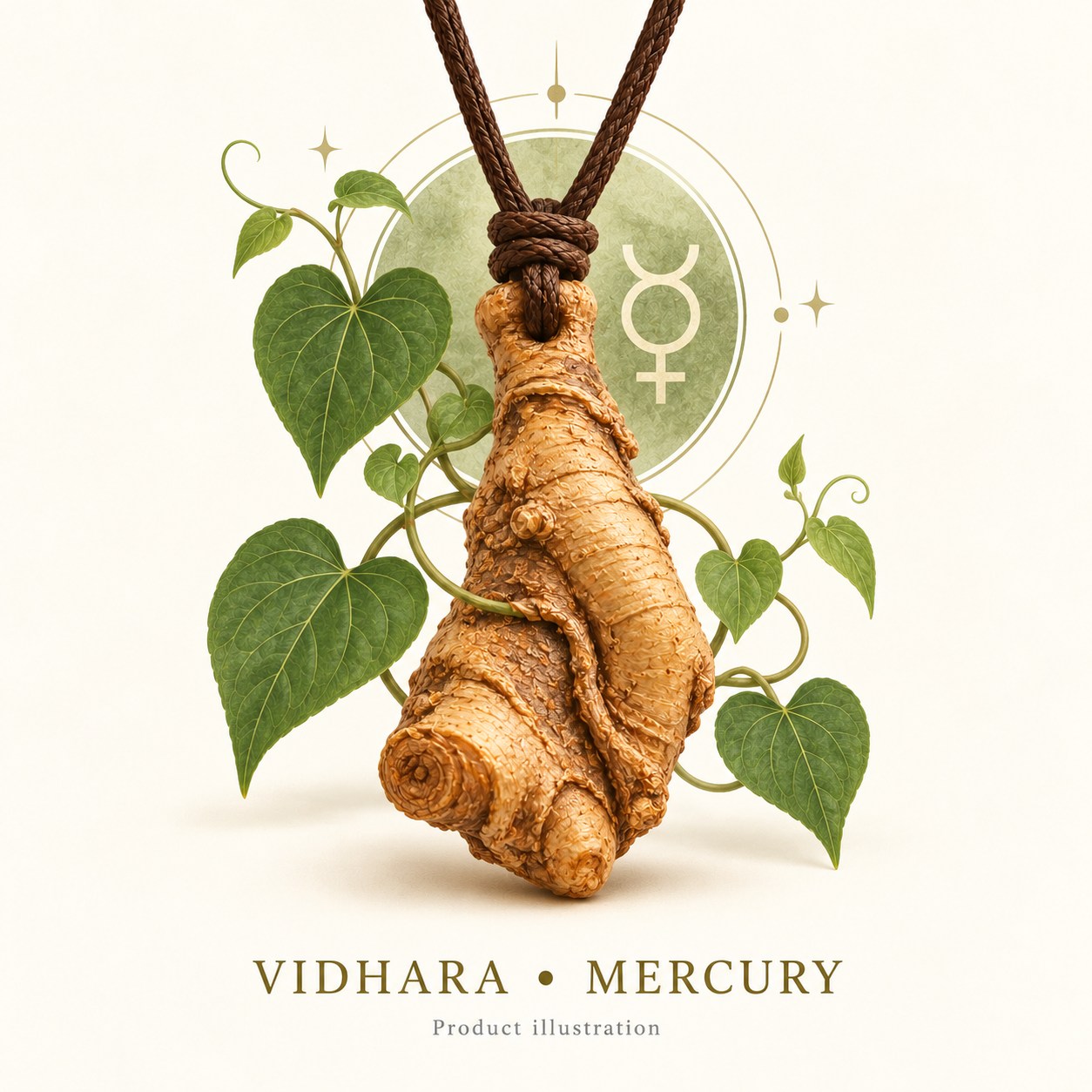
A Vidhara root pendant and a natural emerald (Panna) are both encountered in searches for Budha, the Mercury graha, but they are very different articles of jewellery. Vidhara belongs to a botanical and herbal-jewellery tradition: the customer receives a prepared plant component in a wearable mounting. Emerald is a mineral gemstone, with its own gemological identification, clarity features, enhancement history, setting and valuation. The shared planetary theme explains why they may be considered side by side; it does not erase their differences.
The practical question is therefore not simply, “Which Mercury item is more powerful?” It is which tradition is being followed, what material is actually offered, how its identity can be checked, and whether its design suits the intended wearer. A root certificate is not an emerald report; a gemstone report does not establish that the plant in a pendant is genuine Vidhara. Likewise, a photograph or a green colour is only one piece of information. This guide explains the terminology and gives an item-by-item comparison that buyers can use when asking OmmRudraksha for details.
For related background, read Vidhara: plant identification, names and traditional background and Vidhara and Budh graha: Mercury symbolism. Those companion articles examine the botanical and Jyotish contexts more deeply. Here the emphasis is how to compare two complete products without confusing roots, crystals or customary recommendations.
1. Quick comparison: the same graha, not the same material
| Feature | Vidhara root pendant | Emerald / Panna jewellery | Why it matters |
|---|---|---|---|
| Basic identity | Plant-derived root material placed in a wearable fitting | Green to bluish-green gem variety of beryl | The identification methods are unrelated |
| Common scientific context | Argyreia nervosa (Burm.f.) Bojer; Argyreia speciosa is a botanical synonym | Beryl, chemical formula Be₃Al₂Si₆O₁₈ | One is a species name; the other is a mineral species and variety |
| Traditional comparison | Herbal/plant association with Budha in some contemporary and regional practices | Panna is widely described as Budha's principal gem in Jyotish gemstone practice | A shared graha does not mean a universal substitution rule |
| Typical form | Dried root segment, cap, cord, thread or protective enclosure | Loose cut gemstone, ring, pendant or other setting | Comfort, weight, care and security differ |
| Main evidence | Plant name, plant part, collection/source and supply-chain records | Gem identity, measurements, natural/lab-grown status, treatments and report | Ask what the evidence actually establishes |
| Appearance | Brown/tan botanical variation, fibres or cut surfaces, sometimes coated | Green colour, transparency, inclusions, cutting and setting | Photos do not tell the full story |
| Common care priority | Keep dry, guard against crushing, avoid wet ritual preparations | Protect from impacts, chemicals, ultrasonic cleaning and excess heat | Follow the instructions for the actual materials |
| Pricing factors | Sourcing, preparation, enclosure, craft, metal and documentation | Gem quality, size, cutting, treatment, origin evidence and setting | Price alone does not rank spiritual significance |
| Appropriate purchasing question | “Is this Argyreia nervosa root, and how is it mounted?” | “Is this natural emerald, how enhanced, and is the report item-matched?” | Ask both, not merely “Is it for Mercury?” |
For shopping, explore the existing Emerald gemstone collection alongside the Vidhara Root Pendant for Mercury. Compare the current products actually available, not generic stock images or prices in a blog. Details such as the exact piece, size, treatment, metal and fulfilment should come from the product listing or the seller's confirmation.
2. Budha in Jyotish: intellect, speech, calculation and business
Budha (Mercury) is traditionally associated with buddhi—the faculty of discernment and intellect—as well as communication, analysis, education, language, numbers, accounts, negotiation and adaptability. In practical Jyotish discussions the graha may be considered when examining study, writing, commerce, documentation, speech, trade and the way information is processed. These significations explain why merchants and students are drawn to Budha-related items.
Budha is not a shorthand for “guaranteed profit” or an assurance of passing an examination. A serious Jyotish reading considers the role of Mercury in the person's actual chart: the house it owns, its sign and house placement, associations with other grahas, strength, relevant dasha and the broader framework. In some configurations Mercury may be considered supportive for a particular area; in others an astrologer may advise more caution about strengthening it. The same retailer's “for Mercury” label cannot settle all those cases.
The Sanskrit language of Budha is particularly interesting because budh carries the sense of becoming aware or understanding. A person who chooses an item as a reminder to speak thoughtfully, keep accurate accounts, learn a language or communicate with care is using the traditional symbolism constructively. The symbolism can be explained respectfully without turning the pendant or ring into a mechanical guarantee of those outcomes.
3. Mercury's signs, nakshatras and Wednesday observance
In commonly taught Parashari Jyotish, Budha owns Mithuna (Gemini) and Kanya (Virgo). Virgo is traditionally given as Mercury's exaltation sign, while Meena (Pisces) is described as its debilitation sign. In the widely used Vimshottari dasha arrangement, Mercury is assigned the nakshatras Ashlesha, Jyeshtha and Revati, and its mahadasha is traditionally 17 years. These are chart interpretation terms, not a schedule printed by a jewellery manufacturer.
Budhvar (Wednesday), green colours and Budha mantras appear in many familiar Navagraha observances. Some people make Wednesday a day for a brief prayer, reading, service, attentive speech or remembering their teacher's instructions. Others follow a family puja sequence or a practitioner-specified procedure. An individual item may be blessed or worn according to those customs, but no single preparation applies to every root, stone, metal and wearer.
| Jyotish expression | Common Budha association | What not to assume |
|---|---|---|
| Budha / Mercury | Intellect, communication, learning, calculation, trade | That an accessory directly changes these abilities |
| Mithuna / Gemini | One of Mercury's own signs | That every Gemini native must wear emerald |
| Kanya / Virgo | Mercury's other own sign; exaltation in standard descriptions | That a Virgo label decides the whole horoscope |
| Meena / Pisces | Traditional debilitation sign | That debilitation alone justifies buying a specific object |
| Ashlesha | Mercury-ruled nakshatra in Vimshottari | That nakshatra lordship mandates a root or gem |
| Jyeshtha | Mercury-ruled nakshatra in Vimshottari | That all people born under it use one ritual |
| Revati | Mercury-ruled nakshatra in Vimshottari | That name recognition replaces the full chart |
| Budhvar / Wednesday | Devotional association for Budha | That Wednesday is a physical property of a gem |
| Budha mahadasha | Seventeen-year period in Vimshottari | That a dasha label alone predicts a purchase result |
The distinctions are useful even if a customer buys primarily for personal devotion or appearance. Understanding an item's traditional reason and its material specifications keeps spiritual guidance and product information in the right places. The related Mercury symbolism article gives a more focused account of the root's association in the planetary-herbal collection.
4. Vidhara: the name a buyer sees is not a species test
The botanical research candidate commonly associated with Vidhara, Vidari, Vriddhadaru or Vriddhadaraka in certain medicinal-plant and trading contexts is ***Argyreia nervosa* (Burm.f.) Bojer, a climbing plant in the **Convolvulaceae (morning-glory) family. Kew's Plants of the World Online accepts Argyreia nervosa and lists ***Argyreia speciosa* (L.f.) Sweet** as a synonym. That means the two scientific labels may appear in older and newer botanical literature for the same accepted taxon. It does not mean that any brown root labelled “Vidhara” has been identified to this species.
A vernacular name can carry more than one meaning across region, language, medicinal trade and local practice. Vidari is a particularly risky shortcut because it may be encountered in other botanical contexts and commercial ingredient descriptions. If the supplier uses “Vidhara” alone, the buyer should request the scientific name and the plant part. If an older scientific name is given, check whether it is an accepted name or a synonym in the reference being used. Kew's Medicinal Plant Names Services is valuable here because it records name-to-plant relationships and the plant parts mentioned in medicinal references.
A standing vine with leaves, flowers, fruits and a documented collection location can be identified using botanical characters. By contrast, a short root segment that has been cut, dried, polished, drilled or sealed in a cap may have lost many diagnostic features. A text label on a packet is a claim about the source; physical authentication of a processed piece may require much stronger provenance, documented harvesting or appropriate specialist review. A buyer should not mistake a species description on a webpage for confirmation of the particular item on sale.
5. Argyreia nervosa and Argyreia speciosa: one accepted taxon, two records
Taxonomic naming changes as researchers compare historical specimens and descriptions. In Kew's current treatment, Argyreia nervosa is the accepted name and Argyreia speciosa is listed as a synonym. The full botanical authorship is helpful for precise identification in literature, but most retail listings can use a concise format such as “Vidhara root — Argyreia nervosa (syn. A. speciosa)” only where the supplier can support that identification.
The plant is a woody climber or liana rather than a gemstone source. General descriptions often mention sizeable leaves, a hairy or silvery surface on some plant parts, and distinctive flowers. Those characters may guide a botanist examining a complete plant, but they should not be read as a test of a dried pendant. Nor should reference images of seeds, leaves or flowers be substituted for a photograph of the actual root-containing finished accessory.
This distinction helps prevent a common category error: an accepted scientific name proves a taxonomy reference exists, not that every piece sold under a related village name belongs to that taxon. The scientific record and the supplier trail answer different questions. Use Vidhara Root: Plant Identification, Names and Traditional Background for the wider species discussion, and obtain item-specific confirmation when buying.
6. Which plant part is in a Vidhara pendant?
The phrase “root pendant” implies that the object contains a piece derived from a root. It should not silently be replaced by a stem, woody twig, seed, resin casting, dried powder or unidentified filler. Some pieces may include an exposed root fragment; others may have a sealed capsule or decorative metal cap. Whether visible or enclosed, the product description should say what is inside and how that component was selected and processed.
The trade sometimes uses broad botanical names that conceal plant-part differences. Roots, leaves, stems, bark and seeds can differ in structure, handling and cultural significance even when they originate from the same species. A botanical reference that reports a historical use of a seed does not establish that the seed is the appropriate material for this jewellery item. In particular, do not consume or experiment with any component of a jewellery product. A devotional accessory is not an edible preparation, and unspecified processing, metal fittings, coatings or botanical constituents make the distinction important.
Ask what the supplier can explain about harvesting, drying, trimming and packing. Was the material sourced from a named plant and kept in a traceable batch? Is the visible surface raw, sanded, dyed, resin-impregnated or lacquered? Is the root retained securely, and is there any loose material or strong odour? These practical questions make a much stronger buying checklist than expecting all genuine roots to have one exact shade of brown.
7. What a genuine root might look like—and why appearance is inconclusive
A dried plant root may show uneven surface texture, fibres, varying density, natural taper, lighter or darker cut ends, growth marks or minor asymmetry. Material taken from plants of different ages or environments may vary. Sanding, oiling, heat, a metal cap or photography can change its appearance further. Consequently, a photograph of a pale straight piece is not evidence of superior authenticity, and a dark irregular piece is not necessarily unsuitable.
The most informative pictures show the actual pendant from more than one side, including its cap, loop, cut edge where visible, scale reference and assembly. Ask for length, width, thickness and total weight. If the seller only provides a stylised illustration, request the practical dimensions and a current item photograph or a clear statement that the photo is representative. Confirm whether the root is exposed to skin or fully covered.
Do not damage the piece with a scratch test, flame, prolonged immersion, aggressive scraping or chemical test at home. Such experiments may destroy a finish without establishing species identity. Botanically meaningful verification comes from source records, voucher-backed identification where available, and a responsible supplier's chain of custody—not from a single visual trick.
8. Plant-name and purchase-document checklist
| Question to ask | Useful evidence | Caution sign | Sensible response |
|---|---|---|---|
| Which species is claimed? | Argyreia nervosa and any justified synonym noted | “Any Vidhara-looking root is equivalent” | Request written botanical identification basis |
| Which part is used? | Explicit root declaration | “Plant material” without specifying part | Ask whether it is root, stem or another component |
| Where did the piece come from? | Supplier, batch, collection or cultivation information | No origin trail at all | Assess how much the supplier can verify |
| Is a photograph current? | Images of actual or clearly representative assembly | Only a plant illustration used as a product photo | Request product-specific views and dimensions |
| What processing occurred? | Drying, sealing, coating, polishing and mounting disclosed | Adhesive or colour treatment hidden | Clarify finish and safe handling |
| Are plant names current? | Accepted name compared with trusted taxonomy | Old and new names treated as unrelated plants | Check accepted name and synonym status |
| Is the piece suitable to wear? | Secure loop, comfortable contact surfaces, size | Crumbling root or exposed sharp metal | Seek a sounder assembly or repair |
| What does any certificate cover? | Named object, batch, testing method and issuer | Decorative “certified” wording with no scope | Evaluate the document's actual claim |
These checks are not meant to make traditional botanical jewellery inaccessible. They allow the person buying an item for meaningful reasons to understand exactly what is being received. Many reputable handicraft pieces are sold without laboratory analysis, but the vendor should distinguish what is known, what is reported by the supplier, and what has not been independently tested.
9. Emerald / Panna: a mineral gem, not a green herbal substitute
Emerald, widely called Panna in Hindi jewellery and Jyotish contexts, is the desirable green to bluish-green variety of beryl. Its ideal chemical formula is Be₃Al₂Si₆O₁₈. The green appearance arises principally from trace chromium and/or vanadium in its crystal chemistry. Aquamarine is also beryl, yet an aquamarine is not an emerald simply because both share a mineral family. Similarly, a pale green beryl may be classified differently from emerald depending on colour saturation and gemological practice.
Gemological discussions usually give emerald a Mohs hardness of 7.5–8. Hardness refers primarily to resistance against scratching. It is not the same as toughness, resistance to fractures or the security of a gem in its mounting. Emeralds frequently contain internal inclusions and surface-reaching fissures. Some of those inclusions create the characteristic “jardin” appearance discussed in the trade; the presence of inclusions does not automatically mean the emerald is poor quality or not natural.
In Jyotish gemstone practice, natural emerald/Panna is frequently associated with Budha. A customer may seek it as a ring, pendant or loose gem for setting according to a family or practitioner recommendation. But a label stating “Panna for Mercury” says nothing about whether a stone is natural, laboratory-grown, enhanced, imitation glass, or another green mineral. Identification and astrological interpretation are separate questions, and both deserve clear answers.
10. Emerald colour, clarity, cut and carat weight
Emerald pricing can change dramatically based on colour quality, including hue, tone and saturation; transparency; cut; size; and the nature or extent of enhancements. Attractive emerald greens generally range from green to bluish green, with a desirable balance of liveliness and depth. A dark stone is not necessarily better than a vivid medium-toned one, and a glowing backlit photo can make lower-transparency material look clearer than it does in ordinary light.
Clarity needs interpretation appropriate to emerald. Visible inclusions are common. A stone with attractive overall appearance and stable inclusions may still be desirable; an open fracture at a vulnerable corner or a heavily affected setting may present a different concern. The cut influences face-up colour, apparent size, brightness, windowing and how the stone is supported by a mount. The rectangular step cut traditionally called an “emerald cut” is common, but oval, round, pear and other cuts also exist.
A carat is a mass unit for gemstone weight; it is not the same as the weight of the ring or pendant. Measurements in millimetres, especially the face-up dimensions, help buyers understand how a stone will look in a setting. Ask whether a displayed price includes only the loose stone, a finished ring, a pendant mounting, a report, adjustments and delivery. The resulting total is the appropriate number to compare with the complete botanical pendant price.
11. Natural emerald, laboratory-grown emerald and look-alikes
A natural emerald formed geologically. A laboratory-grown emerald is created under controlled conditions and may have the same essential mineral composition as natural emerald. An imitation may use glass, assembled components or another stone to resemble emerald visually without being emerald in mineral identity. These categories should be clearly named; none is determined just by looking at a green product photograph.
Buyers also encounter green beryl, green tourmaline, green glass, coloured quartz, synthetic materials and various market names. A natural green tourmaline can be a lovely gemstone but is not Panna. A pale green beryl may be a genuine member of the beryl family while not meeting a laboratory's emerald colour definition. If a practitioner specifically requested natural Panna, do not let the phrase “emerald-colour stone” replace identification of the mineral variety.
For expensive purchases, a report from a qualified independent gem laboratory can help clarify the stone's identity, whether it is natural or laboratory-grown, and any detectable treatments within the testing scope. This differs fundamentally from a leaf or root identification record. The buyer can request the certificate number, laboratory name, recorded measurements, weight and comments, then match them with the actual item.
12. Oil, resin and fracture filling: emerald treatments explained
Natural emeralds often have fractures that reach the surface. The industry has long used oil or other filling materials to make those fissures appear less visible, improving the visual impression of clarity. Synthetic resins and polymers are also encountered. The presence of an enhancement does not, by itself, make a natural emerald an imitation; a natural emerald with clarity enhancement is still natural in geological origin. Its treatment should nevertheless be disclosed because enhancement can affect care, appearance and commercial value.
Descriptions such as “no oil,” “minor enhancement,” “moderate filling,” “significant filling” and “untreated” need to be understood in the framework of the laboratory or vendor using them. They should not be guessed from a phone photograph. Re-treatment and the amount or nature of filler may complicate an older report, and no statement about origin or enhancement is stronger than the actual document's scope and date. A report may also have limitations when a stone is already mounted.
Some fine-appearing material is natural but treated; some more included material is natural and untreated; some highly clean green stones are laboratory-grown. Beauty, natural origin, absence of enhancement and astrological meaning are separate dimensions. A careful product description avoids substituting one for another.
13. How an emerald laboratory report differs from a root provenance note
| Documentation feature | Vidhara root pendant | Emerald / Panna | Buyer should verify |
|---|---|---|---|
| What is examined? | Plant source, named part, batch or pendant component | Individual faceted gemstone, rough or mounted stone | Does the document identify the exact sold object? |
| Main terminology | Species, synonym, root, provenance | Beryl, emerald variety, natural/lab-grown, treatments | Are the terms appropriate to the material? |
| Possible expert | Botanist, herbal-material specialist, traceable grower | Gemological laboratory and qualified gemologist | Is the issuer identified and credible? |
| Typical observations | Plant identity and chain of custody | Dimensions, carat weight, shape, colour, inclusions and detectable treatments | Can observations be matched to the current item? |
| What it cannot conclude | Result of a planetary remedy, emerald identity | Root authenticity, personal astrological suitability | Do not claim one report answers the other's questions |
| Common misunderstanding | “Plant name on website proves my pendant” | “Expensive certificate guarantees all future results” | Separate identity evidence from tradition |
| Worth retaining | Batch note, invoice, assembly details, care information | Report number, receipt, mounting description, care and any treatment disclosure | Keep records with the accessory |
GIA's public emerald resources are useful for understanding mineral identity, common treatments, cleaning and what a coloured-stone report does. They are general educational sources, not proof that a particular gemstone sold by any merchant has been tested there. For a current store item, ask for its actual report and specifications. Similarly, the Kew taxonomic entries describe plant names; they do not certify a commercial Vidhara pendant.
14. Panna as Budha's principal gemstone, and where roots fit
In many familiar Navagraha gemstone lists, emerald/Panna is the principal gem assigned to Budha. That is why someone browsing emerald rings often finds references to Mercury, communication, education and commercial skills. The association belongs to a long-running astrological and jewellery tradition; its application to a particular person may vary by school of Jyotish and by the overall interpretation of the kundli.
The Vidhara root–Budha pairing appears in herbal-root and planetary-jewellery discussions. However, a person should not assume that every Sanskrit compendium, regional practice or contemporary astrologer gives Vidhara the same status as emerald, or uses precisely the same list of nine roots. The words mukhya ratna (principal gemstone), uparatna (substitute or secondary gem) and herbal alternative are not equivalent botanical or gemological classifications. A root is not a lower-grade emerald. It is another type of devotional object with its own material and provenance questions.
Sometimes a buyer's preference is practical: a small root pendant may be lighter, less conspicuous or less expensive than a fine natural emerald set in precious metal. At other times a family tradition specifies one particular material, or the person prefers a gemstone as everyday jewellery. Both preferences can be respected. The root should not be sold as an automatically identical substitute with a promised level of effect measured against gemstone carat weight.
15. How a kundli consultation differs from choosing an attractive item
A kundli or birth-chart analysis can involve the ascendant, Mercury's house ownership, placement, aspects or conjunctions, dasha timing and the method followed by the practitioner. An astrologer may distinguish strengthening an associated graha from observing a devotional discipline dedicated to that graha. Such a recommendation is more nuanced than the statement “I have poor communication, therefore I need Panna.”
A store can accurately describe what a product is and which tradition is associated with it without pretending that a universal planetary prescription has been established for every visitor. Someone following a family priest's direction should be able to ask for the requested material and specifications. Someone buying simply because emerald is beautiful should also be able to buy without supplying birth information. The reason for a purchase and the documentation of the physical item remain separate.
If consultation is desired, record the tradition or practitioner recommendation and ask exactly what is being requested: natural emerald, a specific size or setting, a botanical root, another devotional article, or a simple Wednesday practice. Make sure any personalised advice comes from the actual consultation, not from a generic category page. OmmRudraksha's Planetary Herbal Jewellery collection and the Emerald gemstone collection therefore serve two different material pathways.
16. Wednesday worship, mantra and sankalpa with either material
Many devotees associate Budha with Wednesday, green offerings, considerate speech and a short sankalpa—a conscious intention for the observance. A common short invocation is “Om Bum Budhaya Namah” (with transliteration varying across families and teachers). Others recite a Navagraha stotra, follow temple worship, read sacred texts or offer a simple personal prayer. Their practice may focus on clarity of speech, disciplined study, honest transactions or gratitude toward teachers.
The rite and the object should be considered together with the construction. Some families traditionally touch a new gem to appropriate puja materials, while others prefer dry offerings or a separate altar ritual. Avoid immersing a dried root pendant in milk, water, ghee or scented oil unless the construction and supplier permit it. Such treatment can damage root material, adhesives, thread, coatings or metal. Likewise, do not assume that liquids or chemicals that a gemstone might tolerate will suit its setting or clarity enhancement.
It is possible to honour the symbolism without putting the accessory in a bowl of liquids. Place it on a clean dry cloth, observe the family mantra or intention, and follow the actual item's care instructions. If a teacher gives a particular ritual procedure, ask how to adapt it safely for a botanical or filled-gem assembly. Tradition and respectful handling are not in opposition.
17. Wearing design: root enclosure versus emerald setting
A root pendant may be supplied with an exposed fragment, a metal cap or a transparent protective enclosure. Check the total dimensions, attachment method, metal type, sealing, cap edges, cord length and whether the fitting has been tested against normal movement. If the root is fully enclosed, confirm whether there is condensation, a loose part or a cracked cover. If the root is exposed, avoid friction against rough clothing or jewellery that may abrade it.
An emerald ring concentrates attention on stone security, prongs or bezel design, ring size, movement and exposure to knocks. An emerald pendant may have fewer direct impacts than a frequently worn ring, but its bale, chain and stone edges still need inspection. Be cautious of an elaborate open-backed setting that leaves exposed fissures at vulnerable corners. In either form, the metal alloy and skin-contact surfaces matter for comfort.
If a person wears multiple devotional accessories—including items from the Rudraksha for Planets collection—consider whether cords tangle, hard beads strike the emerald, or a root enclosure rubs on another pendant. The combination can be meaningful within a tradition, but the assembly still has ordinary mechanical limits. Good craftsmanship protects the piece and makes continued wearing easier.
18. Material-safe cleaning and storage
| Routine situation | Vidhara root pendant | Emerald / Panna jewellery |
|---|---|---|
| Light dust | Use a soft, dry cloth or delicate clean brush on suitable exterior surfaces | Use a soft cloth; clean carefully if setting and treatment permit |
| Sweat or rain | Remove, wipe permitted exterior surfaces and air-dry away from direct heat | Wipe gently; avoid prolonged wet exposure of the setting or fillings |
| Bath, swimming or household cleaning | Remove before immersion, chemicals, soaps or detergents | Remove before chemicals, knocks and temperature extremes |
| Ultrasonic or steam cleaning | Not suitable for botanical root assemblies | Generally avoid, especially because emerald is commonly fracture-filled |
| Oil, milk, ghee or scented puja liquids | Do not soak; choose a separate dry observance | Do not assume oils and liquids are suitable for treated stone or mounting |
| High heat or direct sunlight | Avoid overheating, drying cracks and coating changes | Heat can aggravate fractures and alter some fillers |
| Storage | Dry, padded pouch; prevent crushing, damp and cord kinks | Separate padded compartment; protect from hard gems and impacts |
| Visible damage | Do not wear until loose parts or sharp edges are addressed | Have chipped corners, loose prongs or visible setting movement inspected |
GIA's emerald care guidance notes that emerald has good scratch resistance but only fair-to-good toughness, and that steam and ultrasonic cleaning are risky for fracture-filled stones. Gentle warm soapy water is commonly described as a safer method for suitable emerald jewellery, but whether to use it depends on the actual setting, surface condition and treatment. For the root, stay with dry care as the default unless the product supplier gives a more specific supported method.
A typical jewellery box can contain radically different materials. Do not place a soft botanical piece under a heavy gemstone ring, or keep an emerald loose beside diamond jewellery where hard contact can scratch the metal setting or damage exposed edges. Inspect attachments periodically rather than waiting for a fall or a broken cord.
19. What the price includes: compare like with like
The price of a root pendant commonly reflects source and preparation of the plant component, labour, protective enclosure, metal fittings, cord or chain and other services. It need not track weight in a way comparable to gems. A very large root piece is not necessarily a better accessory: excessive mass can make mounting fragile or wearing uncomfortable. For hand-prepared botanical jewellery, good documentation and consistent construction may matter more than size.
Emerald prices span an enormous range because individual stones differ. Colour, transparency, cut, carat weight, natural or laboratory-grown origin, treatments, documentation, sourcing and the setting can all affect what a seller charges. A small fine natural emerald can cost considerably more than a larger heavily included or treated example. Conversely, jewellery containing laboratory-grown or imitation materials may be sold for decorative reasons at lower prices if it is accurately labelled.
Do not compare the price of a loose stone with that of a completely finished root pendant without accounting for stone-setting charges, ring metal, sizing and a report. The more useful calculation is the total agreed invoice for the actual item the person will receive, with return conditions and any follow-up support explained.
20. Decision table: what fits the buyer's real priorities?
| Buyer priority | Usually more relevant questions for Vidhara | Usually more relevant questions for emerald |
|---|---|---|
| Botanical meaning | Is the species and root part stated? Is the source traceable? | Do I instead want a mineral gemstone rather than a plant item? |
| Familiar Panna tradition | Does the adviser accept a herbal item, or was a specific gem named? | Is the stone the requested natural emerald with suitable documentation? |
| Daily convenience | Is the enclosure light, dry-safe and comfortably finished? | Does the setting protect vulnerable corners and suit daily use? |
| Low-maintenance routine | Can I avoid water, crushing and exposure of the root? | Can I avoid steam, ultrasonic cleaning, solvents and sharp impacts? |
| Visual preference | Do I like the natural, understated plant appearance? | Do I like the green colour, sparkle, inclusions and metal style? |
| Document trail | Is plant species, part and supplier evidence available? | Is a credible gem report linked to the actual stone? |
| Budget clarity | What is included in the complete pendant price? | Does the cost include natural stone, report, mounting and alterations? |
| Gift suitability | Will the recipient appreciate botanical devotional jewellery? | Does the recipient prefer a recognisable, green gemstone? |
| Traditional consultation | What exactly was recommended and by whom? | Were stone identity, treatment, size or setting specified? |
Neither column proves that one choice will deliver a measurable result and the other will not. The table guides material selection, which is something a buyer can verify. A customer may also decide to have neither item, use a familiar Rudraksha mala, or mark Wednesday through prayer and service alone.
21. Natural emerald buying questions before accepting a certificate
The best starting point is to identify the individual stone, rather than a generic certificate template. Ask whether the emerald is natural or laboratory-grown, whether a report exists from an independent laboratory, and whether the certificate is recent enough to reflect the stone's current state. Ask about fracture filling or other treatment, and match the stone's weight, measurements, shape and distinguishing features with the document. The claimed mining origin, if any, is a separate statement that may or may not be assessable from testing.
A report's issuer, methods and wording matter more than a slogan such as “100% authentic” stamped on packaging. A photograph of a famous laboratory's logo does not by itself identify the supplied gem. For an emerald already in a ring, some observations may be limited by the setting. Ask whether the report describes the gem before mounting and whether the exact numbered stone was set into the ring being sold.
For the physical gem, inspect it under neutral daylight or balanced lighting as well as ordinary indoor light. Ask about visible windowing, overly dark areas, inclusions approaching the surface, scratches and stable prong contact. Do not perform abrasive scratch testing or any hot-liquid test. Careful presentation and accurate records are more useful than attempting to prove a scientific identity through household experiments.
22. Root-pendant buying questions before trusting a label
For Vidhara, the equivalent inquiry begins with the declared plant, plant part and batch. Request the exact name used by the supplier, the relationship between any synonym and the accepted name, and whether the item contains root rather than another part. If the supplier relies on a botanical report, ask whether the test or examination was conducted on the actual supplied lot, a related sample or an entirely different plant illustration. The distinction affects how strongly the paperwork supports the individual pendant.
Next examine the wearable assembly. Ask how the root is secured, whether it has been drilled, coated or sealed, how the loop is attached and how the item behaves under ordinary movement. Check whether the metal is plated, what happens if a chain breaks, and whether moisture is likely to reach the root. A light cord may be suitable for occasional devotional use, while a secured and well-finished enclosure may be preferable for more frequent wearing.
Finally examine the seller's care instructions, price and return conditions. A natural material may show variability; variability is not necessarily a defect. But instability, an unsafe fitting or substitution of a different component should not be explained away as spiritual uniqueness. Clear communication protects both the traditional value of the object and the customer.
23. Marketing phrases that require an extra question
| Common phrase | Why it can be unclear | Better specific information |
|---|---|---|
| “Original Vidhara” | Species, plant part and source remain unstated | “Claimed Argyreia nervosa root; source/batch stated” |
| “Argyreia speciosa is a different premium species” | Kew treats it as a synonym of A. nervosa | Explain the accepted name and synonym honestly |
| “Pure Panna” | Could refer to natural, untreated, colour, or simply appearance | State natural/lab-grown, treatments and report details |
| “No oil emerald” | Requires credible support; appearance alone is insufficient | Treatment statement from a qualified report |
| “Mercury-certified pendant” | Could imply identity testing or ritual blessing | Identify who documented what, and which item |
| “Works exactly like an emerald” | Two material traditions are being compressed into one slogan | Discuss each customary use separately |
| “Best Mercury stone for every person” | Astrology context differs by chart and school | Explain the general association, then relevant personalised advice |
| “Imported, rare, therefore genuine” | Origin and rarity claims do not identify the object | Current supplier evidence and item-specific descriptions |
Promotional language is easier to assess when converted into small, answerable questions. Good product information need not eliminate the language of Budha, Panna, Vidhara, Navagraha and puja. It should simply be explicit about where the statement belongs: Jyotish tradition, botanical identity, gemological testing or a sales specification.
24. Can Vidhara root and emerald be worn together?
Some devotees combine a gemstone with a sacred root, Rudraksha, a thread or other religious accessory according to custom or individual advice. There is no universal merchandise rule requiring or prohibiting all such combinations. If a priest, family teacher or Jyotish adviser has specified a sequence, ask about that tradition directly rather than assuming every shop follows it.
From a jewellery standpoint, mechanical separation is often wise. A hard stone or sharp metal setting can strike a root enclosure; a rough root mount may catch on fine chains; and multiple cords may twist, concentrating strain at the bail. If the emerald is in a ring, inspect the setting before layering other bracelets or hard beads that could come into contact with it. Store the items separately even if they are worn together.
The combined purchase should be judged by its actual construction and the customer's intention. Multiplying the number of items does not eliminate the need for source checks, gemstone identity, correct sizing or sensible care.
25. Common misunderstandings about Mercury jewellery
Misunderstanding: any green stone is Panna. Colour is not a mineralogical identity. Green glass, tourmaline, beryl and natural emerald can appear similar to a non-specialist. Ask for precise gem identification.
Misunderstanding: Argyreia nervosa and Argyreia speciosa must be two different products. In Kew's current treatment the latter is a synonym of the former. The name relationship is not evidence that any particular pendant was verified.
Misunderstanding: a certificate settles everything. The scope matters: a gem report may address identity and treatment but not a horoscope. A botanical note may describe a species but not the origin of an untraced finished piece.
Misunderstanding: a flawless photograph proves a flawless natural emerald. Lighting, inclusions, fracture filling, laboratory-grown material and imitations require proper disclosure and sometimes specialist testing.
Misunderstanding: a larger root or gemstone necessarily has stronger spiritual meaning. Material size affects cost, weight, design and sometimes gem rarity; the relationship between size and personal devotional intention cannot be inferred from an advertised metric.
Misunderstanding: traditional puja must wet the item. Many respectful observances can be performed without exposing delicate material to damaging liquids. Follow the wearer's custom while protecting the object's construction.
26. Frequently asked questions
1. Is Vidhara root the same material as emerald?
No. Vidhara is a botanical trade name used here for a proposed Argyreia nervosa root component, while emerald is a green mineral variety of beryl. They require different methods of identification, different types of documentation and different cleaning routines. Their association with Budha is a traditional comparison, not evidence that the two objects are physically comparable.
2. Why are Vidhara and Panna both associated with Mercury?
Panna/emerald has a prominent place in many Jyotish gemstone correspondences for Budha. Vidhara root appears in certain planetary-herbal jewellery and regional plant-association traditions. These systems can overlap in their graha symbolism while differing in origin and status. Ask the adviser or teacher which specific tradition is being followed when a replacement or combined wearing is proposed.
3. Is Argyreia speciosa a different plant from Argyreia nervosa?
In Kew's Plants of the World Online, Argyreia speciosa is listed as a synonym of the accepted name Argyreia nervosa. Older books and supplier records may therefore use the former name. The synonym relationship clarifies research vocabulary; it does not authenticate an unidentified piece of root. A responsible listing should still describe the source of its actual material.
4. Can a root fragment be identified accurately from its colour?
Colour is a weak test. Dried roots can change appearance with age, preparation, drying, coatings, processing and photography. Similar-looking pieces can come from different plants. Verification should start with a traceable supply chain, documented species and plant part, and specialist assessment where warranted. Ask to see an accurate photograph of the finished piece rather than depending on a plant illustration.
5. Does every product called Vidari or Vidhara contain the same plant?
Not necessarily. Vernacular and commercial plant names can overlap across regions, medical traditions and sellers. A name that appears familiar in Ayurveda or a wholesale catalogue may not correspond to the same botanical material in every context. Request the accepted scientific name, plant part and provenance. The companion plant identification guide explains the nomenclature issue in more detail.
6. What does an authentic emerald report establish?
A credible gemological report may describe the examined stone's mineral identity, natural or laboratory-grown origin, weight, dimensions, shape, colour and detectable treatments, subject to the issuer's methods and limits. Some reports also give a qualified geographic-origin opinion when possible. It does not authenticate a root, guarantee financial outcomes or determine whether Mercury should be strengthened in an individual's kundli.
7. Does “natural emerald” mean “untreated emerald”?
No. A natural emerald forms in the earth but may later be clarity-enhanced by oil, resin or another filler. Treatment is a separate characteristic from geological origin. Ask what is disclosed and how it was determined. A naturally formed but enhanced emerald remains a natural stone, while laboratory-grown emerald is a different origin category and should be identified accordingly.
8. Is a lab-grown emerald fake?
A properly disclosed laboratory-grown emerald can have the same basic mineral composition and crystal structure as natural emerald; it is not naturally mined. An imitation made of glass or another substance is yet another category. The important commercial distinction is accurate labelling. If an individual Jyotish recommendation specifically requests a natural Panna, confirm that the offered stone meets that specification.
9. Can I identify emerald by scratching glass?
A home scratch test is not reliable identification and can damage the gem, mounting or another object. Several different minerals can scratch ordinary glass, and a mounted emerald can still chip or loosen. Use the supplier's precise description and, for consequential purchases, an appropriately qualified gem laboratory. Protecting the actual piece is more sensible than performing destructive demonstrations.
10. Is the most expensive emerald always the best choice for Budha?
No single price can decide a Jyotish recommendation or a customer's personal preference. Emerald prices respond to real differences in colour, size, transparency, cutting, treatment and documentation, and expensive settings can add to the invoice. The right commercial choice is one with accurate specifications and comfortable fit that aligns with the request and budget. A high price by itself is not spiritual evidence.
11. Does an emerald need to touch the skin?
Some practitioners specify particular metal, finger, contact or wearing procedures, while other wearers choose pendants or rings for general devotion or appearance. The product's mechanical safety, hygiene and setting strength still matter. If direct skin contact is part of an individual recommendation, ask how that works with the selected mounting rather than altering prongs or cutting the setting yourself.
12. Must Vidhara root touch the body directly?
No general botanical rule requires exposed root-to-skin contact. Some accessories use a capsule, resin covering, cap or wrapping, and the tradition followed by the wearer may have its own preference. An exposed piece can abrade, soften or rub against skin and clothing. Ask about the mounting and contact surfaces before deciding whether it is suitable for frequent wear.
13. Which finger is associated with emerald in Jyotish?
Popular gemstone-wearing guides give various finger, hand, metal, day and mantra instructions, sometimes differing by school and family practice. Because these details concern an individual observance rather than the mineral's identity, confirm the procedure with the person giving the recommendation. For a ring, accurate sizing and secure stone setting are essential regardless of which finger is chosen.
14. Is Wednesday mandatory to begin wearing a Mercury item?
Budhvar (Wednesday) is a widely observed association with Budha. Some people choose Wednesday for a puja or first wearing, while others follow a family, temple or teacher-specific timing. The item does not become botanically different or gemologically authenticated through the weekday. If the customer follows a specific observance, it can be kept alongside ordinary care and safety.
15. What mantra is commonly used for Budha?
A commonly heard short invocation is “Om Bum Budhaya Namah”, with spelling and transliteration differences across traditions. Other devotees recite a Navagraha stotra or prayers given by their teacher. Mantra practice is a devotional matter; there is no need to imply that a commercial pendant has been individually activated or guaranteed to produce a particular result without any record of what was done.
16. Can I wash an emerald ring with water?
Some emerald jewellery can be cleaned with gentle warm soapy water, as described by professional gemological care guidance, but the method depends on fillers, setting, adhesives and current condition. Avoid steam and ultrasonic devices. When treatment or construction is uncertain, use a soft cloth and ask the jeweller for item-specific cleaning advice. Handle a loose or damaged stone particularly carefully.
17. Can I purify Vidhara root in milk or water?
Avoid soaking a dried botanical pendant unless its maker explicitly permits the method. Root fibres, thread, glued caps, varnish and some metals may be damaged by water, oil or milk. A dry ritual, such as placing the item near the puja rather than immersing it, can respect a devotional intention while preserving the accessory. The suitable procedure may differ by family practice.
18. What if the Vidhara root cracks or changes colour?
Natural material can show movement, drying, darkening or surface changes as it ages, especially when exposed to humidity, heat, friction or solvents. Inspect the cap and enclosure. A crack that makes the piece unstable is a practical repair issue, not proof of an astrological event. Stop wearing any item with sharp edges or loose components and ask about safe repair or replacement.
19. What if an emerald looks cloudy after cleaning?
Cloudiness can relate to residue, scratches, changed filler appearance, exposed inclusions or damage, among other causes. Do not apply harsh solvents, heat or repeated ultrasonic cleaning in an attempt to restore clarity. Have the stone and mounting inspected by a qualified jeweller or gem specialist. Keep original treatment information and reports available to help interpret what may have changed.
20. Is Panna the same as a green tourmaline or green beryl?
Panna commonly refers to emerald in Indian trade, while tourmaline is a different mineral group. Green beryl belongs to the same mineral species as emerald but may not meet the colour criteria for the emerald variety. A retailer should identify the actual stone rather than relying on the similarity of green shades. These distinctions can influence price, care and whether the item matches a named gemstone recommendation.
21. Can I wear Vidhara and Panna together?
Some people combine root-based devotional jewellery and gemstone jewellery, while others follow an individual teacher's advice about combinations. The physical precaution is to stop the assemblies from striking, scratching, catching or entangling one another. Keep vulnerable emerald edges away from hard impacts, and protect roots from friction and moisture. The combined arrangement still needs proper fit and secure attachments.
22. Does a Vidhara pendant replace an expensive emerald automatically?
No universal equivalence can be inferred. They occupy different material categories, and the source of the proposed substitution may vary between practitioners. A buyer who wants the traditional plant form can choose it for that reason; another who has requested specifically natural emerald should not be sold a root under the implication that it is the identical object. Ask for the basis of the recommendation and the actual item description.
23. Is a larger root pendant preferable?
Not necessarily. The most practical considerations include source identification, stability of the dried piece, enclosure, weight, cap security and wearer comfort. A very large root may be awkward, while a compact one may suit daily wear. Unlike a cut gemstone, root size is not a standardised commercial grade. Ask for millimetre dimensions and the exact construction rather than treating length as a spiritual ranking.
24. Should I buy a loose emerald or a finished ring?
A loose gem allows a buyer to examine its full shape, dimensions and report before selecting a setting. A finished ring may be more convenient but requires checks for ring size, secure prongs, correct stone identification and whether the report corresponds to the mounted stone. Compare the total price, including setting, fitting, documentation and any future maintenance. Neither route replaces material identification.
25. How do I choose between a root pendant and emerald as a gift?
Think about the recipient's spiritual interests, preference for botanical objects or gemstone jewellery, usual clothes, maintenance habits and comfort. An understated root pendant may appeal to someone who values Navagraha herbal traditions; an emerald pendant or ring may suit someone who enjoys recognisable green gemstones. Provide a factual description and appropriate care guidance, and avoid presenting a gift as a compulsory remedy.
26. Where should I start if I still cannot decide?
Start with three facts: the tradition you want to follow, the exact material you are buying, and the complete ready-to-wear specification. Review Vidhara and Mercury symbolism, compare the Vidhara root pendant and Emerald gemstone collection, then ask for item-specific photos and documentation. If a kundli-based recommendation is important, have that discussion separately and state the requested product form clearly.
27. Final recommendation: choose the complete, correctly named item
Vidhara root and emerald/Panna can sit next to each other in a Budha-related comparison because both are discussed in Mercury traditions. But they should not lose their individual identities. Vidhara is a root-based devotional accessory requiring a credible plant name, part declaration and sound craftsmanship. Emerald is a green beryl gemstone whose appearance and value depend on gem identity, natural or lab-grown origin, treatment disclosures, cutting and setting. Keeping those facts separate is the foundation of a good purchase.
First decide whether the requested object is botanical jewellery, gemstone jewellery, or a general expression of Budha devotion. Then inspect the actual product, evidence and care routine. Explore Spiritual Jewellery, the Planetary Herbal Jewellery collection, the Emerald gemstone collection or the complementary Rudraksha for Planets collection according to that choice. Traditional meaning remains part of the discussion, but the item delivered should be unmistakably and accurately described.
Source and terminology notes
- Kew, Plants of the World Online: the existing reference for Argyreia nervosa records the accepted botanical name, its family and synonymy. This is a taxonomic reference, not certification of a finished pendant.
- Kew, Plants of the World Online: the corresponding existing entry for Argyreia speciosa identifies it as a synonym of Argyreia nervosa. The original links are retained for readers checking the naming history.
- GIA gemological education: descriptions of emerald as the green variety of beryl, colour and clarity quality factors, fracture filling and care were consulted as general research. GIA is named here as a source rather than adding a new outbound link to the article.
- Jyotish and Navagraha practice: Budha, Mithuna, Kanya, Ashlesha, Jyeshtha, Revati, Wednesday and Panna are used as traditional astrological and devotional terminology; individual practice can vary by school and teacher.
