
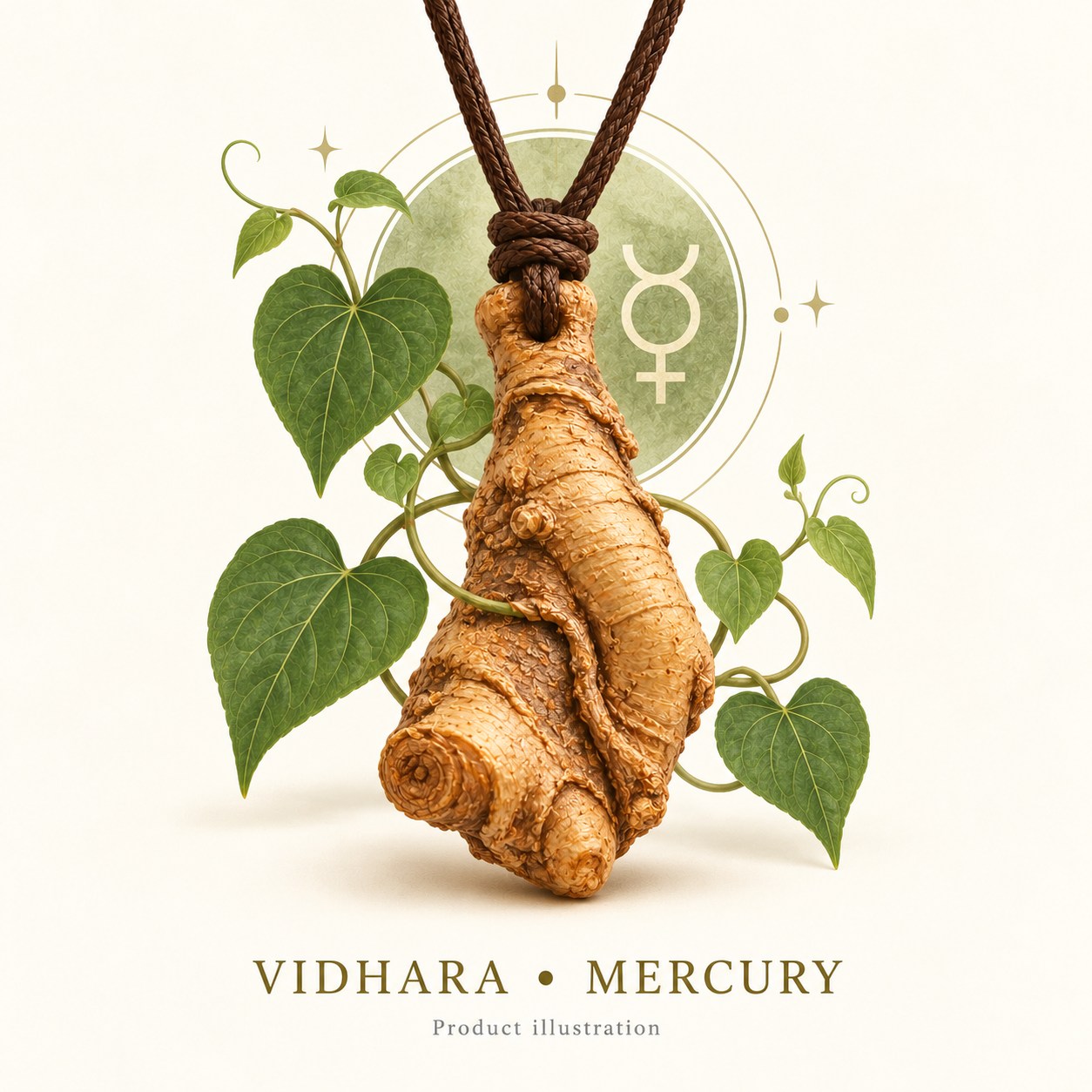
Vidhara root and Budh Graha bring together two different kinds of knowledge. One is the traditional language of Jyotish, where Budha (Mercury) is associated with intelligence, speech, learning, calculation, commercial judgement and the exchange of information. The other is the identification and handling of a real piece of botanical material made into a pendant. People looking for Vidhara as a Mercury-associated herbal pendant deserve an explanation of both, without confusing devotional practice with the physical identity of the item.
The name Vidhara is used in the market for root material linked, in some contemporary planetary-herbal jewellery practices, with Budha. The botanical research most often discussed in this collection concerns ***Argyreia nervosa* (Burm.f.) Bojer, a plant in the morning-glory family, with ***Argyreia speciosa* (L.f.) Sweet treated by Kew as a synonym. A botanical database can explain these names, but it cannot inspect the root contained in a particular pendant. Likewise, the traditional interpretation of Mercury describes why someone might choose the symbol; it does not replace material checks, fit, repairability and responsible wearing.
This OmmRudraksha guide explores Budha's Navagraha place, Sanskrit and Jyotish concepts, Mithuna and Kanya, the Mercury-ruled nakshatras, Wednesday observances, mantra and sankalpa, and the practical steps involved in selecting, wearing and maintaining Vidhara root jewellery. Our separate Vidhara identification guide deals more deeply with names and sourcing; the Vidhara root versus emerald comparison is devoted to materials and buying differences. Here the main subject is traditional Mercury symbolism and its application in daily spiritual practice.
1. Budha among the Navagraha: a quick reference
The Navagraha are the nine grahas considered in Indian astrological and religious traditions. Budha is the graha conventionally identified with the planet Mercury. In Jyotish, graha is more than a modern astronomical label: it belongs to a symbolic interpretive system connecting celestial positions, periods, houses and qualities. Temple Navagraha worship, household practices and horoscope interpretation may use overlapping names without having identical purposes.
| Topic | Familiar Budha / Mercury association | How to interpret the information |
|---|---|---|
| Sanskrit name | Budha (बुध), distinguished from Buddha | The spelling is close to the name Buddha, but the graha and the religious figure are different referents |
| Weekday | Budhavara / Budhvar, Wednesday | A traditional devotional association, not a required property of a botanical pendant |
| Rashi lordship | Mithuna (Gemini) and Kanya (Virgo) | Used in chart interpretation; birth sign alone does not dictate a purchase |
| Exaltation and debilitation | Kanya (Virgo), Meena (Pisces) in widely taught Parashari usage | One interpretive factor among placements, aspects and strengths |
| Vimshottari nakshatras | Ashlesha, Jyeshtha and Revati | Nakshatra lordship is used in dasha reckoning, not a universal remedy instruction |
| Vimshottari mahadasha | Seventeen years | Refers to a traditional planetary period, not the lifespan of any item |
| Common symbolic qualities | Buddhi, speech, learning, analysis, commerce and communication | Traditional significations that guide interpretation and contemplation |
| Colour often associated | Green | Common in prayer articles and gemstone language; Vidhara root need not be green |
| Familiar gemstone | Emerald, called Panna in many Indian markets | A gemstone category distinct from botanical jewellery |
| Herbal-jewellery option | Vidhara root in some contemporary and regional practice | Ask which source or custom underlies the particular recommendation |
A useful habit is to distinguish astrological classification, devotional observance and merchandise description. For example, “Wednesday is associated with Budha” belongs to customary practice; “the product contains a dried botanical root with a sealed cap” is a material fact. Both can be important to someone deciding how to use a pendant, but they are established and evaluated differently.
2. The meaning of Budha: awareness, discrimination and intelligent exchange
The Sanskrit root budh carries meanings relating to knowing, awakening, perceiving and understanding. In the language of Jyotish, buddhi refers to discernment and the capacity to make sense of what is learned. Budha's commonly described sphere also includes expression: vani or vak (speech), reasoning, the written word, memorisation, mathematics, accounting, bargaining and the organisation of information. These are linked by a simple theme: receiving information, interpreting it and communicating it accurately.
This is why merchants, teachers, writers, students, translators, analysts and people whose work involves documents often find Budha imagery meaningful. A trader may use Wednesday worship as a reminder of straightforward dealing; a learner may associate it with patience, note-taking and a regular study habit; a professional may relate it to the precision of written commitments. These are applications of a tradition to everyday conduct, not guarantees created by wearing a root.
Mercury symbolism is not limited to profit or examination results. In many traditional explanations, quality of judgement matters as much as speed. Accurate speech can involve pausing before replying; commercial intelligence can mean refusing misleading claims; good learning can include acknowledging what is not yet understood. Someone choosing Vidhara jewellery as a smarana, or reminder, may find this thoughtful interpretation closer to the spirit of Budha than exaggerated promises of instant success.
3. Budha in the horoscope: why the full kundli matters
In a traditional janma kundli, a graha has a sign, degree, house, relationships and periods of influence. An astrologer examining Mercury ordinarily looks at its sign and bhava, the houses ruled by Mercury from the ascendant, conjunctions, aspects in the method being followed, relative strength, planetary periods and the chart as a whole. Budha in one position may be discussed in connection with one area of life and in another with quite different considerations.
For example, traditional house discussions may connect the second house with speech and resources, the third with communication and effort, the fifth with learning and discrimination, the sixth with service or disputes, and the tenth with work and public activity. It would be too simple to attribute any one of these themes to Mercury independently of the remainder of the chart. A consultation may also examine divisional charts and dasha sequences according to its school. These practices differ in method and emphasis.
A shop category labelled “for Mercury” is therefore not a personal horoscope reading. It tells the customer which traditional cluster the product belongs to. It cannot by itself determine whether Vidhara, emerald, a prayer, a charity practice or no object is appropriate to someone's circumstances. When a person requests personalised guidance, the rationale should be explained openly, and the choice of a physical product should remain a separate, clearly described decision.
4. Mithuna and Kanya: Mercury's two rashis
In widely used Parashari Jyotish, Mithuna (Gemini) and Kanya (Virgo) are the two rashis ruled by Budha. Mithuna is often described through duality, conversation and exchanging information; Kanya through discrimination, method and attention to detail. These descriptions are interpretive themes, not labels that accurately predict every individual's personality. The positions of the lagna, Moon, Mercury and other grahas are interpreted together.
Traditional texts and teaching commonly place Budha's exaltation in Kanya, with the highest exaltation point often given as 15 degrees Virgo, and its debilitation in Meena (Pisces). Exaltation is a technical judgement about dignity in an astrological framework. It is not a measure that can be transferred from the horoscope to the strength of a pendant or the amount of root inside it. Nor does it follow that everyone with a Virgo or Gemini Sun sign needs a Mercury item.
| Jyotish term | Meaning in a Mercury discussion | Better question to ask |
|---|---|---|
| Mithuna rashi | One sign ruled by Budha | Is Mercury's placement relevant in the complete chart? |
| Kanya rashi | Second sign ruled by Budha | What is the ascendant and which houses does it govern? |
| Uccha / exaltation | A traditional planetary dignity | Is the dignity being interpreted with aspects, house and period? |
| Neecha / debilitation | A traditional condition of reduced dignity | Are there qualifying conditions or cancellation combinations in this method? |
| Lagna | Ascendant defining house rulership | Is the recommendation based on lagna, Moon or something else? |
| Yuti and drishti | Conjunction and aspect relationships | Which rule or school is the astrologer following? |
| Shadbala and related strength | Traditional methods of evaluating graha strength | Are quantitative claims being explained rather than assumed? |
| Dasha and antardasha | Planetary-period interpretation | Is the relevant time period part of the analysis? |
These distinctions allow a meaningful discussion of Budha while avoiding the false idea that a single zodiac sign, gemstone colour or product label can replace an individual interpretation.
5. Ashlesha, Jyeshtha and Revati: Mercury's nakshatras
The Vimshottari dasha system, widely used in Jyotish, places Ashlesha, Jyeshtha and Revati under the lordship of Budha. Ashlesha falls within Karka (Cancer), Jyeshtha within Vrishchika (Scorpio), and Revati within Meena (Pisces) in the usual sidereal nakshatra sequence. They are not the same thing as Mercury's two own zodiac signs. Nakshatra lordship and sign lordship are different layers of traditional classification.
When a practitioner describes Budha mahadasha or a person's birth nakshatra, an individual may hear these names. The position of the Moon at birth can help determine the starting point of Vimshottari dasha; subsequent periods are then calculated according to that method. Budha's full mahadasha is conventionally seventeen years, but the actual sequence experienced from birth depends on the starting balance and later periods. This does not imply that an Ashlesha, Jyeshtha or Revati native must wear Vidhara continuously.
A good recommendation identifies whether it is based on nakshatra, rashi, lagna, dasha, individual devotion or a regional custom. Those are different grounds. If a seller cannot explain why it uses a Mercury root for a given purpose, the customer can still appreciate a devotional accessory but should not mistake a generic description for a carefully derived personal recommendation.
6. The traditional character of Budha: flexible, analytical and context-dependent
Budha is sometimes described as adaptable, youthful or responsive to company in classical and later Jyotish explanations. This can be understood within its wider symbolic field: communication changes with context, reasoning needs evidence, and a clever statement can be helpful or misleading depending on intent. Traditional discussion of graha relationships sometimes treats Mercury's natural benefic or malefic role as conditional on association and other circumstances. Specific rules vary by text and interpretive school.
That context-sensitive character is especially relevant to jewellery marketing. A bright green label, a Mercury mantra and a list of favourable business words do not establish that a pendant is appropriate for a particular chart. Even when someone is confident in Jyotish, the traditional analysis is more disciplined than selecting one graha based on a single worry. The same caution applies to interpreting every minor setback as “weak Mercury.”
As an ethical application of Budha's symbolism, the wearer might focus on truthful wording, well-kept records, disciplined study, balanced listening and fair exchange. These are meaningful practices whether or not the person wears a pendant. They also encourage a buyer to ask the seller for exact botanical names, photographs, measurements and aftercare—an unusually practical expression of the very qualities traditionally attributed to Budha.
7. Budhvar: Wednesday worship in family and temple traditions
Budhvar, or Wednesday, is widely associated with Budha in Navagraha observance. Some devotees make an offering at a local temple, join a Navagraha puja, recite a short invocation or read a chosen stotra. Others prefer a simple household prayer before beginning their day. Green-coloured items, moong or green gram, leaves and other offerings are found in many popular accounts, although the exact selection depends on the family, region, temple and the practitioner's instructions.
A traditional observance can be simple and consistent: clean the puja space, offer flowers or water to the worshipped deity as appropriate, sit quietly, repeat the chosen mantra and conclude with a respectful intention. If a Vidhara pendant is included, place it beside the puja arrangement on a clean, dry cloth rather than immersing the root or its metal fittings in unknown liquids. A teacher may recommend a different procedure; there is no single universal rule for all Vidhara pendant constructions.
| Stage | Possible Wednesday practice | Practical note for a root pendant |
|---|---|---|
| Preparation | Wash hands and prepare a clean place | Keep the botanical accessory away from splashing and steam |
| Sankalpa | Express an intention for clarity, responsible speech or learning | The intention does not need to specify a commercial outcome |
| Deity worship | Follow established family, temple or teacher practice | A root pendant need not be placed into the main vessel |
| Mantra or stotra | Recite a familiar Budha invocation or Navagraha text | Quantity and pronunciation may follow the chosen tradition |
| Charity or service | Consider education-related giving or an appropriate act of service | Acts of service are distinct from the price of jewellery |
| First wearing | Put on the pendant after checking fittings and comfort | Ensure the cap and cord are secure and dry |
| Regular use | Maintain a small consistent daily habit | Remove jewellery for bathing, swimming or rough activity |
Devotion is not made more authentic by exposing fragile material to heat, incense oils, milk, lemon juice or prolonged soaking. If a household has a strong immersion custom, a symbolic dry presentation can be discussed without damaging the accessory.
8. Budha mantra, pronunciation and respectful practice
One widely heard short Budha invocation is “Om Bum Budhaya Namah” (with different transliterations of the seed syllable). Another familiar beej-style form is rendered “Om Braam Breem Braum Sah Budhaya Namah.” A devotee may instead recite the Navagraha Stotra, a Budha ashtottara-namavali or another passage taught within their family. The purpose of listing these familiar expressions is to help readers recognise them, not to claim that one spelling is a universal authoritative version.
Pronunciation and counting vary. Many popular guides mention 108 repetitions, but a first-time devotee should not feel pressured to complete a commercial “activation” package or repeat an unfamiliar mantra without understanding its context. Someone initiated into a mantra can follow the teacher's instruction; someone practising a simple household prayer can use the form already accepted in the family. When a seller says an item has been energised or ritually prepared, it is reasonable to request a plain description of the service actually performed.
A sankalpa is an expressed intention. In a Budha-oriented personal practice, it may be phrased around clear understanding, honest communication, responsible accounting or steadiness in study. It need not be a long Sanskrit script printed by a retailer. The continuing conduct of the wearer—truthfulness, attentive listening and careful decisions—offers a direct way to carry that intention into daily life.
9. Budha, Vishnu and Ganapati in devotional settings
In different Hindu traditions, Budha-related worship may be connected with Vishnu, with Navagraha puja more generally, or with reverence for Sri Ganapati, whose association with learning and the removal of obstacles is familiar to many households. These are not identical theological explanations. A person may worship a chosen ishta-devata while also observing the day associated with Budha, and temples may present graha shrines within a larger devotional context.
The important point is that a planetary pendant is an accessory to a practice, not its mandatory centre. Someone may recite Vishnu Sahasranama, visit a temple or perform an act of dana without acquiring anything. Someone else may choose a small Vidhara pendant because they appreciate traditional planetary-herbal jewellery. Neither person needs to claim that botanical material has acquired a special laboratory-measurable property through devotion.
Where a ritual requires exact offerings, mantras or timing, follow a recognised local priest, family practice or teacher rather than mixing instructions from unrelated websites. Especially in shared households, a respectful and modest observance can be easier to maintain than an elaborate procedure copied without context.
10. The origin of the Vidhara–Budha association
The Vidhara root–Budha association appears in some planetary-herbal jewellery and contemporary Navagraha remedy lists. It should be presented as a traditional or attributed pairing used by particular practitioners and product lines. The botanical name Argyreia nervosa is a plant-identification statement; the Mercury connection is an astrological and cultural claim. These are different kinds of evidence. A scientific taxonomic reference is not a source for a specific Navagraha prescription.
Traditional teachings can have textual, oral, regional and commercial transmission. A temple's practice, a family custom, a Jyotish practitioner's training and a modern jewellery catalogue can place different emphasis on a given root. If an article cites a particular classical passage for Vidhara and Mercury, the passage should be identifiable rather than merely attributed to “ancient Vedas.” Without such an identified source, the most accurate description is that this pairing is used within certain traditions, not that it is an undisputed rule for every lineage.
A reader may ask: “Does my teacher use this correspondence?”, “Is this a root or a tuber?”, “How is it prepared?” and “Why is it being recommended to me?” Those are serious questions, not signs of disbelief. They help keep the continuity of a tradition separate from the changing names and specifications of the products available in a market.
11. Vidhara plant identity: Argyreia nervosa and its older name
The accepted species ***Argyreia nervosa* (Burm.f.) Bojer** belongs to Convolvulaceae, the morning-glory family. Kew's Plants of the World Online records its native range from the Indian subcontinent to Myanmar and classifies ***Argyreia speciosa* (L.f.) Sweet** as a synonym. A synonym in botanical nomenclature is a historical scientific name treated by the database as referring to the same accepted taxon; it is not proof that two packaged root pieces have the same source or quality.
This species is a climbing or trailing woody vine commonly called elephant creeper or woolly morning glory. Descriptions of the living plant refer to large leaves, a climbing habit and characteristic flowers and fruits. A dried root slice in a pendant may no longer retain features sufficient for an independent visual identification. That is why supplier records, identification at harvesting and traceability carry such weight. Photographs of a botanical illustration or living vine can inform an article, but they cannot authenticate a particular finished item.
The name Vidhara may overlap with various regional and medicinal trading vocabularies. In particular, Vidari / Vidarikand can refer to plant materials such as Pueraria tuberosa in medicinal records; readers should not equate two similar-sounding names without checking the Latin binomial and plant part. The exact scientific and common names should appear clearly on the purchasing record if the buyer is paying for a specifically identified botanical component.
12. Vernacular names, herb trade names and botanical evidence
Names change as material moves across language regions. A supplier might use Hindi, Sanskrit, Odia, Kannada, English or a locally familiar trading name. Some labels are shared by more than one plant; older medicinal texts may use scientific names that later taxonomic references treat as synonyms. Transliteration adds another layer: “Vidhara,” “Vidara” and similar spellings can be close without referring to precisely the same specimen.
| Label or record | What it can tell you | What it cannot establish by itself |
|---|---|---|
| Vidhara / Vidara on a retail tag | The trading name under which the product is sold | The accepted species and the precise plant part |
| Argyreia nervosa | A scientifically accepted botanical taxon | That the supplied pendant is actually made from that plant |
| Argyreia speciosa | An older botanical synonym for A. nervosa in Kew's treatment | That there are two separate certified species in the same order |
| Elephant creeper | An English common name found in plant references | The identity of an unlabeled processed fragment |
| Vidari / Vidarikand | A medicinal name also associated with other plants, including Pueraria tuberosa | That it is interchangeable with Vidhara jewellery |
| Root | A claimed plant part | Whether the section is genuinely root rather than stem, bark or filler |
| Source-location record | Where a batch was gathered or supplied | Species identification without supporting verification |
| Invoice or assembly record | Connection between a batch and a finished piece | The result of an astrological or spiritual observance |
The distinction matters for SEO as well as buyers: a page may legitimately discuss alternative search spellings, but it should not use those variants to assert a species identity that the supplier has not established.
13. Root, stem, bark and seeds are different plant parts
A plant's root anchors it and participates in absorbing water and nutrients; a stem supports leaves and transports materials; bark is outer tissue from woody organs; seeds serve reproductive purposes. These are ordinary botanical distinctions, but they become essential when a piece of jewellery is described as a root pendant. A polished fragment may be hard to assess after cutting, colouring, sealing or mounting. A seller should therefore confirm the supplied part through records created before the piece was transformed.
Dried botanical jewellery is not an herbal supplement. A pendant should not be recommended for chewing, grinding into a drink, applying to skin or otherwise consuming. Some plant parts and preparations may have pharmacological considerations unrelated to wearing a finished accessory. This article concerns ornamental and devotional use, not a preparation for ingestion. A person who wants medicinal guidance should look for information specific to the botanical species and preparation, not infer it from a jewellery product page.
Similarly, the seed of a plant and its root cannot be treated as interchangeable simply because they come from the same species. If someone finds online information about other uses of Argyreia nervosa, it should not be transferred automatically to a root pendant. For an accessory, the key questions remain identity, surface finish, enclosure, durability and fit.
14. Material authentication and procurement: a traceable process
The strongest practical question is often “What exactly will I receive?” For a Vidhara pendant, the description should distinguish a generic sample image from the actual stock, identify the declared plant species and plant part, and explain any coating or cap. A supplier's evidence may include harvesting records, batch labels, botanical reference photographs, acquisition invoices and assembly notes. These documents differ in strength. A seller should say what each record establishes rather than calling every invoice a certificate of botanical authenticity.
Where specialist botanical analysis is necessary, a processed root may need appropriate comparative reference material or laboratory methods; visual inspection of a tiny sealed section often cannot answer the entire identification question. Avoid “home tests” that involve burning, tasting, scraping or applying household chemicals to the pendant. Such tests can damage the jewellery and still leave species identity unresolved.
If reliable species evidence is missing, the item should be described honestly at the level of certainty available. A photographed brown fragment labelled only “original Vidhara” is not equivalent to a properly traced botanical specimen. Source transparency is especially valuable in a category where vernacular names have overlapping usages and the prepared product hides many plant characteristics.
15. How traditional symbolism informs a personal choice
A person may choose a Budha-associated object for different reasons: a family tradition, a Jyotish recommendation, a Wednesday devotional routine, appreciation of natural materials, a meaningful gift or an interest in Navagraha symbolism. These motivations need not be collapsed into one universal claim. An astrological recommendation is personal only when its basis has been explained; liking a botanical pendant as spiritual jewellery is a valid choice without a horoscope-based justification.
Consider two readers. One wishes to remember to speak clearly and maintain accurate work records. A modest Mercury-themed pendant may serve as a personal symbol of that intention. The other has received a detailed chart reading and has been advised to observe Budhvar worship. The second reader might ask how Vidhara fits the practitioner's specific tradition and whether there are alternatives. Both should still obtain the same factual product information: botanical declaration, fitting, size, care and return terms.
Treating the accessory as a meaningful symbol preserves room for devotion and personal responsibility. It also helps a family avoid disputes in which someone is told that failure to buy a particular pendant will cause harm. Religious practice and responsible commerce need not be opponents; clear information makes both easier to respect.
16. Choosing the pendant: shape, weight, finish and fitting
The finished Vidhara root pendant is more than its central fragment. Its useful specification includes overall height, width, approximate weight, the size and orientation of the root segment, cap material, cord or chain type, adjustability and any protective enclosure. A very large root may feel uncomfortable for daily movement; an unsealed rough surface may abrade clothing; an insecure loop may fail under pulling. Ask for current item photographs against a scale when dimensions matter.
A properly made assembly should have neatly finished edges, a secure but not crushing cap, a cord suited to regular handling and enough clearance to avoid trapping moisture. Some items place the root directly against clothing; others provide a protective case. Neither layout can be judged merely by how elaborate it looks. Skin contact is not necessary to establish the botanical name or the traditional planetary meaning.
For buyers sensitive to certain metals, adhesives or dyes, the full construction is more relevant than the root name alone. A pendant worn by a child or someone doing active manual work needs additional consideration regarding small detachable parts, catching hazards and breakage. Product suitability should always reflect the actual wearer's routine.
17. Common wearing methods and their practical differences
Traditional sources and practitioners may discuss thread, cord, chain, metal caps or enclosures. A particular family may prefer first wearing on Budhvar, while someone else may receive a different instruction. The physical method should not undermine normal comfort or safety. The wearer can remove a pendant during bathing, sleep, swimming or strenuous activity without needing to interpret every removal as a change in spiritual status.
| Wearing option | Practical advantage | Main point to check |
|---|---|---|
| Soft cotton thread | Simple customary appearance | Moisture retention, fraying and replacement |
| Braided synthetic cord | Often adjustable and resilient | Knot security and irritation against the skin |
| Metal chain | Neat jewellery finish | Material disclosure, weight and clasp compatibility |
| Metal-capped root | Protects and secures one end | Whether the cap is fixed without damaging the root |
| Fully enclosed pendant | Helps separate botanical material from clothing and water splashes | Seal, condensation and ease of inspection |
| Pendant kept in a puja space | Allows devotional use without wearing | Clean, dry placement away from incense heat or liquids |
| Gift pendant | Easy to pair with a written meaning card | Recipient's preferences, fit and maintenance capacity |
There is no need to state that one cord colour or one metal is a proven requirement for every Vidhara pendant. Where a tradition specifies a colour or material, name the tradition and verify that the chosen construction can accommodate it. The best wearable design is one that stays safe and comfortable while serving the intended purpose.
18. Should the root touch the skin?
Some popular remedy discussions use the idea of direct contact, while many ordinary religious objects are carried or worn through a protective covering. For a dried root pendant, contact can depend on surface condition, finish, sensitivity and enclosure. The material may shed fine particles, contain residues from preparation or be secured with adhesives whose ingredients are not fully visible. A claim that contact is spiritually mandatory should not override a reasonable concern about irritation or damaged fittings.
A simple pendant can be worn over clothing. An enclosed piece can be carried or placed in an appropriate devotional location. The role of the object as a reminder of Budha's traditional qualities does not depend on exposing fragile organic material to sweat and abrasion. If redness or discomfort occurs, remove the item and check the metal, cord, coating and root surface before considering further use. Persistent skin symptoms warrant ordinary professional advice, not repeated wearing to “adjust” the body to the object.
It is also helpful to ask whether the actual product photo shows the same construction being sold. Promotional images sometimes show a clean root and thread but the delivered product uses a capped assembly. An accurate description should explain such differences rather than letting a symbolic association conceal ordinary product specifications.
19. Consecration, energising and the meaning of ritual claims
Words such as prana pratishtha, abhimantrit, puja, energised and blessed can appear in spiritual-product listings, but they are not automatically equivalent. Some terms have specific religious or temple usages; others are used more loosely in the commercial market. If a customer requests a service, the seller should describe what was performed, by whom, and for which item or batch, without implying that a generic label establishes a uniquely documented ceremony.
A household may prefer its own puja before first wearing. That is a legitimate devotional choice. It does not establish that a different customer's practice is invalid, nor that an item becomes unfit whenever removed for bathing. If water, oil, milk, turmeric or fragrance would damage the accessory, keep those offerings on the altar or in a separate vessel rather than applying them to the root. Devotion can be expressed while caring for the object.
Where a practitioner recommends a specific mantra or muhurta, follow that practitioner. A catalogue article should not invent an exact cosmic timing, guaranteed outcome or mandatory price for ritual services. Respectful detail is better than inflated certainty.
20. Vidhara root and emerald: related symbolism, different traditions
In Indian gemstone practice, emerald or Panna is a familiar gem associated with Budha. Vidhara root appears in some planetary-herbal alternatives. That shared graha association explains why the products appear near one another on a website, but it does not create a universal rule that the root and gemstone have identical efficacy. Each belongs to its own material and customary context, and recommendations may differ by lineage or practitioner.
Emerald is the green variety of beryl; descriptions can involve colour, inclusions, treatments, laboratory reports, carat weight and jewellery setting. Root jewellery calls for a botanical declaration, plant part, tracing of the supplied material and suitable construction. A gemstone report cannot identify a dried root. A photograph of green jewellery cannot authenticate an emerald; likewise, a botanical name in an article does not authenticate a finished Vidhara pendant.
Readers specifically comparing product forms should use our dedicated Vidhara versus emerald guide. This article stays primarily with Budha symbolism and observance. There is no need to import gemstone prices, artificial grading systems or gemstone wearing rules into a botanical-jewellery description.
21. Vidhara root and Rudraksha in planetary devotion
Rudraksha is another major devotional material discussed in Hindu traditions. A Rudraksha bead and a Vidhara root fragment are botanically and physically different objects. Rudraksha traditions often focus on mukhi or face counts and associations with deities and grahas; planetary herbal jewellery concerns particular roots or botanical materials. A person may appreciate either form, both, or neither, depending on tradition and personal practice.
The Rudraksha for Planets collection provides a starting point for that separate material category. Customers should ask about bead authenticity, natural mukhi structure, bead size, holes and thread, rather than applying the inspection rules for a dried Vidhara root. Conversely, the herb's scientific naming and supplier evidence should not be replaced by a Rudraksha recommendation printed in a broad “Mercury remedy” table.
A product comparison is most useful when it identifies the materials and their customary roles without ranking them through unsupported claims about guaranteed success. A family may continue its familiar Rudraksha practice while choosing botanical jewellery as an additional symbol; the two can remain distinct and respectfully described.
22. What to ask when a recommendation comes from a consultation
A genuine consultation should make its reasoning understandable to the person receiving it. If Vidhara is mentioned, the customer can ask whether the advice follows a particular Jyotish method, a general Budhvar custom, a family practice or a non-personal category suggestion. If a birth chart is involved, ask which placements, periods or interpretive assumptions are relevant. Details matter because “Mercury-related” is a broad phrase with many potential meanings.
| Question for the adviser or seller | Why it is useful | What a clear answer looks like |
|---|---|---|
| Why was Budha considered? | Separates a chart interpretation from a generic label | Names the relevant tradition or horoscope factors |
| Why Vidhara specifically? | Clarifies the origin of the herbal correspondence | Explains that the pairing is lineage- or practice-dependent |
| Which plant species is supplied? | Prevents confusion over similar market names | Gives the declared scientific name and relevant evidence |
| Is it root, stem or another part? | Confirms the object being bought | Identifies the plant part and form of preparation |
| What does the finished item contain? | Makes fitting and allergy checks possible | Lists cap, chain/cord, coating and dimensions |
| Are any observances included? | Separates product sale from optional religious service | Describes the service or leaves it clearly optional |
| How should it be maintained? | Protects the organic component | Provides realistic cleaning and storage instructions |
| Which alternatives exist? | Supports informed choice | Explains gemstones, devotional objects and non-purchase options |
When a report is produced using software or a structured method and personally reviewed before delivery, the scope of the report and reviewer can be explained without treating a commercial report as proof of material identity or guaranteed life outcomes. Transparency is more useful than claiming that the existence of a report requires a customer to buy an accessory.
23. Common buying mistakes in Mercury-root jewellery
The first mistake is buying the planetary label rather than the item. A title such as “Original Budh Vidhara” contains a traditional association and a material claim, but it may omit the species, plant part, finish, size and supply evidence. The second mistake is comparing the price of an unmounted plant fragment with that of a ready-to-wear pendant without accounting for the metal, cord and construction.
The third is treating a photograph as a species certificate. Root colour naturally varies, and polishing, dyeing or protective coatings can change its appearance. The fourth is accepting phrases like “always suitable for Gemini” as a full Jyotish interpretation. The fifth is soaking an organic pendant in milk, water or ritual mixtures after reading instructions intended for a mineral or metal object. The sixth is wearing a cracked or loose piece because of anxiety about removing it.
A careful buyer can make a small checklist: exact product name, declared botanical identity, original or representative photo, dimensions, enclosure, wearer comfort, care and after-sale support. The checklist is an expression of Budha's own traditional themes of discernment and clear communication. It makes the buying experience more respectful and often more satisfying than an elaborate list of promised outcomes.
24. Traditional meanings in education, speech and commerce
Education-related Budha symbolism is often described in terms of concentration, language, writing and intellectual capacity. The most constructive way to apply these associations is to pair a personal devotional habit with active study, reading, practice, respectful feedback and honest self-assessment. No pendant can substitute for a lesson, a teacher or revision. Yet a familiar object can still hold meaning as part of a routine built around learning.
For speech and relationships, the same symbolism may encourage listening before replying, precise promises, compassion in disagreement and better documentation. These practices can improve communication through ordinary human effort, without claiming a medical treatment for speech or neurological difficulties. For commerce, the emphasis can be accurate invoices, clear product descriptions, fair exchange, attention to contracts and thoughtful negotiation. Such examples are particularly appropriate to Budha because they show traditional values in action.
A spiritual-jewellery business can embody those values by using correct botanical names, preserving customer privacy, explaining optional services and distinguishing traditional explanations from product specifications. This practical connection is far stronger than simply repeating that a Mercury pendant produces wealth or examination success.
25. Care of a Vidhara pendant: preserving natural material
Because Vidhara root jewellery contains dried organic matter, its care differs from that of solid gemstones or all-metal chains. Keep it dry, away from prolonged humidity, sweat, perfumes, household cleaners, oils and direct water immersion. Wipe the exterior gently with a soft dry cloth; do not scrub exposed root fibres with a brush or attempt to sterilise the piece by boiling, heating or applying alcohol. Follow any additional care instructions for the actual cap, finish and cord.
After wearing, allow the chain or cord to air in a dry shaded place before putting it away. Store the accessory separately where it cannot be crushed by heavier jewellery or scraped by hard gemstone edges. Avoid a tightly sealed damp pouch. If a cap loosens, a coating begins to peel or the root splits, remove the pendant and arrange inspection or repair. A broken fitting is a craftsmanship issue, not an astrological verdict.
| Situation | Preferred care | Avoid |
|---|---|---|
| Daily dust | Soft, dry cloth, gentle handling | Harsh brushes and abrasive powders |
| Sweat or damp weather | Remove, air-dry in shade and inspect cord | Sealing moisture inside a pouch |
| Puja preparation | Keep pendant on a clean dry cloth nearby | Milk, water, oil or acidic immersion |
| Perfume and cosmetics | Apply before putting jewellery on | Spraying liquid directly on root or cap |
| Loose cap or broken thread | Stop wearing until securely repaired | Pulling, force-drilling or improvised glue |
| Long storage | Separate ventilated, dry storage | Direct sunlight, high heat and heavy stacked items |
| Surface change | Document with photos, ask supplier about finish | Scraping away the surface to “test” authenticity |
Care instructions for emerald, Rudraksha and Vidhara root should not be copied from one another. A shared Navagraha association does not make their materials behave the same way.
26. Giving a Vidhara pendant as a meaningful gift
A Vidhara pendant may be selected as a Budhvar gift, a Navagraha-themed token, a symbol for a student or writer, or a modest devotional keepsake. The meaning should suit the recipient. A student may appreciate a message encouraging patient learning; a colleague may value thoughtful speech and integrity; a family member may appreciate a small object associated with an inherited practice. Avoid sending a gift with an alarming message that it is necessary to prevent an unspecified future misfortune.
A useful gift card can explain: “This is Vidhara root jewellery, traditionally associated with Budha in some planetary-herbal practices. Budha represents learning and clear communication in Jyotish. Keep the item dry and remove it during bathing.” If a botanical source has been verified, the declared species and plant part can be added. If it has not, the description should not exceed the available evidence.
Gift packaging should protect the pendant against bending and moisture. Include basic care instructions, identify the metal or cord where known and make return or exchange terms clear. Such ordinary details carry the devotional message with more care than ornate but unsupported promises.
27. A practical sequence before you start wearing
Begin with the actual item. Check that the central material matches its description, the cap and loop are secure, the chain or thread is comfortable and the product is dry. Record the date of purchase, keep any supplier note and take a photograph of the piece as received. These small steps make future repair or questions much easier.
Next consider the tradition you wish to follow. If your family observes Budhvar, prepare a simple prayer, sankalpa, mantra or temple visit in the way customary to you. If a teacher has given more specific instructions, ask how to perform them safely with a root pendant. If the seller provides a ritual service, ask for its actual details. Do not assume that an elaborate ceremony is mandatory for someone who bought the accessory primarily for its meaning or appearance.
Finally establish a sustainable wearing and care routine. Remove the item when water, friction or physical work would damage it. Recheck the attachment periodically. Let the pendant remind you of Budha's qualities, such as study and honest communication, without confusing routine wear with the performance of a horoscope calculation. This balanced approach respects both the practice and the material.
28. Related OmmRudraksha guides and collections
For the complete botanical background, start with Vidhara Root: Plant Identification, Names and Traditional Background. That companion piece focuses on names, evidence and identification rather than restating all the Mercury symbolism here. To compare two very different Budha-associated product categories, read Vidhara Root or Emerald for Mercury: How Do They Differ?.
The Vidhara Root Pendant for Mercury page is the appropriate place to confirm the currently offered item and fitting, not a general article. The wider Planetary Herbal Jewellery collection shows this root in context alongside other graha-themed botanical accessories. The parent Spiritual Jewellery category contains the broader family of wearable devotional products. For a different material tradition, see the Rudraksha for Planets collection.
Related guides should answer complementary questions rather than publishing the same claims under different headings. A buyer can move from meaning (this article), to identity (the botanical guide), to product comparison, and finally to the exact product specification before deciding.
29. Frequently asked questions about Vidhara and Budha
1. What is Budh Graha in Jyotish?
Budha is the Sanskrit name conventionally used for Mercury among the Navagraha. In Jyotish it signifies themes such as intellect, speech, writing, learning, analysis, trade and numerical skill. A complete horoscope reading interprets these themes through the graha's sign, house, relationships and periods. In household devotion, Budha may also be honoured through Wednesday worship or a mantra. These are traditional associations; their practical expression varies with family and school.
2. Why is Vidhara root associated with Mercury?
Vidhara root appears as a Budha-associated herbal material in some contemporary and regional planetary-jewellery traditions. The exact origin and authority of that pairing can vary. A practitioner should identify the tradition behind a personal recommendation rather than claiming that a modern product label is an uncontested universal textual rule. The proposed Mercury association describes customary meaning; it does not independently establish which plant species is inside a pendant.
3. Is Vidhara the same as Vidari or Vidarikand?
Not necessarily. Similar names can occur across languages, botanical references and medicinal trade. Vidari / Vidarikand is used for materials including Pueraria tuberosa in well-known medicinal references, while the Vidhara root candidate discussed in this jewellery collection is Argyreia nervosa. The correct identification depends on the actual source, its scientific name and plant part. Do not assume two roots are identical merely because a regional pronunciation sounds similar.
4. What is the scientific name of Vidhara?
The plant commonly considered in this product context is ***Argyreia nervosa* (Burm.f.) Bojer, in the **Convolvulaceae family. The older botanical name ***Argyreia speciosa* (L.f.) Sweet** is listed by Kew as a synonym. This explains why catalogues and articles may use both names. Species-level accuracy for a physical pendant still depends on sourcing and verification, not the presence of a Latin name in an advertisement.
5. Does Argyreia speciosa mean a different plant from Argyreia nervosa?
Under the taxonomic treatment used by Kew Plants of the World Online, Argyreia speciosa is a synonym of the accepted name Argyreia nervosa. Older botanical publications may legitimately use the synonym, but a seller should not market the two names as inherently different botanical grades without a justified classification. Nor does that synonym relationship certify any dried root sold under either label. Check the current botanical reference and the actual material's provenance.
6. Which weekday is associated with Budha?
Wednesday, called Budhvar or Budhavara, is the familiar weekday association. Some devotees observe a short puja, mantra japa, a temple visit or a personal act of service on that day. There is no universal rule that every Vidhara pendant must be worn for the first time at precisely the same hour. Where a teacher prescribes a particular muhurta or method, the devotee can follow that lineage while respecting the pendant's physical care needs.
7. Which colour is associated with Mercury?
Green is commonly used in Budha symbolism. It may appear in clothing, worship materials and discussions of emerald (Panna). This does not mean a genuine Vidhara root must be green; dried botanical material may have natural beige, tan or brown variation and can change appearance with preparation. Colour alone is not an authenticity test, and artificially colouring a root does not make its species easier to identify.
8. Which zodiac signs does Budha rule?
In standard Parashari Jyotish, Budha rules Mithuna (Gemini) and Kanya (Virgo). The statement concerns rashi lordship; it should not be converted into a rule that every Gemini or Virgo person requires a Mercury root pendant. A personal analysis may consider the ascendant, houses ruled, current dasha, conjunctions and other conditions. A shop category can explain the traditional connection without taking the place of such interpretation.
9. Where is Mercury exalted and debilitated?
In widely used classical Jyotish teaching, Mercury is exalted in Kanya (Virgo), traditionally with a maximum point near 15 degrees, and debilitated in Meena (Pisces). These are astrological dignities within a system of interpretation. They do not measure the purity of a root, the quality of a gemstone or the likelihood of an individual purchase producing an outcome. Other chart factors may significantly qualify a simple dignity label.
10. Which nakshatras are ruled by Budha?
In the commonly used Vimshottari dasha sequence, Ashlesha, Jyeshtha and Revati have Budha as their nakshatra lord. These nakshatras occur in different rashis; therefore nakshatra lordship should not be confused with the two signs Mercury rules. The association can matter in traditional dasha calculations, but no single nakshatra label by itself creates an obligation to buy a specific pendant, gemstone or ritual service.
11. How long is Budha Mahadasha?
Budha Mahadasha is conventionally assigned 17 years in Vimshottari dasha. The starting balance at birth and the position of subsequent planetary periods are calculated within that astrological framework. A person should not assume that the beginning of any Mercury period makes every Budha product suitable. The relevance of that period, if considered, belongs to a complete chart discussion and the practitioner's stated method.
12. What mantra can be recited for Budha?
A familiar short invocation is “Om Bum Budhaya Namah,” with transliteration differences between sources. A commonly taught beej-style form is “Om Braam Breem Braum Sah Budhaya Namah.” Devotees may instead follow an established Navagraha Stotra or family prayer. Pronunciation, number of repetitions and timing should follow the chosen tradition where specific instruction is important. An online product listing cannot replace a teacher's guidance on specialised mantra practice.
13. Is it necessary to chant exactly 108 times?
108 repetitions are common in many japa practices, but they should not be presented as an independently verified universal requirement for every Vidhara pendant. Some traditions use a mala, a fixed count or a specific initiation; others permit a short daily invocation. The meaningful issue is which practice the devotee is actually following. There is no reason to purchase an extra service solely because a product page threatens a negative outcome from a missed count.
14. Can I wear Vidhara without a horoscope consultation?
Someone may buy Vidhara jewellery for its devotional significance, appearance or interest in Navagraha traditions without treating it as a personalised remedial prescription. If a person wants an individual astrological recommendation, the rationale should be discussed separately and in context. A catalogue item's Mercury label is general information. In either case, the buyer should still check the botanical identity statement, pendant construction, size, fitting, care and current purchase terms.
15. Should Vidhara be worn on a green thread?
A green thread can be chosen for its familiar association with Budha, and some practitioners recommend particular thread colours. It is not an established botanical requirement. A securely made cotton thread, durable cord or appropriate chain may each be suitable depending on the design and the custom followed. Choose a fastening that is comfortable and that does not retain damaging moisture around the root. If a specific ritual requires another arrangement, explain the physical design to the person giving the advice.
16. Must Vidhara root touch the body to be effective?
There is no botanical requirement for direct skin contact. Traditional instructions about wearing methods vary, while practical concerns include skin sensitivity, finish, root fibres, metal contact and cord abrasion. A pendant may be worn over clothing or in a protective enclosure. If discomfort develops, remove the item and inspect the materials. It is reasonable to use devotional jewellery in a way that is safe and comfortable for the wearer.
17. Can a Vidhara pendant be placed in a puja room instead of worn?
Yes, a person may keep a devotional object in a clean, dry puja space if that suits their household practice. This can be especially sensible where clothing, work conditions or sensitivity make regular wearing inconvenient. Keep the pendant away from flame, heated lamps, incense ash and liquids. Its role as a reminder of prayer or traditional Budha symbolism does not require continuous contact with the body. If there is a prescribed observance, confirm the details within that tradition.
18. Is Vidhara root an alternative to emerald or Panna?
Some traditions describe botanical alternatives in graha-oriented jewellery, but a Vidhara root is not the same substance as an emerald (Panna). Emerald is a mineral gemstone; Vidhara is an organic plant part. Each needs distinct identity documentation and care. Whether a root is recommended instead of a gem is a question for the relevant practitioner, not a universal technical equivalence. See the full Vidhara and emerald comparison for buying differences.
19. Can Vidhara be worn with Rudraksha?
People sometimes wear different devotional materials together, but customs about combinations vary. The practical questions are whether the items catch, strike, scratch or place unwanted strain on each other's fittings. Rudraksha beads have their own mukhi and authenticity considerations; a dried root has different sourcing and care needs. If a family or practitioner has given a particular combination rule, that is the relevant custom to consult. The Rudraksha for Planets collection is separate from botanical jewellery.
20. How can I check whether a Vidhara root pendant is genuine?
Request the declared scientific name, plant part, source or batch information, photographs and preparation details. For the taxon generally discussed here, Kew records Argyreia nervosa as the accepted name. A photo of a finished root segment is rarely sufficient for independent species identification, especially after cutting and coating. Ask what evidence pertains to the actual supplied item. Avoid unsafe burning, tasting or chemical tests, which may damage the accessory without proving its source.
21. Can I purify the pendant using water, milk or turmeric?
For dried root jewellery, avoid soaking or coating the piece unless its maker explicitly confirms that the full assembly tolerates the substance. Natural fibres, glues, protective coatings, caps and cords can respond differently to moisture and oils. For a devotional observance, place the pendant on a dry cloth beside the ritual items and make offerings separately. This preserves the intended worship without risking avoidable deterioration of the accessory.
22. What if the root develops a crack or the cap becomes loose?
Stop wearing it until the fitting is inspected. Cracks, loose caps and frayed cords may result from handling, dryness, humidity or ordinary wear. Take clear photographs and ask the supplier or a suitable repair professional whether the piece can be safely reassembled. Avoid drilling into the root or forcing an adhesive fix without understanding the materials. A physical defect is not proof of an astrological event; it is a straightforward maintenance issue.
23. How should a Vidhara pendant be stored?
Keep the pendant clean, dry, shaded and protected from pressure, preferably away from heavy gemstones and sharp edges. Allow any damp cord to air-dry before storage and avoid leaving the root sealed in a humid plastic pouch. Perfume, cosmetics, household cleaners, high heat and strong sunlight can affect coatings or organic material. A small separate compartment and occasional inspection of the attachment are generally more useful than complicated treatments or unverified “recharging” procedures.
24. Can Vidhara guarantee business success, good speech or examination results?
Budha's traditional significations include commerce, communication and learning, which explains why those aspirations appear in Mercury-themed devotional language. The accessory itself cannot be presented as a guaranteed mechanism for a result. A meaningful Budha practice may motivate study, clear expression, good record-keeping and fair dealing, but those are activities undertaken by the person. The tradition can retain its significance without reducing it to a commercial promise of a particular job, grade or financial return.
25. What information should a seller provide before purchase?
Ask for the scientific name being claimed, plant part, photographs of the finished piece, approximate dimensions and weight, cap and cord materials, any treatment or coating, care directions, current price and terms. Where the product has a traditional Budha association, the seller can explain its source or the practice followed without presenting the designation as a botanical test. A good product page should make the buyer confident about what will arrive, even when personal spiritual motivations differ.
26. Where can I read more or see the available Vidhara pendant?
Begin with the Vidhara identification guide to understand taxonomy and source questions, and use the Vidhara root versus emerald guide for material comparisons. Then check the Vidhara Root Pendant for Mercury page for the current finished product and its specifications. The Planetary Herbal Jewellery collection provides wider context. If you follow a particular Jyotish school, keep its consultation separate from ordinary product identity and care.
30. Conclusion: understand the graha, identify the root, respect the practice
Budha occupies an important place in Jyotish as a symbol of intelligence, discrimination, speech, learning, accounting, trade and adaptable understanding. Mithuna and Kanya, the nakshatras Ashlesha, Jyeshtha and Revati, Budhvar worship, and Mercury's role in dasha interpretation form different parts of that traditional subject. A Vidhara pendant can be meaningful in planetary-herbal devotional practice when the nature of its particular association is explained clearly.
The botanical material deserves equal clarity. The plant generally discussed here is Argyreia nervosa, with Argyreia speciosa listed as a synonym by Kew, but the identity of a processed pendant depends on real source evidence. It matters whether the piece is truly root, how it has been mounted, whether a coating is present, and how the wearer will care for it. Neither the colour of the accessory nor a broad Mercury label can answer all those questions.
A responsible choice begins with the meaning you wish to honour, continues through the exact item you intend to receive, and ends with a practice that fits your household and daily routine. Explore the Vidhara pendant, the broader Spiritual Jewellery collection or the related Rudraksha for Planets collection, and ask for clear material and traditional information whenever needed.
Source and terminology notes
- Kew, Plants of the World Online: Argyreia nervosa is the accepted taxon in the family Convolvulaceae. Its name and geographic range concern botanical taxonomy, not a product-specific authentication or an astrological prescription.
- Kew, Plants of the World Online: Argyreia speciosa is treated as a synonym of Argyreia nervosa; the original article's two Kew destinations are preserved here with nofollow.
- Kew, Medicinal Plant Names Services: Vernacular plant names including Vidari may be attached to multiple taxa. This was consulted for nomenclature context; no new outbound link is added to the published article.
- Traditional Jyotish context: Budha's sign lordship, commonly taught dignity, Vimshottari nakshatras, 17-year mahadasha, Budhvar and mantra expressions are traditional astrological and devotional conventions. The specific Vidhara–Budha pairing should be attributed to the practice using it, rather than asserted as an independently established botanical property.
