
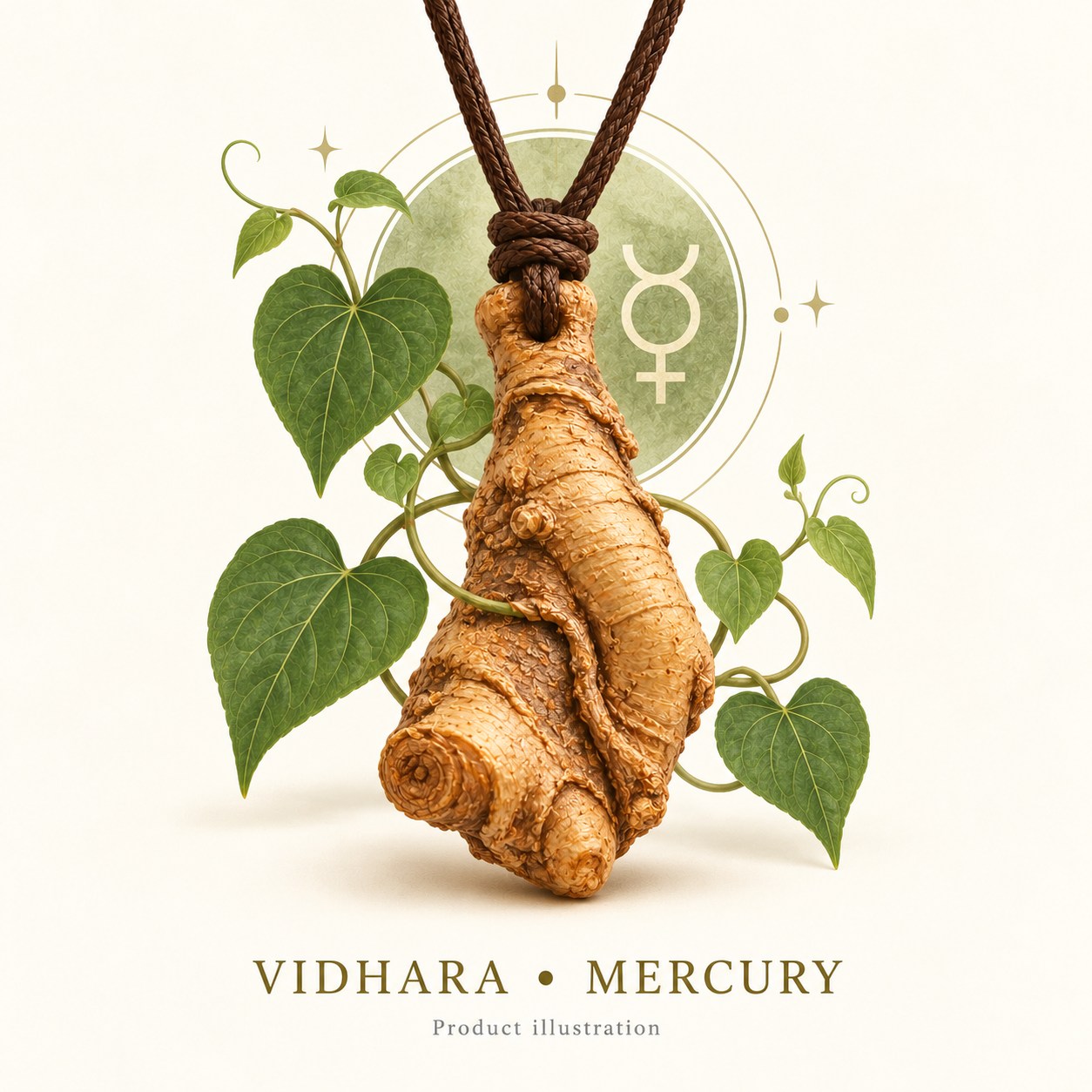
What is Vidhara root? In the botanical and Ayurvedic references relevant to this collection, Vidhara (Vidhaaraa) and Vriddhadaru are names associated with ***Argyreia nervosa* (Burm.f.) Bojer, a woody climbing plant in the morning-glory family **Convolvulaceae. The older scientific name ***Argyreia speciosa* (L.f.) Sweet** is treated as a synonym of Argyreia nervosa by the Royal Botanic Gardens, Kew. The Ayurvedic Pharmacopoeia of India is indexed in Kew's Medicinal Plant Names Services under vidhaaraa and specifically records the dried root as its plant part. That is a strong naming reference, but it does not authenticate every object sold online as a Vidhara root pendant.
For people researching Vidhara plant identification, Vidhara ki jad, Vriddhadaru, Argyreia root, or a Budha (Mercury) herbal pendant, there are three separate questions: Which plant does the name refer to? Which part of the plant is in the product? How was the finished piece sourced and prepared? This guide works through all three. It also places the material within Indian botanical and traditional knowledge, without confusing a plant identification with an individual Jyotish recommendation. The companion Vidhara and Budh Graha article addresses the planetary interpretation, while the Vidhara versus emerald guide compares different categories of Mercury-associated jewellery.
1. Vidhara botanical identity at a glance
A scientific name is more specific than a market label, yet even a correct scientific name must be matched to the actual supplied material. Use this reference table as the starting point for a description, invoice or sourcing conversation.
| Identification field | Reference information | Why it matters for a Vidhara root pendant |
|---|---|---|
| Accepted botanical name | Argyreia nervosa (Burm.f.) Bojer | Establishes the current species name followed by Kew |
| Botanical family | Convolvulaceae, the morning-glory family | Helps distinguish it from plants in unrelated families |
| Scientific synonym | Argyreia speciosa (L.f.) Sweet | Explains older literature and supplier paperwork using another binomial |
| Sanskrit/medicinal name | Vidhara / Vidhaaraa; also Vriddhadaru in medicinal-source records | Names require a source, language and intended species |
| English common name | Elephant creeper; also elephant vine in medicinal-name references | A helpful search label, not a certificate of material identity |
| Plant habit | Woody climber or liana, not simply a conventional tree | Corrects frequent generic descriptions of the plant |
| Native range | Indian subcontinent to Myanmar in Kew's accepted treatment | Useful geographical background, not proof of the harvest location |
| Notable field characteristics | Large heart-shaped leaves, often with a silvery hairy underside; pink-purple funnel-shaped flowers | Useful when the entire living plant can be examined |
| Relevant documented part | Dried root in the Ayurvedic Pharmacopoeia naming record | A pendant marketed as root should identify the part separately |
| Trade-product form | Cut, dried, drilled, capped or enclosed botanical material | Processing can remove visible botanical features |
| Traditional jewellery context | Vidhara is associated with Budha in some planetary-herbal jewellery practice | Identifies the context of use, separate from species verification |
| Main purchasing question | Can the specific finished item be traced back to the identified plant and part? | Prevents a taxonomic reference from being used as unearned proof |
The practical conclusion is that a well-labelled product can state “Vidhara root, declared as Argyreia nervosa” where the supplier's information supports it. If an item has not been identified, its listing should say so rather than treating a copied scientific name as evidence. That distinction is particularly important when the root is sealed beneath a cap or hidden behind decorative thread.
2. Why Argyreia nervosa and Argyreia speciosa appear together
Names can change as botanists compare historical specimens, published descriptions and classification systems. The scientific name has two essential components: the genus and species epithet. In Argyreia nervosa, Argyreia is the genus and nervosa the specific epithet. The author citation (Burm.f.) Bojer refers to the botanical naming history; it is not a brand, a grade or a geographical certification.
Kew currently accepts ***Argyreia nervosa* (Burm.f.) Bojer** and places ***Argyreia speciosa* (L.f.) Sweet** among its synonyms. The second name is not a separate authenticated ingredient merely because an old supplier list displays it alongside the first. Botanical synonymy means a particular taxonomic treatment considers different published names to refer to the same accepted taxon. It does not mean every old description was wrong in its historical context, and it does not mean a retailer has examined its inventory.
When reviewing literature, preserve the name used in the cited publication and explain its present status. For example, a historical materia-medica description might call the plant A. speciosa, while a current database resolves that name to A. nervosa. Both statements can be compatible. The error would be to list them as two supposedly different pendant roots, or to promise that the mere presence of either name proves the supplied object is genuine.
A concise catalogue statement is: “Botanical reference: Argyreia nervosa (syn. Argyreia speciosa); identification and source documentation should be confirmed for the specific stock.” A separate specification must then state whether the piece is root, woody stem, bark or another part. Scientific accuracy is strongest when it is precise without pretending to answer questions it has not measured.
3. Vidhara, Vidhaaraa, Vriddhadaru and other traditional spellings
Traditional plant names travel through Sanskrit, Hindi, other Indian languages, regional pronunciation, trade ledgers and English transliteration. Vidhara, Vidhaaraa, Vriddhadaru, Vridhadaru and related spellings can therefore appear in overlapping discussions. Differences in a written form do not automatically imply a different medicinal ingredient, but neither should every similarly sounding market word be merged without checking the reference.
Kew's Medicinal Plant Names Services records vidhaaraa against Argyreia nervosa using an entry from the Ayurvedic Pharmacopoeia of India, with dried root specified. Its vriddhadaru and vriddhadaraka records connect names appearing in additional Indian medicinal plant sources to the same accepted botanical name, including historical uses of Argyreia speciosa. These records help trace terminology between traditional sources and modern taxonomic databases.
It is important to distinguish an indexed name-to-plant relationship from a conclusion about a specific batch of traded material. A name record documents what a publication intended; it does not inspect a merchant's pendant, establish the harvest date or confirm whether a root was substituted. Ask a supplier which traditional or pharmacopoeial spelling underlies its label, then request the accepted botanical name and the stated part.
Some spellings may also carry different meanings in a different linguistic or medicinal context. For instance, Vidari and Vidarikand often concern tuberous roots such as Pueraria tuberosa, a member of Fabaceae, rather than Argyreia nervosa in Convolvulaceae. The difference cannot be settled by assuming that the two words start with “Vid.” The scientific names and the plant parts should resolve the question.
4. Vidhara versus Vidarikand: a high-priority distinction
A customer searching for “Vidhara root” may encounter Vidari Kand, Vidarikanda, Vidhari Kand, Vriddhadaru or descriptions of an elephant creeper. Search engines can place these words close together even when botanical references point to different taxa. A responsible buying guide must not silently substitute one for another.
| Name found on a label | Common botanical reference in checked medicinal-name sources | Family / material cue | Action before purchasing |
|---|---|---|---|
| Vidhara / Vidhaaraa | Argyreia nervosa | Convolvulaceae; dried root in the relevant pharmacopoeial entry | Confirm the seller's exact species and plant-part declaration |
| Vriddhadaru | Argyreia nervosa in indexed Indian medicinal sources | Woody climber with traditional root references | Ask which source uses this spelling and how material was identified |
| Argyreia speciosa | Synonym of Argyreia nervosa in Kew's current taxonomy | Botanical synonym, not a product grade | Record the accepted name alongside the older label |
| Elephant creeper | Common name used for Argyreia nervosa | Living climber with broad leaves | Do not infer root authenticity from a photograph of foliage |
| Vidarikand / Vidarikanda | Often Pueraria tuberosa | Fabaceae; tuberous material | Treat as a different botanical question, not a variant of Vidhara |
| Vidhari Kand | Indexed in Kew's names service with Pueraria tuberosa | Trade spelling creates collision risk | Require a full botanical and part identification |
| “Original Mercury root” | No botanical species encoded in the phrase | Astrological selling description | Request scientific name, plant part and traceable batch information |
| “Natural brown root” | No unique botanical identity | Many unrelated plants produce brown woody roots | Ask for identification evidence before relying on the label |
Notice that “Vidhaaraa” and “Vidhari Kand” are not safe equivalents just because a seller omits long vowels. The proper approach is to check a named medicinal or botanical reference, not to guess from the spelling. This section is especially relevant to wholesale lists compiled from several regions, because their entries may be translated, shortened or copied between catalogues.
Where the specific trade name remains ambiguous, the best product record states the exact seller declaration and any uncertainty. It is better to have a transparent description with a clear research note than an authoritative-looking label that does not actually establish plant identity.
5. What kind of plant is Argyreia nervosa?
Argyreia nervosa belongs to a family famous for twining and climbing plants. Botanical authorities describe it as a liana, or woody climber, capable of growing through and over surrounding vegetation. Calling it a “Vidhara tree” may be convenient marketplace language, but it can mislead readers into imagining a typical free-standing trunk. The habit matters when trying to connect harvested material to a living plant.
The accepted native range recorded by Kew extends from the Indian subcontinent to Myanmar. Kew also lists introductions beyond that range. Plants may be cultivated or moved, and established populations can exist outside the native region. A statement such as “native to India” is therefore geographical context, not documentation that a pendant's root came from a particular Indian state.
Herbarium records from Karnataka describe the plant as a large climbing shrub with woody stems, young branches bearing pale hairs, large cordate (heart-shaped) leaves and rose-purple funnel-shaped flowers. That regional evidence is useful for a Bengaluru-based audience seeking a recognizable field description. But the characters of the living vine cannot automatically be read from an anonymous dried, polished piece of wood.
A more complete description of the plant also includes its growing environment, reproductive structures and collected specimens. Plants of the same species can vary in size, flowering condition and surface appearance with their age and local conditions. The aim of identification is to assess a combination of diagnostic evidence, not to force every individual plant to match a single perfect stock photograph.
6. Identifying the living plant by leaves and stems
When an intact plant is available, leaf and stem characters provide useful early clues. The leaves of A. nervosa are often large, broadly heart-shaped and arranged alternately along the climbing stem. Their upper surfaces tend to look comparatively green and smoother, while their lower surfaces can be conspicuously silvery or pale with dense fine hairs. Young shoots may also have a pale hairy appearance.
The word tomentose in botanical descriptions means densely covered with short, matted hairs. Learning that term makes field references easier to read, but the term alone is not a definitive species test: other climbing plants can also have hairy leaves. Inspect several mature and young leaves, the vine's growth habit and the relationship of leaves to stems, rather than selecting one isolated photograph that happens to resemble the sample.
The Karnataka flora record notes that older portions become woody. A brown mature segment may look very different from a pale young shoot. If a supplier offers photographs of its source plant, request a whole-plant view and close-ups of the top and underside of leaves. Ask whether the photos show the same identified source population from which the supplied material was harvested, rather than an example image downloaded from a botanical website.
During field observation, avoid cutting or uprooting a plant merely to settle an online product question. Where formal identification is required, use a trained botanist or an established herbarium workflow. A good botanical identification should be reproducible: another qualified observer should be able to understand which characters and reference specimens led to the name.
7. Flowers, fruit and seeds add another line of evidence
Descriptions of Argyreia nervosa frequently mention funnel-shaped flowers in pink to purple hues, often with a more deeply coloured centre. Flower arrangement, the sepals surrounding the flower and the mature fruit are all part of botanical identification. Regional flora records note fruiting structures with persistent, enlarged sepals; this gives the mature reproductive material a characteristic appearance that can be compared with authoritative specimens.
| Visible plant feature | What a field photograph can establish | What it cannot establish alone |
|---|---|---|
| Large heart-shaped leaves | Broad resemblance to Argyreia descriptions | Certain identity of a mature root segment |
| Silvery hairy leaf underside | A distinctive supporting vegetative character | A species name without examining other characters |
| Young pale hairy stems | Habit and surface features of a living vine | Which botanical part was sold after processing |
| Pink or purple funnel flowers | Floral form and colour useful in a field key | A seller's harvest location or product origin |
| Persistent enlarged fruiting sepals | Reproductive features useful for comparison | Authenticity of a separate commercial pendant |
| A voucher specimen with collection data | A documented specimen that can be re-examined | Automatic identity of every later shipment |
| A root on the same witnessed plant | Better connection between vine and underground organ | Whether the finished pendant came from that plant |
A photograph showing both the living vine and the actual dried batch is more meaningful than unrelated photographs, but still depends on reliable records linking them. Botanical field identification and commercial traceability solve different parts of the same problem.
Be especially careful with seed information encountered online. The plant's seeds have attracted attention in non-jewellery contexts, but a dried-root pendant is not a seed preparation. Instructions associated with other plant parts, including ingestion or extraction, are not wearing or cleaning instructions. This article concerns identification and responsible use of a finished accessory.
8. What a true root is—and why appearance alone is insufficient
The root is an underground plant organ distinct from stem, bark, leaf and seed. In a growing plant, roots provide anchorage and participate in water and mineral uptake. A woody vine may have roots that become tough, irregular and textured as it grows. However, ordinary brown colour, a grain pattern or a knotted outline cannot establish which species a cut fragment came from.
A product marketed as “Vidhara root” should ideally be traceable to material identified before cutting and finishing. After drying, grinding, sanding, coating and assembly, features that differentiate root from stem can become less visible. Even a genuine botanical fragment may lack obvious diagnostic structures to an untrained viewer. The appropriate response is not to claim an easy visual test; it is to ask for the preparation and batch records that predate the finished jewellery.
A root slice, whole root section, root-bark fragment and woody stem may look superficially similar in jewellery photographs. They have different anatomical origins. An invoice saying “Argyreia” without the organ being specified does not answer the question. Nor does a ritual instruction calling for “jad” establish what a particular sealed product physically contains.
The material question can be approached in stages: identify the living plant or trusted reference stock; document the harvesting plant part; record drying and processing; keep batches labelled; then link finished units to the batch. No single stage should be replaced by the assumption that a fashionable or expensive pendant must be genuine.
9. Root versus stem versus seed: a practical comparison
| Material or organ | Its role in the plant | Common challenge in processed goods | Suitable evidence |
|---|---|---|---|
| Root | Below-ground anchorage and absorption | Can resemble other dry woody tissues | Source-part photography, botanical records, batch notes |
| Stem | Support and transport between organs | Woody stem segments may resemble root pieces | Whole-plant context and labelled harvest documentation |
| Bark | Outer protective tissues | Detached bark is difficult to identify confidently by colour | Parent-organ identification and processing trace |
| Seed | Reproduction | Identity and chemical profile differ from other parts | Separate labelled botanical and seed records |
| Tubers | Storage organs in some species | “Kand” names may be confused with non-tuberous roots | Species-specific reference and actual organ specification |
| Powder or chips | Processed commercial form, not one plant organ | Original structural characters may have been lost | Traceable sealed batch and reputable specialist analysis |
| Fully enclosed jewellery | Finished retail object | Material may be hidden behind a cap or enclosure | Batch-to-item record and accurate listing photographs |
A root pendant is not necessarily better or worse because it has an unusual colour or prominent knot. For wearability, a securely mounted, dry, accurately described fragment matters more than an artificial expectation of identical size, shape or texture across different natural pieces.
10. How herbarium records strengthen an identification
A herbarium is a scientific collection of preserved plant specimens, usually accompanied by collection details and an identification. A good voucher record may include a specimen number, locality, date, collector, description, and diagnostic features. A researcher can revisit that specimen and compare it with later botanical treatments. For trade identification, this is a much stronger practice than relying on the heading of a generic image search result.
The JCB Herbarium / Flora of Karnataka records Argyreia nervosa with botanical characters including its climbing habit, heart-shaped leaves and rose-purple flowers. That makes it a useful field reference for India. Kew's Plants of the World Online provides the accepted name, nomenclatural synonymy and distribution. Kew's Medicinal Plant Names Services connects names appearing in medicinal works, including the Ayurvedic Pharmacopoeia, with current taxa.
These sources answer different questions. A flora can help identify the plant in the field; a taxonomic backbone can settle which scientific name is accepted; a medicinal-name record can explain what an old or regional label meant. Combining the three is appropriate. None can inspect an individual piece of jewellery unless the item's source has been connected to authenticated material through a separate chain of evidence.
A supplier who says “our root comes from this species” should be able to explain its basis. If botanical authentication was carried out by a qualified specialist, ask for the method, material examined, specimen reference, date and scope. An identification of one reference plant is not proof that every future batch purchased from a different wholesaler is identical.
11. Read scientific and traditional references together, not interchangeably
Traditional Indian plant literature and modern botanical taxonomy organise information for different purposes. An Ayurvedic name may appear in a preparation, a Sanskrit synonym list or a regional materia-medica discussion. Modern taxonomy asks which plant species a name represents in a particular classification. Product authentication asks whether a retailer's actual goods correspond to its stated identity. All are worthwhile, but each uses different evidence.
A reference that records **Vidhaaraa as the dried root of Argyreia nervosa*** is valuable because it identifies a name, a species and a plant part. If a modern pendant uses that terminology, its product record should reflect all three components. An old reference using *Argyreia speciosa may still be relevant under Kew's synonymy. What does not follow is that every historical text discussing this plant automatically instructs people to wear the root for Mercury.
Ayurvedic materia medica describes plants in medical or pharmaceutical contexts, while Jyotish and Navagraha observances concern traditional astrology and spiritual interpretation. The root's possible history as a medicinal raw material should not be transformed into a promise that wearing a dried pendant has the same action as a prescribed preparation. Likewise, a retail Mercury association should be attributed to the relevant customary practice, not used as evidence of the botanical identity.
This distinction allows an article to retain authentic traditional vocabulary—such as dravya, moola, jad, Vriddhadaru, Budha, graha and sankalpa—without forcing every term into a commercial claim. Readers can appreciate the history and meaning of plant-based jewellery while still asking ordinary questions about provenance, condition and construction.
Vidhara and Vriddhadaru in the Nighantu tradition
A Nighantu is an Indian lexicon concerned with names and characteristics of medicinal substances, especially plants and their material forms. Modern Ayurvedic scholarship discussing Vriddhadaru reports the name in lexicons such as Dhanvantari Nighantu, Shodhala Nighantu, Madanapala Nighantu, Raja Nighantu, Nighantu Adarsha and Priya Nighantu. Those references are part of the documented history of the plant's names. A modern review may summarise their usage, but it is not the same thing as checking a precise Sanskrit verse in the edition actually being cited. This article therefore names that textual tradition without inventing a quotation or claiming every text assigns identical qualities.
Traditional Dravyaguna language often classifies medicinal plant material using rasa (taste category), guna (qualities), virya (potency or heating/cooling classification) and vipaka (post-digestive effect). For example, some Vriddhadaru teaching material characterises the material through katu, tikta and kashaya rasa, snigdha guna, ushna virya and madhura vipaka. Those are Ayurvedic pharmacological descriptors in their own system, not measurable properties transferred to a finished necklace. The preparation, plant part and textual source must be understood before discussing medicinal application. The fact that these classifications exist is historically significant even for a reader buying an ornament rather than a formulation.
The regional names also deserve space. Flora records for Argyreia nervosa include Samandar-ka-pat / Samandar-sok in Hindi, Chandrapada in Kannada, Samutrappachai in Tamil, Samudra pala / Chandra pala in Telugu, Bastantri in Sanskrit, and Maruthudari / Samudrappacha in Malayalam. These are useful research leads for locating local descriptions and herbarium records. They should be presented as names reported by those sources—not as proof that every local market uses each word consistently. In a Kannada-speaking shop or nursery, for example, the name Chandrapada may help a knowledgeable observer locate a plant reference while a full identification still requires botanical characters.
A further nuance in Ayurvedic research is that Vriddhadaru has been described as an identity-sensitive or disputed trade drug in some literature, with substitute or confused plants discussed by authors. This makes modern taxonomic clarification especially useful. A seller can honour the name's history while avoiding unsupported certainty about bulk material from an unknown supplier.
12. Is Vidhara traditionally associated with Budha (Mercury)?
In the planetary herbal jewellery context represented here, Vidhara root is offered as an item associated with Budha (Mercury). Budha is traditionally connected in Jyotish with intellect, analysis, communication, language, trade and discrimination. Wednesday (Budhavara) and green colours also commonly appear in Budha observances. These are meaningful parts of devotional and astrological vocabulary, not botanical characteristics of the plant.
Different teachers and families may have different lists of plant associations and observances. If a source explicitly recommends a root, ask which tradition, commentary or practitioner method underlies the recommendation. The fact that a pharmacopoeia identifies Vidhara as a medicinal plant does not by itself establish a universal astrological rule. This page documents the plant and its names; for the deeper discussion of rashis, nakshatras, Budha mantra, worship and chart interpretation, use the dedicated Vidhara–Budha guide.
The same separation is useful for buyers comparing a root pendant with Panna (emerald). One is an organic plant-derived object; the other is a mineral gemstone with its own identification, treatment and durability questions. Their shared position in some Mercury-oriented catalogues does not make their composition or purchasing tests interchangeable. Our Vidhara versus emerald article handles that decision separately.
13. A step-by-step botanical verification process
A practical verification workflow does not require every customer to become a botanist. It requires the seller to document what can be documented and to state honestly when evidence is missing. For Vidhara root accessories, the process can be organised as follows.
- Record the trade label as received. Keep the supplier's exact spelling, language and invoice description rather than silently rewriting it.
- Ask for the proposed scientific identification. Record Argyreia nervosa where substantiated, and note A. speciosa as an older synonym rather than a second species.
- Confirm the plant part. The record should distinguish dried root from stem, bark, seed or other material.
- Capture source evidence before processing. Whole-plant photographs, a collection reference or a reputable supplier's batch documentation are more useful then photographs of a polished pendant alone.
- Check the name with authoritative references. Consult Kew's current botanical treatment and the relevant medicinal-name source; resolve Vidarikand/Pueraria confusion.
- Keep batch identifiers consistent. The dried input material, cut pieces and completed units should be linked to one identifiable batch.
- Record treatments and assembly. Note washing, drying, colouring, coating, glue, drilling, metal caps and other procedures.
- Document the final item. Photograph the actual form, provide dimensions, explain fitting and include care information.
- Review differences between batches. A new supplier, part, dye or product construction warrants a fresh check rather than copying the previous certification wording.
- Retain an uncertainty note. Where confirmation is incomplete, describe only the identity and origin that the evidence supports.
| Verification question | Useful evidence | Weak or incomplete evidence | Preferred listing action |
|---|---|---|---|
| Is the accepted species identified? | Named botanical determination matched to a source batch | A species name pasted from a website | State identification basis or qualify the claim |
| Is the piece really root? | Harvest/processing notes and part documentation | Brown appearance or seller assurance alone | Describe the plant part only at its verified level |
| Is the batch traceable? | Label, invoice, harvest/assembly sequence | Loose unlabelled mixed stock | Request records before claiming authenticated origin |
| Does an old synonym appear? | Kew-checked name relationship | Treating synonym as a premium alternative | Give accepted name plus synonym |
| Is there a treatment or coating? | Declared process or materials list | Photograph too small to judge | Disclose known finish and handle uncertainty |
| Is the finished item accurately described? | Actual photo, dimensions, fitting and condition | Generic image with no specification | Supply practical retail details |
| Are devotional statements attributed? | Named teaching or clearly labelled customary context | Universal or compulsory claim without source | Keep interpretation separate from material facts |
These are reasonable standards for any unusual botanical jewellery. They do not require the shop to publish confidential supplier contracts; a customer-facing description can still communicate the declared species, plant part, evidence status, appearance and care clearly.
14. What to photograph before cutting and mounting a root
The highest-value evidence is often lost at the exact moment a botanical component is transformed into a pendant. When a source plant can be documented appropriately, retain a whole-vine view, leaf upper and lower surfaces, young stem, flower or fruit where present, and the relationship of the selected root to the plant. A scale reference is useful, as is a date and an unambiguous batch or specimen reference.
The later material-handling sequence should ideally show the root or root section before sanding, individual pieces after cutting, and the completed accessory. Photograph identifying details with neutral lighting; avoid filters that exaggerate colour or hide cracks. A picture of a thick woody section with no plant context is still useful for condition, but not strong botanical proof. Keep this distinction in captions and archive notes.
Where the plant is identified through an existing authenticated supplier, ask for the relevant supplier documentation rather than recreating a field examination from decorative photographs. It is better to have a reliable batch document with no romantic harvest story than a beautiful story that cannot be connected to the goods being sold.
For online retail, give customers two kinds of pictures: source or material documentation, when verified, and clear photographs of the actual product type. The former helps explain identity; the latter helps decide what will arrive in the parcel. Neither should be substituted for the other.
15. Supply chain: from living vine to finished pendant
A root pendant passes through more hands than a casual product description may suggest. Material can be gathered, sold to a wholesaler, sorted, cut into small fragments, dried again, polished, glued into a cap, packed and shipped. Each transfer can introduce an identification or labelling error. A product that begins with good botanical documentation may lose that link if batches are mixed; conversely, a finished piece with a modest appearance may have excellent records.
Maintain a simple batch-to-item trail: supplier and date received; declared botanical name; plant part; quantity; drying/inspection status; batch identifier; processing notes; quantity converted into finished pieces; and photos or sample references. If more than one supplier or plant is used, do not merge them under the same record merely because both invoices say “Vidhara.”
A buyer can ask for an explanation in ordinary language: “Is this declared as Argyreia nervosa root? Is that declaration linked to the material in this pendant? Are there any dyes, coatings or adhesives?” This conversation is more useful than a vague request for a “100% original” claim. The seller's response should identify what is known and what remains a supplier declaration.
It is also worth recording harvest and transport compliance where applicable. Collection permissions, land access, conservation obligations and import or interstate movement requirements can vary by source and circumstances. A valid sale does not become automatically ethical merely because the finished item is small. Responsible sourcing protects both long-term material availability and customer confidence.
16. Can a customer authenticate Vidhara root by looking at it?
A customer can inspect condition and manufacturing quality at home: whether the surface is dry and intact, the cap is secure, the cord is sound and the product matches its listing. But that is different from scientific species identification. Brown colouring, rough grain, knots, lightness, or a seller's claim that the root “floats” or “sinks” cannot reliably distinguish Argyreia nervosa from other woody plant parts.
Home procedures involving burning, scraping, chewing, solvent soaking or acid tests are also unsuitable. They damage the object and can create unnecessary exposure without giving a reliable botanical answer. A seller should not encourage customers to destroy the product to compensate for absent provenance. If a serious identity question arises, preserve the item and documents, and seek qualified botanical or laboratory assistance appropriate to the material and available reference samples.
The best buyer-level authentication is therefore documentary and comparative: compare the claimed species with credible references, inspect the actual product description and photos, and ask the seller whether the plant part and batch have been verified. No single photograph substitutes for the record, and no generic scientific certificate guarantees a different future shipment.
17. Processing: drying, cutting and preserving organic material
Organic jewellery needs processing that protects it from moisture, physical damage and unsuitable finishes. Before assembly, plant material should be prepared according to the supplier's appropriate method and inspected for visible deterioration. Poorly dried sections can change shape, shrink within fittings or develop unwanted odours; aggressively dried or brittle sections may split at the point of drilling. These are manufacturing risks, not indicators of planetary efficacy.
A finished Vidhara item may be left uncoated, polished, sealed with a declared finish or enclosed behind a protective housing. None of these options is inherently the universally correct spiritual form. Each has practical trade-offs. An uncoated surface leaves the original texture visible but can be more sensitive to moisture; a coating changes the handling characteristics and should be disclosed if known; an enclosure may protect the root but can hide material features.
Drilled holes, adhesive joints and metal caps deserve careful inspection because small organic pieces may crack under repeated strain. A robust pendant should not depend on the wearer pulling the root directly. Before selling, check whether the cap, bail, knot or chain can withstand normal non-abusive movement. Repairs should not be improvised with unknown household chemicals or open flame.
A buyer should know which instructions apply to the root, which apply to the metal parts and which apply to the cord or chain. Advice appropriate for one component may damage another. For example, immersion routines sometimes discussed for metal or stone ornaments should not automatically be applied to an organic root fitting.
18. Natural variation is not the same as misidentification
Natural botanical pieces will rarely have identical shape, colour or surface texture. A small irregular root section may show pale areas, darker streaks, fibre directions or asymmetry. These features can be part of normal organic variation, but they can also be affected by cleaning, storage or coating. One should not treat every variation as evidence of rare spiritual strength or every uneven surface as evidence of a fake.
| Observation on a finished item | Possible practical explanation | What to check next |
|---|---|---|
| Different brown shades among pieces | Natural variation, lighting, finish or treatment | Neutral-light photos and coating disclosure |
| Uneven silhouette or fibres | Cutting across irregular organic tissue | Loose splinters, sharp points and fit |
| Small surface lines | Grain, drying marks or emerging cracks | Whether the line opens or weakens the fitting |
| Glossy outer layer | Polish, resin, lacquer or another finish | What finish was used and whether it affects care |
| Root largely hidden by metal | Design choice, enclosure or protective cap | Batch evidence and assembly description |
| Visible residue at a join | Adhesive or surface preparation | Clean finish, material information and secure bond |
| Musty smell or fuzzy growth | Possible moisture or storage deterioration | Stop wearing; seek seller assessment |
| Loose cap or frayed thread | Wear, assembly defect or impact | Repair or replacement before further use |
Buying natural material should mean accepting reasonable variation within an accurately specified product, not accepting an absence of information. The seller can state that the photographed sample is illustrative while still providing a representative size range and showing the same type of mounting that will be supplied.
19. Materials and construction: choosing a wearable object
For a Vidhara pendant, the retail specification should include root-section dimensions, total pendant size, approximate weight, metal-cap material, colour or finish of the cord, clasp or knot design, and any declared treatment. A root pendant is not adequately described by a scientific name and a planet alone. Ask whether the pendant comes ready to wear and whether the chain or thread shown in the image is included.
Wearability depends on the full assembly, especially where it touches the skin. Some people prefer to wear a pendant over clothing or inside a protective holder, particularly when the surface is rough or the metal composition is uncertain. Nothing about botanical identity requires a consumer to tolerate discomfort. Children and people undertaking activities where jewellery may catch should use additional caution with cords and detachable components.
Check the item's practical proportions. A tiny root fragment in a bulky cap can feel different from a longer slender pendant; a heavy chain can make a delicate piece hang awkwardly. Confirm the actual measurements rather than relying on a heavily enlarged photograph. A simple well-finished piece may be more practical than an ornate design that hides weak attachment points.
The shop's Vidhara Root Pendant for Mercury page is where up-to-date stock, fitting, construction and any current options should be described. This guide supplies the botanical context and buyer questions; it does not assert that every current or future product uses one identical assembly.
20. Keeping the root dry: everyday wear and storage
A finished organic pendant generally benefits from a gentle, low-moisture care routine suited to the disclosed finish. Avoid prolonged immersion, steam, harsh detergents, perfumes, oils and direct heat unless the maker has explicitly documented a compatible treatment. Bathing, swimming and strenuous work can combine moisture, abrasion and repeated pulling, so removing the piece beforehand is sensible.
For routine dusting, use a soft, dry cloth and light pressure. Do not try to scrape away natural fibres or polish an unknown coating with abrasive powder. Store the pendant separately from harder gemstones and metal objects that may scratch, crush or snag it. A clean dry pouch or compartment is often more suitable than a damp bathroom shelf or direct sunlight on a window ledge.
| Situation | Practical response | What to avoid |
|---|---|---|
| Light surface dust | Gently wipe with a soft, dry cloth | Aggressive rubbing or wet scrubbing |
| Moisture exposure | Remove, blot exterior and follow maker's instructions | Heat gun, prolonged sun or soaking |
| Perfume and skin products | Allow products to dry before wearing, or wear over fabric | Spraying directly onto root and fittings |
| Cord or cap feels loose | Stop wearing and contact the seller about repair | Pulling, drilling or random household glue |
| Visible splinter or sharp edge | Set aside and request inspection | Scraping or breaking fibres by hand |
| Persistent odour or suspected mould | Isolate from other jewellery and seek assessment | Covering the issue with fragrance or oil |
| Travel or shipping | Use dry individual wrapping and cushioning | Tight pressure beside heavy sharp items |
| Long-term storage | Keep labelled in a dry separate compartment | Humidity, direct heat and unventilated damp packing |
A devotional practice sometimes involves incense, water, sandalwood, flowers or other offerings. These can be directed to the puja setting rather than poured over a fragile root ornament. If a family custom specifies contact with a substance, consider whether the particular assembly can tolerate it and ask the maker first.
21. Cultural background: how botanical objects gain meaning
Indian religious and cultural life includes many plant-derived objects: seeds made into malas, sacred woods, flower garlands, leaves used in worship, roots mentioned in inherited practices and botanical symbols associated with particular deities or grahas. Their meanings can come from different layers of tradition—ritual, folklore, local custom, Sanskrit terminology, pilgrimage, family instruction and modern commercial practice.
A Vidhara pendant may be selected by a person who values Budha symbolism, appreciates natural jewellery or follows a practitioner's specific recommendation. These reasons are not identical. A family may attach meaning to the moment an accessory is first worn; another person may use it as a reminder of measured speech and thoughtful learning. Neither preference verifies the root, and material verification alone does not document the full history of the custom.
The strongest cultural explanation names its context and scope. A product page can say that a Vidhara–Budha association is part of the collection's traditional planetary-herbal framing. It should not imply that Kew's plant taxonomy endorses a mantra or that one modern shop's practice is compulsory for all schools of Jyotish.
For readers who wish to explore such associations alongside their other devotional items, the Planetary Herbal Jewellery collection and the Rudraksha for Planets collection provide different material categories. The appropriate choice depends on spiritual preference and the actual goods—not on the assumption that everything bearing a planet's name is physically equivalent.
22. Traditional Ayurvedic names versus medicinal preparation
The Ayurvedic Pharmacopoeia name record is an excellent example of the boundary between identifying a dried root and using that root as a medicine. The former can inform a jewellery article's nomenclature; the latter requires separate information about quality standards, formulation, route, dosage and professional practice. A pendant has no established medicinal dose by virtue of being worn.
The phrase “traditionally used” is most informative when it identifies a source or category. Was a name used in a botanical glossary, a materia-medica description, a local marketplace or a ritual recommendation? Each tells the reader something different. Avoid turning a reference to medicinal plant material into a blanket claim about healing, lifespan, memory or a specific condition. A consumer looking for such information should consult guidance about the actual medicinal preparation, not a jewellery listing.
Likewise, one plant may have very different parts discussed in different historical or contemporary contexts. Claims about a seed, leaf or extract cannot be transferred to dried root jewellery by changing only the word “use.” For a pendant, the relevant practical topics are the authenticity of the root, quality of the assembly and appropriate handling.
Traditional knowledge deserves precise description. A carefully attributed botanical and cultural article is more respectful of that knowledge than one that repeats unsourced miracle claims, invents quotations or treats every material mentioned in a sacred context as interchangeable.
23. Names, claims and evidence: a realistic reading guide
When browsing online, distinguish four types of statement:
- Taxonomic statement: “Argyreia nervosa is the accepted botanical name.” This is checked against a botanical authority.
- Nomenclature statement: “Vidhaaraa appears as a name for the dried root of A. nervosa in a medicinal-source index.” This is checked against the source and index.
- Supply statement: “This pendant contains that root from a named batch.” This requires item or batch evidence; a database cannot establish it.
- Traditional interpretation: “This root is associated with Budha in our planetary-herbal collection.” This describes a customary spiritual framework and should be attributed as such.
| Statement in an online listing | What would substantiate it? | Common misunderstanding |
|---|---|---|
| “Accepted species: Argyreia nervosa” | Reputable taxonomy such as Kew | Thinking the name proves the retailer's stock |
| “Argyreia speciosa is the botanical name” | Explanation of accepted synonymy | Treating older synonym as a different rare species |
| “Vidhaaraa is an Ayurvedic name” | Named medicinal-source record | Assuming all similar spellings identify that plant |
| “This is genuine dried root” | Source and part authentication linked to the batch | Trusting brown colour as a species test |
| “Harvested in a particular region” | Credible provenance record | Mistaking native range for a harvest certificate |
| “Mercury-associated accessory” | Clearly attributed tradition or catalogue practice | Treating planetary symbolism as a laboratory measurement |
| “Ready-to-wear pendant” | Actual assembly, size and fitting details | Assuming the photograph includes the displayed chain |
These distinctions improve SEO as well as accuracy because they answer the questions that lead readers to a search result. Someone searching “Vidhara or Vidari,” “Argyreia speciosa synonym,” “Vidhara root identification,” “Vriddhadaru plant,” or “genuine Vidhara pendant” needs an answer specific to that query, not an identical sales paragraph for every phrase.
24. An inspection checklist for buyers
Before purchasing, save the answers to a short list of questions. They can be answered by photographs and a product description rather than an elaborate certificate for every inexpensive ornament.
- What exact botanical name does the seller declare, and is it supported by a traceable source?
- Is the item specifically a dried root, or has another plant part been used?
- If Argyreia speciosa appears on the label, is the modern synonym relationship explained?
- Is there confusion with Vidari / Vidarikand or another similarly named plant?
- Are photographs of the actual product type, dimensions and fittings available?
- Is any coating, dye, resin, adhesive, metal or cord material declared?
- Are there visible cracks, loose fragments, unstable caps or signs of moisture damage?
- Does the seller explain what its authentication evidence actually covers?
- Are the traditional associations described as traditions rather than material properties?
- Are care, shipping, repair and return instructions suitable for organic jewellery?
A good purchase decision may end in buying the pendant, choosing another accessory or simply learning the plant history. The aim is clarity, not pressure. A person interested in Budha-themed products can also compare practical differences with mineral jewellery through our Vidhara and emerald comparison.
25. For sellers: what an accurate product listing should contain
A useful listing begins with a customer-readable title and an honest species declaration. Suggested fields include: marketed name; accepted botanical name; older synonym where relevant; specific plant part; source or batch evidence status; a clear description of the form; current dimensions; cap, thread and chain specification; disclosures of finishes; and handling instructions. It can then describe the traditional planetary association in a separate paragraph.
A concise example of careful wording is: “Vidhara root pendant. Botanical reference: Argyreia nervosa (syn. Argyreia speciosa). The offered piece is described as dried root; ask for the current batch's identification and construction details. In this collection Vidhara is traditionally associated with Budha (Mercury).” Do not call an item laboratory-authenticated or traceable unless that level of evidence has actually been obtained.
Metadata should accurately summarise the page. Suitable search topics include Vidhara root identification, Argyreia nervosa, Vriddhadaru, elephant creeper, Vidhara versus Vidarikand, botanical synonym, dried root and herbal pendant care. Repeatedly stuffing the same list into every paragraph damages clarity. Give descriptive alt text to the existing product illustration without implying that an illustration proves the specimen's identity.
Finally, retain the original image and established internal navigation so readers can move between the botanical article, the traditional symbolism guide, the gemstone comparison and the relevant collection. Keeping those relationships intact serves visitors better than creating a new disconnected page every time a term changes.
26. Three buying scenarios and what they teach
Scenario A: the invoice says Argyreia speciosa. A retailer sees an older binomial and worries that it differs from Argyreia nervosa. The correct first step is to check the accepted synonymy. If the supplier's specimen was competently identified, the older name may simply be a historical spelling of the taxon in the source. Still verify that the actual stock is linked to that determination; synonymy alone does not authenticate it.
Scenario B: a packet says “Vidari Kand Mercury Root.” This label contains a possible naming collision. Kew's medicinal-name index documents Vidarikand as a name associated with Pueraria tuberosa, while Vidhaaraa is indexed for Argyreia nervosa. The buyer should not accept the combined phrase as sufficient identification. Ask for the botanical name and plant part, and avoid relabelling one species as another to match a search keyword.
Scenario C: the pendant looks beautiful but its source is unknown. Attractive colour, neat mounting and a persuasive ritual description do not prove what is inside the cap. The practical options are to request a verifiable source declaration, buy it only as an openly described decorative object if suitable, or choose stock with clearer documentation. A transparent uncertainty note is useful information, not a flaw to conceal.
These examples show why precise terminology matters. A credible article about Vidhara root should help customers recognise nomenclatural uncertainty, understand its resolution and apply sensible checks before a transaction.
27. Glossary of useful Vidhara identification terms
| Term | Meaning for this topic |
|---|---|
| Botanical name | Formal scientific name of a plant taxon |
| Accepted name | Name adopted in a particular current taxonomic treatment |
| Synonym | Another published scientific name placed under the accepted taxon in that treatment |
| Vernacular name | Name used in a particular language, region or customary setting |
| Vidhaaraa / Vidhara | Traditional name indexed with Argyreia nervosa in the checked medicinal source |
| Vriddhadaru | Traditional name recorded with Argyreia nervosa in medicinal-name references |
| Vidarikand | Name commonly associated with Pueraria tuberosa in checked sources |
| Convolvulaceae | Morning-glory family containing Argyreia |
| Liana | Woody climbing plant |
| Cordate | Heart-shaped, especially used of leaves |
| Tomentose | Covered in short, matted hairs |
| Herbarium voucher | Preserved specimen with identification and collection records |
| Provenance | Documentary information about where material came from |
| Batch traceability | Connection between received material, processing and finished products |
| Moola / jad | Root terminology; physical plant part still needs verification |
| Budha / Mercury | A graha in traditional Jyotish, distinct from botanical identity |
28. Frequently asked questions about Vidhara root
1. What is the scientific name of Vidhara root?
In the checked botanical and medicinal-name references, Vidhara or Vidhaaraa is associated with ***Argyreia nervosa* (Burm.f.) Bojer**. That identifies the reference plant, not automatically the material inside every commercially sold pendant. Ask for evidence connecting the product batch to the declared species.
2. Is Argyreia speciosa the same as Argyreia nervosa?
Under the current treatment used by Kew Plants of the World Online, Argyreia speciosa* (L.f.) Sweet** is a synonym of accepted ***Argyreia nervosa. An old botanical document can therefore use A. speciosa while referring to the same taxon. The synonym itself is not evidence that a pendant is authentic.
3. What is Vriddhadaru?
Vriddhadaru is a traditional medicinal plant name recorded in references that Kew's medicinal-name service links to Argyreia nervosa. Spellings vary in different source traditions. A seller should identify which species and plant part its specific product uses instead of relying on the name alone.
4. Does Vidhara come from a tree?
Botanical sources describe Argyreia nervosa as a woody climbing plant or liana. Calling it a tree in casual sales language can obscure its actual growth form. It develops woody structures, but its climbing habit is relevant to correct identification.
5. How can I identify the living Vidhara plant?
Look at a combination of plant characters: climbing woody habit, large heart-shaped leaves, pale hairy undersides, hairy young stems and pink-purple funnel-like flowers. Use a flora or expert determination rather than matching only one photograph. A living plant's identity still has to be linked separately to a finished root accessory.
6. Is elephant creeper another name for Vidhara?
Elephant creeper is a common English name used for Argyreia nervosa in botanical and medicinal-name references. Common names are useful to search for information, but they vary by locality and do not authenticate a cut piece of organic material.
7. Is Vidhara the same as Vidarikand?
No equivalence should be assumed. Kew's index connects Vidhaaraa to Argyreia nervosa and Vidarikand commonly to Pueraria tuberosa, a plant in a different family. Ask for the exact binomial and plant part if the terms are mixed on a label.
8. What does the Ayurvedic name record establish?
Kew's medicinal-name index links vidhaaraa in the Ayurvedic Pharmacopoeia of India to Argyreia nervosa and identifies dried root as the relevant raw plant part. It does not certify a pendant sold by an unrelated seller or provide wearing instructions for that product.
9. Does root colour prove it is genuine Vidhara?
No. Many roots and woody stems can be brown, pale, streaked or uneven after drying. Colour also changes under photographic lighting or with finishes. Botanical identity needs traceability to authenticated material or appropriate specialist examination, not a visual guess from a product photograph.
10. How do I distinguish Vidhara root from a woody stem?
A finished sanded section can lose diagnostic features. Ask for evidence from the plant and harvest stage, showing that the material was genuinely taken from the root. A generic claim or a brown surface is not a reliable anatomical test.
11. Can I test a pendant by burning or tasting it?
No such destructive home test is recommended. Burning, scraping, tasting or soaking a finished pendant is not a dependable species-identification method and may damage finishes or create exposure. Request documentation or use qualified botanical assessment when necessary.
12. Can a scientific plant database certify my pendant?
A database provides information about names, descriptions and distribution. It does not see the item in your possession. Product authentication requires an additional connection between the actual material, a reliable identification and the finished stock.
13. Why do some older books use a different scientific name?
Scientific classification develops over time. Authors may have published the same plant under a name now treated as a synonym. Record the historical name as it appears in the source and note the currently accepted taxon according to the reference being used.
14. Is Vidhara native to India?
Kew records the native range of Argyreia nervosa from the Indian subcontinent to Myanmar. The taxon also occurs elsewhere through introduction. Its general distribution does not prove where any particular harvested root came from.
15. What pictures should a supplier provide?
The most helpful collection includes representative whole-plant and diagnostic photographs when available, a labelled raw-material image, and clear photographs of the completed pendant. The seller should distinguish actual-batch documentation from illustrative botanical images.
16. Does a certificate of a living plant cover all later root batches?
Not automatically. An identification may apply to a particular source plant or batch. If new inventory comes from another supplier or location, the connection needs review. Ask what was tested, who identified it and how that determination relates to the item offered.
17. Are roots of the same species always identical in appearance?
No. Natural size, fibre pattern, colour, age, drying and finishing can vary. That does not remove the seller's responsibility to identify the species and part accurately. Normal variation and lack of botanical verification are different issues.
18. Should the pendant be coated or left natural?
The choice depends on the design and disclosed materials. An uncoated root shows more original texture, while a coating or enclosure may alter handling and appearance. Ask what is used and follow care instructions appropriate to the complete assembly.
19. Can I wash Vidhara root jewellery in water?
Do not assume a dried root pendant is suitable for soaking or water-based ritual cleansing. Organic material and glued or capped fittings can be affected by moisture. Start with gentle dry cleaning and follow the maker's specific guidance for that product.
20. What if the pendant develops a musty smell or visible fuzz?
Stop wearing it and store it separately while seeking seller assessment. Persistent odour or suspicious growth may indicate moisture-related deterioration. Do not mask the issue with perfume, oils or household chemical treatments.
21. Is Vidhara associated with Budha or Mercury?
In this planetary herbal jewellery tradition, Vidhara is associated with Budha (Mercury). That is a traditional interpretive link, not a property established by botanical taxonomy. Read the Vidhara and Mercury symbolism guide for the fuller Jyotish explanation.
22. Can a Vidhara pendant substitute for Panna or emerald?
The materials are not physically interchangeable: Vidhara is botanical jewellery, while emerald is a mineral gemstone. Different traditions may compare them under the Mercury theme, but their identification, treatment, price and maintenance are distinct. See the Vidhara versus emerald guide.
23. Does a root pendant have the same effect as an Ayurvedic formulation?
A finished pendant is not an oral or topical herbal preparation. A medicinal reference to a dried root does not establish an effect from wearing it. Keep the cultural meaning of the accessory separate from preparation-specific health information.
24. What should appear on a reliable product page?
Look for the declared botanical name, exact plant part, identification or source status, actual product images, dimensions, fitting details, known finishes, care instructions and seller support. The Vidhara pendant page is the appropriate place for stock-specific details.
25. Is buying a larger or darker Vidhara root better?
Not necessarily. Dimensions and natural colouring affect comfort and appearance, not the botanical certainty of the species or a guaranteed spiritual result. Compare material documentation, workmanship, fit and suitability before drawing conclusions from size or shade.
26. Where can I explore related planetary jewellery?
Start with Spiritual Jewellery and the Planetary Herbal Jewellery collection. For a different material tradition, see the Rudraksha for Planets collection. Use botanical identification and finished-product specifications to compare items intelligently.
Conclusion: the name is the beginning of identification
Vidhara root is a useful and meaningful name when its botanical and traditional contexts are explained. The strongest checked reference connects Vidhaaraa / Vriddhadaru to Argyreia nervosa, with Argyreia speciosa as an older synonym. The plant is a woody climber, and the relevant medicinal-name record explicitly mentions the dried root. Importantly, Vidarikand is a separate identification question frequently linked to Pueraria tuberosa. That distinction protects buyers from a common and consequential naming error.
For a finished pendant, the decisive next step is practical: verify the declared species, plant part and batch relationship, and check the dimensions, mounting and dry-care requirements of the item being offered. Those facts sit comfortably alongside the traditional Budha association without replacing it. Readers can explore the Vidhara Root Pendant for Mercury, revisit Vidhara and Budh Graha, compare Vidhara with emerald, or browse the Planetary Herbal Jewellery collection.
Existing botanical references retained: Kew: Argyreia nervosa and Kew: Argyreia speciosa. These explain taxonomic names; item-specific provenance is a separate matter.
