
A seven chakra gemstone tree is an ornamental tree made with coloured mineral chips arranged to evoke the familiar seven-centre chakra system. People choose one for a meditation shelf, a puja corner, a study, an office or a meaningful gift. Yet two trees described as “seven chakra” may differ in every important physical respect: one might contain seven identified gemstone species, another seven colour groups made from four minerals, and another dyed stone chips with mixed or unspecified names. The most useful way to choose is to understand both the traditional meaning and the real material and construction of the item you will receive.
This guide explains the Sanskrit names of the chakras, the modern red-to-violet colour convention, appropriate examples of gemstones without treating any one commercial stone list as universally mandatory, the difference between grouped and freely mixed trees, Vastu placement, workmanship, treatment disclosure, care, buying questions and practical use in Indian homes and shops. It keeps traditional significance intact while explaining clearly which correspondences are historical and which belong to contemporary crystal design.
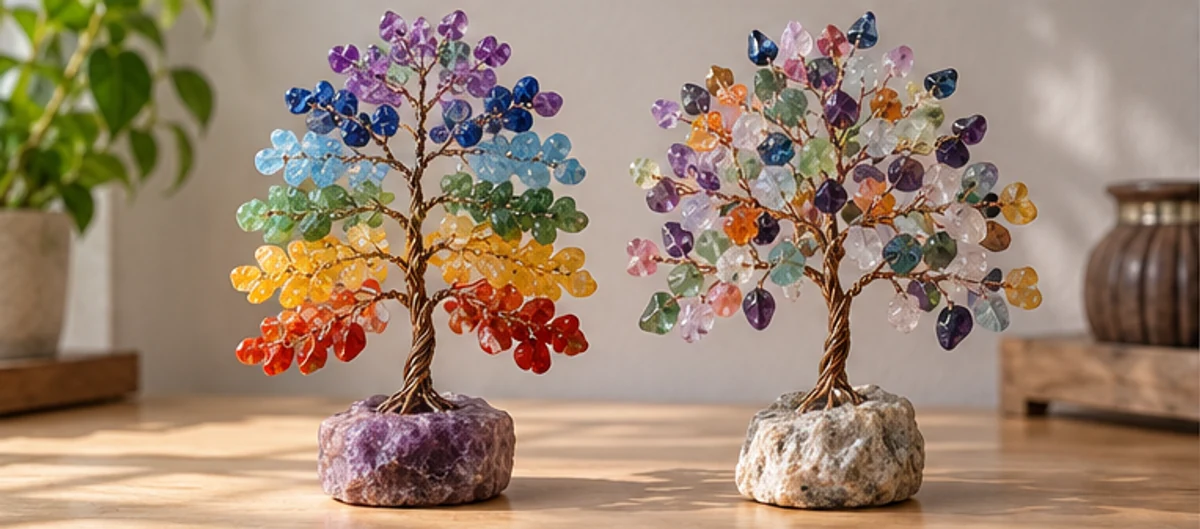
1. What is a seven chakra gemstone tree?
Most gemstone trees are handcrafted decorative objects rather than naturally growing mineral structures. Small polished or rough-edged chips are attached with thin wire, twisted into twigs, gathered into branches and assembled around a trunk. A mineral slice, stone slab, resin base, wooden stand or other support anchors the form. The term “seven chakra” normally refers to the colour and symbolic design of the canopy. It does not tell you automatically which mineral species are present, whether the colours are natural, or whether the tree contains exactly seven separate types of stone.
A grouped tree may display red chips on one branch, orange on another, yellow on a third and so on until violet. Some artisans arrange the bands in upward order; others cluster seven colours around the perimeter of the crown. A mixed design disperses the same colours among every branch. Both can be attractive. The first invites viewers to read a sequence, while the second feels like a lively, integrated rainbow. The tree form adds its own suggestion of rootedness, gradual growth, continuity and protection of what a household values.
Do not judge the finished object solely from a tiny square photograph. Ask what “height” includes, how wide the canopy becomes when arranged, whether the branches can be moved, whether the base rocks, and whether the pictured chip colours reflect the actual piece. A 15-centimetre tree with a broad crown behaves differently on a narrow shelf from a compact tree with the same overall height. If the listing contains a bead-count or chip-count promise, clarify whether it is exact or approximate and how the maker counts multi-chip loops.
2. The chakra names: yoga and Tantra before the gemstone colour scheme
Chakra (cakra) literally means a wheel or circle. In several Indian yoga and Tantra traditions, chakras belong to the subtle-body account of practice, associated with the suṣumṇā channel, nāḍī networks, lotus imagery, bīja syllables, elements and contemplative disciplines. Common Sanskrit names are Mūlādhāra, Svādhiṣṭhāna, Maṇipūra, Anāhata, Viśuddha, Ājñā and Sahasrāra. Some descriptions count six principal centres plus the crown lotus; other lineages organise centres and colours differently. A serious account of the subject should not flatten these traditions into a single modern gemstone shopping list.
The familiar red, orange, yellow, green, blue, indigo and violet sequence is a contemporary visual convention. It is useful for product design because shoppers can immediately recognise the seven colours, but the classical lotuses, petals, bīja syllables, deities and element colours are more varied. A manufacturer may label this arrangement “seven chakra” without implying that historical texts selected carnelian for the second centre or lapis lazuli for the sixth. Those gemstone pairings are modern interpretive choices, not an unchanging prescription found in every school.
For example, the Ṣaṭ-cakra-nirūpaṇa tradition describes subtle centres with detailed lotus and mantra symbolism. Sahasrāra is frequently discussed as a crowning thousand-petalled lotus rather than merely the seventh coloured wheel. Respecting those differences enriches the meaning of a seven-colour tree: it can be a contemporary reminder to approach a traditional subject attentively, while the traditional practices themselves remain deeper than the retail ornament.
Colour and stone examples show the popular modern design language; traditions, actual recipes and mineral identities vary.
| Common name / Sanskrit | Contemporary colour | Contemplative association | Illustrative stone colour, not a required mineral |
|---|---|---|---|
| Root / Mūlādhāra | Red | Groundedness, stability and belonging | Red jasper or carnelian in deep red shades |
| Sacral / Svādhiṣṭhāna | Orange | Creative engagement and flow | Orange carnelian or orange agate |
| Solar plexus / Maṇipūra | Yellow | Purpose and steadiness of intention | Citrine, yellow quartz or yellow jasper |
| Heart / Anāhata | Green | Care, harmony and relationships | Green aventurine or green agate |
| Throat / Viśuddha | Blue | Clarity of expression and careful listening | Blue sodalite, blue agate or lapis lazuli |
| Brow / Ājñā | Indigo | Reflection, discernment and insight | Dark-blue sodalite or lapis lazuli |
| Crown / Sahasrāra | Violet or white | Contemplation and spiritual aspiration | Amethyst, fluorite or clear quartz |
What the seven-colour table does—and does not—mean
The chakra names are traditional, but the suggested chip colours and stone examples are not a universal ancient equivalence. A violet amethyst chip is materially different from a purple fluorite chip; a dark blue sodalite chip is not identical to lapis lazuli. Sellers sometimes use an inexpensive dyed stone as a colour substitute. If that is the product, a clear label can still make it an enjoyable decorative tree. What matters is honest identification rather than assuming one colour proves the name, origin or ritual significance of a mineral.
3. Traditional symbolism: Kalpavriksha, Sankalpa and a tree of seven colours
In Indian cultural imagination the auspicious tree can evoke Kalpavṛkṣa, the wish-fulfilling tree, and the wider symbolism of fertility, shelter, continuity and abundance. A wire-and-stone gemstone tree is not the mythic tree itself, nor is it a substitute for a living sacred tree. Its miniature branching shape gives the owner a visible symbol of patient growth. The colourful leaves make that symbolism more personal: an owner might dedicate the display to study, mindful speech, a new household, family harmony or gratitude.
Saṅkalpa is the deliberate statement of purpose used in many devotional and contemplative contexts. Placing the tree respectfully and recalling a sincere Sankalpa can be part of a personal routine. For a family, this might mean beginning a puja by acknowledging a shared intention. For a student, it might mean pausing before study to remember clarity and disciplined effort. For a business owner, it may symbolise balance across responsibilities rather than promising that the object itself will produce prosperity.
Some modern sellers connect each chakra colour to a planetary ruler, a deity, an organ and a specific gemstone. These mappings vary considerably among lineages and contemporary authors. In classical Jyotiṣa, gemstone selection typically concerns the natal chart, graha relationships, daśā, strength, suitability and the advisor's interpretive method. A seven-colour decorative tree should not silently be advertised as a complete Navagraha prescription. Seven chakra symbolism and nine planetary correspondences answer different questions, even though one household may value both traditions.
Using a tree during a simple reflective practice
Begin by placing the tree on a clean stable surface, with a clear view of its branches. One can name seven qualities—steadiness, creativity, clarity of purpose, kindness, truthful expression, discrimination and contemplation—and allow each colour to remind them of a chosen quality. The tree is a visual aid to the owner's attention, not a device with medically measurable effects. In puja, personal mantras and household customs take precedence over generic retail instructions; anyone following a recognised sampradāya should maintain that tradition's actual practices.
4. Seven colours do not establish seven authentic minerals
Retail photographs can make two distinctly different material assortments appear nearly identical. One tree might contain red jasper, carnelian, citrine, green aventurine, sodalite, lapis lazuli and amethyst. Another could use dyed agate for several positions and amethyst for the violet position. A third could include coloured glass, reconstructed beads and clear quartz chips. No colour chart can resolve those differences. For each advertised chip material, the seller should identify the name, whether colour treatment is known, and whether the tree is assembled from mixed material.
Even a tree with seven distinct natural minerals is not automatically “higher vibration” or more spiritually effective than one with a simpler assortment. The useful comparison concerns actual stone identity, visible craft, price and personal preference. If a product states “natural gemstone tree,” clarify whether this means natural mineral chips rather than natural, untreated colour in every chip. It also does not mean that the wire, adhesive and base are themselves natural gemstones.
| What you see | Possibility | Correct buyer question |
|---|---|---|
| Bright transparent purple chips | Amethyst, fluorite, glass or another purple material | What is the identified mineral species; were chips tested? |
| Opaque red chips | Jasper, carnelian, dyed agate or other stone | Are the red chips natural-colour or treated? |
| Vivid blue chips | Sodalite, blue chalcedony, dyed howlite, glass | What is the exact stone and treatment disclosure? |
| Sparkling orange chips | Sunstone, dyed stone, goldstone glass | Is the sparkle natural in a mineral, or manufactured glass? |
| Uniform green translucent chips | Aventurine, fluorite, dyed quartz or glass | Please provide close-ups and the mineral name |
| Every group has precisely the same shape | Uniformly tumbled natural chips or manufactured beads | Are they stone chips, glass beads or formed composites? |
| “Certified seven chakra” wording | Could describe design only or a limited sample report | What specific items and claims does the report actually cover? |
Colour photographs should be made under neutral light, without aggressive saturation. A magnified view can reveal polish, cracks, dye concentrations or glass bubbles, but observation alone may still be inconclusive. Some quartz, chalcedony and howlite are dyed for the decorative stone trade; dye stability depends on the particular process. Avoid destructive tests on an assembled tree. A professional gemmological report should specify exactly which samples it examined, not promise identity for every part of an untested object.
5. Useful gemstone options for each contemporary colour group
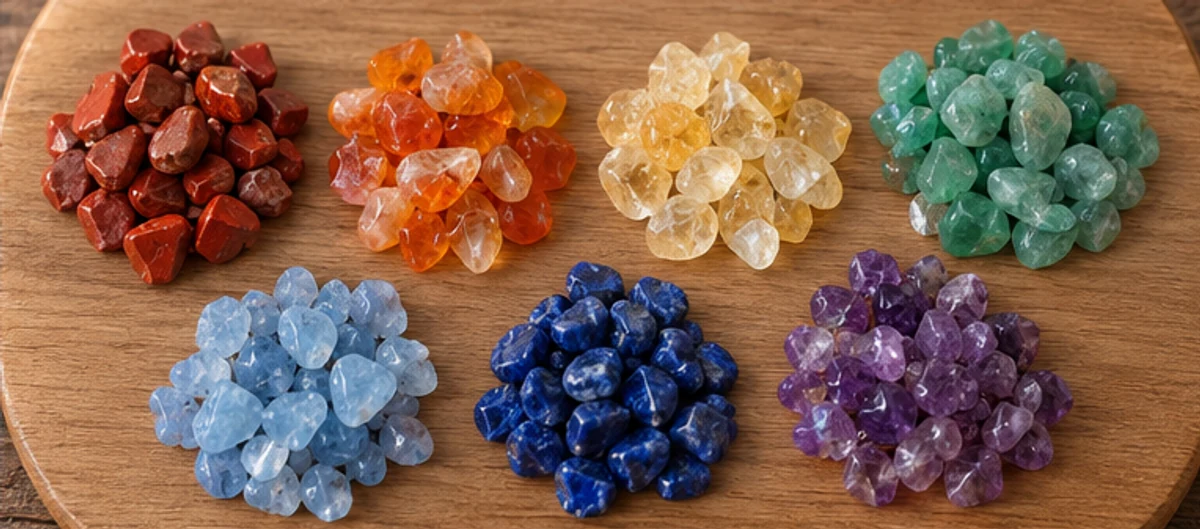
No single mineral list is mandatory, but a few recurring examples help buyers understand the price and durability differences among trees. Red jasper is generally an opaque silica-rich stone. Its varieties and trade terms can be broad, so the name should be specific when known. Carnelian is a reddish-orange chalcedony that can also show brownish or translucent variations; some material is heat-treated to strengthen its colour. The distinction between these stones affects appearance and supplier disclosure even if both occupy warm colour positions in a chakra design.
Yellow positions may contain citrine, yellow jasper or other yellow-toned mineral chips. Citrine belongs to the quartz family; much commercial citrine is produced by heating amethyst or smoky quartz. Calling all transparent yellow chips “natural citrine” without treatment information is therefore unhelpful. Opaque yellow jasper and dyed yellow chalcedony look different close up, so ask to see a normal-light photograph rather than a backlit marketing image.
Green aventurine is a familiar choice because its light to medium green colour can be lively without being transparent. Some material exhibits mica-related aventurescence—a subtle reflected sparkle that differs from glass glitter. Green agate, dyed quartzite and green fluorite can serve a similar visual role while remaining materially different. The actual trade name and treatment statement help the buyer compare like with like.
For blue and indigo groups, sodalite and lapis lazuli are frequent possibilities. Sodalite may be blue with pale calcite areas; lapis lazuli is a rock containing lazurite and other minerals, sometimes including calcite and pyrite. The presence of white patches or the absence of visible gold-like specks does not by itself authenticate or rule out either material. Blue agate can be attractive but may owe its blue colour to dye. “Blue turquoise” in a low-priced chip tree may be dyed howlite, magnesite or another product unless clearly identified.
The violet group often uses amethyst, purple fluorite or dyed quartz. Amethyst is quartz, Mohs 7; fluorite is calcium fluoride, Mohs 4 with perfect cleavage, and is more prone to damage from rough handling. A crown with vulnerable fluorite chips needs more careful packing than an all-quartz crown. White or clear chips may be added to signify the Sahasrāra position in some designs; when called Sphatik, the seller should distinguish natural quartz, synthetic quartz, glass and other transparent materials.
| Chip sold as | Identity or treatment point | Assembly/care priority |
|---|---|---|
| Red jasper | Opaque silica-rich material; variety labels can be broad | Protect polish, confirm drilling and colour description |
| Carnelian / orange agate | Chalcedony; colour may be enhanced | Ask about treatments, keep away from solvents if dyed |
| Citrine / yellow quartz | Quartz family; heated material common | Request honest colour-origin terminology |
| Green aventurine | Quartz-rich material, often with reflective inclusions | Check natural finish and chip attachments |
| Blue sodalite | Blue silicate; white veining may be present | Ask about identity rather than relying on veins |
| Lapis lazuli | Multimineral rock; dye/wax can occur | Avoid harsh chemicals, verify trade claim |
| Amethyst | Purple quartz; fade risk in some material | Keep away from prolonged strong sunlight |
| Purple fluorite | Calcium fluoride, Mohs 4, perfect cleavage | Avoid impact and pressure at wire loops |
| Clear Sphatik quartz | Quartz; clear glass and synthetic quartz can imitate | Check origin and avoid scratch tests |
6. Grouped chakra branches versus a freely mixed gemstone tree
In a grouped seven chakra tree, each colour normally has a recognisable area. A buyer can read the crown in sequence or use the groups as a reflection aid. The arrangement suits someone who specifically wants the popular chakra colour diagram made three-dimensional. To evaluate it, look for the distribution of colours, not an artificial requirement that each group contain precisely the same number of chips. Handmade pieces may vary naturally, and that variation can be attractive.
A mixed gemstone tree distributes colours among many branches without a fixed seven-section sequence. It may contain the same seven materials, more than seven, or fewer than seven. Its purpose is often visual variety, general gemstone-tree symbolism, or a gift that does not depend on chakra study. An artisan may use colour alternation to keep the canopy balanced even if the mineral assortment repeats several stones. The choice is one of design and meaning, not automatically one of authenticity or quality.
A single-stone tree can be a better choice for a person who cares most about a particular mineral. An amethyst tree makes purple quartz the focus; a rose quartz tree emphasises a softer pale-pink appearance. Seven chakra trees can offer richer colour but often need greater verification because several gemstone types, treatments and hardness levels share the same object. The more mixed the components, the more carefully the care instructions need to fit the most vulnerable material.
| Tree style | Visual structure | Typical use | Check before buying |
|---|---|---|---|
| Grouped seven chakra | Seven visible colour areas | Chakra-themed display and personal reflection | Group definition, chip list, treatment disclosure |
| Freely mixed gemstone | Colours scattered across crown | Flexible decorative and gifting use | Actual component list and crown balance |
| Single-gemstone tree | One principal mineral and colour family | Focused material preference or traditional symbolism | Correct species and stone quality |
| Seven-colour imitation-glass tree | Bright colours in manufactured beads | Budget décor where accurately described | Do not pay natural-gemstone premiums |
| Mixed mineral and dyed-chip tree | Varied colour, some enhanced | Colourful display with disclosed treatments | Dye stability, care and labelled components |
7. Is a seven chakra tree the same as a Navagraha gemstone set?
No. A chakra design generally follows the seven-centre language popular in yoga and modern contemplative products; a Navagraha arrangement refers to nine grahas of Jyotish: Sūrya, Candra, Maṅgala, Budha, Bṛhaspati, Śukra, Śani, Rāhu and Ketu. A chart-based gemstone recommendation may consider the native's horoscope, daśā, graha strengths and specific school of interpretation. Seven colours cannot be equated with nine grahas simply because both traditions use stones and symbolism.
Sometimes a retailer assigns one graha to each chakra or advertises a seven-chip tree as an astrological remedy. Such mappings may come from a contemporary method and should be named as such. For example, a yellow chip does not become a proven substitute for a properly selected yellow sapphire simply because yellow features in a chakra chart. The meaningful story of a seven chakra tree remains its chosen colour scheme, its material quality and the owner's personal or devotional intention.
8. Vastu placement: directions, room use and practical realities
Vastu Shastra examines the relationship of buildings, orientation, entrances, rooms, circulation, natural light and function. The eight-direction framework, Aṣṭa Dik, is useful language when discussing placement, and Pañca Mahābhūta refers to the five great elements—Prithvi, Jala, Agni, Vayu and Akasha—in Indian thought. A decorative tree can support a carefully chosen room atmosphere, but an exact shelf position cannot be derived from colour alone. Contemporary practitioners may favour a clean north-east contemplative area (Ishanya), a study desk or another location chosen according to the layout and intention.
In a family apartment, look first for a sheltered stable surface where people can appreciate the colours without brushing the wires while passing. For a puja space, keep the tree away from diya flames, oil droplets, incense ash and vessels of water. If the shelf is crowded, move the tree to the side rather than placing it directly behind burning lamps. A shelf near a window can show lovely translucent chips, but intense direct sunlight may affect dyed materials and some natural stones.
In an office or consulting room, the tree can be a visual reminder of balanced decision-making, provided the base does not obstruct files, charging cables, visitors or cleaning. Reception counters are often high-traffic surfaces; use a stable tree with a manageable width rather than placing a fragile branching object at the edge. In a child's room, sharp wire ends, removable chips and small objects raise practical safety concerns; keep the tree well beyond young children's reach.
| Setting | Reasonable placement approach | Avoid |
|---|---|---|
| Puja room or altar | Stable side shelf with clear view and sufficient spacing | Oil, flames, incense ash and water splashes |
| Meditation space | Quiet raised surface outside the sitting path | Floor placements where ankles or clothing catch the wires |
| Study or work desk | Compact base toward rear of a stable desk | Books and cords repeatedly striking the crown |
| Shop reception | Secure display with visible label and accurate stone names | Unprotected edge or constant customer touching |
| Housewarming gift | Neutral shelf selected by recipient | Presuming a universal compass direction without seeing the home |
| Professional Vastu kit | Fitted case with a materials reference card | Loose packing among heavy stones or metal tools |
9. Inspect the complete construction, not just the coloured chips
A good miniature tree is an engineered craft object. The chips are usually secured by twisted wire loops; several thin branches gather into a trunk, which is fixed to a base. The base may be a mineral slice, agate slab, wood, metal, cementitious body or resin. Each component brings different vulnerabilities. Natural stone can chip, wire can fatigue, plated finishes can abrade, adhesive can weaken, and a narrow base can wobble. A photograph that highlights only the gemstone colours may hide those flaws.
Ask whether the branches are intended to be gently arranged after shipping. Some designs are sold compressed for safety and can be opened carefully; others use fixed or glued branches and should not be reshaped. Support the wire close to the point of a necessary bend rather than pulling on the mineral chip. Repeated bending of one joint can weaken metal and loosen an attachment even when the first movement appears easy. If instructions are absent, do not assume the tree is designed for frequent rearrangement.
Inspect chip holes and wire ends. A chip hanging from a wire with a sharp exposed tail can snag a sari, sleeve or dusting cloth. Cracks through a drilled mineral hole can cause detachment later. Check the trunk-to-base connection by observing whether it rotates or tilts, without intentionally forcing it. Feel the underside of the base for rough edges or unprotected metal that could mark furniture; a properly fitted protective pad can help where compatible with the object's weight and finish.
A large canopy creates leverage on the base, so height, weight, width and balance matter together. Choose a displayed form that is within the dimensions of the chosen shelf rather than planning to squeeze it between heavier objects. Chip count alone does not indicate quality: fewer evenly secured chips can offer a more graceful and reliable result than an overcrowded crown with weak wire attachment.
| Inspection point | What good work looks like | Problem to clarify |
|---|---|---|
| Chip attachments | Wire supports chips without sharp exposed ends | Loose wire, cracked drilled holes |
| Branch junctions | Evenly twisted joints, no excessive force required | Gaps, broken strands, fatigue |
| Trunk | Firm and visually balanced | Twisting or leaning at the joint |
| Base | Level, sufficient footprint, protected underside | Rocking or sharp base edge |
| Canopy distribution | Colour placement matches description | Unexpected substitutions or missing colour groups |
| Finish | Appropriate, clean and stable coating | Flaking, rough plating or residue |
| Packaging | Separate crown support and secure base | Bare chips pressed against heavy base |
10. A 14-point buying checklist for seven chakra gemstone trees
Begin with the actual product, not a list of symbolic benefits. Ask the seller for photographs of the exact tree or a representative sample labelled as such. You need front and side views, close-ups of different chip groups, a view of the base and a picture of the item after packing. If trees are handmade, reasonable variations should be disclosed before purchase. A model photograph may establish the design, but it does not independently verify the mineral content or the craftsmanship of the item shipped.
A practical purchase inquiry can be specific without being confrontational: “Please identify each stone group; clarify whether the colours are natural, dyed or otherwise treated; provide height, crown width and base dimensions; show the underside and branch joints; and tell me whether the branches can be adjusted.” The answers reveal how confidently the seller understands the product. If a report accompanies the tree, ask what item was examined and whether the report number or testing laboratory can be independently verified. A report for one sample chip cannot by itself certify every chip in the finished tree.
| No. | Check | Why it changes the buying decision |
|---|---|---|
| 1 | Actual mineral species for each colour | Prevents treating a colour chart as a stone inventory |
| 2 | Natural, dyed, heat-treated or other colour status | Makes like-for-like comparisons possible |
| 3 | Whether all seven groups contain different minerals | Distinguishes “seven colours” from “seven stone varieties” |
| 4 | Whole-object and neutral-light photographs | Reveals real colour balance and proportions |
| 5 | Close-ups of chip surfaces and wire loops | Shows cracks, rough edges and attachment quality |
| 6 | Total height and canopy width | Ensures a realistic shelf fit |
| 7 | Base dimensions and base material | Helps assess stability and furniture protection |
| 8 | Approximate weight, with packaging weight separate | Makes handling and shipping more predictable |
| 9 | Fixed or adjustable branch construction | Avoids unnecessary wire fatigue |
| 10 | Chip or bead count: exact or approximate | Clarifies what a numerical listing means |
| 11 | Scope of any authenticity report | Separates sample tests from entire-tree claims |
| 12 | Care instructions for the most delicate component | Reduces accidental dye, stone and metal damage |
| 13 | Protective packing and delivery-damage process | Protects delicate twigs and fragile chips |
| 14 | Return and replacement conditions | Explains remedy for a wrong or damaged item |
11. How to read grading, pricing and authenticity claims
A tree labelled “AAA seven chakra” has not necessarily received any independent grading. Unlike standardized grading categories for some faceted gems, retail tree grades are often the seller's own commercial scale. Ask what the grade measures: chip size, polish, colour sorting, low breakage, neat branchwork or something else. A perfectly symmetrical crown may be less desirable to some buyers than a gently irregular handmade form. A premium should be explained in measurable terms rather than simply through promises of unusual power.
Price depends on chip material, treatment status, quantity, chip size, workmanship, metal type, base, local labour, packaging and support. Amethyst and lapis lazuli may cost differently from dyed agate or coloured glass. A product with seven costly minerals can be priced higher without being physically more durable or suitable for the intended shelf. A small well-built tree with accurate material declarations may be a better value than a larger, highly saturated display with uncertain components.
Statements such as “lab tested,” “genuine seven chakra,” “energized” and “handmade” answer different questions. A laboratory may identify the submitted stone but not the entire decorative assembly. “Energized” may describe a seller's devotional handling or specific ritual service; it is not a mineral identification result. “Handmade” describes production, not necessarily chip origin. Request evidence that matches each particular claim, and keep the invoice or product description for future reference.
12. Cleaning and preventive care for seven mixed gemstones
A mixed-chip tree requires the most conservative care of its components. Where material identity and treatment status are not fully known, start with light dry dusting using a soft clean brush while holding the base stable. Do not immerse the assembly in water or salt water, and do not assume an ultrasonic cleaner, detergent or jewellery dip is safe. Hard quartz chips may survive a treatment that damages fluorite, a dyed agate chip, painted wire or a resin base. The weakest part of the entire object governs the safe method.
Keep the tree away from heavy sunlight, high heat and damp windowsills. Some dyed stones can fade, and certain minerals respond poorly to temperature extremes. Metal wire can tarnish or corrode under unfavourable conditions. If the tree is displayed near a humidifier, bathroom, open kitchen or indoor plant watering area, choose a drier and more stable position. Keep abrasive cleaning cloths, solvents, perfumes and scented sprays away from coloured chips and unknown surface finishes.
For dust behind dense branches, use short gentle brush strokes. Do not tug a lodged fibre or cotton thread through the canopy; support the wire and remove the snag carefully. If a chip becomes loose, photograph its position and contact the seller or a competent repairer rather than applying household glue that might leave staining or damage the stone. When packing for a move, immobilise the heavy base separately from the delicate crown, prevent the branches from contacting each other under pressure, and use a rigid outer box.
| Component | Main vulnerability | Conservative approach |
|---|---|---|
| Amethyst / quartz chips | Surface scratches, some colour light sensitivity | Soft dusting; avoid prolonged strong sun |
| Fluorite chips | Low hardness and perfect cleavage | Protect from impact and trapped wire pressure |
| Dyed agate / howlite | Dye sensitivity to solvents, fading | Keep dry; avoid alcohol, acetone and bleaching products |
| Lapis lazuli chips | Possible wax/dye and mixed-mineral sensitivity | Do not soak or use aggressive cleaners |
| Copper-coloured or plated wire | Tarnish, coating wear, corrosion | Use dry storage and gentle handling |
| Adhesive joints | Heat, moisture, mechanical strain | Avoid immersion and forceful twisting |
| Stone, wood or resin base | Chipping, warping, scratches or cracking | Support beneath base; keep stable on clean shelf |
13. Traditional puja care: keep ritual meaning and material care together
Some households wish to include a gemstone tree in a puja arrangement or mark its placement with a Sankalpa. This can be done without forcing the object through a material-damaging routine. A respectfully cleaned shelf, a simple prayer and placing the tree beside—not under—the diya are examples of practical accommodation. If family custom includes sprinkling water, apply that custom in a way that does not wet untreated wire, unknown adhesives or fragile stone chips; the ritual need not be confused with a prescription to soak an ornamental object.
Do not put the tree in rock salt, bury its chips in soil or expose it to smoke and flame merely because such actions appear in general crystal-care videos. They can harm the finish, leave residue and create a cleaning problem. The original meaning of a devotional action is separate from the tolerance of a constructed object. If a guru, priest or family elder recommends a specific observance, the household can honour that intent with appropriate materials and placement rather than automatically using a chemically aggressive treatment.
14. Three realistic examples: Bengaluru home, showroom and professional kit
Example A: A Bengaluru apartment with a compact puja shelf
A family wants a seven chakra gemstone tree to mark a new routine of prayer and reflection. The puja shelf already holds a brass diya, incense holder and several framed images. Rather than buying the tallest possible tree, they measure the clear side area and choose a compact stable base. They select a grouped colour arrangement because they want the popular chakra sequence visible, but they verify the actual mineral chip names independently of the colours. The tree stands away from oil and flame, and one person brushes it gently when the puja area is cleaned. Its value is in the household's chosen symbolism and the daily visual reminder, not in a promise that its seven colours solve every spatial concern.
Example B: A jewellery and spiritual-products showroom
A showroom displays two seemingly similar colourful trees, one assembled with named natural chips and another with a mixture that includes dyed chalcedony. An accurate label makes the difference clear without disparaging either product. The salesperson uses a close-up card to explain why a blue dyed chip is not necessarily lapis lazuli and why chip drilling, wire ends and base stability matter. The cost is presented in relation to actual material and workmanship. Because customers sometimes lean over the counter, the delicate crowns are displayed inside a sheltered shelf where visitors can examine them without snagging the branches.
Example C: A professional Vastu consultation reference kit
A consultant carries a seven chakra tree as a visual example alongside sample tumbled stones and small pyramid models. The tree's reference card names its actual stones, notes any known treatment and separates chakra-colour symbolism from a Navagraha recommendation. During a consultation, the practitioner first studies the room use and layout; the tree is used to explain a choice of decorative object, not as a replacement for the building assessment. For travel, the base and canopy are supported in a fitted case, and the consultant does not repeatedly bend branches between client visits.
15. Gift selection: who will enjoy a seven chakra tree?
A seven-colour gemstone tree can be chosen for a housewarming, new office, graduation, study room or a person who practices meditation. A gift recipient may love the vivid canopy without following a chakra tradition. In that case, a simple card about growth, shared goodwill and careful craftsmanship may be more meaningful than a prescriptive list of promised effects. If the recipient actively follows a particular yoga, Tantra or devotional school, ask whether the modern rainbow display fits their practice before presenting it as a sacred instruction.
Consider the recipient's actual living space. A compact low tree suits a small desk; a broad seven-group crown suits a larger table where it can be admired from several angles. If the person has young children or pets, fragile wire and detachable stone chips should influence the placement or whether the ornament is appropriate at all. A gift that includes a clearly written material list and care card is more useful than one whose stone content remains mysterious after the packaging is discarded.
16. Questions to ask a seller before placing the order
Ask for the seven colour-group names in writing; a photograph alone does not distinguish sodalite from dyed howlite or amethyst from purple fluorite. Clarify whether the item pictured is the one shipped, a representative model or an illustrative sample. Ask the maker whether a coloured group is intentionally made from more than one mineral, and whether the tree has removable or adjustable components. Confirm measurements, the base material, the packing arrangement and the process for reporting transit damage.
If a seller claims a particular Vastu direction, ask which method, tradition or practitioner's interpretation is being followed; do not infer a universal architectural rule from a generic product label. If the purchase is connected to chart-based gemstone advice, obtain that guidance separately rather than relying on a chakra rainbow as a Jyotish substitute. A confident seller should welcome precise questions about the actual tree, not require the buyer to accept unverified claims in place of a component description.
17. Frequently asked questions about seven chakra gemstone trees
What is a seven chakra gemstone tree?
It is a handcrafted tree whose chip colours follow a popular seven-centre chakra design. It may contain seven identified minerals, fewer mineral species in seven colours, or a mixed assortment; the material list determines what it actually contains.
Does every seven chakra tree contain the same seven stones?
No. Stone choices vary by artisan and supplier. The chakra colour sequence does not provide a universal mineral recipe.
Are the chakra colours traditionally always a rainbow?
No. The modern red-to-violet sequence is a familiar contemporary convention. Classical yoga and Tantra sources describe centres, petals and colours differently across traditions.
Which chakra is associated with green in modern colour charts?
Green commonly represents Anahata, the heart centre, in contemporary rainbow charts. The actual green mineral used in a tree could be aventurine, agate, fluorite or another stone.
Can a seven chakra tree contain dyed stones?
Yes, depending on the product. Dyed chalcedony, agate and howlite are known in gemstone commerce. The listing should disclose known treatments accurately.
Is a multicoloured gemstone tree the same as a seven chakra tree?
Not necessarily. A freely mixed crown can contain different stone counts and may have no seven-group arrangement. Compare the actual design and materials.
Is goldstone a natural gemstone?
Goldstone is a manufactured glass with reflective particles, not a natural mineral species. It can be decorative when accurately described.
How can I tell sodalite from lapis lazuli in a tiny blue chip?
Colour and white veins are not decisive by themselves. Ask for accurate supplier identification, magnified views and suitable gemmological evidence when necessary.
Are seven chakra gemstone trees prescribed in classical Vastu?
The familiar seven-colour wire gemstone tree is a contemporary retail and decorative form. Vastu traditions are broader architectural systems; individual placement ideas vary among modern practitioners.
Does a seven chakra tree replace Navagraha gemstones?
No. Navagraha relates to nine grahas and chart-based Jyotish practice. Seven chakra colour symbolism and traditional planetary gemstone selection are distinct systems.
What does Sankalpa mean when using the tree?
Sankalpa is a deliberate statement of intention in many devotional contexts. A tree can be a visual reminder of that intention; it does not itself establish mineral identity or a guaranteed outcome.
Is a bigger tree necessarily better?
No. Chip quality, stable base, secure wirework and fit within the intended room generally matter more than height or an approximate chip count.
Should all branches be arranged perfectly symmetrically?
No. Handmade trees may have a gently varied silhouette. Only adjust branches if the design is intended for gentle repositioning; repeated bending can weaken the wire.
Can I wash all seven gemstone groups together?
Avoid immersion when stone identities, dyes, wire and adhesive behaviour are uncertain. Light dry dusting is a safer starting point for a mixed-material object.
Can I place it next to a diya or incense?
Leave adequate space from flames, ash, oil and heat. A separate stable shelf within a puja setting is generally more suitable than placing delicate chips directly beside a lamp.
Will direct sunlight harm the gemstone tree?
Extended intense light may fade some dyed chips or sensitive minerals and can affect finishes. Moderate indirect indoor light is a practical default.
Does a laboratory certificate verify the whole tree?
Only if its documented scope covers the whole relevant assortment. A report for a single submitted chip does not automatically authenticate every stone, wire and base.
What should I do if a chip arrives loose?
Photograph the damaged area and packaging, keep all fragments, and contact the seller. Avoid pulling branches or using household glue before documenting the condition.
Is the tree suitable for an office reception?
Yes, if the base is secure, the placement is away from frequent contact and material descriptions are accurate. Counter edges and crowded pathways are poor locations.
What should I request before ordering online?
A complete chip-material list, treatment information, neutral-light photographs, dimensions, base details, branch-adjustment guidance, protective packing and return terms.
18. Final selection: respect the tradition and verify the object
A good seven chakra gemstone tree combines thoughtful colour design, accurate identification and solid craft. Decide first whether you want seven visible colour groups, an organically mixed rainbow or a single-stone tree. Next check which minerals and treatments are actually present. Then judge the finished object's stability, dimensions, base and wirework. Finally choose a place that suits your household's routine and leaves room for safe, respectful display.
The chakra vocabulary brings genuine Indian yogic and Tantric significance to the conversation, while the common rainbow arrangement is a modern way to present the theme. Kalpavriksha imagery, Sankalpa, Vastu room context and devotional use can deepen a person's relationship to the tree without being reduced to a seller's generic list of benefits. An honest product listing lets the buyer appreciate those meanings while knowing exactly what the beautifully coloured branches are made from.
Research and terminology: The traditional chakra structure and Sanskrit names were checked against the Indira Gandhi National Centre for the Arts' Elements of Indian Art and reference work on Tantra, and modern rainbow correspondences against historical discussion published by the Theosophical Society in America. The treatment and identification sections draw on GIA guidance on dyed, treated and manufactured gemstone materials; preventive handling and metal care follow Canadian Conservation Institute recommendations. These names are acknowledged for editorial transparency without adding unnecessary outbound commercial links.
