
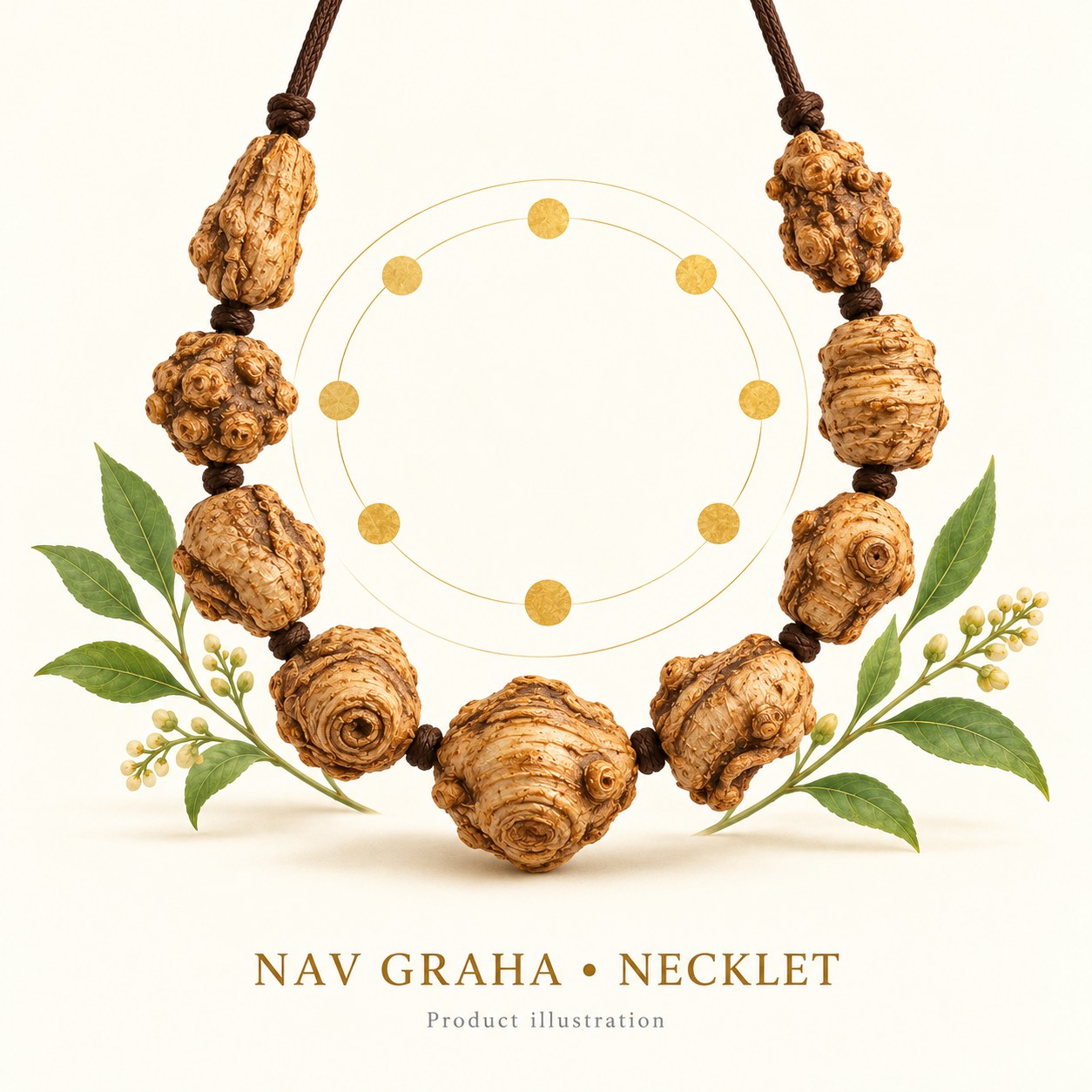
A Navgraha herbal necklet brings nine selected botanical associations into a single devotional ornament. The word Navagraha refers to Surya, Chandra, Mangala, Budha, Brihaspati or Guru, Shukra, Shani, Rahu and Ketu. A necklet is the complete wearable arrangement: plant pieces, supports, cord, knots or clasp, spacers, finish and any protective mounting. Those details matter just as much as the names of the plants when choosing an item to wear, preserve or give as a gift.
The idea is attractive because a single ornament can represent the nine grahas within a personal Sankalpa or customary worship practice. Yet the expression “nine roots” is shorthand. Not every botanical part used in a traditional assortment is anatomically a root. Some plants produce rhizomes; the banyan produces aerial roots; other materials may be sold as woody cuttings. A trustworthy description therefore explains which nine plant identities have been selected, which parts are included, how they are assembled and how the finished piece should be cared for. It should not infer those facts from a photograph of a generic illustration.
This guide is for readers comparing a Navgraha root necklet with single-planet herbal pendants, a Rudraksha-based Navagraha choice or another devotional accessory. It discusses tradition respectfully while giving the practical inspection details a buyer needs. It does not assign an unverified personal astrological prescription to every wearer.
1. Navagraha meaning and the specific nine-plant assortment
Graha is an astrological category, not a botanical classification. Surya and Chandra are luminaries within Jyotish; Rahu and Ketu are lunar nodes in the traditional framework. The nine are discussed together in Navagraha puja, Graha Shanti practices, mantra traditions and individual Jyotish consultations. Plant offerings, ritual woods, garden plantings and wearable roots are related but distinct traditions. Their lists may differ according to region, teacher, purpose and lineage.
The following table describes the selected associations used for OmmRudraksha’s planetary herbal-jewellery collection. It is a product-assortment map, not a claim that every Navagraha temple or classical source uses the same nine materials. For the fuller plant-name discussion, consult the nine-association guide.
| Graha | Selected trade or devotional plant name | Botanical reference to verify | What must be established for an actual necklet |
|---|---|---|---|
| Surya — Sun | Bilva, Bael | Aegle marmelos | Whether the supplied piece is verified root material rather than another part of the sacred bael tree |
| Chandra — Moon | Comfrey | Symphytum officinale | Species, prepared plant part, enclosure, surface finish and contact suitability |
| Mangala — Mars | Anantmool, Anantamul | Hemidesmus indicus | Common-name identity and whether a genuine prepared root segment is supplied |
| Budha — Mercury | Vidhara, Vriddhadaru | Argyreia nervosa; Argyreia speciosa is a recorded synonym | Exact species, part and source rather than inference from the trade name alone |
| Brihaspati — Jupiter | Ashwagandha | Withania somnifera | Correct dried material, secure mounting and absence of loose powder |
| Shukra — Venus | Majeeth, Manjistha | Rubia cordifolia | Botanical identity and whether the coloured piece is a root or prepared substitute |
| Shani — Saturn | Bichoo | Regional name; Girardinia diversifolia is one documented candidate | Which plant the supplier means; do not assume every “bichoo” refers to the same species |
| Rahu | Vacha, Calamus | Acorus calamus | Rhizome identification, stable enclosure and responsible handling |
| Ketu | Bargad, Banyan | Ficus benghalensis | Whether the offered material is an aerial root and how it was collected and prepared |
Why the names alone are insufficient
A label such as “Mars root” conveys the chosen spiritual association; it does not, by itself, establish botanical identity. A botanical Latin name identifies a plant taxon but does not prove that a particular tiny cut piece came from that plant. A botanical part name—root, rhizome, stem or aerial root—is a third fact. All three should line up in the item’s own component record.
A necklet with nine identifiable materials may have nine small packets or pouches, nine distinct sections along one cord, or grouped pieces integrated into a more complex design. Do not assume that one visible bead equals one botanical species: a single plant part can be cut into several components, while one section can contain a mixture. Ask what “nine” means in the seller’s counting method and whether the photographed arrangement shows all nine associations.
Bilva for Surya: reverence and the correct plant part
Bilva or Bael, identified botanically as Aegle marmelos, has a strong devotional presence in Shiva worship and Indian sacred-plant traditions. The significance of a bilva leaf in puja is not interchangeable with the identity of a bilva-root pendant. If the necklet is sold as containing bilva root, its maker should verify the root material itself; a leaf, twig, seed or wooden bead is not automatically an equivalent component. Ask whether the piece is lightly finished, encased or drilled, and whether handling may create splinters. The Sun association here is part of the selected herbal-jewellery system rather than a universal Navagraha plant list.
Comfrey for Chandra: clear distinction between ornament and preparation
Symphytum officinale is a plant with a documented botanical identity, but identifying its scientific name does not establish the identity or suitability of a specific ornament. The necklet should be discussed strictly as a finished decorative or devotional object. Comfrey contains pyrrolizidine alkaloids; ingestion of comfrey preparations has been associated with serious liver injury. This is a concrete reason not to chew, brew, grind or extract material from a piece of jewellery, rather than a reason to discard the traditional name from the discussion. Confirm the surface barrier, shedding, hygiene and whether the assembly contacts damaged or irritated skin. For this collection the plant is associated with Chandra, while other Navagraha plant systems select different plants.
Anantmool for Mangala: names that cross regional markets
Anantmool, Anantamul, Sariva and several regional names may refer to Hemidesmus indicus, commonly called Indian sarsaparilla. Kannada names include Sogade beru and Anantha beru. Such familiarity is useful when asking a local Bengaluru supplier about source material, but it also creates opportunities for mix-ups with other roots marketed under overlapping common names. For a finished necklet, the priority is botanical confirmation and the actual processed piece, not its scent or whether it resembles a known dried root. An aromatic smell alone cannot authenticate the material. The association with Mangala is the chosen devotional correspondence of this assortment.
Vidhara for Budha: accepted names and older synonyms
Argyreia nervosa is an accepted botanical name; Argyreia speciosa is recorded as a synonym in current botanical references. A supplier may encounter both on older labels. This is not, by itself, proof that two different ingredients are present. It does mean that a serious material list should give a consistent scientific name and note any relevant synonym without counting it as a second planet. Vidhara is a climbing plant, so the seller should specify exactly which part was prepared. Avoid guessing from the diameter, surface pattern or reddish-brown colour of a small component. The Budha association expresses the item’s selected traditional meaning.
Ashwagandha for Brihaspati: an accessory, not a supplement
Withania somnifera is widely recognised by its Sanskrit trade name Ashwagandha. That recognition makes its label familiar, but it does not make a pendant or necklet equivalent to a supplement or Ayurvedic preparation. A dry component may be mounted whole, cut, polished, coated or enclosed. Ask what part is used and whether the structure can release dust when worn. If the maker claims a special preparation, obtain the exact description rather than assuming every product follows the same method. Here Ashwagandha represents Brihaspati or Guru as a devotional selection; the article does not equate wearing the material with ingesting it or with an automatic chart correction.
Manjistha for Shukra: pigment, root and identification
Majeeth or Manjistha commonly directs the reader toward Rubia cordifolia, a plant known historically for red colouring materials. Reddish colour is therefore understandable in the trade, but colour is not proof of the plant species. Another botanical piece can be stained, and a natural segment can vary greatly in appearance depending on drying and treatment. Check whether the item contains a solid prepared root, a coated wooden form or loose material enclosed in a transparent housing. The Shukra association is traditional symbolism attached to this collection’s selection, separate from the real plant’s historical dye uses.
Bichoo for Shani: clarify the species before claiming authenticity
“Bichoo” is a broad regional expression; it can be used for plants with stinging characteristics, and it does not uniquely establish one botanical species. Girardinia diversifolia is one documented plant candidate in the collection reference list, but another vendor’s label may mean a nettle of a different genus. A meaningful Shani component record must therefore specify which plant was actually sourced. Because identification is often difficult from a short dried fragment, supplier documentation matters more than a confident colour-based description. Ask about processing and how loose plant fibres are prevented from contacting the skin. Do not reassign the Shani part by appearance alone.
Vacha for Rahu: the rhizome is not a root
Acorus calamus is commonly associated with Vacha. The commercially used underground part is a rhizome—an underground stem—rather than a true root. This is a small botanical distinction with a large practical implication for product descriptions: the collection name “nine roots” can be retained as traditional shorthand while the bill of materials correctly identifies the actual plant parts. Asarone-related concerns appear in regulatory evaluations of Acorus-containing herbal medicinal products. Those evaluations are about medicinal exposure rather than a laboratory verdict on a particular necklet, but they reinforce the importance of not turning ornament components into powders, teas or home remedies. Ask about secure mounting and whether any piece can crumble.
Bargad for Ketu: aerial roots and the life of a banyan
Ficus benghalensis, the banyan or Bargad tree, is distinctive because it produces aerial roots that descend from branches and can later become supportive trunks. Indian botanical and pharmacopoeial references specifically document banyan aerial-root material. An illustration of a banyan tree is not proof that a supplied object contains aerial root, nor that it was collected from a particular tree. Request the plant part, its preparation method and an ethical sourcing description. The tree’s longstanding devotional associations enrich the Ketu symbolism used in this assortment, but the botanical claim still needs confirmation at the level of the physical piece.
2. Three verification layers every necklet should pass
The most useful way to evaluate a necklet is to separate traditional correspondence, botanical identification and finished-article verification. Confusing these layers creates both weak product descriptions and disappointed purchases. A temple custom can explain why a name is revered, but it cannot identify an anonymous fragment. A botanical reference can describe a species, but it cannot certify the cord, coatings or clasp of the item in the buyer’s hand.
| Layer | What is being verified | Good supporting information | What it cannot establish alone |
|---|---|---|---|
| Devotional association | Which graha is paired with which named plant in this assortment | Clear tradition or collection attribution | Identity of a physical component |
| Botanical identity | Scientific plant name and relevant synonym | Supplier identification, botanical references, source records | Whether the photographed piece is authentic |
| Plant part | Root, aerial root, rhizome, stem or other part | Ingredient list and preparation notes | Quality of the finished fitting |
| Physical component | The actual piece supplied for each graha | Close photographs or numbered material map | Personal astrological suitability |
| Wearable assembly | Thread, knots, spacer, mount, finish and fastening | Inspection, dimensions and materials record | Meaning of every traditional rite |
| Finished-item suitability | Stability, comfort and ordinary-use conditions | Seller checks and buyer inspection | A guaranteed spiritual outcome |
For an item sold as a Navgraha necklet, the minimum dependable record is a nine-row component map. If a component is not identified or is temporarily unavailable, it is better to state the gap than to represent an incomplete assembly as a confirmed nine-material product. If a regional alternative is intentionally used, name it; an alternative belongs in the description rather than being hidden under the same botanical label.
A simple component-numbering system
Number the nine associations N1–N9 in the order chosen by the maker. Store the name, proposed botanical identity, plant part, physical location on the necklet and verification status for every row. Photograph the entire piece laid flat against a neutral background, then photograph its two sides and clasp. A numbered layout diagram makes later inspection straightforward: a customer can identify where a segment sits without relying on a memory of nine similar-looking pieces.
Where multiple small fragments form one association, label them N3a/N3b rather than counting them as additional planets. Where a component is enclosed in a pouch, identify the pouch material separately from the root inside. A plain-language note such as “material confirmed by supplier, not independently lab tested” is more useful than an unsupported certificate claim.
3. How the complete necklet is made: cord, cases, knots and clasp
A nine-material necklet is a mixed-material jewellery assembly. Even if every botanical identity is correct, an uncomfortable or poorly secured piece may be unsuitable for regular wear. Common approaches include individually mounted plant segments, drilled wooden or root pieces, small sealed containers, thread-wrapped components or spaced arrangements on a cord. These are construction possibilities, not a statement that every OmmRudraksha unit is built in one predetermined way.
Inspect the load path: where does the weight rest, which connections carry it, and which parts move when the wearer turns their neck? A rigid, oversized central assembly may bump the chest; widely spaced containers may turn sideways; an exposed sharp end of botanical material may catch fabric. Test the complete fitting rather than only its individual decorative pieces.
| Component | Questions to ask | Typical concern to inspect | Sensible remedy or seller response |
|---|---|---|---|
| Main cord or thread | Cotton, silk, nylon, other fibre or metal chain? | Fraying, stretching or staining | Confirm material and replacement method |
| Main joints | Knotted, crimped, glued or mechanically fastened? | Loose or uneven attachment | Inspect every loaded connection |
| Botanical holders | Open, wrapped, sleeved or sealed? | Dust, splinters or slipping pieces | Determine safe physical containment |
| Spacers | Metal, wood, resin or stone? | Corrosion, rough edges or skin reaction | Record all contact materials |
| Clasp | Hook, toggle, screw or tied thread? | Difficult removal or accidental opening | Practise normal opening and closure |
| Adjustable section | Actual usable range? | Dangling loose ends and poor balance | Measure fully extended and minimum lengths |
| Overall balance | Centre of gravity and symmetry? | Necklet rotating or catching clothing | Try fit over ordinary clothing first |
| Surface finish | Dye, varnish, polish, oil or coating? | Colour transfer or sensitivity | Ask supplier what was applied |
Adhesives and protective coatings
An adhesive may be essential to a component’s mounting, but it should not appear as an unexplained glossy film over every botanical part. Ask whether the maker used resin, lacquer or another finish. An enclosure can reduce shedding yet changes the way the plant segment looks and feels; a buyer should know what the material actually touches. Avoid cleaning with a solvent merely because the root material appears hard—solvents can affect coatings, plastic housings and the cord before they affect the botanical material.
Strength is a system property
A strong-looking root does not make an entire necklet strong. The weakest loaded knot, connector or crimp can determine whether a segment is lost. Gently inspect for movement with the piece supported on a table, rather than pulling on a pendant to “test” it. If a joint is loose, stop wearing the item until the maker assesses it. Random household glue may create brittle repairs or coat the botanical surface, complicating future maintenance.
4. Sizing and wearing comfort: measure before choosing
Necklet terminology is inconsistent. Some sellers describe the measured full open length; others quote a folded or drop length. The buyer needs a measurement method, not merely a familiar label such as medium or adjustable. Ask for the full end-to-end length, the circumference when fastened, the central drop and the largest component dimensions. If cord length changes when tied, note the secure adjustment range.
A quick fitting method is to use a soft measuring tape or an existing necklace that is already comfortable. Compare where the botanical sections will rest with the clothing neckline normally worn. A piece worn over fabric may sit differently from one touching skin. People who work at a desk, drive, exercise or frequently bend forward may prefer a shorter, lighter design that does not swing into equipment; longer pieces may be suitable for occasional devotional use rather than every activity.
| Measurement | What it actually means | Why it matters | How to confirm |
|---|---|---|---|
| Total flat length | Entire item measured open | Basic product comparison | Photograph beside a ruler |
| Wearable circumference | Closed neck loop | Comfort and ease of putting on | Measure in normal fastened state |
| Drop length | Distance from neckline to lowest point | Movement and clothing interaction | Photograph on a neutral display form |
| Total weight | All botanical parts plus fittings | Comfort over several hours | Weigh the complete article |
| Largest segment | Height/width of largest mounted piece | Snagging and visual proportion | Show close-up dimensions |
| Adjustment range | Minimum/maximum secure fit | Whether ties remain stable | Demonstrate both settings |
| Contact surfaces | What actually touches skin | Irritation and cleaning choices | List cord, metal and coatings |
Do not sleep while wearing a necklet, and remove it for activity in which the cord can catch, tighten or be pulled. Keep necklaces and detachable small parts away from babies and young children. For a gift intended for someone who may be sensitive to jewellery materials, the safer choice is to ask about the fitting in advance rather than presenting an unknown cord or finish as suitable for everyone.
5. Traditional wearing customs: reverence without a universal formula
Navagraha practice can involve Sankalpa, mantra, prayer, a selected day, purification of the personal worship area and consultation with a family priest or Jyotishi. These are meaningful customs, but one family’s instructions should not be described as a compulsory procedure for all nine-root necklets. There are differences between Navagraha worship, temple-specific plant offerings, planetary-ratna recommendations and contemporary botanical jewellery. For a personal decision, follow the lineage, teacher or consultation you trust and the confirmed characteristics of the actual item.
A common sequence in devotional use is to identify the purpose, prepare a clean place, offer a brief respectful prayer, and put on the piece carefully without stressing its cord or botanical components. If a wearer uses a graha-specific mantra or begins on a chosen day, that belongs to their own practice. There is no need to soak, burn, smoke, perfume or repeatedly wash a botanical necklet to make a devotional commitment meaningful; these actions can damage the material and mounting.
| Traditional question | Consideration for the wearer | Product-level implication |
|---|---|---|
| Is this for general Navagraha remembrance? | Nine associations may be symbolically appropriate | Verify a complete nine-material arrangement |
| Is it for one graha in a personal chart? | Consult the personal Jyotish guidance used | A single pendant may suit a narrower choice |
| Must it be worn on a specific weekday? | Customs vary by family or teacher | No universal weekday printed as a product guarantee |
| Should it be consecrated or offered in puja? | Follow a chosen devotional method | Avoid rituals involving water, flame or chemicals on the article |
| May it be worn with Rudraksha or gemstone jewellery? | Depends on preference and fitting | Prevent crowding, tangles and abrasion |
| Should it touch the skin? | Not a universal requirement | Consider contact materials and any irritation |
| Can the order of nine pieces be changed? | Meaning may depend on the maker’s arrangement | Ask before changing or unstringing the sequence |
Symbolism versus a personal Graha Shanti recommendation
The nine-graha presentation represents a complete symbolic set. That does not make each root an interchangeable substitute for the metal, mantra, gemstone, donation, vrata or worship method that a Jyotish practitioner may advise. If a wearer asks whether one necklet “covers every planet,” clarify the scope of the claim: it represents nine selected devotional associations in one ornament. It does not determine the owner’s horoscope, Dasha, planetary strengths or suitability without the relevant personal context.
Similarly, Navagraha Vanam plantings and ritual samidha lists sometimes use a very different set of nine plants from this wearable-root assortment. Their differences are not errors that can be solved by calling one list the only authentic version. They reflect different contexts and sources. A seller should declare which tradition or collection map they are presenting, not overwrite other customs with marketing language.
6. Cleaning, storage and repair: protect every material at once
A dry botanical piece is not cleaned like a gemstone bead or a metal chain. Roots and rhizomes may absorb moisture; cut ends can shed fine particles; coatings can be affected by water or solvents; thread and knots can retain perspiration. The practical rule is use the most conservative method appropriate for the entire assembly. Begin by dusting gently with a dry, soft brush or cloth while supporting each component. Do not soak, scrub, use ultrasound, steam clean or place the necklet in a washing machine.
| Situation | Recommended starting action | Avoid | Why |
|---|---|---|---|
| Ordinary surface dust | Soft dry cloth or very gentle brush | Abrasive scraping | Protects surfaces, knots and finishes |
| Perspiration after use | Let dry naturally in ventilated shade | Sealing while damp | Reduces retained moisture |
| Perfume or spray exposure | Stop further exposure, assess the affected area | Strong solvent cleaning | Protects unknown coatings and fibres |
| Colour transfer onto fabric | Stop wearing and ask about the finish | Repeated soaking to “set” dye | Prevents greater damage |
| Loose root dust or fibres | Contain the item and seek maker advice | Blowing, brushing aggressively or inhaling dust | Loose botanical particles should not be dispersed |
| Green corrosion on a metal fitting | Isolate from other jewellery and seek repair | Household acid or polishing dip | Chemicals may contact plant pieces |
| Broken knot or clasp | Keep all fragments and document order | Random restringing without a component map | Preserves sequence and accountability |
| Musty smell or visible growth | Stop wearing and isolate in a dry area | Perfume, heat gun or wet scrubbing | Indicates condition requiring assessment |
| Long-term storage | Dry, breathable or suitably protected compartment | Damp bathroom or direct window sun | Limits moisture and fading risk |
A necklet should be stored separately from heavy bangles, sharp-edged jewellery and perfume bottles. Rest the components without tension rather than letting them hang for months under their own weight. Avoid long exposure to direct sun, radiators or vehicle dashboards. If a storage box uses foam, scented paper or treated fabric, verify that the material does not transfer colour or odour onto the jewellery.
What if the owner wants ritual cleansing?
Devotional cleansing and physical cleaning need not be the same procedure. A respectful prayer, a clean altar and a brief Sankalpa may be compatible with delicate materials without immersing the object in water, milk, salt, oil or sandal paste. Burning camphor or incense very close to the ornament can create heat, smoke deposits and fire risk. If a teacher advises a physical ritual, discuss how the rite can be performed without damaging the actual assembly. Do not make claims that a solvent or immersion is necessary for every wearer.
Botanical pieces must not become home remedies
The presence of recognised herbs such as Ashwagandha, Manjistha, Vacha or comfrey may invite questions about Ayurveda or other medicinal traditions. That is a separate use category. These jewellery components may have been dried, stained, varnished, glued, wrapped or stored with metal fittings, and are not supplied as food or medicine. Do not chew, swallow, burn for inhalation, grind or brew any part of the necklet. Comfrey’s documented ingestion risks and regulatory consideration of asarone-containing herbal medicines are specific reasons to keep the distinction clear; they do not establish whether a particular finished jewellery piece passed a contact-material assessment.
7. Routine inspection: before wearing, after wearing and at seasonal intervals
A two-minute check can prevent a small fault becoming a lost component. First inspect the closure, then the cord along its full length. Look at each holder, mounting and plant fragment. Take notice of powdery shedding, rough ends, a fresh crack, peeling coating or new colour transfer. Ask for repair when necessary; do not continue wearing the piece merely because its traditional meaning is important.
| Frequency | Inspection | Record if there is a change | Decision |
|---|---|---|---|
| Before each wear | Knot, clasp, loose ends and contact points | New slack, sharp edges, fibre shedding | Wear only when secure |
| After each wear | Dampness, residue and fabric transfer | Perspiration or unusual odour | Air-dry gently and reassess |
| Monthly if used regularly | All nine mounts and spacers | Cracks or loosened connections | Photograph and ask maker about repair |
| Before storage | Complete dryness and clean enclosure | Stained pouch or compressed cord | Store flat and separate |
| After storage or travel | Full component sequence against record | Missing material or shifted fitting | Confirm before resumed use |
| After any repair | New cord, clasp, coatings and arrangement | Changes in length or plant parts | Update the component map |
Repair without losing the nine-material sequence
A broken clasp is mechanically different from a missing botanical part. If only the clasp is replaced, document that the nine components remain unchanged. If a plant fragment needs replacement, request an identified replacement of the intended plant and plant part; a visually similar substitute is not equivalent without disclosure. Photographs taken before repair, including both sides and the order of the nine segments, can help the maker return the item to its intended layout. For inherited pieces with unknown provenance, identify what is uncertain rather than assigning every fragment a confident species name.
8. Necklet or single planetary pendant: which design suits the purpose?
A full nine-association necklace is useful when the wearer wants one object representing the complete selected Navagraha scheme. A single-planet pendant offers fewer components, a lighter assembly and a simpler identity question, and it may align better with a specific devotional preference. For a complete side-by-side comparison, see single pendant versus necklet.
| Question | Navgraha herbal necklet | Single-planet root pendant |
|---|---|---|
| Traditional scope | Selected nine-graha assortment | One selected graha association |
| Botanical verification | Nine identities and plant parts | One identity and part |
| Assembly complexity | More mounts, joints and contact surfaces | Usually fewer material interfaces |
| Fitting | Full neckline and overall weight matter | Pendant dimensions and chain/cord matter |
| Repair | Sequence and all pieces need recordkeeping | Easier to isolate one component |
| Gifting | Good for interest in the whole Navagraha idea | Good when recipient has a known preference |
| Value comparison | Evaluate nine components plus construction | Evaluate one component plus its setting |
| Astrological decision | Not a substitute for chart-based guidance | Also requires context if intended as a remedy |
A buyer comparing these products should evaluate the actual finished objects, not assume that nine components must be more valuable or more powerful than one. A nine-piece necklace with weak stringing may be a poor practical choice compared with a sound single pendant. Conversely, a carefully mapped necklet may be preferred as a meaningful gift when all nine associations are the intended focus.
9. Choosing a suitable design for different daily settings
Bengaluru office wear. A wearer who works at a computer may prefer a light, securely closed necklet that does not strike the desk during movement. Measure drop length while sitting rather than judging only from a standing photograph. An open, dusty root construction may not suit light-coloured office garments; a contained or well-finished arrangement could be more practical if its materials are disclosed.
Occasional puja or temple visits. A traditional accessory worn for a short observance can be a little more elaborate than a daily-use piece. Even then, secure stringing, appropriate length and straightforward removal matter. Plan for storage when it is taken off; do not leave it beneath an oil lamp or where water and offerings can contact the botanical components.
Jewellery showroom or consultation display. A display item needs a clear label with the selected graha-to-plant map. Show the entire piece and one detail of its fitting. If the display is handled by multiple visitors, maintain a demonstration sample separately from the item offered for sale, or disinfect contact surfaces only with methods compatible with the actual materials.
Housewarming or family gift. Before buying, ask if the recipient wears neck jewellery, knows the intended traditional associations and is comfortable with botanical materials. Include a concise component card with the nine names, handling instructions and seller’s contact details. Do not make the recipient responsible for guessing how to clean or repair a fragile arrangement.
Travel. Pack flat in an individual pouch or supportive case. Ensure metal fittings cannot rub against prepared roots. On arrival, inspect each joint and allow a piece exposed to humid conditions to acclimatise in a dry, shaded space before sealing it away again. Avoid leaving it in a parked vehicle where temperatures fluctuate sharply.
10. Questions to ask OmmRudraksha before purchasing
The most useful buying conversation is concrete. Ask for the actual current unit, not just a generic product illustration. The item’s final price, length, count, botanical confirmations, exact finish and fastening should be verified for the unit offered. This is especially important if product images are illustrative or if the design is handmade and slight variations are expected.
| No. | Buyer’s question | The answer should clarify |
|---|---|---|
| 1 | Which nine planetary associations are included? | Complete named list for this assortment |
| 2 | What are the scientific names? | Botanical identity and relevant synonyms |
| 3 | Which part is used for each? | Root, rhizome, aerial root or other part |
| 4 | Are all nine physical components present? | Component count and numbered layout |
| 5 | Can I see the actual finished item? | Front, back, joint and clasp photographs |
| 6 | Is the botanical material sealed or exposed? | Dust, surface and contact characteristics |
| 7 | What are the exact dimensions? | Length, circumference, drop and weight |
| 8 | What touches skin and clothing? | Thread, clasp, spacers, dyes and coatings |
| 9 | How does the clasp open? | Fastening and safe removal |
| 10 | What care and storage method is recommended? | Dry dusting, moisture and sunlight precautions |
| 11 | Can a broken component be replaced? | Repair process and how replacements are identified |
| 12 | What is the current price and supply status? | Total cost, lead time and any item-specific variation |
When all details are established, see the Navgraha necklet. You may also review the Navgraha Herbal Necklet — Nine Sacred Roots, explore Planetary Herbal Jewellery, or compare with the For Planets collection. These are navigation options, not substitutes for confirming the item’s current specification.
11. Common mistakes when buying or wearing a nine-root necklet
| Mistake | Why it matters | Better approach |
|---|---|---|
| Treating “nine roots” as proof of nine species | The phrase is a trade description | Request a named component map |
| Assuming every plant part is a true root | Vacha is commonly a rhizome; banyan has aerial roots | Record botanical parts accurately |
| Copying a plant list from another Navagraha practice | Lists vary across ritual and regional contexts | State the collection’s chosen correspondence |
| Trusting colour or smell as species identification | Processing changes appearance and scent | Seek supplier records and labelled photographs |
| Ignoring the clasp and cord | Failure of one joint can lose components | Inspect the finished assembly |
| Using perfumes or ritual liquids as routine care | Coatings, cord and plant materials may react | Keep dry and use gentle dusting |
| Wear during sleep, sport or machinery work | Loops can catch or tighten | Remove before higher-risk activities |
| Replacing a missing piece with a random root | The intended association becomes uncertain | Identify and document the replacement |
| Calling a decorative necklet a medicine | Material has not been prepared for ingestion | Keep ornament and medicinal uses distinct |
| Claiming a universal Dasha or remedy result | Personal Jyotish practice is contextual | Discuss traditional purpose accurately |
12. Twenty practical FAQs about Navgraha herbal necklets
1. What is the difference between Navgraha and Navaratna jewellery?
A Navgraha herbal necklet uses botanical pieces assigned to the nine grahas in a selected tradition. Navaratna commonly refers to a set of nine gemstones associated with planetary symbolism. The objects differ in material, sourcing, setting, care and pricing. A botanical piece does not inherit a gemstone’s mineral classification, and a Navaratna ring is not automatically interchangeable with a nine-root necklet in a personal Jyotish consultation. Choose based on the intended practice and actual materials, not on a shared number nine.
2. Are the nine plants listed here the only valid Navagraha plants?
No. Navagraha plant gardens, homa offerings, temple customs and herbal-jewellery traditions can employ different lists. This article records the nine plant associations used for the specific OmmRudraksha collection so customers can verify its composition. It does not present a single list as binding on every regional practice or teacher. When another source differs, compare the ritual context and the exact use before judging it against this assortment.
3. Does every part have to be a literal root?
The trade expression “nine roots” need not describe nine identical botanical organs. For example, Vacha uses a rhizome and Bargad may use an aerial root. Other supplied pieces must be documented individually. What matters is accurate identification of the real plant part rather than forcing every material into the same word. Ask for a botanical-parts map with the actual items pictured and labelled.
4. How can I tell whether all nine associations are physically present?
Request a photograph of the assembled necklet and a numbered diagram connecting each labelled plant to its position. If a component is contained in an opaque mount, ask what documentation supports its identity. Counting nine visible loops, beads or knots is insufficient: a loop may contain more than one fragment or no plant material at all. A careful seller should distinguish verified entries from those still awaiting confirmation.
5. Is a different cord colour acceptable for wearing?
Cord colours can have cultural or aesthetic significance, but the item’s construction must take priority. Ask whether the stated colour is a fixed element of a particular family or teacher’s practice or simply a design choice. The material must be strong enough and comfortable, its dye should not transfer to skin or clothing, and any replacement should preserve the piece’s component order. Do not attribute a universal ritual rule to a standard colour option.
6. Can I wear it every day to work?
That depends on the wearer’s activities and the actual fitting. A secure, light, well-contained necklet may suit occasional normal wear, while a heavy or protruding arrangement may catch on bags, collars and desks. Check for shedding and irritation, and remove it before sleeping, vigorous exercise or work near moving machinery. If there is any doubt about the materials or contact surfaces, seek the maker’s detailed information first.
7. Is there a compulsory weekday for first wearing?
Different teachers and families may specify different days, mantras or observances. A seller should not state that every wearer must begin on one universal day unless the claim is explicitly limited to a particular tradition. For personal practice, use the guidance you have chosen. From a product perspective, the important first step is verifying that the cord, clasp, plant pieces and sizes are correct before wearing it.
8. Must the necklet be immersed in water or milk before worship?
Physical immersion is not a safe default for botanical jewellery. Water, milk, oil or other offerings may saturate plant pieces, loosen adhesives, stain thread or leave residue in enclosed holders. If a devotional instruction calls for cleansing, discuss a non-immersive method suited to the finished object. A respectful prayer or Sankalpa need not require exposing fragile materials to liquids or heat.
9. Can I combine it with a Rudraksha mala?
Many wearers have personal devotional combinations, but there is no universal product-level requirement to combine them. Check that two cords do not abrade or tangle, and that beads do not strike delicate plant mounts. Keep each item’s own care procedure. If the combination is intended as a personal astrological measure, use the guidance of the relevant teacher rather than assuming all planetary accessories have identical functions.
10. Will it fit over clothing instead of touching my skin?
Potentially, if the closed circumference and central drop are suitable. Wearing over clothing can reduce direct contact but may create other issues, such as catching on a collar, sari edge or neckline. Compare with a familiar necklace and confirm dimensions of the actual unit. The seller should not assume that an advertised length produces the same fit on every wearer or garment.
11. Does Ashwagandha in the necklace work like taking Ashwagandha?
No. A jewellery component is prepared and supplied for ornamental or devotional use; it is not a measured medicinal dose. The plant part might be polished, varnished or mounted using adhesives and metals. The traditional meaning of a named material is separate from its pharmacological or dietary use. Never grind or consume any piece of the ornament, even if the plant name is also familiar from Ayurveda.
12. Why are comfrey and Vacha mentioned with specific care cautions?
Comfrey contains pyrrolizidine alkaloids associated with serious liver harm when ingested, while Acorus-related asarone has been evaluated in medicinal-product safety guidance. Those facts concern chemical exposure and do not certify or condemn an individual enclosed ornament. They make the distinction between jewellery and home preparations especially important. Keep components secured and do not chew, brew, grind, burn or use them as remedies.
13. Can I clean the necklet with salt water, alcohol or soap?
These are not safe default methods. Salt water can affect metal fittings, alcohol may dissolve or dull coatings, and soap solution can enter porous botanical components and thread. Start with very gentle dry cleaning. If the item has a special sealed surface, ask the supplier for an approved method for every component rather than applying a treatment used on one bead or fitting to the whole assembly.
14. How do I know if the clasp or knot is secure?
With the piece supported, look for fraying, loose ends, widening gaps, exposed crimp edges or movement of the botanical mount relative to its connector. Open and close a clasp normally without excessive force. If you see a fault, do not tug harder as a test; stop wearing it and request repair. Keep a photograph of the original arrangement to help the maker preserve the sequence.
15. What should I do if one root falls out?
Collect the piece and any loose fragments without exposing yourself to dust or sharp edges. Photograph the mount and find its number on the component map. Ask the original maker whether the item can be re-secured or requires a verified replacement. Do not insert a similar-coloured twig or root and then describe the necklet as an authenticated nine-material assembly. Record any repair and revised care instructions.
16. What does a botanical certificate prove?
The answer depends on what was examined. A report relating to one sample or supplier batch is not necessarily proof about all nine components in the finished necklace. Check the name of the laboratory or identifier, scope of testing, material examined, date and traceability to the actual unit. A photograph or online plant profile establishes background, not laboratory identification of a finished piece. Ask for accurate disclosure rather than an impressive but irrelevant document.
17. Can an old family necklet be restrung?
Often a maker can assess whether the cord or fastening is repairable, but old botanical components may be fragile or poorly documented. Photograph every section before disassembly and keep each fragment in a labelled container. If part identity cannot be established, record that fact. Restringing may change the length, balance or assembly order, so the finished object should be inspected anew before wearing it again.
18. Is it suitable for a child as a gift?
A necklet with cords and detachable small pieces is not an appropriate jewellery item for babies and young children. Such objects create choking and entanglement hazards. For an older recipient, the item still requires appropriate fit, materials, maturity and supervision. A framed display or written explanation of Navagraha symbolism may be more suitable than a wearable adult accessory when a gift is intended primarily to introduce a child to the tradition.
19. Should the sequence of the nine components be fixed forever?
If the maker or a chosen devotional tradition assigns an order, preserve that order when wearing and repairing the item. Other designs may present the same nine associations in a different geometric layout. Do not assume a universal sequence without evidence. Ask for the design map at purchase; if a component shifts, compare with the photograph before adjusting it. Mechanical repairs should not silently change a claimed tradition-specific arrangement.
20. What should I request before placing an order?
Request photographs of the actual available piece, a nine-entry association and botanical-part map, full measurements, fastening and contact-material details, care instructions, current price and repair terms. If the necklace is handmade, ask which particulars may differ from the illustration. This information helps a buyer respect the Navagraha meaning while making an informed practical decision about comfort, workmanship and ongoing maintenance.
Botanical and safety reference reading
The references below were present in the original article and are retained for readers who want to check botanical naming and the specific safety background. A botanical website identifies species; it does not authenticate a seller’s finished necklet. The two health-agency resources concern exposure from medicinal use, not testing of this piece of jewellery.
- Kew: Aegle marmelos
- Kew: Symphytum officinale
- Kew: Hemidesmus indicus
- Kew: Argyreia nervosa
- Kew: Withania somnifera
- Kew: Rubia cordifolia
- Kew: Girardinia diversifolia
- Kew: Acorus calamus
- Kew: Ficus benghalensis profile
- NIH/NIDDK LiverTox: Comfrey
- EMA: Herbal medicines containing asarone
