
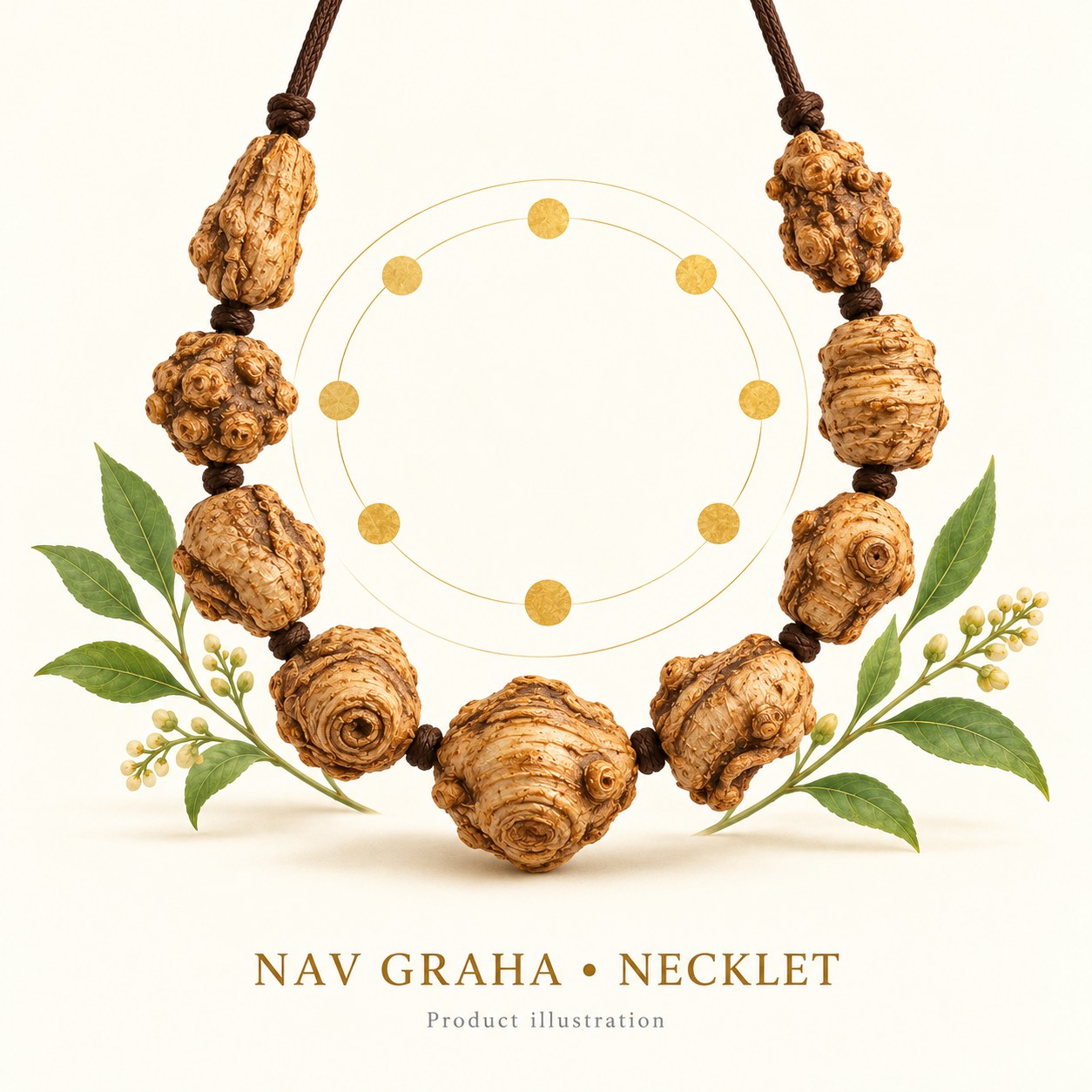
Single planetary herbal pendant or Navgraha necklet: what is the difference?
A single-planet root pendant centres on one named graha and one corresponding botanical component. A Navgraha herbal necklet brings together materials associated with all nine grahas—Surya, Chandra, Mangala, Budha, Guru, Shukra, Shani, Rahu and Ketu—in one wearable arrangement. Both belong to the language of traditional planetary symbolism, but they are not interchangeable products, and neither is automatically the “stronger” option. For someone selecting spiritual jewellery, the relevant questions are which tradition or personal sankalpa is being followed, what materials the actual piece contains, and how comfortably it can be worn and maintained.
The nine-graha arrangement has a wider devotional frame; a single pendant has a more specific frame. The choice need not be forced into an absolute rule. A person may prefer a single botanical symbol after a particular Jyotish consultation, or may choose a Navgraha design for general reverence, a puja-related intention or the meaningful inclusion of all nine names. The actual material, workmanship, fit and wearing customs must be checked separately from that symbolic intention.
A useful purchase comparison starts with the finished object, not with stock photographs or broad statements about planetary influence. Roots, rhizomes, aerial roots, polished wood pieces, cords and findings can look similar in pictures while having quite different identities and care needs. This guide compares the objects in detail and also explains how traditional interpretations fit into the decision.
| Question | Single-planet herbal pendant | Navgraha herbal necklet | Practical decision |
|---|---|---|---|
| Traditional focus | One named graha and its customary plant association | A nine-graha devotional arrangement | Confirm the practice or sankalpa you intend to follow |
| Botanical identification | Usually one main plant component | Up to nine named plant associations, subject to the actual design | Request an item-specific component record |
| Assembly | Pendant body, attachment and cord or chain | Multiple components plus stringing, separators and clasp | Inspect the complete fastening and layout |
| Appearance | Usually compact and visually simple | Often a fuller arrangement with several visible elements | Choose what suits clothing and daily activity |
| Care | Governed by its specific plant part and mount | Governed by the most delicate component and the whole assembly | Avoid one-size-fits-all cleaning rituals |
| Cost | Material, finishing and mount influence price | Labour, component count and finishing may be higher | Compare actual quotations, not an assumed spiritual ranking |
| Gifting | Easy to personalise around a named association | Suitable for someone who appreciates Navgraha symbolism as a whole | Explain the chosen tradition without imposing it |
The traditional distinction: one graha and a complete Navagraha arrangement
In Jyotish, the Navagraha are the nine planetary factors: the seven visible celestial bodies used in the classical astrological scheme—Sun, Moon, Mars, Mercury, Jupiter, Venus and Saturn—together with Rahu and Ketu, the lunar nodes. They form an important interpretive framework for graha shanti, prayer, homa, mantra and symbolic offerings. The traditional importance of the nine grahas does not mean that every herbal necklace has an identical prescription in every lineage. Plant pairings, ritual sequences and the use of roots in jewellery differ across regional practices and modern commercial assortments.
A single-graha sankalpa may focus attention on a specific deity, planetary principle or family practice. For example, the wearer may associate a selected herb with Guru or Shani and regard the pendant as a reminder of an intention undertaken with guidance. In a Navgraha sankalpa, the wearer may express reverence toward the complete nine-graha group. These are different devotional emphases, not a measured scale in which nine components necessarily outrank one.
The terms graha shanti, anugraha, japa, dana, puja, sankalpa and upaya describe different practices and contexts. A necklet is a physical devotional accessory; it is not automatically a substitute for every rite associated with those words. Similarly, a herbal pendant does not have to be represented as an exact equivalent of a prescribed gemstone, a Rudraksha or a ritual offering. Their symbolic vocabularies may overlap, but the objects and traditions are distinct.
Kalpana, bhakti and personal practice matter here. One family may keep a hereditary practice involving one plant; another may favour nine-graha symbolism on a festival or during a vrata. A buyer can respect these differences while still insisting on clear product facts. Whether one wishes to wear the accessory every day, only during worship or simply keep it as meaningful jewellery is a separate question from how the graha association is explained.
How a Jyotish consultation can inform the choice
If the selection is based on individual Jyotish rather than general devotion, it is more useful to understand the reason for the proposed graha than to select by a generic list of “good” or “bad” planets. A properly interpreted janma kundali considers the lagna, planetary lordships, dignity, strength, aspects, house placements, yogas, the running mahadasha and antardasha, relevant gochara or transits, and the particular issue under discussion. The same graha does not play the same functional role in every chart. A gemstone or root associated with a planet should therefore not be offered as a universal remedy based on the weekday or the wearer’s sun sign alone.
In some traditions, the purpose is shanti—a pacificatory or reverential relationship to a difficult planetary influence—whereas other approaches distinguish strengthening, devotional worship and charitable action. The recommendation of a physical object ought to state which approach is being used. A pendant selected for a single graha and a general Navgraha necklace can then be compared without claiming that they deliver the same practice or that combining every graha is always desirable in personal remedial astrology.
| Consultation question | Why it matters | What the jewellery choice can clarify |
|---|---|---|
| Which graha is being addressed? | The selected interpretation needs a named focus | A single pendant may express that specific focus |
| Is the purpose puja, shanti, remembrance or ornament? | Different intentions support different selection criteria | A necklet may represent all nine for general devotion |
| Is there a family or teacher-prescribed material? | Plant associations are not uniform across all lineages | Compare that specified plant with the actual product |
| Is the object intended for daily wear? | Ritual relevance and practical wearability are different | Consider cord, length, movement and skin contact |
| Are particular materials to be avoided? | Botanical and metal sensitivities are individual | Check the exact component and metal list |
| Is a formal consultation involved? | A chart-specific explanation should be coherent | Ask why one graha or a combined set is proposed |
| Can the intention be observed without wearing jewellery? | Prayer and symbolic remembrance do not require a purchase | A wearable is one possible expression, not a compulsory one |
A carefully described consultation can give context without converting the product into a guarantee of particular financial, marital, career or health outcomes. Traditional language should remain meaningful: it is appropriate to discuss Budha, Shani, Rahu, Ketu, graha dosha, graha shanti, dasha, and sankalpa where relevant. It is equally important not to equate a devotional label with independently verified botanical material.
The nine-plant reference map used for this herbal collection
For this collection, the following table records the named associations relevant to the Navgraha necklet. It is a guide for reading the assortment, not an assertion that every school of ritual or Jyotish uses precisely these nine species. The scientific names provide botanical reference candidates and should not be read as laboratory identification of the finished pendant or necklet unless individual stock has been verified.
| Graha | Collection name | Botanical reference | What needs confirmation in the finished piece |
|---|---|---|---|
| Surya — Sun | Bilva / Bael | Aegle marmelos | Plant part and processing; leaf, fruit, bark and root are not equivalent |
| Chandra — Moon | Comfrey | Symphytum officinale | Exact supplied botanical fragment, treatment and intended external contact |
| Mangala — Mars | Anantmool | Hemidesmus indicus | Traceable species and root material; common-name overlap matters |
| Budha — Mercury | Vidhara / Vriddhadaru | Argyreia nervosa; A. speciosa is a synonym | Species identity, selected plant part and finish |
| Guru — Jupiter | Ashwagandha | Withania somnifera | Root versus another plant part, dryness and mount |
| Shukra — Venus | Manjistha / Majeeth | Rubia cordifolia | Plant part, colour transfer and surface preparation |
| Shani — Saturn | Bichoo | Common name may refer to nettle relatives, including Girardinia diversifolia | The actual species—not the vernacular name alone |
| Rahu | Vacha / Calamus | Acorus calamus | Rhizome, which is an underground stem, rather than a true root |
| Ketu | Bargad / Banyan | Ficus benghalensis | Aerial root versus another part of the tree, and responsible collection |
This map serves three purposes. First, it records the planetary vocabulary of the jewellery range. Second, it tells the buyer which common names are vulnerable to ambiguity. Third, it creates a practical request for a complete product-specific bill of materials. Someone who admires an arrangement of nine distinct components may reasonably want to know whether all nine are actually present, how many pieces represent each association, and whether the seller can document the supplied parts.
Several details warrant special attention. Argyreia speciosa is listed as a synonym of Argyreia nervosa in current Kew taxonomy; the two names on separate pages need not imply two distinct ingredients. Bichoo is not a sufficient species identification; local names cover different stinging-nettle groups and the jewellery must be identified by the supplied plant. Vacha is commonly represented by rhizomatous material, despite loose trade use of the word “root”. Bargad produces aerial roots that may extend down to become supporting prop roots. A botanical reference photograph cannot establish the identity of a tiny, dried component after cutting and polishing.
Plant identification is not the same as a planetary designation
A product photograph, a supplier label, a dried fragment and an herbarium voucher answer different questions. The label says what the seller intends to supply; a herbarium reference explains a named plant; a traceable supply record supports the provenance of the actual material. If a seller advertises “nine sacred roots,” ask whether the phrase is a devotional category name or a strict anatomical statement about nine true roots. It may be a mixed group of roots, rhizomes, and aerial roots.
There is also a difference between plant material used externally as jewellery and plant material used in traditional formulations. A piece is not edible because its plant is mentioned in Ayurveda or another herbal tradition. Processing for a wearable object may involve cutting, sanding, sealing, wax, glue, thread or a metal cap. Those finishing materials deserve their own description. Loose claims about herbal potency should not substitute for a clear physical specification.
| Identification item | One-root pendant | Nine-association necklet | Evidence to ask for |
|---|---|---|---|
| Common name | One named herb | Nine named associations | Product-specific ingredient list |
| Scientific name | Check the chosen species | Check each species or state uncertainty | Supplier traceability or verified identification |
| Plant part | Root, rhizome, aerial root or other | Mixed parts may occur | Part-by-part component chart |
| Physical treatment | Drying, shaping, coating, drilling | Each component may be finished differently | Finish and processing description |
| Number of pieces | Often one central segment | May exceed or fall short of nine physical pieces | Actual component count and layout |
| Contact materials | Cord, bail, chain or clasp | Cord, spacers, knots, beads and clasp | Metal and fibre composition |
| Documentation scope | Must correspond to that pendant | Must correspond to that specific necklet | Item photos, invoice and supplied records |
What is actually supplied in a single-root pendant?
A single-planet pendant may have one drilled or mounted botanical piece, but it should not be described as “just a root.” Its wearable function depends on the mounting and attachment system: the root's shape and dryness, the drill-hole position or cap, the loop or bail, the cord or chain, the knot, and any coating or adhesive. A fragile fragment suspended from a thin cord is a very different object from a securely capped and smoothed piece.
The wearer should be able to find the actual dimension of the component, the total pendant drop, finished necklace length if supplied, the weight and what touches the skin. In product photography, a 15 mm fragment can look larger than a 30 mm fragment because of cropping and magnification. Ask for a scale photo and a second image that shows the cord or chain and closure. A picture of a living plant supports the educational story but does not replace photographs of the actual accessory.
For a pendant representing one selected graha, the product description should make it possible to answer: Which planet is named? Which species and plant part have been selected? What is the physical presentation? Does the purchase include the cord or only the pendant? How is it worn or removed? Is the wearing practice supplied by a particular tradition or by a consultation? If these answers are clear, the simplicity of the single-planet design can be an advantage.
A minimal pendant is often preferred under office clothing, with a kurta or sari, or as an unobtrusive object on a personal chain. It may also be suitable for a gift where the recipient has specifically requested one planetary symbol. But a smaller design is not automatically lighter, less expensive or more durable. A heavy metal frame, rough finish or stiff cord can outweigh the advantage of fewer botanical pieces.
What is actually supplied in a Navgraha herbal necklet?
The word necklet suggests a complete ornament that sits around the neck rather than a loose charm. A Navgraha design may string nine different plant fragments, use nine labelled sections, include spacers, or repeat particular pieces for balance. These are design alternatives, not proof that the product has nine true roots. Buyers should ask for the finished arrangement, not assume that a traditional nine-name list specifies the necklace's geometry.
For a combined piece, the assembly holds multiple materials with different surface textures, weights and tolerances. One fragment might have a fibrous cut face; another could be dense and smooth; a rhizome can behave differently from a woody aerial root. If pieces rub against each other, the finish can abrade; if the cord is over-tightened, a drill-hole may split; if a weak knot is hidden inside a decorative bead, failure can release several components at once. The combined design therefore deserves an inspection of the whole object.
A necklet also has a sequence question. Some buyers value a specific order of grahas. Others are content with nine labelled associations presented symmetrically. If an arrangement is being sold as following a particular puja or sampradaya, its sequence should be described and attributed to that practice. Otherwise it is safer to show a clear diagram of the supplied design without suggesting that every lineage prescribes that exact order.
| Construction point | Single pendant check | Navgraha necklet check | Why it matters |
|---|---|---|---|
| Component edge | Smooth, no splinters or sharp metal | Inspect every piece, spacer and end | Comfort and garment protection |
| Holes and caps | No cracks around the mounting | Uniform clearance, no fraying against holes | Reduces breakage and rubbing |
| Cord or chain | Confirm type and thickness | Confirm cord load and movement through components | Durability under ordinary wear |
| Fastening | Knot or clasp is accessible | Secure closure suited to total weight | Convenient removal and inspection |
| Finished length | Pendant and necklace both measured | Whole necklet measured end to end | Prevents misleading size comparison |
| Component identification | One labelled botanical part | Clear nine-association layout | Makes later care and repair possible |
| Replacement policy | Can the main component be remounted? | Can one failed piece be repaired without redoing all? | Controls long-term upkeep |
Choose by purpose: single focus, complete symbolism or personal preference
The following scenarios illustrate the difference between symbolic selection and a physical buying decision. They are examples for discussion, not birth-chart recommendations. Neither the user's profession nor a room's direction automatically identifies a suitable graha.
| Situation | Often worth considering | Question that decides the purchase |
|---|---|---|
| A family follows an established single-graha practice | One matching pendant | Does the actual herb and wearing instruction match that practice? |
| A person wants an expression of reverence to all nine grahas | Navgraha necklet | Are all named associations and actual components clear? |
| A wearer wants an understated daily accessory | Compact pendant | Is the mount comfortable and the cord suitable for daily use? |
| A person values the visual completeness of nine different natural pieces | Navgraha necklet | Are the pieces identifiable and arranged securely? |
| A professional has a chart-specific recommendation | Usually start with that specific question | What is the reasoning for one graha or a combined design? |
| A parent is purchasing a gift for an adult family member | Either, according to the recipient's wishes | Has the recipient agreed with the symbolism and fit? |
| A person dislikes neck jewellery | Neither need be purchased | Can the devotional intention be honoured through another practice? |
| A person already wears other Rudraksha or gemstone jewellery | Check compatibility and comfort first | Are there practical tangling and material-contact issues? |
It is also possible to value the Navagraha collective without wearing a nine-material necklace. A family may observe Navagraha puja, recite stotras or keep devotional imagery. A single pendant can equally have devotional significance without being presented as a special-purpose replacement for worship. Product choice becomes clearer when the object is understood as an accessory within a tradition rather than the entire tradition itself.
Wearing comfort: dimensions, skin contact and movement
Fit is especially important when comparing a single pendant with a multi-component necklet. The wearing length is the complete length around the neck, while the pendant drop is how far the suspended element hangs below the attachment point. A multi-part necklet may sit differently from a single hanging pendant even at the same measured length. It can curve more stiffly, rotate, or concentrate weight at particular points.
Ask for centimetre measurements, not only “small,” “standard,” or “free size.” Measure a familiar necklace that rests comfortably against your preferred neckline; then compare that measurement with the seller's figure. A wider neck or preference for wearing over clothing may call for a different length than the same catalogue photograph suggests. Check whether the closure is adjustable, and whether the stated length includes the clasp. For a necklet, confirm the dimensions of its largest and thickest component, not merely the smallest bead.
| Measurement or test | What to record | Why it is useful |
|---|---|---|
| Finished wearing length | Full length, including the closure | Predicts where it sits against clothing |
| Pendant drop | Top of bail to lowest point | Helps avoid snagging on buttons and desks |
| Largest component dimension | Height, width and thickness | Reveals the physical scale of the design |
| Total finished weight | Measured in grams where available | Useful for extended wear comparison |
| Closure position and type | Hook, knot, adjustable slide or clasp | Determines ease of removal and repair |
| Contact surfaces | Wood, coating, cord, metal and adhesive | Helps address friction and sensitivities |
| Movement when worn | Does it twist, scrape, bunch or swing? | Identifies possible comfort or damage issues |
| Layering with other jewellery | Distance from other pendants | Avoids rubbing and tangling |
Skin contact is not purely an aesthetic matter. Some people react to nickel-containing findings, dyes, finishes or adhesives. The American Academy of Dermatology identifies nickel in jewellery as a frequent cause of contact dermatitis. If you already know that you react to particular metals, request confirmed contact-material information rather than relying on an undefined “skin friendly” description. If any neckwear produces irritation, remove it and identify the material before wearing again.
A wearer working at a desk, driving, caring for young children, performing physical exercise or using machinery should also consider snagging and movement. Remove loose jewellery where it could catch. Neither traditional symbolism nor aesthetic appeal is a reason to tolerate a tight cord, rough fitting or unsafe movement.
Wearing customs, puja and Sankalpa: what can differ
Some purchasers ask whether a pendant or necklet must be worn on a named weekday, after a mantra, after puja or following a particular abstinence. These are questions about parampara, personal practice and the instructions attached to a rite. They do not have one identical answer for all nine plants, all teachers or all sellers. A custom for a single Surya-related pendant, for example, should not simply be copied onto a combined Navgraha arrangement.
Traditional planetary devotion includes names, colours, mantras, offerings, dana and observances that vary by deity and lineage. It is reasonable to ask a trusted practitioner to explain which procedure is being followed, and why. A seller can communicate known product-care requirements without presenting an invented universal consecration formula or mandatory first-wearing hour.
| Question about wearing | Single-planet pendant | Navgraha necklet |
|---|---|---|
| Which graha is named in the sankalpa? | Usually one specifically named graha | May explicitly name the complete Navagraha group |
| Must a weekday be selected? | Varies with family or teacher's custom | Cannot assume one universal day for the combined set |
| Is a mantra necessary? | Depends on the particular devotional practice | Depends on the specific Navagraha tradition followed |
| Is ceremonial purification suggested? | Treat ritual practice and material care as separate | Never soak or heat the mixed assembly without material suitability |
| Must the herb touch bare skin? | Not established by product name | Not automatically established for nine combined components |
| Can it be removed for bathing or work? | Physical care may require removal | Mixed-material protection makes removal especially useful |
| Does it replace puja or dana? | It represents an accessory, not the whole practice | It is not automatically equivalent to a Navagraha rite |
A sankalpa can be simple and sincere without turning the item into a compulsory burden. If a family's established custom asks for an offering or mantra, follow that custom separately from product handling. Particularly with dried botanical pieces, avoid immersing them in milk, oil, salt water, perfume or other ritual liquids unless the actual construction is explicitly suited to that treatment. A dry, respectful presentation is generally easier to reconcile with the care of a wearable organic assembly.
Material quality: authenticity, traceability and the meaning of “nine roots”
The most helpful authenticity question is “Which plant and which part is in this particular piece?” A generic “100% natural” line does not resolve whether the claimed plant is correctly named, whether a piece has been dyed or coated, or whether parts were sourced responsibly. A photograph of the living plant is educational; it does not authenticate a tiny processed fragment. Likewise, the presence of a Kew species page establishes that the botanical taxon exists, not that the dried fragment in the necklace came from it.
For a single pendant, a supplier may be able to provide a plant name, part, approximate origin, processing details and actual product photographs. A nine-association necklet asks for the same information across the complete assortment. It is reasonable to request a table describing each component and the finished count, while recognising that not all inexpensive craft jewellery is accompanied by botanical laboratory analysis. Where scientific identification has not been independently established, product descriptions should identify the limit clearly instead of upgrading a supplier label into a certificate.
The trade language of Navgraha roots should be handled carefully because common names, root synonyms and regional substitutes vary. Banyan aerial root, Vacha rhizome and woody root material are not anatomically identical. Comfrey and several other herbs also have chemical constituents discussed in medicinal safety literature; the necklet is a wearable ornament, not a herbal medicine, food or preparation. Never taste, chew, burn, powder or brew the components to test authenticity or “activate” them.
| Claim or photograph | What it can show | What it does not establish |
|---|---|---|
| A living plant image | General plant appearance | Identity of a particular dried pendant |
| A product's front photo | Overall form and visible colours | Every hidden part, thickness or exact size |
| A nine-name product chart | Intended devotional associations | Nine authenticated botanical components |
| “Pure root” in a listing | Seller's description | Anatomical root rather than rhizome or aerial root |
| Supplier certificate | Whatever the named supplier actually examined | A universal planetary effect or an unexamined piece |
| Kew botanical reference | Accepted scientific naming and background | Item-level provenance or ritual equivalence |
| A statement that a piece is energised | Ritual or seller-described handling | Botanical identity, finishing quality or guaranteed results |
Compare prices and what the quoted amount includes
There is no reliable rule that nine materials must cost nine times as much as one. A simple pendant may use a more complex cap or chain; a necklet may use small fragments with labour-intensive stringing; either may have special packaging or made-to-order fitting. Product photography, finishing and repairs also influence the value a customer receives. The actual quoted price, not the number of planetary names, should anchor the comparison.
Ask whether the cord, chain, clasp, packaging, tax, delivery, fitting adjustment or customisation are included. If a consultation is a separate service, its fee and deliverable should be separately stated. A devotional association is not an objective quality grade for jewellery. Price should be compared with dimensions, botanical declarations, workmanship, seller support and any verification that is genuinely supplied.
| Cost or value factor | Why it changes the comparison | Sensible buyer question |
|---|---|---|
| Number and size of components | More parts can mean more finishing and stringing | How many actual physical pieces are included? |
| Plant-part preparation | Cutting, drying and smoothing require labour | What material preparation is disclosed? |
| Mounting and clasp | Strong fittings can cost more than a plain cord | What contact metals and closure are used? |
| Finished dimensions | Small and large products are not comparable by title | What are the item-specific measurements? |
| Photography and documentation | Actual-object records have value | Will I receive photos and ingredient information? |
| Custom fitting | Different neck sizes need adjustments | Is resizing included and what can be altered? |
| Care and repair policy | A broken nine-piece string is more complex to service | How are breakage and lost components handled? |
| Return and delivery terms | Conditions influence total purchase risk | What are the written terms for this item? |
A buyer comparing quotations from two shops should ensure they are discussing equivalent objects. One may price only a loose pendant; another may include a chain. One Navgraha listing may show nine pieces; another may use nine groups or more decorative spacers. Even within OmmRudraksha's collection, verify the current product specification rather than assuming every variation shares one assembly.
Cleaning and storing a single pendant versus a mixed herbal necklet
Dried plant materials and jewellery findings respond differently to heat, sunlight, moisture and friction. For ordinary upkeep, gentle dry dusting and separate, dry storage are reasonable starting points. Avoid prolonged water immersion, steaming, detergents, alcohol, abrasive polishing, salt, smoke, essential oils and aggressive sunlight-based “cleansing.” Those methods can affect natural fibres, resin, cord, dyes, adhesive and metal components, even when a devotional practice describes them positively.
A single pendant is easier to inspect because there is usually only one botanical component and one mounting. Check it for cracks, loosened caps, frayed cord and residue around the attachment. For a multi-component necklet, inspect each piece and every point of contact. If one piece becomes loose or a cord breaks, store the fragments in a labelled envelope and ask for suitable restringing rather than forcing them onto an improvised wire.
| Material or situation | Practical care | Avoid |
|---|---|---|
| Dried wood or root fragment | Dry, soft brush or cloth; gentle handling | Soaking, boiling, scraping or oiling without finish guidance |
| Rhizome component | Handle its ends gently; keep dry | Exposing cut faces to repeated water and humidity |
| Aerial-root material | Check for fibres and split surfaces | Pulling, twisting or attempting to bend a dried section |
| Cord and knots | Inspect fraying and retie professionally if needed | Pulling knots tight against fragile components |
| Metal findings | Wipe with an appropriate soft dry cloth | Harsh chemical polish near organic material |
| Coloured or sealed pieces | Confirm the finish before any cleaning treatment | Solvents, perfume and strong heat |
| Necklet with many parts | Inspect one component at a time | Tugging the string by one element |
| Storage | Dry pouch or compartment, away from humidity and crushing | Wet bathrooms, direct window sun and crowded jewellery boxes |
In Bengaluru's monsoon periods, moisture management can be especially relevant for dried organic items. An enclosed pouch should be dry when the item goes into it; a damp necklace sealed immediately after wear may retain moisture. If an item shows an unusual smell, visible discolouration, surface dust that looks biological, or a damaged finish, stop wearing it and seek the seller's guidance rather than trying a strong chemical treatment at home.
Three realistic buying examples
Example 1: a Bengaluru professional considering one graha
A person who has already discussed a named graha with a trusted Jyotish practitioner wants something discreet under office clothing. The right sequence is to clarify the specific planetary association and named plant first, then select a pendant with a comfortable mounting and a verified finished length. The buyer asks whether a cord comes with it and whether its metal cap contains nickel. A Navgraha necklet might be a different devotional choice, but it is not necessary to treat a larger design as inherently more suitable.
Example 2: a family choosing a Navgraha gift
A family wants to give a meaningful accessory representing all nine grahas at a housewarming or festive occasion. A necklet may fit the intended symbolism. The purchase depends on the recipient being comfortable with its devotional association and its size. The family requests an actual layout photograph, the nine-association component sheet and a practical guide to drying, storing and restringing. They avoid adding unverified claims about the exact dasha or future prosperity of the recipient.
Example 3: a practitioner comparing a client's preferred material
A professional adviser has a client who already owns gemstone jewellery and is curious about herbal alternatives. The consultation distinguishes botanical items, gemstones, Rudraksha and ritual acts. The adviser documents whether a single graha or the Navgraha group is being discussed, checks whether the plant pairing comes from the practitioner's lineage, and asks for the supplier's actual component information. If the client cannot comfortably wear a necklet, the conversation does not need to force a purchase; devotion and personal comfort remain separate concerns.
Common assumptions that deserve a closer look
| Common assumption | More useful distinction |
|---|---|
| “Nine herbs are always more powerful than one.” | Nine associations express a different symbolic scope; component count is not a performance measure |
| “Every nine-root necklace uses identical ancient ingredients.” | Plant pairings and ritual customs vary by lineage and locality |
| “Any pendant sold as a root must contain a true root.” | Some designs involve rhizomes or aerial roots; anatomy matters |
| “A botanical name on a website proves the actual item.” | Accepted naming and item-specific verification are separate |
| “An expensive piece must have greater graha benefits.” | Price reflects materials, workmanship, verification and selling terms |
| “Every wearer must follow one fixed mantra and weekday.” | Wearing customs depend on the stated practice and practitioner |
| “A necklet is just nine pendants connected together.” | Its distribution of weight, knots, spacers and closure makes it a different assembly |
| “Natural materials tolerate water and traditional cleansing liquids.” | Dried organic pieces, finishes and cords may be damaged by moisture |
A step-by-step decision method
- Name the intended tradition. Is this a general devotional choice, a gift, a family custom or a specific Jyotish suggestion? Write down the reason in a sentence. This keeps the eventual purchase connected to the actual purpose.
- Choose the scope. For one named graha, examine the appropriate single pendant; for an all-nine symbolic presentation, examine the Navgraha necklet. Do not assume the two are equivalent or rank them by number of components.
- Confirm the plant names and parts. Ask for common and botanical names, plant-part descriptions and the actual component list. In the necklet, distinguish nine associations from the number of assembled physical pieces.
- Inspect the real object. Request front and reverse views, close-ups of attachments, a scale reference, total length, drop, weight and full closure description. An illustration can show the concept but not every actual fitting.
- Check wearability and care. Consider metal sensitivities, cord durability, garment movement, climate, storage and whether the accessory can be removed without difficulty.
- Compare terms. Evaluate the total price, included accessories, packaging, delivery, repair possibilities and return conditions. Compare like with like.
- Follow the chosen practice respectfully. If there is a puja or mantra custom, follow an appropriate source for that practice. Keep rituals compatible with the physical care needs of the jewellery.
A careful choice can be both traditional and practical. It can honour graha symbolism, ask precise questions about the botanical component, and value a well-made accessory without turning it into a universal claim. The one-root and nine-association forms are both meaningful when presented clearly; the right purchase is the one that fits the intended purpose, actual materials and person who will wear it.
Frequently asked questions
1. Is a Navgraha herbal necklet better than a single planetary pendant?
Not inherently. A Navgraha arrangement represents all nine planetary associations, whereas a single pendant emphasises one. They serve different symbolic intentions. A person following a specific single-graha practice may have no reason to replace it with a larger design. Someone interested in the collective Navagraha tradition may prefer the necklet. Compare the exact materials and fit rather than treating nine as a numerical rating of effectiveness.
2. Can I wear both a single-root pendant and a Navgraha necklet?
Some people choose to layer devotional jewellery, but the combination should make sense to their own practice and remain comfortable. Check whether the cords and mounts can rub together, tangle, scratch or pull on fragile components. If a practitioner has given a specific instruction about what to wear, clarify that instruction with them rather than assume an unrestricted combination. Neither accessory is compulsory merely because another is already worn.
3. Does a nine-root necklet always contain exactly nine pieces?
Not necessarily. “Nine roots” may refer to nine plant associations rather than an exact physical count. A design could use nine main fragments, groups of repeated pieces or spacers. The product listing should state the actual quantity and arrangement. If exact one-to-one correspondence matters to you, request a labelled photograph and a component list before ordering; do not infer the construction from the collection name.
4. Which nine grahas are represented in Navagraha jewellery?
The traditional list is Surya, Chandra, Mangala, Budha, Brihaspati or Guru, Shukra, Shani, Rahu and Ketu. Rahu and Ketu are lunar nodes in the astrological framework rather than physical planets. The names are widely recognised, but the specific plants associated with each graha may differ by tradition. A named nine-plant collection should present its own mapping and identify its actual materials.
5. Is the same herb prescribed for each planet in every region?
No. Regional vocabulary, ritual lineage, text interpretation and modern trade practice can yield different plant lists. A plant association used in one collection should be described as that collection's stated custom unless a specific source supports broader usage. When a family or practitioner has an established list, compare it with the seller's ingredient chart. An unfamiliar pairing is a reason to ask for its tradition, not to assume all lists are identical.
6. How is one graha selected from a birth chart?
In a chart-specific approach, a qualified reader considers lagna, planetary lordship, placement, strength, aspects, dasha and the purpose of the proposed practice. The weekday, zodiac sign or a short online calculator alone does not convey that full reasoning. Ask whether the recommendation concerns graha shanti, devotion or another traditional objective. The accessory can then be discussed as one possible expression of the stated practice.
7. Does wearing all nine plant materials remove Navagraha doshas?
The language of graha dosha and graha shanti belongs to Jyotish and devotional practice. A combined necklet can have traditional symbolic significance, but the physical presence of nine pieces is not a documented universal solution to every personal horoscope. A practitioner may recommend different forms of prayer, japa, dana or ritual according to a specific interpretation. The jewellery should be presented accurately rather than as a guaranteed outcome.
8. What is the difference between a root, rhizome and aerial root?
A true root is a plant organ usually involved in anchorage and uptake. A rhizome is a modified underground stem; Vacha or Acorus calamus commonly supplies rhizomatous material. An aerial root develops above ground; Bargad or banyan produces hanging roots that may become supports. These may all be described loosely as roots in trade language, but exact identification is important when assessing a listed ingredient.
9. Is Vidhara the same as Argyreia nervosa?
Vidhara or Vriddhadaru is associated with Argyreia nervosa in botanical and medicinal reference contexts, while Argyreia speciosa is listed as a synonym by Kew. These names should not automatically be counted as two separate species in a nine-part assortment. The actual supplied plant and plant part still need independent item-specific verification, because a scientific name on a page does not establish the origin of a processed fragment.
10. What does the name Bichoo mean in a nine-herb list?
Bichoo is a vernacular name that can refer to stinging plants in different nettle groups. It is not itself a precise botanical identification. If a necklet lists a Bichoo component for Shani, ask the seller which species was supplied, which part was used and how it was processed. A named reference such as Girardinia diversifolia is useful background only when it truly corresponds to the current product.
11. Are botanical pendants and gemstones interchangeable in Jyotish?
They are physically different objects and may arise from different remedial customs. A gemstone is a mineral or gem material requiring gemmological identification; a botanical pendant requires plant and part identification. Some traditions discuss multiple symbolic options for a graha, but that does not establish a one-to-one equivalence in every system. Compare their particular meanings, material specifications, prices and wearing requirements without describing one as a certified substitute for the other.
12. Can I wear a pendant under work clothes?
Often yes if the cord, shape and drop suit the neckline and do not rub. Request the total wearing length and the component's dimensions. A smooth, securely mounted piece tends to be easier to wear discreetly than one with rough edges or an oversized cap. Check for metal sensitivities and remove loose neckwear where it could snag, especially around equipment. Comfort is a valid reason to select a compact design.
13. How do I measure the correct necklet length?
Measure a necklace that already sits comfortably at the height you prefer, including its clasp. Ask the seller whether the advertised measurement is end-to-end or only the string between components. For a Navgraha necklet, also check the largest component size and whether it curves naturally when worn. Photographs alone are unreliable for sizing. If adjustments are required, confirm that shortening the cord will not disturb the intended arrangement.
14. Does it matter if the necklace has metal spacers or a metal clasp?
Yes for wearability and durability. Spacers can reduce direct rubbing between dried components, while an appropriate clasp can make removal easier. But unspecified metal alloys may contain nickel or coatings that irritate sensitive skin. Ask what the contact materials are and whether the design can be supplied with another fitting if needed. A metal spacer is a construction feature, not proof of botanical identity or ritual suitability.
15. How should I clean a single botanical pendant?
Begin with gentle dry dusting using a soft cloth or brush suitable for the finish. Avoid soaking, detergent, steam, salt water, alcohol or aggressive polishing unless the maker has verified that the actual item and mount tolerate it. Inspect the attachment and cord at the same time. If the surface is dyed, sealed or fragile, request more specific instructions. A traditional washing practice should not damage the object it is intended to honour.
16. How is a Navgraha necklet stored during humid weather?
Let it dry naturally after ordinary wear and store it in a clean, dry pouch or compartment away from direct sun, damp walls and crushing. Avoid sealing it while damp, which can trap moisture against organic components and cord. Keep the pieces from tangling with heavier metal jewellery. Check the knots and any unusual surface change periodically. In a humid Bengaluru monsoon, dry storage matters more than repeatedly applying scented oils or water.
17. What if one of the nine components breaks or is lost?
Retain the remaining pieces and the original component chart. Ask the seller about a repair or replacement matching the named material and intended arrangement. Do not substitute a random dried fragment or use household adhesive that may stain or weaken neighbouring parts. The presence of nine associations in the original design does not mean a damaged item should be worn loose. Repair depends on the actual stringing and component identification.
18. Must these accessories touch bare skin to have traditional significance?
Direct skin contact is not established by the botanical name alone. Some family or practitioner customs may specify how an item is worn; those instructions should be explained in their own context. From a physical perspective, wearing over clothing may reduce friction or sensitivity for some people. Do not tighten a cord to force continuous contact, and remove an item that irritates the skin. The comfort and safety of the actual wearer remain relevant.
19. Can a Navgraha necklet be given as a housewarming or festival gift?
It can be a thoughtful gift for an adult recipient who appreciates the symbolism of all nine grahas. The giver should check the recipient's preferences and suitable length rather than assign an unrequested astrological remedy. Include a material and care explanation, not promises of particular life events. If the recipient follows a specific family tradition, they may prefer a single-graha pendant or another devotional item instead; that preference deserves respect.
20. What should I confirm before ordering from OmmRudraksha?
Confirm whether you want a single-graha symbol or a combined Navgraha arrangement. Then request the current item photographs, botanical names and plant parts where available, finished dimensions, contact materials, closure details, current price and included accessories. Ask how the item should be stored and repaired. If it is part of an individual Jyotish recommendation, clarify the traditional reasoning separately. Those checks make the purchase understandable even when the devotional meaning is deeply personal.
Explore the related herbal jewellery guides
Use the nine-association guide to understand the common names and the necklet care guide to examine the practical assembly questions. Explore the herbal collection and ask our team about the current pieces and fitting options.
Continue with a specific product or established collection
Explore the Navgraha Herbal Necklet — Nine Sacred Roots, return to Planetary Herbal Jewellery, or visit the established For Planets collection. Botanical references explain plant names and background. Ask our team about the particular item, its fitting and care.Further reading
