
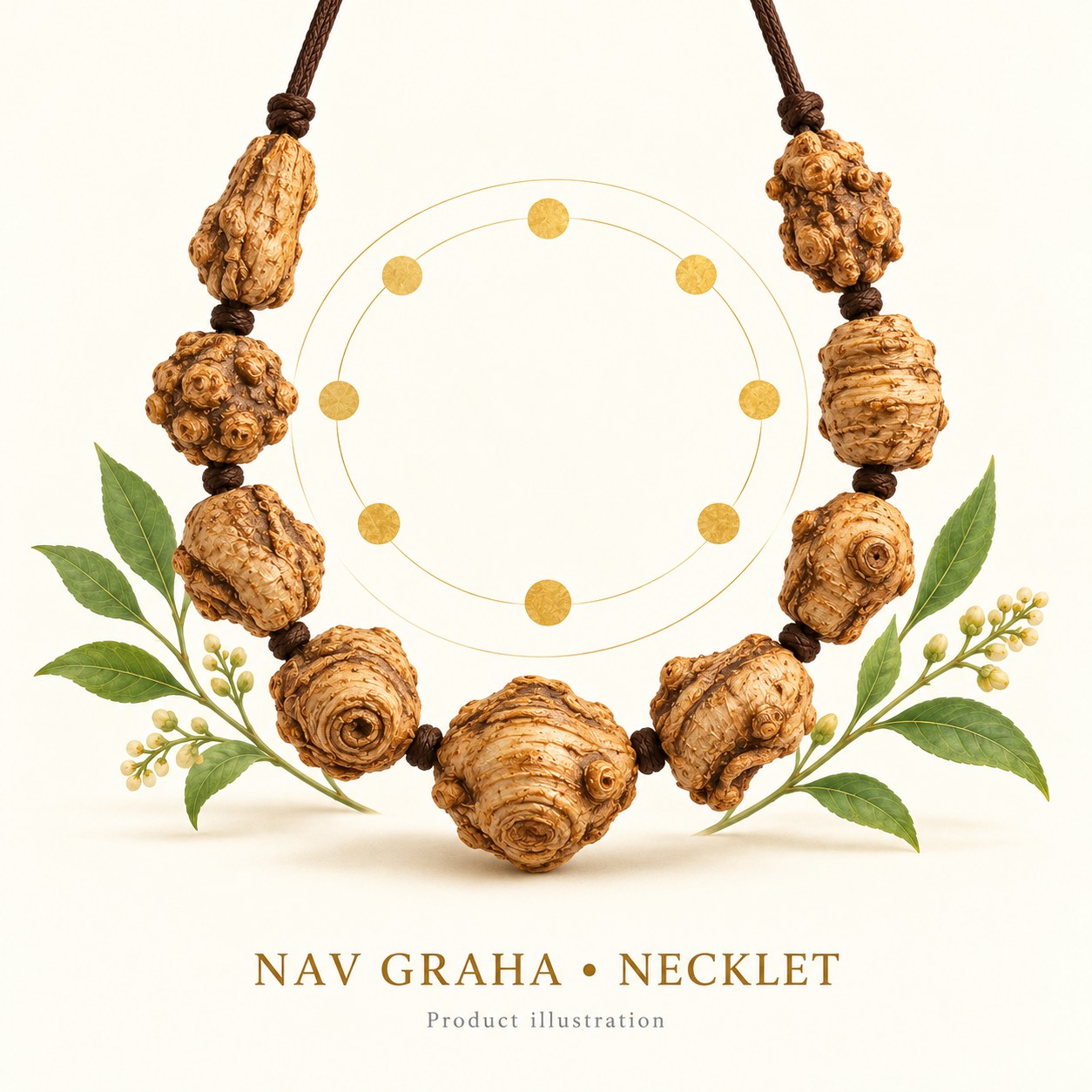
A Navgraha herbal-root collection presents nine botanical materials through the language of Jyotish, Navagraha upasana, graha shanti and sankalpa. Its nine names refer to Surya, Chandra, Mangala, Budha, Guru or Brihaspati, Shukra, Shani, Rahu and Ketu. Some families consider a single root associated with one graha, while others appreciate a nine-part arrangement as a reminder of reverence toward the complete Navagraha. In both cases there are two questions: what does the plant symbolise in the chosen practice? and what plant part is actually contained in the finished jewellery?
These are important questions because the phrase “nine roots” is convenient commercial shorthand. The selected assortment includes trees, climbers, herbs and a rhizomatous plant. A banyan aerial root differs physically from a Vacha rhizome, and neither can be identified solely by the graha name on a label. The plant corresponding to a given graha may also differ between a jewellery assortment, a Navagraha homa samidha list and a family’s inherited tradition. This detailed guide explains OmmRudraksha’s nine selected associations without confusing those separate practices.
The purpose is to make the collection genuinely useful for spiritual-jewellery buyers and readers of Vedic astrology. We consider the Sanskrit and common names, accepted botanical references, parts most relevant to verification, devotional meanings, workmanship, sensible wearing choices and practical questions to ask before ordering a necklet or individual pendant. A botanical reference establishes a species name; the description of a particular product still requires item-specific confirmation.
1. First understand the Navagraha tradition
In Jyotish, graha describes the nine planetary factors used in the traditional horoscope. Surya and Chandra are the two luminaries; Mangala, Budha, Guru, Shukra and Shani are the five remaining classical visible planetary grahas; and Rahu and Ketu are the lunar nodes. The category is therefore not a direct translation of the modern astronomical definition of “planet.” The Navagraha appear in temple worship, household prayer, mantra and japa, homa, charitable observances and chart-specific discussions of graha shanti.
A sankalpa identifies an intention undertaken in worship. Graha shanti is a broad traditional term for practices directed toward harmony or pacification in relation to planetary influences. Upaya refers to a remedial approach discussed within a particular astrological system. Dasha and antardasha describe time periods in predictive Jyotish. Such words matter when choosing jewellery because they explain why someone may favour one graha or all nine; they do not provide the botanical identity or wearing instructions for the object.
Several Navagraha correspondences exist side by side. A homa priest may use prescribed samidha (ritual fuel), a household may offer navadhanya (nine grains), a gardener may establish a planetary planting, and a jeweller may use an assortment of dried root materials. These are not interchangeable inventories. For example, the commonly described homa materials include Arka for Surya and Palasha for Chandra rather than the Bilva and Comfrey names appearing in this jewellery assortment. Their difference does not invalidate either context; it tells the reader to identify the purpose and tradition of the list.
| Tradition or use | What the plant list describes | Why it may differ from herbal jewellery |
|---|---|---|
| Navagraha homa | Samidha, twigs, grasses or fuel materials offered in fire worship | Species and suitable plant parts are selected for a ritual act, not daily wearing |
| Navagraha garden | Nine living plants in a prescribed or customary layout | A planted tree or herb is not the same as a small dried fragment |
| Single-graha herbal pendant | One selected plant association for a named graha | The devotional focus, physical part and setting are individual |
| Nine-association necklet | Multiple prepared pieces grouped as one accessory | The maker must specify actual components and assembly |
| Botanical reference guide | Scientific identification and plant-part terminology | A database cannot authenticate a particular cut piece |
| Jyotish consultation | Interpretation of graha, lagna, dasha and personal practice | A personal recommendation cannot be inferred from a stock list alone |
2. OmmRudraksha’s nine planetary herbal associations
The table records the association map used for this collection, with the botanical candidate most useful when asking the supplier about actual components. It is not a claim that a single ancient text mandates this particular set for every Navagraha rite. Where a regional name is ambiguous, that ambiguity is stated instead of silently attaching an unverified Latin name to a dried fragment.
| Graha and Sanskrit name | Selected common name | Botanical reference | Identification issue for an actual wearable |
|---|---|---|---|
| Surya — Sun | Bilva, Bael | Aegle marmelos | Verify root versus bark, wood, leaf or another bael part |
| Chandra — Moon | Comfrey | Symphytum officinale | Verify species, part, coating and contact-safe enclosure |
| Mangala — Mars | Anantmool, Anantamul | Hemidesmus indicus | Verify species and prepared root rather than another traded “sarsaparilla” |
| Budha — Mercury | Vidhara, Vriddhadaru | Argyreia nervosa | Argyreia speciosa is a botanical synonym; confirm part and provenance |
| Guru / Brihaspati — Jupiter | Ashwagandha | Withania somnifera | Verify the botanical piece rather than assuming a familiar supplement label |
| Shukra — Venus | Manjistha, Majeeth | Rubia cordifolia | Reddish dye history does not identify a finished root segment |
| Shani — Saturn | Bichoo | Regional stinging-nettle names; Girardinia diversifolia is one reference | Confirm exact species; Bichoo is not a unique botanical name |
| Rahu — north lunar node | Vacha, Calamus | Acorus calamus | A rhizome is an underground stem, not a true root |
| Ketu — south lunar node | Bargad, Banyan | Ficus benghalensis | Confirm aerial root when that is the stated component |
The nine rows describe nine associations, not automatically nine inspected pieces in an individual necklet. A completed accessory needs its own component list: source species where verified, harvested plant part, preparation, number of pieces, mounting, cord, closures and dimensions. A label with nine Sanskrit graha names is meaningful as tradition, but it cannot stand in for a material record.
3. Surya and Bilva: sacred Bael, identity and solar symbolism
Surya represents illumination, vitality, authority and the principle of visible light within many Jyotish interpretations. Surya upasana, Sunday observances, Aditya-related prayers and selected forms of graha shanti belong to distinct devotional settings. In this herbal collection, the named Surya material is Bilva, commonly called Bael, identified with Aegle marmelos. The sacred status of Bilva is also strongly associated with Shiva worship, particularly the well-known offering of bilva leaves. Its broader sacred context should be appreciated without assuming that a leaf-offering custom automatically specifies the same plant part for a pendant.
A Bilva tree has bark, leaf, fruit, wood and roots. These cannot be substituted in a product description merely because they originate from the same species. If a component is called Bilva root, request confirmation that it contains dried root rather than a twig or a small wooden bead. When production involves cutting, drilling, polishing, sealing or mounting, ask what was done; processing changes what the buyer sees and how the object should be handled.
The Surya association may be used to express a personal sankalpa concerning confidence, responsibility, discipline or gratitude. A buyer need not choose by birth sign alone. If a Jyotish practitioner advises a Surya-focused observance, confirm the specific practice before assuming this particular botanical accessory is the required material. For a gift, a respectful explanation of the Bilva–Surya association is often more appropriate than claiming that the pendant will change the wearer’s horoscope.
Practical purchase test: identify Aegle marmelos, confirm the material part, check that the surface does not splinter, and examine the attachment rather than choosing on orange or golden packaging colours.
4. Chandra and Comfrey: moon associations and careful material handling
Chandra is discussed in Jyotish in relation to manas (mind), receptivity, nurturing, emotional experience and domestic life. In familiar devotional contexts, the Moon may be represented through Chandra mantras, Monday customs or white offerings. Comfrey, Symphytum officinale, is the plant named for Chandra in this specific herbal-jewellery assortment; this does not make Comfrey the universal Chandra plant of all Navagraha homa systems.
Comfrey is a real, botanically recognised perennial, not a Sanskrit name that by itself proves ancient use as planetary jewellery. A prepared jewellery component may look like an ordinary brown root fragment. Identification requires a supplier record identifying the taxon, part and processing, not simply an unprocessed plant photograph. For an everyday wearable, the quality of the enclosure is especially important: an exposed, friable or powdered herb component is less practical than a stable, contained piece.
Comfrey is also a useful reminder that botanical jewellery is not an herbal preparation for consumption. Comfrey contains pyrrolizidine alkaloids; the European Medicines Agency distinguishes the risks of ingestion from narrowly regulated medicinal topical uses. A necklace is neither of those product forms. It should not be opened for tea, chewing, powder, decoctions or application to skin. Ask whether the component is sealed, whether it sheds, and whether the finished accessory contacts sensitive skin.
The Chandra association may be meaningful as a symbol of care, reflective practice or household worship. It should be described as the collection’s chosen correspondence; that wording preserves its devotional intention while preventing a consumer from confusing the physical properties of Comfrey with those of a gemstone or another plant traditionally used in a ritual.
5. Mangala and Anantmool: roots, regional names and the Mars connection
Mangala, also called Kuja or Angaraka, appears in Jyotish discussions of action, courage, energy, land, conflict resolution, initiative and disciplined effort. Mars-related prayers and observances are often encountered when readers discuss Mangal dosha, family customs or chart-specific interpretation. In this collection, Anantmool, Anantamul or Sariva is the botanical name used for the Mangala association; an important accepted reference is Hemidesmus indicus.
This plant is encountered in traditional Indian botanical commerce, and in Karnataka buyers may hear Sogade beru or related regional descriptions. Those names are valuable for conversation, but dried medicinal trade materials frequently have overlapping or loosely applied common names. A familiar smell, a long narrow segment or a seller’s assertion that it is an “original Mars root” is not a substitute for provenance. If a pendant is described as Anantmool root, ask for the plant source and the actual part used, especially when material has been cut to fit a very small housing.
Anantmool’s devotional use as a Mars symbol must not be conflated with the distinct Ayurvedic literature discussing botanical preparations. A wearer is purchasing a finished ornament, not ingesting the material or receiving a medical prescription. In an assembled necklet, the component can be visually similar to several other brown pieces; use an individual component chart or discreet sequence marking to avoid mistaking the Mars section for another plant.
For a customer who is considering Mangala symbolism following Jyotish consultation, a useful sequence is: identify the intended practice, confirm whether a single pendant or all-nine accessory is preferred, then verify the botanical component and comfortable fitting. The association can carry real cultural meaning without creating an unnecessary claim that a pendant has the same function as formal puja or a gemstone chosen from an individual chart.
6. Budha and Vidhara: a case study in botanical synonyms
Budha is associated in Jyotish with speech, learning, skill, commerce, calculation, interpretation and communication. Budha-related practices may refer to clarity in study or fair dealing in business. The selected plant name Vidhara or Vriddhadaru commonly points to Argyreia nervosa, a climbing species. Kew lists Argyreia speciosa as a synonym of the accepted Argyreia nervosa. This is especially useful in a trade catalogue: two names on invoices need not mean two different plants, and one must not count the synonym as an extra component.
Vidhara is a climbing plant, so the seller should specify whether the item is root, stem or some other processed fragment. An image of the plant’s leaves will not identify the interior of a sealed pendant. The scientific name resolves a taxonomy question; a supplier record and preparation history resolve the item question. If the seller quotes only “Vidhara wood” or “Budh jadi” without a defined plant part, ask what those trade words mean in that product.
There is a practical jewellery issue as well. Naturally fibrous pieces can have irregular surfaces, whereas a polished cylindrical insert may be cut or machined. Neither appearance is automatically right or wrong. The buyer should examine the fitting, visible edges and adhesives, whether material is held securely, and whether a cord rubs against the container. An accurate description will say whether the botanical portion can be removed, and should not invite buyers to scrape it for home testing.
For a reader exploring planetary jewellery for study, intellectual work or communication-related sankalpa, Budha symbolism provides context. It is not enough on its own to determine a personal remedy: a traditional Jyotish reading would consider Budha’s role in the individual chart instead of prescribing the same object to every student or merchant.
7. Guru or Brihaspati and Ashwagandha: the importance of form
Brihaspati, commonly called Guru, is discussed in Jyotish through the language of wisdom, guidance, counsel, learning, dharma and generosity. In devotional practice, Guru-related observances can connect with Thursday, teacher reverence or personal study. The selected botanical material in this assortment is Ashwagandha, recognised as Withania somnifera. Its widespread recognition in Indian and international markets can be useful, but it also creates confusion when people assume that every product bearing the plant name is the same kind of preparation.
A root pendant is a physical ornament. A supplement capsule, tea, Ayurvedic powder and living Ashwagandha plant represent different products, processes and exposures. A genuine prepared root piece needs its own sourcing and finishing details. Ask whether the item uses a single solid segment or an enclosed mixture, whether it contains loose powder, and whether the capsule or fitting is securely closed. A brown segment or an earthy scent by itself is not enough to establish Withania somnifera identity.
When the accessory is given to a teacher, mentor or family elder, the symbolism of Guru can be explained through respect and appreciation rather than promised outcomes. Customers selecting after a personal horoscope consultation may wish to distinguish the use of a Guru-related plant from the separate tradition of prescribing gemstones such as yellow sapphire. They are not physically or ritually interchangeable merely because a graha name is shared.
From a care standpoint, a secure dry enclosure is preferable to exposure to water, perfume or sweat-soaked fabric. Dry plant matter may shrink or become brittle over time, and a necklet containing several plant pieces should be handled according to its most delicate component rather than the strongest mount.
8. Shukra and Manjistha: red dye, root identity and Venus symbolism
Shukra is associated with refinement, relationships, beauty, artistic taste, comfort and the appreciation of harmonious surroundings in many Jyotish interpretations. The collection uses Majeeth, Majith or Manjistha for this association. The botanical reference is Rubia cordifolia, a member of the Rubiaceae, historically appreciated as a source of red colouring material. That history explains why the trade name is familiar; it does not mean every red piece sold as “Venus root” belongs to this species.
Manjistha-containing botanical material may range from reddish brown to muted earth tones after cutting, drying and finishing. Pigment staining can be transferred to another object, and a coating can make unrelated material look similar. If the pendant is a root segment, check the stated plant part, colour-transfer resistance, enclosure quality and any coating. Avoid treating a dramatic red colour as proof of authenticity or of spiritual strength.
A Shukra-related sankalpa may concern aesthetic harmony, gratitude in relationships, artistic pursuits or household joy. The symbolic context is not the same as a chemical property of the root. Just as a diamond or white sapphire is separately discussed in some Jyotish traditions, a Manjistha pendant represents a distinct material and practice. Decisions about planetary strengthening or pacification should not be reduced to a marketing table.
For gifting, clarify whether the buyer wants a single Shukra motif or the wider Navgraha frame. A simple, properly sealed pendant can be more practical for daily wear than an elaborate necklet; another wearer may prefer the nine-association design as a devotional keepsake. Compare verified botanical materials and comfortable construction before deciding.
9. Shani and Bichoo: why the common name needs explanation
Shani is traditionally connected with responsibility, discipline, endurance, time, work, accountability and the results of sustained conduct. Jyotish discussions may mention Sade Sati, Dhaiya, Shani dasha, Saturday observances, seva and dana. Such terms deserve accurate use without suggesting that all Shani-related difficulties are resolved by purchasing one accessory. In this collection, the plant association is Bichoo, a common regional word used for certain plants with stinging characteristics.
Unlike the accepted scientific name Withania somnifera, “Bichoo” does not uniquely identify one species. It can appear in local usage for different nettles or stinging plants. Girardinia diversifolia is one reference candidate; Urtica species may also occur under vernacular nettle labels. Kew recognises Girardinia diversifolia as a distinct accepted species and describes its stinging hairs. A supplier should therefore provide the actual botanical identity for the particular material instead of using the common name as if it were a Latin diagnosis.
A dried root, stem, fibre or mounted fragment from a stinging plant can differ significantly in feel and construction. Make sure the wearable has no exposed fibres, sharp projections or loose pieces, and verify the part used. The finished object’s safety and usability depend on preparation and mounting; the symbolic association with Saturn provides no information about these properties.
A Shani-related pendant may be meaningful in a personal discipline or prayer practice, while a Navgraha necklet expresses a broader nine-graha intention. Neither should be promoted as a mandatory replacement for japa, charitable work or a practitioner’s guidance. The most valuable consumer information is an honest description of which Bichoo plant the maker actually uses.
10. Rahu and Vacha: rhizomes are not true roots
Rahu represents the north lunar node within Jyotish. Its interpretative language can include desire, ambition, unusual influences, foreign associations and disruption, depending on the chart and school. The collection’s Rahu-associated botanical name is Vacha, also called Calamus or Sweet flag. The accepted species reference is Acorus calamus. Kew describes this plant as rhizomatous: its commonly discussed underground material is a rhizome, a modified stem, not botanically a true root.
This distinction matters because the sales phrase “Rahu root” is not literally accurate if the component is Vacha rhizome. The cultural phrase may remain useful in a broad category name, but a detailed product description should use prepared Vacha rhizome when that is the confirmed material. Ask how it was dried, whether the piece is coated or enclosed, and whether it is likely to chip or shed. Scent is not a reliable way for a buyer to establish species or grade.
Vacha has a documented ethnobotanical history, but a necklace is not an Ayurvedic oral preparation. Some Acorus chemotypes contain asarone constituents; readers should never chew, brew, grind or burn a jewellery component for use as medicine or ritual incense. Keep the item contained and dry, and examine it if the casing cracks. That is a concrete material-handling matter rather than a judgement about devotional value.
In the Navgraha context, Rahu’s association can inspire a sankalpa for awareness, discernment or steadiness amid change. It should not be translated into a universal prediction or a compulsory auspicious time for wearing. The family’s customary ritual or an individual astrological consultation provides the appropriate framework when specific instructions are sought.
11. Ketu and Bargad: the living Banyan and its aerial roots
Ketu is the south lunar node in Jyotish and is often discussed with themes of detachment, inward inquiry, spiritual discipline and liberation-oriented reflection. The selected botanical association in this collection is Bargad, Vat or Nyagrodha: the banyan tree, Ficus benghalensis. This is a deeply recognisable sacred tree in Indian cultural life. Its shade, longevity, spreading canopy and hanging aerial roots appear in devotional imagery, local customs and stories involving village gathering spaces and continuity.
The part of the banyan matters greatly. A banyan has leaves, bark, aerial roots and roots in the ground. An aerial root originates from the branches and may later reach the earth and develop into a supporting structure. Kew’s Medicinal Plant Names Services specifically records nyagrodha jaṭā as dried aerial-root material from Ficus benghalensis. This provides a helpful botanical reference for the phrase “Bargad root,” but it does not establish that every pendant sold under that label contains aerial root rather than a twig, bark or another part.
For a jewellery component, seek traceability and responsible sourcing; avoid treating removal from a living sacred tree as a casual collection activity. Ask if the segment was naturally detached or sustainably obtained, whether it has been dried and sealed, and how the piece has been mounted. A small brown cylinder gives little visual certainty about origin. A vendor’s exact component record is more useful than an attractive stock image of a banyan canopy.
The Ketu association is best explained respectfully: the pendant can serve as a personal devotional symbol, while a Jyotish prescription for Ketu may involve very different considerations. In some settings people discuss Vaidurya or cat’s-eye gemstones for Ketu; that gemstone terminology does not turn a botanical aerial root into a mineral equivalent. The object and its place in a chosen practice should be described accurately.
12. The plant names most often confused in trade
Scientific names are not ornamental decoration in a catalogue: they help prevent mix-ups across languages, older labels and differing vernacular names. Yet they are only useful when they correspond to the actual supplied component. A reputable seller should be willing to distinguish an accepted name, a synonym and a broad trade name.
| Trade wording | Botanical detail worth knowing | Avoid the misleading assumption |
|---|---|---|
| Navgraha nine roots | May include true roots, Vacha rhizome and banyan aerial root | Every component has identical anatomy |
| Vidhara / Argyreia speciosa | A. speciosa is treated as a synonym of accepted A. nervosa | Two scientific labels necessarily mean two species |
| Bichoo / nettle | Could refer to Girardinia or another stinging plant | One local common name identifies every supplier’s stock |
| Manjistha | Rubia cordifolia has a red-dye tradition | A red-stained piece proves plant identity |
| Ashwagandha | Withania somnifera names the species | A jewellery fragment is identical to a herbal supplement |
| Anantmool / Indian sarsaparilla | Hemidesmus indicus is an important botanical reference | Every “sarsaparilla” product uses the same species |
| Banyan / Bargad root | Aerial root can be a specifically named part | Every banyan part is interchangeable |
| Comfrey | Symphytum officinale may appear in botanical reference lists | It is suitable to ingest because its name appears in a jewellery guide |
| Bilva | Aegle marmelos has religious uses involving leaves and other parts | A bilva leaf offering authenticates a root pendant |
The practical standard is three fields: plant species, plant part and source/processing record. A fourth field—place in the chosen traditional association—explains the cultural use. Confusion occurs when one field is used to answer another. For example, Kew can establish that Acorus calamus is rhizomatous; only the actual stock record can show whether the pendant contains prepared Vacha rhizome.
13. A nine-association necklet is not a Navagraha homa kit
The same word Navagraha often appears on jewellery, puja kits, temple notices, planting charts and traditional astrological guidance. That shared word does not imply identical contents. A well-known ritual samidha grouping used for Navagraha homa refers, among other things, to Arka, Palasha, Khadira, Apamarga, Ashvattha, Udumbara, Shami, Durva and Kusha. Such lists can vary in regional practice and textual or priestly interpretation. They are relevant to ritual fuel and grasses, not a reason to relabel a Bilva–Comfrey–Anantmool jewellery set as a standard homa assortment.
| Graha | One commonly cited homa-samidha association | Named material in this jewellery collection |
|---|---|---|
| Surya | Arka | Bilva |
| Chandra | Palasha | Comfrey |
| Mangala | Khadira | Anantmool |
| Budha | Apamarga | Vidhara |
| Guru | Ashvattha | Ashwagandha |
| Shukra | Udumbara | Manjistha |
| Shani | Shami | Bichoo |
| Rahu | Durva grass | Vacha rhizome |
| Ketu | Kusha grass | Bargad aerial root |
The table is a comparison of two different contexts, not a prescription to assemble a ritual kit or replace the materials selected by a priest. If the purpose is homa, consult the officiating practitioner’s samagri list. If the purpose is wearing a necklet, investigate the finished piece and the maker’s chosen graha correspondences. If the purpose is home gardening, consult the living plants specified for that design. Clarity about context protects both traditional accuracy and buyer confidence.
14. What meaningful evidence of authenticity actually looks like
A small dried root or rhizome may be difficult to identify from its surface after it has been cut, drilled, polished or encased. A photograph of the whole tree or living herb does not authenticate a tiny jewellery fragment. Different dried materials may look nearly identical and, conversely, two genuine fragments of the same species may vary visibly because of age, plant part or processing. Labels should reflect evidence held by the producer, not speculation based on colour or smell.
A sensible supply record may include the accepted scientific name, the local trade name, plant part, source batch, collection or supplier information, date or lot code, processing steps and a photograph of material before and after assembly. Some jewellery workshops will not have laboratory analysis for every fragment. That does not justify an unsupported claim of laboratory certification. The appropriate approach is traceability proportionate to the item and an honest statement of what was checked.
The phrase “nine original roots” is not a complete technical specification. It could describe nine small plant pieces, nine differently named traditional associations, or many fragments grouped into nine compartments. Ask whether one compartment might contain multiple pieces, whether all nine materials are visible, and how the maker differentiates them after mounting. If a particular species is temporarily unavailable, the description should state that plainly rather than quietly replacing it under a familiar graha label.
| Verification point | What to request | Why it matters |
|---|---|---|
| Botanical name | Accepted genus and species for each confirmed component | Prevents confusion between regional names |
| Name variants | Older scientific synonym where relevant | Makes Vidhara documentation easier to interpret |
| Plant part | Root, aerial root, rhizome, stem, bark or other | The physical contents should match the listing |
| Supplier or batch | Basic traceability without exaggerated certification | Helps resolve later authenticity questions |
| Preparation | Dried, cleaned, cut, coated, drilled or encased | Affects appearance and care |
| Arrangement | Nine sections, individual pieces, pouch or central mount | Clarifies what the word “nine” counts |
| Wearable fittings | Cord, clasp, metal, knots, adhesive and finish | Determines practical comfort and maintenance |
| Actual photographs | Current finished item or clearly labelled illustration | Prevents confusion about the received design |
| Care information | Dry storage, cleaning, handling and repairs | Protects botanical material and attachment |
15. Root, rhizome, aerial root, bark and wood: a buyer’s anatomy guide
The term herbal root jewellery is convenient, but the finer botanical language gives a better understanding of what a maker is supplying. A true root is normally an organ concerned with anchorage and uptake. A rhizome is a stem that grows underground or at the soil surface and bears nodes and buds. An aerial root grows from an aboveground structure such as a banyan branch; some grow downward and eventually thicken. Bark is outer stem or root tissue. Wood usually refers to structural xylem. A pendant described as containing a root should not silently substitute bark or a polished wood bead.
| Plant part | What it means | Relevant example or checking question |
|---|---|---|
| True root | Root organ rather than a stem | Is the claimed Bilva or Ashwagandha section actually sourced from root? |
| Rhizome | Modified stem with nodes or buds | Does the Rahu component contain prepared Vacha rhizome? |
| Aerial root | Root originating above ground | Does the Ketu material come from Banyan aerial root? |
| Stem or twig | Aboveground axis of a plant | Was a twig supplied instead of the promised root? |
| Bark | Outer tissue from stem or root | Is a labelled “root chip” actually bark? |
| Dried botanical powder | Ground rather than solid plant material | Is it sealed so no dust escapes? |
| Composite or coated insert | Multiple materials or protective finish | What does the buyer receive besides the plant component? |
This distinction matters most when the item is sold at a premium for a specific sacred botanical part. It also guides care: powder can escape from an imperfect capsule, rhizomes may retain a fibrous structure, and aerial-root segments can develop small splits when repeatedly bent. The natural origin of the object does not mean it should be submerged, boiled or frequently exposed to oils.
16. Traditional practice: sankalpa, worship and personal selection
A customer may approach a Navgraha herb collection for general devotional symbolism, a specific family observance, a Jyotish-led upaya, or simply because they value sacred plants and handmade spiritual jewellery. These are legitimate but different intentions. A general Navagraha symbol need not be supported by the same rationale as a chart-specific root selected for Budha or Shani. For a personal decision, ask what the actual ritual or customary direction says and whether a wearable accessory is included in it.
A thorough Jyotish consultation normally looks beyond the simplistic idea that a planet is “good” or “bad.” Depending on the method, it can consider lagna, bhava, house lordships, graha bala, dignity, aspects, yoga, mahadasha, antardasha and gochara. The object may be discussed as a reminder of worship or a particular upaya; simply wearing all nine named plants need not be presented as universally preferable to a single graha association. The same person may choose a devotional object for reasons unrelated to remedial astrology.
Sankalpa and daily practice can take many forms: quiet remembrance, mantrajapa when prescribed or learned through family tradition, temple visit, dana, seva, or maintaining a personal worship routine. A necklet does not replace these practices unless a specific tradition explicitly understands it that way. Readers should avoid treating a catalogue label as a substitute for scriptural commentary, a priest’s ritual inventory or an individual horoscope interpretation.
There is also no single compulsory weekday, metal, neck length, wearing side or universal mantra verified for this exact nine-plant commercial assortment. If a family tradition instructs a person to offer prayer before first wear, that custom can be observed without claiming it is mandatory for every buyer. The distinction lets the article retain the richness of Navagraha devotional vocabulary without inventing uniform prescriptions for different traditions.
17. How the physical Navgraha necklet should be assessed
A necklet is a finished engineering and craft object. Beyond the nine plant names, examine the number and placement of sections, the durability of the holder, whether plant pieces are protected from repeated abrasion and whether the complete layout lies comfortably against clothing. If there are nine separate compartments, do they turn or twist? If one pendant contains nine small inserts, are they individually identified? If a cord is tied with knots, do they remain firm when the wearer moves?
Comfort and contact are not trivial matters. Metal fittings can cause irritation in sensitive wearers; hard or pointed botanical pieces can snag fabric; poorly positioned decorative pieces can strike the chest or pull the cord unevenly. A daily-wear design should avoid sharp exposed ends and loose fibres. When a wearer chooses the ornament primarily for special puja occasions, a more elaborate form may be acceptable provided it can be stored securely between uses.
| Part of necklet | Check before purchase | Warning sign |
|---|---|---|
| Botanical compartments | Named contents, closure and absence of loose debris | Powder escaping or housing opening easily |
| Cord or chain | Length, texture, strength and adjustability | Fraying, twisting or rough contact points |
| Clasp or knots | Reliable connection and ease of removal | Gap, sharp wire end or loosening knot |
| Metal findings | Declared material and finish where available | Unclear contact metal or flaking coating |
| Arrangement | Count and labelling of all associations | Nine graha names but unexplained component count |
| Finish | Smooth surfaces and no splinters | Sharp wood fragments or cracked casing |
| Weight | Balanced distribution during ordinary movement | Heavy pendant dragging the necklet |
| Product photograph | Actual item versus labelled illustration | Generic picture treated as exact batch evidence |
A buyer should compare finished length, not just central-pendant size. For a gift, request a clear size description and advice on whether the recipient prefers an adjustable cord or a clasp. If a user wears a Rudraksha mala, gemstone necklace or other accessory alongside it, confirm that multiple pieces will not rub against each other and damage the more delicate botanical housing.
18. Care, storage, cleaning and responsible handling
The simplest default for botanical spiritual jewellery is dry, gentle care. Remove the piece before bathing, swimming, oil massage, heavy sweating and any activity that may repeatedly snag the cord. Wipe the outside of the complete accessory with a soft, dry cloth; remove dust from an enclosure without opening it. Do not soak the plant parts to “purify” them. If a traditional first-wear observance includes sprinkling water or offering incense, adapt the practice so the ornament itself is not exposed to liquid, smoke, flame or heat if its construction cannot tolerate them.
Store the accessory separately from sharp gemstone jewellery or heavy metal chains. A breathable, clean, dry box or pouch that prevents bending and tangling can protect the piece. Bengaluru’s seasonal humidity makes it worth checking for trapped moisture before storage; avoid airtight sealing of a damp necklet. Never store it while wet. If an insert smells unusually musty, appears to grow mould, flakes heavily or causes irritation, stop wearing it and ask the supplier about inspection or repair rather than attempting chemical cleaning at home.
Responsible sourcing is also part of meaningful spiritual use. The fact that a plant is sacred does not justify damaging a protected tree, stripping living roots without authorisation or collecting from restricted areas. Ask whether botanical materials were obtained from lawful, appropriate sources and whether the maker uses processed stock suitable for ornamental use. A genuine devotional context can coexist with attention to ecological responsibility and product traceability.
| Situation | Sensible handling | Avoid |
|---|---|---|
| Ordinary dust on casing | Soft, dry cloth; inspect clasp and cord | Submerging or hard brushing |
| Rain or sweat exposure | Remove promptly and dry the outside | Sealing the piece wet in a pouch |
| Loose powder or broken insert | Isolate, stop wearing and contact seller | Opening, tasting or inhaling the contents |
| Strong perfume or cosmetics | Apply products first and let them dry | Spraying directly onto plant housing |
| Cracked cord or knot | Arrange an appropriate repair | Trusting a weakened attachment for daily wear |
| Fragrance or herbal interest | Treat the object as jewellery | Brewing, burning or consuming material |
| Ritual care | Follow family custom while protecting the object | Flame, concentrated smoke, prolonged immersion |
| Long-term storage | Dry, shaded, separate compartment | Hot window ledges or damp, enclosed storage |
19. Buying a single-graha pendant or a nine-association necklet
The best choice depends on intent, material certainty and everyday practicality, not a claim that a higher count of graha names guarantees a stronger result. A single-graha root pendant can represent a precise association and may be easier to verify because it contains fewer materials. A Navgraha necklet gives an inclusive nine-graha visual and devotional structure but requires more detailed component documentation and quality control. A person may also prefer prayer, charitable observance or a different style of devotional jewellery rather than a botanical wearable.
| Buyer situation | Useful choice to investigate | First verification priority |
|---|---|---|
| Personal observance focused on one graha | Single named-planet pendant | Correct plant, part and any specific custom |
| General reverence to Navagraha | Nine-association necklet | Nine-part inventory and clear finished design |
| Family or mentor gift | Selected symbolic motif, comfortable fastening | Gift recipient’s preference and sizing |
| Occasional puja accessory | Secure, easily stored design | Stability, storage and care |
| Daily office wear | Compact, smooth, discreet mounting | Cord durability and contact comfort |
| Collection or educational display | Well-labelled plant-piece reference | Scientific names and documented part identity |
| Jyotish-guided selection | Practitioner-specified option | Reason for the association and actual material |
The Planetary Herbal Jewellery collection connects the individual accessories and their focused articles. Explore the product guides, ask about the current piece and compare material, fitting, price and availability. Keep botanical jewellery separate from food, drinks and home preparations, and follow care appropriate to the complete assembly.
Read single pendant versus necklet to compare designs, then necklet materials and care for the separate assembly checklist. A complete range begins with a verified object, not merely a complete table of names.
When comparing current offers, consider the exact materials, mounting, labour, size, price and return terms. One ornate necklet can cost more because it has more components or detailed workmanship, but price is not evidence of spiritual effectiveness. Equally, an inexpensive root fragment does not need to be described as inferior in devotional worth. Transparent product facts and respectful language are enough.
20. A practical 15-point checklist for the nine-plant collection
Before ordering or recommending a planetary botanical accessory, work through the following questions. They also provide a useful quality-control sheet for a retailer preparing product descriptions.
| Check | What a satisfactory answer should describe |
|---|---|
| 1. Graha map | Which of the nine names correspond to which named plant |
| 2. Accepted species | Scientific name where confirmed; any meaningful synonyms |
| 3. Exact plant part | Root, rhizome, aerial root, stem or other |
| 4. Source | Responsible supplier or lot traceability |
| 5. Processing | Drying, cutting, coating, cleaning and enclosure |
| 6. Component count | Nine names versus physical count and arrangement |
| 7. Natural appearance | Colour or shape variations explained without exaggeration |
| 8. Construction | Compartments, mount, backing and connection method |
| 9. Metal contact | Fitting material and visible coating condition |
| 10. Size | Complete length, central component dimensions, weight |
| 11. Photographs | Exact product or an explicitly identified illustration |
| 12. Wearing practice | General devotional versus individual custom |
| 13. Care | Dry handling, moisture limits, cleaning and storage |
| 14. After-sales help | Repair, replacement and return conditions |
| 15. Price explanation | Actual product cost, not assumed planetary power |
21. Frequently asked questions about the nine Navgraha herbal roots
1. What are Navgraha herbal roots?
They are botanical materials selected by a particular tradition or commercial collection to symbolise the nine grahas. In this OmmRudraksha assortment, the names are Bilva, Comfrey, Anantmool, Vidhara, Ashwagandha, Manjistha, Bichoo, Vacha and Bargad. The word “roots” is a broad trade description; the real inventory can include other plant parts such as a rhizome or aerial root.
2. Are these nine plants prescribed in every Vedic ritual?
No single plant list applies to every context. Navagraha homa samidha, navadhanya, garden placements, devotional offerings and wearable-root sets may follow different lists. Ask which tradition and intended purpose the list represents rather than assuming one assortment has universal authority.
3. Which root is associated with Surya in this collection?
Bilva or Bael, commonly referred to botanically as Aegle marmelos. For the finished pendant or necklet, confirm whether the maker used actual root material; bilva leaves used in Shiva puja should not be silently presented as the same product.
4. Which plant represents Chandra here?
Comfrey, Symphytum officinale, is the named Moon association in this particular collection. That is not a universal Chandra-samidha mapping. Because it is a plant with specific handling considerations, the material should be enclosed securely and never removed for consumption.
5. Is Anantmool the same as Indian sarsaparilla?
Hemidesmus indicus is widely associated with Anantmool or Indian sarsaparilla, but broad trade names can be applied inconsistently. The actual item needs a verified supplier identity and part specification; the common name alone cannot authenticate a dry fragment.
6. Why do Vidhara and Argyreia speciosa both appear in references?
Kew treats Argyreia nervosa as an accepted name and Argyreia speciosa as a synonym. Both may appear in older and current documentation. They do not automatically represent two separate plants in a nine-component product.
7. Is Ashwagandha jewellery the same as taking Ashwagandha?
No. A prepared root or botanical insert worn in a pendant is materially and functionally different from an oral supplement or Ayurvedic preparation. Verify the plant component and the mount; never open or ingest an accessory’s contents.
8. How can genuine Manjistha be distinguished from coloured imitation material?
A red or reddish-brown appearance is not proof. Ask whether the plant is Rubia cordifolia, which part was supplied, whether a colour finish or coating was applied, and what provenance records exist. A photograph of a red fragment alone is insufficient.
9. Is Bichoo one scientific species?
No. Bichoo is a regional name used for stinging plants, and the exact meaning can vary. Girardinia diversifolia is one botanical reference candidate. Ask the seller which species and part its Shani-labelled component actually contains.
10. Is Vacha a root or a rhizome?
The commonly referenced underground portion of Acorus calamus is a rhizome, a modified stem. A traditional category may call it a “Rahu root,” but a technical product description should identify the genuine plant part accurately.
11. What does Bargad aerial root mean?
It refers to a root growing downward from a banyan branch. Botanical references recognise Ficus benghalensis and specifically record dried nyagrodha jaṭā as an aerial-root material. A mounted pendant still needs its own source confirmation.
12. Are Rahu and Ketu actual planets in modern astronomy?
In Jyotish, Rahu and Ketu are lunar nodes, not physical planets like Jupiter or Saturn. They are included in the Navagraha framework because of their astrological meaning. This is why the English word “planet” in Navagraha writing is a traditional shorthand.
13. Does a nine-root necklet automatically suit every horoscope?
A general devotional Navgraha symbol and a chart-specific Jyotish upaya are different decisions. Individual analysis may consider lagna, lordships, graha positions, dasha and the desired spiritual practice. The presence of nine names alone is not an individual prescription.
14. Must the necklet be worn on a specific weekday?
There is no verified universal weekday for this exact collection’s nine-plant arrangement. Follow an established family custom or an authorised practitioner’s direction if your observance requires one; otherwise choose sensible wearing and care arrangements.
15. Can a necklet replace Navagraha homa or mantra japa?
A wearable is a devotional accessory, while homa, japa, puja and dana are distinct religious practices. A shared graha name does not make them interchangeable. A person following a particular ritual instruction should use the materials and procedure specified by that tradition.
16. How can all nine materials be verified in one necklet?
Request an item-specific component map, accepted plant names where confirmed, plant-part information, photos and the maker’s assembly details. The arrangement should explain whether there is one section per graha or several fragments grouped in a central fitting.
17. May the plant pieces be washed in water or milk for purification?
Immersion can damage dried botanical material, coatings, cords, adhesives and metal fittings. If your worship custom includes offering water or milk, observe it in a way that does not soak the accessory. Follow the finished product’s care guidance.
18. Can any component be chewed, brewed or burned?
No. A sealed or prepared jewellery component is not a food, herbal medicine, tea ingredient or incense supply. Comfrey and Vacha particularly illustrate why botanical names must not be converted into instructions for internal use. Keep inserts enclosed and intact.
19. Is a single planet pendant cheaper or better than the nine-root necklet?
It may be less complex, but the actual price depends on material, sourcing, mounting and workmanship. Better depends on whether you want one graha association or a nine-graha symbol, plus comfort and evidence of the physical materials. Cost does not determine spiritual value.
20. What should I check before gifting Navgraha herbal jewellery?
Check the recipient’s preference for devotional objects, the finished size, fit, material contact, allergies or sensitivities, maintenance instructions and clear descriptions of the selected plant associations. Include a simple note explaining the symbolism rather than a promise of guaranteed results.
22. Final perspective: keep plant identity and Navagraha meaning together
The richness of a nine-plant Navagraha collection comes from two different kinds of knowledge. Traditional Jyotish and devotional practice give the graha names their significance; botany and craft records explain what physical materials have been prepared for a wearable ornament. A strong guide respects both. It can discuss Surya, Chandra, Mangala, Budha, Guru, Shukra, Shani, Rahu and Ketu with complete cultural terminology while remaining precise about roots, rhizomes, aerial roots, synonyms, regional names and finished construction.
If an individual tradition uses a different plant list, the useful question is not which seller can make the stronger claim. Ask what that list is for—homa, garden, individual upaya or jewellery—and whether a particular finished item matches it. For OmmRudraksha’s range, the nine rows above provide an educational starting point. The actual pendant or necklet, with its current components, fitting, imagery and care details, is what a customer should evaluate before buying.
Explore the Navgraha Herbal Necklet — Nine Sacred Roots, return to Planetary Herbal Jewellery, or visit the established For Planets collection. Botanical references explain plant names and background. Ask our team about the particular item, its fitting and care.Further reading
