
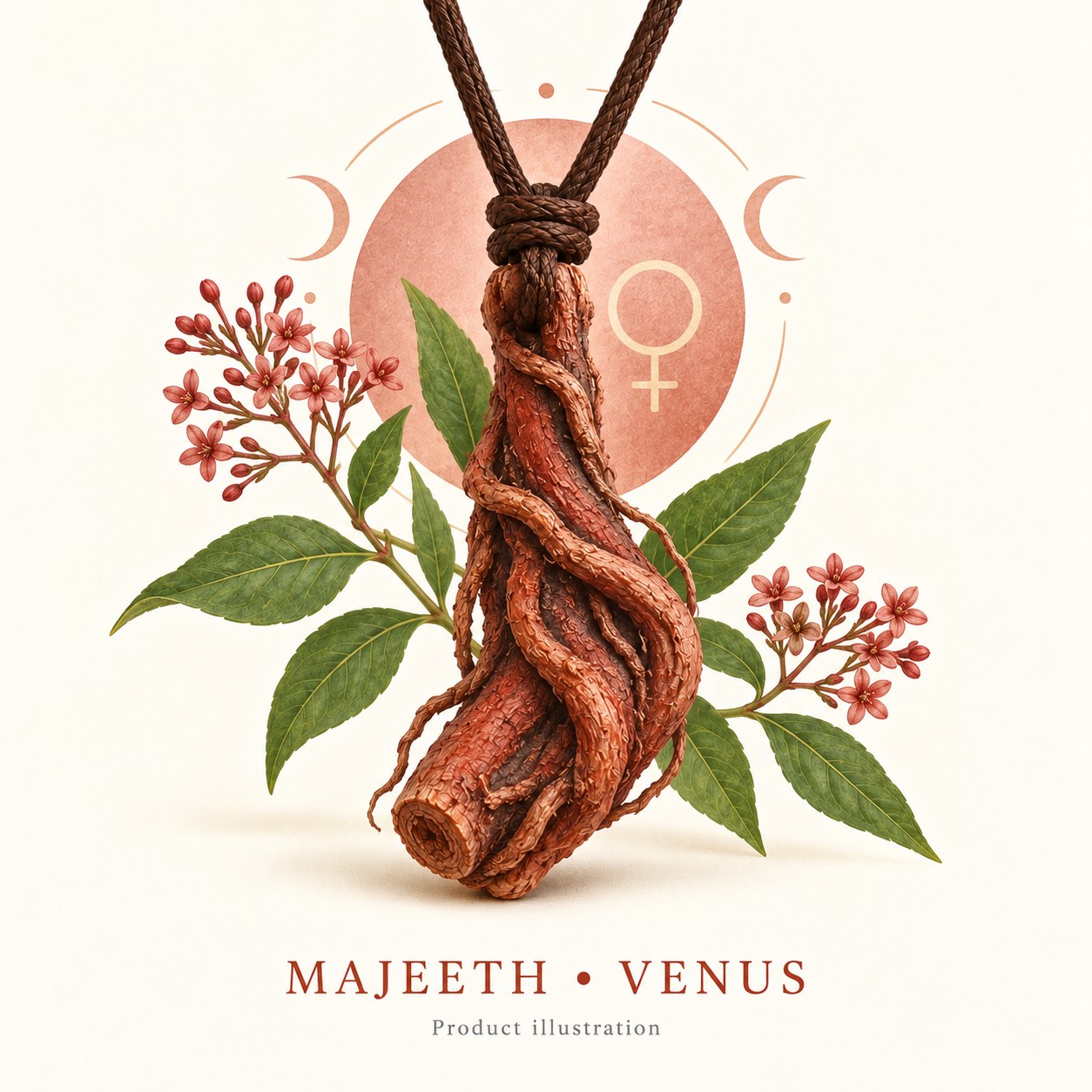
Majeeth root and Shukra (Venus) are connected in some contemporary planetary-herbal jewellery traditions. Shukra is a major graha in Vedic astrology, associated with beauty, creativity, relationships, partnership, refinement, enjoyment, jewellery, comforts and material pleasures. Majeeth, also known as Manjistha or Indian madder in many plant and herbal contexts, is a botanical material rather than a gemstone. The association of a Majeeth root pendant with Venus belongs to a devotional or practitioner-specific practice; it is not a reason to assume that every classical Jyotish text prescribes that exact root, or that a shop label certifies the plant contained in a pendant.
This guide explains the traditional Shukra associations in their broader astrological setting, how a family or practitioner might approach Friday observances and wearing customs, and how to understand a root pendant as a physical object. It also covers Majeeth/Manjistha names, plant identification, natural colour, sourcing, mounting, everyday care, other Shukra-related practices and frequently asked questions. Readers looking for a direct comparison between botanical jewellery and diamond or white sapphire should use the separate Majeeth versus Venus gemstones guide; this article concentrates on the meaning and use of the Majeeth–Shukra association itself. A Majeeth root pendant for Shukra is an item of planetary herbal jewellery, usually described as containing a plant part associated by a particular tradition or seller with Venus. The devotional meaning may centre on a personal sankalpa (intention) related to harmony, beauty, artistic practice, companionship or appreciation of life's comforts. That is different from stating that a root has been scientifically shown to alter planetary positions, cause marriage, restore affection, change bodily appearance or guarantee prosperity. People may value a symbol without claiming such material effects. The word Shukra refers to Venus within Jyotish. The word Majeeth refers to a traditional plant name, and a pendant is an assembled accessory. Three questions should remain separate: (1) what is the conventional planetary meaning? (2) what species and plant part, if any, are documented in the actual item? and (3) is the jewellery fitted and prepared for its intended wear? A credible description addresses each without using one to prove another. In mainstream Navagraha gemstone lists, diamond or Vajra/Heera is the better-known Shukra jewel. A root pendant is not a diamond or an automatically interchangeable astrological substitute. The exact herb-to-planet correspondences differ across lineages, contemporary charts and family customs. If your recommendation originated with a Jyotishi, ask which tradition was used and whether the instruction was specifically for Majeeth or for a broader devotional observance. Shukra Graha is Venus within the Navagraha scheme. Jyotish uses grahas as interpretive factors in a natal chart, together with rashis (signs), bhavas (houses), nakshatras, aspects, conjunctions, planetary strengths, timing systems and the native's wider circumstances. Shukra is widely described as a natural benefic and an important karaka, or significator, for marriage and partnership themes, intimacy and affection, aesthetics, poetry, music, fine arts, taste, ornaments, pleasures and comforts. Some traditions also relate Venus to fertility, reproductive or sexual themes in astrological interpretation; such references describe the symbolism of Jyotish rather than a medical function of a pendant. Shukra is also called Bhargava and Shukracharya in traditional narratives, celebrated as the teacher or guru of the Asuras. His mythological identity has a broader meaning than popular phrases such as “planet of romance.” It encompasses learning, discipline, understanding of desire, negotiation, enjoyment and the tension between comforts and restraint. A serious account of Shukra should not reduce the graha to attractiveness or luxury purchases alone. In commonly taught Parashari Jyotish, Shukra owns Vrishabha (Taurus) and Tula (Libra), is exalted in Meena (Pisces), and debilitated in Kanya (Virgo). Its Vimshottari mahadasha lasts 20 years. Bharani, Purva Phalguni and Purva Ashadha are traditionally the three nakshatras governed by Venus in the Vimshottari system. These descriptions provide context for discussions of Venus; they are not a conclusion that any individual should strengthen or appease Shukra by acquiring jewellery. One person's Shukra may be examined as the lord of particular houses and as a significator of specific areas; another person's chart can give the planet a different functional role. Even an exalted or well-placed planet is interpreted in relation to the whole chart, not in isolation. A product page cannot responsibly decide from the name “Venus” alone whether a recommended item is appropriate for everyone. Shukra's symbolic vocabulary includes saundarya (beauty), kala (art), relationships, ornamentation, refinement, material comforts, desire, enjoyment and the ability to appreciate pleasing forms. These ideas may be expressed through music, dance, painting, craftsmanship, gracious hospitality, relationship conduct and the aesthetic care of one's surroundings. Devotional jewellery can function as a visible or private reminder of such values. It need not be presented as a mechanical device for achieving them. In relationship discussions, a well-grounded symbolic intention might be patience, good communication, kindness, respect for boundaries, mutual responsibility or the art of listening. In creative life, it might involve consistent practice, sharing work, learning a skill or making space for beauty. Someone who appreciates Shukra's association with comforts could connect the practice with gratitude and responsible enjoyment rather than conspicuous spending. These are examples of how individuals interpret the symbol; they are not claimed effects of a plant worn against the skin. Consider the difference between a sankalpa and a product promise. “I will use this pendant as a reminder to approach my relationship thoughtfully” describes the wearer's own intention. “This pendant will make my partner return” describes an outcome that the object cannot verify. The first leaves room for agency and faith; the second replaces responsible behaviour with a commercial guarantee. A helpful article can explain both the sacred vocabulary and these distinctions without diminishing the importance that a family places on its customs. Other traditional Venus associations, including good clothing, fragrance, ornament, fine food, performance, textiles and pleasures, are most useful as cultural and astrological context. They do not indicate that an item must be expensive or that red root colour is inherently a sign of greater Shukra strength. Each association belongs to a different aspect of traditional and material description. Majeeth, Manjeeth, Manjistha and related spellings are encountered in Indian herbal markets and cultural writing. They are closely associated with Indian madder, particularly Rubia cordifolia L., in the Rubiaceae family. The plant is known for a history of dye-bearing root material and is described in ethnobotanical, botanical and Ayurvedic contexts. This background helps explain why Majeeth is recognizable in crafts and herbal traditions, but does not prove which plant a finished pendant contains. A necessary detail is that botanical taxonomy and traditional common names do not always line up one-to-one. Kew's Plants of the World Online recognizes Rubia cordifolia and Rubia manjith Roxb. as distinct accepted species. Older botanical literature, regional trade usage and common-name databases may use the word Manjistha or closely related terms in more than one way. A name on a bag or receipt is therefore weaker evidence than a documented taxon, source region, plant part and traceable lot. The linked Majeeth botanical identity and natural-colour guide explores this problem in greater detail. A botanical record can provide a scientific name, author citation, family, distribution and synonymy. The item for sale might be an exposed fragment of dried root, another underground plant part, a treated piece, or a sealed inclusion. A product description should say what the maker can actually verify. If the name is based on supplier usage without species-level confirmation, “sold as Majeeth/Manjistha root” is more transparent than unqualified certainty. Neither an attractive deep red-brown colour nor a traditional devotional label proves that a sample is Rubia cordifolia. Other plant pieces, staining, surface coating and photographic lighting can change appearance. Conversely, genuine botanical pieces may vary in colour, shape and texture. The physical identification question belongs to botany and sourcing; the Shukra meaning belongs to Jyotish and devotional tradition. Both can be explained side by side. Madder plants are historically associated with red dyes and with traditional herb uses. Plant materials containing colour-producing constituents were valued in textile and craft practices long before modern jewellery catalogues. That context makes Majeeth an interesting object in discussions of natural colour, weaving, adornment and Indian heritage. The history of red dye, however, is not direct evidence of a specifically Shukra-prescribed pendant. It is easy to mix together three claims that need different sources: “Madder plants were used for colour,” “this item came from the stated plant,” and “this plant was prescribed for Venus in a specific astrological lineage.” Evidence for the first can come from botanical and historical sources; the second requires traceability to the object; the third requires documented customary or textual attribution. One claim should not be presented as proof of the others. Where a practitioner offers a root association, it is useful to ask for the tradition's name, its regional usage and any identifiable teaching or source. Traditional Ayurveda may discuss Manjistha as a herbal substance for particular formulations and indications. A piece of plant enclosed in jewellery is not the same as a properly identified and prepared medicinal formulation. Historical references to internal or topical uses should not be transferred to a pendant's effects. There is no need to erase those traditional terms from cultural discussion; precision about the form and use of the object is enough. For a purchaser, dye history has a very practical consequence: visible colour may transfer, especially when a material is damp, rubbed against fabric or finished with unstable colour. Ask how a pendant is processed and whether exposed root surfaces are sealed or otherwise prepared. The spiritual story and the physical care information reinforce each other when they are presented clearly. The association of selected roots with the Navagraha is encountered in planetary herbal jewellery, modern astrological commerce and some local customary practices. Such lists are not as uniform as the familiar Navaratna list of major planetary gemstones. Even where two contemporary practitioners agree that a plant is connected with Shukra, they may describe different plants, procedures, weights, thread colours, wearing days or reasons. A commercially available “nine planetary roots” chart is not automatically a citation to a named Sanskrit work. We should therefore describe Majeeth for Venus as an attributed traditional association when that is what can be documented, rather than asserting that every Jyotish lineage uses it. If a specific classical verse or manual is supplied, it should be checked for its wording, transliteration, context and the actual botanical identification. Sanskrit names are sometimes mapped to modern plants with uncertainty; an apparently exact match in a retail catalogue may not solve that problem. This approach allows tradition to be treated seriously. A teacher's instruction, a family practice or a regional custom can matter to the wearer without being advertised as an undisputed universal rule. A buyer who wishes to follow a particular Jyotishi's prescription should verify the item with that practitioner instead of assuming that every Venus-labelled root pendant is equivalent. A customer who wants devotional symbolism may simply value the object's association and workmanship. Related products can be explored under Planetary Herbal Jewellery. When choosing between a single-graha pendant and a broader arrangement of plant roots, consider the advice being followed, the number of physical components, ease of maintenance and comfort; avoid ranking them by an unsupported scale of “energy strength.” Jyotish recommendations may refer to the janma kundali and the relationships among grahas, rashis and houses. The Shukra of a chart is interpreted through sign, house placement, planetary lordship, degree, dignity, conjunctions, aspects, combust or retrograde conditions where applicable, and its links to other factors. Many astrologers examine the Navamsha (D9), dasha and antardasha for questions involving marriage and partnership. Other practitioners apply different weighting and techniques. One simplified placement cannot reliably substitute for the full interpretive process. For example, an astrologer discussing Shukra as a significator of artistic inclination is not thereby recommending a gemstone or root. An astrologer examining difficult relationship periods may consider several grahas, house lords and timing factors before discussing observances. The statement “Venus is weak, therefore buy Majeeth” skips all of that reasoning. Even traditionally favourable-looking configurations can have nuances because of functional lordship and wider combinations. If birth-based guidance is requested, the practitioner may need the birth date, exact birth time and birthplace to calculate a chart. OmmRudraksha's consultation and guidance process is separate from the physical description of a pendant. A generated report should be treated as a structured interpretation that may be reviewed under the site's guidance workflow; it does not by itself guarantee that any product is necessary. A buyer should be able to ask why a particular object was suggested and whether a non-purchase devotional alternative is acceptable within that tradition. In particular, Shukra's 20-year Vimshottari mahadasha is an astrological timing period, not an instruction to wear a root for 20 years. Similarly, a Venus-ruled nakshatra is not proof that all its natives should use a Venus accessory. These distinctions prevent a long-standing symbolic system from being reduced to simplistic shopping rules. Friday, or Shukravar, is conventionally associated with Venus. Depending on family, sampradaya and region, observances may include puja, a short period of prayer, Shukra mantra or stotra recitation, offering flowers, lighting a lamp in an appropriate safe place, practising charity, or reflecting on the qualities associated with the graha. Some households connect Friday worship with Lakshmi, Santoshi Mata or other forms of the Divine according to local custom. These are living and varied practices, and a reader should not assume that one online list is binding on everyone. In Jyotish-oriented practice, one may encounter Shukra japa, Shukra shanti, dana, vrata and a personally chosen sankalpa. Some communities also pay attention to muhurta or planetary hora when beginning a prescribed observance. Exact mantra variants, pronunciation, repetition numbers, offerings, fasting rules and timings vary with lineage and instruction. Do not assume that the root pendant needs a prescribed count of repetitions simply because a general Friday practice is described elsewhere. Two widely circulated forms include the simple “Om Shukraya Namah” and the seed-mantra form commonly transliterated “Om Draam Dreem Draum Sah Shukraya Namah.” Different teachers use different spellings and ritual requirements. These forms are examples of contemporary devotional usage, not an assertion that chanting them is necessary for Majeeth jewellery or that they must be recited without guidance. Those following a formal initiation or established family text should use their own received wording. For a person who does not observe a Friday ritual, the accessory can remain a symbol of their tradition or an ornament. For a person who does observe, the root need not become the entire practice: respectful behaviour, study, worship, artistic effort and acts of generosity may be meaningful on their own. If fasting is part of a vow, choices about food and physical ability should be made with appropriate personal care; a pendant does not impose that requirement. A sankalpa is an intention or resolve made in a particular spiritual or ritual context. It may be personal, such as cultivating patience or appreciation, or connected with a prescribed puja under a teacher's guidance. Someone choosing a Majeeth pendant in a Venus-associated tradition may make a modest resolve to remember music, beauty, respectful relationships or gratitude. This is a useful way to explain the human side of the association without turning the accessory into a guaranteed external intervention. For example, a musician might associate Shukra with disciplined artistic practice and use a pendant to mark a commitment to daily riyaaz. A couple may value a family heirloom as a reminder of care and reciprocity. A designer may appreciate the botanical colour history. A devotee may choose the object while following a Friday puja taught by an elder. These motivations differ, but none requires a promise that a root makes another person behave a certain way. Spiritual marketing sometimes introduces fear: that a viewer will lose a relationship, become unattractive or suffer business failure unless a remedy is purchased immediately. That is not a sound basis for choosing a root, a gemstone or any other accessory. A straightforward product description offers the actual materials, what is known about the tradition, relevant photos, total price and a way to ask questions. Customers can then decide without being pressed to pay for a prediction. The Navagraha are interpreted as a system rather than nine isolated labels on separate products. Shukra may be read in relation to Guru (Jupiter), Budha (Mercury), Shani (Saturn), Surya (Sun), Chandra (Moon), Kuja/Mangala (Mars), Rahu and Ketu, depending on the chart and school. Classical relationships of friendship and enmity are one vocabulary; aspects, house placements, yogas and time periods form another. A superficial “Venus is always good, more Venus is always better” rule overlooks this complexity. When a customer is considering multiple planetary accessories, the useful questions are whether each was recommended for a specific reason, whether the separate objects can be worn comfortably, and whether they have incompatible care requirements. A dyed or botanical item may require moisture protection while a mineral ornament may tolerate different care. Several pendants with heavy fittings may snag or abrade each other. The materials cannot be combined safely or meaningfully merely by counting their associated grahas. If someone prefers a Navgraha necklet rather than one Shukra-associated root, they should distinguish a nine-root design from a nine-gem Navaratna and from a set of nine prayer items. These have different components, identification standards and customary explanations. Read the Rudraksha for planets collection for a separate product family, and consult the planetary-herbal category for items with plant components. The existence of several products does not imply that all must be combined. Physical authenticity means more than a plant name in a title. Start with the supplier's declared botanical name, plant part and origin. Where available, obtain lot or batch references, processing details, invoice descriptions and any genuine authentication or taxonomic basis. Scientific identification can be supported by qualified botanical examination of source material, herbarium vouchers or traceable supply documentation; a casual photograph is useful but may not be sufficient for species-level confirmation. Ask whether the pendant contains a dried root, another underground portion, an imitation, or a fragment embedded in resin or a capsule. A sealed pendant may make the contents harder to examine, so transparency about its maker and sourcing becomes important. Check if the material has been dyed, coated, polished, impregnated with binder or treated for preservation. If the seller does not know, the product description should not claim more than the evidence supports. Inspect the fitting. A drilled piece may show fibre disturbance around its hole; a mounted piece may be clamped or glued; a capsule may have a screw top, seam or resin fill. Check for sharp edges, loose adhesive, flaking, shedding, gaps around a seal and unsuitable finishes where the item touches skin. Ask for measured pendant dimensions and weight, actual photographs rather than only a symbolic illustration, and a practical care note. One should also distinguish botanical certificates from jewellery quality documents. A supplier note can support traceability but is not identical to a laboratory identification. A stamp on a metal fitting concerns its metal claims, not the species of a plant enclosed in it. Genuine provenance is strongest when the different records are consistent, specific and tied to the actual lot or piece being sold. Someone may receive instructions to wear a Shukra-related object on Friday, use a particular thread colour, chant a mantra, place the item in a locket, or keep it on the body. In many published lists these details are not consistent. The particular directions from a family elder or named practitioner are more relevant to that person's observance than a generic instruction on a shopping page. The seller's role is to describe what is physically supplied and how it can be worn without damage. A pendant worn around the neck should have a suitable chain or cord length, strong closing mechanism and manageable weight. If it contains exposed botanical material, repeated sweating and bathing can cause swelling, staining or deterioration. A well-enclosed piece may resist casual contact better, but its seal and adhesives still require care. Leather, cotton, silk, plated metal, stainless steel and precious metals have different maintenance and skin-contact considerations. The material should be named; it should not be inferred from a photograph. Traditional advice may mention keeping a pendant above clothing or close to the body. This choice can affect wear and comfort. If exposed plant material touches the skin, ask about its processing and whether direct contact is intended. If a wearer experiences irritation, remove the accessory and review the contact materials. Plant identity, natural origin or devotional value should not be confused with being automatically hypoallergenic. If worn with gemstones, Rudraksha or a Navgraha arrangement, check for friction at the pendant surfaces and fittings. Gemstones, metal charms or bead edges can damage a soft botanical component; a heavy chain may break a lightweight mount. Keep the item according to its own construction, whether or not several pieces share a ritual meaning. A botanical pendant is not cared for like a diamond, sapphire or metal bangle. The safest initial approach for an unidentified or untreated plant fragment is minimal handling, no soaking and protection from sweat, perfume, detergent, oil, extreme heat and direct prolonged sun. Use a soft dry cloth on the external fitting as appropriate; do not scrub exposed root material or assume an alcohol wipe is safe. A metal clasp may have a separate recommended cleaning routine, but liquids used on that clasp should not reach the plant or adhesive. After wearing, examine the pendant for moisture, loose fibres, colour transfer, cracks or changes in its enclosure. Store it separately in a clean, dry pouch or box so that stones and chains do not abrade the surface. Avoid keeping an unsealed fragment in a bathroom, near a humidifier or inside a damp ritual tray. If a capsule develops condensation, discoloration or an open seam, stop wearing it until the assembly is assessed. When the pendant is part of a puja, keep offerings such as turmeric, kumkum, milk, water, perfumes, oils, incense ash or other substances away from the exposed root unless the maker confirms that the actual product can tolerate them. Symbolic practices need not damage the material; a separate altar space or dry respectful handling may be preferable. Do not treat root fragility as a deficiency in spiritual meaning. Travel brings additional risks. A pendant can be crushed by heavier ornaments, bent while packing or exposed to high humidity. Photograph the actual item before travel if it has sentimental importance. Use a small padded container with the cord fastened separately, and inspect any screw-top or adhesive closure after unpacking. If the material is visibly breaking down, seek practical replacement or repair advice rather than applying household glue without knowing its compatibility. Start with an accurate description rather than an emotionally charged claim. A good listing should state the material as far as verified, whether the pendant is exposed or enclosed, its dimensions, visible colour, fitting material, current photograph, handling precautions and price components. If a supplier cannot name the botanical species, they should make that uncertainty clear. This does not prevent a customer from appreciating the devotional meaning; it gives the buyer an honest account of what is being bought. Prices can reflect sourcing, preparation, enclosure workmanship, metal fittings, hand assembly, packaging and service. A higher price does not prove a stronger planetary effect or better botanical identification. A simple root pendant with a durable mount might be more suitable for occasional devotional use than an ornate item that is uncomfortable, fragile or difficult to maintain. Conversely, a sealed well-made ornament may justify additional cost because of construction rather than claimed astrological strength. Ask whether the actual photograph corresponds to the delivered item or merely illustrates a product type. Natural plant fragments vary in grain, thickness, colour and visible markings; these differences should not automatically be called defects, nor should major damage be hidden under the label “natural variation.” The seller should distinguish expected variation from cracks, unstable coatings, shedding, broken thread, visible glue or insecure hardware. For a current item, start at the Majeeth (Manjistha) Root Pendant for Venus product listing. The site may provide additional materials, measurements or care guidance through its customer service. Read the product and article together: the article explains conventional meaning and general material principles, while the current product listing should tell you what is actually available for sale. Shukra's traditional principal Navagraha gemstone is diamond (Vajra or Heera) in commonly cited gem lists. White sapphire, colourless zircon and other pale stones are discussed as substitute gems in some later or contemporary systems; practitioner lists vary. The identity of each gem depends on gemological properties and disclosure of natural, treated, laboratory-grown or simulated material. A Majeeth root is botanical and is evaluated using different criteria. A comparison that reduces them to a single numerical “power” ranking is unhelpful. The familiar terminology of ratna and uparatna does not give every herbal accessory a direct equivalence with an identified gemstone. If a Jyotishi recommends diamond specifically, replacing it with a root pendant is a question for that practitioner, not an assumption that follows from sharing the word Shukra. If a practitioner instead recommends devotional observances or a plant object, it may be inappropriate to reinterpret that as an instruction to spend money on diamond jewellery. Materials also behave differently. Diamond and sapphire are crystalline gems normally mounted in jewellery settings and evaluated for durability, treatments and workmanship. Dried botanical fragments can be vulnerable to moisture, colour transfer, shedding and enclosure issues. The right product depends on the actual intention, preferred tradition, available documentation, construction, comfort and personal budget. Our Majeeth root versus diamond and white sapphire comparison contains the detailed buying analysis. Some questions belong with a botanical supplier and some with the person interpreting Shukra. The seller can clarify source records, plant material, current product photograph, fittings, processing, care and return conditions. The Jyotishi or family teacher can explain why a particular object was associated with Venus, whether the instruction was specific or symbolic, and whether a particular mantra, date or wearing custom belongs to that lineage. An answer from one party should not be presented as if it settles the other's expertise. Ask the seller: Is the root species known? Is the pendant sealed? Is there any dye or coating? Which part touches the skin? Can the maker provide actual measurements and a close photo? What should be avoided during cleaning? Ask the practitioner: Is the practice based on a named source or family custom? Is the recommendation tied to an actual chart? Does it require a particular item, or can prayer, study, charity or another non-purchase practice serve the intended observance? Can the wearer follow the practice comfortably and consistently? Documenting these answers reduces confusion when several spellings, stones and root names appear on the same website. It also lets an artisan or shop describe a beautiful item without overstating what is known about its plant identity or devotional lineage. Traditional spiritual vocabulary deserves enough space to retain its actual meaning. The names Shukra, Shukravar, graha, ratna, mantra, puja, japa, sankalpa, vrata, dasha, bhava and karaka have distinct roles; reducing all of them to “positive vibes” would make the article less useful. At the same time, accurately identifying a plant and distinguishing custom from a classical textual prescription makes the article more helpful to practitioners and customers alike. In practical retail copy, a statement such as “Majeeth is associated with Shukra in this planetary herbal jewellery collection” is more precise than claiming universal astrological authority. A statement such as “traditionally Shukra relates to aesthetics and relationships” describes a recognised symbol. A statement such as “this pendant guarantees marriage, financial gain or treatment of reproductive illness” wrongly turns symbolism into an assured outcome. The distinction protects the meaning of the tradition as well as the quality of the product description. The OmmRudraksha site already supplies general terms and a common disclaimer. Individual articles need not repeat a long generic notice in every section. They do need accurate material descriptions, clear attribution of specialised traditional recommendations, honest buying and care information, and the avoidance of specific unsupported outcomes. Those are editorial accuracy requirements, not a reason to discard detailed Jyotish terminology. Current accepted scientific names for madder plants can be checked against the Royal Botanic Gardens, Kew resource Plants of the World Online: Rubia cordifolia. Kew also lists Rubia manjith as another accepted taxon. These records help distinguish plant species and nomenclature; they do not authenticate a private pendant or say that a particular root was universally prescribed for Venus. Well-known Jyotish introductory material describes Shukra's sign lordships, dignity, Friday correspondence, the Venus-ruled nakshatras and the principal gemstone diamond. When a product is sold under a more specific herbal-planetary correspondence, its source should be named if available. A relevant classical citation would need a verified text, chapter, wording and contextual interpretation rather than simply repeating a statement from another shop. In the absence of that attribution, the honest description remains “a tradition followed by some practitioners or retailers.” The references therefore perform different jobs: botanical nomenclature supplies scientific context, material inspection concerns the offered product, and Jyotish sources supply interpretive vocabulary. That division allows detailed spiritual content and precise product information to coexist. A Majeeth root pendant can be meaningful to a wearer following a Venus-associated herbal tradition. Shukra's established symbolic vocabulary includes beauty, artistic expression, companionship, refinement, comforts and the responsible enjoyment of life. Those meanings deserve thoughtful explanation, not a short generic phrase. But the exact Majeeth–Shukra correspondence should be attributed to its actual tradition, and botanical identity must be assessed independently of the devotional label. To choose a piece well, ask what the custom means to you, what species and plant part the supplier can document, how the accessory is constructed, whether it suits daily wear and how it must be stored. A family observance or Friday practice need not depend on an expensive purchase. A well-described piece can be appreciated for its personal and cultural significance without unsupported claims about relationships, health or financial outcomes. Explore the current Majeeth (Manjistha) Root Pendant for Venus, revisit Majeeth root identity and natural colour, or read Majeeth versus Venus-associated gemstones. The wider Planetary Herbal Jewellery collection provides the broader context for these accessories.Quick answer: what does Majeeth for Shukra mean?
Layer What it explains What it does not establish Jyotish tradition Why someone connects an item with Shukra, Venus, Friday or a personal sankalpa The botanic identity of a root or a measurable result from wearing it Botanical identity Which Rubia species or other plant is documented, and which plant part was supplied That the plant was prescribed in a particular classical astrological text Jewellery construction Cord, clasp, enclosure, coating, comfort, size and care The appropriateness of a graha remedy for a birth chart Personal practice How a wearer chooses to remember a devotional or ethical intention A requirement that everyone wear the same root or perform one ritual Who is Shukra in Vedic astrology?
Topic Conventional association Practical interpretation Sanskrit name Shukra; also Bhargava or Shukracharya in traditional contexts Different names refer to the same graha, not distinct accessories Weekday Shukravar, Friday A day chosen for some observances and family customs Owned rashis Vrishabha (Taurus) and Tula (Libra) One factor considered when examining lordship and dignity Exaltation / debilitation Meena (Pisces) / Kanya (Virgo) A traditional dignity scheme, not a purchase instruction Nakshatras in Vimshottari Bharani, Purva Phalguni, Purva Ashadha Relevant to timing frameworks and dasha lords Vimshottari mahadasha 20 years Astrological period length, not the time an ornament must be worn Familiar Navagraha gem Diamond / Vajra / Heera Distinct from a contemporary herbal pendant association Associated themes Arts, beauty, partnership, enjoyment, comforts, refinement Symbolic domains interpreted alongside the chart and other factors Venus symbolism: harmony, relationships, arts and refinement
What is Majeeth or Manjistha? The plant-name question
Term or feature What it usually means What to verify Majeeth / Manjeeth Regional or commercial name associated with madder Scientific name used by the supplier; botanical traceability Manjistha / Manjishtha Sanskrit and widely used herbal name Which accepted taxon and plant part the item actually contains Rubia cordifolia L. Accepted botanical species in Rubiaceae Whether batch-specific evidence identifies this species Rubia manjith Roxb. Another accepted Rubia species in current taxonomy Avoid assuming it is merely an alternate spelling of cordifolia Root or root-like fragment A material description used for jewellery Actual organ, processing, dimensions and stability Red or brown tone Possible colour from dye-bearing tissues or finishing Coating, treatment, transfer to fabric and light conditions Venus or Shukra label Traditional planetary association Which lineage, maker or practitioner provides the correspondence Madder colour and cultural history are not the same as a planetary prescription
Is Majeeth an ancient, universal remedy for Venus?
How Shukra is interpreted in an individual birth chart
Question Why it matters Caution Which chart and method were used? A birth-based interpretation depends on chart calculation and technique Do not infer from a single sun sign What houses does Shukra rule here? Functional lordship changes the interpretation in different ascendants A natural benefic is not identical in every horoscope What are the relevant dignity and aspects? Placement and associations affect traditional judgement A single exaltation/debilitation label is incomplete Is a dasha or antardasha being discussed? Traditional timing can influence the reason for advice Do not confuse dasha duration with jewellery wear duration Is the recommendation for a gem, root or observance? Different object categories have different meanings Do not silently substitute one for another Is the advice from a named lineage? Plant-to-graha correspondences can vary Avoid claiming a universal Majeeth rule Can the practice be followed without buying? Mantra, reflection, charity or worship may be chosen in some traditions Do not treat purchase as compulsory Shukravar: Friday observances and devotional context
Practice Meaning within a tradition Practical note Shukravar prayer or puja Personal observance associated with Shukra or the family deity Follow family or teacher guidance on sequence and offerings Mantra or stotra Repetition, contemplation or devotional recitation Spelling, counts and procedures vary across lineages Sankalpa A clearly expressed personal intention Not a promise of an outcome from a purchased item Dana or seva Charity, generosity or service Select a meaningful and appropriate form of giving Art or aesthetic practice Time devoted to music, craft, design or appreciation An interpretation of Venusian qualities, not a compulsory ritual Wearing jewellery Ornament or sign of an observance Construction, allergies, fit and care remain relevant Fasting or vrat A custom followed in some homes and traditions Not universal; consider health and individual circumstances Sankalpa and intention: a traditional vocabulary without sales pressure
Shukra, other grahas and the problem of simplistic combinations
How to identify and document a Majeeth root pendant
Check Question to ask Why it matters Plant identity What is the exact declared Latin name, and what evidence supports it? Avoid mistaking a broad common name for a certified species Plant organ Is it verified root, rhizome, stem, bark or an enclosure of mixed material? Different parts have different shapes and care needs Supply source Is a batch, supplier or traceability record available? Connect identification to a particular piece or lot Surface preparation Is it naturally coloured, dyed, coated, sealed or stabilised? Understand colour transfer and maintenance Mounting What holds the material: metal, cord, glue, resin or capsule? Assess wear and repair needs Wear surface Does plant, adhesive, plating or resin touch the skin? Choose a suitable fitting and avoid irritation Measurements What is the current item’s size, length and weight? Photographs can distort actual proportions Care instructions What about sweat, water, fragrance, light, heat and storage? Protect botanical material and the assembled accessory Tradition Who attributes Majeeth specifically to Shukra? Distinguish a documented custom from a universal statement Wearing customs: thread, pendant placement, timing and combination
Daily care for Majeeth root jewellery
Situation Preferred approach Avoid Normal daily wear Check fittings, keep the botanical material dry, remove for water activities Showering or swimming while wearing exposed root Perfume and cosmetics Apply products before putting on the pendant and allow them to dry Spraying fragrance, solvent or hair spray directly onto it Cleaning Dry soft cloth on appropriate external surfaces only Soaking, detergent baths, alcohol or abrasive polishing Friday puja Follow devotional practice while protecting the physical plant and enclosure Wet offerings or hot substances directly on an unsuitable material Storage Separate dry pouch or rigid box, away from heavy jewellery Humidity, direct heat, crushing or friction Condensation or cracks Stop wearing and ask maker about repair or enclosure replacement Forcing a seal open or using unknown adhesives Skin discomfort Remove it and check metal, dye, resin, thread and plant-contact surfaces Assuming natural material cannot irritate skin How to choose a genuine, usable piece without overpaying
Majeeth root and diamond are different traditions and materials
Questions to ask the seller or the Jyotishi
An informed way to describe spiritual significance
References: what botanical and Jyotish sources can establish
Frequently asked questions about Majeeth and Shukra
Conclusion: keep the Shukra meaning and the Majeeth material distinct
