
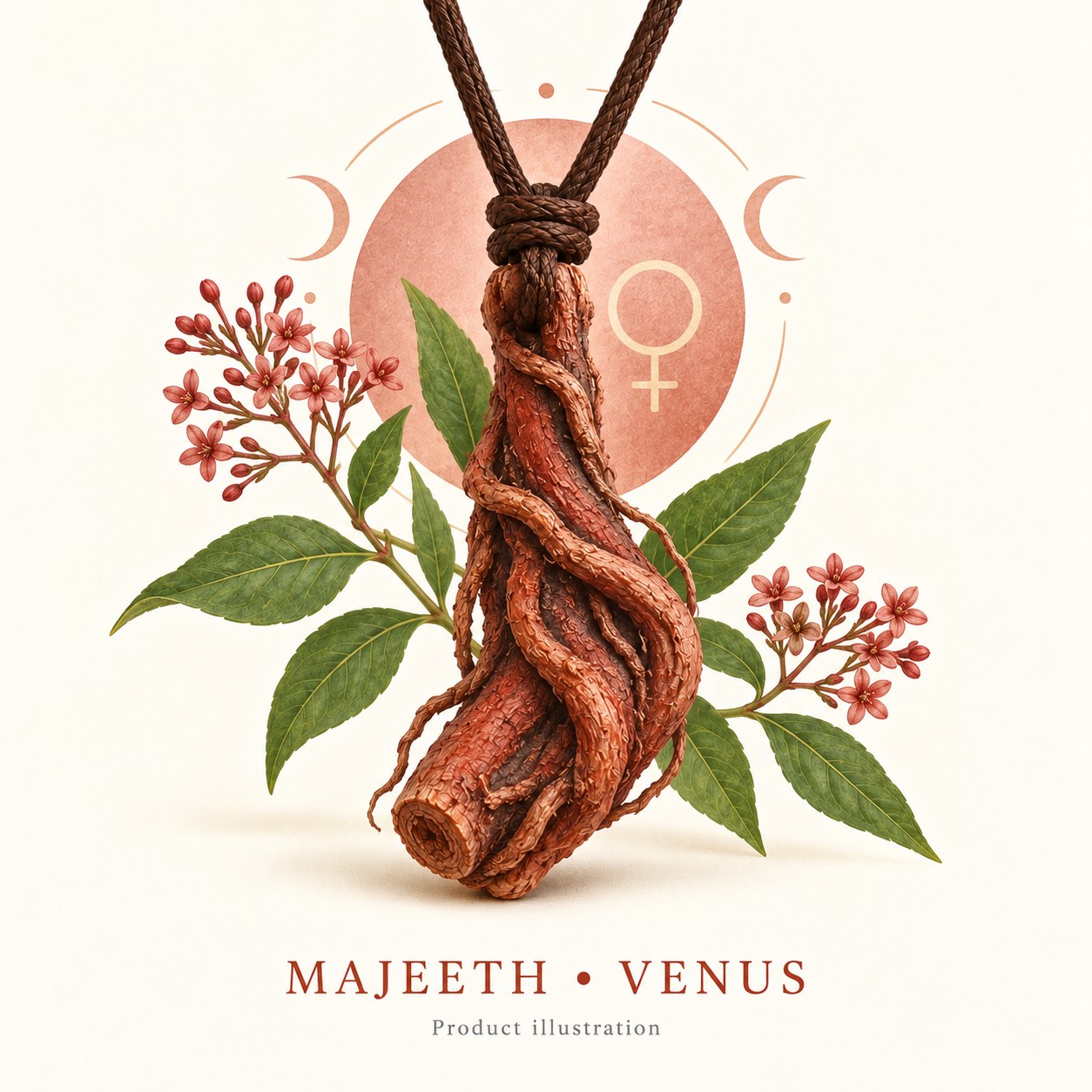
Majeeth root pendant versus Venus-associated gemstones: these objects may appear in the same Shukra or Venus conversation, but they are made from fundamentally different materials and belong to different strands of customary practice. Majeeth, Manjeeth or Manjistha is a plant name used in herbal traditions. A pendant sold under that name is a botanical accessory whose identity, processing, enclosure and care need to be understood. Diamond, white sapphire and other pale gemstones are minerals or crystals assessed through gemological features such as species, origin, treatments, cutting, setting and durability. A shared planetary heading does not mean that a root pendant is a diamond, has the properties of corundum, or is a universally accepted replacement for a specific stone.
For someone selecting jewellery through a family practice, a Jyotish consultation or personal devotion, the useful question is not simply “Which is stronger?” It is “Which tradition am I following, what physical item am I choosing, how is it described, and what will daily ownership involve?” This article compares the symbolic role, botanical and gemological identity, authenticity evidence, appearance, cost structure, practical maintenance and common questions. The discussion of traditional Shukra associations respects Jyotish vocabulary without presenting a purchase as a guaranteed change in relationships, wealth, appearance or health. In many Navagraha gemstone lists, diamond (Heera or Vajra) is the principal jewel associated with Shukra. Some later or present-day practitioner lists discuss white sapphire (Safed Pukhraj), colourless zircon or colourless topaz as alternatives or uparatna; the lists and their instructions are not uniform. An item sold as a Majeeth or Manjistha root pendant for Venus is a different category: planetary herbal jewellery. It may have significance within a shop's, practitioner's or family's practice, but its suitability is not established merely by calling it an alternative to diamond. Where a horoscope-based recommendation matters, ask the practitioner to name the actual object and explain the tradition behind it. In every case, independently inspect the physical product. A botanical supplier should provide as much information as possible about the plant and plant part. A gemstone seller should identify the gem and disclose relevant treatments, mounting details and report limitations. The Majeeth identity and natural-colour guide and the Shukra tradition guide explore the two sides in greater depth. Shukra is the Sanskrit name of Venus, one of the Navagraha considered in Vedic astrology. Jyotish texts and living traditions associate Shukra with pleasure, refinement, beauty, music, poetry, marriage and partnership themes, comforts, ornaments, luxury, artistic ability and forms of enjoyment. Shukra is traditionally the ruler of Vrishabha (Taurus) and Tula (Libra), and is also examined through house position, dignity, aspects, conjunctions, yogas, divisional charts, dasha and antardasha, and the full structure of a birth chart. These interpretive factors explain why a practitioner may discuss Venus in a consultation; they do not identify the material in a pendant. Customary acts associated with Shukra can include Shukravar (Friday) observances, mantra, puja, dana, attention to relationships, aesthetic discipline and the wearing of selected ornaments. Families and practitioners may differ over whether a gemstone should be worn at all, which metal is preferred, how a ring or pendant is prepared, and how a herbal object is understood. Even within gemstone practice, a graha's associations do not automatically mean that strengthening it is appropriate in every horoscope. Detailed recommendations depend on the method being followed and should not be inferred from sun sign or one isolated condition. The distinction between ratna (gem), uparatna (substitute or secondary gem in some traditions) and an herbal accessory is useful here. These are not three grades of the same substance. Ratna refers to gemstones and carries its own historical literature on quality and appraisal. Uparatna lists vary by school and commercial usage; an entry on one contemporary chart is not evidence of a universal classical prescription. Herbal jewellery belongs to a separate practice in which plants and their parts may be associated with grahas. Treat each category with the vocabulary appropriate to it, rather than collapsing all of them into an unverified promise that one is an identical substitute for another. Diamond or Vajra appears as the Shukra gem in widely cited Navagraha lists. The word Diamond tells a jeweller about a particular carbon crystal; the word Shukra tells a Jyotishi about a planetary tradition. They can inform one purchasing decision, but the evidence systems remain separate. A diamond identification or grading report is not an astrological recommendation. Similarly, an interpretation of Shukra in a horoscope does not certify that a stone is a diamond or that a plant fragment came from a particular species. White sapphire is frequently introduced in modern shopping as a Venus-associated alternative. That does not make white sapphire another name for diamond. Sapphire is corundum, with different optical properties, durability details, market prices and possible treatments. There is room to compare both aesthetically and traditionally, provided the objects are named precisely. When a seller uses the word “Venus stone” without naming the material, ask for the mineral species and whether the item is mined, laboratory-grown, treated or simulated. These details matter more than an unexplained planetary label. Majeeth, Manjeeth, Manjistha and related spellings appear in Indian plant and herbal commerce. An important botanical reference for these names is Rubia cordifolia L., a perennial member of the Rubiaceae family, commonly described as Indian madder or heart-leaved madder. Kew's Plants of the World Online accepts Rubia cordifolia; botanical descriptions describe scrambling or climbing growth and root material containing a red dye. These descriptions help explain the plant's longstanding colour and cultural uses. They do not independently establish what is inside any particular jewellery item. One naming detail deserves special attention: Kew's medicinal-plant name resource lists the non-scientific name “manjishtha” against both Rubia cordifolia and Rubia manjith in records from different sources. Kew's botanical checklist currently recognises Rubia manjith Roxb. as a distinct accepted species, not simply an alternative spelling of Rubia cordifolia. Older literature also uses names such as Rubia munjista, which need taxonomic reconciliation. Therefore “Manjistha” is a meaningful traditional and commercial name, but it should not be treated as proof of one particular scientific identity without a source or batch record. The safest catalogue approach is to keep the name customers recognise while specifying exactly what has been checked: “Majeeth (Manjistha) root pendant; botanical identity supplied by the maker where verified.” If a lot has documented identification as Rubia cordifolia, say so and keep the supporting record. If the evidence only supports a local trading name, do not silently attach a Latin binomial to every unit. This matters for traceability, avoiding incorrect plant claims and advising sensible material care, not for diminishing the traditional use of the accessory. The historical role of madder as a dye source is useful for practical jewellery decisions. Colour in a dried plant component can vary with plant part, age, storage, preparation and surface finishing. A red or brown surface is not a reliable species test, and a bright product photograph can be affected by lighting or editing. Someone intending to wear the accessory against pale clothing should ask whether the surface is sealed, whether any pigment can rub off, and what exposure to sweat or perfume may do to the material. Colour and identity are related questions, not the same question. A customer wishing to investigate the original plant can consult Kew Plants of the World Online — Rubia cordifolia, the single established botanical reference preserved from this article. It is a botanical name and description resource, not a seller's certificate for a finished pendant. The dedicated Majeeth identification, colour and history article explains the plant background more fully. A root pendant may consist of a dry botanical fragment suspended on a thread, retained in a cap, fixed within a metal fitting, wrapped in wire or enclosed behind a protective surface. The manufacturing choice changes the accessory's appearance, weight, contact pattern and care requirements. A naturally irregular plant piece does not present the uniform dimensions of a faceted gemstone, and an exposed cut edge behaves differently from a polished mineral face. Photographs should show the actual construction rather than only a decorative concept image. Ask first whether the material is exposed or sealed. A sealed enclosure may reduce direct contact with pigments or fibres, but the enclosure introduces its own possible issues: adhesive quality, surface fogging, a loose seam, moisture trapped during assembly or a metal finish that wears with time. An open pendant may offer a tactile traditional presentation but may require greater care around perspiration, cleaning fluids and handling. Neither construction is automatically superior. The choice depends on how the piece is intended to be worn and whether its condition has been inspected. The second question is whether the item is an identified root, a rhizome, an aerial stem or another prepared botanical part. Plant jewellery vendors sometimes use “root” as a broad commercial category. That shorthand can be understandable in a product menu, but it should not override a more accurate part description when evidence is available. A cut section alone rarely enables a buyer to confirm the species by eye. Supplier documentation, photographs of the collected plant, preparation notes and the assembly lot provide more useful evidence than home scratch, soaking or burning experiments. Finally inspect the clasp, cord, connector and any metal touching the skin. A decorative red-brown root does not tell you whether the chain contains nickel, the mount is plated, a coating has been applied or the fitting is appropriate for prolonged contact. Ask for total length, pendant dimensions, approximate weight, how firmly the material is held, and what happens if it becomes wet. These are ordinary jewellery questions that remain important even when the wearer values the piece for a Shukra custom. Diamond is a crystalline form of carbon. Its exceptional scratch resistance gives it the highest value, 10, on the Mohs hardness scale, but scratch hardness should not be confused with invulnerability. A diamond can chip or break under a forceful impact in an unfavourable direction, and settings can bend or loosen. For everyday ownership, the centre stone's properties and the safety of the mounting both matter. A diamond ring used at work will have different practical exposures from a diamond pendant worn occasionally for a festival or a personal observance. Commercial diamond assessment commonly uses the four Cs: cut, colour, clarity and carat weight. These describe appearance and physical characteristics of a diamond, and they interact with one another in the price. A larger stone is not automatically the better purchase; an attractive cut, well-matched setting and clear disclosure of treatment or laboratory origin are often more useful than a single impressive carat figure. Jewellery quotations must distinguish the stone from the metal, making charges, taxes, certification fees and other services. A handwritten promise of spiritual benefit is not a replacement for a precise invoice. Natural mined diamonds and laboratory-grown diamonds are both diamonds in mineral composition, but they differ in origin and can differ markedly in price and market positioning. A diamond simulant is different again: it may resemble diamond visually without having the same chemistry or physical properties. Labels such as “American diamond,” “CZ,” “moissanite” or “diamond look” must be interpreted as their stated materials, not silently upgraded to diamond. Someone following a specific Jyotish instruction should confirm whether the practitioner intends natural diamond, another named gemstone, or simply a decorative pale stone. Reports may provide identification, grading and characteristics for the examined stone. Their value is highest when the report number, issuing laboratory and report details correspond to the item actually being bought. A seller's printed product certificate is not necessarily equivalent to an independent gemological report. Nor does a genuine diamond report provide botanical information about Majeeth or prescribe a Shukra remedy. Learn the scope of each document rather than expecting one piece of paper to settle every question. From a design perspective, a diamond offers transparent brilliance and a vast range of mountings. A root pendant offers a markedly different visual language: botanical texture, traditional colour and handcrafted character. They should be compared as real goods, not judged by which one sounds more exalted. Price, wearing comfort, ethical sourcing questions, craftsmanship and the purchaser's devotional preference may legitimately point in different directions. White sapphire is the colourless or very pale variety of corundum, the same mineral family as blue sapphire and ruby. Its Mohs hardness is 9. It has good resistance to everyday scratching and does not have the pronounced cleavage found in some other gemstones. Although sapphire can be a durable choice for rings or pendants, settings and existing fractures still require inspection. Diamond and sapphire do not have identical brilliance, optical behaviour or resale characteristics, so it is misleading to treat them as the same gemstone under two names. In current Shukra-related shopping, some practitioners or shops offer white sapphire as an alternative to diamond. The existence of this convention does not by itself settle whether a particular horoscope calls for either stone. The adjective “white” does not make it astrologically universal, and the expression “Safed Pukhraj” is a trade and cultural label that should be accompanied by a clear mineral identification: sapphire, corundum. A seller should also state whether the stone is natural or laboratory-grown and disclose any known or detectable treatments, as appropriate to the source and report. Gemological evaluation of white sapphire considers actual transparency, inclusions, cut, polish, size, treatments and the jewellery setting. A stone described as “clear” should not automatically be represented as flawless. Some sapphires receive treatment; not all treatment types are equivalent, and the buyer should read what an applicable report actually says. A colourless stone set in a shiny metal can also appear more brilliant in a staged photograph than it does under ordinary light. Request neutral-light images, a scale reference and an image of the mount from the back or side. The site already has a White Sapphire collection. That is a useful route for seeing available gemstones, but individual current product attributes must still be checked. By contrast, a Majeeth root pendant calls for the description of a dried plant component and its housing. These items can share a page of Shukra-related choices without sharing the same identification test or care routine. Modern Shukra shopping lists sometimes mention colourless zircon or white topaz among alternatives, and individual sellers may introduce other pale stones. These names must be treated separately. Natural zircon is a mineral with notable fire and often a brilliant visual appearance. It is not cubic zirconia (CZ), which is a manufactured zirconium-dioxide material commonly sold as a diamond simulant. Their names sound related, but their chemistry, toughness, value and identification differ. A buyer who asks for “white zircon” should not be handed unlabelled CZ without a clear explanation. Natural zircon has a broad Mohs hardness range of approximately 6–7.5 and may show abrasion at exposed edges under hard use. Because of brittleness and treatment considerations, it needs gentler handling than sapphire. White topaz, a different mineral, has a Mohs hardness of 8 but prominent cleavage. A sharp impact or stress at an unfavourable angle can damage it. Topaz may be an attractive affordable jewellery material when correctly disclosed, yet its cleavage and possible coatings mean cleaning advice should be tailored to the actual stone. Colourless quartz, glass, CZ, synthetic moissanite and laboratory-grown stones can also be visually pale or brilliant. The appearance alone does not turn them into diamond, sapphire, zircon or topaz. Some objects are perfectly suitable as decorative jewellery even when they are manufactured. The issue is accurate representation. If a practitioner names a specific gem, do not silently substitute another just because both are white. If the purchase is aesthetic rather than horoscope-specific, different options may be evaluated by visual preference, known composition, durability and cost. Some gem sellers market “opal,” “pearl” or even colourless crystals in Venus-related assortments. These associations vary substantially by school and should not be presented as a universally accepted uparatna hierarchy. Opal and pearl also have their own very different care requirements. An organic pearl should not be cleaned like corundum, and an opal may be sensitive to impacts or environmental conditions depending on its type and treatment. For this article's primary comparison, diamond and white sapphire provide a clearer starting point, with zircon and topaz discussed as specifically named options rather than claimed universal replacements. The word “substitute” needs context. In a practical sense, someone may choose a traditional herbal accessory instead of purchasing an expensive gemstone. In a specific family or practitioner's practice, Majeeth may be described as a plant material associated with Shukra. But that does not establish that every classical Jyotish text treats Majeeth root as materially or ritually identical to diamond. Herbal classifications and modern retail compilations have varying lineages; a careful description should name the practice being followed when possible. In the same way, a white sapphire may be offered as an uparatna in a contemporary gemstone recommendation, without making it a universally agreed replacement in every school. Some astrologers prefer a specific gem, some use rituals or observances without jewellery, and others place emphasis on whether the graha should be strengthened at all. A customer should not feel compelled to accept an expensive item solely because one seller calls it the only way to address Venus. Nor is a lower-priced herb necessarily “weaker” in a scientific sense; that comparison is not a measurable material property. A respectful way to discuss the options is to separate three questions: What does this tradition associate with Shukra? What does this person's practitioner recommend, based on the complete chart and approach? What is the actual, verified product offered for purchase? The first is a matter of traditional knowledge. The second is an individual interpretive choice. The third concerns factual product information. Keeping them distinct produces clearer guidance and avoids confusion when customers later compare an invoice, a report or an online listing. Shukravar, the Friday associated with Shukra, is often named in popular observances. Mantra, puja, offering and wearing customs vary by lineage and family. Gemstone ring recommendations may include a particular metal, finger, day or time; root pendants may instead be worn on a cord or in a capsule. These details are customs, not identification methods. The claim that every Shukra object must be prepared in one identical way is too broad. Where a personal ritual is important, follow the guidance actually received rather than copying an instruction intended for a different material or a different person's horoscope. The Majeeth root and Shukra traditions article explores that context, while the current comparison concentrates on identifying and living with the objects. The broader Rudraksha for planets collection is another distinct category to browse, not a reason to assume Rudraksha, root and gemstones have identical rules of choice. The purpose of these links is to help readers select the relevant kind of information rather than rely on a generalised planetary slogan. Botanical identification is normally tied to the source plant, the collected part, relevant photographs or a voucher specimen, taxonomic assessment, and an identifiable batch. Ideally a chain of records connects the collected plant material to the processed piece and the finished pendant. Dry fragments are often hard to identify confidently from appearance alone. A trader's invoice or descriptive card can be useful commercial evidence, but neither automatically confirms the scientific name. A dye-bearing surface can resemble the expected plant while still being processed, substituted or mislabelled. A gemstone laboratory examines a different object using different techniques. The report may state the mineral identity, measured weight, dimensions, colour, features relevant to origin, and evidence of treatment. A diamond grading report and a coloured-stone identification report do not necessarily contain the same fields; the grading standards are also different. A report should be checked against its issuing body's record where such verification is offered. Read any limitation on mounted stones, origin opinions, treatments or the number of tested specimens. An authentic report can be misapplied to a different stone if the seller has not linked it properly to the merchandise. Some retail documents use the word “certificate” to cover a store guarantee, laboratory statement, authenticity card, blessing note or service agreement. Ask what each certifies. A statement that an item was prepared for Shukra is evidence of how the product was presented or used, not a gemstone identification. A laboratory report about a sapphire cannot establish the identity of a separate herbal pendant. Conversely, a correctly identified Rubia specimen does not prove the properties of an accompanying white sapphire. The documents support different claims and should be filed with their respective items. For Majeeth, quality starts with clear disclosure. The material should be described consistently with whatever botanical evidence exists, not upgraded by the addition of a scientific name chosen from a search result. Inspect whether its surface is clean and stable, whether the enclosure is secure, and whether any adhesive, resin, dye or coating is used. Confirm the dimensions and actual appearance. The question is not whether every organic variation looks identical; natural material is often irregular. The question is whether the delivered item matches a reasonable, accurate product description. For diamond, identify whether the stone is natural or laboratory-grown, whether it is graded, and how its cut, colour, clarity, size and setting affect the specific quotation. For white sapphire, establish that it is corundum, identify natural or laboratory-grown origin, examine colour and transparency, and ask about treatment disclosures. For zircon or topaz, confirm the actual mineral name and plan for their separate care needs. Never make an at-home scratch test on valuable jewellery to “verify” a description; the test may damage the item without reliably establishing its identity. A helpful product photo set shows the whole object, a close-up, a side or reverse view, and scale. Gemstones benefit from neutral lighting as well as any attractive styled photography; botanical pendants should reveal their mount and any exposed parts. Consumers should also know whether the product images are illustrative, whether exact pieces vary, and what the return policy covers. Where a custom-made item is offered, ask whether weight and dimensions are ranges rather than promises of an identical mass-produced appearance. When comparing prices, request itemised information rather than applying a simple “cost per remedy” calculation. The gemstone invoice may include the stone, precious metal, making, taxes, certificates and resizing. The herbal pendant may include the plant part, enclosure, chain or cord, packaging, sourcing work and workmanship. Services such as a separate consultation should be stated clearly rather than implied as an invisible property of the material. The lowest price is not always the best fit; neither is the highest price automatically evidence of traditional suitability. A person who wears a pendant beneath ordinary clothing may value low weight, a rounded mount and a secure clasp more than brilliance. A root pendant may sit in a capsule or against a cord and may have irregular edges. If the botanical fragment is exposed, ask whether fibres or pigment can touch the skin, particularly during heat or perspiration. A metal allergy can arise from the chain or cap, regardless of whether the central component is organic or mineral. Check the metal and plating details, not just the pendant name. A gemstone ring has different wear points: prongs can catch fabric, the stone may receive impacts at work, and a ring may be exposed to soap, cleaning agents or hard surfaces more often than a necklace. A gemstone pendant avoids some ring-specific wear but still needs secure links and a protected setting. For a person with an active occupation, the suitability of a ring or pendant may depend more on the setting than on a broad statement about a mineral's hardness. Some buyers prefer an accessory worn visibly, while others want a discreet object for personal practice. It is possible to select a form that respects one's custom without imposing unnecessary discomfort. A specialist may advise a particular orientation or skin contact for a traditional reason, but that instruction should be checked against the physical product and wearer's circumstances. For children, loose cords, small removable fragments and breakable mounts deserve additional supervision and careful judgment. There is also a meaningful aesthetic distinction. Madder-related plant material can evoke a hand-crafted, earthy or herbal devotional style. White sapphire or diamond has a very different expression: a pale, often faceted stone whose visual effect depends on lighting and cut. Neither style needs to be described as objectively better. The natural and cultural vocabulary of a botanical pendant can sit alongside the precision of a gemstone description without forcing a false equivalence. Start a Majeeth pendant's care with the maker's actual construction instructions. Do not assume a botanical piece tolerates soaking, washing with soap, applying oil, exposure to perfume or traditional ritual liquids. Madder's colour-bearing history makes transfer and surface treatment reasonable questions, but it does not prove that every finished item will stain. A sealed piece may need only a gentle wipe of its external mount, whereas a bare plant fragment can be damaged by scrubbing or immersion. Avoid hot water, solvents and aggressive cleaners unless specifically approved for all components. Keep the item dry, away from sustained humidity and excessive heat, and store it separately from sharp or heavier objects. Examine the cap, chain, thread and enclosure periodically. If the botanical part begins shedding, smells musty, develops visible growth or the mount opens, stop wearing it until the condition has been assessed. Do not attempt to sterilise an uncertain fragment using household chemicals. Care depends on the construction, source material and the reason for the damage. Gemstone cleaning varies by mineral and treatment. A sound, untreated sapphire may tolerate routines unsuitable for a botanical pendant, but not every mounted or treated sapphire should automatically be placed in an ultrasonic cleaner. Diamond jewellery may also have fragile settings or treatments to consider. Colourless zircon is more susceptible to wear and impact than sapphire; topaz's cleavage calls for caution around shocks and rapid temperature changes. Some gemstone care methods published for an unmounted, untreated stone are not appropriate for a piece with adhesives, coatings, pearls or multiple materials. The most broadly safe starting point for a delicate mixed-material accessory is inspection and an appropriate soft, dry cloth for accessible external surfaces. When additional cleaning is needed, identify the material and treatment before using water or a commercial cleaner, and consult the seller or a jeweller familiar with that assembly. Avoid storing different hard stones in direct contact, since their edges can rub or scratch. A dedicated pouch or separated jewellery-box compartment preserves both the polished gem and the more delicate botanical piece. First identify the purpose. Is the item intended as a personal Shukra accessory following a particular tradition, a gift, an everyday piece of jewellery, a ceremonial ornament or an object selected simply because it looks attractive? Different priorities can produce different choices. A wearer who prefers a small, light pendant may not want the same form as someone who enjoys a ring. A family seeking a familiar ritual material may be more interested in a root pendant, while another customer may prefer the gemological documentation and finish available with a specific sapphire. Next establish the material. For the botanical product, ask the supplier's recorded species, plant part and available traceability; for the gem, ask the correct gem species, natural or laboratory-grown status and treatments. Request current photographs and measurements. Then check the setting or mounting, the intended wearing routine, and any practical contact considerations. Only after this should the prices be compared. A quotation for a loose sapphire and one for a complete mounted herbal pendant are not directly like-for-like amounts. For gemstone purchases, remember that colourless material is not automatically high quality: cut and proportion affect appearance, inclusions and treatments matter, and a report's scope should be read. For botanical jewellery, a rich red-brown colour is not, by itself, proof of the named species. If the vendor does not know the exact scientific identity, the description should say what can responsibly be established. The shopper can still appreciate a traditional accessory, but should make the decision with the information actually available rather than imagined documentation. Finally check delivery, return terms, packaging, care instructions, any customization, and how the item would be maintained or repaired. A broken root enclosure may need replacement from the maker; a loose gem prong may need a jeweller; an undocumented stone may require identification before resale or alteration. These practical differences are often more relevant to a satisfying purchase than a vague statement that one planetary option is more “powerful.” Specific availability and item data should come from the current catalogue or from the team, not be assumed from an older article. Use the existing contact page for an item-specific question. To explore the complete range, browse Planetary Herbal Jewellery, or view the White Sapphire category if a gemstone is of interest. Such a person could compare a securely enclosed Majeeth pendant with a simple white sapphire pendant, focusing on comfort, exact composition and cleaning. If wearing tradition is central, they should verify the intended material with their adviser instead of choosing solely by colour. If ease of maintenance is central, the properties of the mount and component may be decisive. An organic pendant with exposed surfaces may be less convenient for someone frequently exposed to water, while a fragile or poorly set gemstone can also be inconvenient. A gift works better when it includes a clear description and care note. The recipient may not share the giver's approach to Jyotish, and skin contact or metal choice may matter more than the planetary theme. A non-prescriptive presentation can explain that Majeeth is traditionally used in some Shukra-related herbal jewellery, and that diamond or white sapphire belongs to a different gemstone tradition. Avoid describing a gift as a mandatory personal remedy without the recipient's consent or context. First ask whether the stones are diamond, white sapphire, zircon, topaz, CZ or something else. The difference in price may reflect wholly different materials, not merely quality grades. A seller's description should distinguish natural, laboratory-grown and imitation materials, and should disclose treatments where known. If both are genuine gemstones, compare measurements, cut, condition and report. The phrase “Venus stone” alone cannot answer any of these purchasing questions. Owning one category does not prove that another is required or incompatible. The person may be interested in different family customs or in an accessory with a botanical design. Before wearing both according to a personal practice, they can ask their practitioner about its coherence within that tradition. Independently, the shop should provide ordinary material and construction information. The plant should not be represented as a replacement for the physical gem, and the gem should not be represented as an identification of the plant. The botanical facts in this article use contemporary accepted-name and descriptive resources, including Kew's Plants of the World Online and its medicinal-plant naming records. That research supports the distinction between documented species and broad traditional plant names; it is not a certification of a private finished product. General diamond, sapphire, zircon and topaz characteristics are consistent with standard gemological information published by GIA and comparable professional references. These source names are provided as text rather than adding numerous new commercial outbound links. The Shukra association is presented as a traditional Jyotish context. The classical diamond correspondence and the varied modern discussion of substitutes should not be conflated with the botanical trade or with laboratory tests. In a practical purchase, accurate product identity, scope of documents, construction and care information remain directly relevant regardless of the buyer's devotional practice. Majeeth root and Venus-associated gemstones offer different reasons for choosing an ornament. Diamond is the familiar principal Shukra jewel in many Navagraha lists; white sapphire and other explicitly named stones appear as alternatives in some modern practices. Majeeth or Manjistha belongs to a botanical and herbal-accessory tradition. Even when both are discussed under Shukra, they are not the same object and should never be sold as though they have identical material properties or identification standards. Choose with two kinds of clarity. First, understand the tradition being followed, including any particular recommendation. Second, understand the item being purchased: plant species and organ where verified, stone identity and treatment where appropriate, construction, size, care, documentation and complete price. The result is a meaningful, usable piece of jewellery chosen with informed expectations rather than a confused comparison. Explore the Majeeth (Manjistha) Root Pendant for Venus, the existing White Sapphire collection and Planetary Herbal Jewellery. For more background, read Majeeth plant identity and Majeeth and Shukra associations. Use the contact page to ask about a specific current item or its available source records.Quick answer: a botanical pendant is not the same as a Venus gemstone
Question Majeeth root pendant Gemstone jewellery What is the main material? Processed botanical part sold under a traditional plant name Identified mineral or crystalline gem, such as diamond or sapphire What does Shukra refer to? Traditional herbal or devotional product association Traditional planetary-gem association, with diamond commonly primary How is identity checked? Botanical source, taxon, plant part, lot and processing record Gemological examination, species/variety, treatments and relevant report What does a pale colour mean? Usually not a defining feature; madder plants may have colour-bearing tissues Colour is assessed alongside other gem properties and treatments Typical construction Plant fragment, cord, mount or sealed capsule Faceted or cabochon stone held in a jewellery setting Most relevant care issue Moisture, pigments, fibres, coatings and enclosure stability Scratching, impact, cleavage, treatments and setting security What must be compared in price? Source material, craftsmanship, enclosure and services Species, weight, clarity, colour, cut, treatment, metal and reports Can they use the same cleaning routine? No assumption of water or solvent tolerance Only when appropriate to the specific gem and mounting Understanding Shukra in Jyotish before comparing remedies
Diamond, Shukra and the distinction between tradition and material testing
What is Majeeth or Manjistha? Botanical identity comes first
Word or record Meaning or use Check before relying on it Majeeth / Manjeeth / Manjistha Traditional and commercial names used for madder-related plant material Supplier's botanical determination, locality and source lot Rubia cordifolia L. An accepted species in Rubiaceae; important Indian-madder reference Whether this is the species actually supplied Rubia manjith Roxb. A separately accepted species in current Kew taxonomy Whether the relevant trade or botanical record uses it Root / rootstock / rhizome / stem Different plant parts that may be confused in commercial language Actual organ, preparation and batch continuity Natural red colour Appearance consistent with madder's dye-bearing history Species identity, added dye, coating and colour transfer Shukra or Venus pendant Traditional product classification Not a taxonomic determination or gemological report How a Majeeth root pendant is made and what to examine
Component Inspect Why it matters Plant piece Integrity, cracks, powder, loose fibres, odour Condition and suitability for contact or handling Identity note Common and scientific name; certainty level Distinguishes tradition from botanical evidence Enclosure Clarity, seal, adhesive, moisture, edges Protection and long-term durability Cord and chain Material, length, knot, clasp, coating Comfort, breakage and skin contact Colour finish Added pigment, varnish, colourfastness information Clothing transfer and cleaning decisions Product photograph Scale, reverse side, close-up, actual item Accurate buying expectations Diamond or Heera: the better-known Shukra gemstone
White sapphire or Safed Pukhraj: a frequently discussed alternative
Colourless zircon, topaz, quartz and imitation materials
Material name Actual category General practical distinction Diamond / Heera Carbon crystal; natural or laboratory-grown diamond possible Mohs 10, but still requires protection from impact and setting damage White sapphire Colourless corundum Mohs 9; gemstone reports and treatment disclosure matter White zircon Natural zircon mineral Approximately Mohs 6–7.5; may abrade or chip White topaz Topaz mineral Mohs 8 but has cleavage; avoid shocks and inappropriate cleaners Cubic zirconia / CZ Manufactured diamond simulant Not natural zircon and not diamond Moissanite Usually lab-grown silicon carbide gem Different material and optical appearance from diamond Glass / colourless quartz Different materials with distinct identification and durability Do not identify by a product's white colour alone Majeeth pendant Botanical jewellery rather than a mineral gem Species, plant part, processing and mount are central Is Majeeth a substitute for diamond in Vedic astrology?
Wearing day, mantra, finger and ritual instructions
Evidence, certificates and the difference between a plant record and a gem report
Document or evidence Can support Does not automatically prove Botanical voucher / determination Scientific identity of an examined plant and context Every finished pendant in a mixed lot Supplier batch record Source, processing and traceability information Independent laboratory identification Gem identification report Material and stated detectable properties of a stone A guaranteed Jyotish result Diamond grading report Specified stone characteristics and grading assessment Meaning or certification of a botanical pendant Shop invoice What was sold, costs, terms and named components Every unstated material fact Traditional practice note Customary association, mantra or wearing explanation Scientific identity, rarity or physical durability Photograph Visible condition, style and scale when current and accurate Unseen treatments, exact origin or complete authenticity Practical quality checklist: one list for each product class
Daily wearing comfort: a root pendant versus a stone in a setting
Cleaning and storing the two categories safely
Item Primary care concern Conservative practice Exposed Majeeth root Moisture, pigment, abrasion or particle shedding Keep dry; do not soak; handle gently Sealed Majeeth pendant Enclosure seal, adhesive and trapped moisture Inspect seams; wipe exterior only as appropriate Diamond jewellery Impact, loose prongs, grease, treatment and mount Inspect setting; use care appropriate to the assembly White sapphire Setting, surface wear and treatment considerations Ask about treatment before mechanical cleaning White zircon Abrasion and brittle edges Protect from knocks; avoid ultrasonic or steam unless expert-approved White topaz Cleavage, temperature change and coatings Avoid shocks and mechanical cleaning How to make a fair buying comparison
Questions to send to the OmmRudraksha team
Four practical examples of choosing between them
1. Someone wants a Shukra-related personal accessory with modest upkeep
2. A family is purchasing a gift without the recipient's full preferences
3. A customer is comparing two “white Venus stones” offered at different prices
4. Someone already owns a Venus-associated ring and wants a Majeeth pendant
Frequently asked questions: Majeeth root and Shukra gemstones
Source context and interpretation
Conclusion: compare the material first, then the Shukra tradition
