
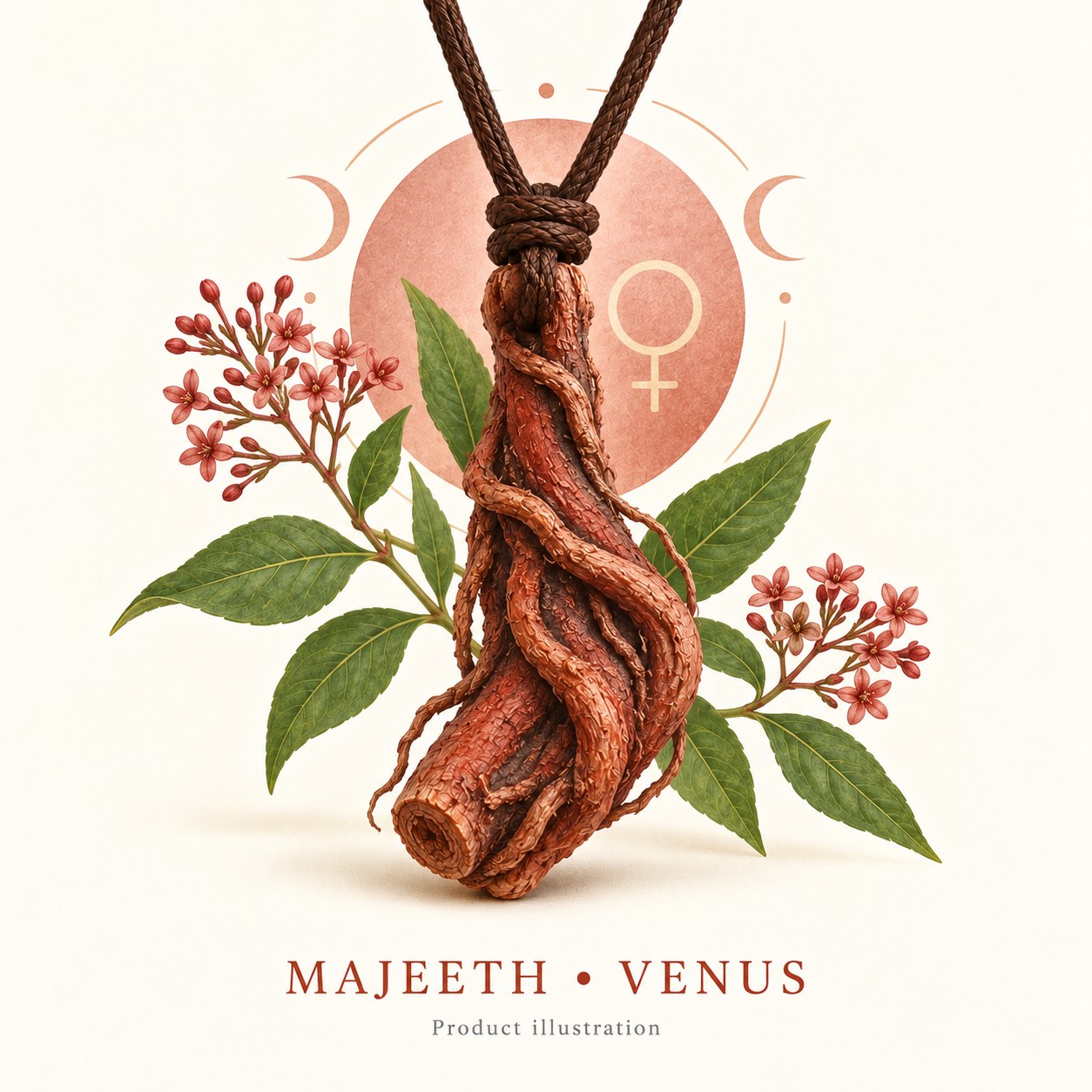
Majeeth (Manjistha, Manjishtha, Majith, Manjeet or Indian madder) is a traditional name encountered in Indian botanical literature, Ayurveda, dyeing history and contemporary planetary-herbal jewellery. One important botanical species is Rubia cordifolia L., a perennial climbing member of the Rubiaceae family. Another accepted species, Rubia manjith Roxb., occurs under related regional names. Their roots and, in some records, stems have been associated with red-to-orange dye materials. Understanding the plant behind a modern pendant therefore requires more than recognizing a reddish piece of root.
This guide brings together three aspects: the real plant and its alternative names; the colouring substances and textile traditions linked with madder; and the practical identity, construction and care of a root pendant. The Vedic and Ayurvedic names are important to cultural history, but they do not by themselves authenticate a dried fragment. For the separate traditional interpretation of Shukra (Venus), visit Majeeth Root and Shukra; this article stays with materials, heritage and identification. Majeeth is a vernacular trade and traditional plant name frequently associated with Indian madder. In modern botanical classification, Rubia cordifolia L. is a familiar accepted species, but Kew's medicinal-plant naming records connect spellings such as manjishtha with both R. cordifolia and the separately accepted R. manjith Roxb. The same popular name may therefore appear against more than one species in reference sources. A product label saying only “pure Manjistha root” is not equivalent to a verified Latin scientific name. The historically useful property of many Rubia materials is their ability to supply warm colours for dyeing. Plant root chemistry can include anthraquinone-related pigments, but the mixture and resulting shade vary by species, root condition, processing method, fibre and dyer's procedure. A red or reddish-brown root fragment does not prove that it came from R. cordifolia; colour is an observation, not an identification certificate. For jewellery, the plant material may be drilled, wrapped, enclosed or mounted. The actual item could be a segment of root, a piece of stem, processed fibre, resin-encased material or an ornamental imitation. The honest buying question is not simply “Is it red?” but “What plant part and botanical species does the supplier identify, how is that identity supported, and how will the finished item behave during use?” Regional words travel across languages, scripts, market towns and product catalogues. Manjistha and Manjishtha are familiar Sanskrit-derived spellings; Majith, Manjit, Majeeth and Manjeet appear in Hindi, regional-language transliteration and trade usage. Indian madder, East India madder and munjeet appear in English plant, dye and museum records. Some spellings reflect pronunciation rather than botanical divergence, but shared pronunciation does not guarantee that every vendor's plant material belongs to the same taxon. The scientific author abbreviation is part of a precise plant name. Rubia cordifolia L. refers to a name attributed to Linnaeus. Rubia manjith Roxb. is a separate accepted species name attributed to William Roxburgh. A former name such as Rubia munjista Roxb. is presently treated by Kew as a synonym of R. manjith; older texts using another name may need taxonomic interpretation before being translated into today's catalogue language. Ayurvedic and vernacular name lists serve different purposes from plant-taxonomy databases. A traditional term may have centuries of usage without pointing to one species in every locality or period. For a historic passage, retain the historical wording and explain the possible modern identification. For a contemporary product, ask the supplier to identify the source species and part rather than reverse-engineering identity from a Sanskrit synonym alone. Kew's Plants of the World Online currently recognises both Rubia cordifolia L. and Rubia manjith Roxb. as accepted species. That matters because many internet lists collapse variants of Manjistha into a single line and may repeat the same photograph for multiple names. Kew describes R. cordifolia as a scrambling perennial with a broad range covering parts of Africa, Europe and Asia. The narrower Kew range for R. manjith extends from the Himalaya into southern-central China and northern India. These broad ranges overlap but should not be turned into a claim about the location where a particular pendant was harvested. An accepted botanical name helps specialists communicate about a species. It is not a quality grade for a pendant, a certification that a commercial batch has been identified, or proof that a traditional herbal instruction named that exact taxon. For an item sold as Rubia cordifolia root, a supplier's traceability record should connect the actual product to an identified plant, not merely to a web page about Rubia cordifolia. Taxonomy can change as experts study specimens and relationships. When reviewing older descriptions, keep the cited name and publication date, then check the modern accepted name and synonym record. In particular, do not assume that the presence of the epithet “cordifolia” in a historic variety name means it is identical to the currently accepted R. cordifolia species. The synonym R. cordifolia var. munjista is associated with R. manjith in Kew's present treatment. Rubia belongs to the Rubiaceae, a large flowering-plant family. Indian madder is generally described as a scrambling or climbing perennial, with somewhat angular stems and hooks or prickles that can catch supporting vegetation. In Rubia cordifolia, foliage is commonly presented in apparent whorls along the stem, and leaf shape ranges from ovate to more narrowly pointed. The plant may have small greenish or yellow-green flowers, followed by dark berry-like fruits. These features are most useful when considered together on a living, botanically documented specimen. The Indian Institute of Science's flora and herbarium records describe R. cordifolia in the Western Ghats and record names such as Manjista, Yojanavalli and Chitravalli. The separate flora entry for R. manjith describes a climbing herb that may be found scrambling over shrubs and rocks in northern subtropical or forest-edge habitats. Such details are useful evidence for botanical specialists but cannot be read from a single sawn and polished root segment. In collection work, identity is supported by several features: leaves, flowers, fruit, stem details, growth habit, locality, specimen reference and a trained comparison with a flora key. A garden photograph may provide context but rarely settles dried-root identification alone. Retail photography should show the product actually being sold; botanical images can be labelled as educational references rather than implied photographs of the harvested source plant. “Majeeth root” is a normal retail description, yet different herbal records mention roots, stems or other parts of the plant. Kew's Medicinal Plant Names Services, for example, reproduces records that refer to dried stems or to both root and stem for the name Manjishtha. Other forestry and dye accounts emphasise roots. This is a reminder that a traditional drug name, a dye commodity and a jewellery component need not specify the same plant part across all sources. A root originates from the underground system that anchors and nourishes a plant. A stem is an above-ground or sometimes modified axis with nodes and distinct anatomical functions; some processed pieces may be hard to recognise after scraping, cutting, drying and polishing. A rhizome is a modified stem, not a generic synonym for any underground fragment. Retailers should not use these words interchangeably. If the precise plant part is unknown, a more cautious material description is “plant fragment supplied under the name Majeeth,” pending clarification. Powdered madder intended for dye demonstrations is not automatically suitable as jewellery material. A loose powder behaves differently from an intact segment, and embedding powder in resin introduces additional substances. A pendant assembled with a dyed decorative insert should be described honestly as such. A saleable description should tell buyers whether the visible colour arises from the botanical material, an applied stain, a coating or a composite construction. Madder has long attracted textile makers because members of the genus Rubia contain natural colour-forming compounds. Research into Rubia reports anthraquinones and related derivatives in plant material, especially roots. The names alizarin, purpurin, pseudopurpurin, munjistin and ruberythric acid appear in dye chemistry literature. These are chemical names, not labels that a shopper can confirm by touching an accessory. Different species, parts, extraction methods and storage conditions may yield different mixtures. A dry root may appear cinnamon brown, brick red, rusty orange, dark reddish-brown or unevenly stained across cuts and fibres. The concentration of colour at the outer surface need not match the cut face. A freshly broken piece, an older oxidised fragment and a coated item may look different even when the underlying plant source is related. A polished retail photograph can also shift the apparent shade because of lighting, background, camera processing and screen settings. The fact that madder can produce a red dye does not mean that every individual root fragment can safely be rubbed against fabric or soaked in water to demonstrate authenticity. Some colours transfer, while colour may also come from added dyes, resins or other materials. The useful questions are whether the piece was treated, whether it is sealed and how to avoid colour transfer during normal use. Where authenticity matters, source documentation is much better evidence than trying to create red water at home. Alizarin and purpurin are familiar names from madder-dye history. They belong to the broader class of anthraquinone-related colourants. In a textile context, the final hue depends not only on plant chemistry but on the fibre, mordant, temperature, pH, extraction sequence and washing. A laboratory may profile dye components using analytical techniques, but those procedures are not home authentication methods for jewellery. For example, a red result in a crude liquid extraction does not identify the plant species or demonstrate that no commercial pigment was added. Research on historical madder textiles is also complicated by the chemistry of extraction. Some compounds can transform when heated or treated strongly; harsh extraction may destroy information that was present in the original textile. Scholars therefore distinguish the colourants found on an artefact from the wider set of molecules present in a living root. This matters to anyone tempted to infer a complete chemical composition from a simple list on a blog or from one familiar word such as “alizarin.” For an OmmRudraksha jewellery listing, there is no need to claim laboratory values unless the actual material has been tested and a relevant report is available. An accessible explanation may simply say that Indian madder is historically associated with naturally occurring red dye compounds and that the colours and finishes of handmade root ornaments can vary. Precise test reports should identify the examined batch and analysis method, not just display a generic plant profile. Indian textile traditions have long used plant-based colours. Madder is particularly associated with red and related hues in parts of the subcontinent, and the term “Indian madder” appears in historical discussions of trade, dye workshops and preserved fabrics. The Metropolitan Museum of Art's study of Indian block-printed textiles places Indian madder or munjeet among several different Indian red-dye plants; other named sources include chay root and Indian mulberry. Their chemical differences are important, even though each can contribute red shades under appropriate processing. The Victoria and Albert Museum documents a fourteenth-century Gujarati block-printed ceremonial hanging dyed with Indian madder, naming Rubia cordifolia in its discussion. This is a much stronger kind of historical reference than a general statement that “every red spiritual pendant descends from an ancient dyeing practice.” It ties a named dye source to an actual textile object and its catalogued history. Such examples illustrate the depth of Indian colour knowledge without establishing the history of the specific root fragment offered for sale today. Indian textile production used skilled preparation of fibres, printing blocks, dye baths and mordants. Workshops transmitted practical techniques among artisans; colour could signify local identity, visual richness, auspicious occasion or commercial taste depending on region and period. Madder belongs to that material history, but not every red cloth used madder and not every madder-dyed textile used the same plant species. A well-written heritage account keeps the diversity of regional practices visible. Colour on a piece of cloth is the outcome of an entire process. Cotton, silk, wool and other fibres take up dyes differently, and many historical dye procedures use a mordant to help colourants associate with a textile. Alum-related preparations, iron salts or tannin-rich materials feature in different dye traditions. These are material-processing concepts, not evidence that a plant worn as a pendant will colour, protect or otherwise influence the body. Artisans alter shade and fastness by adjusting the plant source, washing, extraction, mordant and fibre. The same madder source can contribute different reds, pinks, oranges, browns and purplish tones under different combinations. In museum work, analysts may try to distinguish dyes from madder, chay root, lac or other materials using chemical signatures. A retail photograph of a red strand cannot reveal which historical process produced a different colour on fabric centuries earlier. For those curious about heritage crafts, historical dyeing provides a meaningful bridge between plant science, artisan skill and Indian design. Yet a jewellery page should not suggest that an unprocessed root pendant is automatically colourfast simply because some museum textile survives. A preserved cloth reflects how materials were treated and stored, while a fresh pendant may contain exposed fibres, glue, metal, resin or unfinished plant surfaces. Indian craft traditions employ many different colour sources. Rubia madder, chay root, Indian mulberry, lac, safflower, turmeric and mineral or synthetic pigments should not be merged into one “ancient natural dye” category. Lac is insect-derived, for instance, rather than a plant root. Turmeric is a rhizome from an entirely different botanical family and is familiar for yellow shades. A modern synthetic dye may imitate a madder tone very convincingly without containing madder at all. The Victoria and Albert Museum's writing on Indian reds distinguishes different sources by region and textile tradition, noting chay-root dyes in Coromandel Coast textiles and madder traditions more associated with north and west Indian contexts. That nuanced picture is more helpful than describing every celebrated Indian red textile as “Manjistha.” A reddish object can also be painted, heat-treated or coated with colour unrelated to the material beneath. Buyers should distinguish the purpose of the question. If the concern is cultural history, compare traditional sources and the artisans who used them. If the concern is a pendant, look at its specific material declaration, colour treatment, fitting and care. A brand may sell a product named after a sacred or historical plant while still needing evidence for its exact ingredient and assembly. Manjistha is a significant name in Ayurvedic dravyaguna, the study of medicinal substances and their properties in the classical tradition. Traditional descriptions discuss its place in formulations and associate it with concepts such as rakta, varnya and certain pitta-related interpretations. Some nighantu explanations refer to its colour and climbing habit; terms such as Yojanavalli and Vastraranjini evoke, respectively, its spreading nature and capacity to colour cloth in traditional explanations. These words contribute cultural and linguistic richness to a plant's story. The historical medical use of a plant is different from proof that wearing a small piece around the neck reproduces an ingested, applied or professionally prepared Ayurvedic formulation. Classical medicine uses distinct preparation methods, doses and combinations, and these cannot be inferred from a pendant listing. The article therefore treats Ayurvedic terminology as important source context rather than using it to claim that an ornament treats blood disorders, skin disease or other medical conditions. Modern scientific publications about Rubia cordifolia often review its constituents and experimental pharmacology. Those papers are valuable for learning about the plant but do not establish specific clinical effects of a decorative, untreated or resin-encased botanical item. Readers researching Ayurveda should consult suitable original texts and qualified practitioners for clinical questions; buyers assessing jewellery should examine material and workmanship instead. Red occupies many roles in Indian ceremonial, decorative and devotional life, from textile work and kumkum to wedding fabrics, temple adornment and festival designs. Its interpretation changes with region, deity, period and community. A traditional red dye material may therefore interest a wearer who appreciates Indian craft heritage as well as an accessory's spiritual symbolism. But visual similarity does not mean that every red substance belongs to the same ritual category or has the same textual prescription. Majeeth is also included in some modern planetary-herbal jewellery collections as a botanical object associated with Shukra, or Venus. Shukra in Jyotish is discussed in relation to aesthetics, enjoyment, artistic expression, partnership and refinement. That planetary correspondence belongs to the specific shop, teacher or family custom using it; the dye history of the plant does not independently prove a universal Venus prescription. A customer who follows Shukravar observances or a personal sankalpa may value a pendant as a reminder of the chosen practice. The historically grounded material story is still interesting even for someone who does not follow Jyotish. These motivations can coexist without confusing craftsmanship with botany or turning the presence of red plant compounds into a prediction of spiritual, social or physical outcomes. A precise description begins with what is known. Ideally, it gives the supplier's botanical name, plant part, source locality or supplier chain, whether the piece is naturally coloured or treated, dimensions, approximate weight, mounting material and care. The photograph should represent the offered design and show enough detail to understand its construction. If the species is not yet independently confirmed, a shop can describe the item under the traditional name without implying that a stock photo proves identification. Look at the grain and visible cut ends in actual photographs. Fibrous appearance may be compatible with plant material but not diagnostic of one species. Check whether the pendant is drilled, tied, wired, set in a bezel, coated or fully enclosed. A clear capsule may make the object easier to handle while making its interior harder to examine; a resin-bound piece may protect fragile fibres yet introduces its own care requirements. None of these constructions is inherently more spiritually meaningful simply because it appears elaborate. Request a photograph of the actual product when natural pieces vary. Compare the product title against invoice and packaging wording. A batch certificate or botanical declaration is most useful when it names the supplier lot, describes the method or basis of identification, and is specific to the supplied goods. Be cautious about broad “certified original” badges with no issuer, scope or traceability. Authenticity and good jewellery engineering should be judged separately. Natural roots differ in fibre alignment, diameter, outer texture and irregularities. Decorative wood may have a convincing colour after dyeing, while a resin casting can imitate a fragment's shape with greater consistency. An unidentified brown object may also be another species sold under a familiar name. Looking closely at the surface is useful for questions, but a photograph or casual scratch should not be presented as a definitive botanical test. Some products combine an authentic botanical piece with adhesive, a varnished surface or an encapsulating resin. Others are made entirely from manufactured materials. These designs have different purposes. For a shopper who wants a traditional plant fragment, the exact contents are central; for someone choosing an attractive symbol, a clearly labelled decorative replica may be acceptable. The concern arises when an imitation is presented as an authenticated whole root without supporting evidence. Avoid home procedures involving burning, grinding, soaking in acids or exposing the piece to solvents. Such methods can damage the object, produce unwanted fumes or stain surrounding surfaces and will still fail to establish species reliably. Ask for source documentation, manufacturing information and non-destructive product photographs instead. If a laboratory determination is genuinely required, consult an appropriate qualified botanical or material-analysis service. Madder grows across varied habitats, and the presence of a plant in a region does not mean every retail lot originates there. A reliable supplier may purchase cultivated material, collect through documented channels or use processed stocks from another region. Since root harvesting removes part of the underground system and can affect plants, sourcing arrangements matter. Avoid broad claims of “wild Himalayan origin” when the batch records are not available. Useful traceability can include the supplier identity, region of procurement, whether the plant is cultivated or collected, harvest or receipt date, batch number and processing description. The level of documentation may depend on the scale of the enterprise, but an absence of records should not be filled with certainty in the product description. For any internationally traded botanical material, applicable plant, customs and import rules may also be relevant to the supplier rather than assumed from the item's sacred label. Careful sourcing is also a cultural question: traditional craft materials are linked with growers, gatherers, dyers and artisans. A responsible retailer can describe this chain accurately without reducing the plant to a marketing symbol. Sustainable procurement and honest naming protect the credibility of both the botanical heritage and the finished jewellery. In a simple design, a suitably sized botanical piece may be secured with a cord, wire or protective mount. More complex pendants use a capsule, locket or rigid setting to reduce friction with skin and clothing. The design must account for the plant's shape, moisture sensitivity and risk of splitting near a hole. Sharp metal edges or a tight wire can cut fibres. A glue that looks neat on a product photograph may not remain sound after repeated wear, heat or humidity. The artisan should consider the cord or chain length, clasp strength, edge finish and balance. A heavy metal fitting can stress a small root component; a very delicate thread may break in ordinary movement. If skin contact is intended, the wearer should know whether the visible surface is raw botanical material or a sealed finish. Where a capsule is used, the buyer should know whether the closure can be opened and whether it is designed to tolerate water. The most useful quality photographs include front, reverse, side, fixing point and measurement views. If the product is handmade, reasonable shape variation may be expected, but unsafe cracks, exposed pins, open seams or a loose setting should not be dismissed as natural character. A meaningful spiritual accessory can also be engineered for safe and comfortable day-to-day handling. For a botanical pendant whose precise finish is not documented, start with dry handling and conservative storage. Remove it before bathing, swimming, exercise with heavy sweating or work involving water and cleaning chemicals. Do not apply perfume, hair spray, perfume oils or cosmetic solvents directly to the plant or its enclosure. Dried natural material may absorb moisture, shed colour, soften or change appearance; fittings and adhesives can introduce additional vulnerabilities. A soft, clean, dry cloth may be appropriate for an exterior metal or sealed surface, but not necessarily for rubbing exposed root fibres. Do not soak, steam-clean, boil, polish abrasively or use acidic household liquids. If the root starts bleeding colour onto fabric, stop direct contact and ask the seller about its finish instead of trying to fix it with a random home coating. Keep pieces apart from pale garments until colour stability is known. After wearing, inspect the setting and store the pendant in a dry, separate pouch or small padded box. Keep heavy gemstones and metal chains from pressing against the plant. Protect it from sustained direct sunlight, high humidity and heat. If a capsule shows condensation, open seams or breakdown, do not assume it remains sealed. For puja or Friday observances, devotional care and material care can be compatible: offerings can be made separately when direct application might damage the accessory. Natural material is not automatically non-irritating. The skin-contact issue may involve raw plant fibre, a sealant, a metal alloy, adhesive, dye, thread or residue from processing. If discomfort appears, remove the item and identify the contact surfaces rather than assuming the plant itself is the only possible cause. A cord may be more suitable than some metal chains for one wearer; another person may prefer a fully enclosed locket with no botanical contact. A dye-bearing plant fragment may stain pale clothing when damp or abraded. A buyer should not have to conduct a destructive wet test to discover whether a product is fit for its advertised use. Ask how the maker processed or sealed the material, whether colour transfer has been checked for the actual product type, and what storage conditions are recommended. A well-documented item can be valued for its natural character without pretending that all natural specimens are identical. Keep a small detachable pendant away from young children who may mouth or swallow it, and inspect clasps and cords regularly. Some repairs require replacement rather than improvised adhesives. If the item has a strong scent, tacky surface or unidentified coating, seek further information before wearing directly against the body. These are ordinary considerations for wearable craft items, unrelated to whether the owner values its cultural symbolism. The price of a botanical pendant can reflect plant sourcing, sorting, artisan labour, a mount, a chain, finishing, packaging and service. It cannot by itself establish species identity or the strength of a traditional planetary association. More expensive fittings may be worthwhile for comfort and longevity, but they should be described as craftsmanship rather than proof of a special effect. A simple, well-documented root piece may be preferable to a decorative, poorly described alternative. Compare items on evidence that is relevant to the object: what part is present, what material is used in the casing, whether the finishing is transparent, how the item behaves when exposed to ordinary humidity, and whether current photographs match what will be delivered. Seek measured dimensions rather than judging scale from a photograph. Natural-root colour variation is expected, but instability, fracture or unmentioned dye treatment are separate issues. For the offered design, see the Majeeth (Manjistha) Root Pendant for Venus listing and ask for details of the present stock. A general article explains the plant and traditions; the live listing or seller should identify the actual product, fit and care. This separation helps customers appreciate cultural history without treating a category page as a botanical certificate. In a planetary-herbal jewellery assortment, Majeeth may be presented as a root associated with Shukra or Venus. Traditional Jyotish considers Shukra in relation to aesthetic expression, companionship, luxury, creative skill and the wider interpretation of a birth chart. Devotional discussions may also include Friday observances and mantra or sankalpa. These ideas belong to spiritual interpretation; they do not substitute for the separate question of which plant species the pendant contains. For a full treatment of Shukra's symbolic role, how a custom may be followed and which practices are often mentioned, read Majeeth Root and Shukra: Traditional Venus Associations. Readers comparing botanical jewellery with diamond or white sapphire, the better-known Venus-related gem materials in different traditions, can consult Majeeth Root Pendant Versus Venus-Associated Gemstones. These are companion topics, not competing copies of the same article. A customer may choose a root pendant for its documented plant character, a personal devotional practice or interest in Indian craft history. Respecting those reasons does not require making the same claim about botany, chemistry and Jyotish. The naming and material record should stay accurate regardless of the individual spiritual significance attached to the piece. Ask the supplier which scientific name, if any, applies to the actual batch. Ask whether it is root, stem or composite; where it was sourced; whether dye or coating has been used; and whether a lot-level identification is available. For the artisan, ask what secures the botanical piece, what metal or cord is used, how the piece is measured and whether the assembly is water-resistant. Each question requires different evidence. If a person receives an astrological recommendation, the practitioner can explain which tradition or natal-chart factor motivated a particular item. A botanical supplier cannot verify that interpretation merely by naming a species, and a consultant cannot certify the plant's contents merely by associating it with Shukra. Separating these questions makes each answer more useful. When a retailer cannot obtain a species-level record, it is better to document that limitation and describe the physical object accurately. Useful phrasing might identify a traditional Majeeth-name botanical accessory with a specific construction and care routine, without turning an uncertain source into an exact Latin plant certificate. That is a more durable standard for growing collections of herbal jewellery. One name equals one species: vernacular names may cover more than one accepted taxon. Red colour proves purity: the visible shade is affected by processing, treatments and photography. Historic dye equals current pendant: an account of textile history does not identify an unrelated modern retail object. Every part is called a root: pharmacopoeial and trading records sometimes specify stems or other parts. A plant is a gemstone: botanical and mineral objects have different testing, longevity and handling requirements. Another mistake is to quote a current accepted plant name while silently borrowing descriptive details from a different species or from an older synonym treatment. The remedy is to include the botanical author abbreviation and check a current taxonomy reference. Likewise, avoid using the appearance of a polished pendant to describe the living plant's flowers and berries. The physical fragment and the complete botanical specimen answer different questions. Finally, discussions of traditional Ayurveda or Shukra should keep their context. Classical terminology can be described in full without claiming that merely wearing a pendant reproduces the effect of a preparation used in a medical tradition. Cultural significance, material authenticity and practical suitability are each worthwhile topics on their own. Botanical names: Kew's Plants of the World Online accepts Rubia cordifolia L. and Rubia manjith Roxb. separately. Its Medicinal Plant Names Services lists traditional and vernacular name matches, including records referring to different plant parts. The original article's Kew reference for Rubia cordifolia remains available. For a broader Indian government reference directory, see the existing Botanical Survey of India medicinal plant database. Living plant: the Indian Institute of Science flora and herbarium records document R. cordifolia and separately R. manjith using living-plant and habitat characters. Dye chemistry: scientific reviews of Rubia anthraquinones describe multiple pigments, including alizarin, purpurin and munjistin, and stress that extraction can influence results. Indian textile heritage: the Victoria and Albert Museum records a Gujarati madder-dyed textile and distinguishes madder from chay root and lac; the Metropolitan Museum of Art discusses varied Indian red-dye sources. These are contextual research references, not a claim that any public botanical image or museum textile is the same material as the current shop's merchandise. The research establishes well-supported general concepts; product-specific facts still need verification from the actual supply chain. For related items, explore Planetary Herbal Jewellery and the established Rudraksha for Planets collection. Majeeth is a regional and trading name commonly associated with Indian madder. It appears in botanical, Ayurvedic and textile discussions. For a modern product, ask which accepted species and which plant part the supplier means by the name. They are frequently used as related names in trade and traditional literature. The spellings themselves are not an identification certificate. Plant-name databases show that familiar names may be associated with more than one accepted Rubia species. Both are accepted scientific species names in current Kew records. Rubia cordifolia L. is widely associated with Indian madder; Rubia manjith Roxb. also bears related vernacular names. The correct label for an actual piece depends on evidence about its source. It indicates the authority associated with the botanical scientific name: L. for Linnaeus and Roxb. for Roxburgh. These abbreviations help distinguish formal names in literature. They are not product grades or certifications. Kew currently lists Rubia munjista Roxb. as a synonym under the accepted Rubia manjith Roxb. Older publications may still use the earlier spelling. Interpret such records in context rather than changing their original wording silently. Root material is prominent in dye and trade accounts, but some plant and medicinal-reference records mention stems. A root pendant should be described by the actual part supplied; not every botanical fragment should automatically be called a root. Rubia plant materials can contain naturally occurring anthraquinone-related dye compounds. The resulting appearance varies with species, plant part, age, environment and processing. The colour does not by itself prove origin, untreated status or botanical species. They are named red-associated dye compounds known from madder research. A list of plant chemicals explains dye history, but no one can reliably identify a commercial pendant by colour alone or infer its exact chemical profile without suitable analysis. No. Darkening may arise from the source material, drying, oxidation, coatings, dyes, storage or photography. Stronger colour should not be treated as a direct authenticity grade. Ask for a transparent source and treatment description. Soaking can soften or damage botanical material, release colour, affect coatings and compromise fittings. A coloured liquid would still not prove the species. Seek supplier documentation or qualified testing where identification truly matters. Madder sources were part of Indian textile colour traditions, and museum discussions document Indian madder in historical textiles. Dyeing practices were specific to regions, fibres and workshop methods. Such history does not authenticate a modern retail object. No. Chay root, lac and other botanical or insect-derived colourants also feature in Indian dye history. Even a textile’s red colour cannot identify the dye plant without better documentation or material analysis. A mordant is a substance used in some dyeing processes to help colours bind to fibres or to influence the final hue. It helps explain why a fabric’s colour cannot be inferred directly from the shade of a dried root. Yes. Manjistha is a recognised traditional name in Ayurvedic dravyaguna and classical material discussion. Such context concerns the plant and particular preparations; it is distinct from claims about the effects of wearing an ornamental fragment. The term is used in traditional explanations for a material that colours cloth. It points to a dye-related association and helps explain the plant’s cultural vocabulary, but does not identify a particular commercial lot. Some planetary-herbal jewellery customs associate Majeeth with Shukra, whose Jyotish symbolism includes beauty, relationship themes and refined arts. The tradition used should be stated separately from the botanic identity of the material. No direct material equivalence exists. Diamond and white sapphire are mineral jewellery materials with distinct gemological properties; a Majeeth fragment is botanical. A practitioner-specific astrological suggestion is a separate discussion. An exposed, colour-bearing plant component may transfer colour under moisture or friction. Processing and protective mounting alter the risk. Ask the maker about the actual finish, particularly before wearing it against light garments. Unless the maker has confirmed the entire item is designed for water exposure, remove it. Root material, cords, adhesive, coatings and metal fittings may respond differently to water. Keeping it dry is the safest conservative routine. Use gentle, dry handling and protect the plant from liquid cleaners. Store the pendant separately from heavy jewellery in a dry pouch or box, and inspect its closure, string, coating and root surface occasionally. Only if the document is meaningful and traceable to the actual sample or batch, states what was examined and identifies the responsible issuer. General advertising badges or printed species names are not equivalent to independent identification. A clear picture can document the item’s construction and appearance, but species-level identification from a processed fragment may be difficult or impossible without source records and qualified botanical evidence. Traders may dry, scrape, cut or polish plant pieces, removing visible features. Some traditional records also discuss more than one plant part. Clarify the exact component with the supplier instead of assuming every cylindrical fragment is a root. Resin may protect or decorate a plant fragment but changes the material being worn. Ask whether the root is intact, how the resin was applied, what skin contacts the surface and how to clean the assembled product. A coating is not inherently proof of a false plant source. The name used in trade, botanical species when adequately verified, plant part, treatment or coating, fittings, measurements and a care statement. If origin or species is uncertain, the description should record the uncertainty rather than imply certainty. Read the companion Majeeth and Shukra traditions guide for the Venus association and customary interpretation, and the Majeeth versus Venus gemstone comparison when deciding between different kinds of materials.What is Majeeth or Manjistha? A precise answer
Question Useful evidence Common mistake Which plant? Accepted binomial, author name, origin and reliable collection or supply records Treating every spelling of Manjistha as one automatically proven species Which plant part? Root or stem declaration; cut shape, preparation and supplier batch Calling any reddish botanical fragment a root without evidence Why is it coloured? Known plant chemistry plus physical inspection and processing disclosure Assuming colour alone reveals botanical identity or absence of additives How is it used? Material, fitting, coating, comfort, care and actual photographs Treating a historical dye material as if it were a durable gemstone Majeeth, Manjistha, Majith, Manjeet and Manjith: understanding the names
Name encountered Typical context How to interpret it Majeeth / Manjeet / Majith Retail, vernacular and herbal supply chains Popular name; confirm scientific identification Manjistha / Manjishtha Ayurvedic, Sanskrit-related, cultural writing Traditional name; not itself a voucher for a specific plant lot Indian madder / munjeet Dye and English historical writing May indicate a Rubia dye source; inspect period and region Rubia cordifolia L. Botanical classification; medicinal plant references Accepted species; a label requires traceable support Rubia manjith Roxb. Botanical classification; Himalayan records Separately accepted species, not merely a spelling mistake Rubia munjista Roxb. Older botanical publications and trade records Synonym currently placed under Rubia manjith by Kew Two accepted Rubia species and why the distinction matters
What does the living Indian madder plant look like?
Observed feature Living-plant study Finished pendant assessment Whorled leaves Useful with other characters for identification Usually unavailable after harvesting Angled stems and small prickles May distinguish species in a collected specimen A root pendant generally will not show them Flower and fruit Useful for botanical comparison Not present in a root-only accessory Root texture and colour Useful supporting evidence with whole-plant records Can support description but cannot confirm species alone Collection locality Useful when traceably recorded Cannot be guessed from shade, shape or polish Scientific name A label backed by a source specimen or expert record Should be supported by supplier documentation Is Manjistha a root, stem, rhizome or powder?
Why Indian madder can have red, reddish-brown and orange tones
Madder chemistry: alizarin, purpurin and the limits of a colour test
Evidence Reasonable inference Unjustified leap Reddish fibrous root Material has a warm visible colour It must be Rubia cordifolia Dye-bearing Rubia literature Several Rubia species produce textile colourants Every pendant contains identical pigment proportions Strong red colour on cloth The dye and preparation coloured that cloth The object is safe for repeated skin or wet contact Supplier statement of natural colour Supplier asserts no applied colour Species and absence of treatment are independently certified Botanical specimen plus batch records Traceable identification is better supported A new unrelated batch has the same proven identity Manjistha in Indian textile and dye history
Why a madder-dyed fabric is not the same thing as a red root
Madder compared with chay root, lac, turmeric and synthetic colour
Material name Broad origin Why distinction matters Indian madder / Majeeth Plants of the genus Rubia, especially related Indian madder species Species and part require verification; linked to red dyes Chay root Distinct plant used historically in Indian red dyeing Its chemistry and regional history differ from Rubia madder Lac Resinous material from lac insects Not a plant root despite red-pink dye associations Turmeric / Haridra Rhizomes of Curcuma longa Yellow colour source, unrelated to madder roots Synthetic dye Industrially manufactured colourant Appearance cannot demonstrate the claimed natural origin Dyed wood or resin Composite or treated ornament material May be attractive but should not be sold as an identifiable intact root Manjistha in Ayurvedic vocabulary and cultural study
Red colour, auspiciousness and traditional significance
How to recognise a credible Majeeth product description
Information What to look for Follow-up if missing Plant name Declared scientific name and traditional trade name Which species was supplied and who identified it? Plant part Root, stem or composite material stated clearly Is the visible material truly an intact root? Origin / batch Supplier reference, lot or sourcing statement Can the source be traced to a documented batch? Treatment Any dye, varnish, sealant, resin or stabilisation disclosed What touches clothing or skin? Construction Actual photographs, measurements, closure and cord Can the fittings be safely replaced or adjusted? Care Dry storage, moisture and colour-transfer guidance What should be avoided during cleaning? Cultural association Tradition or product-line context identified Is it a general interpretation or a specific lineage? Real root, dyed wood, resin and other look-alike materials
Harvest, regional sourcing and sustainable supply
How a root fragment becomes a wearable pendant
Daily care: moisture, colour transfer, light and storage
Situation Useful action Avoid Daily wear Check fittings and keep the object dry Bathing, swimming or heavy moisture exposure Clothing contact Use care with light garments until finish is known Rubbing an exposed colour-bearing root against fabric Cleaning Dry soft treatment only where appropriate for the surface Acidic liquids, solvents, soaking and aggressive scrubbing Puja setting Keep the accessory supported and away from damaging offerings Pouring liquids or oil onto an unidentified finish Storage Separate dry box or pouch; inspect for rubbing Damp cupboards or heavy jewellery pressing on the root Surface cracking Stop use and ask maker about a safe repair Covering damage with untested glue or varnish Suspected treatment Ask for product-specific disclosure Assuming a red colour proves the item is untreated Skin contact, clothing stains and sensible precautions
How to compare offerings without confusing price and authenticity
How this material story connects to Shukra and planetary jewellery
Questions for a supplier, artisan or consultant
Common mistakes in online Majeeth and Manjistha articles
Source notes for naming, chemistry and textile history
Frequently asked questions about Majeeth and Manjistha
