
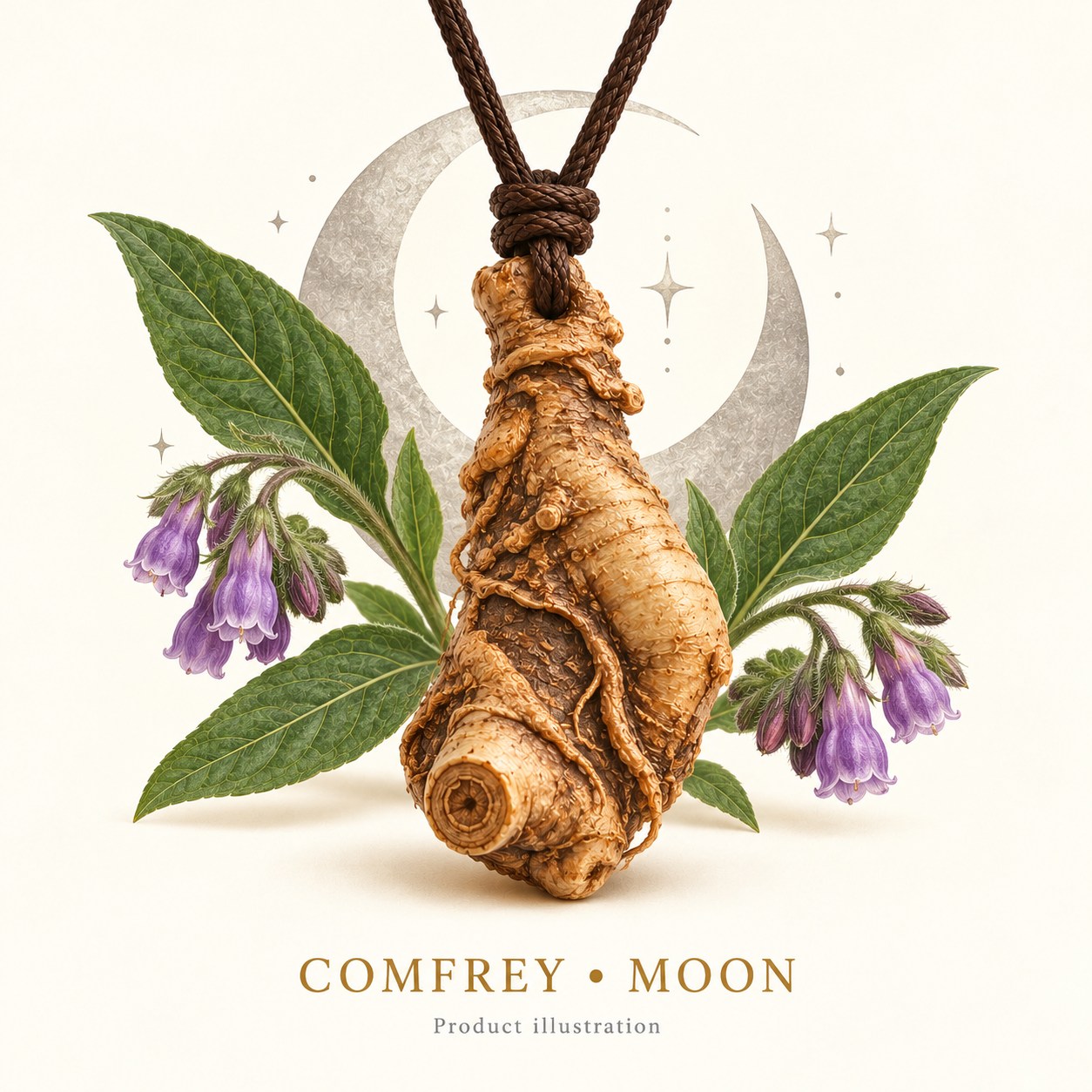
Comfrey root and pearl are two fundamentally different materials that may appear under the same Moon or Chandra search. A comfrey-root pendant is a prepared botanical object. A pearl is an organic gemstone formed by a mollusc; it may be natural or cultured and requires its own identity, quality and care assessment. In Jyotish, Moti or Mukta (pearl) has a widely recognised association with Chandra. A comfrey-root pendant, by contrast, belongs to a particular modern or regional herbal-jewellery offering. It should not automatically be described as the classical, universally accepted equivalent of a pearl merely because both are marketed under the Moon.
The distinction is valuable, not a problem to hide. A devotee may appreciate a botanical symbol and a different customer may prefer a lustrous pearl ring or pendant. Neither customer should have to guess whether a name refers to a plant species, a root fragment, a genuine pearl, a cultured pearl, or an imitation bead. Likewise, the traditional meaning of Chandra is not a physical property that authenticates jewellery. Identity, devotional interpretation, workmanship and care require separate answers.
This guide compares botanical and gemological facts, Jyotish associations, Monday customs, product evidence, fitting, handling and purchase questions. It includes the significant distinction between ornamental comfrey and ingestible comfrey: the latter is not appropriate for jewellery handling or preparation, and a comfrey-root component must never be chewed, brewed or placed into drinking water. For the two focused companion articles, read Comfrey and Chandra's traditional Moon association and Comfrey root identification and jewellery safety.
1. Comfrey root and pearl at a glance
| Comparison point | Comfrey-root pendant | Pearl or Moti jewellery |
|---|---|---|
| Material | Prepared botanical root in a finished fitting | Organic gem material produced by a mollusc |
| Identification | Declared plant species, plant part, batch provenance and finishing | Natural or cultured identity, saltwater/freshwater classification where determinable, treatment and mounting |
| Name to verify | Symphytum officinale is common comfrey; other plants also share the common name | Pearl; distinguish natural, cultured, imitation and shell-based lookalikes |
| Common appearance | Brown or dark dried root, variable texture, sometimes capped or coated | White, cream and many other colours, usually rounded but also baroque or irregular |
| Chandra significance | A specific devotional/herbal-jewellery interpretation, not a universally documented classical pearl replacement | Established association with Chandra in many Jyotish gemstone lists |
| Mechanical construction | Root fragment, cap, bail, adhesive, thread or chain | Pearl, drill or setting, post or bail, metal and possibly stringing |
| Typical wear concern | Moisture, crumbling, finish integrity, exposed botanical surface, attachment strength | Scratching, acid and perfume exposure, loose setting, weakened string or surface treatment |
| Cleaning default | Dry soft cloth; avoid unapproved soaking or oil | Soft cloth after wear; care depends on mounting and stringing, with no steam or ultrasonic cleaning |
| Evidence of identity | Supplier lot and credible botanical identification records | Written origin/identity description and, for significant value, appropriate independent pearl examination |
| Important boundary | Do not treat as an edible herb, medicine, tea or cosmetic | Do not assume every white bead is a pearl or every cultured pearl is an imitation |
2. Why do both appear in Moon-related jewellery searches?
In Indian astrology, Chandra signifies the Moon and is conventionally connected with manas (mind), receptivity, memory, emotional life, nourishment, motherly symbolism, comfort and change. These are interpretive ideas from Jyotish, not a laboratory description of a pendant. In classical and later gemstone traditions, pearls or mukta are linked with Chandra, and their pale lustre lends itself easily to lunar imagery. This association is familiar across gemstone guides, astrologers and family practices.
A root pendant can enter the same search results for a different reason. Some planetary herbal-jewellery collections offer selected roots or other plant parts as symbolic accessories linked with the Navagraha. The supplier may identify a particular root with a particular graha. That creates a meaningful devotional product description for people who follow the practice, but the existence of a product label is not proof that an identical recommendation appears in every Sanskrit Jyotish or Ratna Shastra source. Ask which tradition or teacher the association follows if its lineage matters to you.
The underlying choice is therefore not necessarily 'which material has more Moon power'. It can be: Which item do I actually want to wear? Which tradition am I following? Can the seller identify it correctly? Is it comfortable, well made and suited to my maintenance habits? Such questions remain useful whether the customer has a full horoscope interpretation, follows a family observance, or simply values moon-themed jewellery for its appearance.
A person who prefers not to wear either may still observe Somvar through prayer, charity, reflection or other family practices. A commercial purchase is not an obligatory condition of devotion. In the same way, an elaborate gemstone setting does not become suitable automatically merely because a horoscope mentions Chandra; the customer should be comfortable with the interpretation, price and physical object.
3. Chandra in traditional Jyotish: context before comparison
Chandra is one of the Navagraha, whose roles are interpreted through planetary positions, relationships, signs, houses, periods and other factors. Traditional descriptions place special importance on the Moon because of its connection with the experienced inner world. The Janma Rashi or Moon sign, the Janma Nakshatra, the Moon's house and aspects, and the relative strength or challenges in a chart may all be relevant to an astrologer's analysis. These details can be more important to a personalised discussion than a general merchandising table that simply says 'Moon = one product'.
Chandra is commonly described as the ruler of Karka (Cancer). The lunar mansions Rohini, Hasta and Shravana are assigned to the Moon in standard Vimshottari nakshatra-lord schemes. Jyotish texts and teachers discuss different aspects of the Moon in relation to phase, proximity to other grahas, dignity, house placement and dasha or antardasha. A person's relationship with these ideas is interpretive, and an advertisement must not turn them into a guaranteed result from a necklace.
Moon traditions often favour Monday (Somvar) and connect Chandra worship with Shiva, including names such as Someshvara and Chandrashekhara, as well as with prayers to Soma or Chandra. White offerings and silver settings are frequently mentioned in popular customs. Yet even a familiar convention can vary by sampradaya, household and teacher. For an item intended for actual ritual use, ask about the precise custom rather than following a universal instruction taken from a sales page.
In particular, Moti is a recognised gemstone association; Comfrey has to be described with the narrower basis actually available. The source article concerns a specific Comfrey Root Pendant for Moon, not a demonstrated historical equivalence between Symphytum officinale and Sanskrit mukta. It is useful to explain both without collapsing the distinction.
Table: Keep Chandra interpretation and product verification separate
| Topic | Traditional or cultural framework | Verifiable product question |
|---|---|---|
| Chandra as manas | Moon signifies inner life and receptivity in Jyotish | Does this pendant have a comfortable, safe fitting? |
| Karka Rashi | Chandra is commonly given lordship over Cancer | Is the material described correctly on the invoice? |
| Rohini, Hasta, Shravana | Nakshatras assigned to the Moon under Vimshottari | Does the named pearl or root match source evidence? |
| Somvar worship | Monday prayer and offerings in many traditions | Can a selected observance be done without soaking the item? |
| Mukta/Moti | Familiar traditional Chandra gemstone correspondence | Natural, cultured or imitation pearl, and with what treatment? |
| Comfrey root | Collection-specific herbal Moon association | What botanical species and lot does the seller claim? |
| Recommendation from an astrologer | Contextual interpretation of an individual chart | Does the customer understand the material and maintenance? |
4. What is Comfrey? Correct botanical name and plant family
Common comfrey is generally identified as ***Symphytum officinale* L., a perennial plant in the family **Boraginaceae, or the borage family. Kew's Plants of the World Online accepts this scientific name and places its native range primarily across Europe into western Siberia and neighbouring regions. The plant has coarse leaves, conspicuous hairiness and clusters of bell- or tubular-looking flowers in various pale to pinkish or purplish shades. Its root system and other parts have attracted a long history of folk-herbal use, especially in European contexts.
The word comfrey, however, is a common name rather than a batch-specific identification. Another plant sold as Russian comfrey may be Symphytum × uplandicum, a hybrid rather than S. officinale. Additional Symphytum species and unrelated plants appear under comparable vernacular names in botanical name services. An image of a comfrey garden plant cannot confirm what species a root pendant contains. The species should be stated cautiously unless a seller has credible records connecting the displayed piece to a particular collected or cultivated lot.
A botanical label normally needs genus, species, plant part, source/lot and processing history. 'Real comfrey' is less precise than 'Symphytum officinale root, batch reference XYZ, dried, capped and sealed', provided the latter details can be substantiated. A supplier who knows only the trade name should not imply that the exact species has been verified by a laboratory. The correct approach is to disclose what is known and what remains a supplier assertion.
Comfrey leaves and roots are also different botanical materials. The article is about root jewellery, so customers should not be offered an unidentified stem segment, powder-filled capsule or resin imitation without a clear material description. A small finished fragment often lacks the flowers, foliage and whole-root architecture normally useful in plant identification. This is why specimen traceability matters more than a visual resemblance to product photography.
5. Why comfrey identification matters more than a familiar name
Plant identity is not the same as a marketing association with a graha. Comfrey's common name can cover more than one botanical source, while Symphytum refers to a genus containing multiple related species. A seller may call a pendant 'comfrey root' because that was the wholesaler's label. To use a precise Latin name confidently, the business should know whether a trained person identified the source plant, whether a reference specimen exists, and whether the packed jewellery batch was traced back to the collection.
Dried roots can be difficult to distinguish once cut, dyed, polished or coated. The natural size, colour, branching pattern, root bark and internal tissues may be altered by processing. A glossy finish could mean a protective coating; it does not by itself indicate a genuine or non-genuine plant. Similarly, a strong herbal smell can result from natural constituents, stored fragrances, damp conditions or added scent. Do not use taste, chewing, burning, solvent exposure or scratch tests to authenticate an unknown root. Those home techniques are inappropriate for a finished wearable botanical object.
If a vendor says the root is 'from the Himalayas', ask for ordinary source records rather than treating the geographical phrase as botanical evidence. Cultivation, regional trading centres, storage and final assembly may happen in different places. A wholesale invoice can help with provenance but is not automatically an expert species certificate. A botanical voucher, specialist identification or appropriate laboratory work can strengthen evidence when connected to the actual lot, not merely to an unrelated photograph.
The objective is not to demand expensive laboratory tests for every low-cost accessory. It is to keep claims proportionate. For a simple devotional item, a seller can explain that the piece is offered under a traditional Comfrey Root Pendant label with available supplier identification and disclose uncertainty where relevant. A claim of **verified *Symphytum officinale*** should be reserved for a better-documented material.
Table: Comfrey names and identification questions
| Term seen in a listing | What it commonly means | What to ask before buying |
|---|---|---|
| Comfrey | Vernacular name, potentially ambiguous | Which scientific species is claimed? |
| Symphytum officinale | Accepted name for common comfrey | What evidence links this species to the pendant batch? |
| Symphytum × uplandicum | Hybrid often known as Russian comfrey | Is the product labelled precisely, not sold under another species? |
| Comfrey root | Claimed plant part | Is the whole visible component root, and is it treated or coated? |
| Herbal Moon pendant | Commercial category plus devotional interpretation | Which tradition is being followed; what is the material? |
| Organic comfrey | Possible agricultural or marketing claim | Is there a relevant certification covering the lot? |
| Natural root | Broad statement about origin | Are adhesives, finishes and metal fittings declared? |
| Lab authenticated | Specific technical claim | Which lab, sample, method, date and result? |
6. Comfrey safety: a jewellery component is not an herbal preparation
Comfrey deserves a specific safety discussion because the plant contains pyrrolizidine alkaloids, a class of compounds relevant to liver toxicity. The US National Institutes of Health LiverTox reference reports serious liver injury, including hepatic sinusoidal obstruction syndrome, associated with oral comfrey exposure. That evidence concerns exposure to comfrey preparations and cannot be translated into a claim that a wearable root is medicinal or that a person should consume the material for a ritual.
Do not drink comfrey-root-infused water, place the pendant in tea or milk, lick or chew the root, grind it into powder, or use a pendant as a source of a medicinal preparation. Avoid leaving loose fragments where children or pets might ingest them. An intact enclosed item and an open, crumbling root are not the same handling situation. If the finish flakes or the botanical material is exposed, consult the seller about safe repair or replacement; do not deliberately rub unprotected root material into the skin.
No source identified for this project establishes the safety of every conceivable comfrey jewellery design, coating, skin-contact duration or extraction method. A sealed capsule, an open drilled root and a resin-coated slice have different contact and breakage characteristics. A buyer can request a clear photograph of the back, drill hole and underside of the cap, and can choose a fitting that minimises contact with friable plant material. Keep the piece away from broken skin; remove it if irritation occurs. This is a specific material-handling distinction, not a claim that wearing an intact pendant inevitably causes the oral toxicity described in LiverTox.
A common ritual recommendation to 'charge' a pendant by immersion should be evaluated against the material. Water, milk, ghee, oils and incense residue can damage organic pieces, weaken glue or create an unhelpful exposure route. A brief prayer or placing the jewellery beside a clean altar rather than inside a liquid is a practical alternative for people whose custom allows it.
7. What is a pearl? Natural, cultured and imitation categories
A pearl is formed in a mollusc. It is a gem material with a structure based largely on calcium carbonate and organic components, often displaying iridescent nacre. A natural pearl develops without deliberate human initiation; a cultured pearl is produced by a living mollusc with human intervention in the pearl-forming process. Cultured pearls are genuine pearls, not automatically counterfeit or plastic. An imitation pearl is a different product, typically made to resemble pearl by using glass, shell, coated beads or other materials.
These differences matter because customers sometimes encounter a misleading either/or question: 'Is it natural or fake?' A cultured pearl can be genuine, while a bead marketed as natural pearl without appropriate support may be misleading. Some pearls are grown in saltwater molluscs; others are freshwater cultured pearls. Their shapes, sizes, colours and surfaces vary. A catalogue should describe the material accurately rather than assume every round white bead is an ocean-grown natural pearl.
Pearls are valued through a combination of size, shape, colour, lustre, surface quality, nacre characteristics and matching where appropriate. GIA describes seven pearl value factors, but a seller should not copy a laboratory's terminology as a substitute for examining the actual merchandise. A high-lustre pearl and a lower-lustre pearl can both be genuine; their suitability depends on personal preferences and construction.
Treatments can also influence pearl appearance. Bleaching, dyeing or other surface modifications may be relevant, and a report should state what it does or does not identify. For a high-value natural-pearl claim, appropriate examination may be particularly important because internal growth structures are not reliably determined by a casual visual test. The report's scope must match the specific pearl or jewellery piece and must not be advertised as a guarantee of astrological outcome.
8. Pearl appearance, nacre and quality: what photographs cannot settle
The attractive lustre of a pearl comes from its surface and internal optical structure. Under diffused lighting, a quality pearl may display clear, pleasing reflections; in a highly edited photograph almost any glossy bead can appear attractive. Ask for photographs in ordinary neutral light from several angles, with one frame showing a ruler or the item worn on a neutral display. The front photograph should be supplemented by views of the back, drill hole or setting where possible.
Shape can range from round and near-round to oval, button, drop or baroque forms. A round shape may carry a market premium, but it does not prove natural origin. Colour extends beyond white and cream: pearls can show pink, silver, gold, dark and other hues or overtones. Claims about a specific saltwater or freshwater origin should be grounded in documentation rather than inferred from colour alone.
Surface characteristics such as small pits, ridges, marks and nonuniformity can be consistent with pearl formation. A completely uniform appearance is not by itself evidence of authenticity, and a slightly irregular surface is not by itself evidence that the pearl is natural. Coating and enhancement can complicate visual interpretation. Customers should ask whether the pictured item is the actual pearl they will receive or a stock photograph of a representative design.
For rings, the setting protects and presents the pearl but can obscure part of its surface. For a drilled pearl necklace, silk or other thread condition, knotting, string tension and clasp integrity become part of the purchase. A white bead in an unknown pendant setting should not be represented as a scientifically identified natural pearl without an adequate basis.
Table: Pearl terms that should not be confused
| Term | Useful meaning | Common misunderstanding to avoid |
|---|---|---|
| Natural pearl | Pearl formed without deliberate human initiation | Not every genuine pearl is natural |
| Cultured pearl | Genuine pearl produced with human intervention | Does not mean glass, resin or plastic imitation |
| Freshwater pearl | Pearl formed in freshwater mollusc | Not necessarily a lesser or fake material |
| Saltwater pearl | Pearl formed in marine mollusc | Not automatically natural or untreated |
| Imitation pearl | Pearl lookalike made from other material | Appearance alone is not equivalent to identity |
| Baroque pearl | Pearl of irregular form | Irregular shape does not prove natural growth |
| Dyed pearl | Pearl with colour treatment | Dye should not be hidden beneath a 'natural colour' claim |
| Pearl report | Examination of stated pearl characteristics | Does not verify Chandra effects or every unrelated piece |
Table: Pearl value factors translated into buying questions
| Pearl characteristic | What customers can examine or request | What not to infer |
|---|---|---|
| Size | Diameter or dimensions in millimetres | A bigger pearl is automatically natural |
| Shape | Round, near round, button, drop, baroque or other form | Roundness proves a superior spiritual result |
| Colour | Body colour, overtone and lighting context | White colour proves saltwater origin |
| Lustre | Clarity and intensity of surface reflections | A glossy edited image proves gem identity |
| Surface | Visible spots, pits, ridges and wear | Every irregular mark proves natural formation |
| Nacre | Material growth layers and quality in relevant pearl types | A visual claim replaces a specific lab examination |
| Matching | Harmony of multiple pearls in a strand or pair | Matching means every pearl has the same origin |
| Setting and thread | Drill hole, prongs, posts, knots and clasp | Beautiful mounting authenticates the pearl species or treatment |
9. Why a pearl report cannot authenticate comfrey root
A gemological report and a botanical authentication document answer different questions. A pearl specialist may examine internal growth features, identity, structure and treatment. A botanist or natural-products laboratory assesses species, plant tissue and traceability. A customer should not accept a certificate template from one category as evidence for the other, even where both products are described as Moon-related.
Check the object, the sample and the scope. Does the pearl report identify the same size, weight, shape and image as the piece offered? Does the botanical note refer to the supplier lot from which the pendant material was taken? If the document states only 'sample received as comfrey root', it may not constitute independent identification. If a pearl report says only 'pearl' without natural/cultured status, the seller should not infer more than the document supports.
Online wording such as 'original', 'energised', 'certified', 'tested' and 'lab checked' is meaningful only when the particular claim is defined. Some customers want devotional preparation information; others want independent identification. Those are different forms of information and should be labelled accordingly. A traditional puja note need not be disguised as a gemological laboratory report, and a gem report need not make predictions about the wearer's horoscope.
For a low-price item, simple supplier declarations and clear photographs may be sufficient for a buyer's practical decision, provided the listing avoids unsupported certainty. For an expensive natural-pearl claim, it may be reasonable to request a recognised report and the exact grade factors being relied on. Neither approach ranks one material's spiritual merit above the other.
10. Traditional Moon symbolism without creating a false equivalence
In many households Chandra is honoured through prayers on Monday, remembrance of Shiva as Chandrashekhara, or devotional attention to calmness, family responsibilities and self-reflection. The Moon's changing phases can be used as a contemplative symbol of rhythm and impermanence. A pearl has a long visual and literary history as a shining, precious gem; in Indian gemstone associations mukta/moti is routinely placed with Chandra.
Comfrey is historically known in a different context: it is a plant associated with European folk herbal practices and modern botanical identification. No widely established classical Sanskrit passage has been verified here that universally names Symphytum officinale root as the prescribed Chandra counterpart to pearl. The relevant product is better presented as a botanical devotional accessory whose Moon association depends on the lineage or catalogue tradition being followed. This precision protects both traditional knowledge and consumers.
A family may prefer a white cord, silver-coloured fitting, or a quiet Monday observance. Those choices may express symbolic meaning but do not prove that a product can treat insomnia, anxiety, fertility difficulties or any other condition. A person exploring Chandra's placement in a birth chart should consider the full reading and their own traditions rather than purchase because a generic webpage warns of an unavoidable bad result.
The broader traditional choices include prayer, mantra japa, offerings, service, charity, restraint in speech and attention to family obligations. These are not accessories that require certification. If a chosen tradition requires a specific mantra or count, obtain it from the relevant teacher; a marketing comparison should not impose one rigid prescription on everyone.
11. Monday observances: choosing practices compatible with the material
For someone who follows Somvar observances, the basic distinction is between a devotional act and a material-care procedure. You may place a clean, dry pendant near an altar, offer a short prayer or recite a familiar Chandra or Shiva mantra according to your custom. There is no need to saturate a botanical component with water, milk or oil merely to express that intention.
Pearls are not indifferent to ritual substances either. Acids, perfume, sprays, harsh cleaners and prolonged exposure to unsuitable liquids can damage nacre or settings. A pearl may be carefully wiped and dried according to professional care instructions, but that is not a reason to use the same method for a dry root, cord and adhesive fitting. Both items can be honoured without exposing them to avoidable material risk.
Some traditions discuss a Monday morning, a suitable lunar phase, silver, white flowers or a specific sankalpa. Others place more importance on personal prayer than on timing. A customer who wants a personalised muhūrta should consult the relevant practitioner and should not take a generic sales promise as a definitive chart evaluation. Where astrology is part of your family's practice, ask the practitioner to distinguish the Moon's natal condition, whether a gem is being recommended at all, and why a particular accessory is chosen.
There is also no universal requirement to wear comfrey directly against bare skin or to replace a secure metal cap with an exposed root to make the pendant more 'effective'. Comfort and construction are part of a sensible wearing custom. If a design requires risky handling to follow a particular instruction, request an alternative observance rather than damage the item.
12. Pearl jewellery: ring, pendant, earrings or strand?
Pearl products are not interchangeable in their fittings. A ring presents the pearl on a hand subject to repeated bumps, cleaning products and abrasion. A pendant is more protected from impact but can contact perfume, cosmetics or clothing. Earrings need secure posts or hooks and comfortable weight. A stranded necklace adds concerns about string strength, knotting, clasp and storage. The best form depends on wearer's habits and the particular piece.
If a Jyotish practitioner suggests a ring for a specific symbolic convention, distinguish that custom from the physical suitability of the ring. A fragile pearl ring may be a poor fit for someone whose work frequently exposes the hands to chemicals. For everyday jewellery, a lower-impact pendant may be preferable. This is a practical observation, not a re-interpretation of the practitioner's tradition.
For a pendant, ask whether the pearl is drilled, glued, half-drilled or held mechanically in a setting. A glued design needs different inspection from a prong-supported one. Excess adhesive at a drill entry, wobbling settings and rough metal edges deserve attention. Where a pearl is loose or chipped, a jeweller should assess it before the item is worn again.
Silver, gold and other metal choices affect appearance, cost, durability and possible metal sensitivities. A silver-coloured photograph does not prove sterling silver. If the seller gives a hallmark or purity grade, verify it through the appropriate supporting details. A buyer should separate pearl identity, metal identity and devotional association rather than treating one claim as evidence for all three.
13. Comfrey-root pendant construction: what the listing must show
A genuine root piece is often irregular, light and more vulnerable to moisture or breakage than a metal or polished gemstone. A listing should show the actual root fragment, top cap or drilling method, bail, cord or chain, closure and any coating. The overall dimensions should include the finished item, not only the visible botanical fragment. The weight matters to comfort, while the cap strength and thread quality matter to whether the piece can be worn safely.
A drilled hole may split a small brittle section; an adhesive cap may hide the natural end of the root and eventually loosen. Neither technique is inherently unsuitable, but the buyer should know which has been used. Ask whether the coating is a transparent seal, varnish, resin or another finish, and whether the seller provides instructions about water, sweat and prolonged skin contact. An untreated exposed-root item may not be appropriate for every wearer, especially if it sheds particles.
Natural root can vary from pendant to pendant. A product photograph should disclose when the customer receives a representative piece rather than the exact example shown. Variation in grain, dark spots, surface bends and thickness does not by itself establish or refute species identity. Batch traceability and workmanship remain the appropriate checks.
A comfortable necklace should not tug, cut into the skin, catch on clothing or swing against fragile surfaces. If the wearer has a history of sensitivity to a metal, cord or finish, choose a suitable construction; avoid insisting on a skin-contact tradition that the wearer cannot comfortably follow. A small protective pouch can reduce rubbing when the pendant is carried rather than worn.
Table: Construction and care comparison
| Feature | Comfrey root jewellery | Pearl jewellery |
|---|---|---|
| Main component | Dried, prepared root | Organic pearl gem |
| Mount | Cap, glued or drilled fitting | Post, prong, drilled mounting or strand |
| Main physical concern | Splitting, crumbling, loose cap, moisture | Surface scratching, damaged nacre, loose setting |
| Skin-contact consideration | Finishes, possible shedding, unknown exposure to raw root | Metal fitting, perfume, cosmetics, surface cleanliness |
| Water | Avoid soaking unless seller has validated the entire assembly | Occasional careful cleaning only as appropriate to construction; dry thoroughly |
| Heat | Avoid heaters and forced drying | Avoid intense heat and dehydration |
| Storage | Dry, separate, protected from compression | Soft pouch/case, separated from harder gems; not very hot or excessively dry |
| Repair | Supplier or maker should assess loose cap and root integrity | Jeweller should assess loose pearl, worn strand or damaged setting |
| Ritual handling | Keep liquids and powders off exposed root | Keep acids, sprays and harsh cleaning agents off nacre |
14. How to evaluate a pearl listing before purchase
Start with the seller's exact claim. 'Pearl' can describe a broad group; 'natural untreated saltwater pearl' is much more specific and should have proportionately stronger evidence. Ask whether the item is cultured or natural, the origin category when known, dimensions in millimetres, shape, lustre, obvious surface features, colour description, treatment disclosure and whether the photograph shows the actual item. If the customer pays a premium for exceptional natural origin, an appropriate report may help.
Price should be interpreted through documented characteristics. Two similarly sized white-looking pearls may differ in lustre, blemishes, nacre, shape, matching or verified classification. A price alone does not authenticate a pearl. Conversely, a cultured pearl can be an attractive and legitimate choice even where it costs less than a rarer natural pearl. The description should explain the reason for a premium, not rely on predictions about lunar fortune.
If the product is sold as Jyotish jewellery, the seller may mention a traditional stone preference or ritual option. That information should remain separate from the invoice-grade material description. A pearl report can address gemology; it cannot establish whether the wearer's Moon is weak, whether Chandra Mahadasha will change, or whether a specified mantra will produce an outcome.
Check the item in good light for chips near the drill hole, a loose or skewed setting, abrasion at the contact points, visible uneven colour suggesting treatment and damage where adhesive meets the gem. None of these alone proves a particular origin, but they are meaningful quality and durability observations. Ask for a proper invoice identifying the item being supplied.
15. How to evaluate a Comfrey pendant listing before purchase
A comfrey-root listing should name the declared botanical species if known, identify the plant part, describe source, preparation and finish, and show the complete fitting. A spiritual association can be mentioned as a traditional interpretation; it should not replace the material record. The buyer may ask whether a precise species claim is supported by collection records, a supplier affidavit, specialist review or testing.
The phrase 'handpicked from an auspicious forest' provides little of the evidence needed to identify a plant. It may be part of a story or sourcing tradition, but it does not establish species, legality of collection or the condition of a finished root. Likewise, a seller's image of a living Symphytum officinale plant is not the same as a verified batch connection to the pendant.
Ask about shedding or exposed material, coating, cap strength and replacement policy. A root fragment that crumbles at the drill hole or leaves residue on contact needs attention before use. Do not simply glue it with an unknown household compound and continue to wear it; the repair method may change how the material contacts the skin. A trustworthy maker can explain when repair is possible and when replacement is the better option.
If the product is offered mainly as devotional jewellery, the description should say so clearly. The presence of the word 'herbal' does not convert an ornamental root into a licensed medicine, an edible supplement or a preparation that should be used for a health condition. For the more detailed treatment, read the Comfrey root identification and jewellery safety guide.
16. Comparing total cost and long-term ownership
Comfrey-root and pearl products may have very different price structures. A root pendant's cost may reflect sourcing, preparation, workmanship, mounting and small-batch handling. A pearl's price may reflect its growth origin, classification, size, surface, lustre and jewellery construction. A precious-metal mount can sometimes cost more than the pearl itself, and a specialty botanical accessory can cost more than its raw-material mass suggests.
A fair comparison includes purchase price, documentation, replacement parts, maintenance, likely frequency of wear, storage and repair access. For example, a fragile root piece that should be kept away from water may be inconvenient for someone who wants to wear a necklace during daily exercise. A delicate pearl ring may not suit hands-on work. Neither inconvenience tells you anything about a graha; it tells you about the physical life of the object.
Take marketing urgency out of the decision. A story about immediate lunar misfortune or a promise that the costliest piece will provide greater protection is not a sound basis for choosing material. A devotional object can be meaningful because of personal commitment, aesthetics or family tradition. A pearl can be bought simply because it is beautiful. Both reasons can coexist with precise product information.
For a customer comparing actual offers, ask the OmmRudraksha team through the existing contact page for the current available material, exact fitting and care. If an independent report exists, request its relevant details. General educational references should not be presented as certificates for a specific shop lot.
17. What about pearl alternatives, moonstone and non-jewellery observances?
A person searching for Moti may also find moonstone, white gemstones, silver ornaments and different traditional prayer practices. These choices should not be combined without explaining the basis. In common modern Jyotish literature, moonstone is sometimes presented as an uparatna or alternative associated with Chandra, but it is a different mineral from pearl. A white glass bead, clear quartz or white sapphire is not thereby a pearl or an equivalent product. Each material needs its own identification and care guidance.
Moonstone is a feldspar-family gem known for an optical phenomenon called adularescence in suitable specimens. Its appearance, durability and treatment issues differ from those of pearl. The name 'moonstone' is evocative but does not turn all white or luminous materials into one gemological class. The same caution applies to generic 'Chandra crystal' names, which may simply describe colour or a marketing collection.
For a devotional purpose, some people prefer a non-jewellery observance: Monday prayer, reciting a familiar Shiva or Chandra name, attending temple worship, giving food or other customary offerings, or setting aside time for family responsibilities. What a family regards as appropriate will depend on its own tradition and circumstances. A product comparison should make room for that choice rather than imply that a consumer must purchase something.
If a practitioner suggests an alternative to pearl, ask whether the suggestion is a traditional gemstone substitute, a personal-symbolic object, or a commercially introduced herbal accessory. The three categories need not be dismissed, but they should not be mislabelled as identical.
18. Storage and travel: practical differences after purchase
For pearls, GIA's practical care advice is to avoid harsh chemicals, perfume and hairspray, wipe gently with a soft cloth after wear, and avoid ultrasonic or steam cleaning. Pearls are relatively soft, so store them away from diamonds, corundum and abrasive metal edges. Stranded pearls may need restringing when thread becomes worn, stretched or dirty. High heat and very dry storage conditions can damage pearl structure over time.
For a root pendant, begin with dry storage and minimal handling. Protect it from rain, soaking, sweat accumulation, compression and rubbing against keys or hard stones. If the piece becomes damp, follow the maker's guidance and allow ordinary ventilation; do not use an oven, hair dryer, direct flame or aggressive desiccant treatment. Do not assume that coating it with oil or ghee will preserve it; that can stain the root, weaken adhesive or leave sticky residue.
Travel packing should separate different items. A soft pouch or divided case prevents a pearl from being scratched by a metal cap and prevents the root from being crushed by heavier jewellery. For both products, inspect closures before a journey and avoid wearing a loosely fitted component during activities where it could catch or fall.
A small care card can be more useful than a long generic ritual instruction. It should state material name, whether soaking is allowed, safe cloth type, chemical restrictions, handling of a loose setting and contact details for repair. The item may be spiritually meaningful, but the physical instructions still need to match its actual construction.
19. Verification checklist: material, tradition and product all match
Before selecting either item, collect the details that answer distinct questions: What is it? Who says so? What will I receive? Which traditional association is being described? How will I wear and maintain it? This checklist is especially useful for online shopping, where photographs and certificates are sometimes supplied separately from the particular object.
Do not assume that a screenshot of a report or an educational botanical entry applies to the stock currently being sold. Match the seller's lot, item photo and invoice to the stated documentation. For premium pearls, consider appropriate examination of the particular pearl; for botanical root, request a defensible species declaration and clear finishing details. Where the exact identity is not known, the seller should say so.
Table: Before-you-buy checklist
| Question to settle | Comfrey-root offering | Pearl offering |
|---|---|---|
| Exact material name? | Species, or candidly disclosed trade-name-only identity | Natural, cultured or imitation pearl; applicable category |
| What evidence exists? | Supplier lot, identity method or declaration | Gemological description/report if offered |
| Which piece is pictured? | Actual or representative root fragment and complete mount | Actual or representative pearl, drill/setting and clasp |
| What is the traditional claim? | Named Moon-root/custom or catalogue interpretation | Established Chandra–Moti association, any personal advice separately |
| Any processing? | Drying, sealant, dye, coating, adhesive | Treatments, surface coating, drilling, setting |
| Any contact concern? | Exposed or friable botanical matter and finish | Metal sensitivity and cosmetics/chemicals |
| How is it cleaned? | Dry care; no generic soaking | Soft cloth, pearl-appropriate cleaning; no steam or ultrasonic |
| What if it breaks? | Maker's repair/replacement policy | Jewellery repair, restringing or remounting |
| What will the invoice say? | Accurate botanical accessory designation | Accurate pearl identity and mounting description |
20. Common shopping mistakes and how to avoid them
One common mistake is assuming that shared astrology labels imply shared material properties. An inexpensive root pendant and a costly pearl may both be sold in a Moon collection, but they do not need the same authentication, care or risk assessment. Another is treating natural versus cultured as the same division as genuine versus fake: cultured pearl is genuine pearl. A third is assuming that herbal automatically means harmless or edible; the established oral toxicity concern for comfrey makes that inference particularly inappropriate.
A fourth mistake is treating an image or certificate without a verifiable link to stock as definitive proof. An attractive staged photograph shows shape and design, not plant species or pearl growth history. A laboratory's reputation does not mean it tested every object bearing the store's template. Ask for a specific description of the examined item and what the document concludes.
A fifth is trying to follow every ritual custom by altering or soaking the material. If the selected practice conflicts with the maker's handling guidance, seek a dry alternative consistent with your tradition. A sixth is believing a higher price or stricter wearing ritual necessarily establishes a better astrological result. Price reflects market and workmanship factors; religious or Jyotish significance is understood within a different framework.
Finally, do not make a health or family decision on the basis of jewellery advertising. Traditional Chandra language can be discussed fully as part of the cultural meaning of an article. It should not be confused with an evidence-based treatment or a guarantee of changes in circumstances. A well-written educational comparison gives the buyer more information without requiring exaggerated promises.
21. Which should you choose? Realistic decision examples
Example A: A customer wants an established Chandra gem association. They may choose a pearl after reviewing the traditional recommendation, confirming natural or cultured identity, selecting a comfortable design and learning proper care. They need not buy a root accessory to complete that choice. If they want a premium natural-pearl claim, a relevant identification report may be valuable.
Example B: A customer follows a particular herbal-root tradition. They may choose the Comfrey Root Pendant for Moon because of that lineage or symbolic preference. The seller should be clear that this is a botanical accessory and provide its material identity and handling instructions. The customer should not ingest the root or infer that it carries the same gemological classification as pearl.
Example C: A customer wants jewellery for appearance. They may prefer a pearl pendant because of its lustre, or a different non-herbal, non-pearl object for its design. There is no need to invent an astrological necessity. Good workmanship, a comfortable fastening and honest material naming remain enough reasons to choose carefully.
Example D: A customer dislikes both materials or has concerns about maintenance. They can follow Chandra-related prayer or reflective observances without wearing a pendant. Respecting their own practice need not depend on purchasing an item or believing that every alternative has identical traditions.
Example E: A customer is buying a gift. They should give priority to recipient comfort, size, likelihood of daily use and sensitivity to materials. When giving a pearl as a gift, explain its cleaning needs; when giving a root pendant, include a concise botanical handling card and the maker's repair contact. Do not attach alarmist predictions to a gift.
22. Questions to send to the seller
A concise enquiry can prevent confusion before money is spent. For a root accessory, ask: Which plant species and plant part are supplied? What source information is available? Is the root coated or fully enclosed? Can you show the exact cap, back and fastening? What are the dimensions and dry-care instructions? These questions are more useful than requesting a blanket claim that every root is spiritually 'powerful'.
For a pearl, ask: Is it natural, cultured or imitation? Which environment or origin category is known? What are the size, shape and colour? Are treatments disclosed? Is the pictured pearl the one supplied? What is the metal and fastening? Is a report available for this exact piece? A clear answer lets you compare prices and expectations without confusing a general article with a laboratory assessment.
For tradition, ask a separate question: Is the particular Chandra association a widely described gemstone correspondence, a household practice or this collection's herbal-jewellery custom? The answer does not have to be the same for every buyer, but it should be comprehensible. If the seller recommends a particular Monday ritual, ask whether the item can be kept dry and physically protected during it.
OmmRudraksha's Comfrey Root Pendant for Moon, Planetary Herbal Jewellery collection, and Rudraksha for Planets collection offer related catalogue context. The contact page can be used to request information about the specific piece, its current availability and what the store can document. An informative response should distinguish source evidence, tradition and workmanship without turning these into an unsupported outcome guarantee.
23. Frequently asked questions
1. Is Comfrey root the same thing as pearl or Moti?
No. Comfrey root is plant material, commonly associated botanically with Symphytum officinale when that species is actually the source. Pearl is an organic gem formed in a mollusc. They have different physical properties, authenticity criteria, and care methods. A shared Moon or Chandra collection label does not make them the same substance or establish identical traditional status.
2. Which of the two has the more established traditional Chandra gemstone association?
Pearl (Moti or Mukta) has a widely recognised association with Chandra in Jyotish gemstone correspondence lists. A Comfrey Root Pendant for Moon may belong to a particular planetary-herbal collection, but it should not automatically be described as a classical substitute recognised by every tradition. Ask the practitioner or seller about the lineage for a specific root correspondence.
3. Is Comfrey Root Pendant for Moon a scientific botanical name?
No. It is a product description combining a common plant name with a devotional category. A scientific name would use a recognised botanical form such as Symphytum officinale L. Product identification additionally requires the relevant plant part and supplier batch. The product's traditional association is a separate statement from plant taxonomy.
4. What is the accepted botanical name for common comfrey?
The accepted name for common comfrey is Symphytum officinale L., in the family Boraginaceae, according to Kew. The word comfrey is not exclusive to that species in every source. Some trade supplies use hybrid Russian comfrey or other names. The actual finished root should have traceable identification evidence where a precise species is asserted.
5. Can a dried root photograph prove a piece is Symphytum officinale?
Usually not on its own. Drying, cutting, coating, polishing and cap placement can obscure diagnostic features. Clear photographs help describe condition and construction, but strong botanical identification links the material to a collected specimen, source lot or appropriate identification method. No buyer should be asked to taste or chew the root as a home authenticity test.
6. Is Russian comfrey identical to common comfrey?
No. Russian comfrey is often used for Symphytum × uplandicum, a hybrid, while common comfrey is S. officinale. Names can be used inconsistently in trade, so the botanical species or hybrid name should be stated when known. The fact that both are known as comfrey does not validate a species-specific product claim for either one.
7. Is comfrey root safe to brew as tea for a Moon ritual?
No. Do not brew or consume comfrey-root jewellery material. NIH LiverTox documents pyrrolizidine alkaloids and severe liver injury associated with oral comfrey exposure. A decorative pendant should never be treated as a food-grade herb or source of a medicinal preparation. Use a dry devotional observance where compatible with your household practice.
8. Can I place the comfrey pendant in milk or Ganga water?
Avoid immersion as a general practice. Botanical material can absorb moisture, shed particles or be affected by coatings and adhesives. Liquid immersion also creates a risk of using contaminated liquid inappropriately. A person who wants a ritual observance may keep the pendant dry beside the altar and follow the family's prayer practice without damaging the object.
9. Does a coating make a root pendant authentic?
No. A transparent finish can protect an authentic piece, but it also can conceal grain or surface characteristics. It cannot prove that the underlying material came from a named species. Ask what finish was applied, whether it sheds or transfers, and what source records exist. Construction quality and botanical identity are independent questions.
10. What should I do if comfrey root sheds dust or a fragment breaks?
Stop wearing the damaged item while its condition is assessed. Avoid handling loose fragments unnecessarily, keep them away from children and pets, and contact the maker about repair or replacement. Do not grind the material, add household adhesive or attempt to turn fragments into a preparation. A damaged finish may change contact with the raw plant.
11. Are cultured pearls genuine pearls?
Yes. Cultured pearls are genuine organic pearls produced by molluscs with human intervention. They differ from natural pearls, which form without deliberate human initiation. Imitation pearls are different materials made to resemble pearl. A buyer should ask which category the actual product belongs to instead of assuming all cultured pearls are artificial plastic beads.
12. Does a perfectly round pearl mean it is natural?
No. Roundness is a shape characteristic, not an identity test. Cultured pearls can be round, and natural pearls can be irregular. A reliable description considers formation category, growth evidence, material characteristics and any relevant treatment. A photograph alone usually cannot establish natural versus cultured origin to the standard expected for a valuable gem.
13. Is every white bead sold as Moti a pearl?
No. White glass, coated beads, shell products and other lookalikes may be advertised with pearl-like names. Some are legitimate imitation jewellery when clearly labelled. Ask for an accurate product description and, when necessary, relevant examination. A Sanskrit or astrological name in a title does not authenticate the physical material.
14. What is nacre?
Nacre is the layered material that contributes to the optical beauty of many pearls. It contains calcium carbonate and organic components, and its structure influences lustre and durability. Terms such as nacre quality or thickness may be important in specific cultured-pearl categories. They do not translate into a measurable Chandra effect or a universal buying prescription.
15. Can pearls be dyed or treated?
Yes. Some pearls are dyed, bleached, coated or otherwise treated. Treatment disclosure matters because it can affect appearance and value. A customer should not assume all bright white, pink, black or golden pearls have natural body colour. A seller's material description or relevant examination should support any special colour-origin claim.
16. Are freshwater cultured pearls less authentic than saltwater pearls?
No. Freshwater and saltwater describe the mollusc's environment, not whether a pearl is genuine. Quality and pricing depend on multiple factors including lustre, size, shape, surface, nacre and documentation. A freshwater cultured pearl can be a perfectly legitimate choice. The important point is that its category is described correctly.
17. Can I clean a pearl with toothpaste, vinegar or lemon juice?
No. Abrasive toothpaste can scratch a pearl, while acids such as vinegar or lemon can damage its calcium-carbonate structure. Follow pearl-appropriate care, using a soft cloth and avoiding harsh agents. GIA also advises against ultrasonic and steam cleaning. The correct care depends on the complete setting, not just the bead itself.
18. Why do pearls need separate storage from harder gemstones?
Pearls are relatively soft and can be scratched by harder stones, metal edges and grit. A soft pouch or divided jewellery case reduces contact damage. Stranded pearls also need care for the cord or silk and clasp. Avoid extremes of heat and excessively dry environments, which can affect pearl condition over time.
19. Which is better for everyday wear, a root pendant or a pearl pendant?
That depends on the design, personal routine and maintenance expectations. A sealed root may be vulnerable to water, crumbling or a loose cap; a pearl may be vulnerable to scratches, cosmetics or a loose setting. Both can be worn appropriately when correctly made and cared for. Neither category is universally 'better' without examining the actual object.
20. Must a Moon pendant touch bare skin?
There is no single material rule establishing that all Moon-related jewellery must touch bare skin. Family customs and practitioners may differ, but construction and comfort matter. Exposed or friable comfrey root should not be deliberately rubbed against skin, particularly damaged skin. Pearls can be mounted securely without unsafe contact. Ask about a custom rather than risking the item.
21. Is Monday compulsory for wearing either item?
Monday, or Somvar, is a familiar day for Chandra-related prayer and is often mentioned for pearl-wearing customs. Practices vary among teachers and households. A general website comparison cannot determine a personalised muhūrta or chart recommendation. It is reasonable to perform a simple observance while keeping the jewellery clean and physically protected.
22. Can either item guarantee peace of mind or improve a horoscope?
Neither a pearl report nor botanical evidence demonstrates guaranteed changes to life circumstances, health or mental wellbeing. Chandra symbolism and wearing conventions belong to traditions that people interpret and follow differently. The material claims can be verified independently, while the devotional meaning remains a matter of practice and belief. No one needs to buy an object because of fear-based pressure.
23. Is moonstone the same as pearl?
No. Moonstone is a feldspar-family gem valued for adularescence in suitable specimens, whereas pearl is an organic gem formed by a mollusc. Some modern Jyotish guides describe moonstone as a substitute or uparatna connected with Chandra, but that is not a statement that it is the same material as Moti. Ask for separate identification and care.
24. What documents should accompany a valuable pearl?
Request an invoice, accurate identity description and any report appropriate to the price and claim. A premium natural-pearl assertion may warrant independent examination that distinguishes natural and cultured identity where possible, identifies treatments and matches the exact item. A generic 'certified' badge or a report for another bead is not enough evidence.
25. What information should accompany a Comfrey Root Pendant for Moon?
The most useful details are the declared botanical identity, plant part, source lot if available, finishing method, cap and cord construction, size and care instructions. If a seller claims independent identification, ask what test or specimen it covered. State the Moon association as the particular tradition being followed rather than treating it as botanical proof.
26. What is the safest way to make the final choice?
First decide what you want: a conventional Chandra-associated gemstone, a particular botanical devotional accessory, or neither. Then verify the actual material, seller evidence, fitting and care demands. Keep comfrey away from ingestion and ritual soaking, protect pearls from acids and abrasion, and use the original Comfrey safety guide when considering a root accessory.
Sources, related guides and practical next step
The article retains the original two external references: Kew's accepted entry for Symphytum officinale for botanical identity and NIH/NIDDK LiverTox: Comfrey for the specific oral-exposure concern. These references describe the plant and risk evidence, not a laboratory determination of any particular shop item. The gemological explanations are consistent with GIA's general pearl identification and care guidance, but no additional external commercial links are introduced here.
For related in-site reading, explore Comfrey and Chandra: Understanding the Traditional Moon Association, Identifying Comfrey Root and Understanding Jewellery Safety, Comfrey Root Pendant for Moon, Planetary Herbal Jewellery, Spiritual Jewellery and Rudraksha for Planets. To compare specific available items and fittings, use OmmRudraksha's contact page and ask for the current stock photograph, accurate material description and matching source information. The aim is an informed purchase that respects tradition while describing the physical item precisely.
