
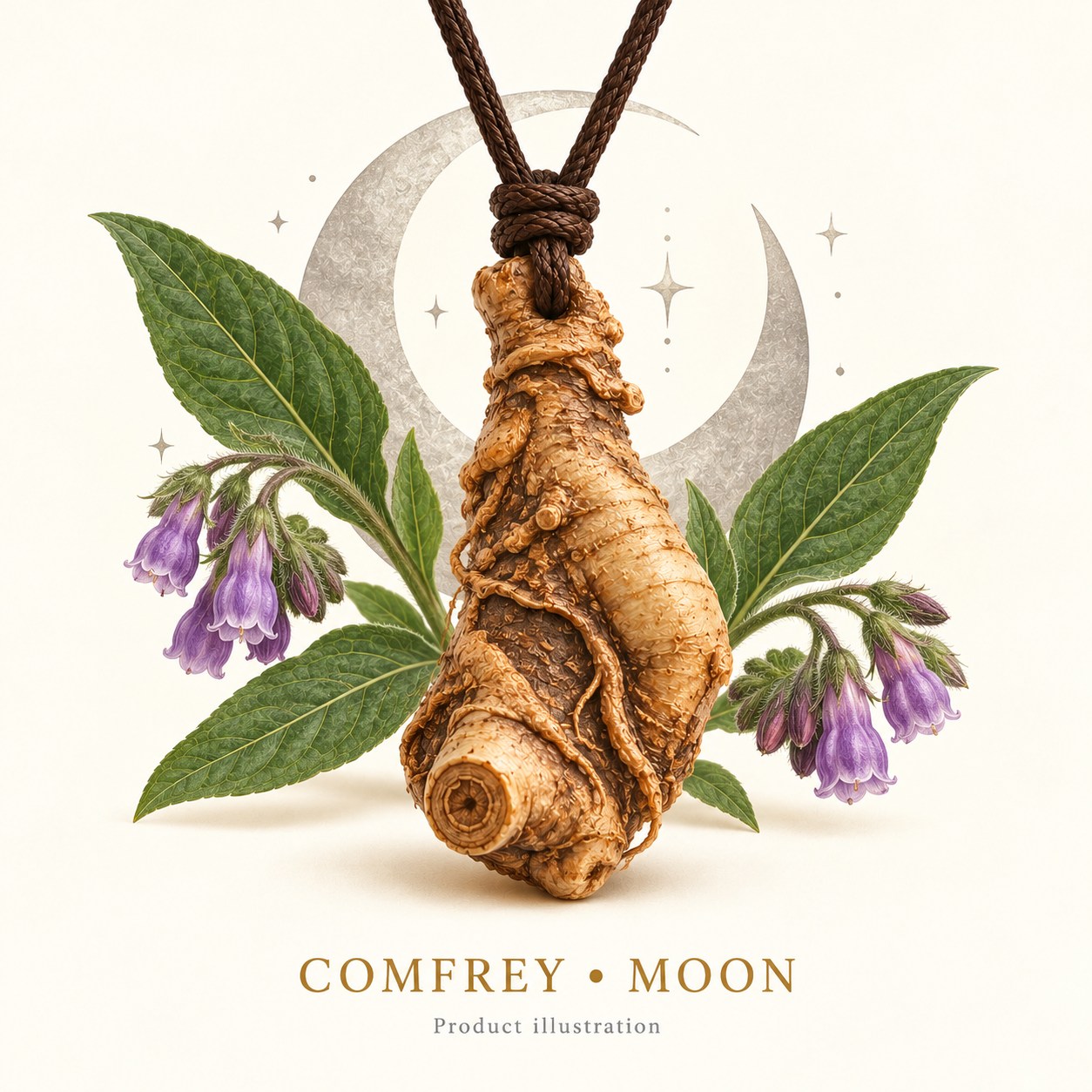
A Comfrey Root Pendant for Moon should be understood first as a botanical jewellery object, not as an edible herb or a treatment. A listing may show a dark root fragment mounted in a cap, a wrapped root piece, a sealed botanical inclusion or an ornament that merely resembles dried root. Those designs are not automatically equivalent. Before choosing one, establish the claimed botanical species, the plant part, the supplier's documentation, the kind of enclosure, the materials touching the body and the care instructions for the exact finished object.
Comfrey has a long European herbal history, and the traditional name knitbone can be encountered in historical writing. That history is not evidence that a root pendant can mend bones, treat pain, improve health or substitute for medical care. Comfrey also has a specific, serious safety issue: it can contain pyrrolizidine alkaloids (PAs), some of which are associated with severe liver injury after ingestion. Do not chew, brew, ingest, grind, boil, lick or soak comfrey jewellery in drinking water. Do not turn a devotional accessory into a preparation for another use.
The guide is designed for customers, collectors, store staff and buyers who want more than a reassuring trade name. It explains botanical identification before processing, the limitations of visual checks after a root is assembled, what constitutes useful provenance, how to inspect a fitting and what to do when a component becomes damaged. For related subjects, see Comfrey and Chandra's traditional association, Comfrey root versus pearl in Moon-related traditions, and the Comfrey Root Pendant for Moon.
1. First identify the kind of object being offered
The label Comfrey Root Pendant is not a complete specification. A customer needs to know what is being supplied, not only why the product appears in a planetary collection. The botanical component could be directly exposed, partly coated, held in a metal cap or completely enclosed inside a separate body. The distinction affects contact with skin, possible release of loose particles, repair decisions, moisture resistance and long-term storage.
A photograph may be useful for assessing shape and workmanship, yet it does not establish chemical composition, botanical identity, absence of alkaloids or safety of all components. An attractive enlarged photo can also hide the actual size of a bail, cord or exposed cut surface. A reliable listing therefore combines the image with words that describe the complete construction.
| Listing description | What it can mean | What to confirm before purchase |
|---|---|---|
| Raw root piece with cord | Exposed botanical surface held by a hole, wrap or knot | Exact species claim, loose fibres, abrasion, attachment strength and contact plan |
| Root in metal cap | Botanical piece held by a glued or mechanically fitted end cap | Adhesive, cap integrity, whether the cut end is exposed and metal composition |
| Root in transparent casing | Plant material apparently isolated behind a window or resin | Whether the enclosure is complete, cracks, seams, curing and material declaration |
| Root-like bead or pendant | A carved, moulded or composite object that resembles wood | Whether any genuine comfrey is present; resin and filler disclosures |
| Powder-filled charm | Plant material inside a container | Seal integrity, spill risk, access by children and whether the contents are accurately declared |
| Moon-themed pendant | Ornament with Chandra imagery but no botanical content | Avoid assuming the imagery itself certifies a named root |
These are construction categories, not endorsements. A fully encased item can reduce direct handling of its contents when the enclosure is intact, but that observation is not proof that a specific finished item has undergone exposure or safety testing. For any design with exposed botanical material, ask whether skin contact is intended and on what basis the seller considers that use appropriate. When those questions cannot be answered, a non-contact display or a different material is the prudent alternative.
2. Correct botanical name: common comfrey and the borage family
The plant most often called common comfrey is ***Symphytum officinale* L., in the family **Boraginaceae. Kew's Plants of the World Online treats that name as accepted. The genus Symphytum contains multiple species and hybrids; therefore, the English word comfrey is not a species-level identification. The name can also appear in historical books with spelling variants or in commercial catalogues without the scientific author abbreviation. A clear label should specify the accepted name rather than relying solely on its common-name translation.
Common comfrey is an herbaceous perennial associated historically with damp soils, edges of streams and cultivated gardens across temperate regions. It develops coarse, hairy foliage, leafy stems, nodding clusters of tubular or bell-like flowers, and a substantial root system. The flowers can vary in colour. A single colour photograph is not a reliable way to identify an isolated root, and flowers seen in a supplier's garden may not belong to the lot used for jewellery.
The botanical information is useful because it tells us what evidence to seek at source. A label referring to S. officinale should connect the harvested or cultivated plant to an identifiable population or lot, preferably with photographs of the whole plant and relevant diagnostic structures taken before processing. The identification should be made by someone with appropriate botanical competence, not retroactively inferred by comparing an assembled pendant with unrelated online photographs.
Root and rhizome are not casual synonyms. Depending on the item and the botanical structure, a supplier may use imprecise terms such as root stick, rhizome, stem or herb. A merchant should describe the actual plant part and preparation accurately. A twig, stem segment, wood carving, resin cast and pulverised herbal filler are different materials from an identifiable dried root, even if all are wrapped in similar jewellery fittings.
3. Common comfrey, Russian comfrey and other related names
Several plants are associated with the name comfrey. Symphytum × uplandicum, often called Russian comfrey, is an accepted hybrid involving S. officinale and S. asperum; Kew treats it separately from common comfrey. The × sign marks its hybrid status. A botanical reference to S. officinale should not be copied to a product whose material is actually sourced from S. × uplandicum. Similarly, the presence of S. asperum in horticultural records does not mean that every lot sold as comfrey contains that species.
A living plant may offer useful comparisons of stem wings, hairiness, leaves, flowering habit and colour, but differences can overlap across growing conditions, populations and hybrids. For difficult identifications, specialist assessment matters. Once harvested material is dried, broken and enclosed, many of those characters disappear. Commercial photographs rarely give enough information to distinguish two species of dried root reliably.
| Name in a catalogue or reference | Botanical meaning | Why it matters for an ornament |
|---|---|---|
| Common comfrey | Usually Symphytum officinale | Appropriate as a species claim only with credible identification and lot traceability |
| Russian comfrey | Commonly Symphytum × uplandicum | A hybrid, not an automatic synonym of common comfrey |
| Symphytum asperum | A distinct species and a parent of the Russian-comfrey hybrid | Should not be relabelled as S. officinale without evidence |
| Symphytum sp. | Genus-level identification with species unresolved | More honest than an unsupported exact species assertion |
| Knitbone | Historical vernacular name for comfrey | A cultural name, not evidence that a pendant treats injuries |
| Comfrey root | Commercial description of plant part | Requires separate identification of species, harvested part and finished form |
| Herbal Moon charm | Devotional or retail designation | Tells the customer about intended symbolism, not botanical proof |
Where identification is uncertain, the product record should say so plainly. It is better to disclose Symphytum species not independently confirmed than to print a confident Latin name without supporting records. If the material does not have enough provenance for a botanical label, it should not be promoted as authenticated S. officinale root.
4. How living-plant identification works before harvest
Reliable identification begins with the plant before its distinctive parts are discarded. Botanical fieldwork examines the plant's habit, foliage, stem, flowers, sometimes fruit, growing location and, when appropriate, voucher specimens. A photo of a detached root cannot substitute for all of these observations. An identified cultivated plant is also different from a loose market sack of roots whose harvest locations and species were combined.
For a supplier, a useful record could include a collection or cultivation location at an appropriate non-sensitive level, a date, the scientific name, the part collected, a lot number, photographic evidence and the name or role of the identifier. The collected plants should be linked to the dry material entering processing. If several batches are mixed during cleaning or sorting, records should identify that point; otherwise the chain of evidence becomes ambiguous.
A specimen photograph need not be beautiful. A clear close-up of flowers, leaf attachment and the entire plant can be more useful for identification than a polished studio image. For scientific uncertainty, a properly documented specimen examined by a qualified botanist or suitable lab method may be needed. DNA-based analysis can sometimes contribute to identification, but processing, contamination, mixed material, reference databases and sampling determine its limitations; it is not an automatic certificate of every pendant in a shipment.
Evidence quality: what can and cannot prove a species
| Evidence offered by seller | What it can establish | What it does not establish by itself |
|---|---|---|
| Product photograph | Appearance of an advertised or sample object | Exact species, PA concentration or identity of all inventory |
| Scientific name on label | Species the seller declares | Independent confirmation that the material came from that species |
| Photograph of the source plant | Botanical context if accurately connected to the batch | Identity of an unrelated dried fragment |
| Cultivation or harvest record | Provenance and collection history | Purity or chemical safety without relevant testing |
| Botanical expert identification | Identity of a documented specimen within the method's scope | Every unexamined lot or substituted piece |
| Laboratory authentication report | Findings for the submitted sample and tested method | Universal identity or absence of every possible contaminant |
| Batch-linked quality report | Results for a defined lot and analytes | Other lots, later processing changes or indefinite shelf life |
| Verifiable chain of custody | Connection between source, processing and sold units | A guarantee of spiritual outcomes or complete risk elimination |
The essential question is whether the evidence belongs to this product lot. A general textbook illustration, certification badge for the seller or laboratory report for a different herbal extract should not be presented as direct proof of the root enclosed in a necklace. When batch-level information is unavailable, communicate that limitation before a customer pays for authenticity claims.
5. Why a dried root is hard to authenticate visually
A living Symphytum plant has botanical features that a broken dried root may not retain. Drying can darken colour, alter texture, collapse soft tissue and produce shrinkage or cracks. Polishing, scraping, varnishing or coating can obscure the cut surface. A tiny fragment in an end cap has even fewer observable characters. Buyers sometimes assume that dark brown colour, distinctive smell, fibrous texture or the appearance of a central core proves genuineness; none of these alone is a definitive species test.
Different roots may be physically similar. Even fragments from the same species can look unlike one another because of age, soil conditions, harvested diameter, drying time and treatment. Some items sold as sacred roots are actually mixed plant material embedded in adhesive or resin. That may be a legitimate design if correctly described; it should not be misrepresented as a single authenticated root specimen.
Do not use burn tests, taste tests, scraping, grinding or chewing to identify a finished comfrey pendant. These methods risk releasing dust, damaging the product and creating avoidable exposure without producing a reliable botanical determination. Also avoid dropping it in hot water, rubbing it on the tongue or asking someone to smell a freshly drilled surface. If an item is already damaged, isolate it rather than subjecting it to further destructive checks.
A buyer inspecting a listing should ask: Is the sample photographed the actual unit? Is the botanical piece exposed? Is the image showing an end grain or a polished resin exterior? Are the dimensions stated? Does the product record say root, herb, bark or wood? Is there a lot number? Has the seller explained whether confirmation is independent or based on the supplier's claim? These questions form a sensible first stage without asking a customer to act as a laboratory.
6. A practical receiving inspection for shop staff
When a batch arrives at the store, receiving staff can compare the delivery against the purchase order and supporting documents. Record the supplier, SKU, date, declared species, plant part, lot and quantity. Check whether the packaging protects fragile pieces and whether there is visible loose dust inside the bags. Retain relevant labels rather than throwing them away after unpacking. The goal is traceability and safe handling, not informal botanical experimentation.
Inspect the fittings and shells without aggressively rubbing the root. A lightweight pendant is not necessarily weak, and a heavy end cap is not necessarily secure. Look for cracks at the root-cap interface, loose bails, sharp crimp edges, exposed adhesive, badly finished cord ends, staining on packaging and movement of the botanical element. A product can be labelled correctly and still be mechanically unsuitable for sale.
If material is loose or broken, separate it from good stock. Do not blow dust off the counter, brush debris into a general food area, test the powder on the skin or reassemble it with an unknown adhesive. Photograph the condition, retain the labelled packaging and ask the supplier for an appropriate return or quality response. If many units show the same issue, the problem may involve an entire lot rather than an isolated mistake.
| Receiving checkpoint | Pass condition | Stop-and-review condition |
|---|---|---|
| Declared botanical material | Species or identification level, plant part and lot recorded | Conflicting labels or unexplained source change |
| Product construction | Assembly matches the listing and purchase order | Unannounced exposed material, loose powder or substitute filler |
| Image and dimensions | Representative photograph, length and weight are stated | Scale hidden or stock differs materially from photographed sample |
| Cap or enclosure | No visible gaps, cracks, looseness or unsafe edges | Root moving freely, cracked casing or exposed broken material |
| Cord and metal | Material stated; closure works in normal inspection | Sharp metal, unidentifiable plating or weak attachment |
| Handling information | No-ingestion and dry-care instructions available | Text encourages oral use, soaking in drinking water or home brewing |
| Lot documentation | Batch can be followed from purchase to listing | No connection between reported specimen and finished units |
| Quality concerns | Issue is documented and isolated | Unlabelled dusty fragments put back into saleable inventory |
A practical acceptance log helps the store respond consistently if a customer later reports a defective cap or uncertain botanical identity. It also prevents an image or description from remaining online after the product construction has changed.
7. The comfrey ingestion warning: what the evidence establishes
Comfrey is not a food-grade accessory material simply because it is a plant. The US National Institutes of Health's LiverTox reference describes comfrey-associated pyrrolizidine alkaloids and reported severe liver injury following oral exposure. The injury pattern can include hepatic sinusoidal obstruction syndrome, a potentially serious disorder involving small liver vessels. The concern is not merely a temporary bitter taste or a matter of personal preference.
PA content can vary with the plant species, part, growing conditions and preparation. A tiny root fragment does not carry a known safe ingestion dose. Nor can a customer infer a safe exposure level from a product photograph or a seller's claim that the pendant is 'natural'. A botanical jewellery listing is not a medicinal-drug dossier, a tested food declaration or a dose instruction. Do not place the root in tea, water, milk, food, prasad or any preparation intended for consumption.
Historic herbal names such as knitbone and descriptions of poultices can be discussed as cultural history, but they must not be converted into a recommendation to eat the material, use it on wounds or prepare a drink. Sometimes spiritual instructions suggest soaking an object overnight and drinking the water. That is inappropriate for comfrey jewellery: the preparation could transfer unknown substances from the plant, adhesives, metals or coatings into the water. A 'charged water' label does not change the chemical exposure question.
The distinction between ornamental wearing and oral exposure needs careful wording. Evidence of harm from ingestion does not in itself quantify exposure from an intact pendant, but neither does it prove prolonged skin contact with untested root material is safe. Dermal exposure depends on whether the plant is exposed, whether the skin is intact, duration of contact, moisture, coatings and other details. A cautious buyer avoids bare or broken root contact and requests specific assembly information. A sealed design should be considered only on the merits of its actual integrity and materials, not a blanket promise of zero exposure.
8. How medicinal comfrey preparations differ from jewellery
Regulated medicinal products, where authorised, may use specific extraction and manufacturing methods, defined indications, quality controls, limits on pyrrolizidine alkaloids, approved instructions and restrictions such as short-term application on intact skin. The European Medicines Agency's herbal assessment makes these distinctions within a medicinal context. Those controls cannot simply be transferred to a raw botanical pendant or to a product whose coating, batch and PA content have not been established.
A comfrey cream with a measured specification is not the same as a cut root tied to a cord. An ointment intended for limited topical use is not proof that an unmeasured pendant should touch the skin continuously. Likewise, a root charm has no scientific basis for advertising the effects of an authorised medical preparation. The customer should not confuse the evidence for a particular regulated product with a general claim about all comfrey-containing objects.
| Product or activity | Intended category | Important boundary |
|---|---|---|
| Comfrey-root pendant | Decorative or devotional accessory | Requires botanical, construction, handling and contact assessment |
| Dried comfrey root sold as herb | Botanical raw material | Not suitable for improvising ingestion from a jewellery product |
| Comfrey tea, capsule or powder consumed orally | Ingestible preparation | Serious PA-related safety concerns; do not recommend |
| Regulated comfrey topical preparation | Specified medicinal product in applicable jurisdictions | Rules, quality limits and instructions are formulation-specific |
| Home poultice or soaked root | Uncontrolled preparation | Not an appropriate reuse of a purchased pendant |
| Encased decorative botanical specimen | Display or ornament | Enclosure integrity and materials still need evaluation |
| Moon-related prayer without material contact | Devotional practice | Does not require manipulating, soaking or ingesting a root |
For a jewellery article, the appropriate response to a question about treating pain, bruises, wounds or a liver condition is not to provide a recipe or an application schedule. Those are medical matters, whereas this guide concerns the identity and care of an ornament. Avoid also making a converse claim that wearing the pendant is a treatment or cure for any emotional or physical condition associated with the Moon in popular astrology.
9. Jewellery contact: distinguish material exposure from fit
An accessory may touch the neck, shirt, wrist, hand or a pouch. Direct exposure can occur if the plant component protrudes through the setting; indirect contact can happen through loose fibres and dust, a cracked casing or dampness. Prolonged pressure from a clasp is another issue unrelated to botanical species. A seller should describe the fitting and intended contact method instead of using 'skin friendly' as a catch-all reassurance.
A pendant intended to sit over clothing may be less likely to touch bare skin, but it can still break, shed particles or transfer material when handled. A cord can wear through at the bail; a root can crumble after impact; a metallic cap can corrode; and a resin shell can crack. Evaluate those risks separately. No single claim such as 'natural', 'organic', 'energetically charged' or 'sealed' proves that a design has passed material-contact testing.
If itching, redness, burning or another reaction occurs, stop wearing the item and avoid further exposure. Allergic or irritant reactions may also arise from metal alloys, plating, dyes, perfumes, cord fibres or adhesive. The presence of comfrey cannot be assumed to be the only cause. Keep the item and packaging for assessment if needed rather than applying another unverified topical preparation to the affected area.
Do not use the ornament over open wounds, irritated skin or under tight wet clothing. Do not use it in situations where a young child or pet could mouth or swallow a detached botanical piece. If the design involves a small detachable component, consider the whole assembly a potential choking hazard, independent of its species. These points belong in care information because the intended use is an everyday physical object, not simply a symbolic description.
10. How to inspect a cap, bail, cord and enclosure
A root pendant's strength is determined by how it is assembled. A cap may be friction-fitted, glued, mechanically crimped or attached to an internal support. Without design information, it is not reasonable to assume that the root itself can support repeated pulling. An exposed drilled hole may be particularly vulnerable when the plant material is dry, fibrous or brittle. The seller should inspect the assembly and state appropriate limits.
Look at the bail where it joins the cap and the cord or chain. A rough edge can cut fibres; a loose jump ring can open; a sharp metal corner can snag a scarf. Check the stated dimensions of the piece rather than the enlarged product photo. Consider whether the size feels comfortable and whether the pendant will strike hard surfaces during normal activity. A larger botanical piece may also need a stronger, better-balanced mount.
The external metal is not automatically sterling silver, copper or a defined alloy. Ask for its material and any plating, particularly if you have sensitivity to a common jewellery metal. A clear resin casing may change appearance in sunlight or after contact with perfume, and its transparency does not reveal the identity or quality of the hidden plant fragment. A seal is only useful while intact.
Construction and wear-risk checklist
| Component | What to inspect | Why it matters |
|---|---|---|
| Root fragment | Fraying, flaking, exposed cracks and loose dust | Loose material can contaminate storage and make handling unsuitable |
| Cap | Fit, movement, adhesive or visible gaps | Cap failure can release a plant piece |
| Bail or jump ring | Closed gap, smooth edges and correct gauge | An open or sharp joint can detach or damage the cord |
| Cord | Abrasion, knots, dye transfer and suitable length | A weak cord can break or sit uncomfortably |
| Chain | Links, clasp and declared metal | Supports durability and wearer comfort |
| Encapsulation | Visible cracks, seams or cloudiness | Broken or degraded casing changes contact conditions |
| Coating | Peeling, stickiness, unknown finish | Surface change can expose material or create unwanted contact |
| Packaging | Individual storage and readable label | Keeps the item identifiable and away from edible materials |
For a newly purchased accessory, perform a gentle visual and functional check rather than a destructive stress test. Do not pull hard on the root, drill a new hole or try to heat-set a loose cap. Mechanical defects should be handled as a product quality matter by the seller or a competent jewellery repair professional who understands that the contents are botanical and should not be ground or heated.
11. Cleaning without soaking, scraping or chemical exposure
Start with dry, gentle external cleaning only, and follow the maker's instructions for the exact finished assembly. An untreated or partly exposed root is not a polished gemstone; immersion can alter its surface, swell fibres, loosen glue or transfer residue. A hard brush can remove material, and repeated polishing can abrade a fragile cap or coating. Never use lemon juice, vinegar, solvents, alcohol, bleach or harsh jewellery cleaners on an unidentified botanical assembly.
If the outside is an intact, specified non-porous enclosure, the supplier may provide separate instructions for its external surface. That does not mean the root itself can be wet. Keep cleaning liquid away from seams, holes, exposed plant parts and damaged finishes. A dry soft cloth for the chain or outside of a secure cap may be appropriate, but avoid rubbing raw botanical material aggressively.
Do not follow ritual bathing instructions borrowed from stones, Rudraksha beads or metal idols for an untested comfrey pendant. Some devotional customs use water, milk, oils, sandal paste or ash; these substances should not be placed on a botanical accessory unless its actual design and maker's care guidance explicitly allow it. A traditional intention can be expressed through prayer without physically soaking or coating the pendant.
For persistent grime, stickiness, mould-like spotting or unusual odour, avoid home experimentation. Isolate the item in a labelled package and contact the seller. A smell does not authenticate comfrey and should not be used as a reason to sniff or scrape the root closely. If there is obvious loose powder, avoid generating airborne dust or handling it repeatedly; preserve it for the supplier's assessment.
12. Storage, humidity, travel and seasonal maintenance
A botanical object responds to its environment differently from many gemstones and metals. Avoid prolonged dampness, condensation, high heat and direct prolonged sunlight unless the maker has demonstrated suitability for those conditions. In a humid climate, a poorly ventilated closed container can trap moisture; in very dry storage, brittle material may become vulnerable to impact. The best storage is typically clean, dry, labelled and physically protected, following the manufacturer's actual product guidance.
Keep the pendant in a separate pouch or compartment where it will not rub against hard stones, keys, coins or sharp edges. Store its product identification card with it. The card matters later: after months or years, a root fragment in an unlabelled drawer can be mistaken for another herbal ingredient, a wood offcut or a similar-looking religious accessory. Explicitly mark the item ornamental only; do not ingest.
For travel, choose a small protective case that prevents the cap from being compressed. Do not put loose pieces beside snacks, spices, herbal powders or medicines. If the pendant must be declared or examined, the species information and invoice may help explain what the object is, although local transport and import rules should be checked where relevant. A botanical accessory may face different agricultural import rules than an ordinary metal necklace.
When unpacking after travel, look for new cracks, loosened joints, unexpected dampness and shed fibres. If the item has been immersed or left in a hot vehicle, do not assume it remains suitable for wearing. Request assessment where uncertain. A simple inspection habit is more meaningful than an arbitrary claim that all root jewellery survives water, sweat or sunlight indefinitely.
13. Damage, breakage, loose fibres and disposal decisions
When a comfrey piece becomes cracked or loose, stop wearing it and avoid touching exposed material more than necessary. Keep children and animals away from fragments. Collect the piece without pulverising it; place it in a clearly labelled, closed container or bag, and contact the retailer for repair or return advice. Do not blow powder away, sweep it into food preparation areas or transfer the fragment into a tea jar. The aim is to prevent accidental contact or confusion.
Home fixes are particularly problematic when they involve drilling, sanding, burning, hot glue, heat guns or solvent-based finishes. These can alter the root, generate particles, damage the seal or introduce other unknown substances. A jewellery professional may repair a metal chain separately, but work directly on the botanical core should be planned only with adequate awareness of the material and appropriate controls.
A broken pendant is not automatically suitable for reuse as a room diffuser, incense, planting material, garden compost additive or Ayurvedic preparation. Each new use would have different questions about contents and exposure. The safer course is to keep its identity clear and seek the original seller's advice about a damaged or no-longer-wanted item. If disposal is necessary, check applicable local waste guidance; do not instruct customers to burn or ingest the material.
If the supplier cannot establish what plant was used, the appropriate action may be to withdraw or relabel the inventory rather than fix the matter with a decorative certificate. If a customer was promised one species and receives an unverified piece, the issue concerns representation as well as care. Document the concern and offer a transparent resolution.
14. What batch records and lab reports can actually say
Botanical identity, workmanship and chemical exposure are separate evidence questions. A taxonomic identification report does not automatically quantify pyrrolizidine alkaloids. An alkaloid assay for a sample does not automatically identify the species. A metal-content test does not authenticate the root. An invoice proves a transaction, not scientific identity. The most reliable product description states the scope and limitations of each document.
If a seller uses a phrase such as 'PA-free', ask what was tested, which analytes were included, the method's detection limits, the sampling plan and whether the tested lot is the one being sold. A result stated as 'not detected' means only that the measured analytes were below stated detection or reporting thresholds in the submitted sample; it is not a promise that all PA compounds are absent everywhere. Without relevant lot-specific evidence, do not market the piece as PA-free or suitable for prolonged skin exposure.
Where botanical identification is based on a supplier declaration, state that. Where an authenticated voucher specimen exists, indicate its relationship to the delivered batch. Where a product has an intact enclosure, describe the enclosure rather than claiming universal safety from it. These distinctions are especially important for commercial pages because a broad safety badge can falsely imply that multiple unrelated questions were tested.
A customer may reasonably request the supplier's plant name, plant part, processing approach, enclosure type, care guidance and provenance statement. If sensitive commercial details cannot be shared, the retailer can still offer a meaningful non-confidential summary. A vague sentence such as '100% pure original divine energy root' supplies neither botanical nor construction evidence.
15. Traditional Chandra meaning: spiritual interpretation versus product facts
The Comfrey Root Pendant for Moon is offered within a planetary herbal-jewellery category. In Jyotish and related devotional settings, Chandra is associated with the mind, change, receptivity, nourishment, emotional experience and family symbolism. Somvar (Monday) is widely linked with Chandra and Shiva traditions. These are interpretive and devotional frameworks. They do not authenticate the root, predict a laboratory test result or establish a medical benefit from wearing it.
Pearl (Moti or Mukta) has a familiar position in traditional Chandra gemstone discussions. The asserted Comfrey association is a more specific herbal-jewellery interpretation, not something that should automatically be presented as the universal classical substitute for Moti. Customers who care about textual lineage may ask which teacher, community or source supports the comfrey correspondence. An honest article can explain the retail tradition without overstating its historical reach.
Customs vary. Some people prefer to begin wearing Moon-related jewellery on Monday, recite a Chandra mantra, keep a sankalpa or conduct Shiva worship. Such customs need not involve washing, soaking, ingesting or placing the root directly against the skin. A person can keep the object in a pouch or on a clean shelf and perform the devotional practice separately. If a family guru provides instructions that involve wetting or consuming the material, request a safe alternative for this particular object rather than converting the ornament into a preparation.
Personal astrological recommendations may take into account Chandra's position, nakshatra, house, dignity, dasha and other chart factors. None of those interpretive factors changes a root's material properties, its PA-related concerns or a defective setting. The practical safety information remains relevant even when a customer has a personalised Jyotish consultation.
For further devotional context, see Comfrey and Chandra: Understanding the Traditional Moon Association. For the material comparison, see Comfrey Root and Pearl in Moon-Related Traditions. This article deliberately stays focused on identification and handling.
16. Common misunderstandings to correct in product descriptions
A product copywriter may be tempted to compress a complicated story into a familiar marketing phrase. That is risky when the phrase blurs species identity, chemical testing or traditional authority. Natural material is not the same thing as a verified species; external jewellery is not the same thing as a tested medicinal formulation; and a Moon association does not remove ordinary material risks.
| Misleading shortcut | More accurate wording |
|---|---|
| 'All comfrey is the same plant' | Several Symphytum species and hybrids share related common names |
| 'Brown root texture proves authenticity' | Dried appearance alone does not authenticate a small processed fragment |
| 'Kew lists the species, so our pendant is certified' | Kew establishes a botanical reference name, not the identity of the seller's individual lot |
| 'Natural jewellery is automatically safe' | Source, exposure, construction and contact details must be considered |
| 'Root is tiny, so it is safe to taste' | No safe oral dose can be inferred from jewellery size; do not ingest |
| 'Topical creams are allowed, so raw root can touch skin forever' | Formulated medical products have separate controls and cannot validate an untested pendant |
| 'Fully sealed means no safety questions remain' | Check the actual enclosure, seams, integrity and other contact materials |
| 'A PA-free label proves absence of all alkaloids' | Ask for lot-linked results, analytes and detection limits; do not infer universal absence |
| 'Comfrey is a classical replacement for Moon pearl' | Identify the specific source of the herbal association; do not conflate it with established Moti traditions |
| 'Ritual activation requires drinking infused water' | A devotional observance can be separate; do not soak the plant for consumption |
These corrections improve trust and search usefulness at the same time. They allow a customer to see exactly what the seller knows and what is still uncertain, without undermining the cultural meaning a customer may attach to a devotional item.
17. Questions a buyer should ask before placing an order
A prepared customer does not need to become an expert botanist. Ask for the declared scientific name and plant part, then ask how the declaration is connected to the actual lot. Check whether the piece is raw, coated, capped, wrapped or fully enclosed. Ask what the metal, thread, glue and transparent casing are made from. Confirm size, weight, attachment style and how the item is supposed to sit when worn.
The next questions concern maintenance: Can the ornament be kept dry? What cleaning is recommended? What are the known limitations around sweat, rain, perfume and water? What should happen if the root cracks or the cap loosens? Does the retailer recommend avoiding direct skin contact? Are there accessible written instructions clearly stating not for ingestion? Where material safety has not been demonstrated for bare contact, treat that as a material uncertainty rather than filling the gap with reassuring adjectives.
Before buying for a child or giving the accessory to someone who may mistake it for an herb, reconsider whether a comfrey-root item is suitable. A clearly documented alternative made of inert decorative material may be a better practical choice. Gifts should include the information card; otherwise a recipient may not know the material is botanical and non-edible.
Ask about stock variation too. A root may look different from the sample image, and a capped specimen could be longer or shorter than expected. The listing should state whether the customer receives the photographed piece or a representative unit and whether these variations are cosmetic or affect construction. Variation in natural materials is normal; unexplained substitutions are not.
18. What to keep on the invoice, label and product page
A good product record reduces after-sale confusion. The public page should tell the buyer what the material is claimed to be, which parts are botanical and what contact or care restrictions apply. The invoice should identify the specific SKU and, where feasible, the batch or version of the product. An internal inventory record can hold deeper supplier documents without displaying confidential commercial details to every visitor.
Recommended retail fields include: product name; scientific name with identification status; plant part; method of drying or coating if known; the fact that the pendant is non-edible; enclosure and other materials; dimensions and mass; batch or lot reference; images of actual or representative stock; and concise handling, cleaning and damaged-product instructions. Do not invent the botanical species, metal purity or independent laboratory status to make a template look complete.
The SEO title and description should focus on actual search intent: identification, safe handling, correct species names and jewellery care. Avoid search copy implying a medical cure, guaranteed Chandra outcome or safety level that has not been substantiated. Internal links can lead readers from this guide to the Comfrey Root Pendant for Moon, the Planetary Herbal Jewellery collection and the broader Spiritual Jewellery collection.
Store staff can use the page for consistent customer replies. If a shopper asks 'Can I drink water in which I soaked this root?', the answer must be no. If they ask 'Is the plant definitely S. officinale?', the response must reflect actual evidence. If they ask 'Can I wear it in the shower?', use the maker's construction guidance rather than a generic gemstone cleaning rule. Good content provides practical decisions instead of replacing every uncertainty with a religious claim.
19. Comparison with other materials in the shop
Different spiritual-jewellery categories need different maintenance. A gemstone may be brittle along a cleavage direction or altered by dye; a Rudraksha seed may have specific moisture and cleaning concerns; a wooden bead may warp; a metal chain may tarnish or trigger skin sensitivity. A comfrey botanical core has additional identity and ingestion-related questions. Therefore, a universal 'energise everything in salt water overnight' instruction is poor material care.
| Material type | Typical identity question | Care question especially relevant to that material |
|---|---|---|
| Comfrey-root accessory | What Symphytum species, plant part and lot? | No ingestion; avoid dust, damage and unverified skin contact |
| Other herbal-root pendant | Which authenticated plant and processing method? | Varies by botanical species, coating and construction |
| Rudraksha seed pendant | Genuine bead, mukhi structure and workmanship? | Protect bead and fitting; use established bead-specific care |
| Natural pearl | Cultured or natural; shell or imitation; treatment? | Avoid harsh chemicals, abrasion and unsuitable cleaning methods |
| Quartz gemstone | Natural, treated or manufactured product? | Inspect polish, setting, chips and any treatments |
| Metal charm | What alloy, plating and closure? | Check skin sensitivity, corrosion and secure attachment |
| Resin botanical display | What is enclosed and what resin was used? | Avoid cracking, high heat and solvent damage |
The purpose of such a comparison is not to rank the spiritual importance of materials. It is to show why precise identification and material-specific instructions make a commercial article more useful. A customer may select an ornament for aesthetics, devotion or a particular personal tradition, but still deserves accurate practical information.
20. An example of a defensible product specification
A product detail page might say: 'Comfrey Root Pendant for Moon — botanical ornament. Species declared by supplier as Symphytum officinale; supplier identification method and lot evidence available on request where held. Dried root component secured in a described enclosure; other materials listed separately. For ornamental use only; not intended for ingestion, preparation in water or application to skin or wounds. Keep dry and stop use if damaged. This product is offered as an item of personal devotional symbolism, not as a health treatment.'
That wording is an illustrative template, not a statement that a particular OmmRudraksha stock item has already met every part of it. The product page should include only facts substantiated for current stock. If the plant species is unverified, use a genus-level description or state the supplier's claim without presenting it as independent authentication. If the root is not enclosed, do not describe it as enclosed. If a coating is unidentified, do not say it is a particular non-toxic resin.
For a premium product, photographs should show the front, back, cap, join, profile and scale reference. If the piece varies naturally, show more than one realistic specimen or explain stock variation. Avoid AI-retouched photographs that erase cracks or imply a more perfect fitting than supplied. The goal is that the buyer can make a practical decision without surprises.
A well-written product page also allows customer service to direct serious queries appropriately. The seller can answer what is inside the pendant, its construction and current handling advice. Medical questions should be directed to qualified healthcare professionals. Questions about highly specific Chandra interpretations can be addressed through a competent astrologer or the customer's preferred tradition, without merging these subjects.
21. A practical step-by-step decision pathway
Step 1: Establish identity. Read the scientific name, identification status and plant part. If the supplier offers no evidence, treat exact species identity as unverified. Do not rely on the dark colour of the finished piece.
Step 2: Establish construction. Determine whether the botanical component is exposed, partly coated or completely enclosed. Check cap, bail, closure, cord and every other material that may touch the body.
Step 3: Check safety information. Confirm that the item is explicitly non-edible and does not carry instructions to brew, chew, soak for drinking or apply to damaged skin. Ask about intended contact, especially if root is exposed.
Step 4: Check stock and workmanship. Compare the actual or representative photographs with the specification; look for unsecured, cracked or dusty material. The sales team should resolve discrepancies before shipment.
Step 5: Decide whether the item fits your routine. If your daily life includes rain, exercise, swimming or frequent washing, the design may not be suitable. Choose an alternative accessory if the necessary care is impractical.
Step 6: Keep records and maintain the item. Retain the identification note, invoice and care guidance; store the object separately from edible herbs. Reinspect the fitting periodically and remove it from use if damaged.
These steps apply even when a devotional reason motivates the purchase. They do not require rejecting the personal meaning of Moon-related customs. They require that the actual physical item be accurately described and handled sensibly.
22. Frequently asked questions about comfrey-root jewellery
1. Is common comfrey scientifically known as Symphytum officinale?
Yes. Kew accepts Symphytum officinale L. as common comfrey in the family Boraginaceae. That validates the botanical name, not the identity of every loose root sold with the label. For a pendant, look for evidence tying the claimed species to the purchased batch.
2. Is Russian comfrey the same as common comfrey?
No. Russian comfrey is generally Symphytum × uplandicum, an accepted hybrid associated with S. officinale and S. asperum. A customer should not assume that a botanical report for common comfrey covers a Russian-comfrey lot. Species or hybrid identity should be stated precisely where known.
3. Can a dried piece of root be identified by colour alone?
No. Colour changes with age, drying and finishing, and unrelated botanical materials can look similar. The piece may also be coated or mounted so that few diagnostic features remain. Supplier records and suitable botanical examination are more important than a colour comparison.
4. Does a plant photograph prove that the material inside my pendant is genuine?
Not by itself. A photograph can document a living plant, but the photographed plant must be linked to the harvested material and finished lot. A generic image from a botanical database is educational evidence about the species, not a batch authentication certificate.
5. Is comfrey root safe to eat because it is traditionally used as a herb?
No. Comfrey can contain pyrrolizidine alkaloids associated with serious liver injury following ingestion. Do not chew or ingest any portion of a comfrey-root ornament. A traditional name does not establish a safe dose, and jewellery is not manufactured or labelled as food.
6. Can I make tea from an old or broken pendant?
No. The item may contain comfrey alkaloids as well as coatings, adhesive, metal residues and other assembly materials. A damaged pendant should not be repurposed as tea, powder, incense, an infusion or any other preparation for consumption.
7. Can I soak the pendant in drinking water for a Moon ritual?
No. Do not put this botanical ornament into drinking water, milk or another liquid intended to be consumed. Devotional meaning can be expressed by prayer, mantra or a separate non-contact observance without immersing the accessory.
8. Does a very small root piece mean the amount of pyrrolizidine alkaloid is harmless?
No. Size does not reveal which alkaloids are present or their concentration, and a product listing does not provide an oral-exposure assessment. No safe ingestion amount can be inferred from the fact that a fragment is small.
9. Does 'sealed root' mean it is proven safe to wear?
No. Enclosure may reduce contact with the plant when intact, but actual seams, coatings, breakage, contact materials and use conditions still matter. Ask what the enclosure is made from and whether the intended contact has been evaluated rather than relying on a broad slogan.
10. Can an exposed comfrey root be worn directly on the skin?
Avoid assuming that untested exposed root is suitable for prolonged skin contact. The available evidence for an oral hazard does not quantify dermal exposure from this specific object. If the seller cannot explain the intended contact and relevant controls, consider a non-contact display or another material instead.
11. What if the pendant touches an open scratch or irritated area?
Remove it and avoid further contact. Do not use the root as a poultice or topical preparation. The advice for regulated topical products cannot be transferred to an unidentified root fragment, especially on damaged skin. Seek appropriate medical guidance for the skin issue if needed.
12. What if the pendant produces itching or redness?
Stop wearing it. The cause might involve plant material, metal, plating, adhesive, dyes, a tight cord or another contact factor. Keep the product information and seek medical advice for persistent or severe symptoms. Do not apply home-made comfrey remedies to investigate.
13. How do I know if a comfrey pendant is actually root rather than a resin imitation?
Ask for the written material specification, construction description and representative close-up images. A resin ornament may be a legitimate alternative if labelled clearly, but it should not be called authenticated natural root without evidence. Avoid destructive home tests to distinguish them.
14. Is a laboratory certificate necessary for every inexpensive pendant?
The degree of documentation can vary with the seller, product and intended claim, but confident species or safety claims require proportionate supporting evidence. A supplier declaration should be distinguished from independent testing. Ask what any certificate actually covers, rather than assuming that all documents are equivalent.
15. What does 'PA-free' on a listing mean?
It has meaning only if the seller can explain the tested sample, lot, method, relevant alkaloids and detection limits. 'Not detected' in a particular assay is not a universal statement that every compound is absent from every unit. A blanket PA-free claim without appropriate evidence should not be relied on.
16. Can I wash comfrey-root jewellery with water and soap?
Do not immerse an unidentified or exposed botanical assembly. Start with the supplier's item-specific guidance, usually involving careful dry external cleaning. Water may affect dry plant material, adhesives, cords or seals. If the item is encased, ask about cleaning only the outer surface without wetting the core.
17. Can I clean it with lemon juice, salt water or perfume?
Avoid those substances. Acids, salt, perfumes, alcohol and other chemicals can damage caps, finishes and adhesives or introduce unwanted residue into porous material. They are not botanical identification methods and should not be used as ritual shortcuts for a fragile pendant.
18. What should I do if the root starts flaking or the cap becomes loose?
Stop wearing it and keep the item in a labelled closed package. Do not sand, drill, heat, burn or glue the root at home. Contact the retailer with photographs and the batch details to discuss assessment, replacement or an appropriate repair.
19. Can children or pets handle the pendant?
A detachable botanical piece can pose mouthing, ingestion and choking concerns. Keep the accessory and loose fragments away from children and animals who might chew or swallow them. Use extra caution when giving botanical charms as gifts to households with young children or pets.
20. Can I wear the pendant every day and during swimming or exercise?
Only the supplier's specifications can establish what the actual assembly is designed to withstand. Sweat, water, impact and friction can affect botanical pieces and fittings. If those exposures are part of your daily routine, choose an accessory whose materials and maintenance are appropriate rather than assuming universal durability.
21. Does wearing comfrey provide the benefits of medicinal comfrey products?
No such conclusion follows. A botanical pendant is not a measured medicinal preparation, and evidence concerning particular external formulations does not demonstrate benefits from wearing a root. Do not market the accessory as treatment for wounds, fractures, pain, anxiety or other conditions.
22. Is comfrey a universally accepted classical substitute for pearl in Chandra Jyotish?
Do not assume so. Moti or Mukta has an established role in Moon gemstone traditions. A Comfrey Root Pendant for Moon is a more specific herbal-jewellery association. Ask the supplier or practitioner for the particular devotional source if the historical lineage is important to you.
23. Can I do Somvar worship without wetting the root?
Yes. A person may follow suitable family or teacher-led Monday prayer, mantra or sankalpa without putting water, oil or offerings directly on the accessory. Keeping the jewellery separate from wet ritual materials respects its construction and the comfrey-specific safety concern.
24. What information should the seller provide on the label?
At minimum, the product should be identifiable by name and SKU, describe the claimed plant or identification status, plant part, construction, other contact materials, intended use and care restrictions. Where feasible, keep the lot reference and supplier record linked to the invoice. State clearly that the botanical material is not for ingestion.
25. Can I store it together with edible herbs or spices?
No. Keep botanical jewellery separately, labelled as ornamental and non-edible. An unlabelled root fragment can be mistaken for a medicinal ingredient, especially after a fitting breaks. Protect the accessory from moisture and hard objects in its own compartment.
26. What if the retailer cannot verify the botanical species?
Treat the species claim as unverified and ask for honest labelling, a better documented lot or a different accessory. A trade name, attractive photo or confident devotional story cannot substitute for species evidence. Choosing not to buy an uncertain object is a reasonable decision.
23. Final buyer's checklist and related reading
Before choosing a Comfrey Root Pendant for Moon, make sure you can identify what the object is claimed to contain, how it is assembled, what the seller actually knows about provenance, whether the botanical material is exposed and what instructions apply if it breaks. The safest product description does not promise invisible protection from the risks of a physical object. It states what can be verified and gives an appropriate use boundary.
Comfrey's traditional herbal history may be discussed with respect, and a customer may value the Moon association as part of a personal devotional practice. Neither consideration changes the basic principle that a root ornament must not be consumed or used to prepare a drink, and a species identification should never be inferred from a catalogue photograph alone. Good documentation, honest materials disclosure and conservative handling allow the customer to make an informed choice.
Explore the Comfrey Root Pendant for Moon, the Planetary Herbal Jewellery category, the wider Spiritual Jewellery range and the existing Rudraksha for Planets collection. For thematic background, read Comfrey and Chandra: Understanding the Traditional Moon Association and Comfrey Root and Pearl in Moon-Related Traditions.
Reference context
The botanical taxonomy discussed above follows Kew's reference for Symphytum officinale. The oral safety distinction follows the existing NIH/NIDDK LiverTox reference on comfrey. These references explain names and risks in general; they do not authenticate or certify a specific OmmRudraksha item. For questions about the current product's fitting, stock, materials or available supplier evidence, contact OmmRudraksha.
