
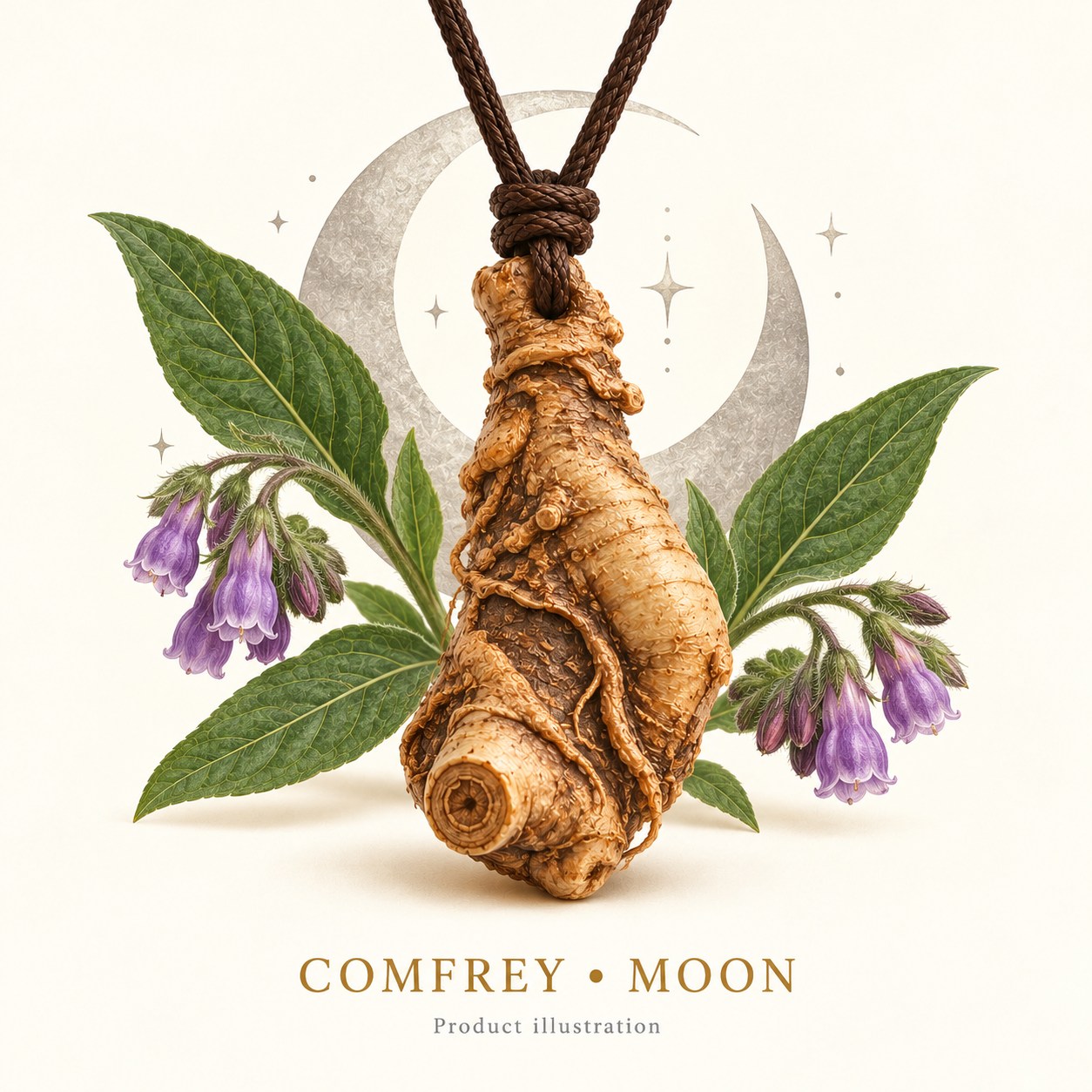
Comfrey and Chandra are connected in some contemporary planetary-herbal jewellery collections, including the Moon-labelled root pendant discussed here. The useful way to understand that pairing is to keep three subjects clear: the established symbolic and astrological meanings of Chandra in Hindu traditions; the botanical identity and known history of the herb called comfrey; and the specific practice of choosing a piece of root as a devotional accessory. They can be discussed together without claiming that a European plant has a universally documented place in ancient Indian planetary prescriptions.
In Jyotish, Chandra is central to the natal chart and to the calculation of lunar days, nakshatras and many dashas. The Moon is commonly interpreted through manas (mind), responsiveness, receptivity, nourishment, memory, the mother, domestic security, fluids and changing emotional rhythms. In worship, Soma, Chandra and the crescent worn by Shiva carry their own rich vocabulary. These well-established traditions give a meaningful context for a person who chooses a Monday observance or lunar-themed ornament. They do not, by themselves, tell us that every root sold as "Comfrey for Moon" is genuine comfrey or that a plant pendant can alter a horoscope.
For the botanical material, Kew recognises Symphytum officinale L. as an accepted species in the borage family, Boraginaceae. Comfrey is a herbaceous perennial with a predominantly European-to-west-Asian background, not an Indian sacred tree. The English common name has also been applied to related species and hybrids. Identification of a finished dark root fragment therefore requires a supplier record; names and photographs alone are limited. The Comfrey identification and jewellery safety guide examines that topic in greater detail.
The purpose of this guide is to explain the traditional Chandra association intelligently and with enough context for a careful buyer: Moon symbolism, Chandra's place in classical Jyotish, Somvar and Shiva worship, regional or household customs, the way herbal planetary pairings are marketed, and how to evaluate an actual pendant. For another material comparison, read Comfrey root and pearl in Moon-related traditions. The example product is the Comfrey Root Pendant for Moon in the Planetary Herbal Jewellery collection.
1. Who is Chandra in Hindu tradition?
Chandra is both the visible Moon and a divine or graha figure embedded in Hindu mythology, calendrical observance, iconography and Jyotish. Soma appears in Vedic literature in several related but not identical contexts: a sacred ritual substance, a deity and later lunar associations. A responsible article does not reduce all of these layers to a single modern gemstone or herbal-remedy chart. The word Chandra evokes brightness and the Moon; Shashi, Indu, Nishakara and Soma are among names encountered in devotional or literary language, with meanings and usage varying by text.
In familiar iconography Chandra may appear riding a chariot, holding lotuses, or associated with a cool, pale luminosity. Shiva as Chandrashekhara or Someshvara bears the crescent Moon; the image can suggest mastery of time and changing phases. The Somnath tradition is likewise associated with Shiva and the Moon in devotional storytelling. These associations are important because they explain why a devotee might prefer a Monday Shiva puja or a lunar motif without needing a special root. Regional customs and family practices may add their own recitations, offerings or pilgrimage places.
In a navagraha setting, Chandra is one of the nine grahas, alongside Surya, Mangala, Budha, Guru, Shukra, Shani, Rahu and Ketu. Graha worship may take the form of an individual prayer, a temple visit, a home altar or a set of nine images. Some planetary accessories carry a visual reminder of a chosen practice. The meaningful claim is that the person uses the ornament as a devotional cue. The stronger claim that contact with a comfrey root necessarily produces a specific astrological result would require evidence not supplied by the traditional symbolism alone.
A vocabulary table for Chandra
| Name or term | Context and ordinary meaning | What it does not establish |
|---|---|---|
| Chandra | Moon deity and Moon graha | A mandatory comfrey prescription |
| Soma | Vedic, ritual, devotional and lunar contexts | That every use of Soma means one plant species |
| Indu or Shashi | Literary or devotional names for the Moon | Material authenticity of an accessory |
| Chandrashekhara | Shiva depicted with the lunar crescent | A compulsory pendant design or metal |
| Somvar | Monday, a day commonly linked with Shiva and the Moon | Guaranteed outcomes from observances |
| Chandra mantra | A recitation addressed to the lunar deity | A rule for unverified root ingestion |
2. Chandra's place in Jyotish: manas, mother and responsiveness
Jyotish is a symbolic interpretive tradition in which the Moon is especially important. The Moon's sign, house, dignity, aspects, conjunctions, strength and phase can be discussed along with the lagna and the rest of a chart. Chandra is commonly connected with manas, mental habits, receptivity, comfort, memory and relationship to the mother. Traditional discussions may also associate it with milk, water, nourishment, public connection, care, travel or change. The precise emphasis depends on the school of interpretation and on the actual configuration, not on a single keyword.
The Chandra rashi is the sign occupied by the natal Moon. Some traditions use it for daily or monthly forecasting, name syllables, compatibility discussions or the reckoning of planetary periods. A popular claim that "all people born under Cancer must wear a Moon root" is too broad. The Moon rules Karka (Cancer) in the conventional graha-rashi scheme, but that does not mean every Karka native has the same natal Moon strength, dasha, personal concern or recommendation. Likewise, the fact that a person has a Moon-related interest does not automatically make a botanical pendant preferable to prayer or to no purchase.
In many classical and contemporary Jyotish presentations, Chandra is exalted in Vrishabha (Taurus) and debilitated in Vrishchika (Scorpio). Exaltation and debilitation are technical placements interpreted along with sign degree, dispositors, aspects, house condition and other chart factors. An isolated shorthand such as "weak Moon" is not a diagnosis of illness, nor can a seller assess a detailed chart through a product-page quiz alone. A personalised consultation should explain which chart features are being considered and why a symbolic practice is suggested.
The Moon is also central to Vimshottari dasha, a widely used dasha framework based on the birth Moon's nakshatra. Chandra's own major period is conventionally ten years in that system; antardasha interpretation depends on the complete sequence and chart. Ritual choices can be guided by a family custom or a knowledgeable practitioner, but a comfrey pendant is not an essential mathematical step in calculating the period. Understanding the terminology helps separate an authentic Jyotish discussion from marketing shorthand.
Jyotish reference: what to examine before a specific recommendation
| Chart consideration | Traditional interpretive question | Caution for shoppers |
|---|---|---|
| Chandra rashi | Where is the Moon placed in the natal zodiac? | Rashi alone does not determine an accessory |
| Bhava / house | Which life themes involve the Moon in that chart? | Avoid one-size-fits-all interpretations |
| Nakshatra and pada | What lunar mansion and quarter contain the Moon? | Do not infer a compulsory root species |
| Paksha and tithi | What is the lunar phase context? | A phase is not a materials test |
| Graha drishti / conjunction | Which other grahas interact with Chandra? | Interpret within the full chart |
| Dasha and antardasha | Which periods are under consideration? | A product cannot replace chart analysis |
| Shadbala or other strength methods | How does the selected Jyotish school assess strength? | A claim needs its method stated |
3. Moon's nakshatras: Rohini, Hasta and Shravana
In the standard 27-nakshatra rulership sequence used with Vimshottari dasha, the Moon rules Rohini, Hasta and Shravana. Their placements span different signs and images; the shared planetary ruler does not make them interchangeable. Rohini is often represented through growing or fertility-related symbolism and has a prominent place in Chandra mythology. Hasta is associated in traditional imagery with the hand and with skillful handling. Shravana is associated with hearing or attentive listening. These are interpretive associations, not physical ingredients to be combined into a pendant.
The birth Moon's actual nakshatra influences the starting dasha balance within the selected calculation system. Yet no universally established instruction follows that a person born in Rohini must purchase comfrey, or that a Hasta-born person needs a particular root length. If an astrologer recommends a Monday practice, the reasoning could concern Chandra, Shiva devotion, a regional sampradaya, or the whole chart. Ask which basis is being used; a traditional-sounding nakshatra name alone is not a sufficient citation.
A practical devotional approach might be as simple as reading a Chandra stotra, observing the Moon respectfully, visiting a Shiva temple or keeping a regular reflective practice. These choices do not require an herbal item. Someone who likes a root accessory may wear it as an optional reminder, provided the material and construction have been checked. Rohini, Hasta and Shravana describe a Jyotish classification; they do not verify the species in a shop's inventory.
4. Paksha, tithi, Purnima and Amavasya
Indian lunar calendars distinguish Shukla Paksha, the waxing fortnight, and Krishna Paksha, the waning fortnight, ending in Purnima (full Moon) and Amavasya (new Moon) respectively. A tithi is based on angular separation of the Sun and Moon; it does not always align neatly with the same clock time from one date to the next. Panchang systems also account for nakshatra, yoga, karana and the local sunrise or other observance rules. It is therefore better to consult a reliable panchang for a specific ceremony than to assume every full-Moon night produces an identical local ritual time.
Lunar phases lend themselves to symbolism of change, rhythm, growth and release. People may incorporate that symbolism into prayer, meditation or household customs. In some homes, Purnima worship is important; in others, Monday Shiva observance has priority. A product description should not create a universal requirement to expose a pendant to moonlight, immerse it in milk, perform a new-moon cleansing or rethread it on a particular tithi. Such rules may be personal or local practices, not intrinsic properties of dried botanical material.
Physical care deserves separate thought. Do not immerse an unverified root pendant in milk, honey, oil, river water or a ritual mixture. Even if an offering is meaningful at a shrine, the root, adhesive, finish, metal cap and cord may not tolerate soaking. A clean, dry cloth or symbolic placement near the puja area may suit the object better; follow the actual construction details. This distinction allows ritual significance to coexist with responsible maintenance.
5. Monday observances: Somvar and Shiva worship
Somvar, Monday, is traditionally associated with Soma/Chandra and with Shiva worship. Common forms of practice include an early bath, clean clothing, prayer at a home altar, darshan at a Shiva temple, a lamp or flowers where customary, mantra japa and acts of kindness or charity. Some devotees observe a Somvar vrata; fasting practices vary significantly by household, age, health and sampradaya. An observance should be chosen with the person's circumstances in mind rather than described as an unavoidable commercial ritual.
A simple personal sequence could be: prepare a clean space, remember the deity with a short sankalpa, recite a familiar Shiva or Chandra prayer, sit quietly and end with gratitude. The person may optionally keep a lunar symbol or a securely enclosed pendant nearby. Ritual purity is a spiritual or cultural idea; it does not imply that a dried root is chemically sterile or that it must be opened, burnt, crushed or consumed. Separating the two makes guidance more respectful of both practices and objects.
Popular recitations include "Om Chandraya Namah" and "Om Som Somaya Namah" in devotional usage; mantras vary by lineage. Some people prefer Shiva's "Om Namah Shivaya" or a stotra familiar from their family. The count of repetitions may be chosen according to an existing practice. It is inappropriate to claim that precisely 108 recitations with comfrey is a universally authoritative requirement unless a particular source is identified. For a household that already follows an established vrata, its own custom should be primary.
Optional Somvar practice: meaning versus product handling
| Practice | Devotional purpose | Pendant-specific consideration |
|---|---|---|
| Lighting a lamp | Focus, offering and remembrance | Keep root, fabric and packaging away from heat |
| Chandra or Shiva mantra | Repeated prayer and attention | The pendant is optional; do not open its enclosure |
| White flowers or appropriate offering | Regional symbol of lunar purity | Food and liquid offerings stay separate from the root |
| Quiet contemplation | Reflection on the changing lunar cycle | Place the accessory on a clean, dry surface |
| Family vrata | Continuity of household observance | Follow personal and family guidance, not retail pressure |
| Charity or service | Ethical expression of devotion | No product purchase is required |
6. Sankalpa and the place of a devotional object
A sankalpa is an intention or formal resolve made in the context of worship. It may name the person, place, occasion, deity or purpose in more elaborate rites; in informal home worship it may be a brief inward statement. With a Chandra-themed pendant, the meaning can be quite modest: "May this object remind me of steadiness, reflection and my chosen prayer." That is an intelligible devotional intention even when one does not believe that the root changes planetary influences.
Many traditional households use mala beads, pictures, sacred threads, rings or other objects as reminders. These objects differ in their source materials, ritual treatment and religious context. A root pendant belongs to the broad class of accessories, not automatically to the same category as a consecrated temple emblem. A merchant should disclose whether a product has actually undergone a named ritual or is simply sold as a suitable item for personal worship. Words such as abhimantrit, siddha or pran-pratishthit imply specific claims; they should not be used indiscriminately as decoration.
If a buyer wants a Moon-themed keepsake, the physical product can be evaluated on its own merits: construction, finish, fit, durability, transparent information and price. If the buyer wants astrological guidance, an individual chart and clearly explained reasoning are separate services. If the buyer wants a religious practice, prayer does not depend on a particular purchase. This three-way distinction prevents the emotional meaning of Chandra from being turned into a fear-based sales pitch.
7. Is comfrey a classical Chandra herb?
A disciplined historical answer must distinguish a retailer's planetary-herbal association from a documented rule in a named traditional text. The classical Indian tradition has extensive discussions of grahas, gems, plants, medicines, vrata and sacred trees. These are not all the same corpus. Comfrey is an English common name most closely linked with Symphytum officinale, a plant with a strong European herbal history. Its presence in a modern "Moon root" assortment does not, without more, prove that a Sanskrit text directs the use of that species for Chandra.
Some Indian astrological and ritual traditions identify plants for graha puja, use samidha (ritual sticks), specify donations, or discuss roots in vanaushadhi and aushadhi contexts. Different schools and translations may select different plants or interpret local plant names differently. A seller who claims that Symphytum officinale is mandated by a classical chapter should be able to state the text, chapter or verse, translation and botanical identification method. Sanskrit plant names are not always one-to-one matches with modern scientific taxa; an English label added centuries later should not be projected back into a manuscript without documentation.
This matters especially when a web catalogue groups nine roots under nine grahas. The ninefold arrangement may be useful for understanding a retailer's assortment, but it is not automatically a historical prescription for every species included. The responsible formulation is: Comfrey is presented in this collection as an accessory associated with Chandra; this specific botanical pairing is not established here as a universal classical requirement. That allows customers to appreciate the symbolism without confusing categories of evidence.
How to assess the source behind a claimed tradition
| Claim heard in a shop or article | Suitable supporting material | What remains unresolved without it |
|---|---|---|
| "Comfrey is the Moon plant" | Named tradition, teacher or historical source | Whether the pairing is local, recent or broadly traditional |
| "This root is in ancient Sanskrit scripture" | Work, edition, passage and reliable identification | Whether the species truly matches the text |
| "This is Symphytum officinale" | Botanical supplier records, batch traceability and expert check | Identity of the actual finished object |
| "It is ritually prepared" | Description of the actual rite performed | What preparation, by whom, and when |
| "Wear it on Monday" | Household or lineage custom | Whether the rule applies to this person |
| "It will heal or cure" | Appropriate clinical evidence for the specific use | A root ornament cannot inherit medical claims |
8. Botanical identity: what the word comfrey can mean
Common comfrey is botanically Symphytum officinale L., a species within Boraginaceae. Kew's Plants of the World Online lists that name as accepted and describes a perennial plant native broadly from Europe toward western Siberia and northwestern Türkiye. Other plants may also be called comfrey in English, notably the hybrid Symphytum × uplandicum, often called Russian comfrey; Symphytum tuberosum is called tuberous comfrey. Kew's medicinal naming resource shows that ordinary-language names can be shared across distinct botanical entries. Thus an online label that says simply "natural comfrey root" is not sufficient to fix the precise species.
Unlike a polished gemstone, a dried root may have irregular texture, branching, bark-like covering, fibrous exposed surfaces and substantial variation among pieces. Cutting, drying, grinding, colouring and sealing can reduce the visible details needed for botanical recognition. A merchant's sample photograph may show the correct plant without proving that every later batch is identical. For traceability, the species, plant part, batch, supplier and processing history should be linked to the physical stock being sold.
The word root must also be used accurately. Some botanical materials are roots, others are rhizomes, stems, wood, barks or composite herbal pieces. A plant's sacred meaning, its trade name and the part that a jeweller has drilled or mounted are different details. Ask whether the component is genuinely a root of the named species, whether it has been coated or dyed, and whether it is enclosed in a capsule. This is especially useful for a Moon pendant, because buyers may focus on the Chandra label while overlooking the actual plant material.
A scientific plant record confirms that the species exists and has a recognised botanical identity. It does not authenticate a single retail product. For step-by-step questions on provenance, dried-root appearance and construction, the dedicated Comfrey root identification guide is the appropriate companion article.
9. Traditional European comfrey history and why it is separate
Comfrey's historical reputation in European herb lore includes the vernacular name "knitbone", references to external preparations and plant-growing uses. These historical accounts belong to their own cultural and medicinal contexts. They should not be blended into Jyotish as though the name itself demonstrated ancient Chandra adoption. A seller might find a symbolic parallel between the plant's historical reputation for repair and the Moon's association with nourishment, but a conceptual resemblance is not evidence of a shared textual lineage.
Some contemporary spiritual writing associates the Moon with water, receptivity or restorative quiet and then associates comfrey with the Moon by analogy. That is one possible modern interpretive scheme. It should be described as such, rather than treated as a universal result of Vedic botanical scholarship. Cross-cultural synthesis can be meaningful when its sources are transparent; it becomes confusing when a reader cannot tell which details originated in a Sanskrit ritual text, which in European folk herbalism and which in present-day merchandising.
There is a practical reason to avoid confusing the two histories. Traditional herb use often concerns extracts, compresses or topical preparations. A sealed root pendant is none of these. Regulatory reviews of comfrey medicines concern particular extracts, limits and routes of application. They do not grant a general safety certification to an untested wearable root fragment. Respecting historical practice means being precise about form, rather than borrowing the reputation of a medicinal preparation for a different product category.
For a website, an appropriate historical paragraph can acknowledge the herb's documented botanical and folk history, explain the contemporary lunar pairing, and then address what buyers can actually inspect. It should not use the plant's former medical reputation as proof of Chandra-related physical outcomes. This is more informative than either dismissing the traditional symbolism or promising therapeutic benefits through jewellery.
10. Chandra, pearl and the range of lunar accessories
A reader may encounter Moti (pearl) as a conventional Chandra-associated gem in Jyotish traditions. Pearls are organic gem materials associated with certain molluscs, with distinctions between natural and cultured pearls, saltwater and freshwater sources, and possible treatments. A pearl ring or pendant differs materially from a comfrey root pendant. The fact that both may appear under a Moon heading does not make them interchangeable by mineralogy, botanical origin, durability, cost or care.
White-coloured stones, moonstone, silver, sacred threads or Rudraksha may also appear in broader devotional commerce. Their use depends on the particular practice and its rationale. The same caution applies to claims of substitution: "cheap replacement for pearl" may mean simply that a customer is offered a lower-cost accessory expressing a similar intention. It does not establish that the two objects have equal astrological status, identical wearing customs or equivalent effects. A personalised Jyotish recommendation should make its own framework explicit.
Pearl identification involves luster, nacre, shape, drilling, treatment and specialist reports where appropriate. Botanical root authentication instead involves plant-part identification and supplier traceability. Pearl is susceptible to acids, cosmetics and abrasion; root pieces may be vulnerable to moisture, cracking, shedding and unsuitable adhesives. Both need care, but the required care is different. A collector should therefore choose based on tradition, material quality, comfort, maintenance and budget, rather than fear of an omitted remedy.
The companion Comfrey root versus pearl guide sets out those differences at greater length. This article keeps the emphasis on why a Chandra association may matter to a person making a devotional choice, and what it can and cannot establish about a specific object.
Moon-associated objects: a responsible comparison
| Object | Material identity | Why someone might choose it | Buyer question |
|---|---|---|---|
| Comfrey root pendant | Claimed dried Symphytum plant part | Modern planetary-herbal collection or personal symbol | Which species and batch, how enclosed? |
| Pearl (Moti) | Organic nacreous gem material | Conventional Chandra gemstone tradition | Natural/cultured status, treatment and mounting? |
| Silver ornament | Metal jewellery | Lunar colour symbolism, family custom | Alloy, hallmark, skin compatibility? |
| Moonstone | Feldspar gemstone trade category | Visual lunar sheen and contemporary crystal preferences | Exact stone, treatment and durability? |
| Shiva or Chandra image | Religious image or motif | Devotional remembrance without root material | Respectful use and suitable setting? |
| Rudraksha | Seed-based spiritual bead | Shiva worship or an advised Jyotish practice | Genuine bead, mukhi, condition and thread? |
11. Chandra and Shiva: overlapping but distinct observances
A significant amount of Moon-themed practice in India is expressed through Shiva worship. Shiva's crescent is a familiar image, and Monday is commonly offered to him. This can create a natural connection between a person's Chandra interest and a visit to a Shiva temple, the recitation of "Om Namah Shivaya", or a quiet home puja. Yet Shiva worship is not reducible to a single planetary correction. Devotees may worship Shiva for spiritual reasons having nothing to do with their horoscope.
Some households offer water or other customary materials to a Shiva linga. The ritual offering belongs at the altar; it is not an instruction to saturate a plant pendant with liquid. When an object contains natural root, dye, glue, cotton thread, metal plating or a sealed compartment, immersion can introduce moisture and damage. A careful user can perform a customary puja in the usual way and keep jewellery separate, or simply place an intact item near the prayer area as a personal reminder if the household finds that appropriate.
The same applies to festivals, Somvar vrata and temple customs. Some rituals have well-defined local protocols, while others are informal household practices. A commercial article should neither prescribe a universal ritual nor imply that a retailer's instruction overrides temple or family guidance. A clear explanation can respect local diversity: identify the named observance, indicate that practices vary and refrain from asserting that every Chandra-related accessory requires the same offering, number of mantras or day of first wearing.
Importantly, a buyer should be free to choose no pendant at all. A devotional practice remains meaningful without an unverified material. If someone does prefer a decorative Moon root pendant, its role can be comparable to that of a keepsake marking personal intention, subject to the ordinary responsibilities of purchasing and caring for a material object.
12. Can a root pendant be worn on Monday?
A Monday first-wearing preference is understandable within Chandra and Shiva devotional language. A family or practitioner may recommend beginning an observance on Somvar, following a bath, prayer or customary sankalpa. There is no need to claim that a specific clock hour, nakshatra or ritual sequence is obligatory for all wearers. Some choose a morning puja; others follow temple timings or an individual chart assessment. A responsible guide treats those as contextual choices.
For the physical accessory, begin more prosaically. Check whether the cap, wrap, bail or cord holds securely. Make sure no raw fibres or dust are escaping, there is no unpleasant residue, and the design avoids unnecessary exposure to skin. Confirm how the jewellery is removed for bathing, exercise, sleeping or water-related work. Test the fit of the cord or chain, not the material by licking, scratching or applying heated oil. If the root is exposed or the seller cannot describe its treatment, consider a fully enclosed alternative or decline the product.
A first-wearing ritual can be non-contact. For instance, a person may recite a familiar prayer, state a sankalpa and put on a finished, intact pendant. No chemical "activation" is required. Do not burn the root, produce smoke from it, brew it in ritual water or press exposed botanical material against damaged skin. These instructions are not arguments against prayer; they are basic distinctions between an accessory and an ingestible or topical plant product.
If the pendant arrives with a manufacturer care card, the care card governs material maintenance. If the family has a religious custom, discuss whether the custom can be observed without compromising the object. Such a conversation is more useful than asking a generic product page to supply a universal auspicious date. Chart-specific muhurta questions require the details and conventions of the relevant practitioner.
13. Why a Moon association does not diagnose emotional concerns
Because Chandra is interpreted through manas, modern marketing sometimes leaps from Moon symbolism to promises about anxiety, depression, trauma, sleep, fertility, hormones, memory or other health conditions. Those are medical or psychological topics, not established outcomes of contact with comfrey jewellery. A traditional association with reflection, nurturance or calm is meaningful as symbolism; it does not establish diagnosis or treatment. A Moon-affiliated product cannot tell a customer what condition they have.
In Jyotish, questions concerning Chandra strength, combinations, houses or dashas are addressed within a chart-based interpretive method. Even there, a statement such as "Chandra is afflicted" should not be translated into a medical condition or a guarantee of harm. The person's circumstances, their actual concerns and the practitioner’s interpretive approach matter. Astrology can be discussed on its own traditional terms without promising that a root pendant will change physiology.
A more useful product description says what the buyer receives, what tradition or modern collection associates the item with Chandra, and how it is intended to be used as an accessory. It may explain that an individual chooses the ornament as a reminder of prayer, patience or daily reflection. The value of a gentle ritual habit may be personally significant, but the object should not be sold as evidence-based treatment. Customers seeking medical or mental-health care should not be redirected into purchasing a pendant.
This distinction also strengthens SEO content. Searchers asking "Comfrey for Moon meaning" deserve clear Jyotish terminology and genuine information about the root. They do not benefit from lists of unrelated diseases appended to an accessory page. Comprehensive content should be deep in the subject, not long because every conceivable condition is mentioned.
14. Safety: the root is not a herbal drink or supplement
Comfrey deserves a specific safety explanation because its plant material may contain pyrrolizidine alkaloids (PAs). The NIH/NIDDK LiverTox reference linked in the original article describes serious liver injury associated with oral comfrey exposure. The European Medicines Agency has also assessed particular regulated Symphytum officinale root preparations intended for limited external medicinal use; these are specific formulations with defined constraints, not undifferentiated root objects. That evidence does not support making tea, chewing a pendant, grinding a root insert or adding it to ritual beverages.
The route of exposure matters. Scientific statements about oral comfrey toxicity should not be exaggerated into a claim that every closed pendant necessarily causes the same effect. Equally, the absence of swallowing does not prove that a raw, dusty, cracked or poorly sealed item has been tested for all contact conditions. Ask what materials touch the skin, whether the root sheds particles, and what happens if a capsule breaks. Keep the object away from children who may mouth small items; do not leave it accessible to pets.
Do not equate a merchant's phrase "natural," "pure," "energised," or "cleaned" with chemical testing. If a seller claims "PA-free", ask which laboratory method, batch, detection limit and tested sample support that claim. Routine visual cleaning or ritual purification is not a validated analytical procedure. If the root has been treated, the seller should identify the finish or sealant and provide ordinary care instructions for the finished piece.
For a damaged pendant, stop wearing it and prevent the release of debris. Avoid sanding, grinding, boiling, heating or home re-encapsulation. Place the item in a suitable closed container and request advice from the supplier about repair or return. Wash hands after handling loose residue and clean any contaminated surface appropriately without dispersing dust. Such precautions preserve the distinction between a wearable object and a processed herbal medicine.
Physical condition and care decisions
| Observation | What it may indicate | Sensible next action |
|---|---|---|
| Root dust inside packaging | Abrasion or exposed botanical part | Do not wear until construction is checked |
| Loose metal cap | Adhesive or fitting failure | Stop using; request a repair assessment |
| Condensation inside capsule | Moisture ingress | Keep dry and contact the seller |
| Cracked or crumbling root | Drying damage, poor processing or impact | Contain fragments and avoid DIY sanding |
| Discolouration after water exposure | Possible stain, coating or substrate change | Stop soaking; seek product-specific guidance |
| Skin irritation near mounting | Metal, finish, friction or other contact issue | Remove the item and assess the cause |
| Strong medicinal or chemical odour | Botanical or finishing process, not proof of identity | Ask about species, treatments and ventilation |
15. Supplier identity, photos and provenance
With a gemstone, a customer might seek a gemological identification report; with a plant root, a credible documentation trail looks different. Ideally it begins with the supplier's scientific species claim, plant part, origin, harvest or sourcing record, processing method and batch reference. If an independent botanist or testing laboratory was involved, the report should identify the sample and method rather than simply print a generic certificate. A photo of green comfrey leaves beside a pendant does not demonstrate that the pendant contains those leaves' root.
For online retail, ask for actual photographs of the available batch, especially the exposed ends, enclosure, cap and overall scale. A beautiful illustration can explain the design, but the actual stocked item may be darker, thinner, more twisted, more heavily sealed or mounted differently. A plain product photograph beside a ruler is often more useful than a highly polished spiritual montage. Any stated size should distinguish overall pendant length from the botanical component and include the approximate weight when practical.
The seller should also describe what they have not verified. If exact species authentication has not been done on each unit, that limitation should be stated. If the root is fully encapsulated, the purchaser should understand whether the enclosure is resin, glass, acrylic, metal or another material. A claim about a natural internal root does not remove the need to identify adhesives, caps or synthetic finishes that may contact skin.
Traceability helps with returns and later product improvements. If customers ask whether two pieces came from the same batch or why one has a different colour, the business can provide a consistent answer. For a collection with multiple planetary-herbal roots, this recordkeeping also prevents accidental substitution among visually similar dried botanicals. The Chandra label should be paired with the actual item identity, not merely inherited from a shared display template.
16. How to choose among devotional, jewellery and Jyotish reasons
There are at least three legitimate reasons to enquire about a Comfrey Root Pendant for Moon. First, a person may like a particular devotional or family association with Chandra. Second, a person may want a botanical ornament whose appearance and construction appeal to them. Third, they may be seeking a Jyotish recommendation concerning the Moon in a birth chart. The same product can be discussed in all three contexts, but each calls for a different conversation.
For devotion, ask which prayer, deity, lineage or household custom matters. For jewellery, examine the fittings, size, materials, repairability and care. For Jyotish, ask what birth details, chart method and reasoning lead to a specific suggestion. A retail page cannot supply a personal chart reading to every visitor; it can provide accurate general vocabulary and explain how to obtain individual guidance if desired. This approach respects the user's traditional knowledge without turning every online visitor into a presumed remedy candidate.
There is also an economic decision. Genuine provenance, thoughtful craftsmanship and a secure enclosure have costs. A higher price is not proof of greater spiritual power, and a lower price is not necessarily disrespectful. Compare the actual package, seller support and documented materials rather than slogans. A person may prefer a pearl, a Shiva image, a simple prayer routine, or nothing to wear; none of those choices should be framed as placing the person at risk.
Choosing the right starting point
| Your main question | Better first source | Outcome to seek |
|---|---|---|
| "What does Chandra mean in Jyotish?" | Traditional interpretive literature or a qualified practitioner | Understanding of Moon symbolism and chart context |
| "Why is comfrey in this Moon collection?" | Transparent collection explanation | Identification of the particular pairing as a collection convention |
| "Is this root genuine?" | Supplier's botanical and batch records | A defensible species and plant-part claim |
| "Can I wear it comfortably?" | Finished-product specification and fit details | Safe construction and suitable dimensions |
| "Must I begin on Monday?" | Household or lineage observance | An optional practice that fits the person's custom |
| "Which Moon accessory should I buy?" | Comparative material and tradition information | A choice based on evidence, preference and budget |
17. Placement, storage and the difference between shrine and wardrobe
Not every Moon accessory needs to be worn around the neck. Someone may keep an ornament in a clean box, on a personal shelf or near an appropriate devotional setting. The decision depends on the object's construction and household norms. A root pendant can be a fragile assemblage of organic fibres, metal, cord and adhesive; excessive sun, humidity or pressure may damage it. A clean, dry container with protective wrapping is often better for long-term storage than an open dish beside incense or water offerings.
Avoid placing the root near a flame, diya, smoking incense, camphor, hot lamps or other heat sources. For ritual washing, use an image or altar vessel according to the custom rather than submerging the accessory. Dry dusting of the outer enclosure may be appropriate if the seller allows it. Do not spray perfume, disinfectant, essential oil or holy-water mixtures directly onto exposed root. Keep the cord away from children and equipment where it might catch.
Some people ask which direction the pendant should face or whether it needs regular moonlight exposure. These rules may appear in modern spiritual advice, but they are not physical requirements of comfrey. If a family has a specific ritual orientation, observe it safely without sacrificing material care. A dry, stable place is more defensible than inventing a universal northeast or northwest direction for every Moon root item.
For occasional wearing, inspect the bail and cord before use and store the item separately from harder gemstones that could scratch a capsule. If there is a new odour, moisture staining, cracking, shedding or loosening, pause use. The distinction is simple: a symbolic object may be meaningful for years, but it remains a physical object requiring ordinary inspection.
18. Why language and historical precision matter for OmmRudraksha
An article can be deeply traditional without overstating its sources. Explain Chandra, Soma, manas, Karka, Rohini, Hasta, Shravana, Shukla Paksha, Krishna Paksha, Somvar, sankalpa, mantra and Chandra dasha in the contexts where they belong. Describe the comfrey plant accurately and distinguish Symphytum officinale from related taxa. Tell customers what the particular herbal-jewellery collection means by its Moon pairing. Avoid replacing all of this vocabulary with vague promises of "positive vibrations" or adding claims about universal cures.
Good internal linking helps the reader follow the subject rather than repeating one sales pitch. From this page, the visitor can explore the identification and safety article for botanical details, the root-and-pearl comparison for material choice, the specific pendant for the actual purchase details and the Rudraksha for Planets collection for a different spiritual accessory category. Broader browsing belongs under Spiritual Jewellery and Planetary Herbal Jewellery.
External botanical and safety references are useful when they support a specific fact. They are not a substitute for the store's own product records and should not overwhelm the page. A scientific plant authority can identify the taxon; it cannot verify which supplier produced an individual root charm. A medical reference can describe known chemical hazards; it cannot certify that an untested piece is suitable for jewellery. A classical source can illuminate a devotional or astrological practice; it cannot, without a documented bridge, authenticate a modern botanical trade pairing.
This is the editorial principle of the article: give traditional meanings their full context while identifying the precise status of each factual, historical, commercial or symbolic assertion. The result is a useful reference for a committed devotee, an informed Jyotish reader, a curious visitor and a careful online buyer.
19. A concise buying checklist
Before ordering a Comfrey Root Pendant for Moon, confirm the offered botanical species and plant part, supplier traceability, real product photographs, dimensions, enclosure material, cord or chain, skin-contact surfaces, restrictions on water or heat, replacement and return policies, and the consequences of damage. Ask whether the item is described as a contemporary Moon association or as part of a specifically identified tradition. If a blessing or mantra service is advertised, ask what is actually included and whether that service is optional.
For someone seeking Jyotish guidance, separate the request for a personal reading from the merchandise. A genuine consultation should identify the tradition or chart method being used; it should not begin with the assumption that everyone requires the same item. Avoid a purchase made from fear about Chandra dosha, a dasha, a nakshatra or a forecast. A consistent personal practice and a carefully chosen accessory can coexist, but the accessory must not be sold as mandatory.
When the piece arrives, compare it with the listing, photograph its condition, review the attachments and keep the supplier documentation. Do not use the root in a food or drink preparation. For a broken enclosure, return to the seller rather than exposing the insert to household chemical treatment. These are ordinary retail disciplines, and they are part of respecting any sacred significance a wearer assigns to the item.
20. Putting the meaning of the Moon into practice
Chandra's place in Hindu culture extends beyond remedies: it is embedded in poetry, calendars, pilgrimage traditions, Shiva iconography, Navagraha worship and systematic Jyotish interpretation. A person may draw meaning from its rhythms without making claims about a particular material. Reflection, remembrance, family observance and attention to the lunar calendar can all be approached as cultural or spiritual practices. Such practices do not require the customer to accept a single commercial interpretation of the Moon.
Comfrey, meanwhile, remains a real plant with a recognisable scientific identity, distinctive historical uses and important safety considerations. A finished pendant is a manufactured accessory made from whatever botanical and mounting materials the supplier has actually used. That makes provenance and craftsmanship indispensable. The clearest conclusion is not that the Chandra association must be discarded, but that its cultural meaning, botanical accuracy and finished-product safety should be discussed on their own terms.
If the Moon-themed root resonates with your chosen observance, first check the product facts and then use the item in a way consistent with your own practice. If the species, construction or suitability cannot be established, a symbolic lunar image, familiar prayer or other well-understood devotional object is a sound alternative. For a side-by-side material assessment, use the Comfrey–pearl guide; for the specific botanical and safety questions, consult the root identification guide.
Frequently asked questions about Comfrey and Chandra
1. Why is comfrey associated with Chandra in some jewellery collections?
It is presented as a Moon-associated root within particular planetary-herbal assortments. The pairing may reflect a contemporary symbolic scheme or a seller's stated tradition. Chandra's wider meaning in Jyotish is well established, but that does not by itself establish a universal classical instruction to wear Symphytum officinale. Ask the retailer which source or lineage underlies the exact pairing.
2. Is comfrey a traditional Indian sacred tree?
No. Common comfrey, Symphytum officinale, is a herbaceous perennial, not a tree. Its accepted scientific identity belongs to Boraginaceae and its documented native distribution is primarily in temperate Eurasia. An accessory can be meaningful without incorrectly describing its plant as an ancient Indian sacred tree. A product listing should identify the plant accurately and keep its separate devotional narrative clear.
3. What is the accepted scientific name of common comfrey?
Kew recognises Symphytum officinale L. as an accepted name. Some trade references use related Symphytum names, including Russian comfrey, Symphytum × uplandicum. Exact names matter because a batch bearing the common label "comfrey" may not represent the same taxon. For a finished root pendant, request supplier and batch-level identification instead of relying on the label alone.
4. Does wearing a comfrey root strengthen the Moon in a horoscope?
That is an astrological or devotional claim, not an established physical property of the botanical material. A traditional practitioner might recommend certain observances for a particular chart, but one should not infer a guaranteed effect from a product category. For a personal Jyotish question, the Moon's placement and the chart as a whole are relevant; the meaning of a pendant should be explained separately.
5. What does Chandra represent in Jyotish?
Traditional meanings include manas, receptivity, mind and memory, the mother, nourishment, home, care, fluids and changing habits or circumstances. A particular chart modifies how these ideas are interpreted. The Moon's symbolism is not a medical diagnosis, and a single keyword such as "emotion" does not capture the range of Chandra's roles in different schools of Jyotish.
6. Which zodiac sign is ruled by Chandra?
Chandra rules Karka (Cancer) in the conventional Vedic planetary rulership scheme. This does not mean all Cancer-ascendant or Moon-sign natives need a root pendant. A natal chart includes the Moon's sign, house, aspects, conjunctions, dasha context and other factors. Avoid blanket remedies based solely on a sun sign, ascendant or short online description.
7. Where is the Moon exalted and debilitated?
In a familiar Jyotish dignity framework the Moon is exalted in Vrishabha (Taurus) and debilitated in Vrishchika (Scorpio). Technical interpretation can involve degrees, cancellation conditions and the entire chart. Such placements should not be used by a retailer as a reason to frighten someone into buying an unverified accessory.
8. Which nakshatras are ruled by the Moon?
In the standard Vimshottari sequence the Moon rules Rohini, Hasta and Shravana. These nakshatras differ in sign placement and symbolic themes. Their shared dasha ruler does not establish a rule that every native of those nakshatras should wear a comfrey pendant. If a ritual is being recommended, ask what tradition or individual chart reasoning supports it.
9. What is Chandra Mahadasha?
Chandra Mahadasha is the Moon's major period within the Vimshottari dasha system, conventionally lasting ten years. Its starting balance and timing depend on the birth Moon's nakshatra position under the chosen calculation method. Interpretive results are discussed in relation to the whole chart; merely being in Chandra Mahadasha does not authenticate a product or mandate a botanical remedy.
10. Is Monday the right day to begin wearing a Moon pendant?
Somvar (Monday) is commonly linked with Chandra and Shiva devotion, so some people prefer to begin a personal observance then. Whether that is appropriate for an individual depends on custom and, when sought, professional Jyotish advice. There is no demonstrated material requirement to wear a comfrey root only on Monday. Check the object's construction and care before any wearing ritual.
11. Which mantra is used for Chandra?
"Om Chandraya Namah" and "Om Som Somaya Namah" are familiar devotional forms. Some households prefer a Shiva mantra or a longer stotra. Variations in recitation, counts and ceremonies exist, so follow a practice you understand and that suits your tradition. The mantra can be recited without touching, opening or wetting an herbal pendant.
12. Is Shiva worship related to the Moon?
Yes. The crescent Moon in Shiva's iconography and names such as Chandrashekhara and Someshvara are significant to many devotees. Monday Shiva worship is widely recognised. This is an established devotional association, but it should not be mistaken for a textual proof that common comfrey is a mandatory Chandra herb. Shiva worship can be meaningful with no root accessory at all.
13. Should I wear the pendant on Purnima or Amavasya?
A family may have a particular Purnima or Amavasya observance, but these lunar dates do not create a universal purchase or wearing requirement. Local panchang calculations and ritual traditions vary. If someone chooses to use the pendant during prayer, keep it intact and dry. There is no need to soak it in milk or leave an exposed root outdoors overnight.
14. Is comfrey root the same as pearl or Moti?
No. A comfrey root pendant is a botanical accessory; a pearl is an organic gem material produced by molluscs. Pearl has a conventional Chandra role in many gemstone traditions, whereas this specific comfrey pairing is more specialised. Their identification, pricing, durability, fitting and cleaning needs differ. See the separate root and pearl comparison before choosing between materials.
15. Can comfrey be used instead of a Moon gemstone?
That depends on what someone means by "instead." A person may choose a lower-cost keepsake expressing a lunar intention, but that does not establish astrological equivalence with Moti. A traditional practitioner should explain any substitution within their own framework. For a retail purchase, compare the specific objects and their provenance rather than accepting a blanket promise of identical effects.
16. Can I make tea or drinking water with the pendant root?
No. Do not ingest comfrey jewellery or use it to prepare drinking water, tea, powders, foods or supplements. Comfrey can contain pyrrolizidine alkaloids associated with serious liver injury following oral exposure. A pendant is not an edible or medicinal preparation, even if a devotional ritual involves water elsewhere. Keep the botanical component separate from consumables and away from children who might mouth it.
17. Is a sealed comfrey pendant completely safe?
A closed enclosure may reduce access to the root, but a claim of complete safety needs evidence about the actual product. The enclosure material, adhesive, seal integrity, metal contact surfaces, root particles and possible damage are relevant. If a capsule cracks or sheds material, stop wearing it and ask the seller about return or repair. An attractive seal is not itself a chemical test.
18. Does natural mean chemical-free or PA-free?
No. Natural plant material contains naturally occurring chemicals, including compounds that may require safety controls. A "PA-free" claim is meaningful only when supported by a suitable batch-level test and stated method. Ritual cleaning, fragrant oils, sunlight or visual inspection cannot establish the absence of pyrrolizidine alkaloids. Ask what was tested rather than treating a spiritual description as laboratory evidence.
19. How can I tell that the pendant contains real comfrey?
Request the scientific name, claimed plant part, batch information, supplier history and actual product photographs. An expert botanical comparison or appropriate analysis may help where feasible. Dark, fibrous appearance alone is not enough, particularly if the root has been cut, painted, sealed or enclosed. The root-identification guide gives a deeper supplier checklist.
20. Does comfrey have a documented European herbal history?
Yes. Common comfrey has a well-known European folk-herbal background, including the name "knitbone". Historical use is a subject worth describing accurately, but it should not be used as proof of a classical Indian Moon-root prescription. Nor does the history establish that a contemporary wearable root is a medicine. Different forms and uses must be kept separate.
21. Can the root pendant be cleaned with milk, holy water or oil?
Avoid soaking or coating an unverified dried-root pendant with liquids. Milk, holy water, perfume, oils and chemical cleaners can affect fibres, adhesives, plating or enclosures. If the tradition calls for a liquid offering, keep the offering at the altar instead. Use the seller's product-specific dry-care instructions for the jewellery itself, and stop use if the seal becomes compromised.
22. How should I store a Moon root pendant?
Keep it dry, protected from impact, away from heat and separate from food or drinks. A small closed box with a soft lining can protect its cap or capsule from scratches. Avoid leaving it beside burning incense, flames or wet puja vessels. Inspect cords and fittings before occasional wearing. If condensation, crumbling or loose fibres appear, contact the seller rather than trying a home repair.
23. Can children wear or handle comfrey jewellery?
A small botanical pendant can create choking, mouthing and breakage risks. Because the root is not intended for ingestion and may contain problematic natural compounds, avoid giving it to young children or leaving it accessible to them. The cord and fittings also need ordinary jewellery-safety consideration. A symbolic Chandra picture or another age-appropriate devotional item may be preferable.
24. Is a Chandra pendant necessary for Somvar vrata?
No. Prayer, Shiva worship, personal discipline and family customs can be practised without buying jewellery. A pendant is an optional devotional accessory, not a prerequisite for taking part in a Somvar observance. If a household has a specific ritual object, follow its established practice; do not assume a modern retail collection has authority over every regional tradition.
25. What should I ask a seller before ordering?
Ask for the scientific species name, plant part, batch traceability, actual photographs, product dimensions, enclosure construction, cord or chain specification, care restrictions and return process. If the seller claims an ancient text, a ritual preparation or a chemical test, ask for the relevant source or documentation. The strongest listing clearly distinguishes tradition, factual identity and the actual item supplied.
26. What is the most useful way to understand the Chandra–Comfrey connection?
Understand it in three layers: Chandra's established place in Hindu devotion and Jyotish; the accepted botanical identity and practical characteristics of comfrey; and the modern or local custom that associates this root with Moon-themed jewellery. A buyer may find sincere spiritual meaning in the accessory while still demanding accurate identification, responsible handling and an honest explanation of the pairing's sources.
References and related reading
For botanical naming, consult Kew: Symphytum officinale. For the special safety context of oral comfrey exposure, consult NIH/NIDDK LiverTox: Comfrey. These sources clarify plant identity and chemical safety; they are not certificates authenticating a particular pendant or authorities prescribing a Chandra ritual.
Continue with Identifying Comfrey Root and Understanding Jewellery Safety, Comfrey Root and Pearl in Moon-Related Traditions and the Comfrey Root Pendant for Moon. You can also explore Planetary Herbal Jewellery within Spiritual Jewellery.
