
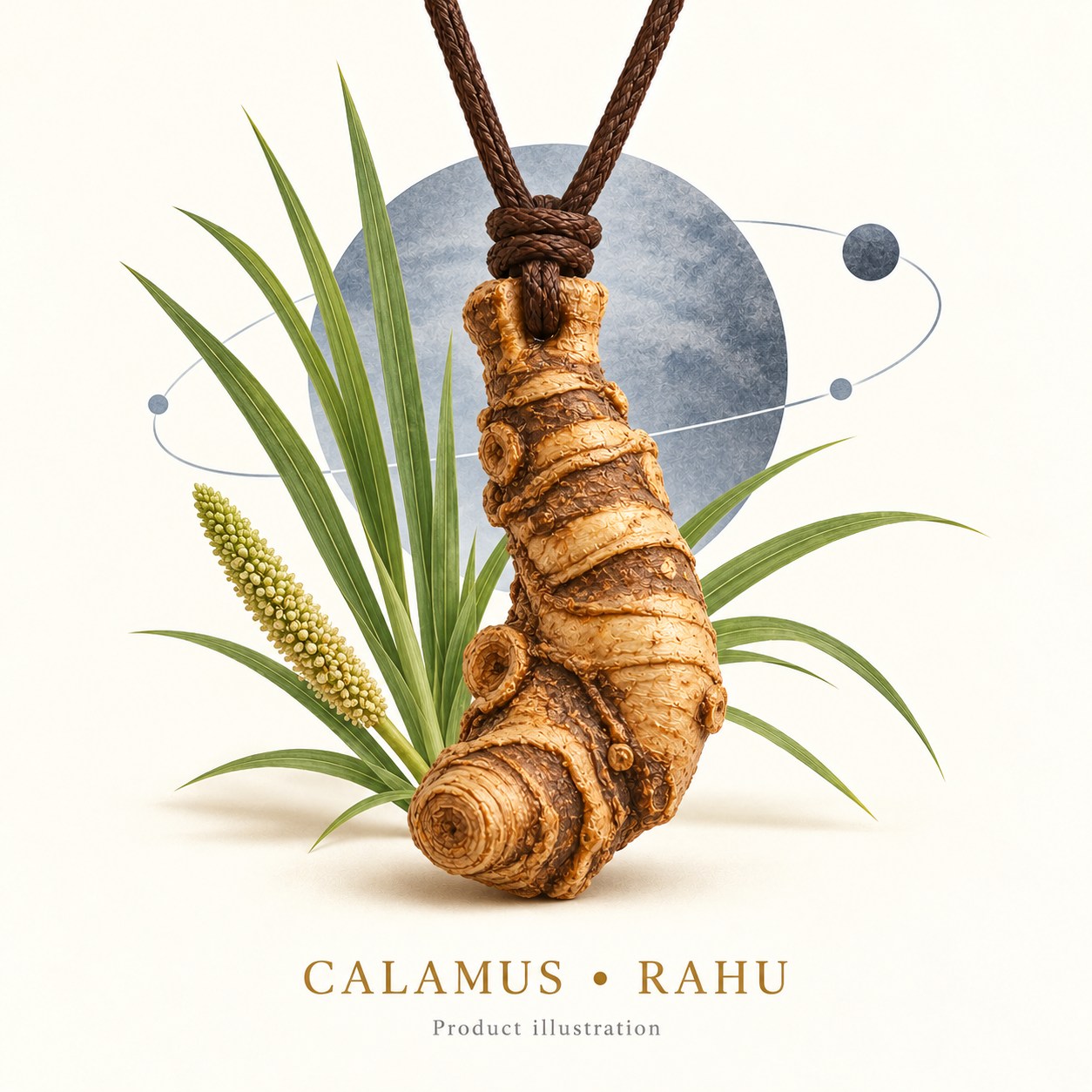
Calamus is familiar in Indian traditional vocabulary as Vacha, Bach, Vekhand, Vayambu or Vasambu, depending on region and language. In shops selling spiritual jewellery, it may appear as a Calamus root pendant for Rahu. That common retail phrase raises a worthwhile botanical question: is the piece really a root, or is it a rhizome? The distinction is significant because it tells us which part of the plant was used, how to assess suppliers' descriptions, and what can reasonably be said about a finished accessory.
The plant typically meant by the familiar name Vacha is Acorus calamus L., an aromatic, moisture-loving perennial herb of the family Acoraceae. It is not a tree. It produces long, sword-shaped leaves above ground and a branching, usually horizontal rhizome from which the leaves and true roots arise. A rhizome may be buried in wet soil and may look root-like after drying. Botanically, however, it is a modified stem, not a true root. The distinction does not diminish the Sanskrit or traditional meanings of Vacha; it simply makes a physical product description more accurate.
For OmmRudraksha, the goal is not to replace traditional language with obscure technical terms. It is to give a customer both: the trade term they recognize and the precise botanical description that should appear in material specifications once the supplied stock is verified. This guide explains the living plant, the harvested material, the limits of identification from a processed pendant, the Rahu association in contemporary planetary herbal jewellery, and practical questions to ask before buying.
Calamus, Vacha and the essential facts
| Question | Clear answer | Why a jewellery buyer should care |
|---|---|---|
| What is the principal research candidate? | Acorus calamus L. | Scientific identification is more dependable than a trade name alone. |
| Which family? | Acoraceae | This is an herbaceous flowering plant, not a sacred tree. |
| What kind of plant? | Perennial, rhizomatous, frequently growing in wet habitats | The harvested material normally comes from an underground stem system. |
| What is a rhizome? | A modified stem with nodes and potential buds | It differs in structure from a true root. |
| Does the plant have roots? | Yes, true roots arise from the rhizome | The existence of roots does not make the rhizome itself a root. |
| What is often used as Vacha in traditional materia medica? | Dried rhizome | Indian pharmacopoeial and botanical references identify the part explicitly. |
| Is every commercial pendant verified as that species and part? | No; batch-specific confirmation is still needed | A correct reference-page name cannot authenticate a mounted fragment. |
| Why does a shop say Calamus root? | Common trade and search usage | Familiar wording may be retained while the product specification clarifies the part. |
| What is its contemporary planetary association here? | Rahu, within a particular herbal-jewellery assortment | An association is not a test of botanical identity. |
| What needs checking before purchase? | Plant, part, origin, processing, fitting and care | A pendant is a complete manufactured object, not merely a plant fragment. |
The Royal Botanic Gardens, Kew, records Acorus calamus as an accepted species and describes its rhizomatous habit. Indian sources go further: the Bureau of Indian Standards lists IS 18412:2023 — Vacha (Acorus calamus L.) Rhizome for Use in Traditional Medicine, and the Ayurvedic Pharmacopoeia terminology reported by Kew's Medicinal Plant Names Services also identifies the dried rhizome. These sources explain conventional botanical terminology; they do not certify the contents of any particular jewellery stock.
The living Vacha plant: what it actually looks like
Vacha is a herbaceous marsh or waterside plant. Its leaves grow in upright clusters; they are long, narrow, green and generally shaped like a sword or blade. The habit can look somewhat like that of an iris, especially to someone who has never seen its flowers. The flowering structure consists of a spadix, a compact spike bearing many small flowers, and an associated spathe, a leaf-like structure. The plant's real branching framework lies below or near the surface of the wet ground as its rhizome spreads.
Botanical descriptions from Flora of China and the US Geological Survey identify a robust aromatic rhizome, with roots on the underside and leaf-bearing shoots associated with its nodes. The rhizome can creep laterally. Portions of its stem tissue can store reserves and produce new shoots. In a wetland habitat, this arrangement helps the plant persist and spread; it is not the same structural arrangement as the woody roots of a banyan tree or the swollen taproot of ashwagandha.
Seen growing, the leaves, flowering structure, growth form and attached underground organs can all help identify a specimen. Seen as a small, dried segment hidden by a metal cap, nearly all those distinguishing features are absent. A whole-plant identification and a jewellery-chip identification are therefore different tasks. A cut surface or the colour of a single fragment cannot replace documentation that follows the plant from source to finished article.
The difference between a root and a rhizome
A true root generally anchors a plant and absorbs water and dissolved nutrients. Roots can branch, form root hairs and change shape for storage. A rhizome is a stem. Even when it is underground, it may have nodes, internodes, buds, scale leaves or leaf scars, and can produce shoots and true roots. In botany the decisive feature is structure and origin, not whether a plant part was dug from the earth.
| Feature | True root | Rhizome (modified stem) | Relevance to Calamus |
|---|---|---|---|
| Organ identity | Root | Stem | Vacha's familiar harvested underground axis is commonly the rhizome. |
| Usual growth position | Often below ground | Often below ground or at substrate surface | Underground position alone proves nothing. |
| Nodes and internodes | Absent in the stem sense | Typically present | A whole or less-processed rhizome may retain these clues. |
| Buds capable of making shoots | Not ordinary stem nodes | Frequently present | Rhizome buds help explain propagation. |
| Root production | Root branches form | Adventitious roots can emerge | Roots may remain attached to a rhizome segment. |
| Leaf or scale scars | Not ordinary stem leaf scars | Can occur at nodes | Scars may help a trained examiner assess a sample. |
| Example | Banyan aerial root or many plant feeder roots | Ginger, turmeric and Vacha underground stems | Similar trade names may describe unlike plant organs. |
| Can a small finished pendant show all the signs? | Often no | Often no | Request batch documentation rather than guessing visually. |
The distinction is taught in standard plant anatomy and is reflected in the US National Library of Medicine's MeSH definition of a rhizome: an underground stem that produces shoots above and roots below, unlike true roots which lack ordinary buds and nodes. That is why the expression “rhizome of Vacha” is botanically more exact than the blanket expression “Vacha root.”
Examine a living specimen before judging a processed piece
Suppose a grower supplies a complete Vacha clump. A botanist could inspect the leaf arrangement, spadix, spathe, rhizome connections and roots, compare the material with taxonomic descriptions, and record a collection location. It is an integrated specimen. Even then, closely related Acorus taxa and regional taxonomic treatments may require expert attention. The first step is a traceable plant, not a marketing caption.
Now imagine that the same rhizome is washed, cut into two-centimetre lengths, dried, sanded, drilled and capped for a pendant. Nodes may be removed or obscured, and some characteristic smell or colour may change with storage. A polished or lacquered surface adds a further layer. No one should infer the exact species, provenance or part solely from a photograph of that finished ornament. The correct approach is to carry the original identification forward through processing records.
A useful supplier photograph therefore shows more than a tray of beads. It may show the raw rhizome before cutting, both sides of a representative piece, its relation to true roots and shoots, and the prepared segments beside their labelled batch. This is evidence to review, not a substitute for professional identification where certainty matters.
Vacha is an herb, not a tree root
Traditional product ranges sometimes group many planet-associated botanical materials under the broad label “herbal roots.” Those nine components need not share the same anatomy. One may be a true root; another may be a rhizome; another could be the aerial root of a woody tree. In that commercial setting “roots” is a collection label, not a botanical diagnosis for every component.
This distinction is particularly important for Vacha because the plant is an emergent or marshland herbaceous perennial, without the woody trunk and branch architecture implied by “Calamus tree.” Claims that a cut Vacha pendant comes from the “root of a sacred Calamus tree” should be revised unless some entirely different, verified plant is actually involved. A clear listing can say “Calamus (Vacha) herbal pendant; plant material traditionally traded as Vacha root; supplied plant part: dried rhizome, subject to batch verification.”
For a parallel, ginger and turmeric are also familiar as underground ingredients but are rhizomes rather than true roots. The analogy clarifies anatomy; it does not establish that one may handle or consume every rhizome in the same way. Plant identity and intended use remain independent questions.
Why trade names and botanical names disagree
Retail terminology evolves through local speech, translation, market conventions and search behaviour. Bach, Vach, Vacha, Vekhand, Vayambu and Vasambu can appear in regional contexts. English-language listings may use Calamus, Sweet Flag, Sweetflag Root or simply Rahu Herb. A common word can be helpful to a customer, but by itself it is not precise enough to guarantee species identity, plant part or composition.
Plant names have also been revised in botanical literature. Kew distinguishes accepted Acorus calamus, Acorus americanus and Acorus verus, while older publications may have treated some populations and names differently. A supplier citing an old botanical synonym is not necessarily describing a fake material, but a current product record should reconcile the old name against the accepted taxonomy and the actual batch. Equating all sweet flags automatically is an avoidable identification error.
| Name encountered | What it usually signifies | What the material record still needs |
|---|---|---|
| Vacha / Vacā | Familiar Sanskrit and Indian traditional name | Scientific species, part and provenance |
| Bach / Ghodvach / Vekhand | Regional or market terms | Local name mapped to accepted scientific identification |
| Vayambu / Vasambu | South Indian vernacular names | Clarification of material and supplier terminology |
| Sweet Flag / Calamus | English common names | Species confirmation because common names can overlap |
| Calamus root | Conventional trade expression | Whether the piece is actually a rhizome |
| Acorus calamus L. | Scientific taxon accepted by Kew | Evidence linking a particular stock lot to the name |
| Acorus americanus | Distinct accepted Acorus taxon | Avoid automatic substitution in documents |
| Acorus verus | Distinct accepted taxon in Kew's current treatment | Reconcile older synonyms and supplier records |
| Rahu herbal pendant | Functional or devotional sales name | Independent identification of the botanical component |
Preserve familiar product searches without preserving an anatomical mistake
A product page may already have a URL such as calamus-root-pendant-rahu. Changing it can disrupt existing references and bookmarks. There is no need to change that address merely to correct an anatomical point. Keep the established URL, but use the product description, material specification and FAQ to identify the plant part accurately. Titles can combine the familiar and exact wording: “Calamus (Vacha) Root Pendant — Dried Rhizome Material for Rahu Tradition.”
This improves customer understanding while respecting navigation and established catalog relationships. The same approach can be used in related blogs: explain the common phrase once, then consistently use “rhizome” when discussing plant anatomy. It is better than repeating a confusing label merely because that label appears in a high-volume search query.
How to recognize the rhizome in botanical references
Descriptions of Acorus calamus rhizomes discuss a stout, horizontal or creeping axis, branches, nodes, and scars associated with leaves or roots. The Flora of China notes roots on the lower side of the rhizome. Descriptions of dried medicinal material likewise refer to irregular segments with surface markings; the precise dimensions and appearances are ranges, not a template that every cut piece must match. Drying age, origin and processing affect the appearance.
A genuine rhizome can look fibrous, woody or root-like in a small retail photograph. Conversely, a different stem, woody stick or resin composite can be prepared in a visually similar shape. Appearance is supporting evidence, not final identification. A shop should not promise that a consumer can authenticate Vacha merely by rubbing the surface, smelling it or looking for a particular shade of brown.
| Observation | What it can help you ask | What it cannot establish on its own |
|---|---|---|
| Brown or yellow-brown exterior | Was this a dried plant part, and how was it processed? | That it must be A. calamus |
| Pale interior | Can the supplier show the raw cross-section? | Species, origin or chemical composition |
| Visible scars or joints | Are these nodes, root scars or processing marks? | Identity without anatomical context |
| Firm fibrous texture | Is the piece dry, intact and stabilized? | That it is untreated or suitable for all skin types |
| Characteristic odour | Is it natural, residual, added or changed by processing? | An authentication certificate or safety assessment |
| Metal cap covering one end | How is the botanical piece fixed? | What's hidden under the cap |
| Coating or varnish | Which finish was used and is it intact? | That the component is waterproof |
| Uniform manufactured shape | How was material graded and cut? | That every item comes from the same verified plant part |
Do not scrape a customer's finished pendant to expose layers or deliberately break one open. Use documentation and approved supplier samples for physical examination. If expert confirmation is necessary, obtain it before the product is assembled or by testing a retained sample from the same lot, rather than damaging a purchased devotional accessory.
From marsh plant to pendant: the traceability chain
A reliable material claim moves through a sequence of records. The chain begins at cultivation or collection and continues through identification, harvest, cleaning, drying, storage, shaping and final jewellery assembly. Losing the link between a field batch and a completed pendant makes later claims about the part far weaker, even if the finished item is attractive.
A small shop need not operate a large botanical laboratory to improve documentation. It can request a clearly labelled source photograph, supplier lot number, written species-and-part declaration, origin, processing method and sample retention. For outsourced products, the invoice or packing slip should correspond to the recorded lot. When a component changes supplier, recheck the description instead of copying a previous batch's assertions into the next listing.
| Stage | Evidence worth retaining | Typical uncertainty to avoid |
|---|---|---|
| Plant identification | Scientific name, identifier, reference or voucher when available | Assuming a market name proves the species |
| Collection or cultivation | Location/region, harvesting source, date/lot | Treating all wild and cultivated material as interchangeable |
| Plant-part separation | Rhizome identified before cutting; roots documented separately | Mixing true roots and rhizomes without disclosure |
| Cleaning and drying | Method, drying conditions, resulting condition | Assuming freshly cut and dry material behave alike |
| Storage and movement | Sealed lot, container label, supplier documentation | Losing provenance when pieces are mixed |
| Cutting and drilling | Batch reference, dimensions, damage inspection | Substituting pieces during assembly |
| Coating and mounting | Fittings, adhesives, sealant, finishes | Presenting the ornament as untreated raw plant matter |
| Finished-product check | Photos, dimensions, fit, label and care leaflet | Promising a specification not confirmed for that item |
The most useful test of a source statement is whether a buyer can connect this pendant to this identified material lot. A photograph of a Vacha plant downloaded from a botanical site is educational, but it does not create that connection.
Difference between botanical verification and traditional reference
An Ayurvedic or Sanskrit discussion of Vacha can establish that the plant has a traditional name, history and place in botanical literature. It does not necessarily establish a specific jewellery practice or prove that a particular supplier has used the correct material. Likewise, a graha recommendation may explain why a devotee selects Vacha for Rahu in a contemporary assortment. The graha association cannot determine whether a dried piece under a cap is Acorus calamus.
Three records therefore serve different purposes. A botanical record names the species and material. A traditional-content record identifies the source or practice behind a Rahu association, including any lineage differences. A product record describes exactly what is being supplied: part, dimensions, finish, cord or chain, and care. When these are separated, customers need not choose between respectful traditional terminology and accurate physical specifications.
The following existing product and reference links are retained for navigation:
The Calamus pendant is paired with Rahu in a selected assortment. That interpretation does not determine its plant part or demonstrate an effect on health or personal circumstances.
Read Calamus and Rahu for the devotional symbolism, and the handling guide for care questions. When choosing a piece, ask how the plant name and part relate to the product description and how the complete fitting should be handled.
Why the whole plant is easier to identify than a pendant chip
Taxonomists work with combinations of characteristics. For Acorus, these can include leaf form, venation, flowering structures, rhizome anatomy, habitat, reproductive details, and comparison with accepted descriptions. The USGS discussion of sweet flag gives useful vegetative characters, including the large underground rhizome system and leaf venation. Field identification also considers the possibility of a similar-looking plant growing in the same wet site.
A pendant may display only a smooth or coated fragment. Leaf venation, spadix and natural growth habit are gone. The material could have been mixed with similarly sized offcuts during processing. That is why online claims like “genuine Vacha can always be identified by an aromatic smell” are too confident. Aroma can change, be added or be lost; it is not a controlled test on its own. A botanist may examine a retained unprocessed sample, while a jewellery customer should receive a proportionate explanation of the evidence available.
Avoid confusing Vacha with other calamus names
The English word “calamus” has been used in multiple historical, botanical and commercial contexts, including aromatic plant materials. Even within Acorus, taxonomic names and older species concepts may not align perfectly across decades of publications. A handwritten sack marked “calamus root” is therefore not definitive. Ask for the binomial scientific name and the plant part, then compare them with the supplier's primary documentation.
When a seller can only supply a local name, record it honestly as a supplier-declared vernacular name pending confirmation. A provisional description is more useful than a confident claim unsupported by a source. The objective is accurate stock management and informed buying, not unnecessarily elaborate wording.
Root, rhizome, tuber, bulb and aerial root: a glossary for this collection
The term “root” frequently gets extended in everyday speech to any underground or hanging plant organ. Yet each structure has a different botanical origin. Planetary herbal jewellery ranges may intentionally include materials with these diverse structures; recognizing the difference is a useful quality-control skill.
| Plant structure | Basic botanical description | Familiar example | Product-description caution |
|---|---|---|---|
| True root | Anchoring/absorbing organ that can branch or store reserves | Many medicinal roots | Do not infer species from underground origin. |
| Rhizome | Modified stem, often horizontal, with nodes and buds | Vacha, ginger, turmeric | Use “rhizome” where this is the verified part. |
| Tuber | Swollen storage organ; stem and root tubers differ | Potato is a stem tuber | Do not use “tuber” as another word for any lump. |
| Bulb | Short stem with fleshy leaf bases/scales | Onion | A bulb is not the same as a rhizome. |
| Corm | Enlarged vertical underground stem | Colocasia and some ornamentals | Can be mistaken for a bulb or tuber. |
| Aerial root | Root formed above ground, sometimes reaching soil | Banyan (Bargad) | Clearly different from a Vacha rhizome. |
| Stem or wood | Above-ground or supporting stem tissue | Woody beads | “Sacred root” is not the correct description. |
| Mixed herbal assembly | Multiple plant parts bound into one object | Navgraha necklet | Each ingredient needs its own part specification. |
For an individual Vacha pendant, the principal question is straightforward: was the actual material cut from a rhizome, or did the supplier provide true roots or another part? Do not assume the answer merely because most pharmacopoeial Vacha material is rhizome. Verify the jewellery batch.
Why this detail matters for the Navgraha herbal necklet
In the nine-association assortment, Vacha may appear beside Bilva, Anantmool, Vidhara, Ashwagandha, Manjistha, Bargad and other locally named botanical materials. These names do not automatically represent identical structures. Banyan may supply aerial-root material; certain herbs supply roots; Vacha supplies a rhizomatous stem in the common materia-medica tradition. A single label saying “nine roots” is understandable as a collection name, but it should not become a nine-row botanical specification where every entry is automatically marked “true root.”
A better component sheet gives the traditional plant name, accepted botanical name, supplied part, verification method and attachment design for each of the nine. It also records any uncertainty rather than quietly substituting one plant for another. This makes repeat orders easier to check and reduces discrepancies between a photograph, product page and package insert. Botanical specificity also helps with care: porous, brittle, resinous and woody pieces can respond differently to moisture and mechanical stress.
| Navgraha-material question | Strong answer to request | Weak answer to avoid |
|---|---|---|
| Is Vacha part of this necklet? | Exact stock lot and component count | “All nine are inside” without an inventory |
| What plant was used? | Scientific name and supplier evidence | “Original jungle root” without species |
| What part was used? | Rhizome, root, aerial root or other named part | “Everything is a root” |
| How is each piece secured? | Cord, separate holder, mount or cap detail | “It is tied traditionally” without a fitting specification |
| Can parts touch skin? | Material/finish description and care instructions | “All herbs are naturally harmless” |
| Can a component be replaced? | Repair or replacement policy by lot | No tracking of materials after sale |
| Are the associations universally identical? | Source or lineage of this selected assortment | A claim that all Hindu rituals use the same nine plants |
What processing changes—and what it does not
Harvested rhizomes can be washed, cleaned, sliced, dried, trimmed, drilled, polished or sealed. Some choices are purely practical, such as reducing moisture before storage or protecting a cut edge. Others substantially alter appearance and feel. Coatings, oils, stains or synthetic fillers are especially relevant to a small wearable object. Ask what was used rather than assuming a smooth surface is naturally polished.
Processing cannot change a rhizome into a true root. It can, however, remove the visible clues that would have shown stem nodes and buds. It can also make a component harder to identify from a photograph. Dried material may shrink or crack, and drill holes can create a stress point. A pendant designed with a protective holder may be sturdier than a piece pierced straight through a weak end. These are practical design considerations, not botanical proof.
Supplier claims such as “hand-cut,” “air-dried,” “untreated,” “naturally aromatic” and “fully waterproof” should each be supported separately. Dry plant material can deteriorate in sustained dampness even when a metal cap looks secure. A water-resistant metal fitting does not make the enclosed botanical piece waterproof.
What about aroma, essential oils and asarone?
Acorus calamus has long been described as aromatic, and the chemical composition of its rhizome has attracted scientific study. Researchers have reported differences among geographic and genetic groups, including variation in constituents such as alpha- and beta-asarone. The European Medicines Agency has a scientific statement concerning asarone exposure from herbal medicinal products. Its remit is not certification of a particular decorative or devotional pendant.
For jewellery, do not convert an ethnobotanical note into an instruction to chew, burn, distil, grind or soak a worn pendant. Those actions change the exposure route, may damage coatings or fittings, and are unrelated to ordinary wearing. Nor is it sound to assure every buyer that a finished accessory has been chemically tested merely because a reference article describes a species. The appropriate record would be product-specific testing or disclosure where applicable.
If a piece leaks oil, sheds dust, causes a contact reaction or has an unexpected strong chemical smell, discontinue wearing and ask about its processing materials. That is a sensible product-care boundary, without treating the pendant as a medicinal preparation. Avoid sweeping claims that a plant's traditional name alone establishes either a therapeutic benefit or the safety of all possible preparations.
How a finished Vacha pendant is constructed
A small botanical fragment becomes jewellery through design choices: where it is cut, whether the piece is drilled, what holds it, how it hangs, and how the metal or cord contacts the body. The plant part may be mounted in a metal sleeve or cap, enclosed in a small holder, suspended from a chain, or incorporated into a multi-piece necklet. The type of construction determines the mechanical stresses it experiences during wear.
A straight-drilled piece puts strain directly on the plant at the aperture, especially if the cord is thin and repeatedly pulled. A cap or enclosed setting can distribute force but may conceal the underlying material and introduce adhesives. A tied holder can be repaired more easily but may allow the plant to rub against the cord. Evaluate the complete article before deciding which version is more suitable for occasional puja use, workday wear or gifting.
| Component | What to inspect | Typical issue to anticipate |
|---|---|---|
| Rhizome fragment | Dimensions, intactness, verified lot | Brittleness, cracks or unclear identity |
| Drilled hole | Smooth entrance, no splintering | Cord cuts into weak plant material |
| Cap or bezel | Alignment and secure attachment | Loose adhesive or hidden breakage |
| Thread or cotton cord | Knot security, fraying and fit | Wear from sweat and repeated pulls |
| Metal chain | Link closure, finish, length | Corrosion, snagging or contact sensitivity |
| Adhesive or varnish | Declared finish and stable surface | Peeling, residue, sensitivity or moisture trapping |
| Protective pouch | Dry, clean, separate storage | Compression, humidity or abrasion |
| Label | Species, part, batch, finish and care | Oversimplified “root” without useful detail |
A useful product-specification template
Rather than inventing a plant-part declaration for unverified stock, maintain a specification that can be filled from supplier evidence. A good page can distinguish confirmed, supplier-declared, and pending verification fields. The scientific name is meaningful only if the supply chain is able to stand behind it.
| Field | Example of a clear specification approach |
|---|---|
| Retail name | Calamus (Vacha) Root Pendant for Rahu |
| Botanical name | Acorus calamus L. — state whether verified or supplier-declared |
| Plant family | Acoraceae |
| Actual plant part | Dried rhizome, only after batch verification |
| Traditional association | Rahu, in the stated planetary-herbal jewellery assortment |
| Source and lot | Supplier and batch reference; country or region if confirmed |
| Surface treatment | Uncoated / coated / not confirmed, as appropriate |
| Attachment | Cord, metal cap, clasp, adhesive or enclosure as actually supplied |
| Dimensions | Measured plant fragment and total hanging length |
| Care | Keep reasonably dry; clean fitting according to material |
| Evidence status | Recorded identification method and responsible reviewer |
| Link to details | Existing product and consultation pages without changing URLs |
A customer need not read a laboratory report to purchase a modest piece of jewellery. However, a retailer making a botanical-identity claim should be able to answer ordinary questions about the source and the part used. The specificity of that answer is part of transparent product quality.
Common misleading descriptions and better alternatives
| Confusing phrase | More precise wording | Reason |
|---|---|---|
| “Calamus is a sacred tree” | “Vacha is an aromatic rhizomatous herb” | Corrects the plant's growth form. |
| “Every Calamus underground piece is a root” | “The commonly used part is a rhizome, a modified stem” | Identifies organ anatomy. |
| “Any brown bead proves original Vacha” | “Identity depends on traceable material evidence” | Colour is not a diagnostic test. |
| “One botanical photograph authenticates the pendant” | “The photographed plant should be linked to the supplied batch” | Provenance matters. |
| “Rahu's association confirms the plant” | “Astrological symbolism and botanical identification are separate” | The two subjects use different evidence. |
| “All nine Navgraha materials are botanically roots” | “The collection may contain roots, rhizomes and other plant parts” | Avoids an anatomical generalization. |
| “Naturally herbal means waterproof” | “Care depends on the plant fragment and fittings” | Plant tissue and mount can absorb moisture. |
| “A smooth sealed piece is untreated” | “Declare the coating or processing where known” | Surface finish changes the object. |
| “The ancient text prescribes this exact retailer assembly” | “Name the source or describe it as a selected contemporary custom” | Prevents an unsupported historical claim. |
Rahu symbolism belongs in its own explanatory layer
In Jyotish, Rahu is the ascending lunar node and is one of the Navagraha, alongside the other grahas used in a horoscope. Traditional interpretation considers Rahu's position in the Kundali, its nakshatra, dispositor, aspects or conjunctions, and dasha periods. Discussions may associate it with unconventional paths, ambition, worldly attachments, foreign environments or the need for discernment. These are interpretive traditions; they do not identify a plant in a supplier's warehouse.
Some herbal-jewellery assortments associate Vacha with Rahu. A person who follows that tradition might wear a pendant during prayer, a Sankalpa or an individually guided practice. There can be differences among families, teachers and regional methods. Do not claim that the exact product design, harvest method or prescribed wearing day is universal without a specific source. The meaningful traditional description is “Vacha selected for Rahu according to this assortment's custom.”
A single herbal pendant is also not interchangeable with a Gomed (hessonite garnet) ring. Gomed is a gemstone described in certain Jyotish systems; Vacha is a botanical material. Each has its own identity and its own traditions. An individual prescription would consider the complete horoscope rather than using a plant-label correction as a substitute for chart interpretation.
Responsible sourcing from wetlands and cultivation
Vacha is associated with damp habitats, marshes and watersides. These environments can be ecologically sensitive. Material supplied for jewellery should have a clear and lawful source where possible, including whether it was cultivated or collected under applicable local rules. Never assume that removing wild rhizomes is harmless merely because the finished piece is small: rhizomes are important to a living clump's growth and propagation.
Cultivated or managed stock can offer better traceability, but the word “cultivated” does not automatically prove the species or the material part. Ask about the grower, lot and harvesting method. If a supplier mixes material from several locations, document how the batches were combined and identified. Customers who care about traditional reverence for plants may reasonably value harvesting practices that respect the living source as well as the final devotional object.
For a Bengaluru retailer, an especially useful practice is to photograph a representative raw sample for every incoming botanical batch before it is cut and assembled. Keep the picture with the stock record, not scattered among general product images. That small discipline improves the quality of future descriptions and customer answers.
Buying questions for a Bengaluru customer
A person considering a Calamus pendant should be able to receive a practical description without being pushed into a complex ritual explanation before learning the basics. Start with the material, size, construction and price. Then ask whether the Rahu connection is part of a particular custom or the result of individual consultation. If an astrologer has recommended Vacha, confirm what they intended: a plant, a plant part, a finished ornament or a specific observance. These are not necessarily the same thing.
For a shop visit, inspect the cord, cap and clasp. Ask for a clear view of the botanical component and whether its identification is confirmed or supplier-declared. For online orders, request photographs of the actual stock type rather than a stylized illustration alone. If the mount conceals most of the material, a record of the pre-mounted batch becomes more important, not less.
| Buyer question | Useful answer to expect |
|---|---|
| Is this actually Acorus calamus? | Plant identification evidence, or a clear supplier-declared status |
| Root or rhizome? | Exact plant part identified for the lot |
| Is the entire item plant material? | Breakdown of the botanical piece, cord, cap and coatings |
| Can I wear it daily? | Fit, durability and contact guidance for the actual design |
| Does it need a ritual? | What the chosen tradition teaches, without a compulsory invented rule |
| How does it relate to Rahu? | Selected assortment's symbolism or a separately obtained Jyotish recommendation |
| Will the item shown match my order? | Current product photographs and dimensions |
| What if it breaks? | Repair/replacement terms and whether the plant piece can be safely remounted |
| Is the plant sustainably sourced? | Cultivation/collection details available for the batch |
| Can it be washed? | Item-specific care; generally avoid soaking botanical pendants |
Caring for a Vacha rhizome pendant
Treat the finished item as mixed-material jewellery containing dried botanical material. Keep it away from prolonged soaking, showers, cleaning chemicals, perfumes sprayed directly onto the plant, and high-humidity storage. To clean superficial dust, start with a soft dry cloth or clean soft brush. Do not assume that a wet cloth suitable for stainless steel is also suitable for an exposed rhizome or adhesive joint.
Remove the pendant before swimming, vigorous exercise or activities likely to pull the cord. Inspect periodically for a frayed knot, detached cap, cracked botanical body or residue around the mount. Store it alone in a clean, dry pouch or box so metal ornaments do not crush it. If the piece develops mould-like growth, persistent dampness or crumbling, stop wearing it and seek advice on repair or replacement rather than applying household solvents or attempting to sterilize it by heat.
The Canadian Conservation Institute's guidance for organic collections emphasizes safe handling, pests, light and relative humidity as preventive concerns. A small pendant is not a museum specimen, but the underlying insight applies: dried botanical material can be harmed by moisture, poor handling and inappropriate storage. Respectful devotional use and careful maintenance can coexist without requiring elaborate daily treatment.
Practical examples of accurate descriptions
Example 1 — Product page. A pendant is sold under an established address containing the phrase “calamus-root.” Its title can retain “Calamus (Vacha) Root Pendant” for recognizability, while the material field states “dried Vacha rhizome (Acorus calamus), supplier-declared; batch verification pending” until documentation is complete. Once verified, that status can be updated. This resolves a botanical issue without disrupting a public URL.
Example 2 — Supplier delivers mixed pieces. A parcel arrives marked “Rahu root” and includes fragments of several sizes and colours. Do not label every fragment as verified rhizome simply because the seller promised an auspicious plant. Segregate the stock, ask for the source and part documentation, inspect a retained sample and record whether the claim can be supported. Jewellery construction can proceed only with an accurately described lot.
Example 3 — Navgraha necklet. A customer asks whether all nine pieces are roots. Explain that “nine roots” can be a trade description of a selected assortment, then provide a component-level list distinguishing Vacha rhizome and any verified true or aerial roots. The answer demonstrates expertise without diminishing the traditional Navagraha meaning.
Example 4 — A customer's family tradition. A family uses the word Vacha for a familiar plant part in a Rahu-related observance. Ask about the customary name and intention respectfully, then explain that in botanical reference material the underground stem is termed a rhizome. Both forms of knowledge can be described without insisting that regional speech be rewritten.
Example 5 — Online buyer comparing two pendants. One listing supplies detailed measurements, source information and construction photos; another merely says “100% sacred Rahu root guaranteed.” Prefer the listing that describes what can actually be checked. Higher price, elaborate packaging and strong adjectives do not independently authenticate a plant.
A material-first review checklist
Before approving or publishing a Calamus pendant or necklet component, use a repeatable review. This approach can be applied to all nine planetary herbs and can simplify future supplier changes.
| Check | Pass condition | If not established |
|---|---|---|
| 1. Common name | Exact retail and local names recorded | Keep naming provisional. |
| 2. Scientific identity | Traceable taxon and evidence | Mark supplier-declared, not confirmed. |
| 3. Plant part | Rhizome, root or other part identified | Do not assert “true root.” |
| 4. Source lot | Supplier and batch reference present | Hold untraceable batches separately. |
| 5. Harvest origin | Cultivated or lawful collected status where available | Request information without inventing provenance. |
| 6. Processing | Drying, cutting, coating and treatment recorded | Avoid “untreated” promises. |
| 7. Dimensions | Actual fragment and hanging length measured | Do not rely on illustration scale. |
| 8. Mounting | Cap, hole, cord and adhesive inspected | Repair poor construction. |
| 9. Care | Suitable for all components | Avoid blanket washing instructions. |
| 10. Traditional wording | Rahu association identified as customary | Do not claim universal prescription. |
| 11. Photography | Product and raw-lot photos appropriately labelled | Avoid presenting illustrative images as proof. |
| 12. Customer information | Material, fit, price and return terms clear | Complete the listing before sale. |
Frequently asked questions
1. Is Calamus root really a root?
In everyday trade language, “Calamus root” commonly describes the underground material sold as Vacha. In botanical terminology, the principal underground organ conventionally used for Acorus calamus is a rhizome, which is a modified stem. The plant also produces true roots that arise from the rhizome, so the existence of roots does not make the rhizome itself a root. A specific finished pendant requires batch evidence to establish what part was actually used.
2. What is the botanical name of Vacha?
The standard research candidate for Vacha or sweet flag in this context is ***Acorus calamus* L.**, accepted by Kew in the family Acoraceae. That does not mean every item sold under the name is correctly identified. Regional names, historical species treatments and commercial sourcing can vary. Ask for the supplier's scientific-name record and how the shop connects that identification to the actual pendant lot.
3. Is Vacha a tree?
No. Acorus calamus is an aromatic herbaceous perennial associated with wet habitats. It has long sword-shaped leaves and an underground rhizome system rather than a woody trunk. Some planetary herbal jewellery collections use the broader phrase “sacred roots,” but that does not turn every component into material from a tree. Describe Vacha as an herb and identify its part accurately.
4. What exactly is a rhizome?
A rhizome is a modified stem that often grows horizontally below ground. It can have nodes and buds, produce above-ground shoots and develop true roots from its underside. It may store reserves that help a perennial plant persist. Because rhizomes can be buried and fibrous, people sometimes call them roots informally; stem anatomy is the reason botanists use a different term.
5. How can a rhizome be distinguished from a true root?
A more complete specimen may reveal nodes, leaf or scale scars, buds, and the place where true roots emerge from the rhizome. Those clues are reduced or lost when the material is cut, dried, polished and capped. Do not try to authenticate a finished pendant with a destructive home test. Review source photographs, a retained raw sample and documented plant-part identification instead.
6. Does every product labelled sweet flag contain Acorus calamus?
Not necessarily. Common names are not always unique, and older literature has grouped or separated certain Acorus populations differently. Kew recognizes more than one accepted taxon within the genus, including A. americanus and A. verus. A retailer should record the scientific name attached to the particular lot and reconcile synonyms rather than using the English common name as conclusive identification.
7. Why do shops still say Calamus root pendant?
The phrase is familiar in traditional markets and online searches, and an established URL may contain it. The customer-facing title can retain familiar wording if the product specification also gives the accurate botanical part. A useful example is “Calamus (Vacha) Root Pendant — dried rhizome material,” provided the supplied lot supports that identification. Search terminology should not be mistaken for an anatomical statement.
8. Is Vacha the same as Bach, Vekhand or Vasambu?
These are names encountered in different Indian languages and regions for materials associated with Vacha or sweet flag. That connection is useful for communication, but a local name may be applied inconsistently in trading. Record both the vernacular name and an accepted scientific name, then confirm the part and batch. The same careful method should be used for a Navgraha necklet whose components have several local names.
9. What does the official Indian standard call the plant part?
BIS lists IS 18412:2023 as a specification for “Vacha (Acorus calamus L.) Rhizome for Use in Traditional Medicine.” Kew's medicinal plant name records similarly identify dried rhizome in Indian pharmacopoeial contexts. These references establish correct terminology for the medicinal plant material. They are not automatically quality certificates for a separate piece of jewellery, which must be described according to its own supply record.
10. Is the rhizome normally aromatic?
Botanical accounts describe Calamus rhizomes as aromatic. However, an odour may weaken during drying or storage, and coatings or other materials can affect the smell of a finished item. Aroma alone does not prove species identity, purity, absence of processing or quality. Do not burn, chew or grind a pendant to test its scent. Ask for traceable supplier evidence instead.
11. Can a photograph authenticate the pendant?
A photograph can show colour, size, attachment style and some surface details. A contextual image of the living Vacha plant can educate a buyer about its leaves and rhizomes. Neither independently authenticates a dried fragment mounted under a cap. Useful evidence links the specimen or source lot to the actual finished goods through supplier records and labelled processing stages.
12. Can a Calamus pendant be washed or soaked?
Avoid soaking unless the actual product maker has confirmed that all its components tolerate it. A dried botanical fragment, thread, adhesive and coating may respond differently to water than a metal chain. For ordinary dust, use a clean dry cloth or soft brush, and follow the shop's construction-specific instructions. Keep the piece away from showers, swimming and prolonged damp storage.
13. Is Calamus used for Rahu in every Hindu tradition?
No single modern retail plant-to-graha assortment should automatically be presented as a rule for every lineage, puja or classical source. Vacha is paired with Rahu in the selected planetary-herbal jewellery context being discussed here. A person following a family or teacher's tradition can confirm its specific practice. That devotional selection is separate from identification of the plant species and part.
14. Does a rhizome pendant replace Gomed for Rahu?
They are different products with different materials and associated practices. Gomed is a gemstone name commonly used in Jyotish for hessonite garnet; Vacha is botanical material. An astrologer may consider a chart, intended practice and personal circumstances before recommending anything. A botanical correction from “root” to “rhizome” is not a claim that one object has the same traditional role as another.
15. How is Vacha different from Banyan root?
Banyan, or Bargad, is a tree whose aerial roots may grow down from its branches and sometimes become supports. Vacha is a marshland herb with an underground rhizome, a modified stem. Both materials can appear in a planetary-herbal jewellery collection, but their anatomy, sourcing, texture and care are not identical. The product specification should name each part rather than calling them both simply “roots.”
16. Is a dried piece of Vacha always suitable for wearing directly on skin?
Not automatically. Comfort and suitability depend on the plant fragment's finish, coatings, metal parts, adhesives, cord and the wearer's sensitivities. Botanical identity alone does not provide a contact-safety assessment for a completed accessory. Ask what touches the skin, inspect the finish, and stop wearing the article if irritation or material shedding occurs. Avoid using a raw herbal claim as a blanket assurance about all products.
17. How should a retailer verify a new Vacha supplier?
Request a written scientific name, exact part, lot details, source information, raw-material photographs and relevant identification evidence. Retain a representative sample when practical, verify the piece's processing and construction, and compare documentation with the goods received. If identity is not independently established, state that the information is supplier-declared rather than treating it as a laboratory-confirmed fact.
18. Does the mention of Vacha in Ayurveda make a pendant medicinal?
No. Traditional medicinal literature and finished jewellery serve different purposes. A pharmacopoeial description may help identify a plant and the part conventionally used, but it does not convert a decorative pendant into a medicine. Do not ingest, extract, burn or prepare the pendant as an herbal remedy. Its finishes and mounting materials may also make such uses inappropriate.
19. What should I look for in an online listing?
Look for a precise material description, supplier evidence status, dimensions, construction details, current photographs, price, care instructions and return terms. Familiar botanical and devotional names should be supported by clear specifications, not vague guarantees. A buyer may value the traditional Rahu association while still asking practical questions about fit, material part and durability.
20. What is the most accurate short product description?
A strong short description combines the established trade name with confirmed material facts: “Calamus (Vacha) Root Pendant for Rahu — traditional planetary-herbal accessory containing dried Acorus calamus rhizome, where batch verified.” Add the actual finish, dimensions and mounting method. If the part is not yet verified, state that explicitly. This wording preserves familiar tradition while making the botanical claim clear and responsible.
Final guidance: accurate anatomy supports better traditional jewellery
The central lesson is simple: an underground part is not necessarily a root. In Calamus or Vacha, the familiar underground stem is commonly a rhizome. Knowing that difference helps people understand a living plant, interpret a traditional material name, check a supplier's claims and compare completed pendants intelligently. It does not require changing every established retail address or treating devotional terminology as an error.
For OmmRudraksha's planetary-herbal collection, keep the familiar customer vocabulary but describe the actual supplied material precisely. Preserve the source identification, processing record, mounting details and care guidance. Present Rahu symbolism as the selected traditional context, separate from botanical evidence. The result is a page useful to a student of botany, a practitioner of Jyotish, a shop owner and a first-time buyer alike.
Explore the Calamus (Vacha) Root Pendant for Rahu, return to Planetary Herbal Jewellery, or visit the established For Planets collection. Botanical references explain plant names and background. Ask our team about the particular item, its fitting and care.Further reading
