
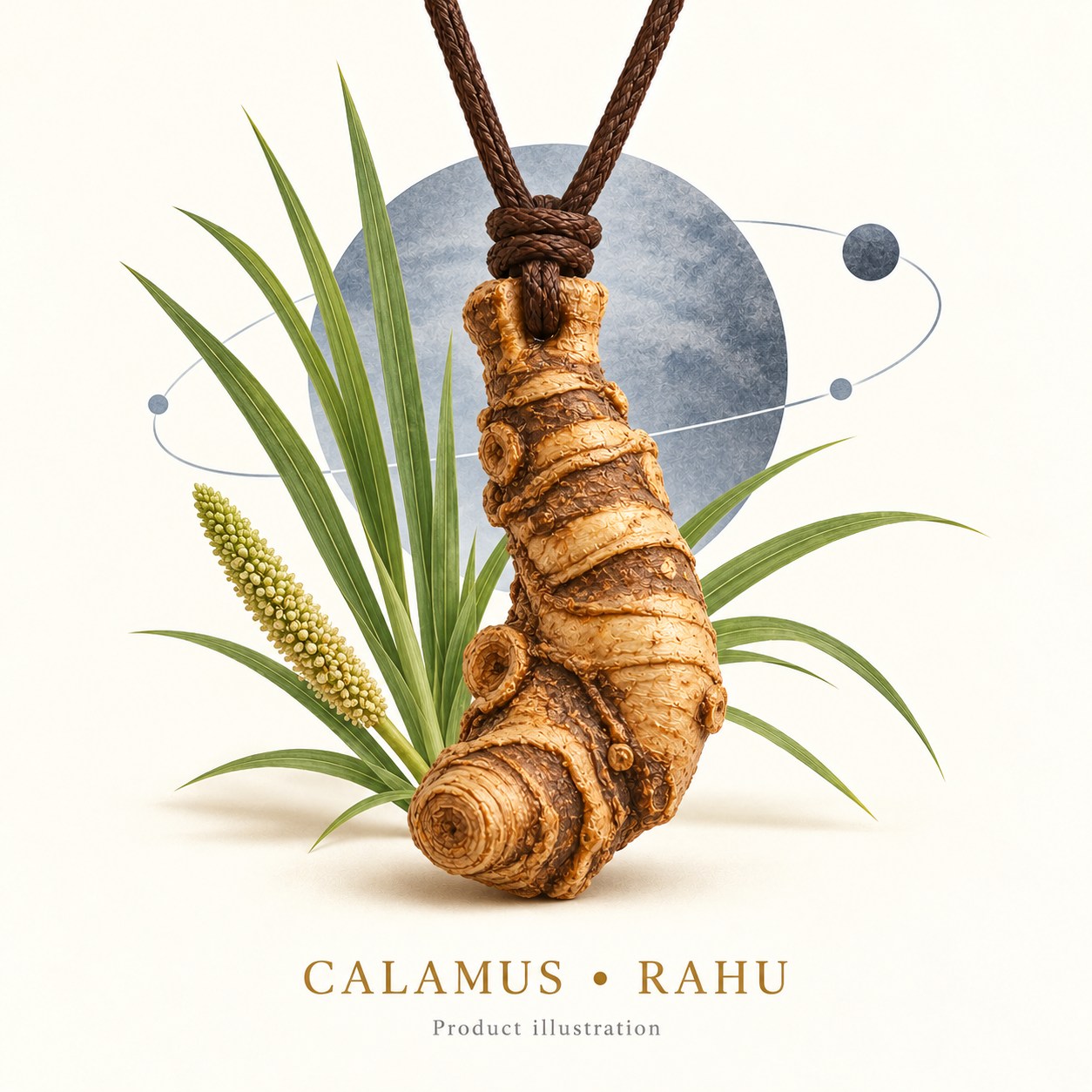
A Calamus herbal pendant is a small devotional accessory with several very different components: a dried plant piece, an attachment or protective setting, a cord or chain, and sometimes a coating, cap, adhesive, thread wrapping or decorative bead. Its care therefore starts by understanding the finished assembly, not by assuming the practices used for a fresh herb, a polished gemstone or a metal locket will work for it. A pendant can appear intact while its attachment point is weakening; the botanical core can be dry while the outer cord remains damp; and a decorative finish can conceal the nature of the plant piece.
In planetary herbal jewellery, Calamus or Vacha is commonly discussed in relation to Rahu. The Sanskrit botanical term vacha appears in several traditional plant contexts, but a present-day product description must still identify the particular plant and part being supplied. The research candidate here is Acorus calamus L. (sweet flag), a rhizomatous plant in the family Acoraceae. The long underground stem called a rhizome is often loosely described as a “root” in trade language. That wording matters when assessing what is actually suspended against the body. No photograph, devotional name or pleasant scent by itself authenticates an individual item.
This guide gives a usable method for receiving, fitting, wearing, checking, dusting, protecting, storing, travelling with and handling damage to a Calamus pendant. It also explains why powdered, burned, boiled, chewed or extracted botanical material is an entirely different exposure from wearing an intact finished ornament. Traditional observances can be maintained without putting an uncertain object into liquids or using improvised household treatments.
First establish exactly what you purchased
Read the supplier's item description before using the jewellery. Write down the botanical designation, the stated plant part, the approximate size, the surface finish and the attachment materials. The name “Calamus root pendant” alone leaves several unanswered questions: is the component a piece of dried rhizome, what processing did it receive, is it sealed, how is it held, and what should happen if the seal is damaged? An honest product record can answer these independently rather than substituting a broad spiritual description for them.
Check that the actual received piece matches the displayed product type, while allowing normal differences in natural grain, shape and colour. A photographic listing may be an illustration. The count of decorative beads, clasp style, cord colour or cap design may differ between handmade batches; the seller should identify any material substitution. A supplier who cannot tell a buyer whether a piece is exposed or enclosed cannot give reliable instructions for cleaning it.
| Identify on receipt | What to verify | Why it changes care |
|---|---|---|
| Plant name | Acorus calamus or a clearly stated alternative | A common name can be applied inconsistently |
| Plant part | Rhizome, a true root, wood or another component | They have different structures and handling behaviour |
| Processing | Dried, polished, sealed, drilled, dyed or coated | Treatments affect water and solvent sensitivity |
| Attachment | Eye screw, cap, wire loop, drilled passage or wrapping | Weak points differ and should be inspected individually |
| Contact surface | Exposed plant, covered plant or closed compartment | Determines whether material can rub directly on skin |
| Neckwear | Cotton cord, silk thread, synthetic cord or metal chain | Cleaning and wear limits vary by fibre and metal |
| Product record | Batch notes, replacement policy and care instructions | Supports accurate repairs and avoids guesswork |
Keep the purchase note and clear photographs of the front, back, cap and fastening. A date-stamped picture from the day of delivery is useful if the surface later changes. It does not prove botanical identity, but it documents the condition of the specific piece.
Botanical identity: why Vacha is a rhizome, not simply a “root”
A true root primarily anchors a plant and absorbs water and minerals; a rhizome is a modified underground stem with nodes and the capacity for shoots. In Acorus calamus, the commercially discussed aromatic material is commonly the rhizome. Kew recognises the species as Acorus calamus L. and describes it as rhizomatous; botanical descriptions from India's Botanical Survey likewise describe a wetland plant with a rhizomatous growth form. The word “root” may remain familiar in jewellery listings, but calamus rhizome is the more precise identification when that part has actually been supplied.
A genuine dried rhizome may show fibrous structure, variable porosity, cut ends, natural colour differences and an irregular outline. Some pieces may also have surface finishing that makes these features difficult to see. None of these visual clues is decisive alone, and neither a strong smell nor a smooth coating is a substitute for traceable procurement information. Ask which part was used and whether identification was made before the piece was cut, drilled or mounted. If the product includes other herbs or a blended resin component, that composition should be stated separately.
Do not confuse a dried devotional accessory with an approved food ingredient or a medicinal preparation. EMA's public statement addresses asarone in herbal medicinal products, while specific food rules in certain jurisdictions address calamus and derivatives. Such guidance does not measure the exposure of a particular sealed or unsealed pendant. The appropriate response is to keep the piece in its intended ornamental role, avoid ingestion or deliberate release of plant particles, and ask the supplier for component-specific information whenever contact with an uncertain material is a concern.
Check the pendant before the first wear
Set the piece on a clean, dry table over a light-coloured cloth so loose fragments can be seen without scraping it. Look for obvious cracks, powdery residue, loosened caps, lifting coating, exposed points, sharp wire ends and a split near any drilled opening. Gently lift the cord or chain by its own support point, not by pulling on the botanical component. The loop should remain seated under normal handling, but a handmade botanical object should never be subjected to a strength test by yanking, twisting or dropping it.
Inspect the clasp and the small rings connecting it. A closed jump ring has its ends aligned; a ring with an open gap can release the pendant unexpectedly. Check that the cord ends are securely finished rather than fraying. If a cap appears crooked, the body rotates abnormally in its setting or the component sheds material when merely moved, set it aside and contact the seller. Attempting to fix an unidentified coating with a drop of adhesive creates a new material whose compatibility is unknown.
| First-wear inspection | Acceptable condition to look for | Hold off wearing when |
|---|---|---|
| Plant component | Dry, stable, with ordinary natural texture | Crumbling, wet, newly sticky or visibly shedding |
| Setting or cap | Secure and reasonably aligned | Loose, cracked, bent or detached |
| Cord or chain | Continuous, clean, without frayed load points | Fraying, corrosion or visible cracking |
| Clasp | Closes fully and releases normally | Gate sticks, ring opens or fastening feels insecure |
| Coating | Consistent with supplied description | Peeling, unexpectedly soft or lifting at edges |
| Edges | Comfortable and without exposed sharp ends | Metal points or rough fragments catch the cloth |
| Fit | Does not obstruct movement or catch on fixtures | Pendant swings into work equipment or hangs dangerously |
If you are purchasing on behalf of someone else, photograph the fitting and provide the actual wearing instructions, not only a ritual card. Different wearers may have different chain lengths, sensitivities and daily activities. A comfortable and secure fit is more valuable than an arbitrary one-size specification.
Decide whether the piece can touch the skin
An exposed botanical surface is not the same as a smoothly finished metal or stone pendant. Contact can cause rubbing, snag fibres, transfer small particles or interact with perspiration and perfume. A covered or capped piece may reduce direct contact, but the cover itself might contain metal, lacquer, dye, adhesive or thread that needs its own assessment. Do not infer an entire pendant is suitable for continuous skin contact merely because one visible part looks polished.
For a sensitive wearer, choose a fully described assembly and begin by checking comfort rather than wearing an unfamiliar piece for an entire day. Position it over clothing if appropriate to the owner's practice and design. Avoid placing exposed material against irritated or broken skin. If redness, itching, breathing discomfort or another unexpected symptom occurs, remove the item and seek qualified advice rather than treating that reaction as a sign of planetary adjustment or spiritual progress.
Some ritual customs specify where a planetary pendant is worn, a day of commencement, a mantra or a Sankalpa. Those customs are distinct from determining whether a particular clasp, cord or natural material is suitable for the wearer. Neither an astrological instruction nor a product photograph can substitute for the physical inspection of the finished item.
Wearing customs: Rahu, Sankalpa and practical restraint
In Jyotish, Rahu is the ascending lunar node, part of the Rahu–Ketu axis, and is interpreted through the complete natal chart: Lagna, house placement, dispositor, sign, nakshatra, dasha and accompanying graha relationships. Some practitioners include Vacha in their herbal associations for Rahu; not every Navagraha plant list or regional ritual uses identical materials. This pendant should be presented as an expression of a specific inherited or practitioner-guided custom, not as a universal substitute for individual horoscope analysis.
A personal Sankalpa may be made before wearing it. If the family's practice includes prayer, japa or respectful placement on a clean cloth, those activities can be performed without wetting, oiling, heating or fumigating the pendant. A brief prayer does not require the object to be dipped in a liquid. There is no need to expose an unknown seal or cord to flame, incense ash, salt water, oils, ghee, turmeric paste or perfume. Keep any lamp or incense at a safe distance and away from hanging fibres.
If wearing the pendant only for a particular period, store it carefully between uses. If continuing daily, adopt a brief condition check. The frequency of wear can be decided according to personal tradition and real-life comfort; the product's material should determine maintenance practices. In a hot Bengaluru afternoon, sweat and rain matter more to the physical object than an asserted universal cleaning calendar.
Everyday wearing: situations that require removal
The most useful habit is to recognise activity risks before they happen. Remove the necklet before bathing, swimming, strenuous exercise, contact sports, working with rotating machines or using strong cleaning chemicals. In a workshop, loose jewellery can catch equipment. In a kitchen, an exposed pendant can brush against food or cleaning liquids. During long travel, a heavy bag strap can rub against the cap or cord. These are ordinary mechanical and environmental hazards regardless of a pendant's spiritual meaning.
| Situation | Primary risk | Practical action |
|---|---|---|
| Bathing, pool or rainstorm | Soaking, swelling, dye transfer and corrosion | Remove first; keep in a dry protective pouch |
| Gym or heavy perspiration | Sweat, friction and sudden pulling | Remove during exertion; inspect before reuse |
| Perfume, lotion or hairspray | Solvent and oil contact, coating changes | Apply products before dressing; let them dry |
| Cooking and food preparation | Contact with food, heat and cleaning agents | Keep the pendant away from preparation areas |
| Workshop or power tools | Snagging, entanglement and impact | Do not wear loose hanging jewellery |
| Puja with flame and incense | Heat, smoke residue and ash | Place safely away from open flame |
| Sleeping | Cord tension and accidental pulling | Store separately unless wear instructions clearly support otherwise |
| Play with children or pets | Pulling, swallowing of fragments, choking | Keep small components inaccessible |
| Outdoor humidity and rain | Moisture absorption and storage mildew | Use protected storage; dry the surrounding case |
| Travel in luggage | Crushing, abrasion and broken fittings | Pack in its own rigid or padded compartment |
If the user works at a desk, look for friction against the desk edge, chair arms, lanyards and bag straps. If the pendant repeatedly knocks against a hard surface, adjust the length or wear it over clothing as suitable. A piece that constantly catches may need an alternative mounting, not a more elaborate cleaning ritual.
A safe daily and weekly checking routine
A daily inspection need not become a lengthy ceremony. Before putting it on, confirm that the fastening closes, the pendant is dry and the main attachment has not shifted. After removing it, let the cord and carrying pouch reach a dry condition before storage. Do not use a hair dryer or direct heater to accelerate drying. If the cord is damp, keep it apart from the botanical body and ask whether the cord can be replaced without exposing the plant to water.
Once a week during frequent use, inspect the cap, eyelet, cord junction and the underside of the plant piece in good light. Compare its condition with the original photographs if changes are suspected. Look for accumulated dust at the attachment point. If the piece is intact and the manufacturer's instructions allow it, remove loose surface dust gently using a dry, very soft brush, directing particles away from the face. Avoid brushing a friable or flaking surface because brushing itself may remove material.
| Frequency | Check | Stop and ask for advice when |
|---|---|---|
| Before each wear | Clasp, attachment, dry condition | The loop moves, the clasp fails or material sheds |
| After each wear | Perspiration on fittings, pouch condition | The object is wet or sticky |
| Weekly if worn often | Cap, cord wear, dust accumulation | Fraying, corrosion or unexpected residue appears |
| Monthly | Compare photographs and assess fit | Cracks widen or the setting changes position |
| Before a festival | Confirm ceremonial display can remain dry | A proposed ritual involves dipping, heating or coating |
| Before travel | Recheck clasp and pack separately | Any loose part could fall off in transit |
| After an impact | Inspect all contact and load points | A chip, crack or loose attachment is visible |
Avoid following a rigid timetable that ignores actual conditions. A pendant worn once a month may need only a pre-wear inspection, while a piece worn in crowded transport or humid weather needs checks more frequently. Condition and wear pattern should guide the routine.
Dusting without liquid, abrasion or unnecessary chemistry
Start with the least intrusive action: leave a clean pendant alone. If visible dust has settled on a stable exterior, hold the item securely over a clean surface and gently dislodge dust with a soft, dry brush or clean microfibre cloth appropriate to its finish. Do not rub across rough exposed edges or pressure-sensitive repairs. Keep dust removal light; a dry-brush technique intended for intact jewellery should not be applied to loose botanical powder.
Avoid an ultrasonic cleaner, steam cleaner, running tap, soaking bowl, jewellery dip, vinegar, alcohol wipe, baking soda paste, detergent bath or essential oil unless the maker has explicitly validated that technique for every material present. The plant, adhesive, metal finish, thread and protective coating can respond differently. A solvent safe for one metal may dissolve the coating on a plant piece. A cleaning method suitable for hard stone does not automatically apply to a porous dried rhizome.
| Proposed cleaning method | Default for an unspecified Calamus pendant | Reason |
|---|---|---|
| Leave clean, intact material as it is | Preferred | Minimises unnecessary wear |
| Dry, soft brush on a stable exterior | Conditional | Use only when there is no shedding or unstable finish |
| Dry microfibre cloth on smooth cap | Conditional | Avoid snagging exposed fibres or damaged coatings |
| Damp cloth | Avoid unless specifically approved | Water can migrate through seams to organic material |
| Soaking or immersing | Do not use | Can affect plant, cord, adhesive and cap |
| Soap, alcohol, perfume or oil | Do not improvise | Solvents and residues may alter finishes |
| Ultrasonic or steam cleaning | Do not use | Heat and vibration can weaken mixed assemblies |
| Compressed air or vigorous shaking | Avoid | Can release particles and damage fragile mountings |
| Sun-drying, hot-air drying or ironing | Do not use | Heat can alter adhesives, coatings and dry materials |
There is no reason to treat a pendant as an object that must be “recharged” by harsh exposure. If the family's practice includes symbolic cleansing, use prayer or a clean cloth rather than experimental chemistry. This keeps the devotional meaning separate from avoidable physical deterioration.
Moisture, perspiration and monsoon conditions
An organic component can change as ambient humidity varies, while metal pieces may tarnish and textile cords may retain sweat. The Canadian Conservation Institute's preventive conservation guidance identifies high humidity as a condition favourable to mould in natural-history materials. That does not set a tested storage specification for a particular Calamus pendant; it provides a reason to avoid damp boxes and unstable environments.
During Bengaluru's monsoon or in a poorly ventilated cupboard, examine the storage environment as well as the ornament. A pouch that smells musty is not an appropriate place to put dried botanical jewellery. Do not lock away a recently wet cord alongside the plant piece. Clean and completely dry the outer storage container according to its own materials before returning the pendant. Avoid storing the pendant next to bathroom products, plant misting stations, damp flowers or used incense cups.
If only the external textile cord becomes damp and the maker confirms it is removable, isolate it from the botanical component and follow the cord's specific instructions. Do not try to wick water out of an unknown coating using a heater, silica powder poured directly onto the piece or solvent spray. If water reaches the main botanical body, stop wearing it and ask the maker how the particular construction should be assessed.
Heat, sunlight, oils and incense: what changes physically
A dried rhizome, adhesive and textile cord should not be exposed deliberately to prolonged heat. Direct sunlight may also change dyes, glues or protective coatings; a sunny windowsill is not a controlled preservation environment. A locked vehicle can become hot even when the room from which you left was comfortable. Keep the pendant away from a heater, hair dryer, stove, flame and open incense stick.
It is common to see suggestions online to apply coconut oil, camphor, perfume, sacred ash, turmeric or fragrant smoke to devotional items. An object intended for such treatment should come with an explicit maker-approved method. For a Calamus pendant of uncertain construction, oils can change surface appearance, attract dirt or soften adhesives; powders can collect at fittings; and incense can transfer particles or expose the piece to heat. A mantra or Sankalpa does not require these contacts.
If the product has an intentionally aromatic finish, do not increase the fragrance by scraping, rubbing, grinding, warming or cutting the rhizome. Deliberately releasing more volatile constituents changes the exposure situation. The EMA guidance about asarone concerns herbal medicinal products, not an evaluation of this jewellery, and it cannot be repurposed as a blanket assurance about burning, inhaling or ingesting its contents.
Asarone and the difference between jewellery and preparation
Some Acorus materials are relevant to discussions of alpha- and beta-asarone, but chemical content can vary with botanical identity and material history. A finished pendant is not automatically tested for these compounds. EMA's public statement discusses their toxicological context when used in herbal medicinal products; it does not give a universal permitted concentration for an arbitrary ornament. Separately, United States food rules prohibit certain uses of calamus and derivatives in food. Food and medicine rules concern different routes of exposure from ordinary external jewellery and should be identified as such.
The practical boundary is straightforward. Do not chew the component, steep it in water, scrape it into a drink, prepare an extract, make a homemade powder or burn it for inhalation. Do not hand detached fragments to someone as an herbal remedy. Keep small components away from children and pets. If the owner is pregnant, has an unusual contact sensitivity, or requires advice about material exposure, ask a qualified professional and the seller for actual composition rather than relying on a general statement about Vacha in traditional literature.
| Intended activity | Category | Appropriate decision |
|---|---|---|
| Wearing an intact described pendant | External ornament | Follow maker's materials and fit guidance |
| Placing it on a clean puja cloth | Devotional handling | Keep dry, stable and away from flame |
| Applying oil or solvent to exposed rhizome | New chemical contact | Do not start without specific compatibility data |
| Chewing, steeping or swallowing fragments | Ingestion | Do not use jewellery material this way |
| Burning, heating or grinding | Particle or vapour release | Do not repurpose an ornament this way |
| Using it in massage or on damaged skin | Direct topical application | Not established by a jewellery description |
| Treating colour or odour as a lab result | Identity or safety claim | Request botanical and material documentation |
This section is a specific material-handling safeguard, not a judgement on the spiritual significance of Vacha or Rahu. Traditional texts can describe a plant's ritual or cultural role, while the present-day seller remains responsible for describing the actual manufactured accessory accurately.
Cord, chain, cap and adhesive: maintenance by component
Jewellery often fails at its smallest connection, not in the most visible centrepiece. A comfortable pendant may still have an opening jump ring, thinning cord or cracked adhesive beneath its cap. Inspect the load-bearing path from neck to clasp to loop to setting. If the product has a screw eyelet fixed directly into the plant, pay special attention to movement at that joint; repeatedly spinning or lifting by the eyelet can loosen it over time.
For metal chains, remove surface dust according to the chain manufacturer's guidance without soaking the attached botanical piece. A chain can sometimes be replaced while leaving the plant setting undisturbed. Plated chains need particular care because aggressive polishing can remove the finish. For cotton or silk cords, avoid knotting so tightly that the cord cuts into a cap; watch for discolouration and fraying where it passes through a ring. Synthetic cords may be affected by heat even if they tolerate occasional moisture.
| Component | What wears first | Preferred response |
|---|---|---|
| Cotton or silk cord | Frayed fibres and dampness | Replace with a compatible dry cord when needed |
| Synthetic cord | Abrasion, heat deformation, slipping knots | Inspect knots; ask for suitable replacement |
| Metal chain | Clasp failure, plating wear, corrosion | Maintain separately if detachable; repair fittings |
| Jump ring or eyelet | Opening, bending or pull-out | Stop wearing until properly closed or replaced |
| Cap or bezel | Movement, cracking or trapped moisture | Ask for professional assessment of the attachment |
| Adhesive joint | Softening, whitening, separation | Do not apply an unknown household glue |
| Surface coating | Lifting, flaking, stickiness | Keep undisturbed and request maker's recommendation |
| Botanical core | Splits, powder, unexpected dampness | Isolate the piece and seek product-specific advice |
A repair can alter the weight, feel and ease of wearing. Ask whether a new setting changes direct contact with the plant or introduces a new adhesive. Keep a note of replacements so the current material specification remains accurate.
Storage at home, in a shop and between observances
Choose a dry, clean, ventilated and protected location away from direct sunlight, spills, heavy jewellery and household chemicals. Use a soft separate pouch or a shallow compartment so that the pendant is not crushed under rings, bangles or gemstone beads. If the pouch is made of natural fabric, ensure it is clean and dry. The condition of the container is part of the item's preservation.
For long-term storage, inspect rather than assuming sealing is always beneficial. An airtight pouch can trap moisture if the item or pouch is damp. A damp wooden drawer or cupboard near an exterior wall may be less suitable than a cleaner, stable interior cabinet. Keep the item away from moth treatments, perfumed sachets or loose camphor because their vapours can affect some coatings and the owner may not know how those chemicals interact with the finish.
Retailers should give each botanical pendant its own protected compartment and display clear material information near the product. Avoid leaving a sample pendant under a hot spotlight all day. Keep try-on items separate from unopened stock and inspect the cords and clasps after repeated customer handling. In a consultation room, avoid passing an exposed plant pendant directly from hand to hand without checking its condition.
Travel, shipping and gifting checklist
Packing a botanical pendant is different from packing a hard polished gemstone. Use a small protective wrap that does not shed fibres into the plant, followed by a rigid box or padded compartment. Prevent the pendant from moving against metal keys, coins or abrasive gemstones. The cord can be loosely secured apart from the botanical piece to prevent a knot from tightening around the setting.
If sending the product as a gift, include the accurate botanical designation, whether the plant is enclosed or exposed, the care instructions, and the seller's contact information. Explain that “root” may refer to a rhizome in this product category. The recipient should not be encouraged to immerse or burn it during an opening-day ritual without confirmation that the design supports that activity.
| Packing step | Reason | Check before closing the box |
|---|---|---|
| Photograph the intact piece | Condition record | Front, back and clasp visible |
| Cover fragile surfaces gently | Prevent scratches | No tape touches the plant or coating |
| Restrain chain and cord | Prevent tangling | No tight knot around the cap |
| Add a rigid outer layer | Prevent crushing | The pendant cannot shift into box edges |
| Include material and care card | Maintain accurate use | Rhizome/plant part and no-immersion advice stated |
| Keep packaging dry | Minimise moisture exposure | Pouch, paper and padding are dry |
| Inspect after delivery | Detect transit damage | Clasp, cap and body remain stable |
On arrival, open the package without cutting through the cord. Check for loose debris before wearing it, and photograph damage immediately. If the piece arrives unusually damp, avoid attempting to dry it with direct heat; notify the supplier and retain the packaging for inspection.
What to do if the pendant cracks, sheds material or develops a smell
Treat new damage as a condition problem to investigate, not as a mystical verdict. A crack can result from impact or mechanical tension. Loose powder can result from abrasion or a deteriorating exposed surface. An unfamiliar smell can come from coating, packaging, humidity or other sources; scent alone cannot determine cause or safety. A clasp can fail from wear regardless of a pendant's ritual history.
If the core breaks, place the complete piece and detached fragments into separate dry containers, avoiding unnecessary handling or breathing of dust. Keep them away from food and children's play areas. Do not glue the fragments to clothing, scatter them in a room, burn them or use them to prepare anything. Photograph the failure, record the date and ask the seller about replacement or material-safe disposal. If an irritation or unexpected physical response occurred, stop wearing it and seek appropriate professional advice.
| Sign | Potential ordinary explanation | Recommended response |
|---|---|---|
| New hairline crack | Drying stress, drilled-hole tension or impact | Remove from wear; photograph; ask for assessment |
| Loose particles | Abrasion, exposed cut face or coating failure | Avoid brushing; isolate and contact seller |
| Sticky or soft finish | Heat, oils, moisture or ageing of coating | Stop contact; avoid solvents and heat |
| Dark spots or musty odour | Moisture, packaging transfer or biological growth | Isolate from stored jewellery; seek guidance |
| Green or dark metal marks | Corrosion or plating change | Assess metal separately; check setting integrity |
| Loose cap or wobbly loop | Joint wear, adhesive failure or mechanical stress | Do not pull-test or repair with household glue |
| Frayed cord | Abrasion against ring or fastening | Replace the compatible cord before wear |
| Skin discomfort | Friction or contact sensitivity | Remove and seek qualified advice if needed |
A shop may offer to replace a cord while keeping the original devotional core. That can be reasonable if the core is stable and the new attachment is mechanically appropriate. If the plant itself is fractured or has an unknown coating problem, replacement may be better than repair. Document which components have changed.
A practical Bengaluru example: daily wear during the monsoon
Consider someone who wears a Vacha pendant for Rahu-related Sankalpa and commutes between home, office and temple. In dry weather the cord may remain comfortable, but during heavy rain the collar and cord can become wet, while perfume applied before work can reach the cap. Over several days the attachment may accumulate residue even when the plant piece looks unchanged. The answer is not to immerse the pendant in a cleaning bath each weekend.
A better routine is to put on the pendant only after perfume and skin products have dried, carry a dry protective pouch, remove it before prolonged rain or exercise, and check the cap and fastening in good light. When the cord is worn, ask for an equivalent replacement. For temple visits, follow the devotional observance while keeping the object clear of oil lamps, wet offerings and incense ash. If the family tradition calls for touching sacred water, the practitioner can adapt the observance without immersing this particular manufactured piece.
In a jewellery showroom, a sample may be handled by many visitors. Staff can demonstrate the pendant over a display cloth, note that the supplied plant part is described as rhizome when verified, and explain that the illustration is not proof of every individual component. They can also show a dry, stable compartment for storage and provide written instructions. Clear physical information strengthens the product's devotional presentation rather than competing with it.
Questions to ask the seller before replacing or repairing one
| Ask the seller | A useful answer should specify |
|---|---|
| What species and plant part are supplied? | Acorus calamus identification and rhizome or another stated part |
| Is the surface sealed or exposed? | Covering, finish and normal contact surfaces |
| How is the plant held? | Cap, loop, drilling, wrapping and the load-bearing point |
| What is the chain or cord made from? | Fibre or metal type, finish and adjustable range |
| Can the cord be changed independently? | Whether the botanical body needs to be disturbed |
| What cleaning is supported? | A method tested for the finished assembly |
| What should I do after rain or accidental soaking? | Clear hold-from-wear and assessment instructions |
| What if the piece sheds or cracks? | Replacement, return or repair procedure |
| Are rituals involving oil or water suitable? | Explicit material-specific yes/no, not a generic instruction |
| What information comes with a gifted piece? | Authentic material description, handling and storage guidance |
Do not accept “natural”, “energised”, “handmade” or “traditional” as a substitute for answering these physical questions. Those words may describe different aspects of the product, but none independently identifies the adhesive, coating, clasp or plant part. If documentation is incomplete, choosing an alternative fully described piece can be more sensible than experimenting on one whose construction is uncertain.
Frequently asked questions about Calamus pendant handling
1. Is a Calamus pendant made from the root or the rhizome?
For Acorus calamus, the commonly discussed aromatic underground material is a rhizome, a modified stem. The trade name “Calamus root” is familiar, but it does not override botanical classification. Ask whether the particular pendant contains dried rhizome, a different plant part or a composite. Product images cannot settle that alone.
2. Can I wear a Vacha pendant every day?
Daily wear may be physically possible for a securely mounted, properly described piece, but the specific fitting and individual contact comfort matter. Check the clasp before use and remove the pendant for bathing, exercise, heavy perspiration and potentially snagging activities. A family or practitioner's devotional custom can coexist with these routine precautions.
3. May I wash the pendant with water?
Do not wash an unspecified botanical pendant under a tap or immerse it. Water can reach the plant, cord, cap or adhesive through small openings. Only use a water-based method if the maker explicitly confirms compatibility with every part of that particular construction. When uncertain, avoid liquid contact and request instructions.
4. Is a soft dry cloth enough to clean it?
Often no cleaning is needed if the pendant is already clean. On a stable smooth cap, gentle dry wiping may be reasonable; on exposed fibres, a cloth may snag. A very soft dry brush can sometimes remove loose dust from intact surfaces, but stop immediately if anything flakes or sheds. Don't brush an unstable body.
5. Can I purify it using Ganga jal or other sacred water?
If the pendant's material compatibility is unknown, avoid applying or immersing it in any water. A prayer, Sankalpa, mantra or respectful placement on a clean cloth can convey the intended devotional observance without exposing the assembled plant and fittings to moisture. Ask the family practitioner how to adapt the custom while preserving the accessory.
6. May I use sandalwood oil, perfume or essential oils on it?
Do not apply oils or perfume to an exposed or coated Calamus pendant unless the maker explicitly approves the procedure for the whole assembly. Oils can attract dust or change coatings, and fragrance ingredients may irritate some wearers. Apply personal perfume before dressing and let it dry away from the pendant.
7. Can the pendant be burned in incense smoke or fumigated?
Do not burn, heat or deliberately fumigate the botanical piece. Flame, ash and high heat create physical damage and can release unwanted vapours or particles. Keep it at a safe distance from lamps and incense. A devotional observance does not require using the pendant itself as incense material.
8. Does fragrance prove that the pendant contains genuine Vacha?
No. Aroma can depend on plant part, processing, added fragrance, coating and storage. A scented accessory may still be incorrectly identified, and a genuine dried piece may have reduced scent. Request reliable botanical sourcing and product specifications instead of treating smell as an authenticity test.
9. Is the material safe to chew or steep as herbal water?
No such use is established by a jewellery listing. Do not chew, steep, grind, swallow, burn or make an extract from pendant material. EMA discusses asarone in herbal medicinal products, but that guidance is not a certification of any particular ornament. Keep jewellery use separate from food or medicinal preparations.
10. What if the pendant becomes wet in unexpected rain?
Remove it from wear and do not apply heat, solvents or oil. Protect the other jewellery from the damp item, note whether the cord or botanical core became wet, and contact the maker for specific assessment instructions. If the cord is independently replaceable, the maker can advise about it without soaking the plant component.
11. Can I dry it in sunlight after rain?
Avoid direct intense sunlight and hot-air drying. High heat may affect adhesives, coatings and dried plant material. The safest response depends on whether moisture reached the cord, cap or plant core. Ask for maker-specific advice rather than placing it on a sunny windowsill until it feels warm.
12. Why has the cord become darker than before?
Perspiration, skin products, dust and normal textile wear can affect colour. The source cannot be identified from colour alone. Inspect whether the cord is weak or damp, and ask about a suitable replacement when necessary. Avoid dyeing or washing it while the botanical piece remains attached unless specifically instructed.
13. What should I do if the metal cap loosens?
Stop wearing the pendant to avoid loss or breakage. Photograph the connection and ask the seller whether the cap or eyelet can be repaired or replaced. Do not pull on the plant to test the cap or apply an unknown adhesive. The correct repair should address the load-bearing attachment, not merely cover a visible gap.
14. What if I notice powder or flakes in the pouch?
Isolate the piece, avoid unnecessary contact with loose particles, and keep fragments away from food, children and pets. Take photographs of the pouch and pendant for the seller. Do not brush, blow or shake the object vigorously to see how much material comes off. New shedding means the condition requires assessment.
15. Is it acceptable to wear the pendant over clothing?
That can reduce friction against skin and may be more comfortable for some people, provided the setting and length are suitable. It does not resolve a loose cap, poor clasp or unknown coating. Avoid arrangements where the pendant can catch on machinery, bags or furniture. Physical safety and personal custom should both inform how it is worn.
16. Can a damaged original pendant be repaired instead of replaced?
Sometimes a cord or chain can be replaced while retaining a stable core; other problems involve the botanical body or adhesive itself and may not be safely repairable. Ask the maker to describe the proposed new materials and whether the repair changes contact or attachment points. Document replacements to keep the item record accurate.
17. Is an airtight pouch the best long-term storage?
Not automatically. If the pendant or pouch is damp, sealing can trap moisture. Choose a clean, dry, stable place, protect against crushing and inspect periodically. A pouch that smells musty or shows moisture should be addressed separately rather than closed around dried botanical jewellery.
18. Is Calamus used for Rahu in every tradition?
No. Herbal graha lists vary across regions, lineages and practitioner systems. If Vacha is chosen for Rahu in a particular practice, the astrological rationale should be explained in that context and, where individualised, through the complete chart. The physical care of the assembled pendant remains necessary regardless of the traditional association.
19. May children or pets handle the pendant?
Keep small detachable components and botanical fragments away from children and pets. Cords also present entanglement hazards. This object should not be treated as a toy, chewable herb or household scent item. For a family gift, provide the adult recipient with the material and care information.
20. What is the simplest reliable care rule?
Identify the actual plant and assembly, keep it dry, avoid heat and chemicals, inspect the clasp and attachment, store it separately, and stop using it if the material sheds or the fitting becomes insecure. Use maker-approved methods rather than generic gemstone-cleaning instructions or improvised ritual treatments. That small routine protects both the physical ornament and its intended devotional use.
A final practical care checklist
The goal is to protect a small handmade Vacha (Calamus) pendant while keeping its traditional purpose intelligible. Confirm whether the supplied botanical component is truly Acorus calamus rhizome, record the construction, choose a secure fit and use only a material-appropriate maintenance method. For everyday wear, a dry pouch, careful handling and regular inspection are usually more valuable than elaborate cleansing procedures.
Before wearing: check dry condition, intact core, strong loop, closed clasp and comfortable placement. After wearing: keep it away from sweat-soaked items and damaging contact. For storage: choose a clean protected compartment and periodically check for changes. In case of breakage or unusual shedding: isolate the piece and contact the maker, not a household-repair tutorial. Devotional observances can stay centred on prayer and Sankalpa without wetting or heating the ornament.
Stop contact if irritation occurs and seek appropriate advice. A reaction is not evidence that a planetary practice is working. For material terminology, see the Calamus root/rhizome guide; for the devotional interpretation, read Calamus and Rahu. Explore the Calamus pendant and ask about its current fitting.
Explore the Calamus (Vacha) Root Pendant for Rahu, return to Planetary Herbal Jewellery, or visit the established For Planets collection. Botanical references explain plant names and background. Ask our team about the particular item, its fitting and care.Further reading
