
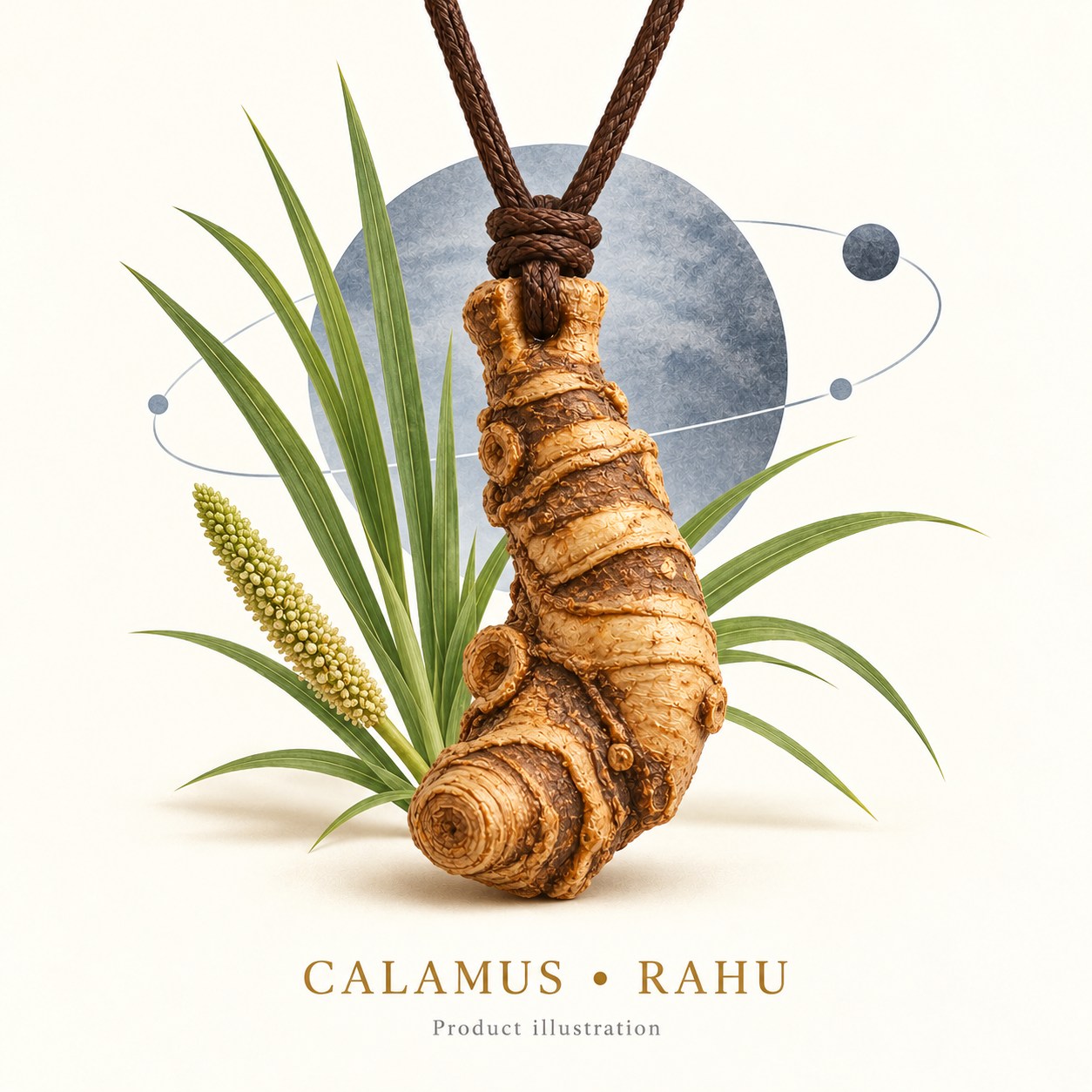
Calamus, called Vacha in Sanskrit and often sold as sweet flag, appears in some contemporary Indian planetary-herbal jewellery collections as a material associated with Rahu. The question is not simply whether a small piece of plant material is attractive. A thoughtful buyer may want to know what Rahu means in Jyotish, why an herbal pendant is used during a devotional practice, which part of the plant is actually supplied, what the pendant is made from, and how the item should be worn and maintained. These questions have different answers and should not be collapsed into a single promise.
The traditional Rahu association belongs to a selected lineage or product convention. The botanical identity of Acorus calamus can be investigated independently. A finished pendant is a manufactured assembly with a cord, cap, coating, and piece of processed plant material. A Jyotish interpretation does not authenticate a botanical sample, and a correct plant name does not itself establish a compulsory Rahu remedy. This guide explains the three subjects together without confusing them.
The essential distinctions at a glance
| Subject | Established description or customary context | What it means for a Calamus pendant |
|---|---|---|
| Rahu in Jyotish | One of the Navagraha, usually represented by the north or ascending lunar node | Interpreted through a birth chart and a practitioner's tradition, not by the appearance of the pendant |
| Rahu in astronomy | A point where the Moon's orbit crosses the ecliptic northward | An orbital node, not a mineral, plant or physically detectable force within jewellery |
| Vacha or sweet flag | A common Indian name for Acorus calamus L., family Acoraceae | Botanical label requires confirmation for the actual supplied stock |
| Rhizome | A modified stem, often below ground, with nodes and buds | More precise than calling every underground piece a true root |
| Trade name: Calamus root pendant | A familiar retail phrase used for a finished accessory | Product specifications should state the verified plant part and construction |
| Sankalpa | A devotional intention or resolve | A context for wearing an accessory, not a botanical identification test |
| Fit and finishing | Cord, drill hole, mount, surface, cap, sealant, clasp and dimensions | These determine the pendant's practical suitability for daily wear |
| Treatment and care | Processing, drying, moisture management and careful handling | Ask about the material used and care for the whole assembly, not merely the plant name |
A customer may respect Rahu-related observances and still request precise evidence of what is being sold. Similarly, a person may simply like a botanical pendant without requesting an individual horoscope analysis. Both are reasonable starting points.
Rahu: Chhaya Graha, ascending node and its place in Navagraha
In Indian astrology, Rahu and Ketu are commonly called Chhaya Grahas or shadow grahas. They have an important position in Navagraha worship and Jyotish even though they are not solid planets like Mars or Jupiter. In astronomical language, Rahu corresponds to the Moon's ascending node and Ketu to the descending node. The Moon's orbital plane is tilted relative to the apparent solar path; those crossing points are essential in understanding eclipse seasons. NASA's eclipse explanations use the same geometry, although Jyotish gives the nodes a further symbolic and interpretive role.
A lunar node is a calculated location, not a rock traveling through space. This distinction matters in product language. Statements such as 'Rahu energy is stored in the pendant' are a different kind of claim from the traditional statement that Vacha is chosen to represent Rahu within a particular devotional practice. A planetary accessory may be used as a material reminder of a vow, prayer or personal discipline without having to make a physical claim about the node itself.
The two nodes form one axis, generally about 180 degrees apart in a horoscope. Traditional interpreters consider the houses they occupy, their relationship with the Lagna, the sign lords, their nakshatra lords, conjunctions and planetary periods. Isolating Rahu's sign, house or transit without the other factors usually loses important context. Its association with unusual choices, expansion, worldly appetite, unfamiliar environments, visibility and changing circumstances is an interpretive vocabulary, not a list of events that every Rahu placement must produce.
The churning-of-the-ocean story and eclipse imagery
The familiar Samudra Manthana narrative gives Rahu and Ketu a vivid place in Hindu sacred storytelling. In a widely told version, an asura obtains a portion of amrita while concealed among the devas; Vishnu intervenes, and the separated head and body become associated with Rahu and Ketu. Their encounter with Surya and Chandra becomes an explanation of eclipses in the narrative world. Retellings vary, and the story is not a substitute for astronomical eclipse calculations. Its importance for devotees is symbolic: discernment, desire, concealment, consequences and the interplay of illumination and shadow.
For a pendant description, there is no need to claim that the plant was present in that episode or that the story prescribed today's particular jewellery component. Rahu's religious symbolism can be explained faithfully while the modern product choice is described as a tradition-specific association rather than a universal instruction from every classical text.
Rahu in an individual Kundali: what an astrologer actually examines
A responsible Rahu discussion begins with the full Janma Kundali rather than a newspaper-style statement that everyone born under a particular sign should wear the same thing. A chart-based reading may consider birth date, accurate time and place, the adopted ayanamsa, the house system, planetary longitudes and the interpretation method. Small differences in birth time sometimes change divisional-chart boundaries or house cusps. The analysis should make its calculation assumptions visible rather than replace them with a blanket product recommendation.
| Jyotish factor | Question examined | Why it matters before suggesting a Rahu-related object |
|---|---|---|
| Lagna and Lagnesha | Which houses are central to this individual chart? | A house result depends on the entire chart, not a single node |
| Rahu's bhava | Which life-domain topics does the placement traditionally signify? | The same graha can be read differently in different houses |
| Rashi and sign lord | Where is Rahu placed and how is its dispositor situated? | Interpretation is not independent of the sign lord |
| Nakshatra and its lord | Which lunar mansion governs Rahu's degree? | Adds a further interpretive layer in many schools |
| Conjunctions and aspects | Which grahas influence the nodes? | Other planetary conditions can modify a reading |
| Rahu–Ketu axis | Which opposite houses are involved? | The two nodes are evaluated together |
| Vimshottari dasha | Is Rahu ruling a Mahadasha or Antardasha? | Timing context differs from a lifetime generic description |
| Gochar or transit | What temporary configuration is under discussion? | A transit is not identical to the natal position |
| D9 and other vargas | Which divisional charts are relevant and reliably calculable? | Supplementary assessment should match question and time accuracy |
| Practitioner and sampradaya | Which lineage and remedial conventions are followed? | Plant choices and observance details are not uniform |
One reader might ask about Rahu because the present Mahadasha is Rahu's. Another might ask because of a transit, an established family vow, or a temple practice. Those are not interchangeable reasons. The product should not decide the chart interpretation; if a personalised recommendation is desired, the sequence is chart and purpose first, accessory second.
Twelve houses: a contextual guide, not twelve fixed predictions
The bhavas are a way of organizing Jyotish discussion. The following is a topic map, not a guarantee that Rahu will produce a specific event in a given house. Sign lord, conjunctions, dignity conventions, aspects, dasha and the wider chart remain material.
| Rahu house | Themes a Jyotish reader may investigate | Avoid this shortcut |
|---|---|---|
| 1st | Self-presentation, direction, identity, ambition | Calling the native permanently unstable |
| 2nd | Speech, family resources, values, savings | Predicting wealth or loss from the node alone |
| 3rd | Initiative, writing, media, siblings, skills | Promising automatic career success |
| 4th | Home, education, emotional rootedness, property | Concluding that every home requires correction |
| 5th | Study, creativity, children, judgment | Turning one placement into a diagnosis |
| 6th | Daily work, service, duties, conflict, habits | Treating a pendant as protection from all disputes |
| 7th | Agreements, partnerships, public dealings | Predicting relationship outcomes from one factor |
| 8th | Shared resources, research, change, inheritance | Using alarming language about inevitable danger |
| 9th | Teachers, travel, learning, belief, dharma | Claiming spiritual worth from the chart alone |
| 10th | Profession, responsibility, recognition | Promising a promotion or business growth |
| 11th | Networks, aspirations, gains, communities | Treating hopes as guaranteed financial results |
| 12th | Retreat, foreign residence, expenditure, release | Equating solitude with failure or supernatural harm |
For example, Rahu in a career-related house may invite a discussion of changing technologies, mobility or a public role. The chart could support many interpretations depending on the other factors. A Calamus pendant remains an optional devotional object; it does not function as a measurement or correction of the house.
Vimshottari: Rahu's eighteen-year Mahadasha and the three Rahu nakshatras
Within the widely used Vimshottari Dasha sequence, Rahu receives 18 years of the total 120-year cycle. The nakshatras governed by Rahu in this system are Ardra, Swati and Shatabhisha. A person's birth Moon nakshatra establishes the starting planetary period and the remaining balance at birth. An Antardasha is a sub-period within the wider Mahadasha; it is not the same thing as a Rahu transit.
| Timing concept | Traditional calculation or use | How it relates to jewellery choice |
|---|---|---|
| Vimshottari cycle | A conventional 120-year nine-graha sequence | Provides timing context for a Jyotish reading |
| Rahu Mahadasha | Assigned 18 years | Not every wearer is in this period |
| Rahu-ruled nakshatras | Ardra, Swati, Shatabhisha | Does not mean everyone in those nakshatras needs the same item |
| Antardasha | A period nested inside a Mahadasha | Must be calculated for the individual birth chart |
| Pratyantardasha | A further subdivision | Fine timing adds uncertainty when inputs are approximate |
| Gochar Rahu | A moving node's transit through the zodiac | A transit should not replace a natal or dasha assessment |
| Ayanamsa convention | Reference used in a sidereal chart | Different settings can shift calculated borders or timing |
| Devotional observance | Prayer, puja, japa or Sankalpa adopted by a practitioner | Does not require the claim that a specific plant guarantees results |
A helpful consultation records the calculation settings and asks what the customer is actually seeking. Is the person looking for a small reminder for their daily japa, trying to understand a dasha report, considering a family Navagraha observance, or comparing traditional herbal jewellery with gemstones? The answer can legitimately be different in each case.
Rahu and three nakshatras: avoid over-reading a label
In the Vimshottari system, Ardra is placed in the Mithuna portion of the zodiac, Swati in Tula, and Shatabhisha in Kumbha. Their traditional imagery and presiding deities differ. Sharing Rahu as a dasha lord does not make these nakshatras interchangeable or impose an identical wearing ceremony. The Moon's degree, pada, associations and full chart determine the context in which the nakshatra is interpreted.
The label 'Rahu remedy' is often presented as if it referred to one standardized rule. A better conversation asks which Rahu question, which tradition, and which item of jewellery. It is also reasonable for a customer to ask for an explanation before deciding whether any accessory is desired.
Vacha: what plant is actually meant by Calamus?
In Indian botanical and Ayurvedic contexts, Vacha commonly refers to sweet flag, Acorus calamus L., family Acoraceae. It is an aromatic, semi-aquatic perennial plant often found in or near wet habitats. The source and accepted botanical classification should be checked against recognized botanical references rather than inferred from a short trade name. Kew's Plants of the World Online lists the accepted name and describes the plant as rhizomatous. Indian government botanical literature also uses the name Vacha and provides names in regional languages.
A rhizome is an underground or near-ground stem. It can have nodes, buds, scale-leaf scars and roots arising from it. A true root differs structurally and functionally. Retailers sometimes call a dried rhizome a root because that is the familiar commerce term, but a careful product specification can preserve the searchable name while stating the verified organ accurately. The product should not be described as a 'root of the Calamus tree': sweet flag is not a tree.
| Term on a label | More precise meaning | What to check with the supplier |
|---|---|---|
| Vacha | Ayurvedic/common Indian name commonly used for Acorus calamus | Confirm Latin binomial against the batch |
| Sweet flag | English common name | Common names can be ambiguous without documentation |
| Calamus | Common trade term | Is it specifically Acorus calamus or another product using the name? |
| Calamus root | Retail shorthand often used for underground material | Was the component a rhizome, a true root or an unspecified fragment? |
| Vacha rhizome | Underground stem material | How was it identified, dried and prepared? |
| Dried botanical bead | Worked or drilled natural material | Is the base material intact and how is it mounted? |
| Encapsulated insert | Botanical material held inside a metal/resin housing | Is the fragment visible and safely sealed? |
| Carved substitute | Another wood, resin or composite | Do not present it as genuine Vacha without proof |
| Essential oil | A processed extraction from botanical material | An oil is not interchangeable with a solid rhizome pendant |
| Herbal powder | Ground or processed plant material | Not the same material or care regime as a whole piece |
A living Vacha plant versus a tiny finished component
A living Vacha specimen can be examined for leaves, flowering structures, rhizome characteristics and habitat. A tiny polished, drilled or sealed piece may no longer display all these identification features. It is therefore not enough to compare the pendant with an internet photograph and declare it genuine. The strongest practical evidence comes from traceable supplier records, stated species, exact plant part and documented processing. If a material is mixed with resin, bonded to a cap or combined with other herbal beads, that detail belongs in the description.
The Government of India's Department of Biotechnology and the Central Council for Research in Ayurvedic Sciences publish botanical and technical information on Vacha. These materials assist species-level research but do not independently certify a particular jewellery shipment. This distinction protects the buyer and gives the seller a stronger, auditable catalogue record.
How the Rahu–Calamus association should be presented
Vacha is an established name in Ayurvedic botanical literature. Its documented role in herbal and classical medicine is not the same question as a fixed rule that all Rahu devotees should wear a Vacha root pendant. Specific Navagraha plant assignments vary among ritual lists, regional practices, teachers and modern vendors. One list may select a tree used in a homa, another an herb for a talisman, and another an arrangement of nine materials in a necklet. Those are related devotional ecosystems, not identical inventories.
For this collection, Calamus/Vacha is presented as a selected Rahu-associated herbal accessory. If a teacher prescribes a particular plant, mantra or muhurta, their tradition may provide a separate explanation. A retailer should not claim that a single named ancient work mandated this exact pendant unless the passage can be identified and shown in context.
| Type of association | Example | Appropriate wording |
|---|---|---|
| Botanical | Acorus calamus is a named species | 'Vacha/sweet flag; verify the actual processed part' |
| Ayurvedic | Vacha is discussed in Dravyaguna sources | 'Historically discussed in Ayurveda' without importing treatment promises |
| Jyotish | Rahu is a Chhaya Graha considered in a kundali | 'Rahu is interpreted in the full chart' |
| Navagraha devotion | Graha Shanti, mantra or temple worship | 'An optional object within a devotional observance' |
| Selected herbal-jewellery collection | Vacha is paired with Rahu for this range | 'Traditional/collection-specific planetary association' |
| Customary wearing day | A teacher or family follows a chosen day | 'Follow the practice given by your tradition' |
| Gemstone alternative | Hessonite/Gomed is often discussed for Rahu in Jyotish jewellery | 'Different material, procurement and suitability decision' |
| Evidence of a finished piece | Supplier part record, batch, fittings, photographs | 'Documentation for this exact article' |
In this way, the association is neither ignored nor expanded beyond its source. The article can respectfully retain Graha Shanti, upaya, Sankalpa, Navagraha, japa and related terminology while keeping product descriptions factual and specific.
Vacha in Ayurveda is not a pendant-use instruction
Classical and modern Dravyaguna sources describe Vacha as an aromatic rhizomatous plant with a history of medicinal investigation. That historical context makes the botanical material culturally recognizable, but a dried ornament is not a prescribed medicinal preparation. Form, dose, method of preparation, exposure and assessment matter in any medicinal setting. A jewellery product should not be recommended for swallowing, chewing, inhaling smoke, burning, powdered use, extraction or adding to water.
The European Medicines Agency has issued a public statement about asarone in herbal medicinal products, discussing toxicological considerations and exposure limits in that context. This is not a test result for a particular pendant, nor does it prove that every possible jewellery setting is appropriate for prolonged bare-skin contact. It is useful background for keeping the item as an external accessory and for disclosing unknown coatings or exposed components. No medical efficacy follows from a graha association.
There is also a practical difference between a solid dried insert and an essential oil. The oil and processed medicinal forms cannot be treated as material equivalents of a pendant. If a supplier markets 'Calamus oil-infused jewellery', request separate ingredient and contact specifications rather than treating the phrase as a synonym for an actual Vacha rhizome.
What a complete Calamus pendant specification should say
A buyer should see more than a photograph and the words 'Rahu root'. The ideal listing records the materials in the finished item and any uncertainty that remains. It should give meaningful dimensions, a visible photograph of the actual design, an accurate statement of what has been verified, and normal jewellery information such as chain or cord length. If the plant part has not yet been authenticated, the product should not imply that the verified name of a botanical species is proof of the supplied batch.
| Specification field | Minimum useful information | Why it matters |
|---|---|---|
| Product name | Calamus (Vacha) pendant for Rahu | Connects search terminology to this collection |
| Botanical name | Acorus calamus L., if verified for the supplied batch | Separates identity from generic trade language |
| Plant part | Rhizome, root or other part, with basis for identification | Avoids organ-name confusion |
| Source and batch | Supplier, region if known, traceable batch and receipt | Supports accountability and reordering |
| Physical form | Whole piece, drilled chip, sealed capsule, bead or composite | Identifies what the customer is actually handling |
| Surface processing | Drying, polishing, staining, coating, adhesive, resin | Changes appearance and cleaning requirements |
| Metal fittings | Cap, loop, clasp, chain alloy or plating where known | Matters for durability and contact preferences |
| Fit | Pendant dimensions, weight, cord/chain length, adjustability | Helps customers choose comfortable jewellery |
| Image | Actual batch/design photograph and honest scale | Differentiates illustration from supplied item |
| Care | Dry wiping, moisture precautions, storage and inspections | Reduces avoidable damage |
| Religious context | Selected Rahu association and optional observances | Avoids presenting a mandatory universal rule |
| Exchange or repair | Condition, size and fitting policy | Helps after-sales decisions |
A visual test cannot settle botanical identity
A brown fragment may resemble dried wood, rhizome, fibre, bark, a seed or molded resin. Smell alone is unreliable, especially after sealing or storage, and it is inappropriate to scratch, burn or taste an accessory for an informal 'authentication' ritual. Instead, request a clear material description and, where necessary, documentation from the maker or an appropriate botanically qualified identifier. The customer can still inspect obvious workmanship: a securely fitted loop, smooth edges, clean cord terminations and a stable setting.
Herbal jewellery versus Hessonite (Gomed) for Rahu
In many Jyotish jewellery discussions, Hessonite garnet is called Gomed/Gomedaka and is associated with Rahu. It is a mineral gemstone—not an herbal insert—and it has different identification, pricing, durability and wearing traditions. The word 'Rahu' in both listings does not make the materials equivalent or establish that one is a substitute for the other in every lineage. Gemstone recommendations are often more individualised than merely choosing a favoured colour or a commercially popular graha label.
| Decision | Calamus/Vacha pendant | Hessonite/Gomed jewellery |
|---|---|---|
| Basic material | Processed botanical component | Garnet-group gemstone, ideally identified as hessonite |
| Main identification question | Which species and plant organ is supplied? | Is the stone natural hessonite, what treatments or imitations apply? |
| Typical construction | Dried insert, cap, thread, cord or chain | Faceted or cabochon stone with a metal setting |
| Durability priority | Moisture and fragile organic component | Setting security, impacts, cleaning and gem disclosure |
| Traditional purpose | Selected herbal or devotional association | Gemstone-linked Jyotish convention, often chart-specific |
| Sizing | Cord and pendant comfort | Ring size, setting and stone dimensions |
| Pricing basis | Workmanship, botanical provenance and assembly | Stone identity, quality, weight and setting |
| Recommended documentation | Species, part, lot, mount and care | Gem identity, disclosures, dimensions and setting |
The purchasing question is therefore not 'Which Rahu item is stronger?' without a defined tradition or method. It is whether the customer seeks a botanical devotional reminder, a gemstone accessory supported by a practitioner, or a broader Navagraha devotional set.
Single Rahu pendant or a Navgraha herbal necklet?
A single-planet pendant concentrates the product description on one selected graha association. A Navgraha herbal necklet brings together nine plant materials or symbolic components in one assembly. The two formats raise different traceability and construction issues: one piece is simpler to document; nine pieces require nine separate identifications, a durable stringing scheme and a clear map of what is included. In either case, it is the actual listed materials—not the title alone—that should guide a purchase.
| Question | Single Calamus pendant | Nine-material herbal necklet |
|---|---|---|
| Focus | Rahu in a selected planetary-herbal system | Complete Navagraha representation |
| Botanical documentation | One verified plant component | Each component mapped and checked individually |
| Construction | One pendant plus fitting | Multiple pieces plus thread/chain and joining points |
| Repair | Usually a localized fitting issue | More joins and opportunities for loosening |
| Appearance | Discreet single focal piece | Wider or heavier arrangement, depending on design |
| Wearing custom | Individual or lineage-specific | May be associated with a broader devotional observance |
| Price comparison | Material, processing, fitting | Multiple materials, assembly work and identification costs |
| Purchase criteria | Species/part, comfort and secure mounting | All nine mappings, distribution, fit and strength |
If the customer is considering both, a side-by-side photograph with scale and dimensions is more informative than broad claims that one product suits everybody. Ask which tradition's nine-plant mapping the necklet follows, since Navagraha ritual plants can vary by purpose and region.
Choosing and wearing the pendant with Sankalpa
Sankalpa refers to a deliberate intention or resolve in ritual and devotional contexts. A person might wear a Calamus pendant while remembering a particular daily practice, as an expression of reverence for Navagraha, or simply as an accessory they associate with disciplined self-observation. A family might have customs involving washing, offering flowers, lighting a lamp, reciting prayers or choosing a time to begin wearing. These practices are not identical across all households or sampradayas.
For anyone following a formal puja method, a priest or established guide can explain the sequence. In informal daily use, the practical order is straightforward: inspect the piece, confirm fit, respect the household's customs, and wear it without pulling on the organic insert. The ornament does not require repeated wet purification; water, oil, incense smoke and heat can affect the surface or fittings. Devotional cleanliness and physical cleaning are different matters. Use the latter only when appropriate for the actual material.
A concise Sankalpa can be a personal statement of the intended observance rather than a claim to alter a planetary force. The chosen words can be in Sanskrit, a regional language or the family's own language. There is no reason to invent a compulsory mantra, number of repetitions or one-size-fits-all muhurta for a collection whose exact custom has not been independently established. If someone has received a specific mantra from a teacher, they can follow that instruction without converting it into an unsupported retail rule.
Rahu, Shani, Ketu and the temptation to combine all remedies
Rahu is often mentioned alongside Shani in everyday conversations about obstacles and along with Ketu because the nodes share an axis. That is not a reason to prescribe three accessories simultaneously. Their meanings differ in the traditional framework, as do the plants, gemstones and devotional customs associated with them in different lineages. A chart or family observance may discuss them together, but an item labelled Rahu cannot be assumed to answer every concern about the other grahas.
The comparison is especially relevant for customers reading articles about Gomed, Neelam, cat's-eye and planetary herbal pendants. Gomed is commonly associated with Rahu; blue sapphire is discussed for Shani in many traditions; chrysoberyl cat's-eye with Ketu. A generic 'Navagraha problem' does not tell a seller which product to recommend. Document the individual's purpose, the tradition being followed, the material choice, cost and willingness to wear the piece regularly. A respectful recommendation can be simply to learn more and make no purchase.
Real-world examples from a Bengaluru showroom or consultation
Example 1: A technology professional during a Rahu Mahadasha
A customer brings a computer-generated chart showing the Rahu Mahadasha and asks whether a Vacha pendant will guarantee career progress. A productive consultation first checks whether the dasha timing was calculated from accurate birth data and which ayanamsa was used. The adviser can explain the traditional Rahu vocabulary of emerging fields, ambition and new networks without converting that vocabulary into a prediction. The customer may then view the botanical pendant as a private devotional reminder, while separately checking whether the supplied piece is actually Vacha and whether its cord fits daily clothing.
Example 2: A family selecting Navagraha accessories for a puja
A Bengaluru family has a Navagraha observance planned and asks whether one Calamus pendant is a substitute for the ritual's list of nine plants. The answer depends on the family's puja paddhati: a wearable keepsake and a homa ingredient set are different product categories. The adviser should not silently change one into the other. A pendant can be shown with its species and care specification, while the family's priest or established customary list governs the ritual materials.
Example 3: A parent shopping for an adult child
A parent requests a Rahu pendant after hearing a troubling prediction. Instead of amplifying anxiety, the seller explains the context, asks whether the intended wearer actually wants a pendant, and offers clear dimensions, materials and return terms. A lightweight piece without sharp edges or exposed adhesive is easier to evaluate. If the person does not want to wear it, that preference can be respected; a spiritual gift works best when chosen thoughtfully.
Example 4: A showroom comparing Vacha and Gomed
A visitor sees both Vacha pendants and Hessonite rings in the same display. They may assume the cheaper item is an inferior version of the gem. The staff member instead explains the different raw materials and traditions, brings out the gemstone identification details for Gomed and the botanical component specification for Vacha, and describes the different cleaning and mounting issues. This protects product accuracy and avoids exaggerated rankings of spiritual effectiveness.
Example 5: A professional Jyotish practitioner recording the recommendation
A practitioner may document the Kundali factors, the graha and dasha context, the selected upaya, the rationale for preferring a wearable item over another form of observance, and the source of the plant association. This note can remain distinct from the product's manufacturing and price record. A software-generated chart may calculate positions; the interpretation and final recommendation can be separately reviewed. Such separation makes follow-up questions easier to answer and reduces accidental contradictions between an astrology report and a retail listing.
Safe handling, storage and everyday upkeep
Calamus pendants combine an organic component with manufactured fittings. Dried plant material can respond to humidity, heat, light, insects or rough handling, while thread can fray and metal finishes can tarnish. Museum conservation guidance for plant-based objects favours stable conditions and gentle handling. Apply practical caution without pretending that a museum specimen and a daily-wear pendant are the same object. The maker's construction-specific instructions take priority where known.
| Situation | Sensible action | Avoid |
|---|---|---|
| Ordinary dust | Use a soft dry brush or cloth on accessible surfaces | Soaking the entire pendant |
| Rain or sweat | Remove, gently blot exposed fittings and allow controlled drying | Hot air, direct heat or harsh sunlight |
| Puja with water or oil | Keep the botanical piece away from the liquid if not explicitly rated for it | Immersing the pendant for ritual cleansing |
| Strong perfume | Apply fragrance before putting on jewellery | Spraying volatile liquids onto the plant or coating |
| Snagged cord | Stop using, inspect and replace as appropriate | Pulling sharply to free the pendant |
| Loose cap or bead | Keep the object aside pending a jeweller's inspection | Using unknown household glue on skin-contact areas |
| Discolouration | Record photographs and consult the supplier | Sanding, bleaching or solvent cleaning |
| Storage | Clean, cool, stable and protected from moisture and crushing | Steamy bathrooms, windowsills and damp drawers |
| Travel | Separate soft pouch or structured compartment | Loose contact with keys and metal tools |
| Pest or mould suspicion | Isolate, document and request professional guidance | Scrubbing or continuing to wear visibly damaged material |
The pendant should be treated as an external jewellery object, not a medicinal ingredient. If a wearer experiences discomfort from a chain, coating or contact surface, remove the accessory and review the setting and materials. The article need not repeatedly attach a general site disclaimer to each section; a clear product-specific care boundary is enough.
A detailed buying and authenticity checklist
A product can be both spiritually meaningful and professionally specified. Before paying for a Calamus/Vacha pendant, verify the actual item and record the answers so that after-sales support is straightforward.
| Check | Question to ask | Good evidence or useful answer |
|---|---|---|
| 1. Species | What botanical species is supplied? | Stated scientific name supported by supplier record |
| 2. Plant part | Is it rhizome, root or another component? | Material part described accurately |
| 3. Traceability | Which batch or supplier produced this item? | Receipt, lot or internal supplier reference |
| 4. Processing | Was it dyed, oiled, sealed or coated? | Specific material and finishing description |
| 5. Assembly | How is the plant attached to its cap or loop? | Visible or documented method |
| 6. Materials | What are the cord and metal fittings made of? | Material names and finish where known |
| 7. Size | What are pendant dimensions and chain length? | Measurements rather than vague 'standard' language |
| 8. Weight | Will the item feel comfortable daily? | Weight estimate or in-person try-on |
| 9. Photograph | Is this the actual product or an illustration? | Clearly distinguished product/batch images |
| 10. Wear surface | Does material touch skin directly? | Description of exposed, lined or sealed surfaces |
| 11. Care | How should the particular assembly be cleaned? | Dry-care guidance matched to components |
| 12. Religious meaning | Which tradition pairs Vacha with Rahu? | Clear collection-specific explanation |
| 13. Recommendation | Was the item individually advised or chosen devotionally? | Transparent basis for selection |
| 14. Price | What is included in the listed price? | Pendant, cord, packaging and applicable charges |
| 15. Service | What happens if the fitting breaks? | Repair, replacement or support terms |
The most common purchasing misunderstandings
A botanical specimen photo is not a batch certificate. A natural-looking brown piece is not proof of Acorus calamus. A material named in Ayurveda is not automatically suitable for all uses or all body-contact situations. A product associated with Rahu is not proof that the customer's horoscope needs Rahu-focused upaya. A mantra found on a page is not a substitute for the customer's own teacher or custom. And a lower price does not make a herbal pendant 'weaker' than a gemstone: the two are different categories with different supply costs.
How to discuss a Calamus pendant without fear-based selling
Rahu is frequently introduced to customers through stories of 'bad periods', 'blockages' and 'evil influences'. An article aimed at practical spiritual jewellery buyers can instead use ordinary questions: What tradition are you following? Is your concern general curiosity, a known dasha, or a temple observance? Do you want a botanical keepsake or a chart-specific recommendation? Can you comfortably wear the material? Do you understand what is included and how to care for it?
These questions do not strip the tradition of meaning. They make the discussion more precise. Upaya is a broad term in Jyotish for remedial or devotional action; the choice among japa, charity, puja, conduct, service, pilgrimage, gemstones or herbal accessories is not settled by one commercial listing. People may undertake the practice as part of devotion and personal discipline, not because a merchant has guaranteed a measurable outcome.
For OmmRudraksha's consultation workflow, there are two separate records worth maintaining: the astrological reasoning (birth inputs, chart settings, interpretive factors, the chosen graha and traditional reference) and the product disclosure (species, plant part, processing, batch, fit and price). When these are not mixed, the customer can understand how a suggestion was reached and what will physically arrive.
A practical comparison before ordering
Use the following decision table when the question is whether to order the pendant, choose a different form of observance, or obtain a personalised consultation first.
| Your primary purpose | Sensible next step | What not to infer |
|---|---|---|
| I am curious about Rahu | Read the Jyotish and astronomy distinctions | That curiosity creates a need to buy |
| I am in a Rahu Mahadasha | Confirm the chart settings and broader context | That every 18-year period is identical |
| My family uses a Vacha-related custom | Ask which plant and form that custom specifies | That every Navagraha list is the same |
| I want an understated devotional item | Inspect a single pendant and its fittings | That a smaller pendant has smaller spiritual worth |
| I want all nine associations | Compare the complete Navgraha necklet and mapped components | That the nine-piece set matches every homa list |
| I was advised to wear Gomed | Clarify whether that refers to a specific hessonite stone and setting | That an herbal insert is automatically interchangeable |
| I have sensitive skin or dislike metal | Inspect contact surfaces, cords and coating disclosures | That 'natural' guarantees contact compatibility |
| I want a gift | Check the recipient's wishes, fit and care preferences | That a predicted fear justifies pressuring someone |
| I need exact botanical certainty | Request supplier evidence for the actual batch | That the Latin name on a blog identifies the merchandise |
Questions customers frequently ask
1. Is Rahu a real planet?
In Jyotish, Rahu is one of the Navagraha and a Chhaya Graha. In the orbital model it corresponds to the Moon's ascending node, a crossing point rather than a planet with a physical surface. The traditional use of the term graha does not require every graha to be a modern astronomical planet. Both explanations are valuable in their own contexts.
2. Why is Vacha connected with Rahu here?
This planetary-herbal collection uses Vacha/Calamus as a selected traditional Rahu association. Plant mappings can differ between contemporary jewellery conventions, regional ritual lists and individual teachers. The connection should be stated as part of that selected custom, without claiming that all classical texts prescribe this exact pendant.
3. Is a Calamus root pendant made from a true root?
Not necessarily. Acorus calamus grows from rhizomes, which are modified stems, and the term 'root' is often used broadly in retail descriptions. Ask which organ was processed into the specific pendant. The wording on a product page should explain any established distinction while retaining the familiar search term where helpful.
4. What is the accepted botanical name of Vacha?
A widely accepted name for the species called Vacha or sweet flag is Acorus calamus L., in the family Acoraceae. Kew and Indian botanical sources describe it as a rhizomatous plant. That establishes the species name for education; it does not automatically establish the identity of an unexamined jewellery fragment.
5. Is Vacha a tree?
No. Sweet flag is an herbaceous, semi-aquatic perennial, not a tree. Referring to it as a 'Calamus tree root' would be botanically inaccurate. A supplier should identify the actual plant part, such as dried rhizome if that is what has been used.
6. What is the meaning of Chhaya Graha?
The expression is commonly translated as 'shadow graha' and applied to Rahu and Ketu. In Jyotish they have interpretive importance despite their different astronomical nature. The term describes their position in a traditional system; it is not a claim that a plant insert contains a physical lunar-node force.
7. Does everyone undergoing Rahu Mahadasha need this pendant?
No single accessory follows automatically from entering a Mahadasha. Traditional chart interpretation considers Rahu's placement, its sign lord, other grahas, the dasha and the person's circumstances. A wearer may independently choose the pendant for devotion, but the planetary period alone does not establish a mandatory product.
8. Which nakshatras are ruled by Rahu?
Ardra, Swati and Shatabhisha are governed by Rahu in the Vimshottari dasha sequence. These nakshatras occupy different zodiac regions and have different imagery and associations. Their common dasha lord does not make them equivalent or impose one uniform buying rule.
9. How long is Rahu Mahadasha?
In the standard Vimshottari scheme, Rahu's Mahadasha is allotted 18 years out of a 120-year cycle. A person's starting balance is based on the Moon's nakshatra at birth, so the age at which the Rahu period occurs differs. Calculation choices should be documented when precise dates are supplied.
10. Is Rahu related to eclipses?
Yes. The ascending and descending lunar nodes are geometrically important for eclipse possibilities because the Moon must be near a node at the appropriate phase. Traditional Rahu–Ketu eclipse stories also carry a mythological and devotional dimension. Astronomy explains the physical alignment; sacred narrative expresses a different kind of meaning.
11. Is a Vacha pendant the same as Gomed?
No. Vacha is botanical material and Gomed usually refers to hessonite garnet. They differ in source, quality checks, construction, maintenance and established jewellery conventions. A chart-based gem suggestion should not be silently converted into a herbal suggestion, or vice versa.
12. Can a Calamus pendant be used in a Navagraha puja?
A wearable accessory may be part of a family's observance, but a pendant should not automatically be substituted for plants or offerings listed in a specific puja or homa procedure. Consult the applicable paddhati or knowledgeable officiant. The product's jewellery specification and the ritual material requirement are separate things.
13. Is there a compulsory day or muhurta to wear it?
Different households and teachers may have particular customs. No universally compulsory day or minute can be concluded simply from a commercial product name. If a personalised muhurta matters to the wearer, use the family's or practitioner's method and verify the location and time calculations before proceeding.
14. Can I wear it without a horoscope consultation?
Many people choose devotional or symbolic jewellery because it is meaningful to them, independently of an astrological prescription. They can still ask about botanical identity, fit and care. If the product is marketed as a specific remedial recommendation, the basis for that recommendation should be stated clearly and separately.
15. Can I wash the pendant during puja?
Do not assume the whole assembly is water-safe. Dried botanical material, adhesives, coatings, textile cords and plated metal can react differently to soaking. If ritual washing is customary, ask how the specific piece may be respectfully handled without wetting a vulnerable component. Dry wiping is often the simpler maintenance method.
16. Can I smell, chew or burn the material to verify Vacha?
No. Those are unreliable and inappropriate methods for a finished jewellery component, and they could damage the item or create unwanted exposure. A supplier's documented species and plant-part record is a better starting point. The EMA's asarone discussion relates to medicinal exposure and should not be misused as a product test certificate.
17. How do I store an herbal pendant in a humid climate?
Store the clean, dry accessory in a protected compartment away from bathrooms, windows and sources of heat. Avoid sealing it while damp and periodically inspect the cord, cap, finish and organic insert. Follow the maker's specific guidance when a coating or mixed-metal assembly has its own care needs.
18. Can the pendant be combined with a Navgraha necklet?
It is physically possible to wear more than one accessory if the fittings are safe and comfortable, but a combined spiritual prescription should come from the wearer's chosen tradition rather than retail assumptions. Avoid excessive weight or rubbing between pieces. Both sets of actual materials should be accurately described.
19. What does a botanical certificate prove?
A valid test or supplier record can support a stated species and, when appropriately documented, the plant part and sampled lot. A general article about Acorus calamus proves none of those facts for the exact pendant in a customer's hand. Ask what was tested, by whom, and how that evidence connects to the supplied item.
20. What should I check before paying for the Calamus pendant?
Confirm the botanical species and part, source record, form of the insert, coatings, chain or cord, dimensions, contact surfaces, care instructions, return terms and what the product's Rahu association actually means. Compare that information with your own devotional preferences. The most valuable transaction is one in which the buyer understands both the symbolic choice and the physical item.
Research and editorial method
This guide distinguishes astronomical terminology (NASA's description of lunar nodes and eclipses), established botanical nomenclature (Kew and Indian government plant references), traditional Jyotish timing (the Vimshottari framework), historical Vacha studies (Ayurvedic institutions) and finished-object care (plant-material conservation guidance). It does not treat those source categories as interchangeable. The original source links below are retained as supplied, without adding a long list of commercial external hyperlinks.
Before publishing new product claims, OmmRudraksha should verify the actual supplier's species and plant-part records, the finishing materials, the stated customs for this collection and the links between its astrology recommendation and merchandise metadata. Updated source dates, terminology and a clearly described consultation basis make the page more useful than unsupported promises. The site's general policies and existing disclaimer page remain the appropriate location for common site-wide statements.
Original product and related reading
Explore the Calamus pendant and ask about its plant part, fitting, price and availability. Take time to compare those details and decide whether the accessory suits your preferences. A personal devotional choice should not be driven by pressure or fear of a prediction.
For the botanical terminology, read root or rhizome. For storage and handling, read Calamus pendant care. These practical guides accompany the symbolism; they do not claim that a purchase is necessary to prevent harm or guarantee a result.
Explore the Calamus (Vacha) Root Pendant for Rahu, return to Planetary Herbal Jewellery, or visit the established For Planets collection. Botanical references explain plant names and background. Ask our team about the particular item, its fitting and care.Further reading
