
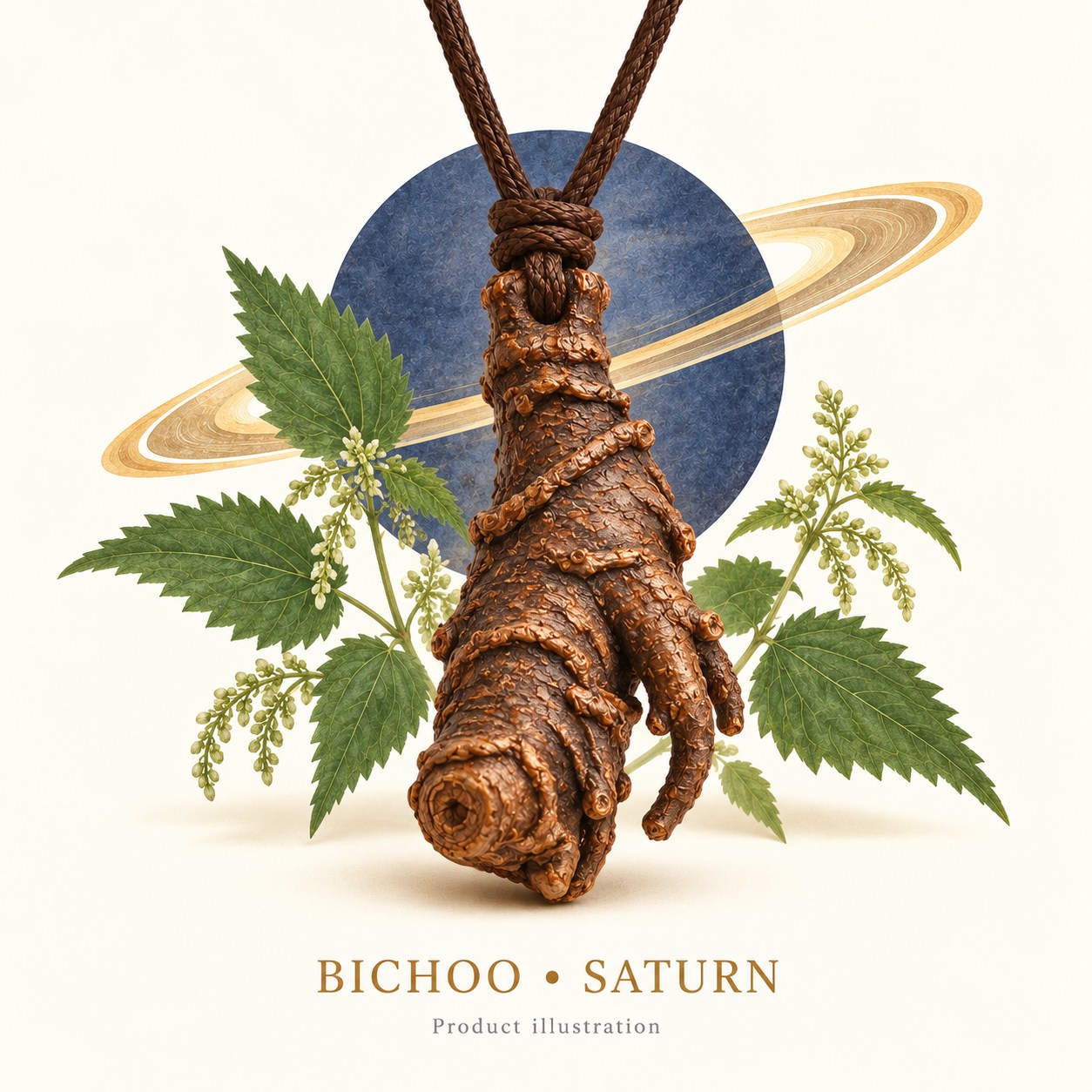
Bichoo Root and Shani brings together two different subjects: a regional botanical material sold as herbal jewellery, and the traditional Jyotish understanding of Shani, the graha associated with Saturn. Customers may encounter the pendant while studying Shani Mahadasha, Sade Sati, Navagraha worship or a family practice involving a Saturday observance. A useful guide should therefore explain what Shani signifies, how a recommendation would actually be assessed, which plant is meant by “Bichoo”, what is inside the pendant, and how to wear and care for the finished item.
The planetary association does not establish the botanical species, and a plant's scientific name does not establish a compulsory astrological prescription. This distinction helps a devotee, a buyer and a consulting astrologer ask the right questions. The pendant can represent a personal Sankalpa, devotional intention or practice connected with Shani. The actual object remains a piece of jewellery whose materials, processing, fit and workmanship must be described accurately.
1. The essential Bichoo–Shani distinctions
| Question | Traditional or factual answer | What to check for the jewellery |
|---|---|---|
| Who is Shani? | A Navagraha with associations of time, karma, discipline, restraint, duty and endurance | No horoscope conclusion follows from seeing a product name |
| What is Saturn? | A physical planet with an orbital period of about 29.4 Earth years | The physical planet does not authenticate an herbal component |
| What is Bichoo? | A regional or trade name associated with nettle-like plants | Ask for the accepted botanical name of the supplied batch |
| Is every Bichoo root Girardinia? | No; vernacular use may overlap with Urtica and other names | Obtain the scientific name and exact plant part |
| Is this a classical prescribed root? | The exact modern pendant-to-graha mapping requires source and lineage identification | Do not automatically assign a Sanskrit textual authority to the product |
| What does the wearer receive? | A botanical insert combined with cord, mount, cap or other components | Inspect the assembly, surface treatment, size and closures |
| Is it the same as Neelam? | No; blue sapphire is corundum, a gemstone, not a botanical object | Distinguish jewellery type, value, testing and wearing convention |
| What should a consultation establish? | The person's chart, intended observance and the basis of the suggested option | Clarify whether it is a general devotional choice or individual advice |
The names often seen in English-language retail—Bichoo, Bichhu, Bichhua, Bichchhoo Buti, and “nettle root”—must not be treated as fully interchangeable species labels. Likewise, Shani, Saturn, Saturdays, Sade Sati and Shani Mahadasha are connected ideas but not synonyms. They refer respectively to a graha, a planet, a weekday association, a transit period and a planetary period in a specific dasha system.
2. Shani in Hindu tradition and Jyotish
In the Navagraha framework, Shani is associated with responsibility, patience, consequences, perseverance, limits, labour, service, perseverance under restriction and sustained effort. Traditions also connect Shani with elders, workers, duty, fairness and the slow unfolding of results. Some devotional stories emphasise the consequences of pride or injustice; others emphasise integrity, restraint and respect. Describing Shani only as a source of suffering would be a very incomplete account of the symbolic tradition.
The Sanskrit expression Shanaishchara is conventionally understood through slow movement. Saturn indeed takes about 29.4 Earth years to orbit the Sun, a useful astronomical point of reference. But a scientific orbit is not an astrological prediction: the former is measured astronomy, whereas the interpretation of a graha in a Janma Kundali belongs to a particular Jyotish system. The meanings of Saturn's position, rulership, aspect and dasha are evaluated within that system, rather than being physically carried by the pendant.
Karma in religious and philosophical discussion is richer than a punishment formula. A Shani observance can foreground honest effort, acceptance of responsibilities, the consequences of action and concern for people whose work is invisible. Some worshippers understand a Shani-related object as a reminder to be punctual, fulfil promises, assist those in need and act fairly. Others use it as part of a puja or a family tradition. These are meaningful differences in purpose, and a seller should allow the customer to describe theirs.
Shani, Saturday and the devotional setting
Saturday is called Shanivara in many Indian languages. Devotees may offer prayers at a Shani shrine, visit a temple, recite a chosen stotra or mantra, donate food or necessities, or perform acts of service. In some popular practices, sesame, sesame oil, dark-coloured materials, lamps and Hanuman worship appear in Saturday observances. These do not amount to one uniform rule across every region, sampradaya and household. The specific mantra, offering and sequence are best taken from a trusted family or temple practice, not assumed from a retail tag.
A Bichoo pendant might be worn after Sankalpa or kept with a devotional item as a personal reminder. There is no need to immerse the pendant in oil, burn it, heat it, soak it or expose it to incense smoke to respect an observance. Such acts can affect the cord, adhesives or dried botanical material. If a ritual calls for water or oil, consider whether the actual jewellery is suitable, or keep it separate while performing the devotional step with appropriate ritual materials.
3. Saturn in a birth chart: what a real Jyotish reading examines
A chart-based Shani reading should begin with the Janma Kundali, its calculation assumptions and the person's actual question. Date, accurate birth time and birthplace are used to calculate the Lagna and planetary positions. A practitioner may record the chosen ayanamsa, whether a sidereal or another convention is being used, the house method, and the date of the transit under discussion. An imprecise birth time can materially affect some ascendant and divisional-chart interpretations.
A generalisation such as “everyone with Saturn in the seventh house needs the same pendant” is inadequate. Saturn's sign, dignity, functional house lordship, conjunctions, aspects, strength, dasha, transit and the condition of relevant houses matter. A traditional consultation may also consider Navamsha (D9) and Dashamsha (D10) when those divisions are relevant, as well as the reliability of the recorded birth time. Charts require interpretation as a whole; one isolated factor should not be turned into a sales instruction.
| Jyotish factor | What a practitioner may examine | Why a single-factor conclusion is incomplete |
|---|---|---|
| Lagna and Lagnesha | Ascendant, chart foundation and house rulership | Saturn's functional role changes by ascendant |
| Shani's rashi | Sign placement, dignity and dispositor | The same sign occupies different houses in different charts |
| House placement | Domains linked with Shani's bhava | House results depend on lordship and other influences |
| Graha drishti | Classical Parashari traditions often consider Saturn's 3rd, 7th and 10th aspects | Aspects are part of a larger network of relationships |
| Yuti or conjunction | Other planets sharing the sign or close degree | A conjunction needs degree, sign and functional assessment |
| Shadbala and other strengths | Multiple measures of planetary strength | Strength is not identical to beneficence or a compulsory remedy |
| Dasha and Antardasha | Whether Saturn periods are operating | A Saturn period does not produce one outcome for all charts |
| Gochar | Saturn's transit relative to Moon and Lagna | Transit timing and personal chart context both matter |
| D9, D10 and other vargas | Relevant divisional charts where appropriate | These are sensitive to the method and, sometimes, birth-time precision |
| Question and tradition | What the individual wants to understand or practise | A devotional item and a chart-specific prescription are not the same |
Traditional sign dignities and their limits
In commonly used Parashari descriptions, Saturn rules Makara (Capricorn) and Kumbha (Aquarius), is conventionally exalted in Tula (Libra) and debilitated in Mesha (Aries). Those reference points are useful terminology, not shortcuts for deciding that a person is lucky, unlucky or must wear an accessory. The strength and role of a graha must still be evaluated within the chart. Interpretive traditions differ in how heavily they weight yogas, combustion, retrogression, nakshatra or divisional placements.
A concrete example: Shani may be a significant house lord in one ascendant and carry a different functional role in another. A client researching career delays might need to examine the tenth house, its lord, relevant dashas, the D10 and the actual career circumstances. A personal choice to wear a devotional herbal pendant is a separate decision. An individual reading should state its rationale in chart terms rather than imply that the mere mention of Shani settles the material choice.
4. Shani Mahadasha, Sade Sati and Dhaiya are different
Vimshottari Dasha is one of the most widely used planetary-period systems in Jyotish. In its conventional 120-year scheme, Shani is assigned 19 years. A Mahadasha is divided into Antardashas, making the operating period more specific than “Saturn is active”. The initial balance depends on the Moon's position in its birth nakshatra, which is why chart calculation matters. There are also alternative dasha systems; not every practitioner treats every method in the same way.
Sade Sati is customarily discussed as Saturn's transit through the sign before the natal Moon's sign, the Moon's own sign, and the sign after it. With roughly two-and-a-half years per sign, this is popularly described as about seven-and-a-half years. The actual calendar boundaries depend on the sidereal zodiac, ephemeris, retrograde crossings and the interpretive convention. A return to a sign can lead to transition dates that should be explained rather than reduced to a generic alarm.
Dhaiya or Kantaka Shani is used differently in different regional schools, often for particular Saturn transits relative to the natal Moon. Do not conflate it with the full Sade Sati period or with Shani Mahadasha. None of these labels proves that a person will lose work, become ill or suffer a specific event. For a jewellery purchase, a frightening forecast is no substitute for material specifications and a reasoned recommendation.
| Term | What it refers to | Common confusion to avoid |
|---|---|---|
| Shani Mahadasha | A 19-year planetary period in conventional Vimshottari | Not the same as Saturn's zodiac transit |
| Shani Antardasha | A subperiod under a Mahadasha | The parent Mahadasha and other chart factors still matter |
| Sade Sati | Saturn's roughly 7.5-year passage around the natal Moon sign | Not an automatic prediction of hardship |
| Dhaiya | A shorter transit classification in particular traditions | Definitions and interpretive emphasis vary |
| Shani return | Saturn's return near its natal position after about 29 years | Different from the usual Moon-sign Sade Sati discussion |
| Shanivara | Saturday, commonly associated with Shani worship | A weekday custom is not a planetary calculation |
| Shani Upaya | A tradition-specific observance, practice or symbolic item | Not necessarily a purchase or one fixed remedy |
A practical consultation should specify which period is being discussed, the date range under the chosen calculation, and why the practice being suggested relates to the client's intention. For OmmRudraksha, its calculation software and a personally verified recommendation can be useful only when the actual underlying assumptions and human review remain clear. A product catalogue should not quietly replace that assessment with a generic rule.
5. Why do some collections associate Bichoo with Shani?
Some contemporary planetary herbal jewellery assortments associate Bichoo or Bichhu Buti with Shani. Such an association can form part of a family's practice, a supplier's root set, or a practitioner-specific selection of plants for the nine grahas. It is appropriate to describe it as a traditional association used in this collection, rather than assert that every Sanskrit source or every Navagraha lineage prescribes the same root, plant part, pendant construction or date of wearing.
The differences among Navagraha samidha lists, plants used in worship, herbs named in classical medicinal texts, and pieces chosen for present-day pendants deserve attention. A plant used as a homa twig is not automatically the same part of the same plant used in a necklet. A regional plant name may refer to a whole plant in one context and processed stem or root in another. A ritual instruction may concern worship rather than continuous contact with skin.
If a seller cites a textual prescription, ask for the title, chapter or verse, botanical interpretation and the material it actually names. The assertion “ancient texts say so” without that information is not useful verification. A devotional wearer can adopt a meaningful contemporary practice without requiring every aspect of a manufactured pendant to have originated as an ancient rule.
What Sankalpa can mean in practice
Sankalpa is an intention or resolve formed for an observance. Someone might choose to associate the pendant with a commitment to greater self-discipline, respectful conduct, completing obligations or maintaining a daily prayer. Another person might use it during a particular family ritual. The point is that the object serves an identifiable practice or personal meaning. A person who prefers no jewellery can still undertake an observance through prayer, charity or ethical action.
Practical advice: write down the intended observance separately from the purchase. For example, “I will keep a fixed time for Saturday prayer and volunteer regularly” is a meaningful personal routine whether or not the pendant is worn. This helps prevent the jewellery from becoming a replacement for the activity with which the wearer associates Shani.
6. Identify the plant behind the name Bichoo
Bichoo is a common-name problem before it is a jewellery problem. Kew's Plants of the World Online recognises Girardinia diversifolia (Link) Friis and Urtica dioica L. as distinct accepted species in the nettle family, Urticaceae. Indian botanical resources document names such as Bichua or Vrischika with Girardinia diversifolia. The similarity of regional names does not make all nettle-family plants taxonomically identical.
Girardinia diversifolia is described by Kew and the Indian Institute of Science flora as a robust nettle-like herb or undershrub with stinging hairs on aerial structures. Urtica dioica, another stinging nettle, is a different species with its own botanical range and morphology. The living-plant descriptions are useful background for understanding the names; they do not authenticate a dried fragment in a pendant. Botanical evidence for an actual batch can involve supplier traceability, plant-part description, collection and processing records, and, when appropriate, specialist identification.
| Material name | Botanical meaning | What the buyer should ask |
|---|---|---|
| Bichoo / Bichhu Buti | Regional or trade name, potentially ambiguous | Which accepted botanical species is meant? |
| Girardinia diversifolia | An accepted species in Urticaceae | What evidence ties this species to the supplied stock? |
| Urtica dioica | A distinct accepted species in Urticaceae | Is the supplier referring to this rather than Girardinia? |
| Vrischika / Bichua | Vernacular names appearing in Indian plant references | Which plant and location does the reference describe? |
| “Root” | A botanical claim about the specific plant part | Is it a true root, rootstock, fibre, stem or other fragment? |
| Dried botanical insert | A manufacturing description | Was the material dried, coated, dyed, sealed or otherwise treated? |
| “Activated Shani pendant” | A ritual or marketing phrase, not a species name | What ceremony was performed, by whom and how was it documented? |
Root, stem, bark and fibre are not interchangeable
It is easy for a traditional product category to acquire a convenient term such as “root”, even when the actual supplied material is not independently verified as a true root. This matters especially for nettle-family plants. A Himalayan fibre-plants reference describes fibre extraction from the **stem bark of *Girardinia diversifolia*** for thread and rope making. That recorded use does not establish that a pendant is made from stem bark; it shows why plant-part identification should not be inferred from a species name or a trade word.
A well-documented listing ideally names the botanical species, plant part, drying and finishing process, and whether the component is fully enclosed. Do not identify a piece by its brown colour, fibrous texture, weight or roughness alone. Those properties can occur in many natural and processed materials. If the present stock lacks evidence, it is better to state exactly which details are still awaiting confirmation than to label the entire batch as species-verified.
7. Stinging hairs and finished jewellery: separate the exposures
Nettle-related plants are sometimes described as stinging because specialized structures occur on stems, leaves and other aerial parts. This is an observation about living or preserved plant tissues, not an automatic description of a processed pendant. An exposed, incompletely cleaned piece and a thoroughly enclosed botanical insert may have different contact profiles. Neither can be declared suitable for all wearers from the botanical name alone.
The skin-contact surfaces of an actual pendant may include plated metal, cord, clasp, adhesive, resin or varnish. Nickel-containing fittings can cause contact reactions for susceptible people, even when the botanical insert does not directly touch the skin. A person who notices itching, redness or discomfort should stop wearing the item and identify the contact material rather than attribute every reaction to the plant. A persistent or significant reaction warrants appropriate medical assessment; the jewellery should not be used as a treatment.
| Contact situation | Material question | Practical action |
|---|---|---|
| Raw plant handling | Are stinging hairs present on the handled portion? | Avoid unprotected contact with unidentified fresh plant material |
| Bare botanical insert | Is any sharp, dusty, resinous or incompletely finished surface exposed? | Inspect without scraping or altering the insert |
| Encased botanical insert | Is the finish intact and the cap properly secured? | Do not assume a sealed part has been individually authenticated |
| Metal at skin | What is the alloy, plating and corrosion condition? | Check for wear, colour transfer and personal sensitivities |
| Textile cord | Can dye, sweat or friction affect the neck? | Check fit, cleanliness and fraying |
| Adhesive or lacquer | What finish was used and has it fully cured? | Ask the maker; avoid solvents and improvised heat treatment |
| Repeated daily wear | Does movement create pressure or abrasion? | Adjust the fit and stop use if uncomfortable |
For ordinary handling, dry dusting with a soft clean cloth is generally more appropriate than wet soaking when the materials are unknown. Do not test the pendant with open flame, abrasion, acids, alcohol or a household cleaner. A botanical source and a finished-product safety assessment answer different questions, so both should be described honestly.
8. What a genuine Bichoo pendant specification should contain
An informative product page does more than repeat a graha association. It should show a clear photograph of the actual style, the size of the botanical insert, the total wearable length and the attachment method. Materials and finishing details should be consistent with the stock being sold. If the photographed item is a sample, say so and explain natural variation in shape and finish.
| Product field | Minimum useful information | Common mistake |
|---|---|---|
| Product identity | Bichoo herbal pendant with the collection's Shani association | Treating the planet as proof of plant identity |
| Species | Accepted scientific name if verified | Substituting a broad vernacular name for identification |
| Plant part | Root, stem bark, fibre or other part as supported by records | Assuming all brown fragments are roots |
| Batch provenance | Supplier, source lot and relevant identification method | Treating a generic supplier note as a test certificate |
| Finish | Exposed, sealed, capped, drilled, polished or coated | Omitting surface and adhesive treatments |
| Fitting | Cord or chain material, clasp and metal composition | Calling all parts “natural” when metal and glue are used |
| Dimensions | Insert width, height, thickness and finished length | Listing one size without saying what it measures |
| Weight | Approximate total assembled weight | Confusing weight with botanical purity |
| Stock photo | Current variant, front/back and close-ups | Using an illustration as proof of actual inventory |
| Care | Moisture, skin contact, storage and repair instructions | Applying a generic gemstone-cleaning rule to plant material |
A certificate or laboratory identification, where available, should identify the sample tested and the method used. An invoice alone does not verify botanical species. A photograph is useful for confirming appearance and construction, but not normally enough for a precise taxonomic determination of a dried fragment. The most reliable descriptions keep these different kinds of evidence separate.
9. Bichoo pendant, blue sapphire and other Shani-related choices
In Jyotish discussions, Neelam or blue sapphire is the gemstone most commonly associated with Shani. A blue sapphire is a variety of corundum and has its own gemmological criteria, treatments, identification, market values and setting requirements. A dried herbal pendant is not a sapphire substitute in the mineralogical or testing sense. They may be presented as different devotional or traditional accessory options, but their authenticity checks and budgets should never be compared as though they are the same material.
There are also practices that involve no wearable item at all. Saturday prayer, a chosen stotra, seva, charitable giving and devotional discipline may be preferred within a family tradition. A collection of Navagraha herbal materials is another option, but its nine-plant selection needs its own botanical documentation. A personal practice need not be reduced to “buy one of two objects”.
| Option | Principal purpose or material | Verification needed | Common decision factor |
|---|---|---|---|
| Bichoo herbal pendant | A botanical jewellery piece linked with Shani in this collection | Species, plant part, processing, fit | Simplicity, tradition, comfort and sourcing |
| Blue sapphire (Neelam) | Corundum gemstone associated with Shani in Jyotish | Gemstone identity, treatments, quality, setting | Budget and individual chart advice |
| Navagraha herbal necklet | Multi-material assortment of planetary plants | Nine botanical names, plant parts, assembly | Complete Navagraha devotional preference |
| Rudraksha or another devotional item | Material and spiritual associations vary by tradition | Genuine material and construction | Personal or family worship practice |
| Puja, japa or seva | Ritual and ethical observance rather than a product | Appropriate teacher or family custom | A non-jewellery expression of devotion |
When a chart recommendation and a personal preference differ
Suppose a customer says their astrologer recommended a particular gemstone but they personally want a lightweight botanical pendant. The correct conversation separates the astrologer's rationale, the customer's devotional preference and the maker's product specification. A shop should not say that an untested herbal component is automatically equivalent to a verified gem or that both must be worn together. If the recommendation is chart-specific, the practitioner should explain whether the botanical option belongs to their actual methodology.
10. How to wear a Bichoo pendant within a devotional custom
A wearer may choose Saturday for a first wearing because of the Shani association, or use a date and prayer specified by a family practice. A universal start time, thread colour, nakshatra or mantra is not established merely by a product name. For someone receiving a specific personal recommendation, it is reasonable to ask what custom the timing follows and whether the instruction concerns the physical pendant or a separate worship act.
For practical wearing, check that the pendant sits comfortably, does not rub a sensitive area and cannot detach during ordinary activity. If a new piece smells strongly of solvent, sheds particles, shows loose metal edges or has an unstable cap, seek product clarification before putting it against skin. Remove it before activities involving soaking, strong detergents, strenuous friction or machinery that can snag a chain. Where an observance involves a lamp, incense or oil, the ornament need not be exposed to heat or liquid.
A simple respectful routine
- Confirm the actual pendant material, construction and comfort before first use.
- Decide the devotional intention or Sankalpa in your own words, consistent with your tradition.
- If following Saturday worship, observe the family or temple method without improvising chemical or heat treatment of the pendant.
- Wear it in a way that avoids snagging, skin rubbing and prolonged wetness.
- Inspect the cord, cap and surface periodically, and store it in a separate dry pouch when not wearing it.
- Keep the devotion and the jewellery condition as separate records: a torn cord is a repair issue, not an astrological omen.
11. Care, storage and repairs for an organic-material pendant
Unlike a faceted corundum gemstone, a botanical fragment can respond to moisture, oils, light exposure and mechanical pressure in ways dependent on its treatment. If the manufacturer provides material-specific instructions, those should take priority. Without them, conservative dry care is a sensible default: use a clean soft cloth to remove dust, keep the piece away from direct soaking and high heat, and store it away from chemical sprays or bathroom humidity.
Check the entire assembly. Moisture can affect cord strength, plated finishes, adhesives and the organic insert differently. A little surface dust can often be removed without dismantling the item. A loose cap, cracked sealant, separated cord, persistent odour or discoloured finish is a reason to seek repair information rather than forcing a household treatment. Never use a hair dryer, boiling water, chemical polish, ultrasonic cleaner or flame to “purify” an unidentified piece.
| Situation | What to examine | Practical response |
|---|---|---|
| Everyday dust | Is dust on the cord, metal or botanical surface? | Dry dust carefully, supporting the insert |
| Accidental rain | Are the cord and mounted material wet? | Blot surface moisture and air-dry away from heat |
| Heavy perspiration | Has the string softened or colour transferred? | Remove after wear, dry and inspect before reuse |
| Loose metal cap | Is the insert held securely? | Stop wearing until the maker or jeweller checks it |
| Fraying cord | Could the pendant fall? | Restring with compatible materials |
| Strong odour | Is there an unknown coating or storage issue? | Ask the supplier; avoid perfume or solvent masking |
| Visible mould or deterioration | Is the organic material discoloured or breaking down? | Isolate it and request specialist or supplier advice |
| Travel | Can the pendant be crushed or tangled? | Use a small padded pouch or rigid compartment |
| Ritual oils | Is the material suitable for liquid contact? | Keep the jewellery separate if compatibility is unknown |
The Indian climate makes storage choices relevant. In Bengaluru's monsoon season, avoid leaving an organic pendant inside a damp cloth bag or next to a bathroom sink. In a hot shop window, intense direct sunlight can also accelerate ageing of cords and coatings. Store the piece in a dry, shaded, well-ventilated area rather than sealing away trapped moisture. If silica gel is used inside a storage box, keep desiccant packets separate from the article and never assume that they can correct an already wet or mouldy insert.
12. Four practical scenarios: making the choice understandable
A Bengaluru working professional concerned about Sade Sati
A customer arrives after seeing an online notice that their Moon sign is entering Sade Sati. The first useful step is not an urgent purchase but a clear account of the transit date and calculation convention. A consultant can explain the three-sign framework, discuss the person's broader chart if requested, and ask which traditions they follow. If they like the Bichoo pendant for personal Sankalpa, they can examine its verified material, fit and care. The jewellery purchase remains a separate choice from the interpretation.
A family buying a Saturday devotional gift
A family may wish to give an elder a small pendant to accompany existing Shani worship. They should first ask whether the recipient wants jewellery at all, whether a cord or clasp is comfortable, and whether there are known metal sensitivities. A product information card can state the botanical name when verified, the symbolic association and dry-care instructions. It should not insert predictions about the recipient's finances or health, which the giver has not asked to assess.
A jewellery showroom preparing an honest product display
A showroom manager should label the article as a Bichoo herbal pendant—Shani-associated collection, and make stock-specific claims only where the supplier provides records. Clear close-up photographs should show the cap, cord and both sides. If the root species is pending confirmation, the listing can say so. Keeping jewellery facts separate from spiritual terminology makes after-sales service easier: a failed clasp is a construction problem, and a colour difference between natural inserts is a product-variation question.
A consultant comparing nine-root jewellery with a single pendant
A practitioner may review a chart, discuss a selected graha, or suggest a general Navagraha devotional routine. The consultant should identify which interpretation is being offered and whether the nine-root collection corresponds to the same plant list as the single pendant. Both options need material verification. An astrologer's report can record the recommendation, its rationale, the person who reviewed it and the exact product specification, without claiming that the physical pendant alters a measured astronomical quantity.
13. Claims, sources and evidence: a buyer's reading guide
Traditional literature, botanical classification, market descriptions and product-specific inspection all have value, but each answers a different question. A temple custom can document how a devotee worships Shani. A Sanskrit text may document a graha's symbolic characteristics. A flora or herbarium record can identify a plant species. A supplier traceability record relates that species to a batch. A finished-product check verifies the cord, mount and exposed surface. None of these documents automatically proves all the others.
| Evidence type | What it can support | What it cannot settle by itself |
|---|---|---|
| Jyotish reference | Terminology, interpretive method and symbolic associations | Species identity or manufacturing quality |
| Family or temple tradition | A real devotional practice | Universal applicability to every household |
| Botanical flora | Names, ranges and plant morphology | Identity of an untested necklace component |
| Supplier batch record | Traceability to a particular lot | Skin suitability without component details |
| Photograph | Visible shape, mounting and finish | Exact botanical identity or hidden treatment |
| Gemmological report | A tested gemstone's identity and disclosed treatment | Authentication of a botanical pendant |
| Product-care instructions | Manufacturer's guidance for a specific assembly | Astrology or the wearer's chart |
| Personal consultation | A recorded rationale for an individual choice | A guarantee of future events |
When evaluating online claims, look for precise wording: “associated with Shani in this collection” explains a custom; “verified Girardinia diversifolia root” would require botanical and plant-part evidence for the particular stock. Similarly, “wear on Saturday according to this family's observance” is specific, while “all people must wear at exactly this time” needs a source that actually supports the universal scope.
14. A practical product-verification checklist
Before purchasing or recommending a Bichoo–Shani pendant, check the information below. This is particularly useful for online orders, where the customer cannot handle the assembled piece before payment.
- Name: Is the accessory clearly identified as Bichoo herbal jewellery rather than a botanical or gemstone test certificate?
- Scientific identity: Is the accepted species provided, or is identification explicitly pending?
- Plant part: Is the root/stem/fibre distinction documented rather than assumed from the retail name?
- Sourcing: Can the supplier trace the stock batch and collection or cultivation details?
- Processing: Are drying, sealing, coatings, dyes and any other treatments explained?
- Visual evidence: Are clear photographs of the actual style and mounting available?
- Dimensions: Are the botanical insert size, overall length and approximate weight specified?
- Contact materials: Are cap, cord, chain, alloy and adhesive details available?
- Comfort: Can the chain length be adjusted without exposing sharp edges or stressing the attachment?
- Care: Does the shop explain moisture, cleaning, storage and accidental damage precautions?
- Traditional context: Is the Shani association attributed to a named practice rather than represented as universally mandated?
- Recommendation: If chart-based, are the personal chart inputs, methodology and review process identified?
- After-sales service: Can a fraying cord, loose cap or broken clasp be repaired?
- Price and stock: Are the current variant, selling price and availability separately confirmed?
- Alternatives: Is the customer free to follow a devotional custom without buying jewellery?
A reliable sales conversation can explain these points without turning them into a demand for unnecessary certificates. The aim is proportional documentation: a small botanical pendant needs accurate species and assembly information, not the same laboratory report as a precious gemstone. The customer should understand what has been checked, by whom, and what remains unspecified.
15. Sources and responsible interpretation
For botanical identity, relevant references include Kew's Plants of the World Online for Girardinia diversifolia and Urtica dioica, the Indian Institute of Science's Indian flora/herbarium records for regional names, and Indian Himalayan fibre-plant research for documented Girardinia stem-fibre usage. Those materials clarify species and plant parts; they do not authenticate a particular pendant lot. NASA's Saturn fact sheet provides the planet's roughly 29.4-year orbit. Jyotish periods, Parashari aspects and regional Shani worship customs belong to their respective astrological and devotional traditions. Source-specific interpretations should be made explicit when an individual recommendation is offered.
For retail use, keep the scientific and spiritual discussions together but not confused. A shop can honour Sankalpa, Shani worship and regional customs while delivering the exact material, workmanship and care facts that a buyer needs. A botanical necklace should be represented neither as a universal replacement for a chart consultation nor as a medical intervention. Its traditional meaning can be understood in its own right.
16. Questions customers ask about Bichoo Root and Shani
1. Is Bichoo root the same material as the Shani gemstone Neelam?
No. The term Bichoo root describes a botanical component used in a particular herbal-jewellery collection. Neelam is blue sapphire, a corundum gemstone with different identification, treatments, durability and pricing. Both may appear in Shani-related discussions, but a botanical pendant should not be called a sapphire replacement in the mineralogical sense. A chart-specific recommendation needs to explain why one option was selected.
2. Which botanical species does “Bichoo” mean in a pendant?
The name alone is insufficient. Indian regional names can be associated with Girardinia diversifolia, while the name Bichhu Buti is also used in contexts involving Urtica dioica. These are distinct plants in the nettle family. Request the scientific name, plant part and batch documentation for the actual pendant before describing its material as botanically verified.
3. Is the piece always made from a true plant root?
Not necessarily. “Root” can be a retail description that needs checking against the actual material. Girardinia also has recorded traditional uses involving stem-bark fibre, but that does not prove that any particular pendant contains bark or fibre. A supplier should specify whether the insert is a true root, stem, bark, processed fibre or another botanical component, and state what evidence supports that description.
4. Does Shani mean only suffering or punishment?
No. In devotional and Jyotish traditions, Shani is also associated with patience, duty, persistence, justice, humility and responsible action. Interpretations of a birth chart depend on more than the name of one graha. A pendant used for Sankalpa may remind someone of those constructive themes, rather than signal that misfortune is inevitable.
5. Must everyone going through Sade Sati wear Bichoo jewellery?
No universal rule follows from the Sade Sati label. It is a traditional Saturn transit framework referenced to the natal Moon sign; the individual reading depends on a chosen zodiac and the wider chart. A person may prefer prayer, service, an established family observance or no physical accessory. A shop should not present the pendant as compulsory for an entire group of people.
6. Is Shani Mahadasha the same as Sade Sati?
They are different. In the conventional Vimshottari system, Shani Mahadasha lasts 19 years, with its own Antardashas. Sade Sati is commonly described as Saturn's roughly seven-and-a-half-year transit across three Moon-relative signs. The two periods may overlap for a person, but one is not calculated from the other. An accurate consultation names the system and dates used.
7. Does a Saturn return occur every seven and a half years?
No. Saturn's orbital period is about 29.4 Earth years. A return near its natal position is therefore a roughly 29-year cycle. Sade Sati is a separate traditional transit construct based on the natal Moon's sign. Since these terms are sometimes mixed in online descriptions, ask which phenomenon and calculation are actually being discussed.
8. Which day is traditionally linked with Shani worship?
Saturday (Shanivara) is a widespread association. Families and temples may use different prayers, offerings and sequences. A Saturday start can be meaningful to someone following that custom, but the product name alone does not verify a single mandatory hour or procedure. If a practitioner gives a specific time, ask which calendar and observance it comes from.
9. Should the Bichoo pendant be immersed in sesame oil or water before use?
Do not assume so. Sesame oil may feature in some Shani observances, but the physical pendant could contain porous botanical material, glue, coatings, plating and cord. Immersion can affect those components. Follow the maker's care instructions and, when needed, keep the jewellery away from ritual liquids while carrying out the observance separately.
10. Do live nettle stings prove the finished pendant will sting?
No. Stinging hairs are documented on aerial portions of various nettle plants. A dried, processed or enclosed jewellery component is a different contact situation. Equally, the absence of an obvious sting is not proof of skin suitability. Surface finish, dust, adhesive, exposed fibres, metal alloys and the wearer's sensitivity still matter. Check the actual product and stop wearing it if irritation occurs.
11. Can a buyer identify real Bichoo material by colour?
Brown colour, texture and size are not conclusive species tests. Different plant parts, drying methods and finishes can produce similar appearances. Photographs help confirm which style is being sold and whether the mounting is secure; they rarely establish the accepted scientific name of a dried insert. Ask for sourcing and identification records rather than relying on an online visual comparison alone.
12. Is the Bichoo–Shani connection the same in every Navagraha tradition?
Plant lists and ritual purposes vary. A material used in a modern nine-root jewellery collection may not correspond exactly to a plant named for a homa twig or temple offering. It is clearer to identify the source tradition or catalogue convention behind this particular association. A seller should not cite an unspecified ancient text as universal proof for a contemporary pendant design.
13. Can the pendant be worn while sleeping, bathing or exercising?
That depends on comfort and construction. For a piece whose botanical insert and fittings are not documented for prolonged wet or abrasive conditions, removing it for bathing, strenuous exercise or activities that could snag the cord is prudent. Sleeping with a chain may also create pressure or tangling. Check the maker's specific instructions and the wearer's personal comfort rather than asserting universal suitability.
14. What should I do if the chain or cord causes a rash?
Remove the pendant and check which surface touched the skin. Metal components, particularly some nickel-containing items, cord dye, friction, adhesives and botanical surfaces can all matter. Avoid repeatedly testing the irritated area. Request material and plating details from the seller, and seek appropriate medical advice if a reaction persists or is substantial. Do not regard skin irritation as evidence of an astrological process.
15. How can I keep the pendant dry during a Bengaluru monsoon?
After ordinary wear, allow the item to become dry in a shaded, well-ventilated place before putting it away. Use a clean pouch or protective box, keep it away from bathroom humidity and do not seal trapped rainwater inside a bag. Inspect the cord and cap for moisture-related deterioration. Avoid direct high heat or chemical drying products on the organic insert.
16. Can the pendant be repaired if the cap loosens?
Often a cord, clasp or external fitting may be replaceable, but the repair method depends on how the botanical piece was mounted. Stop wearing a loose assembly so the insert is not lost. Ask the original maker or a suitable jeweller what adhesive or fitting was used. Avoid forcing a cap back on with household glue, heating a seal or drilling the botanical material yourself.
17. Does a larger pendant mean a stronger Shani association?
No standard measurement connects the weight or dimensions of an organic pendant with an astrological outcome. Size affects comfort, fit, visible appearance and price, not the mathematical position of Saturn. Choose dimensions by the wearer's preference and the quality of the actual assembly. A product page should distinguish measured size from traditional symbolism.
18. What information should be included in a personalised Jyotish recommendation?
It should say which birth details and calculation conventions were used, whether the assessment concerns Sade Sati, a dasha, chart lordship or a broader personal practice, and why the recommended observance or accessory was selected. A reviewed report should distinguish a general product association from an individual conclusion. The actual item also needs its own botanical and construction specification.
19. Can a Shani observance be followed without buying an accessory?
Yes. Depending on the person's practice, Saturday prayer, japa, charitable activity, disciplined conduct or service may be the more relevant expression. An herbal pendant is only one optional devotional object. The fact that a person is interested in Shani, Saturn or a Navagraha report does not create a duty to buy a particular product.
20. What is the best first question to ask before purchasing?
Ask “What exactly is the current pendant made from, and how has that been verified?” The answer should separate the botanical species and plant part from the cord, cap, coatings and any custom behind the Shani association. Then ask for size, price, current photographs, stock availability and care instructions. Once those facts are clear, the devotional choice can be made without confusing material evidence with astrological interpretation.
17. Continue with the actual product and related guidance
Explore the Bichoo pendant and ask about the current material, fitting, appearance and price. These are practical product questions. They can sit comfortably beside a personal appreciation of Shani symbolism without turning the jewellery into a guarantee about future events.
Read which plant the Bichoo name may describe before considering the material, and the handling and care guide for questions about the finished object. A useful listing should make both the attributed meaning and the unresolved facts easy to understand.
Explore the Bichoo Root Pendant for Saturn, return to Planetary Herbal Jewellery, or visit the established For Planets collection. Botanical references explain plant names and background. Ask our team about the particular item, its fitting and care.Further reading
