
Bichoo Root Pendant care and skin-contact guidance
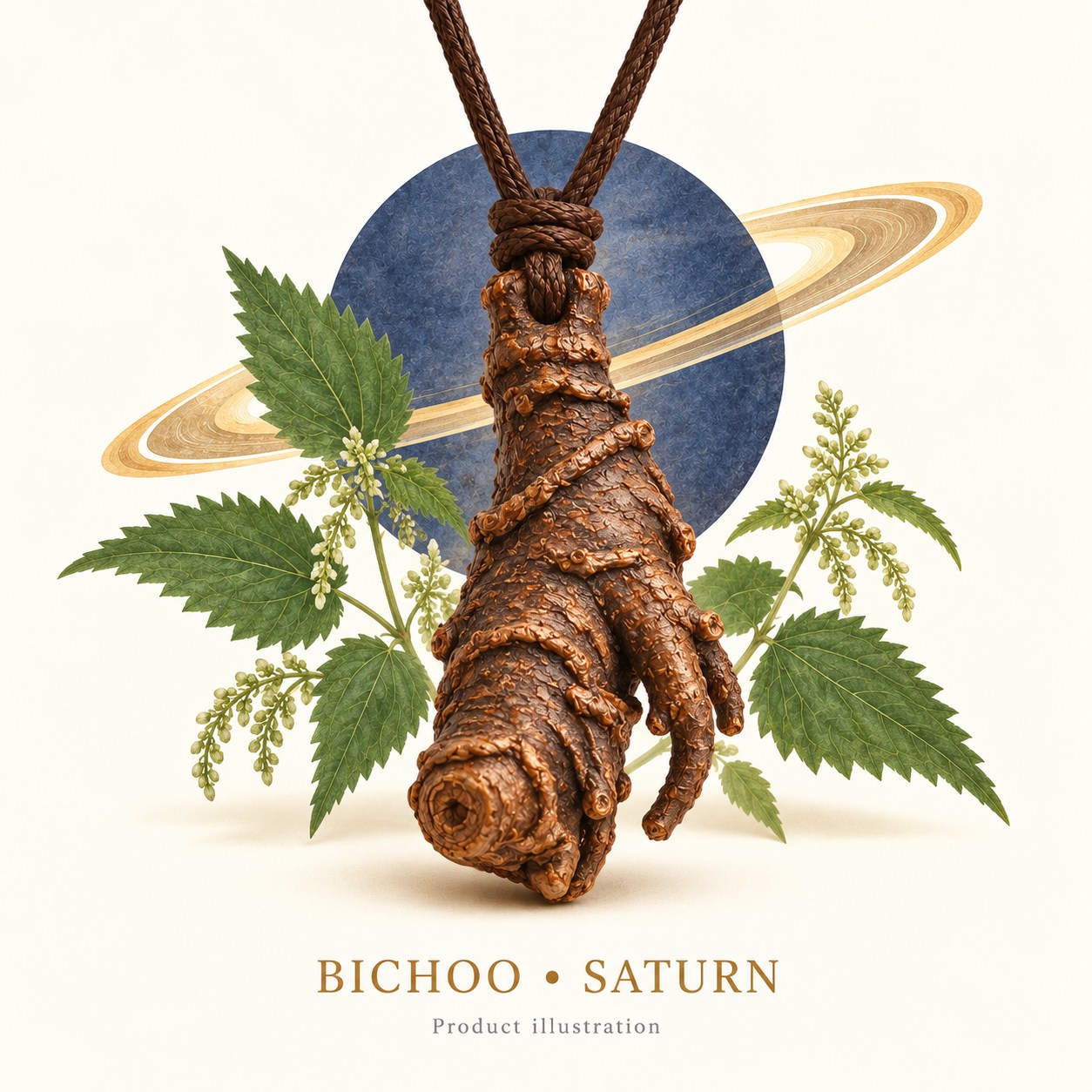
A Bichoo root pendant is a small piece of traditional herbal jewellery with several separate care needs: the identity and condition of the botanical piece, the material that secures it, the metal or textile that holds it around the neck, and the wearer's own comfort. When those elements are understood, routine care can be simple. When the plant and assembly are not documented, no visual inspection or devotional association can substitute for an actual material specification.
Bichoo, Bichhu Buti, Bichoo Buti and related trade spellings appear in different regional contexts around nettle-family plants. This article covers how to handle the finished pendant offered in a Shani or Saturn-related collection, how to identify questions worth asking before wearing it, and what to do when the piece is wet, damaged or uncomfortable. It does not assume that the supplied botanical material has already been identified to species level. A familiar trade name is not a batch-level botanical identification.
1. Start by identifying the complete pendant, not just its name
A small herbal ornament may contain far more than a cut section of plant. Some designs bind the botanical material with thread; others suspend it in a metal cap, use glue or resin around a drilled hole, or attach it to a chain. The component touching the neck may be a clasp or cord rather than the plant, and that difference matters for both comfort and maintenance. Two pendants described as “Bichoo root” can have entirely different care requirements if their constructions differ.
Before using a pendant regularly, request the botanical name, the part of the plant supplied, any preparation and finishing details, and a description of all components that can touch skin. If the seller cannot yet provide that information, treat the item as material verification pending rather than assuming that drying, sealing or polishing has made it suitable for direct skin contact. An honest product description is more useful than a categorical promise of comfort.
| Component | What to establish | Why it changes care |
|---|---|---|
| Botanical insert | Scientific name, root or other part, processing and batch | Plant identity and surface behaviour cannot be concluded from the trade word |
| Outer finish | Natural uncoated surface, wax, resin, varnish or other coating | Solvents, moisture and abrasion affect different finishes differently |
| Mounting | Metal cap, loop, drilled hole, woven cradle or adhesive | Determines where a crack or loosening can start |
| Cord or chain | Fibre type, colourant, metal alloy and length | Changes washing rules, skin-contact risk and fitting |
| Clasp or fastener | Metal, plating, connection design | Metal allergy and clasp reliability are independent of the plant |
| Packaging | Dry pouch, protective tray, contact card and supplier details | Supports storage, complaint review and material traceability |
A botanical identification note should ideally be linked to the same batch as the pendant material. A photograph of a green nettle-like plant beside a product is useful background but cannot, alone, prove the species of a cleaned and mounted fragment. Likewise, a photograph of the ornament can demonstrate its construction without conclusively verifying the original plant.
2. What does Bichoo or Bichhu Buti refer to?
The botanical family Urticaceae includes several nettle-like plants. Kew recognises Girardinia diversifolia (Link) Friis as an accepted species and describes stinging hairs on its aerial parts. Indian botanical references also apply regional Bichchhoo-related names to this species. Separately, the Indian Institute of Science's flora and Indian plant compilations record Urtica dioica L. under Bichchhu Buti or similar names. These are two distinct scientific names, not interchangeable names for one plant. Names used by traders can be less precise than the names used in a herbarium.
The distinction is especially relevant to an article about safe handling. The stinging structures reported on stems and leaves of some nettles explain why people are cautious about the living plant. They do not tell us whether a dried root fragment, a processed fibrous insert or a resin-covered component exposes any such structures. Nor does the absence of a visible leaf or a reported sting prove that a fragment is correctly identified. Ask which species and plant part the maker actually used.
| Name appearing in a discussion | What it tells you | What it does not establish |
|---|---|---|
| “Bichoo root” | A common or trade description of an herbal ornament | An accepted scientific species or authenticated plant part |
| “Bichhu Buti” | A regional nettle-related name used in more than one setting | That every vendor means the same plant |
| Girardinia diversifolia | An accepted nettle-family species identified by Kew | That the pendant contains this species without batch evidence |
| Urtica dioica | A different accepted species, often called stinging nettle | That it is equivalent to Girardinia in a product listing |
| “Stinging nettle” | A description often linked to irritant hairs on an intact plant | That the actual manufactured pendant necessarily stings |
| “Dried root” | A statement about plant part and post-harvest condition | That the item is free of coatings, residues or contact concerns |
The names Vrischika and local equivalents may be encountered in botanical or traditional discussion. Use those as linguistic and cultural context, not as independent proof of the identity of a particular product. If batch identification remains uncertain, the appropriate next step is documentation from the supplier rather than a home experiment.
3. Understand the difference between plant exposure and jewellery contact
There are at least three distinct contact situations. First, someone may touch a fresh or poorly prepared nettle plant. Second, someone may touch a separated botanical piece that has been cleaned, dried or processed. Third, someone may wear a finished object in which the botanical piece may be entirely enclosed, partly exposed, or attached to another material. Information about one situation must not be automatically transferred to another.
For the wearer, the relevant questions are what surface actually touches the skin, whether that surface changes with sweat or friction, and what else is present. Adhesives, dyes, coatings, plated caps, chains and clasps can all contribute to irritation. The American Academy of Dermatology discusses nickel and other jewellery materials as potential contact allergens. Even an authenticated, well-dried botanical insert would not settle the suitability of an unknown metal fitting.
| Contact situation | Principal question | Sensible response |
|---|---|---|
| Botanical part exposed at back | Has its surface and processing been evaluated for skin contact? | Obtain product-specific information before direct wear |
| Plant part inside a secure cap | Can any chips, dust, fibres or adhesive reach skin? | Inspect enclosure and joint; do not assume fully sealed without evidence |
| Plated chain against neck | What alloy or plating actually contacts skin? | Request a metal specification, especially with known sensitivities |
| Textile cord against neck | Does it hold sweat, fragrance or dye next to skin? | Keep it clean and dry in accordance with the identified fibre |
| Pendant over clothing | Are there sharp edges or loose parts? | Still verify construction; clothing is not proof of material safety |
| Broken ornament | Could fragments be released or swallowed? | Stop using, isolate loose pieces, and request a repair assessment |
If the recipient has a known history of skin reactions to plants, adhesives or jewellery, contact a qualified professional about suitable materials rather than testing a questionable object. Never rub an unverified insert deliberately against the skin to “check whether it stings.” A patch test in clinical care is not the same thing as a do-it-yourself exposure trial with unknown material.
4. A five-minute inspection before first use
An inspection should be gentle, visual and non-destructive. Place the item on a clean, light-coloured, dry tray under good diffuse light. Check the complete piece without scratching, pulling, burning or immersing it. Use a phone photograph to document any visible defect before speaking to the seller; a clear photo of the mounting and rear surface is usually more useful than an artistic product portrait.
First, look at the botanical insert. Is it seated firmly? Are there open fractures, flakes, loose fibrous ends, new discolouration or an unfamiliar residue? A natural material can have ordinary variation in its grain, but a new crack or shedding surface deserves investigation. Do not try to decide the plant species from colour alone.
Second, inspect the fittings. Look for a gap in the pendant loop, a partially opened jump ring, a cracked glue junction, a sharp cap edge, or plating that has worn away where the ornament meets the neck. Gently move the intended clasp to confirm that it operates. Do not pull the plant component to test adhesive strength.
Third, examine the cord or chain. Verify that the length fits without tightness, that any adjustable knot is secure and that the item can be removed easily. A devotional article should never require a neckpiece to be worn so tightly that movement, sleep or clothing catches become hazardous.
Fourth, look at the packaging and documentation. Confirm the seller's botanical description, cleaning instructions and repair route. Record purchase date and product code. If the product is intended as a gift, include the recipient's material sensitivities in the purchasing decision instead of assuming a botanical accessory is suitable for everyone.
| Quick inspection result | Decision | Next action |
|---|---|---|
| Item clean, stable and specification complete | Proceed according to the supplied wearing instructions | Keep the documentation for future reference |
| No plant identification or exposure details | Do not assume direct-skin suitability | Request batch, part and finish details |
| Loose attachment or open clasp | Not ready to wear | Ask for replacement or professional repair |
| Unknown powder, flakes or fibres | Avoid disturbing the material | Set aside and send photographs to supplier |
| Sharp edge or protruding wire | Do not wear | Request alteration or replacement |
| Damp smell or visible spotting | Suspend use | Isolate and seek assessment before cleaning |
| Previous contact reaction to similar materials | Do not self-test | Obtain suitable advice and verified alternatives |
5. Wearing choices: direct contact, over clothing and occasional use
Traditional herbal jewellery is often chosen for a personal Sankalpa, a devotional practice, or an individual Jyotish recommendation. The form of wearing should still follow the physical characteristics of the object. Direct skin contact is not a necessary test of devotional seriousness. Where the botanical part or finish is unverified, do not convert a traditional suggestion into a compulsory physical exposure.
A pendant that is meant to hang over a cotton garment may have different contact conditions from one that rests continuously against a sweaty neckline. However, wearing over clothing does not solve a loose mounting, unverified plant fragment or unsuitable finish; it is merely one way of changing where the material touches the body. A cloth pouch may be an alternative only when the specific product and ritual context allow it, and only if it is sewn securely without releasing fragments.
For daily routines, consider whether the wearer commutes, works near moving equipment, uses a lanyard, cycles, exercises or handles children. Any neck cord can catch. Remove it before activities where entanglement, forceful pulling or unexpected contact may occur. For a young child, loose herbal fragments and necklaces deserve particular care; this is not a toy or a teething accessory.
Traditional advice sometimes mentions Saturday as a Shani-associated day, a simple prayer, or a Shani mantra such as Om Sham Shanicharaya Namah. Such customs are devotional choices and may differ by family, lineage and practitioner. A start day, mantra count, bath or oil application should not be presented as a universal instruction for this exact plant-based pendant, particularly if the material specification is incomplete.
6. How sweat, humidity and Bengaluru weather change care
The main practical challenge with many botanical accessories is not ordinary dust; it is repeated moisture, heat, friction and uncertain finishes. Sweat may wet a textile cord, collect between a metal cap and plant fragment, or reach a glue joint. A hot commute or exercise session produces different conditions from quiet use indoors. After a rainy journey or humid storage, the whole assembly—not just the apparent root—needs to be checked.
Plant-based materials can swell, shrink, become brittle or attract surface growth when exposed to unsuitable moisture conditions. The Canadian Conservation Institute describes humidity-related distortion and mould risks for plant materials; museum guidance is not a direct specification for this particular pendant, but it supports a conservative approach: avoid prolonged dampness and rapid repeated wet-dry cycles. Never promise that a botanical item is waterproof simply because it was sold as jewellery.
| Everyday situation | Main risk | Better habit |
|---|---|---|
| Shower, bathing or swimming | Water enters the mount or soaks the cord | Remove the pendant beforehand |
| Heavy sweating or workouts | Moisture and friction near skin or clasp | Keep the pendant away from the activity; inspect before next wear |
| Monsoon travel | Damp pouch, condensation and slow drying | Use a clean, dry protective case and inspect on return |
| Kitchen steam | Heat and humidity near coatings and joints | Keep away from direct steam and splashes |
| Perfume or hair spray | Solvents and fragrance residue on plant, metal or cord | Apply personal products first, away from the pendant |
| Direct sun or parked vehicle | Heat changes adhesives, finishes and natural materials | Store in a shaded, moderate-temperature place |
| Puja water, oil, ghee or incense | Liquid deposits, heat and soot | Position away from flame and offerings; do not immerse |
| Sleeping with a neck cord | Pulling or entanglement and repeated friction | Remove and store safely before sleep |
The best after-wear routine is intentionally small: remove the necklace with clean, dry hands, inspect the joint and cord, and place it in its designated container. If the exterior is dry and clean, no elaborate cleansing ritual is needed for its physical maintenance. If it is damp, the right response depends on the materials and supplier's instructions; do not heat, bake or blow-dry a suspected botanical component.
7. Cleaning the pendant without damaging the plant
Default to the least intrusive method. Where the product has been verified as stable and the maker permits it, remove loose surface dust with a clean, dry, very soft brush or a lint-free cloth used without pressure. Support the cap or solid mounting while cleaning; do not tug at a botanical insert. The goal is to remove a small amount of ordinary dust, not to restore a stained or degraded material by force.
If the insert's identity, finish or integrity is not confirmed, avoid cleaning it directly. Do not use water, soap solution, vinegar, alcohol, detergent, hand sanitiser, bleach, essential oils, lemon, saltwater or ultrasonic cleaning. These techniques may damage organic materials, remove adhesives, contaminate surfaces or leave unknown residues. Salt or oil used in some devotional settings is not a universal physical cleaning solution for jewellery.
A removable chain that the maker explicitly identifies may have separate cleaning instructions, but do not clean an assembled pendant as if it were a loose metal chain. If the chain cannot be detached without stressing the insert, seek the seller's advice rather than immersing the whole object. When the cord itself is visibly dirty, replacement with a documented compatible cord may be safer and easier than trying to wash a mixed-material assembly.
| Method | Suitable for this pendant? | Reason |
|---|---|---|
| Gentle dry dusting of stable verified surfaces | Often the first option if permitted by maker | Minimal added moisture and chemical exposure |
| Dry soft brush on a loose, shedding insert | No | May release fragments or worsen the surface |
| Wet cloth on an unknown plant or glue joint | Avoid | Moisture may enter seams and change the finish |
| Soap soak or running tap water | Avoid | Mixed material and adhesives may deteriorate |
| Alcohol or sanitiser wipe | Avoid unless specifically approved for an isolated component | Solvents may affect coatings and colours |
| Essential oil or perfume application | Avoid | Can leave residue and change skin contact |
| Ultrasonic cleaner or steam | Not suitable as general advice | Mechanical energy, heat and liquid threaten the assembly |
| Polishing powder or abrasive pad | Avoid | Can scratch metal, expose plating or damage the plant |
| Flame, sun-baking or hair dryer | Avoid | Heat may alter plant, cord and adhesive components |
For an item affected by a spill, do not conceal the problem by applying fragrance or a clear varnish. Blotting an exterior surface may be appropriate only if the product's materials are identified and that handling is within the supplied care instructions. Otherwise stop wearing the pendant, keep it away from further water and request product-specific advice promptly.
8. The cord, chain, clasp and adhesive need their own checklist
Herbal jewellery may look lightweight, but its weakest point is often a small connecting element. A plant fragment can be completely sound while a metal loop works open or an elastic cord loses resilience. That is why routine inspection should focus on attachment points, not only on the visible botanical piece.
For a metal chain, ask whether the finish is plated and what metal touches skin. Stainless steel is a broad label, not a guarantee that every alloy is appropriate for every wearer. For a cotton or synthetic cord, ask whether it is dyed, pre-shrunk, waxed or coated. A waxed cord may collect dust; a loosely tied cotton cord may fray; an elastic string can wear suddenly. Maintain the item according to its actual materials, not a generic promise that “herbal products need no care.”
| Assembly type | Typical wear point | Inspect for | Preferred response |
|---|---|---|---|
| Metal cap | Edge and joint with botanical insert | Gap, corrosion, sharp lip, looseness | Professional repair or replacement |
| Split or jump ring | Opening under movement | Ring not fully closed | Do not wear until secured |
| Drilled botanical fragment | Hole edge | Cracks radiating from hole | Stop use; avoid further pulling |
| Adhesive setting | Boundary with plant or cap | White residue, gap or movement | Do not add household glue blindly |
| Woven thread cradle | Knot and friction point | Fraying, colour transfer or loosening | Replace with suitable verified cord |
| Metal chain | Clasp and plating | Discolouration, roughness or break | Replace with disclosed suitable material |
| Adjustable slip knot | Knot path and free ends | Slipping, excessive tightness | Readjust or replace before wearing |
A simple monthly check is more useful than a complicated cleansing routine. View the front, back, connection and cord in good light. If nothing has changed, store it properly and continue according to the maker's instructions. If something is loose, do not “test its strength” by pulling harder.
9. Skin comfort: what to do when a pendant causes a reaction
A rash or itching under jewellery does not have a single automatic explanation. It can be related to friction, sweat, fragrance, textiles, metal alloys, adhesives or a botanical surface. Some contact reactions appear after a delay rather than immediately. The American Academy of Dermatology documents contact dermatitis associated with metal jewellery and fragrances. An online photograph of redness cannot establish which component caused it.
Stop contact as soon as discomfort appears. Remove the necklace and do not wear it again to test the reaction. Follow ordinary appropriate skin care and seek medical advice if the symptoms are significant, persistent, worsening or recurrent. If there is severe swelling, breathing difficulty or another urgent symptom, obtain emergency assistance. Retain the pendant, packaging and material information for any professional review; do not scrape the botanical fragment onto the skin or attempt a home diagnosis.
Neither the seller nor a Jyotish consultant should describe a rash as an auspicious “purification” or proof that the remedy has started working. Spiritual intention and material compatibility are separate matters. If the family wishes to continue a Shani-related devotional observance without wearing this item, prayer, charitable practice or another non-contact option can be discussed within their tradition. There is no need to insist on the same physical jewellery when it causes discomfort.
| Observation | What it may indicate | Action |
|---|---|---|
| Itching or redness where a chain sits | Friction or reaction to metal or another contact material | Stop wearing and seek appropriate evaluation if needed |
| Irritation directly beneath the pendant | Contact with plant, finish, adhesive or trapped moisture | Remove, keep item for review, do not perform a new skin test |
| Delayed rash after repeated wear | Contact allergy can have delayed timing | Discuss with a qualified clinician, especially if recurrent |
| Visible scratch from a sharp cap | Mechanical problem | Stop using and arrange repair |
| New smell, residue or material shedding | Change in item condition | Isolate the pendant and contact supplier |
| Severe or widespread symptoms | Requires individual clinical assessment | Seek urgent medical attention as appropriate |
10. Storage: a dry, stable home for a small botanical object
A box protects against knocks, but it can also trap moisture if packed carelessly. Store the pendant only when it is in the condition approved by the maker for storage. Use a clean individual compartment, a protective liner and enough space that the metal cap does not press into the plant component. Keep the cord laid gently rather than tightly wound around the botanical piece.
Avoid bathroom cabinets, window ledges, damp drawers, hot car interiors, puja shelves immediately beside heat or oil, and direct sun. A shaded interior wardrobe or jewellery drawer in a stable room is generally preferable. Conservation guidance for plant-based materials emphasises avoiding extremes and fluctuations of relative humidity; very damp environments can favour mould, while excessive dryness may embrittle some botanical materials. There is no evidence-based humidity set point established for every commercial Bichoo pendant, so the safer rule is to avoid known extremes and follow the specific maker's specification.
A clean paper envelope or divided jewellery box may be suitable for a dry, stable piece. Plastic bags are not inherently forbidden, but sealing a damp botanical item in plastic is a poor choice. Similarly, a desiccant packet should not be presented as a universal remedy for an unidentified or damaged item: excessive drying may not be appropriate for every construction. Keep storage simple and inspect periodically.
| Storage concern | Avoid | Prefer |
|---|---|---|
| Crushing | Heavy metal jewellery on top | Separate padded compartment |
| Moisture | Wet cloth pouch or bathroom shelf | Clean dry compartment in stable room |
| Heat and light | Sunlit display, parked car, lamp heat | Shade and moderate temperatures |
| Tangles | Chain wrapped tightly around root | Chain arranged loosely beside insert |
| Loss of documentation | Discarding label and supplier record | Keep digital photo and purchase details |
| Children and pets | Open tray with loose fragments | Closed, inaccessible storage |
| Long-term display | Contact with oil lamps, incense or water offerings | Stable, sheltered display away from active ritual materials |
11. Travel, puja and seasonal use
When travelling from a dry Bengaluru apartment to a humid coastal location, humidity and condensation can change even when the pendant stays in a bag. Use a rigid or semi-rigid protective case that separates the plant from keys, coins and sharp metal ornaments. Keep the package out of direct rain, never store it loose in a gym bag, and inspect its condition after travel before putting it back on.
At a temple, during puja or while handling flowers, kumkum, oil or incense, do not assume every ritual substance is physically compatible with the pendant. Oil can stain a cord, water can enter a fitting, and flame or hot ash can damage natural materials. Devotional reverence does not require coating or soaking an accessory. If a family custom includes offering water or oil to a deity, the offering can be performed separately without applying it to the botanical jewellery.
If the pendant is kept for an annual Shani observance or other occasional use, label the box with the last inspection date. Before the next occasion, check for new odour, stains, fraying or loose joints. A long period in a closed drawer does not establish that a plant insert is still mechanically sound. Where the pendant is not worn, it can remain a symbolic keepsake, provided it is stored securely and its material is appropriate for the intended setting.
12. Repair, replacement and end-of-use decisions
A cracked botanical element, a loosened cap or a stained unknown finish is not a project for improvised repair. Cyanoacrylate glue, hot glue, nail varnish and resin can change the appearance, surface chemistry and skin-contact characteristics of the original assembly. The safest course is to ask the maker whether an approved repair is possible and whether the repaired object is still suitable for wearing. Replacing a cord with verified material is different from trying to seal an unknown plant fragment.
A pendant may reach the end of its service life even when its devotional meaning remains important to the owner. If the botanical component is breaking apart or the attachment cannot be made secure, it should not remain in daily wear. A symbolic object can be retired respectfully according to family custom without being buried in a public space, burned indoors or put into water bodies. Actual disposal of coatings, metal parts and botanical material should follow local guidance and the maker's information.
| Condition | Keep wearing? | Next step |
|---|---|---|
| Cord frayed but insert documented and intact | No until repaired | Replace cord with verified compatible material |
| Plant fragment cracked or shedding | No | Isolate and request assessment |
| Cap loose | No | Professional joint replacement or secure reassembly |
| Plating worn through at skin contact | No | Replace fitting with disclosed suitable metal |
| Mould-like growth or strong odour | No | Isolate, avoid dry-brushing, seek specialist advice |
| Product species never established | Do not assume direct-contact suitability | Request traceability; choose a documented alternative if unavailable |
| Item structurally sound and documented | Follow maker instructions | Continue ordinary gentle care and inspection |
13. Buying a Bichoo pendant: information worth getting in writing
A buyer can respect a traditional graha association while asking practical commercial questions. A product page that simply says “original Bichoo root” does not answer species, provenance, plant part, process or safety. Make the purchase conversation specific. Request a close-up of the actual article, including rear contact surface, loop, cord, and any visible exposed insert. Compare that image with the product being delivered.
For a Bengaluru customer purchasing for personal use, the key information is likely whether the botanical insert is exposed, what the chain contains, and how to care for the item during hot weather or commutes. For a gift recipient, fit, sensitivity history and the ability to exchange for a non-contact alternative may matter more. For a professional Jyotish consultation, written separation between symbolic recommendation, botanical identity and product construction prevents confusion in the final report.
| Buyer question | Useful seller answer | Unhelpful substitute |
|---|---|---|
| Which species was used? | Accepted name and traceable supplier record | “It is the original Saturn root” |
| What plant part is fitted? | Root, rhizome, stem or other part clearly specified | “Ancient herbal material” |
| How was it prepared? | Described drying, cutting, coating and handling | “Fully safe because it is natural” |
| What touches the skin? | Exposed surfaces, textile and metal composition | “Allergy-free for everyone” |
| Can it get wet? | Specific care and moisture limitations | “Waterproof because it is blessed” |
| Can the cord be changed? | Method and compatible replacement | “Never remove or change anything” |
| What if it cracks? | Repair, return or replacement policy | “Keep wearing; it is spiritually active” |
| What is the cultural basis? | Named tradition or practitioner explanation | “Scientifically guaranteed to remove Shani problems” |
An accurately described traditional accessory may still be appealing without a promise that it removes illness, changes destiny or prevents every difficulty. Material clarity, good craft and respectful service are stronger foundations for a lasting purchase.
14. Shani, Sankalpa and the pendant's place in tradition
In Jyotish, Shani is associated with discipline, responsibility, endurance, time, limitation, patience and the consequences of actions. A family may relate to these themes through Shani puja, Saturday observances, mantra, service or charity. Some modern herbal-jewellery collections additionally pair certain plant materials with planetary names. The availability of a commercial pendant does not establish an ancient universal prescription of the exact species, plant part, construction and wearing method.
Before suggesting Bichoo for a particular person, clarify whether the conversation concerns a family devotional custom, a general planetary collection or an individual horoscope interpretation. In a chart-based discussion, factors such as Lagna, bhava, rashi, graha drishti, conjunctions, dignity, nakshatra, Vimshottari Mahadasha and Antardasha may be considered by the practitioner. None of these chart calculations identifies an unlabeled botanical fragment. They are separate evidence domains.
Likewise, a claimed association with Sade Sati, Dhaiya or a Shani dasha is a traditional interpretation, not a reason to ignore physical discomfort or a damaged item. If a customer wants a non-wearable observance, options could include mantra, reflection on obligations, practical service, or other customs accepted within their lineage. An astrologer or advisor should explain why a particular recommendation was made rather than supplying a compulsory shopping list.
For OmmRudraksha's consultation workflow, an appropriate report can show the stated Jyotish rationale separately from the item's material specification, whether that botanical identity was independently confirmed, the physical wearing conditions, and the care advice. The reader then knows which part is traditional interpretation and which part is a verifiable product fact.
15. Workshop and showroom handling protocol
A showroom benefits from a short handling protocol because customers understandably wish to examine a pendant closely. Do not put an unverified plant piece directly on the skin of successive visitors as a demonstration. Display it on a clean stand, keep sample and sale stock separate, and provide close photographs for inspection. Any handling after a surface problem is reported should be controlled rather than passing the same piece around.
For stock control, assign a batch reference that can be associated with the claimed species, plant part, processor, finish and received date. A small card can record the permitted cleaning method and whether the insert is exposed. Supplier changes must be tracked; a new lot should not inherit material claims from an earlier, documented lot automatically. This is particularly important for regional names such as Bichoo that may cover more than one nettle-family species.
| Retail checkpoint | When | Record or decision |
|---|---|---|
| Botanical identification | Before receiving or listing | Accepted scientific name, supplier evidence and plant part |
| Finish and fittings | Before sale | Coating, adhesive, cord and skin-contact metal |
| Incoming condition | At receipt | Photo of front, back, loop and any defects |
| Display | Each showroom day | Stable stand, no heat or ritual liquids nearby |
| Customer demonstration | Before handling | Use clean tray; avoid unverified direct-skin trials |
| Packaging | At sale | Separate dry protective storage and written care |
| Follow-up | When damage or reaction reported | Suspend use, collect batch details, refer as appropriate |
| Product description | Each new lot | Update only with supported facts, not inherited claims |
Good customer service includes the option of declining a particular material. A person may prefer a different, well-documented accessory, a conventional Shani devotional item, or no jewellery at all. This does not diminish the traditional significance of their Sankalpa.
16. Common mistakes to avoid
The most frequent error is treating “natural” as a complete safety certificate. Natural plants vary; finishes and fittings vary; people's sensitivities vary. A second error is conflating the sting of a standing nettle plant with the properties of a processed fragment. Both absolute reassurance and automatic alarm can be misleading without inspection of the actual item.
A third error is cleaning the entire ornament using methods appropriate for bare metal. Water, alcohol and polishing compounds may damage the botanical insert or a glue joint. A fourth is treating a loose cap as an ordinary cosmetic flaw when it could release a fragment. Finally, a religious rule should not be applied as a reason to keep a damaged or uncomfortable necklace around the neck.
A sensible routine is uncomplicated: identify, inspect, wear appropriately, keep dry, dust gently when permitted, store separately, and stop use when anything changes. These actions preserve the object and make devotional use more comfortable without forcing unverified claims about the physical material.
17. Frequently asked questions
1. Does a Bichoo root pendant sting the skin?
Not enough is known from the trade name alone to answer for a particular product. Certain nettle plants have stinging hairs on their aerial parts, but the finished pendant may use a different part, processing method or enclosure. Request species, plant part, processing and surface-contact details instead of deliberately rubbing it against the skin.
2. Is Bichoo the same plant as Urtica dioica?
Not necessarily. Regional uses of Bichoo or Bichhu Buti include more than one nettle-family plant. Botanical references document Urtica dioica and Girardinia diversifolia as distinct species. The product seller needs to identify which one, if either, is in the actual supplied batch.
3. Does Girardinia diversifolia have stinging hairs?
Kew's morphological descriptions document stinging hairs on stems, leaves, petioles and other aerial parts of Girardinia diversifolia. That is information about the plant's biology, not a test report for a specific dried and mounted pendant insert.
4. Can I wear a Bichoo pendant directly against my neck?
Only when the botanical material, exposed finish and other skin-contact components have been adequately identified and the supplied item is appropriate for that use. If the specification is missing or you have known sensitivities, do not use your neck as a test site. Request a documented alternative.
5. Can I wear it over a shirt?
Over-clothing wear can reduce direct contact in some designs, but it cannot make a loose, shedding or unidentified component suitable by itself. Check construction, the cord and the chosen tradition's custom. Never allow a long necklace to catch on tools, machinery or moving equipment.
6. What should I do if I feel itching or burning?
Remove the necklace and stop contact. Do not keep wearing it to test a devotional explanation. Seek appropriate medical advice if symptoms are persistent, significant or worsening. Keep the item and its product information available for assessment; do not conduct a new home exposure test.
7. Does drying remove every possible contact concern?
No. Drying changes a plant's moisture content but does not, by itself, document species, exposed residues, finishes or skin compatibility. A chain, cord, glue or coating may also be the relevant cause of discomfort. Ask for details about the assembled item.
8. Should I wash the pendant with water before first wearing?
Do not assume that water is appropriate. Botanical inserts, dyed cords and adhesives can respond poorly to moisture. Obtain the maker's instructions and inspect the item dry. Ritual bathing or rinsing practices should be adapted so they do not damage the physical pendant.
9. Can I clean it with alcohol or sanitiser?
Not as a general method. Alcohol can affect coatings, adhesives and finishes, and it does not resolve a material-identification problem. If a metal chain is independently removable and documented, its approved cleaning method may differ from that of the whole pendant.
10. Can I apply sandalwood oil, attar or perfume?
Avoid applying fragrances or oils to an unverified botanical component. They can leave residue, alter finishes or contribute to skin irritation. A devotional fragrance may be used separately in the person's customary practice without coating the jewellery itself.
11. Is Saturday compulsory for first wearing?
Saturday is traditionally linked with Shani in many devotional contexts, but a universal start-day rule for this exact commercial Bichoo pendant has not been established here. Follow a clearly identified family or practitioner custom where appropriate, without overriding the item's physical care requirements.
12. Can I keep the pendant on while sleeping?
Removing a neck cord before sleeping avoids unnecessary pulling and entanglement. Store the item safely in its own compartment. A spiritual interpretation does not require accepting avoidable mechanical risk from a necklace.
13. How should I store it during the monsoon?
Keep it in a clean, stable and dry indoor location, separated from heavy jewellery. Avoid damp pouches, bathroom cabinets, hot windows and repeatedly fluctuating conditions. If it becomes wet or develops a new odour, stop wearing it and ask for suitable handling advice.
14. What if the herbal piece becomes cracked?
Stop wearing it and preserve the broken parts without grinding, trimming or gluing them. Request an assessment or replacement from the supplier. A crack can lead to detachment, and improvised adhesives may alter the skin-contact properties of the finished item.
15. Can the cord or chain be replaced?
Often the replaceable part is the cord or chain, but the safe method depends on the mounting. Use a properly identified suitable material and do not pull directly on the botanical insert. Ask the maker to carry out changes if the assembly is delicate.
16. Is the pendant suitable for a child?
Loose fragments, small fittings and necklaces can pose swallowing or entanglement hazards. Do not treat this as a toy, teething item or universal children's accessory. A family seeking a child-safe devotional practice can choose an alternative that does not depend on wearing a small botanical object.
17. Can a Bichoo pendant be worn together with Rudraksha?
Traditional combinations depend on the person's observance and the practitioner's interpretation. Physically, multiple necklaces can rub and tangle, especially when one component is brittle or enclosed in a weak cap. Keep each item's materials and care requirements distinct.
18. Is it an alternative to blue sapphire for Shani?
A botanical pendant and a blue sapphire are different categories of material and traditional recommendation. Their roles should not be equated automatically. A Jyotish consultation may consider individual chart factors, but that does not establish the species or safety of a Bichoo pendant.
19. How can I verify that the plant is genuine?
Ask for a traceable supplier record showing accepted species name, plant part, processing method and batch association. A photograph of a live plant or a generic certificate cannot authenticate an untraceable processed fragment. If records are unavailable, avoid claiming a confirmed species.
20. When should I stop wearing the pendant permanently?
Stop wearing it if the material is shedding, the mounting cannot be secured, a contact problem recurs, or the maker cannot establish necessary material information. The pendant may remain a keepsake if appropriate, or be retired respectfully. Shani devotion or Sankalpa can continue without that specific item.
Research and interpretation notes
This guide draws on accepted botanical nomenclature from the Royal Botanic Gardens, Kew; Indian flora and medicinal-plant references, including the Botanical Survey of India and Indian Institute of Science; the American Academy of Dermatology's contact-dermatitis guidance; and conservation guidance for plant-based objects from the Canadian Conservation Institute. Botanical reference records describe species and plant structures; they do not authenticate or certify a particular shop specimen. For direct-contact or repair decisions, use the actual product specification and, when needed, qualified professional advice.
Traditional descriptions of Shani, Sankalpa and Graha Shanti are presented as elements of Jyotish and devotional practice. A physical instruction about an assembled accessory depends on its real materials, not on the strength of the symbolic association. That separation makes both the tradition and the customer-care guidance more useful.
The identification guide explains why species evidence is necessary. The Shani article discusses the separate symbolic association. Clear boundaries between those subjects make care instructions more useful and make sure the actual product is described as verified only after its materials have been confirmed.
A practical next step
Before returning an accessory to daily wear after storage, look at the same points you checked when choosing it: fastening, attachment, surface condition and comfort. If something has changed, ask about care or repair before wearing it again. A devotional interpretation should never be used to dismiss discomfort or visible deterioration.
Explore the Bichoo Root Pendant for Saturn, return to Planetary Herbal Jewellery, or visit the established For Planets collection. Botanical references explain plant names and background. Ask our team about the particular item, its fitting and care.Further reading
