
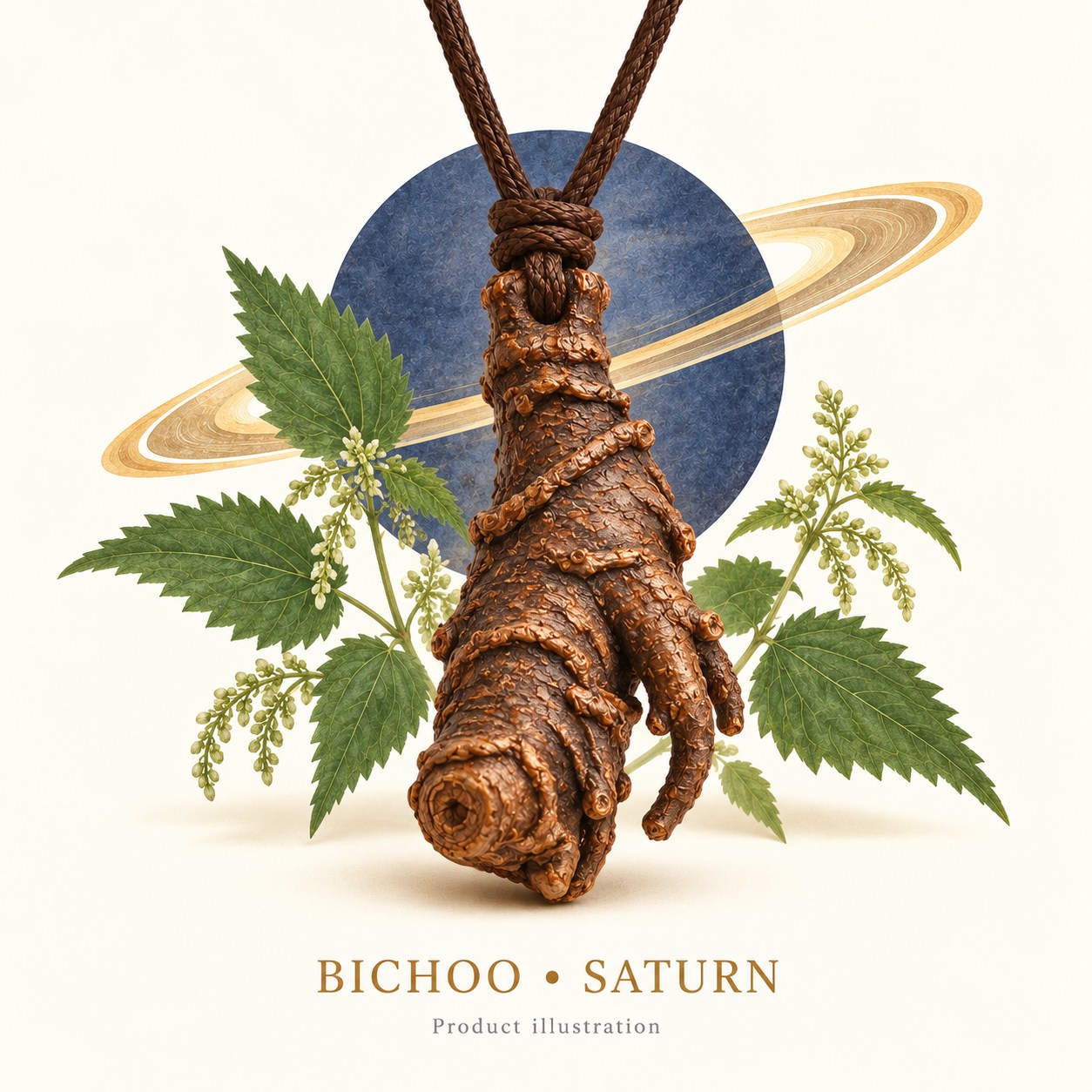
What is Bichoo Buti? Bichoo Buti, also written Bichhu Buti, Bichhu Booti, Bicchu Buti or Bichoo Booti, is a vernacular name encountered in India for plants associated with stinging nettles. The phrase is useful in a market or family conversation, but it is not, by itself, a unique scientific identification. Different regional botanical sources connect similar names to different species in the nettle family, Urticaceae. That matters particularly when a seller offers a dried plant part inside a Shani-associated herbal pendant and a customer wants to know exactly what has been supplied.
This guide brings the botanical question to the centre. It explains how botanical names are recorded; what Urtica dioica, Girardinia diversifolia and nearby nettle names do and do not establish; why leaf photographs cannot authenticate a cut root; how to evaluate supplier and batch documentation; and how to examine the finished accessory without confusing spiritual tradition with a laboratory determination. The companion guide to Bichoo root and Shani deals more fully with the Jyotish association, while the pendant handling and everyday care guide treats routine use. The Botanical Survey of India's medicinal-plant database records Urtica dioica L. under the vernacular name Bichhu booti. The Royal Botanic Gardens, Kew's Medicinal Plant Names Services records the non-scientific name “bichhu buti” against more than one accepted taxon in its underlying source material, including Urtica dioica and a taxon within Girardinia diversifolia. Kew's Plants of the World Online separately recognises Girardinia diversifolia (Link) Friis as an accepted species. These references reveal a naming overlap. They do not establish which species any particular pendant contains. If a supplier says simply “Bichoo root,” the next reasonable questions are: which scientific name is associated with this lot; who made that identification; was it based on the complete living plant or a voucher; which part was collected; how was the part dried and finished; and how was the identified material kept traceable through assembly? A trading label is the start of a conversation, not the end of identification. Indian plant vocabulary moves between spoken languages, local dialects, older botanical writing, Hindi transliteration and English product catalogues. The same sound may appear as “Bichoo,” “Bichhu,” “Bichchhu,” “Bichua,” or “Bichu,” while a regional source may use a different word altogether. Transliteration is not governed by one universally followed retail spelling. When a shop translates a local label into English, two sellers can use identical words for plants collected in different landscapes. Popular names often describe an encounter with a plant rather than its place in classification. In the nettle group, the memorable sting of aerial plant parts is an obvious basis for a familiar name. Yet stinging is a feature shared by more than one botanical taxon. A physical characteristic that gave rise to a vernacular name does not turn that name into a botanical diagnostic key. Local names can also be broad and context-dependent. A collector, a fibre worker, a herbal-trade intermediary and a jewellery seller may all use the same shorthand while thinking about different parts or applications. The botanical answer must therefore include a plant identification, not merely a translation of the name. A name spoken accurately by a local vendor may still be too broad for an item-specific certificate. A particularly revealing example is the difference between “common name evidence” and “specimen evidence.” A published database may state that a name is used for a species; this proves that the association is documented in that source. It cannot prove that another supplier's unnamed fragment belongs to that species. Conversely, a properly identified botanical specimen can support a species determination even if its local name is spelled differently from the name on a store label. For catalogue purposes, a careful short line is: “Bichoo Buti is a regional name used for nettle-family plants. Scientific identification of the supplied plant material should be confirmed from the source batch.” A more specific species claim should be used only when its supporting evidence has been checked. Urtica dioica belongs to Urticaceae and is widely known in English as stinging nettle. Botanical treatments describe a herb with opposite-looking leaf pairs in some photographs, sharply serrated leaves, stinging hairs on aerial portions and greenish, relatively inconspicuous flowers. The species has an extensive recorded range and has been treated with varying subspecies concepts. In Indian sources its regional distribution and vernacular words should be read in the context of the specific flora used. The Botanical Survey of India medicinal-plant listing explicitly pairs Urtica dioica with Bichhu booti. The naming association is substantial evidence for how the name is used, but it is not an authentication service for commercially assembled jewellery. Even when a supplier correctly identifies U. dioica in the field, the record must be tied to the harvested part and the production lot to justify an item-specific description. Girardinia diversifolia is a different accepted species in the same family. Kew describes a plant that may be an annual or short-lived perennial, with stinging hairs on aerial structures. Botanical descriptions of leaves, stems, flowering structures and species variation are more informative than an isolated trade name. Indian botanical listings also record regional names for this species or names historically applied to its material. Older literature may employ Girardinia heterophylla in relation to material now placed within the G. diversifolia complex. A historical synonym needs careful reading because a name used in a source and the currently accepted taxon may not be identical in form or rank. It is worth recording both the original source name and the taxonomic interpretation used to reconcile it. “It is a nettle” is too broad; “it is Girardinia” is still a genus statement; an accepted binomial backed by evidence is stronger. Botanical Survey of India listings include Urtica parviflora with a different regional name, Paharah-bichuti. Its appearance in a nearby entry illustrates why a surname-like similarity among vernacular names must not merge separate species. A locality may contain several stinging or nettle-like plants. Identification requires observed diagnostic characters and a local botanical reference, not a guess from the word “bichuti.” A scientific name is usually written as a two-part Latinised binomial, with the genus capitalised and the species epithet lowercase and both italicised: Urtica dioica or Girardinia diversifolia. The letters after the species, such as L. or (Link) Friis, identify the botanical author citation. They help establish which published name is meant. They are not an indication of grade, ritual status, or commercial authenticity. Taxonomy changes as botanical evidence improves. One reference may retain an older synonym while another uses a newer accepted name. When researching an ingredient, first establish what a cited name referred to, then check its currently accepted interpretation, and finally compare that against a specimen or source record. A mere match in a search-result headline cannot complete these steps. An identification note should preferably include the author citation, family, the accepted name used, any historical name appearing in the supplier's paperwork, and the source or person responsible for the determination. If a qualified botanist identified a collected specimen, a voucher or dated diagnostic record offers stronger traceability than a certificate that prints only a Latin binomial with no method or batch. A botanical worker may consider the plant's habit, where it grows, branching, leaf arrangement, leaf shape, toothed margins, stinging hairs, flowers, fruit, and microscopic features as appropriate to a flora key. No single feature should be treated as a universal shortcut. Environmental conditions and the age of the plant can change appearance, and a photographed leaf may not show all needed structures. The family Urticaceae includes a wide range of plants. Some stinging species share the memorable tactile defence of specialised hairs. In Urtica and Girardinia, describing the aerial sting is botanically relevant, but it is not a reliable diagnosis of which species supplied a commercial dried root. Root tissue usually lacks the leaf or flowering characters that botanical keys rely upon. Once a piece has been trimmed, polished, coloured, coated or enclosed, the visible evidence becomes narrower still. A photograph of an entire plant at the collection site can support documentation if it is linked credibly to the lot. It cannot prove by itself that the specific fragment in a particular pendant came from that plant. The same distinction holds for herbarium images, botanical books and online photographs. They are invaluable comparison references but are not direct evidence of a retailer's stock. For an item assembled from dried botanical matter, a supplier may need a chain of records rather than a simple visual test. If uncertainty persists, the honest description is that the lot carries a traditional Bichoo name while the species remains unconfirmed. An unverified species should never be presented as verified merely because the name is familiar. Useful photographs include the complete plant before harvesting; representative leaves and stems with scale; flowers or fruits when present; the collected plant part before cutting; and the resulting finished pendant. Dates, locations at a non-sensitive general scale, batch labels and image continuity make these photographs much more useful. A decorative catalogue image, by contrast, is primarily evidence of design and appearance. Do not handle an unknown stinging plant bare-handed, bite or taste a root, deliberately expose the skin to hairs, burn an unknown plant material, or put acids or other household reagents on jewellery to “test” authenticity. These methods do not produce trustworthy species identification and may damage the item or cause irritation. Refer the matter to a botanical specialist or ask the supplier for proper evidence. The retail word “root” is sometimes used loosely for a subterranean or woody-looking plant fragment. In botany a true root, a rhizome, a basal stem, bark and a processed fibre have different structures and biological functions. They also present different identification challenges. A product should not automatically be called a “root” merely because it looks brown, fibrous and natural. A true root typically participates in anchorage and uptake. A rhizome is a modified stem, often bearing nodes, buds or scale-leaf remnants; a stem segment may show nodes and internodes. These broad features can help frame questions, but dried and polished fragments may not retain enough diagnostic structure for confident determination. Some botanical material is wrapped, encapsulated or mounted so the surface cannot even be examined without dismantling the item. When a supplier says “the plant was identified,” clarify whether the identification concerned leaves and flowering stems of the same harvested organism or an unidentified bag of dried roots. The two situations are not evidentially equivalent. A batch of labelled root pieces is more persuasive when its collection records can be connected to a botanically identified parent plant. A transparent product description can identify the pendant as “Bichoo-named botanical material in a protective fitting” if the precise plant part is not established. Where the supplier has stronger records, the description can be correspondingly precise. Claims should follow documentation, not lead it. Botanical references describe Urtica dioica in temperate settings and in portions of the Indian Himalayan region. Girardinia diversifolia has a much broader tropical and subtropical Old World distribution in botanical records, including regions of India. These are broad range statements, not proof that any particular commercial lot originated in a stated valley or state. Locality matters because different nettle-family plants may occur in the same trading region. Elevation, climate, habitat, season and condition of a collected plant can support an identification, but they rarely prove it alone. A seller's assertion that material is “Himalayan,” “forest-collected” or “wild” should be treated as a sourcing claim that can be documented, not as a shortcut to a scientific name. An item may be collected in one place, dried in another, traded through a third and assembled elsewhere. Traceability includes legality and environmental responsibility. Where collecting wild plants requires permission, suppliers should follow applicable rules. The buyer can reasonably ask about cultivation or responsible collection without demanding precise coordinates of a sensitive wild population. A broad, substantiated sourcing statement is preferable to an invented village or an unsupported claim of rarity. Material condition also depends on processing after collection. Poorly dried roots or damp storage can affect odour, integrity and surface cleanliness. An herbarium determination may establish a plant species, but it does not show whether subsequent handling made a specific finished accessory suitable for ordinary wear. Botanical identity and product quality are connected questions, not the same question. The strongest description links the name printed in the catalogue to a real collected plant, a recorded determination, a labelled lot and a finished accessory. Each link adds confidence; a break in that chain limits the strength of the final claim. Documentation need not be elaborate in every small craft workshop, but the seller should be able to explain what is known, what has been verified, and where uncertainty remains. Even the most complete chain should describe the actual verification performed. “Certified” is not a substitute for disclosing the certifier, sample, method and scope. A report for one reference specimen cannot be assumed to cover unrelated stock; laboratory identification of the botanical species does not automatically test coatings, metal fittings or skin-contact suitability. Depending on the item, specialist methods may offer additional evidence. Botanical microscopy can compare diagnostic tissue structures, although grinding, heating, heavy finishing and the particular tissue sampled can limit interpretation. Anatomical observations have to be compared with a suitable reference, and a microscopy result should not be described as a universal species test. DNA-based identification may help when sufficiently informative genetic material survives processing and suitable authenticated reference sequences exist. However, DNA extraction can fail on old, treated or highly processed pieces; closely related plants may require careful marker selection; contamination or mixed material may complicate results. A report should state what sample was tested, the markers and reference database used, and the level of resolution actually achieved. Chemical fingerprinting can sometimes characterise a botanical material, but a similar chemical profile does not necessarily resolve the species. Processing, season, plant part and environmental conditions may affect chemical measurements. A claimed laboratory result must be read as a result for the tested sample and method, not as proof of every attribute of the finished pendant. Such investigations are useful when the commercial, conservation or documentation question warrants them. They are not routine requirements for every devotional accessory, and they do not replace honest labelling. An inexpensive item with unknown provenance should not gain an authoritative scientific description simply because a testing method exists in principle. A herbal pendant is a complete object: botanical fragment, housing or mount, cord or chain, adhesive or sealant where used, and any connecting rings. The end user's experience depends on all of these elements. A good description does not stop at “natural root.” It specifies whether the material is enclosed, whether any part is exposed, the nature of its fitting, approximate size, visible surface condition and any known finishes. Inspection begins with the actual jewellery, not a stock picture of a growing nettle. Look for insecure joints, protruding fibres, sharp metal edges, flaking coatings, loose fragments and signs of moisture or mould. A pendant that contains a fragile plant piece may need a secure capsule or robust retaining method. Where the material is unsealed, the seller should explain exposure and cleaning limits. As with other botanical jewellery, wearability cannot be inferred from the plant's religious significance or natural origin. A dried piece may still shed particles or carry residues from collection and processing. The fact that a plant's aerial parts can sting does not establish whether a particular cleaned and enclosed root will sting; the reverse assumption, that drying makes any unidentified fragment harmless, is equally unsupported. Assess the actual material and contact conditions. Clear images should show the entire pendant, the botanical component where visible, the back and edges of the fitting, the connection to the cord, and the approximate scale. If two products differ only in cord colour or length, those details can often be presented as variants without creating separate near-identical botanical claims. The written description should match the photographed item rather than using a visually idealised reference as if it were a specimen record. Some Indian herbal-jewellery assortments position Bichoo material among items associated with Shani or Saturn. In Jyotish, Shani is considered through the natal chart, graha placement, sign and house, aspects, dasha and antardasha, and transits such as Sade Sati or Shani Dhaiya. Shanivara, Saturday worship, mantra, dana, service and personal sankalpa may form part of a family's customary observance. These are part of an interpretive tradition, not a botanical key. The name Shani does not tell a botanist whether an offered plant is Urtica or Girardinia. Equally, identifying the material as Urtica dioica does not prove that a person should wear it on the basis of a horoscope. Traditional significance can be explained respectfully while maintaining an independent material-description standard. In some traditions an herbal pendant may be discussed as an alternative to or alongside gemstones, Rudraksha or other devotional objects. Such a comparison concerns cultural use, budget, comfort, material preference and the guidance a practitioner follows; it should not imply identical botanical contents or interchangeable Jyotish rules. A Shani-associated item should not automatically be marketed as a substitute for Neelam, the blue sapphire associated with Saturn in many gemstone traditions. Customers interested in the full planetary context can read the Shani and Bichoo tradition guide. For a general browse through associated products, the established Rudraksha for planets collection provides a separate product route. Both subjects can be connected through editorial links without claiming that one object has a measurable effect on fate, disease or finances. Four common selling words can describe four very different things. “Genuine” may be used as a general claim that a product is not a substitute. “Natural” may mean plant-derived rather than synthetic, but it does not establish species or absence of processing. “Wild-collected” concerns a collection method and legal sourcing, not whether the species determination is correct. “Certified” implies an attestation whose issuing body, sample and scope need to be stated. A buyer should distinguish an actual material certificate from a seller-generated description card, a traditional blessing note, an origin assertion and a laboratory test report. None is inherently useless; each answers a different question. A package insert that calls a pendant “Bichoo root for Saturn” may describe a product tradition without certifying its botanical identity. A botanist's determination may identify a plant but say nothing about the finished clasp or coating. When documents mention an obsolete synonym, the appropriate response is to reconcile names rather than immediately label the whole consignment false. The source may be valid under an older classification, or it may be too imprecise. Check dates, specimen identity and taxonomic source. Likewise, a photograph that looks unlike a stock picture is not proof of misidentification; plants vary naturally. A consistent, reviewable chain of evidence is better than one dramatic authenticity claim. Choose a wearing method appropriate to the actual pendant. If the plant matter is sealed within a well-made enclosure, handling differs from that of a bare fragment threaded onto a cord. Keep the item away from prolonged immersion, abrasive scrubbing, perfume sprays, detergents and unverified cleaning mixtures unless the material supplier provides compatible instructions. Liquids can affect fibres, adhesives, metals and coatings differently. For ordinary dust on a dry, stable fitting, a soft dry cloth applied to the external mount may be sufficient. Avoid aggressive rubbing over an exposed plant surface. If the pendant becomes damp, keep it out of a closed damp container and consult the maker's care instructions. If there is a musty odour, visible biological growth, unusual surface shedding or damage, stop wearing it until the condition is assessed. Do not apply heat or household chemicals to an unidentified fragment. People with sensitive skin should pay particular attention to components that touch the body: metal alloy, plating, cord, dye, adhesive and any exposed botanical material. A history of irritation can also make a fully sealed design preferable. Avoid wearing a damaged or shedding piece against the skin. If contact causes a reaction, remove the item and seek appropriate medical advice when needed. A product's spiritual category does not alter ordinary contact-safety considerations. Store the pendant separately in a clean, dry pouch or compartment so harder objects do not crush its housing. Avoid areas of high humidity or direct heat. Check cord knots, rings and clasps periodically. The full wearing and care guide discusses these construction and contact details in greater depth. Planetary herbal jewellery may include pendants marketed with different plant materials and graha associations, such as roots linked with Rahu, Ketu or Shukra in particular retail traditions. These names identify cultural product groupings, not a common botanical method of authentication. Different materials may be true roots, rhizomes, woody fragments or prepared botanical parts. Their cleaning needs, stability and biological origins can be very different. For example, a Vacha or calamus-associated accessory should not be assumed to contain the same type of organ as a Bichoo-named pendant simply because both appear under “herbal roots.” A Bargad or banyan aerial-root article brings another botanical context entirely. A Navagraha necklet can combine multiple items, multiplying the need for accurate source notes and secure fittings. Good catalogue structure links these articles while preserving each material's own identification issues. Likewise, a gemstone offered in a planetary context is a mineral object, assessed with mineralogical standards for identity, treatment and condition. A botanical pendant is an organic assembly assessed through taxonomy, plant-part provenance, treatment and construction. Neither category is clarified by imposing the other's authenticity tests. Customers can make choices based on an informed understanding of the actual materials and their chosen tradition. Start with the level of identification stated in the listing. If the listing says only “Bichoo Buti,” do not silently read that as a verified Latin binomial. Look for a supplier who can explain whether the name is a traditional label or a scientifically documented claim. Ask what the item contains, which parts touch the skin, whether the fragment is protected, and how it should be stored. When giving the pendant as a gift, include its care note and any known material details. A recipient may not follow the same devotional practice or may prefer a different fastening. A thoughtful description of the plant name's ambiguity is more useful than an unqualified assertion that every product with the word “Bichoo” is the same herb. Plant-name resources answer different questions. The Botanical Survey of India catalogue is useful for documented species and vernacular-name associations. Kew's Plants of the World Online is useful for accepted taxa, synonymy and botanical descriptions. Kew's Medicinal Plant Names Services additionally shows why non-scientific names can point toward multiple botanical taxa in particular medicinal nomenclature sources. None of these public references identifies a privately offered pendant without a connection to the collected and assembled material. The name associations described here are botanical-reference information. They are not presented as certification of an OmmRudraksha product lot. The sources are intentionally limited to two existing, authoritative outbound references; botanical nomenclature and selling claims remain separate. Bichoo Buti is a useful traditional name, but it is not precise enough to establish the contents of an individual pendant. Indian botanical sources associate the term with stinging-nettle material, while taxonomic and medicinal-name references make clear that multiple nettle-family identities must be considered. A credible description starts with the actual plant, the accepted scientific identification where supported, the harvested part and the batch record. The finished pendant must then be assessed as jewellery, including fittings, processing, condition and care. The Shani association can stand on its own as a meaningful traditional context. It neither removes the need for botanical documentation nor requires an unsupported scientific claim. Customers who know what is documented can choose an accessory in accordance with their interests and custom without mistaking a trade name for a laboratory result. Explore the Bichoo Root Pendant for Saturn, return to Planetary Herbal Jewellery, and compare the practical care guide. When discussing a specific item with our team, please ask for the plant identity evidence available for that item or source lot.Quick answer: one common name, more than one possible botanical identity
Term on a label or in a source What it can tell you What it cannot confirm alone Bichoo / Bichhu Buti A regional or commercial common-name group associated with nettle-like plants A single species, plant part, origin, purity or individual pendant Urtica dioica L. A scientific species name; listed as Bichhu booti in the BSI database That every Bichoo product is U. dioica Girardinia diversifolia (Link) Friis A separately accepted nettle-family species recorded in botanical references That every trade use of Bichoo refers to Girardinia “Root pendant” The product category or material description supplied by a seller Root versus rhizome, exact species, plant-part treatment or safe contact “For Shani / Saturn” A devotional or Jyotish association in an assortment Botanical taxonomy, authenticity or a guaranteed outcome Why Bichoo, Bichhu, Bichua and Bichchhu are not precise taxonomic names
The main botanical candidates in Indian references
Urtica dioica L. — stinging nettle
Girardinia diversifolia (Link) Friis — another nettle-family candidate
Other nettle names in nearby discussions
Candidate Reference-level context Useful field evidence Limit for a finished pendant Urtica dioica BSI records Bichhu booti as a common name Complete plant, leaves, stinging hairs, flowering structures, location and specimen A cut, dried piece may lack these characters Girardinia diversifolia Kew recognises the accepted species; vernacular overlap occurs in medicinal-name sources Mature vegetative structures, flowers, collection context and expert determination A trade label alone cannot distinguish it from Urtica Urtica parviflora Another listed nettle-family species with regional names Independent flora-based diagnosis Similarity of common names does not establish identity Unspecified “Bichoo root” Retail material description without a complete scientific label Supplier record, original plant identification and batch continuity Species must be recorded as unverified until established Scientific names, synonyms and spelling: how to read a botanical label
Wording Interpretation What to request “Natural Bichoo Buti” Common name and a broad natural-material claim Accepted botanical name, part and batch “Bichoo Root — Urtica dioica” A specific identification assertion Who identified it, using what material, and lot record “Girardinia heterophylla” in an older invoice A historical name requiring taxonomic review Original source, accepted-name reconciliation and specimen “Authenticated herbal root” An assertion about testing or provenance Actual report, scope, date, method and sample trace “Shani remedy root” A traditional application claim Separate botanical and material identification What a living plant can reveal — and what a root fragment cannot
Why a photograph is still worth requesting
When not to attempt identification yourself
Root, rhizome, stem or fibre? Why the plant part must be specified
Material stated Meaning to verify Typical documentation Root True below-ground root tissue Collection photographs and identified parent plant record Rhizome Modified subterranean or near-ground stem Part identification, node evidence and batch label Stem or stem base Above-ground or basal shoot tissue Cutting-stage photos and plant record Fibre or processed plant material Extracted or prepared botanical component Process description and source batch Encapsulated botanical fragment Plant part enclosed behind a material barrier Identification evidence before encapsulation and enclosure description Habitat, locality and harvesting context
A practical identification chain for Bichoo material
Level Available evidence Appropriate catalogue wording 1 Only the vendor's traditional name Traditionally sold as Bichoo-named botanical jewellery; species unverified 2 Scientific name copied from a book or database Name association documented in a reference; item identity still unverified 3 Supplier species statement and collection photographs Supplier-identified as named species; supporting records available on request 4 Qualified determination linked to collected parent plant and lot Botanically identified source lot, with stated method and traceability 5 Lot continuity through processing and finished jewellery Identified material traceable to the specific assembled item Can microscopic, chemical or DNA methods identify the material?
How a Bichoo root pendant should be described and assessed
Feature What to look for Question to ask Plant identity Exact name and evidence level Is the species identified or merely traditionally named? Plant part Root, rhizome, stem or other material Which part is inside this pendant? Surface Exposed or sealed; intact or shedding Can particles touch clothing or skin? Housing Secure edges, closure and stable mount Can the fragment escape if the fitting loosens? Fastening Connector and cord integrity Is the clasp suitable for the intended wearer? Processing Coatings, colourants, adhesive and cleaning What treatments or added materials are present? Moisture No damp odour, residue or visible growth How was the material dried and stored? Claims Specific rather than vague assurances What is verified, and what is traditional association? Where Shani, Saturn and Navagraha traditions fit
Genuine, natural, wild-collected and certified: words to handle carefully
Document Potential value Important limitation Vendor invoice Transaction, named material and supplier Does not independently establish species Collection photograph Plant appearance and stated source context Must be linked to the sold lot Botanical determination or voucher Evidence of taxonomic assessment Only as applicable to identified specimen or lot Laboratory analysis Findings for a sampled material and method May not address botanical part, treatments or all units Craft workshop record Assembly, components and batch continuity Does not replace source identification Spiritual information card Tradition, symbolism and use context Not a scientific authentication report Handling, wearing, cleaning and storage
Bichoo material compared with other planetary herbal accessories
A buyer's checklist before purchasing a Bichoo root pendant
Frequently asked questions about Bichoo Buti and botanical identification
Botanical sources and how to use them
Conclusion: identify the material, then explain the tradition
