
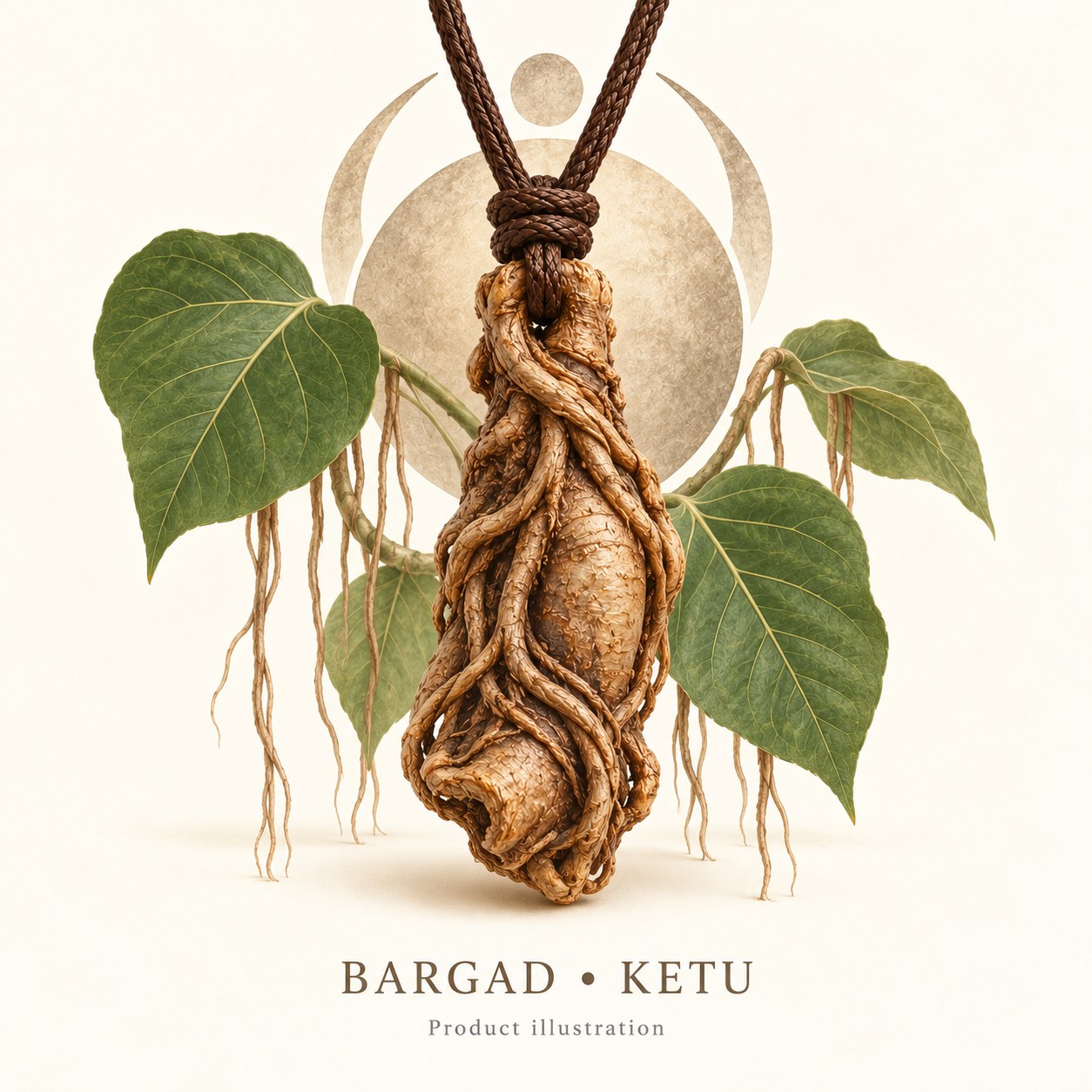
A person exploring a Ketu-associated spiritual accessory may encounter two very different offerings: a Bargad (banyan) aerial-root pendant and a cat’s-eye gemstone. Both may appear in modern Navagraha jewellery discussions, but they are not substitutes in the material or manufacturing sense. One begins with a named plant and a selected plant part. The other begins with a mineral specimen that has been cut and polished to display a moving band of reflected light. Their price, handling, identification and construction therefore need separate evaluation.
The useful question is not simply “Which is stronger?” but “Which tradition and material am I actually choosing, how has the seller identified it, what comes with the completed accessory, and how will I wear and care for it?” For devotees, Ketu’s associations with vairagya, spiritual inquiry, introspection and moksha may be central to the choice. For a careful purchaser, accurate labels and sound construction are just as important. This guide covers both sides without confusing a devotional association with a mineral or botanical test.
Quick answer: which Ketu-associated option fits your purpose?
Choose a Bargad-root pendant when the appeal is botanical, simple, plant-centred spiritual jewellery and you can obtain clear information about the source, actual plant part, processing and pendant fitting. Choose a properly identified cat’s-eye gemstone when you specifically want a gem-based Jyotish accessory and can assess the gem species, cabochon, chatoyancy, documentation, setting and budget. The exact chart-based recommendation, if sought, belongs to an individual Jyotish consultation rather than a blanket online rule.
| Decision point | Bargad aerial-root pendant | Cat’s-eye gemstone pendant or ring |
|---|---|---|
| Primary material | Dried and prepared plant material identified as Ficus benghalensis | A mineral or other chatoyant material; species must be specified |
| Traditional emphasis | Banyan / Nyagrodha symbolism and a Ketu-linked herbal-jewellery practice | Lehsunia or cat’s-eye association in gemstone-oriented Jyotish |
| What to authenticate | Botanical species, aerial-root identity, provenance, coatings and mounting | Gem species, natural or manufactured origin, treatments and optical quality |
| Common construction | Small root fragment within or attached to a protective mount | Polished domed cabochon in a secure metal or other setting |
| Cost drivers | Selection, preservation, workmanship and fittings | Mineral species, gem weight, chatoyancy, colour, treatments, setting and report |
| Everyday risk | Moisture, abrasion, snagging, coating failure and loose fittings | Scratches or chips, setting wear, knocks and inappropriate cleaners |
| Best first question | “Which part of which plant is supplied in this piece?” | “Is this chrysoberyl cat’s-eye, quartz cat’s-eye or another material?” |
Neither column establishes a universal graha prescription. It gives the buyer a way to compare the objects accurately before considering their customary significance.
Understanding Ketu in traditional Jyotish
Ketu is one of the Navagraha and is commonly represented as the descending or south lunar node, paired with Rahu, the ascending node. It is known in Jyotish as a chhaya graha, a shadow planet: an astrological point rather than a luminous physical planet. Traditional interpretations often discuss Ketu in connection with dispassion (vairagya), discernment, separation from excess attachment, unusual insight, spiritual practice and the pursuit of liberation (moksha). Ketu can also appear in discussions of sudden changes, uncertainty, inherited tendencies and subtle obstacles. The emphasis shifts by text, lineage and horoscopic context.
An individual recommendation normally considers the lagna, Ketu’s placement by house and sign, dispositorship, conjunctions and aspects under the astrologer’s system, the running mahadasha and antardasha, and the person’s actual intention. Different schools can interpret these factors differently. A Ketu-associated product page cannot determine from its gemstone colour, plant name or price alone whether an item suits every horoscope. Some practitioners prefer a graha mantra, dana, puja or personal conduct practice rather than a wearable material. The distinction between spiritual observance and product selection is important, especially when users compare a herbal pendant with a more expensive gem.
Ketu, sankalpa and personal observance
In many homes, the purpose of a devotional object is expressed through sankalpa: a consciously stated intention before prayer or other practice. A person may choose a banyan-root keepsake as a reminder of steadiness, humility or reflection, or select a cat’s-eye setting because it aligns with a particular Jyotish tradition. Such meaning arises from practice and context; it is not a visual property that a seller can verify in a photograph. If you follow a family parampara, check whether that practice recognises herbal amulets, gemstones, both or neither. Keep observances respectful of the actual material and do not let an accessory override the advice of a trusted practitioner about a different religious practice.
What exactly is Bargad or Banyan root?
Bargad, also called Vat, Vata, Nyagrodha or banyan, commonly refers to Ficus benghalensis L. in the mulberry/fig family, Moraceae. Kew’s Plants of the World Online accepts this name and describes a large tree whose aerial roots descend from branches and may eventually develop into supporting trunks. The scientific name matters because common names can be used loosely by traders and the appearance of a dry pendant cannot prove species identity on its own.
In Sanskrit and Ayurvedic botanical terminology, Nyagrodha-jata describes banyan aerial-root material. Kew’s Medicinal Plant Names Services associates this name with Ficus benghalensis and identifies the drug part as a dried aerial root. That helps explain why traditional descriptions may say “root” while a jewellery supplier means a hanging or descended aerial root rather than a root dug from the ground. It does not prove that every item sold under the same name contains the correct plant part.
| Botanical term | Practical meaning | What a buyer should confirm |
|---|---|---|
| Bargad / Banyan | Common names for a familiar sacred fig tree | Actual botanical species rather than a common-name assumption |
| Ficus benghalensis L. | Accepted scientific name for the banyan species | Supplier species identification and source documentation |
| Nyagrodha / Vata | Traditional names appearing in Sanskrit and devotional contexts | Whether the seller uses the term for the same identified plant |
| Jata / aerial root | Root formed from above-ground branches | Whether the piece is aerial-root material or another woody part |
| Bark or stem fragment | Different botanical parts with different structure | No substitution under an unexplained “banyan root” label |
| Coated or resin-encased fragment | Plant-based content with a manufactured protective layer | Disclose the coating, resin, adhesive and likely contact surfaces |
A whole banyan tree is a protected living system and a culturally significant presence. Responsible sourcing should not require damaging a revered or public tree. Ask whether the supplier has obtained material lawfully and with permission, and whether the piece has been dried and prepared for a wearable purpose. In devotional contexts, the tree’s significance does not remove the need for good stewardship.
The meaning of Vatavriksha and Nyagrodha in Indian traditions
The spreading canopy and descending roots of the banyan have made Vatavriksha a memorable image of continuity and shelter. In Indian stories and visual culture, it appears in discussions of longevity, stability, lineage, learning and the relationship between generations. Kew itself notes the banyan’s sacred status in Hindu and Buddhist settings and its association with the wish-fulfilling tree in Indian mythology. Local observances, including Vat-related vows and rituals, may honour the living tree in ways that are quite different from wearing a fragment of dried plant material.
A modern pendant inspired by the banyan is best understood in this broader symbolic environment. Not every classical reference to a sacred banyan automatically prescribes a wearable Bargad-root pendant for Ketu; the latter is a particular contemporary herbal-jewellery practice whose plant list can vary among teachers and vendors. This is a meaningful distinction, not a reason to dismiss the tradition. An accurate article can respect the sacred tree, explain Nyagrodha and describe the present accessory without claiming that every textual appearance of Vatavriksha is a historical instruction for the same product.
What is cat’s eye, Lehsunia or Vaidurya?
Cat’s eye is first an optical description: a bright, concentrated band that seems to travel across a polished gem as its orientation changes. Gemmologists call the effect chatoyancy. Fine, roughly parallel inclusions, tubes or fibrous structures can reflect light in a narrow stripe when a stone is oriented and cut with a rounded top, called a cabochon. The effect is most easily inspected with a small directional light source while rotating the stone slowly.
In modern fine-gem trade, an unqualified “cat’s eye” commonly refers to the chrysoberyl variety also called cymophane. Other materials can exhibit chatoyancy, including quartz, tourmaline and apatite. In those cases, the mineral name should accompany the optical term: quartz cat’s-eye, tourmaline cat’s-eye and so on. CIBJO’s coloured-stone nomenclature guidance supports identifying chatoyant gemstones by their correct material name with a cat’s-eye designation. A vague “original cat’s eye” label is therefore not a sufficient species description.
In Jyotish and jewellery markets, the Hindi term Lehsunia and the Sanskrit-derived Vaidurya may be encountered in Ketu-related discussions. Their application can differ across languages, older descriptions and modern trade. For present-day purchasing, write down the actual gem species being sold. In particular, a product listed as quartz cat’s-eye must not be silently upgraded to chrysoberyl cat’s-eye, irrespective of the traditional name shown on the label.
| Material offered as cat’s eye | Material identity | Typical gem hardness (Mohs) | Buying implication |
|---|---|---|---|
| Chrysoberyl cat’s-eye / cymophane | Chrysoberyl, commonly BeAl₂O₄ | About 8.5 | Ask for species-specific report and assess the eye and body colour |
| Quartz cat’s-eye | Chatoyant quartz, SiO₂ | About 7 | A different gem species; lower price does not make it chrysoberyl |
| Tourmaline cat’s-eye | Chatoyant tourmaline-group gemstone | Roughly 7–7.5 | Require the tourmaline name and any treatment information |
| Apatite cat’s-eye | Chatoyant apatite-group gemstone | About 5 | More vulnerable to everyday knocks and scratches |
| Fibre-optic “cat-eye” glass | Manufactured glass | Variable | Disclose plainly as manufactured material, not a natural gem |
| Synthetic or composite imitation | Manufactured or assembled object | Depends on components | Ask for complete material and construction disclosure |
Mohs values describe relative resistance to scratching, not resistance to breaking. A cabochon can still chip at an exposed edge or come loose from a poor setting.
Chrysoberyl versus quartz cat’s-eye: why the distinction matters
Chrysoberyl and quartz are chemically and structurally different mineral species. Gem-quality chrysoberyl generally has a higher refractive index and specific gravity than quartz, and fine chrysoberyl cat’s-eye is often valued for a narrow, bright and well-centred band. Quartz cat’s-eye can show a gentler, broader light band, although appearance alone is not a conclusive identification. The classic milk-and-honey effect—contrasting light and dark halves under directional illumination—is especially discussed with desirable chrysoberyl specimens, but it is not a substitute for species testing.
A reliable gem report typically concerns an identified individual stone. A photograph showing a sharp band does not prove that the stone is chrysoberyl, and a verbal statement that a stone came from a famous mining region is not a laboratory identification. For higher-value purchases, request a report from a competent independent gemmological laboratory identifying the species, whether the material is natural or laboratory-created when determinable, and any detected treatment within the laboratory’s scope. Match report number, dimensions, weight and photographs or identifying characteristics to the exact cabochon being sold.
| Observable feature | Helpful interpretation | What it cannot establish alone |
|---|---|---|
| Moving bright line | Supports the presence of chatoyancy | The species or natural origin of the material |
| Narrow, crisp eye | Often a desirable visual-quality feature | Chrysoberyl identity without tests |
| Honey, olive, greenish or brownish body colour | Common colours in cat’s-eye jewellery | Geographic origin or treatment history |
| “Milk-and-honey” appearance | A recognised quality discussion for chrysoberyl | An automatic guarantee of value or traditional suitability |
| Refractive index and specific gravity | Useful laboratory separation of mineral species | Value, spirituality or chart-specific recommendation |
| Gem laboratory report | Documents the examined specimen and tests | Authenticity of the separate root pendant or its graha effect |
| Seller video | Shows movement of the eye under lighting | The full gem identity, origin or setting quality |
There is no need to test a valuable stone by scratching glass, heating it or applying household chemicals. Such home tests can damage the object, create misleading results and sometimes invalidate return terms. Use observations for screening and specialist instruments for identification.
Ketu and the customary cat’s-eye association
In many Navagraha gemstone lists, cat’s-eye (Lehsunia) is associated with Ketu, just as ruby may be associated with Surya and pearl with Chandra in certain commonly used lists. These lists belong to the symbolic and prescriptive world of Jyotish. They are not chemical classifications. Thus Ketu does not make a quartz cabochon into chrysoberyl, and an expensive chrysoberyl does not automatically mean every person should wear it.
Some astrologers approach Ketu through the janma kundali, dasha sequence, afflictions or spiritual priorities; others avoid recommending a strong gemstone for Ketu unless the chart supports it. The selection of metal, finger, day, ritual, mantra and wearing period likewise varies by lineage and practitioner. Present these customs as contextual, not as an obligatory formula applicable to every person. A well-written product comparison should help the reader ask better questions before purchasing rather than provide a universal horoscope reading from a page title.
For someone who follows a traditional practice, a recommendation may involve a specific quality and species of gem, a different Ketu-related material, or no wearable at all. The customer should know whether the recommendation actually named chrysoberyl cat’s-eye, a lower-cost quartz cat’s-eye, an herbal pendant or an entirely different practice. Ask for that precision in writing where appropriate.
Is Bargad root a traditional substitute for Lehsunia?
The word substitute needs qualification. A root and a gemstone are not equivalent in mineral identity, documentation, retail grading or maintenance. They can be alternative devotional materials within certain modern planetary herbal-jewellery catalogues, but that is different from asserting a universal classical substitution rule. A Bargad pendant may be attractive to someone who prefers simple botanical jewellery or whose chosen tradition associates banyan material with Ketu. Cat’s-eye may be preferred by someone whose Jyotish practitioner has specifically recommended a gemstone.
There are several legitimate reasons a customer might compare them: tradition followed, budget, personal appearance preferences, comfort, metal sensitivities, risk of chipping, willingness to maintain natural plant material, and the quality of available documentation. These are practical criteria. A comparison should not portray a cheaper option as automatically weaker in devotion, or a costly gemstone as proof of a better outcome. It should also avoid suggesting that two completely different purchases carry the same certification or wearing protocol.
| Question | Why it matters for Bargad | Why it matters for cat’s eye |
|---|---|---|
| Who suggested the material? | Identify the herbal tradition, supplier or personal preference | Identify whether the astrologer specified chrysoberyl or merely “cat’s eye” |
| What exactly is included? | Root portion, coating, mount, cord and protective case | Gem species, weight, cabochon, metal, setting and report |
| What documentation is possible? | Botanical identity and sourcing record | Gemmological identification and treatment assessment |
| Can I wear it every day? | Depends on dryness, seal and secure attachment | Depends on species, setting, activity and contact surfaces |
| Is water exposure acceptable? | Usually better to avoid saturation or soaking | Depends on stone, treatments and assembled jewellery |
| Is a high price necessary? | Compare craftsmanship and traceability, not a promised effect | Price may reflect gem rarity and quality, not spiritual certainty |
| Can I return or resize it? | Verify fittings and return terms before purchase | Confirm setting changes do not affect the report or warranty |
How to authenticate a Bargad aerial-root pendant
Begin with the botanical chain of identification. A seller should know whether the material is Ficus benghalensis, what plant part was harvested, and whether it was identified before drying, trimming, sanding or sealing. Ask for a source photograph or batch record when available. A banyan leaf photograph copied onto a listing does not authenticate the fragment inside a pendant, while a traditional Sanskrit name on a label does not answer whether the part is an aerial root, woody stem, bark or resin-filled composite.
A dried aerial root can be fibrous and irregular, with colours and textures that vary naturally. Surface polish or lacquer may make a small segment appear smoother than unworked material. Such changes are not inherently problematic if clearly disclosed. Transparent resin encapsulation, a painted exterior and metal-capped ends can all be acceptable product designs, but the buyer should know which surfaces actually contain plant material and which are manufactured components. Avoid assuming that an attractive wooden-looking bead is automatically genuine Bargad.
For responsible sourcing, ask whether collecting material required permission or harmed the parent tree. A plant revered in religious life should be obtained through a respectful and lawful process. For conservation, store prepared botanical jewellery away from water, prolonged heat and damp compartments. Inspect it for cracks, softening, trapped condensation or separating adhesive. A seller can explain how their specific mounting has been prepared; a generic “never affected by water” claim is a reason to ask further questions.
How to inspect a cat’s-eye gem before buying
First ask for the species and exact item number. Then request a short video with one small moving light or a stationary light while the stone turns. In a good orientation, the bright band should move visibly across the domed surface. Inspect whether the line is reasonably centred, continuous and distinct, whether surface scratches interfere, and whether the setting hides a large portion of the stone. Body colour preference is personal, but sudden unexplained zones, painted backs, obvious glue and chipped edges merit closer review.
Inspect the cabochon itself: dome height, symmetry, proportions, bottom surface, thickness and polish. A very tall dome may look dramatic but sit high in a ring; a shallow poorly oriented dome may not display the eye clearly. Compare physical dimensions in millimetres, not carat weight alone, because two stones of different density can look and weigh differently. For gem rings, examine the prongs or bezel for smooth secure contact and comfort. For pendants, check the bail aperture and chain thickness. Ask about repairs and whether a gem can be removed safely without losing its report-to-specimen match.
| Gem buying checkpoint | What to request | Warning sign |
|---|---|---|
| Species | Chrysoberyl, quartz or another named species | Only “original cat’s eye” without mineral identity |
| Natural or manufactured | Clear disclosure and, when appropriate, laboratory opinion | Natural claims contradicted by a glass or composite description |
| Video and lighting | Actual specimen turning under directional light | Repeated stock video unrelated to the product |
| Stone measurements | Millimetres, weight in carats and orientation | Weight only, with no usable dimensions |
| Treatment | Seller disclosure and laboratory scope | “Untreated” asserted without basis or any uncertainty |
| Mounting | Metal specification, finish, fastening and workmanship | Loose prongs, sharp edges or unspecified contact metal |
| Report | Issuer, number, species and exact item match | Report for another stone, a generic card or an unverifiable identifier |
| Return terms | Written policy for mounted gemstones and resizing | No clear remedy for item mismatch or transit damage |
Certification: botanical records are not gem laboratory reports
The word certificate can mean very different things. For Bargad material, a supplier may offer batch traceability, sourcing records, photographs or identification by a botanically competent person. Kew’s taxonomic profiles establish how botanists classify the species; they do not authenticate a commercial pendant. A generic Kew web page appended to a product listing is educational evidence about the plant, not a certificate for that particular object.
For cat’s eye, a gemmological laboratory can report the properties of the submitted stone. The report may identify chrysoberyl or quartz, document weight and dimensions, or describe observable treatments according to the tests performed. It may not prove mine-to-market traceability, religious suitability, or that a metal setting is nickel-free. An appraisal, seller authenticity card, gemstone report and astrological consultation are four separate kinds of documents. They should not be presented interchangeably. It is also useful to check whether the laboratory examined a loose gem or a mounted one, because mounting can limit which tests are possible.
A competent seller should welcome a precise question such as: “Does this report describe the exact gem I will receive, and does it explicitly identify chrysoberyl?” For the herb pendant: “Who identified the plant and aerial-root part before processing, and what evidence accompanies the batch?” Those questions are more useful than the word “certified” printed prominently without context.
Buying costs and value: compare complete products
Prices vary widely because the underlying objects have very different cost structures. With a Bargad pendant, the plant fragment may be a small part of the retail value; sourcing, preservation, resin work, metal parts, finishing, labour, presentation and after-sales service can explain much of the price. With cat’s-eye jewellery, species, natural origin, eye sharpness, colour, cabochon quality, size, testing costs, setting metal and seller policies can substantially affect the total. A lower-cost quartz cat’s-eye is not the same grade or species as chrysoberyl, even if both are catalogued under a broad Ketu heading.
Do not compare a loose stone price with a fully mounted pendant price without accounting for the mount. Likewise, do not compare a root fragment with a finished jewellery set including chain and packaging. Ask whether taxes, chain, report, consultation, shipping, resizing and returns are included. When a salesperson describes a “premium graha remedy,” ask what documented feature of the material or construction accounts for the premium. The spiritual significance of a purchase need not depend on inflated or unclear merchandise descriptions.
| Price component | Bargad pendant | Cat’s-eye jewellery |
|---|---|---|
| Main material | Identified aerial-root fragment, preparation and selection | Mineral species, size, optical quality and origin considerations |
| Mount or setting | Cap, tube, resin capsule, cord or chain | Metal ring, bezel, prongs, pendant bail and chain |
| Documentation | Botanical and sourcing traceability | Gem lab report, material disclosure and item matching |
| Finishing | Smooth edges, stable enclosure and careful sealing | Polish, cabochon symmetry, eye orientation and secure setting |
| Maintenance | Moisture protection, coating and cord inspection | Cleaning, loose-setting checks and impact protection |
| Personal value | Meaning of the banyan and preferred observance | Gem appearance and specific Jyotish-oriented preference |
Wearing customs: mantra, day, metal and contact with skin
Ketu-related wearing customs are not identical across families, temples, astrologers and jewellery merchants. Some devotees seek a particular mantra, puja, sankalpa, day or metal; others treat the accessory as a personal symbolic reminder without a special activation process. A single site article should not present one procedure as the exclusive or ancient rule for every lineage. If a practitioner prescribed a specific gem, setting or observance, document the instruction accurately rather than silently replacing it with a general internet checklist.
For a root pendant, direct skin contact is not essential to display or honour the material, and pushing a raw fibrous edge against the body can be uncomfortable. A smooth enclosure or secure tube usually makes practical sense. For a cat’s-eye ring, fitting matters as much as the claimed ritual metal: an overly tight ring can irritate the skin, while a loose setting can damage the gem. Check whether jewellery metals contain nickel or other contact allergens if relevant. There is no need to drill a finished stone or cut away the pendant casing in order to force a traditional contact instruction.
Wearing during handwashing, swimming, bathing, sports, heavy work or sleeping should be judged according to the particular assembly and your comfort. Botanical material and adhesives are especially unsuited to repeated soaking. A mounted gemstone can tolerate more routine handling than a fragile plant fragment in some designs, but a ring still deserves removal before impact-heavy tasks. No gemstone or root should be swallowed, used as a medicine, or applied to damaged skin as part of an accessory ritual.
Caring for Bargad jewellery at home
Treat a plant-based accessory as a composite of botanical material, finish and fittings. Light, dry dusting with a soft cloth is usually safer than immersion. Avoid hot-water cleansing, long oil baths, detergents and strong incense heat unless the actual maker has specified compatibility. If the root is enclosed in resin, clean the exterior according to that resin and mounting material instead of attempting to wet the enclosed plant. A sealed pendant that has trapped visible moisture needs professional evaluation before repeated wear.
During a Bengaluru monsoon, humidity and damp cupboards can make natural materials less forgiving. Let a worn pendant dry at room temperature in a ventilated place before returning it to a clean, dry box. Do not use direct sunlight or a hair dryer to speed up drying, because heat can affect coatings, glue and the plant. Store separately from heavy metal jewellery, and avoid pulling on the root body to straighten a twisted chain. If the cord frays or a metal cap loosens, replace or repair the support rather than continue wearing an unsecured fragment.
Caring for cat’s-eye jewellery
Cleaning depends on the identified species, disclosed treatment and setting, not on the word cat’s-eye alone. For a securely mounted, untreated chrysoberyl or quartz gem, gentle surface wiping with a soft cloth is commonly appropriate. A mild soap-and-water approach may be suitable for many individual durable stones, but do not assume it is suitable for an unknown treatment, a glued setting, porous decorative elements or every type of mount. Avoid using steam or ultrasonic devices merely because an online page calls the stone hard.
A chrysoberyl cabochon has good scratch resistance for a jewellery gem, but it is still vulnerable to a direct blow or a loose bezel. Quartz is softer and can collect abrasions during rough use. If the stone is chipped at the girdle or the reflective band appears different after a repair, have the mounting and surface checked. Keep gemstone pendants away from abrasive powders and ensure jewellery is dry before storage. A padded compartment prevents a harder gem from scratching neighbouring softer pieces.
| Situation | Bargad aerial-root pendant | Cat’s-eye cabochon setting |
|---|---|---|
| Daily surface dust | Dry soft cloth or gentle brush around the fitting | Soft lint-free cloth; cleaning appropriate to identified gem and mount |
| Water exposure | Avoid soaking and prolonged moisture | Ask about treatment, glued components and setting first |
| Heat and sunlight | Protect plant fibres, coatings and adhesives | Protect gem and setting; avoid extreme heat and abrupt changes |
| Storage | Dry, ventilated padded pouch or compartment | Separate padded compartment, away from other hard jewellery |
| Repair | Check cords, caps, resin and roots for movement | Check prongs, bezel, bail and stone security |
| Religious cleaning | Prefer non-invasive symbolic handling | Do not apply oils, powders or heat without material compatibility |
| Travel | Prevent compression of the botanical piece | Prevent metal-on-stone contact and direct impact |
Practical example: choosing for a Bengaluru working professional
Consider a professional seeking a small Ketu-associated item for occasional use at the workplace. They prefer something discreet under a shirt, have a limited budget and do not wear rings. A well-fitted Bargad pendant may be a straightforward option if the supplier can identify the plant part, explain the finish and supply a smooth clasp. Alternatively, a quartz cat’s-eye pendant may be attractive as gemstone jewellery if the purchaser understands that the mineral species is quartz and not chrysoberyl. The meaningful comparison is between actual products with measured dimensions and fitting details, not a hypothetical battle between a plant and a stone.
If an astrologer has instead prescribed chrysoberyl cat’s-eye specifically, a quartz lookalike or an herbal pendant should not be presented as automatically satisfying that recommendation. The purchaser can discuss affordable alternatives, defer the purchase or pursue another observance with the practitioner. For comfort, the worker should check that the pendant does not catch on ID lanyards, desk equipment or neckwear. For monsoon travel, the plant-based item may need more protection from humidity and rain.
Practical example: family puja and a traditional gift
A family may want a Ketu-related devotional gift without claiming to know the recipient’s full birth chart. In that case, a respectfully described banyan-inspired pendant with clear botanical identity may be a meaningful symbolic gift for someone who appreciates Vatavriksha traditions. A cat’s-eye gemstone set may suit someone who enjoys distinctive chatoyant gems, but it is better not to present an expensive Jyotish ring as a compulsory personal remedy when the recipient has not requested one. For formal gifting, include the name of the actual material, care instructions and the return or resizing policy.
Gifts can also be decorative rather than worn every day. A pendant may be placed in a clean keepsake box near personal devotional materials if that suits the household. The customer should not interpret an unverified Ketu claim as a requirement to wear an uncomfortable or unsuitable accessory. Preserve both tradition and the recipient’s agency: the gesture is personal and should be described with care.
Practical example: a showroom comparing three “cat’s-eye” listings
Imagine a jewellery showroom presents three labels: “natural cat’s-eye,” “quartz cat’s-eye” and “certified Lehsunia.” A careful salesperson should immediately clarify the mineral species behind each name. The first is incomplete. The second identifies quartz, but still needs treatment and specimen details. The third supplies a certificate claim without telling the buyer what was tested. A properly labelled natural chrysoberyl cabochon with a verified report can then be compared on dimensions, quality of eye, setting and price—not merely with an adjective printed beside a photograph.
In the same showroom, a Bargad pendant belongs to a different botanical-jewellery category. Its supply record should describe Ficus benghalensis and the aerial-root material rather than cite a gemstone lab report as proof. Staff should be able to explain that the products share a Ketu-related catalogue context, not a guaranteed identical use, quality grade or outcome. This separation makes product pages more understandable and reduces disputes after delivery.
How a Jyotish consultation can narrow the choice
A personal consultation may ask for birth date, birth time and birth place to interpret the chart. The astrologer may look at Ketu’s relationship to the lagna, its dispositor, nodal axis, house placement, dasha timing and the question being asked. These details can change how a particular tradition approaches a material recommendation. Someone asking about meditation discipline may receive a different set of practices from someone seeking guidance about a specific planetary period. Neither case is determined by a generic description of a banyan root or a cat’s-eye cabochon.
Once the consultation has clarified the intention, translate the recommendation into a precise product specification: botanical species and plant part for an herbal pendant, or mineral species, carat weight range and acceptable mounting for a gemstone. Also confirm whether the user desires a pendant or ring, whether they have skin-contact concerns, and whether they can maintain the material. The spiritual decision and the purchasing decision then support each other without blurring what can be inspected physically.
A twelve-point buying checklist
| No. | Question to ask | Why it protects the purchase |
|---|---|---|
| 1 | What exact item and material will I receive? | Prevents generic-category substitutions |
| 2 | For Bargad, is it Ficus benghalensis aerial root? | Identifies species and plant part separately |
| 3 | Was the plant material obtained lawfully and prepared responsibly? | Clarifies source and processing |
| 4 | For cat’s eye, is it chrysoberyl, quartz or another species? | Prevents a major trade-name misunderstanding |
| 5 | What treatments, dyes, resins or coatings are present? | Makes cleaning and disclosure more accurate |
| 6 | Is the photograph or video of the exact specimen? | Reduces item-to-listing mismatch |
| 7 | Does a report match that specimen? | Makes documentary claims testable |
| 8 | What are dimensions, weight and full jewellery length? | Helps assess comfort and value |
| 9 | What metal, cord, clasp or fastening is used? | Supports fit and maintenance decisions |
| 10 | What care, repair and replacement instructions apply? | Avoids preventable damage |
| 11 | Are price, taxes, shipping and return terms clear? | Allows a full landed-cost comparison |
| 12 | Is the stated traditional association the one I follow? | Separates individual observance from a universal sales claim |
When ordering online, keep a copy of the product description and the written answers to significant questions. Ask for photographs with a ruler or standard object for scale. Inspect packaging as soon as it arrives and check the exact item against the listing, especially the cat’s-eye species and the botanical part designation.
Common mistakes to avoid
A frequent mistake is to treat “cat’s eye” as a species name rather than an optical term. Another is to read “Bargad root” as proof that a pendant contains an identified aerial root. Similarly, a seller’s statement that the item is “energised” does not describe the gem’s species or the root’s processing. Buyers should not confuse a certificate for a gemstone with a certificate for the plant fragment, and they should not judge authenticity by price, greenish body colour or the presence of a moving eye alone.
Also avoid generic handling advice. Not all cat’s-eye stones have the same hardness, and a plant-based amulet is not made waterproof by being called sacred. Do not assume that a ring recommendation also applies to a necklace, or that a suitable herbal keepsake should be opened, burned, submerged or worn against the skin to be meaningful. Be cautious with promises that one material is guaranteed to produce immediate financial, health or personal results; such promises are not a description of either object and do not help compare their craftsmanship.
Frequently asked questions
1. Is Bargad root the same as cat’s-eye gemstone?
No. Bargad material comes from a plant, conventionally Ficus benghalensis, while a cat’s-eye gem is an optical variety of an identified gemstone. They differ in composition, construction, reporting, appearance, price and care. Sharing a Ketu-related label does not make the objects physically equivalent.
2. Which one is linked to Ketu in Jyotish?
Cat’s-eye or Lehsunia is widely associated with Ketu in commonly used Navagraha gemstone lists. Bargad-root jewellery is presented as a Ketu-related herbal accessory in some contemporary planetary-plant systems. The plant association and precise wearing practice are not universal across traditions.
3. Does a Bargad pendant contain a root dug from the soil?
Not necessarily. Banyans produce aerial roots that descend from branches and may eventually become supporting trunks. The term Nyagrodha-jata refers specifically to aerial-root material in a documented botanical tradition. Ask the seller what part was actually used.
4. What is the scientific name of the banyan tree?
The accepted scientific name for Bargad or the common Indian banyan is Ficus benghalensis L., family Moraceae. Plant identification needs more than a photograph of a banyan leaf attached to an online product page; a supplier should know the source species and part.
5. Is quartz cat’s-eye the same gemstone as chrysoberyl cat’s-eye?
No. Quartz and chrysoberyl are different mineral species with different properties and commercial values. Both can show chatoyancy. A legitimate quartz cat’s-eye should be called quartz cat’s-eye, while a purported chrysoberyl should be described and documented as chrysoberyl.
6. What does “chatoyancy” mean?
Chatoyancy is the optical effect in which a bright band seems to move across a polished surface as the stone or light moves. Parallel structures within the gemstone reflect light in a concentrated way. It does not, by itself, establish species, natural origin or traditional suitability.
7. Why are many cat’s-eye stones cut as cabochons?
A domed cabochon helps bring out the moving reflective band when its orientation follows the gem’s internal structures. Faceting often reduces the visual effect. The quality of the cut, dome and alignment therefore matter when comparing cat’s-eye pieces of the same species.
8. Is chrysoberyl harder than quartz?
Yes. Chrysoberyl is about 8.5 on the Mohs hardness scale, while quartz is about 7. This indicates differences in scratch resistance, not immunity from cracking or chipping. The security of the jewellery setting remains important for both materials.
9. Can I confirm chrysoberyl using only a torchlight?
A small light can reveal whether the eye moves and how well it is centred, but it cannot reliably establish chrysoberyl identity. Quartz, tourmaline and manufactured materials may also show similar visual effects. Species identification belongs to gemmological examination.
10. What should a cat’s-eye gemstone report state?
Look for the tested material name, identifying measurements, report number and any relevant origin or treatment statements within the laboratory’s scope. Confirm that the report matches the actual stone, not an unrelated sample or a generic seller authenticity card.
11. Can a botanical certificate verify a gemstone?
No. Botanical information can establish the classification and identification of plant material, but it does not measure a gem’s optical or chemical properties. Likewise, a gemstone report does not authenticate the species of a root fragment in a separate pendant.
12. Must Bargad root always touch the skin?
There is no universal practical requirement that the raw plant fragment touch the skin. Enclosed, smooth-mounted jewellery is often more comfortable and protects delicate plant material. Follow your own lineage’s observance while respecting the construction and avoiding irritation.
13. Can I wear cat’s eye without an astrology consultation?
A person may wear an accurately identified cat’s-eye gemstone as jewellery. Someone specifically seeking a Ketu-related Jyotish recommendation may prefer a personal chart assessment, since traditions vary about when and how a gemstone should be prescribed.
14. Is a high price evidence of a stronger Ketu accessory?
No. Price may reflect gem species, rarity, eye sharpness, dimensions, craftsmanship, metal, laboratory work and service. It does not verify the buyer’s horoscope or spiritual outcome. Compare the actual material and complete terms of sale.
15. How can I protect a Bargad pendant during the monsoon?
Limit prolonged moisture exposure, dry the exterior gently at room temperature and store the accessory in a clean, ventilated box. Check for softening, trapped condensation or loose glue. Do not use a hot dryer, repeated soaking or strong household chemicals on plant material.
16. Can I use salt water to cleanse either accessory?
Salt-water immersion is a poor general instruction for a mixed-material pendant and may affect metals, adhesives, coatings and botanical material. For gemstones, any cleaning should reflect the identified species, possible treatment and setting rather than a blanket ritual rule.
17. Is “milk and honey” proof of natural chrysoberyl?
The milk-and-honey optical appearance is an admired feature of certain chrysoberyl cat’s-eye gems, but it is not a complete test of species, natural origin or treatment. Use it as one visual quality consideration alongside a reliable gem report where appropriate.
18. What if a listing says only “Lehsunia original”?
Ask the seller to name the gem species, state whether it is natural or manufactured, provide exact dimensions and weight, show the actual specimen and explain any report. Do not infer chrysoberyl from a traditional name alone when the catalogue may also contain quartz-labelled stones.
19. Can a root pendant replace a specific chrysoberyl recommendation?
That is a question for the practitioner who made the recommendation, not a general material-equivalence rule. A root pendant and a chrysoberyl cabochon have different identities and traditions of use. Clarify whether the recommendation allows alternatives before purchasing.
20. What is the simplest way to make a sound choice?
Start with your intention and tradition; then identify the exact material, check fitting and documentation, compare full price and care requirements, and select only what you are comfortable using. A clear product description and realistic maintenance instructions matter more than vague rankings of spiritual strength.
Final perspective: material identity first, devotional meaning with context
Bargad root and cat’s-eye represent two different approaches to Ketu-associated spiritual jewellery. A Bargad aerial-root pendant is connected with the sacred banyan and a plant-based practice; a cat’s-eye accessory is defined by gemstone species, chatoyancy and gem workmanship. Both can be meaningful in the right personal context, but neither should lose its actual identity behind a broad planetary label.
A responsible comparison respects Ketu, Nyagrodha, Graha Shanti, Sankalpa and Jyotish while giving clear information about mineral and botanical sources, wearability, maintenance and price. Ask the seller for precise item information, and let a trusted traditional adviser clarify individual chart questions rather than treating a generic online ranking as a substitute for personal interpretation.
Some customers will prefer one material, some another, and some no purchase. Use the existing contact page to request an accurately identified cat's-eye listing rather than linking an unsuitable or unavailable specimen. Read Bargad's plant-part guide and Ketu association article for the separate botanical and interpretive context of the pendant.
Explore the Bargad (Banyan) Root Pendant for Ketu, return to Planetary Herbal Jewellery, or visit the established For Planets collection. Botanical references explain plant names and background. Ask our team about the particular item, its fitting and care.Further reading
