
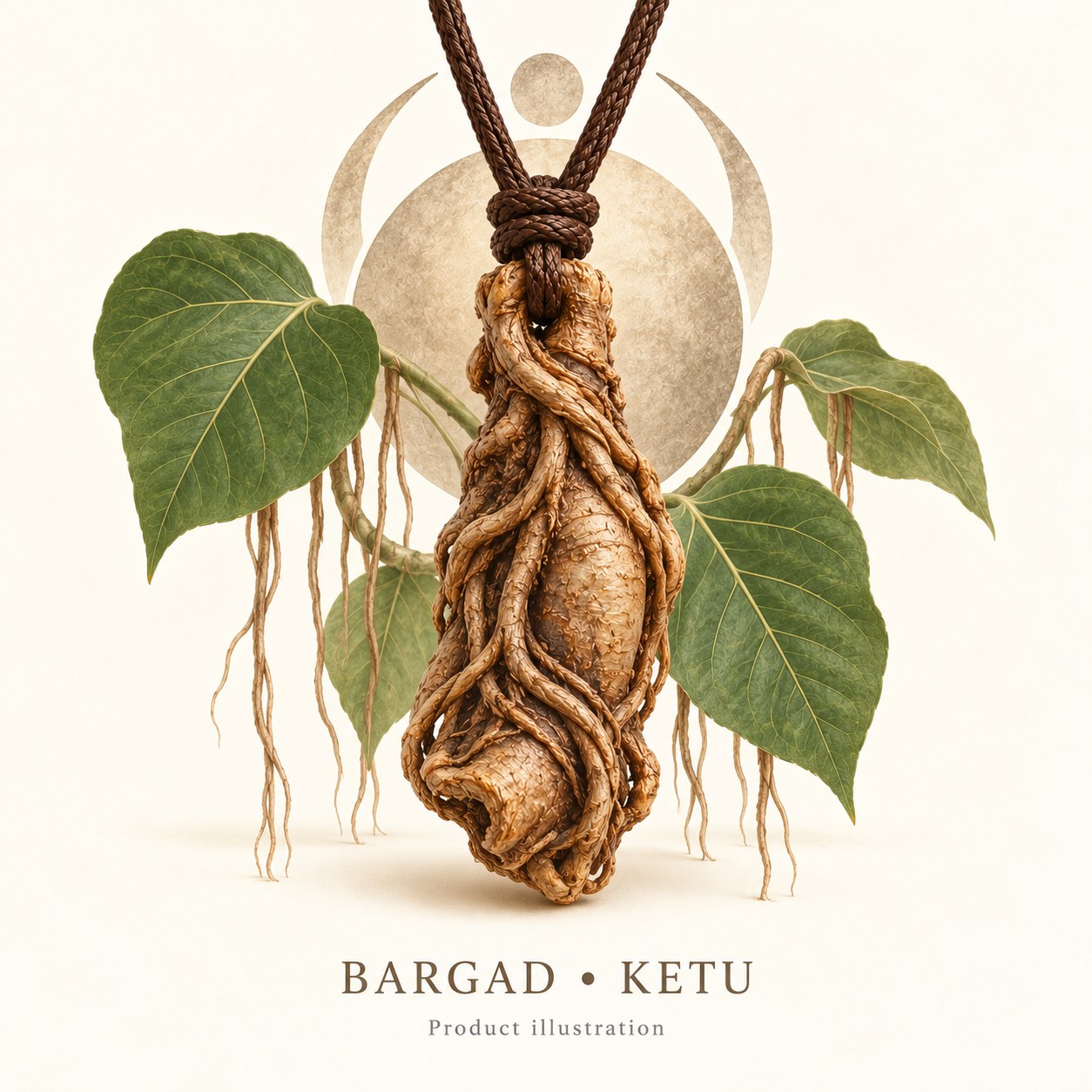
A Bargad (banyan) root pendant is discussed in some Indian planetary-herbal traditions as an accessory associated with Ketu, the south lunar node of Jyotish. That description brings together three different subjects: the astrological significance of Ketu, the sacred and botanical identity of the banyan tree, and the workmanship of a small object intended to be worn. A thoughtful explanation should connect them without making one a substitute for another. The significance of a graha is an interpretive matter; the species and plant part are botanical matters; the fastening and durability are physical matters.
For someone considering this kind of jewellery, the useful questions are not limited to “Is Bargad good for Ketu?” They include: What is the role of Ketu in a personal horoscope? Is this particular root-and-graha association used by the person's family, priest or astrologer? Is the component identified as Ficus benghalensis? Is it actually aerial-root material? Does the pendant fit safely and suit daily use? This guide answers those questions in a practical order, while respecting the traditional language of graha shanti, sankalpa, upaya and vrata.
At a glance: Ketu, Bargad and the finished pendant
| Question | Short answer | Why the distinction matters |
|---|---|---|
| What is Ketu? | The descending or south lunar node; in Jyotish one of the nine grahas. | It is a calculated point, not an ordinary physical planet or a rock in the sky. |
| What does Ketu signify? | Interpretive themes include moksha, vairagya, withdrawal, discernment and unusual transitions. | These symbols do not amount to a guaranteed prediction for every wearer. |
| What is Bargad? | The Indian banyan, Ficus benghalensis L., of the fig family Moraceae. | A common plant name should lead to a verifiable scientific identity. |
| Which part is relevant? | Traditional names Nyagrodha Jata and Vata Jata can refer to dried banyan aerial roots. | An aerial root, underground root, bark and wood are not identical materials. |
| Is Bargad always Ketu's prescribed plant? | No universal plant-to-graha chart is established for every lineage and region. | The particular association should be attributed to the tradition using it. |
| Does wearing the pendant replace a consultation? | No. A personal upaya may be considered in context of the full horoscope and customary practice. | A product category cannot evaluate individual dasha or planetary relationships. |
| Is a cat's-eye gemstone the same thing? | No. Cat's eye is a gemmological optical description; the better-known Jyotish gem is chrysoberyl cat's-eye. | Botanical and gemstone identification require different evidence. |
| What should a buyer verify? | Plant source, specific part, processing, photographs, dimensions, cord, fittings and care. | Symbolism cannot establish the material or build quality. |
1. Understanding Ketu: the astronomy and the Jyotish language
The Moon's orbital plane is inclined to the ecliptic. The two intersection points are the lunar nodes. At the ascending node, the Moon moves northward through the ecliptic; at the descending node, it moves southward. In Indian astrology, Rahu and Ketu normally designate the corresponding nodal axis, with Rahu associated with the northern point and Ketu with the southern point. Their longitudes are opposite each other in the underlying calculation. Eclipse seasons occur when the Sun lies near this nodal line and the Moon is appropriately aligned; that physical geometry is distinct from any symbolic interpretation of a horoscope.
Why is Ketu called a chhaya graha, a shadow graha? The expression differentiates the nodes from visible planetary bodies while recognising their place in the Navagraha framework. “Shadow” should not suggest that a pendant contains a measurable lunar-node energy or that the node itself is a physical object. It signals a different category within Jyotish's conventional vocabulary. The astronomical calculation concerns orbital geometry; the astrological reading concerns a transmitted interpretive system.
The familiar iconography of Rahu and Ketu also belongs to a story-rich religious context. In one telling of the Samudra Manthana narrative, the head and separated body of a being who consumed amrita are associated with Rahu and Ketu. This imagery provides a memorable contrast: the head that seeks and the tail that releases. These are symbolic portrayals, not anatomical descriptions of celestial bodies. Schools of interpretation differ on how strongly they use the narrative in counselling.
A responsible Jyotish discussion can preserve these terms without turning every disappointment, setback or unsettling thought into a “Ketu problem.” A client's chart is read as a whole and a traditional object is only one possible expression of sankalpa. Ketu is not an independent reason to frighten someone into a purchase.
2. What Ketu represents in traditional interpretation
Ketu is frequently discussed through moksha (release or liberation), vairagya (dispassion), withdrawal from excessive attachment, insight beyond surface appearance, and the unsettling but sometimes clarifying experience of discontinuity. Other interpretive themes include hidden skills, technical concentration, spiritual discipline, separation, self-inquiry and the search for meaning. Not every tradition assigns equal weight to each term. A reading must look at the placement, lordships and circumstances rather than treating the keyword list as a personal diagnosis.
| Traditional term | Interpretive lens | What not to assume |
|---|---|---|
| Moksha | Movement towards spiritual freedom or liberation from binding identification. | That wearing a root guarantees liberation or a specific inner experience. |
| Vairagya | Detachment, discrimination or a willingness to release an unhelpful fixation. | That every desire, relationship or ambition should be abandoned. |
| Graha shanti | Devotional or ritual approach to harmonising an astrological concern. | That there is one compulsory ceremony or purchasable object for everyone. |
| Upaya | Traditional remedial observance, potentially including prayer, japa, charity or conduct. | That an accessory alone replaces practice or ethical action. |
| Sankalpa | Deliberately stated intention within worship or personal observance. | That a fixed script has been prescribed for every customer. |
| Karma | In this context, a philosophical and astrological framework for action and consequence. | That an adviser can read a person's entire past or future from one placement. |
| Antarmukha | Inward-directed attention or contemplative orientation. | That solitude, unease or isolation is always evidence of Ketu's influence. |
| Navagraha | The nine-graha devotional and astrological framework. | That every nine-material jewellery chart is an ancient universal list. |
The practical value of these terms is in how they frame a choice. A person may wear a small banyan pendant as a reminder to practise patient reflection, not to make impulsive decisions, or to maintain a personal devotional commitment. Those intentions can be meaningful. They remain different from predictions of employment, marriage, health, litigation or financial results. A personal ritual might be based on one's family tradition even when the individual does not seek a horoscope-based remedy.
3. Ketu's position in a personal horoscope: what an astrologer actually examines
A Ketu-associated product page cannot know whether a person is in Ketu mahadasha, which house the node occupies, or whether a family practice has already selected a different form of worship. A personalised Jyotish assessment typically begins with accurate birth date, place and time, a declared calculation method, and the chart context. The same south node can be interpreted differently in different charts because its sign, house, dispositor and planetary relationships differ.
| Jyotish factor | What a careful reader checks | Why it affects an interpretation |
|---|---|---|
| Lagna and Lagnesha | Ascendant, degree confidence, strength and lordship of the ascendant ruler. | The houses and overall chart orientation depend on the ascendant. |
| Ketu's rashi | Sidereal sign and the condition of its ruling planet. | Nodes are commonly read through the qualities of their dispositor. |
| Ketu's bhava | House placement using the stated house approach. | Houses organise interpretive life themes; they do not dictate events on their own. |
| Rahu–Ketu axis | The opposing houses and signs together. | A node is not interpreted as though its counterpart were absent. |
| Conjunctions | Close links with luminaries and other grahas, including degree separation. | A generic Ketu paragraph ignores the neighbouring planetary context. |
| Drishti | Aspects under the practitioner's school of interpretation. | Aspect conventions for the nodes are not uniform across lineages. |
| Nakshatra | Ketu's lunar mansion, pada and its ruling graha. | Adds an interpretive layer beyond the sign name. |
| Vimshottari dasha | Active mahadasha and antardasha with timing assumptions. | Planetary-period interpretation is different from reading a static natal position. |
| Transits (gochara) | Present nodal movement in relation to natal placements. | Current transits should not be confused with natal conditions. |
| Divisional charts | Appropriate varga charts such as D9, D10 or D20 when birth-time confidence supports them. | Fine subdivisions become less reliable with an uncertain birth time. |
| Ayanamsha and node model | Sidereal reference and whether mean or true nodes are used. | A difference in settings can change reported degrees or timing. |
| Nature of the question | Whether the person seeks ritual guidance, botanical jewellery or a full astrology reading. | Not every product enquiry justifies an elaborate remedial recommendation. |
A chart report generated by software can calculate longitudes, house cusps, nakshatras, dashas and many vargas. That is valuable for consistency, but calculations are not themselves an interpretive verdict. The reasoning connecting those outputs to an upaya still needs review. In particular, an automatic statement such as “Ketu in the eighth house means you must wear Bargad” leaves out the sign, the house ruler, the nodal axis, the active period and the relevant tradition.
Birth-time accuracy deserves special attention. A time rounded from memory may be adequate for some broad discussion while being too uncertain for precise divisional-chart assertions. A good consultation states those limits. It should not use false mathematical precision as a basis for selling a particular accessory. The user's comfort, preference and ability to maintain the item are practical considerations even after a recommendation is made.
4. Ketu through the twelve houses: themes, not automatic verdicts
The following is a reference map of topics that practitioners may discuss when interpreting Ketu by house. It is not a list of guaranteed effects or mandatory purchases. Sign placement, dispositor, conjunctions, divisional indications and the whole chart change the reading. Houses are included to illustrate why a one-line product claim is too small to explain Jyotish.
| House (bhava) | Typical domain discussed | Useful interpretive question |
|---|---|---|
| 1st | Self-presentation, identity and approach to life. | Does the full chart show independence, introspection or competing influences? |
| 2nd | Family speech, stored resources and inherited values. | How is the second lord placed, and what does family practice actually mean to this person? |
| 3rd | Effort, communication, skills and siblings. | Are unusual skills or private disciplines indicated elsewhere in the chart? |
| 4th | Home, inner security, property and foundational relationships. | What supports stability in the chart and in the person's real circumstances? |
| 5th | Learning, creative expression, mantra and children. | How do the fifth lord and relevant periods modify the interpretation? |
| 6th | Service, routine, disputes and obstacles. | Which habits and practical responses matter independently of symbolism? |
| 7th | Partnership, agreements and public dealings. | How do the seventh lord, Venus and other relevant factors contribute? |
| 8th | Change, research, hidden processes and shared responsibilities. | Is the reading being responsibly contextualised rather than made frightening? |
| 9th | Dharma, teachers, study, travel and philosophy. | What lineage or learning framework grounds the person's ritual practice? |
| 10th | Work, responsibilities, recognition and social contribution. | Does D10 add reliable context, and what are the actual career facts? |
| 11th | Networks, aspirations, community and realised goals. | Does the whole chart indicate collaboration, selectivity or something else? |
| 12th | Solitude, charity, retreat, sleep and expenditure. | Is spiritual retreat being distinguished from ordinary life constraints? |
For example, a student who asks about a Ketu interpretation in the fifth house may receive an explanation involving learning and mantra sadhana, while an entrepreneur asking about the tenth house may be focused on vocation and service. Neither situation proves that a banyan pendant is necessary. The table offers vocabulary for a conversation; it cannot replace a chart-specific judgement.
5. Ketu nakshatras, dasha and timing
In the widely used Vimshottari system, Ketu is the ruling graha of Ashwini, Magha and Mula nakshatras, and Ketu's mahadasha spans seven years. A nakshatra lord is part of a specific timing and symbolic scheme; it does not mean everyone born under one of these nakshatras must wear the same object. The starting balance of a dasha is calculated from the Moon's natal position, so a precise birthday or age by itself is insufficient to identify a personal period.
| Nakshatra governed by Ketu | Common symbolic reference | What remains to be checked |
|---|---|---|
| Ashwini | Beginnings, movement and the Ashvini Kumaras in many readings. | Natal Moon or planet placement, pada, sign and connected grahas. |
| Magha | Lineage, ancestors and inherited responsibilities in many traditions. | Relationship to the house, sign, dispositor and the person's context. |
| Mula | Roots, foundations, inquiry and uprooting in symbolic interpretation. | The complete horoscope rather than literalising the word “root”. |
Mula is especially easy to misuse in marketing. The Sanskrit word invites an analogy with physical plant roots, but a vocabulary resemblance does not prove that Bargad root was prescribed for every Mula-born person. Botanical identification and the source of a ritual practice must be established separately. Similarly, an individual with Ketu antardasha might seek prayer or self-reflection without buying any jewellery at all.
When software reports a Ketu period, the result should display the calculation system and timing, not merely a dramatic label. Mean-node and true-node settings, ayanamsha, calendar handling and time-zone conversion all deserve consistent treatment. If a product consultation is meant to be personal, the person reviewing it should know what data were used and where the interpretive recommendation came from.
6. Why the banyan became an auspicious tree
The Indian banyan (Ficus benghalensis) spreads horizontally by producing roots from its branches. Some hanging aerial roots eventually reach the soil, thicken and become supporting pillars. This remarkable growth habit explains why banyan trees can shelter large gathering places for generations. In India the tree is called Vat, Vata, Bargad and Nyagrodha in different languages and textual settings. It appears in sacred-tree traditions, community life, temple precincts and stories of continuity.
Banyan symbolism is broader than any single planetary association. In traditions surrounding Vat Savitri and Vat Purnima, the tree is connected with the story of Savitri and Satyavan, commitment, prayer and enduring life. In other contexts the tree represents shelter, steadfastness, lineage, learning and spiritual contemplation. Some of these associations seem paradoxical beside Ketu's language of release and non-attachment: the banyan spreads, sustains and persists while Ketu is often read as loosening worldly fixation. The pairing can be meaningful precisely as an act of contemplative interpretation, but a modern interpretive bridge should not be presented as a universally quoted classical command.
A sacred tree should not be reduced to a supplier's list of disposable components. It provides habitat and shade, and roots are part of a living structure. Respectful collection means understanding provenance, permissions and the material condition of the tree. A person can honour the banyan without wearing anything taken from it; participating in a family observance, visiting a permitted site, reading the tradition or planting an appropriate tree can be meaningful alternatives.
7. What “Bargad root” means botanically
Ficus benghalensis L. is the accepted botanical name recorded by Kew's Plants of the World Online. It belongs to the Moraceae family. Kew's Medicinal Plant Names Services associates the traditional term Nyagrodha Jata, meaning aerial-root material, with this species. The distinction is useful because the living banyan has roots in several developmental forms. A hanging aerial root before it reaches soil, a thickened prop root, a subterranean root and a section of bark have different structures and histories.
| Name used in conversation | Botanical or material interpretation | What a seller should clarify |
|---|---|---|
| Bargad / Banyan | Common name for the Indian banyan in this context. | Whether the supplied species is actually Ficus benghalensis. |
| Nyagrodha | Classical Sanskrit plant name used for banyan. | Whether the label refers to the whole plant or a particular component. |
| Vata / Vatavriksha | Familiar ritual and regional names for the banyan tree. | Whether a claimed ritual custom has a specific family or regional source. |
| Nyagrodha Jata | Traditional name associated with the banyan's aerial roots. | Whether the pendant contains dried aerial-root material. |
| Vata Jata | Another designation linked to hanging banyan roots. | How the plant part was collected, dried and finished. |
| Prop root | An aerial root that has reached the ground and become a structural support. | Whether the product uses a thin hanging segment or developed support-root wood. |
| Stem bark | Tissue from a stem or trunk, not an aerial-root section. | That bark is not relabelled as a root without evidence. |
| Root-shaped carving | A shaped wooden, resin or composite component may resemble a root. | Exact composition rather than appearance alone. |
Kew's botanical profile confirms that the banyan is indigenous to the Indian subcontinent, with a long history of social and cultural uses. A botanical name narrows identification; it does not prove the identity of one finished, processed pendant. Once a small section is polished, varnished or set into metal, some visible botanical features may be hidden. Product-level evidence is therefore still necessary.
The original material may vary naturally. A root section can show fibrous texture, longitudinal ridges, changes in thickness, surface irregularities and shades ranging across grey, tan and brown. None of these features is an infallible home test. Surface colour can be modified by oil, wax, resin, dye, varnish or simple aging. Authenticity is best supported by traceable sourcing and accurate disclosure of processing, not by one photograph, a fragrance claim or a story about where the piece was found.
8. Connecting Bargad with Ketu: lineage, symbolism and evidence
When the product is called a Bargad Root Pendant for Ketu, the name is presenting a particular tradition-specific relationship. It is useful to ask whose association is being followed. An astrologer may have a local vanaspati upaya list, a family may have inherited an observance, or a shop may organise plant accessories into a Navagraha assortment. These are recognisable contexts, but they should not be conflated with a single exhaustive text binding every graha to one exact plant part.
Some published Navagraha homa lists use ritual grasses, twigs or samidha from species that are not identical to the assortment of roots sold as wearable jewellery. A wood offered into fire is not the same product as a dried aerial-root fragment sealed inside a pendant. A Ketu-focused custom may involve Ganapati upasana, mantra, temple worship, charity or personal disciplines instead of plant jewellery. The presence of the banyan in Hindu worship does not by itself establish the Banyan–Ketu assignment.
A transparent explanatory chain has four links. First, identify Ketu and the chosen school of Jyotish. Second, explain the spiritual or practical intention of the observance. Third, attribute the banyan association to the family, adviser, region or product tradition that uses it. Fourth, describe the physical pendant on its own terms. If any link is unknown, simply say which one is unknown; an attractive product photograph cannot bridge that evidence gap.
| Type of claim | What can support it | What it does not establish |
|---|---|---|
| “Ketu is the descending lunar node.” | Astronomical descriptions and consistent chart calculations. | An astrological outcome produced by wearing a root. |
| “Ketu signifies vairagya in this school.” | A named Jyotish teaching, lineage or interpretive practice. | That every person with Ketu placement will experience the same event. |
| “Banyan is sacred in Indian traditions.” | Botanical-cultural documentation, festivals and well-attested practices. | A universal Ketu-specific plant rule. |
| “Nyagrodha Jata is aerial-root material.” | Medicinal plant terminology and botanical reference records. | The authenticity of a particular packaged pendant. |
| “Our pendant contains Bargad aerial root.” | Traceable supplier data, preparation records and product inspection. | That the wearer's horoscope calls for the pendant. |
| “This family wears it after a prayer.” | The family's own stated and transmitted custom. | A compulsory procedure for other families. |
| “A priest recommends a particular upaya.” | The priest's guidance, with its applicable tradition and context. | A universal retail rule for all customers. |
The tension between release and continuity
It is tempting to describe the banyan's far-reaching canopy as prosperity and to describe Ketu's symbolism as the removal of attachment, then claim that the combination will cause both. A more coherent reading treats these as complementary devotional images. The banyan reminds a devotee of patient continuity, shelter and interconnectedness; Ketu may invite reflection on what to keep and what to let go. A personal sankalpa can hold both ideas: remain responsible to one's commitments while releasing the urge to control every result.
This is an explanation of meaning, not a quantified mechanism of planetary influence. It can be presented in traditional Sanskrit vocabulary and in ordinary English without pretending that the plant acts like a mechanical filter for karma, a substitute for effort or an instrument that alters a horoscope's calculated positions.
9. The place of upaya: practice before product
In Jyotish, an upaya is usually discussed as a response to a concern interpreted through the chart and the person's spiritual framework. Different lineages emphasise different combinations of japa, puja, dana, vrata, seva, conduct and symbolic objects. None should be assumed compulsory because a customer encountered a Ketu-themed product page. If an adviser suggests a root pendant, asking “Why this material, rather than prayer or a different observance?” is an entirely reasonable part of an informed consultation.
| Form of practice | Traditional intention | Practical consideration |
|---|---|---|
| Ganapati puja | Invocation of Ganesha within a Ketu-related devotional practice in some traditions. | Follow the actual temple or family liturgy used, rather than inventing a fixed sequence. |
| Ketu japa | Focused repetition of a mantra according to the practitioner's tradition. | Confirm pronunciation, initiation expectations, and whether a personal teacher is needed. |
| Navagraha worship | Honouring all nine grahas as a related system. | A general Navagraha prayer is not identical to an individual Ketu prescription. |
| Dana and seva | Charity and service as forms of remedial conduct. | Choose a useful act that genuinely benefits others and suits one's means. |
| Sankalpa | A conscious intention accompanying an observance. | State something sincere and actionable, not a purchased guarantee. |
| Banyan reverence | Respect for an auspicious tree or a family Vat observance. | Do not damage public or protected trees to obtain material. |
| Herbal pendant | A wearable reminder connected to a stated plant–graha association. | Confirm the botanical material, finish, fit and maintenance. |
| Cat's-eye jewellery | A distinct gemstone-based Ketu upaya in some Jyotish schools. | Do not treat all stones showing a cat's-eye band as chrysoberyl. |
The same person can honour a custom without adopting every custom at once. A devotional life may include Ganesha worship, responsible charity and a small heirloom piece; another person may prefer no accessory at all. Neither choice has to be marketed as a contest in “strength”. What matters is understanding the source of the recommendation and the responsibilities attached to it.
Does wearing a Ketu pendant require a special weekday?
There is no single, independently verified weekday-and-hour rule specific to every Banyan–Ketu pendant. Some local practices suggest Tuesday or a Ketu-associated observance; others choose a temple day, an auspicious muhurta, the start of japa or the family's normal prayer. These are different customary choices. If a priest or astrologer gives an exact procedure, the explanation should name the observance and make clear that it is a recommendation within that tradition, not a universal operating instruction for the object.
A ritual should never require unsafe heating, burning, soaking or applying unverified chemicals to a pendant. Water and oils may affect natural fibres, surface finishes, adhesives, dyes and metal fittings. A symbolic act can be performed beside the object if its material cannot tolerate immersion. This separation of devotional intention and material care is especially useful with botanical jewellery.
10. From living root to jewellery: responsible provenance
A natural aerial root is part of a living plant. Removing it may interfere with plant growth, and the legality or permissibility of collection can depend on the site and its management. Material taken from a temple tree, a public park or a protected setting needs proper permission, not merely an auspicious-sounding story. Sellers should favour responsible, documented supply and should never encourage customers to cut roots from a revered or publicly maintained tree themselves.
For a finished accessory, procurement records might include the supplied species name, plant part, general source region, authorised collection or supply channel, drying and finishing steps, batch identity and any coating or adhesive. A small retailer may not have a laboratory assay for each piece, but it can still maintain accurate item descriptions, identifiable batches, photographs and a clear policy for uncertain material claims. A label such as “Bargad root” should not be used to conceal that a piece is actually wood, resin or a synthetic imitation.
| Stage | A useful record | Buyer-facing relevance |
|---|---|---|
| Species selection | Accepted botanical name Ficus benghalensis and local name. | Reduces confusion with other Ficus species. |
| Plant part | Aerial root, support root, bark or another part. | Prevents parts from being exchanged under a generic root label. |
| Harvest or procurement | Supplier, source region and permission where needed. | Supports responsible sourcing, not an unverifiable temple-origin claim. |
| Drying | Method, condition and moisture control. | Helps prevent cracking, mould and deterioration. |
| Cutting and shaping | Dimensions, tool marks and any sanding or carving. | Explains why a natural section may have a regular geometric shape. |
| Surface treatment | Wax, oil, varnish, stain or resin if used. | Determines care instructions and appearance. |
| Assembly | Cord, bail, clasp, adhesive, thread and metal composition. | Determines skin contact, repairability and strength. |
| Inspection | Photographs, fit, damage, knots and fastening security. | Helps a buyer understand the actual received item. |
| Packaging | Dry and protective inner wrap, product label and care note. | Reduces transit damage and mix-ups. |
A brief material-authenticity checklist
Inspect the whole pendant and not just its botanical centrepiece. Ask for a photograph of the exact article, including the reverse, side and fastening. Compare the product's stated size with a ruler; isolated macro photographs can make a very small object appear substantial. If a coating prevents visual inspection, ask which finish was applied. If the answer is unknown, choose accurate language such as “supplied as Bargad aerial-root material; finishing details unavailable” rather than asserting laboratory certainty.
Avoid simplistic home tests. Scratching, burning, prolonged soaking and chemical spot-testing can permanently damage botanical pieces. Smell is also unreliable because oils, fragrance, storage conditions and natural variation can change it. The most responsible buyer's question is whether the seller has consistent source documentation and whether the displayed photograph and specifications match the item offered.
11. How to select a comfortable Bargad root pendant
A small spiritual accessory is still jewellery. Comfort, skin contact and the stability of its construction matter regardless of why it is worn. Before buying, establish whether the item is a free-hanging root section, a root enclosed in a locket, a polished piece secured with a metal bail or a component threaded into a necklet. These designs place different stresses on the root and require different cleaning methods.
A direct-drilled hole can be a weak point in a narrow, fibrous botanical segment. A metal cap, wrapped mount or enclosure might reduce pressure, but it may also conceal the specimen and introduce adhesive. A cord with a very hard knot can rub on the mounting; a short chain can pull at a delicate bail during movement. If a child might reach the item, loose pieces and detachable components require particular care. Neither a traditional mantra nor a planetary label changes those mechanical considerations.
| Buying detail | What to ask | Why it matters |
|---|---|---|
| Pendant dimensions | Length, width, thickness and whether the measurement includes the bail. | Helps judge whether the piece is suitable for daily or occasional wear. |
| Weight | Total assembly weight, not just the root section. | A heavy mount can be uncomfortable on a long cord. |
| Root condition | Are there visible splits, soft spots or unstable fibres? | A damaged piece may worsen with friction. |
| Construction | Is the piece drilled, wrapped, enclosed or bonded? | Each construction has different potential failure points. |
| Metal specification | What is the bail or chain made from, and is it plated? | Helps assess finish wear and skin-contact preferences. |
| Cord and clasp | Material, length, strength and replacement method. | A secure fitting is essential during normal movement. |
| Finish | Wax, varnish, oil, resin, dye or no finish. | Alters cleaning and long-term appearance. |
| Actual-item image | Front, back, side and scale reference. | Reduces confusion from a generic illustration. |
| Packaging and returns | How is the piece protected, and what is the inspection policy? | Helps handle cracks or loose fittings discovered at delivery. |
Some traditions prefer an object to touch the skin. That is a customary preference, not a reason to ignore irritation or discomfort. If the natural fibre surface catches clothing, a sealed or enclosed mounting may be more suitable. A customer with known metal sensitivity may prefer an alternative fitting. When the exact finish is uncertain, it is reasonable to choose occasional use rather than continual skin contact.
12. Care of a botanical pendant in everyday Indian conditions
Bengaluru's rainy season, travel between humid and air-conditioned spaces, perspiration and household fragrances can all affect a mixed-material pendant. Plant fibres may absorb moisture and dry unevenly; finishes can become cloudy; cord can weaken; and metal fittings can tarnish or corrode. The right maintenance routine depends on the supplied piece rather than on the root's astrological association.
A sensible default is to dust gently with a clean, dry soft cloth and keep the pendant away from prolonged immersion, aggressive cleaners, bleach, perfume sprays and direct high heat. After normal wear, wipe the contact surfaces and allow the item to air in a shaded, dry place before storage. A cool, ventilated box or pouch is preferable to leaving a potentially damp piece sealed in plastic. Use only any more specific cleaning method confirmed by the maker for that finish and setting.
| Situation | Preferred approach | Avoid |
|---|---|---|
| Fine dust after storage | Soft dry cloth or a very gentle clean brush where accessible. | Wire-brush scraping, abrasive powder or aggressive rubbing. |
| Sweat or dampness | Wipe the fitting and allow the whole piece to dry naturally in shade. | Blow-dryer heat, direct sunshine for rapid drying or sealed damp storage. |
| Perfume or cosmetic exposure | Remove the accessory before spraying or applying products. | Solvents, rubbing alcohol or heavy fragrances on an unknown finish. |
| Cord fraying | Ask for a suitable restringing or replacement of the cord. | Relying on a nearly broken knot because the item has ritual importance. |
| Loose bail or cap | Stop wearing and have the attachment inspected. | Instant glue applied to unknown fibres without checking material compatibility. |
| Surface crack | Document the condition and consult the supplier. | Soaking the piece to make it “expand back” or forcing the crack shut. |
| White or fuzzy growth | Isolate the item and ask the maker for material-specific advice. | Continuing skin contact or concealing suspected mould beneath a coating. |
| Ritual purification | Follow a method that does not harm the assembly; dry symbolic practice may suffice. | Fire, incense ash, repeated oil baths or saltwater soaking of fragile parts. |
The traditional idea of shuddhi, or ritual cleansing, has many expressions. A prayer before wearing need not require submerging a delicate botanical object. If a prescribed custom specifically involves liquids, ask the adviser how it should be adapted to the physical item supplied. The safest product description distinguishes a devotional custom from the maker's maintenance instructions.
13. Bargad root, cat's-eye and other Ketu-oriented choices
The market may present Bargad root jewellery, Lehsunia (cat's-eye gemstone jewellery), Navagraha herbal necklets and Rudraksha combinations under a common Ketu heading. Their similarities are primarily in the surrounding tradition, not in their physical composition. A root pendant is a botanical accessory; chrysoberyl cat's-eye is a mineral gemstone displaying a concentrated band of reflected light (chatoyancy). Other gemstones such as quartz may also show a cat's-eye effect. For a buyer, the gem species, treatment record, size and construction deserve their own verification.
| Option | Physical material | Best question to ask first |
|---|---|---|
| Bargad root pendant | Claimed Ficus benghalensis root or aerial-root component plus jewellery fittings. | Which plant part, supplier and finish does this particular piece contain? |
| Chrysoberyl cat's-eye | A gem-quality chrysoberyl specimen with a chatoyant band. | Is the species verified by a competent independent gemstone report? |
| Quartz cat's-eye | Chatoyant quartz, not automatically chrysoberyl. | Does the seller explicitly say quartz, and is the price based on that identity? |
| Navagraha herbal necklet | Assembly of several plant materials attributed to grahas. | Is the full plant list and the actual botanical part of each component disclosed? |
| Rudraksha accessory | Rudraksha beads with their own traditional vocabulary and physical grades. | What bead type and finish are offered, and how does the tradition relate to the stated aim? |
| Prayer or seva without a pendant | No wearable botanical or gemstone material is required. | Which custom or practice is meaningful, feasible and appropriate to the person? |
A person may already own a meaningful object or follow an established family practice. It is unnecessary to discard that history to adopt a new product. A chart-based adviser can discuss whether the topic calls for a specific ritual, an accessory, both, or neither. A seller can explain components and authenticity without claiming to override an individual consultation.
Explore the Bargad pendant and ask about the material, fitting, price and availability of the current piece. For botanical background, read banyan and aerial roots. For another material comparison, read Bargad and cat’s eye. Both guides support a clearer choice without turning symbolism into a promised result.
14. A sensible consultation-to-purchase decision path
Consider the process in two separate stages. In the interpretation stage, decide why Ketu is relevant and which lineage's practice is being considered. In the product stage, evaluate the actual pendant. Combining them too early can cause a buyer to assume that an attractive item is astrological evidence, or that a report's astrological vocabulary is proof of species identity.
- State the question. Is the person asking about Ketu in Jyotish, honouring a family devotional custom, or shopping for a symbolic gift? Each is a legitimate but different request.
- Check chart inputs if needed. Verify birth date, time, place, time zone and the calculation settings before a personalised interpretation is attempted.
- Review the whole chart. Consider Lagna, the Rahu–Ketu axis, dispositors, planetary relationships, current dasha and relevant divisional indications where justified.
- Identify the lineage of the upaya. Record who recommends Banyan aerial-root jewellery, whether an alternative practice is available, and whether the person agrees with the custom.
- Request the exact item specification. Seek photos, species and plant-part details, finish, mounting, measurements, price and a care statement.
- Evaluate practical suitability. Consider skin contact, workplace requirements, clothing, maintenance, religious preference and budget.
- Keep a simple record. Note the supplier, date, instructions received, fitting material and any repair or replacement details.
- Do not substitute sales wording for follow-up. If an astrologer made a personal recommendation, questions about its meaning belong with the adviser; questions about workmanship belong with the seller.
The distinction also helps an e-commerce team. The BlogPost can explain the cultural and interpretive context, the product page can show what is physically sold, and a consultation report can describe chart-specific reasoning. The three pages should complement rather than contradict one another. For example, a product page should not claim “mandatory for everyone under Ketu mahadasha” when the consultation process is deliberately individual.
15. Practical scenarios: interpreting the question, not guessing the outcome
A Bengaluru professional entering a Ketu period
A customer sees “Ketu mahadasha” in a digital report and asks whether to buy a root pendant immediately. A responsible adviser first checks the birth data, Vimshottari calculation, active sub-periods and the rest of the chart. The customer may be interested in a daily reminder for quiet practice and find the pendant meaningful. Alternatively, a home prayer or charitable observance may fit their tradition better. There is no reason to claim that an accessory automatically determines the quality of the coming years.
A family preserving a banyan custom
A family follows a Vat-related observance and asks for a small, respectfully sourced token. Their interest may have little to do with an individual Ketu position. Here the explanation begins with the banyan's place in their community and the availability of a suitable product. If the family also identifies the object with Ketu, the association can be described as part of that specific inherited practice rather than assigned to all banyan worship.
A jewellery buyer comparing a root pendant with cat's-eye
The customer is drawn to two products carrying the Ketu label. The seller should explain that one is a botanical assembly and the other is a gemstone. The root requires plant-part and construction documentation; a chrysoberyl gem requires species identification, treatment information and a reliable report where appropriate. Their prices may reflect very different materials and workmanship. “Stronger remedy” is not a substitute for these distinctions.
A customer concerned about wearing instructions
Someone is told to place a pendant in saltwater overnight and then wear it continuously. The instructions may conflict with the condition of an unfinished natural-root piece and an unknown alloy mount. Rather than applying them blindly, the person asks the practitioner whether the intended ritual can be performed without wetting the pendant and asks the maker how to protect its materials. The spiritual intention and physical care remain compatible without sacrificing the object.
16. Common misunderstandings worth correcting
| Misunderstanding | More useful explanation |
|---|---|
| “Ketu is a physical planet that transmits through the root.” | Ketu is a lunar node in astronomical calculation and a graha within the Jyotish interpretive system. |
| “Every Ketu placement means the wearer needs a pendant.” | Personal readings depend on the whole chart, tradition and the individual's preference. |
| “All Navagraha plant lists are identical.” | Homa material, sacred trees, herbal pendants and regional lineage lists can differ. |
| “Any banyan wood counts as Nyagrodha Jata.” | Nyagrodha Jata is associated with aerial-root material; plant part must be specified. |
| “Every long hanging root is ethically collectable.” | Permission, tree welfare and local management conditions matter. |
| “A piece sold as natural needs no finish disclosure.” | Natural-origin material may be polished, stained, sealed or assembled with adhesives. |
| “A specific weekday is a universal rule.” | Ritual instructions are lineage- or practitioner-dependent. |
| “A root pendant is interchangeable with cat's-eye.” | One is botanical; the other is a gemstone requiring mineral identification. |
| “A visibly old root proves temple provenance.” | Appearance alone cannot establish where material came from. |
| “A digital horoscope automatically prescribes a product.” | Calculations require interpretation and a stated rationale for an upaya. |
17. Frequently asked questions
1. What is Ketu in Vedic astrology?
Ketu is the south or descending lunar node, treated as one of the nine grahas in Jyotish. Interpretive themes frequently include vairagya, introspection, transitions, discrimination and moksha. A horoscope reading considers Ketu with Rahu, the relevant houses, signs, dispositors, dashas and other planetary factors rather than treating Ketu as an isolated switch.
2. Why is Bargad root associated with Ketu?
Some regional or product-specific planetary-herbal practices connect Banyan material with Ketu. That connection should be attributed to the tradition using it; the banyan's broad sacred status does not establish one universal Ketu plant prescription. A customer can ask the adviser or seller to name the lineage or custom behind the association.
3. Is Bargad the same plant as Banyan?
In this context, Bargad, Banyan, Vata and Nyagrodha generally refer to the Indian banyan, Ficus benghalensis L. Regional names can be imprecise, so a seller should provide the scientific name and source material. Other figs should not be substituted merely because their leaves or hanging roots look similar.
4. Is the pendant made from an underground root?
Not necessarily. Nyagrodha Jata specifically refers in medicinal-plant terminology to dried banyan aerial roots. A commercial pendant might contain another plant part unless its specification says otherwise. Confirm whether the piece is an aerial-root segment, support-root wood, bark, a carving or a composite.
5. Is Ketu the same as a star or the planet Mars?
No. Ketu is a mathematical lunar node. Some Jyotish traditions discuss affinities between Ketu and Mars (Mangala) when interpreting temperament or outcomes, but that does not make the two astronomically identical. A sound report states the planet or node it is actually calculating.
6. What is Ketu's relationship to Rahu?
Rahu and Ketu describe opposite ends of the lunar nodal axis in the standard calculation. In symbolic interpretations, Rahu is often associated with desire, appetite and worldly exploration, while Ketu is linked with withdrawal and release. Their house placements are read together, with attention to chart-specific context.
7. How many years is Ketu mahadasha?
In the commonly used Vimshottari dasha system, Ketu's mahadasha lasts seven years. That does not mean everyone begins it at the same age. A person's period sequence and remaining duration at birth depend on the Moon's natal nakshatra and the chosen calculation settings.
8. Which nakshatras are ruled by Ketu?
Ashwini, Magha and Mula are assigned Ketu as their nakshatra lord in the Vimshottari framework. This is a classification within a timing and interpretive system, not a requirement that every person connected with those nakshatras purchase Banyan-root jewellery.
9. Does Ketu in the eighth or twelfth house automatically require a remedy?
No one house placement alone establishes a mandatory accessory. An interpretation may consider the sign, house ruler, conjunctions, aspects, Rahu's opposite position, current dasha and the person's concerns. A seller should not use house numbers to predict frightening events or pressure a buyer.
10. Is Banyan root an alternative to cat's-eye for Ketu?
They can appear as different options in Ketu-related traditions, but they are not materially interchangeable. Bargad is botanical material; cat's-eye may denote chrysoberyl or another chatoyant gemstone. If a particular adviser recommends one, ask for the reasoning and verify the item independently before buying.
11. Is a Navagraha herbal necklet better than a single Bargad pendant?
“Better” depends on the intended devotional form, whether a full nine-association assortment is desired, physical comfort and the component documentation. A multi-material necklet needs identification for every included plant part. A single pendant is simpler but still requires proper botanical and construction details.
12. Which day should a Bargad pendant be first worn?
There is no single universal rule demonstrated for every Banyan–Ketu pendant. A family or practitioner may specify a preferred day, temple visit or auspicious time. If this matters to the buyer, follow the named practice and confirm that any suggested preparation is compatible with the pendant's materials.
13. Must a root pendant touch bare skin?
That depends on the customary wearing practice and the person's comfort. No retail claim should override irritation, suspected allergy, a catching or sharp fitting, or workplace safety needs. An enclosed mounting or wearing over clothing may be preferable for a sensitive or fragile item.
14. Can I wear the pendant continuously while bathing or exercising?
Continuous contact with water, perspiration and chemicals can affect plant fibres, finishes and metal fittings. Unless the maker provides specific water-resistance information for the exact design, it is sensible to remove the pendant before bathing, swimming, spraying perfume or strenuous activities that could pull the cord.
15. How can I check whether the Bargad material is genuine?
Begin with the supplier's accepted botanical name, plant-part statement, source and finishing details, batch information and clear photographs of the exact piece. A botanical identification of the species does not automatically verify a polished fragment. Do not burn or chemically test the finished item at home.
16. Does a dark brown or highly polished surface mean the root is old?
No. Colour and gloss can result from natural variation, drying, polish, oils, stains or applied coating. The appearance alone cannot establish age, temple origin, species or religious significance. Request honest disclosure of processing rather than relying on a visual guess.
17. May roots be removed from a banyan near a temple?
Do not collect from a temple, park, road verge or other managed site without permission. Aerial roots are living structures, and unmanaged removal can harm the tree or violate local rules. Choose documented responsible material or honour the tree through observation and prayer without removing anything.
18. How do I clean a Bargad root pendant?
Use a soft, dry cloth for routine dusting and follow any specific instructions for the finish and metal assembly. Avoid soaking, harsh cleaners, high heat and rapid sun-drying unless the maker has confirmed an appropriate procedure. Replace damaged cords or loosened fittings before further wear.
19. Can the pendant guarantee relief from Ketu dosha, illness or misfortune?
A botanical accessory does not provide a guarantee of particular personal, medical, financial or astrological results. Traditional upaya is discussed through practice, intention and lineage. If a concern involves health, legal matters or finances, practical professional decisions should not be replaced by product promises.
20. What should I ask OmmRudraksha before ordering?
Ask for the exact current item's photographs, botanical species, plant part, finish, dimensions, weight, cord or chain material, fastening type, care requirements, price and availability. If the question is an individual Ketu recommendation rather than a jewellery purchase, request the explanation of the chart-based or family-tradition reasoning separately.
18. Choosing with clarity and respect
Bargad-root jewellery can be appreciated as a small material expression of a devotional or Jyotish tradition. Its significance is clearest when the Ketu interpretation, banyan sacred-tree symbolism and actual item specification are stated separately and then thoughtfully connected. This prevents two opposite mistakes: reducing a meaningful custom to a meaningless label, or using the label to promise control over events in a person's life.
A buyer who values this tradition can make a sankalpa, consider the personal or family observance that gives the item meaning, and evaluate the botanical accessory as carefully as any other piece of jewellery. A seller can support that decision with traceable material information, clear images and suitable aftercare. Where a personalised Jyotish recommendation is sought, the reasoning should follow the full birth chart and the practice used, not a generic advertisement.
Explore the Bargad (Banyan) Root Pendant for Ketu, return to Planetary Herbal Jewellery, or visit the established For Planets collection.
Research and terminology note
The botanical names and root-part terminology in this article were cross-checked with Royal Botanic Gardens, Kew — Plants of the World Online and Medicinal Plant Names Services. The banyan's cultural significance was cross-checked with Kew's species profile and official Indian tourism information on Vat observances. The distinction between lunar nodes and eclipse geometry follows standard astronomical descriptions, including NASA's eclipse education resources. The discussion of Ketu, graha shanti, dasha, nakshatra and upaya describes traditional Jyotish frameworks; individual readings and exact wearing customs vary with the practitioner and lineage. These references supply context rather than authentication of a particular piece of jewellery. Botanical references explain plant names and background. Ask our team about the particular item, its fitting and care.Further reading
